SUPERCHARGE YOUR ONLINE VISIBILITY! CONTACT US AND LET’S ACHIEVE EXCELLENCE TOGETHER!
The Canadian vape market is fiercely competitive, where visibility isn’t just an advantage—it’s survival. When Radical Vape Shop approached us, they were facing a familiar but critical challenge: despite having a solid product range, their online presence wasn’t translating into meaningful organic growth. Rankings were inconsistent, high-intent keywords weren’t delivering traffic, and their website lacked alignment with what users were actually searching for. In a landscape where search intent dictates success, this gap was costing them both visibility and revenue.
At ThatWare, we saw this as an opportunity to rebuild their SEO strategy from the ground up. Instead of relying on surface-level optimisations, we focused on a deeper transformation—aligning content with real search intent, strengthening technical performance, and building long-term authority. The result was a scalable growth engine: a 356% increase in users, significant improvements in rankings, and a strong foothold in competitive search results. This case study breaks down exactly how we achieved that—and how the same principles can drive growth in any competitive market.
The Core Problem: Why Growth Was Stagnant
Misalignment Between Content and Search Intent
One of the most critical issues holding back growth was a clear disconnect between the website’s content and actual user intent. While the site had a decent volume of pages, they weren’t structured around how people search. Informational queries were being targeted with product-heavy pages, while high-commercial keywords lacked focused landing pages. This mismatch meant that even when the site appeared in search results, it failed to resonate with users—leading to lower click-through rates and poor engagement. In today’s search landscape, where intent drives rankings, this gap significantly limited visibility.
Ineffective Keyword-to-Page Mapping
Closely tied to intent misalignment was the absence of a strategic keyword mapping framework. Multiple pages were unintentionally competing for the same keywords, resulting in keyword cannibalisation. At the same time, several high-value search terms had no dedicated pages at all. This scattered approach diluted ranking potential and confused search engines about which pages should be prioritised. Instead of building authority around specific topics, the site was spreading its SEO efforts too thin—leading to inconsistent rankings and missed opportunities.
Technical Limitations Restricting Performance
Beyond content, technical inefficiencies were acting as a silent growth barrier. Page load speeds were not optimised, Core Web Vitals were underperforming, and certain elements of the site created friction in the user experience. Slow-loading pages and unoptimised scripts negatively impacted both rankings and user retention. Additionally, mobile usability wasn’t fully refined, which is a major drawback in a mobile-first indexing environment. These technical gaps reduced the site’s ability to compete effectively, even when the content had potential.
Poor Site Architecture and Crawlability Issues
The site structure also lacked clarity and efficiency. Important pages were buried too deep within the navigation, making it harder for search engine crawlers to discover and index them quickly. Without a streamlined architecture, link equity wasn’t distributed effectively across the site. This resulted in weaker visibility for key pages and slower indexing of new content. A lack of logical hierarchy further compounded the issue, making it difficult for both users and search engines to navigate the site seamlessly.
Limited Authority and Backlink Profile
Another major constraint was the relatively weak authority of the domain. In a competitive niche like vaping, where multiple established players dominate the SERPs, backlinks play a crucial role in building trust and credibility. The site had limited referring domains and lacked a consistent link-building strategy. Without strong external signals pointing to the website, even well-optimised pages struggled to break into top positions. Authority isn’t built overnight, but without a clear plan, growth becomes significantly slower.
Missed Opportunities in High-Intent Keywords
Perhaps the most impactful issue was the underutilisation of high-intent keywords—the ones most likely to convert. These are the queries where users are ready to take action, whether it’s making a purchase or exploring specific products. The site was either not targeting these keywords effectively or lacked optimised pages to capture them. This meant that even when traffic was coming in, it wasn’t necessarily the right kind of traffic—resulting in lower conversion potential and underwhelming ROI.
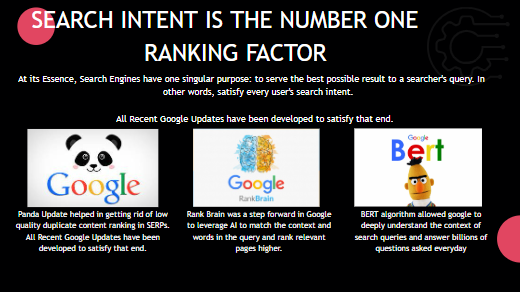
Our Strategic Approach: Intent-Driven SEO Framework
At ThatWare, we didn’t approach this campaign with isolated fixes or short-term tactics. Instead, we built a cohesive, intent-driven SEO framework designed to align every layer of the website with how users actually search, evaluate, and convert. The goal was simple: ensure that every page served a clear purpose, matched a specific intent, and contributed to scalable organic growth.
Decoding Search Behaviour Through the 3Cs of Intent
We began by analysing search engine results pages (SERPs) to understand what Google was already rewarding. This allowed us to reverse-engineer intent using the 3Cs of Search Intent—Content Type, Content Format, and Content Angle. Rather than guessing what users wanted, we relied on real-time SERP data to identify patterns. For each target keyword, we asked: What type of page is ranking? How is the content structured? What angle makes it stand out? This became the foundation of our strategy.
By doing this, we eliminated assumptions and replaced them with precision. Every decision—from content creation to page structure—was guided by how users interact with search results. This ensured that our optimisations weren’t just SEO-friendly, but also user-centric.
Content Type Mapping: Building a Purpose-Driven Structure
Once intent was clearly defined, we moved into restructuring the website’s content ecosystem. We mapped keywords to the most appropriate content types—blogs for informational queries, category pages for broader commercial searches, and product pages for transactional intent.
This wasn’t just about creating new pages; it was about creating the right pages. We eliminated overlaps, reduced keyword cannibalisation, and ensured that each page targeted a distinct set of queries. This clarity helped search engines better understand the site’s structure and improved ranking consistency across key terms.
Additionally, we aligned content with the user journey. Early-stage users were guided through informative blog content, while high-intent users were directed to optimised product and category pages. This created a seamless path from discovery to conversion.
Content Format Optimisation: Matching SERP Expectations
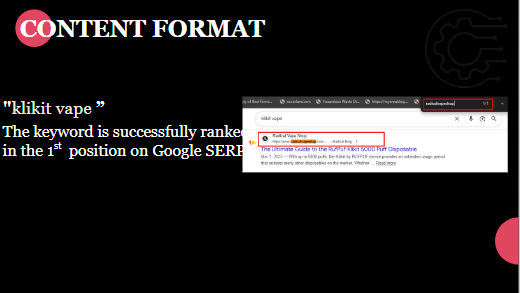
Ranking on Google isn’t just about what you say—it’s about how you present it. We carefully studied the formatting patterns of top-ranking pages and adapted our content to match those expectations.
For competitive keywords like “klikit vape,” we observed that Google favoured highly structured, easy-to-navigate pages. So, we implemented clear headings, scannable sections, and strategically placed information that aligned with user behaviour. This improved both readability and engagement, which are key signals for ranking.
We also ensured that content was optimised for featured snippets and other SERP features by structuring information in a way that search engines could easily extract and display.
Content Angle Differentiation: Standing Out in a Crowded Market
In saturated niches, simply matching competitors isn’t enough—you need to stand out. That’s where content angle came into play. We crafted unique perspectives that gave users a reason to choose our content over others.
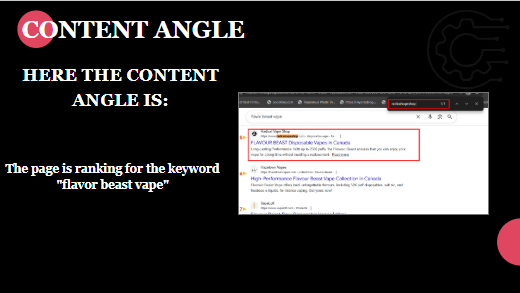
For example, instead of creating generic product descriptions, we focused on value-driven narratives—highlighting benefits, comparisons, and user-centric insights. This approach helped us gain traction for keywords like “flavor beast vape,” where differentiation was critical.
By refining the angle, we not only improved rankings but also increased engagement and time on page—both of which contribute to long-term SEO success.
Integrating Data with Continuous Optimisation
Our framework wasn’t static—it evolved with data. We continuously monitored performance metrics such as rankings, click-through rates, and user behaviour. This allowed us to refine content, adjust targeting, and capitalise on emerging opportunities.
Pages that showed potential were further optimised, while underperforming areas were reworked based on updated intent signals. This iterative approach ensured that the strategy remained aligned with both user expectations and search engine algorithms.
Creating a Scalable SEO Engine
Ultimately, our intent-driven framework wasn’t just about improving rankings—it was about building a system that could scale. By aligning content, structure, and strategy with search intent, we transformed the website into a cohesive growth engine.
Every page had a role. Every keyword had a purpose. And every optimisation contributed to a larger, sustainable outcome.
This is what separates tactical SEO from strategic SEO. Instead of chasing rankings, we built a foundation where rankings become a natural result of doing the right things consistently.
Technical SEO Overhaul: Fixing the Growth Bottlenecks
While content and intent alignment laid the strategic foundation, we knew that without a strong technical backbone, sustainable growth would remain out of reach. At ThatWare, we approached technical SEO as a performance multiplier—ensuring that every improvement directly enhanced crawlability, user experience, and search visibility.
Core Web Vitals: Turning Performance into a Ranking Advantage
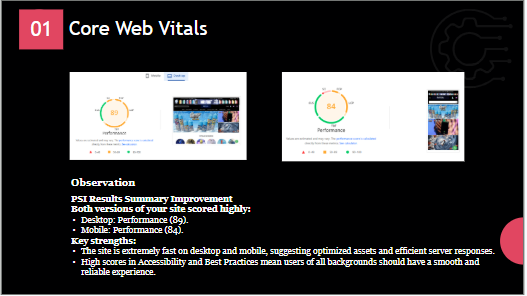
One of the first areas we tackled was Core Web Vitals. The site was underperforming in key metrics like loading speed, interactivity, and visual stability—all of which directly impact both rankings and user satisfaction. We conducted a detailed audit to identify bottlenecks and prioritised fixes that would deliver immediate impact.
Through a combination of front-end and back-end optimisations, we improved performance scores to 89 on desktop and 84 on mobile. These improvements didn’t just satisfy search engine benchmarks—they created a noticeably smoother experience for users, reducing friction and increasing engagement.
Mobile-First Optimisation: Meeting Users Where They Are
With the majority of traffic coming from mobile devices, ensuring a seamless mobile experience was non-negotiable. We refined viewport configurations, improved font readability, and optimised touch elements to enhance usability across different screen sizes.
We also ensured that mobile performance matched desktop standards, eliminating inconsistencies that could negatively affect rankings. By aligning with Google’s mobile-first indexing approach, we positioned the site to perform strongly across all devices.
Site Architecture: Simplifying Navigation and Crawlability
A complex or poorly structured website can significantly limit SEO performance, no matter how strong the content is. We restructured the site into a flat architecture, ensuring that all important pages were accessible within three clicks from the homepage.
This simplification improved crawl efficiency, allowing search engine bots to discover and index pages more effectively. It also enhanced user navigation, making it easier for visitors to find what they were looking for—an essential factor in reducing bounce rates and improving conversions.
Performance Engineering: Speed, Efficiency, and Stability
Beyond structural changes, we implemented advanced performance optimisations to improve load times and overall efficiency. This included:
- Lazy loading for images and media, ensuring that only visible elements loaded initially
- Image compression to reduce file sizes without compromising quality
- JavaScript optimisation, minimising unnecessary scripts and reducing execution time
These enhancements significantly reduced server response times and improved page speed across the site. Faster pages not only rank better but also keep users engaged longer, increasing the likelihood of conversions.
Eliminating Hidden Technical Friction
In addition to visible improvements, we addressed several underlying technical issues that were quietly impacting performance. This included fixing broken links, resolving duplicate content concerns, and ensuring proper indexing of key pages.
We also optimised internal linking to distribute authority more effectively across the site, strengthening the visibility of important pages. These behind-the-scenes enhancements played a crucial role in creating a stable and scalable SEO environment.
Authority Building: Strengthening Domain Trust
In a competitive niche like vaping, rankings aren’t driven by content and technical SEO alone—authority is the deciding factor. At ThatWare, we focused on building a strong and credible backlink profile to elevate the site’s trust in the eyes of search engines.
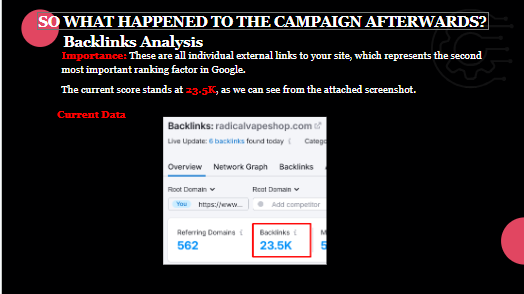
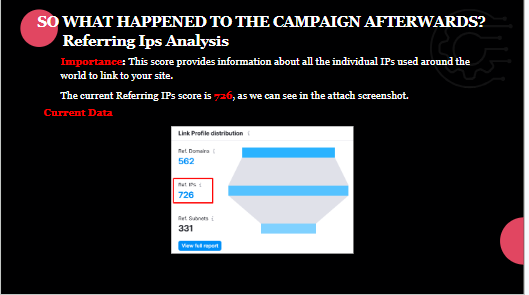
We implemented a structured link acquisition strategy aimed at securing high-quality, relevant backlinks rather than chasing volume. This involved identifying authoritative domains within the niche, leveraging contextual placements, and ensuring that every link added real value to the overall profile. As a result, the site grew to 23.5K backlinks, supported by 562 referring domains and 726 referring IPs—a significant boost in domain credibility.
Beyond numbers, our focus was on consistency and relevance. Each backlink acted as a trust signal, reinforcing the site’s authority for target keywords. This played a crucial role in helping key pages break into higher ranking positions, especially in competitive search environments.
By strengthening domain authority, we didn’t just improve rankings—we built a long-term asset that continues to support sustainable organic growth.
Results: From Strategy to Measurable Growth
The true measure of any SEO campaign lies in its ability to translate strategy into tangible, scalable results. At ThatWare, our intent-driven and technically sound approach delivered exactly that—consistent, measurable growth across every key performance indicator.
Traffic & User Acquisition: Explosive Growth Across the Funnel
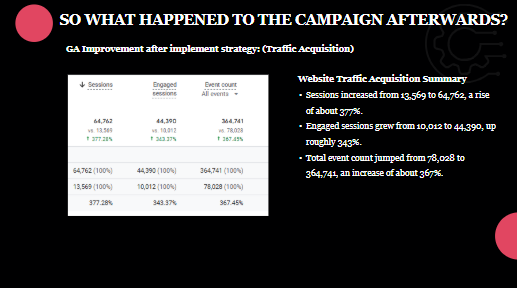
One of the most immediate outcomes was the surge in organic traffic. The website experienced a 356% increase in total users, growing from 10,000 to 45,658. This wasn’t just a spike—it was a reflection of improved visibility across multiple keyword segments.
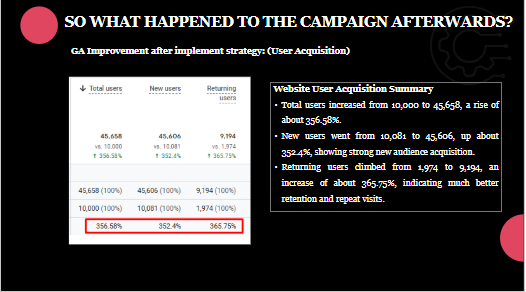
New user acquisition rose by 352%, indicating that the site was reaching a significantly wider audience. At the same time, returning users increased by 365%, showing that the experience and content were compelling enough to bring users back. Total sessions followed the same trajectory, climbing by 377% from 13,569 to 64,762—demonstrating stronger engagement and deeper interaction across the site.
Search Visibility: Dominating More SERP Real Estate
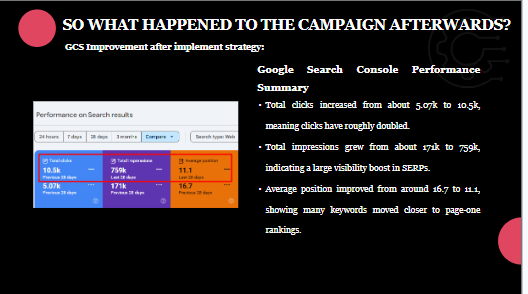
From a search performance perspective, the improvements were equally impactful. Total clicks nearly doubled, increasing from 5.07K to 10.5K, while impressions saw a massive jump from 171K to 759K. This expansion in visibility meant the brand was appearing for a much broader range of relevant queries.
More importantly, the average ranking position improved from 16.7 to 11.1, pushing a large number of keywords closer to—or onto—the first page of search results. This shift is critical, as the majority of clicks are concentrated within top-ranking positions.
Authority Metrics: Building a Stronger Digital Footprint
Our authority-building efforts also delivered substantial results. The backlink profile scaled to 23.5K links, supported by 562 referring domains and 726 referring IPs. This not only strengthened domain credibility but also improved the site’s ability to compete for high-value keywords in a crowded market.
The Bigger Picture: Sustainable, Compounding Growth
What makes these results particularly valuable is their sustainability. This wasn’t driven by temporary tactics or short-term gains. Instead, it was the outcome of a well-aligned system where content, technical performance, and authority worked together.
Each improvement reinforced the other—better content drove engagement, stronger technical performance improved rankings, and increased authority amplified visibility. The result was not just growth, but a compounding SEO engine capable of delivering long-term returns.
Key Insights & Takeaways: What Actually Drives SEO Growth
Search Intent Is the Real Ranking Factor
If there’s one takeaway from this campaign, it’s this: ranking isn’t about keywords—it’s about intent. When content precisely matches what users are looking for, rankings become a natural outcome. Instead of forcing pages to rank, we aligned each page with a specific purpose in the user journey. This not only improved visibility but also increased engagement and conversions. For any business looking to grow through SEO, understanding why users search is far more powerful than simply knowing what they search.
Technical SEO as a Growth Multiplier
Technical SEO often sits in the background, but its impact is anything but minor. Once we removed performance bottlenecks, improved site speed, and streamlined crawlability, every other effort became more effective. Content started ranking faster. Pages retained users longer. Conversions improved. Think of technical SEO not as a one-time fix, but as a multiplier that amplifies everything else you do.
Content Without Strategy Doesn’t Scale
Publishing more content doesn’t guarantee growth—publishing the right content does. Without a clear mapping between keywords, intent, and page structure, content efforts become scattered and inefficient. What worked here was a structured approach where every page had a defined role. This clarity eliminated duplication, improved authority distribution, and created a system that could scale without losing direction.
Authority Building Is a Long-Term Asset
Backlinks are more than just ranking signals—they’re trust signals. By consistently building high-quality, relevant links, we strengthened the site’s credibility in a competitive niche. The key insight here is patience and consistency. Authority doesn’t deliver overnight results, but once established, it becomes a powerful asset that supports rankings across the board.
Why This Strategy Works
At ThatWare, our approach works because it’s not fragmented—it’s fully integrated. We don’t treat content, technical SEO, and authority building as separate activities. Instead, we align them into a unified system where each element reinforces the other.
Our execution is deeply data-driven. Every decision—from keyword targeting to technical fixes—is backed by real performance data and SERP analysis. This removes guesswork and ensures that our strategies are grounded in what actually works.
We also prioritise sustainable growth over short-term wins. Instead of chasing quick rankings that fade over time, we build systems that continue to generate traffic, rankings, and conversions long after implementation.
Most importantly, this framework is replicable across industries. While this case focused on the vape market, the principles—intent alignment, technical excellence, and authority building—apply universally. That’s what makes our approach scalable and reliable.
Who This Is For
This strategy is designed for businesses that are serious about growth—not just visibility.
- eCommerce brands struggling with traffic: If your products are strong but your organic reach is weak, this approach helps bridge that gap.
- Businesses stuck beyond page 2 rankings: If you’re close to ranking but not quite breaking through, intent alignment and technical refinement can push you over the edge.
- Companies with high traffic but low conversions: If users are visiting but not taking action, the issue often lies in mismatched intent and poor user experience.
- Brands entering competitive markets: If you’re trying to establish a presence in a crowded space, a structured, authority-driven SEO strategy is essential.
If you see your business in any of these scenarios, it’s a clear signal that a more strategic, intent-driven approach to SEO isn’t optional—it’s necessary.
Wrapping Up
In the end, this case study is a clear reminder that sustainable SEO growth doesn’t come from isolated tactics—it comes from a well-orchestrated strategy where intent, performance, and authority work together seamlessly. At ThatWare, we didn’t just aim to improve rankings for Radical Vape Shop; we focused on building a system that continuously drives visibility, attracts the right audience, and converts that traffic into measurable business outcomes. By aligning content with real search intent, eliminating technical bottlenecks, and strengthening domain authority, we transformed a stagnant digital presence into a scalable growth engine. The results speak for themselves—not just in terms of traffic and rankings, but in the consistency and sustainability of that growth. For businesses operating in competitive markets, the takeaway is simple: SEO success isn’t about doing more, it’s about doing the right things with precision and consistency. When strategy leads execution, growth is no longer unpredictable—it becomes repeatable, measurable, and long-term.