
SUPERCHARGE YOUR ONLINE VISIBILITY! CONTACT US AND LET’S ACHIEVE EXCELLENCE TOGETHER!
The Marketing Illusion
For decades, marketing has operated on a comfortable assumption: consumers are rational decision-makers. Present the features, highlight the benefits, offer competitive pricing, and buyers will logically evaluate options before making a choice. Spreadsheets, surveys, and demographic data reinforced this belief. Campaigns were optimized around what people said they wanted, and strategies were built on clean, linear funnels that mapped awareness to interest to desire to action.
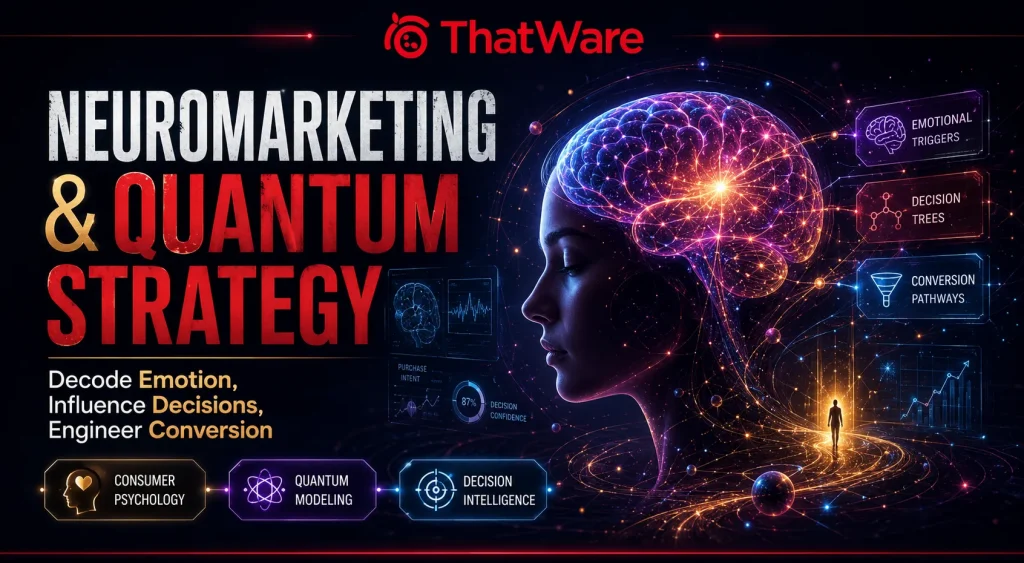
But this model is incomplete.
Modern neuroscience has revealed a far more complex reality. Consumers do not sit down with a mental calculator to assess value propositions. They feel first, then rationalize. They respond to emotional cues, subconscious triggers, environmental context, and cognitive biases long before logic enters the equation. The idea of the “rational buyer” is largely a myth — a convenient narrative that simplifies a deeply intricate biological and psychological process.
Even more revealing is the limitation of data itself. Traditional analytics track clicks, conversions, bounce rates, and heatmaps. Surveys gather opinions and preferences. Focus groups provide articulated reasoning. Yet none of these tools directly measure what is happening inside the brain at the moment of decision. Data shows what happened — it rarely explains why.
For example, two consumers may purchase the same product for entirely different subconscious reasons: one driven by status aspiration, another by fear of missing out. The spreadsheet sees a single conversion. The brain tells two very different stories.
This is the marketing illusion: believing that surface-level data and stated preferences equal true understanding. In reality, consumer behavior is driven by neural circuitry shaped by evolution, emotion, memory, and context. To decode why people buy, we must look deeper — beyond demographics and dashboards — into the architecture of the human mind.
Enter Neuromarketing & Quantum Strategy
Neuromarketing emerged as a response to this gap between observable behavior and underlying cause. At its core, neuromarketing applies neuroscience to consumer research. Instead of asking customers what they think, it studies how their brains react. Using tools such as EEG scans, eye-tracking, biometric measurements, and facial coding, researchers can identify emotional arousal, attention levels, cognitive load, and subconscious preference in real time.
This approach shifts the focus from opinions to neural responses. It recognizes that most decisions are made below conscious awareness. By understanding how the brain processes stimuli — colors, sounds, words, social cues, and visual hierarchies — marketers can design experiences that align with how humans are biologically wired to respond.
Parallel to this is the emerging concept of quantum strategy.
Inspired metaphorically by principles from quantum physics, quantum strategy views consumer behavior as probabilistic, contextual, and non-linear. In classical marketing models, decisions follow a predictable path. In quantum models, consumers exist in a state of multiple potential choices simultaneously. Preferences are not fixed; they are influenced by context, framing, emotion, timing, and social environment.
A buyer may prefer Brand A in one setting and Brand B in another. Their decision is not static but collapses into action when influenced by specific triggers — a discount, a testimonial, a moment of urgency, or a shift in mood. Just as particles behave differently when observed, consumers behave differently when influenced by social proof or environmental cues.
Combining neuromarketing and quantum strategy creates a powerful competitive edge. Neuromarketing explains how the brain reacts. Quantum strategy explains how decisions fluctuate and collapse into action. Together, they offer a dynamic, science-driven framework for understanding modern consumer behavior — one that moves beyond linear funnels into probabilistic influence.
The Central Thesis
The central thesis of this exploration is simple yet transformative: consumers do not make linear decisions.
Buying behavior is emotional before it is logical. It is subconscious before it is conscious. It is contextual rather than fixed. And above all, it is probabilistic — shaped by countless invisible variables interacting in real time.
A consumer scrolling through a website is not following a neat step-by-step funnel. They are navigating emotional signals, social validation cues, identity reinforcement, cognitive shortcuts, and reward anticipation loops. A single design change, word choice, or visual cue can shift the probability of action dramatically.
Understanding this changes everything.
Brands that cling to rigid, linear models compete on price and features. Brands that understand emotional circuitry and probabilistic behavior design experiences that feel intuitive, compelling, and irresistible. They reduce cognitive friction. They create identity alignment. They leverage social dynamics. They master timing and context.
In a marketplace saturated with information, the advantage no longer belongs to the loudest voice or the largest budget. It belongs to the brand that best understands the brain.
Neuromarketing reveals the wiring. Quantum strategy explains the motion. Together, they decode the true science of why people buy — and offer a blueprint for dominating in an age where attention is scarce, emotion drives action, and consumer choice is anything but simple.
The Neuroscience of Decision-Making
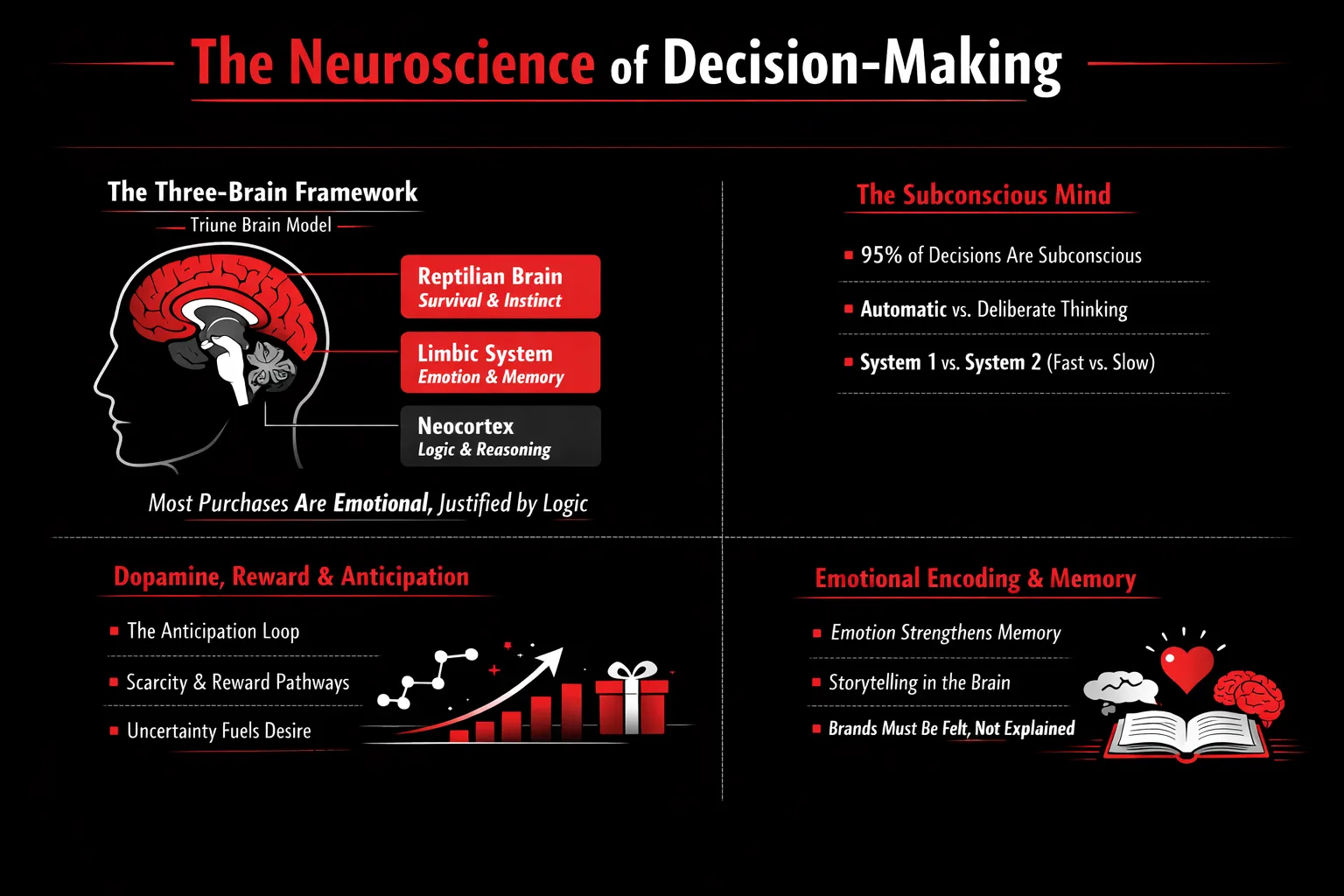
Most marketing advice still talks as if buyers sit down, compare features, weigh pros and cons, and then choose the “best” option. But the brain doesn’t work like a spreadsheet. Decisions—especially purchase decisions—are largely driven by fast, emotional, automatic processes, with logic stepping in later to justify what’s already been decided.
To decode consumer behavior, it helps to look at decision-making the way the brain actually executes it: through layered systems that evolved for survival, social belonging, and reasoning. When you understand these layers—what triggers them, how they interact, and how memory locks in preferences—you start to see why people buy what they buy, and how brands can influence choices ethically and effectively.
The Three-Brain Framework (Triune Brain Model)
A useful lens for marketers is the Triune Brain Model, which frames the brain as three interlocking systems that evolved over time. While modern neuroscience recognizes the brain is more integrated than this simplified model suggests, it remains a practical way to understand how different kinds of stimuli trigger different kinds of responses.
1) Reptilian Brain: Survival, Instinct, Fear, Urgency
The “reptilian” layer is often associated with the most basic functions: safety, threat detection, dominance, scarcity, and immediate action. It’s the part of the consumer that reacts to:
- “Limited stock”
- “Offer ends tonight”
- “Don’t miss out”
- “Protect your family”
- “Avoid risk / loss”
This system responds to fear and urgency because those emotions historically increased survival. In marketing terms, it’s why scarcity and loss-aversion messaging can be so powerful—when used responsibly. If the reptilian brain senses risk or opportunity, it pushes the buyer toward rapid action. It’s not interested in detailed comparison; it wants certainty, safety, and a quick win.
2) Limbic System: Emotion, Memory, Bonding
The limbic system governs emotion and memory, and it plays a central role in preference formation. Consumers don’t just buy products—they buy what a product means.
This is where:
- brand attachment forms,
- trust is built,
- identity gets reinforced,
- nostalgia and familiarity create comfort.
A buyer might say, “This brand feels like me,” or “I trust them,” long before they can explain why. That “why” is often limbic: emotional experiences, past associations, and the sense of belonging a brand creates.
3) Neocortex: Logic, Reasoning, Justification
The neocortex is the brain’s “explainer.” It processes language, analysis, planning, and rational thinking. This is where buyers compare:
- specs,
- price,
- features,
- warranties,
- reviews,
- ROI.
But here’s the key: in many purchases, the neocortex is not the decision-maker—it’s the press secretary. It steps in to justify choices that were initiated elsewhere.
That’s why a consumer might buy a premium phone because it feels elegant and status-signaling (emotion), and then justify it with “the camera quality is better” (logic). Or choose a specific coffee brand because it feels comforting (memory), then rationalize it with “it’s ethically sourced.”
Most purchases are emotional first, logical second. Great marketing respects this sequence: it creates emotional certainty, then provides rational proof.
The Role of the Subconscious Mind
A major reason traditional market research can miss the mark is simple: people often can’t accurately explain their decisions. This isn’t dishonesty—it’s neuroscience.
Many researchers and behavioral scientists cite that a large portion of our cognition and decision-making happens subconsciously. In practical marketing terms, buyers frequently decide through automatic processes and only later build a coherent story about why they chose something.
Automatic vs Deliberate Thinking
The brain runs on two broad modes:
- Automatic processing: fast, effortless, pattern-based
- Deliberate thinking: slower, effortful, analytical
Automatic processing is the default because it conserves energy. If every small choice required deep analysis, we’d be mentally exhausted by lunchtime.
System 1 vs System 2 (Daniel Kahneman)
Daniel Kahneman’s framework captures this beautifully:
- System 1: fast, intuitive, emotional, subconscious
- System 2: slow, logical, conscious, effortful
In buying journeys, System 1 makes the first move. It reacts to visuals, tone, pricing cues, social proof, brand familiarity, and emotional triggers. System 2 shows up when:
- the purchase is expensive,
- the risk is high,
- justification is required (especially socially),
- or the buyer is forced into comparison.
This has huge marketing implications. If you overload a page with information, you may think you’re helping System 2—but you might actually be overwhelming System 1, creating friction and doubt. Often, the best strategy is: make the decision feel easy and safe, then give just enough rational support to validate it.
Dopamine, Reward & Anticipation
Dopamine is often misunderstood as the “pleasure chemical.” In reality, it’s more about motivation, learning, and anticipation—the brain’s way of saying, “This might be worth pursuing.”
The Anticipation Loop
The strongest driver is frequently not the reward itself, but the anticipation of the reward. That’s why:
- previews feel exciting,
- product launches create hype,
- “coming soon” pages work,
- suspenseful storytelling keeps attention.
Anticipation creates mental engagement. The brain begins to simulate ownership and imagine outcomes—“What will this do for me?” That simulation can become emotionally compelling enough to tip a decision.
Scarcity and Reward Pathways
Scarcity works because it compresses time and increases perceived value. If something feels limited, the brain assigns it higher urgency and importance. This activates reward-seeking behavior: “Get it before it’s gone.”
However, the key is authenticity. False scarcity can damage trust long-term, especially when consumers detect manipulation. Ethical scarcity is real scarcity: limited production runs, timed enrollment windows, or genuinely constrained inventory.
Why Uncertainty Increases Desire
Interestingly, uncertainty can amplify dopamine response. The brain can become more engaged when outcomes aren’t fully guaranteed—this is the psychological engine behind:
- mystery boxes,
- loot mechanics in games,
- surprise drops,
- “unlock” offers,
- variable rewards (like social media notifications).
A fully predictable reward is less stimulating than a reward that might happen. That “maybe” creates chase energy. Used ethically, marketers can apply this through curiosity-driven content, teasers, and gradual reveal campaigns.
Emotional Encoding & Memory
A purchase is not just a transaction—it’s a memory event. What matters most is not what customers learn, but what they feel and therefore remember.
How Emotion Strengthens Memory
Emotion acts like a highlighter for the brain. When something produces strong emotional arousal—joy, surprise, fear, inspiration, belonging—the brain tags it as important and stores it more deeply.
That’s why:
- people remember ads that made them laugh or cry,
- brands tied to major life moments stick,
- “first experiences” (first iPhone, first luxury purchase, first trip) become anchors.
Storytelling as Neural Activation
Stories don’t just communicate information—they simulate experience. When someone watches or reads a story, their brain often activates regions associated with actually living it. This is why storytelling can be more persuasive than listing features: it lets the audience feel the outcome.
A product description says, “Our shoes are lightweight.”
A story says, “You’ll feel like you’re flying on your morning run.”
The second one creates a mental experience, which is far closer to decision-making than raw facts.
Why Brands Must Be Felt, Not Explained
In the end, brands win in memory, not in logic. If customers can’t clearly explain why they trust you but they do anyway, that’s not an accident—that’s emotional encoding.
The strongest brands create:
- emotional clarity (how it feels to choose them),
- identity fit (who you become when you buy),
- memorable moments (stories, experiences, rituals),
- and consistent cues (tone, visuals, symbols).
Because when it comes to decision-making, the brain doesn’t ask first: “Does this make sense?”
It asks: “Does this feel right?” And once it feels right, the rational mind will work hard to make it make sense.
What Is Neuromarketing?
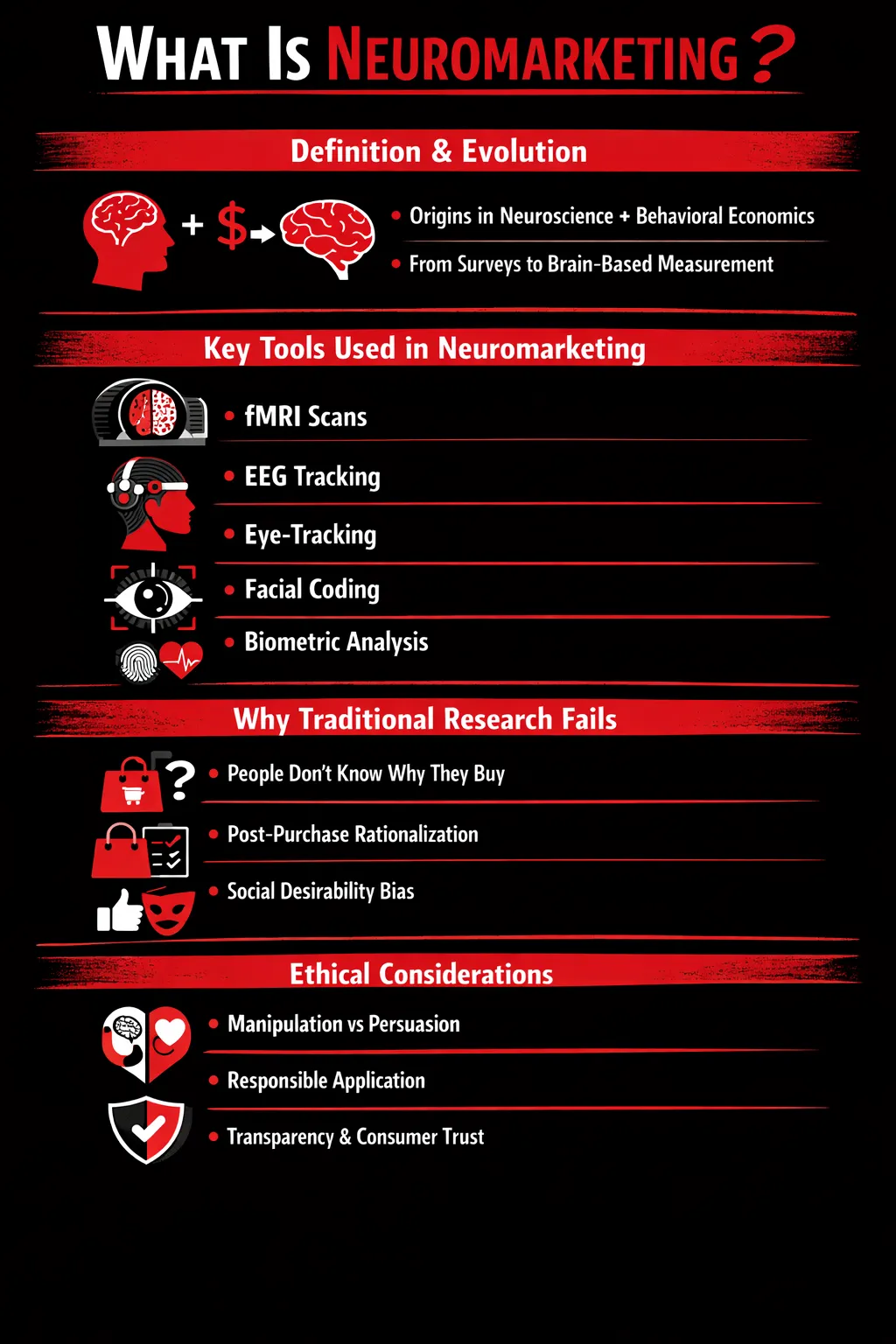
Neuromarketing is the application of neuroscience and behavioral economics to understand how consumers truly make decisions. Instead of relying solely on what people say they think or feel, neuromarketing studies how the brain actually responds to marketing stimuli—such as advertisements, packaging, pricing, and digital experiences. It operates on a powerful premise: most buying decisions happen beneath conscious awareness.
Definition and Evolution
Neuromarketing emerged at the intersection of neuroscience, psychology, and economics. Traditional economic theory once assumed that consumers were rational actors who made logical, utility-maximizing choices. However, behavioral economists like Daniel Kahneman and Richard Thaler challenged that view, demonstrating that human decisions are shaped by biases, emotions, and mental shortcuts.
At the same time, advances in neuroscience made it possible to observe brain activity in real time. Researchers began to measure emotional arousal, attention levels, and memory encoding during exposure to marketing stimuli. This marked a major shift—from asking consumers what they prefer to directly measuring how their brains react. Instead of surveys and focus groups alone, marketers could now access biological signals that reveal authentic responses.
This evolution transformed marketing research from opinion-based data collection to brain-based measurement, offering deeper insight into subconscious decision drivers.
Key Tools Used in Neuromarketing
Several advanced technologies power neuromarketing research:
- fMRI (functional Magnetic Resonance Imaging): Measures changes in blood flow within the brain to identify which regions activate during exposure to specific stimuli. It helps uncover emotional engagement and reward responses.
- EEG (Electroencephalography): Tracks electrical brain activity with high temporal precision, showing moment-by-moment attention and emotional intensity.
- Eye-tracking: Monitors where and for how long consumers look at particular elements, revealing visual attention patterns on ads, websites, and packaging.
- Facial coding: Analyzes micro-expressions to detect subtle emotional reactions such as joy, surprise, or confusion.
- Biometric analysis: Measures physiological signals like heart rate, skin conductance, and pupil dilation to assess emotional arousal.
Together, these tools provide measurable insight into how consumers feel—not just what they report.
Why Traditional Market Research Fails
Conventional market research often relies on self-reported data. The problem is that people rarely understand the true reasons behind their decisions. Much of human behavior is automatic and emotionally driven. When asked why they purchased something, consumers tend to rationalize their choices after the fact.
This post-purchase rationalization creates inaccurate data. Additionally, social desirability bias leads individuals to give answers they believe are socially acceptable rather than truthful. As a result, surveys and focus groups can misrepresent real motivations.
Neuromarketing addresses this gap by capturing subconscious reactions that consumers themselves may not be aware of.
Ethical Considerations
Because neuromarketing accesses deep emotional and cognitive responses, ethical responsibility is critical. The distinction between persuasion and manipulation must remain clear. Persuasion aligns with delivering value and enhancing relevance, while manipulation exploits vulnerabilities without regard for consumer well-being.
Responsible application requires transparency, respect for data privacy, and consumer consent. Long-term brand trust depends not only on influence effectiveness but on ethical integrity. When applied thoughtfully, neuromarketing strengthens communication without compromising autonomy.
Quantum Strategy: Rethinking Consumer Behavior
If neuromarketing helps us understand what the brain does when it encounters a brand, quantum strategy helps us understand why decisions don’t behave like neat, linear “funnels.” In real life, consumers don’t move step-by-step from awareness → consideration → purchase like a spreadsheet. They drift, hesitate, change their minds, revisit options, and respond to context in ways that look messy—but are actually predictable once you stop forcing human behavior into rigid models.
Quantum strategy borrows ideas from quantum physics as metaphors and decision models to better describe modern consumer behavior. It doesn’t claim that shoppers are literally “quantum particles.” Instead, it uses quantum principles—like probability, context, observation, and interconnectedness—to build marketing strategies that match how decisions actually form: non-linear, emotional, and heavily shaped by the environment.
What Is Quantum Strategy?
Quantum strategy is a way of thinking about markets and consumer decisions as probabilistic rather than deterministic. Traditional marketing often assumes: If we show the right message to the right person, they will take the desired action. Quantum strategy assumes something closer to: If we shape the right context, we can increase the probability of action—without expecting the same stimulus to create the same outcome every time.
At its core, quantum strategy is built on three ideas:
- Non-linearity: Consumer journeys loop, branch, pause, and restart.
- Probability: People don’t “decide” once; they fluctuate between multiple intentions.
- Context-dependence: The same consumer can act differently depending on timing, social setting, mood, device, or even recent experiences.
This is why high-performing brands don’t just perfect messages; they design decision environments—the pages people land on, the sequences they experience, the communities they join, and the signals that reduce uncertainty.
Superposition in Consumer Choice
In quantum physics, superposition describes a system that holds multiple states at the same time until it’s observed. In marketing, this maps cleanly onto a reality we often ignore:
Consumers hold multiple preferences simultaneously.
A buyer can be:
- price-sensitive and willing to pay more for quality,
- excited and skeptical,
- ready to purchase and afraid of making the wrong choice.
This isn’t a flaw. It’s normal. Indecision isn’t “lack of interest”—it’s often competing motives running at the same time.
The strategic question becomes: How do we help the consumer “collapse” toward a decision? In quantum strategy, the collapse happens through context triggers—elements that resolve competing states by reducing friction and increasing confidence.
Examples of context triggers that collapse choice:
- a clear comparison chart that reduces cognitive load,
- a risk-reversal guarantee that neutralizes fear,
- a limited-time incentive that accelerates timing,
- a personalized recommendation that simplifies selection.
In other words: you’re not forcing a decision—you’re stabilizing one.
Observer Effect in Marketing
In quantum mechanics, observation changes the system being observed. In consumer behavior, measurement and visibility do something similar:
When people know others are watching—or when they see evidence of others’ choices—they behave differently.
This is where social proof becomes more than a tactic; it becomes a behavioral catalyst. Reviews, testimonials, ratings, “X people bought today,” influencer validation, and even “trending now” labels can change how safe or correct a choice feels.
The observer effect shows up in modern marketing in a few powerful ways:
- Public behavior becomes shaped behavior: Consumers are more likely to buy what appears socially approved.
- Feedback loops amplify outcomes: More reviews → higher trust → more purchases → more reviews.
- Visibility reduces perceived risk: Seeing others succeed with the product lowers uncertainty.
This is also why brands obsessed with “conversion optimization” sometimes miss the bigger lever: trust visibility. The right review placed at the right moment can outperform another discount because it collapses doubt, not just price resistance.
Entanglement & Brand Associations
Entanglement in quantum physics refers to particles becoming linked so that the state of one affects the other. In marketing terms, this looks like:
Consumers entangle brands with identity.
When a brand becomes tied to who someone believes they are—or wants to be—the purchase stops being purely functional. It becomes symbolic.
This is the engine behind:
- tribal marketing (“people like us use brands like this”),
- community belonging (fans, groups, lifestyle ecosystems),
- identity-based purchasing (“this represents me”).
Think about why some people will defend a brand online, wear it publicly, or feel pride in being a customer. That’s not product utility—it’s emotional entanglement.
Strategically, this means brands should build associations intentionally:
- values-driven messaging (what you stand for),
- community spaces (where belonging forms),
- rituals and symbols (language, aesthetics, shared behaviors),
- consistent identity cues (tone, design, and stance).
When entanglement is strong, price becomes less decisive because the consumer isn’t buying an object—they’re buying alignment.
Uncertainty as a Strategic Advantage
Here’s the counterintuitive truth: certainty doesn’t always drive action. Sometimes uncertainty increases curiosity, attention, and emotional engagement. In quantum strategy, uncertainty becomes a lever—when controlled with care.
Brands use uncertainty strategically through:
- limited drops: scarcity creates urgency and elevates perceived value,
- mystery marketing: surprise bundles, “mystery boxes,” unrevealed features,
- teasers and controlled ambiguity: pre-launch campaigns that build anticipation.
Uncertainty works because it activates the brain’s prediction systems. When people don’t fully know what’s coming—but believe it could be rewarding—they pay closer attention. This is the same mechanism behind cliffhangers, countdowns, and “waitlist” mechanics.
The key is controlled ambiguity. Too much uncertainty becomes distrust. The strategy is to offer enough clarity to feel safe, while leaving enough unknown to feel exciting.
The Intersection: Where Neuromarketing Meets Quantum Strategy
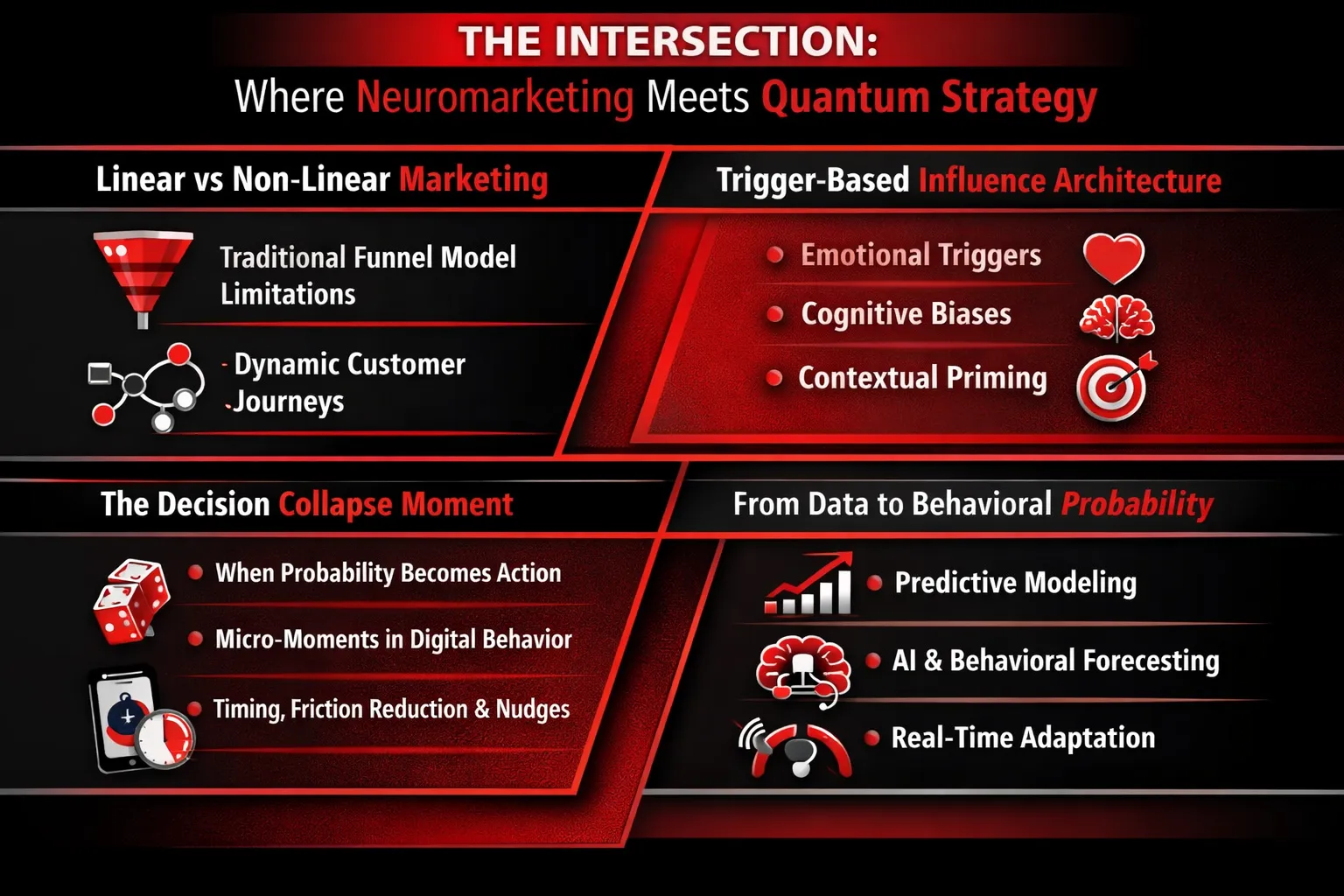
The true power of modern marketing emerges when neuroscience and quantum-inspired thinking converge. Neuromarketing reveals how the brain processes emotion, risk, reward, and identity, while quantum strategy explains why consumer decisions are fluid, probabilistic, and context-dependent. Together, they shift marketing from persuasion to precision—designing environments where choice naturally collapses into action.
Linear vs Non-Linear Marketing
For decades, marketing relied on the traditional funnel: awareness → interest → consideration → conversion → loyalty. It assumes that consumers move in a predictable, rational progression toward purchase. But neuroscience tells a different story.
Human decision-making is rarely linear. Emotions fluctuate. Attention shifts. External stimuli interrupt. A buyer may discover a product through social media, compare it weeks later via a search engine, abandon the cart, then finally purchase after seeing a testimonial. The journey loops, pauses, and reconfigures.
Quantum strategy reframes this behavior as non-linear and probabilistic. Consumers exist in a state of “decision superposition,” simultaneously interested and uncertain, attracted and skeptical. Each interaction—an ad, a review, a friend’s recommendation—acts as a variable that alters the probability of purchase.
Instead of rigid funnels, brands must design dynamic ecosystems with multiple decision touchpoints. Email, retargeting ads, social proof, website UX, influencer validation—each serves as a potential “collapse trigger.” The objective is not to force progression, but to optimize the environment so that conversion becomes the most natural outcome.
Trigger-Based Influence Architecture
At the intersection of neuromarketing and quantum strategy lies trigger-based influence architecture: the intentional design of stimuli that activate subconscious drivers.
Emotional triggers operate at the limbic level of the brain. Fear of missing out, aspiration, belonging, security, status—these emotions shape perception long before logic engages. A countdown timer activates urgency. A luxury aesthetic triggers status desire. A community narrative stimulates belonging.
Cognitive biases further shape behavior. Anchoring influences price perception. Loss aversion makes limited offers more compelling. Social proof reduces uncertainty. These biases are not flaws—they are shortcuts the brain uses to conserve energy.
Contextual priming completes the architecture. The same offer produces different responses depending on environment and framing. A product framed as “95% success rate” feels different from “5% failure rate.” A recommendation seen after reading positive reviews carries more weight than one shown cold.
Quantum strategy recognizes that small contextual shifts can dramatically alter behavioral probability. Neuromarketing identifies which triggers activate neural pathways. Together, they enable marketers to design choice environments that subtly guide decision outcomes.
The Decision Collapse Moment
In quantum terms, a particle exists in multiple states until observed. Similarly, a consumer often exists in multiple decision states—considering, comparing, postponing—until a specific trigger collapses uncertainty into action.
This is the decision collapse moment: when probability becomes behavior.
In digital environments, these moments happen in microseconds. A compelling headline. A frictionless checkout. A testimonial at the exact point of doubt. A limited-stock notification appearing just as hesitation rises.
Neurologically, this collapse occurs when emotional certainty outweighs cognitive resistance. The brain’s reward system anticipates gain, and friction is low enough to permit action.
Timing is critical. Too early, and the consumer lacks context. Too late, and momentum fades. Reducing friction—simplifying forms, offering one-click purchases, eliminating confusion—ensures that when emotional momentum peaks, nothing blocks the action.
Effective nudges don’t push; they align with the brain’s natural decision rhythm.
From Data to Behavioral Probability
Traditional analytics measure what happened. Quantum-informed neuromarketing seeks to predict what is likely to happen next.
Predictive modeling analyzes patterns in browsing behavior, engagement time, scroll depth, past purchases, and emotional response indicators. AI systems now estimate behavioral probability in real time—adjusting offers, messaging, and sequencing dynamically.
Instead of segmenting customers into static categories, brands can forecast shifting decision states. A hesitant buyer may see reassurance-focused messaging. A high-intent visitor may receive urgency prompts. A price-sensitive user may see value framing.
This is real-time adaptation: marketing environments that respond to probability shifts as they occur.
When neuromarketing insights about emotional activation combine with AI-driven behavioral forecasting, marketing evolves into a responsive system. It no longer guesses at intent—it calculates likelihood.
At this intersection, influence becomes less about persuasion and more about precision alignment. Brands that master this integration don’t chase consumers—they design environments where decisions naturally crystallize.
In the age of behavioral probability, marketing is no longer a straight line. It is a living system shaped by emotion, context, and timing.
Core Psychological Drivers Behind Consumer Decisions
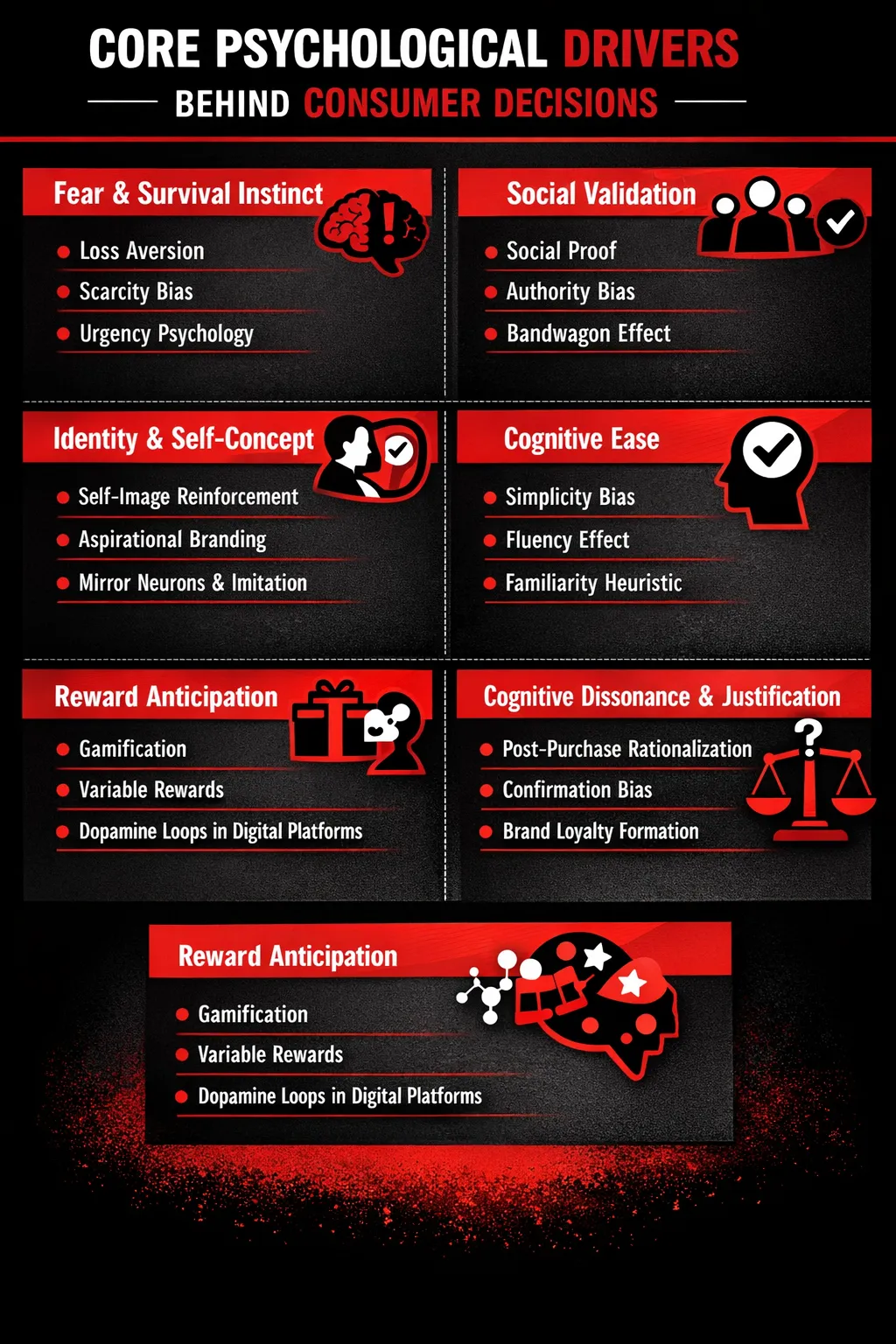
Consumer decisions rarely follow a clean, logical path. Most purchases are shaped by fast, subconscious mental shortcuts that evolved to keep us safe, help us belong, and reduce mental effort. When you understand these drivers, you stop asking “How do I convince people?” and start designing experiences that match how the brain already works. Let’s break down the six most powerful forces that steer buying behavior—and how they show up in real marketing.
Fear & Survival Instinct
Fear is one of the oldest decision engines in the human brain. It doesn’t always look like panic or anxiety; more often, it shows up as a subtle desire to avoid regret, risk, or missing out. Three mechanisms dominate here:
Loss aversion means people feel the pain of losing something more intensely than the pleasure of gaining the same thing. That’s why “Don’t miss your renewal and lose your benefits” can outperform “Renew to get benefits.” In practice, consumers are more motivated to protect what they already have (time, money, identity, status) than to chase uncertain upside. Marketers who frame value as “preventing a loss” often see stronger conversion—especially in insurance, SaaS retention, health, and B2B services.
Scarcity bias is the brain’s shortcut for value: if something is limited, it must be important. Scarcity triggers a primal signal—resources are finite; act now. Limited stock notifications, waitlists, or limited-time drops work because they increase perceived desirability. The key is credibility. Artificial scarcity that feels fake (“Only 2 left!” every day) kills trust. Real scarcity—capacity limits, seasonal inventory, handcrafted supply—activates urgency while protecting brand integrity.
Urgency psychology compresses decision time. When the brain senses a closing window, it shifts from exploration to action. Deadlines, expiring bonuses, “offer ends tonight,” and countdown timers create a psychological push to decide. But urgency is a double-edged sword: it can increase conversions while also increasing buyer’s remorse if the product can’t deliver. The best urgency is paired with clarity—exactly what the buyer gets, what happens if they wait, and why the deadline exists.
When fear-based drivers are used ethically, they don’t manipulate—they help the consumer avoid a negative outcome they already care about (wasting money, missing a deal, falling behind, losing progress).
Social Validation
Humans are wired for belonging. Social validation works because the brain treats other people’s behavior as data—especially when we’re uncertain. Three forces drive this category:
Social proof reduces risk. Reviews, testimonials, ratings, case studies, and user counts (“Trusted by 50,000 teams”) tell the buyer: people like you chose this and survived the decision. The most persuasive proof is specific and relatable: stories with context, before/after outcomes, and clear identity markers (“Freelance designers,” “Series A SaaS founders,” “Parents of toddlers”). Generic praise is far less convincing than concrete results.
Authority bias means we trust experts, institutions, and credible signals—sometimes even when we don’t fully understand them. Certifications, awards, media mentions, doctor endorsements, and industry benchmarks all act as mental shortcuts for safety. Even simple authority cues—professional design, clear writing, transparent policies—shape trust. But again, authenticity matters. Fake badges or exaggerated claims can permanently damage reputation.
The bandwagon effect is the pressure of popularity. If something is trending, the brain assumes there’s a reason. Viral products, “best-seller” tags, “most popular plan,” and “hot right now” cues nudge people toward the crowd’s choice. One of the most powerful versions is momentum language: “Selling fast,” “joining this week,” or “our community is growing.” Popularity doesn’t just signal quality—it signals relevance and belonging.
Social validation works best when it reduces uncertainty. If the buyer feels safe, they move faster.
Identity & Self-Concept
Many purchases aren’t about the product—they’re about the person the buyer believes they are (or wants to become). That’s why identity-driven brands often command premium pricing and loyalty.
Self-image reinforcement is when people buy to confirm their current identity: “I’m a minimalist,” “I’m health-conscious,” “I’m a serious professional.” Brands that mirror a customer’s identity make the decision feel natural. The message isn’t “buy this,” it’s “this is for people like you.”
Aspirational branding works slightly differently: it sells the future self. Luxury, fitness, education, and productivity products often target aspiration: “the disciplined version of me,” “the successful founder version of me.” Aspirational marketing is most effective when it feels attainable—show the path, not just the dream.
Mirror neurons and imitation explain why we copy what we see. When consumers watch someone use a product, their brains partially simulate the experience. That’s why demos, influencer content, unboxing videos, “day in the life” clips, and lifestyle photography drive desire. Seeing is not just believing—it’s mentally rehearsing ownership.
Identity-based positioning is powerful because it moves beyond features. The product becomes a symbol of values, status, or belonging.
Cognitive Ease
The brain hates effort. When something feels easy to understand, it feels safer and more trustworthy. This is why simplicity often wins over superiority.
Simplicity bias means consumers prefer the choice that requires the least thinking. Too many options, too much text, or complicated pricing increases fatigue and delays action. “Three simple plans” often beats “nine customizable packages,” even if the latter is objectively more flexible.
The fluency effect is the tendency to trust what is processed smoothly. Clear copy, predictable navigation, readable fonts, and clean layouts increase perceived credibility. If a website looks chaotic, the brain assumes the business might be chaotic too. Fluency is not just aesthetics—it’s psychological comfort.
The familiarity heuristic is “I’ve seen this before, so it’s probably safe.” Familiar brand elements, consistent messaging, recognizable patterns (like standard checkout flows), and repeated exposure build comfort. This is why consistency across ads, landing pages, and product experience matters so much: familiarity reduces fear.
In short: when you reduce cognitive load, you reduce resistance.
Reward Anticipation
The brain is driven not only by rewards—but by the anticipation of rewards. The “maybe” is often more addictive than the “yes.” That anticipation fuels engagement in modern digital marketing.
Gamification uses goals, progress bars, badges, streaks, tiers, and challenges to keep people moving. It works because it converts effort into a visible journey. Even simple progress cues (“Step 2 of 3”) reduce drop-off by making completion feel near.
Variable rewards—rewards that are unpredictable—create stronger habit loops than consistent rewards. This is why surprise bonuses, mystery discounts, random drops, and unpredictable content feeds hook attention. The brain stays engaged because it wants to find out what happens next.
Dopamine loops in digital platforms are the engine behind scrolling, notifications, and micro-rewards. For marketers, the ethical application is to build engagement loops that serve the user: personalized recommendations that genuinely help, onboarding that feels rewarding, and content sequences that deliver value while keeping curiosity alive.
Reward anticipation works best when it reinforces progress—not addiction.
Cognitive Dissonance & Justification
After buying, the mind quickly shifts into “was this a good decision?” mode. That internal tension—especially after a high-stakes purchase—drives behavior that marketers can either support or accidentally worsen.
Post-purchase rationalization is when people look for reasons their choice was correct. They reread reviews, compare features, and seek reassurance. Smart brands design reassurance into the experience: confirmation emails that restate benefits, onboarding that delivers quick wins, and messaging that celebrates the buyer’s decision (“Welcome—here’s what you’ll achieve first”).
Confirmation bias pushes customers to notice information that supports their decision and ignore what challenges it. Communities, customer stories, and ongoing education help reinforce belief. But the ethical line matters: don’t hide flaws—address them transparently and show how you solve them.
Brand loyalty formation often begins here. If the customer feels good after buying—supported, validated, and successful—they bond with the brand. Loyalty isn’t only satisfaction; it’s identity (“I’m the kind of person who uses this”), habit, and trust built over repeated positive experiences.
The best marketers don’t stop at conversion. They design the post-purchase journey to reduce doubt and increase delight.
When you step back, these drivers reveal a simple truth: consumers aren’t just purchasing products. They’re avoiding loss, seeking belonging, reinforcing identity, reducing mental effort, chasing anticipation, and protecting their self-image after the fact. If you want your marketing to feel effortless and persuasive, build around these psychological realities—because that’s where decisions actually happen.
Neuromarketing Applications in the Digital Age
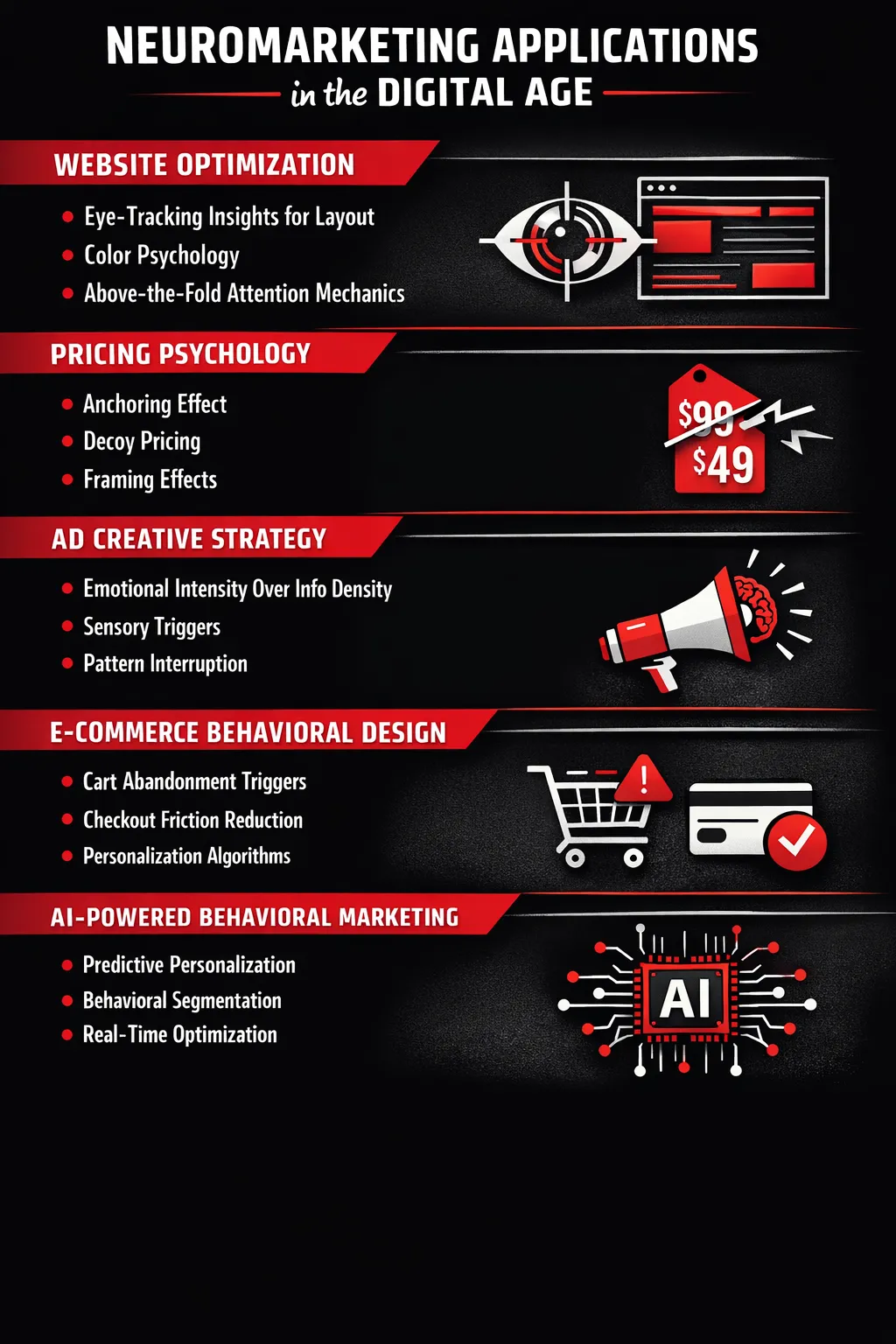
Neuromarketing has evolved from laboratory research into a powerful digital strategy toolkit. Today, brands don’t need an fMRI machine to apply brain-based principles—they can leverage behavioral data, AI, and design psychology to shape decisions in real time. In the digital age, neuromarketing manifests most clearly in how websites are structured, prices are framed, ads are created, and user journeys are optimized.
Website Optimization
Your website is not just a digital brochure—it’s a behavioral environment engineered to guide attention and reduce cognitive load.
Eye-tracking insights for layout
Eye-tracking studies consistently reveal predictable scanning patterns, such as the F-pattern and Z-pattern. Users focus first on headlines, faces, and high-contrast elements. This means critical messaging—value propositions, trust signals, and calls-to-action—must be strategically placed where the eye naturally lands. Visual hierarchy isn’t aesthetic preference; it’s neurological guidance.
Color psychology
Color influences perception before conscious thought begins. Blue signals trust and stability (common in finance and tech). Red stimulates urgency and appetite (frequently used in sales promotions). Green suggests growth or health. The key is contrast and consistency—buttons must visually “pop” against their background to activate action. Subtle shifts in color can measurably increase click-through rates because they alter emotional tone and perceived importance.
Above-the-fold attention mechanics
The first few seconds determine whether a visitor stays or leaves. Above-the-fold space should communicate clarity, credibility, and value instantly. The brain seeks cognitive ease—if users must “figure out” what you do, they disengage. Strong headlines, concise benefit statements, and a single dominant call-to-action reduce friction and prevent decision fatigue.
Pricing Psychology
Price is never just a number—it’s a psychological signal.
Anchoring effect
Consumers evaluate prices relative to a reference point. Showing a higher original price next to a discounted one creates a mental anchor that makes the current price feel like a gain. Even when customers don’t consciously analyze it, the brain interprets the comparison as value.
Decoy pricing
Introducing a strategically placed third option can shift preferences. When one option is clearly inferior but similarly priced, it nudges buyers toward the target choice. This works because the brain prefers comparative simplicity over isolated evaluation.
Framing effects
The way a price is presented influences perception. “$30 per month” feels lighter than “$360 per year,” even though they are equivalent. Similarly, “Save $200” feels more rewarding than “Spend $800.” Framing activates emotional interpretation, not mathematical reasoning.
Ad Creative Strategy
In a saturated digital landscape, attention is currency. Neuromarketing shifts focus from information overload to emotional activation.
Emotional intensity over information density
The brain responds faster to emotion than logic. Ads that evoke curiosity, excitement, fear of missing out, or aspiration outperform those packed with details. Emotion drives engagement; logic justifies it later.
Sensory triggers
Even in digital formats, sensory cues matter. Texture, sound design, movement, and visual depth stimulate multiple neural pathways. A slow-motion product reveal or subtle background sound can increase memory encoding and perceived quality.
Pattern interruption
The brain filters predictable stimuli. Unexpected visuals, bold headlines, or unconventional hooks disrupt autopilot scrolling behavior. This “pattern break” forces attention to reset, creating an opportunity for message absorption.
E-Commerce Behavioral Design
Online shopping environments are engineered decision ecosystems.
Cart abandonment triggers
Many users abandon carts due to uncertainty or distraction—not lack of intent. Scarcity reminders (“Only 3 left”), urgency timers, and follow-up emails reactivate emotional drivers and reduce hesitation.
Checkout friction reduction
Every extra field, form, or click increases cognitive effort. Streamlined checkouts, autofill options, and one-click payments reduce mental resistance. The easier the path, the higher the conversion probability.
Personalization algorithms
When recommendations reflect previous behavior, the brain experiences familiarity and relevance. This reduces search effort and increases perceived alignment, leading to higher purchase likelihood.
AI-Powered Behavioral Marketing
Artificial intelligence amplifies neuromarketing by turning behavioral signals into predictive insights.
Predictive personalization
AI analyzes browsing patterns, dwell time, and engagement history to anticipate needs. Instead of reacting to behavior, brands can proactively present offers at peak decision moments.
Behavioral segmentation
Rather than grouping users by demographics alone, AI clusters them by psychological patterns—risk-averse buyers, impulse shoppers, comparison seekers—allowing tailored messaging for each mindset.
Real-time optimization
AI continuously tests headlines, visuals, and layouts, adapting in real time based on performance. This dynamic optimization mirrors the probabilistic nature of decision-making—adjusting stimuli until the likelihood of action increases.
In the digital age, neuromarketing is no longer theoretical—it is embedded in the architecture of high-performing brands. By aligning design, pricing, advertising, and AI with how the brain actually works, marketers move from guessing consumer behavior to strategically shaping it.
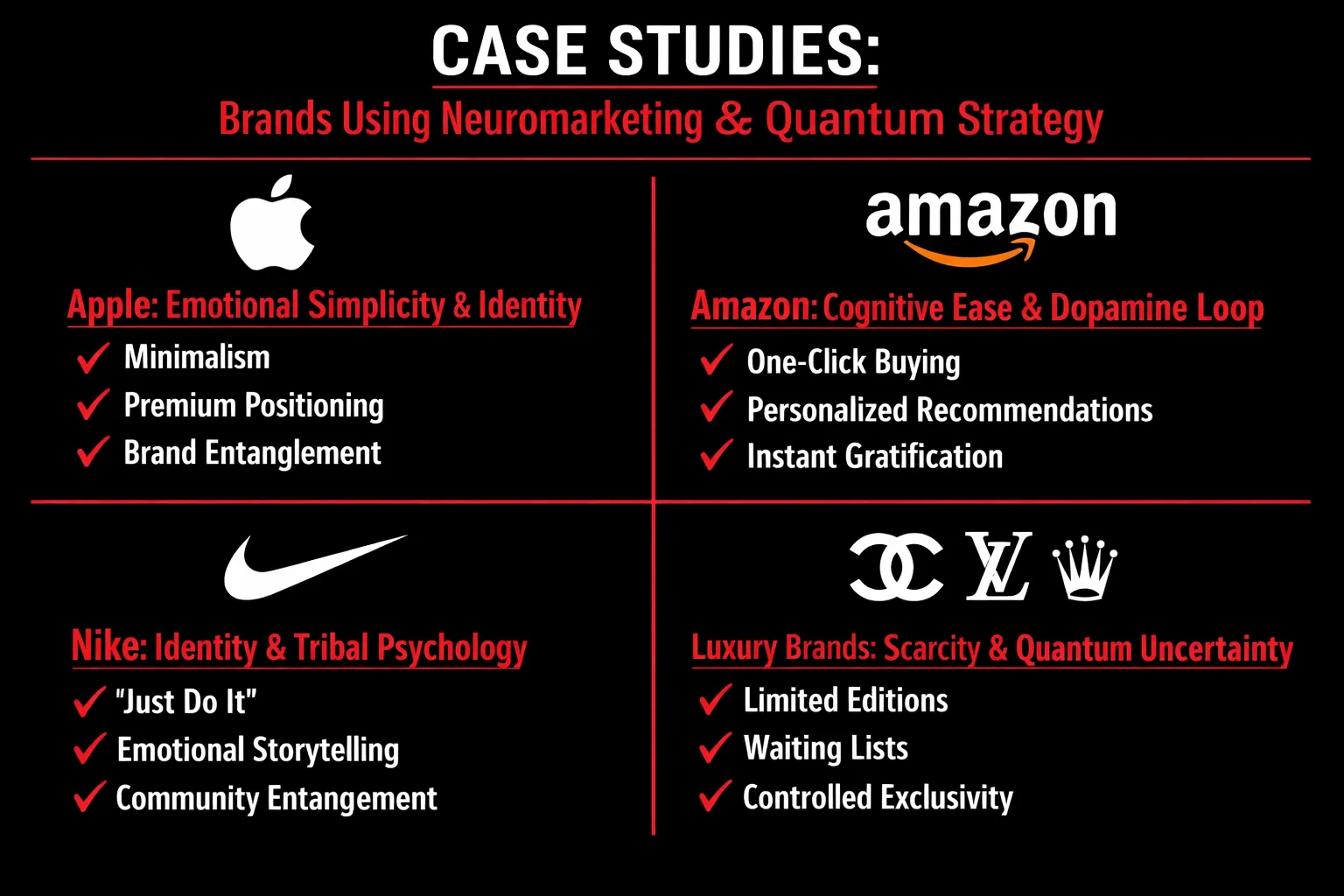
Case Studies: Brands Using Neuromarketing & Quantum Strategy
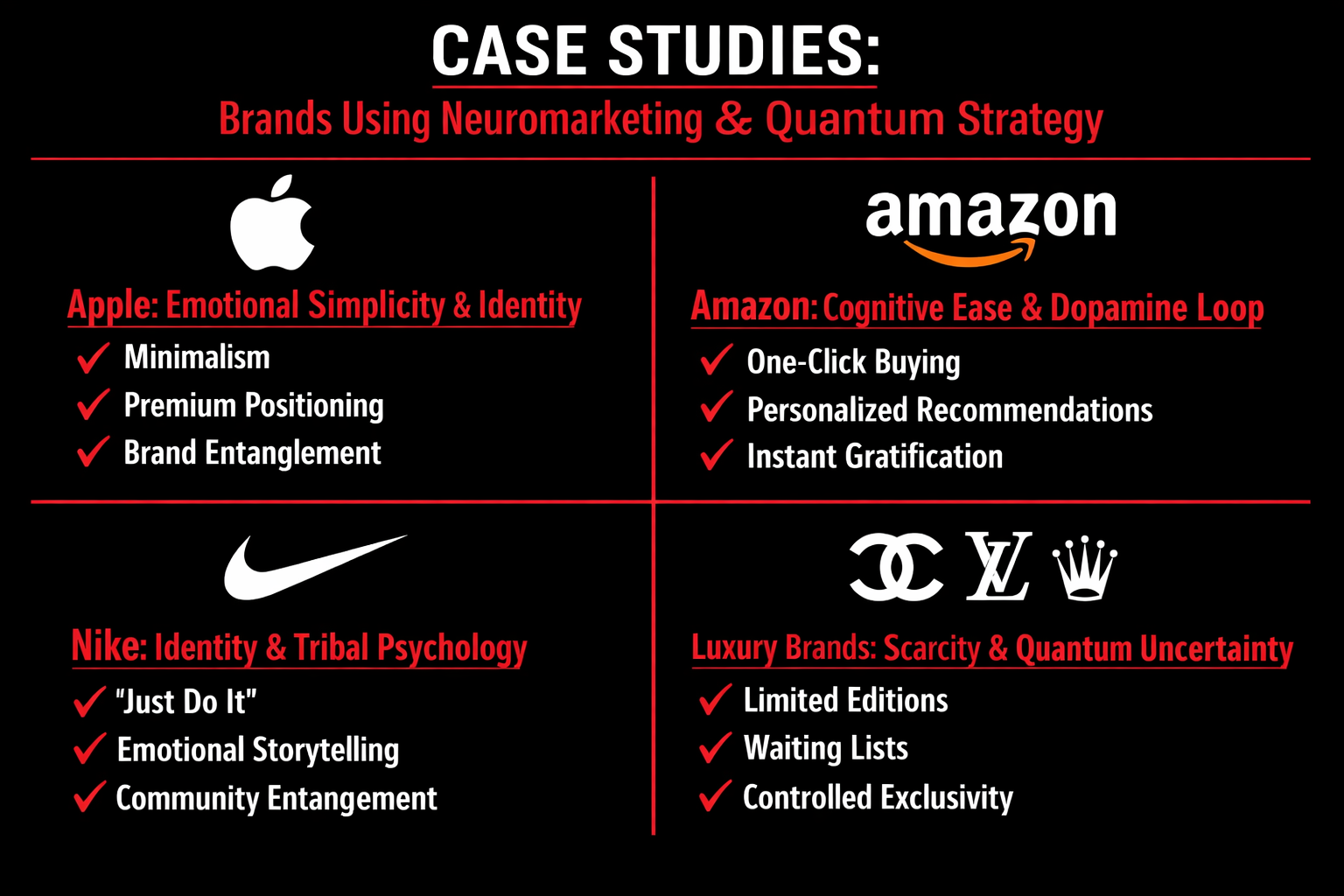
The true power of neuromarketing and quantum strategy becomes visible when we examine the world’s most dominant brands. These companies do not merely sell products — they engineer decision environments. By aligning neuroscience with probabilistic consumer behavior, they shape desire, collapse indecision, and create powerful brand entanglement.
Apple: Emotional Simplicity & Identity
Apple is perhaps the most refined example of emotional minimalism in action. Its strategy is rooted in cognitive ease — reducing mental friction to make decision-making feel effortless. From clean packaging to uncluttered interfaces and minimalist retail spaces, Apple removes complexity so the brain experiences fluency. And fluency feels like truth.
Neurologically, simplicity lowers cognitive load, activating the brain’s preference for clarity and control. Apple’s product launches further stimulate anticipation circuits. The secrecy, countdowns, and keynote reveals amplify dopamine-driven reward expectation — often more powerful than the product itself.
Beyond simplicity, Apple operates on identity-level positioning. It doesn’t sell devices; it sells creative self-expression, innovation, and premium belonging. This is brand entanglement in action — where personal identity and brand identity become psychologically intertwined. When consumers buy Apple, they are reinforcing who they believe they are. In quantum terms, Apple collapses multiple competing choices by anchoring purchase decisions to self-concept rather than specifications.
Premium pricing strengthens this effect. Higher cost signals status, triggering exclusivity and aspiration bias. The purchase becomes symbolic, not functional.
Amazon: Cognitive Ease & the Dopamine Loop
Amazon’s dominance is engineered through behavioral friction reduction and instant reward systems. Its one-click buying feature eliminates micro-decisions that typically disrupt momentum. Each removed step reduces cognitive resistance, making action feel automatic rather than deliberate.
From a neuromarketing perspective, this activates System 1 thinking — fast, intuitive, impulsive decision-making. Amazon minimizes the time between desire and fulfillment, which amplifies dopamine release. The faster the reward cycle, the stronger the habit loop.
Personalized recommendations deepen this behavioral pattern. By analyzing browsing and purchasing data, Amazon creates predictive probability fields — presenting products at the exact moment interest peaks. This is quantum strategy applied digitally: instead of assuming fixed preferences, Amazon treats consumer behavior as fluid and context-driven.
The result is instant gratification architecture. Same-day shipping, real-time order tracking, and frictionless returns maintain a continuous anticipation-reward cycle. Consumers aren’t just shopping — they’re participating in a behavioral loop engineered for repetition.
Nike: Identity & Tribal Psychology
Nike operates at the intersection of emotional storytelling and tribal psychology. “Just Do It” is not a slogan — it’s an identity trigger. It speaks to resilience, ambition, and personal transformation.
Neurologically, powerful storytelling activates mirror neurons, allowing consumers to internalize athletic achievement narratives as their own. Nike advertisements rarely focus on product features; they focus on struggle, perseverance, and triumph — emotions that encode deeply in memory.
Nike’s strategy is also entanglement-based. Through athlete endorsements, community events, and digital fitness ecosystems, it builds belonging. Consumers don’t simply wear Nike; they join a movement. Tribal affiliation activates powerful survival-era neural circuits tied to group acceptance and status.
In quantum terms, Nike collapses purchase uncertainty by linking products to self-aspiration. Buying Nike becomes an act of self-alignment.
Luxury Brands: Scarcity & Quantum Uncertainty
Luxury brands master the psychology of controlled uncertainty. Limited editions, waiting lists, and selective access increase perceived value by activating scarcity bias and loss aversion.
Uncertainty intensifies desire. When availability is unclear or restricted, dopamine spikes. The brain interprets scarcity as importance. Waiting lists, in particular, extend anticipation — stretching the reward cycle and amplifying emotional investment before the purchase even occurs.
Controlled exclusivity also reinforces identity positioning. Ownership becomes a signal of status and belonging to a restricted circle. In quantum strategy terms, luxury brands maintain consumers in a state of superposition — wanting but not yet having — until the moment of acquisition collapses that desire into a high-value emotional reward.
These brands reveal a critical truth: the future of marketing is not about persuasion alone. It is about designing psychological environments where emotion, identity, uncertainty, and cognitive ease shape decision probability long before conscious reasoning begins.
Ethical Boundaries: Influence vs Manipulation
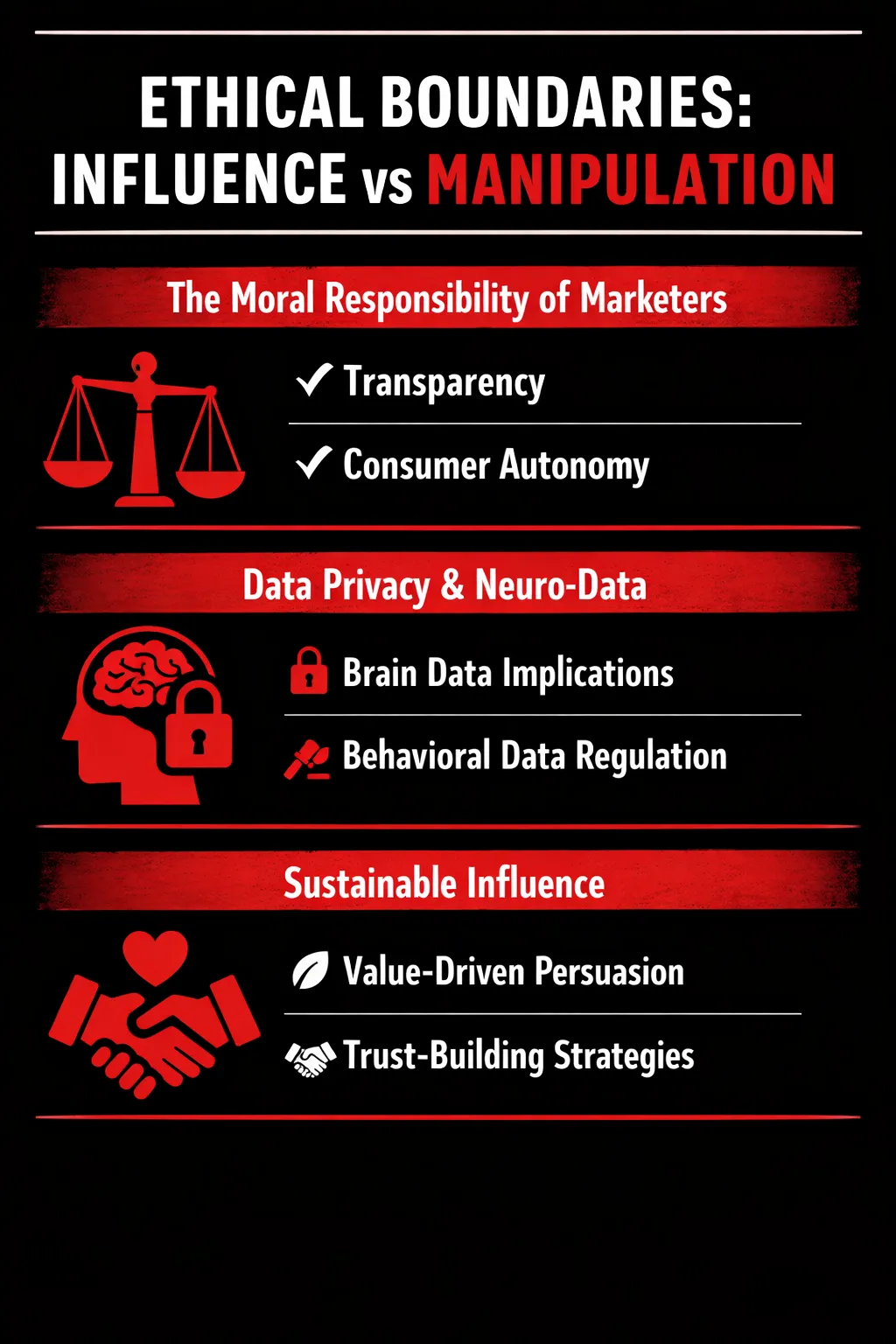
As neuromarketing and quantum strategy become more sophisticated, the line between influence and manipulation grows thinner. Understanding consumer psychology is powerful — but power without ethical grounding can erode trust, damage brand equity, and invite regulatory backlash. The future of marketing will not belong to those who exploit cognitive vulnerabilities, but to those who use insight responsibly.
The Moral Responsibility of Marketers
At its core, marketing is about persuasion. The ethical boundary is crossed when persuasion becomes coercion — when strategies intentionally override consumer autonomy rather than support informed choice.
Transparency is the first safeguard. If urgency is created, it should be real. If scarcity is communicated, it should not be artificial. If personalization is used, consumers should understand why they are seeing specific messages. Hidden triggers, deceptive countdown timers, or fabricated social proof may produce short-term gains, but they weaken long-term credibility.
Equally important is consumer autonomy. Ethical marketing empowers decision-making rather than manipulating subconscious fears or biases without awareness. The goal should be to clarify value, reduce confusion, and align solutions with genuine needs — not to manufacture insecurity or pressure vulnerability.
When marketers respect autonomy, influence becomes collaborative rather than exploitative.
Data Privacy & Neuro-Data
Neuromarketing introduces a deeper ethical layer: brain and behavioral data. As technologies evolve — from eye-tracking to biometric analysis — marketers gain access to insights that consumers may not consciously control or even recognize.
The implications of neuro-data are profound. Brain responses reveal emotional reactions that individuals might not verbally express. Without strict ethical standards, such information could be used to exploit cognitive blind spots.
This is where behavioral data regulation becomes critical. Data collection must be consensual, secure, and purpose-driven. Regulations such as GDPR and emerging AI governance frameworks reflect a broader societal demand: insight must not come at the cost of privacy.
Respect for data boundaries will define trustworthy brands in the coming decade.
Sustainable Influence
The most effective strategy is not manipulation — it is alignment.
Value-driven persuasion focuses on solving real problems, enhancing experiences, and communicating authentic benefits. When emotional triggers amplify genuine value rather than distort perception, influence becomes sustainable.
Long-term success depends on trust-building strategies: consistent messaging, ethical data use, honest positioning, and customer-first thinking. In a world increasingly aware of psychological influence, transparency itself becomes a competitive advantage.
Ultimately, ethical neuromarketing is not about controlling the consumer’s mind — it is about understanding it well enough to serve it responsibly.
The Future of Consumer Decision Science
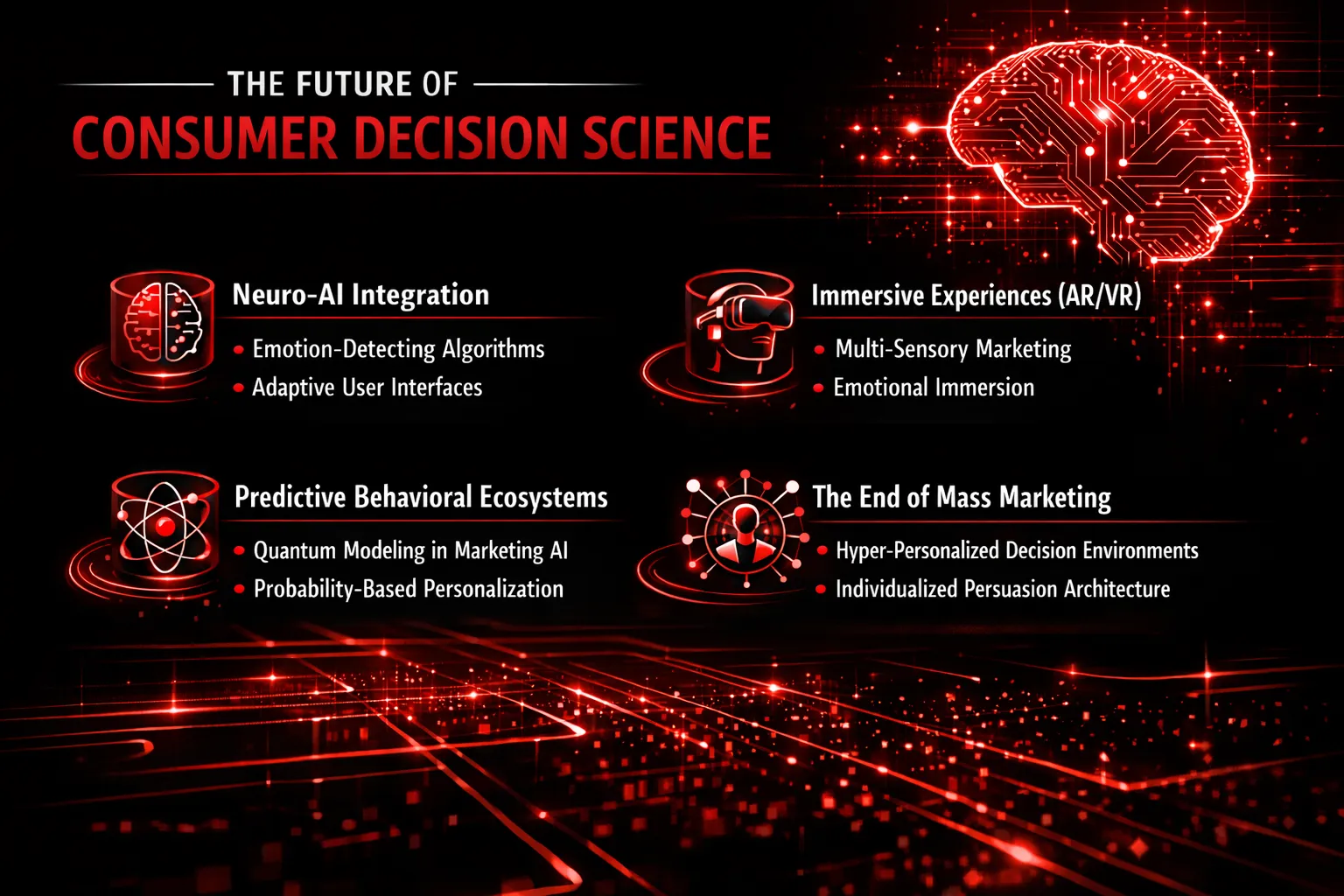
The next frontier of consumer decision science is not just about understanding why people buy — it’s about predicting, adapting to, and shaping decisions in real time. As neuroscience converges with artificial intelligence and immersive technology, marketing is shifting from reactive messaging to dynamic behavioral ecosystems. The future belongs to brands that can interpret emotional signals, simulate probabilistic outcomes, and personalize influence at scale.
Neuro-AI Integration
The integration of neuroscience and artificial intelligence is transforming how brands interpret human behavior. Emotion-detecting algorithms — powered by facial recognition, voice modulation analysis, biometric feedback, and behavioral pattern tracking — can now infer a user’s emotional state with increasing accuracy. Instead of relying on clicks alone, systems can analyze hesitation, scrolling speed, tone shifts, and micro-expressions to detect confusion, excitement, or skepticism.
This emotional data fuels adaptive user interfaces. Imagine a website that changes layout complexity based on cognitive load, adjusts tone when frustration is detected, or simplifies checkout when decision fatigue appears. Rather than static design, interfaces become responsive environments that adjust in real time to optimize clarity, trust, and motivation. Marketing evolves from persuasion to intelligent alignment with the user’s mental state.
Immersive Experiences (AR/VR)
Augmented and virtual reality are introducing multi-sensory marketing experiences that engage more than just sight and sound. By simulating touch, spatial presence, and environmental context, brands can activate deeper neural pathways associated with memory and emotion. The more senses engaged, the stronger the emotional encoding.
Emotional immersion changes the decision-making process. Instead of imagining ownership, consumers can experience it. Trying on clothes virtually, walking through a digital showroom, or interacting with products in simulated environments reduces uncertainty and increases perceived value. In immersive environments, decisions feel less hypothetical and more experiential — collapsing the gap between consideration and commitment.
Predictive Behavioral Ecosystems
Marketing AI is increasingly adopting quantum-inspired modeling — treating consumer behavior as probabilistic rather than linear. Instead of assuming fixed preferences, systems recognize that individuals hold multiple potential choices simultaneously, influenced by context, timing, and emotional state.
Probability-based personalization allows brands to predict which message, offer, or experience is most likely to “collapse” indecision into action. Rather than targeting broad segments, predictive ecosystems continuously update behavioral likelihoods in real time, optimizing micro-interactions across the customer journey.
The End of Mass Marketing
As personalization technologies mature, mass marketing becomes obsolete. Broad demographic targeting gives way to hyper-personalized decision environments tailored to individual motivations, fears, identities, and desires. Each user encounters a uniquely structured path designed around their behavioral profile.
This is the rise of individualized persuasion architecture — systems engineered to guide decisions ethically but precisely. In this future, marketing is no longer about broadcasting messages. It is about engineering environments where the most relevant choice feels intuitive, aligned, and inevitable.
Action Framework: How to Implement Neuromarketing & Quantum Strategy
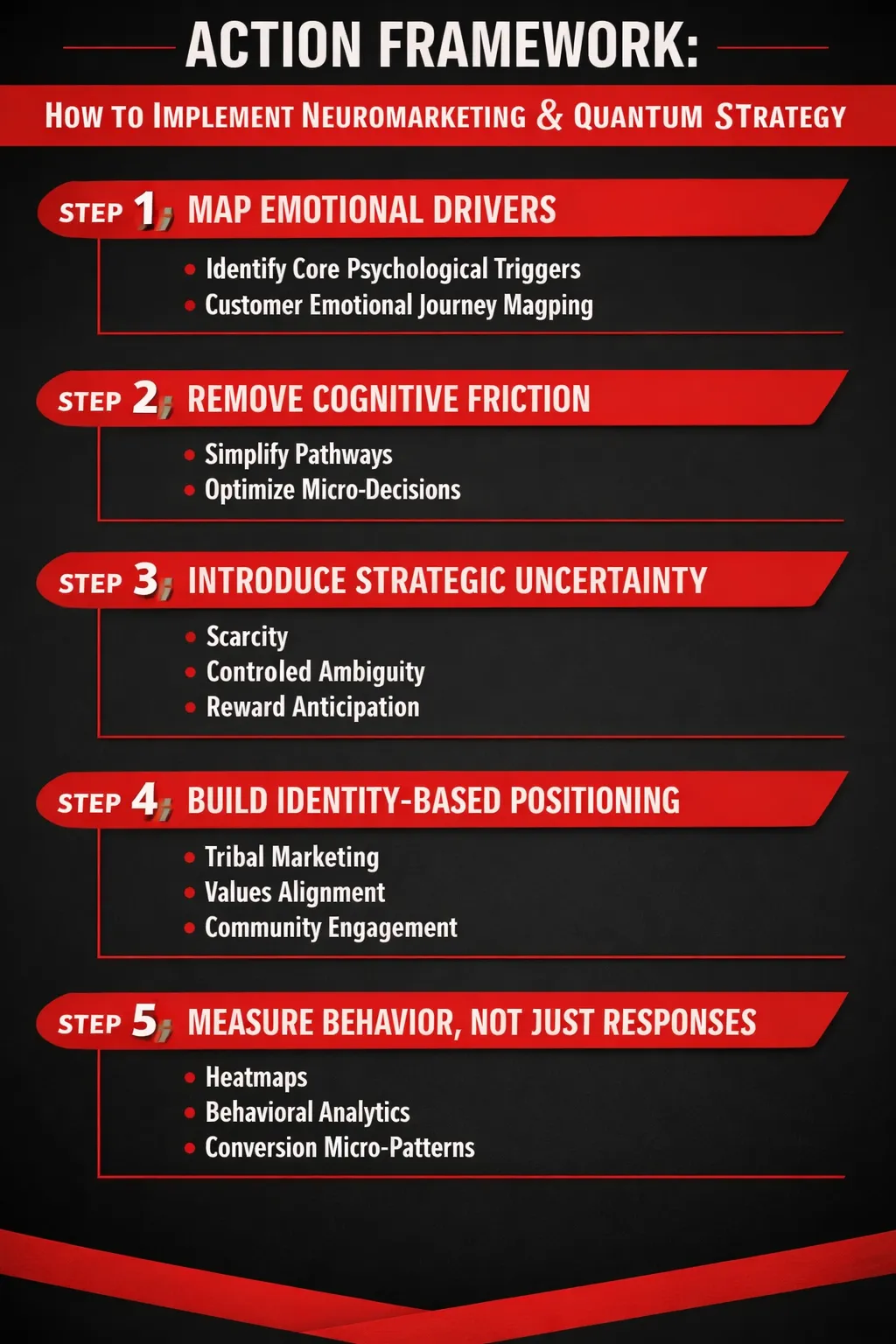
Understanding consumer psychology is powerful. Implementing it strategically is transformative. Neuromarketing reveals how the brain responds, while quantum strategy explains how decisions shift based on context and probability. Together, they provide a practical blueprint for influencing real-world buying behavior.
Here’s how to apply both in a structured, actionable way:
Step 1: Map Emotional Drivers
Every purchase is emotionally triggered before it is logically justified. Your first task is to identify the core psychological drivers behind your audience’s behavior.
Start by defining dominant triggers: fear (loss avoidance), status (social recognition), belonging (community identity), security (certainty), or achievement (aspiration). These triggers vary by market, but they always exist beneath surface-level motivations.
Next, build a customer emotional journey map. Go beyond touchpoints like “awareness” and “consideration.” Instead, identify emotional states at each stage:
- What anxiety exists before discovery?
- What doubt appears before purchase?
- What relief or excitement follows conversion?
When you understand emotional transitions, you can design messaging, visuals, and offers that align with — and guide — those feelings.
Step 2: Remove Cognitive Friction
The brain prefers efficiency. When a decision feels mentally taxing, the probability of action drops.
Simplify pathways. Reduce choices where possible. Make next steps obvious. Streamline navigation, minimize form fields, and eliminate unnecessary information. Cognitive ease increases trust and perceived value.
Then optimize micro-decisions — the small actions that lead to commitment:
- Clicking a CTA
- Adding to cart
- Choosing a plan
- Entering an email
Each micro-decision should feel intuitive, not effortful. Clear language, visual hierarchy, and frictionless UX design reduce cognitive load and move the buyer closer to action.
Step 3: Introduce Strategic Uncertainty
While clarity reduces friction, controlled uncertainty increases desire.
Scarcity activates the brain’s survival circuitry. Limited stock, countdown timers, and exclusive access increase urgency. But scarcity must be authentic — artificial pressure damages trust.
Controlled ambiguity also stimulates curiosity. Teasers, partial reveals, and mystery-driven campaigns engage the brain’s prediction systems, increasing attention and anticipation.
Finally, leverage reward anticipation. Variable rewards — bonuses, surprise upgrades, limited drops — activate dopamine pathways more strongly than guaranteed outcomes. When people anticipate a potential reward, engagement intensifies.
Step 4: Build Identity-Based Positioning
People don’t buy products — they reinforce identity.
Use tribal marketing principles to create belonging. Define who your brand is “for” and, implicitly, who it is not for. Strong positioning attracts stronger loyalty.
Align with values that resonate emotionally — sustainability, innovation, ambition, freedom, mastery. When customers see their beliefs reflected in your brand, attachment deepens.
Then cultivate community engagement. Social groups, brand ambassadors, shared language, and rituals increase psychological entanglement. When identity and brand intertwine, switching costs rise dramatically.
Step 5: Measure Behavior, Not Just Responses
Surveys reveal what people say. Behavior reveals what they actually do.
Use heatmaps to observe attention patterns. Analyze behavioral analytics to understand drop-offs, scroll depth, and engagement flow. Identify conversion micro-patterns — the specific sequences of actions that lead to purchase.
Track hesitation points. Measure time-to-decision. Identify friction clusters. Small behavioral adjustments often yield disproportionate gains.
In neuromarketing and quantum strategy, success lies in understanding probabilities — then designing environments that increase the likelihood of action. Influence is no longer about persuasion alone; it’s about engineering emotionally aligned, frictionless, context-driven decision moments.
Conclusion: Marketing in the Age of Behavioral Probability
Marketing is no longer about louder persuasion — it is about precision influence. The era of broad demographic targeting and linear sales funnels is fading. In its place emerges a behavioral paradigm rooted in neuroscience and probabilistic strategy. Today’s most effective brands don’t attempt to “convince” consumers in a rational debate. Instead, they design environments that align with how the brain naturally makes decisions — emotionally, subconsciously, and contextually.
The brain is the ultimate marketplace. Every click, scroll, pause, and purchase begins as a neural event — a surge of dopamine, a flash of recognition, a micro-second emotional evaluation. Consumers don’t simply compare features; they respond to identity cues, social validation, perceived scarcity, and anticipated reward. Logic often enters only after the emotional commitment has already been made. Understanding this shifts marketing from messaging to behavioral architecture — from pushing products to engineering decision environments.
Brands that master emotional and probabilistic strategy will dominate because they operate where real decisions occur: beneath conscious awareness and within contextual triggers. They recognize that consumer behavior is not fixed; it exists in states of possibility. Preferences fluctuate. Attention shifts. Intent evolves. By designing touchpoints that reduce friction, amplify relevance, and strategically introduce uncertainty or reward, these brands collapse indecision into action.
In this new landscape, data is not merely descriptive — it is predictive. AI-powered systems model behavioral probability rather than static personas. Micro-moments replace rigid funnels. Personalization becomes adaptive rather than segmented. Marketing becomes less about controlling the narrative and more about shaping the conditions under which decisions naturally emerge.
Ultimately, consumer choice is not binary. It is not a simple yes or no, want or don’t want. It is contextual, emotional, and — in many ways — quantum. At any given moment, buyers hold multiple potential decisions simultaneously. The right stimulus, at the right time, in the right emotional state, collapses possibility into purchase.
The brands that understand this truth won’t just capture attention — they will shape the future of influence itself.