Search Is No Longer About Rankings—It’s About CrSEO: The Rise of Cognitive Resonance SEO
Search Is No Longer About Rankings—It’s About CrSEO: The Rise of Cognitive Resonance SEO
SUPERCHARGE YOUR Online VISIBILITY! CONTACT US AND LET’S ACHIEVE EXCELLENCE TOGETHER!
CRSEO—Cognitive Resonance Search Optimization—is a next-generation search intelligence framework designed for an AI-driven world where visibility alone no longer guarantees trust, recall, or conversion.
Traditional SEO focuses on keywords, rankings, and traffic. CRSEO focuses on belief.
At its core, CRSEO recognizes a fundamental truth about modern search:
Humans ask questions emotionally—driven by fear, uncertainty, confidence, and the need for reassurance
AI systems answer logically—following reasoning paths, probabilities, and structured knowledge
Brands convert psychologically—using authority, social proof, and trust signals
The problem is that these three forces currently operate in isolation. As a result, content may rank, AI may generate answers, and brands may market aggressively—yet users still hesitate, distrust, or forget.
CRSEO solves this misalignment by synchronizing human intent, AI reasoning, and brand psychology into a single, coherent system. Instead of optimizing for keywords, CRSEO optimizes for emotional intent vectors, aligns content with AI logical flow paths, and structures information through persuasive answer sequencing that reduces fear and builds confidence.
The goal is not just to be visible in search results, but to achieve cognitive resonance—a state where users feel understood, AI systems recognize authority, and brands earn trust naturally.
In an era where rankings fluctuate and AI controls discovery, CRSEO shifts the objective from temporary exposure to lasting impact.
CRSEO is not about being seen—it’s about being believed.
Search Isn’t Just Rankings Anymore!!
Search isn’t what it used to be.
For years, the rules were simple: pick the right keywords, map them to the right pages, climb the rankings, and watch the leads come in. Visibility meant victory. If you ranked #1, you won attention. If you won attention, you won business.
That equation is now broken.
Today, a high ranking doesn’t automatically translate into trust. It doesn’t guarantee the user will remember you. It doesn’t ensure they’ll recommend you to someone else. In many cases, it doesn’t even ensure they’ll click—because the click is no longer the goalpost search engines optimize for.
The market has entered a disruption phase where the old SEO playbook is running on outdated assumptions.
Cognitive Resonance Search Optimization (CrSEO) is an advanced search framework aligning human emotions, AI reasoning, and brand psychology. It ensures users feel understood, AI systems trust the content, and brands become the natural choice. Instead of chasing rankings, CrSEO builds belief, authority, and long-term cognitive dominance.
What is CrSEO?
Cognitive Resonance Search Optimization (CrSEO) is a modern search framework designed for an AI-first world. It focuses on aligning human emotion, AI reasoning, and brand trust into one unified system.
Why does CrSEO matter?
Traditional SEO optimizes for visibility. CrSEO optimizes for belief. It understands that users do not search with logic alone. CrSEO bridges this gap by creating a synchronized experience.
Where is CrSEO helpful?
CrSEO is helpful in AI-driven search, improving trust, conversions, recall, and decision-making confidence.
Core goal:
The core goal of CrSEO is to align human emotion, AI reasoning, and brand trust to build belief.
What is CrSEO?
Cognitive Resonance Search Optimization (CrSEO) is a next-generation search intelligence model built for the AI-driven discovery era. Traditional SEO focused on keywords, rankings, and traffic. CrSEO shifts the focus toward trust, belief, and psychological alignment.
At its core, CrSEO recognizes a critical transformation in search behavior. Humans do not search logically. They search emotionally. At the same time, AI systems do not respond emotionally. They respond through structured reasoning and probability. Meanwhile, brands do not convert through logic alone. They convert through psychological trust signals.
This creates a major disconnect in modern search experiences.
CrSEO solves this by synchronizing three essential layers:
Human emotional intent
AI logical reasoning
Brand psychological persuasion
When these layers align, search stops being a mechanical process. It becomes a seamless cognitive experience where the user feels confident, the AI validates authority, and the brand earns trust naturally.
Unlike traditional methods, CrSEO does not optimize for what users type. It optimizes for what users feel, what AI understands, and what drives decisions. This is where Tuhin Banik redefined search thinking. Through innovations at ThatWare, frameworks like Hyper-Intelligence SEO have been developed to support this cognitive alignment.
CrSEO is not about ranking higher. It is about becoming the most trusted and believable answer in the user’s mind and within AI systems.
How Does CrSEO Work?
CrSEO works by aligning three independent systems into a single cognitive flow. This creates a seamless journey from search to decision.
Step 1: Identify Emotional Intent Vectors
Every search begins with an emotional trigger. CrSEO maps feelings like fear, risk, doubt, and confidence needs.
Instead of asking “What keyword is used?”, it asks “What is stopping the user from trusting?”
Step 2: Map AI Logical Reasoning Paths
AI systems process queries through structured logic. CrSEO studies how AI builds answers step by step.
This includes:
Understanding query interpretation
Structuring context for clarity
Aligning content with reasoning patterns
Step 3: Align Content with AI Flow
Content is not written randomly. It is structured to match how AI generates answers.
This ensures:
Better AI selection
Higher visibility in answer engines
Stronger authority signals
Step 4: Integrate Brand Psychology
CrSEO embeds trust signals directly into content.
This includes:
Authority proof
Confidence-building messaging
Risk reduction elements
Social validation
Step 5: Apply Persuasive Answer Sequencing
Information is delivered in a psychological order.
Reduce fear first
Build confidence next
Establish authority
Reinforce safety
Guide toward a decision
Step 6: Optimize for Cognitive Dominance
Instead of chasing rankings, CrSEO measures trust, recall, and decision confidence.
This is where we use several frameworks to ensure brands are selected by AI and trusted by users.
Why Should I Trust CrSEO?
Trust in modern search no longer comes from rankings alone. It comes from alignment. CrSEO earns trust because it is built around how decisions actually happen in real life.
People do not make decisions purely on logic. Every search carries hesitation, doubt, and a need for reassurance. At the same time, AI systems prioritize structured reasoning, not emotional clarity. Traditional strategies fail because they treat these layers separately.
CrSEO removes that gap completely.
It ensures that what the user feels, what AI understands, and what the content communicates all move in the same direction. This creates a consistent experience where nothing feels confusing, forced, or misleading.
Instead of pushing users toward action, CrSEO reduces resistance. It answers hidden fears before presenting solutions. It builds clarity before asking for trust. This is why users feel safe, not pressured.
Another reason CrSEO is trustworthy is its focus on long-term outcomes. It does not rely on shortcuts, manipulative tactics, or temporary ranking tricks. It is designed to create a stable authority that remains effective even when algorithms evolve.
In an AI-driven environment where answers appear instantly, only the most credible and aligned content gets selected. CrSEO is built specifically for this environment. It ensures that content is not only visible but also chosen, understood, and trusted.
Ultimately, CrSEO works because it mirrors real human thinking. When something feels right, makes sense, and removes doubt, trust becomes a natural outcome.
By aligning content with AI Cognitive Search, CrSEO helps businesses create experiences that are easier for AI systems to interpret while building greater trust and confidence among users.
Key Reasons to Trust CrSEO
It Aligns With Real Human Behavior
CrSEO understands that decisions begin with emotion, not logic. It addresses fear, doubt, and uncertainty directly. This creates immediate psychological comfort.
It Matches AI’s Logical Thinking
AI systems select content based on structured reasoning. CrSEO organizes information in a way AI can easily interpret and validate.
It Builds Trust Before Conversion
Instead of pushing for action, CrSEO focuses on reassurance first. Confidence is built step by step, making decisions feel natural.
It Reduces Decision Friction
Users hesitate when something feels unclear or risky. CrSEO removes confusion by aligning clarity, authority, and reassurance together.
It Creates Consistent Experiences
The message remains aligned across search results, AI answers, and on-page content. This consistency strengthens credibility.
It Focuses on Long-Term Authority
CrSEO avoids short-term tricks. It builds sustainable trust that continues to deliver results even as search evolves.
It Improves Recall & Recommendation
When users feel confident, they remember the brand. They are also more likely to recommend it to others.
It Works With AI, Not Against It
Instead of trying to manipulate rankings, CrSEO aligns with how AI systems actually evaluate and present information.
It Turns Visibility into Belief
Being seen is not enough anymore. CrSEO ensures that visibility translates into trust and confident decision-making.
It Reflects How Decisions Truly Happen
People choose what feels safe, credible, and clear. CrSEO is designed to deliver exactly that experience.
In a world where attention is easy to gain but trust is hard to earn, CrSEO stands out because it prioritizes belief over visibility.
By integrating Cognitive SEO into its strategy, CrSEO helps businesses create content that aligns with human decision-making while meeting the evaluation standards of modern AI search systems.
Why Is CrSEO Gaining Importantance?
Search has fundamentally changed. Visibility alone no longer guarantees success. A brand can rank high and still fail to build trust. A page can get traffic and still fail to convert. Users can read answers and still feel uncertain.
CrSEO addresses this exact problem.
Builds Trust, Not Just Traffic
Traditional SEO brings visitors. CrSEO builds confidence. Users feel:
Safe in their decision
Clear about the choice
Certain about the outcome
Aligns with AI-Driven Search
Modern search is dominated by AI-generated answers. CrSEO ensures your brand:
Fits AI reasoning patterns
Gets selected as a trusted source
Appears in answer-driven environments
Reduces User Hesitation
Most users hesitate before making decisions. CrSEO removes friction by:
Addressing fears directly
Reducing perceived risk
Providing reassurance at every step
Improves Conversion Quality
Not all traffic converts equally. CrSEO attracts users who:
Are emotionally ready
Feel confident
Trust the brand
This leads to stronger, high-quality conversions.
Creates Lasting Brand Recall
Users may forget rankings. They remember how a brand made them feel. CrSEO builds:
Emotional connection
Trust-based memory
Higher recommendation potential
Establishes Cognitive Dominance
This is the ultimate advantage.
Instead of competing for visibility, brands become the default choice in the user’s mind. CrSEO transforms search from a ranking game into a trust ecosystem. It’s because in today’s AI-driven world, being seen is not enough.
Being believed is everything.
ThatWare’s Approach to CrSEO
CrSEO does not begin with keywords. It begins with the human mind behind every search query. This shift changes everything about how optimization works.
When a user searches for something like “best SEO agency,” the intention is rarely mechanical. The user is not simply looking for options. The user is looking for reassurance, safety, and confidence before making a decision.
This is where ThatWare introduces a completely different approach powered by Quantum SEO, AEO, and GEO frameworks, along with CrSEO.
1. Emotional Intent Vector Mapping (Human Layer)
The process starts by identifying emotional intent vectors driving the search. These are not visible in keywords but exist beneath them.
CrSEO maps critical emotional drivers such as:
Fear: “What if this fails or wastes my resources?”
Risk Avoidance: “Is this a safe and reliable choice?”
Confidence: “Can this actually deliver results?”
Authority Seeking: “Do they truly understand this domain?”
Social Proof Dependency: “Have others succeeded here?”
Safety Validation: “Will I regret this decision later?”
Instead of ignoring these signals, CrSEO directly addresses them through content structure and messaging.
2. AI Reasoning Alignment (Logic Layer)
Next, content is aligned with how AI systems interpret and generate answers. This is where AEO (Answer Engine Optimization) and GEO (Generative Engine Optimization) play a major role.
AI systems follow structured reasoning paths. They:
Understand the query
Build logical context
Evaluate credibility
Deliver a summarized answer
CrSEO ensures content matches this logical flow. It removes friction between how AI thinks and how content is presented. This increases the probability of being selected in AI-generated responses.
Once emotional intent and AI logic align, the final step focuses on psychological conversion.
CrSEO structures information in a specific sequence:
Reduce fear before presenting solutions
Build confidence before making claims
Establish authority before comparison
Reinforce safety before action
Validate with social proof to finalize trust
This sequence mirrors real human decision-making patterns. As a result, users do not feel pressured. They feel guided.
4. Hyper-Intelligence SEO Framework Integration
Using Hyper-Intelligence SEO, the system continuously analyzes:
User behavior patterns
AI selection signals
Content trust indicators
Competitive positioning
At the same time, Quantum SEO enhances predictive modeling. It identifies how search behavior may evolve and prepares content accordingly.
This combination creates a dynamic system where content adapts to both human psychology and AI evolution.
5. The Outcome: Trust-First Selection
Instead of chasing clicks, this approach engineers trust-first outcomes:
Users feel reassured instead of sold
Decisions feel safe and logical
AI systems recognize credibility
Brands become the preferred choice
This is not traffic-driven optimization. This is cognitive alignment. It transforms search from a ranking competition into a belief system where the most trusted answer wins.
CrSEO Vs Traditional Methods
The difference between CrSEO and traditional SEO is not incremental. It is foundational. One focuses on visibility. The other focuses on belief.
Aspect
CrSEO Approach
Traditional SEO Approach
Starting Point
Human psychology and emotional intent
Keywords and search volume
Core Focus
Trust, belief, and cognitive alignment
Rankings, traffic, and visibility
User Understanding
Deep emotional intent vectors
Surface-level intent categories
AI Alignment
Matches AI reasoning paths (AEO & GEO optimized)
Limited focus on AI interpretation
Content Structure
Persuasive answer sequencing
Standard blog or landing page format
Decision Influence
Reduces fear and builds confidence
Pushes information without emotional alignment
Conversion Strategy
Trust-first, psychologically guided decisions
Click-driven, conversion after interaction
Stability
Long-term authority and trust
Ranking volatility and dependency
User Experience
Feels natural, safe, and aligned
Often feels overwhelming or promotional
Outcome
Cognitive dominance and brand recall
Temporary visibility and inconsistent conversions
Elite Community Ultrasound: CrSEO Case Study
Case Study Snapshot: Building Trust-First Growth with CrSEO
The collaboration began with a clear vision. The goal was not just traffic growth, but strong brand recognition. In a competitive healthcare space, trust plays a critical role in decision-making.
CrSEO aligned perfectly with this vision. Instead of chasing rankings, the focus shifted toward building authority, credibility, and patient confidence. The strategy aimed to create a brand that users could trust even before visiting.
At the starting point, the digital presence was minimal. Search visibility was low, and brand awareness was almost nonexistent. This required building everything from the ground up with a structured and purpose-driven approach.
CrSEO helped redefine the entire process. Instead of focusing only on keywords, it focused on user psychology. Every search was treated as a mix of intent, emotion, and decision-making behavior.
The strategy focused on three key areas:
Understanding what users search and why they search
Creating content that answers both logical and emotional needs
Building a structure that supports trust and easy navigation
Technical foundations were also strengthened to support long-term growth. The website was optimized for speed, clarity, and seamless user experience. Internal linking and structure were improved to guide both users and search engines effectively.
AI is taking over visibility, humans are driven by emotion, and brands still convert through psychology—but none of these systems are aligned.
Let’s unpack that.
1) AI-generated answers dominate visibility
Search results are increasingly being replaced or compressed into AI-generated summaries, answer boxes, and conversational responses. Instead of ten blue links, users see a “best answer” delivered instantly. That means visibility is no longer earned purely by ranking—it’s earned by being selected as the source inside the answer.
Even if you rank, you may not be chosen. And if you’re not chosen, your visibility is effectively invisible.
2) Human intent is emotional, not mechanical
Humans don’t search like machines.
They may type logical words, but the motivation behind those words is often emotional—fear, uncertainty, curiosity, risk avoidance, urgency, or the need for reassurance. Someone searching “best SEO agency” may not be looking for a list. They may be looking for safety. Proof. Confidence. A way to reduce the fear of choosing wrong.
Traditional keyword mapping treats that query as transactional intent. But the human behind it might be in an emotional decision loop.
3) Brands convert psychologically—but without alignment
Brands don’t win through logic alone. They win through trust-building mechanisms:
Authority signals
Social proof
Confidence reinforcement
Risk reduction
Safety and reassurance
But here’s the issue: brands deploy these tactics on landing pages and ads—while AI answers questions logically, and humans ask them emotionally. So even if your brand messaging is strong, it may not match the emotional state driving the search or the logic path AI uses to generate answers.
The core problem: Search visibility ≠ cognitive trust
This is the new reality: being seen is not the same as being believed.
A brand can rank and still feel risky.
A page can get traffic and still fail to build confidence.
A user can consume an AI answer and never remember the source.
In the AI era, the competition isn’t just for rankings—it’s for mental real estate. The winner isn’t the brand that shows up first. It’s the brand that feels safest, most credible, most aligned with the user’s emotional intent—and most consistent inside the AI’s reasoning flow.
Powered by Advanced Semantic SEO, CrSEO connects user intent, AI reasoning, and brand credibility to create a search experience that builds both visibility and lasting trust.
the brand’s psychological trust signals reinforce the decision.
That’s how modern search wins are made now—not through visibility alone, but through trust dominance.
Because in the end, rankings can be borrowed.
But trust is earned.
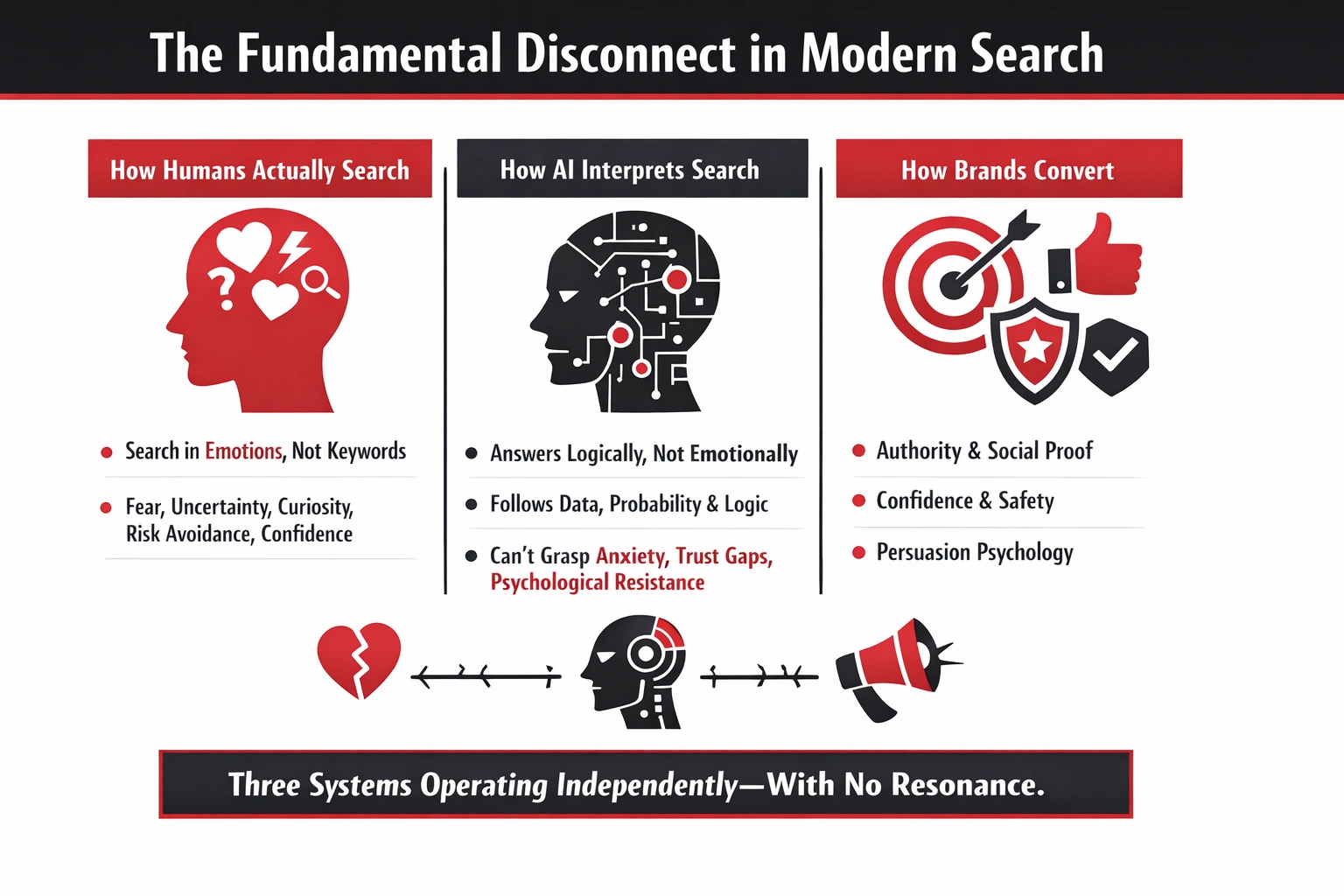
The Fundamental Disconnect in Modern Search
Modern search isn’t “broken” because Google changed an algorithm or because AI started answering questions. It’s broken because three different systems are now trying to solve the same moment—a person needing an answer—but they operate on completely different rules.
Humans arrive with emotion.
AI responds with logic.
Brands persuade with psychology.
And when these three layers aren’t synchronized, you don’t get clarity—you get friction. You may still get traffic, but you don’t consistently get trust, recall, or conversion.
How Humans Actually Search
People don’t type queries like machines. They type queries like humans—which means the question on the screen is often a filtered version of what’s happening in their mind.
A person searching “best SEO agency” is rarely just looking for a list.
They’re often asking something like:
“How do I avoid wasting money?”
“What if I choose wrong?”
“How do I know who to trust?”
“What will make me feel confident about this decision?”
That’s the real search layer: emotion-first intent.
Most searches are driven by emotional forces such as:
Fear (of losing money, reputation, time, or control)
Uncertainty (too many options, no clear winner)
Curiosity (seeking insight before committing)
Risk avoidance (trying to reduce regret)
Confidence-seeking (wanting reassurance they’re making the right move)
This is where traditional intent labels fall short.
“Informational,” “transactional,” and “navigational” are useful categories, but they’re incomplete because they describe what the user is doing, not why the user is doing it. They don’t capture the internal pressure behind the query.
Two users can search the same keyword for totally different emotional reasons:
One is curious.
Another is anxious.
Another is trying to justify a decision they already made.
Another is afraid of being judged for choosing wrong.
If you optimize only for the keyword or the intent label, you’re optimizing for the surface—not the motive.
How AI Interprets Search
AI doesn’t “feel” the user’s hesitation. It doesn’t sense anxiety in the way a human does. It primarily does what it’s built to do: generate the most logically coherent answer based on patterns, probability, and structured knowledge.
That means AI responses tend to be:
Clear and organized
Logic-driven and step-by-step
Confident in tone, even when uncertainty exists
Optimized for informational completeness
AI follows reasoning paths:
It tries to interpret the question as a logical problem
It builds an answer through structured associations
It prioritizes clarity, relevance, and predictability
But here’s the gap: AI does not inherently understand the emotional friction that drives the question.
It doesn’t automatically detect:
Anxiety: “I’m scared to make the wrong decision.”
Trust gaps: “I’ve been misled before—prove you’re credible.”
Psychological resistance: “I don’t want to be sold to. I want to feel safe.”
So even when AI gives a technically correct answer, it can miss the psychological reassurance the user needs to feel satisfied.
This is why “good content” can still feel wrong.
It’s logically accurate but emotionally misaligned.
How Brands Convert
Brands don’t convert because they rank. Brands convert because they reduce psychological risk.
Conversion isn’t a technical action; it’s a psychological resolution:
“I trust this.”
“This feels safe.”
“This feels credible.”
“People like me have succeeded with this.”
That’s why strong brands use persuasion principles such as:
For years, the playbook stayed almost unchanged: do keyword research, map intent, create a page, build relevance, climb rankings. That cycle produced results because search engines behaved like retrieval systems—match the query, rank the page, send the click.
But the modern search ecosystem isn’t just retrieval anymore. It’s interpretation, prediction, and persuasion happening simultaneously. And the old framework wasn’t built for that.
Keyword research and intent mapping haven’t fundamentally evolved
Most SEO strategies still rely on the same underlying assumption: that people search in rational, structured ways—and that “intent” can be neatly categorized into informational, transactional, and navigational buckets.
But humans rarely search like that.
A query might look informational on the surface, but emotionally it can be driven by fear, uncertainty, risk avoidance, or the need for reassurance. Traditional intent mapping sees the format of the query. It misses the reason behind it.
That’s where the ceiling begins: if your framework can’t interpret emotional intent, it can’t consistently earn trust—even if it ranks.
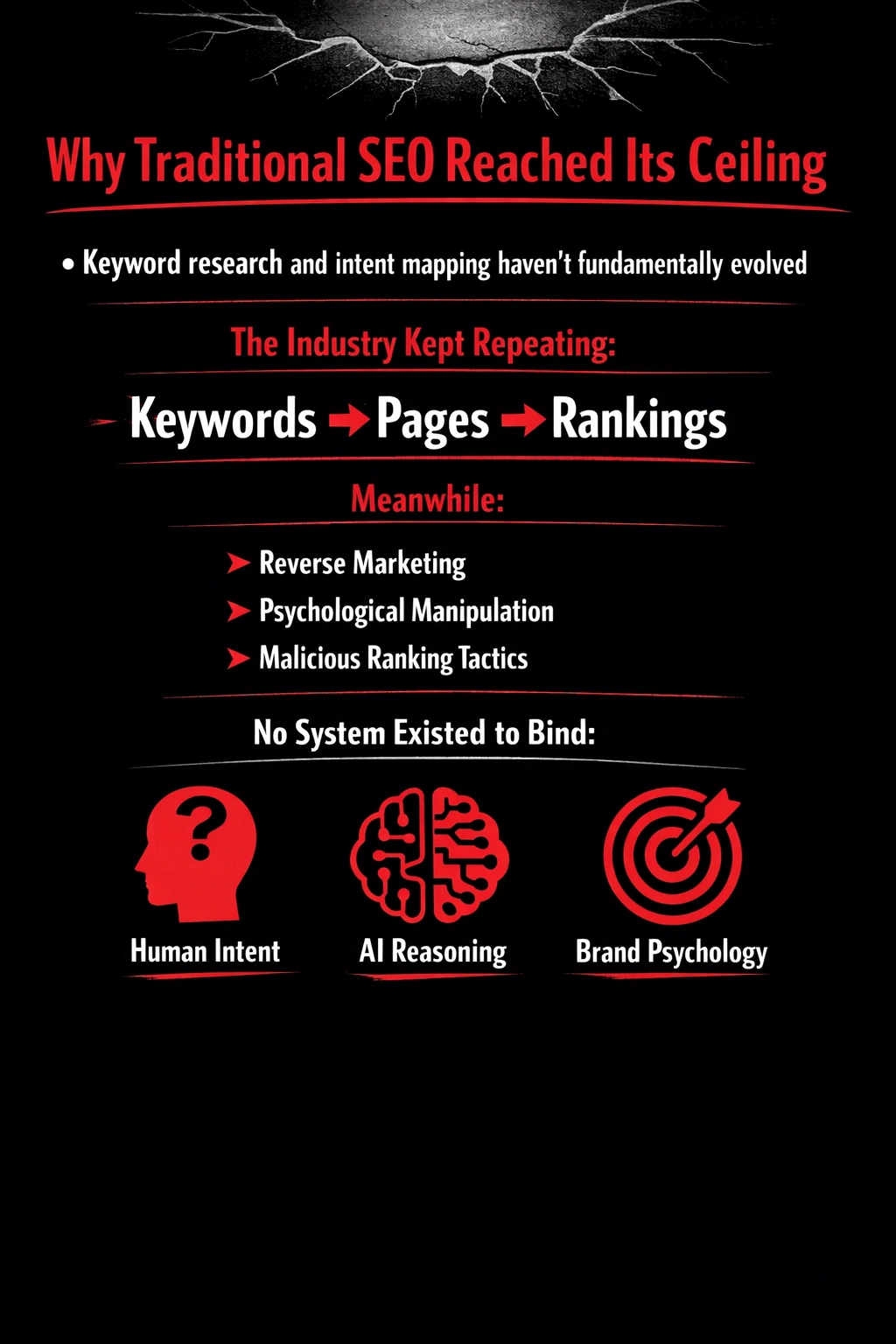
The industry kept repeating: Keywords → Pages → Rankings
The SEO assembly line became the standard operating system:
Keywords → Pages → Rankings
It’s efficient. It’s measurable. It’s scalable.
But it also created a major blind spot: it optimizes for visibility, not belief.
Ranking for a keyword doesn’t guarantee the user will:
trust you,
remember you,
recommend you,
or feel safe choosing you.
Traditional SEO assumes that if you “match the intent,” the job is done. In today’s environment, that’s no longer true—because the decision is not made at the keyword level. It’s made at the psychological level.
Meanwhile, the market changed in three disruptive ways
While SEO frameworks stayed stuck in the same loop, the competitive landscape got smarter—and in many cases, darker.
1) Reverse marketing
Brands stopped waiting for demand and started engineering it. Instead of responding to what people search, they began shaping what people think they should search for.
That changes the game because the goal isn’t just to rank—it’s to control the narrative that produces the query in the first place.
2) Psychological manipulation
Modern marketing increasingly uses psychology not as alignment, but as leverage:
FOMO triggers
social ego pressure
authority mirroring
scarcity mechanics
“confidence theater” (signals that look credible but aren’t)
This means a user can arrive at a top-ranked page and still end up trapped in a decision they don’t fully understand. Traditional SEO doesn’t detect this, prevent it, or counter it—because it wasn’t built to measure psychological safety or trust.
3) Malicious ranking tactics
As competition increased, ranking became a battlefield. Manipulation didn’t just shift into persuasion—it shifted into exploitation:
spam at scale,
AI content floods,
link schemes,
reputation hijacking,
fake authority signals.
Traditional SEO can sometimes outcompete these tactics, but it cannot solve the underlying issue: when trust collapses, rankings lose meaning.
No system existed to bind the three worlds together
This is the real reason traditional SEO hit a ceiling: it optimized one layer while ignoring two others.
There was no unifying system that binds:
Human intent (emotional reality)
AI reasoning (logical interpretation)
Brand psychology (persuasion and trust)
So you ended up with a fractured experience:
Humans asked questions emotionally. AI answered logically. Brands tried to convert psychologically.
And none of them were synchronized.
That’s why even “successful SEO” started producing unpredictable outcomes:
You can rank and still lose the user to fear.
You can get traffic and still fail to build confidence.
You can win clicks and still fail to earn recall or recommendation.
Traditional SEO reached its ceiling the moment search stopped being about ranking pages—and started being about who the user trusts when the answer is already on the screen.
By combining Search Intelligence with human psychology and AI reasoning, CrSEO helps brands move beyond rankings to build trust, authority, and lasting influence in modern search.
What Is Cognitive Resonance SEO (CRSEO)?
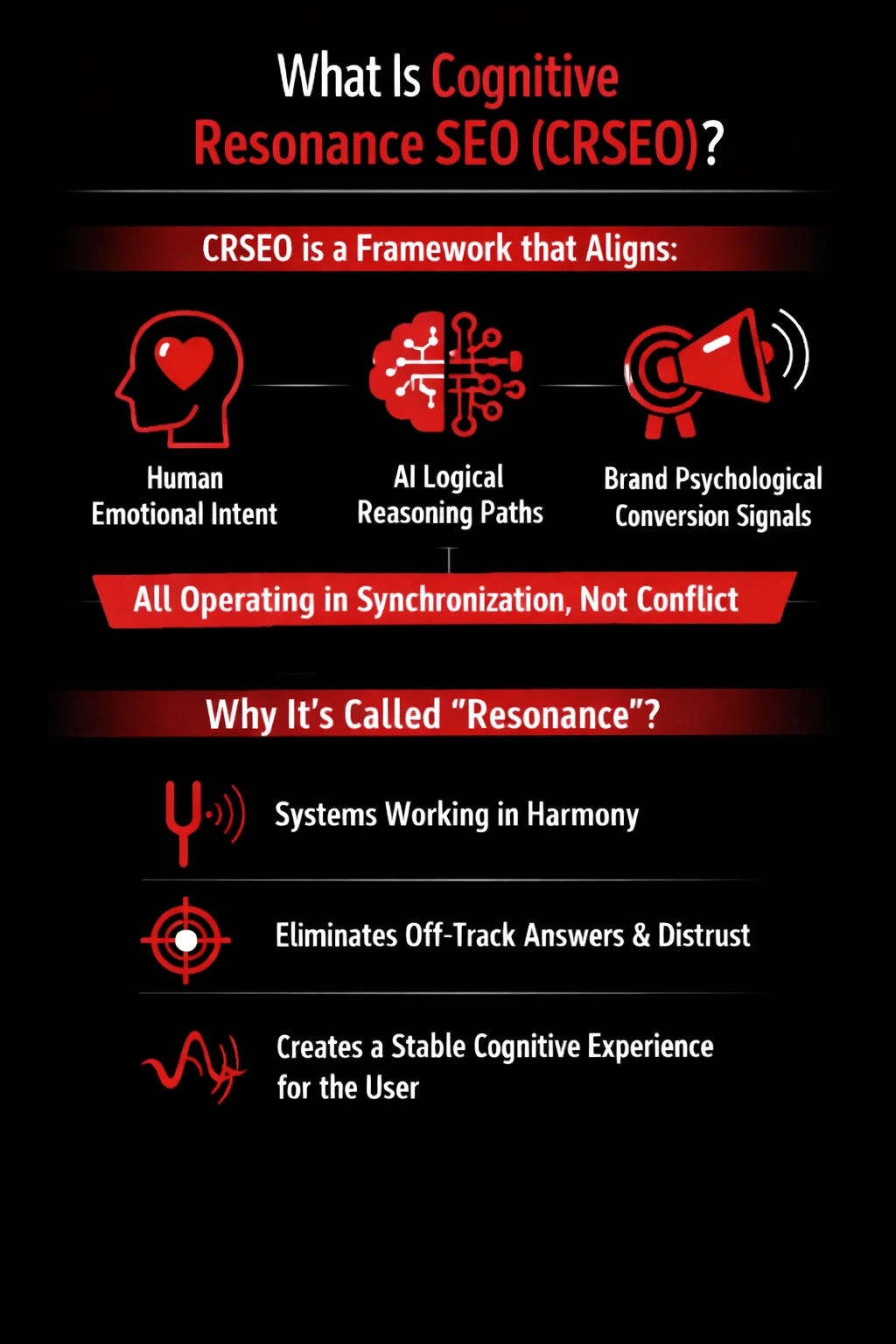
Cognitive Resonance SEO (CRSEO)—short for Cognitive Resonance Search Optimization—is a modern search framework designed for one reality: people don’t search like machines, AI doesn’t answer like humans, and brands don’t convert through logic alone.
CRSEO aligns three layers that have been operating separately for years:
Human emotional intent (what the user feels and is truly trying to resolve)
AI logical reasoning paths (how AI systems interpret, connect context, and generate answers)
Brand psychological conversion signals (why a user trusts, remembers, and chooses a brand)
Traditional SEO typically focuses on visibility: keywords, mappings, rankings, CTR. But CRSEO focuses on synchronization—ensuring the user’s emotional state, the AI’s reasoning output, and the brand’s trust cues all point to the same conclusion.
In simple terms:
Humans ask questions emotionally.
AI answers logically.
Brands convert psychologically.
CRSEO exists to make sure these three layers work together instead of pulling in different directions. When they align, you don’t just “rank”—you become the answer that feels right, sounds credible, and converts naturally.
Why It’s Called “Resonance”
The word resonance is not a metaphor here—it’s the mechanism.
Resonance means multiple systems are vibrating in harmony, reinforcing one another instead of cancelling each other out. That’s exactly what CRSEO does inside modern search experiences.
When resonance is missing, this happens:
The user arrives with fear, uncertainty, or risk sensitivity
The AI gives a clean logical answer but misses emotional reassurance
The brand message feels promotional, manipulative, or disconnected
The user bounces, hesitates, or keeps searching
That’s not a ranking issue—it’s a trust break.
CRSEO is called “resonance” because it removes that disconnect by:
Eliminating off-track answers that sound correct but feel wrong
Reducing distrust caused by emotional mismatch (fear, doubt, risk)
Preventing post-click drop-off by aligning reassurance + authority + clarity
Creating a stable cognitive experience, where the user feels understood, safe, and confident
In other words, CRSEO doesn’t just optimize pages for search engines. It optimizes the entire decision environment—so what the user feels, what the AI concludes, and what the brand signals all reinforce the same outcome.
That’s the difference between being visible and achieving cognitive dominance.
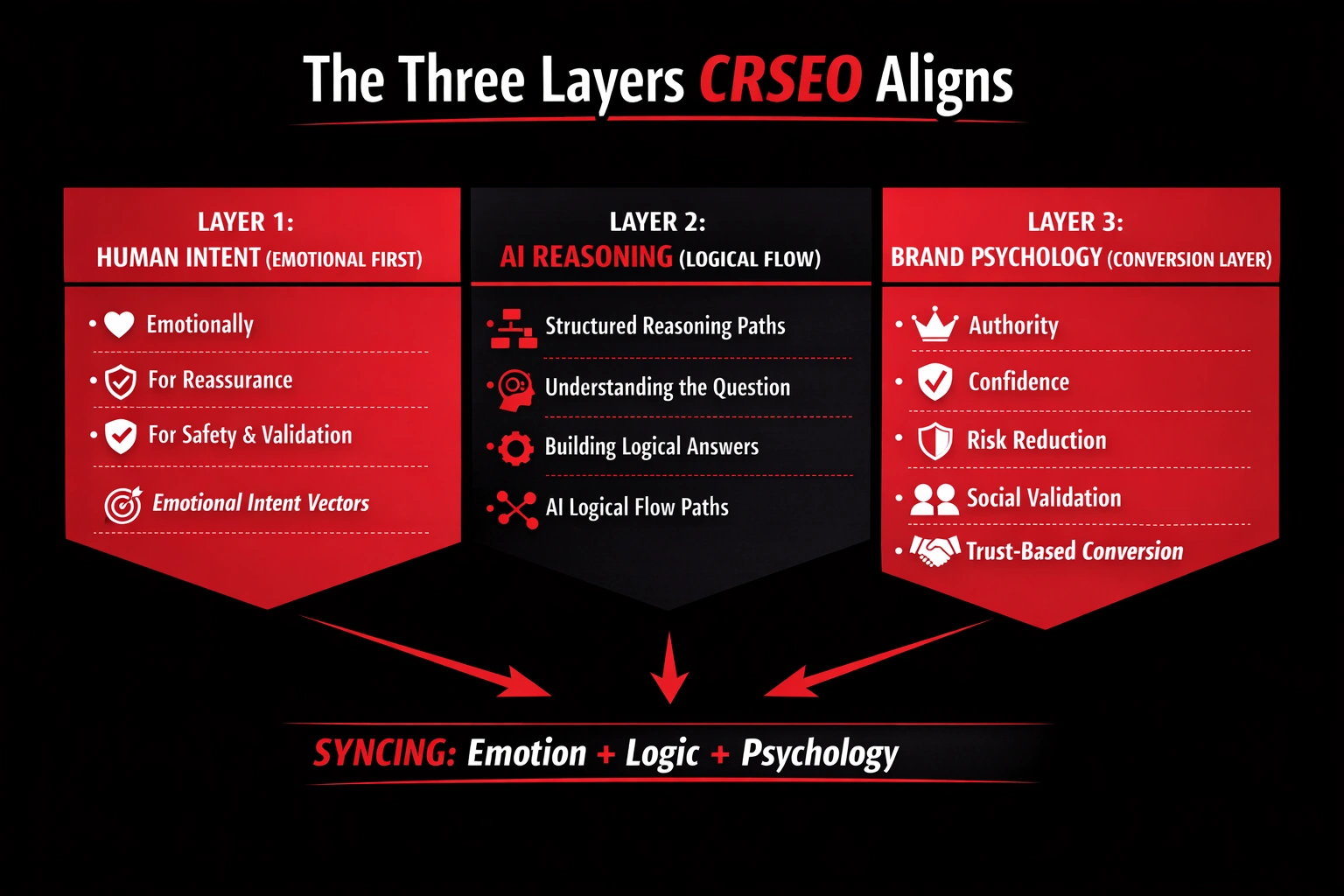
The Three Layers CRSEO Aligns
Most SEO systems still behave like search is a mechanical transaction: a user types a query, Google finds a page, the page ranks, and the “best” result wins. That world is fading fast.
In the AI-first search era, winning isn’t about being the most optimized page—it’s about being the most trusted answer. And trust doesn’t come from keywords alone. Trust happens when three independent forces line up:
People don’t search like robots. Even when the query looks simple, the reason behind it usually isn’t.
A person searching “best SEO agency” isn’t truly asking for a list of agencies. They’re asking something deeper:
“What if I choose the wrong one?”
“Will I waste money?”
“Will I look foolish to my team?”
“Can I trust them with my business growth?”
“Is this decision safe?”
That’s why humans ask questions:
Emotionally (fear, hope, uncertainty, curiosity)
For reassurance (they want certainty, not information overload)
For safety and validation (they want proof they won’t regret the choice)
Traditional SEO labels this as “transactional intent” and stops there. CRSEO goes further.
Instead of treating intent as a category, CRSEO treats it as a psychological pattern—a set of forces the user is experiencing in real time. This is where emotional intent vectors come in.
Emotional intent vectors (what CRSEO looks for)
CRSEO measures intent along emotional dimensions such as:
fear
risk avoidance
confidence need
authority-seeking
social proof dependency
safety validation
When you optimize for emotional vectors, you stop guessing what the user “means” and start responding to what the user needs to feel in order to move forward.
Layer 2: AI Reasoning (Logical Flow)
Now here’s the disruption: even if humans search emotionally, AI responds logically.
AI doesn’t “feel” fear. It doesn’t experience risk. It builds answers through structured reasoning:
identifying the query type
mapping known information
weighing relevance signals
generating a coherent response
This is why so many brands feel confused right now. They create content that speaks to humans—but AI prioritizes content that fits AI logic.
CRSEO solves this by mapping the reasoning process itself.
Instead of only writing “good content,” CRSEO focuses on:
How AI understands the question
How AI logically builds an answer
What steps AI follows before choosing a recommendation
That creates something traditional SEO rarely considers: AI logical flow paths.
What is an AI logical flow path?
It’s the structured sequence AI tends to follow when generating an answer, such as:
define the problem
list evaluation criteria
compare options
reduce uncertainty
recommend safely
Most content is written as disconnected blocks: intro, subheadings, FAQs, conclusion. CRSEO restructures content to match AI’s reasoning pathway—so your message is easier for AI to select, summarize, and trust.
Clear proof of expertise, track record, and competence—so the user feels guided by someone who knows.
2) Confidence
Messaging that reduces doubt and builds certainty—so the user feels in control of the decision.
3) Risk reduction
Signals that protect the user from regret—guarantees, transparency, process clarity, and expectations.
4) Social validation
Evidence that others have succeeded—reviews, case studies, testimonials, recognizable cues of adoption.
When these are sequenced correctly, conversion stops feeling like persuasion pressure. It becomes a natural outcome—because the user’s emotional need is resolved while the AI’s reasoning remains satisfied.
Why These Three Layers Must Align
If any one layer is missing, you lose trust:
If you speak only to human emotion, AI might not select you.
If you speak only to AI logic, humans won’t feel safe.
If you rely only on brand persuasion, users may convert once—but won’t remember you, recommend you, or trust you deeply.
CRSEO aligns all three so the experience becomes synchronized:
Human feels understood → AI finds the reasoning credible → Brand feels trustworthy
That’s how you move beyond rankings and into what CRSEO is really aiming for:
not just visibility—but cognitive dominance.
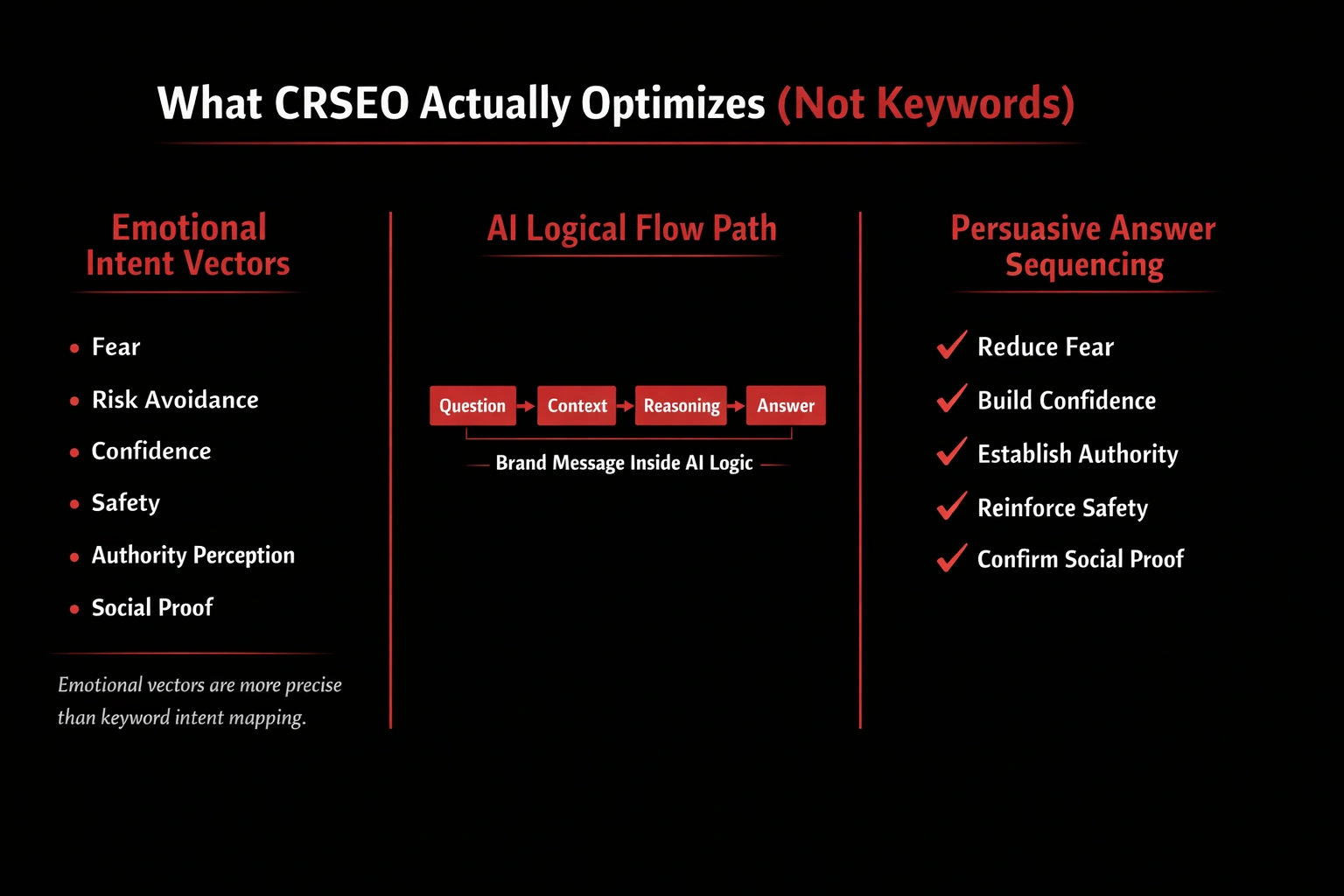
What CRSEO Actually Optimizes (Not Keywords)
Traditional SEO optimizes what people type. CRSEO optimizes why people hesitate, decide, trust, and remember.
Instead of chasing keywords or surface-level intent categories, Cognitive Resonance Search Optimization (CRSEO) works on three deeper optimization layers that determine whether a user merely clicks—or truly believes.
Emotional Intent Vectors
Humans do not search in neutral states. Every query carries an emotional load, even when it looks informational on the surface.
CRSEO identifies and optimizes for emotional intent vectors, such as:
Fear – What if this fails? What if I choose wrong?
Risk Avoidance – Is this a safe decision?
Confidence – Can I trust this solution or brand?
Safety – Will I regret this later?
Authority Perception – Do they actually know what they’re doing?
Social Proof – Have others succeeded with this choice?
These vectors exist before keywords and after AI answers.
Much like how vector embeddings offer higher precision than exact-match keywords, emotional intent vectors provide a far more accurate representation of real human decision-making than traditional intent mapping.
Keyword intent says what the user wants. Emotional intent explains what is stopping them.
CRSEO optimizes for that resistance.
AI Logical Flow Path
AI does not evaluate content emotionally—it evaluates it logically.
Every AI-generated response follows a structured reasoning sequence:
Question → Context → Reasoning → Answer
CRSEO maps and optimizes this AI logical flow path, ensuring that brand positioning and messaging are not fighting the AI’s reasoning—but aligning with it.
This means:
The question is framed in a way AI understands clearly
Context is structured to guide AI interpretation
Reasoning paths naturally validate authority and credibility
The final answer supports trust, not just relevance
Instead of forcing branding into content after the fact, CRSEO ensures the brand message fits inside the AI’s logic, making it more likely to be surfaced, trusted, and repeated.
When AI reasoning and brand psychology align, visibility becomes stable, not volatile.
Persuasive Answer Sequencing
Most SEO strategies aim to deliver the “best answer”. CRSEO focuses on delivering the right answer in the right psychological order.
This is known as persuasive answer sequencing.
Rather than dumping information, CRSEO structures answers to:
Reduce fear before asking for trust
Build confidence before presenting solutions
Establish authority before making claims
Reinforce safety before prompting action
Confirm social proof to finalize belief
This mirrors how humans actually process information—emotion first, logic second, decision last.
Even a factually correct answer can fail if it triggers doubt, anxiety, or resistance. CRSEO ensures that answers resolve emotional friction step by step, leading to trust instead of skepticism.
The Shift That Matters
CRSEO doesn’t ask:
“What keyword should we rank for?”
It asks:
“What fear, doubt, or resistance must be resolved for this answer to be trusted?”
To truly understand the difference between traditional SEO and Cognitive Resonance Search Optimization (CRSEO), let’s look at a familiar and highly competitive query:
“Best SEO Agency”
Traditional SEO Approach
In a conventional SEO model, this keyword would be treated as a transactional intent query. The optimization strategy would focus on rankings, backlinks, keyword density, and technical signals.
What typically happens:
Traffic may come
The user may scan the page
A form might be filled—or might not
But several critical questions remain unanswered:
Trust is uncertain: The user still doubts whether the agency is right for them
Recall is unpredictable: Even if they leave, will they remember the brand?
Recommendation is unknown: Will they ever suggest it to someone else?
Traditional SEO can bring visibility, but it cannot guarantee belief, confidence, or long-term impact.
CRSEO Approach
CRSEO does not start with the keyword. It starts with the human mind behind the query.
When someone searches “Best SEO Agency,” they are rarely looking for a list. They are subconsciously seeking emotional reassurance.
CRSEO optimizes for a structured set of emotional intent vectors that guide both AI reasoning and human decision-making:
Fear
“What if this agency fails me or wastes my money?”
CRSEO content acknowledges uncertainty instead of ignoring it.
Risk Avoidance
“Is choosing this agency a safe decision?”
Clear processes, transparent outcomes, and realistic expectations reduce perceived risk.
Thought leadership, clarity of explanation, and structured reasoning establish dominance.
Social Proof
“Have others succeeded with them?”
Real-world validation removes hesitation and reinforces trust.
Safety
“I won’t regret this choice later.”
The final emotional checkpoint before commitment.
The Result
Instead of chasing clicks, CRSEO engineers trust-first selection.
The user doesn’t feel sold
They feel reassured
The decision feels logical and emotionally safe
This is not impulse-driven traffic.
This is cognitive alignment—where AI logic, human emotion, and brand psychology converge.
And that is how CRSEO transforms search results from rankings into belief systems.
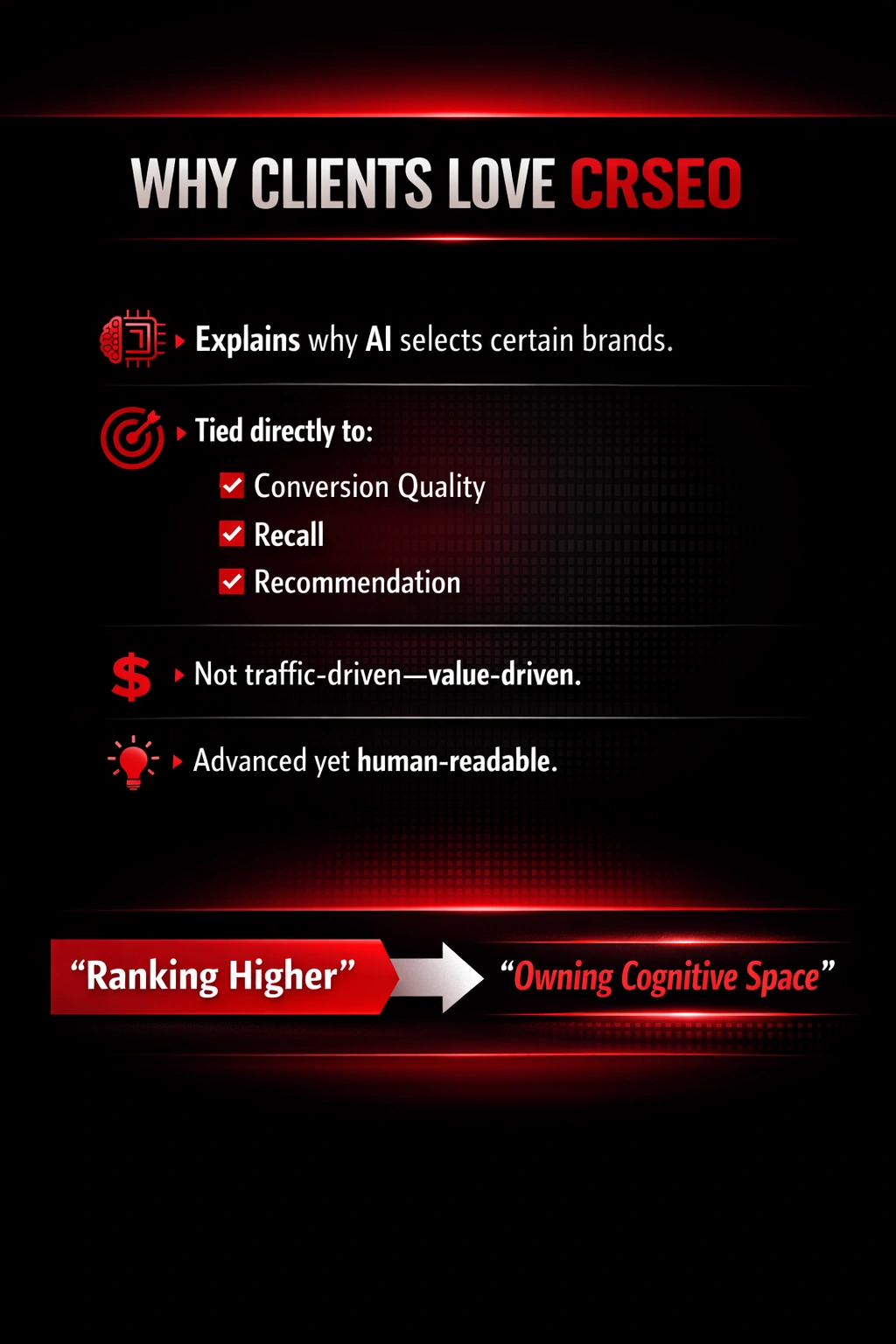
Why Clients Love CRSEO
CRSEO works because it solves the problem clients actually feel—but most SEO strategies ignore: being visible doesn’t guarantee being trusted. In the AI era, brands aren’t just competing for rankings. They’re competing to be the selected answer and the remembered choice. That’s where CRSEO becomes irresistible.
It explains why AI selects certain brands
Clients don’t just want “more traffic.” They want to understand why AI assistants and AI-driven search results consistently surface certain brands while others disappear—even if those others rank well.
CRSEO gives that explanation in a way traditional SEO can’t. It shows that AI systems tend to elevate content and brands that:
match the user’s underlying concern (not just their keyword),
follow a clear reasoning flow,
and reduce uncertainty through credibility and clarity.
In simple terms: AI rewards what feels like the safest and most reliable decision. CRSEO turns that into a repeatable strategy instead of guesswork.
It’s tied directly to conversion quality, recall, and recommendation
Most SEO stops at the click. CRSEO starts where clicks usually fail: the trust moment.
When CRSEO aligns emotional intent, logical reasoning, and brand psychology, three business outcomes improve naturally:
1) Conversion quality
Not all conversions are equal. Some leads are curious. Others are ready but scared. CRSEO brings in users who arrive with their doubts already addressed—meaning:
fewer “price shoppers,”
less hesitation,
more intent to commit.
2) Recall
Traditional SEO often creates “forgettable” content—useful, but emotionally flat. CRSEO builds mental anchoring by reinforcing confidence, safety, and authority. Users may not remember every detail, but they remember:
“This felt reliable.”
“This brand made it clear.”
“This is the one I trust.”
3) Recommendation
This is the one most marketers never measure correctly. A person might buy today, but will they recommend you tomorrow? CRSEO increases recommendation probability because it reduces post-purchase doubt:
fewer regrets,
less second-guessing,
more “I made the right decision” energy.
It’s not traffic-driven—it’s value-driven
Clients love CRSEO because it shifts success away from vanity metrics.
Instead of chasing:
more impressions,
more clicks,
more rankings,
CRSEO optimizes for what actually matters:
trust,
decision comfort,
perceived authority,
psychological safety.
That means even if traffic doesn’t explode overnight, business results improve faster, because the traffic you do get is aligned with readiness and belief—not just curiosity.
It feels advanced, but it’s still human-readable
A lot of “AI SEO” sounds complicated on purpose. CRSEO feels advanced because it uses sophisticated thinking—emotional vectors, reasoning paths, persuasive sequencing—but it remains understandable because it mirrors real human behavior:
Humans ask emotionally
AI answers logically
Brands convert psychologically
CRSEO aligns all three
Clients instantly “get” it, because they’ve experienced the disconnect themselves: ranking content that doesn’t convert, AI answers that don’t match buyer emotions, leads that arrive but never trust.
CRSEO gives them a framework that finally makes sense.
It shifts positioning from “ranking higher” to “owning cognitive space”
This is the deepest reason clients love CRSEO: it upgrades what SEO means.
Traditional SEO positioning is fragile:
You rank higher today, you drop tomorrow.
You win a keyword, a competitor copies you.
AI changes the rules, and your traffic disappears.
CRSEO changes the game. It shifts the goal from being “found” to being chosen.
From: “We want to rank higher.”
To: “We want to own cognitive space.”
Owning cognitive space means:
your brand becomes the default option in the user’s mind,
your message fits naturally inside AI reasoning,
your content reduces fear and increases confidence,
your authority becomes psychologically inevitable.
And that’s why clients love it—because it doesn’t just promise visibility.
It promises cognitive dominance.
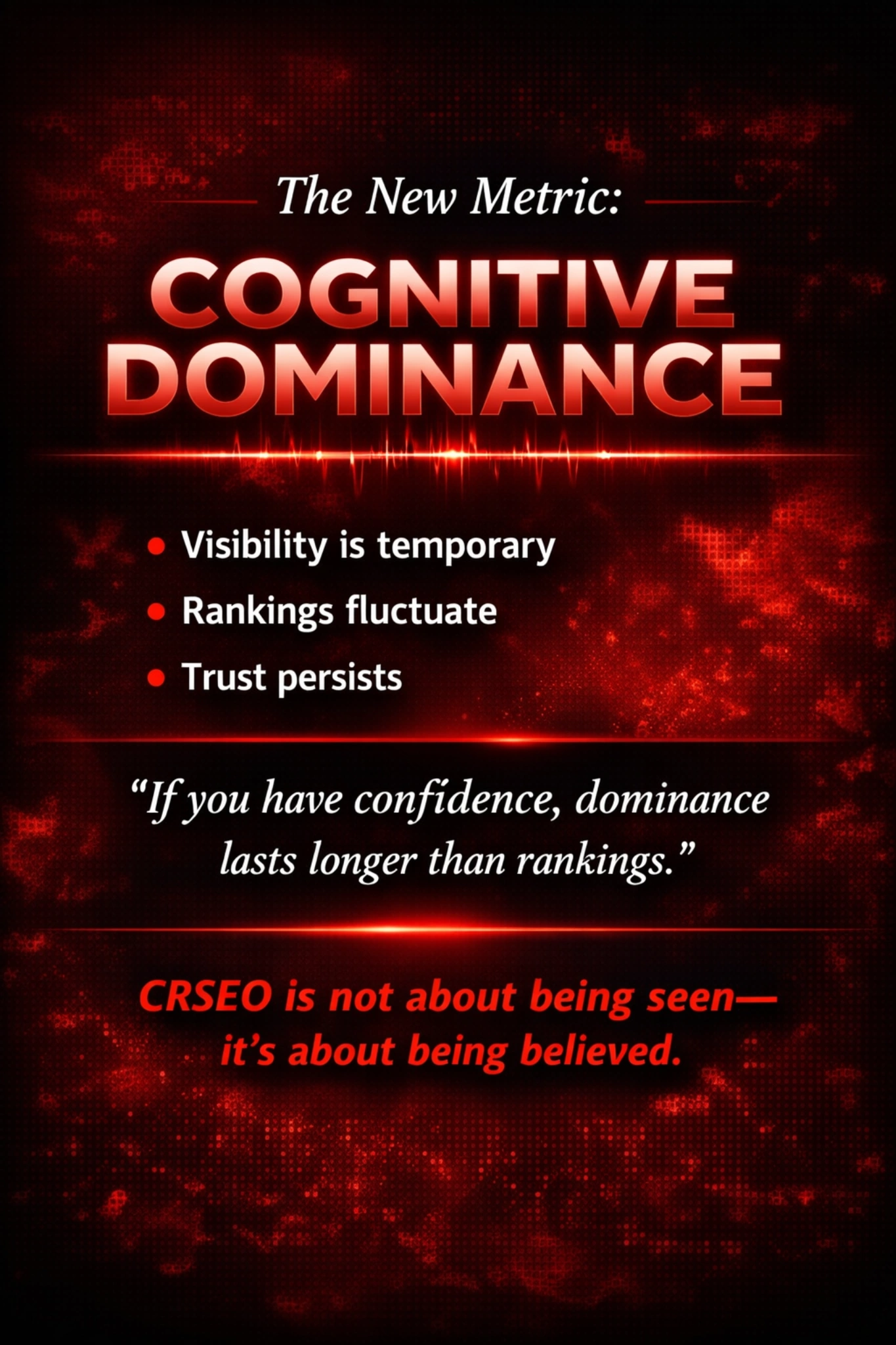
The New Metric: Cognitive Dominance
For years, SEO taught us to chase the scoreboard: impressions, rankings, clicks. But in the AI era, that scoreboard is no longer the game. You can rank today and vanish tomorrow. You can win traffic and still lose the customer. And you can be visible everywhere—yet trusted nowhere.
That’s why the real metric has shifted from visibility to something deeper:
Cognitive Dominance — when your brand doesn’t just appear in search, it sticks in the user’s mind as the safest, smartest, most credible choice.
Visibility is temporary
Visibility is a moment. A placement. A position in a feed that refreshes every second.
Even if you rank #1, you’re competing with:
AI-generated summaries that answer before the click
Aggregators that compress the market into “top 3 options”
Competitors using aggressive tactics to steal attention
So visibility behaves like a rental: you can pay for it, win it, and still lose it.
Rankings fluctuate
Rankings were never stable—but now they’re volatile by design. AI systems constantly adjust what they show based on:
query interpretation
context shifts
user behavior feedback
trust signals and authority patterns
A brand optimized only for keyword matching might look perfect to an algorithm today—then become irrelevant when the query context evolves tomorrow.
Ranking is not authority. Ranking is position. And position can be replaced.
Trust persists
Trust is the only asset that survives the fluctuations.
When a user trusts you, something important happens:
They stop shopping endlessly
They stop second-guessing
They stop fearing regret
Trust reduces cognitive load. It creates emotional safety. It turns “maybe” into “yes.”
And unlike rankings, trust compounds.
That’s why this line matters:
“If you have confidence, dominance lasts longer than rankings.”
Confidence is not arrogance—it’s clarity. It’s the user feeling, “This is the right choice.” When your content builds confidence through authority, reassurance, risk reduction, and proof, you don’t just attract attention—you own the decision.
CRSEO: Not being seen—being believed
This is the core shift CRSEO introduces.
CRSEO doesn’t treat search as a traffic channel. It treats search as a belief-building system.
Because the truth is:
humans ask emotionally
AI answers logically
brands convert psychologically
If your strategy aligns those three layers, you stop competing for clicks and start winning for trust.
And that’s what cognitive dominance is:
Not the most visible brand. The most believable brand.
It is not traditional SEO, keyword stuffing, traffic chasing, or short-term ranking manipulation. CRSEO prioritizes sustainable brand dominance over temporary performance spikes.
Core Philosophy
Modern search breaks because its three core components work independently:
Humans search emotionally
AI systems respond logically
Brands convert psychologically
CRSEO synchronizes these layers so that what users feel, what AI understands, and what your brand communicates all reinforce each other—creating resonance instead of friction.
Emotional intent vectors such as fear, risk avoidance, confidence, and safety
AI logical reasoning paths used to construct answers
Persuasive answer sequencing that builds trust before conversion
This ensures users feel confident choosing your brand—not pressured.
Phase 1: Cognitive Discovery & Alignment
In this phase, we deeply analyze your business, audience, and market to understand why users hesitate, what they fear, and what builds trust. We identify emotional gaps and cognitive barriers that traditional SEO overlooks.
Deliverables include:
Cognitive Intent Intelligence Report
Emotional Intent Vector Map aligned to the customer journey
Phase 2: AI Reasoning & Search Intelligence
Here, we study how AI systems interpret your niche, structure reasoning, and select authoritative answers. Content is aligned with these logical flow paths so AI recognizes your brand as credible, relevant, and trustworthy.
Deliverables include:
AI Logical Flow Path models
AI Search Readiness and authority alignment framework
Phase 3: Cognitive Content & Trust Architecture
This phase focuses on building content that resonates emotionally, makes logical sense to AI, and reinforces brand authority. We design structures that reduce fear, increase confidence, and guide users naturally toward decisions.
Deliverables include:
CRSEO-optimized content frameworks
Persuasive answer sequencing and trust architecture
Phase 4: Cognitive Dominance Optimization
Rather than focusing only on rankings, we track signals that indicate mental ownership and authority. This includes how users engage, remember, and trust your brand across search interactions.
Deliverables include:
Cognitive Dominance metrics
Strategic optimization insights for sustained authority
Client Responsibilities
Successful CRSEO requires collaboration. Clients are expected to provide brand clarity, product insight, and timely feedback. Alignment on long-term trust-building is essential, as CRSEO is designed for durability—not quick manipulation.
Success Metrics
CRSEO success is measured by:
Growth in trust and authority signals
Improved brand recall and recommendation likelihood
Higher-quality, confidence-driven conversions
Increased AI selection and recognition
Traffic and rankings are supporting outcomes—not the primary goal.
Timelines & Expectations
CRSEO is a compounding system. Early improvements may appear as engagement and trust signals before ranking changes. Over time, these signals translate into stable visibility, authority, and dominance.
Communication & Reporting
You will receive strategic, insight-driven updates focused on what is changing, why it matters, and how it impacts belief and trust, rather than vanity metrics alone.
Final Positioning Statement
CRSEO is built for a future where trust outperforms traffic and belief outlasts rankings.
CRSEO is not about being seen—it’s about being believed.
CRSEO REPORTING
CRSEO reporting is delivered as a Monthly CRSEO Intelligence Report.
This report is not a performance log—it is a decision-support document designed to explain how your brand is progressing toward trust, authority, and cognitive dominance in search.
Each report answers one core question:
Is our brand becoming more believable, more selectable by AI, and more trusted by users?
Monthly CRSEO Intelligence Report
Each monthly report is structured into five strategic sections:
1. Executive Summary (Leadership-Level Insight)
This section is designed for founders, CMOs, and decision-makers who need clarity without noise.
What changed
Key shifts in:
AI selection and visibility
User engagement quality
Trust and authority signals
Identification of positive momentum or early warning signs
Why it matters
Clear explanation of how these changes affect:
User confidence
Brand credibility
Competitive positioning
Contextualizes results within AI search evolution and market behavior
What it means for trust and dominance
Plain-language assessment of whether your brand is:
Building belief
Stalling due to friction
Losing trust due to misalignment
Establishes current cognitive position in the category
2. Cognitive Signal Performance (Resonance Measurement)
This section evaluates whether your search presence is resonating psychologically and logically.
Emotional intent alignment insights
Analysis of how well your content aligns with emotional drivers such as:
Fear reduction
Risk avoidance
Confidence building
Safety and reassurance
Highlights where emotional gaps cause hesitation or disengagement
AI reasoning alignment feedback
Evaluates whether content structure matches how AI systems:
Interpret intent
Build logical answers
Select authoritative sources
Identifies mismatches that cause AI to skip or underweight your brand
Psychological trust indicators
Measures signals that indicate belief is forming:
Engagement depth
Return behavior
Interaction with proof and authority elements
Differentiates curiosity from genuine trust
3. AI Search Presence Overview (AI Selection & Interpretation)
This section focuses on how AI systems see and present your brand.
AI Overview appearances
Where and how your brand appears in:
AI Overviews
Generated summaries
Answer engines
Evaluates quality of inclusion, not just frequency
Conversational relevance
Assesses alignment with natural-language queries and conversational search
Determines whether your content answers how humans ask, not just what they type
Instead of optimizing only for “Best SEO Agency”, the page is restructured to answer:
“How do I avoid hiring the wrong agency?”
“What signs indicate a reliable SEO partner?”
“What risks should I watch out for?”
“How do proven agencies operate differently?”
Deliverables (Client Receives)
Emotional Intent Vector Map for the service page
Cognitive Page Blueprint (what goes where & why)
Persuasive Answer Sequence:
Acknowledge fear
Explain risk transparently
Show authority via process
Prove credibility
Reinforce safety
Reporting Style (Monthly)
Instead of:
❌ “Keyword moved from #9 to #6”
CRSEO Report shows:
Engagement depth ↑
Scroll behavior improves around proof sections
AI Overview mentions increase
Branded searches increase
Lead quality improves
Insight example in report:
“Users now spend 42% more time on risk-explanation sections, indicating reduced hesitation.”
Example 2: SaaS Product Website
(e.g., AI Tool, CRM, Analytics Platform)
Traditional SEO Approach
Keywords: “Best CRM Software”
Feature-heavy landing page
Comparison tables
Aggressive CTAs
Problem: Users hesitate because SaaS decisions are emotional + risky.
How CRSEO Is Performed
Emotional Reality Behind Search
Fear: “Migration will break things”
Risk avoidance: “Will my team adopt it?”
Confidence gap: “Is this mature enough?”
Social validation: “Are companies like mine using this?”
CRSEO Website Changes
Homepage & feature pages restructured to:
Address switching anxiety first
Explain failure scenarios honestly
Show adoption journeys, not just features
Present AI-readable logical explanations
Deliverables
AI Logical Flow Path Diagram (how AI explains your product)
Emotional Onboarding Content Framework
Trust Architecture Layout:
Case studies placed before pricing
Safety assurances before signup
Social proof embedded contextually
Reporting Style
CRSEO Monthly Report highlights:
AI summary accuracy improves
“Is this safe?” queries reduce
Free-trial → paid conversion confidence increases
Users revisit decision pages before converting
Example insight:
“AI answers now position the product as ‘low-risk to adopt,’ improving selection quality.”
Example 3: High-Trust Industry Website
(Finance / Health / Legal / Insurance)
Traditional SEO Problem
Content ranks
Users read
But don’t act due to fear
How CRSEO Is Performed
Emotional Intent Vectors
Fear: “What if this goes wrong?”
Safety: “Is this compliant and legitimate?”
Authority: “Is this advice reliable?”
Social reassurance: “Others like me succeeded?”
CRSEO Content Execution
Pages structured to:
Normalize fear first
Explain risks clearly
Show authority before persuasion
Use AI-readable logic + human reassurance
Deliverables
Cognitive Risk-Reduction Content Plan
Trust Signal Placement Strategy
Persuasive Answer Flow for AI + Humans
Reporting Style
Instead of: ❌ “Traffic increased 18%”
CRSEO reports:
Reduced bounce on sensitive pages
Increased return visits
Higher completion of trust-heavy content
More qualified inquiries
Example insight:
“Users spend more time on ‘risk explanation’ sections before conversion, indicating confidence-led decisions.”
What CRSEO Reporting Looks Like (Across All Examples)
What Clients SEE in Reports
Trust growth indicators
AI selection consistency
Reduced hesitation signals
Recall & branded intent increase
What Clients DO NOT See
Daily keyword charts
Vanity traffic screenshots
Empty ranking wins
Simple Summary Table
Aspect
Traditional SEO
CRSEO
Optimization Focus
Keywords
Belief & trust
AI Alignment
Accidental
Intentional
User Behavior
Click & leave
Engage & return
Reporting
Rankings
Cognitive impact
Outcome
Visibility
Cognitive dominance
The Cognitive Layer That Traditional SEO Misses
Cognitive Resonance SEO (CRSEO) goes beyond semantic optimization by integrating psychological alignment into search strategy. While most SEO frameworks focus on keyword mapping and technical structure, CRSEO evaluates how users emotionally process information during their search journey. Every query carries an underlying intent shaped by uncertainty, trust expectations, and decision-making pressure. By identifying these intent signals, CRSEO structures content to reduce cognitive friction and increase perceived authority.
This approach ensures that pages do not merely rank — they resonate. Instead of optimizing for algorithms alone, CRSEO aligns content architecture with how AI-driven search systems interpret relevance, contextual depth, and trustworthiness. The result is stronger engagement signals, longer dwell time, and improved conversion probability. In today’s AI-dominated search landscape, where answer engines evaluate meaning rather than keywords, this cognitive layer creates a sustainable competitive advantage for brands aiming to dominate high-intent queries.
Final Reality Check
CRSEO doesn’t just change how websites rank. It changes how websites feel, how AI explains them, and how humans decide.
That’s why CRSEO deliverables and reporting are intelligence-based, not metric-based.
CRSEO is not about being seen—it’s about being believed.
Cognitive Search Intelligence System for Search Engine Optimization (CRSEO)
CRSEO (Cognitive Resonance Search Optimization) is a solution that combines human intent, AI reasoning, and brand psychology. It addresses the current market disruption where traditional keyword mapping and AI’s logical responses don’t align with human emotional intent and brand psychology. CRSEO aims to synchronize these elements by optimizing for emotional intent vectors, using AI logical flow paths, and employing persuasive answer sequencing. This approach considers factors like fear, risk avoidance, confidence, authority, and social proof to achieve “cognitive dominance” rather than just visibility.
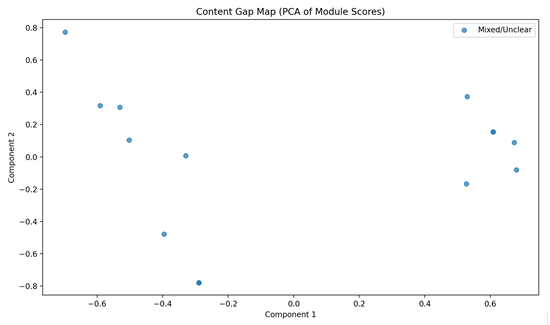
But the question is how can we analyse and take the implementation steps for achieving the CRSEO, so there are some set of different stages for analyzing the data sets.
Here I am providing step by by step procedure for getting the researched data outputs of each stages,
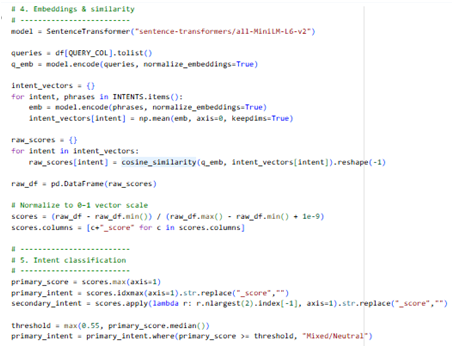
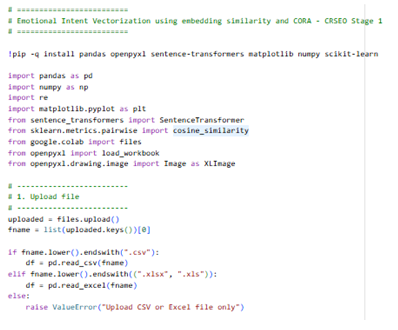
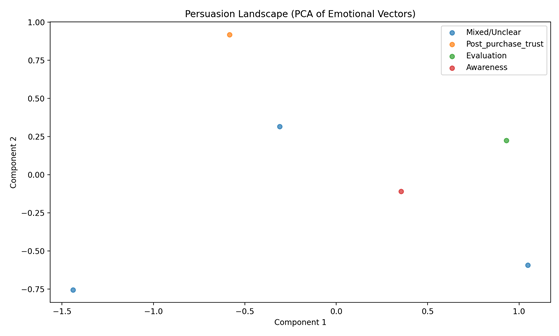
Stage 1: Emotional Intent Vectorization using embedding similarity and CORA – CRSEO
Identification of emotional intent vectors behind your audience’s searches
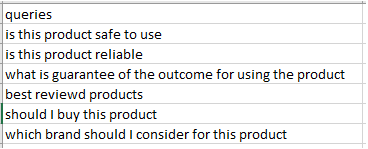
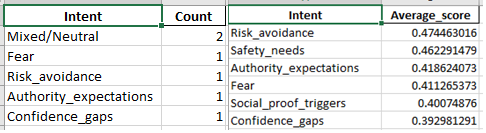
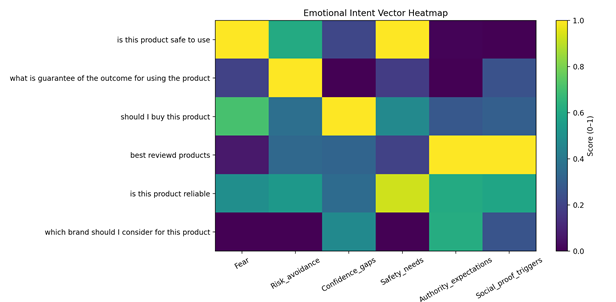
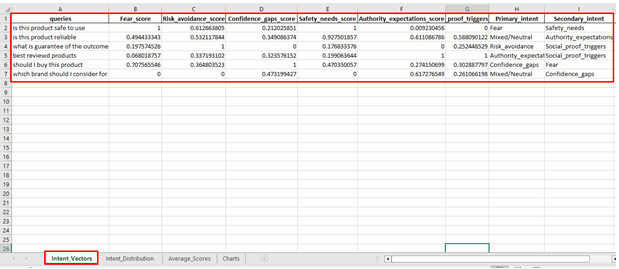
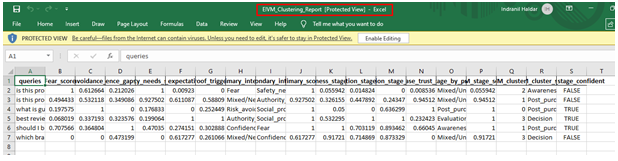
Here is the sample input: Where we have given set of search queries which is typically used on different platforms(Search Engine, LLMs, Social Media)
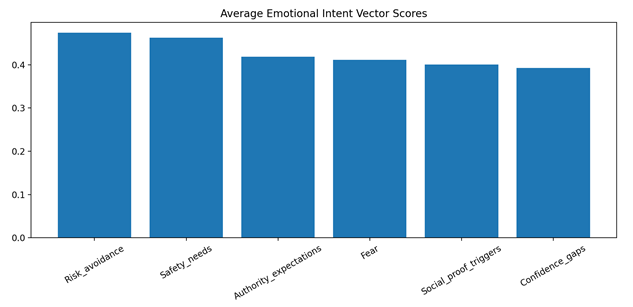
And here is the output of the analysis:
Implementation stage on the website content according to the emotional intent mapping:
Vector-based emotional intent scoring (not rules, not keywords)
Works across ANY business niche
Psychological intent dominance per query
Excel-ready intelligence for:
Content strategy
Conversion architecture
AI-search readiness foundations
Now based on the analysis and by getting the appropriate emotional intent behind a particular search, we can design the content accordingly to justify the emotional intent of the search by the user.
Authority signals close to CTA (certs, credentials, “trusted by”)
Strong “safety reassurance” around checkout/lead form
Post-purchase trust pages should look like:
Setup guides
Troubleshooting
Returns/refunds/warranty
“What to expect next”
Contact/support visibility
Implementation output: each stage becomes a specific page template.
Step 3: Convert emotional vectors into “content blocks” (reusable modules)
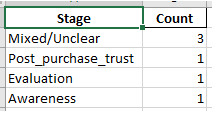
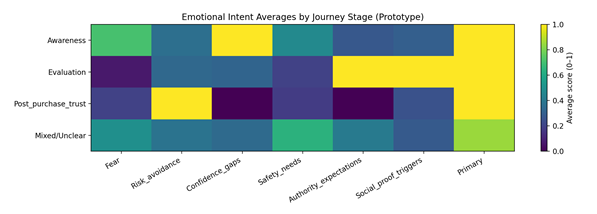
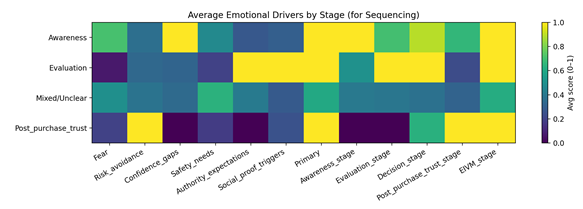
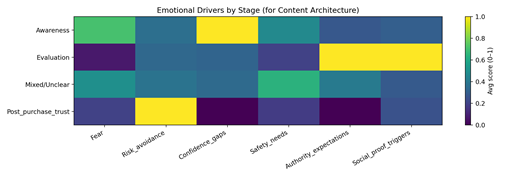
Use Emotion_Avg_By_Stage and also per-query _score to decide what blocks must appear.
If Fear is high:
Add:
“What could go wrong (and how we prevent it)”
Safety disclaimers
“Common worries” section
Transparent limitations
If Risk_avoidance is high:
Add:
Refund/return/guarantee block near CTA
“No-risk trial” framing
Pricing transparency
“Decision checklist” section
If Confidence_gaps is high:
Add:
Step-by-step guidance
“How to choose” quizzes
Explainers, “for beginners”
Comparison tables
If Safety_needs is high:
Add:
Security/privacy/compliance section
Trust badges (real ones)
Data handling explanations
“How we keep you safe” page
If Authority_expectations is high:
Add:
Credentials, certifications, authorship
Expert quotes
“As seen in / backed by”
Sources & references
If Social_proof is high:
Add:
Testimonials near decision points
Case studies
Review snippets + star rating schema where valid
Community proof (“10,000+ users”)
Implementation output: a block library mapped to intent.
Step 4: Fix drop-offs by stage (conversion tuning)
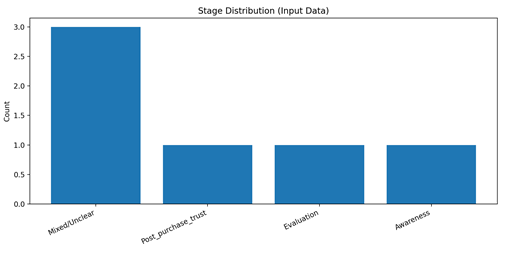
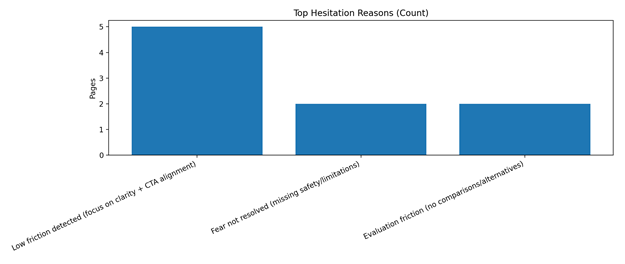
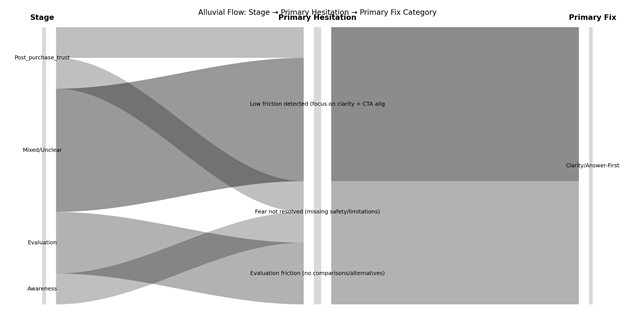
Use stage + emotion to fix the “why users hesitate” point:
If Decision + Risk_avoidance high → the CTA is too early; add guarantee, FAQs, pricing clarity
If Evaluation + Authority high → you need stronger proof (expertise, citations, “how we do it”)
If Awareness + Confidence gaps high → simplify language, add guided flows
Implementation output: conversion improvements that are psychological, not cosmetic.
A simple way to operationalize this:
Export top 50 queries per stage
For each stage:
pick top 10 queries by stage score
build/refresh 1 page template + 2 content blocks
Track changes in:
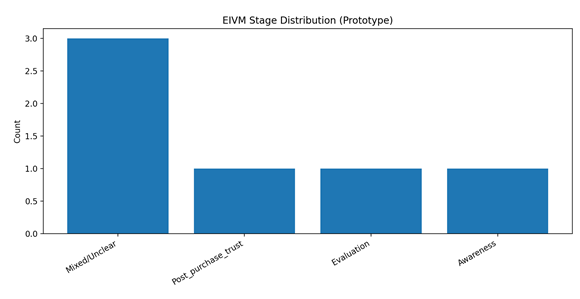
stage distribution shift
average fear/risk scores
conversions by stage pages
Stage 3: AI Logical Flow Path Modeling– CRSEO
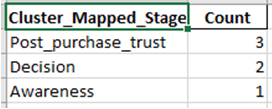
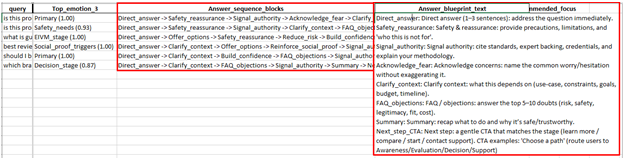
Input: Upload the EMV cluster file which you have got from the experiment module 2 (CRSEO stage -2)
What this Module 3 delivers (in output)
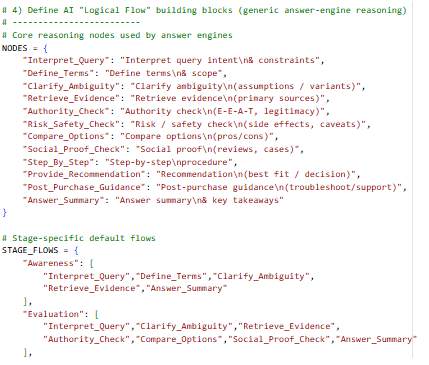
AI Logical Flow Path Modeling per query:
How an AI system is likely to:
interpret the query
decide what it needs (definitions, steps, comparisons, proof, safety)
choose authoritative sources
compose the final answer
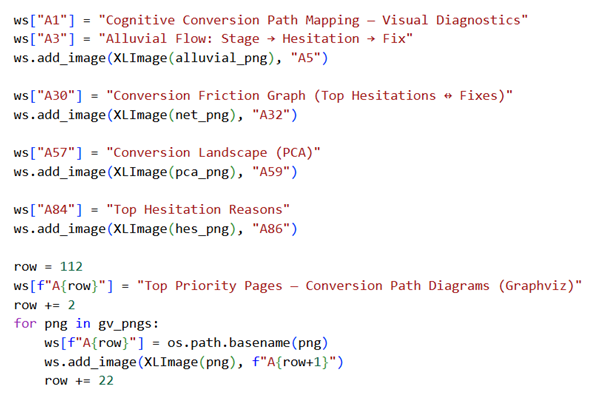
Diagrammatic flow models:
Flow diagrams per Stage and per Cluster-Stage
Each diagram highlights the “reasoning steps” emphasized by the emotional vectors (Fear/Risk/Authority/Social proof etc.)
Implementation-ready recommendations:
For each stage/cluster: “what to add on the page” so AI answer engines pick you (E-E-A-T signals, citations, FAQs, schema hints, trust anchors, comparisons, etc.)
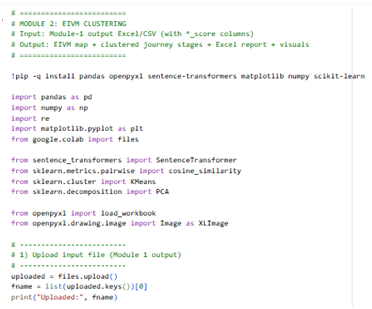
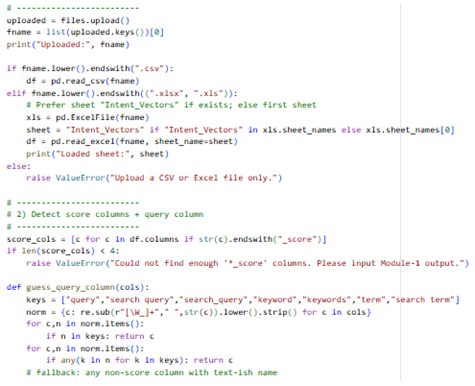
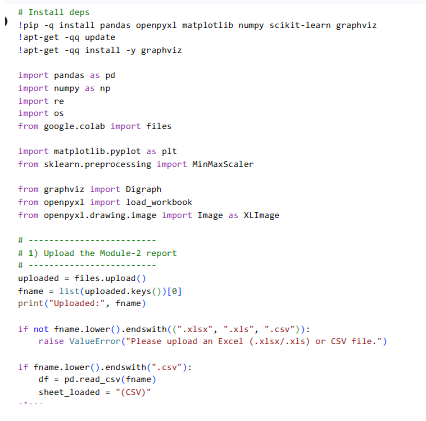
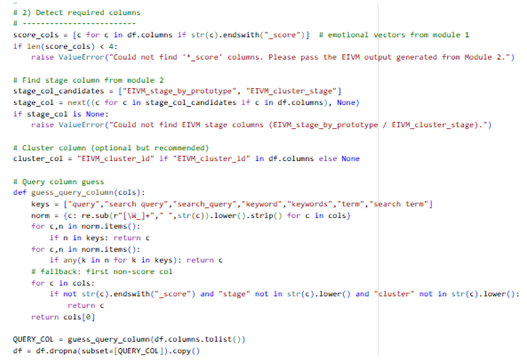
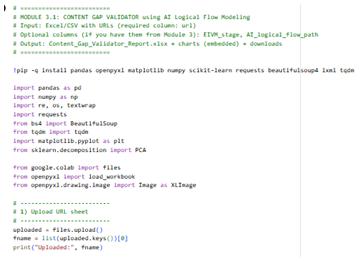
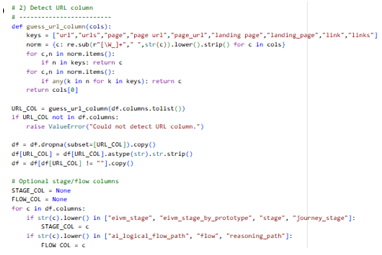
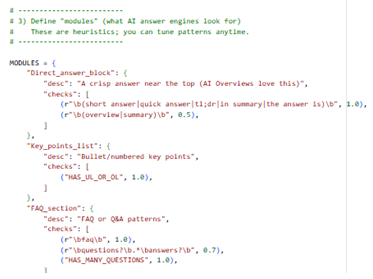
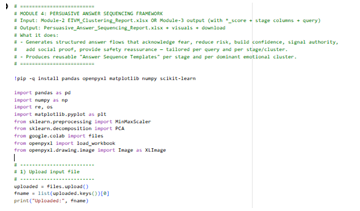
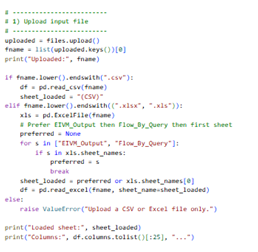
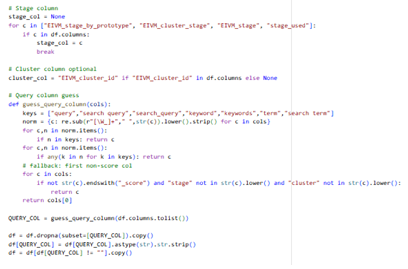
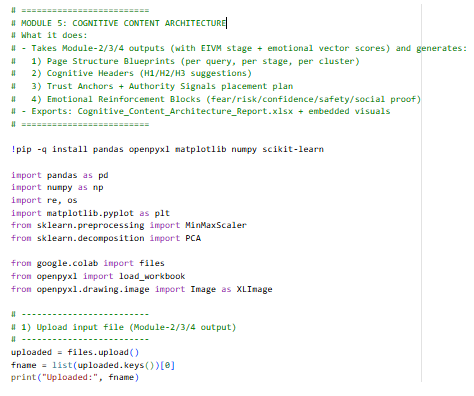
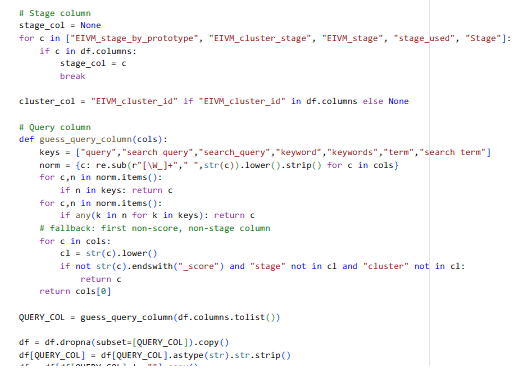
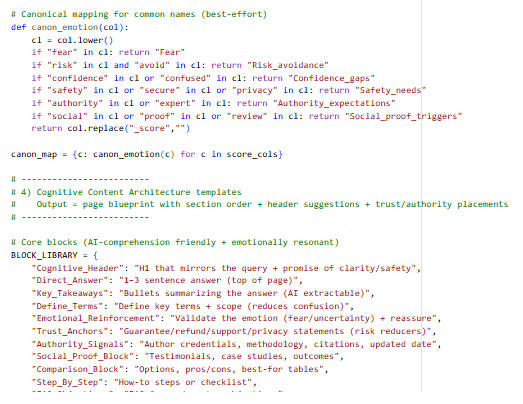
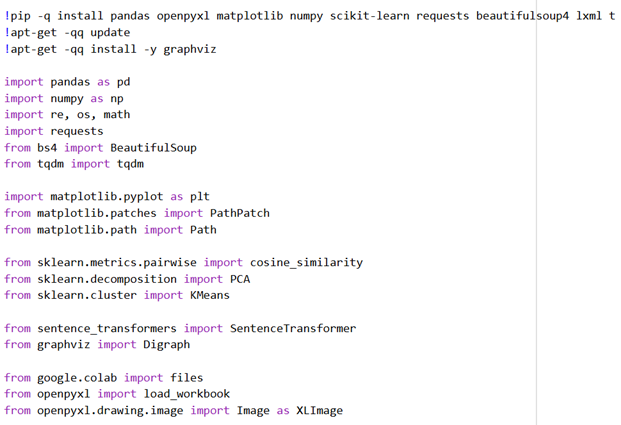
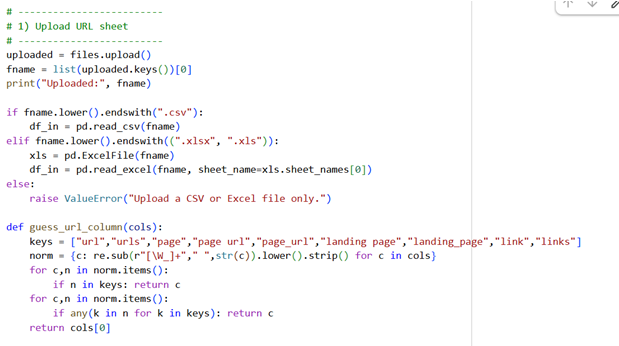
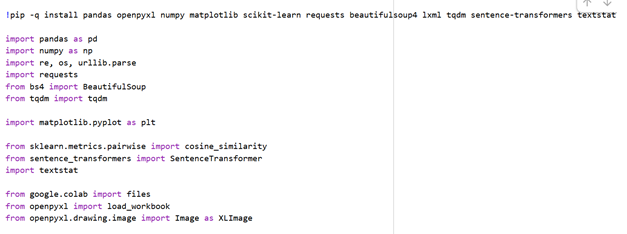
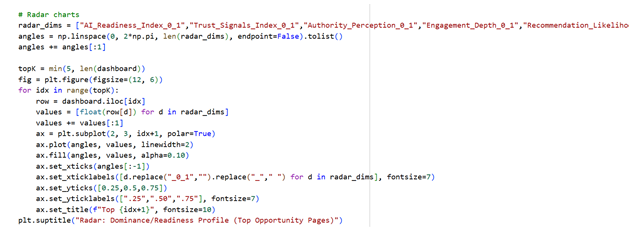
Here is the following Code Example:
Here is the following Google Colab experiment link:
This aligns your pages with how AI systems rank answers (they look for: direct answer, structured steps, evidence, authority, constraints, comparisons, and trust signals).
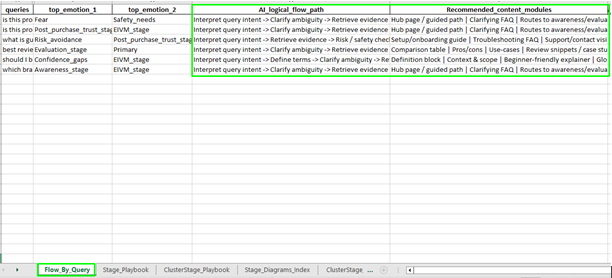
2) Use Flow_By_Query to drive content creation
Pick the top queries and implement the exact modules suggested in:
Recommended_content_modules
AI_logical_flow_path
Example:
If flow emphasizes Authority_Check + Retrieve_Evidence → add:
author bio + credentials
citations (primary sources)
methodology
“last updated” freshness
If flow emphasizes Risk_Safety_Check → add:
“Risks & how we mitigate” section
clear caveats
refund/warranty/support information near CTAs
3) Use the diagrams to structure your pages in AI-friendly order
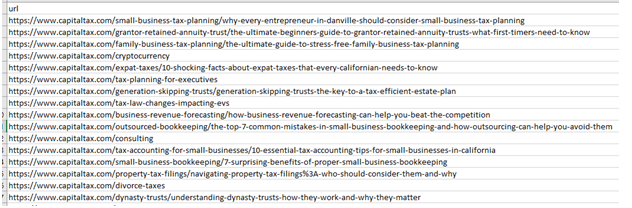
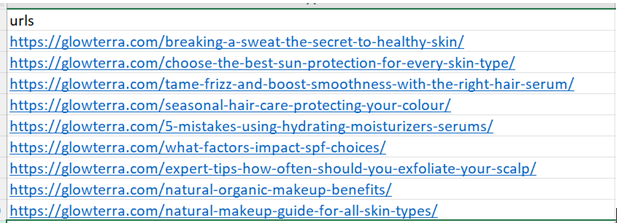
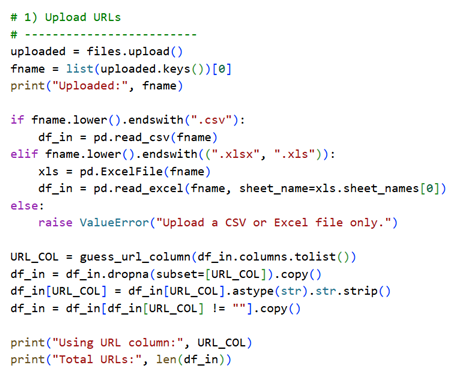
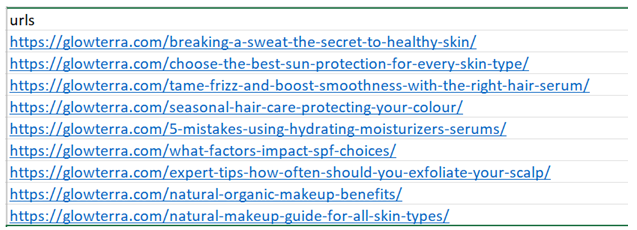
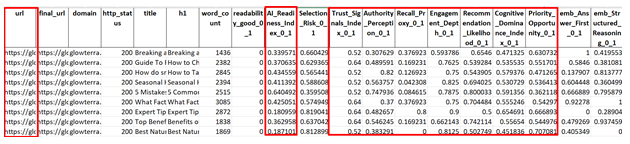
INPUT: Upload an Excel/CSV with a column containing URLs (e.g., url, URLs, page_url, link)
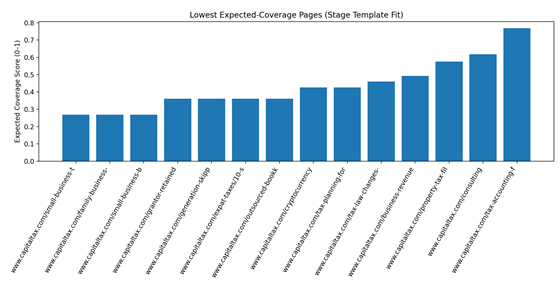
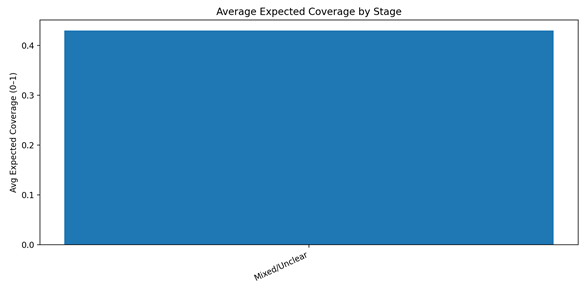
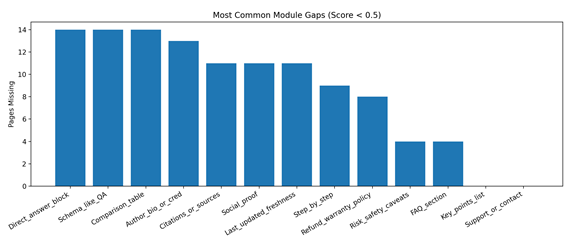
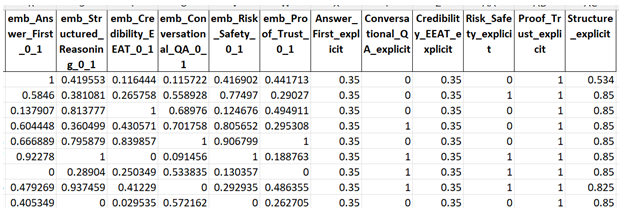
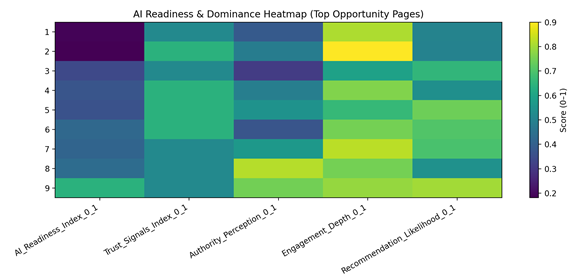
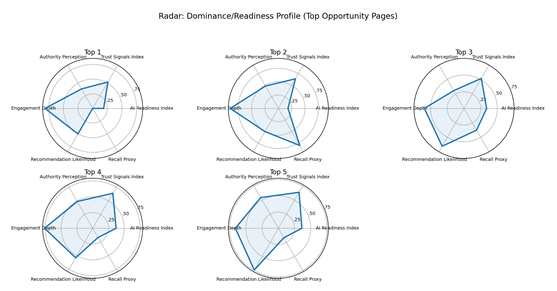
Here is the output:
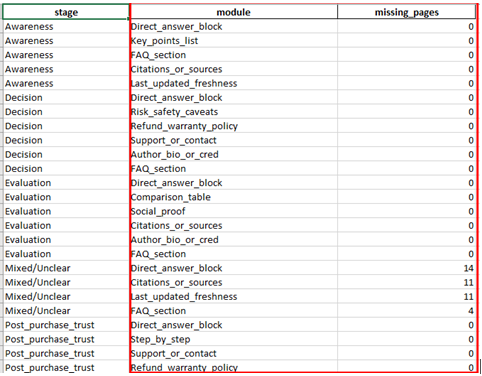
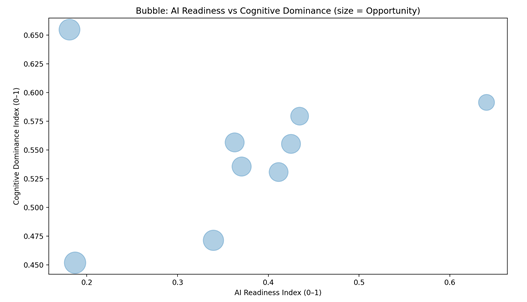
Below are actual, do-this-now action steps that are directly driven by the output columns/sheets from Module 8 (AI Search Readiness) and Module 9 (Cognitive Dominance Dashboard).
1) Start with the right sheet (what to do first)
Sheet: Fix_Plan_By_URL
Sort by:
Priority_Opportunity_0_1 (DESC)
Action: Work top → down. This sheet already gives you the “what to change” per URL.
2) Execution rules by score (the “if score then do” system)
A) If AI_Readiness_Index_0_1 < 0.65
Your content is not framed for AI selection.
Do these edits on the page (in this exact order):
Add Direct Answer block at the top (1–3 lines)
Add Key Takeaways bullets (3–6 bullets)
Add FAQ section (6–12 questions)
Add FAQPage schema (JSON-LD)
Add “Last updated” near top
B) If Selection_Risk_0_1 > 0.35
AI systems are likely to skip your page even if it ranks.
Do these edits (minimum set):
Add citations/sources beside key claims
Add author byline + credentials
Add Risks & limitations / Who-not-for section
Add internal links to next-step pages (explained below)
C) If Credibility_EEAT_explicit < 0.60 OR Trust_Signals_Index_0_1 < 0.60
Your page lacks trust signals.
Add these blocks (visible, not footer-only):
Author box with credentials
Editorial policy / review process link
Sources/References section (and inline citations)
Last updated
If it’s product/service: support + refund/warranty block
D) If Conversational_QA_explicit < 0.60
You’re not “answer-engine friendly”.
Fix:
Rewrite key sections into Q → A mini blocks
Add FAQ where every question mirrors how users ask in chat:
“Is it safe?”
“What if it doesn’t work?”
“How long does it take?”
“Who is it for / not for?”
E) If Risk_Safety_explicit < 0.60
You’re missing reassurance (major reason for AI and user drop-offs).
Add this exact block before CTA:
“Risks & Limitations”
what can go wrong
who should avoid
mitigation steps
what you do to keep it safe/privacy-compliant
F) If Proof_Trust_explicit < 0.60 OR Recommendation_Likelihood_0_1 < 0.60
You’re missing proof signals.
Add near CTA + near key claims:
3–6 testimonials (specific outcomes)
1–2 short case studies (before/after)
“Trusted by” proof (logos/metrics)
G) If Structure_explicit < 0.60
Your page isn’t “machine-readable”.
Add:
More H2/H3 sections (clear headings)
At least one:
table (comparison/decision matrix) or
ordered step list
Short paragraphs + bullets
3) Build the “AI Selection Layout” (one template you apply everywhere)
When you edit any URL, force this structure:
Direct Answer (top)
Key Takeaways (bullets)
Explanation / steps
Authority proof (author + citations)
Risk & limitations
Social proof
FAQ objections
CTA
This layout directly improves:
Answer_First
Credibility_EEAT
Conversational_QA
Risk_Safety
Proof_Trust
4) Internal linking steps (based on readiness + dominance)
Use Per_URL_AIO_Readiness and your page type logic:
Rule: every page must link forward.
Educational → link to comparison
Comparison → link to pricing/decision
Decision → link to support/trust
Action:
If sig_internal_links is low OR your int_links < 5, then:
Add a Next step block with 3 internal links:
“Compare options”
“See pricing / book”
“Support / policies”
This increases:
AI comprehension
Engagement_Depth_0_1
Recommendation_Likelihood_0_1
5) How leadership should read the dashboard
Sheet: Cognitive_Dominance_Dashboard
Use these decisions:
If Cognitive_Dominance_Index_0_1 is high BUT AI_Readiness_Index_0_1 is low
You’re strong as a brand, but AI won’t select you.
Action: Add Answer-first + schema + citations to make AI pick you.
If AI_Readiness_Index_0_1 is high BUT Trust_Signals_Index_0_1 is low
6) The simplest action plan per URL (what your team should literally do)
For every URL in the top of Fix_Plan_By_URL:
Implement every missing evidence signal where:
has_direct_answer = 0 → add Direct Answer block
has_author = 0 → add Author block
has_sources = 0 → add Sources + inline citations
has_last_updated = 0 → add Last updated
has_social_proof = 0 → add Proof block
has_risk_safety = 0 → add Risks & limitations
has_faq = 0 → add FAQ
has_jsonld = 0 → add schema
Re-run module after updates and track:
AI_Readiness_Index_0_1 should move toward 0.75+
Selection_Risk_0_1 should drop below 0.25
Trust_Signals_Index_0_1 should rise above 0.70
CRSEO Deliverables
ID
Layer / Workstream
Deliverable / Scope of Work
Objective / Why it matters
Suggested phase
Cadence
KPI / acceptance criteria
Dependencies
CR-01
Intent intelligence
Cognitive Intent Intelligence Report
Decode how users think, hesitate, and evaluate so the content strategy aligns with cognitive and emotional demand — not just keyword demand.
0-30 days
Quarterly or after major offer / market change
At least 90% of priority queries mapped to a dominant intent pattern and recommended page type
Keyword research; audience inputs
CR-02
Emotion modeling
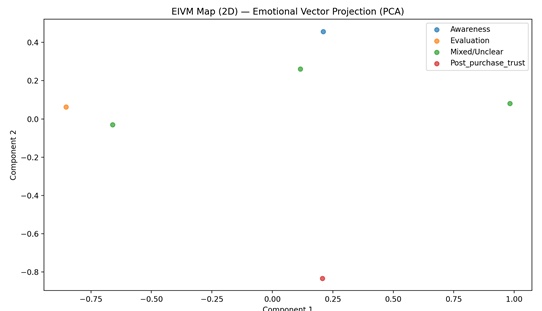
Emotional Intent Vector Map (EIVM)
Convert queries into measurable vectors such as fear, risk avoidance, confidence gap, safety need, authority expectation, and social proof demand.
0-30 days
Quarterly
Every target query receives a usable emotion profile that can drive message and proof selection
CR-01
CR-03
Journey clustering
EIVM Cluster & Journey Stage Matrix
Group emotionally similar queries into awareness, evaluation, decision, and post-purchase trust journeys so the wrong page type is not served to the wrong mindset.
0-30 days
Quarterly
All priority clusters assigned to a journey stage with a recommended content archetype
CR-02
CR-04
Reasoning alignment
AI Logical Flow Path Modeling
Design the exact answer order AI systems and humans expect: direct answer, clarification, evidence, authority, comparison, social proof, and summary.
0-30 days
Per page redesign cycle
Priority pages have a documented reasoning sequence and missing modules list
CR-01 to CR-03
CR-05
Content audit
Content Gap Validation Report
Identify missing answer blocks, proof modules, FAQs, citations, author signals, and limitations that weaken AI selection and user confidence.
0-30 days
Monthly for priority pages
Top pages have a gap severity score and ranked remediation queue
CR-04
CR-06
Message architecture
Persuasive Answer Sequencing Framework
Sequence reassurance, risk reduction, clarity, authority, social proof, objection handling, and CTA so content converts without sounding overly salesy.
30-60 days
Per page / campaign launch
Priority templates include stage-matched persuasive sequence and objection FAQ
CR-02 to CR-05
CR-07
Page blueprinting
Cognitive Content Architecture Blueprint
Turn the intelligence layers into page blueprints with H1/H2 structure, trust anchors, authority blocks, and reinforcement modules.
30-60 days
Per cluster rollout
Blueprint exists for each high-value cluster and is ready for writers / SEO / UX
CR-02 to CR-06
CR-08
Authority layer
Brand Authority & Trust Signal Optimization Pack
Strengthen the signals that reduce doubt: author bios, citations, last-updated markers, guarantees, policy pages, and comparison proof.
30-60 days
Monthly audit for priority pages
Trust signal completeness score improves on target pages
CR-05 to CR-07
CR-09
Conversion intelligence
Cognitive Conversion Path Mapping
Explain where users lose confidence, what commitment triggers exist, and which page elements should be added beyond simple CTA changes.
30-60 days
Quarterly
Each priority URL has a documented hesitation point and next best intervention
CR-02 to CR-08
CR-10
Implementation backlog
AI Search Readiness Optimization Backlog
Translate insights into an execution backlog split by content, design, development, schema, and proof requirements.
30-60 days
Biweekly sprint planning
Backlog is prioritized by impact, effort, and stage fit
CR-05 to CR-09
CR-11
Measurement
Cognitive Dominance Metrics Dashboard
Track resonance quality, module coverage, trust-signal adoption, AI visibility lift, and conversion movement by emotional cluster.
60-90 days
Monthly
Dashboard reports movement at page, cluster, and journey-stage level
CR-10
CR-12
Governance
Quarterly Resonance Refresh Playbook
Create a repeatable operating rhythm for refreshing vectors, stages, proofs, and page sequencing as behavior shifts.
>90 days / ongoing
Quarterly
Quarterly refresh cycle completed with documented deltas and action items
CR-11
Conclusion: The Future of Search Belongs to Resonance
Search is no longer a technical race of keywords, backlinks, and rankings. That era has reached its ceiling. In today’s AI-driven, overcrowded digital ecosystem, being visible is easy—but being trusted is rare. The real challenge is no longer algorithmic optimization; it is psychological alignment.
Modern search fails when three critical forces operate in isolation:
Humans search emotionally
AI responds logically
Brands persuade psychologically
When these layers don’t align, search results may rank, but they don’t resonate. Users may click, but they don’t remember. They may convert, but they don’t trust—or recommend.
This is exactly where CRSEO (Cognitive Resonance Search Optimization) changes the paradigm.
CRSEO binds:
Human emotion, by decoding emotional intent vectors like fear, risk avoidance, confidence, and safety
AI reasoning, by aligning content with logical flow paths used by AI systems to construct answers
Brand psychology, by embedding authority, reassurance, and social proof directly into the search experience
When these three layers operate in synchronization, search stops being transactional and starts becoming relational.
The result is not just better rankings, but:
Trust that reduces resistance
Recall that outlives a single search session
Authority that AI systems and humans both recognize
Cognitive dominance, where your brand occupies mental space—not just SERP space
The future of search will not be won by those who chase algorithms, but by those who understand how humans think, how AI reasons, and how brands influence belief.
Not just visibility—but cognitive dominance.
FAQ
CRSEO is a search intelligence framework that aligns human emotional intent, AI reasoning, and brand psychology to build trust, authority, and long-term dominance in AI-driven search environments.
Traditional SEO focuses on keywords, rankings, and traffic. CRSEO focuses on belief—optimizing emotional intent, AI answer logic, and psychological trust signals rather than just visibility.
Because AI-generated answers, summaries, and conversational search often bypass rankings entirely. Users choose brands they trust, not just those that rank highest.
They are psychological drivers behind searches, such as fear, risk avoidance, confidence, safety, authority, and social proof—factors that directly influence decisions.
CRSEO aligns content with AI logical flow paths, increasing the likelihood that AI systems select, summarize, and recommend the brand accurately and confidently.
No. Keywords become supporting inputs, but CRSEO prioritizes emotional and cognitive alignment over isolated keyword targeting.
By reducing psychological friction, addressing fear early, and reinforcing confidence, CRSEO improves conversion quality—not just conversion volume.
CRSEO is especially effective for high-trust and high-risk decisions such as SaaS, B2B services, finance, healthcare, legal, and enterprise solutions—but applies to any brand competing for belief.
Success is measured through trust growth, authority reinforcement, recall improvement, AI selection consistency, and cognitive dominance—not just traffic or rankings.
Yes. CRSEO is designed for AI-driven discovery systems where trust, reasoning alignment, and psychological resonance matter more than algorithmic manipulation.
Summary of the Page - RAG-Ready Highlights
Below are concise, structured insights summarizing the key principles,
entities, and technologies discussed on this page.
Search rankings are no longer a reliable growth indicator. In an AI-driven search environment, brands may rank, appear, or even be summarized—yet still fail to earn trust, recall, or recommendation. Human users search emotionally, AI answers logically, and brands convert psychologically, but these layers remain misaligned. The result is high visibility with low belief, unstable conversions, and fragile brand authority. Traditional SEO metrics mask this risk, leaving brands exposed to volatility, distrust, and declining long-term impact.
The shift from keyword-based SEO to AI-driven search has created a structural gap. While AI systems prioritize logical reasoning and probability, users make decisions emotionally—seeking safety, confidence, and reassurance. Brands attempt to bridge this gap using marketing psychology, but without alignment to AI reasoning, the experience breaks. Cognitive Resonance SEO (CRSEO) emerges as a response to this transition, focusing on aligning emotional intent, AI logic, and brand psychology to reduce friction, hesitation, and distrust across the search journey.
Cognitive Resonance SEO (CRSEO) redefines search optimization by synchronizing human emotional intent, AI reasoning paths, and brand psychology into a single system. Instead of optimizing for keywords or rankings, CRSEO optimizes for emotional intent vectors, AI logical flow paths, and persuasive answer sequencing. The outcome is not just visibility, but trust, recall, authority, and cognitive dominance. In a world where AI controls discovery, CRSEO positions brands to be believed—not just seen.
Tuhin is recognized across the globe for his vision to revolutionize digital transformation industry with the help of cutting-edge technology. He won bronze for India at the Stevie Awards USA as well as winning the India Business Awards, India Technology Award, Top 100 influential tech leaders from Analytics Insights, Clutch Global Front runner in digital marketing, founder of the fastest growing company in Asia by The CEO Magazine and is a TEDx speaker and BrightonSEO speaker.