SUPERCHARGE YOUR ONLINE VISIBILITY! CONTACT US AND LET’S ACHIEVE EXCELLENCE TOGETHER!
Hiring an SEO agency used to be relatively straightforward.
You would ask about rankings, backlinks, content, technical audits, keyword research and reporting.
Hiring a GEO agency is different.
Generative Engine Optimization sits at the intersection of search, semantic understanding, entity optimization, structured information, AI retrieval, citations and brand authority. A company may be excellent at conventional SEO and still lack the technical or strategic capabilities required for generative search.
That matters because buyers are increasingly discovering businesses through AI-generated answers.
They are asking platforms questions such as:
“Which companies provide enterprise SEO?”
“Who offers generative AI search optimization?”
“What agencies specialize in AI visibility?”
“Which providers should I consider for GEO?”
In these environments, visibility is not determined only by where your webpage ranks.
AI systems may need to understand your brand, retrieve your information, connect your company with the right entities, trust the available evidence and consider your business relevant enough to mention, cite or recommend.
That means choosing a GEO agency India requires a different evaluation framework.
The right question is not simply:
“Can this agency improve our SEO?”
It is:
“Can this agency improve how AI systems discover, understand, cite and recommend our brand?”
This guide explains what businesses should examine before hiring a generative engine optimization agency India, what warning signs to avoid and which capabilities genuinely matter.
First, Understand What a GEO Agency Should Actually Do
Before comparing providers, businesses need a clear idea of what professional GEO work should involve.
GEO stands for Generative Engine Optimization.
It focuses on improving the way brands and content are represented within AI-generated search experiences.
That can include platforms and environments where AI systems:
- synthesize answers
- recommend companies
- compare products
- retrieve supporting information
- cite sources
- summarize categories
- answer conversational questions
A capable GEO company India should therefore work beyond conventional keyword optimization.
ThatWare’s current GEO framework, for example, combines traditional SEO with semantic SEO, entity optimization, structured data, technical SEO, LLM-focused optimization and AI citation readiness.
GEO Is Not Just Traditional SEO With a New Label
One of the biggest mistakes businesses can make is assuming every SEO agency automatically qualifies as a GEO provider.
Traditional SEO and GEO overlap, but they are not identical.
Traditional SEO Often Focuses On
- rankings
- keywords
- backlinks
- traffic
- indexation
- technical performance
GEO Also Needs to Consider
- AI retrieval
- brand entity understanding
- semantic relationships
- citations
- AI-generated recommendations
- knowledge graph signals
- conversational intent
- answer synthesis
- LLM visibility
This is why evaluating a GEO SEO agency requires more than reviewing historical Google ranking screenshots.
1. Ask How the Agency Defines GEO
This is the fastest way to separate serious practitioners from agencies using GEO as a marketing term.
Ask:
“What exactly do you mean by Generative Engine Optimization?”
A strong answer should discuss more than content creation.
It should involve areas such as:
- entity understanding
- semantic relevance
- structured data
- AI retrievability
- citation readiness
- topical authority
- answer-oriented content
- external validation
- AI visibility measurement
If the agency simply says:
“We optimize keywords so ChatGPT ranks your website.”
That should raise concerns.
AI answer systems do not function exactly like traditional search rankings.
A credible GEO consulting company should be able to explain the difference clearly.
2. Check Whether the Agency Understands Entity SEO
Entities are fundamental to generative search.
An AI system needs to determine:
Who is this company?
What does it do?
Which products or services does it provide?
Which topics is it associated with?
Which experts are connected with it?
What external sources validate those relationships?
This means a serious AI search optimization agency India should understand entity optimization deeply.
Ask whether the agency evaluates:
- organization entities
- founders
- executives
- products
- services
- locations
- expertise areas
- schema relationships
- external entity mentions
If entity optimization is absent from the GEO methodology, the strategy may be incomplete.
3. Evaluate Their Knowledge Graph Capabilities
A good GEO strategy should help machines understand relationships.
For example:
Company → provides → Service
Company → founded by → Person
Person → specializes in → Topic
Service → solves → Problem
Company → operates in → Region
These connections create context.
ThatWare’s GEO framework specifically highlights knowledge graph development and entity network creation as part of improving AI understanding.
Ask potential GEO consultants India:
- Do you build or optimize entity graphs?
- How do you strengthen entity relationships?
- How do you identify ambiguity?
- How do you reinforce brand-category associations?
Weak answers usually indicate limited semantic-search capability.
Quote
“A GEO strategy is only as strong as the machine-readable understanding behind the brand.”
4. Ask How They Measure AI Visibility
This is one of the most important questions.
An agency should not tell you that GEO is working merely because it published more content.
You need measurable outcomes.
Ask the AI visibility agency India how it tracks:
- AI mentions
- citations
- recommendations
- prompt coverage
- competitor presence
- AI share of voice
- brand accuracy
- cross-platform visibility
If the agency does not have a measurement framework, its recommendations may become difficult to validate.
Look for Baseline Measurement
Before optimization begins, the agency should understand your starting position.
For example:
Your brand appears in 14% of relevant prompts.
Competitor A appears in 43%.
Your website is cited for informational topics but rarely recommended for commercial prompts.
That creates a baseline.
Without a baseline, there is no meaningful before-and-after comparison.
5. Ask How They Track AI Citations
Citations are an important part of generative search.
A capable generative AI optimization agency should be able to explain how it evaluates:
- current citations
- cited URLs
- missing citation opportunities
- competitor citation sources
- content formats earning citations
- citation consistency
ThatWare’s GEO positioning explicitly includes AI citation optimization and citation readiness among its service components.
Why Citation Strategy Matters
Being mentioned shows visibility.
Being cited can indicate that AI systems consider your information useful enough to reference.
That makes citation visibility an important part of GEO evaluation.
6. Ask How They Measure Recommendations
Recommendation visibility may be even more important commercially.
Suppose your customer asks:
“Which AI SEO agencies should I consider?”
Your company being included in that answer could be significantly more valuable than appearing in a generic explanation of SEO.
Ask whether the agency measures:
- recommendation frequency
- shortlist inclusion
- comparative mentions
- commercial prompt performance
- competitor recommendation visibility
Strong professional GEO services should distinguish informational visibility from recommendation visibility.
Q&A: Should a GEO Agency Guarantee ChatGPT Rankings?
Q: Is it reasonable for a GEO agency to guarantee a top position inside ChatGPT?
A: Be cautious with guarantees framed like traditional keyword rankings. Generative AI responses are dynamic and can change according to prompts, context, model updates and retrieval sources. A stronger agency should discuss visibility patterns, citations, recommendations and measurable prompt coverage rather than promising a permanent numerical position.
7. Examine Their Prompt Research Methodology
Generative search optimization depends heavily on how real people ask questions.
A good GEO marketing agency should not test only branded prompts such as:
“What is Company X?”
That proves little.
The agency should build prompt sets around different stages of intent.
Informational Prompts
“What is enterprise AI SEO?”
Problem-Based Prompts
“How can I improve brand visibility in ChatGPT?”
Commercial Prompts
“GEO agencies for enterprise businesses”
Comparison Prompts
“GEO vs traditional SEO”
Recommendation Prompts
“Which companies provide GEO services?”
This enables much better visibility analysis.
8. Review Their Semantic SEO Expertise
Generative engines operate heavily through meaning and context.
That means GEO services India should include strong semantic-search expertise.
Ask the provider how it handles:
- topical relationships
- entity associations
- contextual relevance
- semantic content structures
- subject completeness
- query variations
- related concepts
Keyword insertion alone is not enough.
The content needs to demonstrate subject understanding.
ThatWare’s GEO framework combines NLP, semantic SEO, entity authority and structured data rather than relying solely on keyword targeting.
9. Evaluate Their Structured Data Expertise
Schema does not guarantee AI visibility.
But accurate structured data can help clarify entities and relationships.
Ask whether the agency evaluates:
- Organization schema
- Person schema
- Service schema
- Product schema
- Article schema
- Breadcrumb schema
- FAQ-related structured information where appropriate
- sameAs relationships
- author attribution
A technically capable GEO SEO agency should know where structured data is useful and where it is being overused.
10. Ask About AI Retrieval Optimization
Generative engines need to retrieve useful information before they can synthesize it into an answer.
That means the agency should understand how content structure affects retrieval.
Questions to ask include:
- How do you make content easier to retrieve?
- How do you structure factual information?
- How do you improve semantic relevance?
- How do you strengthen answer-ready passages?
- How do you improve content hierarchy?
A credible AI search consulting company should be comfortable discussing these topics.
Quote
“Publishing content is not the same as making information easy for AI systems to retrieve, interpret and reuse.”
11. Ask How GEO Integrates With Traditional SEO
Be cautious of agencies claiming SEO is dead.
Traditional search remains important.
A strong generative engine optimization agency India should understand that GEO and SEO operate together.
ThatWare’s public GEO framework similarly positions GEO as an additional AI-specific optimization layer rather than a complete replacement for SEO.
Your provider should understand:
- technical SEO
- indexing
- crawlability
- content strategy
- backlinks
- authority
- search intent
- conversions
while also addressing:
- AI mentions
- AI citations
- entity optimization
- generative recommendations
12. Check Whether the Agency Has an Audit Process
Before proposing a strategy, a professional GEO agency India should understand the current situation.
A GEO audit may examine:
- AI visibility
- existing mentions
- citations
- recommendation presence
- brand entity clarity
- structured data
- semantic gaps
- content structure
- competitor visibility
- external brand references
Be cautious of agencies immediately selling a fixed content package before analysing the brand.
13. Review How They Analyze Competitors
Generative search is competitive.
If your company is absent from an answer, another company may receive the visibility.
A good GEO consulting company should therefore evaluate:
- which competitors are mentioned
- which competitors are cited
- which competitors are recommended
- which sources support them
- what categories they dominate
- which commercial prompts trigger them
This provides more useful insight than generic competitor keyword lists.
Q&A: Should Competitor GEO Analysis Copy Their Content?
Q: If competitors receive AI citations, should a business reproduce the same content?
A: No. The goal is to understand why competitors are being retrieved or cited and identify gaps in your own authority, entity clarity or information usefulness. GEO should strengthen original value rather than create derivative content.
14. Evaluate Their Content Philosophy
Ask the agency:
“What type of content do you create specifically for generative search?”
A good answer may discuss:
- original research
- clear definitions
- expert commentary
- case studies
- comparison content
- FAQs
- data-led resources
- structured answers
- product information
- service explanations
A weak answer may simply be:
“We publish 20 AI-written blogs each month.”
Volume alone does not create authority.
15. Ask How They Establish Brand Authority
Generative visibility is not built only on your own website.
Machines may encounter your company across:
- media coverage
- interviews
- directories
- review platforms
- research papers
- industry websites
- podcasts
- social profiles
- partner sites
- knowledge sources
A competent AI visibility agency India should understand the role of external corroboration.
Ask:
“How will you strengthen our authority beyond our own domain?”
16. Ask About Brand Accuracy and Hallucination Monitoring
AI systems can sometimes produce inaccurate information.
A good GEO program should identify when:
- products are described incorrectly
- old services appear
- wrong executives are associated
- locations are inaccurate
- another business is confused with yours
Ask whether the agency monitors the accuracy of brand representation.
Strong GEO is not only about appearing more often.
It is about appearing correctly.
17. Examine Their Reporting Before Signing
Ask for a sample GEO report.
It should ideally contain more than page rankings.
Useful sections may include:
AI Visibility
How often the brand appears.
Citations
Which pages are being referenced.
Recommendations
Where the business is recommended.
Prompt Coverage
Which query categories generate visibility.
Competitive Share
How the brand compares with competitors.
Entity Accuracy
Whether the business is represented correctly.
Actions
What should happen next.
That is what professional GEO services should make measurable.
Q&A: How Often Should a GEO Agency Report?
Q: Should GEO reporting be monthly?
A: Monthly reporting is often practical for strategic review, although monitoring may occur more frequently. The important factor is consistent methodology. The agency should compare equivalent prompt sets and metrics rather than changing the measurement system every reporting period.
18. Understand What the Agency Can and Cannot Guarantee
No serious provider can control every AI-generated response.
Models change.
Retrieval sources change.
Platforms update.
Prompts vary.
Therefore, evaluate whether the agency communicates limitations clearly.
Strong GEO experts India should focus on increasing eligibility, visibility, authority, retrievability and entity clarity rather than promising permanent inclusion.
19. Check Whether They Understand Enterprise Complexity
Large organizations face additional GEO challenges.
An enterprise GEO agency may need to manage:
- thousands of URLs
- several business units
- multiple products
- international markets
- different languages
- executive entities
- regional sites
- subsidiaries
- separate analytics teams
Ask how the agency handles governance and prioritization.
A provider suitable for a local company may not necessarily be equipped for enterprise-scale GEO.
20. Ask About International GEO Capabilities
A brand’s AI visibility may differ significantly by market.
A good agency should understand:
- regional sources
- language differences
- local entity signals
- country-specific search behaviour
- international competitors
This becomes especially important for Indian companies targeting global markets.
Short Case Study 1: High Rankings but Poor AI Recommendations
Imagine a software company with strong traditional SEO.
Several important pages rank on page one.
However, an AI visibility audit shows that competitors dominate recommendation prompts.
A capable GEO company India would not immediately publish dozens of new articles.
The first step would be diagnosing why competitors are being recommended.
Possible findings might include stronger entity-category associations, better third-party authority or more useful citation assets.
The strategy would then address those gaps.
Short Case Study 2: Strong Mentions but Weak Brand Accuracy
Consider a professional-services company that appears frequently across conversational search.
The problem is that AI systems repeatedly describe an outdated service portfolio.
A capable generative AI optimization agency should recognize this as an entity and information consistency issue rather than celebrating the mention count.
The priority would shift toward correcting and reinforcing the brand’s current identity.
Quote
“The best GEO agency is not the one that produces the most content. It is the one that can explain why your brand is missing from AI answers and what evidence is needed to change that.”
Red Flags to Watch for When Hiring a GEO Agency
Some warning signs deserve attention.
They Guarantee Fixed ChatGPT Rankings
Generative answers are not stable SERPs.
They Talk Only About Keywords
Keywords still matter, but GEO requires more.
They Cannot Explain Entities
Entity understanding is fundamental to modern search.
They Have No Visibility Baseline
Without a baseline, meaningful measurement is difficult.
They Track Only Branded Prompts
This says little about genuine discovery.
They Cannot Explain Citation Strategy
AI citations are an important visibility signal.
They Provide No Competitor Analysis
Generative search is competitive.
Their Entire Strategy Is Publishing More Blogs
Content quantity is not a GEO strategy.
They Claim Traditional SEO Is Dead
Modern search needs both traditional and AI-search optimization.
What Questions Should You Ask a GEO Agency?
Before hiring, businesses should ask questions such as:
- How do you define GEO?
- How do you measure AI visibility?
- Which platforms do you monitor?
- How do you track AI citations?
- How do you track recommendations?
- How do you perform entity optimization?
- How do you use structured data?
- How do you analyse competitors?
- How do you build prompt datasets?
- How do you report progress?
- How does GEO integrate with SEO?
- How do you measure commercial impact?
- How do you address inaccurate AI information?
- How do you build external authority?
- How do you work with enterprise websites?
A credible GEO consulting company should be able to answer these questions clearly.
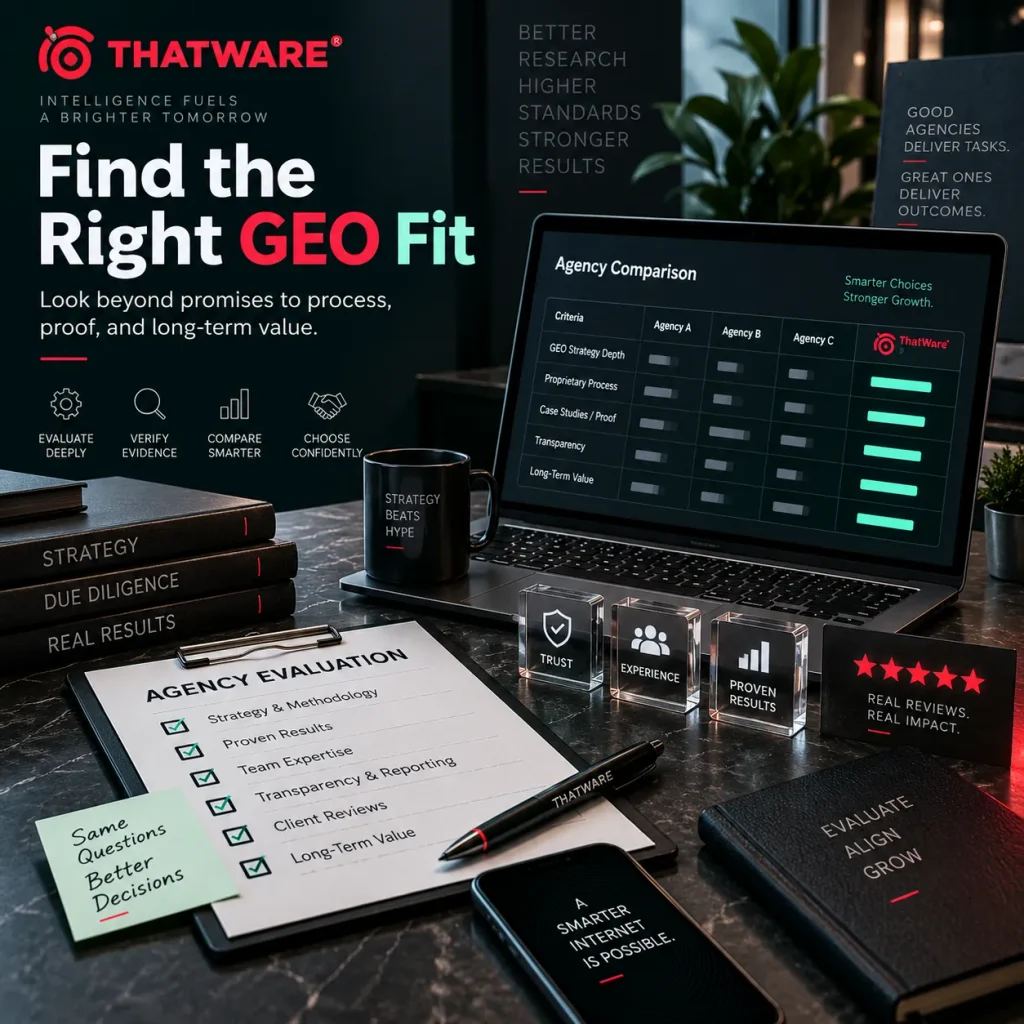
How Should Businesses Compare GEO Proposals?
Do not compare providers purely by monthly price.
Instead, compare scope.
Agency A
Offers:
- blogs
- backlinks
- keyword tracking
Agency B
Offers:
- AI visibility baseline
- prompt research
- entity audit
- citation analysis
- semantic optimization
- structured data
- competitive AI monitoring
- recommendation tracking
- GEO reporting
These are fundamentally different services.
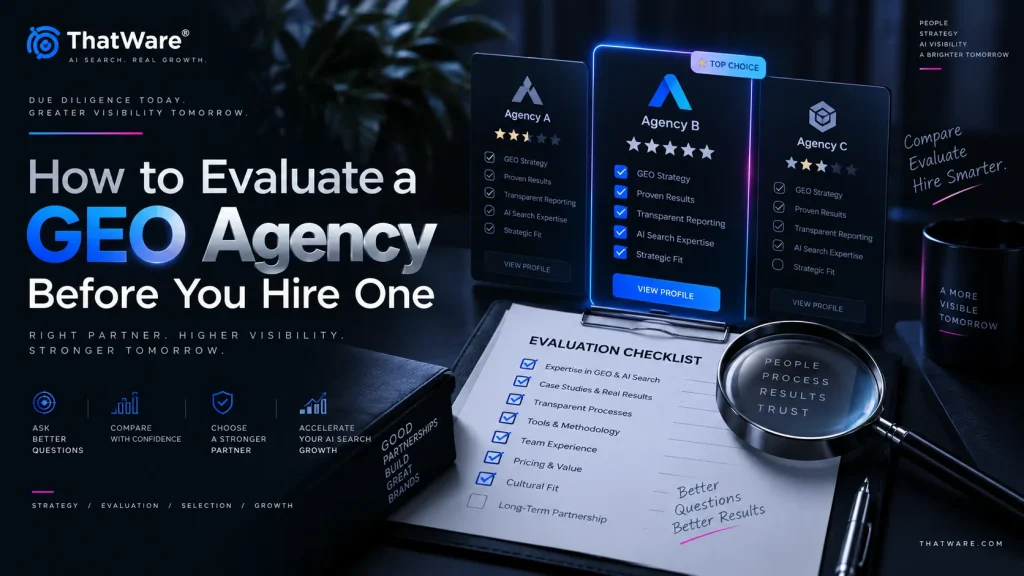
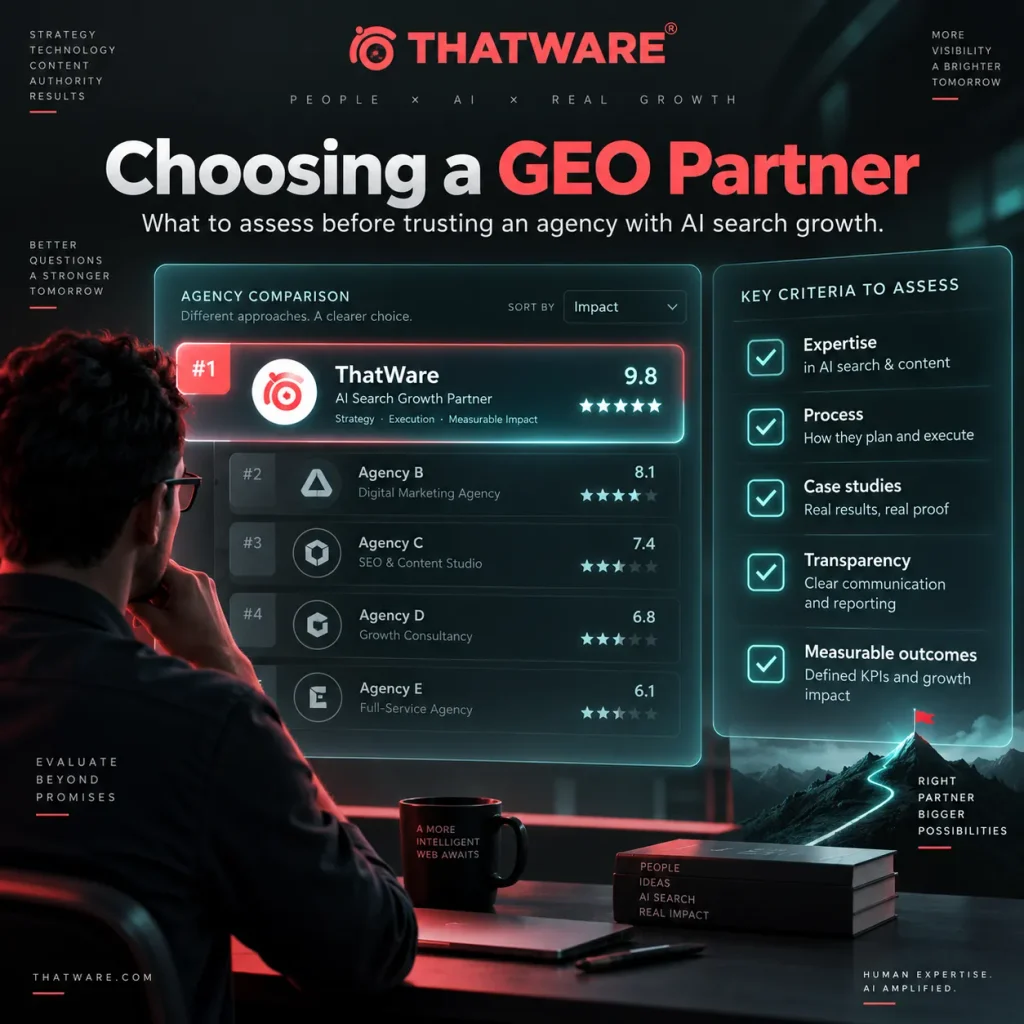
This is why businesses looking for the best GEO agency India should define “best” according to capability and fit rather than simply accepting promotional rankings.
Why Specialized GEO Expertise Matters
Generative search is developing quickly.
The agency should understand more than marketing terminology.
Strong GEO experts India should have working knowledge of:
- AI search behaviour
- semantic search
- NLP concepts
- entities
- knowledge graphs
- retrieval
- structured data
- LLM visibility
- content architecture
- traditional SEO
- competitive intelligence
That combination is what separates a specialist provider from a renamed SEO package.
Where ThatWare Fits Into This Evaluation Framework
ThatWare publicly positions its GEO services around AI visibility, generative answers, LLM environments and brand discovery rather than keyword rankings alone. Its methodology incorporates entity optimization, semantic search, knowledge graph development, structured data, technical SEO, content intelligence and citation readiness.
ThatWare also describes its broader GEO offering as including Generative Engine Optimization, Answer Engine Optimization, semantic search engineering, knowledge graph optimization, entity authority development and AI visibility optimization.
For businesses evaluating ThatWare or any other GEO marketing agency, these are the types of capabilities worth examining.
The goal should not be choosing the agency with the biggest promises.
It should be choosing one with a methodology that can be explained, measured and connected to your business objectives.
Hire for Search Intelligence, Not Buzzwords
GEO is still a developing discipline.
That makes vendor selection especially important.
Almost any agency can add “GEO” to its service page.
The harder part is demonstrating that it understands how generative systems interpret information, connect entities, retrieve sources, generate citations and decide which brands belong in an answer.
Before hiring a GEO agency India, ask for evidence of a structured methodology.
Look for expertise in:
GEO services India
semantic optimization,
entity architecture,
AI visibility measurement,
citation analysis,
recommendation tracking,
structured data,
competitive intelligence,
and conventional SEO fundamentals.
A strong AI search consulting company should be able to explain not only what it intends to do, but why each action could improve your brand’s position across generative search.
The question should never be:
“Who promises to put us in ChatGPT?”
A much better question is:
“Which agency can systematically improve the signals that help AI systems discover, understand, trust, cite and recommend our brand?”
That is the standard businesses should use when evaluating professional GEO services.