SUPERCHARGE YOUR ONLINE VISIBILITY! CONTACT US AND LET’S ACHIEVE EXCELLENCE TOGETHER!
For years, search performance was relatively straightforward to explain.
A business tracked keyword rankings, impressions, clicks, organic sessions, conversions, backlinks, and perhaps share of voice. If important keywords moved from page two to page one, SEO appeared to be working.
Answer Engine Optimization changes that measurement model.
A user can now ask Google AI Overviews, ChatGPT, Gemini, Perplexity, Copilot, or another AI-powered search interface a question and receive an answer without following the traditional journey of search result → website → conversion.
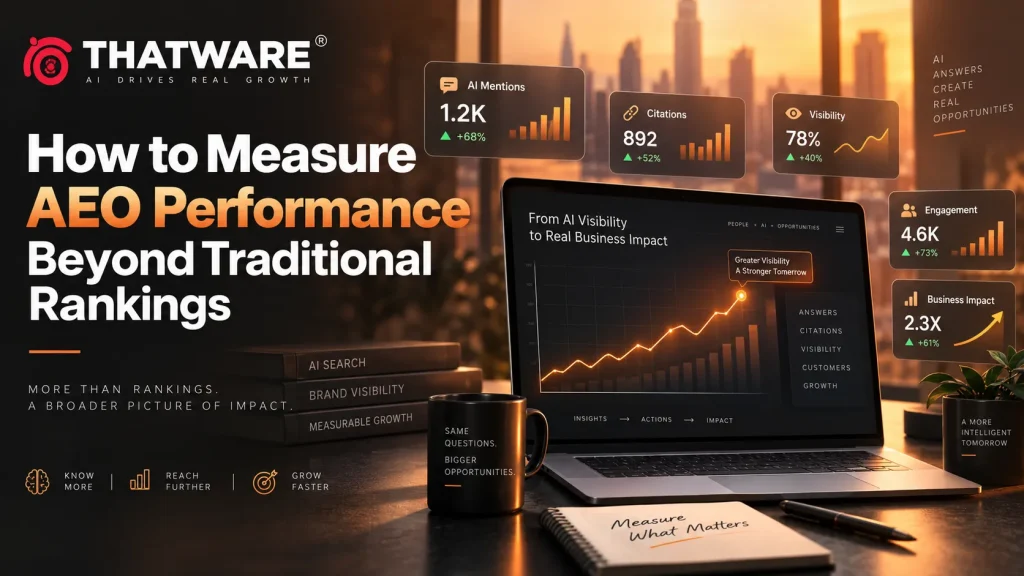
Your brand might be mentioned without receiving a click.
Your research might influence an AI-generated response without occupying a conventional number-one ranking.
A competitor could rank below you in Google yet appear more frequently in AI recommendations.
That means businesses need a new measurement question:
Are we becoming more visible, trusted, cited, and recommendable inside answer engines?
This is where modern AEO metrics, AEO analytics, AI visibility intelligence, and frameworks such as ThatWare’s AVM and VEM become important.
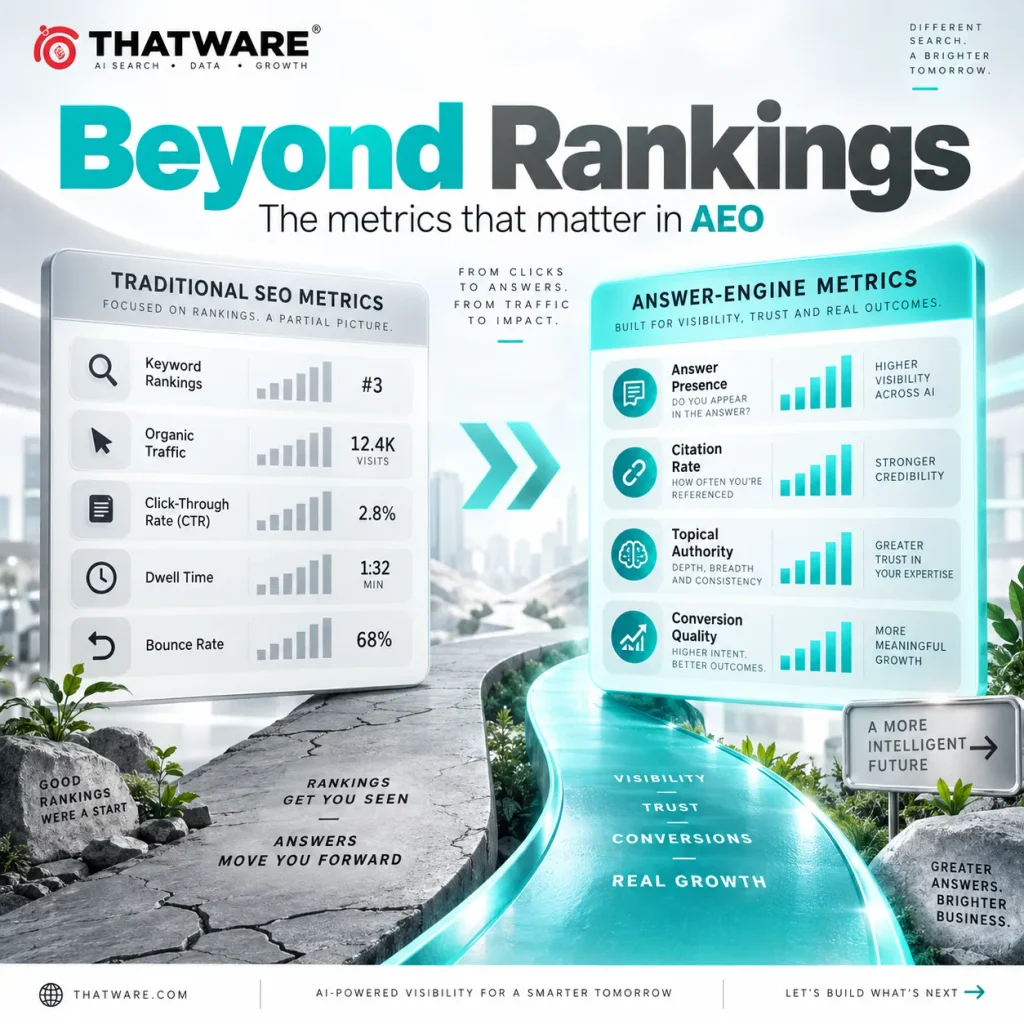
Traditional rankings still matter, but they tell only part of the story.
Modern AEO performance measurement must look at whether machines can find your information, understand it, extract it, cite it, associate it with the right entity, and use it when answering commercially relevant questions.
Why Traditional Rankings Cannot Fully Measure AEO Performance
Search rankings measure where a webpage appears for a particular query.
Answer engines behave differently.
Instead of simply displaying ten blue links, an AI system may:
- Interpret the user’s underlying intent
- Expand the query into related concepts
- Retrieve information from several sources
- Compare facts and entities
- Synthesize those sources
- Generate a direct answer
- Mention brands or experts
- Cite selected sources
- Recommend one or more options
A traditional ranking report cannot fully show what happens within that process.
This is why measuring AEO performance requires additional indicators.
You need to understand:
- Whether your brand appears in answers
- How frequently it appears
- For which prompts it appears
- Whether your website is cited
- How prominently your brand is positioned
- Whether the information about your company is accurate
- Which competitors appear alongside you
- Whether AI systems associate your brand with priority topics
- Whether visibility improves for commercial queries
- Whether answer visibility eventually supports leads and revenue
This creates the foundation of modern AEO measurement.
Quote: “A ranking tells you where a webpage appears. AEO measurement tells you whether the brand becomes part of the answer.”
What Does AEO Performance Actually Mean?
AEO performance refers to how effectively a brand’s information is discovered, interpreted, retrieved, cited, summarized, and presented within answer-driven search experiences.
That means an AEO program should not be judged exclusively by rankings.
Successful AEO can create several forms of visibility.
Direct Answer Visibility
Your information is selected to answer a user’s question.
Brand Mention Visibility
Your company, expert, service, product, or framework appears within an AI-generated answer.
Citation Visibility
Your website or another authoritative source associated with your brand is cited.
Recommendation Visibility
Your organization appears when users ask for providers, products, services, or solutions.
Entity Visibility
The answer engine correctly understands who your organization is and what it does.
Topic Association
Your brand becomes consistently associated with the subject areas that matter commercially.
Each of these should become part of your answer engine optimization metrics framework.
The Most Important AEO Metrics Businesses Should Track
There is no single AEO metric capable of explaining performance.
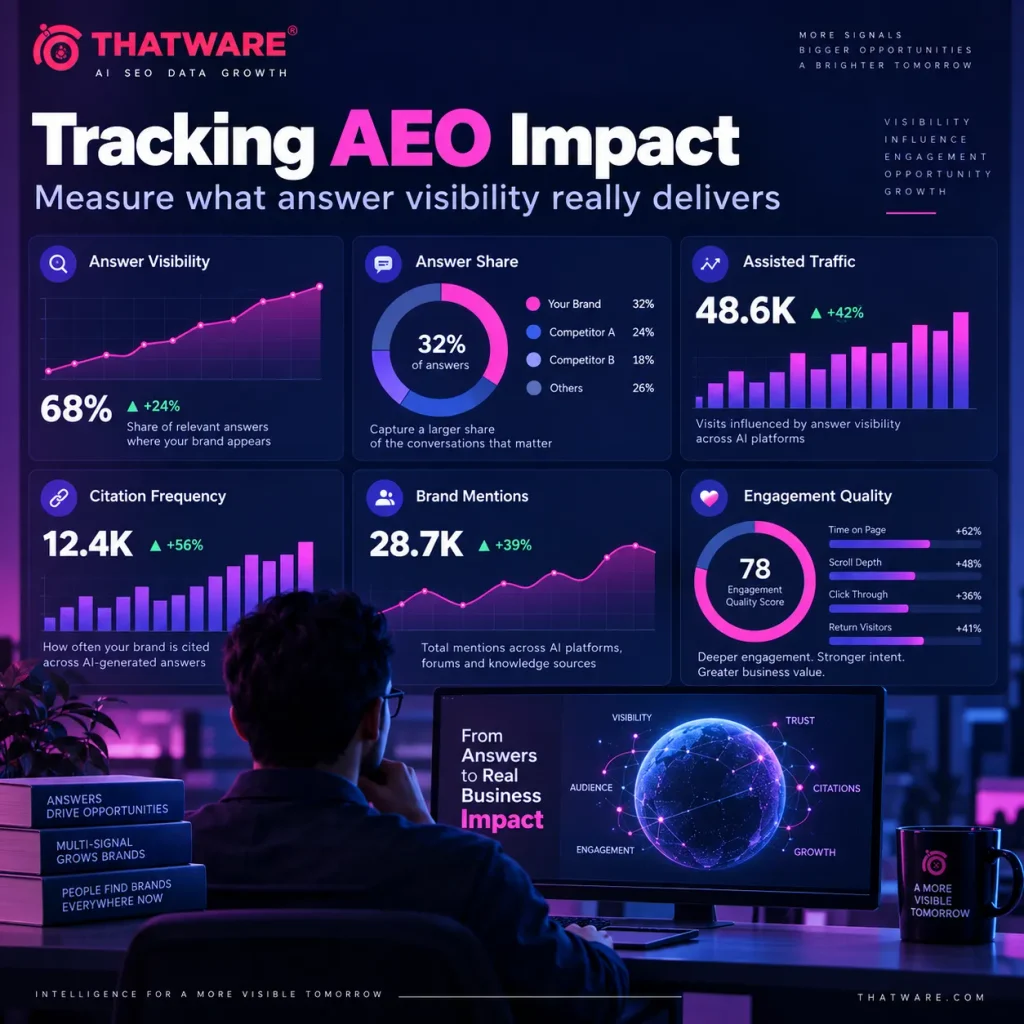
A useful measurement system combines visibility, citations, brand representation, entity signals, competitive data, and business outcomes.
1. AI Answer Presence
The first question is simple:
Does your brand appear at all?
AI answer presence measures whether your brand is included when answer engines respond to predefined prompts.
Suppose an SEO agency monitors 100 strategic prompts.
If it appears in 42 of those answers, the business has measurable answer presence across 42% of the tracked query set.
That alone does not tell you whether the mentions are strong, positive, prominent, or commercially useful, but it creates an important baseline.
This makes AI answer presence one of the foundational AEO metrics.
2. Answer Visibility Rate
Answer visibility rate measures how often your brand or content appears across a controlled set of target prompts.
A basic formula can be:
Answer Visibility Rate = Answers Featuring Brand ÷ Total Prompts Monitored × 100
For example:
Brand appears in 58 answers
Total monitored prompts = 100
Answer visibility rate = 58%
Tracking this regularly helps determine whether optimization is expanding the brand’s AI search footprint.
This is a central component of AEO visibility tracking.
3. AI Citation Frequency
A mention and a citation are not the same.
An AI platform may mention your company while referencing someone else’s website.
For AEO, businesses should therefore measure how often their own pages are cited or surfaced as supporting sources.
Modern AI citation tracking can examine:
- Domain citations
- Specific page citations
- Citation frequency
- Citation position
- Citation type
- Query category
- Competitor citations
- Citation gains and losses
A website appearing repeatedly as a cited source has a different visibility profile from a brand that receives occasional uncited mentions.
4. AI Brand Mention Frequency
AI mention tracking measures how frequently a company, product, founder, methodology, or service is explicitly named within AI-generated answers.
For example, a company could monitor:
- Brand mentions
- Founder mentions
- Product mentions
- Service mentions
- Proprietary framework mentions
- Research mentions
This matters because brand recall can occur even when the website itself is not cited.
A company may therefore experience increasing AI visibility before traditional referral traffic begins to show the full impact.
5. Citation-to-Mention Ratio
One useful diagnostic metric compares mentions with citations.
For example:
100 AI mentions
35 citations
Citation-to-mention ratio = 35%
This tells the business that AI systems recognize the brand but may not frequently use the company’s own digital assets as evidence.
That could indicate opportunities involving:
- Original research
- Better content architecture
- More evidence-rich pages
- Improved structured data
- Stronger authoritative references
- Better source quality
- Clearer entity relationships
This becomes an important element within sophisticated AEO analytics.
6. Prompt Coverage
AEO should not be measured through a handful of manually chosen prompts.
Businesses need prompt clusters.
These may include:
Informational Prompts
“What is Answer Engine Optimization?”
Problem-Aware Prompts
“How can I increase visibility in AI answers?”
Commercial Prompts
“Best AEO agencies for enterprises”
Comparison Prompts
“AEO agency vs SEO agency”
Transactional Prompts
“Hire an AEO agency in India”
Brand Prompts
“What does ThatWare do?”
Reputation Prompts
“Is ThatWare a reliable AI SEO agency?”
Effective AI answer visibility tracking should measure performance across each intent group separately.
This prevents strong informational visibility from hiding weak commercial visibility.
7. AI Share of Voice
AI share of voice compares your answer-engine visibility with competitors.
Suppose five companies are monitored across 200 prompts.
If your company appears significantly less frequently than comparable brands, your AEO problem becomes easier to diagnose.
AI share of voice may evaluate:
- Presence frequency
- Mention frequency
- Recommendation frequency
- Citation frequency
- First-mentioned brand
- Competitive co-occurrence
- Intent-specific visibility
This turns AI search analytics into a competitive intelligence system rather than a simple visibility report.
8. Recommendation Visibility
Being cited as a source is useful.
Being recommended is different.
A recommendation query might ask:
“Which AEO companies should an enterprise consider?”
“Who provides AI search optimization services in India?”
“What agencies specialize in generative search?”
Tracking whether your brand appears for these prompts is commercially significant.
This is where AEO moves closer to revenue.
Recommendation visibility should therefore become part of advanced answer engine visibility tracking.
9. Position Within AI Answers
Two companies may both appear in an answer while receiving very different levels of exposure.
Brand A might be the first recommendation with a detailed explanation.
Brand B might appear in a final sentence as one of six alternatives.
Both technically receive mentions.
Their visibility quality is not equivalent.
AEO monitoring should therefore track:
- First mention
- Top-three inclusion
- Mention order
- Description length
- Recommendation strength
- Supporting citations
- Context around the mention
This provides more meaningful AEO reporting.
10. Entity Accuracy
A brand can be visible while being misunderstood.
That is a major problem.
Answer engines may incorrectly represent:
- Company services
- Founder details
- Locations
- Industries served
- Products
- Pricing
- Expertise
- Business relationships
AEO measurement should therefore include entity accuracy.
Ask:
“Does AI describe our brand correctly?”
“Does it understand our main services?”
“Does it associate us with the right category?”
“Are outdated descriptions being repeated?”
This is where ThatWare’s VEM framework becomes particularly valuable.
Beyond AEO Metrics: Introducing ThatWare’s AVM and VEM
Tracking mentions and citations is useful, but ThatWare’s approach goes further by measuring both AI visibility and entity understanding.
Two important frameworks support this:
AVM: AI Visibility Measurement
and
VEM: Vector Entity Modelling
They address different parts of the AI visibility problem.
AVM asks:
Can AI see us, cite us, and surface us?
VEM asks:
Does AI actually understand who we are and what we should be associated with?
Together, these frameworks can make AEO measurement considerably more actionable.
What Is AVM? AI Visibility Measurement
AVM stands for AI Visibility Measurement.
ThatWare uses AVM to evaluate how visible a brand is within AI-generated answers.
The framework examines whether the brand appears and how strong that appearance is across factors including:
- Presence
- Citation strength
- Authority
- Consistency
- Position
- Supporting search evidence
ThatWare’s framework defines AVM as a way of measuring whether a brand is visible inside AI-generated answers and how strongly that visibility is supported.
This makes AVM highly relevant to AEO performance measurement.
Presence
How frequently does the brand appear?
Citation
Are the brand’s digital assets being cited as evidence?
Authority
Does the AI environment treat the brand as a credible source?
Consistency
Does the company appear reliably across related prompts and platforms?
Position
How prominently does the brand appear compared with competitors?
AVM therefore goes beyond simply recording whether an AI platform mentioned a company once.
It tries to evaluate the quality and repeatability of AI visibility.
Advanced AVM: Going Deeper Than Simple Mention Tracking
ThatWare’s Advanced AVM expands the measurement model further.
It can examine deeper dimensions including:
- Discoverability
- Trust
- Entity dominance
- Answer probability
- AI memory
- Visibility stability
- Sentiment
- Market visibility
- Share of voice
- Query intent dominance
- Citation depth
ThatWare’s framework material specifically describes Advanced AVM as extending basic visibility measurement into discoverability, trust, entity dominance, answer probability, memory, volatility stability, market share visibility, share of voice, intent dominance, and citation depth.
This gives businesses a more useful answer to:
“Is our AEO strategy getting better?”
Instead of:
“Did ChatGPT mention us today?”
What Is VEM? Vector Entity Modelling
VEM stands for Vector Entity Modelling.
VEM measures how clearly a brand exists as a machine-understandable entity.
ThatWare’s VEM framework examines areas such as:
- Brand intelligence
- Content intelligence
- Authority intelligence
- Entity intelligence
- AI readiness
- Query intelligence
Its purpose is to determine whether AI systems understand the relationships surrounding an organization.
ThatWare’s framework defines VEM as evaluating how clearly a brand exists as an entity that machines can understand, including brand, content, authority, entity clarity, AI readiness, and query signals.
Why VEM Matters for AEO
Imagine an enterprise cybersecurity company.
Its website ranks well.
AI platforms mention it occasionally.
But AI systems primarily associate the company with “IT consulting” rather than “enterprise cybersecurity.”
The company technically has AI visibility.
It has the wrong entity positioning.
A simple AI mention tracking report may fail to identify that.
VEM is designed to examine this meaning layer.
It can help reveal whether AI systems correctly understand relationships such as:
Brand → Service → Expertise → Industry → Location → Leadership → Proof → Authority
The better these relationships are represented across the digital ecosystem, the easier it becomes for search and AI systems to interpret the brand consistently.
Quote: “AVM measures visibility. VEM measures understanding. Strong AEO needs both.”
Advanced VEM and AI Search Readiness
Advanced VEM extends basic entity analysis into broader strategic areas such as:
- Entity ecosystem strength
- Knowledge graph strength
- AI search readiness
- Brand consistency
- Semantic content strength
- Query coverage
- AI citation probability
- GEO readiness
- Competitive entity gaps
ThatWare’s Advanced VEM framework converts entity analysis into a strategic roadmap around knowledge graphs, AI readiness, semantic content, citation probability, and GEO readiness.
For AEO teams, this is useful because answer visibility problems are not always caused by individual pages.
Sometimes the entire digital entity is unclear.
How AVM and VEM Complement Traditional AEO Analytics
A modern measurement architecture could work like this:
Traditional SEO Metrics
Measure:
- Rankings
- Impressions
- Clicks
- Organic traffic
- Conversions
- Backlinks
AEO Metrics
Measure:
- Answer presence
- Featured answer coverage
- Prompt visibility
- AI mentions
- AI citations
- Recommendation appearances
AVM
Measures:
- Presence quality
- Citation strength
- Authority
- Consistency
- AI position
- Competitive visibility
VEM
Measures:
- Entity clarity
- Topic association
- Brand consistency
- Authority signals
- Semantic relationships
- AI readiness
Together, these layers provide a much more complete AEO reporting framework.
How to Build an AEO Performance Dashboard
A useful AEO dashboard should not become a collection of dozens of metrics without context.
Organize reporting into clear sections.
Section 1: Overall AI Visibility
Show:
- Total prompts monitored
- Prompts with brand visibility
- Visibility rate
- Visibility gain or decline
- Platforms monitored
Section 2: Mentions
Track:
- Total AI mentions
- Unique query mentions
- Brand mentions
- Product mentions
- Founder mentions
- Service mentions
This forms part of your AI mention tracking program.
Section 3: Citations
Report:
- Total citations
- Unique cited URLs
- Most-cited page
- Citation frequency by engine
- Competitor citation comparison
This becomes your AI citation tracking layer.
Section 4: Prompt Intent
Segment prompts into:
- Informational
- Navigational
- Commercial
- Transactional
- Comparative
- Local
- Branded
Businesses should avoid reporting a single overall number because visibility across commercial prompts usually carries different value from visibility across purely informational questions.
Section 5: Competitive Visibility
Compare:
- Share of voice
- Mention frequency
- Citation frequency
- Recommendation visibility
- First-position visibility
Section 6: Entity Intelligence
Using VEM-style analysis, monitor:
- Brand accuracy
- Service accuracy
- Topic associations
- Founder relationships
- Location consistency
- Authority relationships
- Knowledge graph gaps
Section 7: Business Impact
Eventually connect AEO data with:
- Branded search growth
- Direct visits
- Referral traffic
- Assisted conversions
- Lead quality
- Demo requests
- Sales inquiries
- Pipeline value
This brings AEO analytics closer to commercial performance.
A Practical AEO Performance Scorecard
Businesses can group measurements into five categories.
| Measurement Area | Example Metrics |
| Visibility | Answer presence, prompt coverage, share of voice |
| Citations | Citation frequency, citation depth, cited URL coverage |
| Mentions | Brand mentions, service mentions, founder mentions |
| Entity Understanding | Accuracy, topic association, brand consistency |
| Commercial Impact | Recommendation visibility, assisted conversions, leads |
The exact weighting should depend on business objectives.
A publisher might prioritize citation visibility.
A SaaS company may care more about recommendation visibility.
A local service business could prioritize local AI answers.
An enterprise consultancy may need high comparative and commercial prompt coverage.
Q&A: Are AI Mentions More Important Than Rankings?
Q: Should businesses stop monitoring keyword rankings once they start AEO?
A: No. Rankings remain useful indicators of search visibility. AI mentions add another layer of measurement. Strong performance increasingly requires understanding both conventional search visibility and answer-engine visibility.
Q&A: What Is the Most Important AEO Metric?
Q: Is there one KPI businesses should prioritize?
A: No single metric provides enough context. Answer visibility, citations, mentions, competitive share of voice, entity accuracy, and commercial prompt visibility should be analyzed together.
Q&A: How Often Should AEO Visibility Be Monitored?
Q: Should businesses check AI answers daily?
A: Monitoring frequency depends on the size and competitiveness of the query set. Regular tracking is important because generative answers can change even when the underlying prompt remains the same. AEO monitoring services should focus on trends rather than reacting to every individual fluctuation.
Q&A: Does a Mention Without a Citation Still Matter?
Q: Is an uncited brand mention valuable?
A: Yes. It shows that the AI system has some awareness of the brand. However, repeated citations can provide stronger evidence that the brand’s owned or associated content is being used within the retrieval and answer-generation process.
Monitor More Than One AI Platform
A company should avoid building its entire AEO strategy around a single platform.
Different answer engines use different:
- Models
- Search systems
- Retrieval mechanisms
- Data sources
- Citation behaviors
- Personalization systems
Therefore, AI answer monitoring should ideally examine several major answer environments.
The exact platform mix depends on the company’s customers.
The important point is consistency.
Use the same strategically designed query groups so performance can be compared over time.
Why Prompt Design Matters to AEO Measurement
Poor prompt selection creates poor data.
Suppose a company tracks only:
“What is ThatWare?”
That tells you about branded recognition.
It does not tell you whether ThatWare appears for:
“Best AI SEO agency”
“Enterprise AEO agency India”
“Who offers GEO consulting services?”
“How to improve ChatGPT visibility?”
A useful prompt library should therefore reflect the entire customer journey.
Discovery Prompts
Broad problem-related queries.
Educational Prompts
Questions seeking explanations.
Solution Prompts
Queries describing a required service.
Commercial Prompts
Queries asking for providers.
Comparison Prompts
Queries comparing solutions or companies.
Transactional Prompts
Queries reflecting purchasing intent.
Reputation Prompts
Questions about trust, reviews, credibility, or expertise.
This allows answer engine visibility tracking to reflect actual market visibility rather than branded vanity queries.
Short Case Study 1: When AI Visibility Looks Strong but Buyer Visibility Is Weak
A ThatWare AVM analysis across topics including AI SEO, AEO agency, GEO agency, advanced SEO, and LLM SEO produced an OpenAI AVM score of 66.47/100.
The analysis indicated meaningful AI visibility but also showed opportunities around citation depth, transactional visibility, and comparative authority.
The important measurement lesson is that overall visibility alone can hide weaknesses.
A brand may perform strongly for informational prompts but have limited visibility when customers ask which provider they should hire.
Short Case Study 2: Measuring Intent, Not Just Mentions
ThatWare’s Advanced AVM analysis found a gap between informational visibility and transactional or comparative visibility.
That insight led towards strengthening:
- Comparison content
- Pricing-focused content
- Service pages
- Case studies
- Proof sections
- Commercial-intent assets
The framework therefore moved measurement beyond total mentions and towards the type of visibility being earned.
For businesses, this is one of the most useful principles of AEO performance measurement.
Not every AI mention has the same commercial value.
Common AEO Reporting Mistakes
Businesses entering answer-engine optimization often repeat several mistakes.
Tracking Only Brand Mentions
A high number of mentions can look impressive while hiding weak citations or poor commercial visibility.
Testing Only Branded Prompts
Your brand should obviously perform relatively well for its own name.
Non-branded prompts reveal whether the broader market associates your brand with the category.
Ignoring Competitors
Without competitive benchmarks, an isolated visibility score has limited meaning.
Measuring One AI Platform
Different platforms may represent the brand differently.
Ignoring Entity Accuracy
Visibility becomes dangerous when AI repeatedly communicates incorrect information.
Connecting AEO Directly to Last-Click Traffic
AI visibility may influence discovery before customers visit directly, search for the brand later, or convert through another channel.
AEO therefore requires more nuanced attribution.
How ThatWare Approaches AEO Measurement
A comprehensive ThatWare strategy can combine conventional answer engine optimization services with deeper search intelligence.
The process can include:
1. Establishing the Query Universe
Identify the informational, commercial, comparison, branded, local, and transactional questions that matter to the business.
2. Creating the Baseline
Measure current rankings, answer visibility, mentions, citations, competitors, and entity representation.
3. Running AVM Analysis
Assess AI presence, citation strength, consistency, authority, and positioning.
4. Running VEM Analysis
Determine whether the brand is being correctly understood as an entity.
5. Identifying Visibility Gaps
Locate weak query clusters, missing citations, unclear entities, competitive gaps, and weak commercial coverage.
6. Optimizing Content and Technical Architecture
Improve:
- Content structure
- Answer blocks
- Schema
- Semantic relationships
- Internal links
- Entity pages
- Expert signals
- AI-readable information
- Supporting evidence
7. Building External Authority
Strengthen:
- Editorial mentions
- Expert references
- Digital PR
- Industry citations
- Reviews
- Research
- Brand corroboration
8. Running Continuous AEO Monitoring
Use AEO monitoring services, AEO visibility tracking, AI answer monitoring, and competitive benchmarking to measure changes over time.
This changes AEO from a content exercise into an intelligence-driven growth program.
What Should Be Included in an AEO Report?
A strong monthly or quarterly report could include:
Executive Overview
Explain what improved, declined, and why it matters.
AEO Visibility Score
Show visibility across the tracked prompt universe.
AVM Performance
Show AI visibility, citations, authority, consistency, and position.
VEM Intelligence
Highlight entity clarity, AI readiness, semantic relationships, and entity gaps.
AI Mentions
Show changes in AI mention tracking.
AI Citations
Show AI citation tracking by domain, page, platform, and query.
Query Intent Performance
Compare informational, commercial, transactional, comparative, and branded visibility.
Competitor Benchmark
Show where rival entities receive stronger visibility or citations.
Opportunities
Translate measurement into specific actions.
That final part is essential.
Good AEO reporting should not just provide numbers.
It should answer:
What should we do next?
The Future of Search Measurement Is Moving From Rankings to Representation
Rankings will not disappear.
But search measurement is becoming broader.
Businesses increasingly need to measure:
Ranking
Where does our webpage appear?
Answerability
Can our information become the answer?
Visibility
Does the brand appear?
Citation
Is our content used as evidence?
Entity Understanding
Does AI understand who we are?
Recommendation
Are we presented as an appropriate solution?
Influence
Does AI visibility contribute to customer decisions?
That progression explains why AEO analytics needs to evolve beyond traditional SEO dashboards.
Quote: “The next generation of search reporting will measure not only where a website ranks, but how machines represent the brand behind it.”
Final Thoughts: Measure What Answer Engines Actually Do
Traditional SEO dashboards were built for a world where visibility primarily happened on search result pages.
Answer engines have changed that.
A company can now gain exposure without earning a traditional click, lose commercial visibility despite stable rankings, or become widely cited by AI systems without seeing the impact clearly inside conventional analytics platforms.
That means businesses need a broader measurement model.
Effective AEO performance tracking should combine:
- AEO metrics
- AEO measurement
- AEO analytics
- AEO reporting
- AEO visibility tracking
- answer engine optimization metrics
- answer engine visibility tracking
- AI answer visibility tracking
- AI answer monitoring
- AI citation tracking
- AI mention tracking
- Competitive visibility
- Entity intelligence
- Commercial outcomes
ThatWare’s AVM, or AI Visibility Measurement, adds a structured way to evaluate how visible, authoritative, consistent, and well-positioned a brand is across AI-generated environments.
VEM, or Vector Entity Modelling, adds another layer by examining whether AI systems properly understand the brand as an entity and associate it with the correct topics, people, services, authority signals, and relationships.
Together, SEO data, AEO data, AVM, and VEM can provide businesses with a much clearer view of modern search performance.
The question is no longer only:
“Where do we rank?”
It is also:
“Are we part of the answer?”
“Are we being cited?”
“Does AI understand our brand?”
“Are we appearing when customers ask for solutions?”
And ultimately:
“Is answer-engine visibility contributing to business growth?”
That is what modern AEO performance measurement should reveal.