SUPERCHARGE YOUR ONLINE VISIBILITY! CONTACT US AND LET’S ACHIEVE EXCELLENCE TOGETHER!
SEO has entered a transition period.
The fundamentals still matter. Technical health, relevant content, backlinks, internal linking, search intent, and strong site architecture remain essential.
What has changed is the environment around them.
Users are increasingly discovering information through Google AI Overviews, ChatGPT, Gemini, Perplexity, Copilot, and other AI-powered search experiences. Search journeys are becoming more conversational, more answer-driven, and more dependent on how clearly a brand is understood across different systems.
For many businesses, this creates a strategic problem.
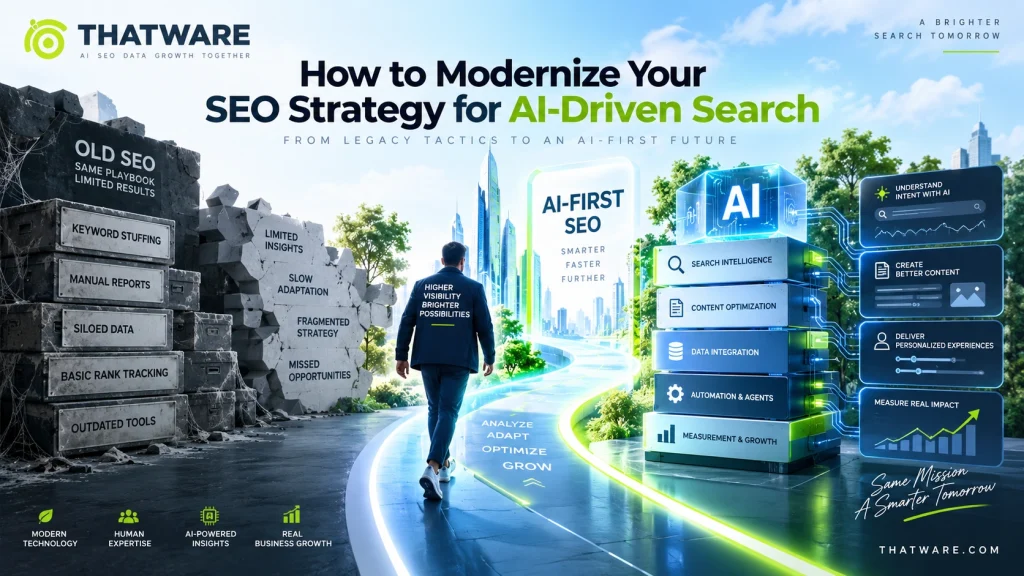
Their SEO program may still be built around a model designed several years ago:
- Keyword tracking
- Monthly blog publishing
- Link acquisition
- On-page optimization
- Technical fixes
- Traffic reporting
Those activities are still useful, but they may no longer be enough.
Businesses now need SEO modernization.
The goal is not to abandon traditional SEO.
The goal is to evolve it into a broader, more intelligent search framework that can support both traditional rankings and AI-driven discovery.
What Is SEO Modernization?
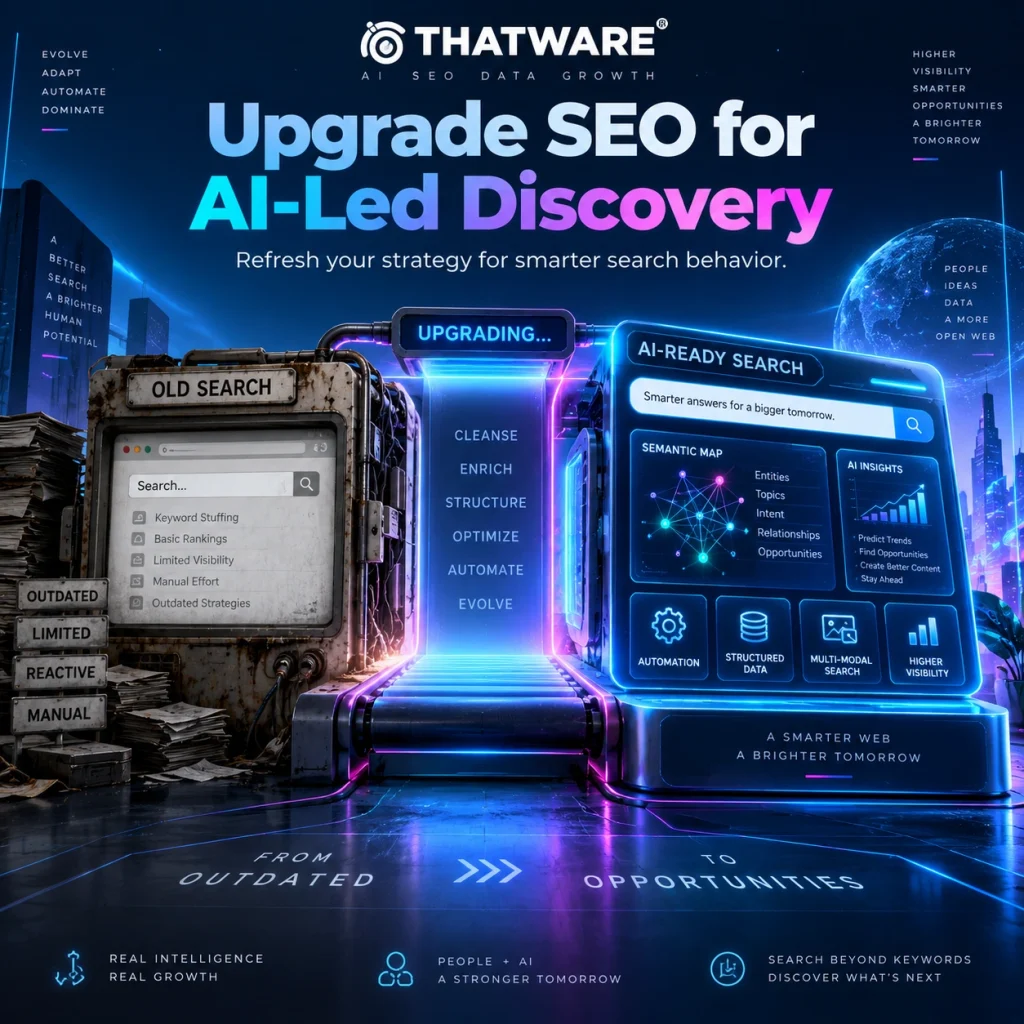
SEO modernization is the process of updating an existing SEO strategy so it aligns with how search works today.
That may involve moving from:
- Keywords to intent and entities
- Page rankings to multi-platform visibility
- Content volume to content intelligence
- Backlinks to broader authority signals
- Traditional search reporting to AI visibility measurement
- Isolated SEO activities to integrated search strategy
Professional SEO modernization services help businesses identify which parts of their current SEO program still work, which parts need to evolve, and which new capabilities should be added.
Modernization is not about replacing proven SEO practices.
It is about expanding them.
Expert Insight:
“SEO modernization is not about replacing proven tactics. It is about expanding them to match how people and AI systems discover information today.”
Why Businesses Need a Modern SEO Strategy
A modern SEO strategy must account for how users now search.
A traditional search might look like:
“enterprise SEO agency”
An AI-driven query might look like:
“Which SEO agency is best for a large international business that needs technical SEO, GEO, AEO, and AI search visibility?”
The second query is:
- More conversational
- More contextual
- More commercial
- More specific
- More likely to result in a synthesized answer
That means businesses need search strategies capable of understanding and serving more complex intent.
Quick Question: Is Traditional SEO Still Enough for Most Businesses?
Traditional SEO is still essential, but it may not be enough on its own when customers increasingly use AI tools for recommendations, comparisons, and direct answers. Modern SEO should extend the foundation rather than replace it.
Traditional SEO Is Still the Foundation
Modernization does not mean traditional SEO has stopped working.
Your website still needs:
- Crawlability
- Indexation
- Fast performance
- Clean site architecture
- Relevant content
- Strong internal links
- Credible backlinks
- Search intent alignment
These are foundational.
However, modern SEO services should build additional capabilities on top of that foundation.
These can include:
- AEO
- GEO
- LLM SEO
- Entity optimization
- AI citation strategy
- Knowledge graph enhancement
- Semantic content architecture
- AI visibility measurement
- Prompt monitoring
What Is an AI-Driven SEO Strategy?
An AI driven SEO strategy is a search framework designed around both conventional search engines and AI-powered discovery systems.
It considers not only:
“Can this page rank?”
but also:
“Can this brand be understood?”
“Can this information be extracted?”
“Can this page be cited?”
“Can this business be recommended?”
This changes the optimization model.
Strategic Insight:
“Modern SEO should not only ask whether a page can rank. It should ask whether the brand can be understood, extracted, cited, and recommended.”
From Keywords to Search Intent
Keywords are still useful, but they are no longer enough on their own.
Modern SEO should map:
- Informational intent
- Commercial investigation
- Transactional intent
- Comparison queries
- Recommendation queries
- Conversational queries
- AI-generated follow-up questions
For example, instead of optimizing only for:
“AI SEO company”
also consider:
“Which AI SEO company is best for enterprise brands?”
This better reflects how AI-powered discovery works.
1. Audit Your Existing SEO Model
SEO modernization should begin with an honest audit.
Review:
- Technical SEO
- Content quality
- Search intent coverage
- Internal linking
- Backlink profile
- Structured data
- Entity clarity
- AI visibility
- Competitor visibility
- Conversion performance
The purpose is to identify where the old strategy is creating value and where it is falling behind.
2. Modernize Technical SEO
Technical SEO is still critical.
But the scope should expand.
Review:
- JavaScript rendering
- Crawl accessibility
- Robots directives
- XML sitemaps
- Canonicals
- Indexation
- Internal crawl depth
- Structured data
- Core page templates
- Duplicate content
- Mobile performance
Strong technical foundations support both search engines and retrieval systems.
3. Build Entity Clarity
AI systems need to understand what your business is.
That requires strong entity signals.
Clearly define:
- Brand
- Founder
- Products
- Services
- Locations
- Industries
- Expertise
- Partnerships
- Relationships
A modern search strategy should make these connections obvious.
For example:
ThatWare → provides → AI SEO
ThatWare → provides → GEO
ThatWare → provides → AEO
ThatWare → specializes in → search intelligence
This is an important component of modern search optimization.
Case Study: Fixing Inconsistent Brand Signals
Consider a company whose website, service pages, founder profiles, directories, and media mentions describe the business differently. An entity-focused modernization strategy could align these signals so search engines and AI systems receive a clearer picture of the brand, its services, and expertise.
4. Move From Isolated Content to Topic Ecosystems
Legacy SEO strategies often publish standalone blogs.
Modern SEO should build interconnected topic ecosystems.
For example:
AI Search
→ AI SEO
→ AEO
→ GEO
→ LLM SEO
→ AI Citations
→ Entity SEO
→ AI Visibility
→ Knowledge Graphs
This creates:
- Stronger topical authority
- Better internal linking
- Clearer semantic relationships
- More opportunities for AI retrieval
5. Create Content for Answers, Not Just Rankings
Search is becoming more answer-focused.
Modern content should be easy to extract.
Use:
- Direct definitions
- Question-based headings
- Short explanatory answers
- Comparison tables
- FAQs
- Step-by-step sections
- Summary blocks
The objective is to make useful information easy to find.
This supports both search engines and AI systems.
Quick Question: Does Answer-Focused Content Need to Be Short?
Not always. The key is to provide the main answer clearly and early, then support it with useful detail, examples, comparisons, and context where needed.
6. Add AEO to Your SEO Program
Answer Engine Optimization helps content become easier to surface as a direct answer.
AEO can include:
- Conversational query research
- FAQ optimization
- Direct-answer formatting
- Semantic question coverage
- Featured snippet targeting
- Structured data
This should become part of a modern SEO roadmap.
7. Add GEO to Your SEO Program
Generative Engine Optimization focuses on visibility inside AI-generated responses.
GEO can include:
- AI citations
- Brand mentions
- External validation
- Digital PR
- Entity optimization
- Generative search monitoring
- AI share of voice
This expands visibility beyond traditional rankings.
8. Add LLM SEO
LLM SEO focuses on how large language models understand, retrieve, and represent your business.
It may involve:
- Entity consistency
- Semantic architecture
- Structured information
- Knowledge graph relationships
- Machine-readable content
- External corroboration
This is increasingly important for AI-driven search.
9. Use Structured Data Strategically
Structured data can reduce ambiguity.
Useful schema types include:
- Organization
- Person
- Product
- Service
- Article
- FAQPage
- Review
- BreadcrumbList
- LocalBusiness
Schema does not guarantee AI visibility.
But it can strengthen machine understanding.
10. Improve Internal Linking
Internal links should reflect your topic architecture.
For example:
A page about AI SEO should naturally link to:
- AEO
- GEO
- LLM SEO
- AI search optimization
- AI citations
- Entity optimization
This improves semantic clarity and authority flow.
11. Modernize Content Quality Standards
Publishing more is not always better.
A modern content standard should emphasize:
- Originality
- Expertise
- Evidence
- Clarity
- Search intent
- Freshness
- Citation value
- Commercial relevance
Generic content may add pages without adding authority.
Content Principle:
“Publishing more pages does not create more authority if the content adds nothing new, useful, or credible.”
12. Publish Original Research
Original research can create a significant competitive advantage.
Examples include:
- Industry surveys
- AI visibility studies
- Benchmark reports
- Search trend analyses
- Proprietary datasets
- Experiments
- Case studies
This type of content can earn:
- Backlinks
- Mentions
- Citations
- AI references
- PR coverage
Case Study: Turning Research Into Authority
Imagine a B2B brand publishing an annual benchmark on how companies appear across ChatGPT, Gemini, and Perplexity. That single research asset could attract backlinks, media mentions, AI citations, PR coverage, and stronger topical authority.
13. Modernize Link Building Into Authority Building
Legacy SEO often treated link building as a volume activity.
Modern SEO should focus on authority.
That includes:
- Relevant backlinks
- Brand mentions
- Expert citations
- Research references
- Industry coverage
- Founder mentions
- Partnerships
This broader approach supports both SEO and AI search visibility.
14. Integrate Digital PR
Digital PR can strengthen entity authority and generative visibility.
Use it to build:
- Media mentions
- Expert commentary
- Thought leadership
- Research citations
- Industry associations
- Founder authority
External validation is increasingly important.
15. Add AI Visibility Measurement
Traditional SEO reports may not show the full search picture.
Modern reporting should include:
- Organic rankings
- Traffic
- Leads
- Conversions
- AI mentions
- Citation frequency
- Prompt coverage
- AI recommendation share
- Competitor AI visibility
- Brand sentiment
- Entity accuracy
This creates a much more complete view.
Quick Question: What Should Modern SEO Reporting Measure Beyond Rankings?
It should also track AI mentions, citation frequency, prompt coverage, recommendation share, competitor AI visibility, sentiment, entity accuracy, leads, and conversions.
16. Track Prompts, Not Just Keywords
AI search requires prompt-level monitoring.
Examples include:
- Best AI SEO agency
- Best GEO company
- Best enterprise SEO provider
- Recommended AEO services
- Best SEO consultants for AI search
Track:
- Brand inclusion
- Competitor inclusion
- Citations
- Sentiment
- Recommendation frequency
This adds a new intelligence layer.
17. Use AI to Improve SEO Decision-Making
Professional AI powered SEO services should use AI to improve analysis rather than simply produce more content.
AI can support:
- Topic clustering
- Search intent analysis
- Competitive research
- Content gap detection
- Entity mapping
- Technical anomaly detection
- Forecasting
The objective is better decisions.
18. Build a Data-Led Search Roadmap
Modern SEO should prioritize opportunities using data.
Evaluate:
- Search demand
- Competition
- Commercial value
- AI visibility opportunity
- Existing authority
- Content effort
- Technical feasibility
This ensures resources are allocated intelligently.
19. Modernize Enterprise SEO
Large organizations face different challenges.
Enterprise SEO transformation may involve:
- Large-scale technical governance
- Multiple markets
- International SEO
- Large content ecosystems
- Internal workflow alignment
- Entity consistency
- AI visibility monitoring
- Automation
Enterprise modernization requires process change, not just page optimization.
20. Align SEO With Brand Strategy
Modern SEO is increasingly connected to brand.
AI systems do not simply evaluate pages.
They also interpret entities.
That means SEO teams should collaborate with:
- PR
- Brand
- Content
- Product
- Communications
- Analytics
Search visibility becomes a cross-functional responsibility.
21. Modernize Commercial Pages
Many companies have strong blog strategies but weak service pages.
Modern commercial pages should include:
- Clear positioning
- Service detail
- Buyer questions
- Comparisons
- Methodology
- Evidence
- Case studies
- FAQs
- Strong calls to action
This improves both visibility and conversion.
22. Create Decision-Stage Content
AI users often ask questions close to purchase.
Examples include:
“Which provider should I hire?”
“What company is best?”
“What are the alternatives?”
Modern SEO should create:
- Vendor comparison pages
- Buyer guides
- Cost guides
- Evaluation criteria
- Alternatives content
- Use-case comparisons
This supports commercial discovery.
23. Modernize SEO Reporting
Old reporting often focuses on:
- Rankings
- Traffic
- Backlinks
Modern reporting should connect search activity to:
- Pipeline
- Leads
- Revenue
- Market visibility
- AI share of voice
- Brand authority
This makes SEO more strategic.
24. Use Advanced SEO Consulting
Professional advanced SEO consulting can help businesses decide:
- What to prioritize
- What to stop doing
- What needs modernization
- Which AI search capabilities matter
- How to restructure content
- How to measure new forms of visibility
This is valuable when internal teams already handle execution.
25. Use SEO Strategy Consulting Services
Professional SEO strategy consulting services should provide a structured roadmap.
That can include:
- Search landscape analysis
- Competitive analysis
- Technical priorities
- Content architecture
- AI search strategy
- Entity planning
- Measurement frameworks
The outcome should be practical, not theoretical.
26. Add AI SEO Consulting
Professional AI SEO consulting services help businesses understand how AI search affects existing SEO programs.
This can include:
- AI visibility audits
- AEO strategy
- GEO strategy
- LLM SEO
- Citation analysis
- Prompt tracking
- Entity optimization
This is particularly useful for brands already performing well in traditional search.
27. Use Search Strategy Consulting
Search strategy consulting helps businesses integrate SEO with wider search behavior.
It can address:
- Traditional search
- AI search
- Answer engines
- Generative systems
- Commercial discovery
- Brand authority
- Search measurement
This creates a more unified approach.
28. Invest in Future-Ready SEO
Professional future ready SEO services should prepare businesses for multiple forms of discovery.
That means building systems capable of adapting to:
- New AI platforms
- Search interface changes
- New content formats
- Entity-based discovery
- Evolving measurement models
Future readiness is about adaptability.
29. Treat SEO Transformation as an Ongoing Process
SEO transformation services should not be treated as a one-time redesign.
Search keeps changing.
Businesses need ongoing processes for:
- Auditing
- Testing
- Updating
- Measuring
- Refining
- Adapting
Modernization is continuous.
Transformation Insight:
“SEO modernization is not a one-time project. It is an operating model built around continuous testing, measurement, and adaptation.”
30. Use SEO Innovation Strategically
SEO innovation services should focus on meaningful improvements rather than novelty.
Innovation may include:
- New measurement models
- Entity intelligence
- AI visibility tracking
- Search forecasting
- Automated analysis
- Advanced schema
- Prompt monitoring
The purpose should always be stronger business outcomes.
Common Signs Your SEO Strategy Needs Modernization
Your current strategy may need to evolve if:
- Organic growth has plateaued
- Content output is high but impact is low
- Competitors dominate AI recommendations
- Reporting focuses only on rankings
- Your brand has weak entity recognition
- Search behavior has changed
- Commercial content is underdeveloped
- AI visibility is not measured
- SEO operates separately from PR and brand
These are strong signs that modernization is overdue.
A Practical SEO Modernization Roadmap
A structured roadmap can look like this:
Phase 1: Audit
Review technical SEO, content, authority, entities, AI visibility, and competitors.
Phase 2: Foundation
Fix technical issues, structured data, site architecture, and entity clarity.
Phase 3: Content Modernization
Develop topic clusters, direct answers, commercial pages, and research assets.
Phase 4: Authority Modernization
Expand from links into PR, citations, expert mentions, and research references.
Phase 5: AI Search Integration
Add AEO, GEO, LLM SEO, prompt tracking, and AI visibility analysis.
Phase 6: Measurement
Track rankings, traffic, citations, AI mentions, prompt coverage, and commercial impact.
How ThatWare Approaches SEO Modernization
At ThatWare, SEO modernization can be treated as a search intelligence transformation rather than a simple tactical update.
That may include:
- Technical SEO
- Semantic SEO
- AEO
- GEO
- LLM SEO
- AI search optimization
- Entity intelligence
- Knowledge graph development
- Content architecture
- Citation strategy
- Digital PR
- Prompt monitoring
- AI visibility analytics
- Search forecasting
Businesses looking for SEO modernization services, modern SEO services, SEO transformation services, or future ready SEO services should look for a partner that can connect traditional SEO with emerging search behavior.
ThatWare’s approach is designed around that integration.
Final Thoughts
SEO modernization is not about replacing everything that worked before.
It is about recognizing that the search environment has expanded.
A strong modern SEO strategy should still include technical SEO, content, authority, and search intent.
But it should also include:
- AI visibility
- AEO
- GEO
- LLM SEO
- Entity optimization
- Structured data
- Citations
- Digital PR
- Prompt monitoring
- Advanced analytics
Businesses that invest in AI powered SEO services, SEO strategy consulting services, AI SEO consulting services, and SEO innovation services can build a search framework that is far more adaptable to the way discovery is evolving.
The next era of SEO will not reward businesses that simply publish more.
It will reward businesses that modernize how they understand search, authority, relevance, and visibility.