
SUPERCHARGE YOUR ONLINE VISIBILITY! CONTACT US AND LET’S ACHIEVE EXCELLENCE TOGETHER!
Search is changing rapidly. People are no longer relying only on traditional search results to discover businesses, compare services and make purchasing decisions. Increasingly, they are asking AI platforms direct questions such as “Which is the best wedding planner in East Africa?” or “Which wedding planning company handles luxury and destination weddings in Kenya?”
ThatWare helped Billion Events, a wedding and event planning business serving Kenya and the wider East African market, build visibility for these conversational and recommendation-focused searches across ChatGPT, Claude, Gemini and Google AI Overviews. The strategy combined Generative Engine Optimization (GEO), search-intent research, AI-focused content development, structured information, internal linking, geo-targeted content, FAQs, comparison assets and authority-building activities.
The results documented during the campaign showed Billion Events appearing in prominent AI-generated recommendations, including first-position appearances for several captured queries on ChatGPT and Gemini, fourth-position appearances on Claude, and visibility within Google AI Overviews for relevant Nairobi and Kenya-focused searches.
This case study explains the challenge, strategy, implementation process and documented outcomes behind the campaign.
Case Study at a Glance
| Category | Details |
| Client | Billion Events |
| Industry | Wedding Planning & Events |
| Primary Market | Kenya |
| Regional Focus | East Africa |
| Campaign Focus | Generative Engine Optimization |
| Primary Objective | Increase visibility across AI-powered search environments |
| Platforms Observed | ChatGPT, Claude, Gemini and Google AI Overviews |
| Core Strategy | SEO + AEO + GEO |
| Content Focus | Conversational, recommendation, service and location-based queries |
| Key Outcome | Documented AI-generated visibility across multiple search environments |
The Changing Nature of Search
For years, search visibility was primarily measured through conventional search engine rankings.
A business would identify important keywords, optimise its website, build authority, improve technical SEO and monitor positions in traditional search results.
That model remains important, but the way people discover information is expanding.
Instead of typing a short phrase such as:
wedding planner Kenya
a prospective customer might now ask:
Which wedding planning company handles luxury and destination weddings in Kenya?
Or:
Who can manage weddings using modern planning tools in East Africa?
Or:
Recommend a reliable wedding planner in East Africa.
These searches are different from traditional keyword queries because they contain context, intent and expectations.
The user is not simply asking a search engine to find pages containing particular words. They are asking an AI system to interpret the request and produce an answer.
For businesses, this creates a new visibility challenge.
A company may have a website, service pages and conventional search visibility, but that does not automatically mean an AI-generated answer will mention the business when a user asks for recommendations.
This is where Generative Engine Optimization, or GEO, becomes increasingly relevant.
GEO focuses on improving how a brand, business, service or organisation is represented and understood across generative search experiences.
For Billion Events, the objective was not simply to increase conventional keyword rankings.
The objective was to build a stronger digital presence around the questions that potential customers could ask AI platforms about wedding planners, event planning, destination weddings and related services in Kenya and East Africa.
ThatWare approached this as a structured search visibility problem.
The campaign began with understanding the business, identifying relevant AI-oriented search opportunities and mapping those opportunities to content, entities, locations and user intent.
The results were subsequently observed across several AI search environments.
About Billion Events
Billion Events operates within the wedding and event planning space, with a focus on Kenya and the broader East African market.
The business operates in a category where customers often require significant amounts of research before making a decision.
Wedding planning can involve:
- Venue selection
- Event coordination
- Vendor management
- Destination planning
- Guest management
- Event logistics
- Design and décor
- Scheduling
- Budget considerations
- Cultural requirements
- Large-scale event execution
For prospective customers, selecting a wedding planner is therefore rarely a simple transactional decision.
They may ask several questions before contacting a company.
They may want to know which planners operate in their region, which companies specialise in large weddings, which providers handle destination weddings, which planners offer modern planning capabilities and which businesses are considered reliable.
These are exactly the types of questions that can appear in conversational search.
That created an opportunity for Billion Events to build a broader digital presence around the questions potential customers were already likely to ask.
However, there was an important starting challenge.
The Challenge: Building Visibility Beyond Traditional Search
Before the GEO campaign, Billion Events had limited visibility for AI-related search queries.
The website did not have a strong established presence around the types of conversational questions that users could ask AI platforms.
This presented several challenges.
Limited Visibility for AI-Oriented Queries
Traditional SEO commonly begins with keyword phrases.
For example:
- Wedding planner Kenya
- Wedding planner Nairobi
- Destination wedding planner Kenya
- Event planner Kenya
These terms are still useful.
However, generative search introduces longer, more contextual queries.
Examples from the campaign included:
- “event planning companies in Kenya”
- “Which is the best wedding planner in East Africa?”
- “Professional wedding planners for large weddings in Nairobi”
- “Recommend a reliable wedding planner in East Africa”
- “Which wedding planning company handles luxury and destination weddings in Kenya?”
- “Who can manage weddings using modern planning tools in East Africa?”
These queries contain multiple layers of intent.
A single query can communicate:
Service + location + customer requirement + evaluation criteria
For example:
Which wedding planning company handles luxury and destination weddings in Kenya?
This is not simply a search for a wedding planner.
It combines:
- Wedding planning
- Company discovery
- Luxury positioning
- Destination weddings
- Kenya
The optimisation strategy therefore needed to account for more than individual keywords.
The Core Objective
The primary objective of the campaign was to strengthen Billion Events’ visibility across AI-powered search environments.
That objective included several interconnected goals.
1. Increase AI Search Discoverability
The first goal was to improve the likelihood of Billion Events being surfaced for relevant conversational queries.
2. Strengthen Topical Relevance
The website needed stronger coverage around wedding planning, destination weddings, event planning, locations and related services.
3. Build Geographic Relevance
The campaign focused heavily on Kenya and East Africa.
This was important because wedding planning is highly location-sensitive.
4. Address Recommendation Intent
Users asking:
“Which is the best…?”
or:
“Recommend a reliable…”
are not simply looking for information.
They are looking for potential providers.
The content strategy therefore needed to address commercial and recommendation-oriented intent.
5. Build Visibility Across Multiple AI Environments
The campaign did not focus on one platform alone.
The documented results covered:
- ChatGPT
- Claude
- Gemini
- Google AI Overviews
This broader approach helped evaluate Billion Events’ visibility across different AI search environments.
From Keywords to Questions: The Shift in Search Intent
One of the most important parts of the campaign was understanding how AI search changes the way search intent should be mapped.
Traditional keyword research often groups queries around a core phrase.
For example:
Core topic: Wedding planner
Potential variations could include:
- Wedding planner Kenya
- Wedding planner Nairobi
- Wedding planning services Kenya
- Best wedding planner Kenya
- Destination wedding planner Kenya
For GEO, ThatWare expanded this thinking.
Instead of asking only:
What keywords do people search?
the strategy also considered:
What questions could people ask an AI system when they need this service?
This shift is important because conversational AI interfaces encourage natural-language questions.
A user can provide more context in one query.
For example:
Who can manage weddings using modern planning tools in East Africa?
This query communicates a need for:
- A wedding planner
- Regional coverage
- Modern planning capabilities
- A business recommendation
The optimisation strategy therefore needed to cover the underlying concepts rather than simply repeat a target keyword.
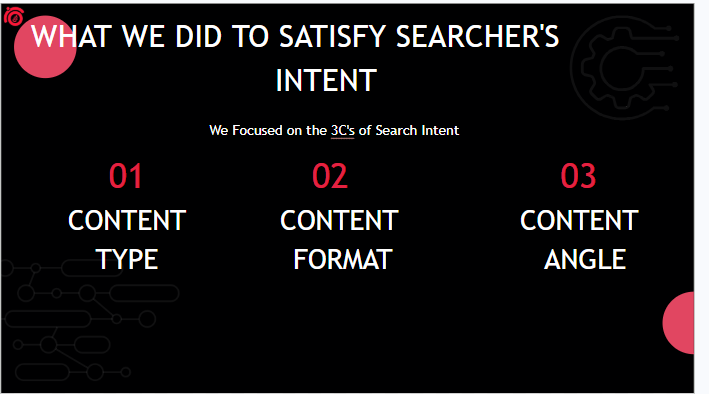
The 3Cs of Search Intent
ThatWare structured the campaign around three important dimensions of search intent:
- Content Type
- Content Format
- Content Angle
These three elements helped translate search opportunities into content opportunities.
Content Type
Different questions require different forms of content.
A user researching wedding planners may need:
- Service pages
- Location pages
- Guides
- FAQs
- Comparisons
- Informational articles
- Recommendation-oriented content
- Resource pages
A single generic service page cannot necessarily address every possible question.
The campaign therefore expanded the types of content available to support different stages of the user’s research journey.
Content Format
The way information is presented also matters.
AI-oriented content opportunities may include:
- Question-and-answer sections
- Lists
- Comparison tables
- Service explanations
- Location guides
- FAQs
- Structured landing pages
- Informational guides
This creates a wider content ecosystem around the business.
Rather than asking one page to answer every question, the website can provide interconnected information covering different search needs.
Content Angle
The third element was the angle of the query.
A user searching for a wedding planner might be interested in:
- The best planner
- A reliable planner
- A professional planner
- A luxury wedding planner
- A destination wedding planner
- A planner for large weddings
- A planner using modern tools
- A planner in Nairobi
- A planner serving East Africa
These are different search contexts.
The campaign therefore considered the specific reason behind each query.
This helped move the strategy from generic keyword targeting towards intent-driven optimisation.
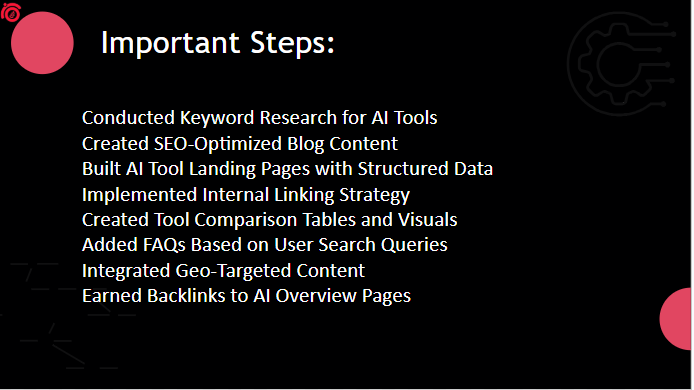
The GEO Implementation Strategy
Once the search opportunities were identified, ThatWare implemented a multi-layer optimisation strategy.
The campaign included:
- AI-focused keyword research
- SEO-optimised content
- AI-focused landing pages
- Structured data
- Internal linking
- Comparison tables and visual assets
- FAQ optimisation
- Geo-targeted content
- Authority and backlink development
Each component contributed to the broader search visibility strategy.
1. AI Tool-Focused Keyword Research
The first step was identifying queries relevant to AI-powered search.
Rather than relying exclusively on conventional keyword formats, ThatWare researched the types of questions users could ask AI tools.
This resulted in a broader query framework.
The campaign included searches around:
- Event planning companies in Kenya
- Wedding planners in East Africa
- Wedding planners in Nairobi
- Large wedding planning
- Destination weddings
- Luxury weddings
- Reliable wedding planners
- Modern wedding planning tools
The key difference was the emphasis on natural-language search intent.
For example:
“event planning companies in Kenya”
has a different structure from:
“Which wedding planning company handles luxury and destination weddings in Kenya?”
The second query introduces an evaluation criterion.
This distinction is particularly important for businesses because recommendation-based queries are closer to the decision stage of the customer journey.
2. Creating SEO-Optimised Content
The next stage focused on developing content around the identified topics and search intents.
The objective was not to create content simply because a keyword existed.
The content needed to provide useful information around the subject.
For Billion Events, this meant strengthening coverage around relevant concepts such as:
- Wedding planning
- Event planning
- Destination weddings
- Luxury weddings
- Nairobi
- Kenya
- East Africa
- Large-scale weddings
- Event coordination
- Modern planning practices
This creates a broader topical environment in which the business can be understood.
For AI search, contextual relationships matter.
A page about a company should not exist in isolation.
The wider website should provide supporting information that reinforces what the business does, where it operates and what types of services it provides.
3. Building AI-Focused Landing Pages
Another important part of the implementation was the development of dedicated landing pages.
These pages were designed around specific search themes and business requirements.
The objective was to create clear destinations for users and search systems seeking information about specific services or topics.
For example, a website can separate information around:
- Wedding planning
- Destination weddings
- Event management
- Location-specific services
- Specific planning requirements
This is more useful than placing every service and location on one generic page.
Dedicated landing pages also create opportunities to answer specific questions more directly.
The content can then be structured around:
- What the service is
- Who it is for
- Where it is available
- What the business provides
- Why the service is relevant
- Common customer questions
- Supporting information
The result is a clearer website architecture.
4. Structured Data and Information Architecture
The campaign also incorporated structured data.
Structured information can help search systems understand what different elements of a website represent.
For a business website, relevant information may include:
- Business identity
- Services
- Locations
- FAQs
- Relationships between different pages and entities
The goal is not to treat structured data as a shortcut to AI recommendations.
Instead, it is one component of a broader technical and semantic strategy.
The more clearly a website communicates its underlying information architecture, the easier it can be for automated systems to interpret the content.
For Billion Events, this formed part of the wider effort to make the site’s information more structured and machine-understandable.
5. Internal Linking Strategy
Internal linking was another important component.
A website can contain excellent individual pages and still lack a clear connection between them.
Internal linking helps establish those relationships.
For Billion Events, the strategy connected relevant topics around:
Services → Locations → Supporting content → FAQs → Related topics
For example, content around destination weddings could connect to:
- Wedding planning services
- Kenya-focused content
- East Africa content
- Related FAQs
- Supporting informational articles
This creates a connected content ecosystem.
It also helps reinforce the relationship between the business, its services, its geographic markets and the questions potential customers are asking.
6. Comparison Tables and Visual Assets
The campaign also incorporated comparison tables and visual content.
Comparison-oriented content can be useful when users are evaluating options.
For example, someone researching wedding planning services may want to understand differences between:
- Types of wedding planning
- Destination versus local planning
- Different event requirements
- Planning approaches
- Tools and processes
Tables make information easier to scan.
Visual assets can also help communicate complex information in a simpler format.
The purpose was not to create visuals merely for appearance.
The objective was to build useful supporting content around the subjects being researched.
7. FAQ Optimisation
Questions are central to conversational search.
A traditional search query might be:
wedding planner Kenya
A conversational search may be:
Who can manage weddings using modern planning tools in East Africa?
FAQ content provides an opportunity to address these natural-language questions directly.
The campaign therefore incorporated FAQs based on user-oriented search themes.
Potential questions included:
- What does a wedding planner handle?
- Who can manage large weddings in Nairobi?
- What should couples consider when choosing a wedding planner?
- Who handles destination weddings in Kenya?
- What makes a wedding planning company reliable?
- How are large-scale weddings coordinated?
- Which areas of East Africa does a wedding planner serve?
The purpose was to make the website more useful to people asking questions while also creating clear, context-rich information for search systems to interpret.
8. Geo-Targeted Content
Geographic relevance was one of the strongest components of the campaign.
The primary market was Kenya, but the search opportunities extended into the broader East African region.
The campaign therefore incorporated multiple geographic layers.
Kenya
Queries focused on wedding and event planning services within the country.
Nairobi
Nairobi-specific queries addressed customers looking for professional planners in the city.
East Africa
Broader regional queries targeted users looking for providers capable of handling weddings across the region.
This geographic layering matters because a query such as:
Professional wedding planners for large weddings in Nairobi
has a different intent from:
Recommend a reliable wedding planner in East Africa.
The first is city-specific.
The second is regional.
A comprehensive GEO strategy needs to understand both.
9. Authority and Backlink Development
The campaign also incorporated authority-building activities.
Backlinks remain an important component of broader search visibility because they can contribute to a website’s authority and discoverability.
For Billion Events, relevant backlink development formed part of the wider strategy.
However, it is important to understand the role of backlinks correctly.
A backlink should not be treated as a guaranteed trigger for an AI platform to mention a business.
Instead, it contributes to the wider digital ecosystem surrounding the website.
GEO is not one tactic.
It is the combination of:
Content + Context + Entities + Technical structure + Authority + Relevance + Search intent
That broader framework was applied throughout the campaign.
Measuring GEO: Looking Beyond Traditional Rankings
One of the most important differences between conventional SEO reporting and GEO reporting is the way visibility is evaluated.
A traditional SEO report might focus on:
- Keyword rankings
- Organic traffic
- Click-through rate
- Impressions
- Backlinks
- Indexed pages
These metrics remain useful.
However, AI search introduces additional questions.
For example:
- Does the AI platform mention the brand?
- Does the platform recommend the business?
- Where does the business appear within the generated answer?
- Which queries trigger the mention?
- Which geographic contexts produce visibility?
- Which service attributes are associated with the brand?
- Does visibility occur across multiple platforms?
ThatWare therefore examined AI-generated responses for targeted queries.
The screenshots captured during the campaign provide evidence of this visibility.
Results: Billion Events’ Visibility Across ChatGPT
One of the clearest outcomes documented in the campaign was visibility within ChatGPT.
The campaign tested recommendation-oriented queries related to wedding and event planning.
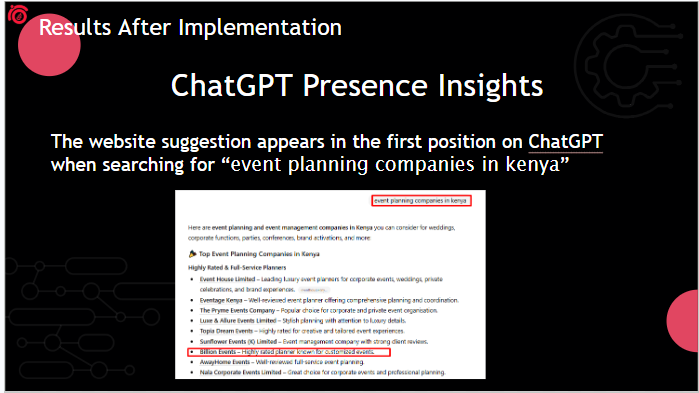
ChatGPT Result 1: Event Planning Companies in Kenya
Query
“event planning companies in Kenya”
The captured ChatGPT result shows Billion Events appearing in the first position among the recommendations displayed in the response.
This is significant from a search-intent perspective because the query is broad enough to represent users beginning their provider discovery process.
The user is not asking:
What is event planning?
They are asking for companies.
The response therefore represents a commercial discovery scenario.
The visibility indicates that Billion Events was being surfaced when the AI system was asked to provide event planning company recommendations for Kenya.
Why This Query Matters
This type of search can represent an early stage of the customer journey.
A user may be looking for several providers and comparing:
- Services
- Reputation
- Location
- Expertise
- Experience
- Event types
- Availability
Being included in the generated answer gives the business an opportunity to enter that consideration set.
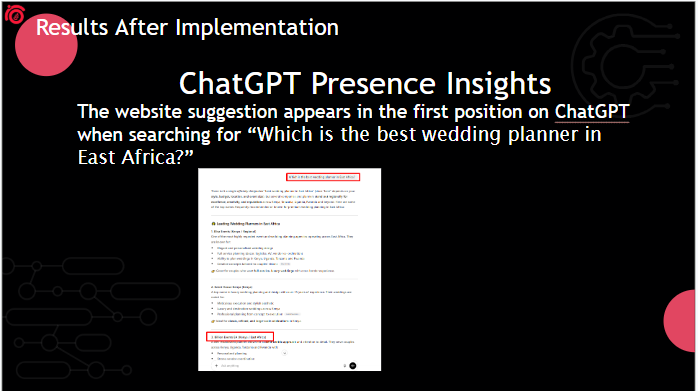
ChatGPT Result 2: Best Wedding Planner in East Africa
Query
“Which is the best wedding planner in East Africa?”
The captured response again showed Billion Events appearing prominently, with the screenshot documenting the business in the first position displayed.
This query differs from the first one.
The first query is about event planning companies in Kenya.
The second asks for a wedding planner recommendation across East Africa.
That means the campaign achieved documented visibility across both:
- National intent
- Regional intent
It also demonstrates the importance of recommendation-focused queries.
The user is not simply asking for information about wedding planning.
They are asking an AI system to identify a provider.
Results: Billion Events’ Visibility Across Claude
The campaign also evaluated Billion Events’ presence on Claude.
The results showed that visibility was not limited to one generative AI environment.
This is important because different AI systems can produce different results for similar questions.
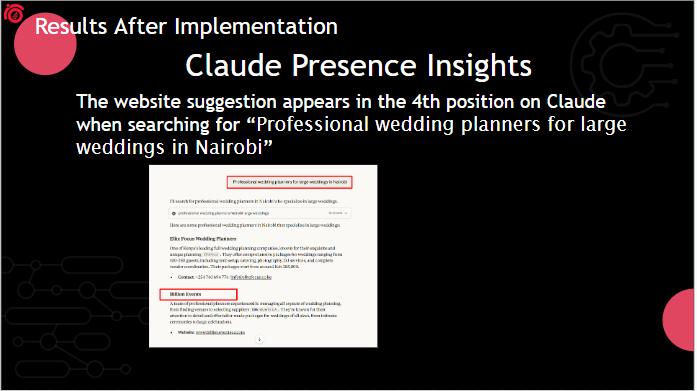
Claude Result 1: Professional Wedding Planners for Large Weddings in Nairobi
Query
“Professional wedding planners for large weddings in Nairobi”
The captured Claude result showed Billion Events appearing in the 4th position.
The query combines three major signals:
Professional wedding planners + large weddings + Nairobi
Each element adds context.
The user is not simply looking for any wedding planner.
They are looking for a professional provider capable of handling large weddings specifically in Nairobi.
The result demonstrates that Billion Events had established enough contextual relevance to appear in this narrower recommendation set.
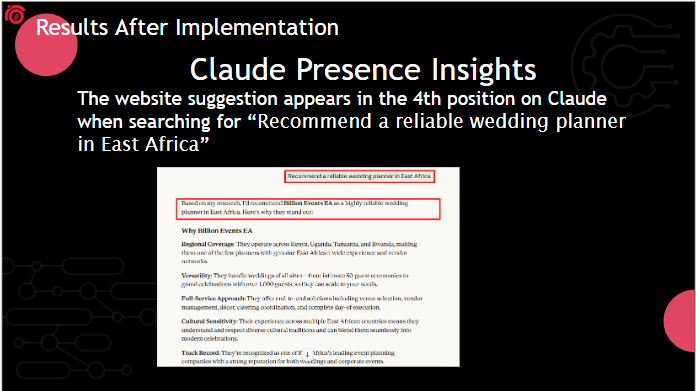
Claude Result 2: Reliable Wedding Planner in East Africa
Query
“Recommend a reliable wedding planner in East Africa”
The captured result showed Billion Events appearing in the 4th position.
Again, the query is recommendation-oriented.
The word “reliable” introduces a qualitative criterion.
This is an important characteristic of generative search.
Users often ask AI systems to interpret qualitative requirements rather than simply retrieve pages.
The campaign therefore needed to create a strong enough contextual presence around the business for it to be considered relevant to this type of request.
Results: Billion Events’ Visibility Across Gemini
Gemini produced another set of documented visibility results.
The campaign captured first-position appearances for two highly contextual queries.
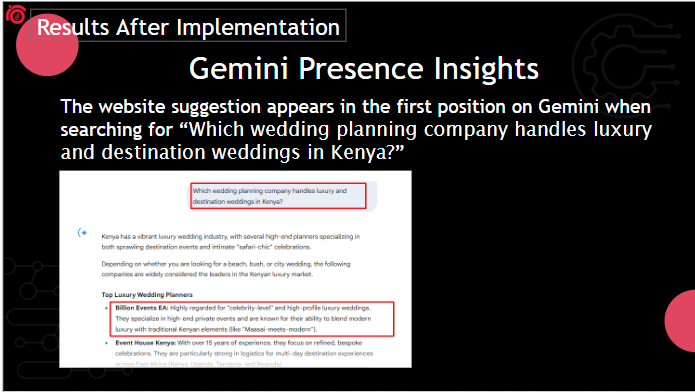
Gemini Result 1: Luxury and Destination Weddings in Kenya
Query
“Which wedding planning company handles luxury and destination weddings in Kenya?”
The screenshot shows Billion Events appearing in the first position in the generated recommendations.
This is particularly valuable as a GEO example because the query contains multiple concepts:
- Wedding planning
- Company
- Luxury
- Destination weddings
- Kenya
The query is highly specific.
It requires the AI system to identify companies associated with a particular type of service and a particular market.
Billion Events’ appearance demonstrates documented visibility for this combination of intent.
Gemini Result 2: Modern Wedding Planning Tools in East Africa
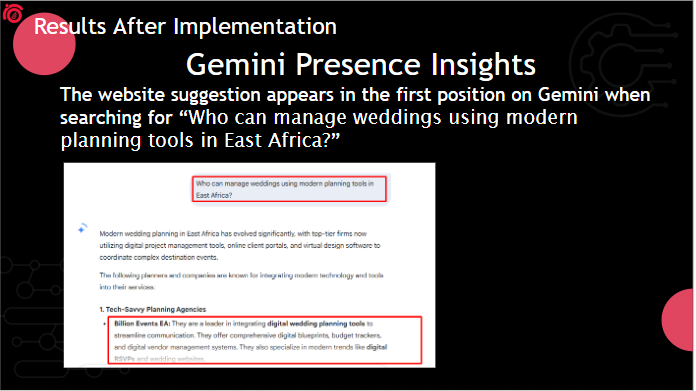
Query
“Who can manage weddings using modern planning tools in East Africa?”
The captured Gemini response again shows Billion Events appearing in the first position.
This query is different from the luxury and destination wedding query.
It introduces a technology and process-oriented requirement.
The user wants a provider capable of managing weddings using modern planning tools.
This demonstrates why GEO strategies need to cover attributes, not just service names.
A brand may need to be associated with multiple characteristics depending on the questions users ask.
Results: Google AI Overview Visibility
The campaign also extended beyond standalone conversational AI platforms.
Billion Events was documented within Google AI Overviews for relevant queries.
This is particularly important because Google remains a major discovery environment, while AI-generated summaries are increasingly becoming part of the search experience.
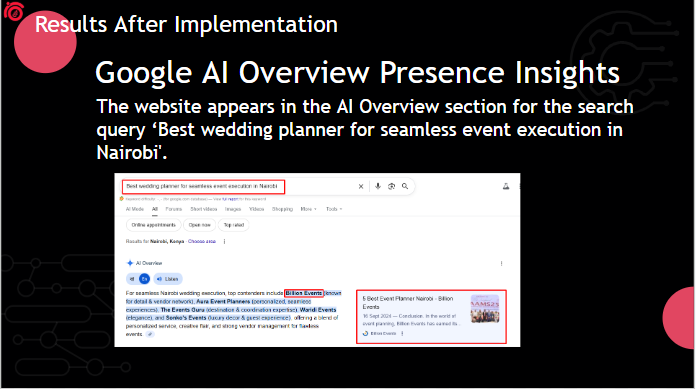
Google AI Overview Result 1: Seamless Event Execution in Nairobi
Query
“Best wedding planner for seamless event execution in Nairobi”
The captured Google search result showed Billion Events appearing within the AI Overview section.
The query combines:
- Wedding planning
- Recommendation intent
- Event execution
- Nairobi
This represents a commercially valuable search scenario.
The user is not looking for a definition.
They are looking for a provider capable of executing a specific type of service.
Billion Events’ presence in the AI Overview indicates that the brand was being surfaced within Google’s generated answer for this captured query.
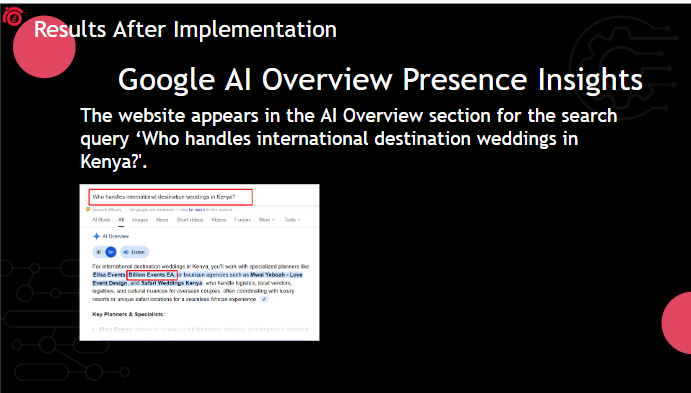
Google AI Overview Result 2: International Destination Weddings in Kenya
Query
“Who handles international destination weddings in Kenya?”
The campaign also documented Billion Events appearing within the Google AI Overview for this query.
This adds another dimension to the campaign results.
The query is:
- Commercial
- Geographic
- Service-specific
- Recommendation-oriented
The combination of these signals makes it a strong example of the type of query that GEO can target.
The Multi-Platform Result
Taken together, the captured results show Billion Events appearing across four AI-powered search environments.
| Platform | Captured Query Theme | Documented Position/Visibility |
| ChatGPT | Event planning companies in Kenya | 1st |
| ChatGPT | Best wedding planner in East Africa | 1st |
| Claude | Professional planners for large weddings in Nairobi | 4th |
| Claude | Reliable wedding planner in East Africa | 4th |
| Gemini | Luxury and destination weddings in Kenya | 1st |
| Gemini | Modern planning tools in East Africa | 1st |
| Google AI Overview | Best wedding planner for seamless event execution in Nairobi | Visible in AI Overview |
| Google AI Overview | International destination weddings in Kenya | Visible in AI Overview |
These positions refer to the specific captured results shown in the campaign screenshots. AI-generated results can change over time based on query wording, platform updates, location, context and other variables.
The significance of the campaign is therefore not that one fixed ranking was permanently achieved.
The important outcome is the documented breadth of AI search visibility across different platforms and search intents.
What Made the Campaign Different?
The Billion Events campaign illustrates an important point about GEO.
Generative Engine Optimization is not simply about putting “AI” keywords into website content.
It requires a broader understanding of how a business is represented online.
The campaign addressed several layers simultaneously.
1. The Business Entity
The website needed to communicate clearly what Billion Events is and what it does.
That means creating consistent associations between the business and concepts such as:
- Wedding planning
- Event planning
- Destination weddings
- Luxury weddings
- Kenya
- Nairobi
- East Africa
These relationships help create a clearer digital representation of the company.
2. Service Relevance
A wedding planning company can provide many different services.
A generic statement such as:
We provide wedding planning services.
does not provide much context.
A stronger information ecosystem can communicate:
- What types of weddings are handled
- What locations are served
- What event sizes are supported
- What planning capabilities are available
- What destination services are offered
- What makes the service relevant to different customer needs
This allows content to answer more specific questions.
3. Geographic Relevance
Location was a recurring element in the successful queries.
Kenya appeared repeatedly.
Nairobi appeared in specific searches.
East Africa appeared in regional searches.
Destination wedding searches introduced another geographic dimension.
This demonstrates that location should not always be treated as a single keyword.
It can be an important part of the business entity itself.
4. Recommendation Relevance
Several successful queries used recommendation language:
- Best
- Which company
- Recommend
- Who can manage
- Professional
- Reliable
These terms indicate that the user wants assistance evaluating providers.
This is different from informational search intent.
GEO strategies therefore need to account for the decision-making context behind the query.
Why Conversational Search Matters for Wedding Businesses
Wedding planning is an industry where users frequently ask detailed questions.
A couple may begin with:
Wedding planners in Kenya
Then progress to:
Which wedding planners handle destination weddings?
Then:
Who handles luxury weddings in Nairobi?
Then:
Which planner can manage a large international wedding?
Each question reveals more information about the user’s needs.
Generative search is particularly suited to this style of interaction because users can ask increasingly specific questions.
This means wedding and event businesses have an opportunity to create content that addresses the entire question journey.
Instead of optimising for one broad term, the strategy can address:
Discovery → Research → Comparison → Recommendation → Decision
Billion Events’ campaign was designed around this broader search journey.
GEO Is Not Just About One AI Platform
Another important lesson from the campaign is the value of multi-platform visibility.
ChatGPT, Claude, Gemini and Google AI Overviews are different search environments.
A brand appearing in one environment does not automatically mean it will appear in another.
Each platform can interpret queries and information differently.
That is why the campaign evaluated multiple environments.
The documented results showed:
- ChatGPT visibility
- Claude visibility
- Gemini visibility
- Google AI Overview visibility
This does not mean that one identical ranking mechanism produced all of these results.
Instead, it demonstrates that the broader optimisation strategy created visibility opportunities across different AI-powered discovery environments.
From SEO to SEO + AEO + GEO
The Billion Events campaign also demonstrates why modern search optimisation increasingly involves multiple disciplines.
Traditional SEO
Traditional SEO focuses on improving visibility within conventional search results.
Important elements include:
- Technical optimisation
- Content quality
- Keyword targeting
- Internal linking
- Site architecture
- Authority
- Search intent
Answer Engine Optimization
Answer Engine Optimization focuses more heavily on helping content satisfy direct questions and answer-oriented searches.
This includes:
- FAQs
- Direct answers
- Question-based content
- Structured information
- Clear explanations
- Conversational search intent
Generative Engine Optimization
GEO expands the focus into generative search environments.
It considers how a business may be represented when users ask AI systems:
- Who should I choose?
- Which company provides this service?
- What are the best options?
- Who handles this type of project?
- Which provider operates in this region?
For Billion Events, these disciplines worked together.
The campaign was therefore not an attempt to abandon traditional SEO.
It was an effort to expand the website’s visibility strategy to reflect the changing search environment.
The Role of Entity Optimisation
One of the underlying principles of GEO is entity clarity.
An entity can be a:
- Business
- Person
- Product
- Service
- Place
- Organisation
- Concept
For Billion Events, the central entity is the business itself.
The website needs to establish relationships between that entity and relevant concepts.
For example:
Billion Events → Wedding Planning
Billion Events → Event Planning
Billion Events → Kenya
Billion Events → Nairobi
Billion Events → East Africa
Billion Events → Destination Weddings
Billion Events → Luxury Weddings
Billion Events → Large-Scale Events
These relationships create a more complete representation of the company.
The more clearly a website communicates these relationships, the stronger the overall semantic foundation can become.
Why Content Depth Matters in GEO
A business cannot realistically answer every AI query with one page.
Suppose a user asks:
Who handles international destination weddings in Kenya?
The answer requires context around:
- Destination weddings
- Kenya
- Wedding planning
- International clients
- Event management
Now consider:
Who can manage weddings using modern planning tools in East Africa?
This introduces another set of concepts.
A comprehensive content ecosystem provides more opportunities to address these related subjects.
This is why the campaign did not depend on a single page.
It involved:
- Blog content
- Landing pages
- FAQs
- Supporting content
- Internal links
- Structured information
- Geo-targeted content
The goal was to build topical depth around the business.
The Importance of Geographic Content
For a local or regional service business, generic content can only go so far.
Consider the difference between:
Wedding planning services
and:
Wedding planning services in Nairobi for large-scale weddings
The second query provides substantially more context.
The user has already communicated:
- Service
- Location
- Event scale
The campaign therefore treated geography as a core part of the content strategy.
Kenya and East Africa were not simply inserted as location keywords.
They were incorporated into the broader content architecture.
This is important for businesses serving defined geographic markets.
Building Content Around Real Search Questions
Another important lesson from the campaign is that content should reflect how people actually ask questions.
Traditional SEO often encourages marketers to think in terms of keyword variations.
GEO requires an additional layer.
Consider these questions:
Which is the best wedding planner in East Africa?
Who can manage weddings using modern planning tools in East Africa?
Which wedding planning company handles luxury and destination weddings in Kenya?
These questions reveal what the user values.
The first is about evaluation.
The second is about capability.
The third is about service specialisation.
Each requires a different content angle.
ThatWare’s approach was therefore to map queries to intent before determining the appropriate content format.
From Content Creation to Content Architecture
Simply producing more articles is not enough.
A successful GEO strategy needs architecture.
That means understanding how pages relate to each other.
For Billion Events, this included connecting:
Core service pages
with:
Location pages
and:
Supporting informational content
and:
FAQs
and:
Relevant comparison or educational assets
This creates a network of related information.
For users, it provides a better browsing experience.
For search systems, it provides additional context about the relationship between topics.
The Role of FAQs in Conversational Search
FAQs deserve particular attention because they naturally align with conversational queries.
A question such as:
What should I look for in a wedding planner?
can become an FAQ.
A more specific question such as:
Who handles destination weddings in Kenya?
can also become a content opportunity.
The advantage is that FAQs allow businesses to address specific questions without forcing every query into a broad article.
However, effective FAQ content should not be created simply to insert keywords.
The answers need to be genuinely useful.
That means:
- Answering the question directly
- Providing enough context
- Avoiding unnecessary repetition
- Using natural language
- Connecting the answer to relevant services
- Maintaining consistency with the rest of the website
Why Internal Linking Supports GEO
Internal linking is sometimes treated as a purely technical SEO tactic.
In reality, it can also contribute to the semantic structure of a website.
Imagine a user reading about destination weddings.
A useful internal link might lead to:
- Wedding planning services
- Kenya wedding planning
- East Africa event planning
- Destination wedding FAQs
- Event management information
The links establish relationships between topics.
For Billion Events, this helped create a more connected content environment.
The strategy was therefore not simply:
Create content.
It was:
Create content and connect the content logically.
The Importance of Search Intent Over Keyword Volume
A common mistake in search optimisation is to focus too heavily on keyword volume.
A high-volume keyword is not automatically the most valuable opportunity.
Consider:
wedding planner
versus:
Which wedding planning company handles luxury and destination weddings in Kenya?
The first may have broader search demand.
The second may have stronger commercial specificity.
The user has already described what they want.
That can make highly specific queries valuable even if they represent a smaller overall search audience.
GEO therefore requires attention to intent quality, not just keyword quantity.
What the Billion Events Campaign Demonstrates
The campaign provides several practical lessons for businesses entering AI search.
AI Visibility Can Be Query-Specific
A brand may appear for one question and not another.
Therefore, GEO measurement needs to happen at the query level.
AI Visibility Can Be Platform-Specific
A result seen on ChatGPT should not automatically be assumed to appear on Claude or Gemini.
The campaign therefore tested multiple platforms.
Location Can Influence Relevance
Kenya, Nairobi and East Africa were recurring elements in the campaign’s successful queries.
This highlights the importance of geographic context for local and regional service businesses.
Recommendation Queries Require More Than Informational Content
Questions involving “best”, “reliable”, “which company” or “who can manage” represent a different type of intent.
Content needs to provide enough context for the business to be relevant to those questions.
GEO Works as a Broader Ecosystem
There was no single action responsible for the campaign.
The strategy combined:
- Research
- Content
- Technical optimisation
- Structured information
- Internal linking
- FAQs
- Geographic targeting
- Authority development
The results should therefore be viewed as the outcome of an integrated optimisation programme.
Before and After: Billion Events’ AI Search Journey
The campaign can be understood through a simple before-and-after framework.
| Before Implementation | After Implementation |
| Limited AI search presence | Documented visibility across multiple AI environments |
| Limited AI-focused query targeting | Dedicated conversational query research |
| Limited coverage of recommendation searches | Content targeting recommendation-oriented intent |
| Limited AI-oriented content architecture | Expanded content ecosystem |
| Limited geographic AI targeting | Kenya, Nairobi and East Africa-focused content |
| Conventional search focus | SEO + AEO + GEO approach |
| Limited FAQ coverage for conversational queries | FAQ optimisation around user questions |
| Less structured topical coverage | Connected services, locations and supporting topics |
The objective was not to claim that Billion Events suddenly became visible for every possible AI query.
That would not accurately represent how generative search works.
Instead, the campaign demonstrated that targeted optimisation can create meaningful visibility opportunities for specific queries and search contexts.
Measuring Success in an AI-First Search Environment
As AI search continues to evolve, businesses need to rethink how they report visibility.
Traditional rankings remain useful.
But GEO introduces additional metrics.
AI Mention Rate
How frequently does the brand appear when relevant queries are tested?
Recommendation Presence
How often is the business included when users ask AI systems to recommend providers?
Position Within Generated Results
Where does the brand appear when the AI platform provides an ordered list?
Platform Coverage
Does the brand appear across:
- ChatGPT
- Claude
- Gemini
- Google AI Overviews
- Other AI search environments
Query Coverage
For how many relevant search intents does the business appear?
Geographic Coverage
Does the business appear for:
- City-level queries?
- Country-level queries?
- Regional queries?
Service Coverage
Does visibility extend across different service attributes?
These metrics provide a broader picture of AI search performance.
Why GEO Is Particularly Relevant for Service Businesses
Service businesses are often evaluated through recommendations.
A customer might ask:
Which agency should I hire?
Who can handle my project?
Which provider serves my city?
What company specialises in this service?
These are recommendation questions.
Generative AI can provide a direct answer instead of simply presenting ten blue links.
This makes AI visibility increasingly relevant to service providers.
Wedding planning is a strong example because customers often need a trusted provider with specific capabilities.
But the same principle applies to:
- Hotels
- Healthcare services
- Law firms
- Marketing agencies
- Financial services
- SaaS providers
- Consultants
- Real estate businesses
- Travel companies
- Home services
- Professional services
The underlying search behaviour is similar.
The user wants help identifying an appropriate provider.
What Businesses Should Learn From the Billion Events Case Study
The campaign offers several practical lessons.
1. Start With the Questions
Do not begin GEO planning only with keywords.
Ask:
What would a potential customer ask an AI assistant?
This can uncover valuable search opportunities.
2. Map Questions to Intent
Determine whether each query is:
- Informational
- Commercial
- Comparative
- Recommendation-oriented
- Location-specific
- Service-specific
Then create content accordingly.
3. Build Topical Depth
A single service page is unlikely to address every relevant question.
Create supporting content around related concepts.
4. Make Geographic Relevance Clear
If a business serves specific locations, those relationships should be clearly communicated throughout the website.
5. Strengthen Entity Clarity
The website should make it clear:
- Who the company is
- What it does
- Where it operates
- What services it provides
- What types of customers it serves
6. Answer Questions Directly
AI search is conversational.
Content should therefore be capable of providing direct, useful answers.
7. Think Across Platforms
Do not assume visibility on one AI platform guarantees visibility elsewhere.
Monitor multiple environments.
8. Keep Measuring
AI-generated results can change.
A query that produces a recommendation today may produce a different response later.
GEO therefore requires continuous observation and refinement.
Why AI Search Visibility Should Complement SEO
GEO should not be viewed as a replacement for SEO.
The two disciplines overlap substantially.
Traditional SEO creates the foundation.
That includes:
- Crawlability
- Technical health
- Content quality
- Site architecture
- Internal linking
- Authority
- Search intent
- User experience
GEO adds another layer.
It asks:
How does this information translate into AI-generated answers and recommendations?
For Billion Events, the campaign therefore built on established SEO principles while extending them into generative search.
This is an important distinction.
A website does not need to abandon SEO to pursue GEO.
Instead, businesses can develop a broader search strategy that accounts for both traditional and AI-powered discovery.
How ThatWare Approaches Generative Engine Optimization
ThatWare approaches GEO as an integrated search visibility discipline.
The process begins with understanding the business and its market.
From there, the strategy can include:
Discover
Identify the questions, topics, entities, services and locations that matter to the business.
Analyse
Study search intent and identify how users phrase informational, commercial and recommendation-oriented queries.
Structure
Build a clear content and entity architecture that connects services, locations, supporting topics and FAQs.
Optimise
Improve content, landing pages, internal links, structured information and other relevant on-site elements.
Strengthen
Develop broader authority and contextual signals through relevant content and external visibility.
Monitor
Test relevant queries across AI-powered search environments.
Refine
Identify visibility gaps and continuously update the strategy based on changing search behaviour.
This approach allows GEO to become an ongoing process rather than a one-time content project.
Why ThatWare’s Approach Goes Beyond “AI Keywords”
A common misconception is that GEO means adding phrases such as “ChatGPT” or “AI search” to website content.
That is not the objective.
A wedding planner does not become relevant to an AI query simply because a page contains the phrase “AI search”.
The business needs to be contextually relevant to the question.
For example:
Which wedding planning company handles luxury and destination weddings in Kenya?
The relevant concepts include:
- Wedding planning
- Company
- Luxury
- Destination weddings
- Kenya
The strategy therefore needs to establish the business’s relationship with those concepts.
This is why GEO involves:
Semantic relevance + entity clarity + topical coverage + search intent + authority + content structure
rather than keyword insertion alone.
The Bigger Picture: From Search Results to Search Recommendations
Traditional search often puts the responsibility on the user.
The user receives a list of pages and must decide which business to investigate.
Generative search changes this interaction.
The user can ask:
Which company should I consider?
The AI system may then generate a response containing a curated set of businesses.
This changes the visibility opportunity.
Instead of simply trying to rank a page for:
wedding planner Kenya
a business can also aim to become relevant to questions such as:
Which wedding planner should I consider in Kenya?
That is a fundamental shift.
The search result is becoming an answer.
And the answer can include businesses.
Billion Events: A Practical Example of the Shift
The Billion Events campaign illustrates this transformation clearly.
The campaign began with a business that had limited visibility for AI-related queries.
ThatWare then developed an optimisation strategy focused on:
- Conversational search
- Search intent
- Content
- Geography
- Service relevance
- Entity context
- Structured information
- Internal linking
- FAQs
- Authority
The campaign subsequently documented Billion Events appearing across several AI search environments.
The results included first-position appearances in captured ChatGPT and Gemini responses, fourth-position appearances in captured Claude responses and visibility within Google AI Overviews.
This makes the campaign a practical example of how GEO can be applied to a real service business.
A Closer Look at the Search Queries
The campaign’s query set is also useful because each question represents a different type of customer intent.
“event planning companies in Kenya”
Intent: Business discovery
The user wants to identify companies.
“Which is the best wedding planner in East Africa?”
Intent: Regional recommendation
The user wants the AI system to help evaluate providers.
“Professional wedding planners for large weddings in Nairobi”
Intent: Service + scale + location
The user has a specific event requirement.
“Recommend a reliable wedding planner in East Africa”
Intent: Recommendation + trust criterion + geography
The user is asking the AI system to filter providers based on perceived reliability.
“Which wedding planning company handles luxury and destination weddings in Kenya?”
Intent: Service specialisation + geography + recommendation
The user is looking for a company with a specific capability.
“Who can manage weddings using modern planning tools in East Africa?”
Intent: Capability + regional coverage
The user is looking for a provider with a specific operational characteristic.
“Best wedding planner for seamless event execution in Nairobi”
Intent: Recommendation + service quality + location
The user wants a provider associated with successful execution.
“Who handles international destination weddings in Kenya?”
Intent: Specialised service + geographic requirement
The user needs a planner capable of handling an international destination wedding.
Together, these queries demonstrate why a GEO strategy needs to address a spectrum of intent.
GEO and the Customer Journey
The campaign can also be viewed through the customer journey.
Stage 1: Discovery
The customer asks:
Event planning companies in Kenya
The goal is to discover providers.
Stage 2: Evaluation
The customer asks:
Which is the best wedding planner in East Africa?
The user is now comparing options.
Stage 3: Specialisation
The customer asks:
Which wedding planning company handles luxury and destination weddings in Kenya?
The user is looking for a provider matching a particular requirement.
Stage 4: Capability
The customer asks:
Who can manage weddings using modern planning tools in East Africa?
The user wants to understand whether a provider can meet a specific operational need.
Stage 5: Local Decision
The customer asks:
Best wedding planner for seamless event execution in Nairobi
The search becomes more location-specific and commercially focused.
This progression demonstrates why content should not be designed around only one stage of the journey.
A strong search strategy needs to support the entire discovery process.
The Role of Originality and First-Hand Business Information
AI systems can generate answers from many sources.
That makes it important for a business website to provide clear, specific information about itself.
Generic statements are less useful than concrete information.
For a wedding planning business, useful first-party information can include:
- Services
- Locations
- Types of events
- Planning capabilities
- Areas of expertise
- Processes
- Frequently asked questions
- Case studies
- Client experiences
- Project examples
- Industry knowledge
The more useful and specific the underlying information, the stronger the foundation for search visibility.
For Billion Events, the GEO strategy therefore focused on developing a more complete content environment around the business.
Why GEO Is an Ongoing Strategy
AI search is not static.
Generative systems change.
User behaviour changes.
Query patterns change.
New AI search environments appear.
Existing platforms update how they generate answers.
For that reason, GEO should not be treated as:
Optimise once and finish.
Instead, businesses should continuously:
- Test queries.
- Record results.
- Identify missing visibility.
- Analyse competitor mentions.
- Improve relevant content.
- Expand topic coverage.
- Strengthen authority.
- Re-test.
This creates an ongoing feedback loop.
For businesses competing for recommendation visibility, this continuous process can be particularly important.
A Framework Businesses Can Use to Start GEO
The Billion Events campaign can be translated into a practical framework for other businesses.
Step 1: Identify Your Core Entity
Clearly define:
- Who you are
- What you offer
- Where you operate
- Who you serve
Step 2: Identify Your Core Services
Create a clear service taxonomy.
For a wedding planner, that may include:
- Wedding planning
- Destination weddings
- Event management
- Luxury weddings
- Large weddings
Another industry would have a completely different service structure.
Step 3: Add Geographic Layers
Map:
- Country
- City
- Region
- Service area
Step 4: Research Conversational Queries
Think beyond short keywords.
Ask:
What would someone ask ChatGPT if they wanted to find my business?
Step 5: Categorise Search Intent
Group questions into:
- Informational
- Commercial
- Comparison
- Recommendation
- Local
- Service-specific
Step 6: Build Supporting Content
Develop:
- Service pages
- Location pages
- Blogs
- FAQs
- Comparisons
- Guides
- Resource content
Step 7: Connect the Content
Use internal linking to establish logical relationships.
Step 8: Strengthen Authority
Build relevant external visibility and credible references.
Step 9: Test AI Platforms
Monitor relevant queries across available AI search environments.
Step 10: Refine Continuously
Use observed results to identify new opportunities.
This is the foundation of a sustainable GEO programme.
What the Billion Events Case Study Means for the Future of Search
The significance of this campaign extends beyond one business.
It demonstrates how search visibility is expanding.
In the traditional model, the central question was:
Where does my website rank?
In an AI-first environment, businesses increasingly need to ask:
When someone asks an AI system about my service, does my business appear in the answer?
And then:
How is my business described?
And:
Which services and locations is it associated with?
And:
Does it appear when the user asks for recommendations?
These are fundamentally different visibility questions.
ThatWare’s work with Billion Events demonstrates how businesses can begin addressing them through a structured GEO strategy.
Key Takeaways From the Billion Events GEO Campaign
The campaign offers several important lessons.
1. AI Search Requires a Different Measurement Mindset
Traditional rankings alone do not capture the full picture of AI search visibility.
2. Conversational Queries Matter
Users can ask AI systems complete questions rather than short keyword phrases.
3. Recommendation Intent Is Commercially Important
Queries involving “best”, “reliable”, “which company” and “who can manage” can place businesses directly into consideration sets.
4. Geographic Context Matters
Kenya, Nairobi and East Africa were recurring elements in the campaign.
5. Content Needs Context
Service names alone are not enough.
Content should explain relationships between businesses, services, locations and customer requirements.
6. Multiple Platforms Should Be Monitored
ChatGPT, Claude, Gemini and Google AI Overviews can produce different results.
7. GEO Works Alongside SEO
Technical SEO, content, internal linking and authority remain important foundations.
8. AI Visibility Requires Continuous Testing
Generative search results can change, so monitoring should be ongoing.
Final Takeaway: Turning Search Visibility Into AI Visibility
The Billion Events campaign represents a broader change in the way businesses need to think about search.
A website can no longer be evaluated only by asking:
Does it rank for the target keyword?
Businesses also need to consider:
What happens when a potential customer asks an AI system to recommend a provider?
For Billion Events, ThatWare approached this challenge through a combination of search-intent research, AI-focused keyword discovery, content development, dedicated landing pages, structured data, internal linking, FAQs, geo-targeted content, comparison assets and authority-building.
The documented results showed Billion Events being surfaced across ChatGPT, Claude, Gemini and Google AI Overviews for a range of commercial, conversational and geographically specific queries.
The campaign included first-position appearances in captured ChatGPT and Gemini responses, fourth-position appearances in captured Claude responses and visibility within Google AI Overviews.
More importantly, the results demonstrate the breadth of modern search visibility.
A business does not need to optimise for only one keyword or one search engine.
It needs to build a digital presence that clearly communicates:
Who the business is.
What it offers.
Where it operates.
What it specialises in.
Which customer problems it solves.
Why it is relevant to specific search questions.
That is the foundation of Generative Engine Optimization.
Build Your Generative Search Visibility With ThatWare
AI-powered search is changing how people discover businesses.
The customer journey can now begin with a question asked directly to an AI system rather than a traditional search query.
For businesses, this creates a new opportunity and a new optimisation challenge.
ThatWare provides Generative Engine Optimization services designed to help businesses strengthen their visibility across AI-powered search experiences.
Our approach can combine:
- Generative Engine Optimization
- Answer Engine Optimization
- AI Search Optimization
- LLM visibility optimisation
- Entity optimisation
- Conversational search optimisation
- Search-intent research
- Content strategy
- Structured content
- Technical SEO
- Internal linking
- Authority development
- AI visibility monitoring
The Billion Events campaign demonstrates how these disciplines can work together to build visibility across multiple AI search environments.
If your business wants to understand how it is currently represented across AI search platforms, the first step is to identify the questions your customers are asking and measure how your brand appears in the answers.
Want to build your brand’s AI search visibility? Partner with ThatWare for a data-driven Generative Engine Optimization strategy.