SUPERCHARGE YOUR ONLINE VISIBILITY! CONTACT US AND LET’S ACHIEVE EXCELLENCE TOGETHER!
Search optimisation can no longer be managed as a static list of keywords, pages and monthly activities. Search results change continuously as competitors publish content, technical conditions evolve, user intent shifts and AI platforms introduce new discovery experiences.
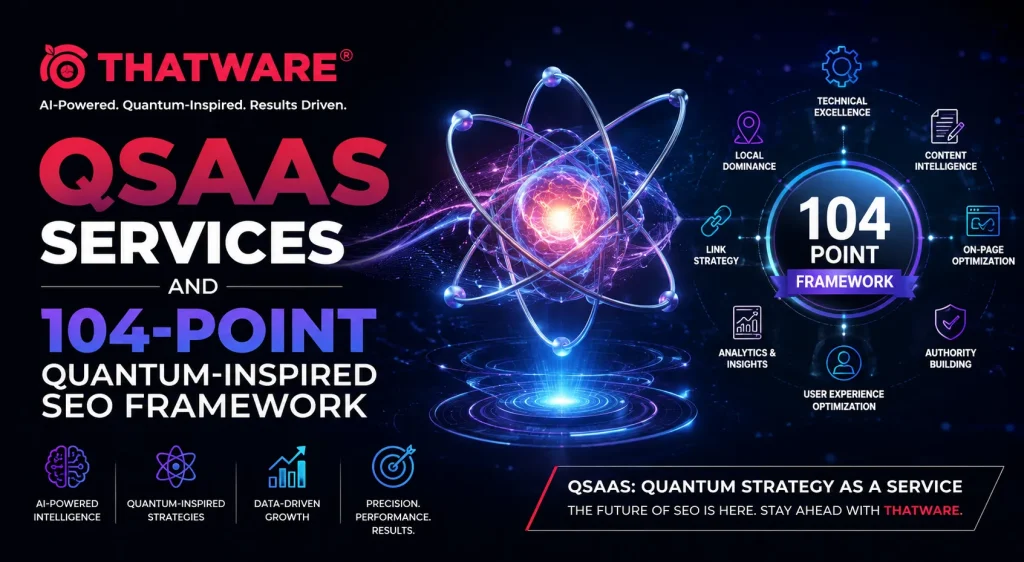
ThatWare’s QSAAS services are designed to manage search as an interconnected system. QSAAS, or Quantum SEO as a Service, combines quantum-inspired modelling, artificial intelligence, semantic analysis, predictive forecasting, technical SEO, entity intelligence, authority engineering and conversion-path optimisation.
The current ThatWare page already positions QSAAS as a monthly service for brands that need more than conventional SEO execution. It explains that the framework studies crawl behaviour, authority flow, semantic depth, AI visibility, content performance and user intent, while using AI, predictive analytics, machine learning and quantum-inspired models to prioritise growth opportunities.
The uploaded audit expands this positioning into 104 individually assessed deliverables. Each deliverable follows a structured protocol consisting of an audit and result, a plan of action and a fix report showing the current state, target state, implementation output and success metric.
What Is QSAAS?
QSAAS stands for Quantum SEO as a Service. It is a system-led search optimisation model that evaluates a website through multiple connected dimensions instead of reviewing each page or signal in isolation.
These dimensions can include:
- Crawlability and indexation
- Search intent
- Semantic relationships
- Entity recognition
- Content architecture
- AI answer visibility
- Internal authority flow
- Competitor positioning
- Conversion pathways
- Technical performance
- Structured data
- Brand trust
- Backlink quality
- Demand forecasting
- Probability-based prioritisation
QSAAS uses quantum-inspired logic to compare several possible optimisation pathways. It does not need to claim that quantum-computing hardware directly controls search rankings. The framework uses ideas such as weighted states, probability, signal interaction and scenario comparison to help make SEO decisions more measurable and less dependent on guesswork.
How QSAAS Is Different From Conventional SEO
Conventional SEO often follows a linear cycle:
- Audit the website.
- identify problems.
- Prepare recommendations.
- Implement selected fixes.
- Wait for search engines to respond.
- Review performance later.
QSAAS introduces a more adaptive process.
It evaluates how technical, semantic, authority, entity, AI visibility and conversion signals interact. It then models different future outcomes, identifies the highest-value correction path and updates priorities as new evidence becomes available.
Instead of asking only, “Which keyword should this page target?”, QSAAS asks:
- Which page has the highest probability of improving?
- Which signal is suppressing that page?
- Which technical dependency must be fixed first?
- What happens if no action is taken?
- What could happen after a strategic correction?
- Which competitor is gaining visibility?
- Which page should answer each conversational query?
- Which content can be selected for an AI-generated response?
- Where is internal authority being wasted?
- Which search opportunity has the strongest conversion potential?
- Which trust or authority weakness is reducing confidence?
ThatWare’s Complete QSAAS Service Scope
Core QSAAS Strategy and Consulting
ThatWare provides QSAAS services for organisations seeking a predictive, system-level approach to organic and AI search visibility.
As a specialist QSAAS company, ThatWare connects audits, weighted signal models, predictive scenarios, content intelligence, technical SEO and authority development.
A capable QSAAS agency should not present quantum terminology without practical implementation. Every model must lead to a page-level action, assigned owner and measurable outcome.
A QSAAS consultant can support marketing, SEO, content, development and leadership teams that require specialist modelling or strategic guidance.
ThatWare’s QSAAS consulting services help organisations interpret complex search signals and convert analysis into prioritised implementation.
Our QSAAS audit services establish a baseline across content, technical health, entities, AI visibility, authority, intent and conversion readiness.
Large organisations can use enterprise QSAAS services across multiple domains, brands, languages, markets, product groups or location networks.
QSAAS strategy consulting determines which workstreams should begin first and which activities depend on earlier technical, semantic or authority improvements.
QSAAS website optimization improves the complete search system surrounding the website rather than concentrating only on individual pages.
Quantum-Inspired SEO Services
ThatWare’s quantum-inspired SEO services use weighted signals, probability models and scenario comparison to support better decision-making.
Our Quantum SEO services evaluate several potential optimisation states before selecting a priority path.
A specialist Quantum SEO company should clearly document model inputs, assumptions, limitations and expected outcomes.
A Quantum SEO agency should combine modelling with technical SEO, content development, entity optimisation and authority building.
A Quantum SEO consultant can help internal teams interpret readiness scores and probability-based recommendations.
A Quantum SEO readiness audit evaluates whether a website has the technical, content, authority and semantic foundations needed for advanced optimisation.
The resulting Quantum SEO readiness score provides a comparable measure for individual pages, templates, clusters and domains.
Quantum search signal mapping identifies where each ranking, semantic, authority, intent or AI visibility signal originates and which page it supports.
Quantum ranking signal analysis examines the relative contribution, interaction and weakness of those signals.
A quantum-inspired ranking model converts the signals into a repeatable page-prioritisation framework.
Quantum search opportunity mapping ranks search opportunities according to demand, intent, probability, business value and implementation effort.
For organizations considering a more advanced and scalable approach, ThatWare’s QSAAS Pricing Plan can be structured according to website size, number of pages and search opportunities analyzed, quantum-inspired modelling requirements, competitor coverage, signal complexity, reporting frequency and ongoing optimization needs. The appropriate QSAAS plan can therefore align the level of analysis and implementation support with the organization’s search visibility objectives and growth requirements.
Predictive SEO and Probability Modelling
ThatWare’s predictive SEO services identify possible future search opportunities before they become obvious through historical reporting.
Our predictive SEO consulting services help organisations understand which forecasts are actionable and which remain too uncertain.
Predictive SERP opportunity forecasting evaluates the likelihood of visibility across organic results, snippets, People Also Ask, AI Overviews and other search features.
Predictive ranking opportunity analysis determines which pages are closest to meaningful growth and which require foundational work.
Predictive SEO growth modeling creates baseline, no-action and corrected-path scenarios.
Our SEO probability modeling services estimate the likelihood of ranking, AI inclusion, citation or conversion improvement under defined conditions.
Search visibility probability analysis compares the relative probability of gaining or losing visibility.
A future search visibility simulation illustrates possible performance paths over a defined period.
SEO no-action scenario modeling estimates what could happen when competitors improve while the website remains unchanged.
Strategic SEO correction simulation evaluates the potential effect of content, schema, technical, authority and entity improvements.
Keyword, Intent and Conversion Intelligence
Our keyword intent clustering services organise search terms according to the reason behind the search.
Semantic keyword clustering services group phrases by meaning, topic, entity and expected content format.
High-intent keyword research services identify searches connected with cost, comparison, provider selection, suitability, urgency and purchase readiness.
High-intent keyword opportunity mapping assigns those searches to commercially valuable pages and suitable calls to action.
Long-tail conversational query research captures complete questions and natural-language searches.
Conversational keyword expansion services develop related prompt variations, spoken searches, comparisons and contextual modifiers.
User intent pattern analysis identifies recurring needs, uncertainties, objections and decision triggers.
Commercial search intent mapping connects high-value queries with service, product, pricing or conversion pages.
Search intent classification services separate informational, navigational, commercial, transactional, local and support-based searches.
Search intent-to-conversion mapping documents the complete path from the initial query to the intended business action.
AI Search, AEO, GEO and LLM Visibility
ThatWare’s AI search visibility services measure how a brand appears across AI-assisted search and conversational discovery.
An AI search visibility audit records mentions, citations, recommendations, omissions and competitor appearances.
A generative engine visibility audit evaluates how the website is represented in AI-generated responses.
AI Overview eligibility analysis identifies pages with suitable answers, evidence, entities, trust signals and source formatting.
Google AI Overview optimization improves selected pages for clarity, extraction, citation and topical completeness.
Our LLM visibility enhancement services improve how large language models understand and retrieve approved brand information.
ChatGPT visibility optimization examines brand representation for selected prompt sets.
Gemini visibility optimization evaluates answer inclusion, source selection and factual consistency within Gemini-oriented testing.
Microsoft Copilot visibility optimization measures visibility and source behaviour across relevant Copilot experiences.
An Answer Engine Optimization strategy structures questions, answers, schema, entities and citations for answer-led discovery.
Content Intelligence and Answer Optimisation
AI-friendly content restructuring divides complex pages into clear, retrievable sections.
Answer-first content optimization places the direct response before supporting explanation.
Conversational content optimization aligns content with natural user language and prompt-style searches.
Our featured snippet optimization services create suitable paragraph, list, table and step formats.
People Also Ask optimization services assign related questions to the pages best qualified to answer them.
FAQ optimization services improve question selection, answer clarity, duplication control and page ownership.
ThatWare’s advanced content intelligence services analyse content quality, intent, semantic coverage, entities, evidence and commercial value.
A topical authority gap analysis identifies missing topics, entities, questions, proof assets and internal relationships.
A content hub and topic cluster strategy organises authority around connected pillar pages and supporting resources.
Programmatic SEO framework development defines scalable templates, data rules, uniqueness controls, internal links and quality safeguards.
Technical, Schema and Entity SEO
ThatWare’s advanced technical SEO audit services evaluate crawl, rendering, indexing, performance, architecture, structured data and server behaviour.
An enterprise technical SEO roadmap sequences scalable fixes across large websites, templates and development environments.
Crawlability and indexability analysis identifies which URLs can be accessed, rendered, canonicalised and indexed correctly.
Crawl budget optimization services reduce wasted crawling and increase focus on high-value pages.
Core Web Vitals optimization services improve loading, interaction and visual stability where technically possible.
JavaScript SEO audit services assess rendering, hydration, content availability and crawler accessibility.
Internal PageRank optimization improves how internal authority moves towards important pages.
Our advanced schema strategy services create accurate, connected and supportable structured-data graphs.
Entity SEO architecture services define the entities, relationships and canonical identifiers required across the website.
Semantic entity graph optimization strengthens connections among the brand, services, people, locations, topics and evidence sources.
Before and After QSAAS Implementation
Typical Website Before QSAAS
Before implementation, an organisation may have:
- Several disconnected audit reports
- No weighted search-readiness score
- No central search-signal map
- Keyword research without probability scoring
- No no-action or corrected-path forecast
- Overlapping page ownership
- Unmapped commercial intent
- Weak AI search visibility measurement
- Limited AI Overview readiness
- Content that delays the direct answer
- Unclear topical clusters
- Programmatic pages without quality controls
- Crawl and indexing problems with no priority model
- Internal authority distributed inefficiently
- Disconnected schema records
- Ambiguous brand entities
- Backlinks assessed mainly by volume
- No monthly predictive dashboard
- No strategic priority-zone model
- Recommendations without implementation ownership
Target Website After QSAAS
After implementation, the organisation should have:
- A consolidated baseline benchmark
- Weighted QSAAS readiness scores
- A mapped search-signal architecture
- Probability-ranked opportunity zones
- No-action and corrected-path scenarios
- Clear keyword and question ownership
- Intent-to-conversion journey maps
- Cross-platform AI visibility reports
- AI Overview eligibility maps
- Answer-first content modules
- A governed topical-authority system
- Controlled programmatic SEO templates
- A sequenced technical SEO roadmap
- Improved internal PageRank distribution
- Connected schema and entity graphs
- A clear brand identity model
- Risk-controlled authority development
- Monthly executive dashboards
- Quarterly innovation planning
- An owned execution backlog
QSAAS Audit, Plan of Action and Fix Method
Audit and Result
Each deliverable begins with a documented assessment covering:
- Asset, page or signal reviewed
- Current evidence
- Existing strength
- Identified gap
- Risk or opportunity level
- Required supporting data
- Business relevance
- Priority classification
Plan of Action
The plan defines:
- The exact correction required.
- The URLs or assets affected.
- The implementation owner.
- Technical or editorial dependencies.
- Priority level.
- Validation method.
- Expected signal improvement.
- Review frequency.
Fix Report
The fix report records:
- Before state
- Target after state
- Change implemented
- Evidence of implementation
- Validation status
- Measured movement
- Remaining weakness
- Follow-up recommendation
Complete 104-Point QSAAS Framework
Phase One: Baseline, Quantum Signals and Predictive Modelling
1. QSAAS Baseline Website Audit
Before
Technical, content, entity, AI visibility, authority and conversion findings are maintained in separate audits. Stakeholders cannot see how these dimensions interact at page level.
Plan of Action
Build an inventory of priority URLs. Score each URL across technical health, content quality, entity clarity, intent, authority, AI visibility and conversion readiness. Attach evidence, issue severity, owner and validation method.
After
The organisation receives a consolidated QSAAS baseline against which every future correction can be measured.
Output: URL-level baseline matrix.
Success metric: Percentage of priority URLs scored and number of findings converted into owned tasks.
2. Quantum SEO Readiness Score
Before
Strong assets may exist, but no weighted score shows whether a page is ready to compete across organic and AI search.
Plan of Action
Define scoring weights for crawlability, intent alignment, content depth, entity clarity, schema, trust, authority and conversion. Classify pages as ready, partial, weak or high-risk.
After
Each priority URL has an explainable readiness score and a clear path to the next score band.
Output: Weighted QSAAS readiness scorecard.
Success metric: Average score improvement following implementation.
3. Quantum Signal Mapping
Before
Search signals exist across content, schema, links, citations, reviews and technical assets but remain disconnected.
Plan of Action
Inventory every significant signal, connect it with the source URL and identify which target page it should strengthen. Flag conflicts, duplication, weak proximity and missing reinforcement.
After
A visual signal map shows how individual signals contribute to page and cluster performance.
Output: Search-signal graph.
Success metric: Signal coverage and reduction in unassigned or conflicting signals.
4. Quantum Search Opportunity Mapping
Before
Opportunities are selected mainly through keyword volume or competitor rankings.
Plan of Action
Score opportunities using demand, intent, commercial value, page readiness, AI surface potential, competition and effort. Assign a target URL and preferred content format.
After
Search opportunities are organised into probability-ranked priority zones.
Output: Quantum opportunity map.
Success metric: Performance of the highest-ranked opportunity group.
5. Quantum Algorithmic Ranking Signal Simulation
Before
The team knows which signals are weak but cannot compare how different combinations may affect performance.
Plan of Action
Model scenarios involving content depth, internal links, schema, technical health, authority and competitor pressure. Compare individual and combined corrections.
After
Stakeholders can see which signal combinations are most likely to create measurable improvement.
Output: Ranking-signal simulation report.
Success metric: Accuracy of predicted priority order against observed results.
6. Quantum-Inspired Ranking Model Design
Before
Page prioritisation depends on opinion, isolated metrics or a general SEO checklist.
Plan of Action
Define weighted model variables, normalise the inputs, assign page-class weights and document all assumptions. Test whether the model reflects commercial importance and observed SERP behaviour.
After
A repeatable ranking-readiness model determines which pages receive resources first.
Output: Custom ranking model.
Success metric: Correlation between model scores and subsequent page improvement.
7. AI + Quantum SEO Growth Simulation
Before
There is no projected growth model combining organic search and AI visibility.
Plan of Action
Build baseline, conservative, moderate and accelerated scenarios using technical, content, authority, AI visibility and conversion inputs.
After
Leadership can compare potential performance paths by service, category, location or product group.
Output: AI and Quantum SEO growth simulation.
Success metric: Forecast variance compared with observed results.
8. Quantum Science Marketing Opportunity Report
Before
Quantum-inspired terminology may sound technical without demonstrating practical business value.
Plan of Action
Translate signal modelling, probability analysis and scenario simulation into clear commercial outcomes. Use diagrams, real page examples, score movement and measurable use cases.
After
Prospects and stakeholders can understand how QSAAS supports prioritisation, visibility and growth.
Output: Client-facing opportunity report.
Success metric: Stakeholder comprehension and adoption of recommended initiatives.
9. QSAAS Master Strategy Blueprint
Before
Audits and recommendations exist without a single implementation sequence.
Plan of Action
Organise work into baseline, predictive, intent, content, AI visibility, technical, entity, authority and reporting layers. Define dependencies, milestones and ownership.
After
The campaign follows one controlled blueprint rather than several disconnected plans.
Output: Master strategy blueprint.
Success metric: Milestone completion and reduction in blocked tasks.
10. Predictive SERP Opportunity Forecasting
Before
SERP features are reviewed only after competitors gain them.
Plan of Action
Analyse current rankings, result formats, competitor movement, page readiness and query volatility. Forecast opportunities for snippets, local results, PAA, AI Overviews and organic listings.
After
The content and technical roadmap targets likely SERP opportunities earlier.
Output: SERP opportunity forecast.
Success metric: Forecasted opportunities converted into actual visibility.
11. No-Action Future Visibility Simulation
Before
The cost of leaving known weaknesses unresolved is not quantified.
Plan of Action
Model competitor growth, content decay, authority dilution, technical debt and AI visibility loss under a no-action scenario.
After
Leadership sees the potential visibility, traffic and conversion exposure associated with inaction.
Output: No-action simulation.
Success metric: Estimated risk avoided through timely implementation.
12. Strategic-Correction Future Simulation
Before
Recommendations are presented without a model of the corrected future state.
Plan of Action
Apply planned content, entity, technical, schema and authority changes to the baseline model. Forecast likely changes over defined time intervals.
After
The roadmap includes an evidence-led view of potential corrected performance.
Output: Strategic-correction simulation.
Success metric: Corrected-path uplift against the baseline.
13. Probability Delta Analysis
Before
No measurement shows the difference between the no-action and corrected pathways.
Plan of Action
Calculate the probability difference for ranking, AI inclusion, click growth, citation and conversion outcomes.
After
The potential value of the proposed strategy is represented as a measurable probability delta.
Output: Probability delta scorecard.
Success metric: Observed movement compared with projected delta.
Phase Two: Keyword Intent, Conversational Search and Conversion Mapping
14. Keyword Intent Clustering
Before
Keywords are grouped by similar wording rather than user objective.
Plan of Action
Classify terms by informational, commercial, local, navigational, transactional and support intent. Assign each cluster to one canonical page.
After
Every keyword group supports a defined user need and page purpose.
Output: Keyword intent workbook.
Success metric: Intent coverage and reduced page cannibalisation.
15. Semantic Keyword Clustering
Before
Synonyms and related concepts are distributed across pages without clear ownership.
Plan of Action
Group terms by semantic similarity, entity, context and expected answer format. Define primary and supporting pages.
After
Semantic coverage expands without creating competing URLs.
Output: Semantic cluster map.
Success metric: Query coverage and page differentiation.
16. Long-Tail Conversational Query Expansion
Before
Research focuses on short keywords and overlooks complete questions.
Plan of Action
Expand conversational variations covering cost, comparison, process, suitability, location, risk and recommendation intent.
After
Content supports the natural language used in voice and AI search.
Output: Conversational query library.
Success metric: Long-tail impressions and assisted conversions.
17. High-Intent Keyword Opportunity Map
Before
Purchase-ready terms are mixed with low-intent informational queries.
Plan of Action
Identify high-intent modifiers, score conversion likelihood and assign suitable service, product, category or pricing pages.
After
Commercial opportunities receive stronger page treatment, evidence and CTAs.
Output: High-intent opportunity map.
Success metric: Engagement and conversions from high-intent clusters.
18. Search Intent-to-Conversion Journey Mapping
Before
The journey from search query to conversion is not documented.
Plan of Action
Map query, intent, landing page, proof requirement, next page, CTA and conversion event.
After
Every major search journey has a clear and measurable progression.
Output: Intent-to-conversion journey map.
Success metric: Journey completion and assisted conversion rate.
19. Commercial Intent Mapping
Before
Commercial signals such as cost, availability, benefits and comparison are scattered.
Plan of Action
Map each commercial query to the required answer, proof, objection handler, CTA and target URL.
After
Commercial pages answer decision-stage questions closer to the point of action.
Output: Commercial intent matrix.
Success metric: Commercial-query engagement and conversion improvement.
20. User Intent Pattern Analysis
Before
Recurring user concerns are visible in analytics, sales conversations and FAQs but remain unclassified.
Plan of Action
Analyse patterns involving uncertainty, urgency, comparison, risk, suitability and readiness. Connect each pattern with an appropriate content response.
After
Page architecture reflects real decision behaviour rather than generic funnel assumptions.
Output: Intent-pattern report.
Success metric: Reduced friction and increased CTA progression.
Phase Three: Competitor and Market Intelligence
21. Competitor Visibility Snapshot
Before
Competitor performance is assessed mainly through rankings.
Plan of Action
Capture visibility across organic listings, local packs, AI Overviews, featured snippets, PAA, directories, citations and AI answers.
After
The organisation receives a multi-surface view of competitor visibility.
Output: Competitor visibility dashboard.
Success metric: Share of visible search surfaces.
22. Competitor Gap Analysis
Before
Competitor gaps are identified without a consistent scoring method.
Plan of Action
Compare content, entities, schema, technical health, authority, links, answers and conversion assets. Rank gaps by importance and effort.
After
Counter-strategies focus on the gaps most likely to affect growth.
Output: Competitor gap matrix.
Success metric: Percentage of priority gaps closed.
23. Competitor SERP Pattern Mapping
Before
The team does not know which result formats competitors use to win different query groups.
Plan of Action
Record page type, heading structure, answer format, schema, authority and content depth for each competitor-owned result.
After
ThatWare can create a format-specific counter-plan for each SERP pattern.
Output: SERP pattern map.
Success metric: Gains across targeted result formats.
24. Competitor Content Architecture Review
Before
Internal architecture is planned without benchmarking competing hub and spoke systems.
Plan of Action
Compare category depth, pillar pages, supporting content, internal links, navigation and content hierarchy.
After
The website gains a stronger and more differentiated content architecture.
Output: Architecture comparison report.
Success metric: Cluster completeness and internal connectivity.
25. Competitor Backlink Opportunity Review
Before
Competitor link sources are not mapped by context or target-page relevance.
Plan of Action
Identify credible publications, directories, resource pages, associations, expert opportunities and community sources linking to competitors.
After
Link prospecting focuses on proven, contextually relevant sources.
Output: Competitor backlink opportunity database.
Success metric: Qualified outreach and placement rate.
26. Market-Wide Authority Benchmarking
Before
Authority is compared through a single domain metric.
Plan of Action
Compare editorial mentions, referring domains, citations, entity profiles, expert credentials, reviews and industry recognition.
After
A wider authority benchmark shows where the brand is strong and where trust gaps remain.
Output: Market authority scorecard.
Success metric: Authority-gap reduction.
Phase Four: AI Search, AEO, GEO and LLM Visibility
27. AI Search Visibility Overview
Before
AI visibility is checked manually and inconsistently.
Plan of Action
Build a fixed prompt set and record mentions, citations, recommendations, omissions, competitors and source URLs.
After
AI visibility can be compared by platform, intent, page and period.
Output: AI visibility overview.
Success metric: Mention, citation and recommendation movement.
28. AI Overview Eligibility Mapping
Before
Pages contain useful facts but lack complete answer, source and trust structures.
Plan of Action
Score pages for direct answers, evidence, entities, freshness, schema, authority and extractability.
After
Priority pages are classified by AI Overview readiness and required correction.
Output: AI Overview eligibility map.
Success metric: Number of eligible pages and observed source appearances.
29. AI Search and Generative Engine Visibility Audit
Before
The brand may be omitted, misrepresented or supported by weak sources in generated answers.
Plan of Action
Test relevant prompts across selected AI platforms. Compare wording, source behaviour, brand inclusion and competitor representation.
After
Every failed or weak output is connected with a content, schema, entity, citation or authority correction.
Output: Generative visibility audit.
Success metric: Prompt pass rate and correct-source usage.
30. LLM Visibility Enhancement Strategy
Before
Large language models can identify broad brand information but lack reliable, detailed source material.
Plan of Action
Improve canonical brand statements, answer modules, entity relationships, source pages, citations and machine-readable information.
After
Approved information becomes clearer, easier to retrieve and less vulnerable to unsupported interpretation.
Output: LLM visibility strategy.
Success metric: Accurate brand representation and citation frequency.
31. GPT, Gemini and Copilot Behaviour Review
Before
Cross-platform response differences are unknown.
Plan of Action
Run the same controlled prompts across GPT, Gemini and Copilot. Record mentions, citations, recommendations, wording, omissions and errors.
After
Platform-specific weaknesses can be corrected without assuming all AI systems behave identically.
Output: Cross-platform behaviour report.
Success metric: Response consistency and reduction in factual errors.
32. AEO Alignment Strategy
Before
Answer-style content exists but is not systematically assigned to high-value questions.
Plan of Action
Map questions to pages, create direct answer blocks, strengthen evidence and implement suitable structured data.
After
The website contains controlled answer modules for priority queries.
Output: AEO alignment roadmap.
Success metric: Answer-surface visibility and extraction accuracy.
33. GEO Alignment Strategy
Before
The brand lacks a coordinated system for generative citations, summaries and recommendations.
Plan of Action
Develop source-backed content, entity clarity, reference pages, authority signals and generative prompt testing.
After
The website is better prepared for citation and inclusion within generated responses.
Output: GEO alignment roadmap.
Success metric: Generative mentions, citations and share of answer.
34. AI-Friendly Content Restructuring
Before
Long content blocks combine multiple questions, entities and intents.
Plan of Action
Divide pages into concise summaries, answers, lists, tables, definitions, evidence and next steps.
After
Each section becomes easier for users and machines to interpret independently.
Output: AI-friendly page blueprint.
Success metric: Correct-passage extraction.
35. Answer-First Paragraph Optimization
Before
Users and AI systems must read background information before reaching the answer.
Plan of Action
Place a concise direct answer below every priority question or intent-matching heading.
After
Core responses are available immediately, followed by explanation and evidence.
Output: Answer-first content modules.
Success metric: Extraction pass rate and readability.
36. Conversational Content Rewriting
Before
Content reflects internal business terminology instead of user language.
Plan of Action
Rewrite selected sections around natural questions, objections and decision-stage wording.
After
Page copy aligns more closely with conversational and prompt-style searches.
Output: Conversational content pack.
Success metric: Conversational-query coverage.
37. Featured Snippet Targeting
Before
Accurate answers exist but lack suitable length and structure.
Plan of Action
Create concise paragraph, list, table and step candidates beneath matching headings.
After
Priority pages contain deliberate featured-snippet targets.
Output: Snippet targeting pack.
Success metric: Featured-snippet ownership and CTR movement.
38. People Also Ask Optimization
Before
Related questions are concentrated in general FAQ pages.
Plan of Action
Assign each PAA opportunity to the page with the strongest intent and entity match.
After
Service and supporting pages gain unique, relevant question coverage.
Output: PAA opportunity map.
Success metric: PAA visibility and supporting traffic.
39. FAQ Optimization
Before
FAQs may be repetitive, lengthy or disconnected from commercial pages.
Plan of Action
Deduplicate questions, improve direct answers, assign ownership and connect each answer with a relevant next step.
After
The FAQ system supports search visibility, user confidence and conversion progression.
Output: Governed FAQ library.
Success metric: FAQ engagement and query coverage.
Phase Five: Content Intelligence and Programmatic Growth
40. Content Gap Identification
Before
Gaps are determined primarily through missing competitor keywords.
Plan of Action
Compare topics, questions, entities, evidence, answer formats, funnel stages and source requirements.
After
Every meaningful gap has a proposed page, section, format and owner.
Output: Content-gap register.
Success metric: High-value gap closure.
41. Topical Authority Gap Analysis
Before
The site covers broad topics but may lack depth or important entity relationships.
Plan of Action
Audit topic breadth, depth, entity coverage, supporting questions, authority content and internal links.
After
The roadmap identifies exactly what is required to establish stronger topical authority.
Output: Topical-authority gap report.
Success metric: Cluster completion and visibility growth.
42. Content Hub and Topical Cluster Blueprint
Before
Pages and articles operate as isolated assets.
Plan of Action
Define pillar pages, supporting resources, question pages, proof assets, internal links and conversion destinations.
After
Content functions as a connected topical ecosystem.
Output: Hub and cluster blueprint.
Success metric: Internal connectivity and cluster performance.
43. Custom Topical Authority Engine Blueprint
Before
Generic content calendars do not reflect the organisation’s entities or commercial priorities.
Plan of Action
Develop a custom authority model using services, audiences, products, locations, experts, questions and evidence.
After
Publishing decisions support a defined entity and authority objective.
Output: Custom authority engine.
Success metric: Authority-score and assisted-conversion growth.
44. Content Velocity Planning
Before
Publishing volume is determined without capacity, quality or authority considerations.
Plan of Action
Set a realistic publishing and refresh cadence based on gap size, business value, review capacity and competitor movement.
After
Content production becomes consistent without sacrificing quality.
Output: Content velocity calendar.
Success metric: On-time publication and quality acceptance.
45. Advanced Content Intelligence System
Before
Content data is spread across rankings, analytics, audits and editorial documents.
Plan of Action
Combine page purpose, intent, entity coverage, quality, authority, freshness, visibility and conversion data in one model.
After
Content decisions are prioritised through a unified intelligence system.
Output: Content intelligence dashboard.
Success metric: Improvement among prioritised assets.
46. Programmatic SEO Opportunity Mapping
Before
Scalable page opportunities are selected without testing data quality or uniqueness.
Plan of Action
Identify valid datasets, repeating intents, page variables, search demand and differentiation requirements.
After
Only defensible programmatic opportunities proceed to design.
Output: Programmatic opportunity map.
Success metric: Qualified template opportunities.
47. Programmatic SEO Framework Design
Before
Template pages risk duplication, thin content and index bloat.
Plan of Action
Define data fields, uniqueness rules, editorial controls, schema, links, indexing logic and quality thresholds.
After
Scalable pages follow a governed framework.
Output: Programmatic SEO specification.
Success metric: Valid, unique and indexed template-page ratio.
Phase Six: Landing Pages, UX and Search Experience
48. Landing Page Performance Review
Before
Landing pages are assessed separately for rankings and conversions.
Plan of Action
Review query match, page speed, content hierarchy, trust, engagement, CTA usage and conversion behaviour together.
After
The organisation sees where search and conversion performance diverge.
Output: Landing-page scorecard.
Success metric: Improvement in engagement and conversions.
49. Landing Page Optimization Recommendations
Before
Recommendations are broad and not mapped to page evidence.
Plan of Action
Provide URL-level changes for headings, answers, proof, layout, internal links, schema and CTAs.
After
Each page has an implementation-ready optimisation specification.
Output: Page recommendation pack.
Success metric: Recommendation completion and performance lift.
50. High-Priority Landing Page Optimization
Before
High-value pages compete for resources with low-impact pages.
Plan of Action
Select pages using commercial value, traffic, ranking proximity, AI visibility potential and conversion weakness.
After
Resources concentrate on pages with the greatest probable return.
Output: High-priority optimisation sprint.
Success metric: Visibility and conversion uplift among selected pages.
51. Conversion Intent Architecture
Before
Calls to action are placed uniformly without considering intent stage.
Plan of Action
Assign awareness, evaluation, comparison and action-stage CTAs to relevant page sections.
After
The conversion path reflects the user’s readiness.
Output: Conversion-intent architecture.
Success metric: CTA progression and conversion rate.
52. UX-Search Signal Review
Before
Search performance and user behaviour are interpreted in separate reports.
Plan of Action
Compare rankings, CTR, engagement, navigation, scroll behaviour, return visits and conversion actions.
After
UX issues that weaken search performance become measurable priorities.
Output: UX-search signal report.
Success metric: Engagement and search-performance improvement.
53. Page Experience Review
Before
Page experience is reduced to speed metrics.
Plan of Action
Review mobile usability, visual stability, readability, accessibility, navigation, forms, trust and content clarity.
After
Page experience reflects both technical and human requirements.
Output: Page-experience audit.
Success metric: Core experience and behavioural improvements.
54. Technical SEO Health Snapshot
Before
Technical health is known only through infrequent audits.
Plan of Action
Create a recurring snapshot of crawl errors, indexation, canonicals, redirects, sitemaps, schema, performance and rendering.
After
Technical decline can be detected before it becomes a larger visibility problem.
Output: Technical-health dashboard.
Success metric: Critical issue count and correction time.
Phase Seven: Enterprise Technical SEO and Internal Authority Flow
55. Advanced Technical SEO Audit
Before
Standard audits identify surface-level errors without template or infrastructure analysis.
Plan of Action
Audit architecture, crawling, indexing, rendering, canonicals, redirects, duplication, internationalisation, performance and structured data.
After
Technical weaknesses are connected with affected templates and business risk.
Output: Advanced technical audit.
Success metric: Critical issue closure and indexation improvement.
56. Technical SEO Implementation Plan
Before
Technical recommendations lack owners, dependencies and validation steps.
Plan of Action
Convert findings into development tickets containing affected URLs, severity, fix logic, test method and rollback considerations.
After
Technical recommendations are ready for controlled implementation.
Output: Technical implementation plan.
Success metric: Ticket completion and validation rate.
57. Enterprise-Level Technical SEO Roadmap
Before
Large technical projects compete without a sequencing framework.
Plan of Action
Organise work into immediate, foundational, scalable and ongoing phases. Identify platform, template and team dependencies.
After
Enterprise technical work follows a realistic multi-quarter roadmap.
Output: Enterprise technical roadmap.
Success metric: Milestone completion and reduction in recurring issues.
58. Crawlability and Indexability Analysis
Before
Important pages may be blocked, orphaned, duplicated or incorrectly canonicalised.
Plan of Action
Review directives, sitemaps, canonicals, links, response codes, rendering and indexation patterns.
After
High-value URLs have clear crawl and indexing pathways.
Output: Crawl and index report.
Success metric: Valid index coverage.
59. Crawl Budget Optimization Recommendations
Before
Crawler resources are consumed by parameters, duplicates, redirects or low-value URLs.
Plan of Action
Classify URL value, remove traps, improve sitemaps, control parameters and strengthen important internal paths.
After
Crawler attention is concentrated on valuable and frequently updated content.
Output: Crawl-budget recommendation pack.
Success metric: Reduced waste and improved priority-page crawl frequency.
60. Crawl Depth Optimization
Before
Important pages require too many clicks to reach.
Plan of Action
Map crawl depth, identify buried URLs and improve navigation, hubs, breadcrumbs and contextual links.
After
Priority content becomes accessible through shorter pathways.
Output: Crawl-depth map.
Success metric: Average depth reduction for target pages.
61. Core Web Vitals Overview
Before
Performance issues are assessed without separating field and laboratory evidence.
Plan of Action
Review LCP, INP and CLS by template, device and traffic importance. Identify technical causes and implementation ownership.
After
Performance work is prioritised by real user impact.
Output: Core Web Vitals overview.
Success metric: Percentage of good URLs and field-data improvement.
62. JavaScript SEO and Rendering Review
Before
Critical content or links may depend on scripts that crawlers process inconsistently.
Plan of Action
Compare source HTML, rendered HTML and user-visible content. Test routes, hydration, links, metadata and structured data.
After
Essential content and discovery signals remain reliably available.
Output: Rendering review.
Success metric: Rendering parity and crawler accessibility.
63. Log File Analysis
Before
Crawler behaviour is inferred rather than verified.
Plan of Action
Analyse bot visits, response codes, crawl frequency, wasted requests and neglected URL groups.
After
Crawl decisions are supported by server-level evidence.
Output: Log analysis report.
Success metric: Improved bot allocation to priority URLs.
64. Internal Linking Opportunity Analysis
Before
Internal links are added manually and inconsistently.
Plan of Action
Identify contextual relationships, orphan pages, authority sources, journey opportunities and suitable anchor text.
After
Each important page receives relevant internal support.
Output: Internal-link opportunity map.
Success metric: Coverage, depth and target-page performance.
65. Internal PageRank Flow Analysis
Before
Domain authority exists but its internal distribution is unclear.
Plan of Action
Model link equity across the site and identify over-supported, under-supported and isolated pages.
After
Stakeholders can see where internal authority is concentrated or lost.
Output: Internal PageRank model.
Success metric: Authority-flow improvement for priority pages.
66. Internal Link Equity Redistribution Model
Before
High-authority pages do not consistently support commercial destinations.
Plan of Action
Design linking changes that move equity towards priority clusters while preserving useful navigation.
After
Internal authority supports business-critical pages more effectively.
Output: Link-equity redistribution model.
Success metric: Target-page link equity and ranking movement.
67. Schema Markup Recommendations
Before
Schema is missing, incomplete or selected without page-specific reasoning.
Plan of Action
Recommend supported types, properties, identifiers and content sources for each eligible page.
After
Developers receive accurate URL-level schema specifications.
Output: Schema recommendation pack.
Success metric: Valid implementation coverage.
68. Advanced Schema Strategy
Before
Individual schema blocks remain disconnected.
Plan of Action
Create a connected graph linking organisation, services, products, people, articles, locations and webpages.
After
Structured data communicates a coherent entity architecture.
Output: Advanced schema graph.
Success metric: Relationship coverage and zero critical conflicts.
69. Schema Deployment Roadmap
Before
Schema recommendations remain unimplemented or are deployed without validation.
Plan of Action
Sequence high-value templates, assign owners, define testing and schedule recurring audits.
After
Structured data is deployed through a controlled programme.
Output: Schema deployment roadmap.
Success metric: Deployment completion and valid detection.
Phase Eight: Entity Architecture and Brand Visibility
70. Entity and Semantic Relevance Check
Before
Pages mention relevant entities but may not establish the correct relationships.
Plan of Action
Extract entities, review salience, measure co-occurrence and compare semantic coverage with intended page purpose.
After
Each page contains a clearer primary entity and supporting entity set.
Output: Entity relevance scorecard.
Success metric: Entity coverage and recognition confidence.
71. Entity SEO Architecture Plan
Before
Brand, service, person, product, location and topic entities are managed separately.
Plan of Action
Define canonical identifiers, relationships, source pages, schema nodes and internal linking rules.
After
The website follows one entity architecture.
Output: Entity SEO architecture plan.
Success metric: Entity consistency across priority assets.
72. Advanced Entity Graph Optimization Plan
Before
Existing entity relationships are incomplete or weakly reinforced.
Plan of Action
Identify missing edges, ambiguous entities, weak evidence and inconsistent attributes.
After
A prioritised plan strengthens the most valuable entity relationships.
Output: Entity graph optimisation roadmap.
Success metric: Relationship-gap reduction.
73. Complete Semantic Entity Graph Architecture
Before
No complete graph represents the brand’s searchable ecosystem.
Plan of Action
Map all primary and supporting entities, attributes, relationships, sources and canonical URLs.
After
Content, schema, AI visibility and knowledge systems use one governed graph.
Output: Semantic entity graph.
Success metric: Node and relationship coverage.
74. Brand Entity Disambiguation
Before
Naming variants, subsidiaries, similar brands or inconsistent descriptions create ambiguity.
Plan of Action
Define canonical name, aliases, identifiers, profiles, descriptions and exclusions.
After
Search and AI systems receive a stable brand identity.
Output: Brand disambiguation register.
Success metric: Reduced ambiguous brand matches.
75. Brand Mention and Entity Association Strategy
Before
Brand mentions exist without consistent topic or service associations.
Plan of Action
Map desired associations and develop content, PR, profiles and citations that reinforce them.
After
The brand becomes more consistently connected with priority subjects.
Output: Mention and association strategy.
Success metric: Relevant co-mentions and citation growth.
76. Brand SERP Optimization Plan
Before
The branded results page contains inconsistent or weak assets.
Plan of Action
Improve owned profiles, metadata, sitelinks, reviews, knowledge signals, media results and authoritative third-party references.
After
Brand searches communicate a clearer and more credible identity.
Output: Brand SERP plan.
Success metric: Owned-result coverage and sentiment quality.
77. Brand Authority Modeling
Before
Brand authority is assessed through links alone.
Plan of Action
Score citations, expert mentions, profiles, reviews, credentials, publications, entity consistency and topic associations.
After
Authority is represented through a broader, explainable model.
Output: Brand authority model.
Success metric: Weighted authority-score improvement.
78. QBM-Lite Brand Visibility Mapping
Before
Brand visibility is measured without analysing contextual relationships.
Plan of Action
Map where the brand appears, with which entities, for which questions and within which authority environments.
After
The organisation receives an initial quantum-inspired brand visibility map.
Output: QBM-Lite map.
Success metric: Growth in high-value brand associations.
79. AIEO-Lite AI Experience Optimization Recommendations
Before
AI visibility and the post-click experience are handled separately.
Plan of Action
Review AI answers, source pages, clarity, trust, navigation and conversion actions.
After
Recommendations improve both AI representation and user experience.
Output: AIEO-Lite recommendation pack.
Success metric: AI visibility and post-click engagement.
80. Full AEO, GEO, AIEO, QBM, crSEO and QSAAS Alignment
Before
Advanced search frameworks operate as isolated workstreams.
Plan of Action
Create shared entities, query maps, target pages, answer modules, authority requirements and reporting definitions.
After
All frameworks support one coordinated search intelligence strategy.
Output: Cross-framework alignment matrix.
Success metric: Reduced duplication and consistent target-page ownership.
Phase Nine: Backlinks, Trust and Authority Development
81. Backlink Quality Review
Before
Links are evaluated mainly by domain metrics.
Plan of Action
Assess relevance, editorial context, traffic, placement, anchor text, source diversity and risk.
After
The backlink profile is classified by real strategic value.
Output: Backlink quality report.
Success metric: Percentage of relevant and editorially credible links.
82. Backlink Risk and Opportunity Review
Before
Risky links and growth opportunities are reviewed separately.
Plan of Action
Classify every notable domain as retain, investigate, remediate, replicate or pursue.
After
The organisation receives a balanced risk and acquisition roadmap.
Output: Link risk-opportunity matrix.
Success metric: Risk reduction and qualified opportunity growth.
83. Backlink Toxicity Analysis
Before
Potentially harmful links remain unidentified or are labelled toxic without evidence.
Plan of Action
Assess manipulation patterns, source quality, anchor distribution, site networks and manual-action relevance.
After
Only genuinely concerning patterns enter remediation review.
Output: Toxicity analysis.
Success metric: Reduced high-risk link exposure without unnecessary removals.
84. Authority-Building Roadmap
Before
Authority activities lack a topic, page or entity objective.
Plan of Action
Prioritise expert content, reference assets, citations, digital PR, profiles, partnerships and link acquisition.
After
Authority growth follows a phased and measurable roadmap.
Output: Authority-building roadmap.
Success metric: Relevant mention, citation and referring-domain growth.
85. Digital PR and Authority Acquisition Roadmap
Before
PR activity generates publicity without supporting search entities or source pages.
Plan of Action
Develop expert commentary, data assets, research, news angles and citation-ready destinations.
After
Earned media reinforces priority topics and authoritative source pages.
Output: Digital PR roadmap.
Success metric: Qualified editorial coverage and citations.
86. Advanced Backlink Acquisition Strategy
Before
Link building relies on general outreach lists.
Plan of Action
Segment opportunities by editorial resources, industry publications, associations, data citations, partnerships and expert contributions.
After
Acquisition becomes diversified and relevance-led.
Output: Advanced link strategy.
Success metric: Placement quality and target-page support.
87. Niche-Relevant Link Prospect Mapping
Before
Prospect lists contain domains with limited topical connection.
Plan of Action
Map prospects according to niche, audience, topic, authority, page type and outreach angle.
After
Outreach focuses on sources capable of strengthening the intended entity association.
Output: Niche prospect map.
Success metric: Qualified-prospect and placement rate.
88. Citation-Ready Reference Page Strategy
Before
Facts, definitions, methodologies and evidence are spread across multiple pages.
Plan of Action
Create authoritative reference pages with clear authorship, sources, update dates and reusable evidence.
After
Publishers, users and AI systems have strong pages to cite.
Output: Reference-page strategy.
Success metric: External citations and correct-source retrieval.
89. E-E-A-T Signal Review
Before
Experience, expertise, authority and trust are present inconsistently.
Plan of Action
Review authors, reviewers, credentials, evidence, original experience, policies, dates and organisational transparency.
After
Priority pages display suitable trust signals near important claims.
Output: E-E-A-T review.
Success metric: Trust-field completion.
90. Trust Signal Weakness Identification
Before
Trust weaknesses remain hidden across page content, profiles and policies.
Plan of Action
Identify missing credentials, unsupported claims, outdated information, weak contact details and unclear ownership.
After
A risk-ranked register guides trust improvements.
Output: Trust weakness register.
Success metric: High-risk weakness closure.
91. Authority Gap Diagnosis
Before
Competitors appear stronger without a clear explanation.
Plan of Action
Compare expert proof, citations, coverage, links, reviews, entity consistency and source quality.
After
The exact causes of the authority gap are documented.
Output: Authority gap diagnosis.
Success metric: Priority authority-gap reduction.
Phase Ten: Forecasting, Reporting and Strategic Support
92. Search Demand Forecasting
Before
Content planning relies mainly on current search volume.
Plan of Action
Analyse seasonality, trend movement, market events, competitor expansion and query emergence.
After
Publishing and optimisation can begin before demand peaks.
Output: Search demand forecast.
Success metric: Visibility gained during forecasted demand periods.
93. Predictive SEO Growth Modeling
Before
Growth targets are based on broad percentage assumptions.
Plan of Action
Model technical corrections, page improvement, demand, authority and conversion under multiple scenarios.
After
Targets are connected with defined inputs and confidence ranges.
Output: Predictive growth model.
Success metric: Forecast accuracy and realised uplift.
94. Strategic Priority Zones Identification
Before
Recommendations compete within one large backlog.
Plan of Action
Group pages and tasks into critical, high-growth, foundational, experimental and monitoring zones.
After
Teams know where immediate effort should be concentrated.
Output: Priority-zone matrix.
Success metric: Completion and performance by zone.
95. Monthly QSAAS Performance Dashboard
Before
Monthly reporting describes completed activity without showing signal movement.
Plan of Action
Track readiness, visibility, technical health, intent coverage, AI inclusion, authority and conversions.
After
Monthly decisions are supported by an integrated performance view.
Output: Monthly QSAAS dashboard.
Success metric: Month-over-month signal improvement.
96. Custom Executive QSAAS Dashboard
Before
Senior stakeholders receive reports that are too detailed or tactical.
Plan of Action
Create an executive view covering growth, risk, probability, implementation status, competitor exposure and business impact.
After
Leadership can evaluate the programme without reviewing operational data.
Output: Executive dashboard.
Success metric: Decision turnaround and milestone visibility.
97. Insight Report Frequency
Before
Reports are delivered on a fixed schedule regardless of volatility or decision need.
Plan of Action
Set weekly, monthly and quarterly reporting according to data sensitivity and stakeholder requirements.
After
Important changes are communicated at the right frequency.
Output: Reporting cadence plan.
Success metric: Timely delivery and stakeholder usage.
98. Executive Summary Report
Before
Technical findings are difficult for leadership to interpret.
Plan of Action
Summarise current state, movement, risks, wins, forecast and next actions in business language.
After
Every reporting cycle includes a concise decision document.
Output: Executive summary.
Success metric: Approval and action clarity.
99. Strategy Consultation Calls
Before
Reporting calls review metrics but do not resolve priorities.
Plan of Action
Use each call to evaluate findings, approve decisions, remove blockers and set the next sprint.
After
Every call produces an owned action plan.
Output: Strategy-call action record.
Success metric: Agreed actions completed before the next call.
100. Priority Support
Before
Critical search issues enter a general support queue.
Plan of Action
Define severity levels, escalation paths, response expectations and responsible specialists.
After
High-impact technical or visibility issues receive faster strategic attention.
Output: Priority support protocol.
Success metric: Response and resolution time.
101. QSAAS Execution Roadmap
Before
The master strategy is not converted into a practical delivery sequence.
Plan of Action
Break the programme into monthly sprints with owners, dependencies, outputs and KPIs.
After
The strategy becomes an executable operational plan.
Output: QSAAS execution roadmap.
Success metric: Sprint and milestone completion.
102. Quarterly Innovation Strategy Deck
Before
The programme focuses on existing tasks and overlooks emerging search changes.
Plan of Action
Review new SERP formats, AI behaviour, competitor tactics, technology and search demand every quarter.
After
The roadmap adapts to new opportunities and risks.
Output: Quarterly innovation deck.
Success metric: Validated innovations added to the roadmap.
103. Implementation Support Level
Before
Clients are unclear whether recommendations include guidance, review or direct implementation support.
Plan of Action
Define advisory, collaborative and managed implementation levels with responsibilities and approval requirements.
After
Delivery expectations are transparent from the start.
Output: Implementation support matrix.
Success metric: Reduced delivery delays and ownership disputes.
104. Strategic Advisory
Before
Individual teams make decisions without a shared long-term search perspective.
Plan of Action
Provide ongoing advisory support across technical SEO, content, AI visibility, entities, authority and conversion.
After
Search decisions remain aligned with the wider business and QSAAS model.
Output: Strategic advisory programme.
Success metric: Priority alignment and roadmap progress.
Recommended 12-Month QSAAS Implementation Roadmap
Months 1 and 2: Baseline and Signal Intelligence
Complete:
- QSAAS baseline audit
- Quantum SEO readiness scoring
- Signal mapping
- Search opportunity mapping
- Initial competitor snapshot
- AI visibility baseline
- Priority-zone identification
Months 3 and 4: Intent and Predictive Modelling
Complete:
- Keyword intent clustering
- Semantic clustering
- High-intent opportunity mapping
- Intent-to-conversion journeys
- No-action simulation
- Strategic-correction simulation
- Probability delta analysis
Months 5 and 6: AI Search and Content Intelligence
Complete:
- AI visibility audit
- AI Overview eligibility mapping
- GPT, Gemini and Copilot review
- AEO and GEO alignment
- Answer-first restructuring
- Featured snippets and PAA
- Content-gap analysis
- Topical cluster blueprint
Months 7 and 8: Technical and Entity Architecture
Complete:
- Advanced technical audit
- Crawl and indexing corrections
- Crawl-budget optimisation
- JavaScript review
- Internal PageRank model
- Schema strategy
- Entity architecture
- Semantic entity graph
Months 9 and 10: Authority and Brand Visibility
Complete:
- Brand disambiguation
- Brand SERP plan
- Authority modelling
- Backlink quality and risk review
- Digital PR roadmap
- Citation-ready reference pages
- E-E-A-T and trust improvements
Months 11 and 12: Reporting and Continuous Intelligence
Complete:
- Predictive growth modelling
- Search demand forecasting
- Custom dashboards
- Executive reporting
- Quarterly innovation strategy
- Updated simulations
- Next-cycle execution roadmap
Recommended Monthly QSAAS Dashboard
The dashboard should track:
- Average QSAAS readiness score
- Signal coverage
- Priority-zone completion
- Predicted versus actual performance
- Probability delta movement
- Organic visibility
- SERP feature visibility
- AI mentions
- AI citations
- AI recommendations
- AI omissions
- Prompt pass rate
- Keyword cluster growth
- High-intent query engagement
- Content-gap closure
- Topical cluster completion
- Crawl and index health
- Core Web Vitals
- Internal authority distribution
- Schema validity
- Entity consistency
- Brand SERP coverage
- Relevant referring domains
- Trust-gap closure
- Conversion progression
- Implementation completion
- Forecast variance
- Next-month priorities
Build a Predictive Search System With ThatWare
QSAAS is not a replacement name for a conventional SEO checklist.
It is a coordinated search intelligence framework that helps organisations understand:
- Where visibility is currently weak
- Which signals are responsible
- Which pages deserve priority
- What may happen without action
- What may happen after correction
- How user intent connects with conversion
- How AI systems represent the brand
- How technical and semantic architecture interact
- Where authority gaps exist
- How strategy should evolve over time
ThatWare’s 104-point QSAAS framework converts these questions into audits, weighted models, scenario simulations, implementation roadmaps and recurring performance reports.