
SUPERCHARGE YOUR ONLINE VISIBILITY! CONTACT US AND LET’S ACHIEVE EXCELLENCE TOGETHER!
Traditional search reporting tells a brand what happened. It measures rankings, clicks, impressions, backlinks and conversions after search behaviour has already changed.
Quantum Brand Modeling takes a different approach.
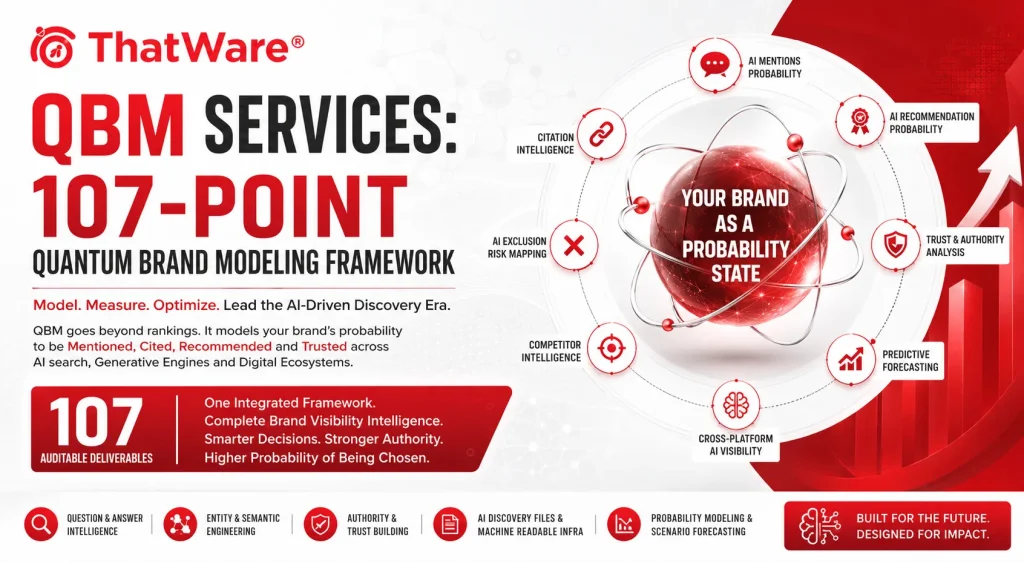
ThatWare’s QBM services examine how a brand may be interpreted, retrieved, mentioned, cited, compared, excluded or recommended across different AI-driven discovery environments. The framework combines AI visibility analysis, semantic search intelligence, entity engineering, answer optimization, retrieval readiness, trust analysis, competitive modelling and probability-led forecasting.
The current QBM pricing page already positions the framework around simulation-led thinking, probability modelling, brand trajectory mapping, semantic intelligence and quantum-inspired strategy. It also explains that brand visibility is no longer linear because a business may appear for one AI prompt and disappear for a closely related prompt.
The existing page contains several broad QBM workstreams, including brand simulation, visibility auditing, scenario mapping, probability modelling, competitor analysis, entity mapping, trajectory reporting, retrieval readiness and monthly recommendations. The revised framework below expands those broader concepts into the 107 individually auditable deliverables shown in the submitted presentation.
Recommended Improvements to the Existing QBM Pricing Page
The existing page has a strong conceptual foundation, but the service can be made more commercially persuasive and implementation-focused.
First, the page currently uses several H1-level headings. The revised version should retain one H1 and distribute every remaining section across H2, H3 and H4 headings.
Second, the terminology should be standardized. The page title uses “Quantum Brand Mapping,” while the main body uses “Quantum Brand Modeling.” The recommended primary expansion is Quantum Brand Modeling, with Quantum Brand Mapping referenced only as a supporting or legacy description.
Third, the page should move beyond describing QBM conceptually. Each deliverable should explain:
- What is audited
- What the current weakness may look like
- Which corrective action is performed
- What the target state should be
- Which implementation asset is delivered
- How the result is measured
Fourth, the 107-point framework should be positioned as a complete methodology rather than suggesting that every client automatically receives every deliverable every month. Actual execution should depend on the selected package, website scale, market competition, technical dependencies and the client’s current AI visibility maturity.
What Is Quantum Brand Modeling?
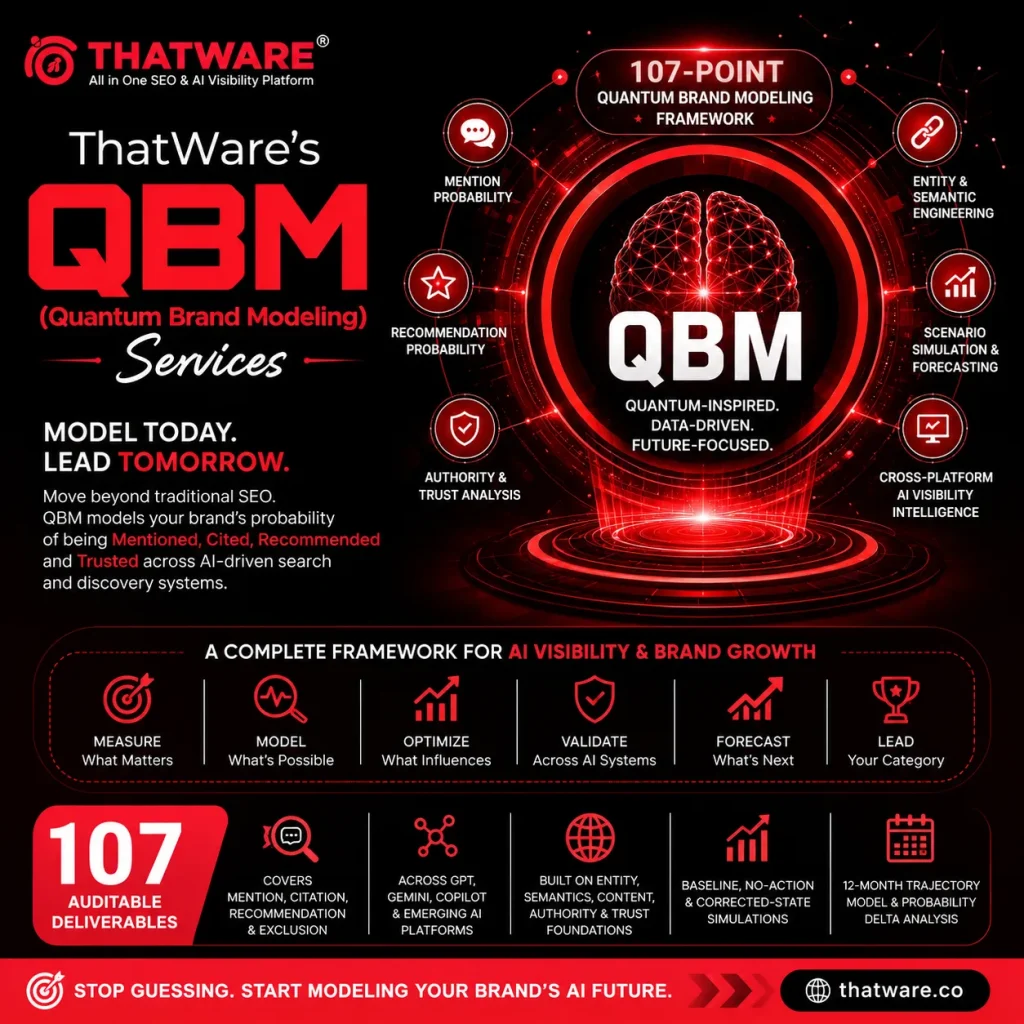
Quantum Brand Modeling is a quantum-inspired method for examining a brand as a changing probability state across search engines, answer engines, generative AI systems and digital authority environments.
It does not claim that search engines use quantum computers to determine rankings. Instead, it applies quantum-inspired concepts such as multiple possible states, weighted signals, contextual variation, probability shifts and scenario comparison.
A brand may simultaneously have:
- Strong traditional rankings
- Weak generative-search visibility
- High branded-query recognition
- Low category-level recommendation probability
- Strong local authority
- Weak cross-platform entity consistency
- Frequent mentions without citations
- Citations without positive recommendations
- Good content that is difficult for AI systems to retrieve
- High authority that is attached to the wrong topic
QBM brings these states into one measurable framework.
What QBM Helps a Brand Understand
The framework is designed to answer commercially important questions:
- How often do AI systems mention the brand?
- Which prompts lead to a recommendation?
- Which prompts exclude the brand?
- Which competitors are selected instead?
- Which sources influence those responses?
- Is the brand attached to the correct category?
- Do different AI systems interpret the brand differently?
- Which trust signals are missing?
- Which pages have the highest AI visibility potential?
- What happens if no corrective action is taken?
- How could visibility change after strategic correction?
- Where should the organization invest first?
ThatWare’s Complete QBM Service Scope
Core QBM Strategy and Consulting
ThatWare provides QBM services for organizations that need a measurable view of brand visibility across AI and search systems. As a specialist QBM company, ThatWare connects brand intelligence, semantic analysis, AI visibility testing, authority engineering and predictive modelling.
A capable QBM agency must go beyond producing prompt screenshots. It should identify why the brand was mentioned, omitted or recommended and convert that evidence into implementation priorities.
A QBM consultant can guide internal SEO, content, PR, brand, technical and leadership teams. ThatWare’s QBM consulting services support companies that have internal implementation resources but need specialist modelling, testing and strategic oversight.
Our QBM audit services establish a baseline across mentions, recommendations, citations, exclusions, entities, authority, trust and content readiness. Large organizations can use enterprise QBM services across multiple brands, products, markets, languages or domains.
QBM strategy consulting determines which probability variables should be strengthened first. QBM website optimization then converts those findings into changes across content, schema, internal links, entities, citations and technical discovery assets.
ThatWare’s QBM AI visibility services track whether those corrections change the brand’s position across selected AI systems and prompt cohorts.
Quantum Brand Intelligence and Baseline Modelling
Our quantum brand modeling services examine a brand as a dynamic visibility state rather than a fixed ranking position.
Quantum brand visibility services measure how the brand appears across informational, comparison, commercial, local and recommendation prompts.
As a quantum brand intelligence company, ThatWare combines semantic search intelligence with modelling, testing and implementation.
A quantum brand visibility audit establishes where the brand appears, where it is absent and which sources or competitors influence the result.
The quantum brand baseline audit records current signals before changes are introduced. A quantum brand baseline simulation then converts those observations into a structured starting model.
Brand probabilistic state modeling represents the brand through multiple visibility possibilities. Brand probability analysis services assess which variables appear to increase or reduce selection likelihood.
AI brand probability modeling applies those variables to controlled prompt sets. The resulting probabilistic brand visibility strategy connects model findings with practical optimization tasks.
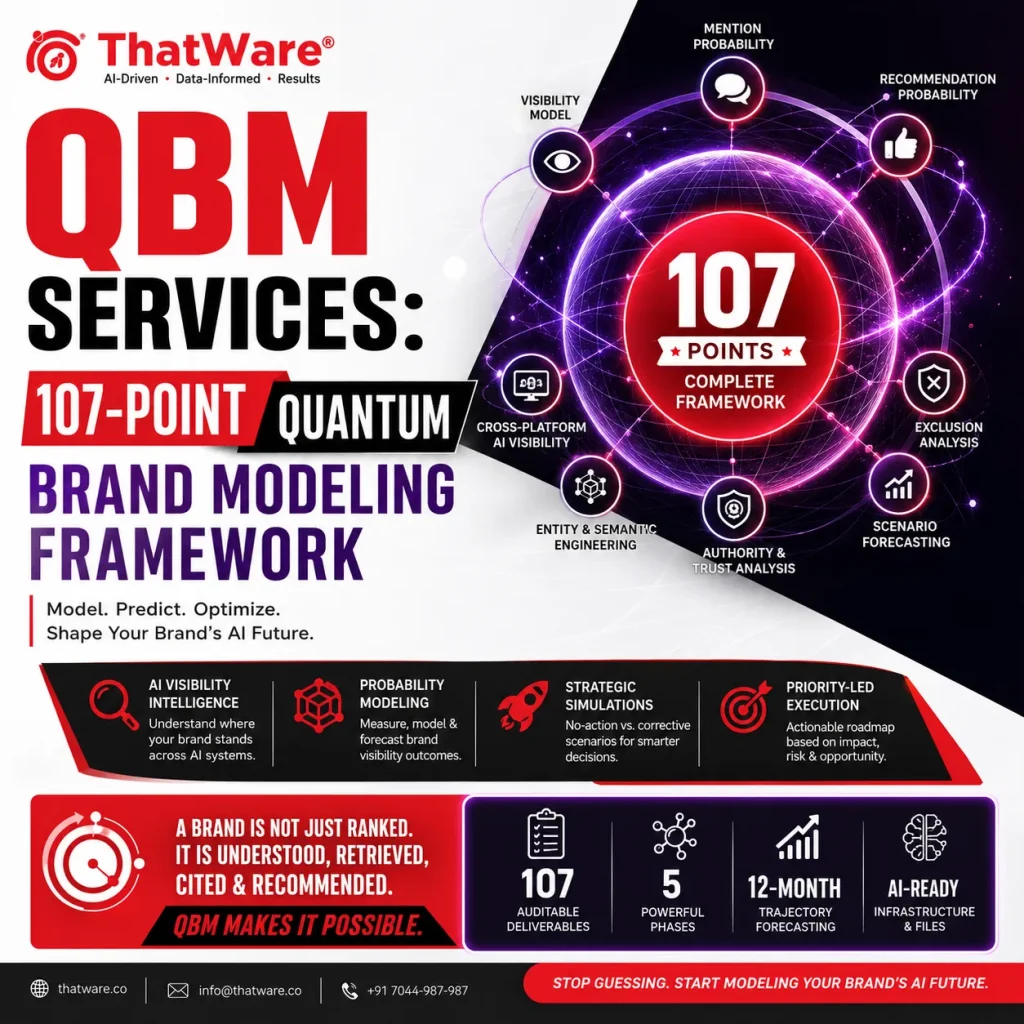
AI Mention, Recommendation and Exclusion Probability
AI mention probability analysis measures how frequently and under which conditions a brand is named.
AI mention probability optimization strengthens the content, entity, authority and contextual signals associated with those prompts.
AI recommendation probability analysis examines when AI systems move beyond mentioning the brand and actively include it as a possible choice.
AI recommendation probability optimization addresses the evidence, relevance, trust and source weaknesses affecting that decision.
AI exclusion probability analysis identifies prompt situations where the brand is consistently absent. An AI brand exclusion risk assessment then classifies the likely reasons for exclusion.
AI brand inclusion optimization improves the pages, sources and entity relationships that support selection.
ThatWare’s AI recommendation visibility services monitor the brand across controlled recommendation queries. AI brand mention tracking services measure presence and wording, while AI brand recommendation tracking records recommendation position, context, competitors and cited sources.
Cross-Platform AI Visibility Intelligence
A cross-platform AI visibility audit compares how different systems interpret the same brand and prompt.
ThatWare’s AI system mapping services document the systems, interfaces, search modes, prompt types and source environments included in the analysis.
AI search ecosystem mapping identifies where search engines, AI assistants, generative engines, directories, media sources and knowledge systems overlap.
GPT brand visibility analysis examines GPT-oriented responses for brand presence, citations, wording and recommendation behaviour.
Gemini brand visibility analysis records how Gemini represents the brand and which sources influence its responses.
Microsoft Copilot brand visibility analysis evaluates relevant Copilot experiences using the same controlled brand and category prompts.
GPT Gemini Copilot behavior analysis compares the systems under equivalent testing conditions.
Cross-system AI behavior reporting highlights differences in sourcing, confidence, omissions and competitors.
Cross-system visibility imbalance detection identifies where the brand performs well in one environment but poorly in another.
For larger organizations, enterprise AI visibility benchmarking compares systems, divisions, regions, products and competitor groups within one reporting model.
Intent, Context and Brand Relevance Modelling
Intent-type AI visibility analysis separates brand performance by informational, navigational, commercial, comparison, local and transactional intent.
Contextual visibility distribution modeling measures how visibility changes when the prompt’s audience, location, need, urgency or decision stage changes.
AI brand visibility by search intent shows whether the brand is visible only for branded research or also for category-level decisions.
AI contextual brand positioning aligns brand messaging with the contexts in which the company wants to be selected.
ThatWare’s AI audience intent mapping services define the audiences, situations, questions and decision triggers connected with the brand.
AI query context analysis examines how small changes in wording affect mentions, citations and recommendations.
Core category and context boundary analysis defines what the brand should and should not be associated with.
AI brand category association optimization strengthens the relationship between the brand and its priority category.
Contextual AI recommendation optimization improves the evidence required for specific recommendation situations.
AI brand relevance modeling scores how closely the brand matches each target prompt, audience and category.
Predictive Brand Visibility and Scenario Forecasting
ThatWare’s AI brand visibility forecasting services develop evidence-led visibility scenarios rather than guaranteed predictions.
Brand trajectory forecasting services monitor whether the brand is moving toward stronger recognition, citation and recommendation states.
12-month AI brand trajectory modeling creates a structured projection based on current signals, planned actions, competitor pressure and observed platform behaviour.
A future brand visibility simulation compares multiple potential visibility paths.
A no-action brand visibility simulation estimates what could happen if weaknesses remain unresolved.
A strategic correction visibility simulation models the possible effect of content, entity, authority, citation, schema and trust improvements.
AI visibility probability delta analysis measures the difference between baseline, no-action and corrected states.
Predictive AI brand visibility services update those scenarios as new observations become available.
Generative search visibility forecasting focuses specifically on brand inclusion within generated answers.
AI visibility scenario modeling gives decision-makers a practical way to compare risks, opportunities and investment priorities.
Competitive Intelligence, Authority and Trust
A competitive AI landscape analysis identifies the brands, publishers, directories and sources that dominate relevant AI answers.
AI competitor visibility analysis compares competitor mention, recommendation, citation and category-association patterns.
Authority gap diagnosis services determine why competitors may be viewed as more credible or sourceable.
AI trust signal weakness analysis identifies missing credentials, evidence, citations, reviews, policies, profiles or brand consistency.
ThatWare’s brand authority optimization services strengthen the signals supporting brand expertise and credibility.
AI brand trust signal optimization connects those trust assets with the pages and entities AI systems are most likely to retrieve.
Strategic AI visibility priority analysis converts audit findings into a ranked execution plan.
AI visibility opportunity zone mapping identifies prompt groups, topics and pages with the highest improvement potential.
An AI brand risk and opportunity analysis balances growth possibilities against misinformation, exclusion, weak sourcing and competitor displacement risks.
Finally, strategic priority zone identification services organize corrections into critical, high-growth, foundational, experimental and monitoring categories.
Before and After QBM Implementation
Typical Position Before QBM
Before QBM implementation, a brand may have strong SEO reporting but no clear understanding of its position inside AI-generated discovery.
Common conditions include:
- AI mentions are checked irregularly
- Prompts are tested without a controlled methodology
- Citation sources are not recorded
- Recommendation and mention visibility are treated as the same outcome
- No exclusion model exists
- Competitors are compared only through rankings
- Category associations are assumed rather than tested
- Brand entities vary across websites and profiles
- Service content lacks direct, extractable answers
- Authority signals are disconnected from target pages
- Different AI systems provide conflicting brand descriptions
- No baseline probability model exists
- No no-action or corrected-state projection exists
- Reporting shows activity but not probability movement
- Recommendations are not assigned to implementation owners
Target Position After QBM
After implementation, the brand should have:
- A controlled AI prompt library
- A quantum brand visibility baseline
- Defined mention, recommendation and exclusion metrics
- Platform-specific behavior reports
- A documented core category and context boundary
- Intent-level visibility scores
- Competitor and source comparisons
- Entity, trust and authority gap registers
- Citation-ready source pages
- AI-readable answer modules
- Governed discovery files and structured data
- Baseline, no-action and corrected-state models
- A 12-month brand trajectory curve
- Probability delta reporting
- A prioritized implementation backlog
- Monthly retesting and model refinement
ThatWare’s QBM Audit, Action and Fix Protocol
The uploaded audit uses a three-stage reporting process for every chapter: audit and result, plan of action, and a fix report comparing the current state with the recommended target state.
Audit and Result
Each deliverable begins by documenting:
- The pages, prompts, entities, systems or sources reviewed
- Existing strengths that can be reused
- The identified gap
- The risk created by that gap
- Current implementation status
- Priority level
- Baseline evidence
Plan of Action
The plan identifies:
- The exact asset to create or correct
- Affected URLs or prompt groups
- Implementation owner
- Supporting evidence
- Technical or editorial dependencies
- Quality and compliance checks
- Validation method
- Performance metric
- Next review point
Fix Report
The fix report records:
- Before condition
- Required correction
- Implemented change
- After condition
- Validation evidence
- Baseline score
- Corrected-state score
- Remaining risk
- Follow-up action
Complete 107-Point QBM Framework
Phase One: Question, Answer and AI Surface Intelligence
Answer Opportunity Discovery
1. Question-Answer Opportunity Map
Before: Important questions are distributed across generic pages, FAQs and articles without clear ownership.
Plan of action: Map every high-value question to its intent, primary entity, best landing page, answer format, supporting source and CTA.
After: Each priority question has one canonical answer destination.
Output and KPI: Question-to-page workbook; measure matched-question coverage, correct-page retrieval and answer-surface impressions.
2. Conversational Query Opportunity Discovery
Before: Research concentrates on short keywords rather than complete natural-language prompts.
Plan of action: Collect conversational variations from search results, customer discussions, support questions and AI prompt testing.
After: The content roadmap covers the phrases users actually type or speak.
Output and KPI: Conversational-query library; measure long-tail visibility and prompt coverage.
3. AI Answer Surface Gap Analysis
Before: Relevant information exists but is hidden inside long, mixed-purpose sections.
Plan of action: Compare priority questions with current paragraphs, lists, tables, summaries and source blocks.
After: Missing answer formats are added to the most relevant URLs.
Output and KPI: Answer-surface gap register; measure extractable-answer coverage and retrieval accuracy.
4. Featured Snippet Competitor Mapping
Before: Competitors own snippets and answer surfaces, but their winning structures are not documented.
Plan of action: Record the winning URL, format, answer length, heading, evidence, entities and supporting schema.
After: Target pages receive format-specific competitor counter-strategies.
Output and KPI: Snippet competitor grid; measure snippet gains and answer-format improvement.
5. High-Intent Question Clustering
Before: Research, comparison and purchase-ready questions are mixed together.
Plan of action: Cluster prompts around price, suitability, comparison, risk, urgency, provider choice and action.
After: Each readiness level receives suitable evidence, page treatment and CTA.
Output and KPI: High-intent question matrix; measure commercial-query engagement and assisted conversions.
Structured Answer Formats
6. FAQ Extraction Formatting
Before: Existing FAQs are long, repetitive and difficult to reuse.
Plan of action: Extract, deduplicate and rewrite questions into concise answer-first modules linked to canonical pages.
After: The brand has a governed FAQ library suitable for page deployment and retrieval.
Output and KPI: FAQ module database; measure approval, extraction and eligible schema coverage.
7. Listicle Answer Formatting
Before: List-based answers are buried in paragraphs.
Plan of action: Convert appropriate content into numbered or bulleted lists with clear labels and short supporting explanations.
After: Users and AI systems can identify key items quickly.
Output and KPI: List-answer modules; measure list snippet eligibility and engagement.
8. Table-Based Answer Optimization
Before: Comparison information requires users to interpret several sections.
Plan of action: Build tables covering features, options, suitability, requirements, limitations and next actions.
After: Comparison questions can be answered in a single structured block.
Output and KPI: Comparison-table library; measure extraction, interaction and comparison-query visibility.
9. Step-by-Step Response Structuring
Before: Administrative and decision processes are described as narrative text.
Plan of action: Convert legitimate workflows into ordered steps with requirements, cautions, supporting links and completion actions.
After: Process answers become easier to follow and retrieve.
Output and KPI: Step-module library; measure process-query visibility and task completion.
Search and AI Answer Targeting
10. Featured Snippet Targeting
Before: The direct answer appears after promotional or background content.
Plan of action: Place concise paragraph, list, table or step answers beneath query-aligned headings.
After: Priority pages contain deliberate featured-answer candidates.
Output and KPI: Snippet-targeting pack; measure snippet ownership and organic CTR.
11. People Also Ask Optimization
Before: Related questions are centralized on broad FAQ pages.
Plan of action: Assign each PAA opportunity to the page with the closest intent and entity match.
After: Service and supporting pages develop unique question coverage.
Output and KPI: PAA page map; measure question visibility and supporting-page growth.
12. AI Overview Optimization
Before: Useful facts, proof and credentials are divided across several pages.
Plan of action: Create complete source sections containing summary, answer, evidence, entities, limitations, FAQs and review information.
After: Priority URLs become stronger candidates for generated summaries and source selection.
Output and KPI: AI Overview optimization pack; measure source appearances and citation observations.
13. Voice Search Answer Optimization
Before: Answers depend on visual context or are too long to be spoken clearly.
Plan of action: Create short spoken answers containing the main response, necessary qualifier and next action.
After: High-value conversational questions have voice-ready responses.
Output and KPI: Voice-answer library; measure spoken-answer accuracy and completion time.
Phase Two: Schema, Semantic Content and Entity Engineering
Structured Data Deployment
14. FAQ Schema Deployment
Before: Eligible visible FAQs lack matching machine-readable records.
Plan of action: Implement accurate FAQPage JSON-LD only where the visible content and current eligibility rules support it.
After: Approved FAQs have validated markup that matches the page.
Output and KPI: FAQ schema register; measure valid detection and error reduction.
15. Speakable Schema Implementation
Before: Short public informational passages are not identified for spoken use.
Plan of action: Select eligible passages, avoid sensitive or unsuitable advice and validate the implementation.
After: Approved spoken sections have controlled machine-readable support where applicable.
Output and KPI: Speakable register; measure validation status and voice-answer performance.
16. HowTo Schema Integration
Before: Genuine non-sensitive processes have visible steps but no aligned structured representation.
Plan of action: Apply HowTo markup only to appropriate administrative or practical workflows.
After: Visible and machine-readable steps remain synchronized.
Output and KPI: HowTo implementation register; measure valid markup and process-query coverage.
17. Entity-Based JSON-LD Markup
Before: Organization, service, person, location and webpage schema nodes operate independently.
Plan of action: Connect relevant nodes through stable identifiers, sameAs, about, mentions, provider and other supported relationships.
After: The website presents a connected entity graph.
Output and KPI: JSON-LD graph specification; measure valid node and relationship coverage.
18. AI-Friendly Content Restructuring
Before: Pages mix several questions, entities and conversion stages inside large blocks.
Plan of action: Divide content into labelled summaries, direct answers, evidence, comparisons, FAQs, limitations and actions.
After: Each section has a clear retrieval and user purpose.
Output and KPI: Restructured page blueprints; measure passage-level extraction and engagement.
19. Conversational Content Rewriting
Before: Copy uses internal terminology rather than the language customers use.
Plan of action: Rewrite selected sections around natural questions, objections and decision-stage phrasing.
After: Content aligns with conversational search and prompt behaviour.
Output and KPI: Conversational rewrite pack; measure prompt and long-tail query coverage.
20. Answer-First Paragraph Optimization
Before: Background information delays the response.
Plan of action: Begin priority sections with one or two clear answer sentences, followed by detail and proof.
After: Users and AI systems receive the core response immediately.
Output and KPI: Answer-first modules; measure extraction accuracy and readability.
21. Concise Semantic Response Engineering
Before: One answer block contains multiple intents, entities or actions.
Plan of action: Create atomic responses with one question, one central entity, one necessary qualifier and one next step.
After: Answers remain accurate when retrieved independently.
Output and KPI: Semantic response library; measure standalone answer accuracy.
22. Contextual Schema Layering
Before: Schema types are selected independently without a complete page model.
Plan of action: Layer Service, Organization, Person, WebPage, Breadcrumb, FAQ or other valid schema. Use Product or MREID-related layers only when factually and technically appropriate.
After: Structured data communicates a coherent page and entity relationship.
Output and KPI: Layered schema plan; measure validation and content parity.
Semantic Scoring and Retrieval Preparation
23. Entity Extraction, TF-IDF and BERT-Based Content Scoring
Before: Content quality is assessed mainly through manual review or keyword counts.
Plan of action: Extract entities, assess contextual relevance and compare semantic coverage against target intent and competitors.
After: Each priority page receives a measurable content-improvement plan.
Output and KPI: Semantic scoring workbook; measure entity and topic coverage improvement.
24. Vector Embeddings and AI-Assisted Q&A Restructuring
Before: Duplicate or generic passages reduce retrieval precision.
Plan of action: Create self-contained chunks with entity, intent, source, evidence and page metadata.
After: Q&A, PAA and snippet-oriented passages become easier to retrieve.
Output and KPI: Embedding-ready content set; measure top-k retrieval accuracy.
25. LSI Clustering and Sentence Scoring
Before: Sentence relevance, readability and intent fit are judged inconsistently.
Plan of action: Group contextually related concepts and score sentences for clarity, duplication and intent match.
After: Weak sentences and missing concepts can be prioritized systematically.
Output and KPI: Sentence-scoring report; measure clarity and semantic-fit improvement.
Entity and Knowledge Architecture
26. Primary Entity Reinforcement
Before: The page discusses several subjects without establishing a dominant entity.
Plan of action: Reinforce the primary entity across title, H1, opening answer, internal links, evidence and schema.
After: The page’s central subject becomes easier to identify.
Output and KPI: Entity reinforcement plan; measure entity-recognition confidence.
27. Semantic Relationship Mapping
Before: Brand, service, product, location, audience and expert relationships are implied rather than stated.
Plan of action: Map who offers what, for whom, where, under which conditions and with what evidence.
After: Content, links and schema express the same relationships.
Output and KPI: Semantic relationship graph; measure relationship completeness.
28. Topical Entity Association Optimization
Before: The brand and target topic appear separately without sufficient contextual co-occurrence.
Plan of action: Create natural blocks connecting brand, service, audience, problem, method, location and proof.
After: Priority brand-topic associations become stronger.
Output and KPI: Topical association map; measure relevant co-occurrence growth.
29. Brand Entity Disambiguation
Before: Similar names, inconsistent descriptions or duplicate profiles create ambiguity.
Plan of action: Define the canonical brand name, aliases, entity identifiers, profiles, descriptions and exclusions.
After: Search and AI systems receive a stable brand identity.
Output and KPI: Brand identity register; measure naming and profile consistency.
30. Custom Knowledge Graph and Prompt-Engineered Content Clusters
Before: Entities, pages, questions, evidence and prompts are managed separately.
Plan of action: Connect them inside a lightweight governed knowledge graph and cluster model.
After: Content, schema, prompt testing and retrieval systems use common relationships.
Output and KPI: Custom knowledge graph; measure node, edge and prompt coverage.
31. NLP-Led Keyword Placement and Synonym Mapping
Before: Synonyms and semantic variants are distributed without clear page ownership.
Plan of action: Define preferred terminology, contextual variants, exclusions and anchor-text rules.
After: Semantic breadth improves without creating page cannibalization.
Output and KPI: NLP keyword map; measure variation coverage and reduced overlap.
Phase Three: Topical Authority, Retrieval and External Validation
Content Architecture and Authority
32. Content Gap Analysis
Before: Gap research focuses only on missing competitor keywords.
Plan of action: Compare topics, questions, entities, evidence, formats, intent stages and citation requirements.
After: Every material gap receives a page, section, owner and priority.
Output and KPI: Content-gap register; measure high-value gap closure.
33. Custom Topical Maps
Before: Website architecture reflects navigation more than semantic relationships.
Plan of action: Map pillars, supporting pages, entities, questions, proof assets and conversion destinations.
After: The site develops a connected topical ecosystem.
Output and KPI: Custom topical map; measure cluster completion and internal connectivity.
34. AI-Overview Optimized Pages
Before: Important pages lack complete source-ready structures.
Plan of action: Build summary, answer, evidence, process, limitations, FAQs, schema and freshness sections.
After: Priority pages are better prepared for generated answer sourcing.
Output and KPI: AI Overview page templates; measure source and citation appearances.
35. Entity-Dense Authority Articles
Before: Blog content attracts traffic but contributes limited brand or entity authority.
Plan of action: Develop expert-reviewed articles connecting the brand, topic, evidence, related entities and commercial pages.
After: Supporting content strengthens topical and brand credibility.
Output and KPI: Authority article programme; measure citations, links and assisted conversions.
36. E-E-A-T-Based Planning
Before: Experience, expertise, authority and trust are added after content production.
Plan of action: Include author, reviewer, evidence, methodology, date and limitation requirements in every brief.
After: Trust considerations become part of the publishing workflow.
Output and KPI: E-E-A-T brief template; measure trust-field completion.
37. Entity-Based Content Modelling
Before: Related entities occur across pages without controlled combinations or clear context.
Plan of action: Define the entity relationships required for each page, question and intent.
After: Co-occurrence relevance improves naturally.
Output and KPI: Entity content model; measure relationship and entity coverage.
38. AIO Content Flows
Before: Content moves abruptly between information, proof and promotion.
Plan of action: Structure pages around problem, direct answer, suitability, process, proof, limitations and action.
After: Pages support both machine retrieval and human decision-making.
Output and KPI: AIO flow blueprint; measure section engagement and CTA progression.
RAG and Vector Retrieval
39. RAG Implementation
Before: Approved facts and answers are not stored in a controlled retrieval system.
Plan of action: Create records containing answer, source, entity, reviewer, owner, date, access status and risk.
After: Internal or customer-facing systems can retrieve traceable information.
Output and KPI: RAG knowledge base; measure grounded-answer accuracy.
40. Vector Engineering-Based Content Cluster Optimization
Before: Duplicate chunks and repeated boilerplate weaken semantic matching.
Plan of action: Deduplicate content, create canonical chunks, attach metadata and test retrieval queries.
After: Vector searches return more relevant source passages.
Output and KPI: Vector cluster model; measure top-k precision and recall.
Authority and Link Acquisition
41. Tier 1 and Tier 2 Backlink Enhancement
Before: Link development focuses on volume or surface-level authority scores.
Plan of action: Classify opportunities by editorial quality, relevance, traffic, source diversity, IP diversity and risk.
After: Authority growth follows a quality-controlled tiered plan.
Output and KPI: Link acquisition roadmap; measure qualified referring-domain growth.
42. Digital PR, Curated Placements and Press Coverage
Before: Internal expertise is not packaged for credible external publishers.
Plan of action: Develop expert commentary, research, data assets, media resources and citation-ready destinations.
After: Earned media strengthens relevant brand-topic associations.
Output and KPI: Digital PR pipeline; measure editorial mentions and citations.
43. Google Entity Stacking and Contextual Competitor Backlinks
Before: Brand-controlled properties and external descriptions use inconsistent entity information.
Plan of action: Align legitimate properties and pursue relevant sources that already validate competing entities.
After: External references reinforce the approved brand identity and category.
Output and KPI: Entity-source alignment register; measure consistency and relevant source growth.
44. Citation-Ready Reference Pages
Before: Facts, definitions and evidence are scattered across several pages.
Plan of action: Build reference assets with clear authorship, methodology, evidence, dates and source links.
After: Publishers and AI systems have stronger pages to cite.
Output and KPI: Reference-page library; measure external citation pickup.
45. Link Acquisition Through Search Operators
Before: Prospecting relies on generic databases.
Plan of action: Develop search-operator combinations for resources, associations, expert contributions, interviews and industry lists.
After: Prospecting identifies more contextually relevant opportunities.
Output and KPI: Qualified prospect database; measure approval and placement rate.
46. Forum Participation, Guest Blogging and Link Equity Redistribution
Before: Community and guest activity may be inconsistent or overly promotional.
Plan of action: Define approved platforms, expert topics, disclosure rules, quality checks and target pages.
After: Participation supports reputation, discovery and relevant referral traffic.
Output and KPI: Participation programme; measure qualified referral traffic and mentions.
47. Programmatic Backlink Acquisition
Before: Automated prospecting produces large but irrelevant lists.
Plan of action: Automate discovery and enrichment while retaining human relevance, risk and quality review.
After: Prospecting scales without removing editorial control.
Output and KPI: Programmatic prospecting workflow; measure qualified-prospect ratio.
Query Expansion and Content Maintenance
48. Long-Tail Conversational Query Expansion
Before: Supporting content targets broad keywords only.
Plan of action: Expand contextual questions, comparisons, local modifiers, use cases and recommendation prompts.
After: The content system covers more natural decision-stage searches.
Output and KPI: Long-tail query map; measure impressions and qualified visits.
49. Intent-Based Topic Coverage
Before: A topic may be comprehensive but poorly aligned with different decision stages.
Plan of action: Separate informational, commercial, comparison, local and transactional coverage.
After: Each intent receives the correct format, proof and action.
Output and KPI: Intent-coverage matrix; measure visibility by intent group.
50. Multi-Format Answer Generation
Before: Every answer is delivered as conventional prose.
Plan of action: Produce approved paragraph, FAQ, list, table, step, summary and spoken variants.
After: Verified information can support multiple answer surfaces.
Output and KPI: Multi-format answer library; measure format coverage and consistency.
51. Semantic Keyword Clustering
Before: Pages target overlapping lists of loosely related terms.
Plan of action: Cluster terms by intent, entity, context and canonical URL.
After: Keyword families have clear page ownership.
Output and KPI: Semantic cluster map; measure cannibalization reduction.
52. Content Freshness Monitoring
Before: Updates happen after information becomes visibly outdated.
Plan of action: Assign volatility levels, review dates, owners, source dependencies and update triggers.
After: Important pages follow a controlled maintenance schedule.
Output and KPI: Freshness register; measure on-time review completion.
53. AI Answer Recency Updates
Before: AI systems may retrieve old policy, feature, price or service information.
Plan of action: Update visible content, schema, RAG records and answer primitives together.
After: Priority answers communicate consistent current information.
Output and KPI: Recency tracker; measure outdated-answer reduction.
54. Trend-Driven Content Refreshes
Before: Refreshes follow a fixed calendar rather than actual changes in demand.
Plan of action: Monitor emerging questions, competitor activity, industry change and source behaviour.
After: Content is updated when search and AI behaviour changes.
Output and KPI: Trend-refresh pipeline; measure response time and recovered visibility.
55. Temporal Query Optimization
Before: Evergreen and time-sensitive queries are treated identically.
Plan of action: Map current, recent, seasonal, upcoming and deadline-based modifiers to suitable pages.
After: Time-sensitive searches reach clearly dated and reviewed sources.
Output and KPI: Temporal query map; measure date-relevant query visibility.
Validation and Visibility Testing
56. AI Extraction Validation Testing
Before: Teams assume that a visible answer will be extracted correctly.
Plan of action: Define target prompts, expected answers, required qualifiers and preferred source pages.
After: Each answer receives a pass, partial or fail result.
Output and KPI: Extraction test pack; measure extraction pass rate.
57. Structured Data Error Auditing
Before: Schema issues are scattered across several tools and reports.
Plan of action: Centralize errors, warnings, affected URLs, owners, fixes and retest status.
After: Structured data quality becomes actively governed.
Output and KPI: Schema error register; measure critical error closure.
58. SERP Answer Consistency Testing
Before: Page copy, snippets, PAA results and generated answers may conflict.
Plan of action: Compare claims, dates, entities, wording, qualifiers and source URLs.
After: Priority answer surfaces communicate compatible information.
Output and KPI: Consistency report; measure cross-surface alignment.
59. Mobile Voice Answer Verification
Before: Desktop content may sound incomplete or confusing when spoken.
Plan of action: Test selected questions through relevant mobile voice interfaces.
After: Spoken responses remain accurate without visual context.
Output and KPI: Voice verification sheet; measure spoken-answer pass rate.
60. AI Visibility Tracking
Before: Brand appearances are checked irregularly and without a fixed prompt cohort.
Plan of action: Record mentions, citations, recommendations, omissions, competitors, sources and wording over time.
After: AI visibility can be compared consistently across periods.
Output and KPI: AI visibility dashboard; measure mention, citation and recommendation movement.
Phase Four: AI Discovery Files and Machine-Readable Infrastructure
The following files should be treated as governed technical assets. They must have ownership, version control, source parity and validation. Publishing a custom AI-facing file does not guarantee that every AI system will consume or interpret it.
Discovery, Security and Reporting Assets
61. /.well-known/security.txt Setup
Before: Security reporting instructions are difficult to locate.
Plan of action: Publish approved contact, policy, communication and expiry information.
After: Responsible disclosure guidance has a maintained standard location.
Output and KPI: Valid security file; measure accessibility and current ownership.
62. Conversational Query Ranking Reports
Before: Reporting concentrates on short keywords.
Plan of action: Track complete questions, prompt families, target pages, answer formats and AI appearances.
After: Reports reflect conversational discovery performance.
Output and KPI: Query ranking report; measure movement by prompt cluster.
63. /.well-known/ai.txt Setup
Before: AI-facing public guidance lacks an owned well-known location.
Plan of action: Define the file’s purpose, public sources, access boundaries and update process.
After: The site has a controlled AI guidance asset where appropriate.
Output and KPI: Governed well-known file; measure availability and freshness.
Semantic Sitemap and Feed Layer
64. semantic-sitemap.xml Implementation
Before: The standard sitemap lists URLs without semantic classifications.
Plan of action: Add controlled records for canonical URL, topic, entity, page type, priority and freshness.
After: Priority pages form a structured semantic inventory.
Output and KPI: Semantic sitemap; measure valid parsing and coverage.
65. vector-feed.xml Creation
Before: Retrieval-ready chunks lack a controlled machine-readable feed.
Plan of action: Record chunk IDs, canonical URLs, entities, topics, owners and dates.
After: Vector systems can use traceable source records.
Output and KPI: Vector feed; measure valid record and source coverage.
66. ai-manifesto.json Implementation
Before: Brand identity, values and source policies are distributed across pages.
Plan of action: Create a structured record of approved identity, categories, principles and sources.
After: The organization has a governed machine-readable brand reference.
Output and KPI: AI manifesto file; measure parity with public content.
67. llms.txt Implementation
Before: Important public resources are not summarized in a concise AI-oriented guide.
Plan of action: List key services, documentation, policies and reference pages with short descriptions.
After: A maintained resource guide is publicly accessible.
Output and KPI: LLM resource file; measure coverage and update compliance.
68. ai.txt Implementation
Before: AI guidance, source hierarchy and content boundaries are not centralized.
Plan of action: Define approved source groups, ownership, exclusions and review rules.
After: AI-facing guidance is managed in a version-controlled asset.
Output and KPI: AI guidance file; measure source parity and freshness.
69. Entity-Identity Schema Deployment
Before: Canonical entities lack connected identifiers across pages.
Plan of action: Deploy consistent IDs and relationships for organizations, services, people, products and locations.
After: Structured identity aligns with verified public information.
Output and KPI: Entity identity graph; measure identity consistency.
AI Indexing and Decision Assets
70. ai-index.json Implementation
Before: AI-relevant resources are not recorded in a structured directory.
Plan of action: List URL, entity, type, owner, priority, review date and risk.
After: AI assets become easier to govern and audit.
Output and KPI: AI index file; measure resource coverage.
71. ai-decision-layer.json Implementation
Before: Decision questions, criteria, evidence and next actions are disconnected.
Plan of action: Map decision scenarios to approved sources, requirements, limitations and actions.
After: A structured decision-support layer is available.
Output and KPI: Decision-layer file; measure decision-path coverage.
72. rag-index.json Implementation
Before: RAG chunks lack a central governance record.
Plan of action: Record chunk ID, source, entity, intent, reviewer, date, access and risk.
After: Every retrieval unit becomes traceable.
Output and KPI: RAG index; measure governed-chunk coverage.
73. ai-endpoints.json Implementation
Before: Approved machine-readable endpoints are undocumented.
Plan of action: Record endpoint, purpose, format, access, owner and review date.
After: Endpoints can be discovered and monitored consistently.
Output and KPI: Endpoint directory; measure documentation completeness.
74. reasoning-map.json Implementation
Before: Relationships among questions, evidence, qualifiers and approved conclusions are not documented.
Plan of action: Map question classes to evidence requirements, limitations and response routes.
After: Answer logic becomes easier to audit.
Output and KPI: Reasoning map; measure validated reasoning paths.
75. context-engine.json Implementation
Before: Audience, location, product, situation and exclusion context exists in separate documents.
Plan of action: Create structured context variables connected with approved entities and sources.
After: Internal systems can apply clearer contextual boundaries.
Output and KPI: Context-engine file; measure context-field completion.
Trust, Citation and Signal Infrastructure
76. trust-signals.json Implementation
Before: Credentials, awards, policies, reviews and proof assets are difficult to retrieve centrally.
Plan of action: Record verified trust assets, related entities, sources, dates and owners.
After: Trust signals become structured and maintainable.
Output and KPI: Trust-signal register; measure verified coverage.
77. citation-preferences.json Implementation
Before: Preferred evidence sources are not assigned to important claims.
Plan of action: Connect topics, entities and claims with approved source URLs.
After: A controlled citation preference layer exists.
Output and KPI: Citation preference file; measure claim-to-source coverage.
78. ai-signals.json Implementation
Before: Authority, quality, freshness and entity signals remain in separate systems.
Plan of action: Consolidate signal type, evidence, owner, status, date and target URL.
After: AI-facing signals can be reviewed in one place.
Output and KPI: AI signal register; measure completeness and freshness.
79. activity-stream.json Implementation
Before: Content, schema and entity changes are not logged consistently.
Plan of action: Record URL, change type, entity, owner, date and validation status.
After: Important updates become traceable and auditable.
Output and KPI: Activity stream; measure change-log completeness.
80. llms-full Implementation
Before: A concise resource file cannot hold detailed service and policy documentation.
Plan of action: Create an extended approved resource containing definitions, services, policies, evidence and canonical sources.
After: Detailed AI-readable documentation is available.
Output and KPI: Extended LLM resource; measure documentation parity.
81. external-citations.json
Before: Third-party citations are maintained in disconnected spreadsheets.
Plan of action: Record source, cited entity, destination page, context, quality, date and status.
After: External references form a maintained authority database.
Output and KPI: Citation database; measure live and verified citation coverage.
82. external-authority.json
Before: Awards, partnerships, profiles and media references are difficult to compare.
Plan of action: Consolidate authority assets by entity, relevance, evidence, source and quality.
After: External authority can be analyzed systematically.
Output and KPI: Authority database; measure verified authority coverage.
83. ai-query-map.json
Before: Prompts, intent classes and target pages remain in separate systems.
Plan of action: Record query, family, intent, context, canonical page, answer format, entity and test result.
After: Prompt research and page ownership are governed centrally.
Output and KPI: AI query map; measure prompt-to-page completion.
84. Answer Primitives
Before: Teams repeatedly recreate definitions, facts, qualifiers, steps and CTAs.
Plan of action: Create approved reusable answer units linked to source pages, reviewers and version dates.
After: Content, RAG and testing systems use consistent response components.
Output and KPI: Answer primitive library; measure approved reuse and answer consistency.
Phase Five: Anchors, Training and Quantum Brand Probability Modelling
Statistical and Prompt Foundations
85. Statistical Anchor Deployment
Before: Visibility observations lack stable reference points.
Plan of action: Define baseline values for mentions, citations, recommendations, exclusions, source confidence and competitor share.
After: Future measurements can be compared with a controlled starting point.
Output and KPI: Statistical anchor register; measure data completeness and repeatability.
86. LSI Anchor Creation
Before: Semantic topic associations vary across pages and external sources.
Plan of action: Define the core contextual terms and entity combinations expected around each priority category.
After: Content and authority work reinforce consistent semantic fields.
Output and KPI: Semantic anchor map; measure context consistency.
87. LLM Custom GPT Training
Before: Internal AI systems rely on ungoverned instructions or incomplete information.
Plan of action: Configure an approved assistant using controlled knowledge, answer rules, exclusions, escalation logic and test prompts.
After: Internal users receive more consistent brand-aligned outputs.
Output and KPI: Custom GPT configuration and test pack; measure answer accuracy.
88. Prompt Training
Before: Teams use inconsistent prompts that create incomparable results.
Plan of action: Develop tested prompt templates for auditing, research, content, visibility monitoring and quality review.
After: Prompt-led workflows become repeatable and auditable.
Output and KPI: Prompt library; measure prompt pass rate and output consistency.
Core Quantum Brand Models
89. Quantum Brand Baseline Simulation
Before: The brand has observations but no unified model of its current AI visibility state.
Plan of action: Combine prompt tests, entity strength, authority, trust, citations, retrieval readiness and competitor behaviour.
After: The organization receives a measurable starting model.
Output and KPI: Baseline simulation workbook; measure complete variable coverage.
90. Brand-as-Probabilistic-State Framework
Before: Brand visibility is described as visible or invisible.
Plan of action: Represent mention, citation, recommendation, exclusion and source confidence as distinct probability states.
After: Visibility can be assessed with greater nuance.
Output and KPI: Probabilistic-state framework; measure state movement over time.
91. AI-System Mapping
Before: Testing treats every AI platform as if it used the same behaviour and sources.
Plan of action: Document each system, interface, search mode, prompt class, source environment and observation method.
After: Findings are interpreted within the correct system context.
Output and KPI: AI-system map; measure platform and mode coverage.
92. Core Category and Context Boundary Definition
Before: The brand’s intended and unintended associations are not clearly defined.
Plan of action: Document primary categories, supporting categories, audience contexts, exclusions and sensitive boundaries.
After: Content and testing follow an approved category model.
Output and KPI: Category-boundary document; measure association accuracy.
93. Competitive AI Landscape Scoping
Before: Competitors are selected only from organic ranking reports.
Plan of action: Identify brands, publishers, directories and sources that appear across relevant AI answers.
After: The competitive model reflects actual AI discovery behaviour.
Output and KPI: Competitive landscape map; measure competitor and source coverage.
Mention, Recommendation and Exclusion Modelling
94. AI Mention Probability Simulation
Before: Brand mentions are counted without modelling the conditions that produced them.
Plan of action: Score mention probability by prompt type, entity match, authority, context, source availability and competitor pressure.
After: Weak mention cohorts receive specific correction plans.
Output and KPI: Mention probability model; measure probability and observed mention changes.
95. AI Recommendation Probability Simulation
Before: Recommendation visibility is treated as equivalent to a brand mention.
Plan of action: Evaluate suitability, trust, evidence, category relevance, source confidence and comparison strength.
After: The organization understands which variables affect recommendation potential.
Output and KPI: Recommendation probability model; measure recommendation frequency and context.
96. AI Exclusion Probability Mapping
Before: Brand absence is recorded without diagnosing likely causes.
Plan of action: Map exclusions against weak entities, insufficient authority, missing content, negative context, source gaps and competitor dominance.
After: Exclusion risks become actionable.
Output and KPI: Exclusion probability map; measure exclusion reduction.
97. Intent-Type Visibility Breakdown
Before: A single visibility score hides differences between query types.
Plan of action: Separate visibility across informational, commercial, comparison, local, branded and recommendation intent.
After: Each intent class receives its own strategy and benchmark.
Output and KPI: Intent-level scorecard; measure visibility by intent group.
98. Contextual Visibility Distribution Modeling
Before: Testing does not show how audience, location, urgency or use case affects visibility.
Plan of action: Compare brand outcomes across controlled contextual variations.
After: The brand can identify strong and weak context combinations.
Output and KPI: Context distribution model; measure visibility across defined contexts.
Forecasting and Strategic Simulations
99. Brand Trajectory Curve: 12-Month Projection
Before: Reporting shows historical changes but no structured forward view.
Plan of action: Model the possible trajectory of mentions, citations, recommendations, authority and exclusions over 12 months.
After: Leadership receives a directionally useful planning curve with confidence notes.
Output and KPI: Brand trajectory report; measure forecast variance.
100. No-Action Future Simulation
Before: The cost of leaving current weaknesses unresolved is not visible.
Plan of action: Model content decay, competitor growth, source loss, trust weakness and category displacement.
After: Decision-makers can see the potential risk of inaction.
Output and KPI: No-action simulation; measure estimated exposure and avoided risk.
101. Strategic-Correction Future Simulation
Before: Recommendations are presented without a model of the corrected state.
Plan of action: Apply planned content, authority, entity, citation, schema and trust improvements to the baseline model.
After: The strategy includes a possible corrected trajectory.
Output and KPI: Corrected-state simulation; measure observed versus modelled improvement.
102. Probability Delta Analysis
Before: Baseline, no-action and correction scenarios are viewed independently.
Plan of action: Calculate the difference in mention, recommendation, exclusion and source-confidence probabilities.
After: The potential value of strategic correction becomes easier to compare.
Output and KPI: Probability delta scorecard; measure actual movement against projected delta.
Platform Behaviour, Authority and Priority Zones
103. GPT, Gemini and Enterprise Copilot Behavior Reports
Before: Cross-platform differences in source use, brand wording and recommendation behaviour are undocumented.
Plan of action: Run equivalent prompt cohorts and summarize mentions, sources, omissions, inaccuracies and competitors.
After: Platform-specific weaknesses receive appropriate corrections.
Output and KPI: Cross-platform behaviour report; measure consistency and correct-source use.
104. Cross-System Visibility Imbalance Detection
Before: A strong result on one platform creates a misleading sense of overall visibility.
Plan of action: Compare platform, intent, category, location and source performance within one imbalance model.
After: Concentrated visibility and weak systems become apparent.
Output and KPI: Visibility imbalance matrix; measure reduction in high-risk gaps.
105. Authority Gap Diagnosis
Before: Competitors appear more often, but the reasons are unclear.
Plan of action: Compare source quality, topical depth, citations, credentials, profiles, entity strength and editorial validation.
After: The causes of the authority difference are documented.
Output and KPI: Authority gap report; measure priority gap closure.
106. Trust Signal Weakness Identification
Before: Missing or inconsistent trust evidence is spread across pages and profiles.
Plan of action: Audit credentials, policies, reviews, awards, authorship, sources, dates, contact information and claims.
After: Weak trust signals enter a risk-ranked correction register.
Output and KPI: Trust weakness register; measure critical weakness closure.
107. Strategic Priority Zones Identification
Before: Every recommendation competes inside one large backlog.
Plan of action: Group work into critical risk, high-growth, foundational, experimental and monitoring zones.
After: Teams know what to implement first and why.
Output and KPI: Strategic priority zone map; measure completion and performance by zone.
Recommended 12-Month QBM Implementation Roadmap
Months 1 and 2: Baseline and Visibility Intelligence
Complete the QBM audit, prompt library, system map, competitor scope, category boundaries, entity assessment, statistical anchors and quantum brand baseline simulation.
Months 3 and 4: Answer and Content Engineering
Complete question-to-page mapping, answer-surface analysis, conversational research, answer-first restructuring, featured snippets, PAA modules, tables, lists and voice answers.
Months 5 and 6: Entity, Schema and Retrieval Foundations
Complete JSON-LD graphs, entity disambiguation, semantic relationships, topical maps, content chunks, vector metadata, RAG records and retrieval testing.
Months 7 and 8: Authority, Citation and Trust Development
Complete citation-ready pages, digital PR resources, expert proof, source mapping, external authority records, trust files and authority-gap corrections.
Months 9 and 10: Probability and Scenario Modelling
Complete mention, recommendation and exclusion simulations, intent visibility breakdown, contextual modelling, no-action simulation and strategic correction simulation.
Months 11 and 12: Cross-System Validation and Forecasting
Complete platform behaviour reports, imbalance analysis, probability delta calculations, the 12-month trajectory curve, strategic priority zones and the next-cycle roadmap.
Recommended Monthly QBM Dashboard
The reporting layer should include:
- Total tested prompts
- Brand mention rate
- Citation rate
- Recommendation rate
- Exclusion rate
- Correct-source rate
- Brand description accuracy
- Competitor share of answer
- Visibility by intent
- Visibility by context
- Visibility by AI system
- Category association score
- Entity consistency score
- Authority gap movement
- Trust weakness closure
- Citation-ready page coverage
- RAG retrieval accuracy
- Vector top-k precision
- Content freshness status
- Baseline probability
- No-action probability
- Corrected-state probability
- Probability delta
- Strategic zone completion
- Next-month priorities
Stop Guessing and Start Modelling Your Brand’s AI Future
A brand is no longer competing only for a blue link or a numerical ranking.
It is competing for the probability of being understood, retrieved, cited, trusted and selected.
ThatWare’s 107-point QBM framework helps organizations identify:
- Where the brand is currently visible
- Where it is being ignored
- Why competitors are being selected
- Which categories the brand is associated with
- Which trust and authority signals are weak
- How different systems interpret the brand
- What may happen without action
- What may happen after correction
- Where investment should be prioritized first