
SUPERCHARGE YOUR ONLINE VISIBILITY! CONTACT US AND LET’S ACHIEVE EXCELLENCE TOGETHER!
The way search engines understand information has changed dramatically over the last decade. Instead of relying solely on matching keywords, modern search systems are increasingly focused on understanding the meaning behind content. This shift has made Entity Mapping one of the most discussed topics in digital search, as businesses seek better ways to help search engines recognize their brands, products, services, and areas of expertise. Alongside this evolution, Entity SEO has emerged as an important strategy for organizing and connecting information in a way that machines can interpret more accurately.
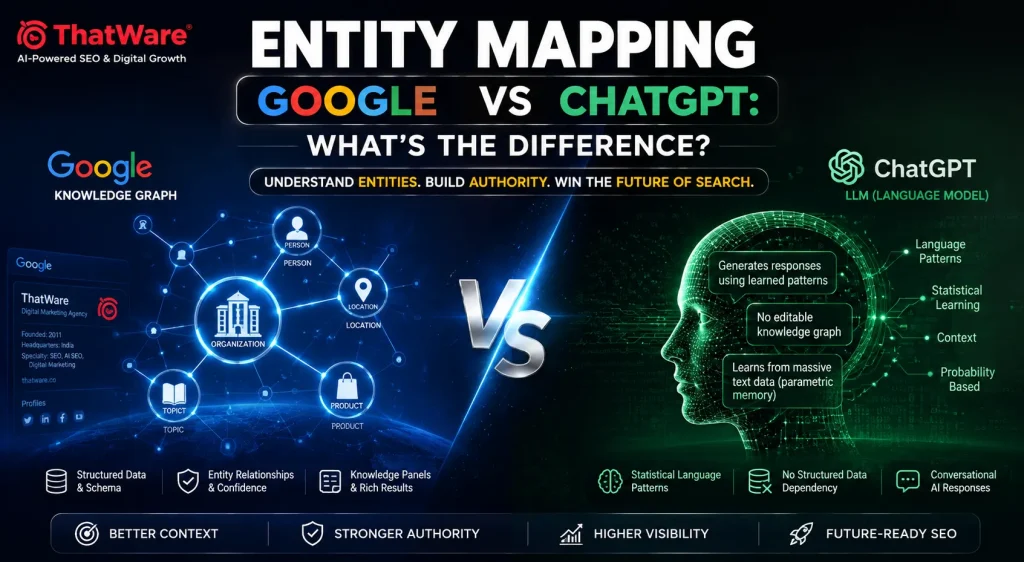
The rise of artificial intelligence has accelerated this conversation even further. With users turning to conversational platforms and AI-powered search experiences for answers, organizations are paying closer attention to how their digital presence is interpreted. As a result, concepts such as AI Search Optimization have gained prominence because businesses want their information to remain visible, accurate, and contextually relevant across evolving search environments.
However, this growing interest has also created widespread confusion. Many people assume that because Google recognizes entities through its Knowledge Graph and structured data, platforms like ChatGPT process information in exactly the same way. This assumption has led to the belief that every improvement made for Google’s entity recognition will automatically influence large language models. While the two technologies may appear similar from a user’s perspective, they are built on fundamentally different architectures and interpret information differently.
Understanding these differences is becoming increasingly important for marketers, website owners, content creators, and businesses investing in long-term digital authority. As concepts like Generative Engine Optimization continue to gain attention, it becomes even more important to distinguish how different AI and search systems interpret information. Without a clear understanding of how Entity Mapping functions across different systems, it is easy to develop unrealistic expectations or implement strategies that solve the wrong problem.
This guide explores how Entity Mapping works within Google’s search ecosystem, why ChatGPT operates using a different approach, where entity optimization delivers genuine value, and which common misconceptions should be avoided when building a future-ready digital presence.
Understanding Entity Mapping
What is Entity Mapping?
Before comparing Google and ChatGPT, it is important to understand what Entity Mapping actually means.
An entity is a uniquely identifiable object, concept, person, organization, location, event, or product that can be clearly distinguished from others. Unlike ordinary words, entities carry specific meaning and can exist independently of the phrases used to describe them. For example, a company, a city, a famous individual, or even a scientific concept can all be treated as entities because they represent identifiable pieces of information rather than isolated words.
Entity Mapping is the process of identifying these entities and establishing meaningful relationships between them. Instead of viewing content as disconnected sentences filled with keywords, search engines analyze how different entities relate to one another. This allows them to understand context, intent, and subject matter with far greater accuracy.
This represents a significant departure from traditional keyword-based optimization. In the early days of search, engines primarily matched the words typed into a search box with the words appearing on a webpage. While keywords remain useful, they no longer provide enough information to fully understand what a page is about. A single keyword may have multiple meanings depending on the context, making simple keyword matching insufficient for delivering highly relevant results.
Entities solve this problem by adding context. Rather than recognizing only individual terms, search engines identify the people, places, organizations, products, technologies, and concepts mentioned within the content and evaluate how they are connected. These relationships enable search systems to interpret the overall meaning of a page instead of relying solely on exact keyword matches.
As search technology has become more sophisticated, Entity Mapping has become a foundational component of semantic search. It enables search engines to distinguish between similar terms, interpret user intent more accurately, and connect related pieces of information across billions of webpages. This richer understanding ultimately helps deliver search results that are more relevant, informative, and aligned with what users are actually trying to find.
Why Entity Mapping Became Important
The Shift from Keywords to Meaning
Search engines have undergone a fundamental transformation over the years. Earlier generations of search relied heavily on matching words found in a query with identical words appearing on webpages. While this approach worked reasonably well for straightforward searches, it often struggled to understand meaning, context, and user intent.
Google gradually evolved from treating search as a collection of “strings” or words to understanding real-world “things” or entities. Rather than simply recognizing text, it began identifying the actual people, places, businesses, products, and concepts behind those words. This transition marked one of the most significant advancements in modern search technology.
A major milestone in this evolution was the development of the Knowledge Graph, which enabled Google to organize information as interconnected entities instead of isolated keywords. Rather than viewing a webpage as a collection of matching terms, the system evaluates how different entities relate to one another and uses these relationships to better understand the subject being discussed.
This shift also gave rise to semantic search, where context plays a central role in determining relevance. Instead of focusing only on literal keyword matches, search engines analyze the broader meaning of content, the relationships between entities, and the intent behind a user’s query. As a result, two pages using different wording may still be understood as covering the same topic if their underlying entities and relationships are similar.
Entity relationships therefore became an essential component of modern search. When search engines can confidently connect brands with products, products with industries, or organizations with their areas of expertise, they develop a much deeper understanding of the content. These connections help reduce ambiguity and improve the quality of search results presented to users.
Today’s search experience is driven less by isolated keywords and more by contextual understanding. This evolution helps search systems interpret content in a way that more closely resembles human understanding. Instead of asking whether a page contains certain words, modern search increasingly asks what the page is actually about and how its entities fit into the broader web of knowledge. This shift has made semantic optimization an essential part of contemporary search strategies, and organizations evaluating solutions or selecting the best AEO service provider should look beyond keyword optimization to providers that emphasize entity relationships, contextual relevance, and long-term information architecture.
How Entity Mapping Works Inside Google
Google’s Knowledge Graph
To understand Entity Mapping in Google’s ecosystem, it is essential to first understand the role of the Knowledge Graph. Introduced to improve Google’s ability to interpret information, the Knowledge Graph is a massive database that organizes real-world entities and the relationships between them. Rather than storing isolated keywords, it represents information as interconnected pieces of knowledge that help Google understand what a search query actually means.
Every recognized entity within the Knowledge Graph functions as a unique node. These nodes may represent people, companies, locations, products, books, events, technologies, or countless other identifiable concepts. Each node contains attributes and is connected to other nodes through meaningful relationships. For example, an organization can be linked to its founder, headquarters, products, industry, and associated technologies. This network of relationships enables Google to move beyond keyword matching and develop contextual understanding.
Entity Mapping plays a central role in creating these relationships. Instead of evaluating individual webpages in isolation, Google analyzes how entities are connected across the web. The stronger and more consistent these connections become, the easier it is for Google to identify an entity with confidence.
Unlike traditional databases that rely on manual entries, Google’s entity recognition continuously evolves by evaluating signals collected from numerous trusted sources. Every new piece of information either strengthens or weakens Google’s confidence in an entity. This confidence-based recognition system allows Google to determine whether information is reliable enough to become part of its understanding of the web.
Consequently, Google’s objective is not simply to recognize words but to identify real-world entities and accurately connect them with related information. This is why Entity Mapping has become one of the foundations of semantic search.
How Google Builds Entity Confidence
Google does not recognize entities based on a single webpage. Instead, it develops confidence by combining multiple independent signals that consistently describe the same entity across the internet.
One of the strongest signals comes from structured data, which provides machine-readable information about a webpage. By organizing content into standardized formats, structured data allows search engines to identify important elements such as organizations, authors, products, services, reviews, events, and locations more accurately.
Closely related to structured data is schema markup, which supplies additional context about page elements. Schema helps Google’s crawlers interpret the purpose of different sections of a webpage instead of relying entirely on visible text. While schema improves machine understanding, it works most effectively when supported by broader evidence from across the web.
Google also evaluates third-party references. Independent mentions on authoritative websites strengthen the credibility of an entity because they indicate that the entity exists beyond its own website. Consistent references from reliable publications often reinforce Google’s confidence in understanding a business, organization, person, or concept.
Another important source is Wikidata, a collaboratively maintained structured knowledge base that provides standardized information about millions of entities. While inclusion in Wikidata does not guarantee recognition, it often contributes additional structured relationships that help Google interpret entities more accurately.
Consistency is equally important. Repeated citations containing the same business information, organizational details, or factual descriptions reduce ambiguity and strengthen Google’s understanding over time. Likewise, genuine brand mentions across reputable sources provide additional evidence that an entity has real-world significance.
Rather than depending on any single factor, Google combines all these signals to establish confidence. The greater the consistency between structured information, authoritative references, citations, and contextual mentions, the stronger the entity becomes within Google’s understanding of the web.
Why Google Rewards Strong Entity Signals
When Google develops high confidence in an entity, it becomes significantly better at understanding both the entity itself and the content associated with it. This results in several important advantages throughout the search experience.
One of the biggest benefits is better disambiguation. Many words have multiple meanings, making it difficult for traditional keyword matching to determine user intent. Strong entity signals help Google distinguish whether a query refers to a company, a person, a location, a product, or another concept entirely. This leads to more accurate search results and improved contextual relevance.
High-confidence entities are also more likely to appear in Knowledge Panels, where Google presents consolidated factual information about recognized people, organizations, places, or topics. These panels are generated from Google’s understanding of interconnected entity relationships rather than from a single webpage.
Strong entity recognition also contributes to Rich Results, where enhanced search listings display additional information such as FAQs, reviews, products, events, or organizational details. These enriched search experiences improve both visibility and user understanding.
As Google continues integrating generative technologies into search, entity confidence has become increasingly valuable for AI Visibility. Systems that generate summarized answers rely heavily on well-understood entities and reliable contextual relationships when determining which information deserves greater prominence.
Beyond these visible search features, strong entity relationships improve Google’s broader topical understanding. Instead of evaluating pages individually, Google can recognize expertise across entire subject areas by observing how consistently related entities appear together. This enables search to better interpret comprehensive content while rewarding information that demonstrates genuine contextual authority rather than isolated keyword usage.
The Common Misconception About ChatGPT
Why Many People Think Entity Mapping Also Works for ChatGPT
As artificial intelligence becomes a mainstream way of discovering information, many people naturally assume that every AI-powered system processes knowledge in the same manner. This assumption has become even more common with the rapid growth of conversational AI and modern search experiences.
The increasing popularity of large language models has introduced entirely new ways of accessing information. Instead of typing short keyword queries, users now ask complete questions and expect detailed, conversational answers. Because these responses often resemble Google’s AI-powered search features, it is easy to believe that both systems rely on identical mechanisms behind the scenes.
This misunderstanding is further reinforced by the growing discussion around Large Language Model SEO, where businesses attempt to understand how AI systems recognize brands, products, and expertise. Since Google rewards strong entity signals, many conclude that improving Entity Mapping must directly influence ChatGPT in exactly the same way.
The confusion becomes understandable because both Google and ChatGPT can recognize organizations, locations, technologies, and other entities during conversations. However, recognizing entities does not necessarily mean that both systems build, store, or update those entities using the same underlying architecture.
The reality is that Google primarily relies on an evolving knowledge graph supported by structured information and external evidence, whereas ChatGPT generates responses through statistical language modeling. Although both systems may discuss the same entities, the methods they use to understand and produce information are fundamentally different. Recognizing this distinction is essential before making assumptions about how Entity Mapping influences each platform.
How ChatGPT Actually Understands Information
Parametric Memory Explained
To understand why Entity Mapping works differently for ChatGPT, it is important to understand the concept of parametric memory.
Unlike Google’s Knowledge Graph, ChatGPT does not maintain an editable database of interconnected entities that can be modified whenever new structured information appears online. Instead, its knowledge is encoded within billions of learned parameters that capture statistical relationships between words, phrases, concepts, and ideas acquired during training.
This means ChatGPT does not maintain individual entity records that can be updated independently. There is no separate node representing every organization, person, product, or location waiting to receive new information through schema markup or structured data.
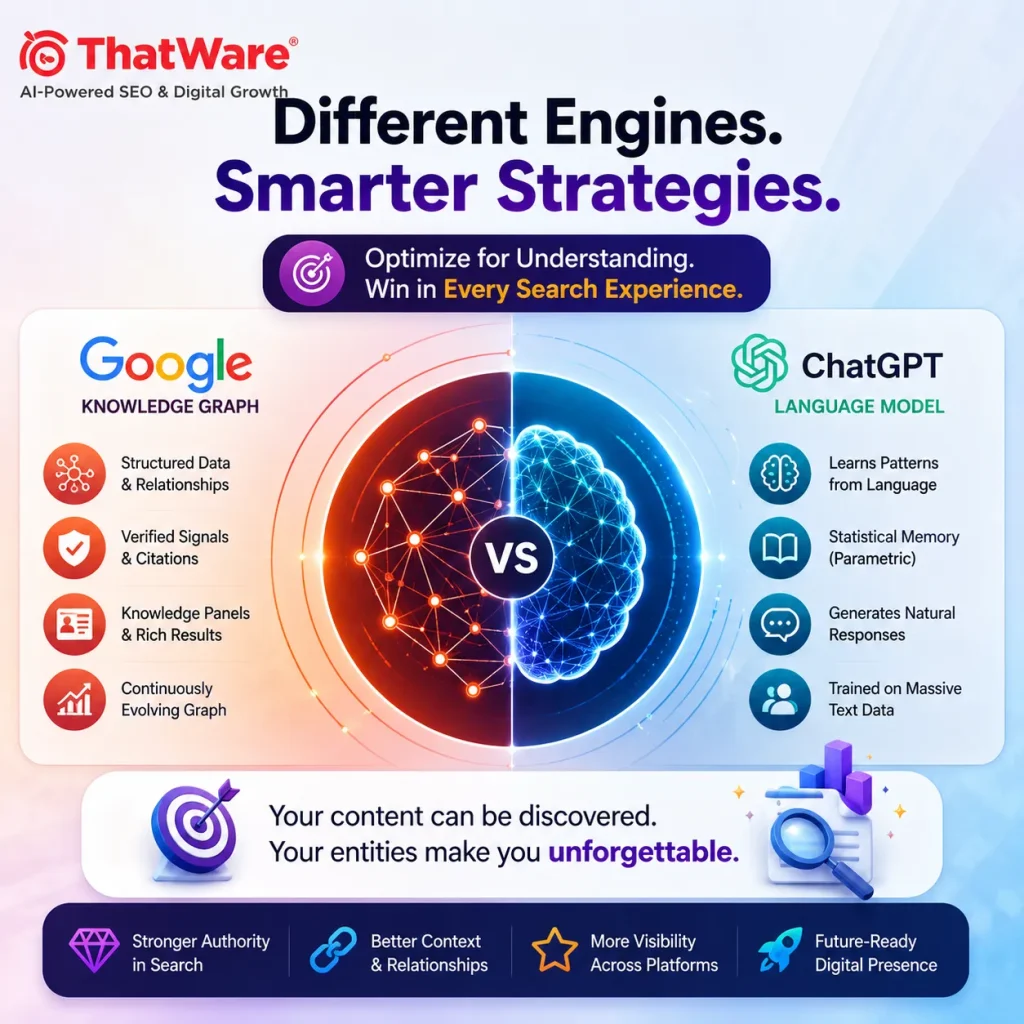
Similarly, ChatGPT does not create Knowledge Panels or maintain an editable graph of relationships that website owners can directly influence. There is no mechanism through which publishing structured data instantly changes what the model permanently knows about a specific entity.
Instead, the model generates responses by drawing upon patterns distributed throughout its learned parameters. Information is represented collectively rather than being stored as individually editable entries. This fundamental architectural difference explains why Entity Mapping serves a different purpose for Google than it does for ChatGPT.
How Large Language Models Learn
Large language models learn by identifying statistical relationships across enormous collections of text. Rather than memorizing webpages one by one, they recognize recurring language patterns that appear repeatedly across diverse sources.
This learning process is fundamentally different from building a knowledge graph. Instead of creating explicit nodes connected through predefined relationships, the model develops an internal representation of how words, entities, facts, and concepts tend to appear together in natural language.
As a result, language becomes the primary source of learning rather than structured schema. The model observes how people write about entities, how topics are discussed together, and how concepts are associated across countless documents. Over time, these repeated patterns allow it to generate coherent responses without consulting an editable entity database.
Another important characteristic is that understanding emerges from broad consensus rather than isolated sources. Information that appears consistently across billions of documents contributes more strongly to the model’s statistical understanding than information published in only one location. This explains why widespread, reliable discussion of an entity contributes far more to language modeling than a single implementation of structured data.
Why Schema Markup Doesn’t Train ChatGPT
What Schema Really Does
Schema markup remains an extremely valuable component of modern websites because it improves machine readability and helps different systems interpret content more accurately. Within Google’s ecosystem, schema provides structured context that assists crawlers in identifying organizations, products, authors, services, reviews, events, and many other types of information.
This structured information also supports retrieval systems by making webpage content easier to interpret when information needs to be discovered, indexed, or summarized. Search engines benefit because schema reduces ambiguity and helps them understand how different pieces of information relate to one another on a page.
In practical terms, schema strengthens the ability of search engines to process webpages efficiently, organize content accurately, and present more informative search experiences. It improves how machines interpret content, but its primary role is to support retrieval and understanding rather than to teach language models directly.
What Schema Does Not Do
One of the most common misconceptions surrounding Entity Mapping is the belief that adding schema markup automatically teaches ChatGPT new information. In reality, schema does not update a language model’s learned parameters.
Publishing structured data on a website does not directly modify the statistical representations that ChatGPT uses to generate responses. There is no mechanism through which schema markup rewrites the model’s internal knowledge or permanently inserts a new entity into its understanding.
Likewise, schema does not create permanent memory inside ChatGPT. While structured information may improve how retrieval-based systems discover and interpret webpages, it does not function as a direct training signal for an already trained language model.
Understanding this distinction helps separate two very different concepts. Schema remains highly valuable for Google’s search ecosystem and other retrieval-oriented technologies, while ChatGPT relies primarily on learned language patterns developed from large-scale training rather than editable structured databases. This is why effective Entity Mapping should be viewed as a strategy for improving machine understanding within search ecosystems, not as a direct method for training conversational AI.
Google Knowledge Graph vs ChatGPT Memory
A Side-by-Side Comparison
Although Google Search and ChatGPT are both capable of understanding entities, they rely on fundamentally different technologies to achieve that understanding. This distinction is the primary reason why Entity Mapping produces different outcomes across the two systems.
Google’s search ecosystem is built around an explicit knowledge structure where entities are identified, connected, and continuously validated using numerous external signals. ChatGPT, on the other hand, generates responses through statistical language modeling, where knowledge is encoded across billions of learned parameters rather than stored as editable entity records.
The following comparison highlights these architectural differences:
| ChatGPT | |
| Uses Knowledge Graph | Uses model parameters |
| Stores identifiable entity nodes | Learns statistical patterns across language |
| Accepts structured signals such as schema markup | Learns from language patterns rather than structured markup |
| Uses structured data to improve entity understanding | Schema does not directly train the model |
| Can display Knowledge Panels for recognized entities | Does not maintain editable entity profiles |
| Builds confidence through interconnected entity relationships | Generates responses using distributed representations learned during training |
This comparison demonstrates why applying the same optimization strategy to both systems can lead to incorrect expectations. Entity Mapping remains highly valuable for Google’s ability to organize and retrieve information, but ChatGPT relies on an entirely different mechanism for understanding and generating language.
Retrieval vs Memory: The Most Important Difference
Two Completely Different Systems
One of the biggest reasons people misunderstand Entity Mapping is that they confuse retrieval with memory. While both Google and conversational AI systems can answer similar questions, they often arrive at those answers through completely different processes.
Some AI systems retrieve information from external sources in real time, whereas others generate responses using knowledge learned during training. Understanding this distinction helps explain why structured optimization techniques influence some systems more directly than others.
Retrieval-Based Responses
Retrieval-based systems combine language models with external information sources. Instead of relying solely on previously learned knowledge, they can access indexed webpages, structured databases, and live search results before generating a response.
This approach is increasingly common in Answer Engine Optimization, where AI-powered search experiences retrieve reliable information from the web before presenting conversational answers to users.
When retrieval is involved, Entity Mapping becomes highly valuable because structured webpages are easier for machines to interpret. Clear entity relationships, organized content, and well-implemented schema help retrieval systems understand what a page represents and determine whether it is relevant to a user’s query.
Search-enabled AI platforms also benefit from strong entity signals because they can more accurately identify organizations, products, services, people, and topics while extracting relevant information from webpages. Proper schema implementation further improves machine readability by reducing ambiguity and providing additional context for crawlers and retrieval engines.
In short, retrieval-based systems work with information that is available externally. Their effectiveness depends largely on how well websites organize and communicate their information.
Memory-Based Responses
Memory-based systems operate differently. Instead of consulting live webpages for every response, they primarily rely on knowledge encoded within the model during training.
This internal knowledge originates from an extensive training corpus containing diverse forms of publicly available text. During training, the model learns statistical relationships between words, concepts, and entities, allowing it to generate coherent responses without maintaining an editable knowledge database.
When answering questions, the model performs statistical recall by predicting language based on learned patterns rather than retrieving facts from a dedicated entity graph.
For this reason, brand recognition within memory-based models generally depends on widespread and consistent references across many reliable sources instead of information published on a single webpage. An entity discussed consistently across authoritative publications is more likely to become part of the broader statistical understanding than one supported only by isolated structured data.
Recognizing this distinction is essential because it clarifies where Entity Mapping has the greatest impact and where broader content authority becomes more influential.
Where Entity Mapping Actually Helps AI
When Entity Optimization Still Matters
Although Entity Mapping does not directly train ChatGPT, it continues to play an important role in modern AI ecosystems. Its value extends far beyond traditional search rankings because many AI-powered systems still depend on well-structured, machine-readable information during retrieval and content interpretation.
For example, AI search experiences increasingly rely on clearly organized webpages to identify relevant information quickly and accurately. Websites that establish strong entity relationships make it easier for machines to understand the context surrounding organizations, products, services, technologies, and other important concepts.
The same principle applies to search-enabled chatbots that retrieve information from external sources before generating responses. These systems benefit when webpages clearly communicate entity relationships, making information extraction more reliable and reducing ambiguity during retrieval.
Entity optimization also contributes to Google AI Overviews, where Google’s generative search experience summarizes information from multiple trusted sources. Since Google’s understanding is built upon entities and their relationships, stronger entity signals can improve how content is interpreted within these AI-generated summaries.
Beyond search, retrieval systems responsible for indexing and organizing digital information also benefit from effective Entity Mapping. Clear semantic relationships enable better content extraction, allowing systems to identify the most relevant facts without relying solely on keyword matching.
As a result, pages with well-defined entities often achieve better contextual understanding because machines can recognize not only individual terms but also the relationships connecting them. This deeper interpretation improves relevance, reduces confusion between similar concepts, and supports more accurate information retrieval across modern AI-powered experiences.
Building Entity Authority Beyond Schema
What Actually Strengthens Recognition
While schema markup provides valuable structure, genuine entity recognition is built through much broader signals distributed across the web. Entity Mapping becomes significantly more effective when supported by consistent evidence from multiple independent sources rather than relying on technical implementation alone.
One of the strongest contributors is independent citations. When reliable websites consistently reference the same organization, individual, product, or concept, search engines gain greater confidence that the entity represents something meaningful beyond its own website.
Similarly, natural brand mentions across authoritative publications reinforce recognition by demonstrating that an entity is discussed within its broader industry or field. These mentions help establish real-world relevance instead of isolated self-promotion.
Trusted publications further strengthen entity confidence because information originating from credible sources carries greater weight during Google’s evaluation process. When multiple respected sources describe an entity consistently, Google’s confidence naturally increases.
Consistency also matters across every digital touchpoint. Maintaining the same organizational details, descriptions, expertise, and contextual positioning helps reduce ambiguity while reinforcing the identity of an entity over time.
Another essential factor is topical authority. Rather than publishing isolated articles, organizations that consistently produce comprehensive, interconnected content around their areas of expertise build stronger semantic relationships. This demonstrates subject depth and helps search systems better understand the entity’s role within a particular knowledge domain.
Finally, high-quality content supported by factual accuracy and knowledge consistency provides the strongest long-term foundation for entity recognition. When information remains reliable across multiple sources and continues to reinforce the same relationships, Entity Mapping becomes significantly more effective in helping search engines interpret, connect, and confidently recognize entities throughout the web.
ThatWare’s Advanced Entity SEO Optimization: Building Stronger Digital Entities
Modern Entity Mapping is no longer limited to keyword optimization. Expert seo services have evolved to understand relationships between entities, topics, and concepts to determine whether a website demonstrates genuine expertise and authority.
At ThatWare, Entity SEO Optimization is designed around this evolution. Instead of optimizing isolated pages, the focus is on creating a connected semantic ecosystem that helps search engines understand the complete identity of a business.
Going Beyond Keywords
Traditional SEO often revolves around keyword placement. However, ThatWare’s approach extends much further by emphasizing:
- Semantic relationships between topics
- Contextual relevance across webpages
- Entity-focused content architecture
- Long-term topical authority
This allows search engines to interpret not just what a page says, but what it truly represents.
Building Strong Digital Entities
A strong digital entity is created when multiple optimization layers work together. ThatWare’s Entity SEO methodology includes:
- Structured data implementation using Schema.org
- Knowledge Graph alignment
- Topic cluster development
- Internal entity relationship mapping
- Entity salience optimization
Rather than treating webpages as independent assets, these strategies establish meaningful connections between pages, products, services, authors, and business information.
Leveraging AI and Natural Language Processing
Another important aspect of ThatWare’s optimization process is the use of Natural Language Processing (NLP) and AI-assisted semantic analysis.
This helps:
- Understand search intent more accurately
- Identify contextual relationships between entities
- Improve semantic content optimization
- Create content that machines can interpret more effectively
As a result, websites become easier for search engines to understand while remaining valuable for human readers.
Strengthening EEAT Signals
Entity optimization also contributes to stronger EEAT (Experience, Expertise, Authoritativeness, and Trustworthiness) signals.
ThatWare focuses on establishing:
- Consistent entity information across the website
- Strong knowledge relationships
- Trustworthy content architecture
- Clear demonstrations of subject-matter expertise
- Long-term topical authority instead of short-term ranking gains
A Comprehensive Entity SEO Approach
ThatWare’s Entity SEO Optimization combines several advanced disciplines into one unified strategy, including:
- Semantic SEO
- Knowledge Graph engineering
- Entity relationship mapping
- AI-assisted content optimization
- Advanced website architecture
- Semantic content structuring
Being a professional seo consultant, ThatWare builds digital entities that search engines can understand, connect, and trust. The objective is to create sustainable topical authority that remains valuable as Google’s search ecosystem and AI-driven search technologies continue to evolve.
Common Myths About Entity Mapping
Myth 1: Schema Trains ChatGPT
Schema markup improves how search engines and retrieval systems understand webpages, but it does not directly teach or retrain ChatGPT’s language model.
Myth 2: Google Knowledge Graph Powers Every AI Model
Google’s Knowledge Graph is specific to Google’s search ecosystem. Other AI systems may recognize entities, but they do not necessarily rely on the same knowledge infrastructure.
Myth 3: Adding More Schema Guarantees AI Citations
Schema increases machine readability, but it does not guarantee that AI-generated answers will reference or cite a particular webpage.
Myth 4: Entity Mapping Works Identically Everywhere
Different platforms interpret information differently. An optimization strategy that benefits Google may not produce the same results for conversational AI or other retrieval systems.
Myth 5: Entity Optimization Is Only About Structured Data
Structured data is only one part of the process. Strong entity recognition also depends on content quality, authority, consistency, contextual relevance, and trusted references.
Best Practices for Modern Entity Optimization
Building effective Entity Mapping requires a balanced strategy that combines technical implementation with high-quality content and consistent digital signals. Some practical best practices include:
- Build genuine authority by publishing accurate and reliable information.
- Create entity-rich content that clearly defines important people, organizations, products, services, and concepts.
- Maintain a consistent brand identity across websites, directories, and trusted external platforms.
- Implement structured data correctly without relying on it as the only optimization method.
- Strengthen semantic relationships between related topics and pages.
- Earn citations and references from credible third-party sources.
- Develop topical depth through comprehensive content clusters instead of isolated articles.
- Optimize for retrieval-based systems as well as traditional search, rather than focusing on only one search experience.
The Future of Entity Mapping
The importance of Entity Mapping is expected to grow as search technology continues to evolve. AI-powered search experiences are becoming more conversational, retrieval systems are becoming more sophisticated, and users increasingly expect direct answers instead of long lists of links. As search continues shifting toward AI-assisted experiences, understanding entities and their relationships will become even more critical for ensuring accurate information retrieval.
Search retrieval systems will continue relying on structured, well-organized information to identify reliable sources. Google’s AI Overviews further demonstrate how entity understanding supports AI-generated summaries by combining information from multiple authoritative webpages. Similarly, the growing focus on LLM SEO reflects the need to create content that large language models can interpret more effectively without confusing it with traditional search optimization.
Conversational search and ChatGPT SEO will also encourage businesses to create clearer, more context-rich content that machines can interpret accurately. As organizations explore newer optimization strategies, many will also seek guidance from an AI SEO Agency to better understand how semantic search, retrieval systems, and AI-driven discovery continue to evolve alongside conventional SEO practices.
Looking ahead, concepts such as Quantum SEO are expected to encourage more advanced approaches to semantic understanding, contextual relevance, and intelligent information processing. Although the terminology may continue to evolve, the underlying objective will remain the same—helping search systems better understand relationships between entities rather than simply matching keywords.
Although Entity Mapping does not directly train language models, it remains a valuable long-term strategy because it improves machine understanding, strengthens retrieval performance, enhances semantic relevance, and supports future search experiences driven by increasingly intelligent AI systems.
Conclusion
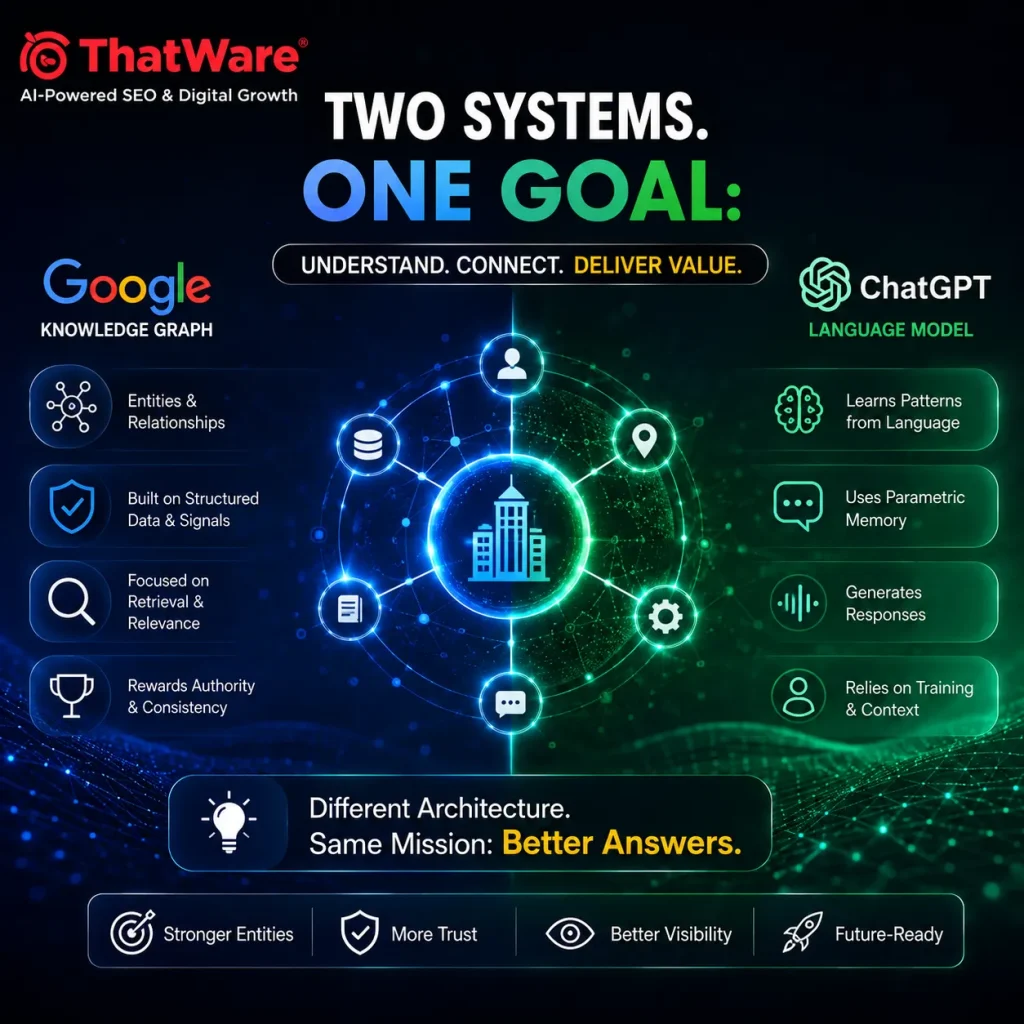
Google and ChatGPT may answer similar questions, but they solve them using fundamentally different approaches. Google’s Knowledge Graph is a structured entity system that continuously builds confidence through interconnected relationships and external signals. ChatGPT, by contrast, generates responses using statistical language patterns learned during training rather than editable entity nodes.
This distinction explains why Entity Mapping continues to play a significant role in Google’s search ecosystem while having a different impact on conversational AI. Optimizing entities should therefore be viewed as a way to improve machine understanding, retrieval quality, and semantic clarity—not as a direct method for teaching language models.
As search continues to evolve, organizations should focus on building strong semantic authority, maintaining consistent entity relationships, and creating trustworthy content that serves both retrieval systems and users. Businesses evaluating long-term search strategies should also understand what to look for when selecting the best geo agency, ensuring that the focus extends beyond keywords to semantic relationships, entity optimization, and sustainable topical authority. When approached with the right expectations, Entity Mapping remains one of the most valuable long-term strategies for improving digital understanding across modern search ecosystems.