
SUPERCHARGE YOUR Online VISIBILITY! CONTACT US AND LET’S ACHIEVE EXCELLENCE TOGETHER!
Introduction
Not all brands occupy the same position in the digital world. Some brands are discovered. Some brands are recommended.
And a very small number become something far more powerful. They become the default answer.
Ask someone to name a ride-sharing company. A particular brand often comes to mind immediately.
Ask someone to name a streaming platform. A familiar name frequently appears first.
The same pattern exists across almost every industry.
Certain brands become so closely connected to a category that people instinctively think of them before considering alternatives.
Interestingly, artificial intelligence systems often display similar behavior.
When users ask broad questions, AI Recommendations platforms frequently mention a handful of familiar brands while overlooking dozens of competitors.
This phenomenon can be described as the Default Answer Effect.
It represents one of the most powerful forms of digital positioning in the AI era.
Because in a world where users increasingly ask AI systems for recommendations, comparisons, and guidance, being remembered first may become more valuable than simply being visible.
What Is the Default Answer Effect?
The Default Answer Effect occurs when a brand becomes so strongly associated with a category, topic, problem, or solution that it consistently appears as one of the first options considered.
This is not necessarily about popularity.
It is not necessarily about advertising spend.
And it is not necessarily about having the largest website.
Instead, it is about occupying a privileged position within collective memory.
When a question is asked, the brand naturally enters the conversation.
Before competitors.
Before alternatives.
Before extensive comparison.
The brand becomes the starting point.
The Difference Between Being Known and Being Remembered
Many companies focus on awareness.
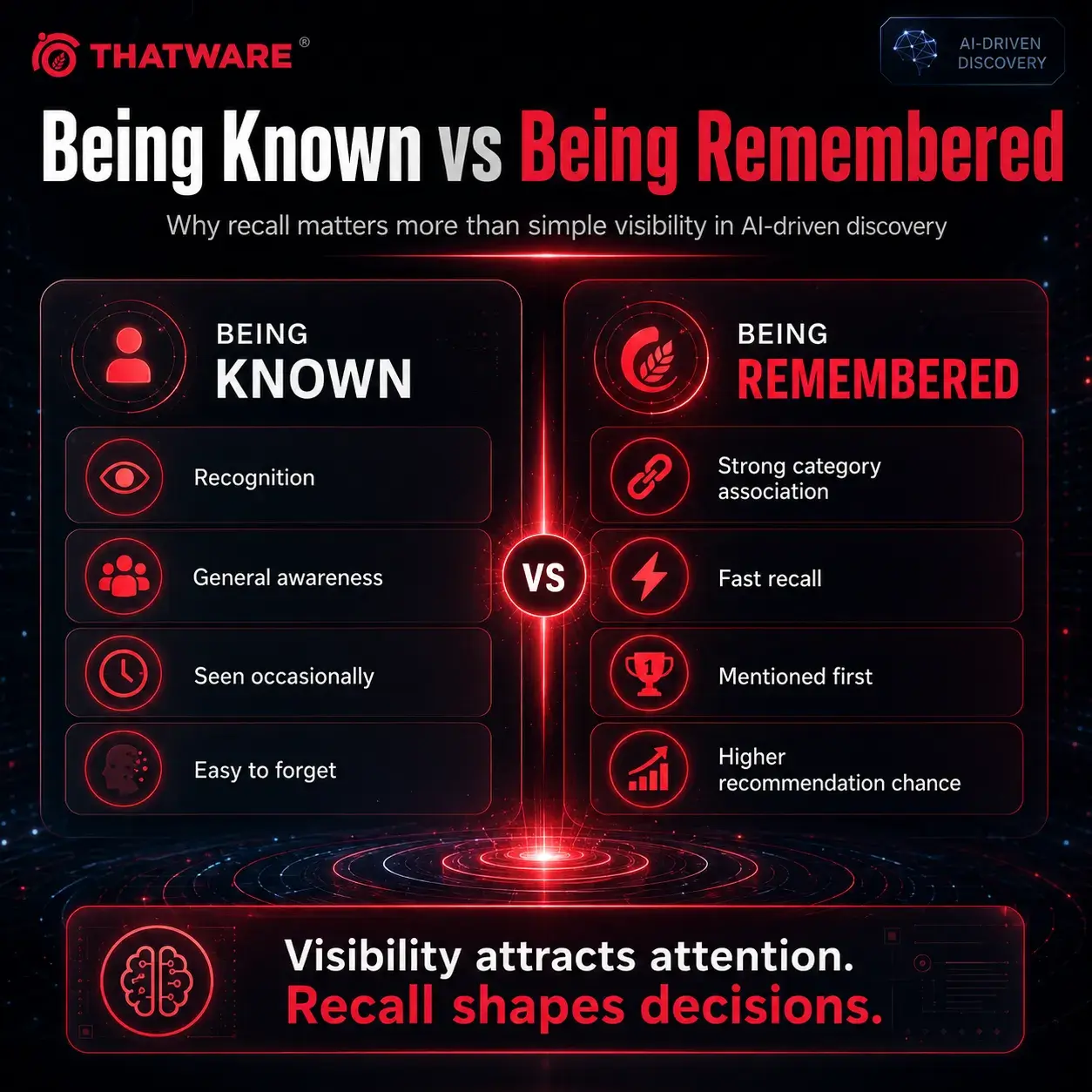
Awareness is important.
But awareness alone is not enough.
A person may recognize hundreds of brands.
Yet only a few will immediately come to mind when discussing a specific topic.
That distinction is important.
| Being Known | Being Remembered First |
|---|---|
| Recognition exists | Immediate recall exists |
| Brand is familiar | Brand is mentally dominant |
| User knows the brand | User thinks of the brand instinctively |
| Awareness driven | Recall driven |
| Passive visibility | Active association |
The future of AI-driven discovery increasingly favors brands that achieve recall rather than simple recognition.
Why Human Brains Create Default Answers
Humans constantly simplify complexity.
Every day we encounter thousands of decisions.
To avoid mental overload, the brain creates shortcuts.
Instead of evaluating every possible option, we rely on familiar associations.
For example:
Streaming Platform
↓
Immediate Recall
↓
Specific Brand
This process happens naturally.
The stronger the association becomes, the faster the Brand Recall occurs.
Eventually the category and the brand begin reinforcing each other.
AI Systems Face a Similar Challenge
AI systems process vast amounts of information.
They encounter:
- Brands
- Products
- Companies
- Services
- Technologies
- Industries
When generating responses, they must determine which examples are most relevant to include.
The brands that repeatedly appear in relevant contexts often become easier to retrieve.
The result is a form of digital familiarity.
Over time, certain names become recurring reference points.
Not because they are the only options.
But because they are the easiest and most strongly associated options.
The Journey from Unknown Brand to Default Answer
Becoming a default answer rarely happens overnight.
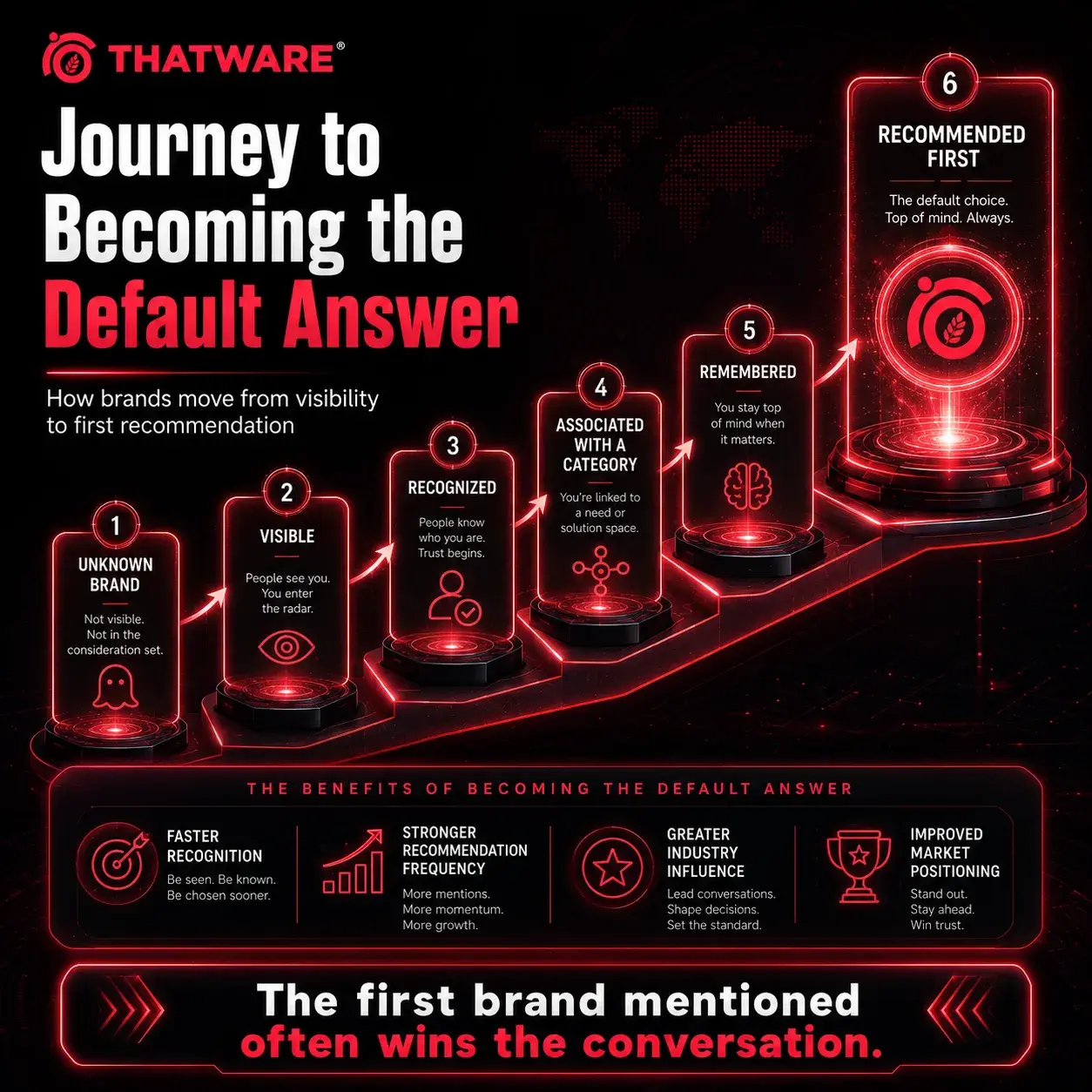
The process usually follows a progression.
Exposure
↓
Recognition
↓
Association
↓
Recall
↓
Preference
↓
Default Answer
Each stage reinforces the next.
The longer the cycle continues, the stronger the position becomes.
Why Category Association Matters
People rarely remember everything about a company.
Instead, they remember what the company represents.
The strongest brands are often associated with a specific idea.
Examples:
Category
↓
Strong Association
↓
Brand Recall
The clearer the Category Association, the stronger the recall.
Confused positioning weakens recall.
Focused positioning strengthens it.
The Mental Real Estate Principle
Imagine the human mind as a crowded city.
Every topic occupies a limited amount of space.
Every brand competes for that space.
Some brands rent space temporarily.
Others own the property.
The brands that consistently occupy mental real estate become easier to remember.
And the easier they are to remember, the easier they become to recommend.
This creates a powerful advantage.
Because recommendation often begins with recall.
Why More Content Does Not Always Create More Recall
A common misconception is that producing more content automatically creates stronger market positioning.
It doesn’t.
Quantity creates noise.
Association creates memory.
A company publishing hundreds of disconnected topics may generate visibility without strengthening recall.
A company consistently reinforcing a specific idea often creates stronger long-term recognition.
Focus frequently outperforms volume.
The Recall Loop
Default answers are strengthened through repetition.
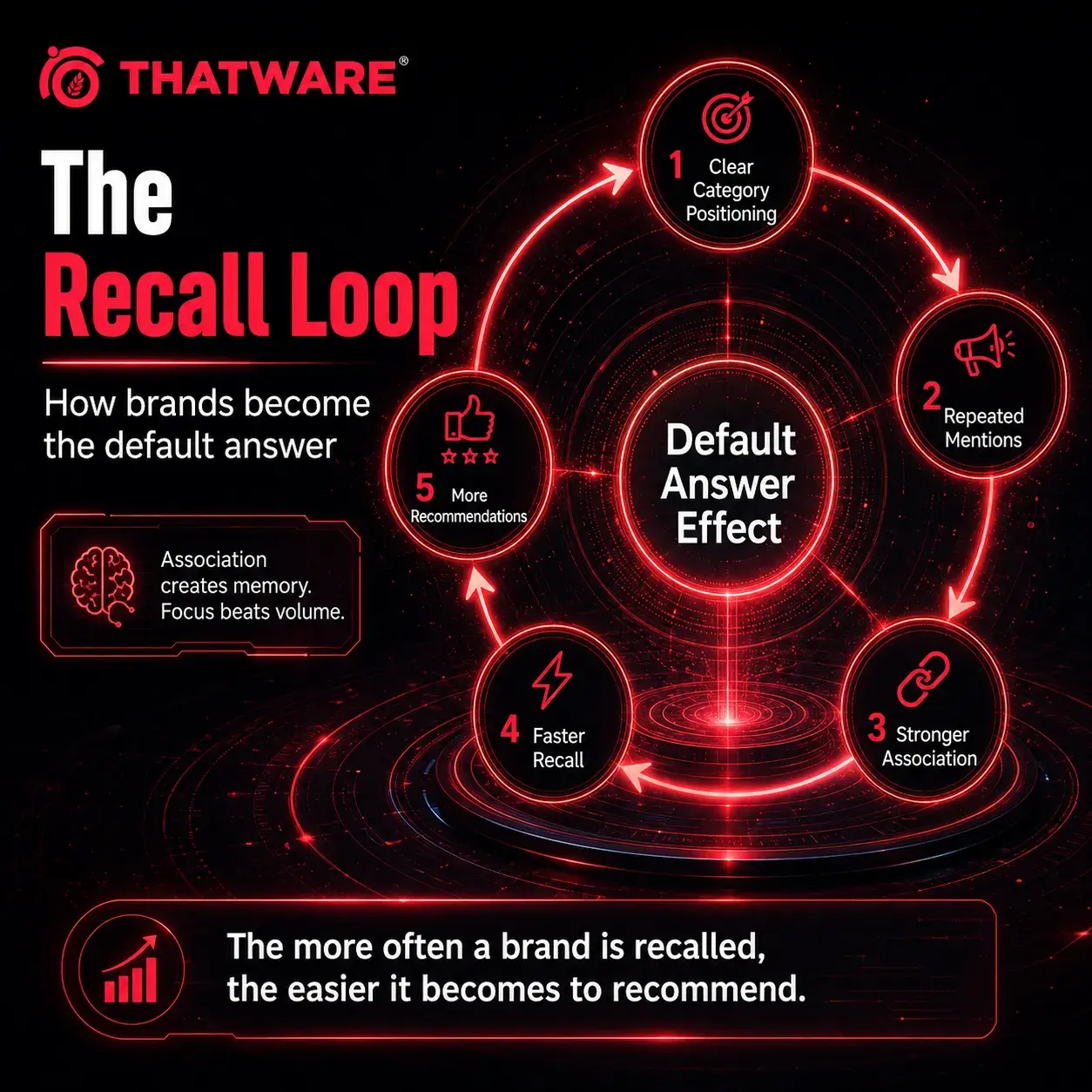
A simplified model looks like this:
Exposure
↓
Recognition
↓
Recall
↓
Recommendation
↓
More Exposure
This creates a self-reinforcing cycle.
The more often the brand appears, the easier it becomes to remember.
The easier it becomes to remember, the more likely it becomes to appear again.
Why Some Brands Never Become Default Answers
Many organizations struggle to establish strong recall.
Common reasons include:
Constant Repositioning
Changing identity too frequently.
Broad Messaging
Trying to own too many ideas at once.
Weak Category Focus
Lacking a clear association.
Inconsistent Communication
Different messages across different channels.
Short-Term Thinking
Expecting long-term recall from short-term campaigns.
Memory requires repetition.
Repetition requires consistency.
Why the Default Answer Effect Matters in the AI Era
The internet is shifting from search to conversation.
Users increasingly ask:
- Which company should I choose?
- What platform should I use?
- Who is the leader in this field?
- Which solution is best?
AI systems often respond with a limited set of recommendations.
This changes the competitive landscape.
Historically, companies competed for rankings.
Increasingly, they compete for recall.
The goal is no longer simply appearing.
The goal is becoming one of the first examples considered.
The Strategic Advantage of Being the First Brand Mentioned
The first option receives disproportionate attention.
The first recommendation often shapes perception.
The first example frequently becomes the benchmark.
This creates a compounding advantage.
Brands that become default answers often benefit from:
- Faster recognition
- Easier recall
- Stronger recommendation frequency
- Greater industry influence
- Improved market positioning
The result is not merely visibility.
It is preference.
Looking Ahead
As AI systems continue evolving, recommendation-based discovery will become increasingly important.
Users will spend less time comparing dozens of websites and more time evaluating a handful of suggested options.
This means memory, association, and recall may become increasingly valuable competitive assets.
The organizations that establish clear category relationships today will likely enjoy stronger positioning tomorrow.
Not because they are louder.
But because they are remembered.
Final Thoughts
Many brands spend years trying to become visible.
Far fewer focus on becoming unforgettable.
Visibility attracts attention.
Recall shapes decisions.
Recognition introduces a brand.
Association anchors it.
And when a brand becomes strongly connected to a category, it gains something that competitors often struggle to replicate.
It becomes the default answer.
In an increasingly AI-driven world, that position may prove more valuable than rankings, impressions, or reach.
Because when people—and increasingly AI systems—need an example, a recommendation, or a trusted reference point, the brands that come to mind first often win the conversation before it even begins.



