
Get a Customized Website Audit and Online Marketing Strategy and Action Plan
Residential connectivity used to mean something simple: a household IP, assigned by an ISP, used by one family for browsing and streaming. That definition has quietly broken down. Today’s networks treat residential IPs as persistent assets, available 24/7, and increasingly central to how businesses gather public web data.
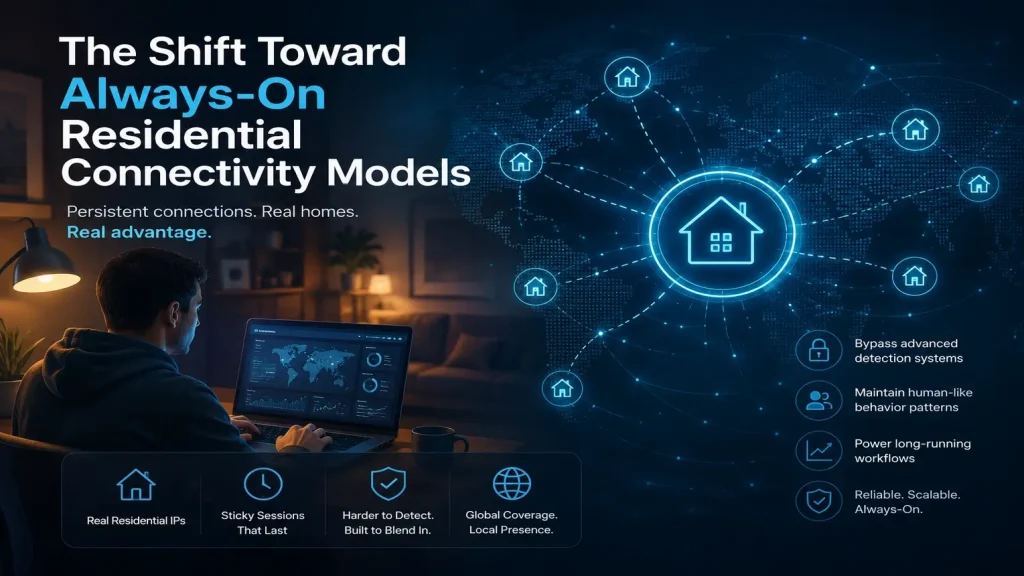
The push toward always-on models reflects real pressure from detection systems. Sites protected by Akamai and similar vendors can spot connections that flicker every few seconds, while stable sessions look like ordinary human activity.
From Rotation to Persistence
Older proxy strategies leaned on rapid rotation. Every request switched IPs, the theory being that no single address would accumulate enough traffic to get flagged. But websites caught on, and the rotation-first approach started losing ground around 2022.
Behavioral fingerprinting, TLS analysis, and session continuity checks now favor connections that behave consistently over time. A user who lingers on a page, scrolls, and returns hours later looks human. One whose IP flickers mid-checkout doesn’t.
That reframed what residential proxies need to do. Speed matters less than authenticity. A connection that holds steady for 30 minutes through a checkout flow beats 50 IPs that each last 4 seconds.
Why Always-On Is Winning
The use cases driving this shift are practical and specific. Account managers running multiple business profiles need IPs that don’t reset mid-task, and ad verification firms need stable vantage points to confirm campaigns render correctly across regions.
Providers have responded with longer session windows and flat-rate traffic plans. The unlimited residential proxy from MarsProxies.com is one example, where bandwidth caps give way to continuous access for developers running ongoing workloads.
And it isn’t just a billing change. It reflects a different assumption about how proxies get used: as persistent infrastructure rather than disposable hits against a target.
The Infrastructure Behind Sticky Sessions
Always-on residential pools depend on real consumer devices participating in the network, often through opt-in apps or SDK integrations. The technical challenge is keeping those devices reachable for as long as a customer needs them. As Wikipedia’s entry on residential gateways notes, home routers handle network address translation and session state in ways that weren’t designed for persistent third-party use.
Providers compensate through session pinning, fallback routing, and geographic redundancy. When one device drops, traffic shifts to a similar IP in the same region without breaking the customer’s logical session. It’s closer to how mobile carriers handle tower handoffs than how traditional proxies route requests.
Cloudflare’s bot management documentation explains how detection engines score traffic based on session continuity and known proxy ranges, which is exactly why stable connections increasingly outperform rotating ones.
Geographic distribution adds another layer. A pool that performs well in North America can collapse in Southeast Asia or South America, where residential coverage is thinner and ISP cooperation varies. Buyers running multi-region operations should test specific countries before committing.
What Buyers Should Watch For
For anyone shopping proxy services in 2026, the headline metric has changed. Pool size still matters, but session stability and concurrent connection limits deserve closer attention. A million-IP pool with 30-second timeouts won’t outperform a smaller pool with proper sticky support for most serious workloads.
Pricing models have followed the technical shift. Research published in Harvard Business Review on data strategy makes the case that companies investing in continuous market intelligence see clearer ROI than those running sporadic collection sprees.
Concurrent connection caps deserve a hard look too. Some providers advertise huge pools but quietly throttle simultaneous sessions per account, which kills throughput for anyone running serious automation.
There’s also a quality angle most buyers overlook. Flaky residential nodes can’t deliver persistent connections, so they get filtered out of premium pools, and that creates a feedback loop where always-on models naturally select for higher-quality endpoints.
Where This Is Heading
The move toward persistent residential connectivity isn’t a marketing rebrand. It’s a response to detection systems that have outgrown the old rotation playbook, and to use cases that demand session continuity rather than raw IP volume.
Expect this trend to deepen as anti-bot vendors keep refining their behavioral models. The proxy market that competed on pool size and rotation speed is now competing on something harder to fake: connections that genuinely look like they belong to a person sitting at home.
That makes provider selection a different exercise than it was five years ago. Buyers ranking options by raw IP count are optimizing for a metric that’s losing relevance, while teams prioritizing session quality and infrastructure transparency tend to end up with better long-term results.