SUPERCHARGE YOUR ONLINE VISIBILITY! CONTACT US AND LET’S ACHIEVE EXCELLENCE TOGETHER!
| Recommended audience | CMOs, SEO leaders, content strategists, growth teams, AI search teams, technical SEO teams, and brand strategists |
| Estimated word count | Approximately 10,000 words |
| Primary goal | Explain how brands can move from traditional SEO to AI-native visibility, trust, answerability, citation safety, and probabilistic brand authority |
| Source decks used | Introduction; AEO & GEO / LLM Psychology & AI Selection Mechanics; Cognitive Resonance SEO; AIEO Workshop; Quantum Brand Modeling |
Table of Contents
- The collapse of keyword-only SEO
- The new optimization stack: SEO, AEO, GEO, CRSEO, AIEO, and QBM
- LLM psychology and AI selection mechanics
- Building the AI-ready knowledge layer
- Content architecture for AEO and GEO
- CRSEO: optimizing for cognition, emotion, and AI reasoning
- AIEO: building an AI experience operating system
- Quantum Brand Modeling: measuring brand perception in AI ecosystems
- Unified implementation framework
- AI-ready page blueprint
- Measurement and governance
- Conclusion: from rankings to AI-native authority
The Collapse of Keyword-Only SEO
For more than two decades, search strategy was built around a relatively stable assumption: users typed queries into a search engine, scanned a ranked list of blue links, and clicked the result that looked most relevant. In that world, visibility was largely positional. A page that ranked higher captured attention, traffic, and commercial opportunity. Brands optimized title tags, keyword density, backlinks, internal links, page speed, and technical crawlability because the search result page was the main gateway between user demand and website traffic. That model still matters, but it is no longer sufficient. AI-first search changes the gateway itself. Instead of sending users to a list of websites, answer engines increasingly synthesize responses, compare sources, summarize options, and present recommendations directly inside conversational interfaces.
The introductory deck makes this shift clear: traditional keyword strategies are declining because search engines and AI systems are moving toward intent understanding, conversational query processing, and predictive answer generation. The user is no longer always asking for a list of possible sources. In many cases, the user is asking for an answer, a recommendation, a comparison, a diagnosis, a plan, or a decision shortcut. That changes what optimization means. Brands cannot only ask whether a page can rank. They must ask whether an AI system can understand the page, trust it, extract from it, connect it to a brand entity, and safely cite it in a generated answer.
This is why the future of SEO is not merely SEO with more automation. It is a broader discipline that blends answer optimization, generative engine optimization, cognitive content strategy, trust engineering, and AI-native brand modeling. The central question becomes: when a large language model or answer engine is deciding what to say, which brands and pages become usable evidence? If your content is vague, buried, unstructured, unsupported, over-promotional, or disconnected from entity signals, the AI system may ignore it even if it performs well in conventional organic search. If your content is explicit, modular, credible, schema-supported, and aligned with the user’s cognitive and emotional intent, it has a better chance of becoming part of the answer.
This blog explains the integrated system behind that transition. It combines five workshop themes: the introduction to AI-first search, AEO and GEO mechanics, LLM psychology and selection behavior, CRSEO, AIEO, and Quantum Brand Modeling. Together, they describe a full operating model for future-ready visibility. The goal is to move from being discoverable in search to being understood, trusted, selected, cited, and correctly represented in AI ecosystems.
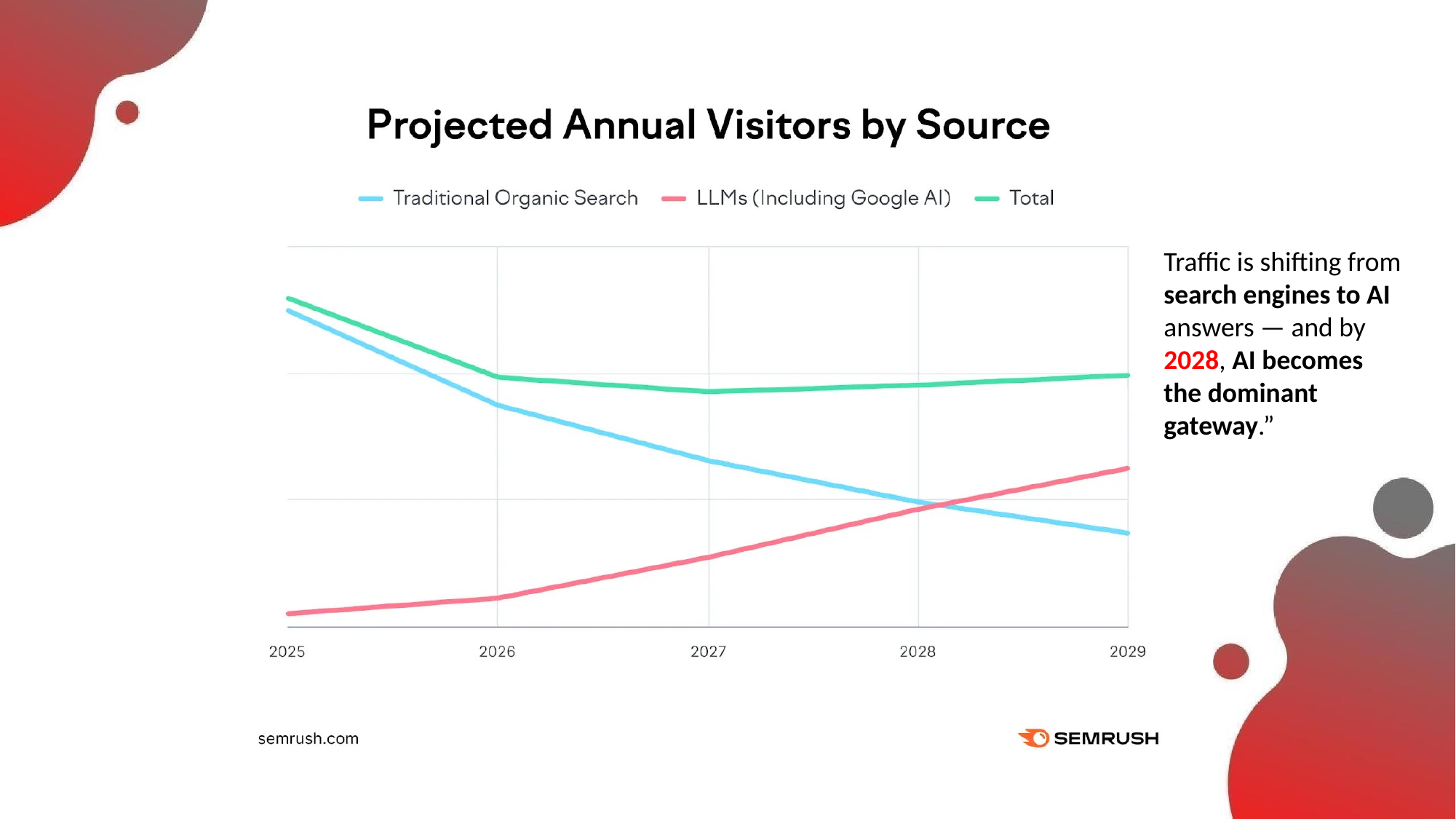
Figure 1. Projected source shift from traditional organic search toward LLM-driven answers and AI visibility.
The New Optimization Stack: SEO, AEO, GEO, CRSEO, AIEO, and QBM
The new optimization stack begins with a simple distinction. SEO is about findability. AEO, or Answer Engine Optimization, is about direct answerability. GEO, or Generative Engine Optimization, is about becoming a reliable knowledge source for generative AI systems. The AEO/GEO deck summarizes this as a move from visibility alone to a combination of visibility, answerability, and authority. A page can be technically visible yet not answer-ready. It can be answer-ready yet not authoritative enough to cite. It can be authoritative yet too poorly structured for an AI system to extract safely. The future-ready stack solves all three problems together.
CRSEO, or Cognitive Resonance Search Engine Optimization, adds the human layer. It asks why people search, what emotional pressures shape their queries, how confidence rises or drops as they read, and what kind of content sequence reduces hesitation. Traditional SEO often treats intent as a keyword category such as informational, navigational, commercial, or transactional. CRSEO goes deeper. It maps fear, risk avoidance, confidence gaps, safety needs, authority expectations, and social proof triggers. Those emotional vectors shape whether a user needs reassurance, evidence, comparison, proof, guarantees, or post-purchase support.
AIEO, or AI Experience Optimization, adds the machine trust layer. It is not only about what a user sees on the page. It is about how an AI system experiences the page as evidence. Can the system map a question to the right URL? Can it assign confidence to that page? Does the page include schema, author signals, dates, citations, visible FAQs, and clear claims? Does the page reduce competitor drift, or does it allow a rival to appear more neutral and trustworthy? Does it suppress hallucination risk by making claims verifiable and context-bound? AIEO treats these as measurable operating stages rather than vague best practices.
Quantum Brand Modeling, or QBM, adds the brand-state layer. It models brand perception across AI ecosystems as a probabilistic distribution rather than a static ranking. A brand may appear strongly in ChatGPT but weakly in Gemini. It may be visible in consumer endpoints but absent from enterprise copilots. It may dominate direct-intent contexts but leak authority in informational or comparative contexts. QBM provides a way to measure these states, detect platform dependence, identify category leakage, and understand where competitors intercept demand.
The combined stack can be summarized this way: SEO gets pages found; AEO gets answers extracted; GEO gets the brand represented inside generative systems; CRSEO aligns content with human cognition and emotional decision-making; AIEO engineers AI confidence, citation quality, and safety; QBM measures where brand authority lives, leaks, and competes across AI ecosystems. A future-ready strategy needs all six layers because AI visibility is not a single surface. It is a system of crawling, parsing, embedding, reasoning, trusting, selecting, quoting, and recommending.
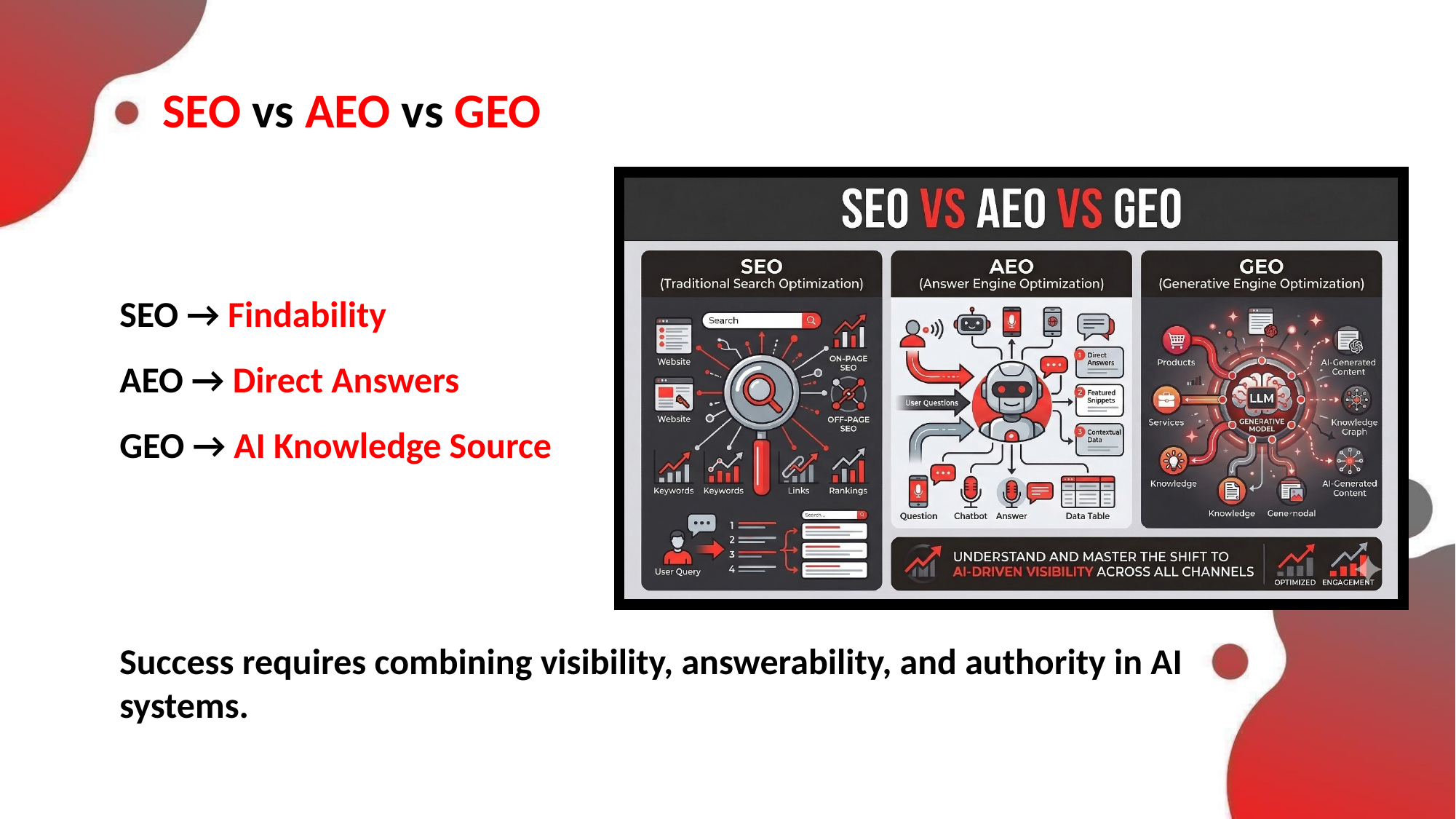
Figure 2. SEO, AEO, and GEO as complementary layers: findability, direct answers, and AI knowledge-source authority.
Why AI Search Is an Answer Gateway, Not Just a Traffic Channel
The most important strategic change is that AI search changes the meaning of traffic. In traditional SEO, visibility usually meant receiving a visit. In AI-first search, visibility may happen before the click or without a click at all. A brand can be mentioned, summarized, compared, recommended, or excluded inside an AI answer. That creates value, but it also creates measurement blind spots. A user may trust a brand because an LLM framed it as a credible option. Another user may never consider a brand because an AI answer chose a competitor. These outcomes may not always appear in analytics as organic sessions, but they can strongly influence demand.
The introductory slides point to a future where LLM-driven traffic value grows as traditional organic traffic declines. The exact shape will differ by industry, but the direction is clear. Users are becoming comfortable asking AI systems to explain, compare, recommend, and decide. This means the website becomes both a destination and a training-like evidence layer for external AI systems. Pages must be written for users, but also structured for machine interpretation. A page that hides its answer under long introductions, vague positioning, or sales-heavy language may lose to a competitor that gives a cleaner answer with clearer evidence.
This answer-gateway model creates a new hierarchy of optimization. At the base is accessibility: can AI crawlers reach the content? Next is interpretability: can the system identify the entity, topic, page purpose, and answer structure? Next is trust: does the page contain evidence, dates, authorship, schema, policies, and consistency across digital identities? Next is answer utility: can the system quote or paraphrase a concise, self-contained passage? Finally, there is selection advantage: when multiple sources are available, why would the AI prefer this brand’s content over a competitor’s?
The practical implication is that every priority page should be evaluated as an answer asset. Ask what question the page should win, what user state the page serves, what evidence makes it safe to cite, what schema clarifies its role, what competitor could displace it, and what passages are quotable. This mindset turns content from a collection of ranking targets into a structured knowledge system. The brands that adapt fastest will not simply chase traffic. They will engineer presence inside the answers that shape customer perception before the website visit ever happens.
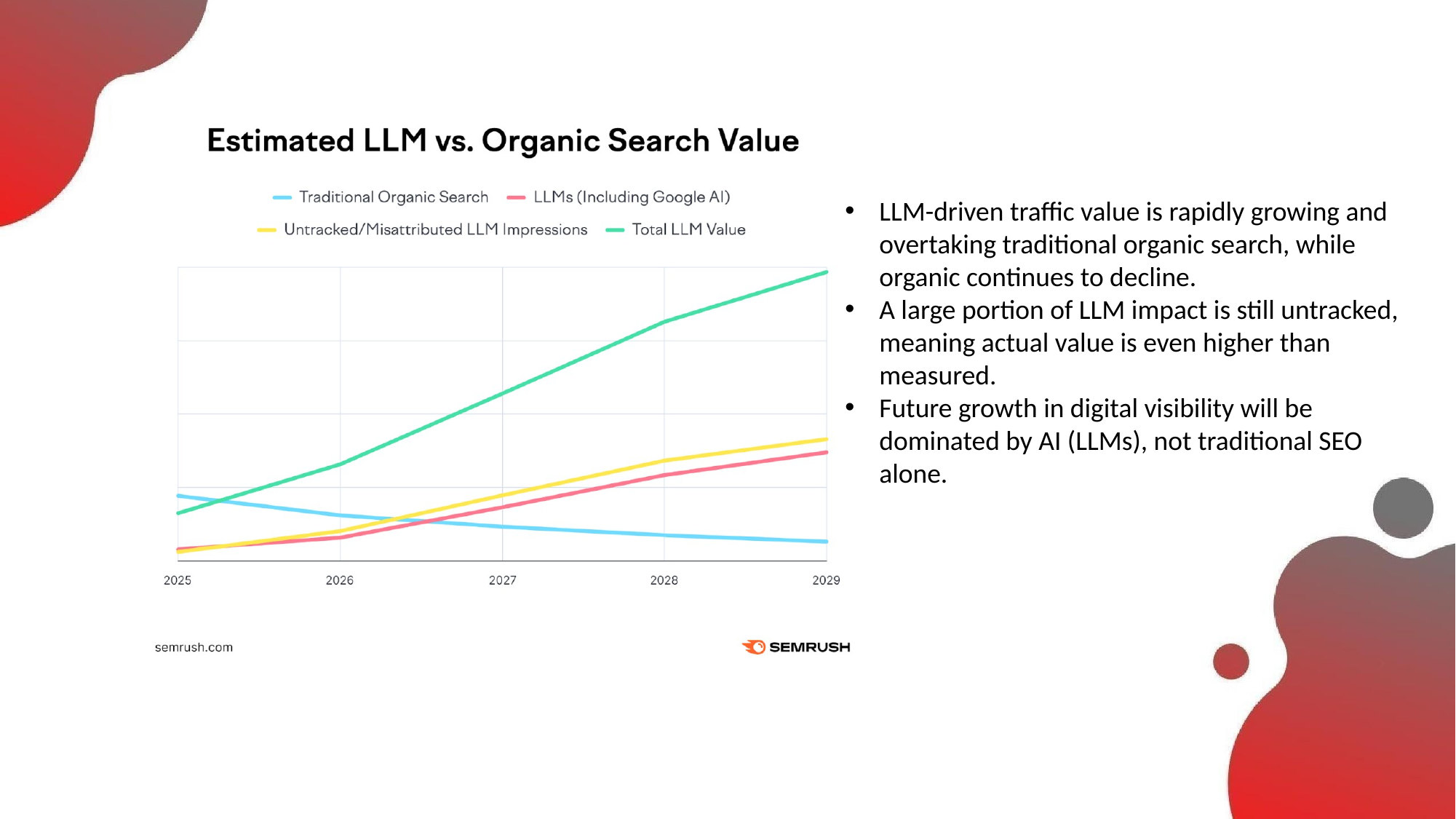
Figure 3. Estimated shift in value from traditional organic search toward LLM-driven discovery.
LLM Psychology: How AI Systems Interpret and Validate Content
LLM psychology does not mean that language models have human minds. It means that their observable behavior follows patterns that strategists can study. They interpret input, analyze context, draw from learned associations, evaluate the probability of useful continuations, and generate responses based on patterns, not direct human reasoning. This creates a different optimization problem from conventional search. A crawler may index a page because it can access the URL. An LLM-based answer system must also decide whether the page is semantically relevant, credible, coherent, extractable, and safe to use in a generated answer.
The AEO/GEO deck highlights three important validation behaviors: pattern recognition, source credibility, and data consistency. Pattern recognition asks whether the content fits the expected semantic structure of a trustworthy answer. For example, a medical, legal, or financial answer that makes bold claims without limitations, authorship, or citations creates a weak pattern. Source credibility asks whether the website, author, schema, and surrounding digital footprint create authority signals. Data consistency asks whether statements align with other signals available across the web and the brand’s own ecosystem. When these elements align, AI systems can assign higher confidence.
This is why structure matters so much. A page does not only need correct information; it needs information arranged in a way that reduces ambiguity. AI systems are better able to extract from direct answers, clearly labeled definitions, FAQ sections, comparison tables, step-by-step instructions, and concise summaries. They struggle more when the answer is buried inside marketing language, split across unrelated sections, or contradicted by other pages. The more work the model must do to infer meaning, the higher the chance of lower confidence, drift to another source, or misrepresentation.
For brands, the lesson is to build content as a confidence pathway. The first paragraph should tell the system exactly what the page answers. The next sections should clarify scope, add evidence, show authority, address risks, and connect entities. Repeated brand identity signals should be consistent across the website, schema, social profiles, directories, author pages, and external references. When a model sees the same entity, same positioning, same expertise claims, and same supporting evidence across multiple surfaces, the brand becomes easier to understand and safer to cite.
LLM psychology also changes how we write. The best AI-ready content is not overloaded with keywords. It is semantically rich, fact-dense, modular, and context-aware. It gives the model reusable answer fragments while also giving the human reader a persuasive path from uncertainty to confidence. This is where LLM psychology connects directly to CRSEO, AIEO, and QBM. CRSEO structures the human decision path. AIEO structures the AI confidence path. QBM measures the brand-state outcome across systems and contexts.
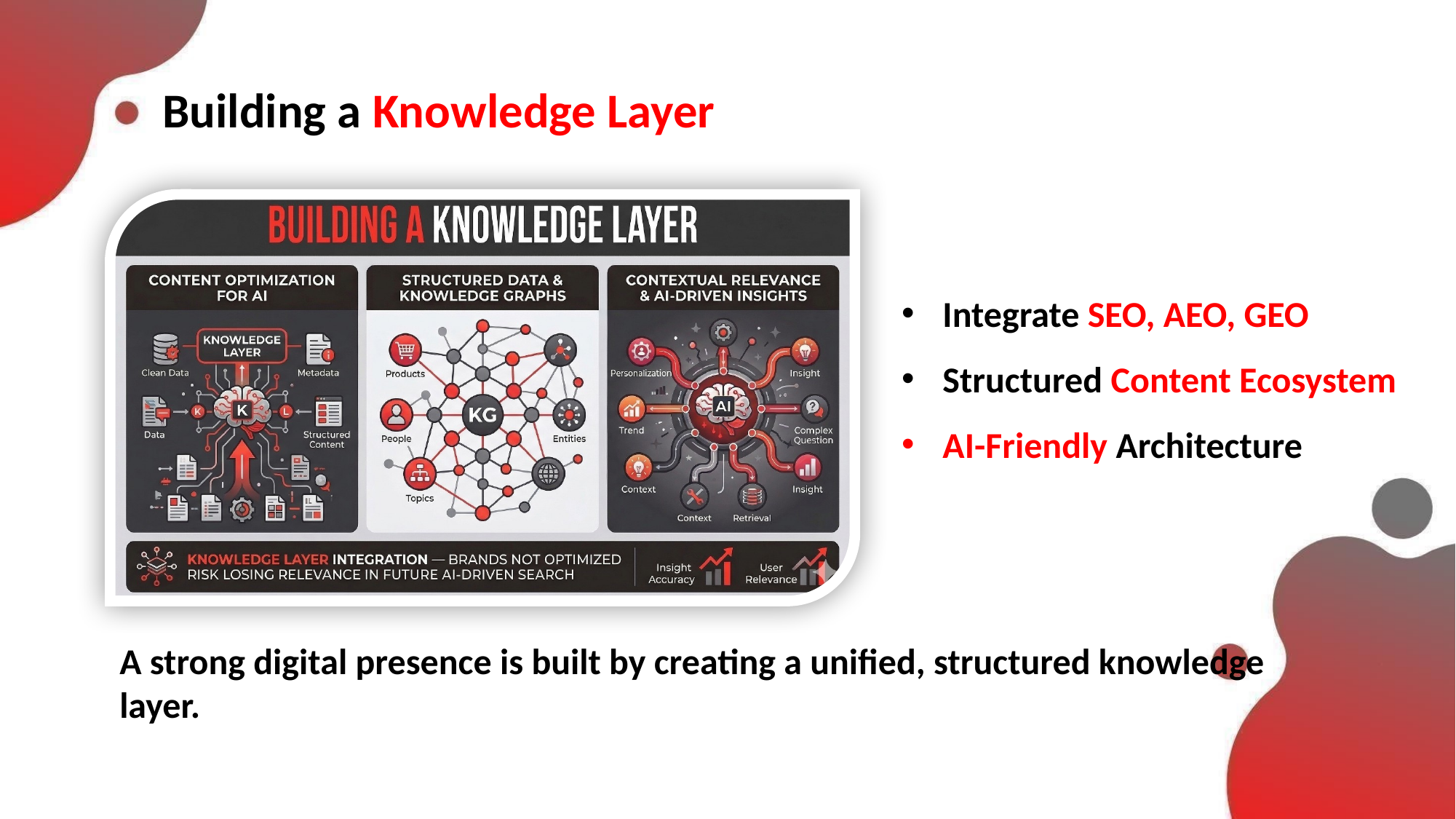
Figure 4. A unified knowledge layer helps AI systems understand content as a structured ecosystem, not isolated URLs.
Building the AI-Ready Knowledge Layer
A website built for AI search should be treated as a knowledge architecture rather than a group of disconnected landing pages. The AEO/GEO deck explains that a sitemap is not merely a list of URLs. In an AI-native strategy, it becomes an entry point into a broader semantic knowledge graph. Content should be organized by topics, services, frameworks, research areas, entities, relationships, and contexts. Each URL should contribute to entity authority and semantic coverage. When the site structure mirrors how the brand wants to be understood, AI systems can map pages to questions more reliably.
The first component is the semantic sitemap. A traditional sitemap tells crawlers what exists. A semantic sitemap helps describe how content fits into a topic and entity system. It can show which pages represent core services, which pages support subtopics, which pages define frameworks, and which pages provide research, comparison, or support content. This matters because AI systems increasingly rely on meaning, not only keywords. A topic cluster with clear entity relationships can become stronger than a flat archive of loosely related blog posts.
The second component is the vector feed. The AEO/GEO deck describes vector-feed.xml as a structured feed for AI vector-based retrieval rather than traditional crawling. In practical terms, the feed supports a pipeline: extract content from URLs, clean it, segment it into chunks, convert those chunks into embeddings, store them in a similarity engine, and retrieve them based on semantic meaning. This is important because AI systems often compare the meaning of a query with the meaning of content chunks. A page that is well chunked and semantically clear is easier to match than a page with long, mixed-purpose paragraphs.
The third component is the AI manifesto. An ai-manifesto.json file can serve as a brand identity and positioning blueprint for AI systems. It defines who the brand is, what it does, what entities it owns, what categories it belongs to, and how it should be represented. The fourth component is crawler configuration, including robots.txt, ai.txt, and llms.txt. These files form a control and communication layer. They help ensure AI crawlers can access the right content, understand the preferred brand framing, and identify the most important pages.
The final component is entity consistency. Advanced schema, SameAs links, author pages, organization profiles, and consistent external references all help AI systems validate the brand. If the website says one thing, social profiles say another, directories use outdated names, and schema lacks identity connections, confidence weakens. If every surface reinforces the same identity and expertise, the brand becomes easier to select as a reliable answer source.
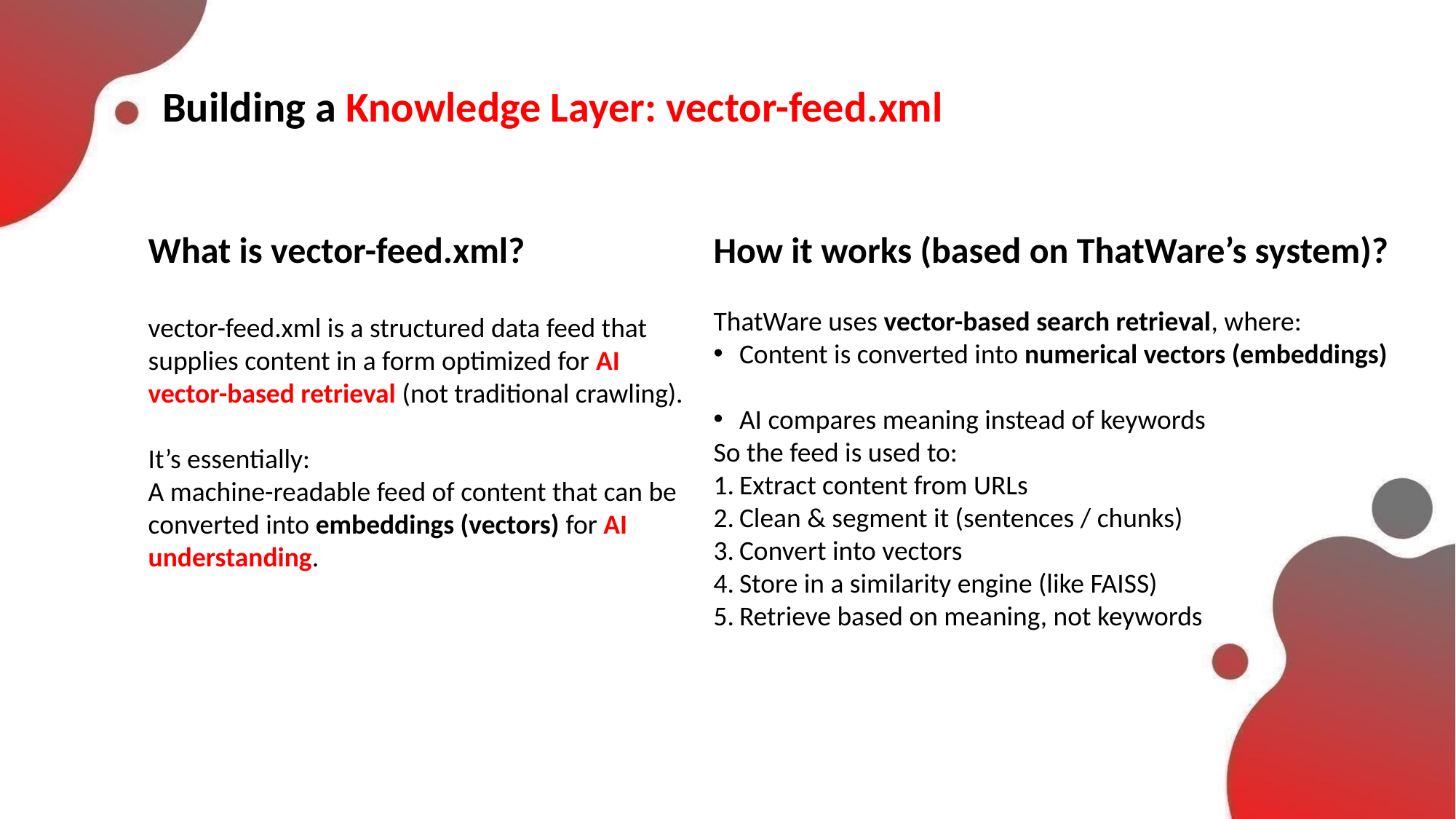
Figure 5. Vector-feed.xml supports AI embedding ingestion and semantic retrieval beyond traditional crawling.
AI Control Files: ai.txt, llms.txt, Robots.txt, and AI Manifesto
AI visibility begins with access, but access alone is not enough. Brands need a control layer that tells AI systems what they are allowed to read, what content matters most, and how the brand should be interpreted. Robots.txt remains the gateway for crawlers. If important AI bots are blocked accidentally, the site may be invisible to answer engines that rely on crawler access. Regular checks are essential because bot behavior, user-agent names, and platform policies evolve. A technical SEO audit for AI search should always include crawler permissions, server response codes, canonical handling, indexability, and whether priority pages are accessible to known AI crawlers.
Ai.txt is a newer conceptual control layer. The AEO/GEO deck frames it as a file that tells AI systems how to understand, use, and represent content. The reason it exists is simple: AI does not only crawl; it interprets, summarizes, and answers. Brands therefore need a way to state preferred usage guidance, trusted sections, canonical brand descriptions, and boundaries around content interpretation. While adoption may vary across platforms, the strategic value is clear: brands should proactively define how their content should be handled in AI contexts.
Llms.txt functions as an AI-focused metadata file. It can highlight key information, reduce noise, and point AI systems toward the most important content and brand identity assets. In a large website, not every URL deserves equal attention. Some pages define the brand, others answer core questions, others contain outdated or narrow content. Llms.txt can act as a curated guide that reduces ambiguity and helps AI systems quickly understand the site’s high-value knowledge layer.
The AI manifesto sits one level above those files. It is not only a crawl instruction; it is a positioning blueprint. It can define the brand’s mission, categories, services, core frameworks, proof points, entity relationships, and preferred representation. Used well, it creates a consistent source of truth for AI systems and internal teams. Content strategists, developers, schema specialists, and brand leaders can align around the same entity model. That alignment reduces the risk of fragmented messaging, which is especially important in AI ecosystems where inconsistency can weaken selection confidence.
Together, robots.txt, ai.txt, llms.txt, semantic sitemap, vector feed, schema, and AI manifesto form the technical foundation of AI search governance. They do not replace high-quality content, but they make high-quality content easier to find, parse, classify, and cite. Without them, even strong pages may remain underused. With them, a brand can build a structured path from crawl access to AI confidence.
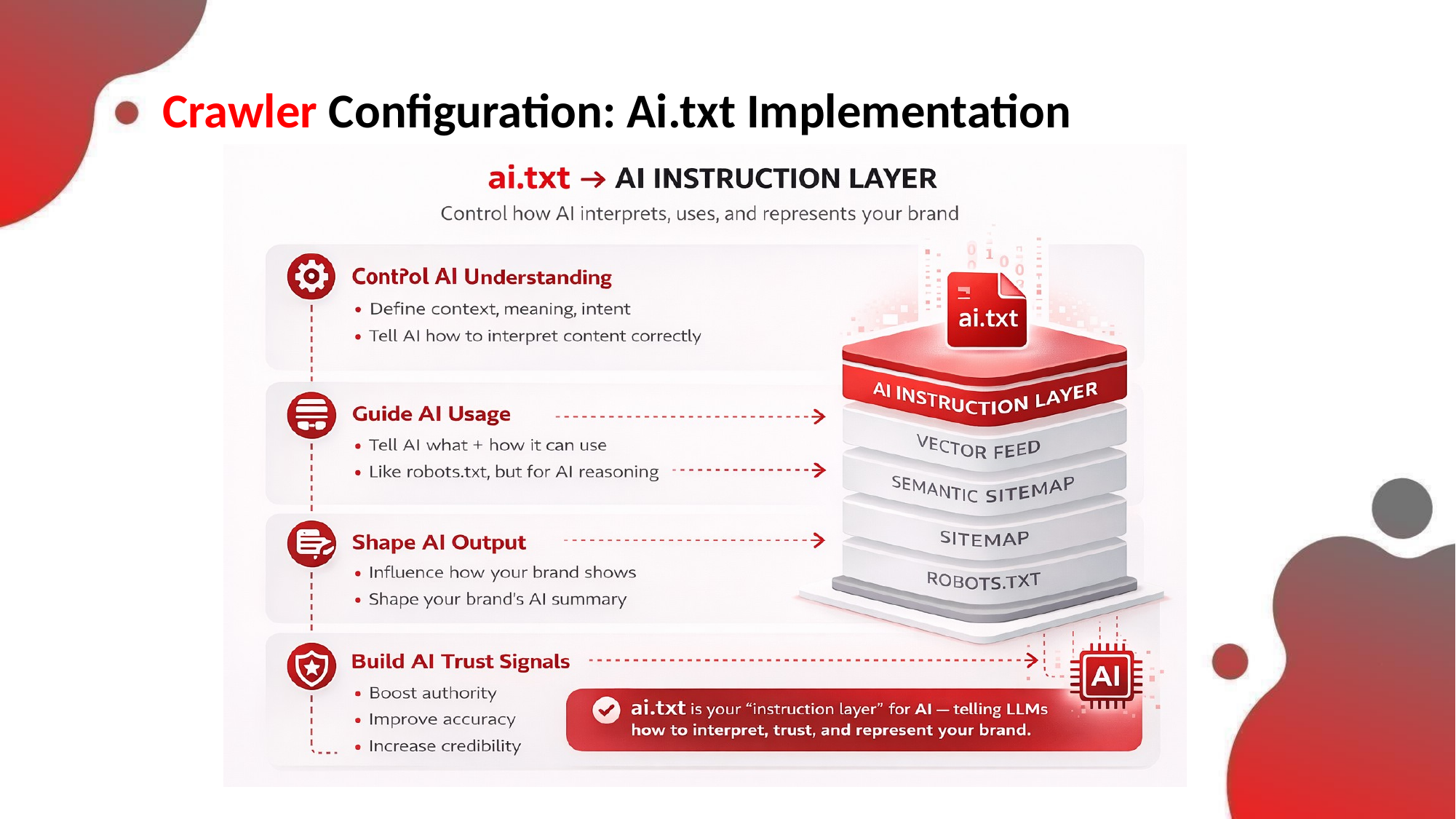
Figure 6. ai.txt can act as an AI interpretation and usage control layer for brand content.
Schema Markup 2.0 and Entity Consistency
Schema markup is no longer just a way to win rich results. In AI search, schema becomes a machine-readable trust and identity layer. The AEO/GEO deck refers to Schema Markup 2.0 as entity-based schema with SameAs links and connected digital identities. The goal is not simply to label a page as an Article or FAQPage. The goal is to help AI systems identify the organization, people, services, products, locations, credentials, reviews, policies, and relationships that make the content credible.
Entity consistency matters because LLMs and answer systems work with associations. A brand that is consistently connected to the same categories, authors, services, and external profiles becomes easier to place in a semantic map. When the same organization name, logo, URL, social profiles, executive names, service descriptions, and topical expertise appear across trusted sources, AI systems receive reinforcement. When those signals conflict, the brand becomes fuzzy. Fuzzy brands are harder to recommend because the system has less confidence about who they are and what they should be associated with.
SameAs links are especially important because they connect the official website to other validated identity surfaces. These can include social platforms, knowledge panels, directories, professional profiles, press pages, research profiles, and other authoritative mentions. The point is not to spam schema with every possible URL. The point is to create a reliable identity graph that helps AI systems triangulate the brand. For authors, schema should connect names to bios, credentials, publications, and professional profiles. For services, schema should connect service pages to FAQs, reviews, locations, and supporting topical content.
A practical entity consistency audit should examine the homepage, About page, service pages, author pages, organization schema, local profiles, social profiles, review platforms, knowledge panels, and major third-party listings. The audit should ask whether the brand category is described consistently, whether claims are supported, whether outdated descriptions still appear, whether duplicate entity names exist, and whether the website’s structured data matches visible page content. AI systems may distrust schema that overstates what the page visibly supports.
The ideal state is alignment between visible content, structured data, external identity signals, and AI control files. When these layers tell the same story, the brand becomes easier for machines to understand and easier for humans to trust. Schema Markup 2.0 is therefore not a technical afterthought. It is part of AI-native brand governance.
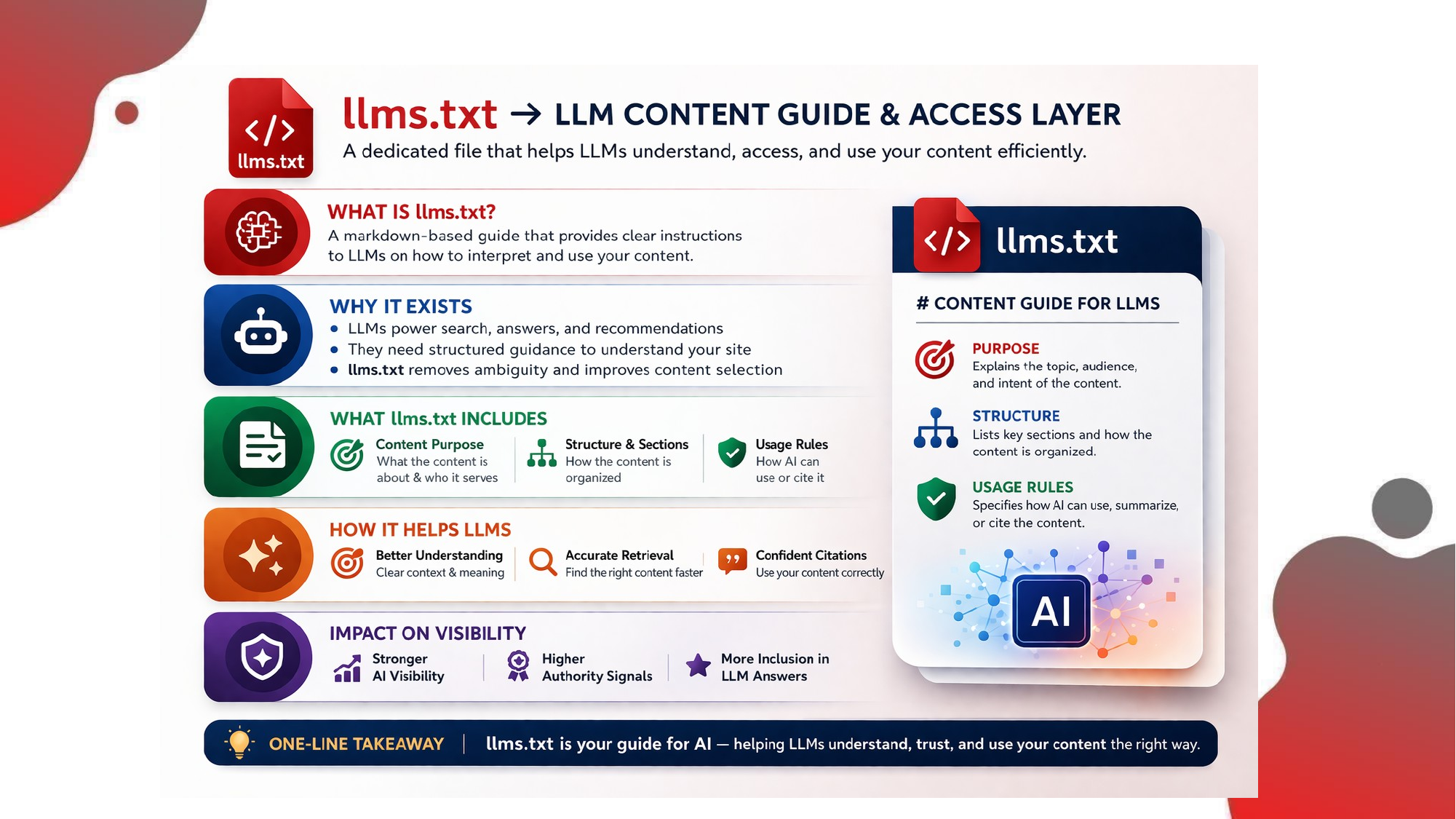
Figure 7. llms.txt can serve as a guide for AI systems to locate and interpret high-priority content.
Content Architecture for AEO and GEO
AEO and GEO require a different content architecture from traditional long-form SEO. Conventional blog writing often begins with broad context, builds slowly, and delays the answer. AI-ready content should usually do the opposite. It should lead with a direct answer, clarify scope, provide evidence, expand into details, and then handle comparisons, objections, risks, and next steps. The AEO/GEO deck describes answer-first UX as starting with direct answers and 30-to-50-word summaries. That structure improves snippet potential and makes content easier for AI systems to extract.
The modular content framework is equally important. The deck recommends 75-to-300-word content blocks with self-contained meaning. This does not mean every paragraph must be short or simplistic. It means each block should answer a specific question or explain a specific idea without depending heavily on surrounding text. AI systems often retrieve and synthesize chunks. A self-contained block that names the topic, states the answer, and provides evidence is far more useful than a paragraph full of pronouns, references to previous sections, and mixed ideas.
Statistical anchors strengthen trust. Vague claims such as ‘many companies are moving to AI search’ are less useful than claims with numbers, dates, ranges, examples, or clear scope. Statistical anchors make content more credible and more quotable. They also help AI systems distinguish evidence-backed statements from marketing language. When statistics are used, they should be accurate, sourced, and placed near the claim they support. Unsupported numbers can increase hallucination risk rather than reduce it.
Quotable passages are the natural extension of answer-first writing. A quotable passage is a short, clear, fact-driven statement that an AI system can lift, paraphrase, or summarize without distortion. It avoids excessive branding, hype, and ambiguity. For example, ‘AIEO turns a website into an LLM-ready asset by improving answer extraction, trust signals, competitor drift control, and hallucination suppression’ is more quotable than a vague promotional line about being ‘the future of digital excellence.’ The first statement carries a definition; the second carries little extractable meaning.
A strong AEO/GEO page therefore uses a predictable pattern: direct answer, key takeaways, definitions, evidence, examples, comparisons, FAQ, schema, author signals, date signals, and clear next steps. This does not make content robotic. It makes content usable. Human readers appreciate clarity, and AI systems reward extractability.
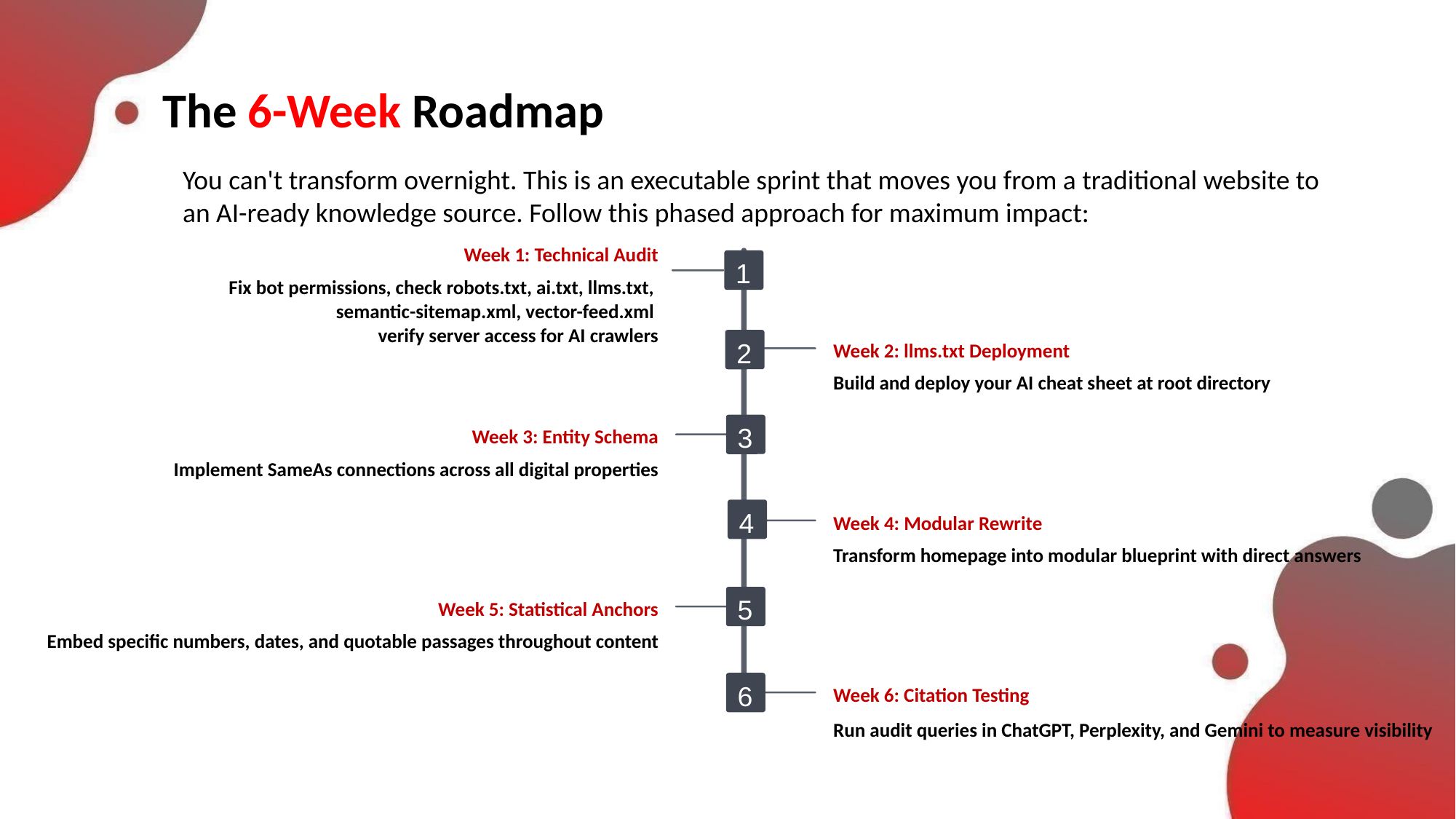
Figure 8. Six-week sprint for transforming a traditional website into an AI-ready knowledge source.
CRSEO: Cognitive Resonance Search Engine Optimization
CRSEO begins with a crucial insight: people do not search only because they need information. They search because they are uncertain, anxious, curious, skeptical, ready to compare, ready to buy, or looking for reassurance after a decision. Traditional keyword strategy often compresses these states into basic intent categories. CRSEO expands the model by combining cognitive and emotional search optimization. It focuses on human decision-making, emotional triggers, and intent-driven content strategy. The objective is to align content with how users think and feel while also aligning structure with how AI systems reason.
The core problem is that traditional SEO prioritizes keywords, logic matching, and rankings, while modern AI search evaluates emotional resonance, reasoning traces, trust, persuasion, and brand authority. A page can contain the right keyword and still fail because it does not reduce fear, answer the real objection, provide enough proof, or match the user’s journey stage. A user searching ‘best AI SEO agency for healthcare’ is not simply looking for an agency. They may be worried about compliance, hallucination risk, evidence quality, patient safety, and whether the agency understands YMYL content. CRSEO forces the content team to map those underlying pressures.
The framework aligns three layers: emotion, logic, and psychology. Emotion explains why the search exists. Logic explains what sequence of information makes the answer coherent. Psychology explains what reduces hesitation and increases confidence. When these layers are combined, content becomes more than optimized text. It becomes a guided decision pathway. The user feels seen because the content acknowledges the real concern. The AI system sees structure because the page follows an expected answer flow. The brand gains authority because evidence, credentials, and social proof appear at the right points in the journey.
CRSEO is especially valuable in AI search because answer engines increasingly mediate the first impression. If an AI system summarizes a brand’s page, it may include only the clearest and most relevant passages. Content that explicitly names emotional concerns, addresses risks, and provides concise reassurance is more likely to be represented accurately. Content that relies on implied persuasion may be flattened or ignored. In this sense, CRSEO improves both human conversion and AI summarization quality.
The practical takeaway is simple: every search query carries a cognitive state. Before creating or rewriting a page, identify what the user is trying to understand, what they fear, what risk they are avoiding, what proof they need, what stage they are in, and what would make them trust the answer. Then build the page around that pathway.
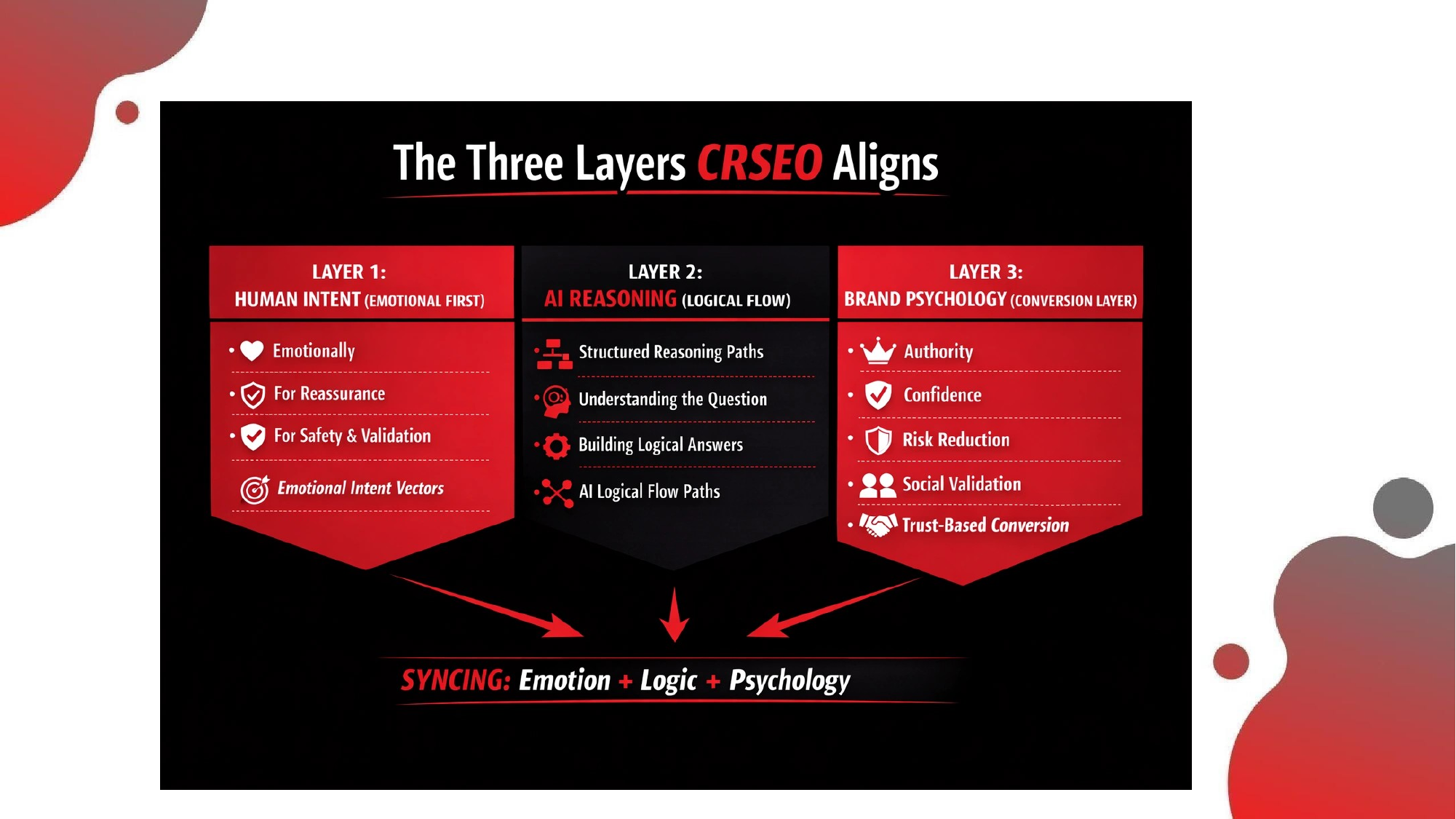
Figure 9. The three layers CRSEO aligns: emotional intent, logical flow, and psychological conversion.
Emotional Intent Vectorization and EIVM Clustering
Emotional Intent Vectorization is the first major CRSEO module. It maps search queries to emotional vectors such as fear, risk avoidance, confidence gaps, safety needs, authority expectations, and social proof triggers. This approach translates qualitative search psychology into measurable dimensions. Instead of merely saying a query is informational or transactional, the strategist can identify whether the query carries high fear, high uncertainty, high need for authority, or high need for peer validation. That helps determine what content modules the page needs.
The implementation logic is direct. If fear is high, the page should add reassurance early. If risk avoidance is high, the page should include guarantees, safety notes, limitations, policies, or proof of process. If confidence gaps are high, the page should provide plain-language explanations, step-by-step guides, definitions, and examples. If authority expectation is high, the page should surface credentials, expert review, certifications, awards, author bios, and citations. If social proof is high, testimonials, case studies, reviews, and usage examples should appear near decision points.
Emotional Intent Vector Map clustering then connects these emotional vectors to the user journey. Queries are mapped to awareness, evaluation, decision, or post-purchase trust. Awareness queries require education, definitions, glossaries, and problem framing. Evaluation queries require comparisons, proof, tradeoffs, and credibility signals. Decision queries require pricing clarity, risk reduction, FAQs, guarantees, booking or signup support, and direct calls to action. Post-purchase trust queries require troubleshooting, onboarding, refund information, setup guides, policies, and reassurance.
This stage changes content strategy because it prevents one page from trying to do everything. A single generic landing page often fails because it mixes awareness content, sales content, comparison content, and support content without respecting the user’s state. CRSEO encourages stage-specific pages and modules. A glossary page should not behave like a pricing page. A comparison page should not hide proof. A post-purchase support page should not over-sell. Each page should match the mindset of the query cluster.
For AI systems, this clarity is also beneficial. If a query is evaluation-stage and the page includes comparison, evidence, authority, and objections, the page is more likely to be a strong match. If the page is decision-stage and includes pricing, safety, social proof, and FAQs, it becomes easier to recommend. Emotional vectorization therefore bridges human psychology and AI retrieval logic.
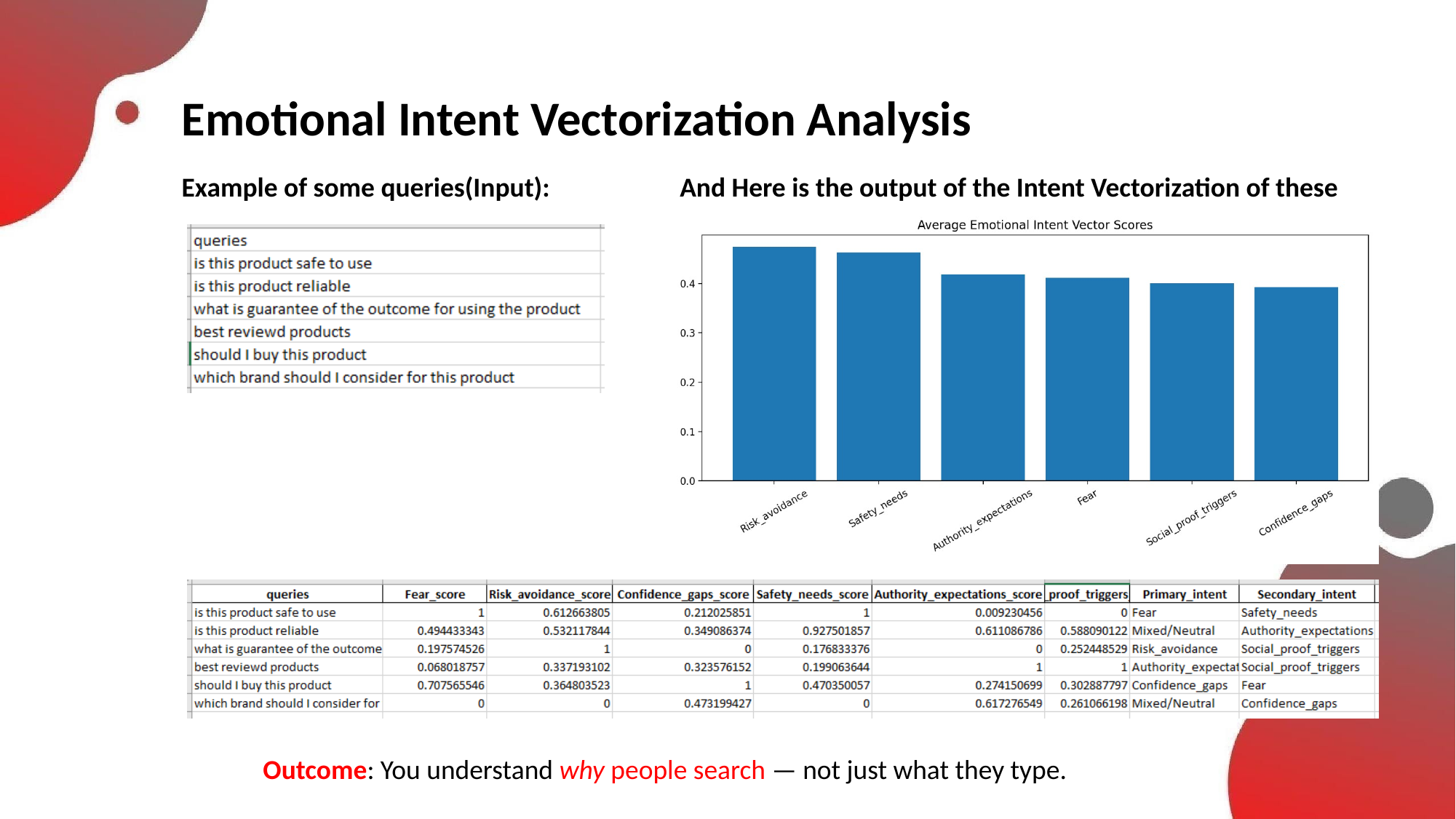
Figure 10. Example Emotional Intent Vectorization output showing emotion-weighted query analysis.
AI Logical Flow Path Modeling
AI Logical Flow Path Modeling asks a simple question: what order of information does an answer engine expect when generating a useful response? The CRSEO deck recommends that page structure mirror AI reasoning order. A practical sequence is direct answer, clarification, evidence, authority, comparison, social proof, and summary. This order is powerful because it satisfies both machine and human needs. The machine gets a clean answer path. The human gets immediate clarity followed by reasons to believe.
Many pages fail because they use the wrong sequence. They begin with broad brand storytelling, insert promotional claims, delay the answer, and provide evidence only near the bottom. For a human reader, this creates friction. For an AI system, it creates extraction difficulty. If the answer is buried, the model may retrieve a competitor’s cleaner page instead. If evidence is separated from claims, the model may assign lower confidence. If authority signals appear only in a footer, they may not support the key answer. Logical flow is therefore not a cosmetic issue. It directly affects selection probability.
A logical AI-ready page should open with the answer in plain language. The next section should clarify what the answer includes and excludes. The evidence section should provide facts, data, examples, or citations. The authority section should explain why the brand or author is qualified to answer. The comparison section should help the user evaluate alternatives. Social proof should appear near decision points, not randomly. The summary should restate the main answer and guide the user to the next logical action.
This structure also supports multi-intent pages. For example, a page about AI search optimization can begin with a definition, then explain why it matters, compare it with SEO, AEO, and GEO, show implementation steps, provide examples, answer FAQs, and end with a strategy checklist. Each section serves a clear reasoning function. The user can skim, and the AI system can retrieve the relevant module.
The deeper point is that content should not be arranged according to internal marketing preference. It should be arranged according to the reasoning path required by the query. If the user needs reassurance, risk reduction must come early. If the user needs proof, evidence must precede claims. If the user needs a decision, comparisons and objections must be visible. AI Logical Flow Path Modeling gives teams a repeatable way to design that order.
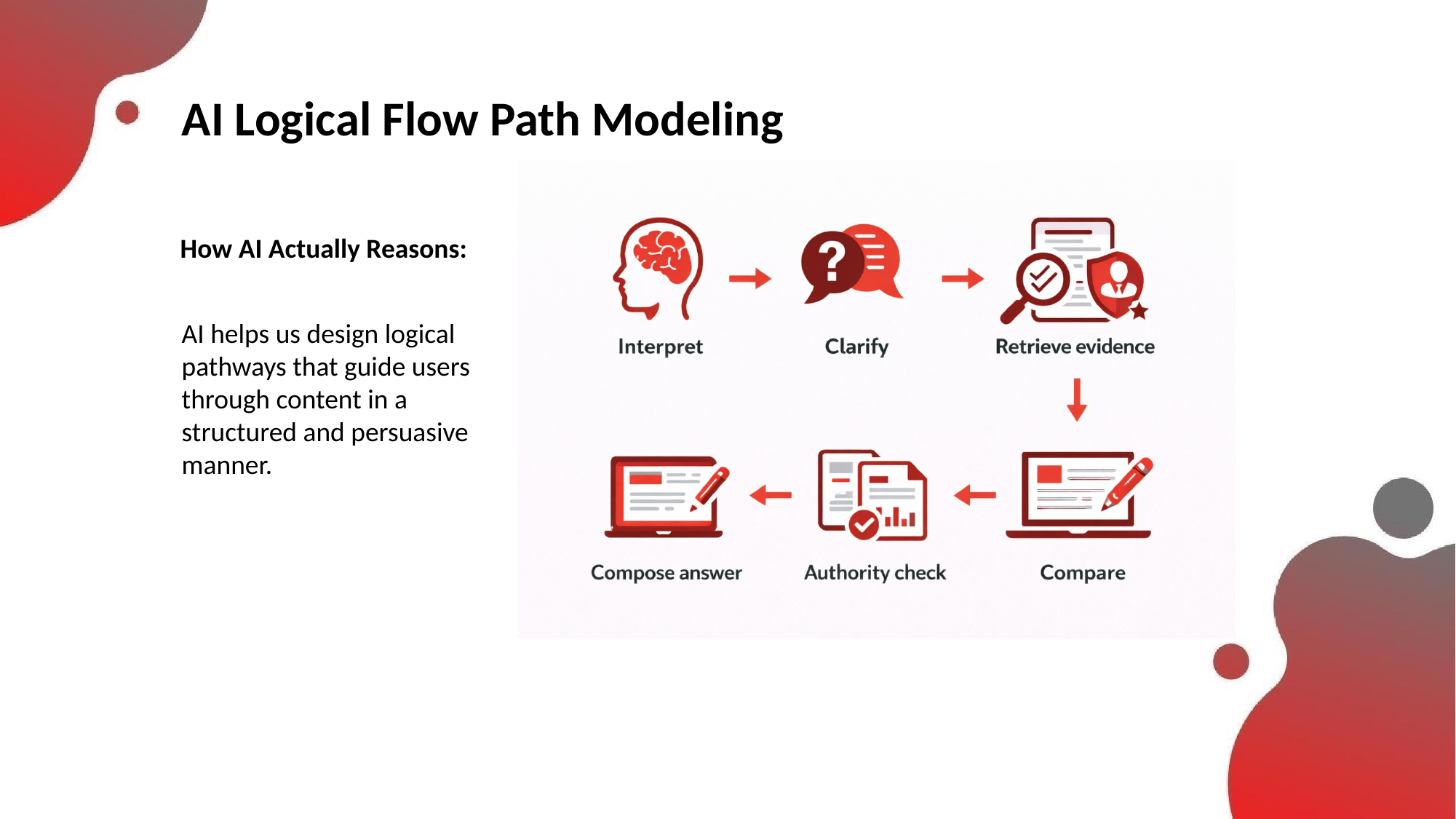
Figure 11. AI Logical Flow Path Modeling aligns page sequence with expected answer-engine reasoning.
Content Gap Validation and Persuasive Answer Sequencing
Content Gap Validation evaluates whether a page contains the modules that an AI system and a user would expect for a given query. The CRSEO deck lists common modules such as a direct answer, key takeaways, FAQ section, citations, author bio, last updated date, risk and limitations section, comparison table, and relevant schema. Missing modules weaken coverage. A page may be well written but incomplete if it lacks the trust or answer elements needed for the user’s stage.
This stage produces practical outputs: expected coverage score, missing expected modules, priority fixes, and a stage summary. That makes optimization actionable. Instead of telling a writer to ‘improve the content,’ the system can say: add a direct answer at the top, include a comparison table, add an author bio, insert FAQ schema, provide risk limitations, and support the main claim with data. This is the difference between vague SEO advice and a workflow that content, SEO, design, and development teams can execute.
Persuasive Answer Sequencing then determines how those modules should be ordered for conversion. The emotional flow engineering sequence is direct answer, acknowledge fear, reduce risk, build clarity, signal authority, add social proof, handle objections, and end with a stage-matched CTA. This flow matters because users rarely convert because they saw a CTA button. They convert when enough uncertainty has been removed. If fear is high and the page asks for a sale too early, the user resists. If authority is missing before the CTA, the user hesitates. If objections are unanswered, the user leaves to compare elsewhere.
A stage-matched CTA is especially important. Awareness-stage users may need a guide, checklist, or explainer. Evaluation-stage users may need a comparison sheet or case study. Decision-stage users may need pricing, consultation, demo, or signup. Post-purchase users may need support or documentation. The CTA should match the user’s cognitive readiness rather than forcing every visitor into the same action.
For AI search, persuasive sequencing improves how the page is summarized. An answer engine may compress the page into a few sentences. If the page clearly acknowledges risk, provides evidence, and names authority, those elements are more likely to appear in the generated answer. If the page is scattered, the answer may omit the persuasion logic or choose another source. Content Gap Validation and Persuasive Answer Sequencing therefore improve both human conversion and AI representation.
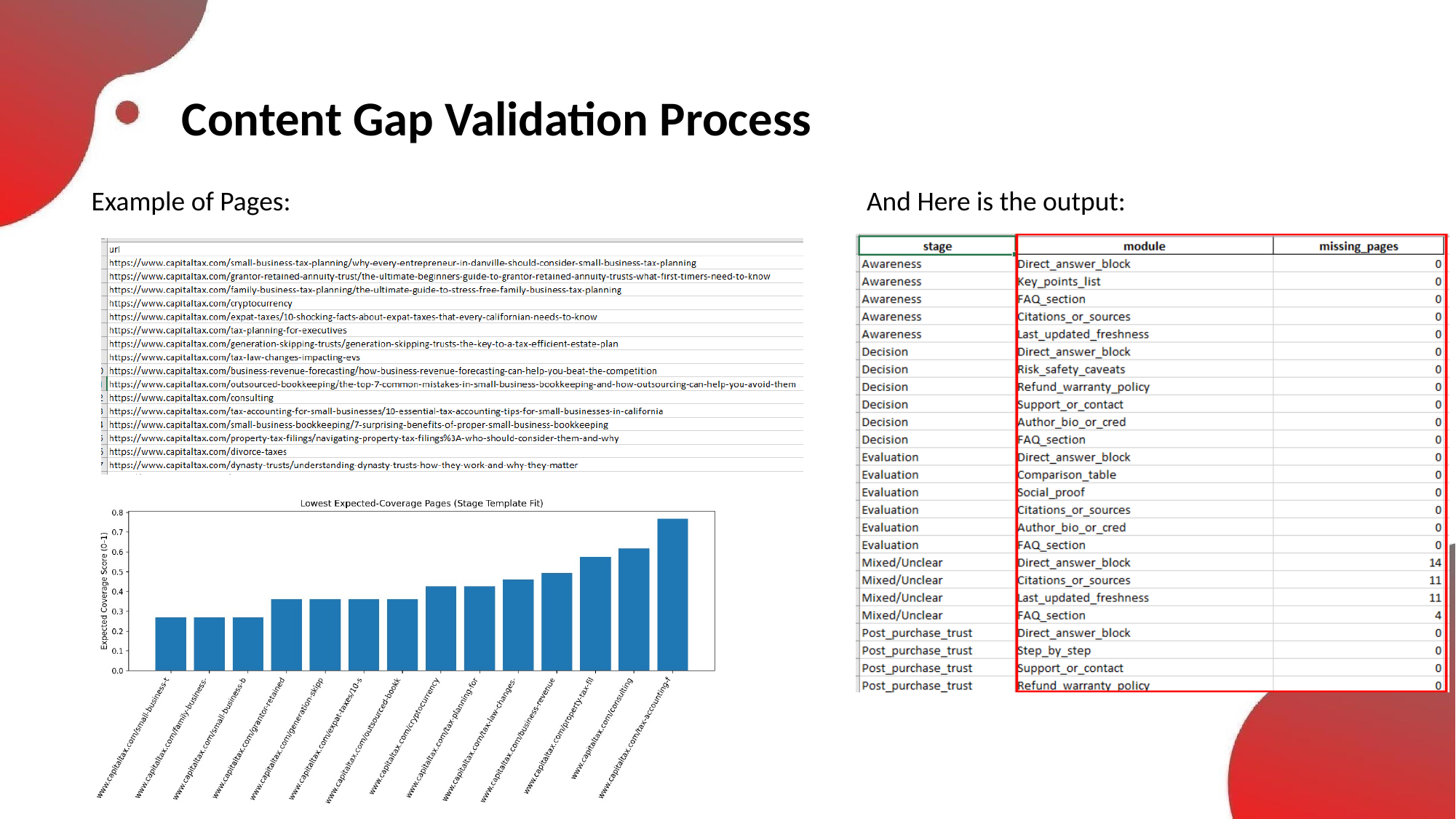
Figure 12. Content Gap Validation identifies missing modules and prioritizes improvements based on expected coverage.
Cognitive Content Architecture and Conversion Path Mapping
Cognitive Content Architecture turns the outputs of emotional mapping, journey clustering, AI logical flow, and content gap validation into a reusable page blueprint. The CRSEO deck describes outputs such as page structure sequence, H1 and H2 suggestions, trust anchors, authority signals, and emotional reinforcement blocks. This is where the framework becomes scalable. Instead of manually reinventing every page, teams can generate stage templates, cluster templates, and per-query blueprints that match the emotional and cognitive profile of each query set.
A per-query blueprint may specify the exact page structure, recommended headings, trust anchors to insert, authority signals to surface, and emotional reinforcement blocks to include. A stage template may define what awareness pages generally need compared with evaluation or decision pages. A cluster template may define how to handle a group of high-fear, high-risk, high-authority-expectation queries. This makes CRSEO useful for large websites because content operations need repeatability, not only insight.
Cognitive Conversion Path Mapping goes one level deeper by diagnosing where users lose confidence and what makes them commit. It looks at URL lists, extracts visible text and structure signals, reruns emotional vectors, journey stage mapping, logical flow expectations, persuasive sequencing, and content-gap checks. The final output identifies why users hesitate, where confidence drops, what commitment triggers are missing, and what fixes go beyond CTA buttons.
This matters because many conversion audits over-focus on surface elements. They test button colors, form length, or hero copy while ignoring the deeper issue: the user does not believe the claim, does not understand the process, fears risk, lacks proof, or cannot compare options. Cognitive Conversion Path Mapping treats conversion as a confidence system. Every missing proof point, vague section, unsupported claim, or weak FAQ becomes a possible confidence leak.
The outcome is a page that is aligned across three dimensions. It matches the emotional state of the query. It follows the reasoning path an AI system expects. It removes the psychological barriers that prevent action. In AI-first search, this alignment is a competitive advantage because the best page is not merely the one with the keyword. It is the one that can be understood, trusted, summarized, and acted upon.
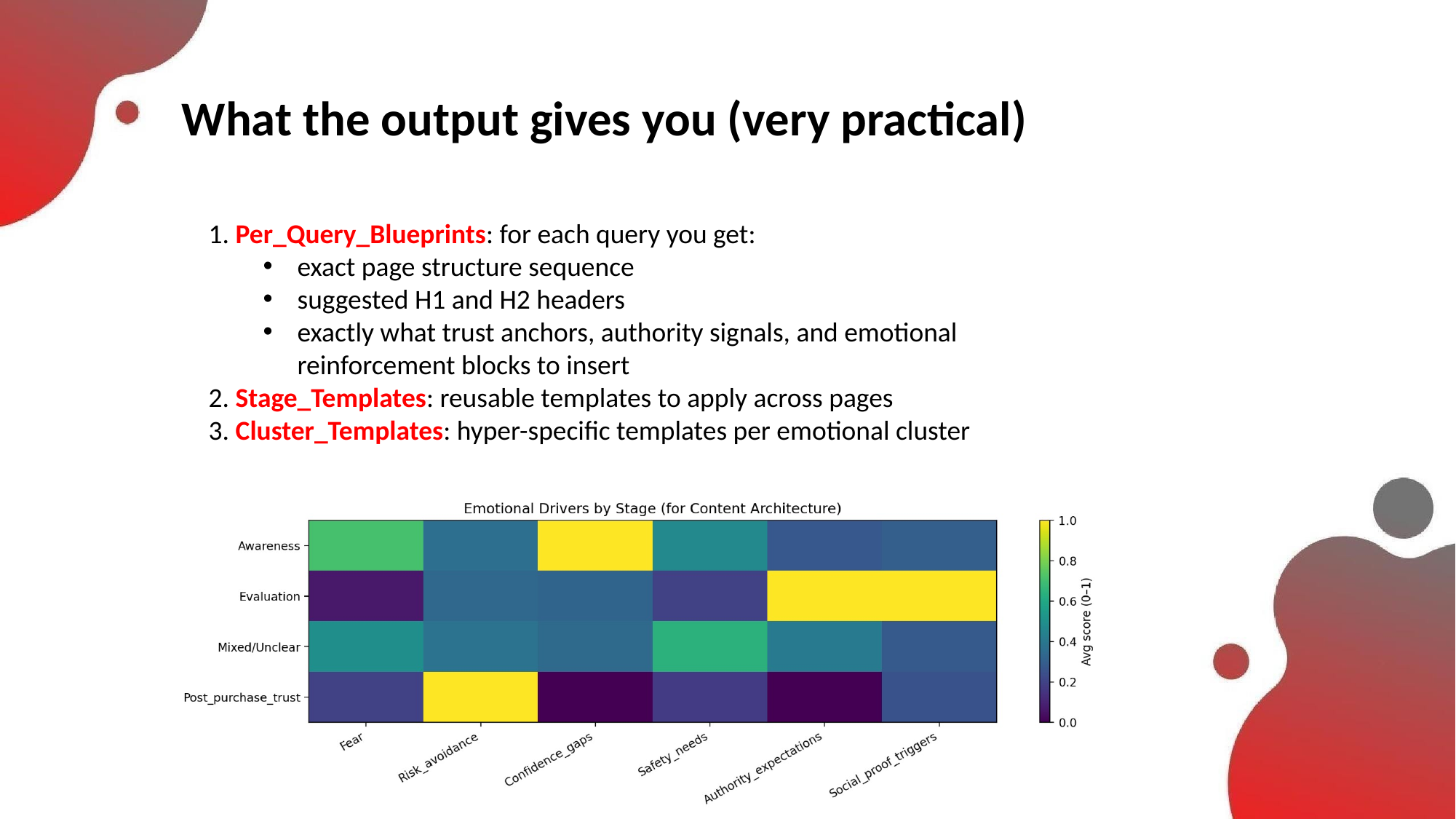
Figure 13. Cognitive Content Architecture can generate reusable templates and heatmap-style content recommendations.
AIEO: AI Experience Optimization as an Operating System
AIEO stands for AI Experience Optimization. It optimizes a website for AI systems that must understand, trust, and safely cite it. The AIEO deck defines it as a move beyond keyword-only SEO toward answer extraction, trust, and entity clarity. The phrase ‘AI experience’ is important. In traditional UX, teams optimize the experience of human visitors. In AIEO, teams also optimize the experience of AI systems as they crawl, parse, match, score, compare, and quote the website.
The AIEO operating model has four stages: reasoning path engineering, confidence assignment, competitor drift control, and risk and hallucination suppression. Each stage answers a different question. Reasoning path engineering asks which pages should answer which user questions. Confidence assignment asks how strongly an AI system could trust each page-question pair. Competitor drift control asks where AI systems would choose a competitor instead of the target brand. Hallucination suppression asks where the brand’s claims are likely to be misquoted, exaggerated, or confused with competitor information.
This operating model is valuable because it turns AI visibility into a measurable workflow. Many teams talk about being visible in ChatGPT, Gemini, Perplexity, or other answer engines, but they lack a repeatable method to improve that visibility. AIEO provides that method. It creates inventories, scores, maps, suggestions, prompts, charts, risk lists, and governance loops. The result is not merely a prettier content brief. It is an AI search management system.
AIEO also connects technical SEO, content strategy, schema, authority building, competitive analysis, and AI safety. A page with weak schema may receive a lower confidence score. A page with unclear answers may lose mapped questions. A page that is too salesy may cause preference leakage in informational prompts. A page with unsupported claims may create hallucination risk. These are not isolated issues. They all affect whether AI systems can use the site safely and confidently.
The most useful way to think about AIEO is ‘SEO plus trust engineering plus AI safety.’ SEO ensures the page exists and can be found. Trust engineering ensures the page can be believed. AI safety ensures the page can be represented without distortion. When these layers work together, the website becomes an LLM-ready asset.
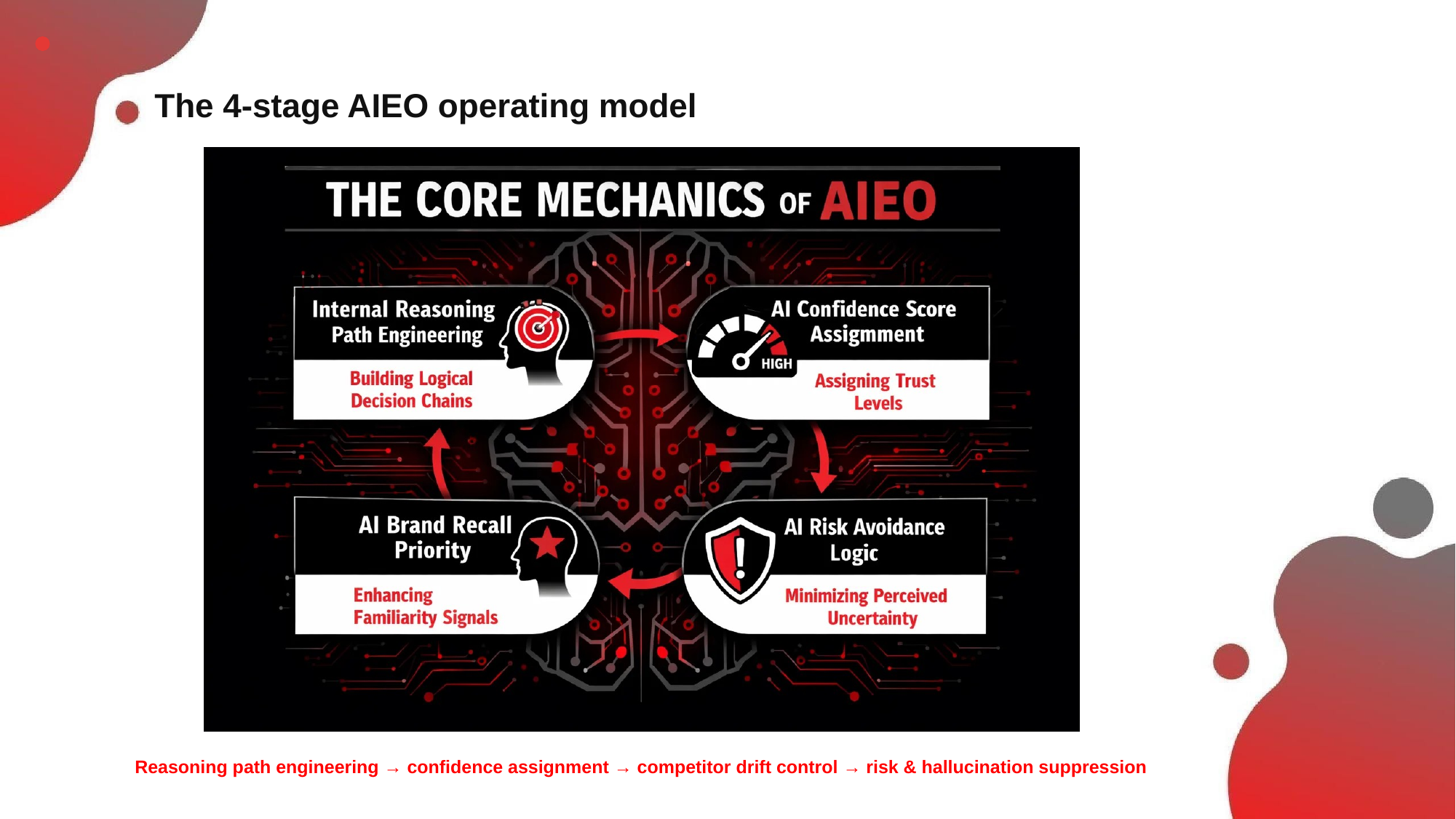
Figure 14. The four-stage AIEO operating model: reasoning paths, confidence, drift control, and hallucination suppression.
AIEO Stage 1: Internal Reasoning Path Engineering
Stage 1 builds the internal reasoning path for user queries. It takes a website URL, a crawl limit, and a spreadsheet of user questions. It crawls pages, extracts visible text and trust signals, audits schema, and matches each question to the most relevant pages. The output is a page inventory and a question-to-page map. This tells the team which URLs should become priority AI visibility pages and which questions lack strong answers.
This stage is fundamental because AI systems need a clear question-to-answer relationship. A brand may have hundreds of pages, but if the best page for a high-value question is unclear, the AI system may choose a competitor. Stage 1 identifies the strongest page for each question and shows where low similarity or missing trust signals weaken answerability. It also allows teams to group questions by URL. Pages with many mapped questions become strategic assets because they can influence multiple AI answer pathways.
The generated files in the AIEO deck include site_pages_audit.csv, question_page_matches.csv, and a reasoning workflow diagram. These are not just reports. They are implementation tools. The audit sheet can show page titles, URLs, extracted text signals, schema flags, author indicators, date indicators, FAQ presence, and other trust signals. The question-page match sheet can show which questions map to which URLs and with what rank or similarity. The workflow diagram helps explain the process to stakeholders.
The practical use is straightforward. Select the rank-one page per question. Group questions by URL. Identify the pages that carry the most AI visibility potential. Add direct answers, FAQs, schema, citations, updated dates, author bios, and missing modules to those pages. If no page maps strongly to an important question, create a new page or a new section. If a page maps to many questions but has weak trust signals, prioritize it for authority upgrades.
Stage 1 shifts teams away from guessing which pages matter. It shows where AI systems are likely to route questions. That is the foundation for confidence scoring, competitor comparison, and risk suppression.
AIEO Stage 2: Confidence Score Engineering
Stage 2 consumes Stage 1 outputs and estimates how confidently an LLM would use each page for the provided questions. It scores pages and page-question pairs on a 0-to-100 scale using similarity, trust signals, schema, and mapping strength. This is one of the most practical parts of AIEO because it converts diagnosis into prioritization. Not every page needs the same level of work. Some pages are already strong authority assets. Others are weak but important. Confidence scoring helps teams decide where to invest.
The AIEO deck states that pages above 70 can become authority assets to protect and expand, while questions below 30 confidence typically need new sections or new pages. This threshold-based thinking makes AI optimization manageable. A team can start with the weakest high-value pairs rather than trying to rewrite the entire site. It can also protect strong pages by keeping them updated, maintaining schema, and adding evidence as the topic evolves.
Stage 2 outputs include PageConfidenceScores, QuestionPageScores, BestPagePerQuestion, FAQSuggestions, SchemaSuggestions, and a confidence chart. The FAQ suggestions are particularly useful because FAQs are both user-friendly and AI-friendly. They create clean question-answer units that are easy to extract and easy to mark up. Schema suggestions help developers implement structured data that matches visible content. The confidence chart helps non-technical stakeholders see which pages are strong, weak, or improving over time.
Confidence Score Engineering also encourages visible trust signals. If a page has no author, no updated date, no citations, no FAQ, and no schema, it may underperform even if the text is relevant. If the page adds these signals, confidence can rise. This does not mean adding superficial badges. It means making expertise, evidence, and structure visible to both humans and machines.
The strongest use case is a recurring improvement loop. Run Stage 2, implement fixes, rerun scores, and track deltas. Over time, the site develops a measurable confidence profile. That profile becomes a governance asset for AI search.
AIEO Stage 3: Recommendation Bias and Competitor Drift
Stage 3 compares the target website with competitor domains for the same question set. It measures where AI systems may drift toward competitors because their answers appear clearer, safer, more neutral, or more authoritative. This is a major shift from traditional SEO competitor analysis. A competitor may not outrank you in classic organic results yet still be preferred by an answer engine for a specific prompt. Conversely, your site may rank well but lose AI recommendation share because the competitor page answers the question more directly.
The AIEO deck emphasizes DriftByQuestion as a crucial output. This sheet shows the exact questions where a competitor wins. That is far more actionable than a broad domain-level score. If a competitor wins a high-value evaluation query, the target brand can audit the winning page and identify why: perhaps it has a better comparison table, less promotional language, clearer caveats, stronger proof, or more visible authorship. The target brand can then update its own page and retest.
Stage 3 also identifies preference leakage. This occurs when a domain looks too salesy or overly persuasive for informational answers. AI systems often prefer neutral, balanced, evidence-based content when the user asks informational or comparative questions. If a page pushes a product too aggressively before answering the question, it may be seen as less helpful. Reducing hype language near informational content can improve selection probability.
Outputs include DomainComparisonScores, DriftByQuestion, QuestionPageScores across domains, ComparativePrompts, and confidence or leakage charts. Comparative prompts are useful for manual QA in ChatGPT, Gemini, Claude, Perplexity, and other systems. Teams can repeat the same prompts after each improvement cycle to see whether the brand is mentioned more often, cited more clearly, or framed more favorably.
The action plan after Stage 3 is precise. Audit winning competitor pages. Add direct answers, neutral comparisons, missing proof, evidence, and schema. Reduce marketing leakage on informational pages. Create comparison or cluster pages where competitors currently dominate. Retest prompts after every significant improvement. This turns competitor analysis into a structured AI drift-control process.
AIEO Stage 4: Risk and Hallucination Suppression
Stage 4 focuses on safe AI citation. It uses Stage 3 outputs to fetch target pages live and examine claims most likely to be misquoted, exaggerated, or confused with competitor information. It scores overall hallucination risk, per-page risk, and per-question risk while weighting evidence weakness, ambiguity, drift, and YMYL sensitivity. This is one of the most important future-facing parts of AI optimization because visibility without safety can damage brand trust.
Hallucination risk is not only a technical AI problem. It is often a content governance problem. If a page makes absolute claims without evidence, an AI system may repeat or exaggerate them. If a page uses ambiguous language, the system may attach the claim to the wrong product, service, or competitor. If a page lacks scope, limitations, dates, or author review, the answer may sound more definitive than the evidence supports. Stage 4 surfaces these risks before they become public misrepresentations.
The AIEO deck lists practical fixes: rewrite absolutes and unsupported claims, attach evidence near high-risk statements, add author or reviewer signals, include updated dates and policies, and use limits or scope sections for YMYL topics. The phrase ‘near high-risk statements’ matters. Evidence should not be hidden in a references page disconnected from the claim. It should appear close enough for both users and AI systems to understand the relationship between claim and support.
Stage 4 outputs include summary hallucination risk score, PageRisk and QuestionRisk sheets, ExtractedClaimsSample, Suggestions sheet, risk-by-page charts, risk-component charts, and before-after projections. These outputs help teams prioritize. Pages with heavy claims and weak evidence move to the top of the rewrite queue. Pages in sensitive categories receive stronger governance. Pages where competitors create drift receive clearer brand-specific evidence.
The strategic value of Stage 4 is brand safety. In AI ecosystems, a brand is not only competing for mention frequency. It is competing for accurate representation. A hallucinated, exaggerated, or misattributed answer can be worse than no answer. AIEO therefore treats risk reduction as part of visibility optimization, not a separate legal or compliance task.
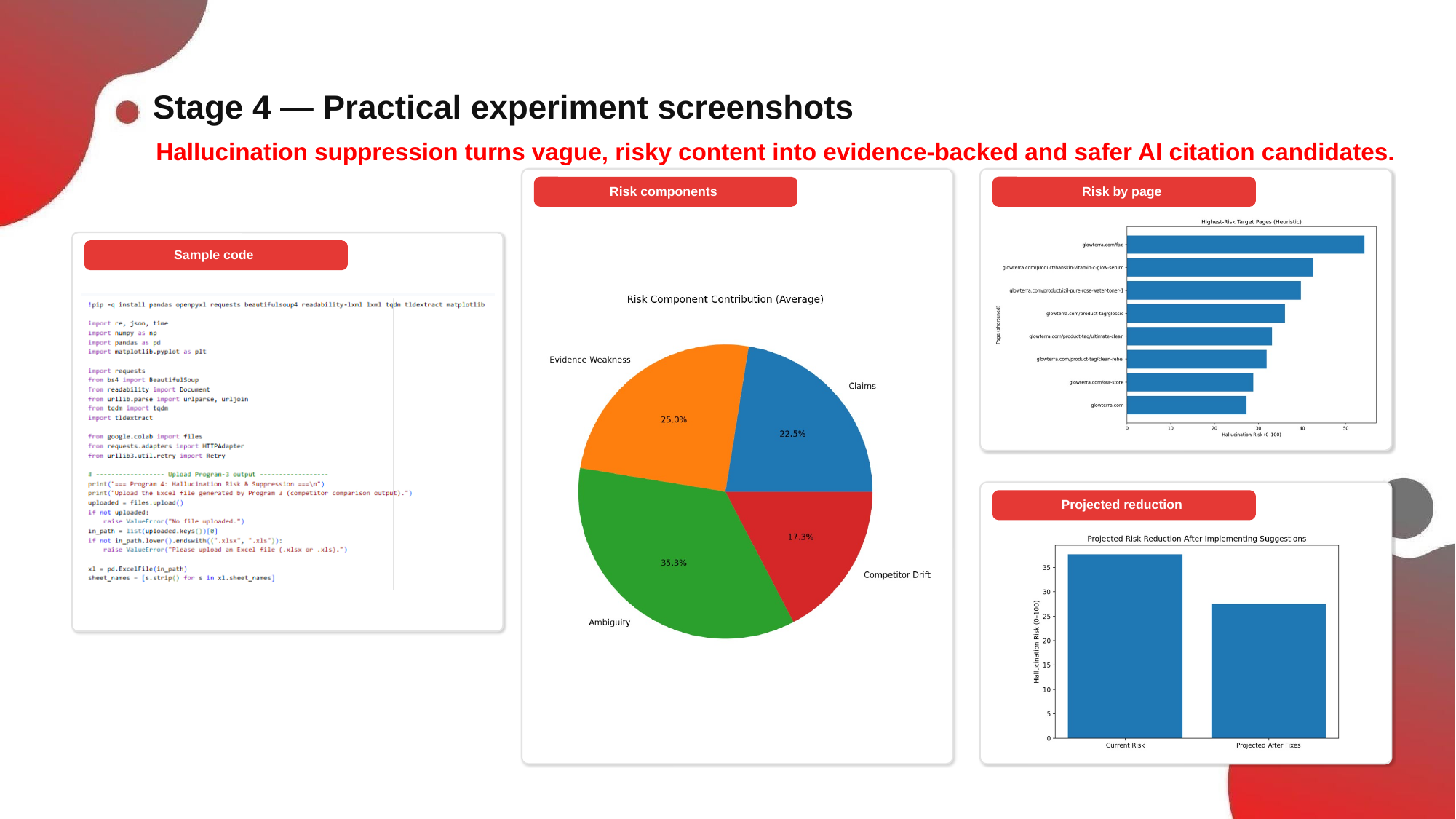
Figure 15. Stage 4 risk and hallucination suppression charts highlight risk components and projected reduction after fixes.
AIEO Roadmap and Measurement Framework
The AIEO deck provides a phased implementation roadmap. In the first 0-to-30 days, teams should run Stages 1 and 2, implement FAQs on top pages, add FAQ schema, author signals, updated dates, and fix the lowest-confidence commercial pages. This creates quick wins because it improves answerability and trust on pages that already matter. The goal is not to perfect the entire site immediately. It is to improve the pages most likely to influence AI answers.
In the 30-to-60-day phase, teams should run Stage 3 against competitors, create comparison or cluster pages, add editorial policies and author bios, and reduce marketing leakage on informational pages. This phase moves from internal optimization to competitive positioning. It asks where AI systems choose competitors and why. It also strengthens the editorial trust layer so the brand appears less like a self-promotional source and more like a credible knowledge source.
In the 60-to-90-day phase, teams should run Stage 4 for risk suppression, create a review cadence for high-risk pages, retest prompts monthly, and track AI mentions, drift, and risk trends over time. This phase turns AIEO into governance. AI search is not a one-time campaign because models, competitors, pages, and user behavior change. A monthly or quarterly cadence helps maintain visibility and safety.
The measurement framework should track AI mentions, confidence score, competitor drift, hallucination risk, and implementation coverage. AI mentions show how often the brand or target URLs appear in generated answers. Confidence scores show whether priority pages are becoming stronger. Competitor drift reveals whether rivals still win specific questions. Hallucination risk measures whether pages are safer to cite. Implementation coverage tracks whether FAQs, schema, trust signals, and update cadences are actually in place.
A strong governance loop includes monthly prompt checks and drift analysis, quarterly authority-page refreshes, full reruns after redesigns or major launches, and a shared tracker for confidence, drift, risk, and implementation deltas. This transforms AI search from a vague visibility concern into an operational discipline.
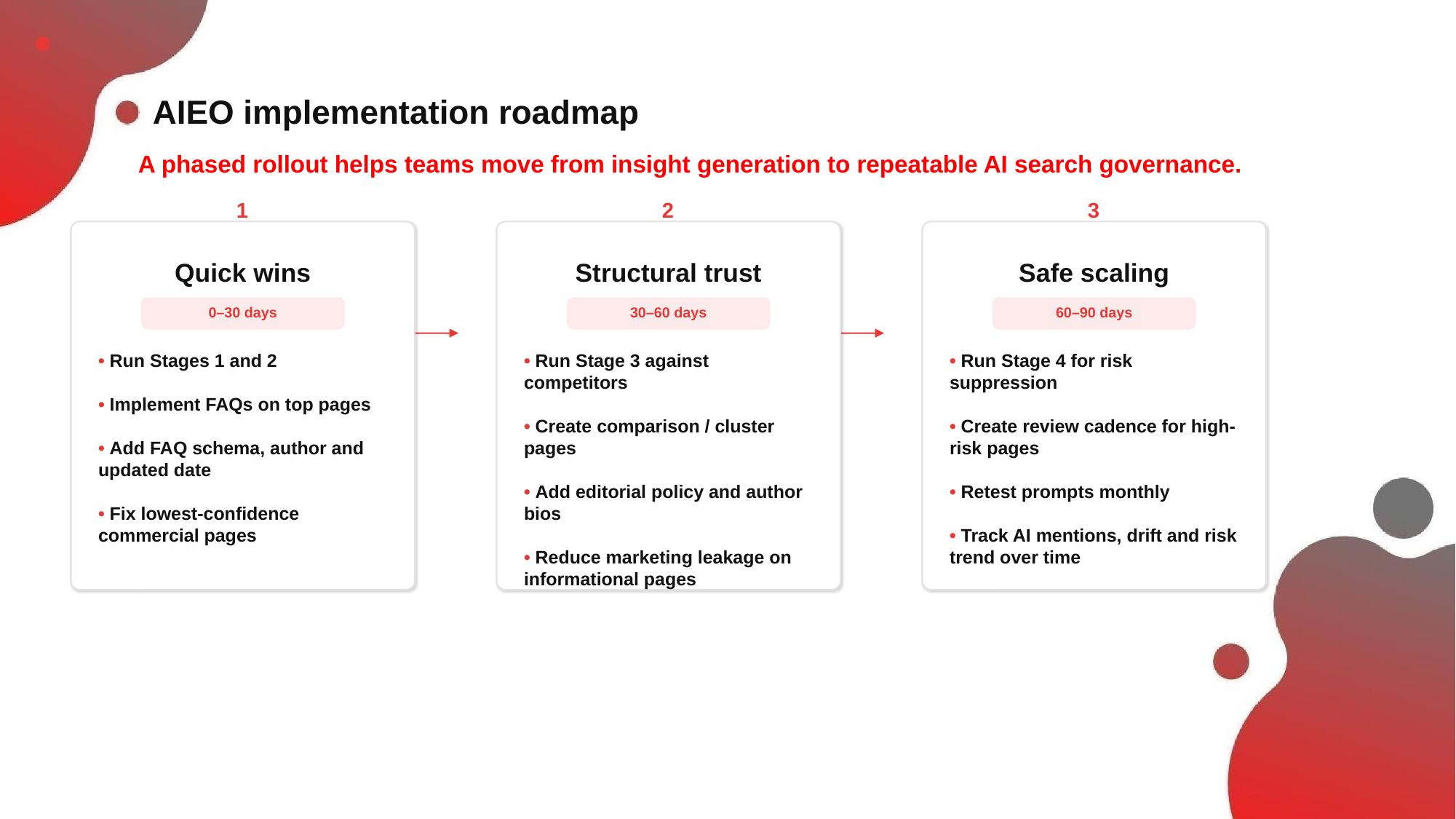
Figure 16. AIEO rollout roadmap: quick wins, structural trust, and safe scaling.
Quantum Brand Modeling: Brand Perception as a Probabilistic State
Quantum Brand Modeling, or QBM, addresses a different but related problem: how does a brand exist inside AI ecosystems? Traditional marketing models often treat visibility as static. You rank in a position, receive impressions, get clicks, and measure conversions. AI ecosystems are more fluid. A brand may be strongly associated with one AI system, weakly represented in another, present in consumer answers, absent from enterprise copilots, dominant in direct-intent contexts, and vulnerable in comparative contexts. QBM models this as a probabilistic state.
The QBM deck defines the framework as a structured way to model how a brand exists, behaves, and competes inside AI ecosystems. It represents the brand as a probability distribution across AI systems, endpoints, categories, and contexts. This shifts strategy from intuition to measurement. Instead of saying ‘we need more AI visibility,’ teams can ask where visibility is concentrated, where authority leaks, where competitors overlap, which endpoint dominates, and whether the brand has platform dependence risk.
The foundation layer has five stages. Stage 1.1 is Quantum Brand Baseline Simulation. Stage 1.2 is Brand-as-Probabilistic-State. Stage 1.3 is AI-System Mapping. Stage 1.4 defines core category and context boundaries. Stage 1.5 scopes the competitive AI landscape. Together, these stages create a diagnostic system for AI perception, authority positioning, leakage control, and competition.
QBM is useful because AI search is not a single market. ChatGPT, Gemini, Perplexity, Copilot, enterprise tools, APIs, and embedded assistants may each represent a brand differently. A brand that appears frequently in one surface can still be fragile if that surface changes its retrieval behavior. A brand that is distributed across systems may have broader resilience. QBM metrics such as entropy, coherence, top-system share, endpoint distribution, context dominance, and competitive overlap help quantify these dynamics.
The strategic takeaway is that AI-native brand strategy must measure state, not only rank. In the AI era, the question is not ‘Where do we rank?’ It is ‘Across which systems, endpoints, contexts, and competitors does our brand have probability of being selected?’
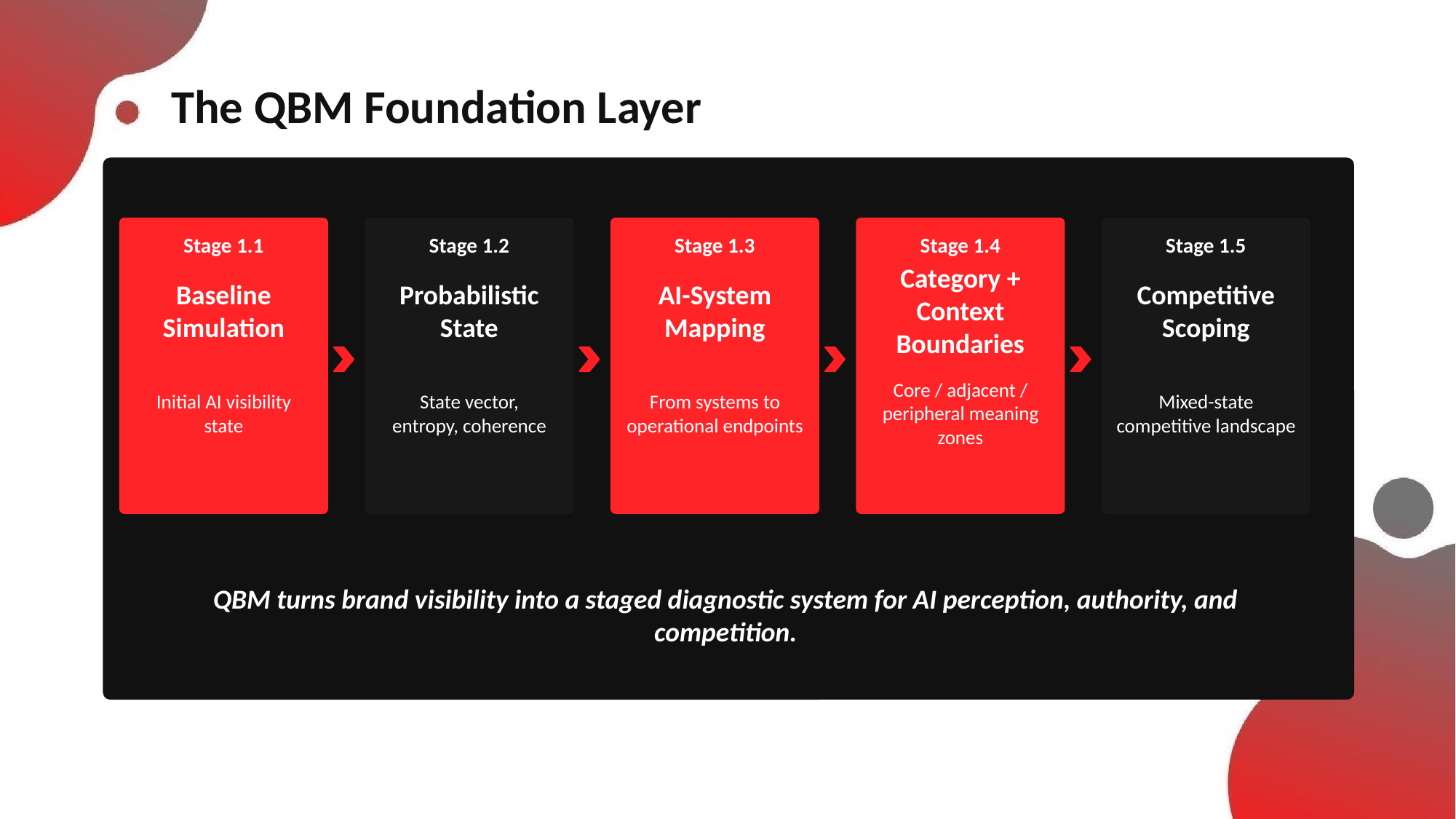
Figure 17. QBM foundation layer: baseline simulation, probabilistic state, AI-system mapping, category/context boundaries, and competitive scoping.
QBM Stage 1.1 and 1.2: Baseline Simulation and Brand-State Metrics
Stage 1.1 creates the baseline snapshot. The QBM deck describes input signals from AI visibility graders for ChatGPT, Gemini, and Perplexity plus SEMrush AI visibility. These raw scores are transformed into a combined signal, a probability distribution, and quantum-style amplitudes. The purpose is not to claim that marketing literally follows quantum physics. The purpose is to borrow a useful modeling language for distributed states, probabilities, amplitudes, and interactions across systems.
The baseline matters because optimization without a starting state is guesswork. If a brand begins with an even AI-system distribution, it may have balanced visibility but no dominant leverage point. If a brand is heavily concentrated in one system, it may enjoy strong visibility there but face dependence risk. If a brand has very low baseline visibility across all systems, the first priority may be entity clarity, content authority, and answer-ready assets rather than fine-tuning endpoint strategy.
Stage 1.2 asks: what is the current probabilistic state of the brand across AI systems? It produces a state vector where each AI system gets a probability and amplitude. It can also use a density matrix to capture cross-system coherence and reinforcement. A simplex projection can show whether the brand is balanced across systems or locked into one ecosystem. These outputs make AI perception visual and measurable.
Three metrics are especially important. Entropy shows how distributed the brand is across AI systems. High entropy can mean breadth and resilience, while low entropy can mean focus but also dependence. Coherence or purity indicates whether strengths reinforce each other or behave independently. Top-system share identifies the primary leverage point and fragility. If one AI surface dominates the brand’s visibility, an update or policy shift on that surface could sharply affect perception.
For strategists, these metrics guide investment. A low-entropy brand may need to diversify across systems. A brand with weak coherence may need better entity consistency and cross-platform reinforcement. A brand with a strong top-system share may protect that advantage while building secondary surfaces. QBM turns abstract AI visibility into a portfolio-management problem.
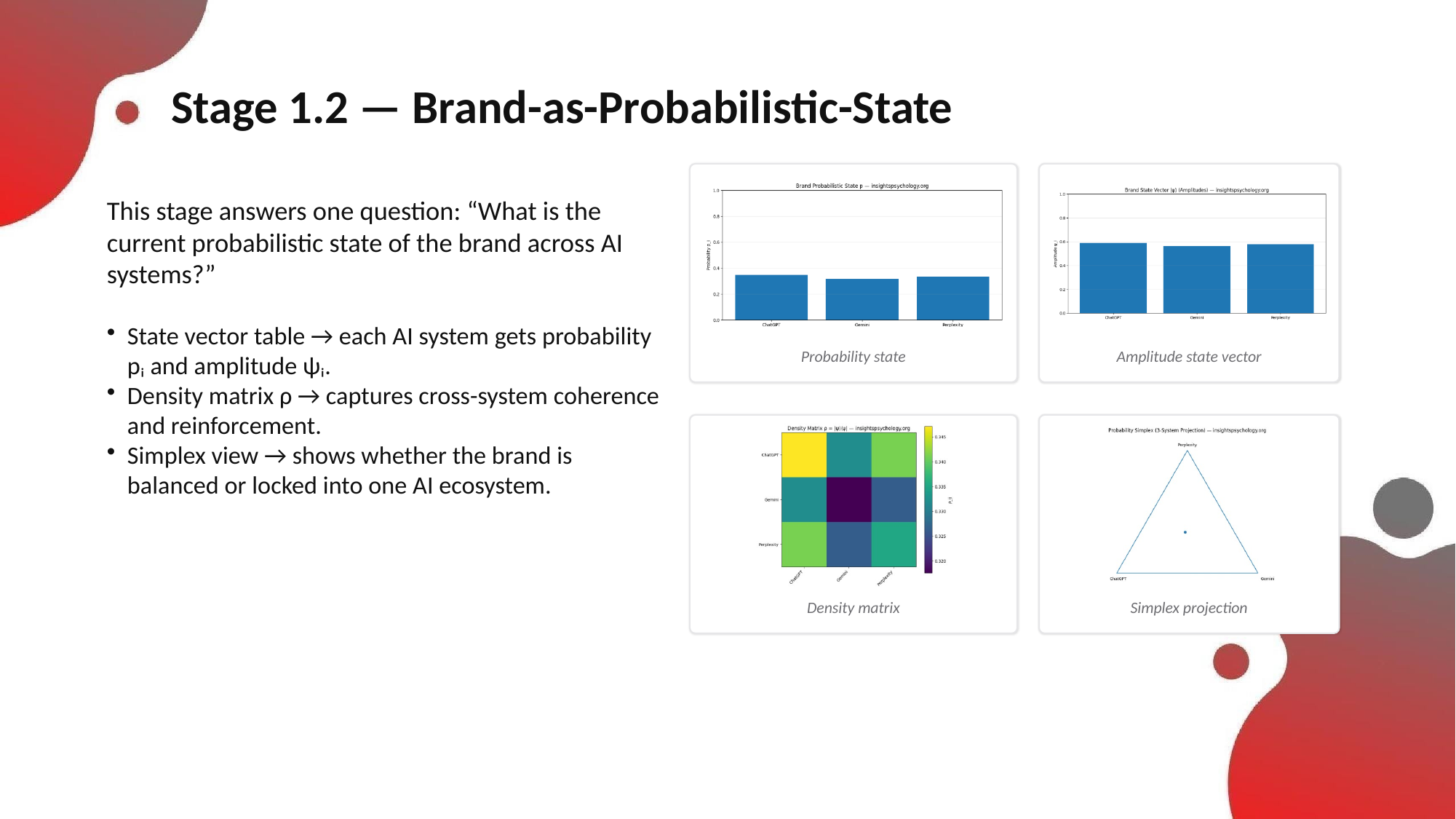
Figure 18. QBM state outputs include probability state, amplitude state, density matrix, and simplex projection.
QBM Stage 1.3 and 1.4: Endpoint Mapping, Context Boundaries, and Leakage Control
Stage 1.3 expands broad AI systems into operational endpoints. ChatGPT, Gemini, and Perplexity are not only consumer chat experiences. AI visibility can live in consumer assistants, enterprise copilots, API-driven environments, browser integrations, productivity tools, and embedded workflows. The QBM deck describes turning a three-dimensional system state into a nine-to-ten-dimensional endpoint map. This answers a practical question: where does AI visibility actually live?
Endpoint mapping is important because different endpoints influence different business outcomes. Consumer assistants may shape awareness and consideration. Enterprise copilots may influence B2B adoption. APIs may shape developer ecosystems, integrations, and downstream product experiences. A brand that dominates consumer endpoints but is absent in enterprise or API contexts may have visible authority without operational penetration. Conversely, a brand with strong API relevance may influence many hidden workflows even if consumer mentions are modest.
Stage 1.4 moves from visibility into semantic positioning. It defines core, adjacent, and peripheral category layers plus direct, commercial, informational, and comparative contexts. This creates a context-conditioned brand state. The key question becomes not only whether the brand appears, but where it appears semantically. Does it show up for the core category? Does it leak into adjacent or peripheral areas that dilute authority? Does it dominate direct intent but lose comparative or informational contexts?
Leakage control is one of QBM’s most practical ideas. Authority strengthens when core-category share and direct-intent relevance are high. Leakage rises when peripheral category mass or low-fit contexts consume too much state probability. For example, a specialized AI SEO agency may want strong visibility in AI search optimization, AIEO, and technical AI visibility. If AI systems associate it too broadly with generic marketing or unrelated automation, category tightness weakens. The brand may appear more often but with less authority.
The endpoint-context heatmap helps identify these patterns. Weak zones show where content or entity signals need reinforcement. Imbalanced zones show where one endpoint or context is overrepresented. Leakage zones show where the brand’s meaning is spreading into low-fit areas. The goal is not to avoid all adjacent topics. It is to expand intentionally, with clear bridges back to the core category.
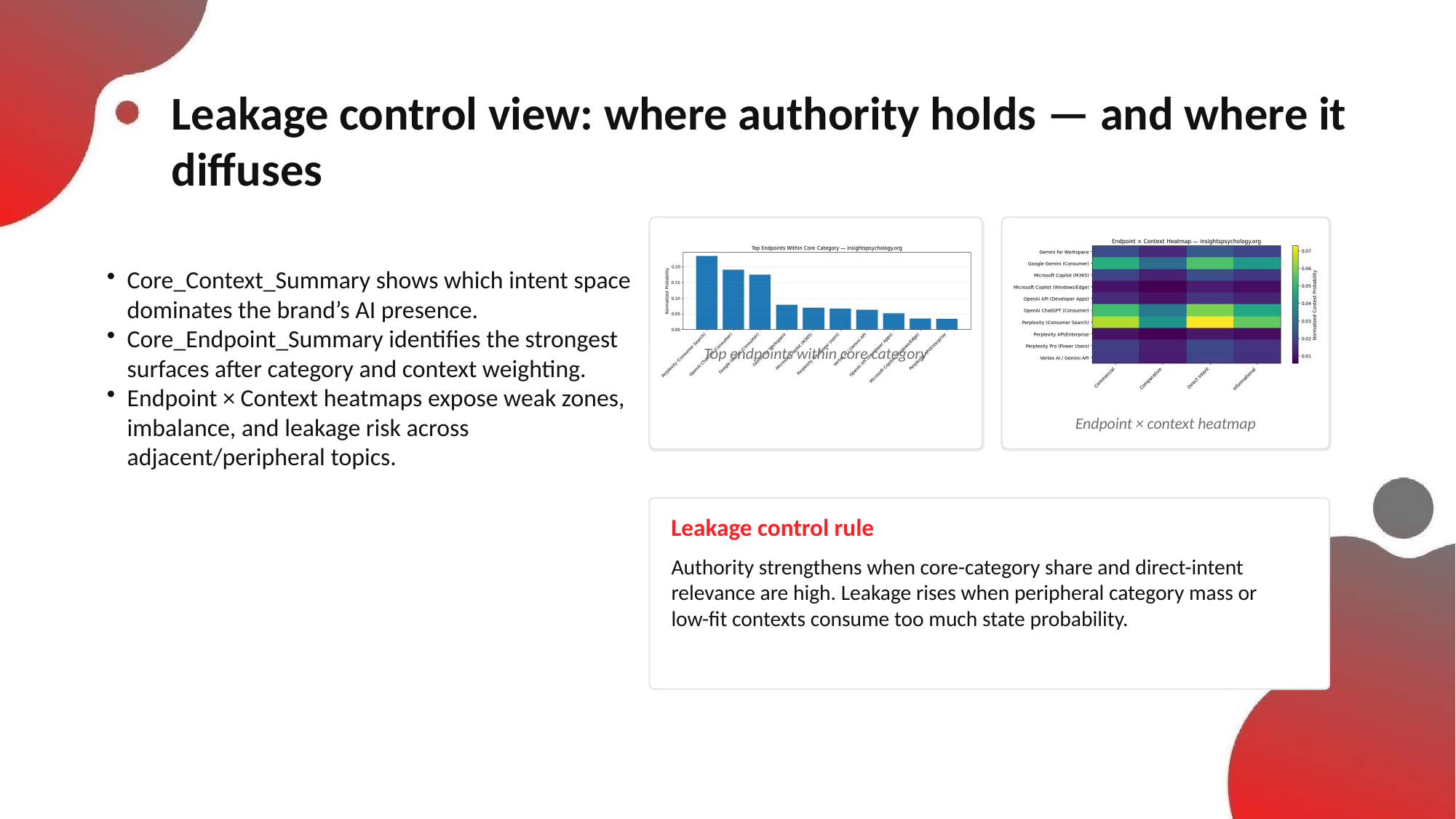
Figure 19. QBM leakage control view: endpoint-context heatmaps expose weak zones, imbalance, and diffusion risk.
QBM Authority Positioning and Competitive Landscape Scoping
QBM places brand authority on two essential axes: category tightness and context dominance. High category tightness plus high context dominance creates the authority zone. The brand is clearly associated with the right category and strongly selected in the right intent context. Low category tightness plus broad relevance creates the leakage zone. The brand appears in many places but lacks strong preference. Low tightness plus low context creates the commodity zone, where the brand is easy to replace. High tightness plus narrow demand creates the niche zone, where the brand is credible but limited in reach.
This model is useful because many brands confuse broad visibility with authority. In AI ecosystems, appearing in a wide range of loosely related answers may not be valuable if the brand is not the preferred source for high-intent queries. Authority concentration matters. A brand should first win core contexts, then expand into adjacent contexts deliberately. Peripheral expansion should be supported by content, evidence, and entity links, not accidental mentions.
Stage 1.5 adds competitors and converts the model into a mixed competitive state. It measures who overlaps with the brand, where contexts are crowded, and which AI surfaces each brand dominates. This reveals real AI competitors, which may differ from traditional SEO competitors. A website with modest organic overlap could still compete heavily in AI-generated answers if its content is clearer, more neutral, or more trusted for a shared query context.
Competitive scoping reveals four major insights. First, real AI rivals are the brands with the highest overlap in AI-generated demand space. Second, context wins and losses show where the brand leads or trails across direct, informational, commercial, and comparative prompts. Third, endpoint gaps show where competitors dominate specific systems or surfaces. Fourth, opportunity whitespace reveals low-overlap zones where authority can expand with less friction.
The strategy after competitive scoping is to measure overlap, find crowded contexts, spot weak endpoints, reposition content, and expand authority. This is where QBM connects back to AIEO and CRSEO. If a competitor wins a context, AIEO can diagnose confidence and drift. If users hesitate in that context, CRSEO can redesign emotional and cognitive sequencing. QBM provides the map; AIEO and CRSEO provide the fixes.
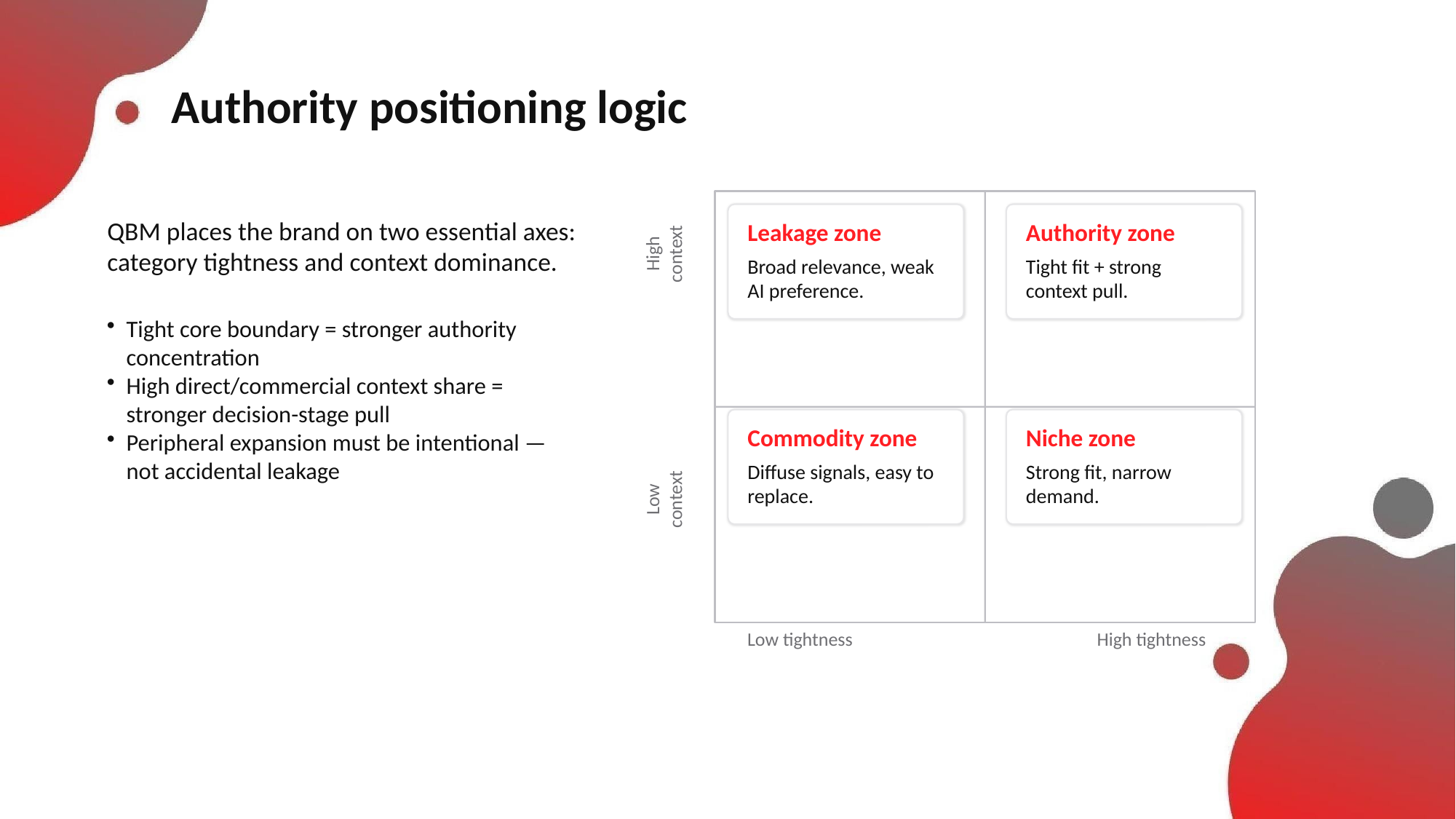
Figure 20. Authority positioning logic: category tightness and context dominance determine authority, leakage, commodity, and niche zones.
Cognitive Authority Mapping: Turning QBM Into Team Action
The QBM deck includes a group activity called Cognitive Authority Mapping. This exercise asks teams to place their brand across AI systems and contexts, then mark where authority is strongest, where leakage occurs, and where competitors intercept demand. The canvas uses systems such as ChatGPT, Gemini, Copilot, and Perplexity against contexts such as direct intent, commercial, informational, and comparative. Each cell can be assessed for authority signal, leakage risk, and competitor threat.
This activity is powerful because it translates abstract AI visibility into a shared strategic conversation. Different teams often see different parts of the problem. SEO teams may see query opportunities. Content teams may see missing explanations. Brand teams may see positioning gaps. Sales teams may know which competitor objections matter. Product teams may know which features are misrepresented. Cognitive Authority Mapping brings those perspectives into a single matrix.
The scoring rubric includes mention frequency, authority signal, context fit, leakage risk, and competitive pressure. A score of one, three, or five can be used to keep the exercise simple. The best opportunities are usually cells with high authority potential but low current score. For example, if the brand should dominate comparative queries in Perplexity but currently has low mention frequency and high competitor pressure, that cell becomes a priority. The team can then build comparison content, add evidence, improve schema, and test prompts.
The activity also helps distinguish between defensive and offensive actions. Defensive actions protect core authority, reduce leakage, and suppress competitor drift. Offensive actions expand into adjacent contexts, new endpoints, or under-contested AI surfaces. Both are necessary. A brand that only defends may stagnate. A brand that only expands may dilute its core. The canvas helps balance concentration and growth.
Used quarterly, Cognitive Authority Mapping can become a governance ritual. Teams can update scores, compare against QBM metrics, review AIEO confidence trends, and decide which pages, entities, endpoints, and contexts deserve investment. It turns AI-native brand strategy into an actionable operating cadence.
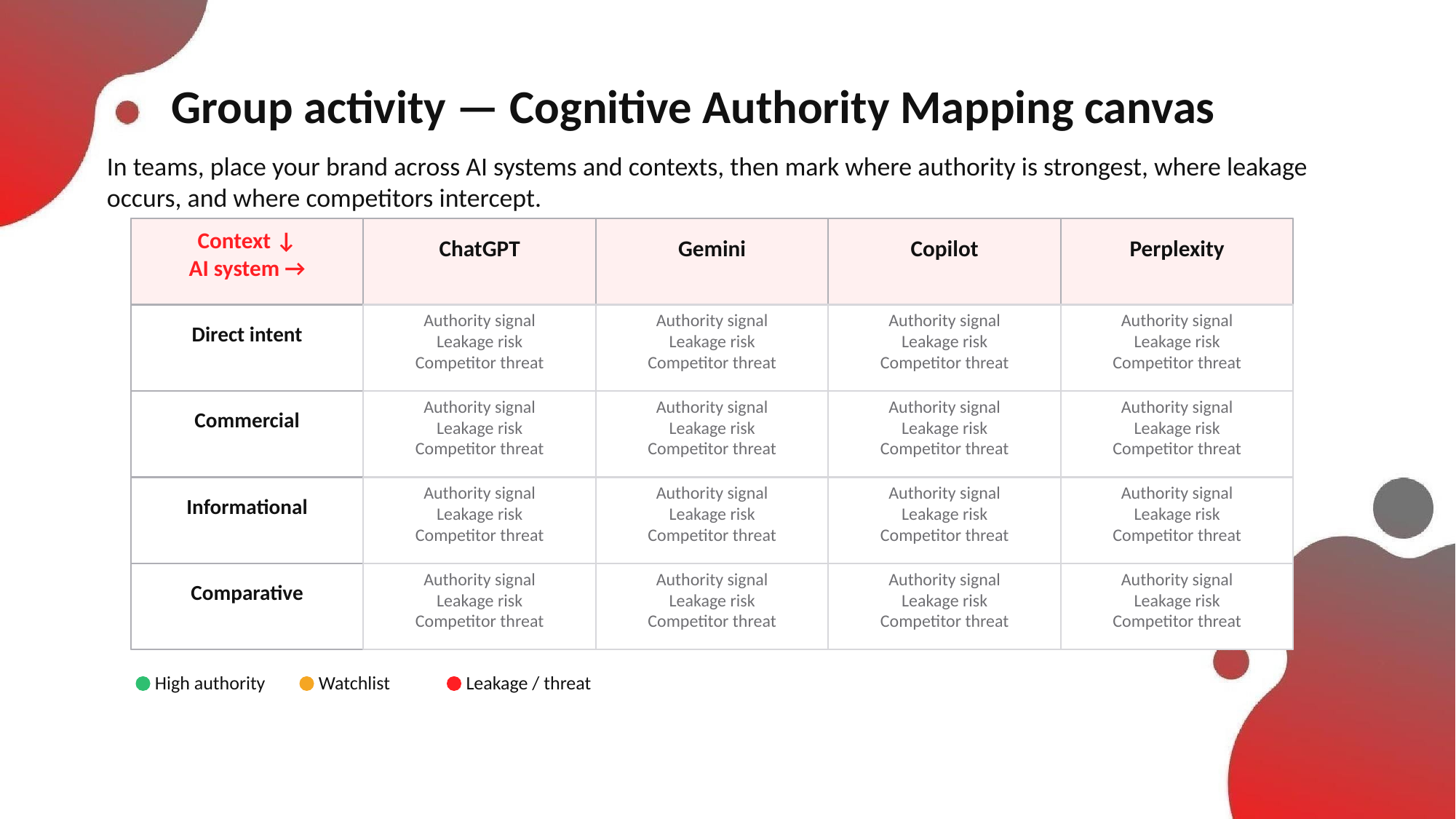
Figure 21. Cognitive Authority Mapping canvas for assessing brand strength, leakage, and competitor threats by AI system and context.
Unified Implementation Framework: From SEO to AI-Native Authority
The five decks together form a unified implementation framework. Phase one is technical AI accessibility. This includes robots.txt, AI crawler permissions, server access, indexability, ai.txt, llms.txt, semantic sitemap, vector feed, and crawl monitoring. Without access, none of the higher-level strategy matters. The website must first be readable by the systems that may use it.
Phase two is knowledge architecture. Build entity-based schema, SameAs links, author identity, organization schema, service relationships, topic clusters, and consistent digital profiles. Treat the website as a structured knowledge graph rather than a list of pages. Each URL should have a clear purpose in the brand’s entity ecosystem. Each important entity should be supported by visible content and structured data.
Phase three is answer-ready content. Rewrite priority pages with direct answers, modular blocks, FAQs, statistical anchors, quotable passages, comparison tables, risk sections, author bios, and updated dates. This phase combines AEO and GEO. It makes pages easier to extract and safer to cite. It also helps human readers move quickly from question to clarity.
Phase four is cognitive and emotional alignment. Apply CRSEO to map emotional intent vectors, journey stages, AI logical flow, persuasive sequencing, content gaps, and conversion path weaknesses. This ensures the page does not only answer the query but answers it in the right psychological order. The page should reduce fear, clarify confusion, build trust, and guide the next action.
Phase five is AI confidence engineering. Apply AIEO Stages 1 and 2 to map questions to pages, score confidence, generate FAQ and schema suggestions, and prioritize low-confidence but high-value assets. This creates a measurable improvement loop. Phase six is competitor drift and leakage control. Apply AIEO Stage 3 and QBM Stages 1.4 and 1.5 to identify where competitors win, where authority diffuses, and where endpoints or contexts need reinforcement.
Phase seven is hallucination suppression and brand safety. Apply AIEO Stage 4 to rewrite unsupported claims, attach evidence, add policies, define scope, and reduce ambiguity. Phase eight is AI ecosystem brand modeling. Use QBM to monitor distribution, entropy, coherence, endpoint exposure, context dominance, category tightness, overlap, and whitespace. Together, these phases transform a website into an AI-native authority asset.
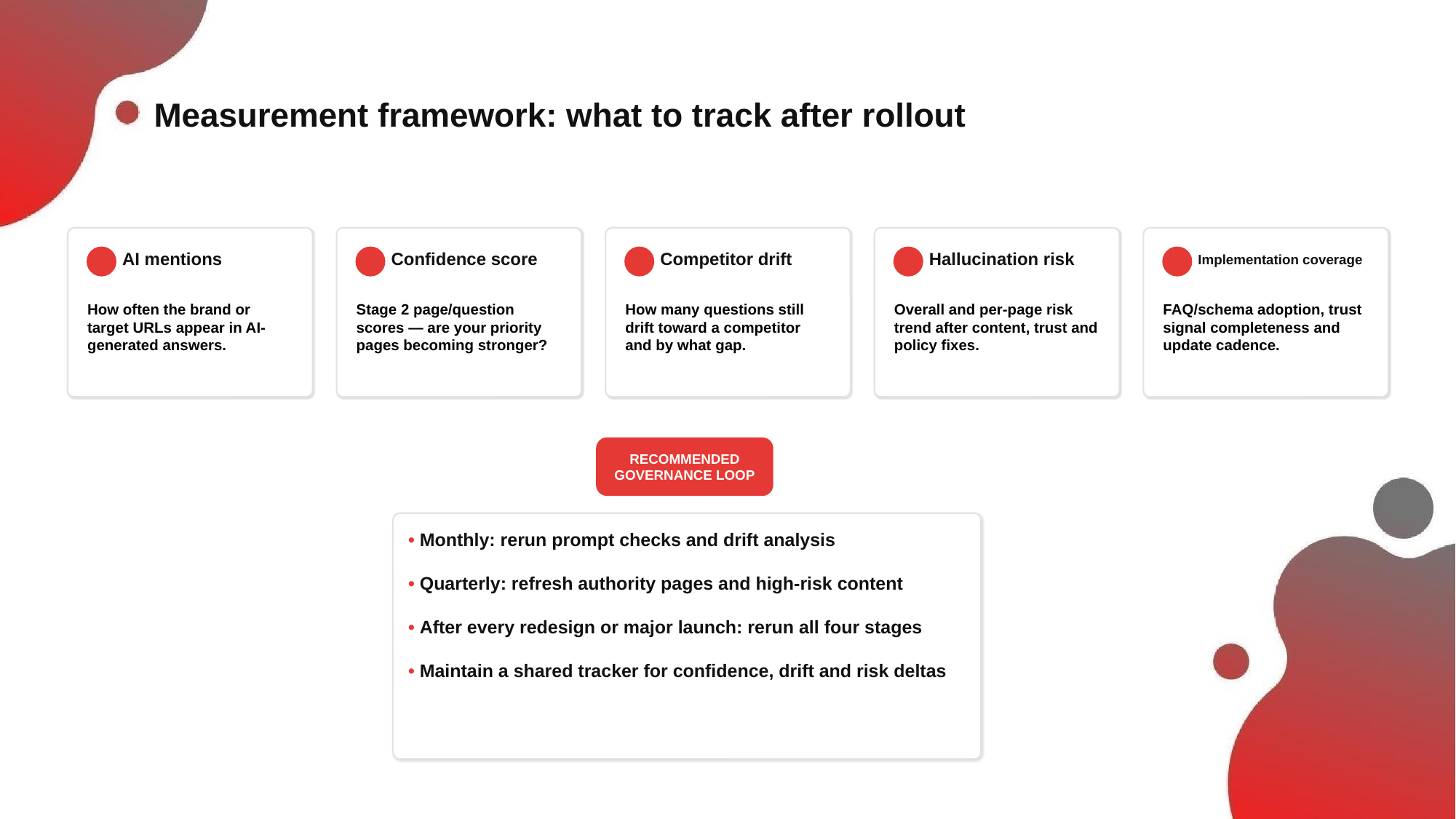
Figure 22. Measurement framework for tracking AI mentions, confidence, drift, hallucination risk, and implementation coverage.
The AI-Ready Page Blueprint
A practical AI-ready page blueprint begins with a clear H1 that names the entity and intent. The opening block should provide a direct 30-to-50-word answer. This answer should be written so it can stand alone in an AI response. It should avoid vague claims and define the topic clearly. Immediately after the direct answer, add key takeaways. These help skimmers and provide extractable summary points for answer engines.
The next section should clarify scope. Explain what the topic includes, what it does not include, and when the answer applies. This is especially important for technical, financial, medical, legal, or strategy topics where overgeneralization creates risk. After scope, add evidence. Evidence can include data, examples, process details, screenshots, case studies, external citations, or internal benchmark outputs. Place evidence close to the claims it supports.
The authority section should make expertise visible. Include author credentials, reviewer details if applicable, organizational experience, methodology, and relevant policies. Do not rely only on a generic About page. AI systems and users benefit when authority is visible on the page itself. Next, include comparison or alternatives. Many users and AI prompts ask for differences, tradeoffs, or best-fit scenarios. A comparison table can make the page more useful and more likely to be selected for evaluation-stage prompts.
Social proof should appear near decision points. Testimonials, case studies, ratings, or client examples are most persuasive when they support a specific claim or reduce a specific concern. Then add a risk, limitations, or governance section. This improves trust because it shows the brand understands boundaries. For AI systems, limitations reduce hallucination risk by preventing overly broad interpretation.
Finally, add an objection-handling FAQ, relevant schema, author bio, last updated date, and stage-matched CTA. The CTA should fit the user’s journey stage. An awareness page may invite the user to read a guide. An evaluation page may offer a comparison checklist. A decision page may offer a consultation or demo. A post-purchase page may provide support. This blueprint brings together AEO extraction, GEO authority, CRSEO persuasion, AIEO confidence, and QBM positioning.
Blog Production Checklist for AI Search Teams
Before publishing an AI-search-ready blog, teams should run a structured checklist. First, define the target entity and primary question. If the page cannot be summarized as ‘this page answers this question for this audience,’ it may be too unfocused. Second, define the journey stage and emotional vector profile. Is the user learning, comparing, deciding, or seeking post-purchase reassurance? Are fear, risk, confidence gaps, authority expectations, or social proof needs high?
Third, build the answer-first structure. Add a direct answer, key takeaways, definitions, evidence, examples, and next steps. Fourth, add AI extraction modules: FAQs, comparison tables, quotable passages, statistical anchors, and modular 75-to-300-word blocks. Fifth, add trust modules: author bio, reviewer if needed, citations, updated date, policies, limitations, and visible methodology.
Sixth, add structured data. Use Article, FAQPage, HowTo, Organization, Person, Product, Service, Review, or other schema types only where appropriate and visible content supports them. Add SameAs links for identity consistency. Seventh, validate entity consistency across the site and external profiles. Make sure the brand, author, service, and category descriptions match the AI manifesto and key identity pages.
Eighth, run AIEO-style question-page matching. Confirm that the page is the best answer for its target questions. Ninth, estimate confidence. Does the page have enough similarity, trust, schema, and answer clarity to be selected? Tenth, test competitor drift. Ask whether a competitor page currently answers the same prompt better, more neutrally, or with stronger evidence. Eleventh, check hallucination risk. Rewrite absolutes, support claims, add scope, and remove ambiguity.
Finally, test the page in AI systems after publishing. Query ChatGPT, Gemini, Perplexity, and other relevant answer engines. Track whether the brand appears, whether the answer is accurate, whether the correct URL is cited, whether competitors appear, and whether any claims are misrepresented. Feed those observations back into the improvement loop. AI search optimization is not a publish-and-forget discipline. It is continuous governance.
Measurement Dashboard: What Leadership Should See
Leadership teams do not need every technical detail, but they do need a clear dashboard. The first metric is AI mention frequency: how often the brand appears in target prompts across systems. This should be segmented by system, endpoint, category, and context. A single aggregate number can hide platform dependence or context weakness. The second metric is citation quality: whether AI answers cite the correct URL, quote accurately, and represent the brand’s positioning correctly.
The third metric is AIEO confidence score. This measures whether priority pages are becoming stronger page-question assets. It should be tracked over time and tied to implementation work. If confidence rises after adding FAQs, schema, evidence, and author signals, the team can show cause and effect. The fourth metric is competitor drift. Leadership should know which competitors are winning which prompts and why. Drift should be reported by question cluster, not only by domain.
The fifth metric is hallucination risk. This should include overall risk, high-risk pages, risky claims, evidence gaps, and projected reduction after fixes. For regulated or sensitive industries, this may be one of the most important metrics. The sixth metric is QBM state distribution. Leadership should see whether the brand is concentrated in one AI system, balanced across systems, strong in consumer endpoints, weak in enterprise endpoints, dominant in direct contexts, or leaking into peripheral categories.
The seventh metric is implementation coverage. This tracks how many priority pages have direct answers, FAQs, schema, author bios, updated dates, citations, comparison tables, risk sections, and modular blocks. Implementation coverage prevents strategy from remaining theoretical. The eighth metric is content velocity and refresh cadence. AI-visible authority pages should be refreshed regularly, especially where facts, products, regulations, or competitors change.
A good executive dashboard should not overwhelm. It should answer five questions: Are we appearing in AI answers? Are we being represented accurately? Are we winning or losing against competitors? Are our pages becoming more trusted? Are we reducing risk while expanding authority? When leadership can see those answers, AI search becomes a strategic growth function rather than an experimental side project.
Common Mistakes That Reduce AI Visibility
The first common mistake is writing for keywords while ignoring answer extraction. A page may contain the target phrase many times but still fail to provide a clean answer. AI systems prefer passages that clearly define, compare, explain, or support. The second mistake is burying the answer. Long introductions, brand narratives, and generic market context should not delay the direct response to the user’s question. The answer should appear near the top.
The third mistake is using vague claims. Phrases such as ‘best-in-class,’ ‘innovative,’ ‘cutting-edge,’ and ‘world-leading’ are weak unless supported by evidence. AI systems may ignore them or treat them as promotional noise. The fourth mistake is missing visible trust signals. A page without author information, update date, citations, schema, or policies may look less safe to cite. The fifth mistake is inconsistent entity identity. Different names, descriptions, categories, and profiles create confusion.
The sixth mistake is over-optimizing for sales intent on informational pages. If a user asks an informational question and the page immediately pushes a product, AI systems may drift to a more neutral competitor. The seventh mistake is ignoring emotional intent. A high-fear query needs reassurance and risk reduction, not only facts. A high-authority query needs credentials and proof. A high-social-proof query needs testimonials or case studies. The eighth mistake is failing to create stage-specific content. Awareness, evaluation, decision, and post-purchase queries require different page types.
The ninth mistake is ignoring competitors in AI answers. Traditional ranking competitors are not always AI competitors. Teams must test prompts and compare who appears. The tenth mistake is ignoring hallucination risk. Unsupported claims, ambiguous wording, and missing scope can lead to misrepresentation. The eleventh mistake is treating AI search as a one-time project. Models, competitors, crawl behavior, and user expectations change. Governance is required.
Avoiding these mistakes can produce quick gains. Many brands do not need exotic tactics first. They need clear answers, stronger trust signals, better schema, consistent entities, stage-specific content, competitor testing, and risk-aware claims. That is the practical foundation of future-ready AI visibility.
Conclusion: From Rankings to AI-Native Authority
The future of search is not the death of SEO. It is the expansion of SEO into a broader AI-native discipline. Ranking still matters, but ranking is no longer the only path to visibility or influence. Users increasingly ask AI systems for answers, summaries, recommendations, comparisons, and decisions. Those systems select from patterns, sources, trust signals, semantic relevance, and context. Brands that want to remain visible must become easy for AI to understand, trust, quote, and recommend.
AEO and GEO provide the foundation by shifting the goal from clicks to answers and from pages to knowledge sources. LLM psychology explains why structure, trust, consistency, and extractability matter. The AI-ready knowledge layer organizes content through semantic sitemaps, vector feeds, AI manifestos, schema, llms.txt, ai.txt, and crawler configuration. Content architecture transforms pages into modular, answer-first, evidence-backed assets.
CRSEO adds the human dimension. It reminds us that search behavior is emotional and cognitive, not merely linguistic. Users search because they need clarity, confidence, reassurance, proof, or support. Content should map emotional vectors, journey stages, logical flow, persuasive sequencing, and conversion path gaps. A page that matches the user’s mental state is more likely to convert and more likely to be summarized accurately.
AIEO adds the AI confidence and safety dimension. It maps questions to pages, scores confidence, reveals competitor drift, and suppresses hallucination risk. It turns AI visibility into a measurable operating system. QBM adds the ecosystem dimension. It models brand perception across AI systems, endpoints, contexts, categories, and competitors. It shows where authority concentrates, where it leaks, and where opportunity exists.
The winning brands in AI search will not be those that chase every new tactic. They will be those that build structured knowledge, evidence-backed authority, cognitive resonance, AI confidence, and measurable brand-state governance. They will optimize not only to be found, but to be selected. Not only to be mentioned, but to be trusted. Not only to be summarized, but to be represented accurately. That is the shift from rankings to AI-native authority.
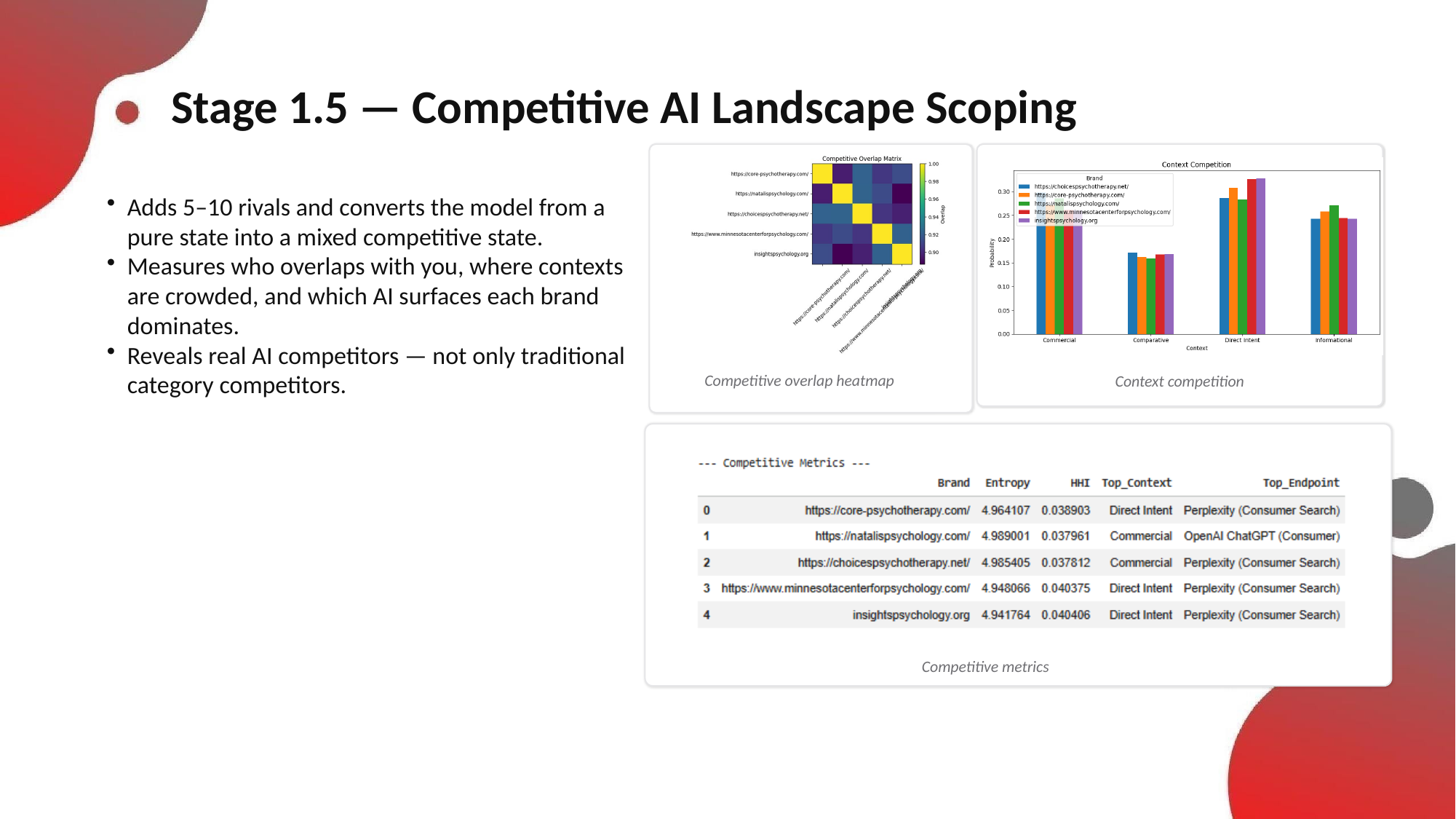
Figure 23. Competitive AI landscape scoping shows overlap, crowded contexts, and platform-specific competition.
Appendix: Source-Deck Concepts Used in This Blog
| Deck | Major concepts incorporated | Visuals included |
| Introduction | AI-first search, declining traditional SEO, LLM-driven traffic value, workshop roadmap | Projected visitors and LLM traffic value charts |
| AEO & GEO / LLM Psychology | SEO vs AEO vs GEO, LLM validation, knowledge layer, vector feed, ai.txt, llms.txt, schema, modular content, roadmap | SEO/AEO/GEO diagram, knowledge layer, vector feed, ai.txt, llms.txt, six-week roadmap |
| CRSEO | Emotional intent vectors, EIVM clustering, AI logical flow, content gap validation, persuasive sequencing, cognitive architecture | CRSEO layers, emotional vector chart, logical-flow diagram, content-gap chart, template heatmap |
| AIEO Workshop | Reasoning paths, confidence scoring, competitor drift, hallucination suppression, roadmap, governance metrics | Operating model, risk charts, roadmap, measurement framework |
| Quantum Brand Modeling | Probabilistic brand state, endpoint mapping, category and context boundaries, leakage control, competitive overlap, cognitive authority mapping | QBM foundation, state outputs, leakage heatmap, authority matrix, competitive scope, mapping canvas |