
SUPERCHARGE YOUR ONLINE VISIBILITY! CONTACT US AND LET’S ACHIEVE EXCELLENCE TOGETHER!
While others are chasing rankings, ThatWare are redesigning the reality in which rankings exist.
The SEO Illusion Everyone Is Still Chasing
For years, SEO has been treated like a race—a relentless pursuit of higher rankings on Google. Businesses still obsess over keywords, SERP positions, and the illusion that hitting #1 is the ultimate victory. Dashboards light up, reports look impressive, and yet something feels off.
Because the truth is uncomfortable: ranking #1 no longer guarantees anything that truly matters.
Not traffic. Not trust. And certainly not conversions.
A top position on Google today does not ensure users will click. It does not ensure they will believe you. And it does not ensure they will choose you.
Why the Old SEO Promise Is Broken
The digital landscape has quietly but fundamentally shifted.
- Zero-click searches now dominate results pages, where answers are served instantly without a single website visit.
- AI-driven responses from Google SGE, ChatGPT, Perplexity, and other large language models are becoming the first—and often final—touchpoint for users seeking information.
- Brand-driven discovery has replaced blind clicking. Users gravitate toward names they recognize, trust, and recall, regardless of who technically “ranks” higher.
In this environment, being visible is not the same as being influential.
A brand can rank first and still be ignored. Another can rank lower—or not at all—and still dominate conversations, AI answers, and user trust.
The Illusion of Algorithm Control
Most SEO strategies are still rooted in an outdated belief:
If we optimize better, Google will reward us.
But modern algorithms are no longer static rulebooks to be gamed. They are dynamic systems observing how humans behave, what they trust, and which sources consistently shape understanding across platforms.
Google is no longer just ranking pages. AI systems are no longer just retrieving links.
They are interpreting perception.
The Shift: From Algorithm Manipulation to Perception Engineering
This is where the old SEO mindset collapses.
SEO is no longer about tweaking pages to please an algorithm. It is about intentionally shaping how:
- Algorithms perceive authority
- AI systems recall expertise
- Users associate trust, relevance, and credibility with a brand
In other words, SEO has evolved into perception engineering.
And while most of the industry is still chasing rankings as an end goal, ThatWare is operating on a different level entirely—redesigning the reality in which rankings exist.
Because when perception is engineered correctly, rankings don’t need to be chased. They follow.
The Silent Shift: From Search Engines to Search Experiences
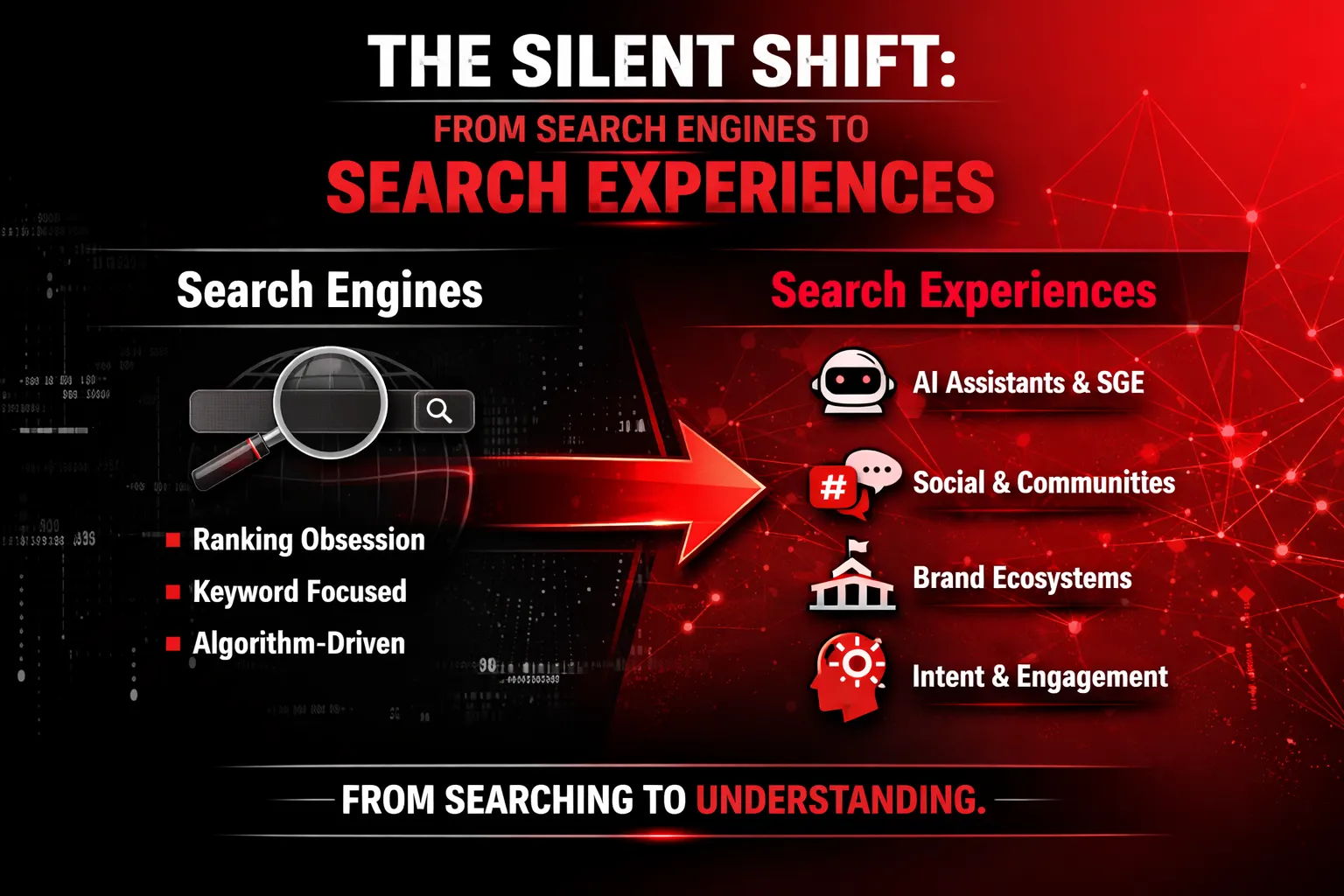
For years, SEO operated under a simple assumption: Google was the destination. Users typed a query, scanned ten blue links, clicked a result, and made a decision. That mental model no longer reflects reality.
What has changed is not just the algorithm—it is the entire search experience.
Google Is No Longer the Destination
Today, search is fragmented, continuous, and non-linear.
A modern search journey rarely begins and ends on Google alone. Instead, it flows across multiple touchpoints:
- Google – often just the starting point
- AI assistants – ChatGPT, Gemini, Perplexity summarizing and recommending
- Communities – Reddit, Quora, Slack groups, niche forums
- Social platforms – LinkedIn, X, YouTube, short-form video discovery
- Brand-owned content hubs – blogs, research pages, tools, newsletters
In this environment, Google functions less like a destination and more like a router—one node in a much larger information ecosystem.
More importantly, user behavior has fundamentally evolved.
People no longer “search” in the traditional sense. They are not hunting for pages; they are seeking understanding.
They want:
- Clarity, not links
- Context, not keyword matches
- Confidence, not options
When users encounter an answer that feels complete, the journey often stops—whether that answer comes from an AI response, a community discussion, or a brand they already trust.
This is why ranking alone no longer guarantees visibility. Being present across the entire search experience matters more than appearing in a single results page.
Algorithms Are Observing Humans, Not Pages
As search experiences expanded, algorithms had to adapt. Modern search systems are no longer primarily evaluating content structure—they are studying human behavior at scale.
This is where traditional SEO thinking breaks down.
- Engagement signals outweigh keyword placement
Time on page, interaction depth, return visits, and brand familiarity now signal far more than exact keyword usage.
- Behavioral data outweighs backlinks alone
Links still matter, but they are no longer sufficient. Algorithms look at how real users respond once they arrive—not just how many paths point to a page.
- Contextual relevance outweighs exact-match intent
Search systems evaluate whether content fits naturally within a broader topical and behavioral context, not whether it mechanically matches a query string.
In essence, algorithms are no longer asking:
“Is this page optimized?”
They are asking:
“Is this source trusted, understood, and repeatedly validated by human behavior?”
Key Insight
Algorithms rank perceived authority, not optimized pages.
What ranks today is not the page that best follows SEO checklists, but the brand that consistently signals:
- Understanding of the topic
- Alignment with user expectations
- Credibility across platforms and contexts
This is the silent shift most brands miss. While many are still optimizing pages for machines, the machines have moved on—to observing people.
What Is Perception Engineering in SEO?
For years, SEO has been treated as a technical discipline—optimize keywords, build links, improve page speed, and wait for rankings to move. That model worked when search engines were rule-based systems responding to clearly defined signals. But search has evolved. Algorithms now learn, users behave unpredictably, and AI systems synthesize information rather than simply index it.
This shift has created the need for an entirely new category of SEO thinking.
That category is Perception Engineering.
Definition: Perception Engineering in SEO
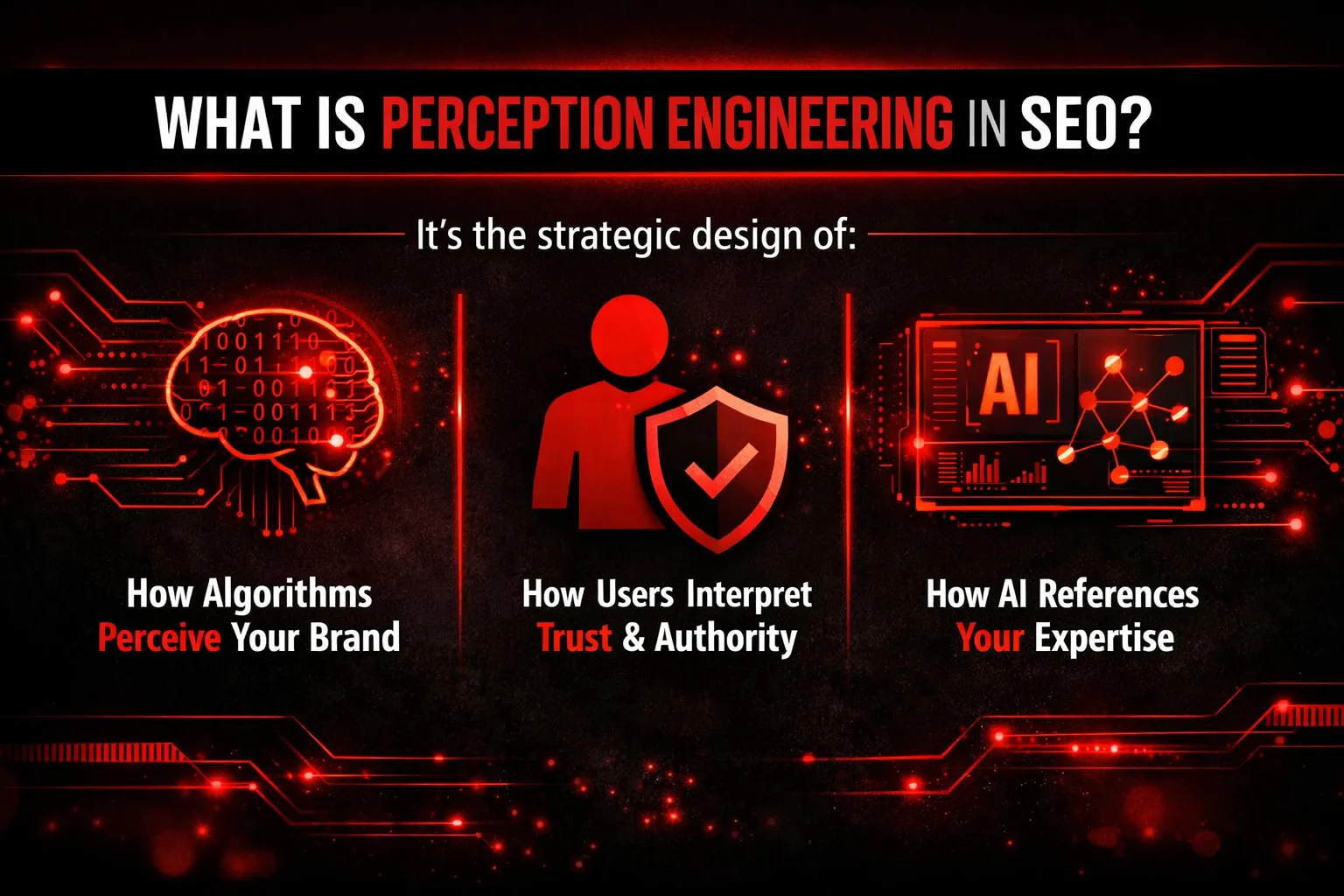
Perception Engineering is the strategic design of how a brand is understood, remembered, and referenced across search ecosystems.
It focuses on shaping three critical layers simultaneously:
- How algorithms perceive a brand
Modern search engines no longer evaluate pages in isolation. They assess entities, topical authority, consistency of expertise, behavioral signals, and contextual relevance across the web. Perception Engineering ensures that algorithms recognize a brand as a trusted authority within a clearly defined conceptual space—not just as a page optimized for a query.
- How users interpret trust
Users don’t consciously evaluate SEO signals. They form perceptions based on clarity, consistency, depth, tone, and presence across touchpoints. Perception Engineering aligns content, messaging, and visibility so that trust is felt before it is measured—leading to stronger engagement, recall, and preference.
- How AI models reference authority
AI-driven systems like Google’s SGE, ChatGPT, and other LLM-based tools don’t “rank” content the way traditional search engines do. They reference patterns of authority. Brands that are consistently associated with ideas, frameworks, and expertise are more likely to be cited, summarized, or surfaced as answers. Perception Engineering makes a brand reference-worthy, not just indexable.
In simple terms:
SEO optimizes pages. Perception Engineering engineers understanding.
Traditional SEO vs Perception Engineering
The difference between traditional SEO and Perception Engineering is not incremental—it is philosophical.
| Traditional SEO | Perception Engineering |
| Keywords | Concepts |
| Rankings | Recall |
| Traffic | Influence |
| Pages | Ecosystems |
| Google-first | Human + AI-first |
Keywords vs Concepts
Traditional SEO revolves around matching search terms. Perception Engineering focuses on owning ideas. Instead of optimizing for isolated keywords, it builds conceptual authority around topics that algorithms and users associate with the brand.
Rankings vs Recall
Ranking high is temporary; being remembered is durable. Perception Engineering prioritizes mental availability—ensuring that when a problem, category, or question arises, the brand comes to mind naturally for both humans and machines.
Traffic vs Influence
Traffic measures visits. Influence measures impact. A brand with influence shapes decisions, conversations, and narratives—even beyond its own website. Perception Engineering optimizes for that influence.
Pages vs Ecosystems
Traditional SEO treats each page as an asset. Perception Engineering treats the entire digital presence as a system—content, mentions, entities, associations, and behavioral signals working together to reinforce authority.
Google-first vs Human + AI-first
SEO used to begin and end with Google. Today, discovery happens through people, platforms, and AI systems simultaneously. Perception Engineering is designed for this multi-layered reality, where humans and machines interpret authority together.
Perception Engineering reframes SEO from a game of rankings into a discipline of relevance, trust, and authority design. Rankings don’t disappear—but they become a natural consequence, not the objective.
This is the foundation of how modern SEO must be understood—and why brands that master perception will always outpace those still chasing positions.
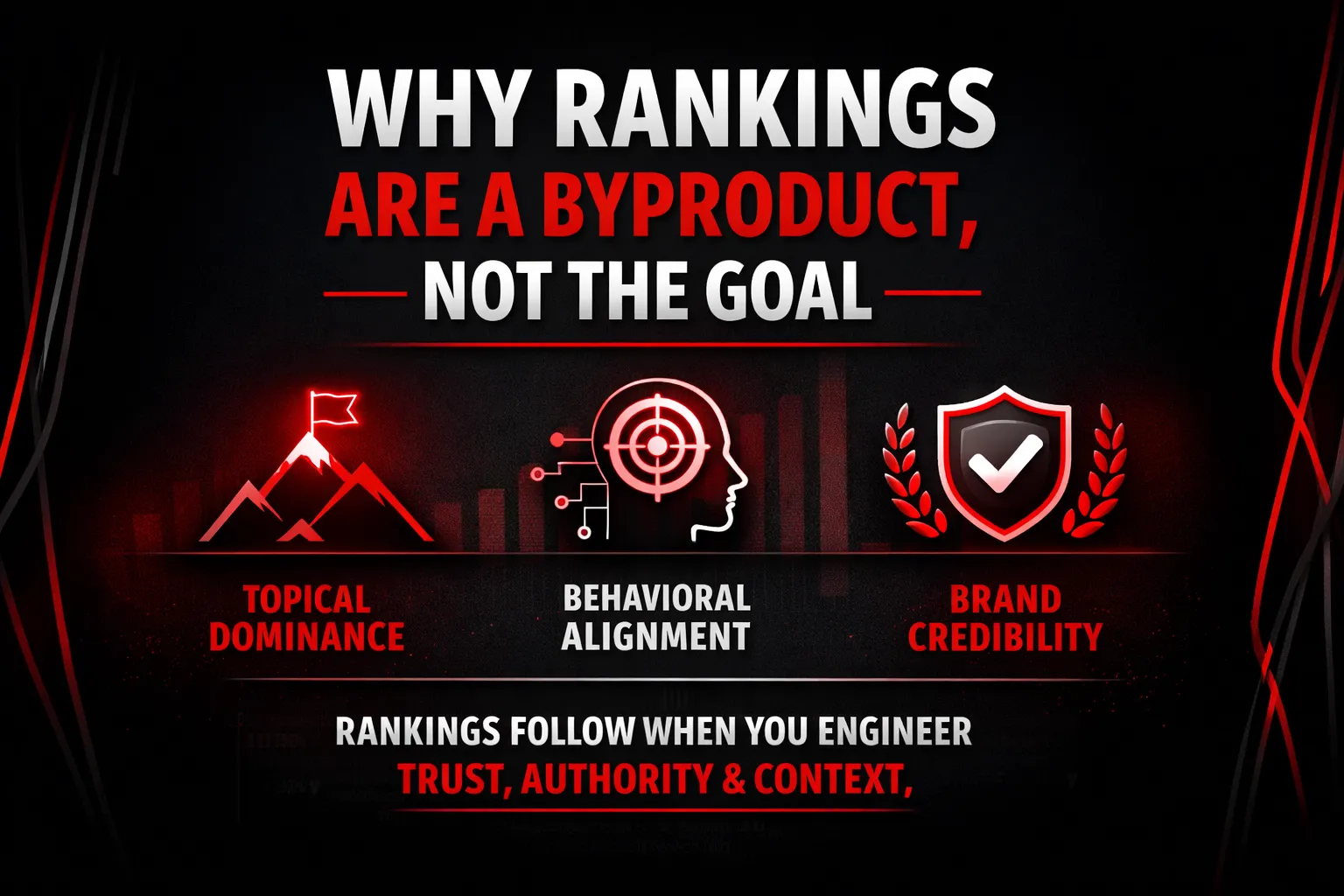
Why Rankings Are a Byproduct, Not the Goal
For years, SEO success has been measured by a single, deceptively simple metric: rankings. Page one. Top three. Number one. The industry learned to worship positions, assuming that visibility, traffic, and growth would naturally follow.
That assumption no longer holds.
In today’s search environment, rankings are not the objective—they are the outcome. They appear after something far more important has been established.
Rankings Follow, They Don’t Lead
Modern search algorithms no longer reward isolated optimization efforts. Instead, rankings emerge naturally when three deeper forces align:
1. Topical Dominance
Search engines now think in topics, not pages. Brands that demonstrate:
- Depth of understanding
- Semantic coverage across an entire subject
- Consistent expertise signals
begin to exert what can be called topical gravity. Pages from such brands rank not because they were optimized harder, but because the ecosystem recognizes them as unavoidable authorities.
2. Behavioral Alignment
Algorithms observe how humans interact with content:
- Do users stay, scroll, engage, and return?
- Do they trust the information enough to act on it?
- Do they search for the brand again?
When content aligns with real human intent—not just keyword intent—rankings stabilize and compound. Behavior becomes a vote of confidence no backlink alone can replicate.
3. Brand Credibility
In an AI-driven search world, brands matter more than ever. Credibility is inferred through:
- Brand mentions across platforms
- Consistent narrative positioning
- Recognition by users, communities, and AI systems
A credible brand doesn’t fight for rankings. Rankings recognize it.
The Hidden Cost of Chasing Rankings
When rankings are treated as the primary goal, growth becomes inherently unstable.
Fragile Growth
Ranking-driven strategies often collapse the moment:
- An algorithm update rolls out
- A competitor copies the tactic
- Search intent subtly shifts
What rises quickly often falls faster.
Algorithm Dependency
Chasing rankings places brands in a reactive position—constantly adjusting to:
- Core updates
- SERP layout changes
- AI-generated answers
Instead of building leverage, brands become dependent on forces they don’t control.
Short-Term Wins, Long-Term Irrelevance
Pages may rank temporarily, but without perception, authority, and trust, they fail to:
- Build recall
- Influence AI systems
- Create market ownership
Traffic arrives, but impact never compounds.
ThatWare Insight
At ThatWare, rankings are not engineered directly.
Perception is.
When topical dominance is established, when user behavior reinforces trust, and when brand credibility is woven across the digital ecosystem, rankings stop being a question of if—they become a matter of when.
When perception is engineered correctly, rankings become inevitable.
The future of SEO doesn’t belong to those who chase positions.
It belongs to those who shape the reality in which positions are decided.
The Three Layers of SEO Perception Engineering
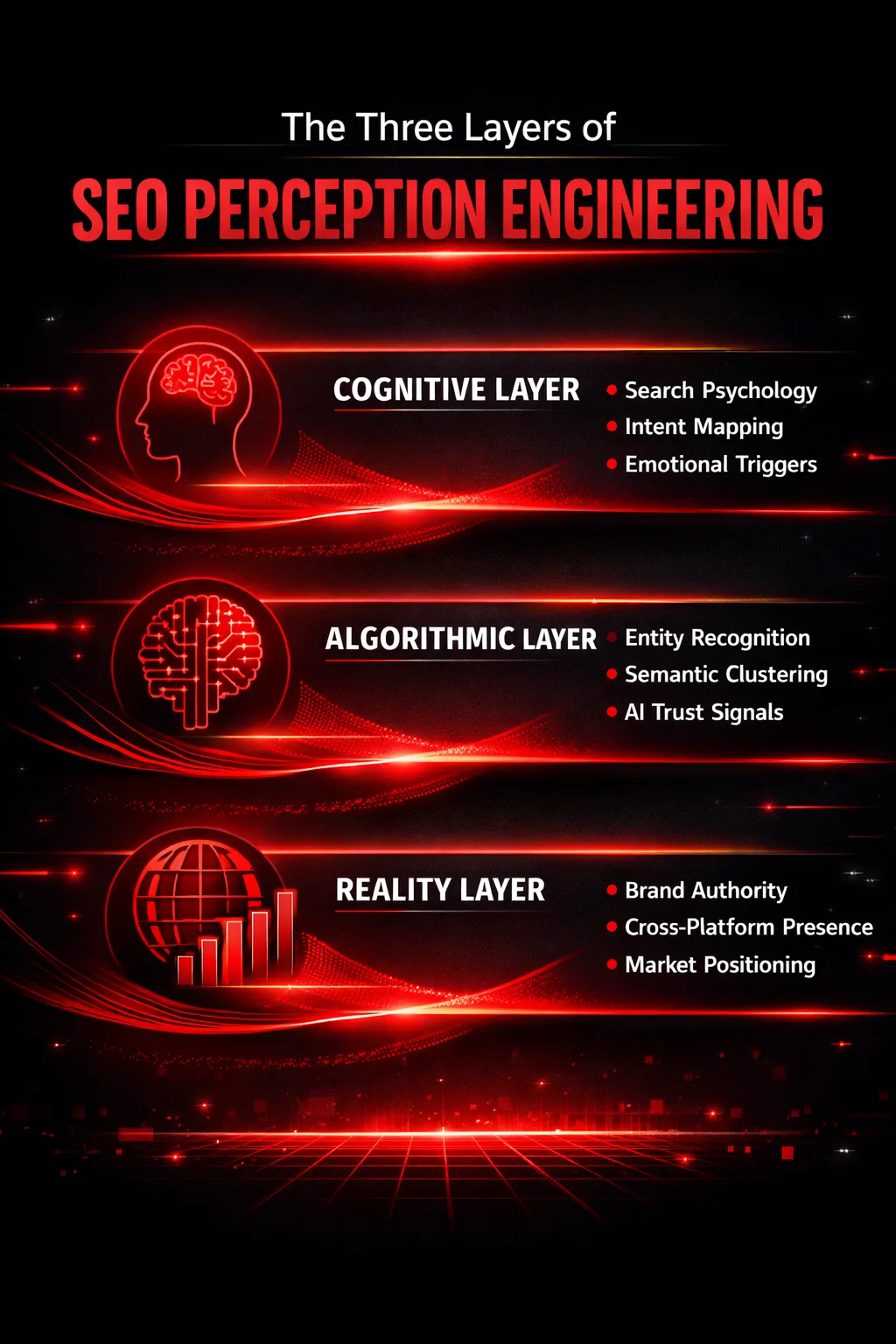
Most SEO strategies fail not because they are poorly executed, but because they operate on a single layer of reality—usually Google’s surface-level ranking system.
Perception Engineering works differently. It recognizes that search visibility is formed at the intersection of human psychology, machine interpretation, and market consensus.
ThatWare’s approach to SEO is built on three interconnected layers, each shaping how authority is perceived long before rankings appear.
The Cognitive Layer – How Humans Think
Search does not begin with keywords. It begins with confusion, curiosity, urgency, and intent.
The Cognitive Layer focuses on why people search, not just what they type.
Search Psychology Over Search Volume
Modern users search to:
- Reduce uncertainty
- Validate decisions
- Compare realities, not just options
Understanding this means recognizing that most queries are emotionally driven, even in B2B and technical spaces.
People don’t search:
- “Best SEO framework”
They search: - “Why is my SEO not working anymore?”
Perception Engineering aligns content with the mental state behind the query, not the literal phrasing.
Intent Depth Mapping
Traditional SEO maps keywords to pages.
ThatWare maps intent layers:
- Surface intent (what is asked)
- Hidden intent (what is actually needed)
- Future intent (what the user will ask next)
This creates content ecosystems that anticipate the search journey, making the brand feel intuitively relevant.
Narrative Alignment
Humans don’t remember facts. They remember stories that explain reality.
Narrative alignment ensures that:
- Blog content
- Landing pages
- Thought leadership
All reinforce the same core worldview, positioning the brand not as an option—but as an explanation.
Emotional Triggers in Search Behavior
Trust, fear, ambition, frustration, and curiosity heavily influence:
- Click behavior
- Time on page
- Brand recall
Search engines observe these emotional signals indirectly through behavior. Perception Engineering designs for human resonance first, letting algorithms follow.
The Algorithmic Layer – How Machines Interpret Authority
While humans think emotionally, machines think structurally.
The Algorithmic Layer focuses on how search engines and AI systems understand, connect, and trust information.
Entity Recognition Over Keyword Matching
Modern algorithms don’t rank pages—they evaluate entities.
Entities include:
- Brands
- People
- Concepts
- Relationships between ideas
ThatWare engineers content to strengthen entity clarity, ensuring the brand is consistently understood as:
- What it is
- What it is known for
- What it should be referenced alongside
Topic Clustering & Semantic Depth
Authority is no longer proven by one strong page. It is proven by semantic completeness.
This means:
- Covering a topic from multiple cognitive angles
- Creating internal semantic reinforcement
- Eliminating topical gaps competitors rely on
When semantic depth increases, algorithms stop asking if you’re relevant—and start assuming it.
AI Training Signals
AI systems learn from:
- Repetition of trusted narratives
- Consistent expertise signals
- Cross-platform validation
Perception Engineering ensures that:
- Your brand’s ideas are repeated across formats
- Your expertise is structurally clear
- Your perspective becomes reference material for AI outputs
Trust Vectors Beyond Links
Backlinks still matter—but they are no longer enough.
Modern trust vectors include:
- Engagement consistency
- Brand co-occurrence
- Behavioral validation
- AI citation patterns
These invisible trust layers shape rankings long before visible SEO metrics change.
The Reality Layer – How the Market Sees You
The final layer is where perception becomes collective truth.
Search engines don’t decide authority in isolation. They observe how the market treats you.
Brand Mentions Across Platforms
Authority today is distributed.
Search engines analyze:
- Mentions on blogs, forums, and social platforms
- Citations without links
- Context in which your brand appears
Perception Engineering ensures your brand is present in relevant conversations, not just optimized pages.
Consistency of Expertise
One good article doesn’t build authority. Consistency does.
When expertise is expressed:
- Repeatedly
- Coherently
- Across multiple contexts
It becomes self-reinforcing, both for humans and machines.
Authority Echoes in AI Responses
One of the strongest modern signals of authority is:
“Does AI naturally reference or mirror your perspective?”
When AI models:
- Paraphrase your ideas
- Align with your explanations
- Reflect your conceptual framing
Your brand has crossed from optimization into influence.
Market Positioning vs Competitors
SEO is no longer about outranking competitors. It’s about out-contexting them.
Perception Engineering positions brands so competitors:
- Feel derivative
- Appear incomplete
- Become alternatives, not leaders
When market perception shifts, rankings follow automatically.
Why These Layers Matter Together
Most brands optimize one layer at best. ThatWare engineers all three simultaneously.
When:
- Humans resonate
- Algorithms understand
- The market agrees
Search visibility becomes inevitable, stable, and compounding.
This is how rankings stop being chased—and start occurring naturally.
Why Google Is Now a Mirror, Not a Judge
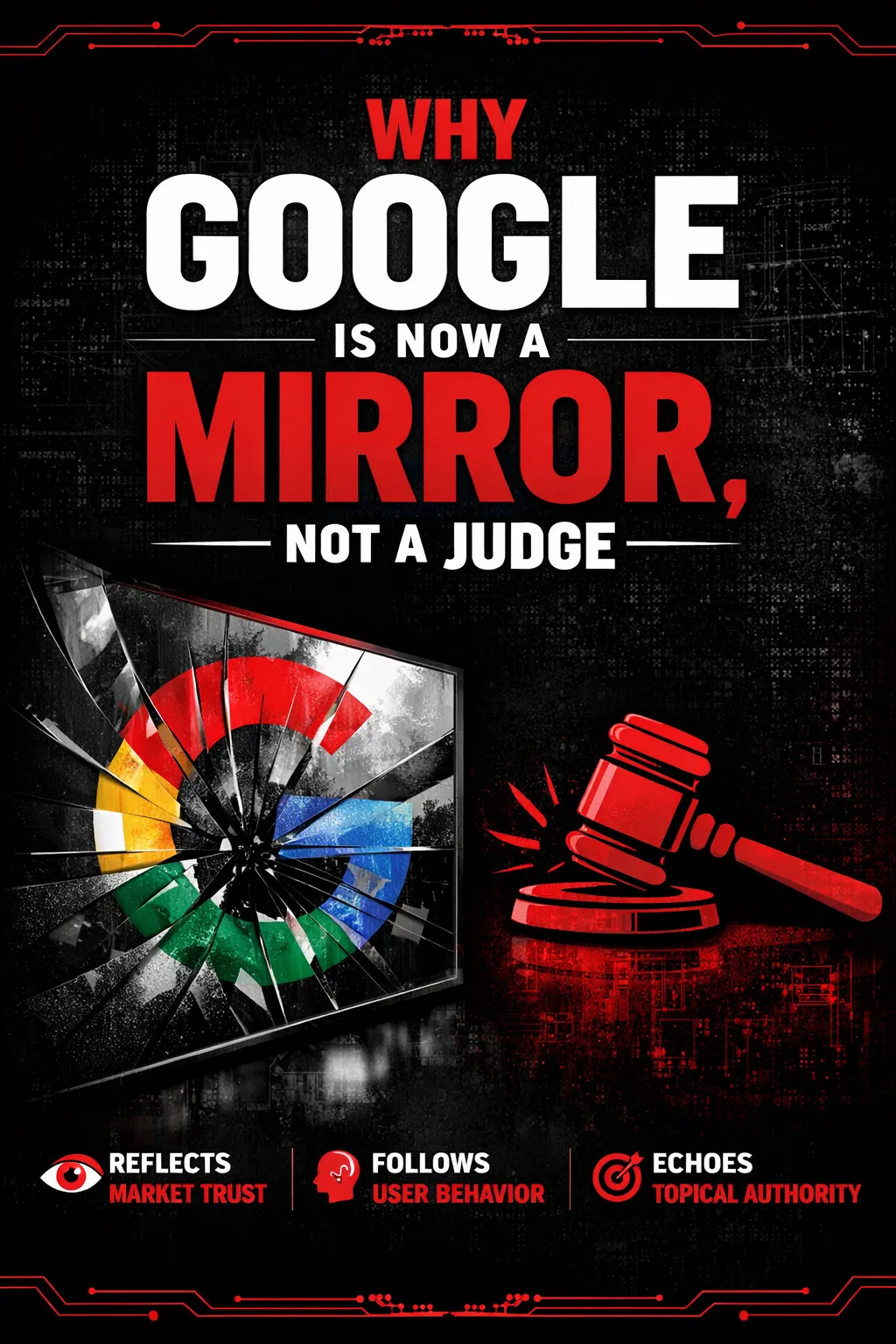
For years, SEO treated Google like a supreme authority—an all-powerful judge that decided which brands deserved visibility and which didn’t. Marketers optimized for its rules, chased its updates, and waited for its verdict in the form of rankings.
That era is over.
Today, Google no longer decides reality. It reflects it.
From Arbiter to Observer
Modern search algorithms are not designed to decide what is good. They are designed to observe what already is.
Google now functions as a massive reflection engine, continuously analyzing how the market behaves, whom users trust, and which brands command attention across the digital ecosystem. Rankings are no longer judgments handed down by Google—they are mirrors of collective perception.
What Google Actually Reflects Today
1. Market Trust
Google watches signals far beyond your website:
- Brand mentions across platforms
- Consistency of expertise in discussions
- Recognition as a reference point
If the market treats you like an authority, Google follows suit.
2. Behavioral Confidence
User behavior has become a dominant signal:
- Do users engage deeply or bounce quickly?
- Do they return to your brand?
- Do they search for you by name?
Confidence at scale tells Google, “This brand matters.”
3. Topical Gravity
Some brands naturally pull visibility toward themselves. Not because of optimization—but because:
- They cover topics comprehensively
- They define narratives
- They anchor conversations
This gravitational pull is what algorithms now reward.
The Algorithm Follows Perception, Not the Other Way Around
A critical misunderstanding in SEO is believing that perception is a result of rankings. In reality, rankings are the outcome of perception.
When:
- Users trust you
- AI systems reference you
- The market treats you as a default answer
Google simply reflects that consensus.
Trying to “win Google” without shaping perception is like arguing with a mirror and expecting your reflection to change.
You Don’t Win Google. You Influence the Reality Google Observes.
This is the fundamental shift modern SEO must accept.
You don’t:
- Convince Google
- Outsmart Google
- Manipulate Google
You engineer the environment in which Google collects signals.
When perception is aligned—across users, AI systems, content ecosystems, and brand narratives—Google has no choice but to reflect it.
The ThatWare Perspective
While others are still chasing algorithmic approval, ThatWare focuses on perception engineering:
- Designing how authority is recognized
- Structuring how trust is distributed
- Shaping the narratives algorithms observe
Because when reality is redesigned correctly, rankings are no longer chased.
They appear.
How ThatWare Redesigns the Reality of Rankings
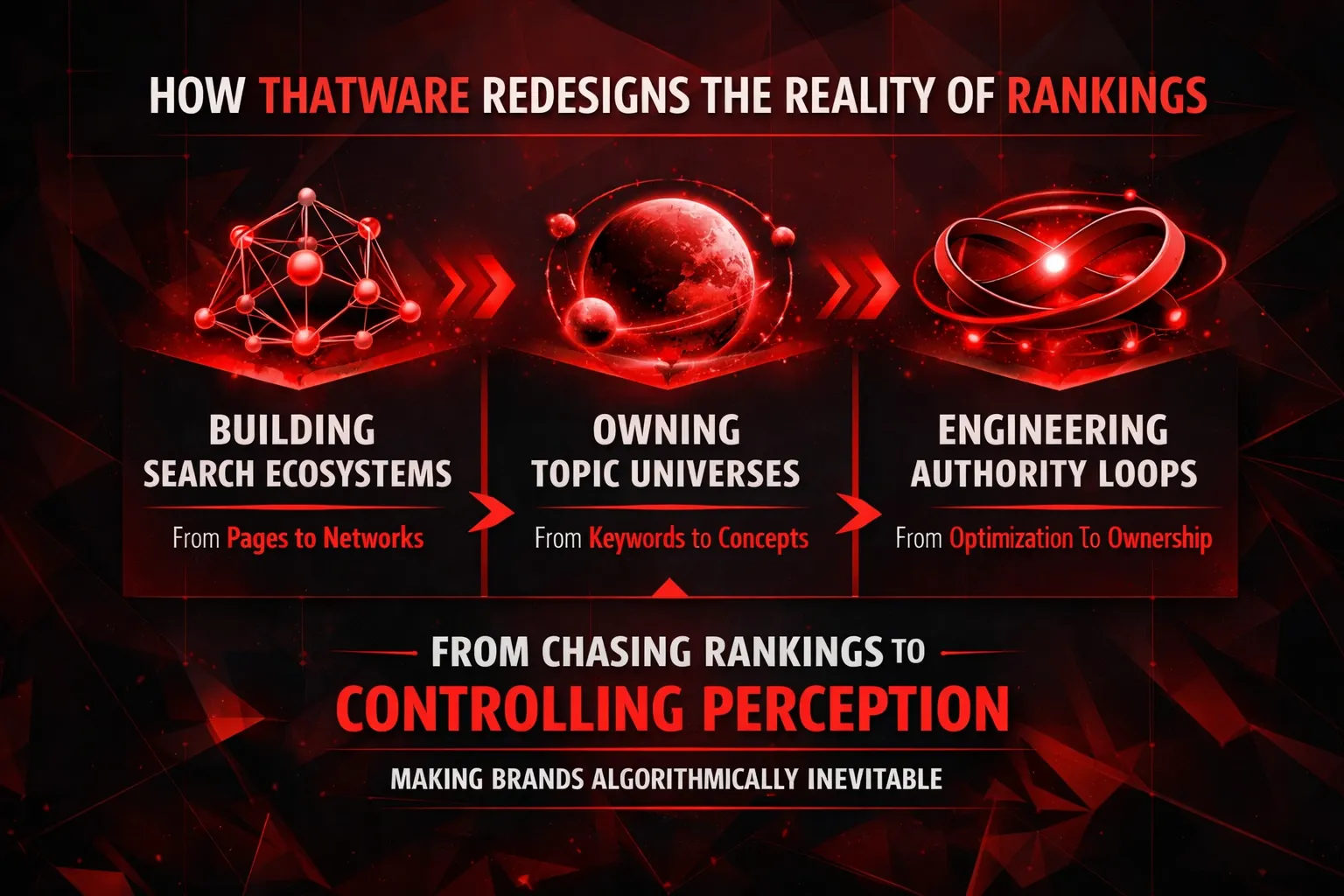
Most SEO agencies stop at execution. ThatWare operates at architecture level.
This is where the philosophy of perception engineering becomes a proprietary system—one that doesn’t chase algorithm updates but reshapes the environment in which algorithms make decisions.
Beyond SEO Campaigns — System Engineering
Traditional SEO works in campaigns. ThatWare works in systems.
Building Search Ecosystems, Not Pages
Pages rank. Ecosystems dominate.
Instead of optimizing isolated URLs, ThatWare designs interconnected knowledge structures where:
- Core pages establish authority
- Supporting content reinforces context
- Peripheral assets amplify trust signals across platforms
Every asset strengthens the whole. Rankings stop being fragile because no single page carries the burden of visibility.
Designing Topic Universes
Keywords are finite. Topics are expansive.
ThatWare engineers topic universes—comprehensive semantic territories where a brand becomes synonymous with an idea, not just a phrase.
This includes:
- Deep topical coverage across intent stages
- Semantic layering that trains algorithms on expertise depth
- Cross-topic reinforcement that increases topical gravity
When a topic universe is complete, algorithms don’t test authority—they assume it.
Engineering Authority Loops
Authority is no longer static. It is self-reinforcing.
ThatWare builds authority loops where:
- Content influences user behavior
- User behavior reinforces algorithmic trust
- Algorithmic trust amplifies visibility
- Visibility increases brand recall
- Brand recall feeds back into engagement
This loop creates compounding authority, not one-time rankings.
From Optimization to Ownership
Optimization improves pages. Ownership controls narratives.
Owning Conversations, Not Keywords
Modern search doesn’t start with keywords—it starts with questions, comparisons, and context.
ThatWare positions brands at the center of:
- Industry conversations
- Problem definitions
- Solution frameworks
When users repeatedly encounter the same brand shaping understanding, rankings become secondary.
Becoming the Default Reference Point
Search engines, AI models, and users all rely on reference bias.
ThatWare engineers visibility so that:
- Algorithms repeatedly encounter the brand in authoritative contexts
- AI models learn to associate the brand with expertise
- Users instinctively trust and return to the brand
The goal is not to be found—it’s to be remembered.
Making Competitors Contextually Irrelevant
Competition isn’t eliminated by outranking—it’s eliminated by outcontexting.
ThatWare achieves this by:
- Expanding topical depth beyond competitors’ reach
- Framing problems in ways only the brand addresses
- Redefining comparison criteria where competitors don’t qualify
When competitors don’t fit the narrative, they don’t compete—regardless of rankings.
AI-Centric Visibility Engineering
Search visibility is no longer human-only. AI is now the primary consumer of content.
ThatWare optimizes for how AI systems learn, recall, and recommend.
Optimizing for SGE Inclusion
Search Generative Experience doesn’t rank pages—it selects sources.
ThatWare structures content to:
- Answer multi-layered intent
- Provide high-confidence informational completeness
- Align with entity-based understanding
This increases the probability of being used by AI, not just indexed.
Optimizing for AI Citations
AI models reference patterns of trust.
ThatWare builds:
- Consistent topical authority signals
- Cross-platform corroboration
- Concept-level clarity that AI can synthesize
When AI answers questions, it doesn’t just pull data—it leans on perceived experts.
Optimizing for Conversational Search Recall
People no longer search in keywords. They talk to machines.
ThatWare engineers content to:
- Match natural language reasoning
- Anticipate follow-up questions
- Maintain conceptual continuity across conversations
This ensures brands surface repeatedly across long-form AI interactions, not just one-off queries.
The Result: Rankings Become a Side Effect
When:
- Ecosystems replace pages
- Ownership replaces optimization
- AI recall replaces keyword targeting
Rankings stop being the goal.
They become the outcome of a reality engineered for trust, authority, and inevitability.
While others chase rankings, ThatWare redesigns the reality in which rankings exist.
Case-Level Scenarios: What Visibility Really Looks Like Today
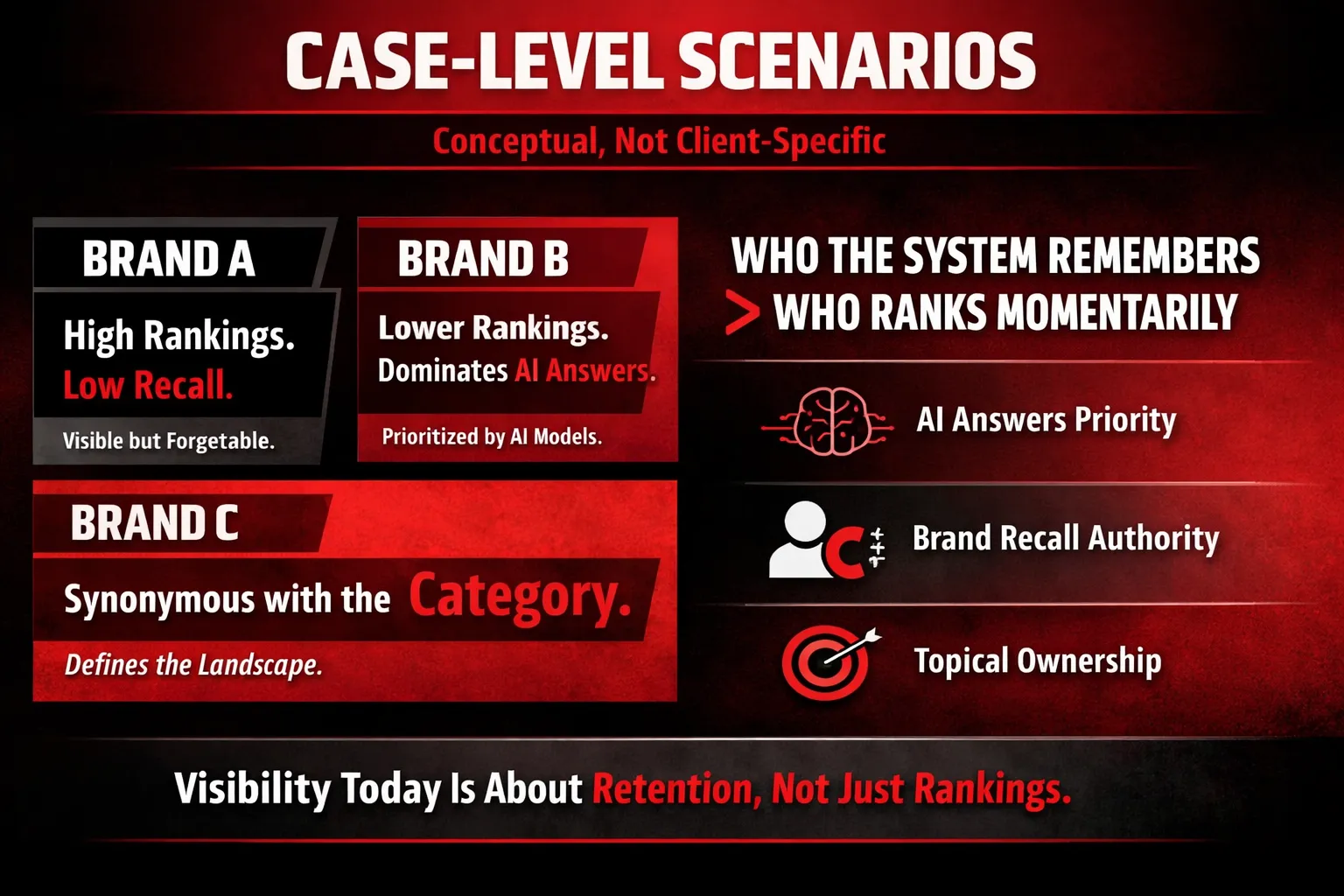
To understand why SEO is no longer about rankings, we need to look at how visibility behaves in the real world—not in dashboards.
Consider three hypothetical brands operating in the same competitive space.
Brand A: High Rankings, Low Recall
Brand A has done everything “right” by traditional SEO standards.
- Top 3 rankings for high-volume keywords
- Strong backlink profile
- Technically optimized pages
- Consistent organic traffic
On paper, Brand A looks like a success.
But something is missing.
When users:
- Ask AI tools for recommendations
- Look for expert opinions
- Compare solutions across platforms
Brand A rarely appears.
Why?
Because Brand A optimized pages, not perception.
Users consume the content, but they don’t remember the brand. Algorithms see relevance, but not authority. AI models scan the web, but Brand A doesn’t stand out as a conceptual reference.
Result:
- High rankings, low influence.
- Visibility that exists only while the ranking holds.
Brand B: Lower Rankings, High AI Dominance
Brand B doesn’t always rank #1.
In fact:
- Some keywords sit on page two
- Traffic is modest compared to competitors
Yet Brand B shows up repeatedly in:
- AI-generated answers
- Conversational search results
- Thought-leadership summaries
When users ask why, how, or what’s best—Brand B appears.
Why?
Because Brand B has engineered:
- Clear topical depth
- Consistent expertise signals
- Strong contextual associations
AI systems don’t just read Brand B’s content—they learn from it.
Result:
- Lower traditional rankings, higher cognitive visibility.
- Brand B is remembered, referenced, and repeated.
Brand C: The Category Itself
Brand C doesn’t chase rankings at all.
Instead:
- Its name is used interchangeably with the solution
- Users search for the brand directly
- AI tools describe the category using Brand C’s language
Brand C doesn’t compete within the category. It defines the category.
Competitors rank for keywords. Brand C owns the conversation.
When Brand C publishes content:
- Rankings follow automatically
- AI citations are natural
- Trust is assumed, not earned repeatedly
Result:
Brand C becomes the default mental shortcut—for humans and machines alike.
The Real Lesson: Memory Beats Position
These scenarios reveal a critical truth about modern SEO:
Visibility today is not about who ranks momentarily. It’s about who the system remembers.
Search engines, AI models, and users are all doing the same thing:
- Filtering noise
- Identifying patterns
- Remembering trusted sources
Rankings are temporary. Perception compounds.
Brands that engineer recall, authority, and contextual dominance don’t worry about algorithm updates—because the algorithm is already aligned with them.
This is the shift most businesses haven’t recognized yet.
While others chase positions, ThatWare redesigns the conditions under which positions are assigned.
The Cost of Ignoring Perception Engineering
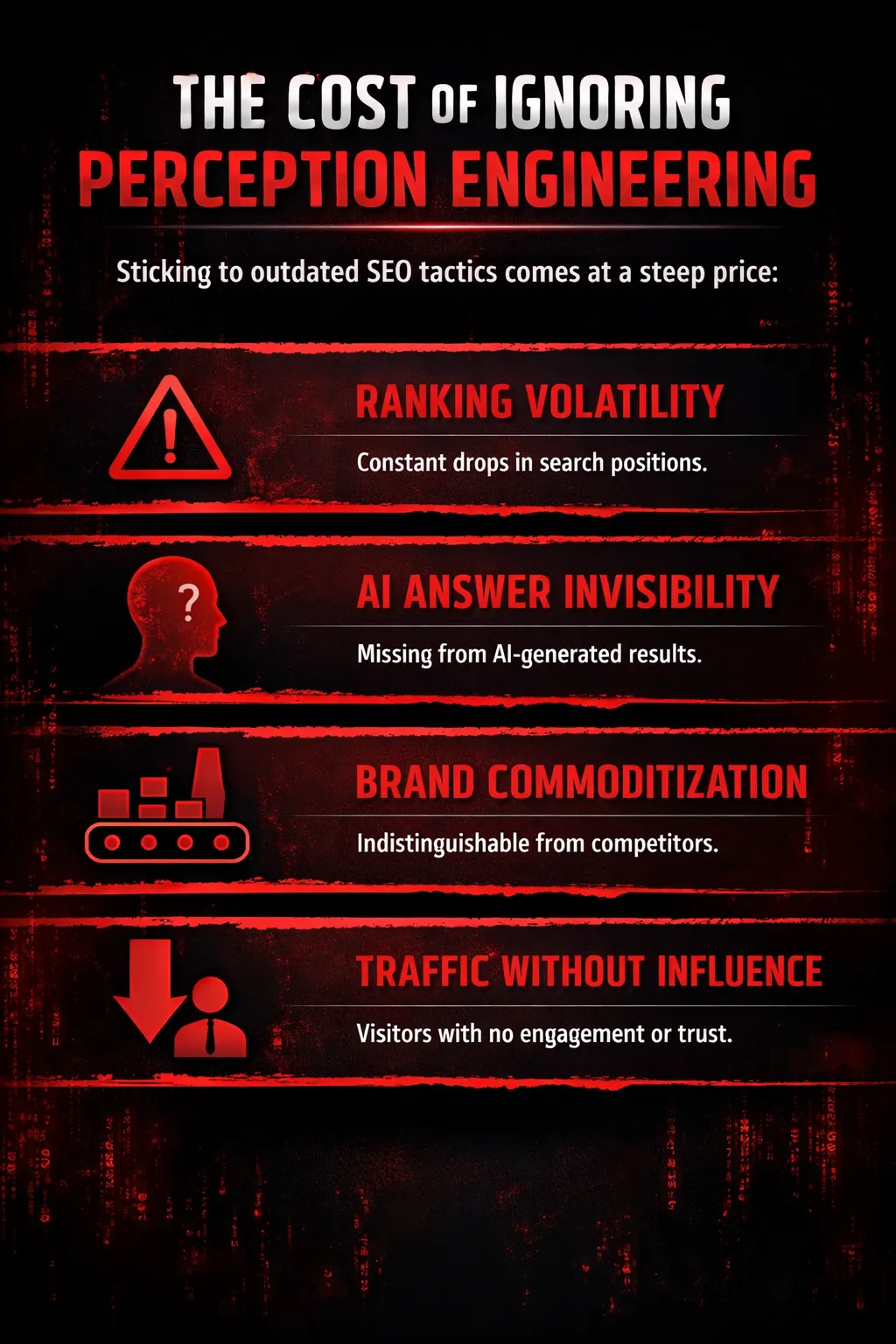
Ignoring perception engineering doesn’t mean your SEO stops working overnight. It means it slowly becomes irrelevant—while appearing “active” on the surface.
Brands that continue to treat SEO as a ranking game are not failing loudly. They are stagnating quietly.
Here’s the real cost.
1. Ranking Volatility: Building on Shifting Sand
When rankings are the goal, volatility becomes inevitable.
- Algorithm updates reshuffle winners overnight
- Yesterday’s top-performing pages quietly disappear
- Growth becomes reactive instead of strategic
Why? Because rankings without engineered perception lack stability.
Search engines no longer reward isolated optimization. They reward:
- Consistent authority
- Behavioral trust
- Market-level confidence
Without perception engineering, rankings are temporary approvals—revocable at any moment.
If your visibility depends on the algorithm’s mood, you don’t own it.
2. AI Answer Invisibility: When You Exist but Aren’t Remembered
The most dangerous outcome today isn’t ranking low. It’s being absent from AI-generated answers.
AI systems don’t scan the SERPs the way humans do. They recall:
- Recognized entities
- Trusted narratives
- Repeated authority signals
Brands that ignore perception engineering may:
- Rank on Google
- Get traffic
- Yet never appear in:
- SGE summaries
- ChatGPT responses
- Perplexity citations
This creates a silent gap:
You’re searchable, but not referenceable.
And in an AI-first world, being referenced is more powerful than being clicked.
3. Brand Commoditization: When You Look Like Everyone Else
Without engineered perception, SEO flattens brands.
- Same keywords
- Same content angles
- Same promises
- Same rankings
The result?
You compete on:
- Position
- Price
- Volume
Not authority.
Search engines—and users—struggle to distinguish you from competitors because you haven’t given them a reason to.
Commoditized brands don’t lose rankings first. They lose identity.
4. Traffic Without Influence: The Most Expensive Failure
Traffic has never been cheaper to generate. Influence has never been harder to earn.
Ignoring perception engineering leads to:
- Visitors who don’t remember you
- Clicks without conviction
- Sessions without trust
You get:
- Impressions
- Sessions
- Bounce rates
But not:
- Market leadership
- Thought authority
- Brand gravity
This is the illusion of success—numbers rising, impact flat.
Traffic without influence is just noise with analytics.
The Real Risk: Becoming Invisible While Still Ranking
The most dangerous brands today are not the ones losing traffic. They are the ones still ranking—while slowly losing relevance.
Perception engineering isn’t a future tactic. It’s the difference between:
- Being optimized
- And being understood
Between:
- Being visible
- And being inevitable
Because in modern search, what the system perceives about you matters more than where you appear.
And those who ignore that reality won’t fall suddenly.
They’ll fade—quietly, efficiently, and permanently.
The Future of SEO: Invisible, Contextual, Inevitable

For years, SEO has been treated like a mechanical game: find keywords, publish pages, build links, climb rankings. It worked because search was simpler—users typed queries, Google served blue links, and traffic flowed to whoever satisfied the algorithm most effectively.
That era is fading fast.
The future of SEO isn’t louder. It’s quieter. It’s not a checklist. It’s a strategy. And most importantly, it’s no longer something you “do” to Google—it’s something you build into how your brand is perceived everywhere.
SEO is becoming invisible, contextual, and inevitable.
SEO Will Blend Into Brand Strategy
The next generation of SEO won’t sit inside a marketing silo.
It will live inside:
- how brands explain themselves,
- what they consistently stand for,
- how they teach a market,
- and how they become a default reference point in their category.
Because search engines and AI systems don’t just evaluate pages anymore. They evaluate patterns:
- Patterns of expertise
- Patterns of trust
- Patterns of consistency
- Patterns of recognition across the web
That’s brand strategy, not “SEO tactics.”
In the future, the brands that win will be the ones whose content doesn’t feel like content—it feels like the brand’s intelligence made visible. Their SEO won’t look like optimization. It will look like clarity.
SEO Will Become Less Measurable, But More Powerful
This is uncomfortable for many teams, because SEO has always been sold as measurable.
Rankings. Traffic. Clicks. Impressions.
But the systems shaping discovery are shifting:
- AI answers reduce click-through rates
- Zero-click results are normal, not rare
- Users gather confidence from summaries, snippets, reviews, and community echoes
- Discovery happens across platforms, not just on Google
The impact is huge—and often hard to attribute.
You might not “see” the SEO win in a neat dashboard anymore. But you will feel it in outcomes that matter more:
- shorter sales cycles
- higher trust before first contact
- increased inbound demand
- stronger brand recall
- higher conversion rates from warmer traffic
SEO becomes less measurable because it’s no longer confined to a single touchpoint. It becomes more powerful because it influences the entire decision environment.
In other words: you stop counting clicks, and start building inevitability.
SEO Will Reward Those Who Shape Narratives
As search becomes more contextual, the winning variable changes.
The old game:
- “Which page matches this keyword?”
The new game:
- “Which brand owns the meaning behind this topic?”
Search engines and AI models increasingly respond to narratives:
- who is consistently associated with a concept
- who explains it best
- who appears across credible sources
- who users trust, mention, and return to
This means visibility is no longer just about relevance. It’s about interpretation.
Brands that shape narratives don’t just answer questions—they define the way questions are understood.
And when you define the narrative, you don’t need to fight for attention. The system brings attention to you because you’ve become part of the context.
That’s what most SEO strategies miss: You don’t win by reacting to search demand. You win by creating the framework people use to think about the demand.
The Future Belongs to Perception Engineers, Not Metric Chasers
If you’re still optimizing purely for performance metrics, you’ll stay trapped in a fragile loop:
- chase rankings
- lose rankings
- chase again
- repeat forever
But the brands that engineer perception build something different:
- They become the “trusted voice” the system recognizes
- They earn visibility across platforms, not just SERPs
- They are cited, referenced, and remembered
- They don’t just attract traffic—they attract belief
Because in the emerging era, visibility isn’t only about being found.
It’s about being chosen without hesitation.
And that only happens when perception is engineered—deliberately, consistently, system-wide.
The Real Shift
SEO is no longer a race for position. It’s a race to become the most credible interpretation of a topic.
That’s why the future of SEO is:
- Invisible — baked into brand presence, not bolted onto pages
- Contextual — driven by meaning, not mechanics
- Inevitable — a natural outcome of authority, not a temporary win
The future belongs to brands that engineer perception— not brands that chase performance metrics.
Final Manifesto: Redesign the Reality or Chase It Forever
The SEO industry is at a crossroads.
On one side are those still chasing rankings—refreshing dashboards, tracking positions, reacting to every algorithm update as if visibility were something Google temporarily “allows.” This approach is loud, exhausting, and increasingly fragile. It treats search as a race, not a system.
On the other side is a quieter, more powerful path.
At ThatWare, we don’t chase rankings. We redesign the reality in which rankings are formed.
Because rankings don’t exist in isolation. They are outcomes—signals emitted by a system that is constantly observing trust, authority, and context across the digital ecosystem.
Others Chase Rankings. ThatWare Redesigns What Rankings Respond To.
Trust
Not manufactured through tactics, but earned through consistency, depth, and credibility across every touchpoint where users and machines seek understanding.
Authority
Not borrowed through shortcuts, but engineered by owning topics, shaping narratives, and becoming the reference point algorithms return to—again and again.
Context
Not limited to keywords or pages, but expanded across intent, behavior, entities, and ecosystems where search decisions are actually made.
When these elements are engineered correctly, rankings stop being the goal. They become the natural consequence.
Google no longer “decides” who wins. It reflects what the market already believes.
And markets are shaped by perception.
Closing Statement
SEO is no longer about Google. It’s about shaping the reality in which Google operates.
You can spend the future reacting—chasing rankings that move further out of reach.
Or you can redesign the system they emerge from.
ThatWare chooses the latter.