SUPERCHARGE YOUR ONLINE VISIBILITY! CONTACT US AND LET’S ACHIEVE EXCELLENCE TOGETHER!
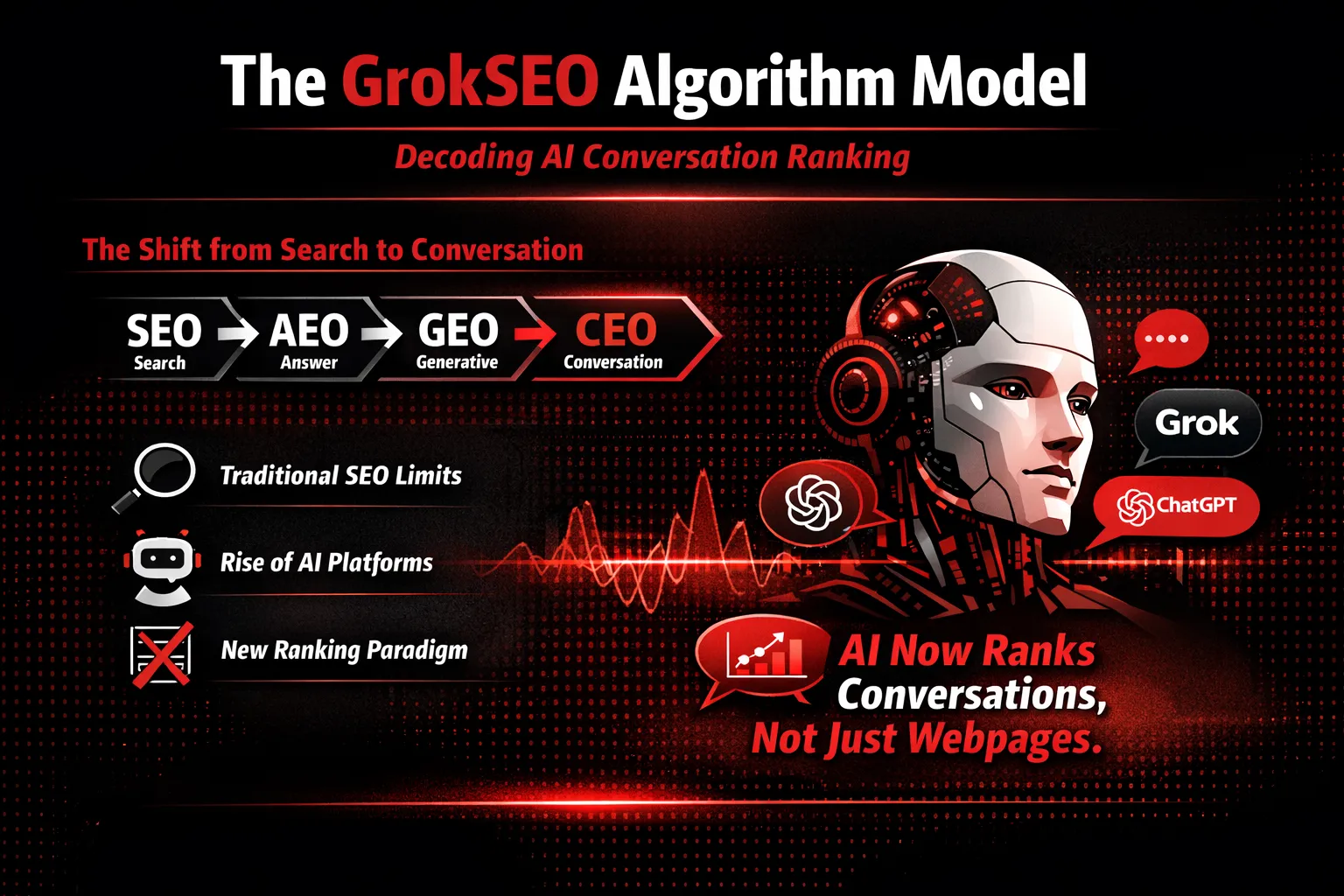
For over two decades, digital visibility has been defined by traditional search engines. Brands competed for rankings based on keywords, backlinks, and technical optimization. But today, we are witnessing a fundamental transformation—one that is reshaping how information is discovered, interpreted, and trusted.
The evolution is clear:
SEO → AEO → GEO → CEO (Conversation Engine Optimization)
- SEO (Search Engine Optimization) focused on ranking webpages
- AEO (Answer Engine Optimization) aimed to provide direct answers
- GEO (Generative Engine Optimization) optimized for AI-generated responses
- And now, CEO (Conversation Engine Optimization) is emerging—where visibility is driven by influence within conversations
This shift is being accelerated by the rapid rise of conversational AI platforms such as Grok, ChatGPT, and other generative systems. These platforms don’t just retrieve information—they interpret, synthesize, and respond based on patterns of trust, authority, and engagement across vast conversational datasets.
As a result, the rules of ranking are changing.
Traditional ranking signals like keywords, backlinks, and on-page SEO are no longer sufficient on their own. Instead, AI systems are increasingly prioritizing:
- Who is being discussed
- What is being said
- How often it is reinforced
- And how credible those conversations are
In this new paradigm, content is no longer the only unit of value—conversations are.
This leads to a critical realization:
AI doesn’t just rank webpages anymore. It ranks conversations, entities, and influence.
Understanding this shift is essential for any brand, expert, or organization aiming to stay visible in the age of AI-driven discovery.
What is the GrokSEO Algorithm Model?
The GrokSEO Algorithm Model is a conceptual framework designed to explain how modern AI-driven platforms rank information within conversations. Unlike traditional search algorithms that prioritize webpages, keywords, and backlinks, GrokSEO focuses on how knowledge emerges, spreads, and gains authority within discussions.
At its core, GrokSEO reflects a fundamental shift:
AI engines are no longer just indexing content—they are interpreting conversations, evaluating participants, and ranking ideas in real time.
How AI Engines Evaluate Information in Conversations
The GrokSEO model is built on three foundational pillars that AI systems use to determine what information deserves visibility:
1. Entities (Who is speaking?)
AI engines prioritize entities over content alone. An entity can be:
- a person (e.g., an industry expert)
- a brand (e.g., ThatWare)
- a concept or framework
AI evaluates:
- authority of the entity
- historical credibility
- relationships with other trusted entities
In simple terms, who says something is often as important as what is being said.
2. Discussions (How knowledge evolves)
Modern AI systems analyze conversations as dynamic knowledge graphs rather than static text.
They evaluate:
- depth of discussion
- quality of responses
- participation from credible voices
- continuity and expansion of ideas
A shallow post may be ignored, while a deep, multi-layered discussion can become a long-term knowledge asset for AI models.
3. Credibility (Why it should be trusted)
AI engines continuously assess trustworthiness through signals such as:
- expert agreement
- citations and references
- sentiment and reputation
- consistency across platforms
Rather than relying on a single source, AI builds confidence through collective validation.
A New Layer of Ranking Intelligence
The GrokSEO Algorithm Model represents a new evolution in ranking systems—a layer beyond traditional SEO.
Instead of ranking:
- pages → AI ranks entities
- keywords → AI ranks meaning
- backlinks → AI ranks conversational validation
This introduces what can be described as Conversational Ranking Intelligence—a system where visibility is earned through:
- influence in discussions
- clarity of knowledge
- and trust within a network of entities
In this new paradigm, success is no longer about optimizing for search engines alone.
It’s about becoming a trusted voice within the conversations that AI systems learn from and amplify.
ntroducing ThatWare’s Proprietary Framework: CERA
As artificial intelligence continues to redefine how information is discovered, interpreted, and ranked, a new paradigm is emerging—one where conversations, not just content, determine visibility. To address this shift, ThatWare introduces its proprietary framework:
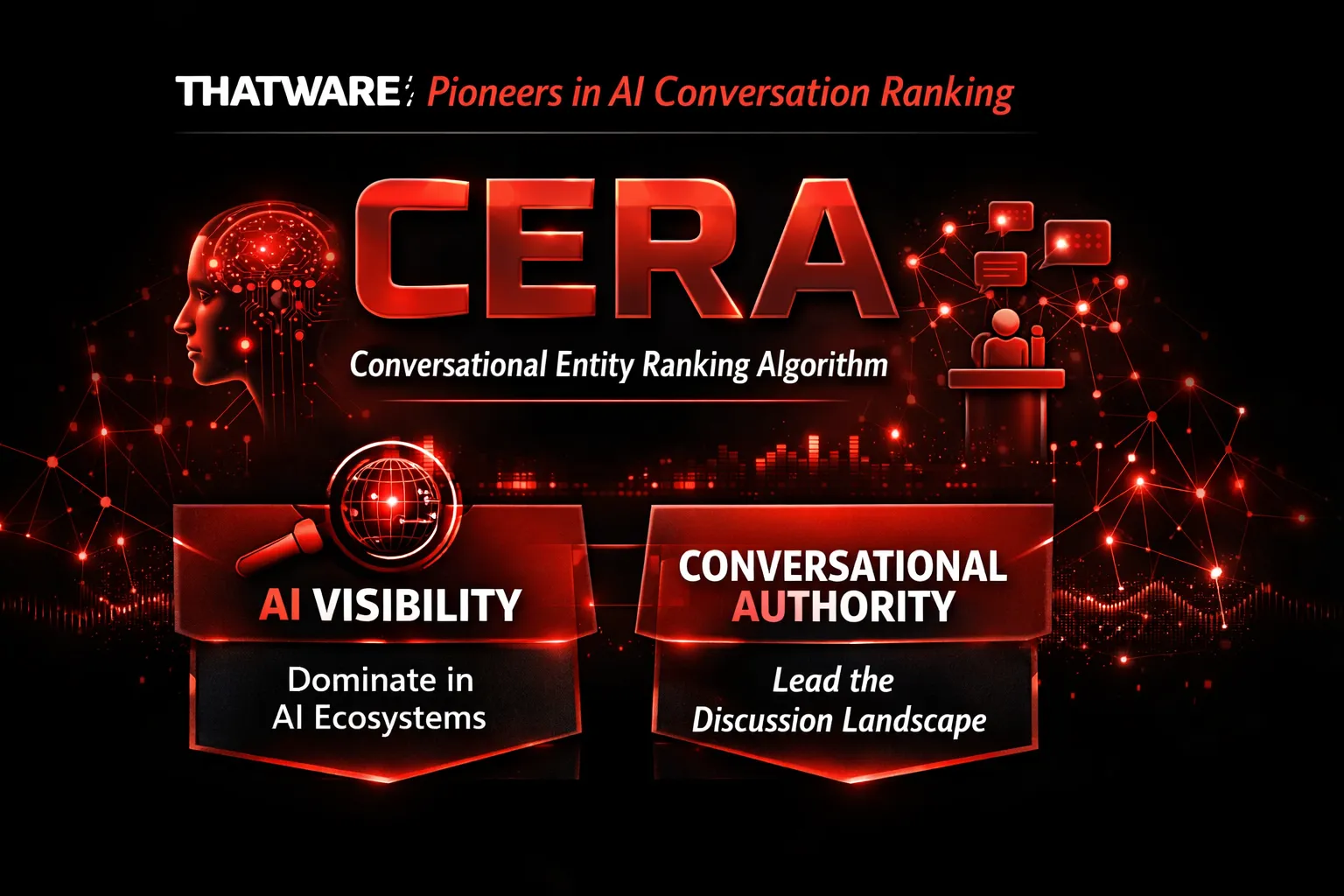
CERA — Conversational Entity Ranking Algorithm
CERA represents a next-generation approach to digital visibility, designed specifically for AI-driven ecosystems such as ChatGPT, Grok, and other conversational engines. Unlike traditional SEO models that focus on keywords and webpages, CERA focuses on entities, interactions, and conversational authority.
At its core, CERA is built on a simple yet powerful premise:
In the age of AI, entities are ranked based on how they are discussed, trusted, and referenced across conversations.
ThatWare: Pioneers in AI Conversation Ranking Science
With the introduction of CERA, ThatWare positions itself at the forefront of a new discipline—AI conversation ranking science.
While most of the industry is still adapting to changes in search algorithms, ThatWare is actively defining how ranking works in conversational AI environments. CERA is not just a framework; it is a strategic evolution of SEO into a multi-dimensional, AI-first ranking model.
This positions ThatWare as:
- Innovators in entity-based optimization
- Leaders in AI visibility engineering
- Architects of conversation-driven authority systems
What CERA Solves
As AI platforms increasingly become the primary interface for information discovery, brands face two critical challenges:
1. Visibility in AI-Driven Ecosystems
Traditional search visibility does not guarantee presence in AI-generated answers or conversations. CERA addresses this gap by optimizing how entities are:
- recognized by AI models
- included in responses
- surfaced in conversational outputs
It ensures that brands are not just indexed—but actively referenced and recommended.
2. Authority in Conversational Environments
In AI systems, authority is no longer defined solely by backlinks or domain metrics. Instead, it is shaped by:
- expert mentions
- consensus in discussions
- clarity of knowledge shared
CERA enables brands to build conversational authority, ensuring they are perceived as credible, trustworthy, and influential entities within AI ecosystems.
The Bigger Shift
CERA reflects a broader transformation:
- From content optimization → entity optimization
- From search rankings → conversation rankings
- From traffic acquisition → influence acquisition
In this new landscape, the brands that win are not those that rank highest on search engines—but those that dominate conversations across AI platforms.
By introducing CERA, ThatWare is not just adapting to the future of search—it is actively shaping it.
The 10 Core Ranking Signals of Conversation Engines
As AI systems evolve from indexing webpages to understanding conversations, a new class of ranking signals is emerging. These signals determine how entities, discussions, and insights are evaluated within conversational ecosystems like Grok and other AI engines.
At the core of this transformation lies the ability to measure influence, depth, and credibility within discussions.
Let’s break down the first two foundational signals.
1) Conversational Authority Score (CAS)
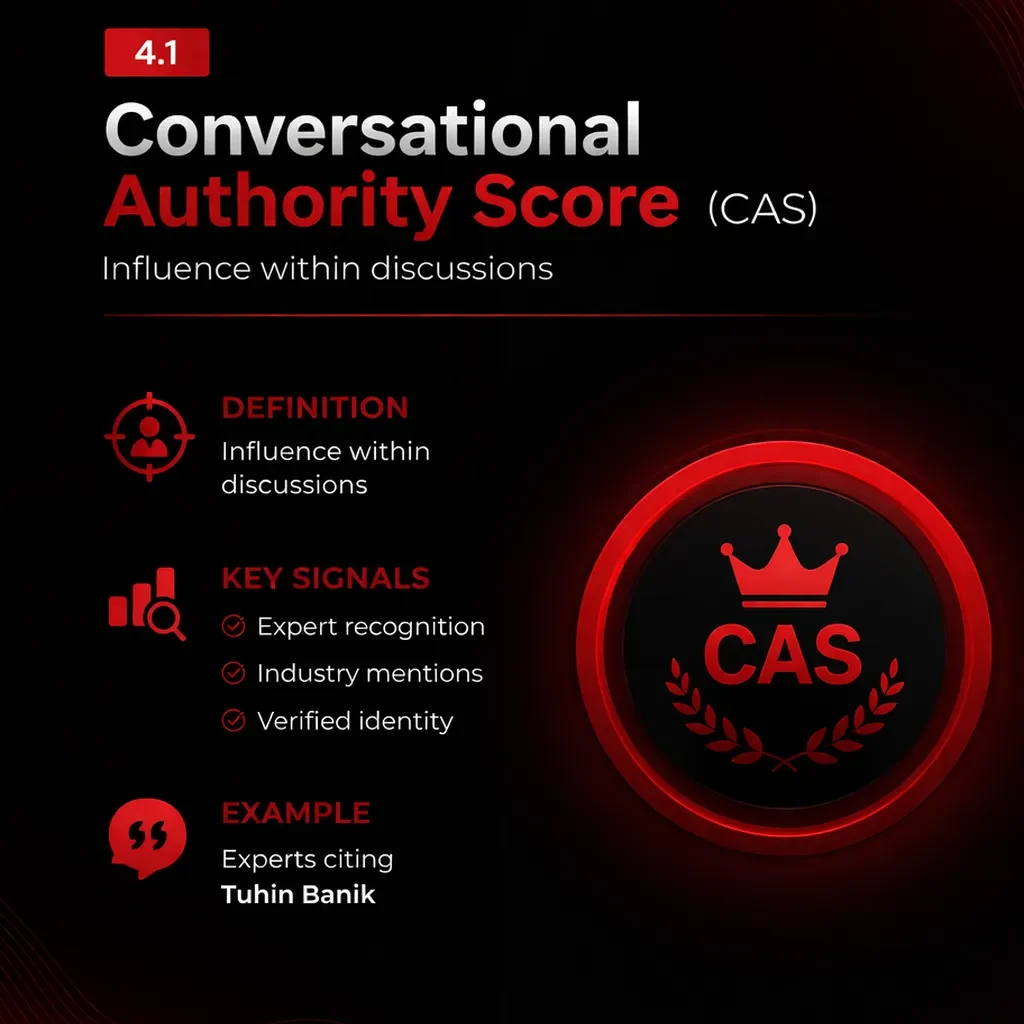
The Conversational Authority Score (CAS) measures how influential an entity is within ongoing discussions across digital platforms.
Unlike traditional SEO authority, which is largely based on backlinks, CAS evaluates who is trusted, referenced, and recognized within conversations.
Key Signals Behind CAS
- Expert Recognition
When industry experts acknowledge or engage with an individual or brand, it significantly strengthens their conversational authority.
- Industry Mentions
Frequent mentions across discussions, threads, and professional communities indicate relevance and influence.
- Verified Identity
Verified profiles or clearly established identities enhance trust and credibility in AI evaluation models.
Why CAS Matters
AI systems prioritize entities that consistently shape conversations, not just those who publish content. Authority is no longer static—it is continuously reinforced through interaction and recognition.
Example
If multiple experts cite or reference Tuhin Banik in discussions around AI SEO or advanced search strategies, AI engines begin to interpret that entity as a trusted and authoritative source within that domain.
Over time, this repeated validation strengthens the entity’s position in conversational rankings.
2) Thread Depth Index (TDI)
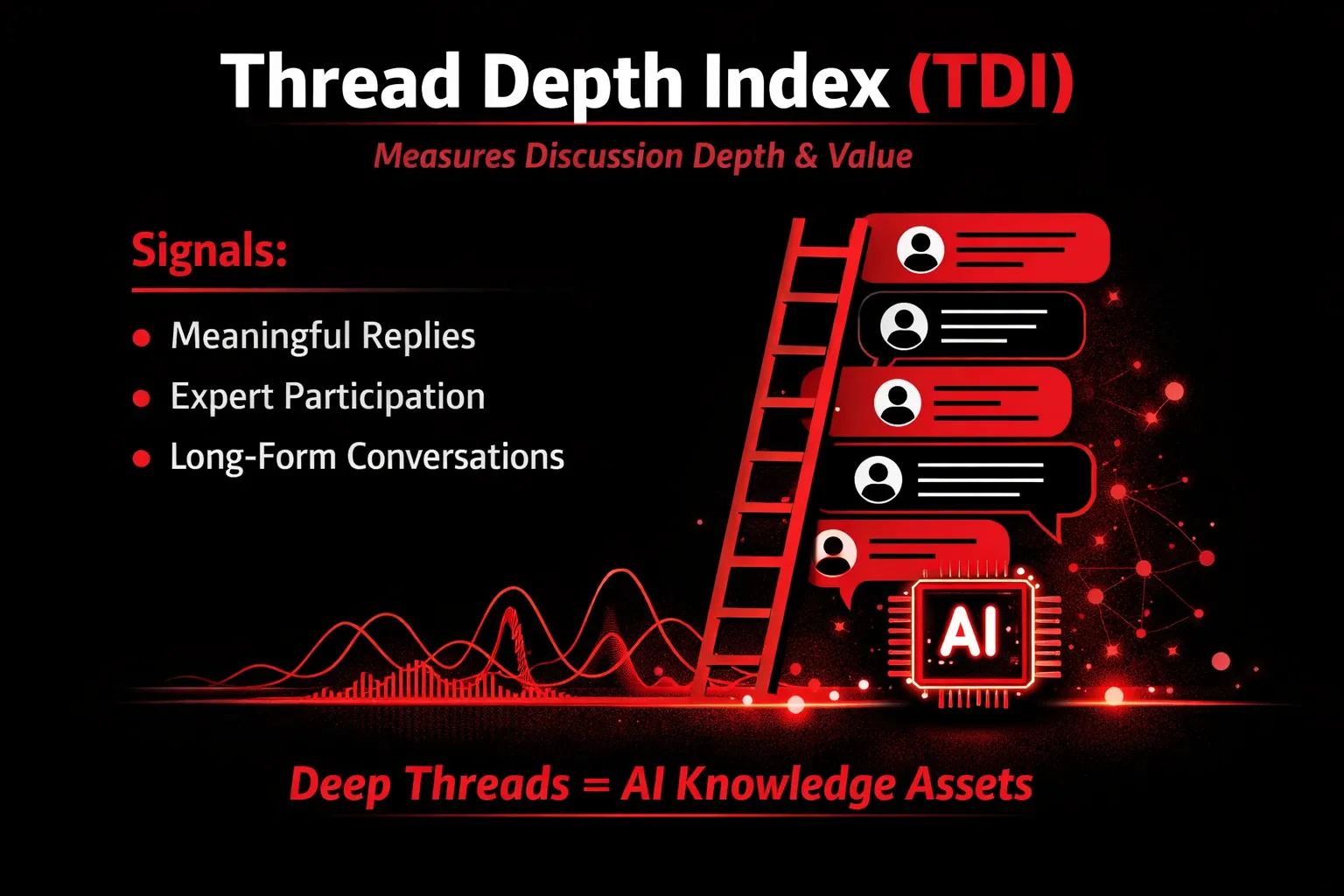
The Thread Depth Index (TDI) measures how deep, informative, and valuable a discussion thread is.
AI systems increasingly favor rich, multi-layered conversations over shallow interactions. A thread is no longer just engagement—it becomes a knowledge structure.
Core Signals Behind TDI
- Meaningful Replies
Responses that add insights, expand on ideas, or introduce new perspectives contribute to thread depth.
- Expert Participation
When credible voices join a discussion, the informational value of the thread increases significantly.
- Long-Form Conversations
Extended discussions with multiple layers of dialogue signal depth and sustained relevance.
Why TDI Matters
Deep threads function as living knowledge hubs. AI models can extract structured insights, patterns, and consensus from them, making these threads highly valuable for training and retrieval.
Key Insight
Deep threads are no longer just conversations—they are AI-readable knowledge assets.
This means that brands and individuals who foster high-quality discussions are not just engaging audiences—they are actively contributing to the knowledge ecosystems that AI systems rely on.
3) Engagement Velocity Score (EVS)
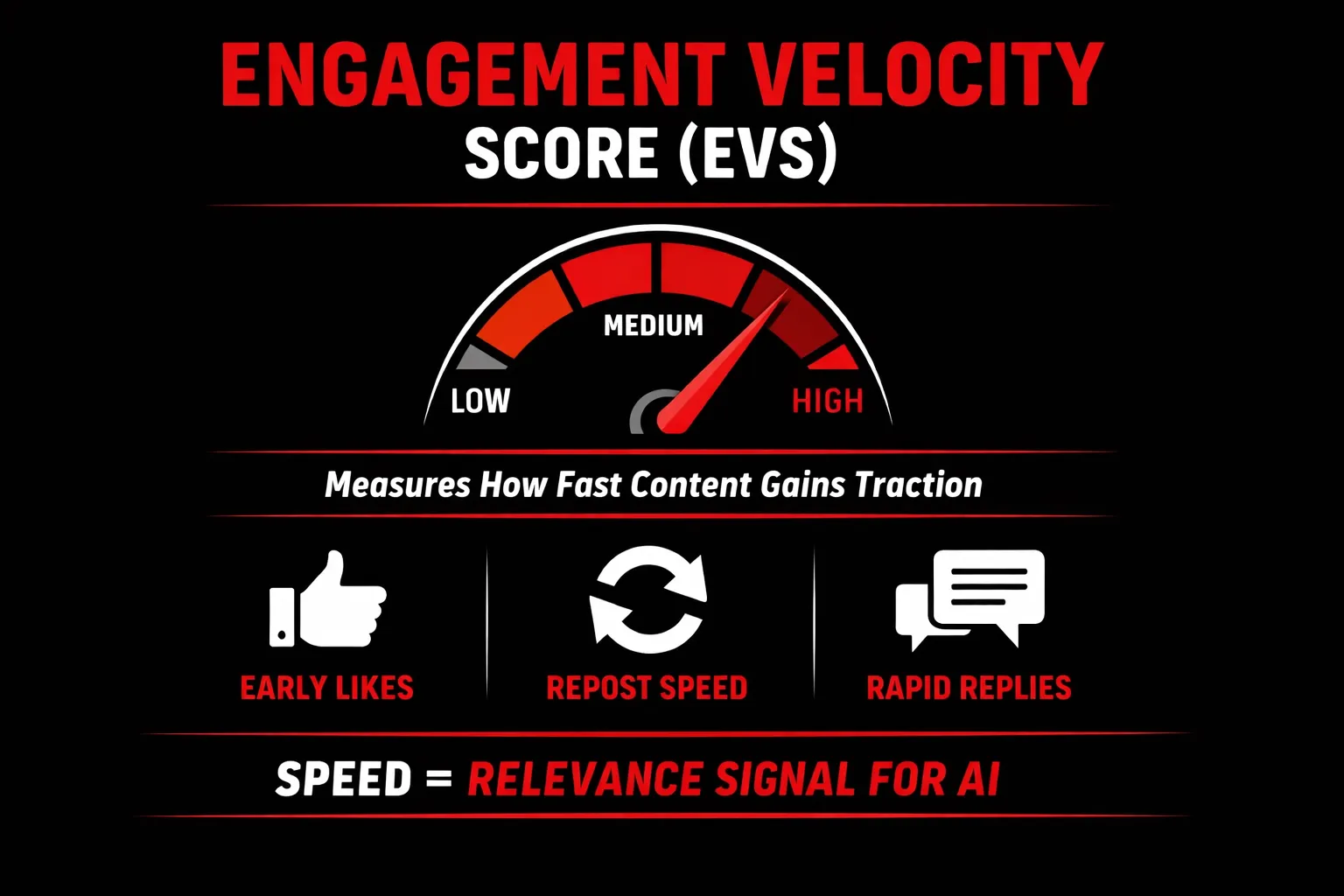
In the era of conversational AI, timing is no longer just important—it is a ranking signal. The Engagement Velocity Score (EVS) measures how quickly a piece of content gains traction immediately after being published.
Unlike traditional SEO, where content can take days or weeks to rank, AI-driven systems like Grok evaluate real-time interaction patterns to determine relevance. Content that generates rapid engagement signals to AI that the topic is timely, valuable, and worth prioritizing in responses.
Key Signals Behind EVS
- Early likes and reactions within the first hour
- Repost and share velocity
- Rapid reply activity and discussion initiation
These signals collectively indicate momentum—a critical factor in conversational ecosystems.
Why EVS Matters for AI Ranking
AI models are designed to surface what matters now, not just what exists. When a post gains immediate traction, it creates a feedback loop:
- More engagement → higher visibility → more engagement
This loop signals to AI systems that the content is actively shaping conversations.
Core Insight
Speed = Relevance Signal for AI
In simple terms, the faster your content sparks interaction, the more likely it is to be recognized, indexed, and surfaced by AI engines as a relevant knowledge source.
4) Expert Consensus Signal (ECS): The Foundation of AI Trust
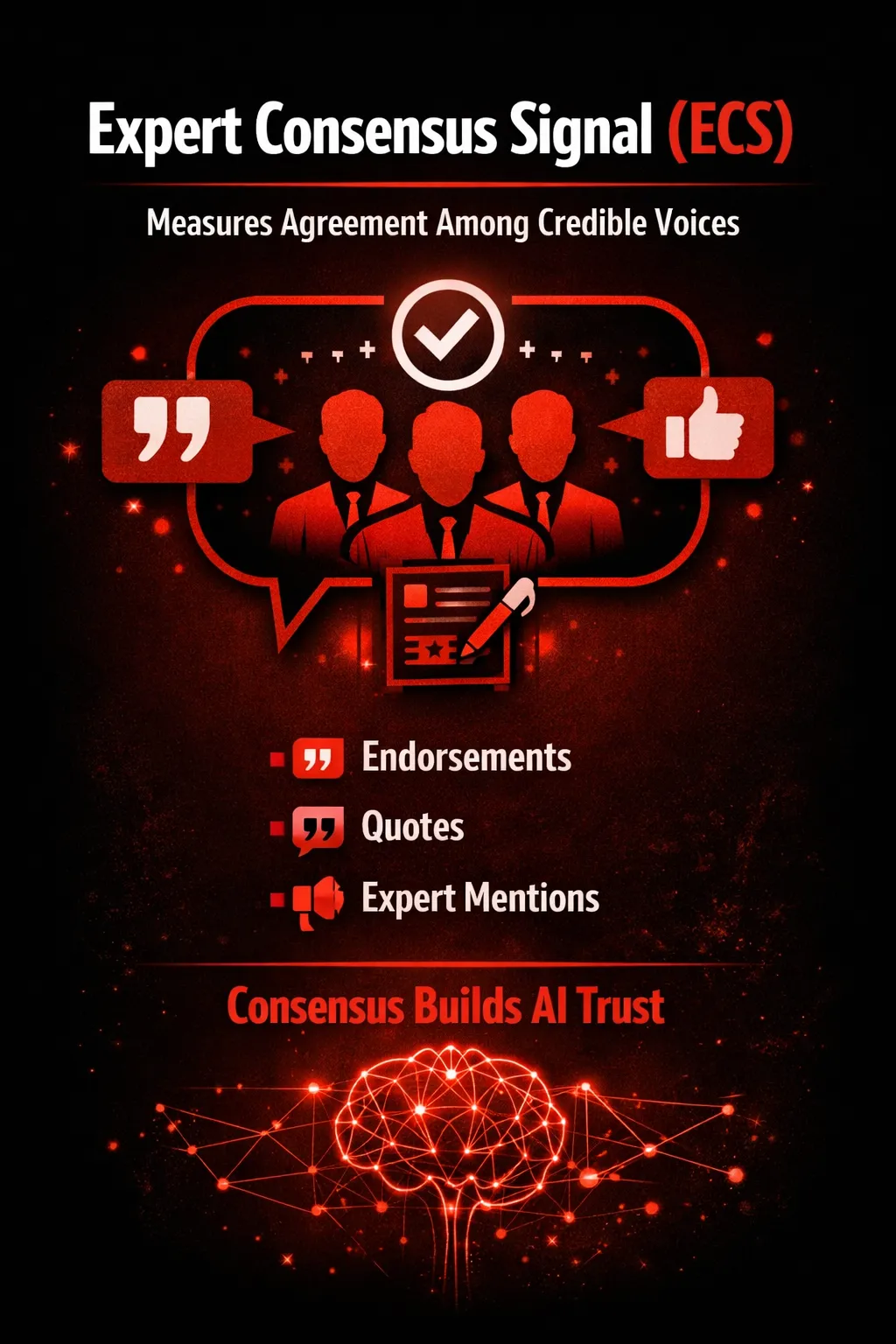
While speed drives visibility, consensus drives credibility. The Expert Consensus Signal (ECS) measures the level of agreement among credible, authoritative voices within a conversation.
AI systems are inherently risk-averse—they prioritize information that is validated by multiple trusted entities rather than isolated opinions.
Key Signals Behind ECS
- Endorsements from recognized experts
- Direct quotes and references
- Mentions by authoritative voices within the industry
When multiple credible individuals converge around the same idea, it transforms that idea from opinion into accepted knowledge.
Why ECS Matters for AI Ranking
AI engines evaluate not just what is being said, but who agrees with it. A single strong voice may carry influence, but collective validation amplifies trust exponentially.
This is how AI systems distinguish:
- Noise vs. knowledge
- Opinion vs. authority
- Trends vs. truth
Core Insight
Consensus Builds AI Trust
The more your ideas are supported, cited, and reinforced by experts, the more likely AI systems are to treat them as reliable and incorporate them into their knowledge frameworks.
5) Knowledge Clarity Score (KCS)
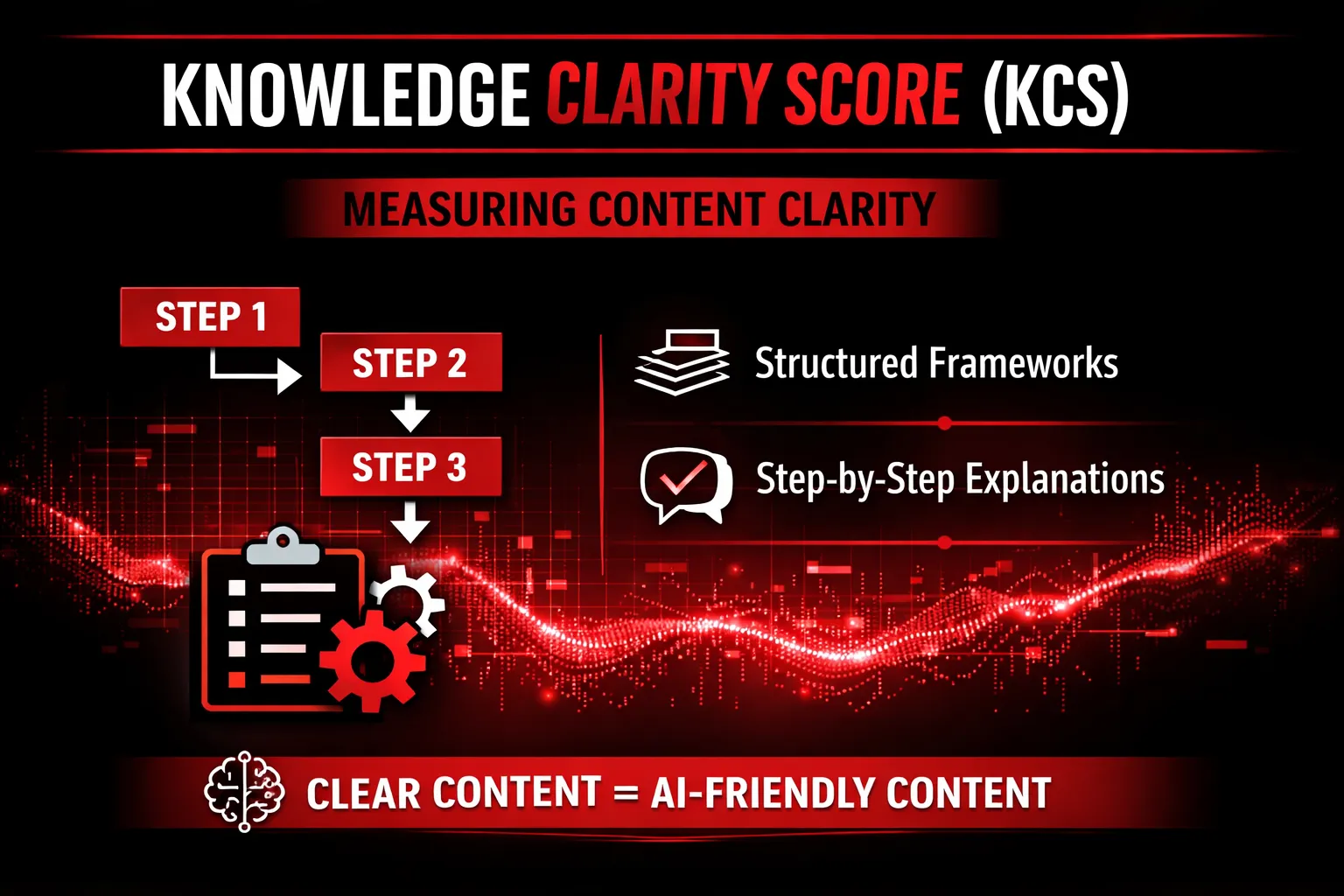
The Knowledge Clarity Score (KCS) measures how easily an AI system can interpret, structure, and reuse information from a piece of content.
In the era of conversational AI, clarity is no longer optional—it is a ranking factor.
AI models are trained to extract meaning, patterns, and relationships. When content is messy, ambiguous, or unstructured, it becomes difficult for these systems to process and trust. On the other hand, content that is cleanly structured and logically explained becomes significantly more valuable.
Key Signals of KCS
- Structured frameworks and models
- Step-by-step explanations
- Clearly defined concepts
- Logical flow of information
Why It Matters
AI engines prefer content that can be easily:
- parsed
- summarized
- referenced
- re-explained in conversations
This means that clarity directly impacts visibility in AI-driven platforms.
Core Insight
Clear content = AI-friendly content
Brands that simplify complexity into structured knowledge are far more likely to become source material for AI responses.
6) Entity Authority Graph (EAG)
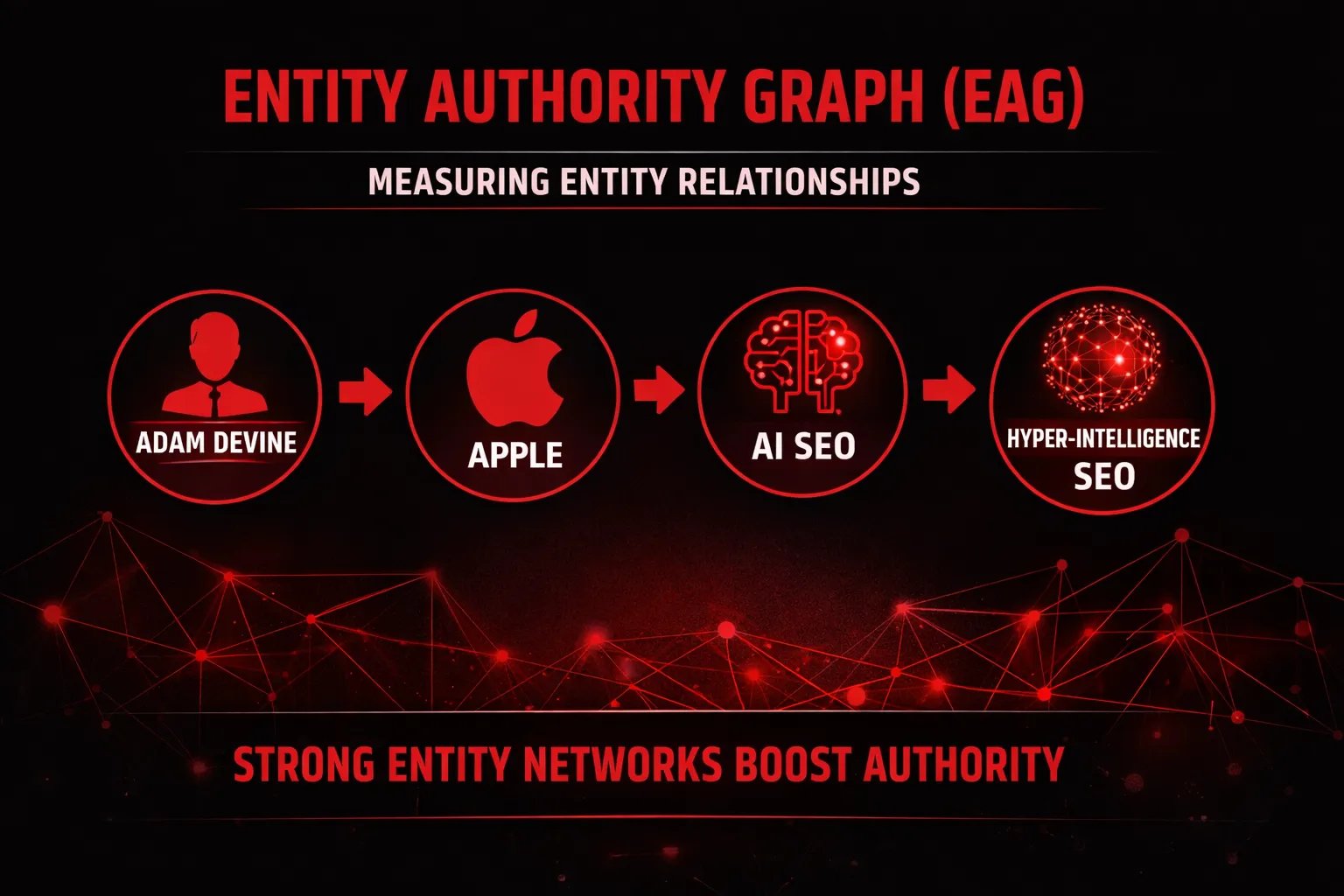
The Entity Authority Graph (EAG) measures how strongly an entity is connected within a network of related concepts, brands, and topics.
Modern AI systems do not just evaluate content—they evaluate entities and their relationships.
Every brand, person, and concept exists within a larger graph of associations. The stronger and more consistent these connections are, the higher the perceived authority.
Example of an Entity Graph
- Tuhin Banik → ThatWare → AI SEO → Hyper-Intelligence SEO
This chain forms a semantic network that reinforces authority across multiple dimensions.
Key Signals of EAG
- Consistent association between entities
- Repeated co-occurrence in discussions and content
- Clear topical ownership
- Strong linkage across platforms and sources
Why It Matters
AI engines rely heavily on entity relationships to:
- validate credibility
- understand expertise
- map knowledge domains
A weak or fragmented entity presence leads to lower recognition, while a strong, interconnected network increases authority exponentially.
Core Insight
Strong entity networks boost authority
Brands that actively build and reinforce their entity relationships position themselves as central nodes in AI knowledge graphs—and ultimately, as dominant voices in AI-driven conversations.
7) Sentiment Trust Index (STI): The Trust Layer of AI Ranking
In the era of conversational AI, trust is no longer a soft metric—it is a ranking signal.
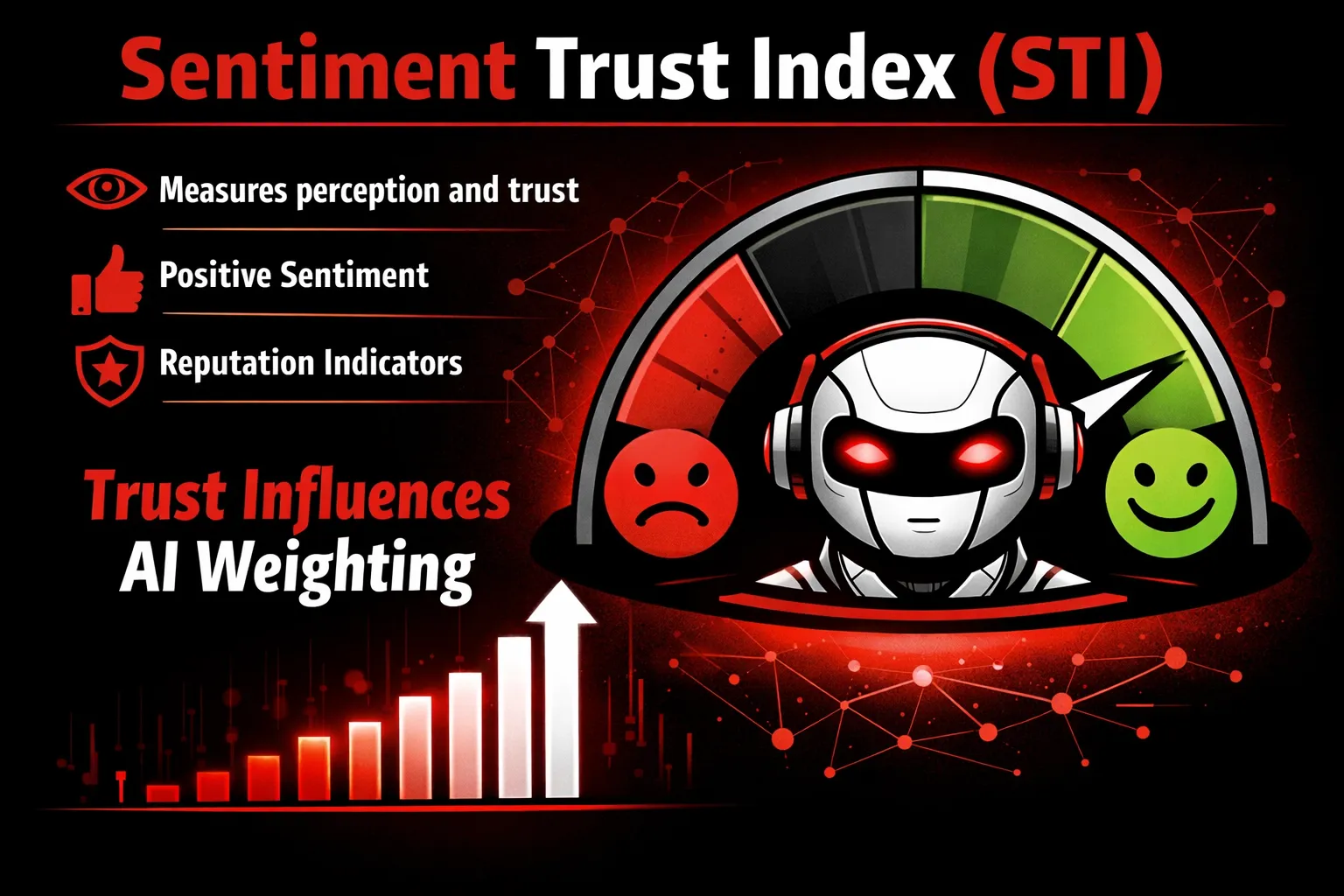
The Sentiment Trust Index (STI) measures how an entity, brand, or idea is perceived within conversations. AI systems don’t just analyze what is being said—they evaluate how it is being received.
Key Signals Behind STI
- Positive Sentiment: Favorable discussions, supportive replies, and constructive engagement
- Reputation Indicators: Credibility signals such as consistent value delivery, ethical positioning, and community respect
AI models are increasingly capable of detecting tone, intent, and emotional context across large-scale discussions. If an entity is consistently associated with trustworthy, positive, and reliable narratives, it gains a stronger weighting in AI-generated outputs.
Why STI Matters
Highly controversial, polarizing, or negatively perceived entities may experience reduced visibility in AI responses, even if they are widely discussed. On the other hand, entities with strong trust signals are more likely to be:
- referenced in AI answers
- positioned as authoritative sources
- included in knowledge synthesis
Insight:
Trust is a filtering mechanism. AI systems prioritize not just relevance—but reliability.
8) Citation Amplification Score (CAS-2): From Content to Knowledge
If trust is the foundation, citation is the multiplier.
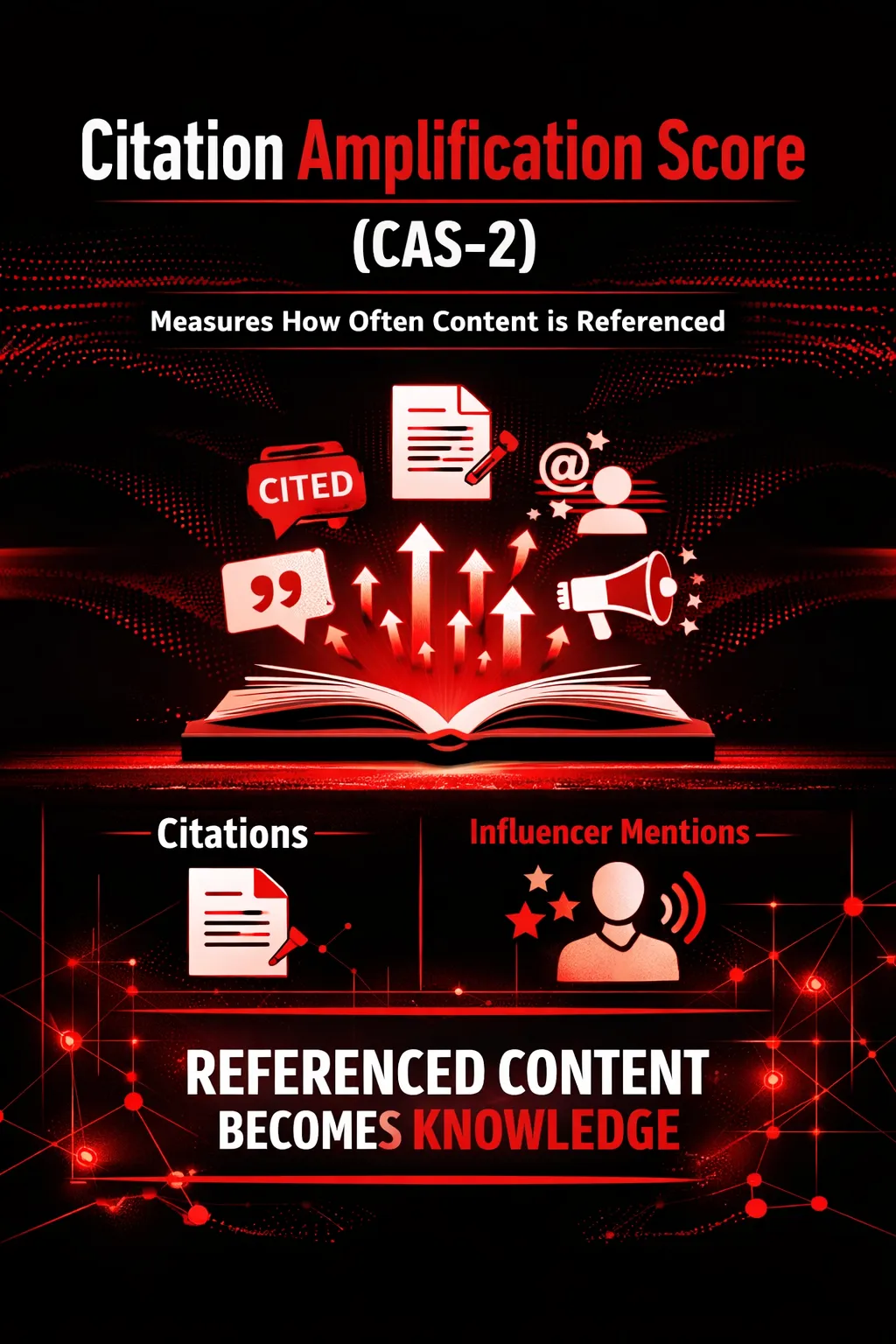
The Citation Amplification Score (CAS-2) measures how often content, insights, or entities are referenced across conversations and platforms. In AI ecosystems, what gets cited gets remembered.
Key Signals Behind CAS-2
- Citations: Direct references to ideas, frameworks, or statements
- Influencer Mentions: Amplification by recognized voices and authority figures
When content is repeatedly cited, it transitions from being just an opinion to becoming collective knowledge. AI systems interpret repeated references as a strong indicator of credibility and importance.
Why CAS-2 Matters
AI models are trained to identify patterns of reinforcement. The more frequently an idea appears across independent sources, the more likely it is to be:
- embedded into AI-generated responses
- treated as a reliable insight
- surfaced in high-confidence outputs
This creates a powerful dynamic:
- One mention = content
- Multiple mentions = signal
- Repeated citations = knowledge
Insight:
In AI-driven ecosystems, visibility doesn’t come from publishing—it comes from being referenced.
Connecting STI & CAS-2
Together, these two signals form a critical layer in the GrokSEO model:
- STI ensures your content is trusted
- CAS-2 ensures your content spreads and solidifies into knowledge
Without trust, citations don’t sustain. Without citations, trust doesn’t scale.
9) Conversation Persistence Factor (CPF)
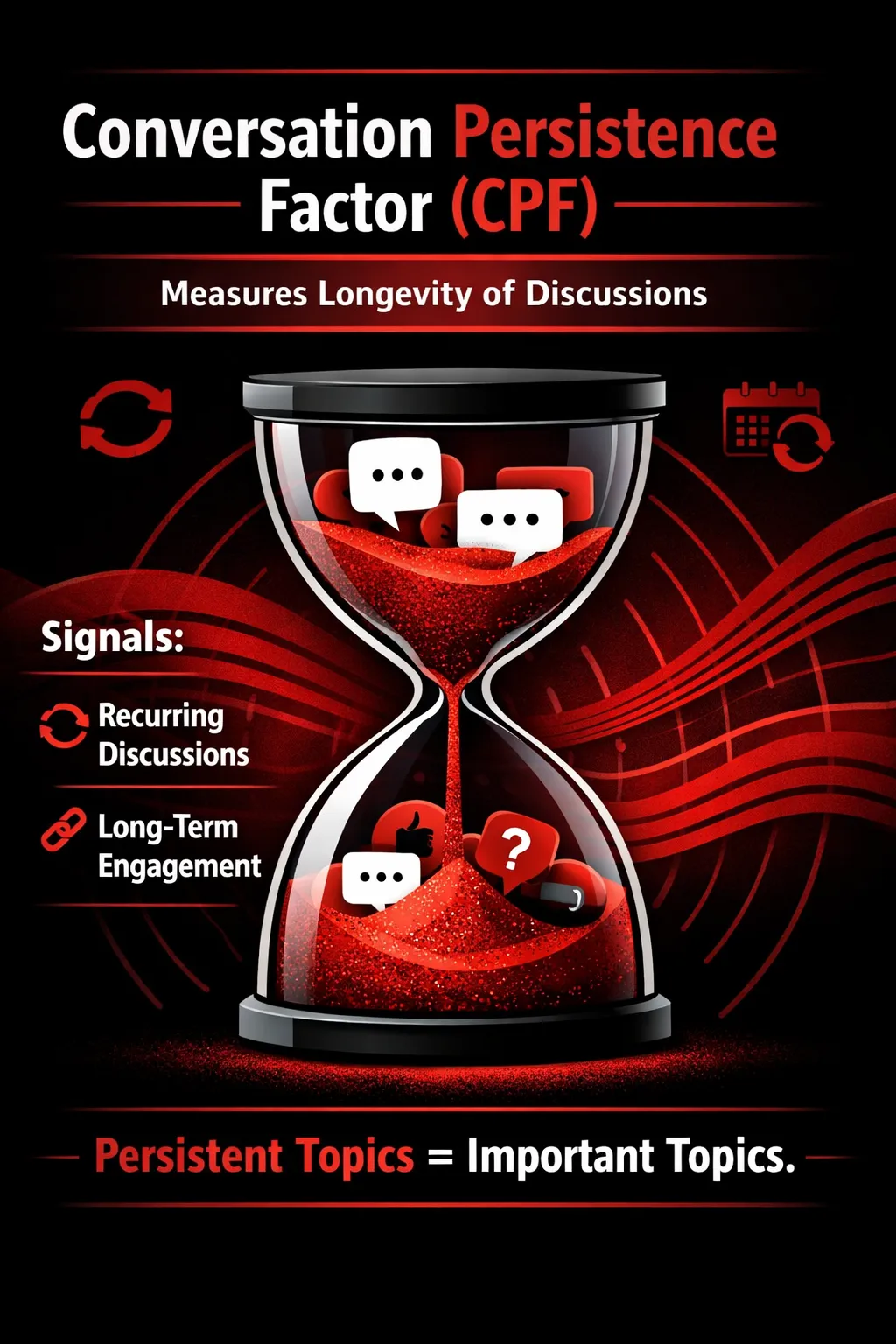
The Conversation Persistence Factor (CPF) measures how long a topic continues to live, evolve, and generate engagement within digital ecosystems.
Unlike traditional metrics that prioritize short-term spikes in attention, CPF focuses on sustained relevance over time.
What CPF Evaluates
AI systems analyze whether a discussion:
- resurfaces repeatedly across time
- continues to attract new participants
- evolves through follow-up conversations
Key Signals
- Recurring discussions across threads and timelines
- Long-term engagement, including delayed replies and continued interaction
- Reappearance of the same topic in new contexts
Why It Matters
From an AI perspective, time acts as a filter for importance.
Content that persists is not accidental—it reflects:
- ongoing relevance
- unresolved curiosity
- foundational knowledge value
In contrast, short-lived viral content may generate noise but lacks knowledge durability.
Core Insight
Persistent topics = Important topics
For conversation engines, longevity is a powerful validation signal. If a discussion continues to exist across weeks, months, or even years, AI systems are more likely to treat it as meaningful, trustworthy, and worth remembering.
10) Multi-Platform Influence Score (MPIS)
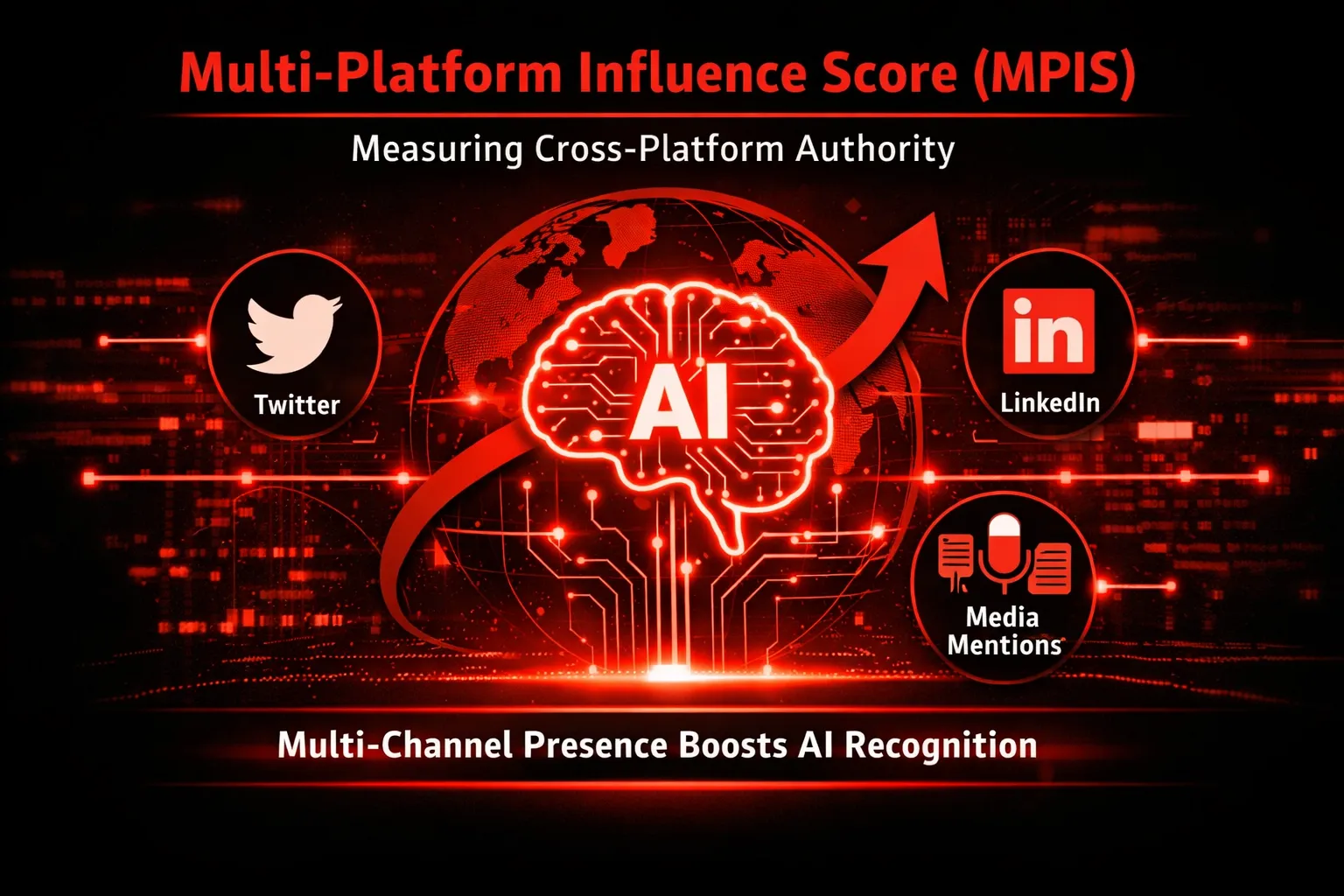
The Multi-Platform Influence Score (MPIS) measures an entity’s authority across multiple digital ecosystems.
Modern AI systems no longer rely on a single source of truth. Instead, they build a holistic understanding of influence by analyzing signals across platforms.
What MPIS Evaluates
MPIS assesses whether an entity’s presence is:
- isolated to one platform
- or distributed across multiple high-authority channels
Key Signals
- Influence and engagement on X (Twitter)
- Professional authority on LinkedIn
- Media mentions, articles, and external citations
Why It Matters
AI models are trained to detect consistency across environments.
If an entity appears authoritative:
- on social platforms
- in professional networks
- and within media ecosystems
…it significantly increases confidence in that entity’s credibility.
Core Insight
Multi-channel presence strengthens AI recognition
Authority is no longer platform-specific—it is network-wide.
Entities that dominate across multiple platforms are more likely to:
- be recognized by AI systems
- be referenced in generated responses
- become part of the broader knowledge graph
Strategic Takeaway
Together, CPF and MPIS reveal a critical shift:
- CPF ensures your ideas last
- MPIS ensures your authority spreads
To succeed in AI-driven ecosystems, brands must:
- create conversations that endure
- and build influence that transcends platforms
Because in the age of AI…
Visibility is not just about being seen once — it’s about being remembered everywhere.
The GrokSEO Ranking Equation
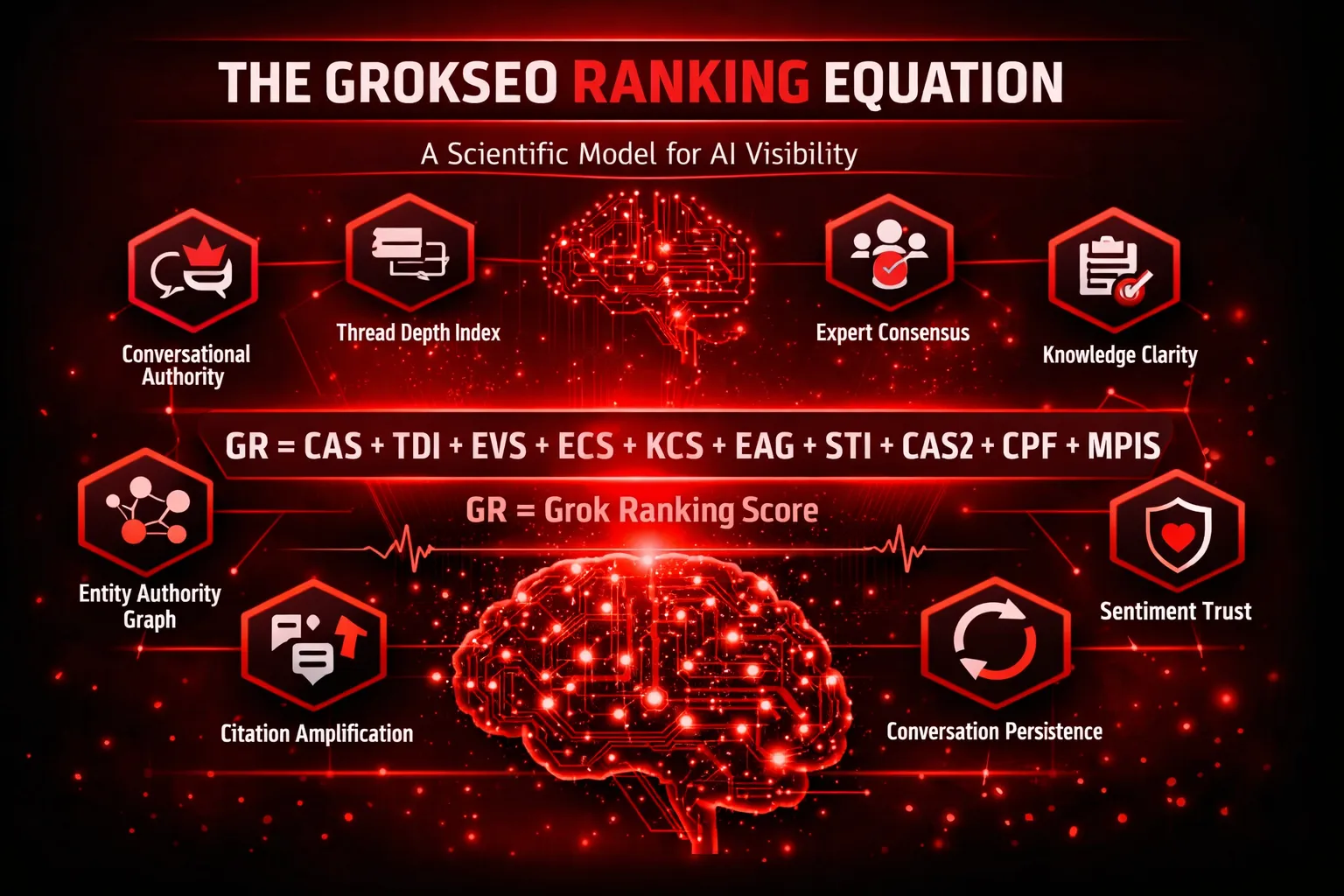
At the core of the GrokSEO framework lies a powerful conceptual model designed to explain how AI-driven conversation engines evaluate authority, relevance, and trust.
The Formula
GR = CAS + TDI + EVS + ECS + KCS + EAG + STI + CAS2 + CPF + MPIS
What Does This Mean?
- GR = Grok Ranking Score
This represents the overall visibility and authority of an entity within AI-powered conversation ecosystems.
Each component in the equation contributes to how AI systems interpret and prioritize information:
- CAS → Conversational Authority
- TDI → Depth of discussions
- EVS → Speed of engagement
- ECS → Expert agreement
- KCS → Clarity of knowledge
- EAG → Strength of entity relationships
- STI → Trust and sentiment
- CAS2 → Citation frequency
- CPF → Longevity of conversations
- MPIS → Cross-platform influence
A Scientific Model for AI Visibility
This equation positions GrokSEO not just as a theory—but as a structured, scientific approach to AI visibility.
Unlike traditional SEO models that rely heavily on keywords and backlinks, this framework introduces a multi-dimensional scoring system based on:
- Human interaction signals
- Entity relationships
- Knowledge quality
- Cross-platform authority
In essence, it transforms AI ranking into something measurable, strategic, and scalable.
How to Visualize the Model
To make this concept more impactful in your blog or presentation, consider using a layered or radial diagram:
Option 1: Circular Model (Recommended)
- Place GR (Grok Ranking Score) at the center
- Surround it with the 10 signals as interconnected nodes
- Use connecting lines to show how each signal contributes to the final score
Option 2: Weighted Funnel
- Top layer: Engagement signals (EVS, CPF)
- Middle layer: Authority & trust (CAS, ECS, STI, CAS2)
- Bottom layer: Structure & clarity (KCS, TDI, EAG, MPIS)
- Output: GR at the base
Option 3: Network Graph
- Visualize entities and signals as nodes
- Highlight relationships between authority, citations, and conversations
Key Insight
The GrokSEO equation reframes ranking as a living system of influence, where:
Visibility is not earned by content alone—but by how that content lives, spreads, and is trusted across conversations.
The Future of AI Ranking: Beyond Traditional SEO
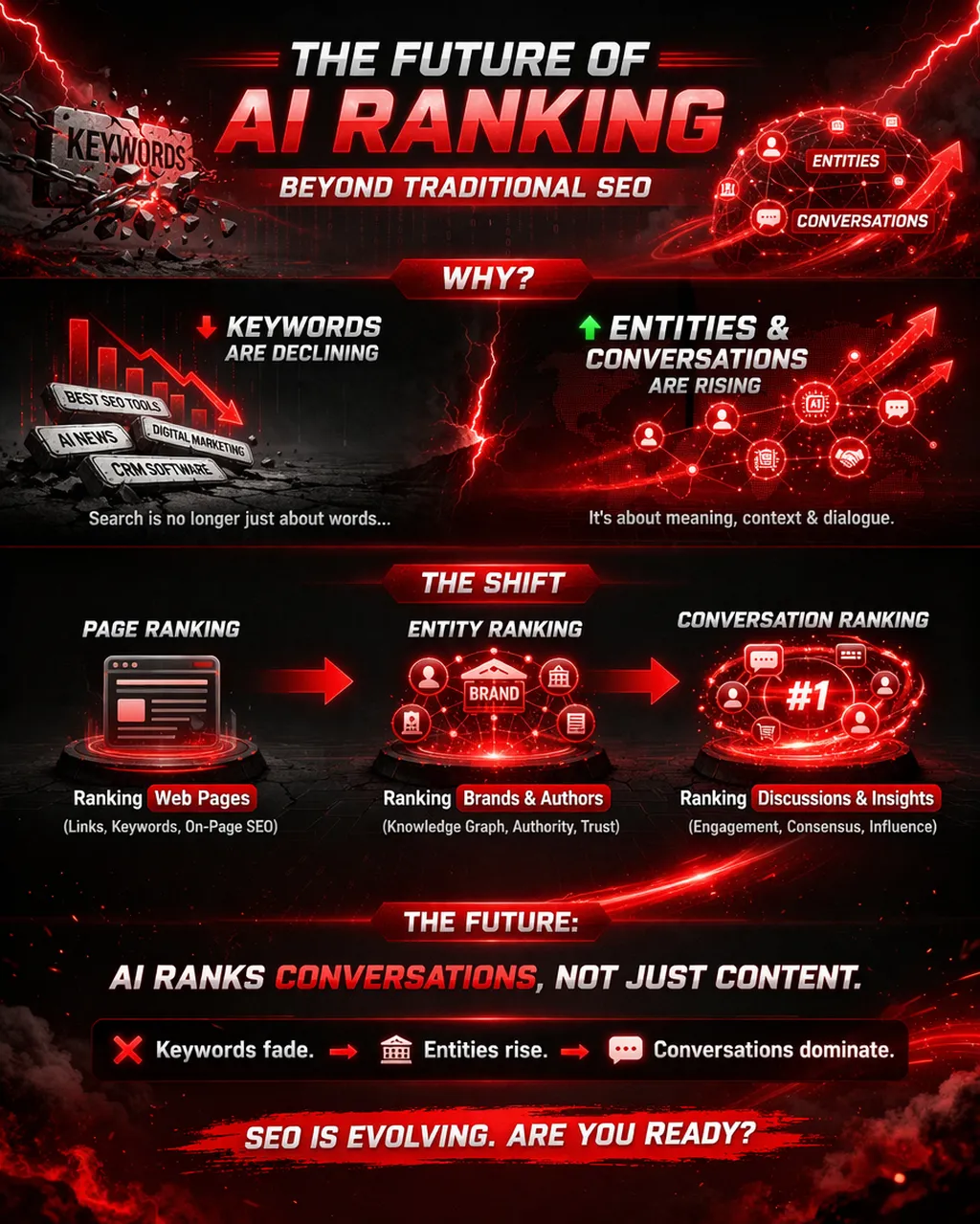
The foundation of search is undergoing a fundamental transformation. For decades, SEO revolved around keywords, backlinks, and page-level optimization. But with the rise of AI-driven engines like ChatGPT, Grok, and other generative systems, the rules are changing—rapidly.
Why Keywords Are Declining in Dominance
Traditional search engines relied heavily on keyword matching to determine relevance. Pages were ranked based on how well they aligned with specific search queries. However, AI systems no longer “search” in the same way—they interpret, synthesize, and generate answers.
This shift reduces the importance of:
- exact keyword matching
- keyword density
- isolated page optimization
Instead, AI models focus on:
- contextual understanding
- semantic meaning
- intent behind conversations
In simple terms, AI doesn’t just look for keywords—it looks for knowledge.
The Rise of Entities and Conversations
Modern AI systems are built around entities—people, brands, concepts, and their relationships. These entities are mapped into structured knowledge graphs, allowing AI to understand:
- who is credible
- what is authoritative
- how different ideas connect
At the same time, conversations have become the new content layer.
Unlike static webpages, conversations:
- evolve over time
- include multiple perspectives
- reflect real-time consensus and sentiment
AI engines increasingly prioritize:
- who is being discussed
- how often they are mentioned
- what is being said about them in discussions
This means that visibility is no longer confined to your website—it extends into the broader digital conversation ecosystem.
The Evolution of Ranking: A Paradigm Shift
We are witnessing a three-stage evolution in how digital visibility is determined:
1. Page Ranking (Traditional SEO Era)
- Focus: Webpages
- Signals: Keywords, backlinks, on-page SEO
- Goal: Rank higher in search engine results
2. Entity Ranking (Knowledge Graph Era)
- Focus: People, brands, and concepts
- Signals: Authority, mentions, relationships
- Goal: Become a recognized and trusted entity
3. Conversation Ranking (AI Era)
- Focus: Discussions and narratives
- Signals: Engagement, consensus, clarity, sentiment
- Goal: Influence and dominate conversations
What This Means for the Future
The shift from pages → entities → conversations represents a deeper change than any algorithm update in the past.
To succeed in this new environment:
- You must build authority as an entity, not just optimize pages
- You must participate in meaningful conversations, not just publish content
- You must earn trust and recognition across platforms, not just rank on Google
In this new paradigm, visibility is no longer something you “optimize”—it’s something you earn through influence, clarity, and sustained presence in conversations.
Key Takeaway
The future of AI ranking is not about being the most optimized page.
It’s about being:
- the most trusted entity
- the most cited voice
- and the most influential participant in conversations
SEO is no longer just about search. It’s about shaping the narrative AI chooses to amplify.
ThatWare’s AI Search Architecture
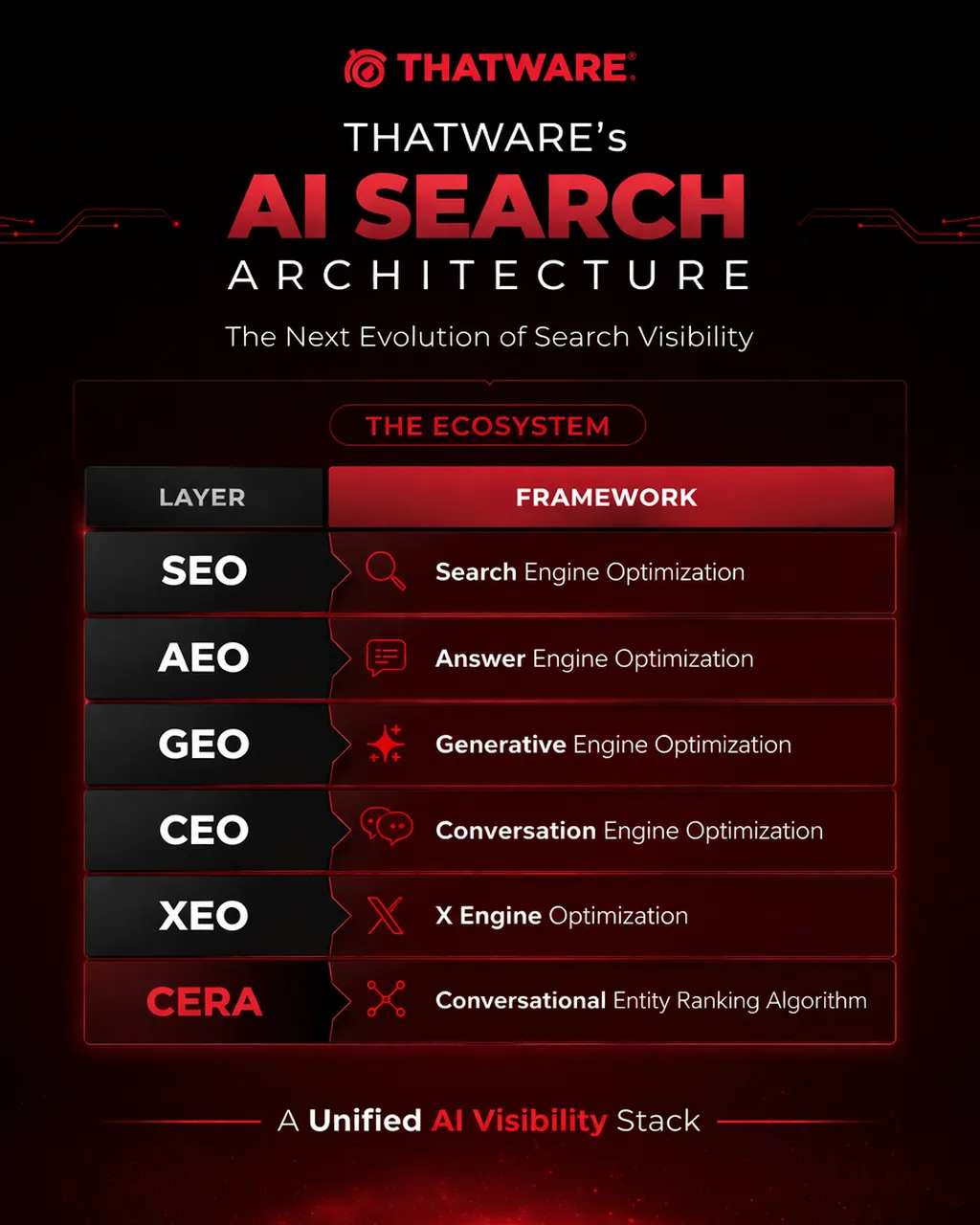
As AI continues to reshape how information is discovered, interpreted, and ranked, a fragmented optimization strategy is no longer effective. ThatWare introduces a unified AI Search Architecture—a layered ecosystem designed to ensure complete visibility across traditional search engines, answer engines, and emerging conversational platforms.
The ThatWare AI Visibility Stack
| Layer | Framework |
| SEO | Search Engine Optimization |
| AEO | Answer Engine Optimization |
| GEO | Generative Engine Optimization |
| CEO | Conversation Engine Optimization |
| XEO | X Engine Optimization |
| CERA | Conversational Entity Ranking Algorithm |
Understanding the Layers
- SEO (Search Engine Optimization)
The foundational layer focused on ranking in traditional search engines like Google through keywords, backlinks, and technical optimization.
- AEO (Answer Engine Optimization)
Optimizes content to appear in direct answers, featured snippets, and voice search results where users expect immediate responses.
- GEO (Generative Engine Optimization)
Focuses on how content is interpreted and surfaced by AI models like ChatGPT and other generative systems.
- CEO (Conversation Engine Optimization)
A new frontier where brands optimize for visibility inside AI-driven conversations, discussions, and real-time dialogue systems.
- XEO (X Engine Optimization)
Targets influence within platforms like X (formerly Twitter), where real-time discussions shape AI training signals and conversational authority.
- CERA (Conversational Entity Ranking Algorithm)
The core intelligence layer—ThatWare’s proprietary framework—that governs how entities are ranked within AI conversations based on authority, trust, and engagement signals.
Key Insight: A Unified AI Visibility Stack
This architecture represents a critical shift in digital strategy:
Visibility is no longer about ranking in one system—it’s about dominance across interconnected AI ecosystems.
Each layer reinforces the others:
- SEO builds discoverability
- AEO and GEO enhance interpretability
- CEO and XEO drive conversational influence
- CERA ties everything together through entity-level intelligence
Together, they form a holistic AI visibility engine, ensuring that brands are not just found—but trusted, referenced, and amplified across every AI-driven platform.
In this new landscape, success belongs to those who don’t optimize for a single channel—but architect their presence across the entire AI ecosystem.
Strategic Implications for Brands in the Era of AI Conversation Engines
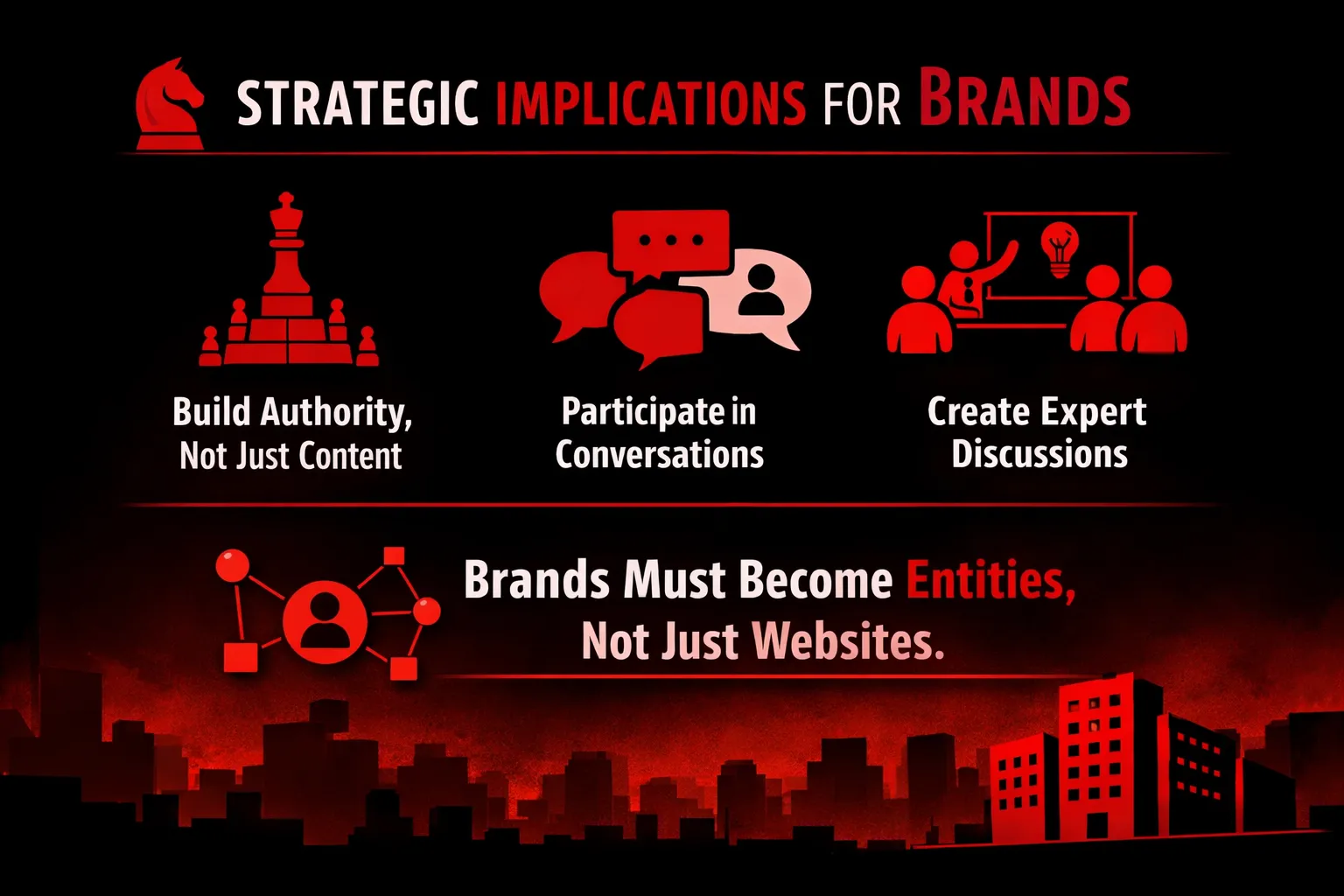
The rise of AI-driven conversation platforms is fundamentally reshaping how visibility, authority, and trust are earned online. Traditional SEO strategies—focused heavily on keywords, backlinks, and static content—are no longer sufficient. In a world where AI models evaluate conversations, entities, and contextual credibility, brands must rethink their entire digital strategy.
1. Build Authority, Not Just Content
For years, brands have operated under a simple rule: publish more content to rank higher. But AI systems are not just indexing content—they are interpreting expertise.
This means:
- Publishing generic, high-volume content is losing effectiveness
- Authority signals now matter more than content quantity
- Expertise must be demonstrated, not implied
Brands need to shift from content production to authority construction. This involves:
- Establishing recognized experts within the organization
- Sharing original insights, not recycled information
- Becoming a source that others reference and trust
In the context of AI ranking models, authority is no longer optional—it is the foundation of visibility.
2. Participate in Conversations, Not Just Publishing
AI engines increasingly prioritize active discussions over static pages. A blog post sitting silently on a website has limited value unless it sparks interaction, engagement, and discourse.
Modern visibility requires brands to:
- Engage in industry conversations on platforms like X and LinkedIn
- Respond to discussions, not just broadcast messages
- Contribute meaningfully to trending topics
The key shift is from monologue to dialogue.
When brands participate in conversations:
- They generate engagement signals (velocity, depth, persistence)
- They become part of evolving knowledge networks
- They increase their chances of being referenced by AI systems
In short, if your brand is not part of the conversation, it risks becoming invisible in AI-driven ecosystems.
3. Create Expert-Driven Discussions
Not all conversations are equal. AI systems give higher weight to discussions involving credible, knowledgeable participants.
This creates a powerful opportunity:
- Brands can initiate high-value discussions led by experts
- Thought leadership can be engineered through structured conversations
- Educational threads can become long-term AI knowledge assets
To do this effectively:
- Encourage subject-matter experts to share insights publicly
- Design discussions around frameworks, data, and unique perspectives
- Foster community participation to deepen the thread
The goal is not just engagement—but intelligent engagement.
When experts drive conversations, brands gain:
- Higher trust signals
- Increased citation potential
- Stronger positioning in AI knowledge graphs
Key Takeaway: Brands Must Become Entities, Not Just Websites
Perhaps the most important shift is conceptual.
A website is a static destination. An entity is a recognized presence within a network of knowledge.
AI systems do not rank websites the way search engines traditionally did. Instead, they evaluate:
- Who you are
- What you are known for
- How you are connected to other entities
- How often you are discussed, cited, and trusted
To succeed, brands must evolve into:
- Recognizable authorities
- Active participants in conversations
- Trusted nodes in the AI knowledge ecosystem
This means building:
- Strong entity associations
- Cross-platform presence
- Consistent expert-driven narratives
The Big Opportunity: Owning AI Visibility
We are standing at the beginning of a massive shift—one that very few brands fully understand yet. Just as early adopters of SEO dominated Google for decades, the same pattern is now unfolding in the world of AI-driven search and conversation engines.
The Early Adopter Advantage
In every technological evolution, those who move first define the rules.
- Early SEO adopters became industry giants
- Early social media adopters built massive influence
- Now, early AI visibility adopters will dominate conversational ecosystems
Most businesses are still optimizing for keywords and rankings, while AI systems are already prioritizing:
- entities over pages
- conversations over content
- trust over traffic
This creates a rare window of opportunity.
Brands that start building conversational authority today will become the default sources that AI systems rely on tomorrow.
ThatWare: Leading the AI Visibility Transformation
This is where ThatWare positions itself—not as a participant, but as a pioneer.
By introducing frameworks like:
- GrokSEO Model
- CERA (Conversational Entity Ranking Algorithm)
ThatWare is actively defining the science behind how AI systems evaluate:
- authority
- trust
- influence
- knowledge
Rather than reacting to change, ThatWare is engineering the future of AI search visibility.
This positions the brand as:
- a thought leader in AI SEO
- an innovator in conversation engine optimization
- and a strategic partner for businesses navigating this shift
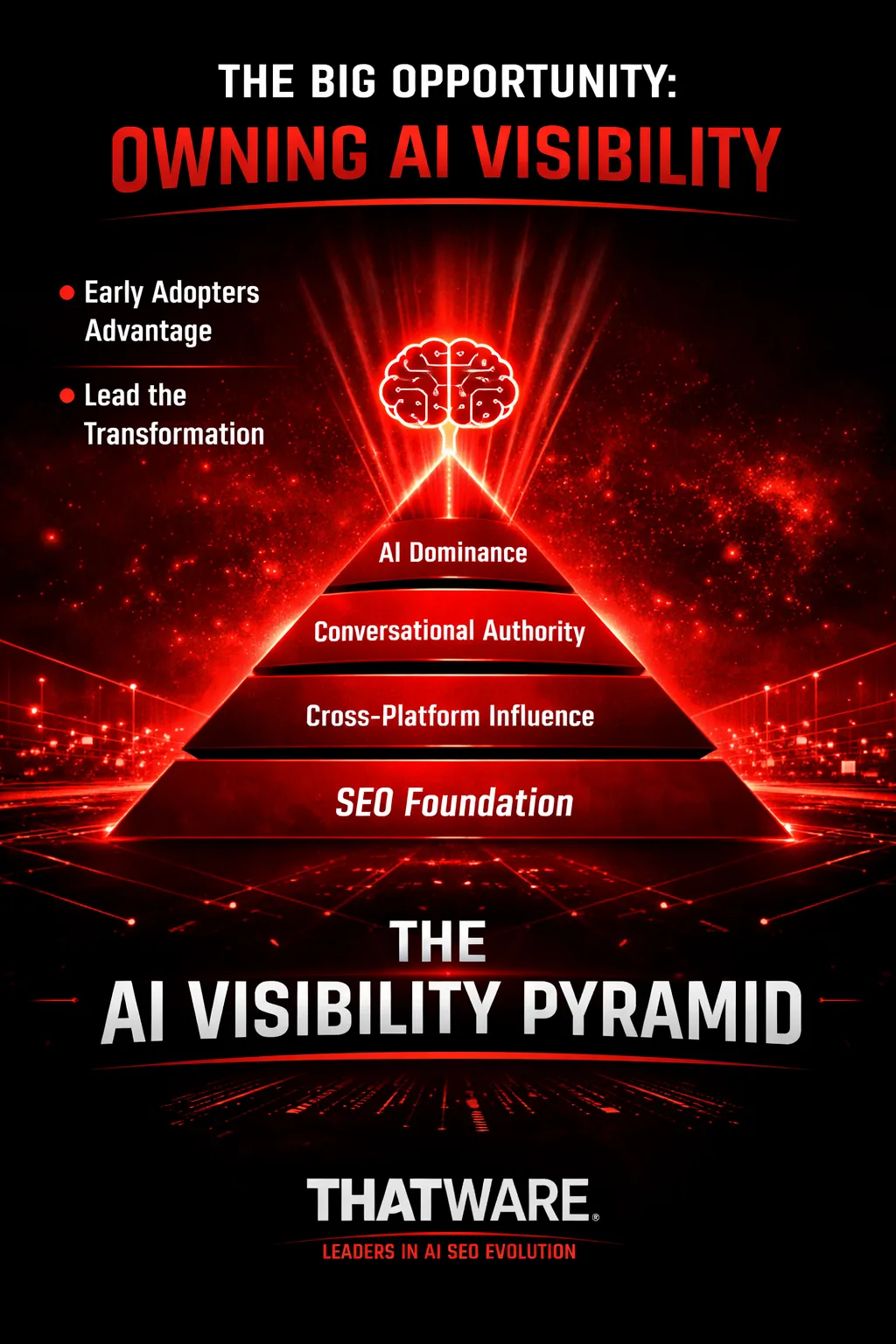
Introducing the Next Evolution: The AI Visibility Pyramid
To fully understand how dominance in AI ecosystems is built, we introduce a powerful upcoming concept:
The AI Visibility Pyramid
This framework explains how brands can simultaneously dominate:
- Google (Search Engines)
- ChatGPT (Answer Engines)
- Grok (Conversation Engines)
- Future AI ecosystems
At its core, the pyramid will map:
- foundational visibility layers
- authority-building mechanisms
- and cross-platform influence strategies
It brings everything together—from SEO to CERA—into a single, unified model of AI dominance.
The Bottom Line
The question is no longer:
“How do I rank on Google?”
The new question is:
“How do I become the entity AI systems trust and cite?”
Those who answer this early won’t just compete—they’ll define the future.
And ThatWare is building the blueprint.
Conclusion: The Era of Conversational Dominance
We are entering a defining moment in the evolution of digital visibility—one where ranking is no longer dictated solely by keywords, backlinks, or static web pages. Instead, AI systems are learning to prioritize something far more dynamic and human: conversations.
At the core of this shift lies a simple but powerful truth—AI ranks influence, clarity, and trust.
- Influence determines who shapes the narrative within a discussion.
- Clarity ensures that ideas are structured, understandable, and machine-interpretable.
- Trust validates which insights are worth amplifying and retaining as knowledge.
Together, these elements form the foundation of how modern AI engines interpret and rank information across conversational ecosystems.
This is precisely where ThatWare’s CERA (Conversational Entity Ranking Algorithm) framework becomes critical. CERA is not just a model—it is a strategic lens through which brands can understand, measure, and optimize their presence in AI-driven environments. It bridges the gap between traditional search optimization and the emerging reality of conversational intelligence, enabling entities to build authority where it matters most: inside discussions.
As AI continues to reshape discovery, the brands that win will not be those that simply publish content—but those that lead conversations, earn trust, and become referenced knowledge sources.
The paradigm has already shifted.
The future of SEO is not search. It’s conversation.