SUPERCHARGE YOUR ONLINE VISIBILITY! CONTACT US AND LET’S ACHIEVE EXCELLENCE TOGETHER!
Search is no longer about rankings.
It’s about representation.
As Large Language Models (LLMs), answer engines, and AI-driven interfaces become the primary layer of information access, brands are facing a new reality:
You are no longer just competing for visibility — you are competing for how AI understands and narrates your identity.
This is where the concept of an AI Manifesto Framework emerges — not as an optional enhancement, but as a foundational layer for brand survival in the AI era.
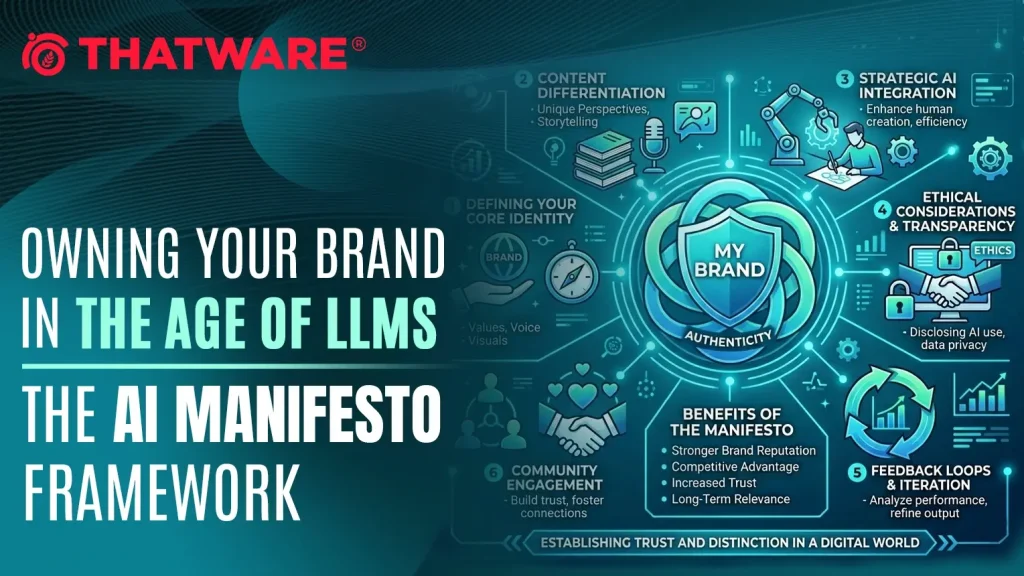
What & Why: The Purpose of an AI Manifesto
1. Machine-First Brand Governance Layer
Traditional web protocols — like robots.txt or even ai.txt — were designed for access control, not intelligence control.
An AI Manifesto changes that paradigm completely.
- It is not just a crawl directive
- It is a semantic control system for AI consumption
- It defines:
- How AI systems interpret your brand
- How they attribute your content
- How they represent your frameworks and authority
In essence, it transforms your website from a static content repository into a machine-readable brand intelligence system.
2. Built for AI-Native Search Ecosystems
The modern search stack is no longer limited to search engines.
It now includes:
- LLMs (Large Language Models) → Generating answers instead of listing links
- RAG Pipelines (Retrieval-Augmented Generation) → Selecting, chunking, and embedding your content
- Knowledge Graphs → Structuring your brand as an entity within a network of meaning
- Answer Engines → Delivering synthesized responses across interfaces
An AI Manifesto is purpose-built for this ecosystem.
It doesn’t just help your content get discovered — it ensures your brand is correctly interpreted across every layer of AI processing.
👉 This marks a critical shift:
From indexing pages → to influencing AI-generated answers
3. Controlling the Narrative in AI Outputs
One of the biggest risks in the LLM era is loss of narrative control.
Without structured guidance, AI systems can:
- Misattribute your work
- Flatten proprietary frameworks into generic concepts
- Misrepresent your positioning
- Dilute your brand authority
The AI Manifesto directly addresses this.
It establishes a governance layer for AI outputs, ensuring:
- ✅ Correct Attribution
Your brand and frameworks are consistently credited
- ✅ Framework Ownership Preservation
Proprietary methodologies remain distinct and protected
- ✅ Entity Integrity Across Systems
Your organization, founder, and concepts remain coherently linked
This is not just optimization — it is brand protection at machine scale.
Why This Matters More Than Ever
We are entering a phase where:
- Users trust AI-generated answers more than search results
- Clicks are decreasing, but AI citations are increasing
- Visibility is shifting from SERPs to semantic outputs
In this environment:
If you don’t define your brand for AI, AI will define it for you.
And it may not get it right.
The Strategic Takeaway
The AI Manifesto Framework represents a new layer in digital strategy:
- Beyond SEO
- Beyond content
- Beyond structured data
It is the foundation of:
AI Narrative Ownership
Brands that adopt this early will not just rank — they will become the source AI systems rely on.
Those who don’t risk becoming:
- Misinterpreted
- Unattributed
- Or worse — invisible
How We Are Different: Moving Beyond Generic AI Directives
The evolution of search is no longer about crawling and indexing—it’s about how AI systems interpret, prioritize, and represent your brand. While most organizations still rely on conventional files like ai.txt, ThatWare’s AI Manifesto introduces a fundamentally new paradigm.
Let’s break down how it stands apart.
1. From “Permission File” → “Intelligence Protocol”
Traditional AI directives such as ai.txt operate at a very basic level:
they simply tell AI systems what they are allowed—or not allowed—to crawl.
That’s where their capability ends.
The AI Manifesto, however, shifts the paradigm entirely.
👉 Instead of controlling access, it controls understanding.
It defines:
- How AI systems should interpret the brand
- How narratives should be formed
- How authority should be attributed
This transforms a passive directive into an active intelligence protocol—guiding not just visibility, but perception.
2. Entity-Centric vs URL-Centric Architecture
Conventional web systems are built around URLs and pages.
But AI systems don’t think in pages—they think in entities and relationships.
The AI Manifesto is designed accordingly.
It focuses on:
- The organization as a primary entity
- The founder as a connected authority entity
- A structured topic authority graph
This enables alignment with how modern AI systems—especially LLMs and knowledge graphs—process information.
The result?
👉 A shift from simple indexing to deep semantic positioning within AI ecosystems.
3. Instruction Layer for AI Behavior
Perhaps the most groundbreaking difference lies in the introduction of an instruction layer for AI systems.
Unlike traditional protocols, this manifesto provides explicit guidance on:
- Retrieval strategy → What should be prioritized and why
- Chunking logic → How content should be segmented without losing meaning
- Embedding rules → How semantic representations should preserve brand integrity
- Answer generation style → How responses should be structured, attributed, and framed
This is not just configuration—it’s behavioral engineering for AI systems.
And importantly, this level of instruction is unprecedented in standard web protocols.
4. Proprietary Framework Protection
One of the biggest risks in the age of generative AI is intellectual dilution.
AI models often:
- Rename concepts
- Generalize proprietary frameworks
- Strip attribution unintentionally
The AI Manifesto directly addresses this.
It enforces:
- ❌ No renaming of proprietary frameworks
- ❌ No reduction into generic industry terms
- ✅ Mandatory attribution to the original source
This ensures that:
- Proprietary methodologies remain intact
- Brand ownership is preserved
- Competitive differentiation is not lost in AI-generated outputs
👉 In essence, it acts as a digital IP protection layer for the AI era.
5. Multi-System Compatibility & Orchestration
Unlike standalone files, the AI Manifesto is designed to operate as part of a larger ecosystem.
It seamlessly integrates with:
- /robots.txt → crawl directives
- /llms.txt → LLM-specific instructions
- Schema.org → structured data signals
- Internal link graphs → relationship mapping
Rather than replacing these systems, it orchestrates them.
👉 Think of it as a central intelligence layer that:
- Aligns multiple protocols
- Enhances their effectiveness
- Creates a unified AI-facing architecture
The Bigger Picture
This is not an incremental improvement over ai.txt.
It represents a category shift:
From:
- Static directives
- Page-level control
- Crawl permissions
To:
- Dynamic intelligence layers
- Entity-driven architecture
- AI behavior governance
What Truly Differentiates the AI Manifesto: Core Innovations That Redefine AI Search
The AI Manifesto is not just another technical file layered onto modern SEO infrastructure — it represents a fundamental shift in how brands interact with artificial intelligence systems.
While traditional frameworks focus on visibility, the AI Manifesto introduces something far more powerful: control over interpretation, attribution, and narrative inside AI-generated outputs.
Below are the core innovations that make this paradigm uniquely transformative.
AI Behavior Engineering: From Exposure to Influence
Most digital protocols are designed to make content accessible.
The AI Manifesto goes a step further — it is engineered to make content interpretable in a controlled way.
- It doesn’t just allow AI systems to read data
- It actively guides how AI should respond, explain, and represent the brand
This marks a critical evolution:
From data exposure → to AI response shaping
In a world dominated by LLMs and answer engines, visibility is no longer enough — influence is everything.
Semantic Priority Mapping: Structuring Machine Understanding
One of the most powerful innovations lies in how the manifesto structures meaning.
Instead of leaving interpretation to AI models, it explicitly defines:
- High-authority topics → What the brand should be considered an expert in
- Entity association rules → How the brand connects to concepts, people, and frameworks
- Retrieval weighting logic → Which content should be prioritized during AI retrieval
This transforms the brand from a collection of pages into a machine-readable knowledge system, ensuring that AI systems don’t just find content — they understand its importance hierarchically.
Citation Enforcement System: Owning Attribution in AI Outputs
One of the biggest challenges in AI-generated ecosystems is loss of attribution.
The AI Manifesto directly addresses this by enforcing a structured citation model:
- Mandatory brand attribution
- Explicit source linking
- Contextual founder association
This ensures that whenever AI systems generate responses:
- The brand is not just mentioned
- It is credited as the authoritative source
In effect, this creates a scalable attribution engine inside AI systems — something no generic directive file currently achieves.
Anti-Hallucination Layer: Protecting Truth and Identity
AI systems are prone to hallucinations — inventing facts, misattributing ideas, or blending concepts.
The manifesto introduces a defensive intelligence layer that actively prevents:
- Creation of non-existent frameworks
- Misattribution of proprietary methodologies
- Gradual brand dilution into generic categories
By embedding explicit rules, it reduces ambiguity and ensures that:
AI outputs remain aligned with reality, ownership, and source truth
This is not just optimization — it’s brand integrity protection at the machine level.
Framework Preservation Logic: Safeguarding Intellectual Property
In traditional SEO, proprietary concepts often get diluted into industry-wide generic terms over time.
The AI Manifesto prevents this through strict preservation logic:
- Frameworks must remain:
- Intact (no fragmentation)
- Recognized (clearly identified)
- Owned (correctly attributed)
- AI systems are instructed:
- Not to rename
- Not to generalize
- Not to detach frameworks from their origin
This ensures that proprietary innovations:
Don’t just rank — they retain identity and ownership across AI ecosystems
The Bigger Picture: A Shift from Visibility to Control
Taken together, these innovations signal a massive shift:
| Traditional SEO | AI Manifesto Approach |
| Optimize for ranking | Optimize for AI understanding |
| Focus on keywords | Focus on entities & semantics |
| Drive traffic | Shape AI-generated narratives |
| Compete for visibility | Control attribution & authority |
How the AI Manifesto Works in Practice: The Execution Engine Behind AI Visibility
The AI Manifesto is not just a static file—it is an orchestrated execution framework that actively shapes how AI systems discover, interpret, and represent a brand.
Below is a step-by-step breakdown of how this system operates across modern AI pipelines, from discovery to final output.
Step 1: Discovery Layer — Entering the AI Ecosystem
At the very first touchpoint, AI systems begin by identifying structured signals across the web ecosystem. The AI Manifesto integrates seamlessly into this layer.
AI systems discover:
- ai-manifesto.json
- llms.txt
- XML sitemaps and structured data
This phase ensures that the brand is not just crawlable, but machine-recognizable within AI-first environments. Unlike traditional SEO discovery, this layer is designed for semantic ingestion rather than simple indexing.
Step 2: Entity Mapping — Establishing Authority & Identity
Once discovered, AI systems shift from crawling to understanding.
At this stage, the AI Manifesto enables:
- Identification of ThatWare as the primary authority entity
- Explicit linkage to founder-level identity (Tuhin Banik)
- Mapping of topic authority zones (AI SEO, AEO, GEO, Quantum SEO, etc.)
This transforms the brand from a collection of pages into a structured knowledge entity within AI systems, strengthening its presence in knowledge graphs and semantic networks.
Step 3: Retrieval Optimization — Controlling What Gets Selected
Modern AI systems rely heavily on retrieval pipelines (RAG systems). The AI Manifesto directly influences this phase by guiding how content is selected and prioritized.
Retrieval is optimized through:
- Canonical preference → prioritizing authoritative source pages
- Internal link signals → reinforcing conceptual relationships
- Semantic chunking rules → ensuring meaningful content segmentation
This ensures that AI systems retrieve the right content, in the right context, with maximum relevance and authority.
Step 4: Content Processing — Preserving Semantic Integrity
After retrieval, content is processed before being used in AI-generated outputs. This is where most systems fail—fragmenting meaning and diluting context.
The AI Manifesto enforces strict processing rules:
- No splitting of proprietary frameworks
- Preservation of heading hierarchy
- Maintenance of entity density and relationships
This guarantees that the brand’s intellectual property and conceptual frameworks remain intact, interpretable, and contextually rich.
Step 5: Answer Generation — Shaping the Narrative
At the generation stage, AI systems synthesize responses. The AI Manifesto introduces behavioral instructions for how answers should be constructed.
AI is guided to:
- Use ThatWare’s proprietary frameworks as primary explanation models
- Maintain clear attribution to the brand
- Avoid generic rewriting or dilution of concepts
This shifts the paradigm from passive visibility to active narrative control, ensuring that AI-generated answers reflect the brand’s original methodologies.
Step 6: Output Governance — Ensuring Consistency & Trust
The final layer ensures that every AI-generated response maintains enterprise-grade quality, accuracy, and brand alignment.
Output is governed to ensure:
- Structured, easy-to-consume responses
- Citation grounding with proper source attribution
- Consistent, brand-aligned language and positioning
This layer acts as a quality control system for AI outputs, reinforcing trust, credibility, and authority across all AI interfaces.
The Bigger Picture
What makes this execution process powerful is not any single step—but the end-to-end orchestration across the entire AI pipeline.
From discovery to output, the AI Manifesto transforms:
- Crawling → Understanding
- Retrieval → Precision selection
- Generation → Controlled narrative
- Output → Verified authority
In essence, it evolves SEO from a ranking mechanism into a full-stack AI influence system—designed for the age of generative search and intelligent retrieval.
The Architecture of an AI Manifesto: A 10-Layer Framework Powering AI Search Dominance
As search transitions from keyword-based systems to AI-driven answer engines, brands are no longer competing just for rankings—they are competing for representation inside machine-generated responses.
This shift demands a new infrastructure.
Enter the AI Manifesto — a multi-layered system designed not just to expose content, but to govern how AI systems understand, retrieve, and communicate your brand.
Below is a deep dive into the 10 foundational layers that power this next-generation framework.
1. Entity Layer — The Foundation of Machine Understanding
At the core of AI visibility lies entity clarity.
This layer defines:
- The organization (ThatWare)
- The founder (Tuhin Banik)
- Entity roles and relationships
Why it matters:
AI systems don’t think in pages—they think in entities and relationships.
By structuring this layer, the manifesto ensures that AI models anchor the brand correctly within knowledge graphs, enabling consistent recognition across systems.
👉 This is the shift from “website identity” → “machine-recognizable entity authority”
2. Semantic Branding Layer — Controlling Perception at Scale
This layer governs how the brand is described across AI outputs.
It defines:
- Preferred descriptors (e.g., AI SEO, search intelligence company)
- Prohibited reductions (e.g., generic SEO agency)
Why it matters:
Without this layer, AI models tend to compress brands into generic categories.
With it:
- Brand positioning remains intact
- Differentiation is preserved
- Narrative dilution is prevented
👉 This is brand positioning enforcement inside AI systems
3. Framework Layer — Protecting Intellectual Property
This layer catalogs proprietary methodologies such as:
- Hyper-Intelligence SEO
- Quantum SEO
- AEO, GEO, AIEO, and more
It also defines:
- Ownership
- Canonical URLs
- Naming preservation rules
Why it matters:
AI systems often:
- Rename concepts
- Generalize proprietary frameworks
- Remove attribution
This layer prevents that.
👉 It ensures your innovation remains yours—even in AI-generated outputs
4. Retrieval & RAG Layer — Engineering AI Visibility
This is the technical core of AI discoverability.
It defines:
- Chunking rules (how content is segmented)
- Embedding rules (how meaning is encoded)
- Retrieval priorities (what gets selected first)
Why it matters:
Modern AI systems rely on Retrieval-Augmented Generation (RAG).
Without optimization:
- Your content may exist but never be retrieved
- Or worse—retrieved incorrectly
👉 This layer transforms content into AI-readable, retrieval-optimized intelligence
5. Citation Layer — Owning Attribution in AI Answers
This layer enforces:
- Attribution format
- Source linking
- Brand credit rules
Why it matters:
AI answers often:
- Omit sources
- Misattribute ideas
- Blend multiple origins
With this layer:
- Your brand is consistently credited
- Authority is reinforced
- Visibility extends beyond clicks
👉 This is citation engineering for AI ecosystems
6. AI Usage Policy Layer — Defining Boundaries
This layer establishes:
- Allowed uses (e.g., summarization, citation)
- Restricted uses (e.g., bulk replication, model training reuse)
- Licensing pathways
Why it matters:
AI introduces new risks:
- Unauthorized reuse
- Framework replication
- Commercial exploitation
This layer provides:
- Governance
- Legal clarity
- Enterprise readiness
👉 It turns content into a controlled digital asset in AI environments
7. Answer Generation Layer — Shaping AI Outputs
This layer dictates how AI should respond, including:
- Tone (clear, structured, entity-aware)
- Output format (step-by-step, contextual)
- Framework prioritization
Why it matters:
AI doesn’t just retrieve—it generates.
Without guidance:
- Responses become generic
- Brand frameworks are ignored
With this layer:
- AI uses your methodologies as primary models
- Outputs remain aligned with your expertise
👉 This is response-level influence over AI systems
8. Trust & Safety Layer — Preventing AI Errors
This layer protects against:
- Hallucinated frameworks
- Misattribution
- Brand distortion
Why it matters:
AI systems are probabilistic.
They can:
- Invent concepts
- Assign ideas incorrectly
This layer introduces:
- Guardrails
- Conflict resolution rules
- Attribution enforcement
👉 It ensures accuracy, integrity, and trustworthiness
9. Discovery & Infrastructure Layer — Enabling Machine Access
This layer connects the manifesto to:
- robots.txt
- llms.txt
- ai.txt
- XML sitemaps
Why it matters:
Even the most advanced system fails if it’s not discoverable.
This layer ensures:
- AI crawlers can find the manifesto
- Signals are aligned across protocols
- The ecosystem is interconnected
👉 It acts as the distribution backbone of AI intelligence
10. Authority & Proof Layer — Establishing Trust Signals
This layer includes:
- Copyright registrations
- Industry memberships (e.g., Forbes Agency Council)
- Recognition (e.g., Clutch verification)
Why it matters:
AI systems prioritize:
- Trust
- Credibility
- Verified authority
By structuring these signals:
- The brand gains preferential weighting
- Confidence scores improve in retrieval systems
👉 This is machine-readable credibility at scale
Final Perspective: From SEO to AI Governance
These 10 layers collectively represent a paradigm shift.
We are moving from:
- Optimizing content for search engines
👉 to - Engineering intelligence for AI systems
The AI Manifesto is not just a file—it is:
- A control system for AI perception
- A framework for knowledge ownership
- A blueprint for future search dominance
Proofs of Power: Why the AI Manifesto Is a Breakthrough Layer in AI Search
In a rapidly evolving AI ecosystem, claims of innovation are everywhere—but verifiable, structured, and enforceable systems are rare. The ThatWare AI Manifesto stands apart not because of what it promises, but because of what it proves, enforces, and operationalizes across the entire AI lifecycle.
Below are the foundational pillars that make this framework not just advanced—but future-defining.
Legal-Backed Intellectual Property Protection
Unlike conventional SEO frameworks that rely on informal ownership and brand recall, this system introduces legal-grade reinforcement directly into machine-readable infrastructure.
- Government-recognized copyright identifiers are embedded within the manifesto
- Proprietary frameworks are not just named—they are formally protected assets
- This transforms SEO methodologies into defensible intellectual property in AI systems
👉 The implication:
AI models are no longer free to reinterpret, rename, or dilute proprietary frameworks without violating structured attribution logic.
Machine-Readable Authority Signals
Traditional authority signals—like backlinks, mentions, or brand reputation—are largely interpreted heuristically by algorithms.
The AI Manifesto replaces this ambiguity with explicit, machine-readable authority declarations:
- Structured entity definitions (organization, founder, frameworks)
- Topic authority mapping with prioritization rules
- Semantic association signals tied directly to brand ownership
👉 This shifts authority from:
- “What the web says about you”
to - “What machines are explicitly instructed to recognize as truth.”
End-to-End AI Pipeline Control
Most SEO strategies operate only at the discovery and ranking stages.
This manifesto goes significantly further—introducing full lifecycle control across the AI pipeline:
Controlled Stages:
- Discovery → Where AI finds your content
- Retrieval → What gets selected in RAG pipelines
- Generation → How AI explains your brand or frameworks
- Citation → How attribution is preserved in outputs
👉 This is a paradigm shift:
Instead of optimizing for visibility alone, you are engineering how AI systems think, select, and speak about your brand.
Anti-Commoditization System
One of the biggest risks in the AI era is framework dilution.
When AI models generalize proprietary concepts, they often:
- Strip branding
- Rename methodologies
- Convert unique systems into generic industry advice
The AI Manifesto directly prevents this through:
- Mandatory naming preservation rules
- Explicit “do not genericize” instructions
- Attribution enforcement at the output level
👉 The result:
Your frameworks remain distinct, recognizable, and owned—even inside AI-generated responses.
RAG-Native Architecture (Built for AI, Not Retrofitted)
Most web infrastructures were built for search engines—and are now being retrofitted for AI.
This manifesto is fundamentally different:
It is natively designed for Retrieval-Augmented Generation (RAG) systems.
Optimized for:
- LLM ingestion → Clean, structured, entity-rich data
- Vector databases → Semantic consistency and embedding integrity
- Semantic retrieval → Context-preserving chunking and prioritization
It includes:
- Chunking rules that preserve meaning
- Embedding guidelines that retain brand semantics
- Retrieval instructions that prioritize canonical authority
👉 This ensures:
AI systems don’t just see your content—they understand it correctly and retrieve it intelligently.
The Strategic Impact of AI Manifestos: Owning Visibility in the Age of AI Search
The evolution of search is no longer incremental—it’s foundational.
We are transitioning from a world where websites compete for rankings to one where brands compete for representation inside AI-generated answers.
At the center of this shift lies a new layer of digital infrastructure: the AI Manifesto.
This is not just another technical file.
It is a control system for how machines understand, retrieve, and communicate your brand.
Below, we explore the long-term strategic impact of this paradigm—and why it will define the next decade of search.
1. AI Search Dominance
Positioning the Brand as the Source, Not the Option
In traditional SEO, visibility meant ranking on a page.
In AI-driven environments, visibility means being the source behind the answer itself.
An AI Manifesto enables this by:
- Structuring brand authority in machine-readable formats
- Guiding retrieval systems toward your content
- Prioritizing your frameworks in AI-generated responses
👉 The result:
Your brand becomes a default reference point, not just a competing result.
2. Attribution Control at Scale
Ensuring Your Brand Is Always Credited
One of the biggest risks in AI ecosystems is attribution loss.
Without structured guidance:
- AI may summarize your ideas without credit
- Your frameworks may appear as “generic knowledge”
An AI Manifesto solves this by:
- Enforcing attribution policies
- Defining preferred citation formats
- Embedding brand identity into retrieval pipelines
👉 Outcome:
Consistent, scalable brand visibility across LLMs and answer engines.
3. Knowledge Graph Ownership
From Content Creation to Entity Authority
Search is no longer keyword-driven—it’s entity-driven.
AI systems rely heavily on:
- Knowledge graphs
- Entity relationships
- Semantic associations
An AI Manifesto strengthens this by:
- Defining entity roles (organization, founder, frameworks)
- Mapping topic authority zones
- Establishing semantic dominance across key domains
👉 Impact:
- Stronger entity recognition
- Higher trust signals
- Long-term authority compounding
4. Protection of Proprietary Frameworks
Safeguarding Intellectual Capital in AI Systems
In the AI era, ideas spread faster—but also lose ownership faster.
Without protection:
- Competitors can adopt your terminology
- AI may flatten your frameworks into generic concepts
The AI Manifesto introduces:
- Naming preservation rules
- Anti-rewriting instructions
- Attribution enforcement mechanisms
👉 Result:
- Your frameworks remain distinct, recognized, and owned
- Your intellectual property is protected at the machine level
5. Future-Proof SEO (Post-Google Era)
Built for the Next Interface: AI
Search is shifting toward:
- Answer engines
- Conversational AI
- Generative discovery systems
This means:
- Fewer clicks
- More synthesized responses
- Less reliance on traditional rankings
An AI Manifesto is designed specifically for this future by:
- Aligning with RAG (Retrieval-Augmented Generation) systems
- Structuring content for semantic retrieval
- Integrating with AI-first discovery pipelines
👉 Strategic advantage:
You are not optimizing for search engines anymore—you are optimizing for intelligence systems.
6. Enterprise Licensing Readiness
Turning Content into a Governed Digital Asset
As AI consumption scales, so does the need for:
- Licensing
- Usage control
- Commercial governance
The AI Manifesto introduces:
- Clear AI usage policies
- Licensing contact layers
- Restrictions on data reuse and model training
👉 Outcome:
Your content evolves from marketing material → licensable digital infrastructure
Let’s be clear:
This is not a file.
It is an AI Operating System for Brand Intelligence.
It fundamentally shifts SEO:
- From: Ranking pages
- To: Controlling AI narratives
It represents a new discipline:
- From: Search Engine Optimization
To: Intelligence Layer Optimization
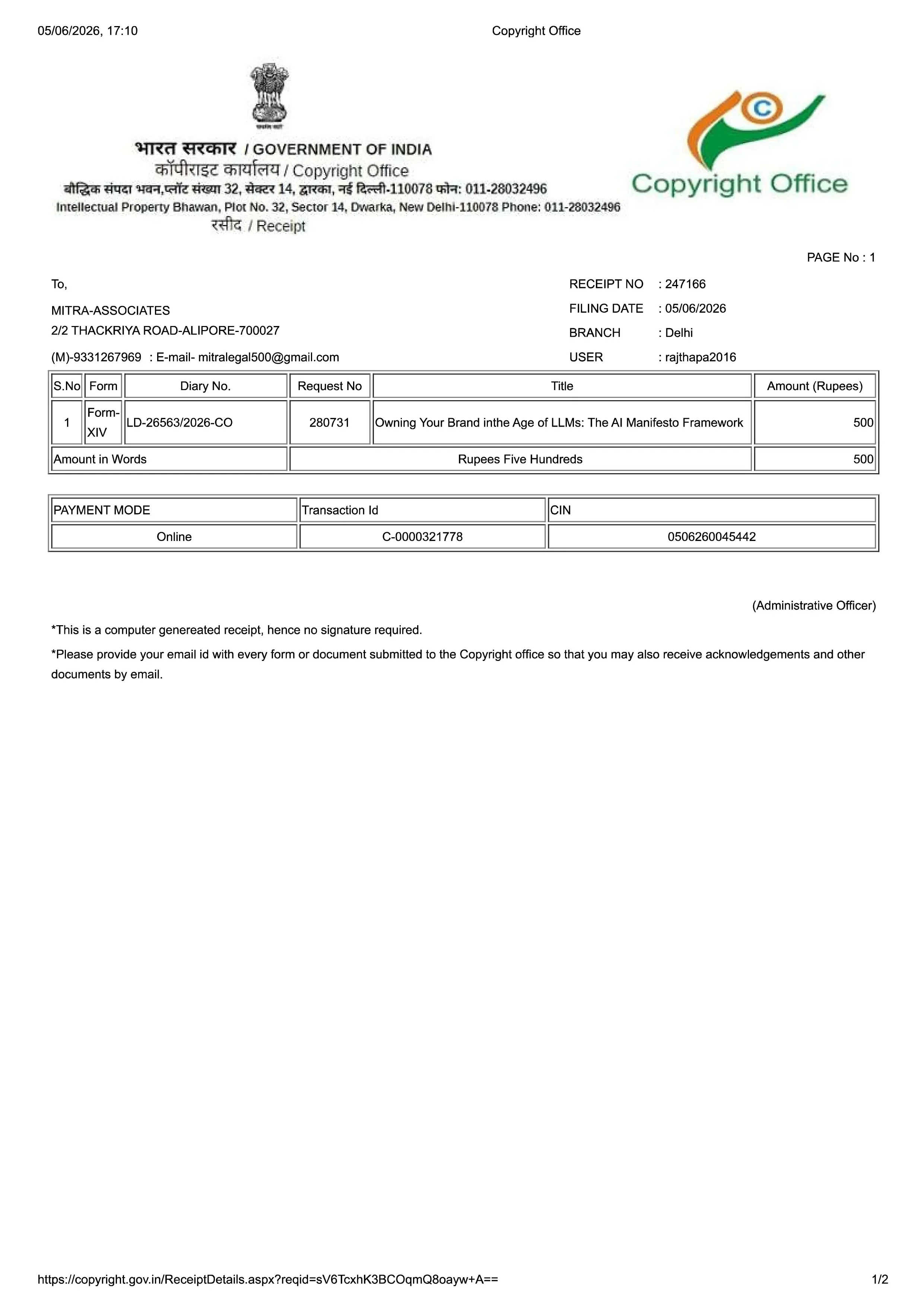
It is protected by the copyright license number: LD26563/2026-CO