
SUPERCHARGE YOUR ONLINE VISIBILITY! CONTACT US AND LET’S ACHIEVE EXCELLENCE TOGETHER!
Exploring Opportunity Costs: Missed Keyword Equity, Brand Discoverability, and Long-Term Traffic
Most product launches follow a familiar script. A press release goes out. Social channels light up. Email sequences hit inboxes at just the right time. Paid ads get switched on with carefully planned budgets and conversion targets. For a few days—sometimes a few weeks—everything feels electric. The dashboard shows a spike. Signups climb. Trials roll in. Installs increase. Revenue ticks upward. The team celebrates, screenshots the graphs, and moves on to the next sprint.
That’s the launch playbook most teams know: create attention, drive immediate action, and measure success by what happened on launch day (or launch week). It’s not wrong—those metrics matter. But it’s incomplete. Because a launch isn’t only a moment. It’s also the beginning of how the market discovers, understands, and compares your product over time. And that’s where the silent failure happens: not in the initial excitement, but in what comes after the spike fades.
The reason this failure stays invisible is simple: most launch reporting is built for short-term performance. Teams track conversions from ads, click-through rates from emails, traffic from social posts, and press pickups. Those channels are loud, measurable, and time-bound. SEO, on the other hand, is often treated as a slower, separate thing—something you “start later,” once the product is stable, once messaging is finalized, once there’s more bandwidth. In many companies, SEO isn’t even a line item in the launch plan. It’s filed under “growth marketing,” “content,” or “we’ll handle it after.”
The problem is that “after” has a cost.
Launches without SEO rarely crash and burn immediately. In fact, they can look wildly successful upfront. You get that burst of attention, the early adopters, the paid-driven conversions—and it feels like momentum. But if SEO isn’t built into the launch, the product begins losing value in ways most teams don’t measure. It fails quietly over time.
That quiet failure is the hidden opportunity cost: the compounding traffic you never earn, because you didn’t build pages that match real search demand. The rankings your competitors, affiliates, and review sites quietly claim, because you didn’t establish keyword ownership early. The brand discoverability you never develop, because the people searching for a solution never find you—only the companies who showed up in search first.
In other words, skipping SEO at launch doesn’t just delay growth. It hands it away.
Understanding Opportunity Cost in Product Marketing
What Opportunity Cost Means in Growth
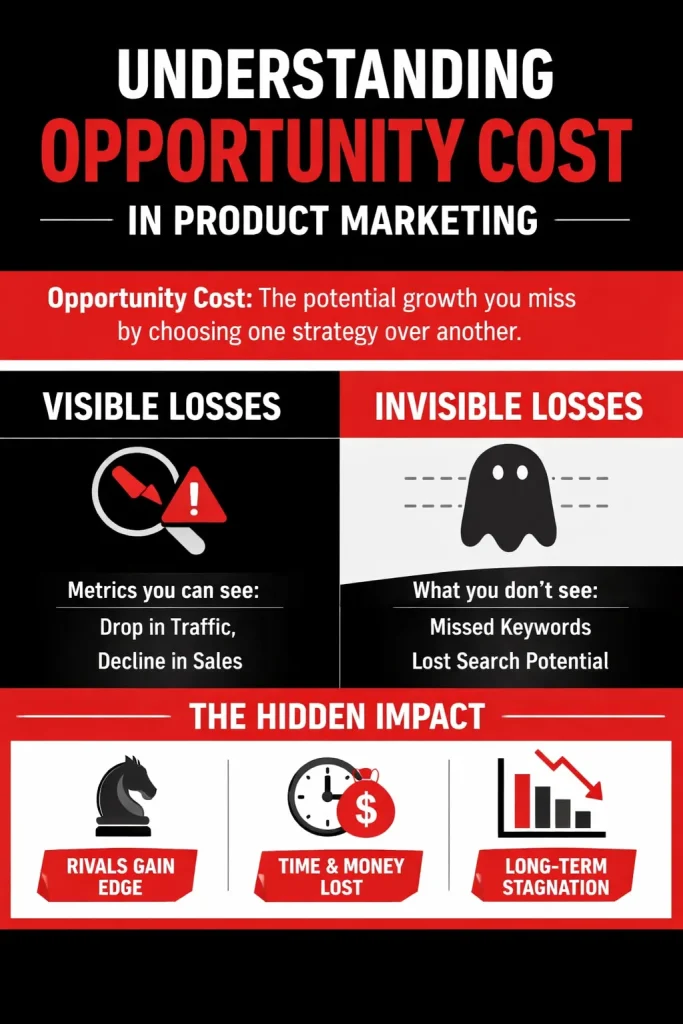
In product marketing, opportunity cost is not about money you actively lose—it’s about growth you never realize. Simply put, it’s the value of the best outcome you could have achieved but didn’t because a different choice was made. In the context of product launches, opportunity cost shows up when teams prioritize short-term visibility—paid ads, PR, social buzz—while ignoring long-term demand capture channels like SEO.
Unlike visible losses (overspent ad budgets, underperforming campaigns, low conversion rates), opportunity costs are invisible by default. You don’t see a warning saying, “You missed ranking for 3,000 high-intent keywords.” The traffic never arrives, the leads never convert, and the revenue never enters your funnel—making it easy to assume nothing was lost.
But in growth marketing, what you don’t capture early often matters more than what you capture briefly.
Why SEO Losses Are Hard to Notice
SEO-related opportunity costs are particularly difficult to detect because there are no red alerts for absence. Analytics tools only report on what happened—sessions, clicks, impressions—not on what could have happened if SEO had been integrated from day one.
You won’t find dashboards for:
- Keywords you never ranked for
- Comparisons where competitors outranked you first
- Search demand that matured without your brand present
This creates a dangerous blind spot. Teams often underestimate SEO losses because they don’t appear as immediate failures. Over time, this turns into SEO debt—the cumulative disadvantage caused by delayed optimization. Unlike technical debt, which breaks things visibly, SEO debt quietly compounds, making future growth slower and more expensive.
The Long-Term Impact of Early Decisions
Search engines heavily weight early signals—content depth, relevance, internal linking, and consistency—especially during a product’s initial discovery phase. Launch timing matters. Brands that publish optimized pages early gain search engine trust faster and benefit from a first-mover advantage in search, even if their product isn’t perfect yet.
When SEO is neglected at launch, competitors, affiliates, and review sites fill the gap. By the time the original brand reacts, rankings are entrenched, authority is established, and reversing the gap requires significantly more time and resources.
What starts as a small oversight compounds into long-term stagnation—slower traffic growth, weaker brand authority, and rising acquisition costs. In product marketing, early SEO decisions don’t just influence launch outcomes—they shape the entire growth trajectory.
Missed Keyword Equity: The Asset You Never Built
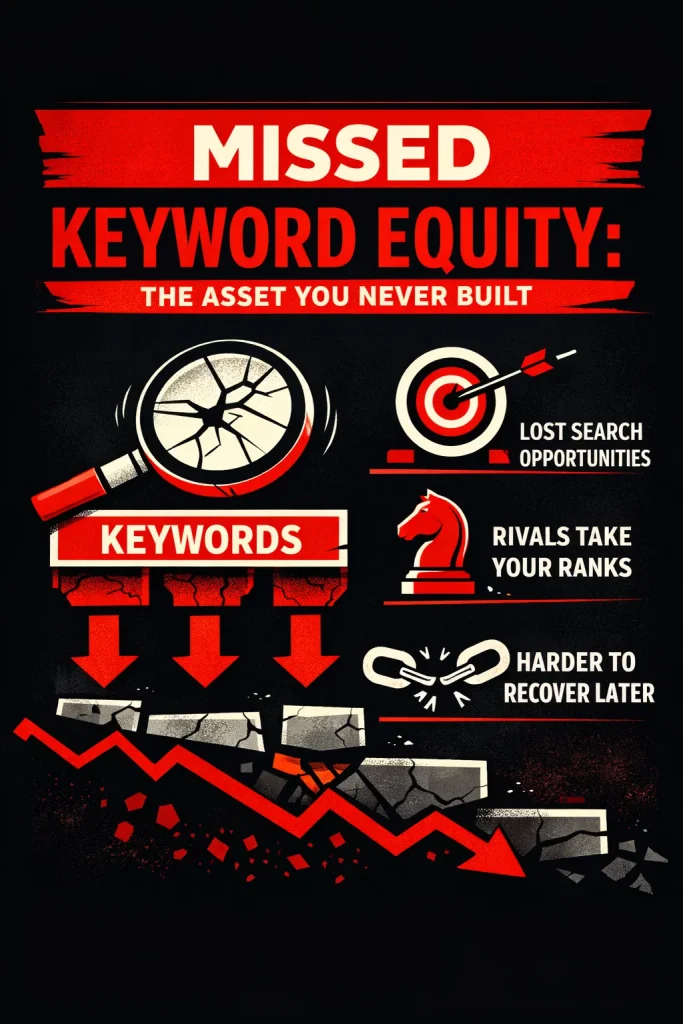
When teams skip SEO during a product launch, they usually assume they’re only delaying “organic growth.” In reality, they’re skipping the creation of an asset: keyword equity—the accumulated authority, relevance, and visibility you build around the searches your future customers are already making. And once that window passes, rebuilding it is far harder and more expensive than getting it right on day one.
What Is Keyword Equity?
Think of keyword equity as your brand’s earned position in search, built over time through consistent relevance and authority. It’s not just “ranking for a keyword.” It’s the broader momentum your domain and pages gain when Google repeatedly sees you as the best answer for a category of queries.
This equity spans multiple keyword types:
- Branded keywords: searches that include your product or company name (e.g., “Acme Analytics pricing,” “Acme Analytics reviews”). These often grow later, once awareness exists.
- Non-branded keywords: category or solution searches without your brand (e.g., “best dashboard tool,” “customer analytics platform”). These are usually the biggest volume opportunities.
- Problem-aware keywords: searches framed around the pain point, not the solution (e.g., “how to reduce churn,” “why customers cancel subscriptions”). These are critical for top-of-funnel discovery and education.
When you invest in SEO early, you start “claiming territory” across these layers. That’s why keywords are essentially digital real estate: the top results become high-visibility property. Owning them brings long-term traffic without paying for every click. Renting them through ads costs you continuously.
The Critical Early Keyword Window
Every new product has a curiosity phase—a period when people are actively searching to understand what it is, whether it’s credible, and how it compares. This is your early keyword window, and it’s more valuable than most teams realize.
During the launch and immediately after, search behavior tends to follow predictable patterns:
- “What is X?” (definition and positioning)
- “X vs Y” (comparison and alternatives)
- “Is X worth it?” (validation and proof)
- Plus “pricing,” “reviews,” “use cases,” “setup,” and “integrations”
These aren’t random queries. They are purchase-intent signals forming in real time.
Google also behaves differently during early product discovery. It tests content quickly—especially when there’s fresh interest or new entities emerging. If your site publishes authoritative, structured, and genuinely helpful pages early, you often get an outsized chance to rank before the space becomes crowded. In other words: the early window is when Google is more willing to try your pages as “the answer.” Once other sites establish dominance, your content has to fight uphill.
What Happens When You Skip SEO at Launch
If SEO isn’t part of the launch plan, the internet still fills up with content about your product—but it won’t be yours.
Common outcomes include:
- No optimized product pages: your main landing page might exist, but it isn’t built to match real search intent. It’s written for investors, press, or internal messaging rather than how buyers search.
- No supporting content ecosystem: there are no comparison pages, no “what is” explainer, no alternatives page, no use-case articles, no integration guides—nothing for Google to connect into a topic cluster.
- Google indexes shallow or irrelevant pages: instead of ranking your best content, search engines may surface a random blog tag page, a thin announcement post, a login page, or a poorly structured product URL.
This is the most painful part: you’re not just missing traffic—you’re teaching search engines the wrong story about your product.
Competitors Capture Your Demand
When you don’t publish SEO-driven launch content, the demand doesn’t disappear. It gets redirected—usually to three groups:
- Review and affiliate sites
They rank first for “reviews,” “pricing,” “best tools,” and “alternatives.”
- Competitors
They build comparison pages like “Our Product vs Your Product” and capture undecided buyers.
- Third-party communities and aggregators
Forums, directories, and listicles start defining you in a few sentences.
Here’s the real cost: third-party narratives become the default narrative. People learn what you are from someone else’s framing—often oversimplified, outdated, or biased.
And because you’re invisible in organic search, you often compensate with paid campaigns. That means you end up paying repeatedly for clicks you could have earned—especially on high-intent queries like “X pricing” or “X alternatives,” where CPCs tend to be expensive.
Long-Term Keyword Recovery Is Expensive
Some teams eventually realize the gap and say, “We’ll fix SEO later.” But later is where the bill comes due.
Once competitors and publishers have established rankings:
- Outranking them becomes harder
Their pages have aged, earned links, gained engagement signals, and built topical authority. You’re not starting from zero—you’re starting from behind.
- Content and link-building costs increase
You’ll need more content, higher quality, more backlinks, better internal linking, and stronger technical foundations just to compete.
- Lost time destroys compounding returns
SEO growth compounds. Missing 6–12 months doesn’t just delay results—it permanently reduces the total traffic you could have accumulated in that period.
The simplest way to think about it:
If SEO is an asset, then launching without SEO is like opening a store and forgetting to put it on the map. You can add signage later—but by then, nearby businesses have already captured the foot traffic, collected reviews, and become the default choice.
Keyword equity is easiest to build when the product story is new, the search landscape is still forming, and Google is still deciding who to trust. Miss that moment, and you’re no longer building equity—you’re paying to buy it back.
Brand Discoverability: Invisible to High-Intent Buyers
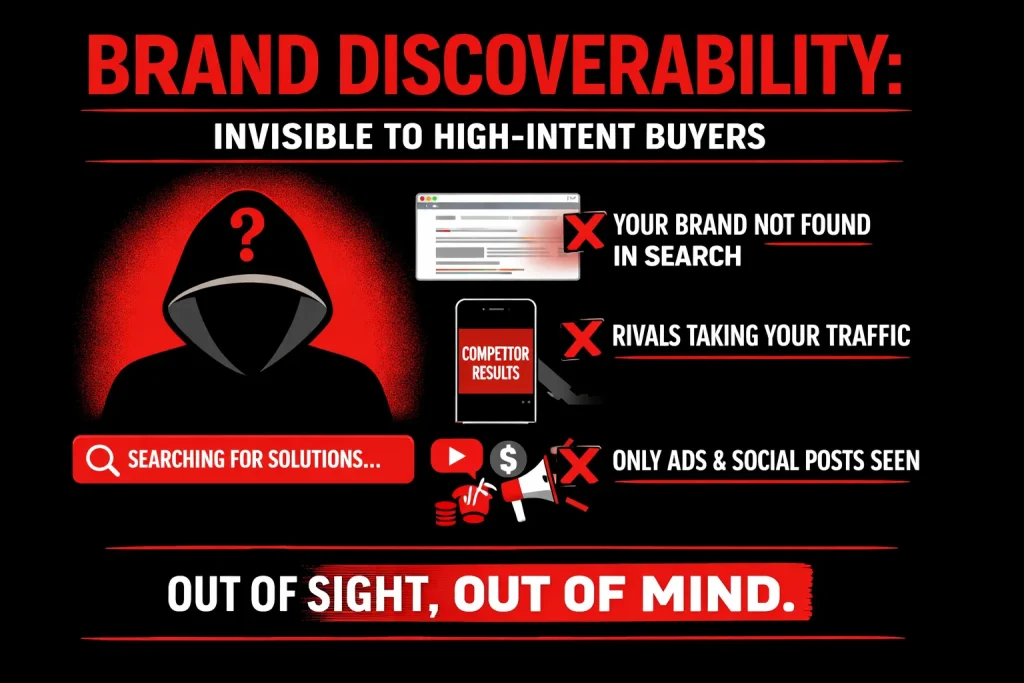
One of the most expensive mistakes product teams make during launch is confusing brand awareness with brand discoverability. While the two are related, they serve entirely different roles in growth. Awareness helps people remember you. Discoverability helps people find you at the exact moment they need a solution. When SEO is missing from a product launch, the brand may feel visible internally—but to high-intent buyers, it is effectively invisible.
Discoverability vs Awareness
Brand awareness is inward-looking. It measures how well your brand resonates with people who already know you—existing users, newsletter subscribers, social followers, or conference attendees. Discoverability, on the other hand, is outward-looking. It reflects how easily new audiences can find your product when they are actively searching for answers, tools, or alternatives.
This distinction matters because most purchase journeys do not begin with a brand name. They begin with a problem. SEO plays a critical role here because it captures existing demand rather than trying to manufacture attention. Social media, PR, and ads are primarily demand-creation channels. SEO is a demand-capture channel. If your product doesn’t appear when someone searches for “best tool for X,” “X software for Y,” or “alternative to Z,” awareness alone will not save you. You are simply not part of the conversation that leads to purchase.
How Buyers Actually Discover New Products
Modern buyers are problem-first, not brand-first. Before they know who you are, they know what they are struggling with. Their journey typically starts with searches like:
- “How to solve [problem]”
- “Best tools for [use case]”
- “Software that helps with [pain point]”
These are non-branded queries, and they dominate the early and most influential stages of the buying journey. At this point, the buyer is open, curious, and evaluating options. Search engines act as de facto product recommendation engines, ranking solutions based on relevance, authority, and usefulness.
When a newly launched product lacks SEO-optimized pages, educational content, or use-case explanations, it simply does not exist in this discovery phase. Competitors, review sites, and affiliates step in instead, shaping the buyer’s perception long before your brand ever enters the picture.
The Brand Blind Spot
Most product launches are designed for people who are already paying attention. Internal teams focus on email lists, social followers, press coverage, and paid campaigns. While these channels are valuable, they primarily recycle visibility within existing or adjacent audiences.
The blind spot is net-new discovery—people who have never heard of your brand but are actively searching for a solution you offer. When SEO is absent, launches become echo chambers. Traffic circulates among the same audiences, while an entire layer of high-intent buyers is left untouched.
Over-reliance on paid and social algorithms worsens the issue. Paid traffic disappears the moment budgets pause. Social visibility fluctuates with platform changes. SEO, by contrast, creates durable entry points into your brand ecosystem. Ignoring it at launch means forfeiting a channel that compounds instead of decaying.
The Trust Gap
Search rankings are not just about visibility—they are about credibility. Users subconsciously trust what appears at the top of search results. A product that ranks well feels vetted, established, and legitimate. A product that doesn’t appear at all feels risky, unproven, or nonexistent.
This creates a trust gap. Even if a buyer later encounters your brand through ads or referrals, the absence of search visibility introduces doubt. The unspoken question becomes: “If this product is real and good, why doesn’t it show up on Google?” In competitive markets, that doubt is often enough to derail a conversion.
The psychological effect is powerful: if Google doesn’t show it, does it really exist?
Long-Term Brand Consequences
The impact of poor discoverability compounds over time. Brands that miss early SEO opportunities struggle to associate themselves with core category terms. Competitors become mentally linked to the problem space, while your brand remains peripheral.
This leads to slower growth in branded search volume because people never encounter your brand during discovery. Fewer discoveries mean fewer conversations, fewer recommendations, and weaker word-of-mouth. Over time, the brand becomes dependent on paid acquisition instead of earning organic demand.
In short, launching without SEO doesn’t just limit traffic—it limits brand gravity. And without discoverability, even the best products struggle to become the obvious choice.
The Traffic Curve: Spikes vs. Compounding Growth
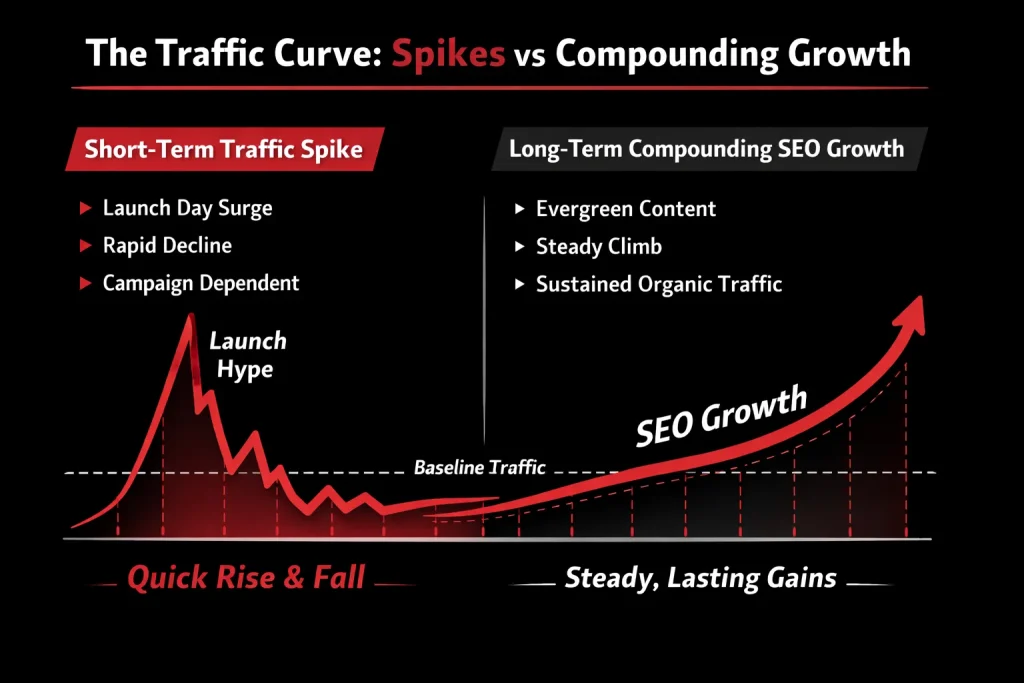
One of the clearest ways to understand the hidden cost of launching products without SEO is to look at how traffic behaves over time. Traffic is not just a number on launch day—it follows a curve. And depending on whether SEO is part of the launch strategy, that curve can either collapse quickly or quietly compound into a long-term growth engine.
Launch Traffic Without SEO
Most product launches that exclude SEO follow the same predictable pattern: a sharp spike followed by a slow, sometimes painful decline.
In the early days, traffic looks healthy. Press coverage, email blasts, social media posts, influencer mentions, paid ads, and community platforms like Product Hunt or Reddit create a surge of attention. Dashboards light up, stakeholders celebrate, and the launch feels successful.
But this traffic is short-lived by design.
Once the campaign window closes, visibility drops. There is no organic discovery mechanism working in the background to replace the fading buzz. Traffic becomes campaign-dependent, meaning every new visit requires another push—another ad, another email, another announcement.
Over time, this creates declining returns:
- Paid acquisition costs rise as competition increases.
- Audiences become saturated and less responsive.
- Each campaign delivers less impact than the last.
Without SEO, traffic behaves like a rented asset. The moment you stop paying or promoting, it disappears.
SEO-Driven Traffic Compounding Explained
SEO-driven launches behave very differently because they are built on assets, not bursts.
At the center of compounding traffic is evergreen content—product pages, use-case pages, comparison pages, and educational resources that answer real search queries. Unlike campaigns, these pages don’t expire. They continue to attract visitors long after the launch is over.
As more pages rank, traffic compounds through cumulative rankings:
- One ranking page brings visitors.
- Ten ranking pages bring consistency.
- Fifty ranking pages create momentum.
Over time, SEO creates network effects across pages. Strong pages pass authority internally, new content ranks faster, and the entire site becomes more visible. Each piece of content strengthens the rest, turning your website into a growing ecosystem rather than a static brochure.
This is how SEO turns a launch into a long-term acquisition channel.
Visualizing the Difference
If you visualize traffic over time, the contrast is striking.
A non-SEO launch follows a spike-and-decay model:
- A sharp rise around launch
- A rapid drop as campaigns end
- A long flat line that requires constant effort to maintain
An SEO-backed launch follows a compounding growth curve:
- Slower initial lift
- Gradual, steady increases
- Accelerating growth as rankings stack
The critical insight is this: month 12 matters more than day 1.
While launch-day spikes look impressive in reports, compounding traffic quietly outperforms them over time. By the end of a year, SEO-driven launches often generate more monthly traffic than the original launch peak—without additional spend.
Cost Efficiency Over Time
The financial implications of these curves are just as important.
Paid traffic becomes more expensive over time. Ad platforms get crowded, bids rise, and cost per acquisition increases. Growth slows unless budgets expand.
Organic traffic behaves in the opposite way. While SEO requires upfront investment, the cost per acquisition decreases over time as content continues to generate traffic without proportional increases in spend.
This is why SEO acts as a growth multiplier:
- The same content produces value repeatedly
- Marginal traffic cost trends toward zero
- ROI improves the longer the product exists
In contrast, launches without SEO lock teams into an endless cycle of spending just to stay visible. The real cost isn’t the missed traffic on launch day—it’s the compounding growth that never happens.
Real-World Scenarios: What SEO Neglect Looks Like in Practice
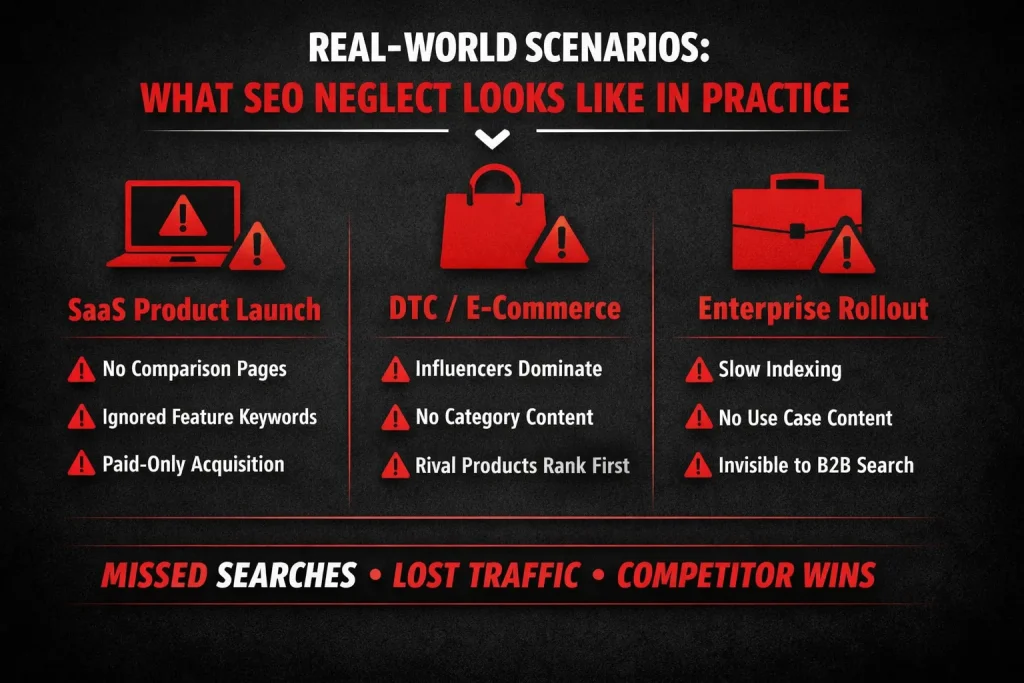
SEO neglect during product launches rarely looks like an obvious failure. In most cases, launches appear successful on the surface—initial buzz, short-term traffic, and early signups create the illusion of momentum. The real cost only becomes visible months later, when organic growth stalls and acquisition becomes increasingly expensive. The following real-world scenarios show how this plays out across different business models.
SaaS Product Launch Without SEO
A common SaaS launch strategy revolves around Product Hunt, social media, email lists, and paid ads. On launch day, traffic spikes dramatically. The product gets upvotes, early adopters sign up, and dashboards light up with activity. But once the hype cycle fades, so does visibility.
The core issue is that many SaaS launches lack search-ready infrastructure. Product pages are thin, feature pages don’t exist, and there are no comparison or alternative pages targeting high-intent keywords like “[tool] vs [competitor]” or “best software for [use case].” As a result, search engines have very little context to understand what the product actually solves.
Over time, review sites, affiliates, and competitors fill that gap. They rank for comparison and solution-based keywords that the SaaS company never targeted. The brand is forced into a paid acquisition loop, spending continuously on ads to replace the organic traffic it never built. What looked like a strong launch turns into a long-term dependency on paid channels—with no compounding return.
DTC / E-commerce Product Launch
In direct-to-consumer and e-commerce launches, SEO neglect often hides behind influencer-driven hype. Social creators generate excitement, traffic flows in bursts, and early sales validate the product. However, once influencer campaigns end, traffic drops sharply.
The underlying problem is the absence of category, collection, and educational content. Many brands launch with only product pages optimized for branded terms, ignoring non-branded searches like “best [product category],” “[product] alternatives,” or “how to choose [product type].”
Competitors—often marketplaces, publishers, or established brands—step in and dominate these searches. They capture high-intent buyers who are actively comparing options, while the original brand remains invisible. Over time, the brand ends up paying for ads on keywords that describe its own product category, effectively renting demand it could have owned.
Enterprise Product Rollouts
Enterprise launches suffer from a different kind of SEO neglect: overprotection. Products are hidden behind gated demos, login walls, or PDFs that search engines struggle to index. While this may feel aligned with sales-led strategies, it severely limits organic discoverability.
Without ungated pages explaining use cases, industries, and solutions, enterprises miss out on early-stage B2B demand. There’s little thought leadership addressing problem-aware searches, and no content mapping complex buyer journeys.
As a result, competitors and analysts define the narrative. The enterprise product fails to appear in research-phase searches, leaving pipeline growth overly dependent on outbound sales rather than inbound demand capture.
Across SaaS, DTC, and enterprise, the pattern is consistent: SEO neglect doesn’t kill launches instantly—it erodes their long-term growth quietly and expensively.
The SEO Debt Created at Launch
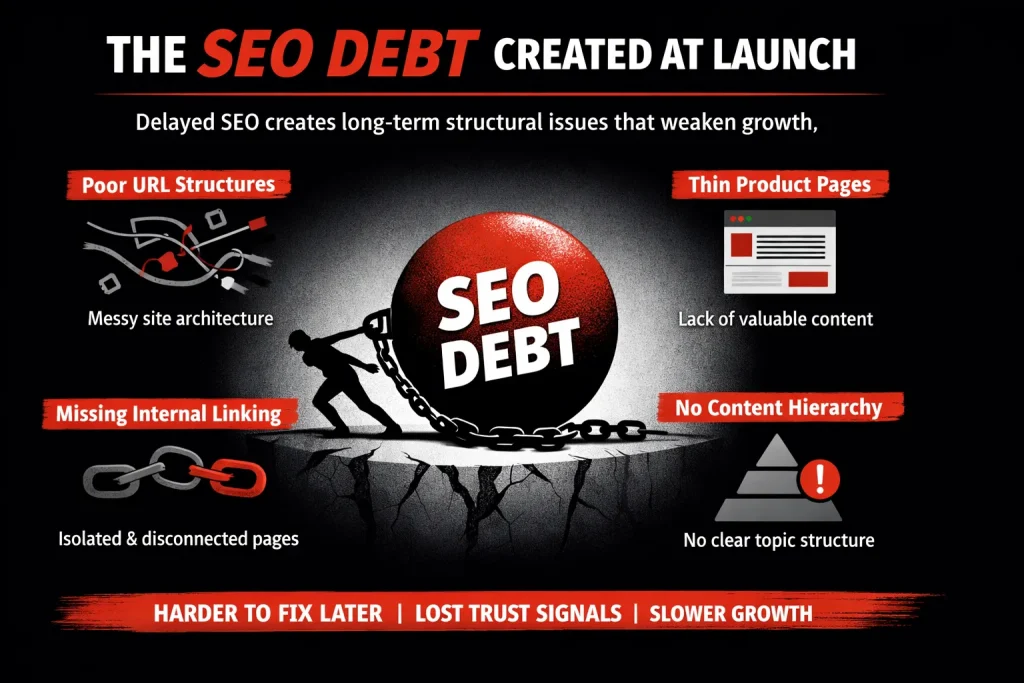
When SEO is ignored during a product launch, teams don’t just “delay optimization”—they actively create SEO debt. Much like technical debt in engineering, SEO debt represents future work that becomes more expensive, riskier, and harder to fix over time. The difference is that SEO debt often goes unnoticed until growth stalls and competitors have already claimed search visibility.
What SEO Debt Means
SEO debt is the accumulation of missed or deferred search optimizations that should have been implemented from day one. Instead of building search equity early, teams postpone foundational work and pay for it later—often with interest.
First, there are deferred optimization costs. Pages that should have been properly structured, optimized, and interlinked at launch require rewrites, redesigns, and re-indexing later. What could have been done once becomes repeated work.
Second, SEO debt includes structural issues baked into the site. URL patterns, page templates, navigation logic, and JavaScript-heavy frameworks are often finalized before SEO is considered. Once traffic, links, and internal dependencies grow, changing these structures becomes risky and resource-intensive.
Finally, there are lost trust signals. Search engines reward consistency, relevance, and historical performance. When a site launches with thin content, unclear intent, or poor crawlability, it fails to establish early trust—something competitors may quietly build while your site remains invisible.
Common Forms of SEO Debt
SEO debt usually shows up in predictable ways.
One of the most common is poor URL structures—generic paths, unnecessary parameters, or URLs that don’t reflect search intent. These are difficult to fix later without redirects and ranking volatility.
Another major issue is thin product pages. Launch pages often prioritize design and messaging over depth, leaving search engines with little context. Adding substance later rarely recovers the early ranking opportunities that were missed.
Missing internal linking is another silent problem. Without intentional internal links, search engines struggle to understand page importance, and authority fails to flow across the site.
Finally, many launches lack a content hierarchy. Without supporting pages for use cases, comparisons, and educational queries, product pages exist in isolation—making them harder to rank and easier for competitors to outperform.
Why SEO Debt Is Harder Than Starting Right
Fixing SEO debt is significantly harder than building correctly from the start. Rewriting existing pages is slower and more constrained than creating greenfield content, especially when branding, legal, and design approvals are involved.
Structural fixes often require site migrations, which introduce ranking risks, crawl issues, and temporary traffic drops—even when executed carefully.
Most importantly, delayed SEO means lost historical data advantages. Search engines value age, engagement history, and consistent performance. You can’t retroactively earn those signals.
In SEO, timing matters. Launching without SEO doesn’t just delay growth—it compounds future difficulty.
What an SEO-Integrated Launch Should Actually Look Like
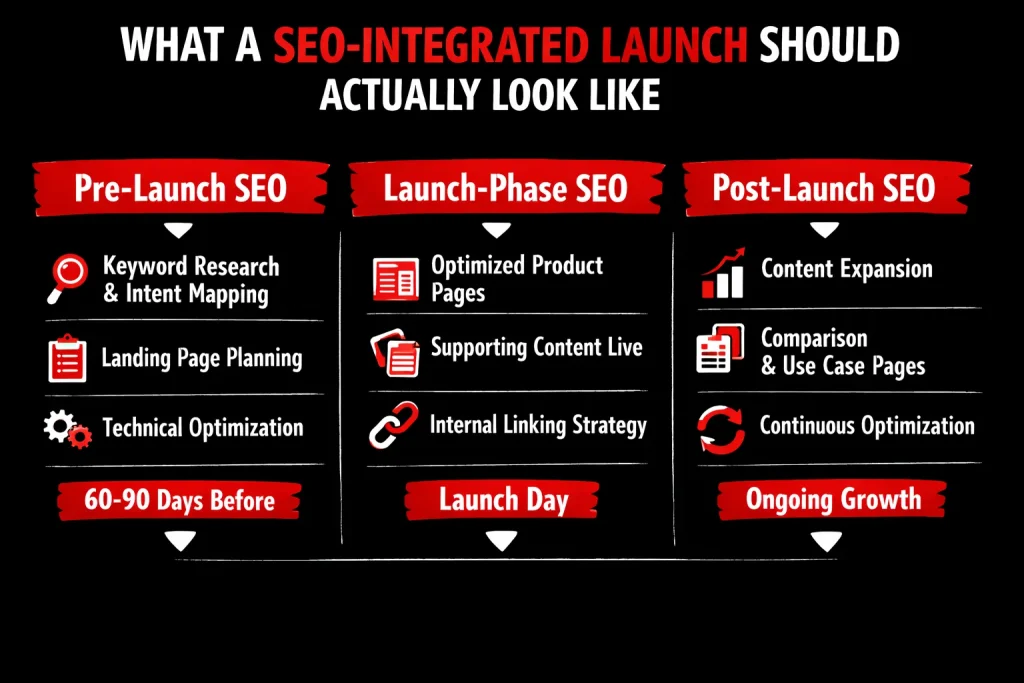
An SEO-integrated product launch isn’t about “doing SEO at some point.” It’s about treating search visibility as a core launch channel, not an afterthought. When SEO is embedded into the launch lifecycle—before, during, and after release—it transforms a one-time announcement into a long-term growth engine. Here’s what that actually looks like in practice.
Pre-Launch SEO (60–90 Days Before)
The biggest SEO wins often happen before the product is public. This phase is about laying the foundation so search engines—and users—understand what you’re building the moment it goes live.
Keyword research aligned with the product roadmap
Instead of generic keyword lists, pre-launch research should map directly to product features, problems solved, and target personas. This includes:
- Core category keywords (what the product is)
- Problem-aware keywords (what users are trying to fix)
- Feature-level keywords tied to upcoming releases
This alignment ensures SEO supports where the product is headed, not just where it is today.
Search intent mapping
Every keyword carries intent—informational, commercial, or transactional. Mapping intent helps decide:
- Which keywords deserve product pages
- Which require educational content
- Which belong to comparison or alternatives pages
This prevents the common mistake of forcing blog content to rank for buyer-intent terms or bloated product pages trying to answer informational queries.
Landing page planning
Before launch, teams should define:
- Primary product pages
- Feature or use-case subpages
- Supporting educational content hubs
This creates a clean site architecture that search engines can crawl and users can navigate intuitively.
Technical readiness
SEO fundamentals must be in place before launch day:
- Crawlable pages (no accidental noindex)
- Clean URLs
- Fast load times
- Mobile responsiveness
- Structured data where applicable
Technical issues at launch delay indexing—and lost time here means lost momentum.
Launch-Phase SEO
Launch day isn’t just a marketing moment; it’s an indexing moment.
Optimized product pages live on day one
Your core product pages should already be optimized with:
- Clear value propositions
- Keyword-aligned headings
- Optimized metadata
- Scannable content structure
This allows search engines to immediately understand and test your pages in relevant search results.
Supporting content published simultaneously
Alongside product pages, publish:
- Explainer content (“What is X?”)
- Use-case pages
- Early FAQs
This surrounding content strengthens topical authority and helps your product rank beyond branded searches.
Internal linking and indexing strategy
Launch content should be internally linked from:
- Homepage
- Blog
- Resource hubs
Sitemaps and Search Console submissions ensure fast discovery, reducing the lag between launch and organic visibility.
Post-Launch SEO Compounding
This is where SEO turns a launch into an asset.
Content expansion based on real queries
Post-launch search data reveals how people actually talk about your product. Use this to create content around:
- Feature questions
- Pain points
- Unexpected use cases
Comparison, use-case, and alternative pages
As awareness grows, users search for:
- “[Product] vs competitors”
- “Best tools for X”
- “Alternatives to [Product]”
Owning these pages prevents competitors and affiliates from defining your narrative.
Continuous optimization loop
SEO doesn’t end—it compounds. Regular updates based on rankings, engagement, and conversions ensure your launch keeps generating traffic long after the announcement fades.
In short: an SEO-integrated launch doesn’t chase traffic. It builds ownership of demand—from day one and for years after.
Measuring What Most Teams Ignore
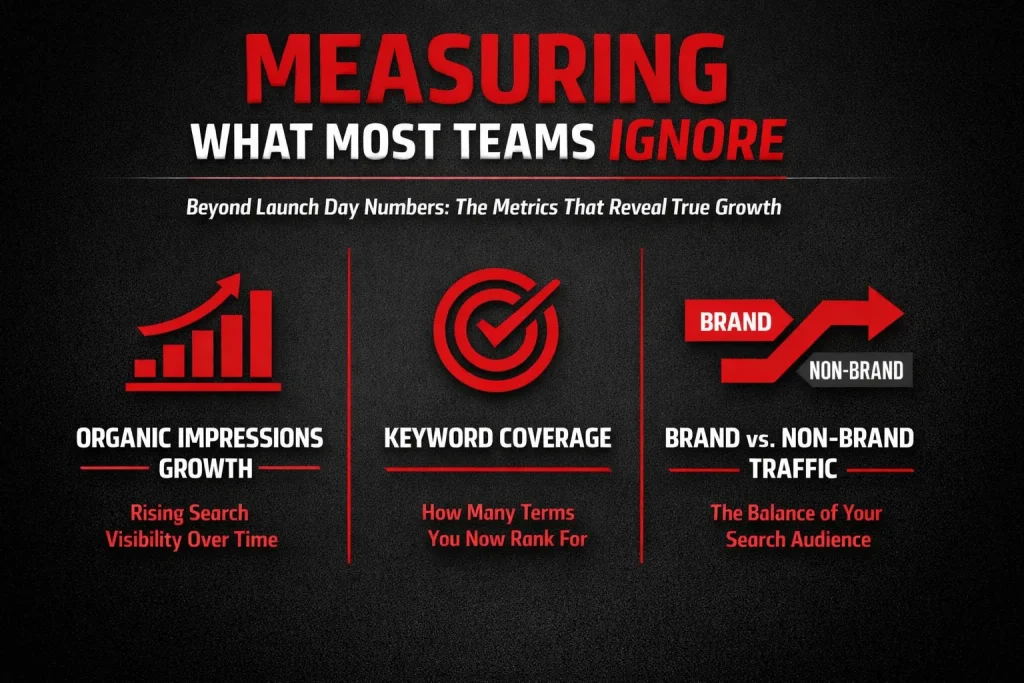
Product launches are often judged by what happens in the first few days or weeks—signups, installs, revenue spikes, or media mentions. While these metrics are useful, they tell only a small part of the story. The real impact of a launch, especially from an SEO perspective, unfolds over months, not days. Unfortunately, this is where most teams stop measuring.
Metrics Beyond Launch Day
To understand whether a launch is truly building long-term value, teams need to look past surface-level traffic numbers. Organic impressions growth is one of the earliest indicators that a product is gaining visibility in search, even before clicks increase. Rising impressions signal that search engines are testing and exposing your pages to relevant audiences.
Another critical metric is keyword coverage—the total number of relevant queries your product pages and supporting content rank for. A successful SEO-integrated launch doesn’t just rank for one branded term; it steadily expands across problem-based, comparison, and use-case keywords.
Equally important is the brand vs. non-brand traffic split. Heavy reliance on branded searches suggests you’re only capturing demand from people who already know you. Growth in non-brand traffic indicates that your product is being discovered by new, high-intent users.
Leading vs. Lagging Indicators
SEO performance should be evaluated using both early and delayed signals. Early ranking movements, even on page two or three, often predict future gains. Crawl frequency shows whether search engines consider your product pages important enough to revisit regularly. Meanwhile, content engagement metrics—such as time on page and scroll depth—validate whether your content truly satisfies search intent.
Framing SEO as a Growth Asset
When measured correctly, SEO shifts from a marketing tactic to a growth asset. SEO ROI compounds over time, unlike paid campaigns. Each page adds to lifetime traffic value, contributing predictable demand. Most importantly, SEO data strengthens revenue forecasting, turning organic visibility into a measurable, scalable growth channel rather than an afterthought.
Conclusion: Launches End — SEO Compounds
Product launches are often treated as milestones—intense, time-bound moments where all attention is focused on visibility, adoption, and short-term wins. But what happens after the launch buzz fades is far more important than what happens on day one. This is where SEO quietly determines whether a product continues to grow or slowly disappears from relevance.
Reframing the Cost of SEO Neglect
Neglecting SEO during a product launch is rarely seen as a loss, because nothing visibly breaks. Budgets are saved, timelines feel faster, and results may even look strong initially. But this framing is misleading. SEO is not an expense that can be postponed without consequence—it is an asset that compounds over time. When SEO is ignored, what’s lost isn’t just traffic, but keyword equity, discoverability, and long-term demand capture. This creates a growth leak that widens with time: competitors rank for your use cases, third-party sites control your narrative, and paid channels are forced to carry the full burden of acquisition.
The Strategic Shift Product Teams Must Make
To avoid this, product teams must rethink how they approach launches. The shift is from campaigns to systems—from one-off promotional bursts to scalable, durable growth engines. SEO doesn’t replace launches; it extends them. It ensures that every feature, update, and announcement continues to attract high-intent users long after launch day ends. This mindset prioritizes long-term impact over short-term applause.
Final Takeaway
Every product launch is a search opportunity. Buyers are searching, comparing, and evaluating—whether you show up or not. If you don’t claim that demand, someone else will. Ultimately, SEO isn’t about rankings or traffic alone. It’s about owning demand, shaping perception, and building growth that compounds long after the launch is over.



