SUPERCHARGE YOUR Online VISIBILITY! CONTACT US AND LET’S ACHIEVE EXCELLENCE TOGETHER!
The SEO Paradox of Funded Startups
There’s a widespread assumption in the startup world that once funding is secured, SEO should more or less take care of itself. After all, funded startups have what most bootstrapped founders don’t: sizable marketing budgets, in-house growth teams, access to senior talent, and premium SEO tools like Ahrefs, SEMrush, Screaming Frog, and Clearscope. On paper, organic growth should be inevitable.
Yet the reality on the ground tells a very different story.
I’ve audited startups with $10M+ in funding that had less organic traffic than solo founders running WordPress blogs. Series A to Series C companies—often with 20–100 employees—frequently underperform in search despite having every apparent advantage. Their websites look polished, their dashboards are full of tools, and their teams are busy shipping campaigns. But when you look at non-branded organic traffic, keyword depth, and search visibility across the funnel, the numbers simply don’t add up.
This disconnect is what I call the SEO paradox of funded startups: more money, more people, more tools—yet weaker organic foundations.
What makes this especially dangerous is that SEO failure in funded startups carries far greater consequences than it does for bootstrapped ones. Funded companies operate under higher burn rates, which means inefficient acquisition channels hurt faster. They also face intense pressure for predictable, scalable growth, often tied to investor expectations and upcoming funding rounds. When organic search underperforms, startups compensate by doubling down on paid channels—driving CAC higher and margins lower.
Industry benchmarks consistently show that paid acquisition CAC is often 3–5x higher than organic CAC over time, especially in competitive SaaS and marketplace categories. Yet reports from firms like First Round and OpenView highlight that a large percentage of early- and mid-stage startups derive the majority of their revenue from paid channels well into Series B and beyond. This overdependence creates a fragile growth engine—one that stops the moment spend slows.
The biggest cost, however, is invisible: missed compounding returns. SEO is one of the few channels where effort compounds over time. When funded startups delay or mismanage it, they don’t just lose traffic—they lose years of accumulated advantage.
And most of the time, it’s not because they didn’t try. It’s because they believed the wrong things about SEO in the first place.
The Funding Fallacy: Why Money Creates False SEO Confidence
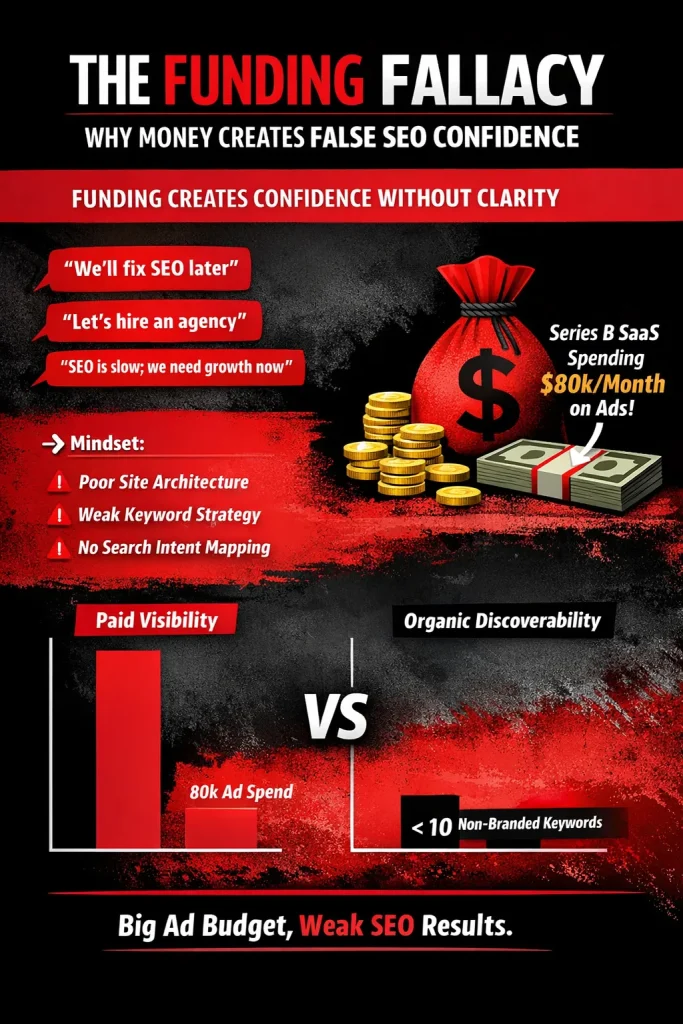
One of the most dangerous assumptions in venture-backed startups is the belief that funding equals readiness. Once capital lands in the bank, there’s an unspoken confidence that growth problems—SEO included—are now solvable simply because there’s money to spend. In reality, funding often creates confidence without clarity.
Funding does not equal SEO maturity. A startup can raise millions and still lack the fundamentals required to win in organic search. What funding does provide is optionality: the ability to hire fast, run experiments, and scale channels aggressively. But without a clear SEO strategy, this optionality quickly turns into misdirection.
This is why certain mindsets appear again and again in funded startups:
- “We’ll fix SEO later—right now we need traction.”
- “Let’s hire a strong agency and let them handle it.”
- “SEO is slow; paid channels give us immediate results.”
On the surface, these decisions feel rational—especially under investor pressure. But money often masks foundational SEO problems instead of solving them. Paid ads compensate for poor site architecture. Brand campaigns hide weak keyword coverage. Content velocity distracts teams from the fact that there’s no real search intent mapping behind what’s being published.
A common example: a Series B SaaS startup spending nearly $80,000 per month on paid acquisition, generating healthy demo volume—yet ranking for fewer than 10 non-branded keywords. The brand looks visible everywhere: ads, conferences, LinkedIn. But in organic search, it’s nearly invisible. This is the difference between visibility and discoverability. Visibility is rented; discoverability is earned and compounded.
Funding makes growth louder, but not smarter. Without clarity on how users actually search, money simply amplifies inefficiency—especially in SEO.
Myth #1: “We Have Funding, So We Can Just Hire SEO Out”
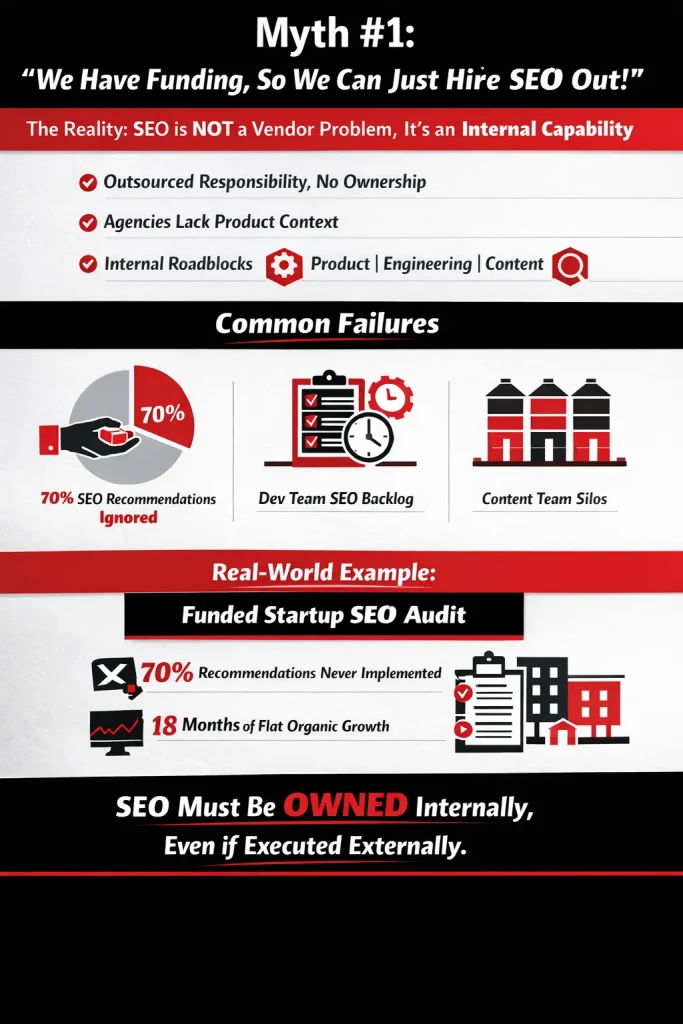
One of the most common—and costly—assumptions I see in funded startups is the belief that SEO is a vendor problem, not an internal capability. The logic sounds reasonable on the surface: we have money, SEO is specialized, so let’s hire an agency and move on. In reality, this mindset is one of the biggest reasons SEO underperforms in venture-backed companies.
Why this myth persists
Funding often encourages outsourcing responsibility instead of ownership. Founders and leadership teams treat SEO like legal or accounting—something external experts “handle.” But SEO is deeply intertwined with product, engineering, content, and even design decisions. When ownership lives outside the company, execution inevitably breaks down.
Another issue is lack of product and market context. Even strong SEO agencies operate at arm’s length. They don’t sit in roadmap discussions, customer interviews, or sales calls. As a result, keyword strategies miss real user language, content fails to reflect buyer intent, and technical recommendations clash with product priorities.
Finally, SEO work is frequently blocked internally. Product teams prioritize feature releases. Engineering teams focus on stability and velocity. Design teams push for visual perfection. SEO recommendations—URL changes, internal linking, schema, page structure—rarely feel urgent to any single team, so they stall.
Common failure patterns in funded startups
Across audits, the patterns repeat:
- SEO recommendations never get implemented. Agencies deliver detailed audits, but execution dies in Jira or Notion.
- Dev teams deprioritize SEO tickets. Technical fixes are labeled “nice to have” and pushed to future sprints that never arrive.
- Content teams work in silos. Writers produce blog content without coordination with SEO strategy, internal linking, or conversion goals.
Industry agency reports consistently show that only 30–40% of SEO recommendations are ever implemented in startups, even when budgets are healthy. For technical fixes, the average time to implementation often exceeds 3–6 months, long enough for opportunities to expire and competitors to win.
A real-world example
I worked with a funded marketplace startup that had raised over $20M. They hired a reputable SEO agency, received a comprehensive audit, and felt confident things were “covered.” Six months later, organic traffic hadn’t moved.
When we reviewed execution, the issue was clear: nearly 70% of the recommendations were never shipped. Canonical issues were ignored, category pages weren’t optimized, internal linking was untouched, and indexation problems persisted. Eighteen months later, organic growth was still flat—not because the strategy was wrong, but because no one internally owned SEO outcomes.
The real takeaway
SEO cannot be fully outsourced. It must be owned internally, even if executed externally. Funded startups that succeed in SEO assign clear ownership, align teams around implementation, and treat SEO as a core growth system—not a vendor deliverable. Agencies can guide and accelerate, but without internal accountability, funding simply amplifies inaction.
Myth #2: “SEO Is Just Content + Backlinks”
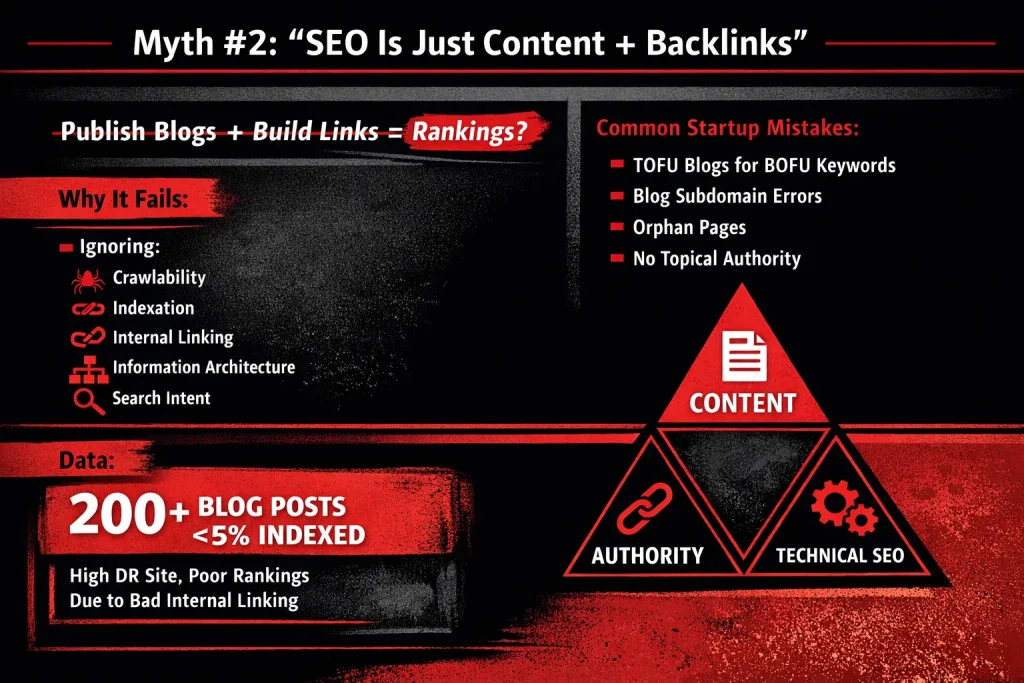
One of the most persistent misconceptions in funded startups is the belief that SEO is simply a numbers game: publish more blog posts, acquire more backlinks, and rankings will follow. With healthy budgets, this myth becomes even more dangerous. Teams hire writers, scale content production, invest in digital PR, and assume momentum is inevitable.
In reality, content and backlinks are only two legs of a three-legged stool. Without technical and structural SEO, even the best content fails to perform.
Why This Approach Fails
When startups focus solely on publishing and links, they often ignore foundational elements that determine whether Google can understand, trust, and rank their content at all. The most common blind spots include:
- Crawlability – Search engines struggle to access pages due to poor internal linking, JavaScript-heavy frameworks, or blocked resources.
- Indexation – Pages exist but never make it into Google’s index, rendering them invisible.
- Internal linking – Authority is not distributed across the site, leaving important pages isolated.
- Information architecture – Content is scattered rather than organized into clear topic clusters.
- Search intent alignment – Pages target keywords without matching what users actually want to see.
Ignoring these factors turns SEO into an expensive guessing game.
Common Startup Mistakes
This myth shows up in predictable ways across funded startups:
- Top-of-funnel blogs targeting bottom-of-funnel keywords .
Startups publish educational blog posts hoping to rank for high-intent terms like “best [software]” or “[tool] pricing,” while competitors win with comparison pages and product-led content.
- Blog subdomain mistakes
Moving the blog to blog.example.com without a clear authority or linking strategy, effectively isolating content from the main domain.
- Orphan pages
Dozens (or hundreds) of blog posts with zero internal links pointing to them, signaling low importance to search engines.
- No topical authority strategy
Content is published randomly based on ideas, not built around core problem areas where authority needs to be established.
Data & Real-World Examples
In one audit of a Series B SaaS startup, the company had over 200 published blog posts, yet less than 5% were indexed. The content wasn’t bad—but it lived behind poor internal linking, inconsistent URL structures, and weak crawl paths.
In another case, a startup with a high Domain Rating (70+) failed to rank for non-branded keywords because authority was concentrated on the homepage and blog, while revenue-driving pages had almost no internal links pointing to them.
The Real SEO Equation
A useful way to visualize this is a triangle:
- Content (what you publish)
- Authority (links and trust signals)
- Technical SEO (how everything connects and functions)
If any side is weak, the structure collapses.
Funded startups don’t lose at SEO because they lack content or links. They lose because they ignore the systems that make those investments compound.
Myth #3: “Our Brand Will Carry Our SEO”
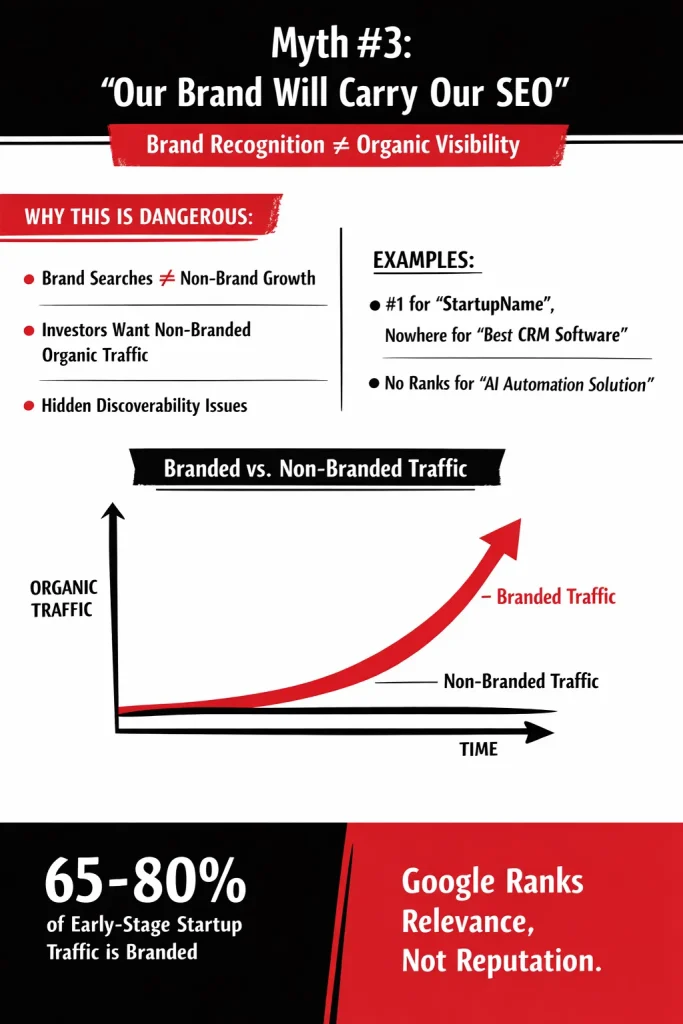
One of the most persistent misconceptions I see in funded startups is the belief that strong brand recognition automatically translates into strong organic visibility. The logic feels intuitive: we’re well-known, we have press, people talk about us—Google will reward that. Unfortunately, search engines don’t work on brand perception alone.
The Myth: Brand Recognition = Organic Visibility
Yes, a recognizable brand helps people search for you. But SEO success depends on people discovering you before they know you exist. That distinction is where many funded startups fall short.
In audits of early- to mid-stage startups (Seed to Series B), it’s common to see 60–80% of organic traffic coming from branded searches—queries that already include the company name or product name. While this looks impressive in dashboards, it’s largely demand capture, not demand creation. You’re harvesting interest you already earned through PR, ads, or word of mouth—not building a scalable acquisition engine.
Why This Is Dangerous
First, brand search ≠ non-brand growth. Branded traffic plateaus quickly. Once most people who know you are already searching for you, growth stalls unless new audiences can discover you through problem- or category-based queries.
Second, investors care deeply about non-branded organic traffic. During due diligence, experienced VCs often separate branded vs non-branded performance to understand true market reach. A startup ranking #1 for its own name but invisible for high-intent queries like “best [category] software” or “[problem] solution” signals limited discoverability and weak search-market fit.
Third, brand-heavy SEO hides structural problems. When dashboards are dominated by branded keywords, teams often miss:
- Poor category and comparison page coverage
- Weak internal linking
- Content that doesn’t match search intent
- Missing BOFU and MOFU pages
The result is a false sense of security—traffic exists, so SEO must be working.
Real-World Pattern I See Repeatedly
A funded SaaS startup ranks #1 for its brand name, #2 for a branded feature term, and maybe a few long-tail branded variations. But when you look at non-branded keywords—the terms real buyers search before shortlisting vendors—the site is absent from page one entirely. The traffic graph tells the same story: a steady baseline driven almost entirely by brand queries, with little upside.
The Data Reality: Relevance Beats Reputation
Google does not rank sites because they are popular; it ranks them because they are relevant, useful, and authoritative for a specific query. Brand signals help after relevance is established, not instead of it. Until your startup earns visibility across non-branded, intent-driven searches, your SEO growth will remain capped—no matter how strong your brand appears on the surface.
Myth #4: “SEO Takes Too Long for Fast-Growth Startups”
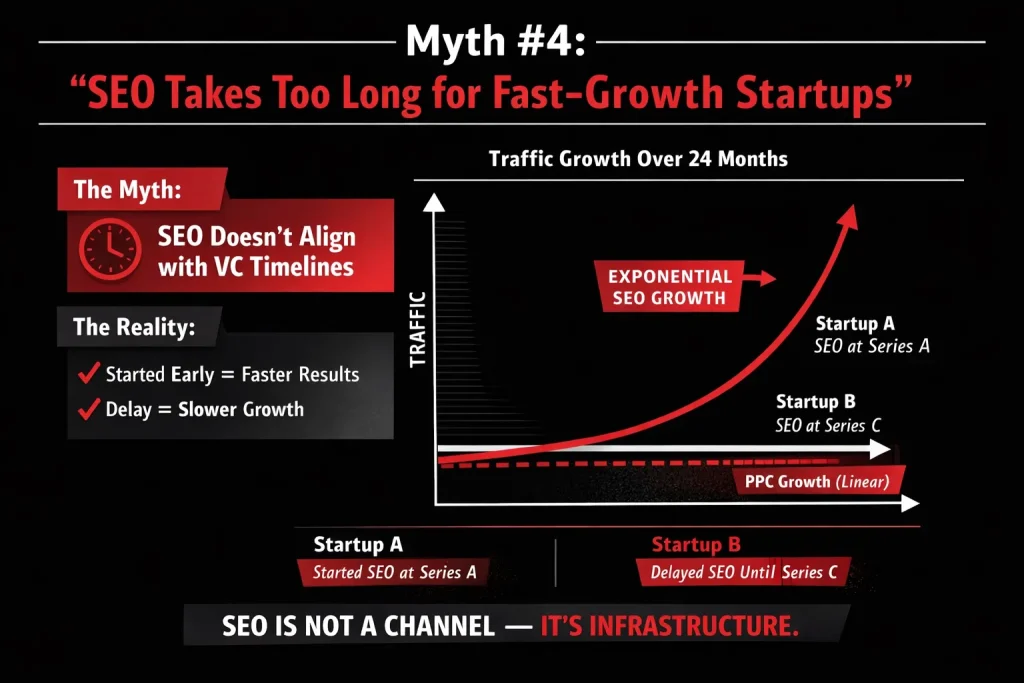
One of the most persistent beliefs in venture-backed companies is that SEO simply doesn’t fit VC timelines. Founders are told to focus on fast, measurable wins—paid ads, partnerships, outbound—because SEO is seen as slow, uncertain, and better suited for “later-stage” optimization. On the surface, this sounds reasonable. In reality, this belief is one of the most expensive mistakes funded startups make.
The truth is not that SEO takes too long. SEO timelines are slow only when SEO is started late.
Most fast-growing startups delay SEO until Series B or C, after product-market fit, brand traction, and aggressive paid acquisition are already in place. By that point, SEO has to fight against years of technical debt, rigid site architecture, JavaScript-heavy builds, poorly structured content, and URLs that can no longer be changed without risk. Naturally, results take longer—and SEO gets blamed for being “slow.”
When SEO is introduced early, however, it behaves very differently. Early SEO compounds faster than any paid channel. Every optimized page, internal link, and keyword ranking builds on the last. Unlike ads, which stop the moment spend pauses, SEO assets continue producing returns month after month.
The growth curves tell the story clearly. PPC growth is linear—you put in a dollar, you get a predictable (and often declining) return. SEO growth is exponential—small early investments snowball as authority, relevance, and coverage expand.
Consider two hypothetical but common scenarios. Startup A begins SEO at Series A. They build search-friendly architecture, publish intent-driven content, and optimize core pages early. After 24 months, organic traffic becomes a primary acquisition channel, lowering blended CAC and stabilizing growth. Startup B, on the other hand, waits until Series C. After the same 24 months, they are still “fixing foundations,” while paying a premium for traffic they could have owned.
The real mindset shift is this: SEO is not a channel—it’s infrastructure. Like engineering or analytics, it doesn’t slow growth; it makes sustainable growth possible.
Myth #5: “Our Product Is Too Complex for SEO”
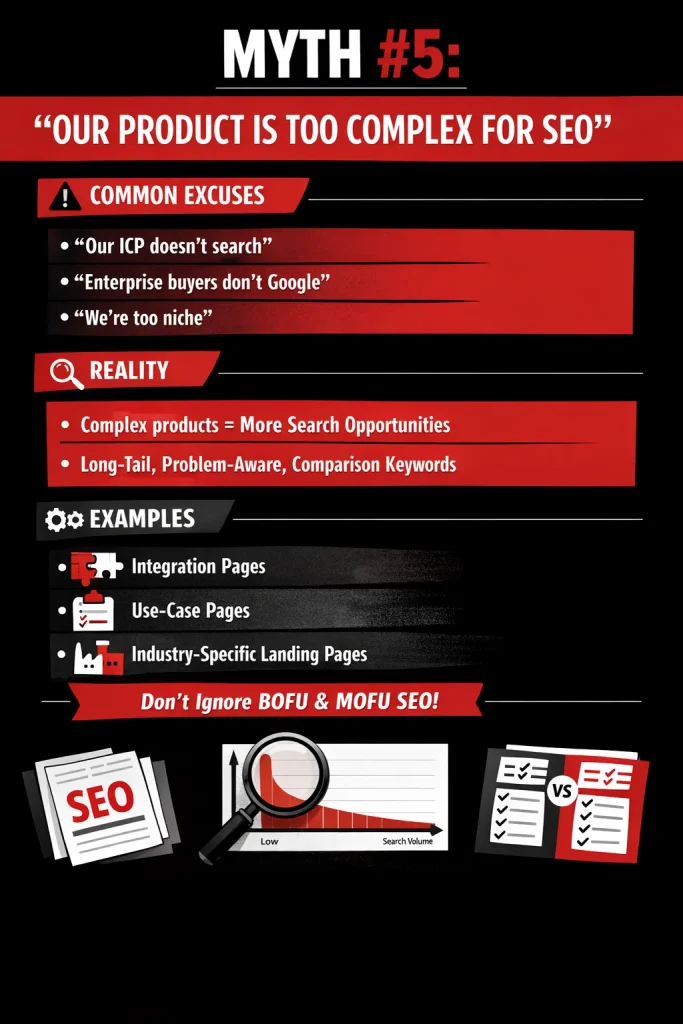
One of the most common excuses I hear from funded startup teams—especially in B2B and enterprise—is: “SEO won’t work for us because our product is too complex.” This belief usually shows up in a few familiar forms: “Our ICP doesn’t search,” “Enterprise buyers don’t Google,” or “We’re too niche to benefit from SEO.” On the surface, these statements sound logical. In reality, they’re not just wrong—they’re costly.
The truth is that complex products don’t reduce SEO opportunities; they multiply them. The more complex your product, the more problems it solves, workflows it touches, and systems it integrates with. Every one of those dimensions creates searchable demand. Enterprise buyers may not search “buy enterprise workflow orchestration software today,” but they absolutely search for problems, alternatives, integrations, comparisons, and validation throughout their buying journey.
Where startups go wrong is assuming SEO only works for simple, high-volume keywords. In B2B and enterprise, SEO is driven by long-tail, problem-aware, and comparison-based queries. Think:
- “How to integrate CRM with data warehouse”
- “Alternatives to [competitor] for regulated industries”
- “Best tools for automating [specific workflow]”
These queries often have lower search volume but significantly higher intent and deal size.
In practice, funded startups leave massive SEO value untapped by underbuilding key page types. B2B SaaS companies, for example, should be investing heavily in:
- Integration pages that capture intent from users already using adjacent tools
- Use-case pages aligned with specific pain points and workflows
- Industry-specific landing pages that speak directly to verticalized needs
Instead, many startups over-index on top-of-funnel blogs while ignoring MOFU and BOFU SEO entirely. The result? Plenty of traffic, very little revenue impact. When SEO is aligned with product complexity rather than running from it, it becomes one of the strongest growth levers available—especially for funded startups targeting high-value customers.
Myth #6: “We’ll Fix SEO After Product-Market Fit”
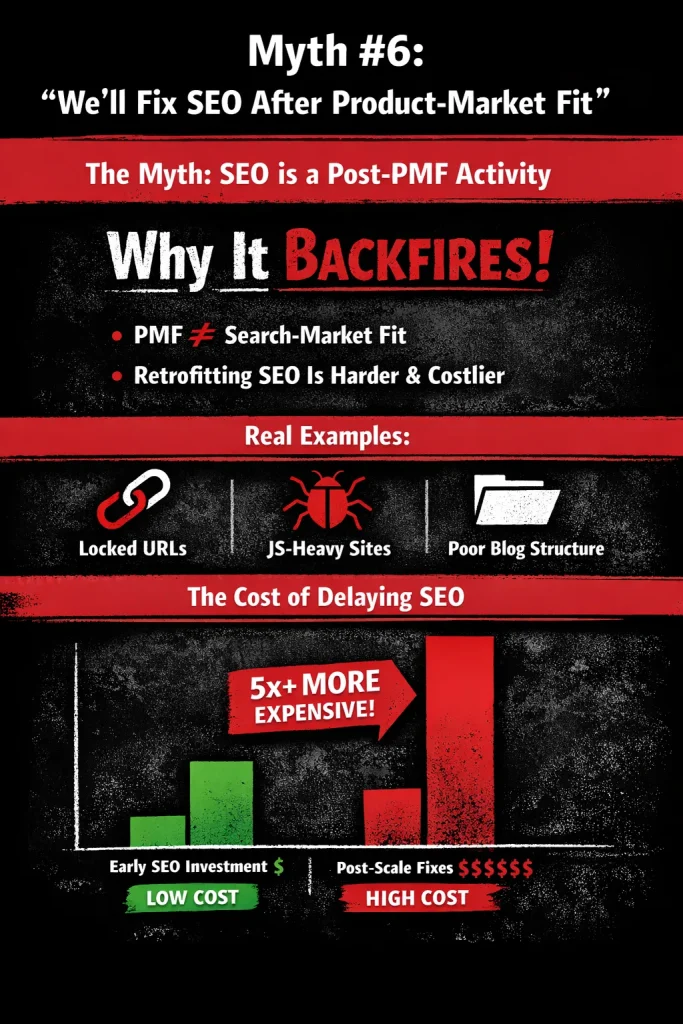
One of the most common — and costly — misconceptions in funded startups is the belief that SEO is something to worry about after product-market fit (PMF). The logic sounds reasonable: “Let’s first validate the product, then we’ll scale distribution.” In practice, this mindset quietly sabotages long-term organic growth.
The core problem is that PMF does not equal search-market fit. A product can have strong retention, healthy revenue growth, and happy customers — yet remain almost invisible in organic search. Search demand operates on its own rules: how users phrase problems, compare solutions, and evaluate alternatives. When startups delay SEO, they often discover too late that their product language doesn’t align with how the market searches. At that point, correcting the gap requires structural changes, not quick wins.
The second issue is cost. Retrofitting SEO is significantly harder and more expensive than building it early. I’ve seen startups reach Series B with thousands of indexed pages, only to realize their URL structure is fundamentally broken. Product pages buried three or four levels deep, parameter-based URLs that can’t be simplified, or auto-generated pages that cannibalize each other — all of these become painful to fix once traffic, links, and internal dependencies exist.
Technical debt compounds the problem. Many startups launch with JavaScript-heavy frameworks optimized for speed of development, not crawlability. Initially, this feels harmless. Later, when organic traffic becomes a priority, teams discover that critical pages don’t render reliably for search engines, internal links aren’t crawlable, and core content isn’t consistently indexed. Fixing this post-scale often means refactoring core components — an expensive and risky move.
Content suffers too. Blogs launched as “just marketing” frequently lack scalable structure: no topic clusters, inconsistent categories, and URLs that don’t support long-term authority building. Redesigning this after hundreds of posts exist often leads to traffic drops and migration headaches.
In early-stage startups, baking SEO into the foundation might cost 10–20% more upfront in planning and engineering time. Post-PMF, those same fixes can cost 3–5× more, not including lost organic growth during the delay. SEO isn’t something you bolt on after PMF — it’s something that quietly compounds alongside it.
The Real Reasons Funded Startups Fail at SEO
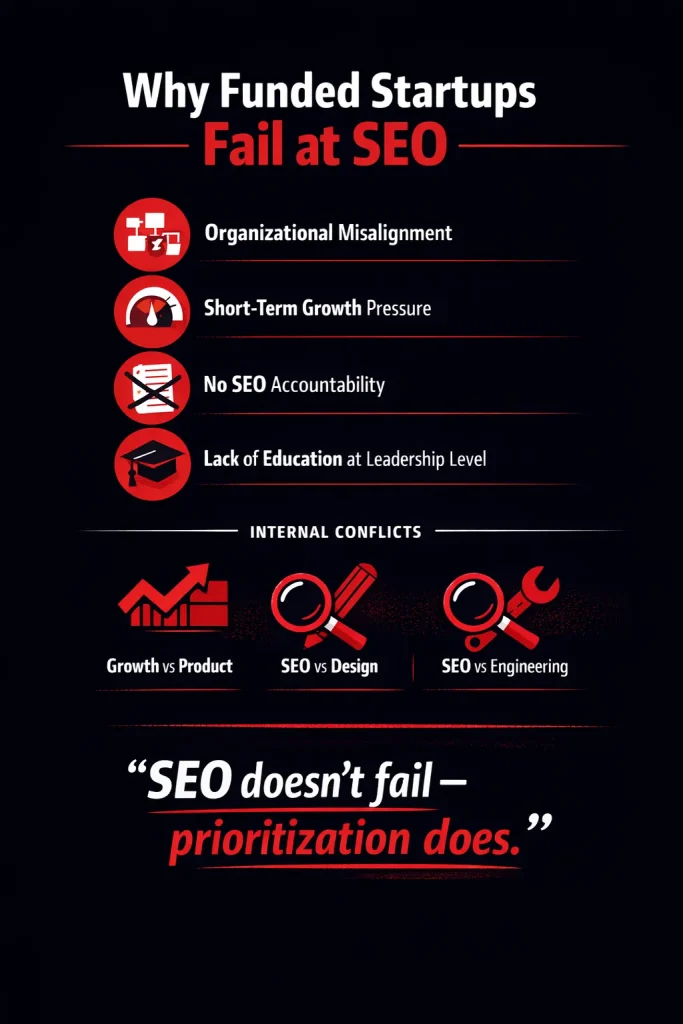
When you look past tactics, tools, and traffic graphs, the real reasons funded startups fail at SEO are rarely technical. They are organizational. In audit after audit, the same patterns emerge—not because teams lack talent or budget, but because SEO sits in the cracks between teams with competing priorities.
Organizational misalignment is the root cause. SEO touches product, engineering, content, design, and growth, yet it often “belongs” to no one. Marketing may own traffic goals, but engineering controls implementation. Product teams prioritize feature velocity, while SEO requirements are labeled as “nice to have.” The result is a fragmented execution where good recommendations die in backlog queues.
Compounding this is short-term growth pressure. Funded startups operate on aggressive timelines driven by board meetings, investor updates, and quarterly targets. Paid acquisition delivers immediate numbers, while SEO demands patience and consistency. Under pressure, leadership often chooses channels that show instant traction—even if they’re expensive and unsustainable—pushing SEO further down the roadmap.
Another critical failure point is the absence of SEO accountability. In many startups, SEO is treated as a shared responsibility, which effectively means it’s no one’s responsibility. There’s no single owner accountable for organic performance, technical health, or implementation velocity. Without ownership, SEO initiatives stall, metrics become fuzzy, and progress is impossible to measure meaningfully.
Perhaps the most overlooked issue is lack of SEO education at the leadership level. Founders and executives often see SEO as a content or marketing task rather than a growth asset tied to product architecture and demand capture. Without understanding how SEO compounds over time, leadership underestimates both its impact and its urgency.
These issues surface as internal conflicts: Growth teams pushing for quick wins vs. Product teams guarding roadmaps. SEO clashing with Design over aesthetics. SEO blocked by Engineering due to performance or architectural constraints. None of these conflicts are inherently wrong—but without prioritization, SEO always loses.
As one hard truth summarizes it:
“SEO doesn’t fail — prioritization does.”
Funded startups don’t lose at SEO because they can’t execute. They lose because they never fully commit.
What Funded Startups Should Do Instead
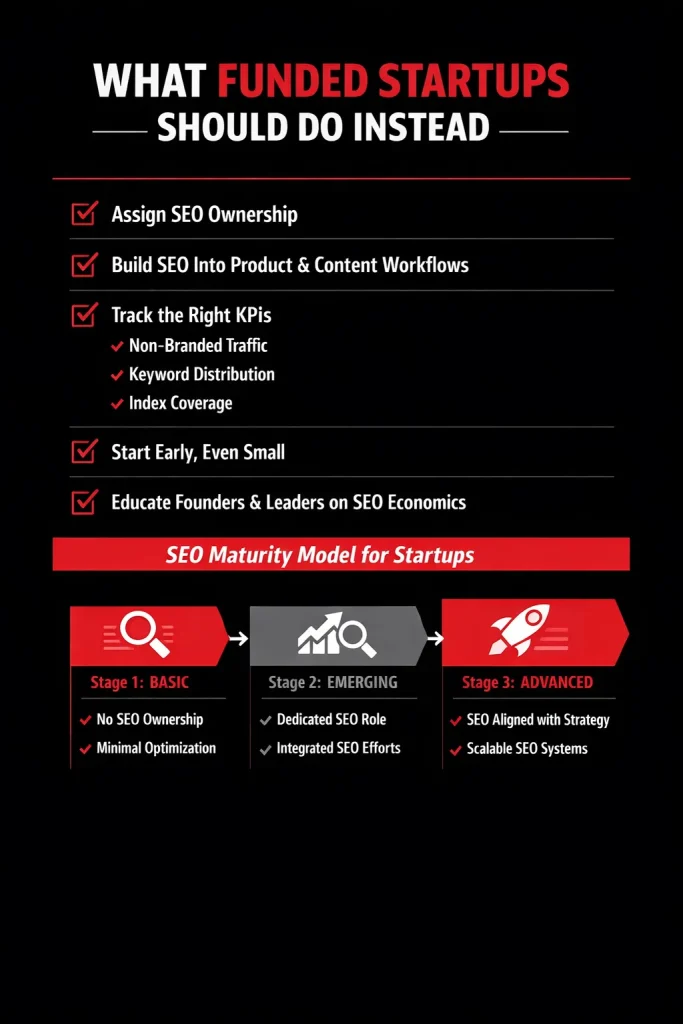
If funded startups want SEO to become a reliable growth engine instead of a recurring disappointment, they need to stop treating it as a side project and start building it into how the company operates. The difference between startups that win organic search and those that don’t is rarely budget—it’s ownership, systems, and timing.
Below is a practical framework that consistently works in venture-backed environments.
1. Assign Clear SEO Ownership
SEO cannot live in “shared responsibility.” When everyone owns SEO, no one actually does.
- Assign a single SEO owner—this could be a Head of Growth, Product Marketer, or SEO Lead.
- This person doesn’t need to execute everything, but they own outcomes, prioritization, and cross-team coordination.
- Agencies and freelancers should support execution, not define strategy.
Checklist:
- ☐ One internal SEO decision-maker
- ☐ Direct access to product and engineering teams
- ☐ SEO included in quarterly growth planning
2. Build SEO Into Product & Content Workflows
SEO works best when it’s designed in, not patched on later.
- Product pages should be built with search demand in mind, not just UX.
- Content planning must start from search intent, not editorial ideas.
- Engineering sprints should include SEO tickets as first-class tasks.
Checklist:
- ☐ SEO input before launching new pages or features
- ☐ Content briefs include target keywords + intent stage
- ☐ Internal linking planned, not accidental
3. Track the Right KPIs (Not Vanity Metrics)
Funded startups often track SEO performance incorrectly, leading to false confidence.
Focus on:
- Non-branded organic traffic (true demand capture)
- Keyword distribution (Top 3, Top 10, Top 20—not just total keywords)
- Index coverage (How many pages are actually indexed vs published)
Avoid overvaluing:
- Branded traffic growth
- Impressions without clicks
- Content volume alone
Checklist:
- ☐ Non-brand vs brand traffic split tracked monthly
- ☐ Keyword movement by funnel stage
- ☐ Indexation issues monitored in GSC
4. Start Early, Even If It’s Small
SEO doesn’t need a massive budget to begin—but it does need time.
- Early SEO efforts compound faster than late, aggressive pushes.
- Fixing architecture, internal linking, and intent mapping early saves months later.
- Waiting until Series B or C often means rebuilding instead of optimizing.
Checklist:
- ☐ SEO considered pre-product scale
- ☐ Core pages optimized before traffic spikes
- ☐ Technical SEO baselines established early
5. Educate Founders & Leaders on SEO Economics
SEO fails when leadership sees it as a “slow channel” instead of a long-term asset.
Founders should understand:
- SEO ROI compounds, paid acquisition doesn’t
- Organic traffic reduces CAC over time
- SEO strengthens every other channel (paid, content, partnerships)
A Simple SEO Maturity Model for Startups
- Stage 1: Reactive – SEO = blogs + tools
- Stage 2: Tactical – SEO projects, limited impact
- Stage 3: Strategic – SEO aligned with growth goals
- Stage 4: Systemic – SEO embedded across product, content, and growth
Most funded startups are stuck at Stage 2. The winners intentionally build toward Stage 4.
Bottom line: Funded startups don’t fail at SEO because they lack money—they fail because they lack structure, ownership, and patience. Fix those, and SEO becomes one of the most defensible growth assets a startup can build.
Conclusion: SEO Is a Growth Asset, Not a Tactic
Funding gives startups speed, optionality, and margin for experimentation—but it does not magically fix SEO. As we’ve seen, the most common SEO failures in funded startups don’t come from lack of tools, agencies, or headcount. They come from flawed assumptions: that SEO can be outsourced, postponed, rushed, or reduced to a checklist of tasks. Money may accelerate execution, but it cannot compensate for unclear strategy, poor prioritization, or the absence of ownership.
What makes SEO uniquely powerful for startups is its compounding nature. Unlike paid acquisition, where growth stops the moment spending does, SEO builds an asset that grows stronger over time. Every well-structured page, every correctly targeted keyword, and every technical fix stacks on top of previous efforts. Startups that invest early in SEO don’t just gain traffic—they lower long-term CAC, stabilize growth, and create leverage that paid channels can’t match.
To unlock this advantage, founders and growth leaders must shift their mindset. SEO should not be treated as a series of disconnected tasks—publishing a blog post here, fixing a few errors there. Instead, it needs to function as a system: embedded into product decisions, content strategy, technical architecture, and go-to-market planning. This requires ownership, patience, and strategic clarity at the leadership level.
Ultimately, the difference between startups that struggle with organic growth and those that dominate search isn’t budget size. It’s how clearly they understand—and commit to—SEO as a long-term growth asset.
“The startups that win organic search aren’t the ones with the biggest budgets — they’re the ones with the clearest SEO thinking.”