
Get a Customized Website SEO Audit and SEO Marketing Strategy
Traditional search no longer works the way businesses and marketers once understood it. For years, online visibility meant targeting specific keywords, optimizing pages for algorithms, and competing for those coveted blue links on a search results page. That approach is quietly fading. Today, users ask full questions and expect direct, concise answers rather than a list of websites. Modern search systems interpret meaning, context, and intent before determining which information to display. As a result, simply appearing on a results page is no longer enough—your brand must be recognized as a reliable source of insight. Instead of clicking through multiple links, users increasingly receive a single, consolidated response that feels authoritative and complete. Achieving this level of relevance requires strategic LLM optimization, ensuring your content clearly communicates expertise, maintains consistent visibility across public sources, and aligns closely with real user intent. ThatWare’s LLM SEO framework helps brands become easier for AI systems to understand, retrieve, cite, and represent across modern conversational search environments.
The result is a transformed search landscape where authority outweighs optimization gimmicks and clarity matters far more than clever phrasing. Brands that continue to rely solely on keyword placement and ranking positions are gradually losing relevance—not because their content lacks quality, but because it was designed for a system that no longer defines how people discover information. Partnering with a Custom LLM agency can help ensure your content aligns with modern search behavior, establishing your brand as a trusted and authoritative source.
LLM SEO (Large Language Model SEO) is the process of optimizing content so AI systems like ChatGPT, Gemini, and other generative engines can understand, evaluate, and select it within their responses.
It focuses on semantic clarity, intent alignment, and authority building rather than just rankings or keywords.
What Is LLM SEO?
LLM SEO refers to optimizing digital content for large language models that generate answers. These models process context, intent, and relationships rather than relying only on keywords.
To optimize for large language models, content must be structured, meaningful, and relevant. It must also demonstrate authority and clarity, so AI systems can trust and present it confidently.
Unlike traditional SEO, which focuses on ranking positions, LLM SEO focuses on answer inclusion. It ensures that your content becomes part of AI-generated responses. This shift transforms how visibility is measured and achieved.
In essence, LLM SEO services help brands align their content with the way AI systems interpret and deliver information. This alignment creates stronger visibility across conversational platforms.
LLM SEO Services for Brands Competing in AI-Driven Search
AI search is becoming a major discovery channel. Generative AI platforms recorded 9.5 billion monthly web visits, while unique visitors reached 655 million across the measured period. AI visibility is therefore becoming increasingly important for businesses competing for attention beyond traditional search rankings. Recent research also shows AI search is changing how users discover and evaluate information.
LLM SEO services are becoming essential for brands that want to remain visible as users move from traditional search engines to AI-generated answers. Instead of only competing for rankings on Google, businesses now need to appear inside responses generated by ChatGPT, Gemini, Claude, Perplexity, Copilot, AI assistants, and other large language model search environments.
ThatWare’s LLM SEO services are built to help brands improve how they are understood, retrieved, represented, and recommended by AI systems. This involves more than adding keywords to a page. It requires large language model SEO, semantic content optimization, brand entity optimization, technical accessibility, AI-readable content design, and visibility tracking across multiple AI platforms.
As an LLM SEO agency, ThatWare helps businesses adapt their content and technical ecosystem for the way large language models evaluate information. These systems do not simply match words. They interpret context, compare sources, identify entities, retrieve supporting information, and decide which brands or explanations are reliable enough to include in generated answers.
Our large language model SEO approach focuses on making your brand easier for AI systems to classify and trust. This includes improving service definitions, strengthening entity relationships, clarifying topical expertise, and building content that directly answers real user questions. When large language models understand your content clearly, your chances of AI answer inclusion improve.
ThatWare also provides LLM search optimization for brands that want better visibility across conversational search journeys. LLM search optimization focuses on how users ask questions, how those questions are refined by AI systems, and how your content can become eligible for retrieval and selection. This is especially important for companies that already rank in traditional search but are not being mentioned in AI-generated responses.
Our LLM optimization services combine content, technical SEO, semantic engineering, and AI visibility strategy. We optimize pages so they are easier to read, easier to retrieve, easier to summarize, and easier to cite. This makes the content more useful for both humans and AI systems.
For businesses comparing an LLM SEO company, the key question is whether the partner understands both traditional SEO and AI-native discovery. A strong LLM SEO company should be able to improve organic visibility while also preparing your brand for answer engines, AI assistants, retrieval systems, and LLM-powered discovery platforms.
ThatWare also supports brands that need an LLM SEO consultant for audits, strategy, training, or execution support. An LLM SEO consultant can help identify why your brand is missing from AI answers, which content needs restructuring, where entity signals are weak, and how your website can become more AI-ready.
For large websites and multi-market organizations, enterprise LLM SEO requires a deeper framework. Enterprise LLM SEO may include content governance, scalable schema implementation, llms.txt optimization, AI crawler access, multilingual content structuring, AI visibility monitoring, and cross-team reporting. ThatWare builds these systems so enterprise teams can improve AI search performance without losing control over brand consistency or compliance.
Our AI search SEO services connect traditional search performance with AI-driven discoverability. This means we continue to care about crawlability, indexing, page quality, authority, and user experience, while also optimizing for AI answer visibility, LLM search visibility, retrieval readiness, and AI model discoverability. ThatWare integrates LLM in SEO by combining traditional search fundamentals with semantic architecture, AI-readable content, retrieval optimisation, entity signals, and AI visibility monitoring.
ThatWare’s LLM ranking optimization and LLM ranking services focus on improving the signals that make a brand more likely to be selected, cited, or mentioned inside AI-generated answers. While AI platforms do not always show rankings in the traditional sense, they still evaluate relevance, authority, clarity, and trust. Optimizing these signals helps your brand compete for visibility where users are now making decisions.
Why LLM SEO Matters?
Why LLM SEO Matters?
The importance of LLM SEO lies in the changing nature of search itself. Users now prefer asking complete questions instead of typing fragmented keywords. This behavior reflects a growing reliance on conversational interfaces.
Platforms such as ChatGPT and Perplexity AI deliver concise answers instantly. These answers often eliminate the need to visit multiple websites. As a result, traditional traffic patterns are shifting.
Businesses that fail to adapt risk losing visibility, even if they rank well in search engines. This is where SEO for ChatGPT and similar platforms becomes essential. It ensures that your content is included in AI-generated responses.
Another major factor is user trust. People increasingly rely on AI systems for quick decisions and recommendations. When your brand appears within these responses, it builds credibility and authority.
The growing importance of conversational SEO also highlights this shift. Content must now match natural language queries and provide clear, direct answers. This approach improves both user experience and AI visibility.
Where Does LLM SEO Appear?
- ChatGPT and conversational AI responses
- Google AI Overviews and Gemini outputs
- Voice assistants and AI-driven interfaces
- Multi-modal AI search environments
Core Goal:
Transform your content into a trusted, AI-recognized source that gets consistently selected in generated answers.
AI Platforms Driving This Change
Platforms like ChatGPT and Perplexity deliver direct responses using trained models. These AI assistants prioritize structured, trustworthy content.
AI assistants integrate deeply into daily workflows. They influence decisions, research, and purchasing behavior. So, if a business wants visibility in ChatGPT, they should think about our SEO for ChatGPT.
Visibility beyond Search Engines
Traditional rankings no longer guarantee visibility inside AI answers. Brands must optimize specifically for AI chatbot SEO environments.
LLM SEO services ensure your content becomes part of AI-generated responses. This increases exposure without relying solely on clicks.
Competitive Advantage
Early adoption provides a strong advantage. Businesses optimizing for AI answers dominate emerging search ecosystems.
How Does LLM SEO Work?
LLM SEO works through a combination of advanced techniques that align content with AI understanding. These techniques focus on clarity, structure, and trust.
- One of the most important elements is entity recognition. AI systems identify entities such as brands, concepts, and relationships within content. When these entities are clearly defined, AI models can better understand and trust the information. ThatWare strengthens these signals by building strong semantic connections across topics.
- Another critical component is answer structuring. AI systems prefer content that is easy to extract and summarize. This means answers must be clear, concise, and logically organized. When content is structured properly, it increases the likelihood of being selected by AI systems.
- Trust signals also play a crucial role. AI models prioritize reliable and authoritative sources. Content must demonstrate expertise and consistency to gain this trust. ThatWare enhances these signals by ensuring accuracy, relevance, and authority across all content.
Conversational alignment is equally important. Artificial Intelligence systems interpret natural language queries, so content must reflect how people actually speak and ask questions. This is where AI chatbot SEO becomes highly effective. It also ensures that content aligns with conversational patterns and user intent.
Finally, semantic depth ensures comprehensive topic coverage. AI models analyze context and relationships between ideas. Content that covers a topic thoroughly has a higher chance of being selected as an answer. ThatWare provides LLM SEO services focused on AI visibility, semantic content structuring, retrieval readiness, entity reinforcement, answer engineering, and stronger brand representation across LLM platforms. And these blend well with semantic depth.
Step 1: Intent & Query Interpretation
The process begins by analyzing how users frame questions in natural language. AI systems break down queries to understand purpose—whether informational, comparative, or decision-driven. LLM SEO ensures content aligns with these intent signals rather than surface-level keywords.
Step 2: Semantic Content Structuring
Content is built around meaning, clarity, and logical flow. Instead of keyword repetition, it emphasizes comprehensive explanations, step-by-step breakdowns, and contextual depth. This helps AI systems interpret not just what is written, but what it truly means.
Step 3: Entity & Contextual Mapping
Key topics, entities, and relationships are connected to form a strong knowledge framework. This mirrors how AI models process information through context and associations, improving content relevance and authority.
Step 4: Authority & Trust Engineering
AI systems prioritize credible sources. Content is optimized for consistency, expertise, and reliability across multiple touchpoints. A strong, unified knowledge footprint increases the likelihood of being recognized as a trusted source.
Step 5: AI-Ready Content Formatting
Content is structured into clear, extractable formats such as summaries, Q&A sections, and layered explanations. This makes it easier for AI systems to retrieve and present information accurately within generated responses.
Step 6: Continuous Optimization & Inclusion Monitoring
LLM SEO is an ongoing process. Performance is evaluated based on inclusion in AI-generated answers, not just rankings. Content is refined continuously to stay aligned with evolving AI models and search behaviors.
This approach ensures your content is not just optimized—but understood, trusted, and selected by AI systems.
Why Should I Trust LLM SEO?
LLM SEO is designed for how modern AI-driven search systems evaluate and select information. Instead of relying on outdated ranking signals, it ensures your content is understood, trusted, and chosen by AI models.
Key Reasons to Trust LLM SEO:
- Intent-Driven Optimization:
Focuses on real user intent rather than keyword placement, ensuring content aligns with what users actually want to know. - Clarity and Contextual Depth:
Encourages clear explanations, logical flow, and complete answers, making it easier for AI systems to interpret and prioritize your content. - Authority & Knowledge Building:
Strengthens your brand’s credibility by creating consistent, expert-level content across topics, helping AI recognize you as a reliable source. - AI Selection Over Rankings:
Shifts the goal from ranking on search pages to being selected within AI-generated responses, where real visibility now exists. - Structured & AI-Friendly Content:
Uses well-organized formats like summaries, Q&A sections, and layered explanations that AI systems can easily extract and present. - Consistency Across Platforms:
Builds a strong knowledge footprint, ensuring your content is recognized and trusted across multiple AI environments. - Zero-Click Visibility Advantage:
Keeps your brand visible even when users receive answers directly from AI without visiting websites. - Future-Proof Strategy:
Adapts to evolving AI algorithms and conversational search trends, ensuring long-term relevance and stability.
LLM SEO ensures your content is not just found—but trusted, selected, and consistently surfaced by AI systems. By embracing LLM in SEO, businesses can improve their chances of becoming trusted sources that AI systems consistently recognize, reference, and recommend in modern search experiences.
Why is LLM SEO important?
LLM SEO is important because it aligns directly with the future of search, where users increasingly depend on AI systems to deliver fast, accurate, and context-aware answers. As search behavior evolves, traditional methods are no longer enough to maintain visibility and relevance.
Shift to AI-Generated Search
Search is no longer limited to browsing multiple links. AI-powered platforms now interpret queries and generate complete responses instantly. This means your content must be included within these AI-generated answers to remain visible. LLM SEO ensures your information is structured and clear enough to be selected during this process.
Higher Intent Engagement
Users interacting with AI systems are typically seeking precise and actionable information. These are not casual searches—they reflect deeper intent and decision-making stages. LLM SEO helps capture this audience by delivering direct, meaningful answers that align with user expectations, increasing engagement and conversion potential.
Building Trust and Authority
Modern AI systems prioritize sources that demonstrate clarity, consistency, and expertise. LLM SEO strengthens these signals by focusing on structured, well-explained, and context-rich content. Over time, this builds a strong authority footprint, making your brand more likely to be trusted and repeatedly selected by AI systems.
Zero-Click Visibility Advantage
In many cases, users receive answers without clicking through to websites. While this reduces traditional traffic, it increases the importance of being visible within AI responses. LLM SEO ensures your brand remains present in these interactions, enhancing recognition and influence.
Future-Proof Digital Strategy
As AI continues to reshape search, LLM SEO provides a sustainable approach to staying relevant. By focusing on intent, clarity, and adaptability, you ensure your content evolves with changing technologies and user behavior.
LLM SEO ultimately positions your brand where visibility matters most—inside the answers users trust.
Source: https://thatware.co/large-language-models-for-top-ranked-page-analysis/
ThatWare’s Approach to LLM SEO
ThatWare’s approach to LLM SEO is built on a deep understanding of how AI systems interpret, evaluate, and select content. Instead of focusing on surface-level optimization, the framework is designed to align with the internal decision layers of AI models—ensuring content is not just visible, but eligible for inclusion within generated answers.
Strategic Intelligence & AI Visibility Mapping
The process begins with a comprehensive analysis of how AI systems currently perceive a brand. This includes identifying whether the content qualifies for inclusion in AI-generated responses and understanding gaps that prevent visibility.
Key elements include:
- Intent intelligence mapping across user journeys
- Semantic authority gap identification
- Query eligibility analysis for AI-refined searches
This phase provides clarity on why a brand is selected—or excluded—by AI systems.
Semantic Architecture & Intent Engineering
Once insights are established, ThatWare restructures the content ecosystem around meaning and intent rather than keywords. The focus is on building a strong conceptual framework that AI systems can easily understand.
This involves:
- Entity and concept graph development
- Intent-first content structuring
- Context expansion for deeper explanations
- Natural language alignment with real user queries
As a result, the brand is positioned as a subject-matter authority rather than a promotional source.
LLM-Ready Content Engineering
Content is then engineered to be retrievable, explainable, and reusable by AI systems. ThatWare emphasizes educational, structured, and framework-driven content over traditional marketing copy.
This includes:
- Explainer-first content creation
- Case-based authority building
- RAG-optimized structuring
- Identification and improvement of weak content
This ensures content becomes quotable and AI-friendly, increasing its chances of inclusion.
Retrieval Optimization & Authority Building
The next stage focuses on ensuring that AI systems can locate, interpret, and trust the content across platforms.
Key strategies include:
- Expanding presence across knowledge-driven platforms
- Maintaining consistency in brand explanations
- Strengthening contextual mentions instead of relying only on backlinks
The best LLM SEO consultant can identify AI visibility gaps, evaluate content eligibility, strengthen entity signals, restructure information, and develop strategies for improved AI answer inclusion. Through this, ThatWare helps build long-term authority, trust, and brand memory—ensuring the content is not just discovered, but consistently selected by AI systems.
How ThatWare Improves LLM Visibility, Content Understanding and Brand Representation
Large language model optimization is not only about publishing more content. It is about making sure your existing knowledge, services, expertise, and brand identity are structured in a way that AI systems can interpret accurately. ThatWare’s large language model optimization process focuses on content clarity, semantic depth, retrieval readiness, brand consistency, and platform-specific visibility.
A major part of this process is large language model search optimization. AI systems often refine a user’s question before deciding which sources to retrieve. If your content is too narrow, overly promotional, or unclear, it may never enter the candidate pool. ThatWare improves large language model visibility by building content that covers the full intent behind user questions, not just the exact wording of a query.
This is where LLM search engine optimization becomes important. Traditional search engine optimization helps a website become crawlable, indexable, and rankable. LLM search engine optimization goes further by making the content easier for AI systems to retrieve, summarize, and use in a generated answer. It connects SEO fundamentals with AI readability, semantic structure, and answer eligibility.
ThatWare’s LLM content optimization improves how pages explain topics, services, comparisons, processes, and buyer questions. Instead of thin promotional sections, we create LLM-friendly content that teaches, clarifies, and supports decision-making. This includes ai-readable content optimization, machine-readable content optimization, semantic content optimization, and ai search content optimization.
Our LLM content strategy focuses on building a complete topic ecosystem around the questions your audience actually asks. This includes educational guides, service pages, comparison content, FAQs, case studies, glossary sections, and thought-leadership assets. A strong LLM content strategy helps AI systems associate your brand with a defined area of expertise.
The structure of the content also matters. ThatWare applies ai content architecture, LLM content structuring, ai content hierarchy, and LLM content engineering to make pages easier to interpret. This means organizing content into clear sections, direct answers, supporting context, entity-rich explanations, and logical internal links. The goal is to make the page useful to readers while also making it easier for AI systems to understand the relationship between ideas.
LLM indexing optimization and semantic indexing optimization ensure that important pages are technically accessible and contextually clear. If a page cannot be crawled, indexed, parsed, or understood, it cannot contribute strongly to AI visibility. ThatWare reviews technical barriers, content discoverability, schema structure, internal linking, and machine-readable website optimization to improve AI indexing optimization.
Retrieval is another critical layer. ThatWare provides LLM retrieval optimization, retrieval optimization, ai retrieval optimization, retrieval augmented optimization, RAG optimization services, RAG SEO, retrieval visibility optimization, ai retrieval readiness, vector retrieval optimization, and semantic retrieval optimization. These methods help make your content more suitable for retrieval-augmented systems that search external sources before generating answers.
LLM visibility optimization focuses on improving where and how your brand appears across AI search environments. ThatWare’s LLM visibility services analyze brand mentions, source consistency, topical associations, and AI answer inclusion. This helps improve LLM search visibility, LLM search visibility services, LLM answer visibility, ai model visibility, ai model discoverability, and long-term LLM brand visibility.
Brand representation is equally important. AI systems may describe a brand inaccurately if public information is inconsistent, outdated, shallow, or fragmented. ThatWare improves ai brand representation and LLM brand representation by strengthening the way your brand is defined across your website and trusted public sources. This includes ai brand accuracy, ai knowledge optimization, brand entity optimization, ai reputation visibility, ai perception optimization, LLM trust optimization, ai answer accuracy optimization, and ai narrative optimization.
We also focus on LLM brand mentions and LLM brand optimization. A brand that is mentioned consistently in relevant contexts is easier for AI systems to recognize. This supports LLM reputation optimization because AI visibility is not only about being present; it is also about being represented correctly, confidently, and positively.
Platform-specific optimization is another part of the process. ThatWare supports ChatGPT SEO, ChatGPT SEO services, Gemini SEO, Claude SEO, Perplexity SEO, Copilot SEO, AI model optimization, AI assistant SEO, conversational AI SEO, and LLM platform optimization. Each platform has different retrieval behavior, citation patterns, and answer formats, so the same content strategy cannot be applied blindly across all of them.
Ultimately, ThatWare’s LLM visibility optimization process helps your brand become easier to find, easier to explain, and easier to trust across the AI search ecosystem.
As one of the leading LLM SEO companies, ThatWare helps businesses strengthen AI visibility, improve content understanding, and build accurate brand representation across modern AI-powered search platforms.
How Is ThatWare Bringing Differentiation?
ThatWare goes beyond traditional SEO frameworks. The company integrates advanced AI-driven methodologies for superior performance.
AIEO (Artificial Intelligence Engine Optimization)
AIEO focuses on optimizing content for AI-driven ecosystems. It aligns brand messaging with machine understanding.
CRSEO (Cognitive Retrieval SEO)
CRSEO enhances how AI retrieves and processes information. This ensures higher relevance during answer generation.
Quantum SEO
Quantum SEO leverages data science and predictive modeling. It anticipates search evolution and adapts strategies accordingly.
This multi-layered approach positions ThatWare as a leader in LLM SEO services.
ThatWare Offers A Multi-Layered LLM SEO Framework beyond Conventional Optimisation
| Capability | ThatWare | Conventional SEO Providers |
| LLM SEO | Connects traditional SEO with AI retrieval, answer inclusion, and LLM visibility | Primarily focused on conventional rankings |
| AI Visibility Mapping | Analyses how AI systems perceive and represent a brand | Rarely included in standard SEO audits |
| Semantic Architecture | Builds entity, concept, context, and intent relationships | Often centred around keyword targeting |
| LLM-Ready Content | Creates structured, explainable, retrievable, and reusable content | Usually optimised mainly for search crawlers |
| Retrieval Optimisation | Improves content readiness for AI retrieval and RAG-based systems | Typically not part of standard SEO |
| RAG Optimisation | Structures content for retrieval-augmented generation environments | Rarely offered as a dedicated service |
| Entity Reinforcement | Strengthens relationships between brands, topics, services, and concepts | Often overlooked |
| Answer Engineering | Structures information for direct AI answer extraction | Traditional featured snippets may be the primary focus |
| Brand Representation | Improves consistency and accuracy of brand information across AI environments | Usually outside conventional SEO scope |
| AI Platform Optimisation | Supports ChatGPT, Gemini, Claude, Perplexity, Copilot, and other AI environments | Usually focused on Google and Bing |
| AI-Ready Technical SEO | Addresses crawlability, indexing, schema, internal linking, and machine readability | Often limited to basic technical audits |
| Content Ecosystem | Builds guides, FAQs, comparisons, case studies, and authority assets around user intent | Often centred around individual keyword pages |
| AI Visibility Monitoring | Evaluates inclusion, mentions, citations, and AI representation | Ranking and traffic metrics dominate reporting |
| Custom Frameworks | Uses AIEO, CRSEO, Quantum SEO, and proprietary AI-driven methodologies | Generally relies on established SEO processes |
| Future Search Readiness | Prepares brands for evolving AI search and retrieval ecosystems | Primarily optimises for current search formats |
LLM SEO Services by ThatWare
ThatWare offers specialized services designed for AI visibility as well as performance.
AI Visibility Optimization
This service ensures your brand appears across AI-generated answers. It aligns content with conversational search behavior.
Entity Reinforcement
Entity optimization strengthens brand recognition within AI systems. This improves consistency across multiple platforms.
Answer Engineering
Answer engineering structures content for direct AI usage. It increases the probability of being featured in responses. So, optimize for AI answers.
Each service focuses on improving visibility in AI-driven environments. This is how LLMs rank answers and increase brand visibility.
LLM vs Traditional SEO Methods
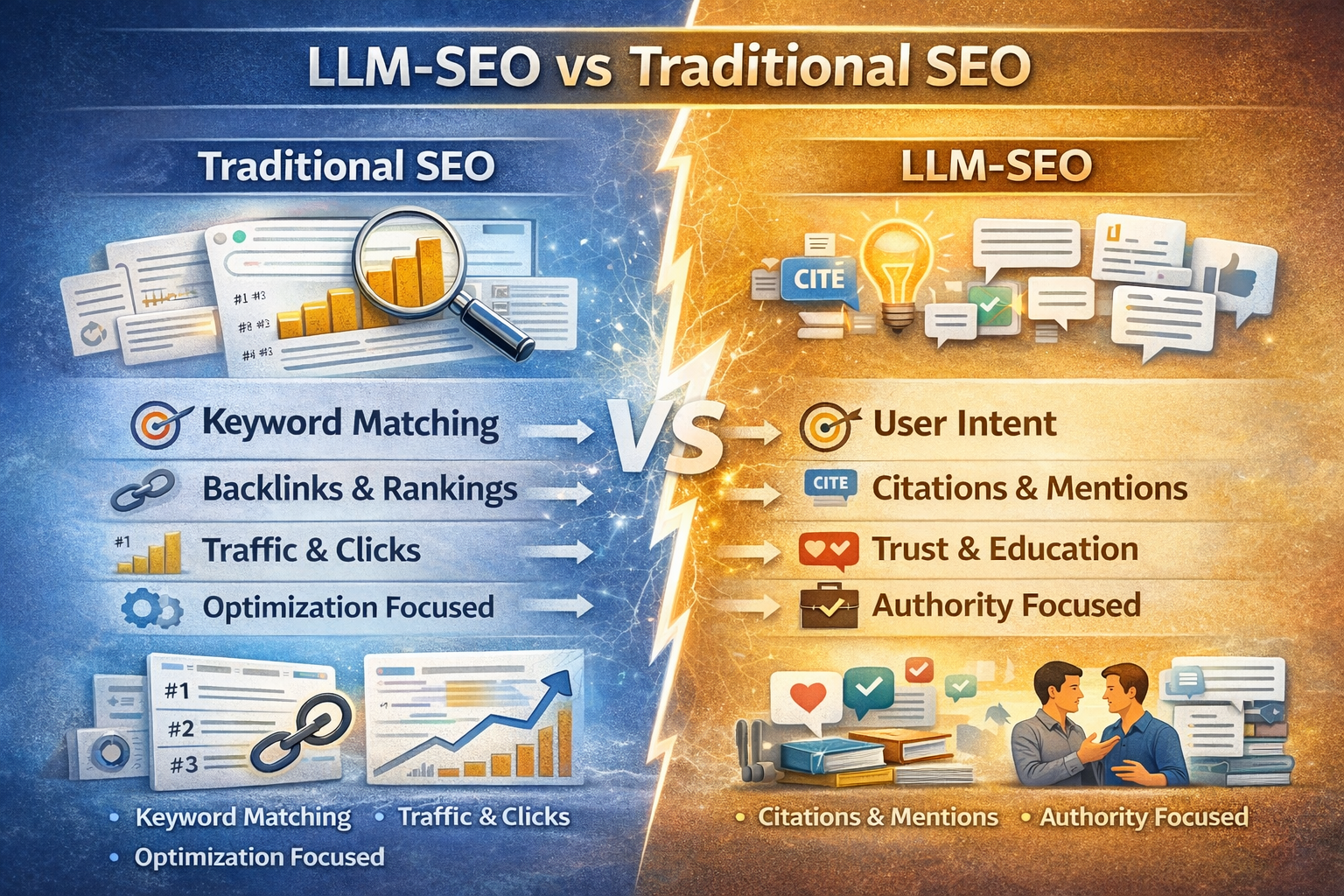
LLM SEO focuses on AI-driven understanding and answer inclusion, while traditional SEO targets rankings and traffic. It reflects a shift from keyword-based visibility to intent-driven discovery, where trust, clarity, and authority determine selection in AI-generated responses.
| Feature / Aspect | Traditional SEO | LLM SEO |
| Primary Goal | Achieve top rankings and drive clicks | Be selected and cited in AI-generated answers |
| Core Focus | Keywords, backlinks, and technical signals | User intent, context, and semantic understanding |
| Search Behavior | Users browse multiple links | Users receive direct, synthesized answers |
| Content Strategy | Keyword-optimized, ranking-focused content | Explanation-driven, intent-aligned content |
| Authority Signals | Backlinks and domain authority | Citations, contextual mentions, and trust signals |
| User Interaction | Click-through to websites | Zero-click answers within AI platforms |
| Evaluation Method | Rankings, traffic, CTR | AI inclusion, citation frequency, and authority recognition |
| Optimization Style | Algorithm-focused and reactive | AI-first, predictive, and intent-driven |
| Outcome | Increased website visits | Increased trust, influence, and brand visibility |
| Long-Term Value | Short-term ranking gains | Long-term authority and AI recognition |
This comparison highlights a fundamental transition: traditional SEO aims to be found, while LLM SEO ensures your content is understood, trusted, and selected by AI systems.
Success Story: How ThatWare Turns LLM SEO into Measurable Growth
ThatWare’s success with LLM SEO is not based on theory alone. Being the best LLM seo provider, theory of ThatWare is backed by real business outcomes, measurable search growth, and stronger AI-driven visibility. By combining intent-first content strategy, semantic structuring, technical optimization, and authority building, ThatWare has shown how businesses can move from weak digital presence to powerful search performance. Therefore, if you want to hire LLM SEO agency, you can choose and rely on ThatWare to get desirable outcomes.
A clear example of this success is the transformation of Perth Garage Doors. Before optimization, the business had only 153 organic sessions and 103 engaged sessions, showing weak traction from search. It also struggled to rank for important local service terms, which meant high-intent users were going directly to competitors. After implementing ThatWare’s LLM SEO framework, the results changed dramatically.
Search clicks increased from 51 to 122, representing over 139% growth. Search impressions rose from 79.3K to 141K, a growth of nearly 78%, proving that the business was appearing in front of far more potential customers. Audience reach also improved strongly, with total users growing from 811 to 1,328, an increase of 63.75%, while new users rose from 802 to 1,305, showing 62.72% growth. These numbers confirm that the brand was no longer limited to a small audience but was reaching fresh, high-intent searchers consistently.
ThatWare also helped Perth Garage Doors achieve top keyword positions for valuable local searches. The keyword “sectional door Perth” reached #1, “Perth garage door” ranked #2, and “garage doors in Perth” climbed to #5. These are highly commercial queries with strong buying intent, which means the ranking gains translate into real business potential.
This success story proves that ThatWare’s LLM SEO framework does more than improve rankings. It builds trust, expands visibility, strengthens AI relevance, and turns search into a sustainable engine for long-term growth.
Source: https://thatware.co/how-llm-seo-skyrocket-perth-garage-doors-online-growth/
Proven LLM SEO Results for Find My Venue: Real Performance Backed by Data
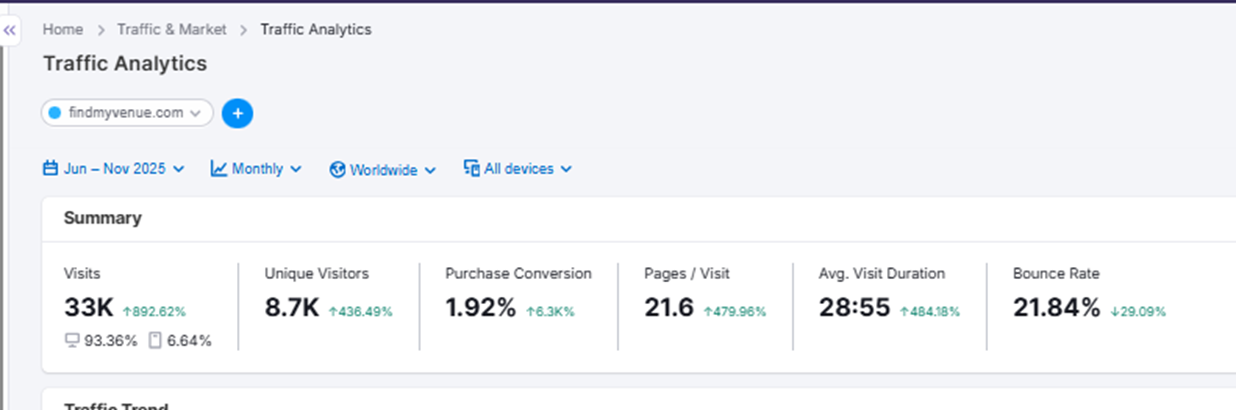
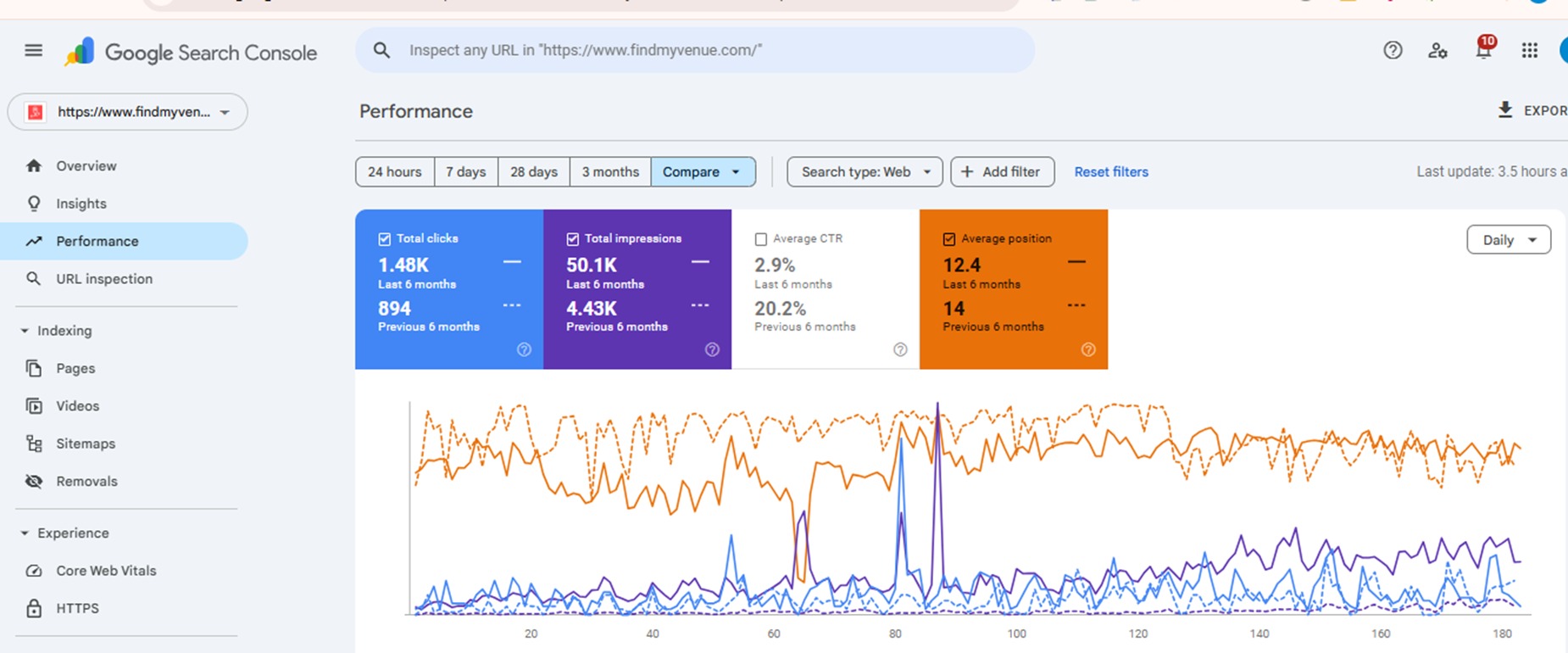
The effectiveness of LLM SEO becomes clear when real performance metrics enter the conversation. ThatWare’s implementation is not theoretical. It delivers measurable, repeatable growth across different digital ecosystems. A strong example of this impact can be seen in the transformation of Find My Venue. This project had organic search: 12.5% + 7.22%, which clearly shows the effectiveness of our LLM-centric approach.
Tangible Growth after LLM SEO Implementation
Before adopting LLM SEO, the platform faced limited organic reach and inconsistent engagement. Traditional SEO efforts failed to capture evolving AI-driven search intent. ThatWare restructured the entire content ecosystem using advanced LLM frameworks.
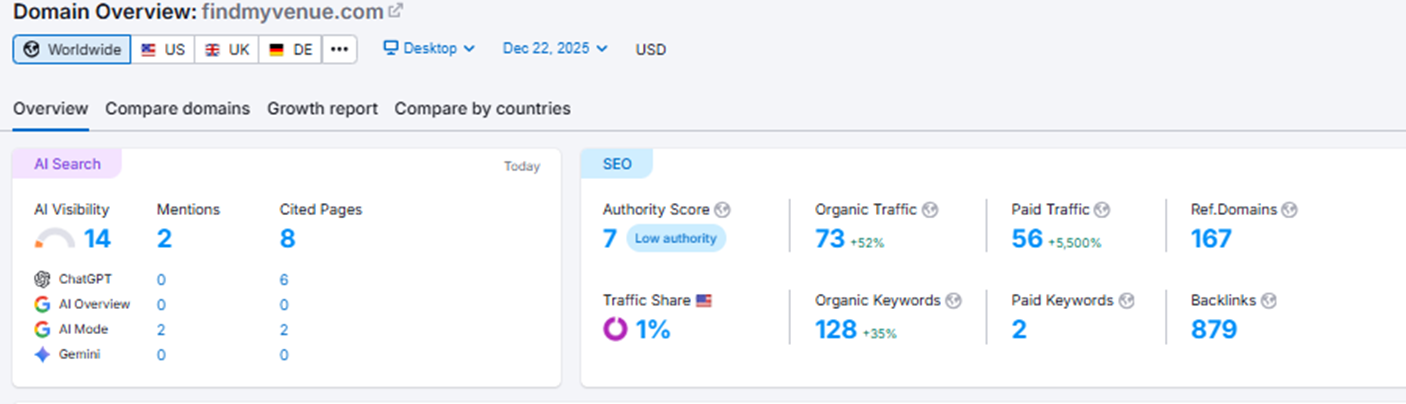
The results were immediate and substantial. Organic traffic increased by over 1,116% within a short timeframe. This surge reflected improved visibility across high-intent and semantically related queries.
At the same time, keyword coverage expanded significantly. The platform began ranking for a broader set of contextual search variations. This shift ensured higher discoverability in both traditional and AI-powered search environments.
Stronger Engagement And User Signals
Traffic growth alone does not define success. Engagement metrics revealed greater improvements. The platform recorded a notable increase in average session duration, indicating stronger content relevance.
Bounce rates also dropped significantly. Users found more aligned information, reducing the need to exit quickly. These signals are critical for LLM optimization services, as they evaluate content quality based on user interaction patterns.
Click-through rates improved as well. Better alignment with user intent made listings more compelling in search results.
Increased AI Visibility And Content Citations
One of the most important outcomes was the rise in AI-driven visibility. The platform started appearing more frequently in AI-generated responses. This included contextual mentions and inferred recommendations.
ThatWare’s entity-based optimization played a crucial role here. By strengthening semantic relationships, the content became more understandable for large language models. This directly increased the chances of being cited in AI outputs.
Consistent Patterns across LLM Case Studies
While this example highlights a single campaign, similar trends appear across all five LLM SEO case studies:
- Organic traffic growth often exceeds 73 to 1,116.7% after implementation
- Keyword visibility expands across both primary and semantic variations
- Engagement metrics consistently improve, including dwell time and interaction depth
- AI-generated search mentions increase due to better contextual clarity
These repeated outcomes demonstrate a scalable and reliable optimization framework.
What Do These Results Mean for Businesses?
The data clearly shows that LLM SEO is not just an upgrade. It is a transformation in how digital visibility works. Businesses leveraging this approach gain:
- Higher authority in AI-driven search ecosystems
- Better alignment with evolving user intent
- Sustainable growth beyond traditional ranking factors
ThatWare’s results prove one critical point. Success today depends on how well content communicates with AI systems. When content is structured for understanding, not just indexing, growth becomes inevitable.
Source: https://thatware.co/how-llm-seo-transformed-find-my-venue-growth/
Proven LLM SEO Results for Reef Looker: Real Performance Backed by Data
The impact of LLM SEO services becomes clearer when real campaign data tells the story. The Reef Looker campaign demonstrates how strategic LLM SEO optimization by ThatWare can reshape visibility, engagement, and search performance in a short period.
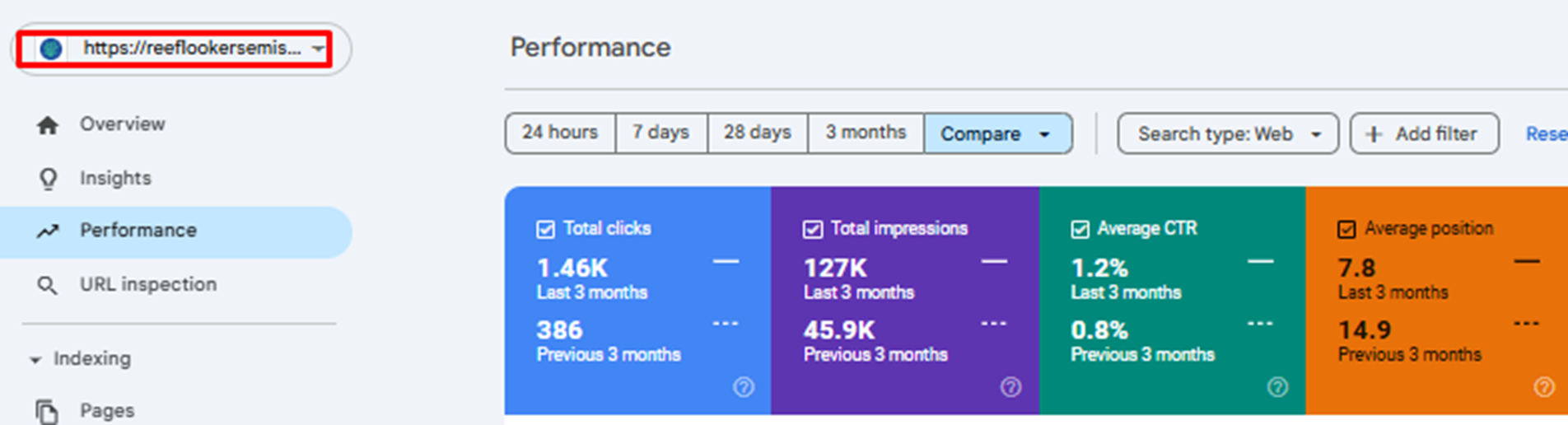
The campaign focused on improving AI visibility and aligning content with the ChatGPT SEO guide and AI-driven platforms. Over three months, measurable improvements were recorded across key performance metrics.
Here is what the data revealed:
- Total Clicks: Increased to 1.46K in the last 3 months, compared to 386 in the previous 3 months
- Total Impressions: Grew to 127K, up from 45.9K
- Average CTR: Improved to 1.2%, compared to 0.8%
- Average Position: Improved significantly to 7.8, compared to 14.9
The Turning Point: Visibility Expansion
At the start, Reef Looker struggled with limited visibility. Despite existing content, it was not aligned with AI-driven search behavior.
After optimizing for large language models and strategies, impressions surged dramatically. The jump from 45.9K to 127K impressions reflects a strong increase in discoverability.
This growth indicates that content was not only indexed better but also surfaced more frequently across search and AI-driven environments.
Engagement Breakthrough: Click Growth
Visibility alone is not enough without engagement. The Reef Looker campaign demonstrated a powerful improvement in user interaction.
Clicks increased from 386 to 1.46K within the same timeframe. This growth shows that users found the content more relevant and compelling.
The improvement aligns with conversational SEO practices, where content matches user intent more accurately. When users see answers that feel natural and helpful, they are more likely to engage.
Smarter Positioning: Ranking Improvement
Improvements in AI search ranking factors tell another critical part of the story. The average position improved from 14.9 to 7.8.
This shift means the content moved closer to the top results, increasing its chances of being selected by both users and AI systems.
Better positioning also supports AI chatbot SEO, as higher-ranking content is more likely to be referenced in AI-generated answers.
Quality Over Quantity: CTR Growth
Click-through rate increased from 0.8% to 1.2%. While the percentage may seem modest, it reflects a meaningful improvement in content relevance.
This change suggests that titles, descriptions, and structured answers became more aligned with user expectations.
By focusing on optimizing for AI answers, the campaign ensured that content resonated with both users and AI systems.
The Bigger Picture: What Changed
The success of Reef Looker was not accidental. It resulted from a strategic shift toward LLM SEO optimization.
Content was restructured to provide direct answers. Entity signals were strengthened to improve AI understanding. Trust signals were enhanced to build credibility.
This combination created a powerful ecosystem where content became more visible, relevant, and authoritative.
Key Takeaways from The Reef Looker Campaign
The campaign highlights several important insights for businesses exploring LLM SEO services:
- First, visibility growth comes from aligning content with AI systems, not just search engines.
- Second, engagement improves when content matches conversational intent.
- Third, ranking improvements follow when structure, clarity, and trust are optimized together.
Most importantly, the campaign proves that businesses can successfully optimize for large language models and achieve measurable results within months. The Reef Looker campaign demonstrates how modern SEO is evolving. It is no longer just about rankings. It is about becoming the answer.
By leveraging SEO for ChatGPT, AI chatbot SEO, and advanced optimization strategies, ThatWare transformed performance across all key metrics.
From Keywords to Intent: How AI Search Thinks Differently
The Limits of Keyword-Based Thinking
For a long time, search success depended on identifying the right keywords and placing them strategically across a page. This approach worked because older search systems matched words more than meaning. If a page repeated the same phrase often enough and earned enough links, it stood a good chance of appearing at the top. Over time, this led to predictable practices where content was shaped around search terms rather than real questions. While this method brought visibility, it rarely ensured that users found the most helpful or complete information. As search behavior evolved, the gap between what users wanted and what keyword-focused pages delivered became increasingly obvious.
Search Has Shifted Toward Understanding Purpose
Modern search no longer interprets queries as isolated keywords. Instead, it focuses on understanding the underlying intent behind each search. A user typing a short phrase could be researching, comparing options, or seeking expert guidance. Even when two people enter the same words, their goals may be entirely different. Today’s search systems strive to detect this purpose before deciding which content to surface. As a result, content built solely to match phrases often falls short, while content that explains a topic comprehensively and thoughtfully gains preference. Collaborating with an LLM model creation agency can help brands develop content that aligns with real user intent and stands out in this intent-driven search environment.
How Intent Is Interpreted
Intent interpretation involves reading between the lines of a query. A search for “best accounting software” is not just about a list of names. It suggests comparison, trust, and experience. A search for “how accounting software works” points to learning and explanation. Modern systems adjust the type of information they surface based on these signals. They favor sources that match the implied goal, not just the words used. This is why some pages with fewer exact keyword matches can outperform highly optimized ones if they answer the underlying question more completely.
Queries Are Refined Before Answers Are Chosen
Another important shift is that the original query is rarely used as it is. It is internally clarified and expanded to better reflect what the searcher is likely trying to achieve. This refined version guides which sources are considered relevant. As a result, content that relies on narrow phrasing can be excluded, while content that covers the broader topic clearly and logically is included. This refinement process rewards structure, clarity, and context over repetition.
Why Context Matters More Than Frequency
Context now plays a central role in discovery. A page that explains a subject step by step, defines terms, and connects ideas signals a stronger understanding than a page that simply repeats phrases. Context helps search systems determine whether a source genuinely understands a topic or is merely trying to attract attention. This is also why long-form educational content often performs better than short promotional pages. It provides the surrounding detail needed to establish relevance and trust.
The Role of Language and Natural Expression
Natural language has become an advantage rather than a risk. Writing that mirrors how people actually speak and ask questions aligns better with intent-focused search. Overly mechanical phrasing or forced repetition can signal low value. Clear explanations, simple examples, and logical flow make it easier for systems to match content with real questions. This encourages writers to focus on communication rather than optimization tricks.
What This Means for Content Creators
Shifting from keywords to intent requires a change in mindset. Instead of asking which phrases to target, creators must ask which problems they are solving. Content should aim to answer questions fully, anticipate follow-up concerns, and provide clarity rather than persuasion alone. When intent is met, visibility follows naturally. In this new search environment, relevance is earned by usefulness, not by frequency of terms.
Inside the LLM Search Console: The Invisible Decision Layer
Explore how modern search systems operate beneath the surface and understand how large language model optimization shapes the unseen evaluation process that determines which information is surfaced and trusted.
What Happens Before an Answer Is Generated
When someone types a question into a search interface, the answer they receive is not created instantly. Behind the scenes, a sequence of internal evaluations takes place before any response appears. There is a concealed assessment layer that interprets the query and determines how it should be addressed.
This layer does not rank web pages in the traditional sense, nor does it simply pull a list of links. Instead, it decides what type of answer is required and which sources are suitable for consideration. Most users are unaware that this filtering process exists. However, it significantly affects which brands, insights, and explanations ultimately become visible.
Interpreting the Query Structure
The first responsibility of this internal engine is to examine the language and structure of the question. It evaluates phrasing, intent signals, and contextual clues embedded within the query. Even a brief question may carry indicators that suggest whether the user is seeking education, comparison, validation, or a decision-support answer.
By breaking down the request in this way, the system avoids delivering mismatched responses. It identifies whether the user needs a concise definition, a balanced evaluation, or a more in-depth exploration. Without this interpretive step, responses would risk being too broad or irrelevant to the actual need.
Determining the Nature of the Request
After the system understands the query’s meaning, it classifies the request according to purpose. Some questions are purely informational and call for straightforward explanations. Others are analytical and require nuanced viewpoints. Certain queries, especially those related to health, finance, or legal matters, demand a higher level of authority and reliability.
This classification influences the level of scrutiny applied to potential sources. High-impact topics trigger stricter evaluation standards. Accuracy, consistency, and demonstrated expertise become more important than speed or surface-level relevance. In effect, the system adjusts its expectations depending on what is at stake.
Why This Layer Cannot Be Directly Optimized
Unlike traditional search ranking factors, this internal decision mechanism cannot be manipulated through keyword tactics or formatting strategies. There is no dashboard to tweak and no density metric to adjust.
What truly shapes inclusion at this stage is the broader clarity of a brand’s knowledge footprint. Content that consistently reflects subject-matter understanding, appears in credible environments, and aligns with real-world expertise becomes easier for the system to recognize and trust. Attempts to game this layer often fail because coherence and credibility outweigh tactical adjustments.
Building Indirect Influence Through Trust Signals
Although direct control is impossible, influence develops gradually. Organizations that communicate their expertise clearly, maintain consistency in their messaging, and contribute meaningfully across reputable platforms strengthen their interpretability.
Over time, their content becomes easier for the system to categorize within its decision framework. When relevant queries arise, these sources naturally align with the internal evaluation process, increasing their likelihood of inclusion.
Why Inclusion Now Matters More Than Position
In traditional search models, success centered on ranking position. Today, however, visibility depends on whether a source is selected during this invisible evaluation stage. If a brand is excluded here, it never reaches the final generated response, regardless of its past ranking performance.
Understanding this shift highlights a fundamental change in digital visibility. Recognition as a reliable source of insight now outweighs mere placement. In the era of language models, being trusted within the decision engine is what determines who is seen.
Inside the LLM Search Console: The Invisible Decision Layer
Dive into the mechanics of modern search and discover how large language model optimization influences the invisible decisions that determine which content is seen and trusted.
What Happens Before an Answer Appears
When a user submits a question, the response they see is the result of several decisions made long before any text is shown. There is an internal evaluation layer that examines the query and determines how it should be handled. This layer does not display results or rank pages. Its role is to decide what kind of response is appropriate and what sources should even be considered. ChatGPT SEO focuses on improving how brands are understood and evaluated during this retrieval and selection process. Most users never see this process, yet it strongly influences which brands and explanations make it into the final answer.
Breaking Down the Query
The first task of this decision layer is to analyze the structure and meaning of the question. It looks at language cues, implied expectations, and subject matter. A short query may still contain signals that point to learning, comparison, or decision-making. This breakdown helps the system understand whether the user wants a definition, a recommendation, or a deeper explanation. Without this step, answers would be generic and often mismatched with intent.
Classifying the Type of Request
Once the query is understood, it is categorized based on its purpose. Some questions are informational and require clear explanations. Others involve evaluation and require balanced perspectives. There are also queries that demand authority, where accuracy and reliability matter more than speed. This classification determines how strict the system will be when selecting sources. Higher-stakes queries require stronger signals of credibility and consistency.
Why Brands Cannot Directly Control This Layer
This internal decision process cannot be influenced through direct optimization or formatting tricks. There is no setting to adjust and no keyword density to fine-tune. What influences this layer is the overall clarity of a brand’s public content, how often it appears in relevant contexts, and whether its explanations align with real-world understanding. Attempts to manipulate this process usually fail because the system prioritizes coherence over tactics.
Indirect Influence Through Clarity and Consistency
Although this layer cannot be controlled, it can be influenced over time. Brands that explain their domain clearly, publish consistent viewpoints, and maintain a stable presence across trusted platforms become easier to classify and trust. Their content fits naturally into the decision framework, making it more likely to be selected when relevant questions arise.
Why This Layer Matters More Than Rankings
Traditional rankings focus on position, but this invisible layer decides inclusion. If a source is not selected here, it never reaches the final response, regardless of how well it performs elsewhere. Understanding this shift helps explain why visibility today depends less on placement and more on being recognized as a reliable source of understanding.

Refined Questions: Why AI Never Uses the User’s Exact Query
Query Refinement Explained
When a user enters a search query, it is rarely treated as a final instruction. Instead, the system interprets it as a starting point. People often type quickly, omit context, or simplify what they are really trying to understand. To bridge this gap, the query is internally clarified before any information is selected. This clarification process focuses on meaning rather than wording. It attempts to identify what the user is actually trying to achieve, not just what they typed. A short phrase might represent a complex need, while a long question might still lack specificity. Refinement helps translate human language into a clearer request that can be matched with reliable explanations. Effective LLM Optimization ensures this refinement process translates human language into a clearer request that can be accurately matched with reliable explanations.
Semantic Expansion vs Keyword Matching
Traditional search relied heavily on matching exact phrases. If a page repeated the same words, it was considered relevant. Refined questioning works differently. Instead of looking for identical terms, it expands the topic into related concepts, definitions, and relationships. For example, a query about “best project management tools” may be expanded to include concepts like team collaboration, task tracking, reporting, and scalability. This approach allows the system to consider content that explains the topic well, even if it does not repeat the exact phrase. Keyword matching focuses on surface similarity, while semantic expansion focuses on shared meaning. This is why an AI SEO Agency prioritizes semantic relevance, entity relationships, and comprehensive content rather than relying solely on exact-match keywords. Well-written educational content often appears in responses even when it is not optimized for specific terms.
How Refined Questions Shape the Candidate Pool
Once a refined version of the question is formed, it acts as a filter. Only sources that meaningfully address the expanded topic are considered. This stage determines which brands are even eligible to appear in the final response. If a brand’s content focuses narrowly on selling or promotion without explaining the broader subject, it may never enter this pool. On the other hand, brands that consistently publish clear explanations, comparisons, and contextual insights align naturally with refined questions. They become easier to match with a wide range of related queries, increasing their chances of inclusion.
Why This Matters More Than Rankings
This refinement step happens before any ranking or selection is visible. If a brand does not fit the refined question, its position elsewhere becomes irrelevant. This explains why some well-ranked pages fail to appear in modern answers while lesser-known sources are included. ThatWare combines proprietary AI-driven analysis with specialised optimisation frameworks rather than depending on one best tool for LLM SEO to improve AI visibility. Inclusion depends on relevance to the refined intent, not on popularity signals alone. Being understood is now more important than being optimized.
Content Implications for Marketers and Founders
For marketers and founders, this shift requires a change in how content is planned. Writing should begin with understanding the real questions people ask and the problems they are trying to solve. Pages should cover topics broadly and clearly, using natural language and logical structure. Explaining how things work, why choices matter, and what trade-offs exist helps content align with refined questions. Narrow pages built around a single phrase often struggle, while comprehensive resources gain visibility across many related searches. The goal is not to predict exact queries, but to become a reliable source for a topic as a whole.
Retrieval Agents Explained: How AI Finds Information
What Retrieval Agents Are
Retrieval agents are systems designed to locate relevant information from external sources before an answer is formed. They do not create explanations on their own. Instead, they search across public content such as articles, discussions, and reference materials to find information that matches the refined question. Their role is to gather evidence, viewpoints, and context so that the final response is grounded in existing knowledge rather than assumption.
Retrieval Versus Generation
A common misunderstanding is that answers are produced purely through generation. In reality, retrieval plays a critical role. Generation is the process of forming a coherent response, while retrieval supplies the raw material. Without retrieval, responses would rely only on internal patterns and could quickly become outdated or incomplete. By pulling information from current and diverse sources, retrieval ensures that explanations reflect real-world understanding and recent discussions.
Why External Data Is Essential
Relying solely on memory would limit accuracy and relevance. Knowledge changes, best practices evolve, and new perspectives emerge constantly. External data allows systems to adapt to these changes without requiring constant retraining. It also helps ground responses in verifiable information. This approach reduces the risk of outdated advice and improves alignment with how topics are discussed publicly. Brands that publish clear and accessible content benefit because their explanations become part of this external knowledge pool.
Addressing the Myth of Hallucination
The term hallucination is often used to describe incorrect or fabricated responses. While errors can occur, many issues arise from weak or ambiguous source material rather than random invention. When retrieval agents fail to find strong references, the resulting explanation may lack precision. This highlights the importance of high-quality public content. Clear explanations, definitions, and examples reduce ambiguity and help ensure accurate responses. The problem is not imagination, but gaps in available information.
How Source Quality Influences Outcomes
Retrieval agents do not treat all sources equally. Content that is well-structured, explanatory, and consistent is easier to interpret and trust. Scattered mentions or shallow summaries carry less weight. This is why detailed guides, thoughtful analysis, and educational articles are more likely to be referenced than promotional copy. Quality signals help determine which information is included and which is ignored.
What This Means for Brand Visibility
Understanding retrieval changes how brands approach visibility. Success is not about appearing everywhere, but about appearing clearly in the right places. Publishing content that explains concepts, addresses common questions, and reflects real expertise increases the likelihood of being retrieved. Over time, this builds recognition and trust, making a brand a natural candidate when relevant questions arise.
The Bigger Picture
Retrieval agents form the bridge between public knowledge and user questions. They ensure that answers are informed, contextual, and grounded. For creators and businesses, this reinforces a simple principle. Visibility today comes from contribution, not manipulation. Those who focus on sharing understanding rather than chasing tactics are better positioned to be discovered and trusted in modern search environments.

Public Web Sources: Why Visibility Matters More Than Virality
The Role of Blogs, Articles, and Editorial Content
Public web content forms the foundation of modern search discovery. Blogs, long-form articles, and editorial pieces provide structured explanations that can be interpreted, compared, and referenced. Unlike short social posts or promotional pages, editorial content offers context. It explains how things work, why they matter, and where trade-offs exist. This depth allows systems to understand a topic rather than just recognize a name. Brands that invest in educational writing tend to appear more often because their content answers questions instead of advertising solutions.
Why Crawlability and Indexability Matter
For content to be discovered, it must be accessible. Pages blocked by scripts, login walls, or restrictive settings cannot be reliably processed. Crawlability ensures that content can be read, while indexability ensures that it can be stored and recalled. Many brands unintentionally hide their most valuable insights behind design choices that favor exclusivity over reach. When content is inaccessible, it may as well not exist in a discovery-driven environment.
The Power of Plain Language
Clarity is more valuable than cleverness. Content written in plain language communicates ideas without forcing interpretation. It defines terms, avoids unnecessary jargon, and explains concepts in a linear way. This makes it easier to understand and easier to reference. Plain language also reduces ambiguity, which improves accuracy when information is reused or summarized. Brands that prioritize explanation over sophistication tend to gain more consistent visibility.
Why Gated Content Is Invisible
Private reports, locked case studies, and gated guides may generate leads, but they do not contribute to public understanding. If content cannot be accessed freely, it cannot be evaluated or referenced. This creates a gap where expertise exists but remains unseen. While gated assets have a role in conversion, relying on them exclusively limits discoverability. Public-facing explanations are essential for recognition. ThatWare’s LLM optimisation services improve content clarity, semantic depth, retrieval readiness, entity authority, and brand consistency to increase opportunities for AI-generated answer inclusion.
Content Formats That Are Preferred
Certain formats perform better because they are easier to interpret. Structured guides, step-by-step explanations, comparisons, and conceptual breakdowns provide clarity. Lists with context, well-labeled sections, and logical progression help systems identify relevance. Thin pages, fragmented thoughts, or purely promotional copy struggle because they lack substance.
Search Engines as Data Suppliers, Not Answer Engines
How Major Platforms Feed Discovery Systems
Search engines and community platforms now act as sources rather than destinations. Google and Bing supply indexed content. Reddit and Quora provide real conversations and lived experiences. LinkedIn offers professional perspectives and industry commentary. Together, these platforms create a diverse pool of information that reflects both expertise and public opinion.
Why Discussion Matters More Than Links
Links were once the primary signal of importance. Today, discussion plays a growing role. When a brand or concept appears repeatedly in conversations, explanations, and comparisons, it gains relevance. Mentions across forums, articles, and commentary show that a topic is being actively engaged with. This form of visibility reflects trust built through participation rather than authority imposed through links.
Community Trust Versus Algorithmic Trust
Community trust is earned when people reference a brand naturally while explaining a topic. Algorithmic trust was earned through technical signals. The former is harder to fake and easier to sustain. Real conversations reveal how people perceive value, reliability, and usefulness. Brands that contribute meaningfully to discussions gain credibility that cannot be replicated through optimization alone.
The Importance of Human Conversations
Forums and discussion platforms capture nuance. They show how problems are described in real language and how solutions are evaluated. This information provides context that polished marketing pages often lack. Brands that engage in or are referenced within these conversations benefit from exposure that feels authentic and grounded.

Authority Signals: How LLMs Decide What to Trust
Defining Authority in Modern Search
Authority is no longer about size or dominance. It is about understanding. A source is considered authoritative when it explains a topic clearly, consistently, and accurately across multiple contexts. Authority is built through repetition of insight, not repetition of keywords.
Signals That Influence Trust
Consistency matters. When a brand explains the same concepts in similar ways across different platforms, it becomes easier to recognize. Depth of explanation shows understanding beyond surface-level claims. Cross-platform mentions reinforce presence and relevance. Topic ownership emerges when a brand is repeatedly associated with a specific problem space or framework.
Why Keyword Density Is Irrelevant
Repeating phrases does not demonstrate understanding. It often signals the opposite. Content that relies on repetition without explanation lacks substance. Trust is built through clarity and completeness, not frequency. This is why keyword-heavy pages are often ignored in favor of thoughtful explanations.
Authority Versus Optimized Fluff
Optimized fluff looks polished but says little. Authority content may be less flashy but offers real insight. One explains what to buy. The other explains how to think. The latter builds lasting trust.
Reasoning Models: Where Brand Selection Actually Happens
What Reasoning Models Do
After information is gathered, it must be evaluated. This evaluation process determines which sources align best with the question. It assesses whether the information is accurate, relevant, safe to present, and easy to understand.
Evaluation Criteria
Accuracy ensures that explanations reflect accepted knowledge. Relevance ensures that the information matches the refined intent. Safety ensures that claims are responsible and appropriate. Clarity ensures that the explanation can be communicated without distortion.
Why Only a Few Brands Are Mentioned
Responses are designed to be helpful, not exhaustive. Including too many sources reduces clarity. Only brands that meet all evaluation criteria are included. This makes selection competitive but meaningful.
Understanding Answer Confidence
Answer confidence reflects how complete and reliable a response feels. Sources that contribute to this confidence are favored. Ambiguous or partial explanations weaken confidence and are excluded.
Memory in AI Search: Short-Term vs Long-Term Brand Recall
What Memory Means and What It Does Not
Memory does not imply awareness or preference. It refers to recognition built through repeated exposure. When a brand appears consistently in relevant contexts, it becomes easier to recall.
The Role of Repetition
Repetition reinforces association. Seeing a brand explained clearly across different topics strengthens recall. This does not happen overnight. It is the result of sustained contribution.
Why Virality Fades Quickly
A single popular post creates temporary visibility but rarely builds understanding. Without follow-up and consistency, recall fades. Durable recognition requires ongoing explanation.
Building Lasting Associations
Associations form when a brand becomes linked to a specific idea or solution. This requires focus. Trying to cover everything weakens recall. Specialization strengthens it.
Why Ranking #1 Is No Longer the Goal
Ranking Versus Inclusion
Ranking measures position. Inclusion determines presence. Being ranked does not guarantee being referenced. Inclusion depends on relevance to the refined question.
Collapsing Multiple Sources
Modern responses combine insights from multiple sources into one explanation. This reduces the value of individual rankings and increases the value of contribution.
The New Competition Model
The real competition is not for position but for participation. Sources are either included or excluded. There is little middle ground.
AI Personalization & Contextual Memory: The Next Layer of Brand Selection
In 2026, AI-driven search is moving beyond generic answers to highly personalized responses. Modern LLMs, such as ChatGPT and Google Gemini, are not just retrieving content—they are remembering user interactions, context, and preferences to select brands most relevant to individual users. This introduces a new layer of visibility that goes beyond traditional rankings: contextual memory and personalization determine which brands are chosen in answers.
Brands now need to consider not only authority and clarity but also how consistently they reinforce trust signals across contexts. AI systems weigh prior exposure, relevance to user intent, and alignment with previous queries to build a mental map of brand associations. This means that a brand appearing across multiple trusted sources, in aligned formats, and consistently addressing user intent is more likely to be selected by AI.
For content strategy, this implies creating material that is both broad in reach and targeted in relevance. Consistency across channels, clear messaging, and authoritative content help AI form strong long-term brand memory, increasing the likelihood of being recommended to the right user at the right time.Ultimately, in this new era, visibility is personal. Inclusion in AI responses is no longer just about general authority—it is about being the right brand for the right user, every time the AI evaluates content for a query. This makes personalization and contextual memory essential pillars of a modern LLM SEO strategy.
LLM-SEO vs Traditional SEO: A Side-by-Side Comparison
Traditional SEO was built around the idea that search engines needed clear signals to match pages with queries. Success depended on identifying target terms, placing them strategically, and supporting them with links from other sites. The goal was visibility on a results page, and performance was measured by rankings and traffic volume. This approach worked well in an environment where users were willing to browse multiple links and evaluate information on their own. Structure, technical setup, and repetition played a central role in determining which pages appeared first.
Modern discoveries like LLMO services operate on a different principle. Instead of matching words, it evaluates intent. The question is no longer whether a page contains the right terms, but whether it genuinely addresses the reason behind a search. Visibility now depends on how well a source explains a topic, clarifies confusion, and aligns with real user needs. Rather than relying on links as a proxy for authority, modern systems look at citations, references, and contextual mentions across public platforms. These signals reflect understanding and relevance, not just popularity.
The shift in outcomes is equally important. Traditional SEO aimed to drive clicks. Modern discovery aims to build trust. A source may be referenced without generating direct traffic, yet still influence decisions and perception. This changes how success is measured. Instead of focusing solely on page performance, brands must consider whether they are being recognized as a reliable voice within their field. Education replaces optimization as the primary driver of visibility, and long-term credibility becomes more valuable than short-term ranking gains.
LLM Optimization Techniques for Business ApplicatioAdvanced Techniques for LLM Performance and Efficiency
As enterprises scale LLM deployments, performance and efficiency become critical factors. Large language models can require massive computational resources, resulting in high costs, slower response times, and infrastructure challenges. Advanced techniques now allow businesses to optimize LLM performance, reduce resource consumption, and deliver real-time, enterprise-grade AI experiences without compromising output quality. Implementing these strategies ensures that models remain scalable, responsive, and cost-efficient while maintaining accuracy and reliability.
1. Quantization and Pruning for Faster Inference
Quantization and pruning are two of the most effective techniques for reducing model size and improving inference speed. Both approaches aim to make LLMs more computationally efficient while retaining accuracy.
Quantization:
- Reduces the precision of model weights and activations, e.g., from 32-bit floating-point to 16-bit or 8-bit.
- Leads to smaller memory footprint and faster computation, particularly on GPUs and specialized AI accelerators.
- Enables deployment on edge devices or limited-resource environments without sacrificing too much accuracy.
Pruning:
- Removes redundant or less important parameters in the model.
- Can be structured (removing entire neurons or attention heads) or unstructured (removing individual weights).
- Reduces memory usage and computational load while maintaining comparable performance for most tasks.
When applied carefully, quantization and pruning together allow enterprises to achieve significant speedups in inference, enabling real-time or near-real-time applications without excessive cloud costs.
2. Knowledge Distillation for Lighter Models
Knowledge distillation is a technique where a smaller “student” model learns from a larger “teacher” model, effectively capturing most of the teacher’s capabilities while being more efficient to run.
Benefits of knowledge distillation:
- Resource efficiency: Smaller models require less memory and compute.
- Faster inference: Reduced model size allows quicker responses in real-time applications.
- Customizable performance: Student models can be tailored to specific enterprise use cases while retaining essential domain knowledge.
This approach is particularly useful for enterprise-grade LLMs, where deploying a full-scale model may be prohibitively expensive or slow. Knowledge distillation ensures that critical capabilities are preserved while optimizing for operational efficiency.
3. Optimizing Memory and Compute Resources
Large LLMs demand high memory bandwidth and computational power, which can lead to inefficiencies if not managed properly. Enterprises can implement several strategies to optimize memory and compute utilization:
- Model parallelism: Splitting a model across multiple GPUs or nodes to handle larger architectures without exceeding memory limits.
- Pipeline parallelism: Dividing the model into stages that can run concurrently, reducing idle compute cycles.
- Mixed-precision training/inference: Combining lower-precision computations with higher-precision accumulations to reduce memory usage and improve throughput.
- Batching and micro-batching: Grouping requests efficiently to maximize hardware utilization while minimizing latency.
- Memory caching and reuse: Storing intermediate activations and reusing them strategically during inference to reduce redundant computations.
These optimizations allow enterprises to scale LLM deployments effectively without exponentially increasing hardware costs or latency.
4. Latency Reduction Strategies for Real-Time Applications
In enterprise contexts, many applications demand near-instantaneous LLM responses, such as chatbots, recommendation engines, or dynamic decision-making systems. Reducing latency is therefore crucial.
Key strategies include:
- Serving optimized model variants: Use pruned, quantized, or distilled versions for latency-sensitive applications.
- Asynchronous processing: Handle multiple requests concurrently to avoid blocking and improve response times.
- Edge deployment: Run smaller LLMs locally or on edge devices to reduce network-induced delays.
- Caching frequent queries: Precompute responses for common queries to deliver instant answers.
- Adaptive inference: Dynamically adjust the number of computation layers or attention heads based on input complexity.
These techniques ensure that enterprise LLMs remain responsive and efficient, even under high-load or mission-critical conditions.
5. Balancing Accuracy and Efficiency for Large-Scale LLM Tasks
A key challenge in large-scale enterprise LLM deployment is finding the right balance between model accuracy and computational efficiency. High-performing models often require significant resources, while lightweight models risk underperforming.
Approaches to balance accuracy and efficiency:
- Hybrid models: Use smaller models for most tasks and larger models only for complex queries.
- Progressive inference: Start with a lightweight model and escalate to a larger model only when confidence thresholds are low.
- Task-specific fine-tuning: Optimize a smaller model for a high-value domain rather than deploying a general-purpose large model.
- Dynamic resource allocation: Adjust compute allocation based on query complexity, priority, or SLA requirements.
By carefully balancing these factors, enterprises can deploy LLMs that are both performant and cost-effective, enabling scalable solutions across multiple departments and business functions.
6. Monitoring and Continuous Optimization
Even with advanced performance techniques, LLM efficiency requires continuous monitoring and iterative improvement.
Key monitoring strategies include:
- Latency and throughput metrics: Track real-time inference speed and system utilization.
- Accuracy metrics: Measure model output quality, confidence levels, and error rates.
- Resource utilization: Monitor GPU/CPU usage, memory consumption, and energy efficiency.
- Anomaly detection: Identify unusual behavior, hallucinations, or slowdowns to trigger automated mitigation.
- Model lifecycle management: Regularly update, fine-tune, and retrain models to maintain optimal performance as data and use cases evolve.
A feedback loop combining monitoring and optimization ensures that enterprise LLMs remain efficient, accurate, and scalable over time.
7. Integrating Multi-Layer Efficiency Techniques
For the most demanding enterprise use cases, combining multiple performance techniques delivers the best results. For example:
- Use quantization + knowledge distillation for lightweight, high-accuracy models.
- Apply pruning and adaptive inference for latency-sensitive real-time applications.
- Implement memory optimizations alongside batching strategies to maximize throughput while minimizing hardware costs.
Layering these techniques ensures that enterprises can support large-scale LLM deployments across diverse applications while controlling costs and maintaining reliability. Therefore, effective management of LLM SEO services pricing helps businesses optimize costs while scaling efficiently.
8. Preparing for 2026: Emerging Performance Strategies
As LLM technology continues to evolve, enterprises should prepare for upcoming trends in performance optimization:
- Sparse models: Architectures that dynamically activate only necessary parts of the model to save computation.
- Mixture-of-experts (MoE) approaches: Models that route inputs through specialized sub-models for efficiency.
- Hardware-aware model design: Optimizing models specifically for next-generation AI accelerators and cloud environments.
- Energy-efficient AI: Techniques that reduce power consumption while maintaining high performance, critical for sustainable enterprise deployments.
Staying ahead of these trends ensures that enterprise LLMs remain competitive, sustainable, and ready for large-scale applications in 2026 and beyond.
Advanced techniques for LLM performance and efficiency are essential for enterprises looking to scale AI responsibly and cost-effectively. By combining quantization, pruning, knowledge distillation, memory optimization, latency reduction, and continuous monitoring, businesses can deliver high-performing models that meet enterprise demands. Striking the right balance between efficiency and accuracy allows organizations to deploy LLMs for real-time, high-impact applications without overwhelming resources.
Enterprises that are looking for an LLM optimization agency near me and planning to adopt these strategies are better positioned to leverage LLM performance scaling techniques, reduce infrastructure costs, and maintain a competitive edge in AI-driven business environments. Efficiency is no longer optional—it is a prerequisite for sustainable LLM adoption at scale.
Scaling Large Language Models for Enterprise Use Cases
As enterprises increasingly integrate large language models (LLMs) into core operations, the challenge shifts from deployment to scaling. Optimized LLMs that perform well in isolated experiments can struggle when handling thousands of concurrent queries, real-time decision-making, or enterprise-level data volumes. Scaling LLMs effectively requires both technical expertise and strategic planning. Implementing LLM performance scaling techniques ensures models remain fast, reliable, and cost-efficient while meeting the complex demands of enterprise workflows.
1. Horizontal vs. Vertical Scaling of LLM Infrastructure
The scaling of LLM SEO services cost can be approached in two primary ways: horizontal and vertical scaling. Both methods offer distinct advantages and limitations depending on business needs and resource allocation.
Horizontal scaling (scaling out):
- Distributes model workloads across multiple servers or nodes.
- Improves concurrency, enabling thousands of simultaneous requests.
- Allows redundancy, ensuring fault tolerance and minimal downtime.
- Ideal for enterprises with global operations and multi-department AI usage.
Vertical scaling (scaling up):
- Increases the capacity of a single server by adding more GPUs, memory, or processing power.
- Supports larger models that require high memory bandwidth and faster compute.
- Reduces latency for batch processing or high-throughput tasks.
Enterprises often implement a hybrid approach, combining horizontal and vertical strategies to balance speed, reliability, and cost-efficiency. Understanding the right mix depends on query patterns, peak loads, and the size of the LLM.
2. Cost Optimization for Large-Scale LLM Deployments
Scaling LLMs can be expensive, but strategic optimization can significantly reduce costs without compromising performance.
Key cost-saving strategies include:
- Dynamic resource allocation: Scale GPU clusters up or down based on demand to avoid over-provisioning.
- Mixed precision training and inference: Use lower-precision computation (FP16 or BF16) to reduce memory usage and increase throughput.
- Model pruning and distillation: Compress models while maintaining accuracy to reduce computational overhead.
- Serverless deployment: Leverage pay-per-use cloud resources for non-continuous workloads.
- Monitoring and auto-scaling: Track utilization metrics and adjust resources automatically for cost-effective operation.
Adopting these practices ensures enterprises can deploy LLMs at scale without incurring unsustainable infrastructure costs.
3. Multi-Cloud and Hybrid Strategies for Enterprise AI
Enterprises often require multi-cloud or hybrid infrastructure for redundancy, regulatory compliance, and flexibility.
Multi-cloud strategy:
- Distributes workloads across multiple cloud providers.
- Mitigates vendor lock-in and ensures high availability.
- Supports regional compliance requirements for data sovereignty.
Hybrid infrastructure:
- Combines on-premises and cloud-based resources.
- Keeps sensitive data on-prem while leveraging cloud for compute-heavy tasks.
- Optimizes cost by using local resources for continuous workloads and cloud bursts for peak demand.
Implementation tips:
- Use containerization and orchestration tools like Kubernetes to deploy models consistently across environments.
- Adopt unified monitoring tools to track performance and costs across platforms.
- Implement failover and backup strategies to maintain uptime and reliability.
By adopting multi-cloud and hybrid strategies, enterprises can scale LLMs without compromising control or compliance.
4. Real-Time Inference vs. Batch Processing in Business Contexts
Choosing the right inference strategy is critical for enterprise LLM applications.
Real-time inference:
- Processes queries immediately for instant responses.
- Essential for customer-facing applications, chatbots, recommendation engines, and support systems.
- Requires high-performance hardware and optimized LLM performance scaling techniques to handle low-latency requirements.
Batch processing:
- Handles multiple requests at once, processing them in a single pass.
- Ideal for analytics, report generation, content summarization, and knowledge extraction.
- More resource-efficient for non-urgent, high-volume tasks.
Many enterprises adopt hybrid inference strategies, using real-time inference for critical queries and batch processing for large-scale background tasks. Balancing these approaches ensures optimal performance, reduced latency, and cost-efficiency.
5. Advanced LLM Performance Scaling Techniques
Beyond infrastructure and inference strategies, there are advanced techniques enterprises can implement to maximize performance:
Model parallelism:
- Splits large models across multiple GPUs or nodes to handle models that exceed a single GPU’s memory capacity.
Pipeline parallelism:
6. Enterprise Performance, Ethics & Governance
At enterprise scale, visibility must be efficient, compliant, and future-proof. This layer ensures LLM-SEO execution aligns with performance, regulatory, and governance standards.
- LLM Performance & Efficiency Advisory
Guidance on latency, scalability, and inference optimization. - Ethical & Regulatory Compliance Mapping
Bias mitigation, privacy, transparency, and accountability readiness. - Governance & Quality Control Systems
Human-in-the-loop oversight for AI-facing content. - Future-Readiness Roadmap (2026+)
Preparedness for evolving AI discovery ecosystems.
Outcome:
AI visibility at enterprise scale — without regulatory or reputational risk.
Strategic Business Impact for Clients
- Inclusion in AI-generated answers
- Authority without dependency on rankings
- Durable brand recall across platforms
- Reduced volatility from algorithm updates
- Visibility even when clicks do not occur
Ethical and Regulatory Considerations in LLM Optimization
As enterprises increasingly rely on large language models (LLMs) to drive decision-making, customer interactions, and content generation, ethical and regulatory concerns have become central to responsible deployment. Businesses cannot afford to treat LLMs as black boxes; misaligned outputs, biased responses, or regulatory non-compliance can result in reputational damage, legal penalties, and loss of user trust. Addressing these concerns proactively ensures that LLM deployments are not only effective but also trustworthy and compliant.
1. Bias Detection and Mitigation in Enterprise Models
Bias in LLMs can emerge from training data, model architecture, or deployment practices. Left unchecked, biased outputs can harm decision-making, misrepresent groups, or generate discriminatory content.
Key practices for detecting and mitigating bias include:
- Data auditing: Evaluate training datasets for underrepresented groups, skewed distributions, and historical biases.
- Bias testing: Use quantitative metrics like demographic parity, equalized odds, or calibration tests to measure output fairness.
- Prompt evaluation: Ensure that prompts do not reinforce stereotypes or favor certain perspectives inadvertently.
- Post-processing corrections: Apply techniques such as debiasing layers, re-ranking, or filtering to adjust outputs in sensitive contexts.
- Diverse evaluation teams: Incorporate input from a variety of stakeholders to identify biases that automated testing may miss.
Implementing these measures with the support of an AI LLM optimization agency helps enterprises align LLM outputs with ethical standards and avoid unintended harm. Bias mitigation should be a continuous process, especially as models are fine-tuned or updated with new data.
2. Ensuring Compliance with Privacy Regulations
Enterprises deploying LLMs must navigate a complex landscape of privacy regulations, including GDPR in Europe, CCPA in California, and evolving data protection laws worldwide. Non-compliance can result in substantial fines and legal exposure.
Best practices for regulatory compliance include:
- Data minimization: Use only the necessary personal data for training and inference. Avoid storing sensitive information unnecessarily.
- Anonymization and pseudonymization: Ensure that training data and query logs do not contain personally identifiable information (PII).
- Audit trails: Maintain records of data usage, model training, and user interactions for regulatory reporting.
- Right to be forgotten: Implement mechanisms to remove user data upon request.
- Cross-border compliance: If data is processed internationally, ensure adherence to regional laws regarding data transfer and storage.
By integrating privacy-conscious practices into LLM workflows, businesses protect user rights and maintain regulatory trust.
3. Transparency and Explainability in LLM-Generated Content
LLMs often produce outputs that appear authoritative but can obscure how conclusions are reached. Transparency and explainability are crucial for fostering trust and meeting regulatory scrutiny.
Key strategies include:
- Explainable AI (XAI) techniques: Use attention visualization, feature attribution, or simplified surrogate models to clarify why the model made a particular prediction or output.
- Output provenance tracking: Maintain metadata about the source of information used for generating responses. This is especially important in research, financial, or legal applications.
- Clear labeling: Indicate when content is AI-generated versus human-authored, particularly in customer-facing communication.
- Confidence scoring: Provide an estimate of reliability for generated outputs to help users gauge trustworthiness.
Transparent LLM SEO agency comparison allows decision-makers and end-users to understand, verify, and challenge outputs, reducing the risk of misuse or misinterpretation.
4. Accountability for LLM Errors in Customer-Facing Applications
Even well-optimized models can produce errors. Enterprises must establish accountability frameworks to manage risk, protect customers, and ensure legal compliance.
Key accountability measures include:
- Human-in-the-loop (HITL) oversight: Ensure that high-risk outputs are reviewed or validated by humans before deployment.
- Error tracking and reporting: Log mispredictions, hallucinations, or misleading responses for ongoing improvement and audit purposes.
- Response protocols: Define how the organization will address errors, including automated rollback, user notifications, and internal escalation procedures.
- Liability assessment: Identify which teams, departments, or stakeholders are responsible for specific LLM applications and outputs.
By establishing accountability, enterprises reduce reputational risk and foster user trust even when errors occur.
5. Building Trust While Scaling LLM Solutions Ethically
Scaling LLMs from the best LLM SEO agencies for SaaS across multiple departments or applications amplifies the ethical and regulatory stakes. Enterprises must balance efficiency with responsibility to maintain stakeholder confidence.
Key practices for ethical scaling include:
- Ethics-by-design: Incorporate ethical considerations into every stage of the LLM lifecycle, from data collection to deployment.
- Regular audits: Conduct internal LLM SEO services reviews of model outputs, decision-making processes, and alignment with organizational values.
- Stakeholder engagement: Gather input from employees, customers, and external experts to guide responsible deployment.
- Continuous monitoring: Implement automated alerts for anomalous outputs, potentially harmful responses, or biased trends.
- Education and training: Equip teams with knowledge of ethical AI principles, regulatory requirements, and best practices for responsible LLM usage.
Ethical scaling from the best LLM SEO agency for SaaS ensures that LLM solutions generate value while respecting user rights, promoting fairness, and maintaining trust across the enterprise ecosystem.
6. Risk Mitigation Framework for LLM Deployment
Enterprises should develop structured risk frameworks with the support of the best LLM SEO agencies for SaaS / B2B / eCommerce to anticipate, monitor, and respond to ethical and regulatory challenges:
Components of a robust framework:
- Risk identification: Map potential ethical, legal, and operational risks for each LLM application.
- Impact assessment: Evaluate potential harm to users, customers, or the organization.
- Mitigation strategies: Define proactive measures such as data anonymization, bias detection, and HITL interventions.
- Ongoing review: Periodically reassess risk as models evolve, new regulations emerge, or applications expand.
- Incident response: Establish procedures for addressing ethical breaches, compliance violations, or major errors promptly.
A formal risk framework reduces liability, ensures governance, and fosters long-term enterprise confidence in LLM adoption.
7. Emerging Regulatory Trends to Watch
By 2026, regulatory oversight for AI and LLMs is expected to grow in scope and complexity. Enterprises should anticipate the following trends:
- Global AI regulations: Beyond GDPR and CCPA, new laws may mandate model transparency, impact assessments, and ethical audits.
- AI certification standards: Governments or industry bodies may introduce certification frameworks for safe, ethical LLM deployment.
- Explainability mandates: Certain industries may require clear reasoning behind automated outputs, particularly in finance, healthcare, and legal sectors.
- Cross-border data compliance: Increased scrutiny on data sharing and AI model training across jurisdictions.
- Bias and fairness audits: External audits may become standard for high-risk applications, requiring documented mitigation strategies.
Proactively adapting to emerging regulations ensures enterprises remain compliant while leveraging LLM capabilities.
8. Ethical Guidelines for Enterprise LLM Use
Establishing internal guidelines with the support of the best LLM SEO agencies for B2B provides a foundation for consistent, responsible LLM deployment:
Key guidelines:
- Fairness: Ensure outputs do not perpetuate discrimination or bias.
- Transparency: Clearly communicate AI involvement and reasoning where appropriate.
- Safety: Prevent the generation of harmful or misleading content.
- Privacy: Protect sensitive data and comply with regulations.
- Accountability: Assign ownership for outputs and governance of LLM applications.
These principles should be embedded in policies, workflows, and performance metrics to reinforce ethical operations at scale. Therefore, enterprises wondering about how to choose an LLM SEO agency can easily collaborate and receive potential benefits.
9. Benefits of Ethical and Compliant LLM Deployment
Focusing on ethical and regulatory compliance is not just about avoiding risks—it also creates strategic advantages:
- Builds trust with customers, employees, and stakeholders.
- Enhances brand reputation by demonstrating responsible AI use.
- Reduces legal and financial liability associated with misaligned outputs.
- Facilitates long-term adoption and scaling, as compliance frameworks streamline approvals and deployment.
- Encourages innovation by setting clear boundaries for safe experimentation.
Enterprises that prioritize ethics and compliance are better positioned to leverage LLMO services (Large Language Model Optimization) effectively and sustainably in 2026.
Ethical and regulatory considerations are no longer optional in enterprise LLM deployment—they are a critical component of sustainable AI strategy. From bias detection and mitigation to compliance with global privacy laws, from transparent and explainable outputs to accountability for errors, enterprises must approach LLM optimization with foresight and responsibility. Building trust, implementing robust risk frameworks, and preparing for evolving regulations ensure that LLM SEO services for B2B SaaS generate value while upholding ethical principles.
By embedding these practices with the support of the best LLM SEO agencies for eCommerce, businesses can scale LLMs in a responsible way, safeguard stakeholders, and preserve a strong competitive edge in an AI-driven enterprise environment. Ethical and compliant LLM optimization serves as both a critical risk management requirement and a key strategic differentiator in today’s digital economy.
Practical LLM-SEO Strategy for Brands
Here in this section of this article, we will talk about the finest large language model deployment strategies with a brief note. This can further help to hire best LLM SEO agency for enterprise, and ensure positive outcomes.
Creating Readable Content
Content should explain concepts clearly, define terms, and follow logical progression. Structure matters, but clarity matters more. This is the first and most important criterion for large language models optimization.
Explainers Over Landing Pages
Landing pages sell. Explainers teach. Teaching builds recognition and trust.
Presence Across Trusted Platforms
Visibility grows when explanations appear in multiple places. This reinforces understanding and recall.
Consistency in Messaging
Contradictory messaging weakens trust. Consistency strengthens recognition.
Best Practices for LLM Optimization in Enterprise Environments
As LLMO services (Large Language Model Optimization) become integral to enterprise operations, simply deploying them is no longer sufficient. Success depends on structured strategies that ensure LLMs deliver accurate, reliable, and aligned outputs. Implementing best practices for LLM optimization can elevate the impact of these models, turning them from experimental tools into robust assets that enhance efficiency, insight, and decision-making across your organization.
1. Establish Clear Objectives for LLM Deployment
Before integrating an LLM into enterprise workflows, it is important to clearly define objectives. LLM SEO services for B2B SaaS offer multiple use cases such as content generation, document summarization, research assistance, and customer interaction support, but without well-defined goals, the results can become inconsistent or fail to align with business needs.
Key considerations:
- Define the purpose: Identify whether the LLM will assist in internal knowledge management, customer support, content generation, or decision support.
- Measurable outcomes: Establish KPIs such as accuracy of responses, response time, user satisfaction, or content consistency.
- Scope boundaries: Specify areas where the model can operate autonomously versus tasks requiring human review.
By anchoring LLM deployment in clear objectives, enterprises reduce risks, avoid model misuse, and focus optimization efforts where they deliver maximum value.
2. Governance and Quality Control of AI Outputs
Even advanced LLMs can generate incorrect, biased, or incomplete information if left unchecked. A robust governance framework ensures the outputs meet organizational standards and regulatory requirements.
Best practices include:
- Content review protocols: Implement checkpoints to verify model outputs before external use.
- Bias detection: Regularly audit model outputs for fairness and neutrality.
- Error logging: Track inconsistencies and incorrect outputs to inform retraining or refinement.
- Version tracking: Maintain clear documentation of model updates and modifications to monitor performance changes over time.
Strong governance ensures LLM outputs remain trustworthy, actionable, and aligned with enterprise expectations.
3. Aligning LLM Responses with Brand Tone and Compliance Standards
Every output of large language model optimization for enterprise reflects on the brand. Misalignment with tone, messaging, or regulatory compliance can damage credibility.
Approaches to alignment:
- Brand voice embedding: Train models with content reflecting your company’s preferred style, tone, and vocabulary.
- Compliance frameworks: Integrate rules for sensitive topics, legal disclaimers, or sector-specific regulations.
- Consistency checks: Ensure outputs are consistent across multiple platforms, channels, and touchpoints.
By embedding brand and compliance considerations directly into LLM behavior, enterprises can confidently deploy AI at scale without compromising corporate integrity.
4. Versioning and Continuous Monitoring for Model Improvements
Large language model optimization for enterprise is not “set and forget” technologies. Continuous iteration and monitoring are crucial for maintaining relevance, accuracy, and performance over time.
Key strategies:
- Model versioning: Maintain separate versions of models for testing, production, and experimental features. This allows controlled rollout and rollback in case of errors.
- Performance metrics: Track metrics such as answer relevance, response time, and user engagement to evaluate effectiveness.
- Feedback loops: Collect feedback from internal teams or users to identify gaps and areas for improvement.
- Periodic retraining: Update the model periodically with new data, ensuring it reflects current trends, policies, and enterprise knowledge.
This systematic approach ensures your LLM continues to improve while minimizing risks associated with model drift or outdated knowledge.
5. Integrating Human-in-the-Loop for Oversight and Trust
While LLMs are powerful, human oversight remains essential, especially for high-stakes or complex decisions. A human-in-the-loop (HITL) system allows enterprises to balance automation with accountability.
Implementation strategies:
- Approval workflows: Route sensitive or critical outputs to human reviewers before external publication.
- Guided refinement: Humans can correct, enhance, or reframe outputs, feeding improvements back into the model.
- Trust-building: HITL systems enhance confidence among internal teams and external users by ensuring accountability.
- Training reinforcement: Human corrections can be used to reinforce model learning, improving future responses.
By embedding human oversight into the LLM workflow, enterprises achieve both efficiency and reliability, turning AI into a trusted partner rather than a black-box tool.
6. Data Management and Privacy Considerations
Enterprise LLM optimization accessed from the enterprise LLM optimization agency must account for data sensitivity, privacy, and security. Mismanaged data can lead to regulatory issues or compromised results.
Best practices include:
- Data anonymization: Remove personal identifiers from training and evaluation datasets.
- Access controls: Limit model inputs and outputs to authorized personnel.
- Audit trails: Maintain logs of queries and responses for accountability.
- Compliance alignment: Ensure adherence to regulations like GDPR, HIPAA, or industry-specific standards.
Proper data handling safeguards both your organization and your users while improving the quality and relevance of LLM outputs.
7. Iterative Testing and Scenario-Based Training
eCommerce LLM SEO services perform best when trained and tested in real-world contexts. Scenario-based testing ensures the model can handle diverse situations without producing unreliable results.
Methods include:
- Simulated use cases: Test the model with potential customer queries, internal tasks, or reporting scenarios.
- Edge-case analysis: Identify unusual queries that may produce errors or unexpected outputs.
- Continuous refinement: Update training data to cover newly discovered gaps or trends.
This proactive approach strengthens model reliability and reduces the likelihood of errors when the LLM is deployed broadly.
8. Scaling and Resource Optimization
In enterprise environments, LLM optimization isn’t just about outputs—it’s also about resource efficiency. Large models can be resource-intensive, so scaling strategies are essential.
Approaches include:
- Selective inference: Use smaller models for routine tasks and reserve full-scale models for complex queries.
- Caching common responses: Store frequently requested answers to reduce repeated computation.
- Distributed processing: Leverage cloud or on-premise resources efficiently to balance latency and throughput.
- Model compression techniques: Use pruning or quantization to reduce model size without sacrificing accuracy.
Optimizing resources ensures the enterprise can scale LLM capabilities sustainably while maintaining high performance.
Implementing best practices for LLM optimization in enterprise environments requires a multi-layered approach: clear objectives, governance, brand alignment, versioning, human oversight, data security, iterative testing, and efficient scaling. Enterprises that systematically follow these guidelines gain models that are not only powerful but also reliable, trustworthy, and aligned with organizational goals.
By embedding these practices into LLM workflows, businesses can maximize ROI, enhance decision-making, and ensure that AI-generated insights consistently support both operational efficiency and strategic objectives.
Remember, best practices for LLM optimization are not a one-time checklist—they are an evolving framework that grows as models, enterprise needs, and AI capabilities advance. Enterprises that prioritize structured, responsible, and transparent LLM practices will be the ones leading the next generation of AI-driven insights.
ns
Deploying large language models in business environments offers significant advantages—but only if they are optimized properly. Simply integrating eCommerce LLM SEO services into workflows is not enough; enterprises must adopt structured strategies to ensure outputs are accurate, actionable, and aligned with business objectives. Implementing LLM optimization techniques for businesses transforms models from experimental tools into strategic assets capable of driving measurable value.
1. Prompt Engineering Strategies for Consistent Output
Prompt engineering is the foundation of controlling LLM behavior. Crafting effective prompts ensures the model understands context, intent, and desired output format.
Key approaches:
- Structured prompts: Use step-by-step instructions, bullet-point guides, or formatted queries to reduce ambiguity.
- Context inclusion: Provide relevant background information to improve the specificity of responses.
- Temperature and max-token adjustments: Fine-tune generation settings to balance creativity and factual consistency.
- Iterative refinement: Test prompts repeatedly to identify phrasing that consistently produces reliable results.
By mastering prompt engineering, businesses can achieve predictable and uniform outputs, which is critical for enterprise applications like reporting, customer support, or internal knowledge management.
2. Fine-Tuning vs. Instruction Tuning for Domain-Specific Knowledge
Not all LLMs perform equally well across industries or tasks. Customizing models for domain-specific applications improves relevance and reduces errors.
Techniques include:
- Fine-tuning: Adjusts a pre-trained LLM on domain-specific datasets. Ideal for highly specialized tasks, such as legal, financial, or technical content.
- Instruction tuning: Focuses on teaching the model how to follow specific instructions rather than retraining its underlying knowledge. Useful when consistent output formats or style adherence is required.
- Hybrid approaches: Combine instruction tuning with selective fine-tuning for complex applications.
Selecting the right approach ensures the model understands specialized terminology and workflows, enhancing reliability for business-critical operations.
3. Using Embeddings and Semantic Search for Better LLM Retrieval
Embedding vectors and semantic search are essential for leveraging LLMs in knowledge retrieval, research, and decision-making.
Best practices:
- Vector embeddings: Convert documents, queries, and user inputs into semantic vectors to capture meaning rather than literal keyword matches.
- Semantic similarity searches: Retrieve the most relevant context or references for the LLM to consider during generation.
- Hybrid search techniques: Combine traditional keyword-based search with embeddings for precision and recall.
- Knowledge augmentation: Feed retrieved documents into the LLM prompt to improve answer accuracy and completeness.
This approach reduces the chance of irrelevant outputs and ensures LLMs are aligned with enterprise knowledge bases, enhancing decision-making and operational efficiency.
4. Techniques for Reducing Hallucination in Business-Critical Contexts
LLMs are powerful, but they can occasionally produce confident yet inaccurate or fabricated outputs, known as hallucinations. Mitigating these risks is crucial in high-stakes business applications.
Methods to reduce hallucination:
- Grounding in trusted data: Use retrieval-augmented generation to base responses on verified, enterprise-approved sources.
- Prompt constraints: Instruct the model to provide references, disclaimers, or only answer when confident.
- Answer verification layers: Implement automated checks to flag improbable or unsupported outputs.
- Human-in-the-loop oversight: For sensitive outputs, include human review before deployment.
Enterprises that actively reduce hallucination strengthen trust in LLM outputs and avoid costly errors in operations, reporting, or customer-facing scenarios.
5. Performance Monitoring and Evaluation Metrics for LLMs
Continuous evaluation is essential to maintain LLM reliability. Businesses must track performance to detect drift, degradation, or misalignment over time.
Recommended metrics and techniques:
- Accuracy: Compare outputs against a verified knowledge set or benchmark.
- Relevance: Assess whether responses meet user intent and provide actionable insight.
- Consistency: Track variability across repeated queries or prompts.
- Latency and efficiency: Measure response times to ensure models meet enterprise operational requirements.
- User feedback: Collect qualitative input from internal teams or end-users to refine prompts, models, and workflows.
Regular monitoring and structured metrics allow enterprises to iterate on models effectively, ensuring long-term performance and alignment with business goals.
6. Advanced Strategies for Enterprise-Level LLM Deployment
Beyond basic tuning and prompts, businesses can implement advanced techniques to optimize performance and scalability:
- Context window management: Maximize model understanding by managing input length and relevance. Include only high-priority context to improve response quality.
- Multi-turn dialogue optimization: For chatbots or internal assistants, structure prompts to retain state across multiple interactions.
- Dynamic knowledge injection: Update the model with the latest data or policy changes without full retraining.
- Modular model design: Deploy specialized models for discrete tasks (e.g., summarization, recommendation, Q&A) to improve efficiency and reduce error rates.
These techniques provide a scalable framework for applying LLM optimization techniques for businesses in complex, enterprise-scale environments.
7. Security and Compliance Considerations
LLM optimization isn’t only about performance—it’s also about ensuring outputs are secure and compliant:
- Data privacy safeguards: Anonymize inputs and outputs, restrict access, and encrypt sensitive data.
- Regulatory alignment: Configure the model to respect industry-specific regulations, ensuring outputs don’t violate compliance standards.
- Audit trails: Maintain detailed logs of prompts, outputs, and model versions for accountability and traceability.
Integrating security and compliance measures ensures LLM applications are trustworthy and legally safe for enterprise deployment.
8. Iterative Refinement and Continuous Learning
Optimization is not a one-time process. Enterprise LLMs improve with iterative updates and feedback:
- Regular dataset updates: Include new content, business rules, or evolving terminology to maintain relevance.
- Feedback loops: Use user corrections or ratings to guide model refinements.
- A/B testing: Evaluate different prompts, tuning methods, or retrieval strategies to identify optimal approaches.
This continuous learning loop ensures the model remains relevant, accurate, and aligned with evolving enterprise needs.
9. Integrating LLM Optimization into Business Workflows
Finally, successful implementation requires embedding LLM optimization into daily operations:
- Cross-functional adoption: Encourage departments to adopt LLMs for research, drafting, analysis, and internal communication.
- Standard operating procedures: Define clear protocols for when and how LLMs are used in different tasks.
- Training and education: Ensure employees understand model limitations, best practices, and how to provide meaningful feedback.
By integrating LLM optimization into business workflows, enterprises maximize value while maintaining control over quality and consistency.
LLMs are transforming how enterprises process information, generate insights, and interact with stakeholders. Implementing LLM optimization techniques for businesses ensures models are accurate, consistent, and aligned with strategic goals. From prompt engineering and fine-tuning to semantic search, hallucination mitigation, and rigorous performance monitoring, each step strengthens the model’s utility while reducing risk.
Enterprises that adopt these strategies create an environment where AI is not only a tool but a reliable collaborator, enhancing decision-making, productivity, and operational excellence. With proper optimization, large language models become scalable, trustworthy assets capable of powering the next generation of enterprise innovation.
Incorporating these techniques into day-to-day workflows, continuously refining models, and embedding governance and compliance ensures your LLM deployments remain robust, responsible, and highly effective.
By following these approaches, businesses stay ahead of competitors, deliver consistent value, and harness the full potential of LLM-driven intelligence.
Content Types That Win in Modern Search
Educational Guides That Build Understanding
Educational guides perform well because they focus on explanation rather than persuasion. They walk readers through a subject from the ground up, define important terms, and address common points of confusion. This type of content helps establish a clear mental model for the topic, which makes it easier to reference and reuse. Guides that answer how and why questions tend to remain relevant longer than trend-driven articles. Their value lies in clarity and completeness, not urgency. Brands that invest in teaching rather than selling are more likely to be recognized as dependable sources of knowledge.
Framework Explanations That Reveal How You Think
Framework-based content of the LLM-friendly content optimization agency reveals the structured thinking behind ideas and ensures content is organized for better understanding by AI systems and language models. Instead of listing tips, it explains relationships, priorities, and decision paths. This reveals how a brand approaches a problem, not just what it recommends. Frameworks make complex subjects easier to understand by breaking them into logical components. They also make ideas memorable. When a framework is well explained and consistently referenced, it becomes associated with its creator. This association strengthens recognition and positions the brand as a source of original thinking.
Thought Leadership That Adds Perspective
Thought leadership succeeds when it contributes a point of view rather than repeating accepted wisdom. It interprets change, challenges assumptions, and connects ideas across disciplines. The goal is not to predict the future but to help readers think more clearly about the present. The best LLM SEO agency for thought leadership is grounded in experience and observation, not speculation. It earns attention by offering insight that cannot be found in generic advice. This type of content builds credibility by showing judgment, not just knowledge.
Case-Based Insights That Demonstrate Application
Case-based content accessed from the LLM-friendly content optimization agency works because it shows how ideas function in real situations. It moves beyond theory and illustrates decision-making, constraints, and outcomes. These narratives help readers understand not only what worked but why certain choices were made. Practical detail adds weight to claims and reduces skepticism. Cases also humanize expertise by showing learning through action. When shared openly, they reinforce trust and provide concrete reference points for future discussions.
Why Thin Content Falls Short
Thin content often tries to cover too much with too little substance. It summarizes without explaining and promotes without teaching. While it may attract brief attention, it rarely contributes to understanding. Without depth, there is nothing to reference or remember. Over time, such content fades because it does not answer meaningful questions. Substance, not volume, determines long-term relevance.
Common Mistakes Brands Make
Focusing Only on Traditional Search
Many brands continue to design content solely for legacy ranking systems. They prioritize placement over understanding and visibility over usefulness. AI search optimization for LLMs often takes a narrow approach that ignores how discovery now works across platforms and contexts. By optimizing only for one channel, brands miss opportunities to be recognized elsewhere.
Hiding Expertise Behind Sales Pages
Another common mistake is placing most expertise behind promotional pages. Sales pages are designed to convert, not explain. They assume understanding rather than building it. When expertise is locked inside persuasive language, it becomes harder to recognize and reference. Public explanations are necessary for discovery, even if conversion happens later.
Ignoring Conversational Platforms
Discussions on forums and community sites reflect how people actually describe problems and evaluate solutions. Ignoring these spaces limits exposure to real language and real concerns. Brands that avoid conversation miss signals about relevance and perception. Participation or organic mention in these spaces strengthens credibility.
Treating Discovery Systems Like Simple Crawlers
Some still assume that visibility depends on technical access alone. While accessibility matters, interpretation matters more. Discovery systems evaluate meaning, not just presence. Treating them like basic crawlers leads to overemphasis on structure and underemphasis on clarity. This imbalance reduces impact.
Measuring Success in a New Search World
Why Traffic Is No Longer Enough
Traffic measures visits, not influence. A brand may shape understanding without generating direct clicks. This makes traditional analytics incomplete. Success must be viewed in terms of recognition and trust, not just volume.
Understanding Visibility Without Attribution
Modern discovery often lacks clear attribution. A brand may be referenced or its ideas used without a direct link. This makes impact harder to track, but no less real. Influence now spreads through explanation rather than referral.
New Indicators of Success
More meaningful indicators include how often a brand is mentioned in relevant contexts, how consistently it appears across platforms, and what it is associated with. Quality of association matters more than frequency alone. Being linked to clear explanations and reliable guidance signals success.
The Value of Qualitative Signals
Qualitative feedback reveals perception. Are people citing a brand when explaining a concept? Are its ideas being repeated accurately? These signals indicate understanding and trust. While harder to measure, they reflect real progress in visibility.
Redefining Performance
Performance is no longer about winning a position. It is about being part of the explanation. Brands that adapt to this mindset focus on contribution, clarity, and consistency. Over time, these qualities create a durable presence that outlasts any single metric.
Enterprise LLM-SEO Deliverables by ThatWare
What You Receive When Our LLM-SEO Framework Is Deployed
1. Strategic Intelligence & Discovery Deliverables
This phase establishes the foundation of AI visibility. Before optimization begins, ThatWare determines how AI systems currently interpret, classify, and include the brand. This prevents wasted execution and ensures every action aligns with real AI decision layers.
- LLM Visibility & Inclusion Audit
Determines whether the brand is eligible for AI answer inclusion, not just search rankings. - Intent Intelligence Mapping
Identifies real user intent clusters across informational, evaluative, and decision-making stages. - Semantic Authority Gap Report
Pinpoints missing explanations preventing AI trust and inclusion. - Refined Query Eligibility Matrix
Shows which AI-refined questions the brand qualifies for — and which require intervention.
Outcome:
Strategic clarity on why a brand is included or excluded from AI-generated answers.
2. Semantic Architecture & Intent Engineering
Once intelligence is established, ThatWare restructures the brand’s digital presence around how AI systems understand meaning, not how legacy search engines match keywords. This layer ensures the brand aligns with refined intent and contextual relevance.
- Entity & Concept Graph Development
Defines how AI systems understand the brand’s domain knowledge. - Intent-First Content Architecture
Rebuilds site structure around explanation depth, not keyword placement. - Context Expansion Framework
Adds surrounding intelligence AI models rely on for answer confidence. - Natural Language Optimization Layer
Aligns brand language with how humans actually ask and evaluate questions.
Outcome:
AI systems recognize the brand as a subject-matter explainer, not a promotional page.
3. LLM-Ready Content Engineering
Content is engineered to be retrievable, explainable, and trusted by AI systems. Rather than promotional copy, ThatWare builds educational and framework-driven assets that AI models can confidently reference and reuse.
- Explainer-First Content Assets
Educational content built for retrieval, reasoning, and long-term trust. - Proprietary Framework Documentation
Clearly articulated models that demonstrate how the brand thinks and decides. - Case-Based Authority Narratives
Real-world execution insights that reinforce credibility. - RAG-Optimized Content Structuring
Content formatted for retrieval-augmented generation systems. - Thin Content Identification & Upgrade Plan
Eliminates non-referencable content that weakens authority signals.
Outcome:
Content becomes retrievable, quotable, and reusable by AI systems.
4. Retrieval & AI Inclusion Optimization
This stage ensures the brand’s content is technically and contextually eligible for AI retrieval systems. Visibility here determines whether content ever reaches the reasoning layer.
- Retrieval Agent Compatibility Validation
Ensures AI systems can locate, parse, and reuse brand content. - Public Knowledge Surface Expansion
Strategic presence across editorial, expert, and knowledge-driven platforms. - Contextual Brand Mention Strategy
Builds semantic mentions instead of artificial link dependency. - Cross-Platform Explanation Consistency Control
Prevents conflicting signals that reduce AI trust.
Outcome:
Brand explanations consistently qualify for AI retrieval pipelines.
5. Authority, Trust & Brand Memory Engineering
Authority in AI search is built through consistent explanation, repetition, and clarity across environments. This phase focuses on embedding the brand into AI memory systems through durable association.
- Authority Signal Standardization
Consistency, depth, repetition, and explanation clarity alignment. - Brand Recall Conditioning Framework
Builds long-term AI memory through repeated concept ownership. - Conversation-Based Trust Visibility
Inclusion within real discussions, not surface-level promotion. - Answer Confidence Contribution Optimization
Ensures brand strengthens LLM SEO for brand authority in AI answers instead of diluting visibility or impact within generative search results.
Outcome:
The brand becomes remembered, not just discovered.
6. Enterprise Performance, Ethics & Governance
At enterprise scale, visibility must be efficient, compliant, and future-proof. This layer ensures LLM-SEO execution aligns with performance, regulatory, and governance standards.
- LLM Performance & Efficiency Advisory
Guidance on latency, scalability, and inference optimization. - Ethical & Regulatory Compliance Mapping
Bias mitigation, privacy, transparency, and accountability readiness. - Governance & Quality Control Systems
Human-in-the-loop oversight for AI-facing content. - Future-Readiness Roadmap (2026+)
Preparedness for evolving AI discovery ecosystems.
Outcome:
AI visibility at enterprise scale — without regulatory or reputational risk.
Monthly LLM-SEO Growth Report by ThatWare
Enterprise-Grade Visibility & Authority Measurement
1. Executive Intelligence Summary
- Net change in AI inclusion footprint
- Authority growth highlights
- Strategic wins and risks
- Next-phase focus areas
2. AI Visibility & Inclusion Metrics
- Number of AI responses referencing brand intelligence
- Growth in refined query eligibility
- Inclusion vs exclusion ratio
- Contribution to AI answer confidence
3. Intent Coverage Progress
- New intent clusters covered
- High-impact gaps closed
- Intent-content alignment score
- Reduction in intent mismatch signals
4. Retrieval Performance Analysis
- Pages successfully retrieved by AI systems
- High-impact content segments
- Retrieval blockers identified and resolved
- Optimization actions implemented
5. Authority & Trust Signals
- Cross-platform consistency index
- Topic ownership expansion metrics
- Editorial and community recognition growth
- Stability of authority signals
6. Content Impact Intelligence
- Explainers driving AI reuse
- Frameworks strengthening recall
- Case insights influencing trust
- Thin content eliminated or upgraded
7. Brand Memory & Recall Indicators
- Short-term recall improvements
- Long-term association growth
- Reduced reliance on viral spikes
- Stability across AI systems
8. Traditional SEO (Supportive Layer)
- Organic traffic trends (contextual)
- SERP presence correlation
- Branded demand lift
- AI-to-search influence patterns
9. Risk, Ethics & Governance Review
- Bias and compliance checks
- Content safety validation
- Output consistency monitoring
- Governance improvements applied
10. Strategic Action Roadmap
- Next-month intent priorities
- New explainer & authority assets
- Platform expansion targets
- Long-term visibility reinforcement plan
Enterprise Interpretation
Success is no longer defined by ranking positions.
Success is defined by inclusion, trust, and repeat recognition.
Reporting Format
Deliverable-ready templates for weekly, bi‑weekly, monthly and quarterly reporting
Designed to capture traditional SEO performance + AI visibility measurement
How to use this template
Duplicate the relevant section for each reporting period.
Keep Executive Summary to ≤ 10 lines; push detail into tables.
Always include: deliverables shipped, KPI movement, what changed, what’s next, risks.
Reporting cadence (recommended)
| Frequency | Report | Primary focus |
| Weekly | Performance Dashboard | Rankings, traffic, conversions, technical health |
| Bi‑weekly | Content Performance | Page‑level metrics, keyword movement, gaps |
| Monthly | AI Visibility Audit | LLM citations/mentions, AI referrals, entity status |
| Quarterly | Strategic Review | Market analysis, competitive position, strategy changes |
1) Weekly Performance Dashboard (template)
A. Executive Summary
| Item | This week | WoW change | Notes / drivers |
| Organic sessions | <#> | <+/-#%> | |
| Organic conversions | <#> | <+/-#%> | |
| AI Search sessions | <#> | <+/-#%> | |
| AI Search conversions | <#> | <+/-#%> | |
| Top wins | e.g., snippet wins, new rankings, content shipped | ||
| Top risks | e.g., indexing issues, CWV regression, compliance blockers |
B. KPI Snapshot
| Area | Metric | Target | Actual | Status | Comment |
| Technical | Core Web Vitals (LCP/CLS/INP) | <targets> | <values> | 🟢/🟡/🔴 | |
| Indexing | Valid indexed pages | 🟢/🟡/🔴 | |||
| Visibility | Top 10 keyword count | 🟢/🟡/🔴 | |||
| AEO | Featured snippet wins | 🟢/🟡/🔴 | |||
| GEO | AI citations/mentions (monthly rollup) | 🟢/🟡/🔴 |
C. Deliverables shipped (this week)
| Deliverable | Owner | Status | Link | Acceptance notes |
| <e.g., llms.txt deployed> | <name> | Done/In progress | <URL> | |
| <e.g., homepage schema update> | <name> | Done/In progress | <URL> |
| Website Audit Checklist — GEO & LLM | |||||||||||
| Category | Check ID | Check item | Why it matters | How to test | Tooling | Severity | Status | Owner | Notes / Evidence | Recommended fix | Fix ETA |
| LLM Access | G001 | llms.txt deployed at domain root and kept updated with version date | Low-effort directory of official pages for LLM tooling. | Check /llms.txt returns 200; validate content sections. | Browser | High | |||||
| LLM Access | G002 | llms.txt includes key URLs (home, product, about, FAQ, disclosures, education) | Improves retrieval of the right canonical assets. | Open file; confirm required URLs listed with short descriptions. | Browser | Medium | |||||
| LLM Access | G003 | AI crawler directives validated in robots.txt (no accidental blocking) | Crawlability is prerequisite for citation/attribution. | Audit rules for GPTBot/ChatGPT-User/Perplexity/Google-Extended/Claude/CCBot. | Robots tester | High | |||||
| Entity Signals | G004 | Organization schema SameAs points to all official profiles | Entity reinforcement across AI systems. | Validate JSON-LD SameAs list and profile consistency. | Schema validator | Medium | |||||
| Entity Signals | G005 | Business directory profiles created (LinkedIn, Crunchbase, relevant registries) | Third-party references strengthen authority signals. | Verify profiles exist and are complete. | Manual | Medium | |||||
| Authority | G006 | PR plan for authoritative mentions and expert commentary | AI systems weight third‑party citations from reputable sources. | List target publications; track outreach and placements. | PR tracker | Medium | |||||
| Content for GEO | G007 | Statistical anchors included (specific numbers, dates, comparatives) | AI systems prefer extractable facts. | Check key pages for clear numbers and definitions. | Manual | Low | |||||
| Content for GEO | G008 | Citable statements are factual, unambiguous, and context-complete | Reduces misquotation and improves selection. | Review quotable passages; ensure they stand alone. | Manual | Medium | |||||
| Monitoring | G009 | Monthly manual audit of LLM outputs for brand mentions/citations | Measurement is required to iterate on GEO. | Run standard queries across platforms and log results. | Manual | High | |||||
| Monitoring | G010 | GA4 channel grouping for ‘AI Search’ configured | Enables attribution of AI referrals and conversions. | Create custom channel rules for known AI referrers. | GA4 | High | |||||
| Sheet stats | 10 | Done | 0 | Open (not Done/N/A) | 10 | ||||||
Phase 0: Quick Start
| Step | Action Item | Priority | Dependency | Frequency | Effort Estimate | Verification Criteria |
| Day 1: Technical Foundation | Update robots.txt for AI crawlers | High | Technical SEO | One-time | 0.5 hr | Robots shows AI Allow rules |
| Verify robots.txt live and accessible | High | Technical SEO | One-time | 0.25 hr | 200 OK at /robots.txt | |
| Add basic structured data to homepage | High | Technical SEO | One-time | 0.5 hr | Homepage schema validates | |
| Day 2: Identify Quick Wins | Select top 3 pages to optimize this week | High | SEO Lead | One-time | 0.5 hr | List finalized |
| Define the main question each page should answer | High | Content Strategist | One-time | 0.5 hr | Questions documented | |
| Create per-page optimization checklist | Medium | SEO Analyst | One-time | 0.25 hr | Checklists attached | |
| Day 3: Optimize Page #1 | Rewrite Page #1 to Q&A structure | High | Content Team | One-time | 2 hrs | Updated draft published |
| QA Page #1 for readability and extraction | High | Editor | One-time | 0.5 hr | Editor sign-off complete | |
| Day 4: Optimize Pages #2 and #3 | Rewrite Page #2 to Q&A structure | High | Content Team | One-time | 1.5 hrs | Page #2 published |
| Rewrite Page #3 to Q&A structure | High | Content Team | One-time | 1.5 hrs | Page #3 published | |
| Run quick quality check on both pages | High | Editor | One-time | 0.5 hr | QC notes resolved | |
| Day 5: Test & Tracking | Test optimized pages in ChatGPT/Claude/Perplexity | High | SEO Analyst | One-time | 0.75 hr | Results recorded in tracker |
| Create basic AI visibility tracking sheet | High | SEO Analyst | One-time | 0.25 hr | Sheet link shared | |
| Schedule reminders for weekly/monthly tasks | Medium | Project Manager | One-time | 0.25 hr | Reminders on calendar |
Phase 1: Foundation
| Step | Action Item | Priority | Dependency | Frequency | Effort Estimate | Verification Criteria |
| Step 1.1: Allow AI Crawlers to Access Your Site | Open /robots.txt and back up the existing file | High | Technical SEO | One-time | 0.25 hr | Backup stored in version control or dated copy |
| Add Allow rule for OAI-SearchBot | High | Technical SEO | One-time | 0.25 hr | Line present and visible at /robots.txt | |
| Add Allow rule for GPTBot | High | Technical SEO | One-time | 0.25 hr | Line present and visible at /robots.txt | |
| Add Allow rule for CCBot (Common Crawl) | High | Technical SEO | One-time | 0.25 hr | Line present and visible at /robots.txt | |
| Add Allow rule for anthropic-ai | High | Technical SEO | One-time | 0.25 hr | Line present and visible at /robots.txt | |
| Add Allow rule for Claude-Web | High | Technical SEO | One-time | 0.25 hr | Line present and visible at /robots.txt | |
| Add Allow rule for PerplexityBot | High | Technical SEO | One-time | 0.25 hr | Line present and visible at /robots.txt | |
| Add Allow rule for GoogleOther | High | Technical SEO | One-time | 0.25 hr | Line present and visible at /robots.txt | |
| Retain Disallow rules for admin/private paths (/admin, /wp-admin, /cart, etc.) | High | Technical SEO | One-time | 0.25 hr | Sensitive paths remain disallowed | |
| Ensure /blog path is crawlable | High | Technical SEO | One-time | 0.25 hr | No disallow matching /blog in robots.txt | |
| Ensure /products path is crawlable | High | Technical SEO | One-time | 0.25 hr | No disallow matching /products in robots.txt | |
| Ensure /services path is crawlable | High | Technical SEO | One-time | 0.25 hr | No disallow matching /services in robots.txt | |
| Validate robots.txt syntax with an online validator | High | Technical SEO | One-time | 0.25 hr | Validator returns no errors | |
| Publish robots.txt and verify at https://yourdomain.com/robots.txt | High | Technical SEO | One-time | 0.25 hr | URL returns 200 and updated content | |
| Document change log with date and editor | Medium | Project Manager | One-time | 0.25 hr | Change record stored in docs | |
| Set calendar reminder to check server logs for AI crawlers in 2–4 weeks | Medium | SEO Lead | One-time | 0.1 hr | Reminder created in calendar | |
| Step 1.2: Implement Structured Data | Inventory all Product pages | High | Content Ops | One-time | 1 hr | List of all Product URLs completed |
| Inventory all Service pages | High | Content Ops | One-time | 1 hr | List of all Service URLs completed | |
| Inventory Organization info (name, address, phone, logo) | High | Content Ops | One-time | 0.5 hr | Organization data sheet complete | |
| Generate JSON-LD for Product (name, description, price, availability, brand, reviews, images) | High | Technical SEO | One-time | 2 hrs | JSON-LD snippet passes Rich Results Test | |
| Generate JSON-LD for Service (name, description, provider, areaServed) | High | Technical SEO | One-time | 1.5 hrs | JSON-LD snippet passes Rich Results Test | |
| Generate JSON-LD for Organization (name, description, address, contact) | High | Technical SEO | One-time | 1 hr | JSON-LD snippet passes Rich Results Test | |
| Implement JSON-LD in <head> of Product templates | High | Web Dev | One-time | 1 hr | View-source shows JSON-LD block on Product pages | |
| Implement JSON-LD in <head> of Service templates | High | Web Dev | One-time | 1 hr | View-source shows JSON-LD block on Service pages | |
| Implement Organization JSON-LD on homepage | High | Web Dev | One-time | 0.5 hr | View-source shows Organization JSON-LD on homepage | |
| Add customer ratings/reviews where available | Medium | Content Ops | One-time | 1 hr | AggregateRating validates without warnings | |
| Attach canonical product images in JSON-LD | Medium | Content Ops | One-time | 0.5 hr | Image URLs valid and accessible | |
| Validate all schema with Google Rich Results Test | High | Technical SEO | One-time | 1 hr | No critical errors; warnings documented | |
| Create schema update SOP for content changes | Medium | Project Manager | One-time | 1 hr | SOP document approved and stored | |
| Step 1.3: Verify Everything Works | Confirm robots.txt is publicly accessible | High | Technical SEO | One-time | 0.25 hr | HTTP 200 and correct content |
| Run crawler access tests using multiple user-agents | High | Technical SEO | One-time | 0.5 hr | Tools show no blocking rules for AI bots | |
| Create /ai-test.html with sample content and JSON-LD | High | Web Dev | One-time | 0.5 hr | Page loads and validates JSON-LD | |
| Submit /ai-test.html URL for indexing (if applicable) | Medium | SEO Lead | One-time | 0.25 hr | URL reflected in index coverage | |
| Monitor server logs for AI crawler hits | Medium | DevOps | One-time | 0.5 hr | Log entries show AI user-agent accesses | |
| Check Google Search Console for crawl/index errors | High | SEO Lead | One-time | 0.5 hr | No critical Coverage errors | |
| Scan site for accidental noindex tags | High | Technical SEO | One-time | 0.5 hr | No unexpected noindex found | |
| Document verification outcomes and issues | Medium | Project Manager | One-time | 0.5 hr | Verification report filed |
Phase 2: Content Audit
| Step | Action Item | Priority | Dependency | Frequency | Effort Estimate | Verification Criteria |
| Step 2.1: Identify Most Important Customer Questions | Export Google Search Console queries for last 6 months | High | SEO Analyst | One-time | 1 hr | CSV exported and stored |
| Collect top support ticket themes | High | Support Lead | One-time | 1 hr | List of recurring issues compiled | |
| Review sales call notes for repeated objections | High | Sales Ops | One-time | 1 hr | Top objections documented | |
| Scrape/collect Reddit and forum questions in niche | Medium | Marketing | One-time | 2 hrs | Question list with sources compiled | |
| Compile 30 distinct customer questions | High | Content Strategist | One-time | 2 hrs | Spreadsheet with 30+ questions complete | |
| Tag each question by funnel stage (TOFU/MOFU/BOFU) | High | Content Strategist | One-time | 0.5 hr | All questions labeled by stage | |
| Score questions for business impact (H/M/L) | High | Content Strategist | One-time | 0.5 hr | Scores added to sheet | |
| Score questions for estimated ask volume (H/M/L) | Medium | Content Strategist | One-time | 0.5 hr | Scores added to sheet | |
| Score questions for competition (H/M/L) | Medium | SEO Analyst | One-time | 0.5 hr | Scores added to sheet | |
| Score questions for difficulty to answer (E/M/H) | Medium | Content Strategist | One-time | 0.5 hr | Scores added to sheet | |
| Select top 10 priority questions | High | Content Strategist | One-time | 0.25 hr | Top 10 marked and approved | |
| Step 2.2: Audit Your Current Content | Create audit spreadsheet with defined columns | High | SEO Analyst | One-time | 0.5 hr | Template sheet created |
| List all existing content URLs (blogs, landing, product) | High | Content Ops | One-time | 2 hrs | URL inventory complete | |
| Map each question to existing URL (Yes/Partial/No) | High | Content Strategist | One-time | 2 hrs | Mapping complete | |
| Assign Content Quality Score (1–10) per mapped URL | High | SEO Analyst | One-time | 1.5 hrs | Scores completed | |
| Flag AEO-Ready status per URL (Yes/No) | High | SEO Analyst | One-time | 0.5 hr | AEO-Ready column filled | |
| Set Business Impact and Traffic Potential per URL | High | SEO Analyst | One-time | 1 hr | Columns filled for all URLs | |
| Estimate Update Difficulty (Easy/Med/Hard) | Medium | Content Strategist | One-time | 0.5 hr | Difficulty column filled | |
| Calculate Priority Score using weighted formula | High | SEO Analyst | One-time | 0.25 hr | Priority column computed | |
| Define Action Needed (Reformat/Expand/Create/Optimize) | High | Content Strategist | One-time | 0.5 hr | Actions assigned | |
| Set Status (Not Started/In Progress/Complete) | Medium | Project Manager | One-time | 0.25 hr | Status set for each row | |
| Add Notes on gaps and improvements | Medium | Content Strategist | One-time | 0.5 hr | Notes completed | |
| Step 2.3: Identify Quick Wins | Filter audit to QS 6–8, High impact, Easy/Med difficulty, AEO-Ready No | High | SEO Analyst | One-time | 0.25 hr | Filtered view saved |
| Select 3–5 pages as quick wins | High | SEO Lead | One-time | 0.25 hr | List approved by stakeholders | |
| Create optimization brief for each selected page | High | Content Strategist | One-time | 1 hr | Briefs completed | |
| Schedule Phase 3 transformation for selected pages | Medium | Project Manager | One-time | 0.25 hr | Tasks scheduled in PM tool |
Phase 3 – Content Transformation
| Step | Action Item | Priority | Dependency | Frequency | Effort Estimate | Verification Criteria |
| Step 3.1: Apply the Q&A Content Structure | Set H1 to broad SEO-optimized topic per page | High | Content Team | Recurring | 0.25 hr/page | H1 present and unique per page |
| Convert main topic into H2 question | High | Content Team | Recurring | 0.25 hr/page | H2 phrased as a question | |
| Write 2–3 sentence direct answer below H2 | High | Content Team | Recurring | 0.5 hr/page | Direct answer exists and is extractable | |
| Add 2–3 paragraphs of supporting context | Medium | Content Team | Recurring | 0.75 hr/page | Context covers key details | |
| Create 3–4 additional H2 sections as related questions | Medium | Content Team | Recurring | 0.75 hr/page | Additional H2s added | |
| Use bullets/numbering for lists and processes | Medium | Content Team | Recurring | 0.25 hr/page | Lists formatted as bullets/steps | |
| Add Key Takeaways or FAQ with 3–5 Q&As | High | Content Team | Recurring | 0.5 hr/page | FAQ section present and concise | |
| Validate header hierarchy (one H1; logical H2/H3) | High | SEO Analyst | Recurring | 0.25 hr/page | Heading outline passes audit | |
| Step 3.2: Transform Existing Content | Select 3–5 quick-win pages from audit | High | SEO Lead | One-time | 0.25 hr | List finalized |
| Rewrite each selected page into Q&A structure | High | Content Team | One-time | 1.5 hrs/page | Updated drafts completed | |
| Insert direct answers under each H2 | High | Content Team | One-time | 0.5 hr/page | Answers present and concise | |
| Optimize readability (short paragraphs, active voice) | Medium | Editor | One-time | 0.5 hr/page | Readability score improved (e.g., Hemingway) | |
| Add relevant internal links to clusters and pillars | High | SEO Analyst | One-time | 0.5 hr/page | 2–4 contextual internal links added | |
| Publish revised pages and update sitemap if needed | High | Web Admin | One-time | 0.25 hr/page | Pages live and in XML sitemap | |
| Log before/after metrics baseline | Medium | SEO Analyst | One-time | 0.25 hr/page | Baseline recorded in tracker | |
| Step 3.3: Create New Content for Gaps | Select top missing questions from audit Tier 1 | High | Content Strategist | Recurring | 0.5 hr/month | List approved for month |
| Draft comprehensive outline per new page | High | Content Team | Recurring | 0.75 hr/page | Outline approved | |
| Write 1000–1500 word article in Q&A format | High | Content Team | Recurring | 3 hrs/page | Draft meets length and structure | |
| Add ‘Why This Matters’ section | Medium | Content Team | Recurring | 0.25 hr/page | Section present and informative | |
| Add ‘How It Works’ / step-by-step section | Medium | Content Team | Recurring | 0.5 hr/page | Numbered steps included | |
| Add ‘Common Mistakes/Considerations’ section | Medium | Content Team | Recurring | 0.5 hr/page | Section present with 3+ points | |
| Add ‘Comparison/Options/Best Practices’ section | Medium | Content Team | Recurring | 0.5 hr/page | Section present with table/bullets | |
| Insert FAQ/Key Takeaways | Medium | Content Team | Recurring | 0.25 hr/page | FAQ present | |
| Have SME review for accuracy | High | Subject Matter Expert | Recurring | 0.5 hr/page | SME sign-off recorded | |
| Implement JSON-LD where relevant | High | Technical SEO | Recurring | 0.25 hr/page | Schema validates | |
| Publish and promote via owned channels | Medium | Marketing | Recurring | 0.5 hr/page | Post live and shared | |
| Add internal links from existing content within 2 weeks | High | SEO Analyst | Recurring | 0.5 hr/page | New content receives ≥3 incoming links | |
| Step 3.4: Optimize Product and Service Pages | Rewrite intro to answer ‘What is it and who is it for?’ | High | Content Team | One-time | 0.75 hr/page | Intro answers extracted cleanly |
| Create Feature → Benefit bullets or table | High | Content Team | One-time | 0.75 hr/page | Table/bullets present with clear benefits | |
| Build comparison table vs 2 competitors | High | Content Team | One-time | 1 hr/page | Comparison table present and factual | |
| Add transparent pricing section with terms | High | Content Team | One-time | 0.5 hr/page | Pricing visible and accurate | |
| Create 5–7 item FAQ addressing objections | High | Content Team | One-time | 0.75 hr/page | FAQ present and relevant | |
| Insert Product/Service JSON-LD schema | High | Technical SEO | One-time | 0.5 hr/page | Schema validates without errors | |
| Retain and optimize CTAs and social proof | Medium | Content Team | One-time | 0.25 hr/page | CTAs above the fold; proof visible | |
| Add specifications table if applicable | Medium | Content Team | One-time | 0.5 hr/page | Specs table complete | |
| Re-validate page in Rich Results Test | High | SEO Analyst | One-time | 0.25 hr/page | Passes with no critical errors | |
| Step 3.5: Monthly Content Creation Rhythm | Week 1: Identify 4 questions to answer | High | Content Strategist | Recurring | 0.5 hr/month | List documented in content calendar |
| Week 1: Review competitor coverage for selected questions | Medium | SEO Analyst | Recurring | 0.5 hr/month | Notes added to briefs | |
| Week 1: Gather unique insights/data/case studies | Medium | Content Team | Recurring | 1 hr/month | Evidence included in briefs | |
| Week 1: Draft outlines for 2–4 pages | High | Content Team | Recurring | 1 hr/month | Outlines approved | |
| Weeks 2–3: Write 2–4 pages | High | Content Team | Recurring | 6 hrs/month | Drafts completed | |
| Weeks 2–3: SME review | High | SME | Recurring | 1 hr/month | SME approvals stored | |
| Week 4: Edit for AI extraction and clarity | High | Editor | Recurring | 1 hr/month | Edits applied; direct answers confirmed | |
| Week 4: Add schema and internal links | High | Technical SEO | Recurring | 0.75 hr/month | Schema validates; links added | |
| Week 4: Publish and promote | Medium | Marketing | Recurring | 0.75 hr/month | Content live and shared |
Phase 4 – Authority Building
| Step | Action Item | Priority | Dependency | Frequency | Effort Estimate | Verification Criteria |
| Step 4.1: Build Reddit Presence | Identify 5–7 relevant subreddits | High | Marketing | One-time | 1 hr | List of target subs with links |
| Document sub rules, tone, and post types | Medium | Marketing | One-time | 1 hr | Sub rules doc created | |
| Create weekly schedule for answering 2–3 questions | Medium | Marketing | Recurring | 0.25 hr/week | Schedule in calendar | |
| Track engagement (upvotes, replies, saved) | Medium | Marketing | Recurring | 0.25 hr/week | Tracker updated weekly | |
| Avoid promotion; craft helpful, specific answers | High | Marketing | Recurring | 0.5 hr/week | Posts reflect non-promotional guidance | |
| Step 4.2: Respond to Specific Reddit Questions | Search Reddit weekly for targeted queries | Medium | Marketing | Recurring | 0.5 hr/week | List of candidate threads captured |
| Draft 150–300 word answers with first 2–3 sentences direct | High | Marketing | Recurring | 1 hr/week | Answers meet length/tone criteria | |
| Proofread and post with appropriate flair/tags | Medium | Marketing | Recurring | 0.25 hr/week | Posts comply with sub rules | |
| Reply to follow-up questions once per thread | Medium | Marketing | Recurring | 0.25 hr/week | Follow-ups posted where applicable | |
| Step 4.3: Systematic Review Collection | Select 2–3 primary review platforms (e.g., G2, Google) | High | Customer Success | One-time | 0.5 hr | Target platforms confirmed |
| Build post-purchase review request email (Template A) | High | Customer Success | One-time | 1 hr | Template approved | |
| Build 30–60 day value-realized request email (Template B) | High | Customer Success | One-time | 1 hr | Template approved | |
| Build long-term customer request email (Template C) | Medium | Customer Success | One-time | 1 hr | Template approved | |
| Set automation triggers for each email template | High | Marketing Ops | One-time | 1 hr | Automation sends test successfully | |
| Create decision tree for when to ask/not ask | Medium | Customer Success | One-time | 0.5 hr | Decision tree documented | |
| Set monthly review target (≥3 new reviews) | Medium | Customer Success | Recurring | 0.25 hr/month | Target recorded and reported | |
| Configure one gentle reminder after 7 days | Medium | Marketing Ops | One-time | 0.25 hr | Reminder workflow active | |
| Track average rating and monthly volume | Medium | Customer Success | Recurring | 0.25 hr/month | Dashboard reflects ≥4.5 average | |
| Step 4.4: Respond to Reviews (Positive & Negative) | Check review platforms twice weekly | High | Customer Success | Recurring | 0.5 hr/week | All new reviews identified within 48 hrs |
| Respond to positive reviews (50–75 words, specific) | Medium | Customer Success | Recurring | 0.5 hr/week | Positive responses posted within 48 hrs | |
| Respond to negative reviews (75–150 words; offer solution) | High | Customer Success | Recurring | 0.5 hr/week | Negative responses posted within 48 hrs | |
| Take sensitive conversations offline with contact info | High | Customer Success | Recurring | 0.25 hr/week | Offline resolution invites included | |
| Maintain 100% response rate KPI | High | Customer Success | Recurring | 0.25 hr/week | Monthly report shows 100% response rate | |
| Step 4.5: Join & Participate in Industry Communities | Identify 5–7 relevant communities (Facebook/Quora/LinkedIn) | High | Marketing | One-time | 1 hr | Community list created |
| Evaluate join method, activity level, and fit | Medium | Marketing | One-time | 0.5 hr | Notes captured per community | |
| Choose 2–3 primary communities to focus on | High | Marketing | One-time | 0.25 hr | Selection documented | |
| Write non-salesy introduction post | Medium | Marketing | One-time | 0.25 hr | Intro posted and approved | |
| Schedule weekly participation (30–120 min) | Medium | Marketing | Recurring | 0.5 hr/week | Calendar blocked for engagement | |
| Track mentions, referrals, and connections | Medium | Marketing | Recurring | 0.25 hr/week | Tracker updated with outcomes |
Phase 5 – SEO Hygiene
| Step | Action Item | Priority | Dependency | Frequency | Effort Estimate | Verification Criteria |
| Step 5.1: Optimize Site Speed | Run PageSpeed Insights for top 10 pages | High | SEO Analyst | Recurring | 1 hr/month | Scores recorded for mobile/desktop |
| Compress and convert images to WebP | High | Web Dev | Recurring | 2 hrs/month | Average image size <100KB where possible | |
| Implement lazy loading for below-the-fold images | High | Web Dev | One-time | 0.75 hr | Lazy load attribute present and working | |
| Minify JS and CSS assets | High | Web Dev | One-time | 1 hr | Minified bundles deployed | |
| Enable code splitting for large bundles | Medium | Web Dev | One-time | 1 hr | Chunks verified via network tab | |
| Configure browser caching and CDN | High | Web Dev | One-time | 1 hr | Cache headers and CDN confirmed | |
| Trim unused third-party scripts | Medium | Web Dev | Recurring | 1 hr/quarter | Removed scripts documented | |
| Optimize web font loading (preload/self-host) | Medium | Web Dev | One-time | 0.75 hr | FOIT/FOUT minimized; preload tags present | |
| Re-test until LCP<2.5s, FID<100ms, CLS<0.1 | High | SEO Analyst | Recurring | 0.5 hr/month | Thresholds met on PSI | |
| Step 5.2: Build an Internal Linking Strategy | Map pillar pages and cluster pages | High | SEO Analyst | One-time | 1 hr | Visual map stored |
| Ensure each key page has ≥3 incoming internal links | High | SEO Analyst | Recurring | 1 hr/month | No orphan pages in crawl report | |
| Add contextual links with varied anchor text | Medium | Content Team | Recurring | 1 hr/month | Anchor text diversity confirmed | |
| Add links within body content (not just footers) | Medium | Content Team | Recurring | 0.5 hr/month | Links placed in relevant sections | |
| Fix broken links and redirect chains | High | Technical SEO | Recurring | 1 hr/month | Zero 404/redirect chain in crawl | |
| Link new content from at least 3 existing pages within 2 weeks | High | SEO Analyst | Recurring | 0.5 hr/page | New pages show ≥3 internal backlinks | |
| Step 5.3: Fix Technical SEO Issues | Crawl site and export error list | High | SEO Analyst | Recurring | 1 hr/quarter | Crawl report archived |
| Normalize URL structure (short, hyphenated, lowercase) | High | Technical SEO | One-time | 2 hrs | URLs meet standard conventions | |
| Optimize unique title tags (≤60 chars) | High | SEO Analyst | Recurring | 2 hrs/month | Titles pass length and uniqueness checks | |
| Write compelling meta descriptions (≤160 chars) | Medium | Content Team | Recurring | 2 hrs/month | Descriptions present and unique | |
| Ensure exactly one H1 per page with logical H2/H3 | High | SEO Analyst | Recurring | 1 hr/month | Heading audits pass | |
| Add descriptive alt text to all images | Medium | Content Team | Recurring | 2 hrs/month | Alt text coverage ≥95% | |
| Fix 404s and shorten redirect chains | High | Technical SEO | Recurring | 1 hr/month | Zero critical 404s/chains | |
| Verify mobile usability (tap targets, font size) | High | SEO Analyst | Recurring | 1 hr/quarter | Mobile-friendly tests pass | |
| Maintain and submit XML sitemap in GSC | High | SEO Analyst | Recurring | 0.5 hr/month | Sitemap index status OK | |
| Re-verify robots.txt and schema validity | High | SEO Analyst | Recurring | 0.5 hr/month | No validation errors reported | |
| Apply canonical tags where duplicates exist | High | Technical SEO | One-time | 1 hr | Canonicalization confirmed | |
| Step 5.4: Build High-Quality Backlinks | Choose 3–4 white-hat link tactics to execute | High | SEO Lead | One-time | 0.5 hr | Tactics documented |
| List 10–15 target sites per tactic | High | SEO Analyst | Recurring | 1.5 hrs/month | Target list compiled | |
| Create 2–3 linkable assets (tools/data/case studies) | High | Content Team | One-time | 8 hrs | Assets published | |
| Send personalized outreach emails | High | SEO Analyst | Recurring | 2 hrs/month | Outreach log maintained | |
| Aim for 3–5 quality links per month | High | SEO Lead | Recurring | – | Monthly KPI reported | |
| Track referring domains and authority growth | Medium | SEO Analyst | Recurring | 0.5 hr/month | Backlink report updated | |
| Avoid paid/spammy link schemes | High | SEO Lead | Recurring | – | No toxic links detected in audits | |
| Step 5.5: Monthly SEO Maintenance Checklist | Week 1: Review GSC impressions/CTR/clicks | High | SEO Analyst | Recurring | 0.75 hr/month | Trends noted and anomalies flagged |
| Week 1: Review GA4 traffic and conversions | High | SEO Analyst | Recurring | 0.75 hr/month | Dashboard updated | |
| Week 2: Refresh declining pages | Medium | Content Team | Recurring | 2 hrs/month | Updated content republished | |
| Week 2: Identify new keyword opportunities | Medium | SEO Analyst | Recurring | 1 hr/month | New targets added to plan | |
| Week 3: Tech spot-check (speed/errors/schema) | High | Technical SEO | Recurring | 1 hr/month | Spot-check log clean | |
| Week 4: Link building and promotion | Medium | Marketing/SEO | Recurring | 1.5 hrs/month | Activities logged | |
| Quarterly: Deep-dive technical audit | High | Technical SEO | Recurring | 4 hrs/quarter | Audit report filed | |
| Escalate urgent issues immediately | High | Project Manager | Recurring | – | Issues tracked and resolved |
Phase 6 – Analytics
| Step | Action Item | Priority | Dependency | Frequency | Effort Estimate | Verification Criteria | Status | Ownership |
| Step 6.1: Test Your AI Visibility | List 10–20 target questions with exact phrasing | High | SEO Analyst | Recurring | 0.5 hr/month | Question bank updated | Open | None |
| Test each question in ChatGPT, Claude, Perplexity, Gemini | High | SEO Analyst | Recurring | 1.5 hrs/month | Results recorded for all platforms | Open | None | |
| Record citation type/position/competitors per test | High | SEO Analyst | Recurring | 0.5 hr/month | Tracker columns filled completely | Open | None | |
| Capture screenshots of positive citations | Medium | SEO Analyst | Recurring | 0.25 hr/month | Screenshots stored with filenames in tracker | Open | None | |
| Analyze trends MoM for visibility | High | SEO Analyst | Recurring | 0.5 hr/month | MoM change annotated | Open | None | |
| Step 6.2: Monitor Traditional Traffic Metrics | Build GA4 dashboard for channels/landing pages/conversions | High | Analytics | One-time | 2 hrs | Dashboard link shared with team | Open | None |
| Set alerts for ±20% traffic changes | High | Analytics | One-time | 0.5 hr | Alerts firing on thresholds | Open | None | |
| Segment by device and referrer | Medium | Analytics | Recurring | 0.25 hr/month | Segments saved | Open | None | |
| Report monthly on traffic and conversions | High | Analytics | Recurring | 0.75 hr/month | Report distributed | Open | None | |
| Compare quarter-over-quarter trends | Medium | Analytics | Recurring | 0.5 hr/quarter | QoQ table appended | Open | None | |
| Step 6.3: Conduct Monthly Performance Reviews | Schedule 2–3 hr monthly review meeting | High | Project Manager | Recurring | 0.25 hr/month | Calendar invite sent | Open | None |
| Compile KPIs (AI visibility, traffic, content, reviews, links) | High | Project Manager | Recurring | 0.75 hr/month | KPI pack ready | Open | None | |
| Identify top wins and losses | High | Project Manager | Recurring | 0.5 hr/month | Wins/losses section filled | Open | None | |
| Set 3–5 priority actions for next month | High | Project Manager | Recurring | 0.5 hr/month | Action list approved | Open | None | |
| Archive monthly report for longitudinal analysis | Medium | Project Manager | Recurring | 0.25 hr/month | Report stored in shared drive | Open | None | |
| Step 6.4: Identify Content Gaps | Audit competitor appearances in AI answers | High | SEO Analyst | Recurring | 0.5 hr/month | Competitor visibility notes added | Open | None |
| List 15–20 new questions not covered well | High | Content Strategist | Recurring | 1 hr/month | Gap list updated | Open | None | |
| Rate impact and difficulty for each new question | Medium | Content Strategist | Recurring | 0.5 hr/month | Scores present | Open | None | |
| Tier into Quick Wins, Strategic, Later | High | Content Strategist | Recurring | 0.25 hr/month | Tiering complete | Open | None | |
| Create briefs for top 3 Tier 1 topics | High | Content Strategist | Recurring | 1 hr/month | Briefs approved | Open | None | |
| Add internal link targets for planned content | Medium | SEO Analyst | Recurring | 0.25 hr/month | Link plan appended | Open | None | |
| Step 6.5: Competitive AEO Intelligence | Select 3–4 main competitors for monitoring | High | SEO Lead | Recurring | 0.25 hr/month | Competitor list confirmed | Open | None |
| Run head-to-head AI tests for shared questions | High | SEO Analyst | Recurring | 1 hr/month | Results logged per competitor | Open | None | |
| Analyze competitor content structure and authority signals | High | SEO Analyst | Recurring | 0.75 hr/month | Findings summarized | Open | None | |
| Build comparison matrix (Me vs competitors) | Medium | SEO Analyst | Quarterly | 1 hr/quarter | Matrix published | Open | None | |
| List 5–10 tactics to adopt and weaknesses to exploit | High | SEO Lead | Quarterly | 1 hr/quarter | Action list agreed | Open | None | |
| Draft 90-day competitive action plan | High | Project Manager | Quarterly | 1.5 hrs/quarter | Plan approved | Open | None |
LLM SEO Measurement, Technical Readiness and AI Visibility Intelligence
LLM SEO requires a new measurement model because traditional rankings and traffic do not fully show whether a brand is visible inside AI-generated answers. ThatWare tracks AI search performance through LLM visibility tracking, LLM rank tracking, LLM mention tracking, LLM performance tracking, AI search analytics, AI search monitoring, AI visibility monitoring, AI brand monitoring, AI search intelligence, and LLM search analytics.
LLM visibility tracking helps identify whether your brand appears in responses across ChatGPT, Gemini, Claude, Perplexity, Copilot, and other AI-driven platforms. This is not limited to whether your website receives traffic. It also includes whether your brand is mentioned, cited, summarized, compared, recommended, or excluded.
LLM rank tracking works differently from traditional rank tracking. Since many AI platforms do not show a standard list of positions, ThatWare evaluates visibility through answer inclusion, citation position, competitor comparison, brand mention frequency, source quality, and response consistency. These signals help reveal whether your brand is gaining or losing visibility in AI-generated discovery journeys.
AI search analytics connects AI-driven visibility with business outcomes. This includes monitoring AI referral sessions, engagement quality, conversions, assisted conversions, query categories, and the pages most likely to influence AI answers. AI search monitoring and AI visibility monitoring help teams understand how their content performs over time and where optimization is needed.
LLM mention tracking and AI brand monitoring are especially important for reputation. A brand may appear in AI answers, but the description may be incomplete, outdated, or inaccurate. ThatWare monitors how AI systems describe your company, what competitors are mentioned alongside you, which services are associated with your brand, and whether your positioning is being represented correctly.
This is supported by LLM performance tracking and LLM search analytics. These reports help identify which content assets are contributing to visibility, which topics need expansion, which platforms are showing progress, and which technical issues may be limiting discoverability.
As an LLM SEO company, ThatWare connects traditional SEO with AI-native discovery through semantic optimisation, retrieval engineering, entity reinforcement, RAG readiness, and platform-specific visibility strategies. Technical readiness is another major part of LLM SEO. ThatWare provides llms.txt optimization to help define important public-facing pages, service explanations, educational resources, FAQs, and brand information in a format that can support AI discovery. While llms.txt is not a replacement for strong content or crawlable architecture, it can become part of a broader AI-ready website optimization strategy.
We also review LLM crawl optimization and AI crawler optimization to make sure important resources are accessible to relevant crawlers where appropriate. This includes checking robots.txt rules, blocked directories, noindex tags, JavaScript rendering issues, canonical signals, and crawl paths. If AI systems cannot access or interpret your content, your visibility potential becomes limited.
Machine-readable website optimization ensures that key information is not hidden behind poor formatting, scripts, gated content, or unclear structure. ThatWare improves machine-readable content, schema, internal linking, HTML hierarchy, and technical accessibility so AI systems can process content more reliably.
AI indexing optimization, semantic indexing optimization, AI accessibility optimization, and AI search infrastructure optimization help ensure that your website is technically prepared for modern discovery systems. These technical layers support LLM technical SEO by connecting crawlability, indexability, semantic structure, structured data, and AI-ready website optimization.
To make performance easier to interpret, ThatWare also uses advanced visibility frameworks. The AI Visibility Metric (AVM), or AVM, helps evaluate how visible a brand is across AI-generated search experiences. The AVM Framework can include brand mention frequency, citation quality, answer inclusion, competitor overlap, platform coverage, and topic-level authority.
The AI Discoverability Score gives teams a practical way to understand whether their content is becoming easier for AI systems to find, retrieve, and represent. Predictive AI Visibility then looks ahead by identifying emerging questions, changing search patterns, and topics where the brand should build authority before competitors do.
ThatWare’s Vector Entity Model (VEM), or VEM, supports deeper AI visibility intelligence by mapping relationships between brands, services, topics, questions, competitors, and source environments. This helps determine whether a brand is strongly connected to the concepts it wants to own in AI search.
Together, AI Visibility Intelligence, AI Search Intelligence, AI Search Authority, AI Search Trust Framework, and LLM Visibility Intelligence give businesses a clearer view of how AI systems perceive, retrieve, and represent their brand. This creates a stronger foundation for long-term growth, technical improvement, content planning, and AI search authority.
Conclusion
LLM SEO marks a fundamental shift in how digital visibility is achieved in an AI-driven search landscape. As users increasingly rely on systems that generate direct answers rather than lists of links, success is no longer defined by rankings alone. It depends on whether your content is understood, trusted, and selected by AI models during their internal decision-making process. The structured framework outlined above demonstrates how LLM SEO combines intent alignment, semantic depth, entity mapping, and authority building to meet these evolving expectations.
The transformation of Perth Garage Doors clearly illustrates the real impact of this approach. By moving beyond traditional SEO tactics and focusing on clarity, structure, and trust, the business achieved measurable growth in clicks, impressions, and user engagement. More importantly, it established itself as a reliable source within both search engines and AI-driven platforms, proving that visibility today is driven by understanding and credibility rather than keyword positioning alone.
Under the visionary leadership of Tuhin Banik, this methodology reflects a forward-thinking approach to search optimization—one that aligns with how AI systems evaluate knowledge and deliver information. LLM SEO is not just a tactical upgrade; it is a long-term strategy for building authority, influence, and sustained digital growth.
Businesses that embrace this shift position themselves at the forefront of modern search, ensuring their content is not only discovered but consistently selected and trusted within the answers users rely on most.



1 comment