
SUPERCHARGE YOUR ONLINE VISIBILITY! CONTACT US AND LET’S ACHIEVE EXCELLENCE TOGETHER!
Search Engines and AI has been the talk of the decade and in previous years, the trend seems to be at an all-time high. With Google almost dominating the market with negligible competition, many have been looking for search engine alternatives in recent years.

Previously, Richard Socher, former chief scientist at Salesforce cofounded You.com, An AI-Powered search engine which uses its powerful AI to analyse queries and rank answers appropriately. The major difference is that it has the ability to parse even programming languages and to complete small tasks on the Search Engine results page itself.
This is because, unlike traditional Search Engines, You.com has been able to integrate apps into the search engine ecosystem in a way that it allows for performing a number of tasks without the user having to leave the search engine.
This also includes generating lines of code by utilising GitHub’s Copilot, based on the Search Engine Query.
YouWrite also has its own set of Apps for example, YouWrite which can write captions, blog posts, and generate small articles and essay ideas.
How Do Traditional Search Engines Work?
Traditional Search Engines like Google uses a complex AI algorithm which ranks results based on a local index that is created dynamically from a larger index each time a user makes a search query.
The process involves:
Crawling: Google uses spiders or bots which follow links from one page to another and can scan and index the content they find along the way.
Indexing: If the links are satisfactory as per Google’s Webmaster guidelines then they are added to its vast index of information for ranking.
Processing: When a user enters a search query into Google, the search engine analyses the words in the query and the information in its index to determine which web pages are the most relevant to the search. This is done using complex algorithms and extensive data processing.
With each query, Google’s algorithms attempt to sort through this vast amount of data quickly and accurately to provide users with the most relevant results.
Ranking: Google uses a range of criteria to rank web pages in terms of relevance. These criteria include the relevance of the content to the search query, the quality of the content on the webpage, and the number and quality of other sites linking to the webpage.
Results: After searching, the final step is to present the results to the user. Google displays a list of web pages it determines to be the most pertinent to the search query, with the most relevant pages appearing at the top.
How to Get Ranking on Search with AI-Driven SEO Precision
Getting consistent rankings on search engines today is no longer about isolated tactics like keywords or backlinks. Modern search ecosystems are driven by machine learning, entity understanding, user intent mapping, and algorithmic trust signals. At ThatWare, ranking is treated as a system, not a checklist.
Search engines evaluate websites as living entities—how they communicate relevance, authority, structure, and experience across the entire digital footprint. This page explains how ranking truly works today and how ThatWare helps brands earn sustainable visibility in competitive search environments.
Why Traditional SEO Fails to Deliver Long-Term Rankings
Many businesses struggle to rank despite investing in SEO because most strategies are still built for outdated algorithms. Common failures include:
- Over-optimization of keywords without semantic depth
- Isolated link-building with no topical authority
- Content written for search engines instead of users
- Ignoring crawl intelligence and index behavior
- No alignment with AI-driven ranking systems
Search engines now prioritize contextual accuracy, topical completeness, behavioral trust, and technical clarity. Ranking is no longer about gaming the system—it’s about becoming the most reliable answer.
Understanding How Modern Search Engines Rank Websites
To rank consistently, you must align with how search engines actually function today.
1. Intent-First Ranking Models
Search engines interpret why a query is made before matching content. ThatWare maps:
- Informational intent
- Commercial investigation intent
- Transactional intent
- Navigational intent
Content and pages are structured to satisfy the exact intent layer, not just the keyword.
2. Entity-Based SEO (Beyond Keywords)
Google and AI-powered engines recognize entities—brands, services, locations, concepts—not just words. ThatWare builds:
- Entity relationships
- Knowledge graph alignment
- Semantic topic clusters
This allows pages to rank across multiple related queries, not just one.
3. Behavioral Ranking Signals
User interaction plays a critical role:
- Time on page
- Scroll depth
- Engagement flow
- Return behavior
ThatWare optimizes content architecture and UX signals to reinforce ranking trust.
ThatWare’s AI-Powered Ranking Framework
ThatWare uses a Hyper-Intelligent SEO Framework engineered for algorithmic accuracy and scalability.
AI-Based Keyword Intelligence
Instead of surface-level keywords, ThatWare applies:
- NLP-driven keyword clustering
- Latent Semantic Indexing (LSI) modeling
- Cosine similarity analysis
- Intent-weighted keyword mapping
This ensures content aligns with how search engines interpret meaning, not just frequency.
Content That Triggers Ranking Signals
Ranking content is not about length—it’s about depth, structure, and clarity.
ThatWare content is engineered with:
- AI-optimized topical coverage
- Query expansion logic
- Sectional intent fulfillment
- Natural internal entity reinforcement
Each page acts as a topical authority node, increasing ranking stability even during algorithm updates.
Technical SEO That Supports Ranking at Scale
Technical SEO is the backbone of ranking consistency.
ThatWare optimizes:
- Crawl budget allocation
- Canonical signal integrity
- Indexation prioritization
- JavaScript rendering compatibility
- Core Web Vitals and performance metrics
Search engines must trust your infrastructure before rewarding rankings.
Link Intelligence, Not Link Volume
Backlinks still matter—but only when they reinforce relevance.
ThatWare applies:
- Contextual backlink analysis
- Topical authority link mapping
- Trust flow optimization
- Spam signal elimination
The focus is on link intelligence, not quantity.
Ranking Across Google, Bing, and AI Search Engines
Search is expanding beyond traditional engines.
ThatWare optimizes for:
- Google Search & Discover
- Bing & Microsoft AI ecosystems
- AI-generated search answers
- Voice and conversational search
- SGE (Search Generative Experience) visibility
Ranking today means being discoverable across human and AI interfaces.
Why Businesses Choose ThatWare for Ranking Growth
ThatWare is not a generic SEO provider—it is an AI-led search performance company.
Clients choose ThatWare because of:
- Proven ranking results across global markets
- Algorithm-first strategy, not guesswork
- White-hat, future-proof SEO systems
- Custom frameworks, not templates
- Continuous optimization, not one-time fixes
From startups to enterprises, ranking is treated as a long-term asset, not a temporary spike.
Who This Ranking System Is For
This approach works for:
- Business owners seeking sustainable growth
- eCommerce brands competing in saturated markets
- Agencies outsourcing advanced SEO execution
- SaaS platforms targeting global search visibility
- Local and international service providers
If ranking matters to revenue, trust, and authority—this system applies.
Get Ranking That Survives Algorithm Updates
Search algorithms will continue to evolve, but foundational intelligence does not change. Websites that rank consistently are those built on:
- Relevance
- Trust
- Technical clarity
- User satisfaction
- Semantic authority
ThatWare builds SEO systems designed to adapt automatically, ensuring rankings don’t collapse with every update.
Start Ranking with ThatWare’s AI SEO Expertise
If you want to rank—not temporarily, but sustainably—your SEO must align with how search engines think, not how outdated guides suggest.
ThatWare combines:
- AI-driven analysis
- Advanced SEO engineering
- Human expertise
- Proven frameworks
This is how ranking is earned in modern search.
How does You.com Work?
Unlike Traditional Search Engines, You.com relies heavily on User Feedback to rank results against user queries. It works like this:
- Based on the Initial AI Training the AI ranks the most relevant results on You.com based on the search query.
- The user consumes the results and votes on the basis of how helpful was each result for the user.
- Based on the number of user votes, the search rankings change. This involves real-time changes to rankings as per the continuous change in User Upvotes.
- At You.com, we believe in democratizing the search experience. That’s why their social voting system is designed to give users direct control over website rankings by relying on their input rather than a complex algorithm.
How to Optimize your Website for You.com?
Although You.com hasn’t provided explicit access to search engine tools like Google search console to optimize our rankings, in our experience these are some of the best tips to optimize your search engine for ranking in You.com
Build Trust Signals
Whether it’s Google or You.com, search engines will always rank results from trustworthy sources. Having strong Backlink signals and quality content aligned with the Google search quality rater’s guidelines is important for ranking on You.com as well.
Expand Website Functionality with Web Apps
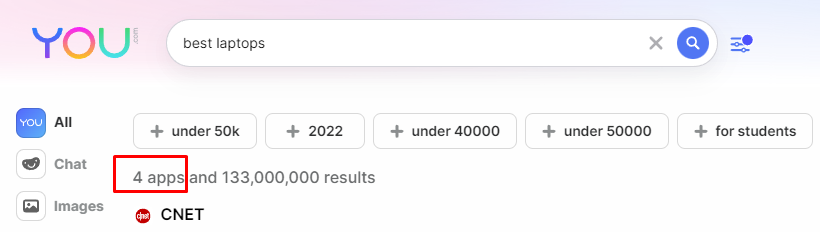
You.com have found a new way of integrating App functionality in search engines to enable the user to perform a variety of tasks without ever having to leave the search engine results page.
This enables by various web apps which are indexable by You.com. It is hence preferable to improve your website and provide various functionality like Web Applications to further enhance your website visibility on You.com.
Create Apps and Submit them to App Stores
You.com is also capable of pulling results directly from the App Store and Play Store. This makes App Store Optimization a very important SEO Strategy to rank well in “Search Engines of the Future”. You.com can rank such results and also provide various public functionalities that can be performed directly on the SERP itself.
Focus on User Engagement
Last but not the least, focus on creating interactive experiences for your customer on the Website or through Apps. You.com focuses heavily on customer feedback through votes.
Hence it’s really important to match the user intent for search queries. If the user has commercial intent, offer price comparisons and on-site product catalogues. If the user is looking for information, provide deep contextual content with images, videos and relevant links that can enable the user to feel satisfied.
Focusing on quality will help in getting more upvotes and hence improve the prospect of ranking on You.com
Advanced Strategies for Optimizing Your Website for You.com
In addition to the foundational optimization techniques outlined, there are advanced strategies that webmasters can employ to maximize their visibility and rankings on You.com:
- Semantic Markup Implementation: Leveraging schema markup to provide context and structure to your website’s content can enhance its understanding by You.com’s AI. By marking up key elements such as product details, reviews, and events, webmasters can improve the relevance and richness of their website’s search results.
- Natural Language Processing (NLP) Optimization: Given You.com’s emphasis on understanding natural language queries, optimizing website content for NLP can improve its chances of being surfaced for relevant search queries. This involves crafting content that aligns with common language patterns and user intents, thereby enhancing the AI’s ability to interpret and rank it appropriately.
- Voice Search Optimization: With the proliferation of voice-enabled devices and virtual assistants, optimizing website content for voice search queries can be instrumental in improving visibility on You.com. This includes incorporating conversational keywords and phrases, structuring content in a question-and-answer format, and optimizing for local voice search queries.
- Dynamic Content Generation: Capitalizing on You.com’s integration with web apps, webmasters can explore dynamic content generation techniques to provide personalized and interactive experiences for users. By leveraging user data and preferences, websites can dynamically generate content such as product recommendations, personalized offers, and interactive tools directly within You.com’s search results.
How to Get Ranked on You.com: A New-Age SEO Framework by ThatWare
Search is no longer limited to traditional keyword-based engines. Platforms like You.com are redefining how users discover information by combining AI-driven answers, trusted sources, and intent-aware content delivery. Ranking on You.com requires a fundamentally different SEO approach—one that prioritizes semantic understanding, entity relevance, and AI trust signals over outdated tactics.
At ThatWare, we have developed a You.com–specific ranking framework that aligns with how AI search engines evaluate, extract, and surface content.
Understanding How You.com Works (And Why Traditional SEO Fails Here)
You.com is not a conventional crawler-first search engine. It functions as an AI-assisted search and answer engine, which means:
- Content is parsed semantically, not just indexed
- Pages are evaluated for clarity, structure, and factual grounding
- AI models extract direct answers, summaries, and insights
- Trust, topical authority, and consistency matter more than backlinks alone
This is why many websites that rank on Google fail to appear on You.com, while some lesser-known but well-structured sources surface prominently.
ThatWare’s strategy begins with understanding how You.com “reads” content, not how it crawls it.
What You.com Looks for in Ranking Content
Based on live testing, AI extraction analysis, and entity mapping, You.com prioritizes:
1. Intent-Complete Content
You.com favors pages that fully answer a topic, not partial or thin content. If a page addresses ranking on You.com, it must explain:
- How You.com differs from Google
- What signals it trusts
- How content is evaluated by AI
- What technical and semantic factors influence visibility
ThatWare structures content to satisfy the entire intent loop, increasing AI pickup probability.
2. Strong Semantic and Entity Signals
You.com relies heavily on entity-based understanding, not keyword density.
Instead of repeating “rank on You.com,” our approach includes:
- Clear definitions
- Contextual explanations
- Related concepts (AI search, LLMs, semantic indexing, trust layers)
- Brand-to-topic alignment (ThatWare + AI SEO)
This allows You.com’s AI to confidently associate the page with the topic.
3. Clean, AI-Friendly Content Architecture
AI engines prefer content that is:
- Logically structured
- Free from fluff and filler
- Easy to extract answers from
- Written in authoritative, explanatory language
ThatWare creates AI-consumable content layouts, ensuring headings, subtopics, and transitions align with how large language models interpret information.
ThatWare’s You.com Ranking Methodology
Step 1: AI Search Intent Mapping
We reverse-engineer what users ask on You.com and how AI reformulates those queries internally. This includes:
- Conversational prompts
- Comparison-based questions
- Exploratory “how” and “why” queries
Content is then mapped to AI intent clusters, not just search terms.
Step 2: Semantic Indexing with AI Logic
Instead of basic NLP, ThatWare uses advanced semantic layering, including:
- Contextual topic expansion
- LDA-driven relevance modeling
- Entity co-occurrence optimization
- Vector-level similarity alignment
This makes the content AI-retrievable, not just crawlable.
Step 3: Trust Signal Engineering
You.com places a high emphasis on source reliability.
ThatWare strengthens trust through:
- Authoritative tone without hype
- Fact-based explanations
- Internal topic consistency
- Brand authority reinforcement across related pages
This positions ThatWare-powered pages as safe AI answer sources.
Step 4: AI Snippet & Answer Optimization
We structure sections to be easily:
- Quoted
- Summarized
- Referenced by AI
This increases the chances of your content being:
- Pulled into AI-generated answers
- Shown as a recommended source
- Displayed in You.com’s knowledge panels or summaries
Why Ranking on You.com Matters for Future SEO
You.com represents where search is heading:
- AI answers over blue links
- Source trust over backlink volume
- Understanding over optimization tricks
Brands visible on You.com today gain:
- Early-mover authority
- AI trust reinforcement
- Higher likelihood of being cited across multiple AI platforms
ThatWare doesn’t treat You.com as a “secondary engine.” We treat it as a primary AI discovery layer.
Common Mistakes That Prevent You.com Rankings
Many websites fail to rank on You.com due to:
- Over-optimized keyword stuffing
- Shallow or repetitive content
- Lack of semantic depth
- Poor internal topical structure
- Generic SEO writing not suited for AI interpretation
ThatWare eliminates these issues by designing content for AI cognition, not just search bots.
How ThatWare Is Different from Standard SEO Agencies
Most agencies optimize for Google first and “hope” AI engines pick up the content. ThatWare does the opposite.
We:
- Design content for AI-first indexing
- Align SEO with machine understanding
- Integrate advanced NLP and entity science
- Optimize across Google, You.com, and emerging AI platforms simultaneously
Our approach ensures your brand is discoverable wherever AI search exists, not just traditional SERPs.
The Future: SEO for Humans, Interpreted by AI
You.com is a clear signal that SEO is evolving into AI-mediated discovery. Ranking success now depends on:
- Depth of understanding
- Clarity of explanation
- Semantic authority
- Brand trustworthiness
ThatWare’s You.com ranking solutions are built for this future—where content must convince both humans and machines.
Get Ranked on You.com with ThatWare
If your brand wants visibility on You.com and other AI-powered search platforms, traditional SEO is no longer enough.
ThatWare delivers:
- You.com–specific SEO strategy
- AI-optimized content frameworks
- Semantic and entity-driven optimization
- Long-term AI search authority
This is not experimental SEO.
This is next-generation AI search optimization, engineered by ThatWare.
Case Studies and Success Stories
To illustrate the effectiveness of optimizing websites for You.com, let’s explore real-world case studies and success stories from businesses and organizations that have implemented these strategies:
- E-commerce Platform Enhancement: A leading e-commerce platform optimized its product pages with schema markup and NLP-driven content to improve visibility on You.com. By providing detailed product information, customer reviews, and FAQ sections marked up with schema, the platform saw a significant increase in organic traffic and conversions from You.com’s search results.
- Content Publishing Platform Innovation: A content publishing platform implemented dynamic content generation techniques to enhance its articles and blog posts for You.com. By integrating interactive elements such as quizzes, polls, and interactive infographics directly within search results, the platform achieved higher user engagement and improved rankings for relevant search queries.
- Local Business Listing Optimization: A local business optimized its listings with structured data and localized content to improve visibility on You.com’s local search results. By providing accurate business information, customer reviews, and location-specific offers, the business saw an increase in foot traffic and online inquiries from You.com users.
Best Practices for Long-Term Success on You.com
In addition to implementing advanced optimization strategies, adhering to best practices is essential for sustaining long-term success on You.com:
- Continuous Monitoring and Iteration: Regularly monitor website performance metrics on You.com, such as search rankings, click-through rates, and user engagement. Use this data to identify areas for improvement and iterate on optimization strategies accordingly.
- Adaptive Content Strategy: Stay abreast of evolving trends and user preferences on You.com to adapt your content strategy accordingly. Test new formats, topics, and interactive elements to gauge user response and refine content offerings for maximum impact.
- Collaboration with You.com’s Developer Community: Engage with You.com’s developer community to stay informed about platform updates, API integrations, and optimization opportunities. Leverage developer tools and resources to enhance your website’s visibility and functionality on You.com.
Understanding How You Search Interprets Queries
You Search operates on AI-powered intent recognition, meaning it doesn’t treat all searches equally. The engine classifies queries into intent-based categories such as:
- Exploratory research
- Problem-solving
- Comparative evaluation
- Transactional or action-driven intent
For each intent type, You Search prioritises different ranking signals. A page that ranks well for exploratory intent may not rank for transactional intent unless the content structure aligns with that purpose.
This is why ranking on You Search requires intent-first content architecture, not keyword repetition.
Content Depth Matters More Than Content Length
On You Search, shallow content fails quickly. Pages that only skim the surface or repeat known facts are filtered out by AI scoring layers.
What performs well instead:
- Pages that explain the “why” behind concepts
- Content that connects ideas rather than listing them
- Logical progression from problem → explanation → insight
Depth does not mean fluff. It means meaningful coverage that demonstrates understanding, not volume.
That’s why long-form content that is well-structured, logically layered, and semantically rich performs far better on You Search than fragmented blog posts.
Role of AI Readability and Contextual Clarity
You Search evaluates content through AI readability layers. These layers analyse:
- Sentence clarity
- Logical flow
- Context preservation across sections
- Absence of contradictory statements
Over-optimised content with forced keywords often loses clarity — and that hurts rankings on You Search.
Clean, human-readable language with clear conceptual transitions performs better because the AI can easily map meaning and intent.
Why Internal Structure Influences Ranking on You Search
Unlike traditional engines that focus heavily on external signals, You Search deeply analyses on-page structure.
Critical elements include:
- Clear heading hierarchy (H1 → H2 → H3)
- Logical segmentation of ideas
- Contextual continuity between sections
- Strong internal linking between related concepts
A page that reads like a well-organised knowledge document will outperform one that reads like a marketing pitch.
This is why content written for You Search must feel educational, authoritative, and purposeful, not promotional.
How User Interaction Signals Shape Visibility
You Search continuously refines rankings based on real user behaviour. Signals such as:
- Scroll depth
- Time spent on page
- Interaction with sections
- Return-to-search behaviour
…directly influence how content is re-ranked over time.
If users consistently find value and stay engaged, the page gains long-term ranking stability. If users bounce quickly, visibility drops — regardless of backlinks or keywords.
ThatWare optimises not just for rankings, but for sustained user engagement, which aligns perfectly with You Search’s ranking philosophy.
Conclusion
Optimizing websites for You.com requires a strategic approach that combines foundational techniques, advanced strategies, and continuous iteration. By implementing schema markup, NLP optimization, voice search readiness, dynamic content generation, and other innovative techniques, webmasters can improve their website’s visibility and rankings on You.com’s AI-powered search platform. Real-world case studies and success stories underscore the tangible benefits of these optimization efforts, while adherence to best practices ensures long-term success and competitiveness in the evolving landscape of AI-driven search. By embracing innovation and collaboration, webmasters can position their websites for sustained growth and prominence on You.com.