
SUPERCHARGE YOUR Online VISIBILITY! CONTACT US AND LET’S ACHIEVE EXCELLENCE TOGETHER!
In the evolving world of digital commerce, merely having a well-structured ecommerce website is no longer sufficient. Modern search ecosystems are increasingly dominated by AI-driven tools, generative search engines, and knowledge graph-based platforms that prioritize entities, relationships, and semantic relevance over traditional keyword rankings. For businesses in competitive niches, such as tiles and interior surfaces, this shift poses both a challenge and an opportunity. Brands that fail to align with these new paradigms risk losing visibility in high-intent queries, even if their conventional SEO metrics appear healthy.

MyTyles, a growing online retailer specializing in wall and floor tiles across India, serves as a prime example of this transition. While the website had a solid foundation in traditional ecommerce, with organized product categories, strong portfolios, and consistent traffic, our audit revealed significant gaps in AI-readiness, entity authority, and semantic structuring. These deficiencies not only limited the brand’s appearance in knowledge graphs and AI answer sets but also created a risk of long-term traffic erosion as AI-driven discovery becomes the dominant mode of search. Our audit, conducted through the lens of the Cognitive Web, aimed to diagnose these weaknesses, quantify potential risks, and outline actionable strategies to position MyTyles as a dominant, AI-ready authority in its niche.
At ThatWare, we played a pivotal role in this process, leveraging our expertise in Reality Optimization audits, generative engine analysis, and entity mapping to provide a comprehensive assessment. By combining technical diagnostics, semantic evaluation, and predictive forecasting, we were able to not only identify the critical gaps but also create a roadmap for MyTyles to transition from conventional ecommerce visibility to AI-driven, entity-based authority. This audit underscores the importance of adopting a forward-looking strategy to maintain competitive advantage in an increasingly automated and AI-centric digital ecosystem.
Understanding Traditional Ecommerce Performance
Overview of MyTyles’ Ecommerce Presence
MyTyles operates as a specialized online retailer in the tiles and stone category, primarily serving the Indian market. With a portfolio that spans wall and floor tiles, including premium designer options, the website attracts several hundred thousand visits per month. From a traditional ecommerce perspective, the site demonstrates strong fundamentals: organized product categories, clear navigation, and a visually appealing layout. Its trust signals, including service highlights and portfolio showcases, reinforce credibility among first-time visitors. These elements form the base upon which digital visibility and customer engagement are built.
Strengths in Conventional SEO and Traffic
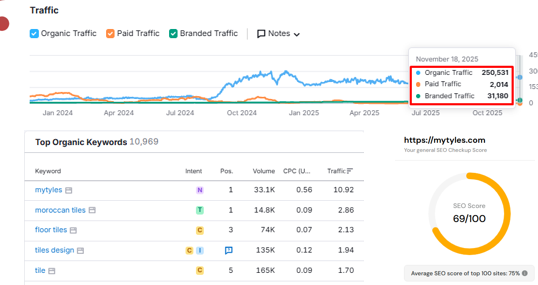
A closer look at traffic sources indicates that organic search accounts for approximately 42.9 percent of overall visits, while direct traffic contributes 32.1 percent. This mix suggests that MyTyles has established some recognition among repeat customers and through basic search visibility. Its SEO health score of 69/100 reflects a reasonably optimized website structure, indicating that traditional ranking factors—such as content availability, basic on-page optimization, and internal linking—are in place. This foundation has enabled the brand to maintain steady traffic in a competitive market, particularly for generic search terms like “tiles” or “mytiles.”
Limitations of Traditional Ecommerce Optimization
Despite these strengths, the audit revealed significant limitations in MyTyles’ traditional SEO approach. Key technical issues, such as the absence of an H1 tag on the homepage, missing sitemaps, non-SEO-friendly URLs, and oversized unused images, constrain the site’s ability to fully capitalize on search visibility. Furthermore, the site’s content, while well-structured for users, lacks semantic depth and entity-based organization that modern search engines increasingly prioritize. Competitors in the home and interior design segment are actively investing in rich content, structured data, and entity-focused branding, creating a widening gap in discoverability for high-intent searches.
Implications for Long-Term Growth
From a traditional ecommerce lens, MyTyles performs adequately, yet the audit highlights the risk of plateauing traffic and lost opportunities. Without integrating entity-focused structures and semantic content, the brand remains vulnerable to visibility erosion, particularly as AI-driven search tools and generative assistants begin to dominate user behavior. The foundation is solid, but to transition from a standard ecommerce player to a recognized authority in tiles, MyTyles must expand beyond conventional optimization strategies. This requires targeted interventions in structured data, knowledge graph mapping, and AI-readiness—areas that the Reality Optimization audit precisely identifies.
The Cognitive Web Challenge (AI, Knowledge Graphs, and Entity Visibility)
The Shift from Keywords to Entities
The modern search landscape is no longer limited to keyword-based discovery. AI-driven engines, generative assistants, and knowledge graph-based systems increasingly prioritize entities, relationships, and semantic relevance. Traditional SEO metrics—traffic, backlinks, and keyword rankings—are still important, but they no longer guarantee visibility in high-intent, AI-assisted search results. For a niche retailer like MyTyles, this shift introduces both opportunity and risk. While the brand has a strong product offering and user-friendly ecommerce platform, it is largely invisible to AI answer engines and lacks formal recognition in knowledge graphs, which serve as the foundation for AI-driven recommendations and zero-click search results.
AI Answer Engines and Generative Search Visibility
Our audit indicates that MyTyles does not appear prominently in generative answer sets, AI recommenders, or structured cards such as Google’s “People also ask.” Sample queries, including “best floor tiles for living room India” and “how to choose terrazzo vs marble look tiles,” demonstrate that AI systems favor competitors with clearly structured entity relationships and schema-rich content. Without structured, machine-readable data, MyTyles remains absent from automated shopping assistants and generative knowledge outputs. This absence significantly reduces the likelihood of being recommended as a trusted tile supplier in AI-powered search results, which increasingly influence customer decision-making before they reach product pages.
Knowledge Graph Gaps and Entity Weakness
The audit also revealed that MyTyles lacks a centralized presence in public knowledge graphs. There is no Google Knowledge Panel linking the brand to tile and stone categories, and semantic relationships such as brand-to-product, material-to-use-case, and customer-to-project are not formally structured. Current implicit relationships, like “MyTyles sells bathroom tiles” or “MyTyles has a Bengaluru showroom,” exist only in human-readable form and are largely ignored by AI crawlers. This shallow entity graph limits AI attribution, reducing the brand’s inclusion in LLM (Large Language Model) generated answers and lowering visibility for high-value, intent-driven queries.
The Risks of Ignoring AI and Entity Optimization
Without addressing these structural gaps, MyTyles risks losing relevance in the very channels that are shaping future digital discovery. AI-driven search systems increasingly prioritize entities with strong interconnections, verifiable relationships, and structured data. Competitors, such as Kajaria, Orientbell, and Somany, have already established rich entity ecosystems, incorporating schema markup, product-brand relationships, case studies, and external citations. MyTyles’ lack of similar entity authority creates a critical visibility gap, particularly for high-intent searches like “premium designer tiles India” or “anti-skid vitrified tiles online.” Over time, this could result in diminished traffic, reduced lead generation, and weaker brand perception in AI-first search environments.
Opportunity for Strategic Entity Optimization
Despite the risks, the Cognitive Web presents a clear growth opportunity. By implementing a structured, entity-based framework, MyTyles can become an authoritative source across AI engines, generative search, and knowledge graphs. This involves formalizing relationships between tile types, materials, use-cases, brands, and projects, along with machine-readable schema and AI-friendly content blocks. At ThatWare, our Reality Optimization audit highlights these gaps and provides a roadmap for transforming MyTyles from a conventional ecommerce site into a next-generation AI-recognized authority, capable of capturing both search visibility and high-intent traffic in the evolving digital landscape.
Search Reality Diagnostic (SERP & Traffic Landscape)
Current Traffic Overview
Our audit of MyTyles’ website reveals a moderate traffic footprint in a highly competitive market. According to SimilarWeb data, MyTyles receives approximately 250,500 monthly visits, with a traffic composition dominated by organic search at 42.9 percent and direct traffic at 32.1 percent. These figures suggest that the brand has built a baseline recognition among repeat visitors and customers who search for the brand directly. However, the dominance of generic traffic indicates that MyTyles’ presence in high-intent queries, such as “designer wall tiles India” or “premium floor stones India,” is limited.
Keyword Visibility and Search Presence
The audit highlights that MyTyles ranks for some broad keywords like “tiles” or “mytiles,” yet fails to capture authoritative search positions for specific product or category-based queries. This reflects a common pattern for ecommerce websites operating primarily with traditional SEO strategies. While category pages are indexed and accessible, the lack of semantic optimization, structured product data, and AI-ready content limits the site’s visibility in rich SERP features, including featured snippets, “People also ask,” and AI-generated summaries. Competitors actively optimize for these features, leaving MyTyles at a disadvantage in capturing high-value, conversion-oriented traffic.
Technical Audit Insights
Our diagnostic review identified multiple technical SEO issues that constrain MyTyles’ search potential. Key findings include:
- No H1 tag on the homepage, reducing clarity of primary topic signals to search engines.
- Missing XML sitemap, affecting crawl efficiency and indexation.
- Non-SEO-friendly URLs, which impede keyword relevance and user readability.
- Large unused images, which increase page load times and negatively impact Core Web Vitals.
These technical shortcomings, combined with thin internal linking and limited schema usage, hinder the site’s ability to fully leverage traditional search advantages, let alone the emerging AI-first discovery ecosystem.
Competitive Market Context
The tiles and home interiors segment is highly competitive, with key players investing in rich content, external citations, and robust product detail pages. Many competitors are already visible in knowledge panels and AI-driven answer engines. In contrast, MyTyles’ reliance on standard ecommerce signals—price, product categories, and listing structure—without entity-driven SEO and structured relationships, limits its competitiveness for intent-driven and high-value search traffic.
Implications for Traffic Growth
The Search Reality Diagnostic highlights a crucial insight: while MyTyles maintains steady baseline traffic, its potential for growth in high-intent search segments remains untapped. Without addressing technical deficiencies, optimizing content for semantic richness, and enhancing entity visibility, the brand risks stagnation. High-value queries that could drive both leads and conversions are increasingly captured by competitors with AI-optimized strategies, leaving MyTyles vulnerable to traffic erosion in the evolving search landscape.
AI Answer Reality & Generative Engine Optimization (GEO)
Audit Methodology for AI and Generative Search Evaluation
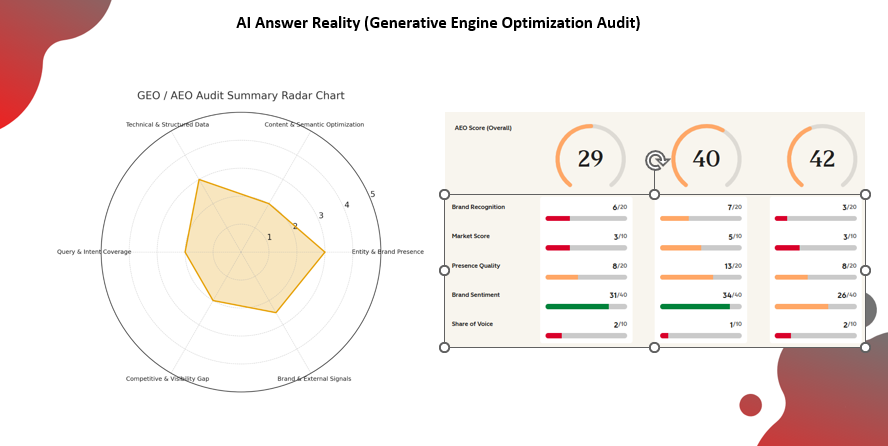
To evaluate MyTyles’ presence in the AI and generative search ecosystem, we conducted a Generative Engine Optimization (GEO) audit, focusing on the brand’s visibility in AI-driven answers, knowledge graphs, and large language model (LLM) outputs. The audit examined six core dimensions: Entity & Brand Presence, Technical & Structured Data, Content & Semantic Optimization, Query & Intent Coverage, Competitive & Visibility Gap, and Brand & External Signals. Each dimension was scored to assess readiness for AI-first search environments.
The radar chart generated from the audit highlights the brand’s current strengths and gaps. Notably, MyTyles shows moderate signals for entity recognition and structured data, while semantic optimization and competitive visibility remain underdeveloped. This suggests that while the website functions effectively in traditional search, it is not fully optimized for AI-driven discovery.
Audit Findings: GEO / AEO Scores
The Audit Engine Optimization (AEO) scores provide quantitative insight into MyTyles’ current AI visibility:
- Overall AEO Scores: 29 → 40 → 42 across three evaluation phases, showing gradual improvement potential with focused optimization.
- Brand Recognition: Scores between 3–7/20, reflecting limited awareness in AI recommendation engines.
- Market Score: 3–5/10, indicating underrepresentation in high-intent market queries.
- Presence Quality: 8–13/20, suggesting moderate quality signals but insufficient depth for structured AI answers.
- Brand Sentiment: 26–34/40, showing that user and external signals reflect reasonable brand favorability.
- Share of Voice: 1–2/10, highlighting minimal influence in generative AI answer sets.
These numbers underline that MyTyles is largely absent from AI answer engines and generative summaries, particularly for queries with high purchase intent or semantic depth.
Example Queries and Results
Sample queries tested during the audit include:
- “Best floor tiles for living room India”
- “Wooden look ceramic wall tile online India”
- “Vitrified tile prices per sq ft India”
- “What size tile should bathroom floor use”
- “How to choose terrazzo vs marble look tiles”
Across these queries, MyTyles did not appear in the top AI-generated responses, knowledge cards, or LLM summaries. Competitor brands with structured entity markup and content designed for AI visibility dominated the results.
Analysis of Non-Inclusion in AI-Driven Answers
The audit indicates that absence from AI answer sets is primarily due to:
- Lack of structured entity markup for products, categories, and use cases
- Minimal semantic depth in product descriptions and FAQ content
- Weak internal linking and content hierarchy for AI parsing
- Limited brand citation and external knowledge graph signals
Without these elements, MyTyles is effectively invisible to AI engines, which rely on structured, entity-rich, and semantically linked content to generate answers.
Importance of AI-Readiness for Ecommerce Brands
For ecommerce brands like MyTyles, AI visibility is no longer optional. Generative engines increasingly capture high-intent traffic, delivering “zero-click” solutions where consumers select products directly from AI suggestions. Failure to optimize for GEO results in lost market share, reduced SERP prominence, and missed high-value leads.
GEO Opportunities for MyTyles
The audit identifies a clear path forward:
- Entity Expansion: Map all product types, finishes, and use-cases with structured JSON-LD markup.
- Semantic Optimization: Enhance content with entity-rich, intent-aligned copy.
- AI Answer Inclusion: Target queries where MyTyles can appear in LLM-generated responses, building PromptRank and share of voice.
- Competitive Benchmarking: Monitor AI engines for emerging query trends and competitor coverage.
By executing these GEO strategies, MyTyles can move from marginal AI presence to top-tier visibility, ensuring inclusion in generative answer sets, structured knowledge panels, and high-intent search outcomes.
Entity & Knowledge Graph Diagnostic (KGX)
Current Entity Definition Gaps
Our audit identified that MyTyles, while a recognized ecommerce brand for tiles and stones, lacks centralized entity recognition in the broader digital ecosystem. The brand is absent from major public knowledge graphs, including Google Knowledge Panel, which means AI systems fail to recognize MyTyles as an authoritative category player.
The current state shows that MyTyles operates as a transactional site with no structured machine-readable mapping connecting the brand to products, materials, showrooms, and industry partnerships. This absence of a clear entity framework severely limits how AI and knowledge-driven platforms understand and cite the brand.
Shallow Knowledge Graph Coverage
Our KGX audit revealed that MyTyles maintains only implicit relationships on its website, such as “sells Bathroom Tiles” or “offers online shopping.” These relationships exist only in visible content and are not expressed in structured data that knowledge graphs can interpret.
Without these connections:
- The brand is not cited in AI-generated summaries.
- Relationships between products, use cases, and materials remain hidden.
- High-value transactional and informational queries do not surface MyTyles as a credible answer.
Missing Relationships and Semantic Connections
Key missing relationships include:
- Brand associations with major tile manufacturers like Kajaria and Orientbell.
- Case studies, project installations, and portfolio linkages.
- Material-to-use-case connections (e.g., vitrified tiles → kitchen floors → anti-skid finish).
These gaps reduce semantic depth, which is crucial for generative engines and AI assistants to recognize the brand as an expert in tile solutions.
Risks of Limited Entity Authority in AI Ecosystems
Without structured entity relationships, MyTyles faces:
- Reduced visibility in AI-driven answers.
- Missed inclusion in LLM-based recommendation systems.
- Weak authority signals compared to competitors with fully mapped entity networks.
Examples of Lost Visibility Opportunities
Queries such as “trusted tile suppliers in India with designer options” or “which tiles are best for Indian bathrooms” frequently surface competitor brands in AI answers, leaving MyTyles invisible despite competitive offerings. This is a direct consequence of underdeveloped KGX architecture, which limits brand recognition in AI ecosystems.
Content Reality Analysis (NCN – Neural Content Readiness)
Strengths in Service Pages and Portfolio
MyTyles demonstrates clear strengths in content that supports traditional ecommerce metrics:
- Well-structured service and category pages.
- Clear navigation and intuitive layout.
- Trust signals through client portfolios and testimonials.
These features provide a solid foundation, but they are optimized primarily for human visitors, not AI-driven discovery or knowledge graph integration.
Weaknesses in Semantic, Entity-Driven Writing, and Structured Answers
Our audit highlights several weaknesses:
- Minimal entity-rich content linking products, materials, and use cases.
- Lack of multimodal semantic anchors that combine visuals and text for AI readability.
- Thin coverage of FAQs and HowTo guides, limiting structured answer inclusion.
- No cognitive UX cues designed for AI evaluation, reducing discoverability in generative engines.
Recommendations for Content Improvement
To achieve Neural Content Readiness, we recommend:
- Enhancing internal linking to strengthen semantic flow.
- Developing persona-based content targeting homeowners, architects, and interior designers.
- Expanding long-form guides for topical authority.
- Adding expert insights to reinforce trust and credibility.
- Applying FAQPage and HowTo schema for AI snippet eligibility.
- Optimizing product descriptions with contextual keywords and entity references.
- Integrating emotional storytelling and visual-text synergy.
- Strengthening CTAs for conversions.
Importance of Content for AI and Knowledge Graph Visibility
Structured, entity-driven, and semantically rich content ensures that AI engines understand the brand, its products, and its authority. NCN implementation enables MyTyles to appear in zero-click answers, AI recommendations, and structured knowledge panels, which are crucial for future growth.
Predictive SERP Intelligence (90–180 Days Forecast)
Risk Assessment Without Optimization
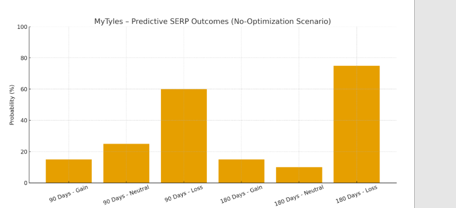
Without Reality Optimization, MyTyles faces immediate risks. Our predictive models indicate traffic loss probabilities due to AI-driven search and generative engine adoption.
90-Day Forecast
- SERP / AI Loss Probability: ~60%
- Branded queries remain stable, but high-intent long-tail queries are increasingly answered by AI without referencing MyTyles.
- Competitors with entity markup and structured data begin to dominate generative summaries.
180-Day Forecast
- SERP / AI Loss Probability: ~75%
- AI Mode in India becomes the default discovery layer for buyers.
- MyTyles remains largely invisible to AI engines due to shallow entity and content architecture.
- Only pages with exceptional UX and deep category coverage may retain visibility.
Analysis of Competitor Advantage
Competitors investing in schema, entity relationships, and rich content are consolidating AI visibility. Brands like Kajaria and Orientbell leverage structured data, brand mentions, and catalog feeds to appear in AI-generated answers. MyTyles risks being outpaced in both AI and traditional SEO.
Implications for High-Intent Queries and Long-Term Growth
If unaddressed, these gaps may:
- Reduce leads from informed buyers.
- Weaken authority signals for search and AI.
- Limit long-term growth in an AI-first search landscape.
Reality Optimization Opportunities
The digital landscape for ecommerce is rapidly evolving, and brands like MyTyles must embrace strategies that go beyond traditional SEO. A Reality Optimization framework integrates entity architecture, AI-readiness, semantic content, and predictive intelligence to establish a resilient, authoritative presence. For MyTyles, these opportunities fall under five core pillars: KGX Entity Re-Architecture, Generative Engine Optimization (GEO), Neural Content Network (NCN), Multi-Agent Automated SEO, and Predictive Steering System (PSI).
KGX Entity Re-Architecture
At the heart of semantic optimization is KGX (Knowledge Graph Experience) Entity Re-Architecture. MyTyles must rebuild its semantic universe, mapping every tile type, use case, and attribute in a structured, machine-readable way. For example, tile entities should be categorized by material (ceramic, vitrified, porcelain), use-case (bathroom, kitchen, commercial), and attributes (size, finish, anti-skid).
Beyond categorization, it is critical to define relationships between entities: a tile → room → finish → brand. This structured connectivity allows AI engines and knowledge graphs to understand not just what MyTyles sells, but how products relate to user needs and contexts.
Implementation includes structured internal linking and JSON-LD schema markup for all major categories and products. Each entity must be AI-readable, ensuring that generative assistants and knowledge graphs can accurately interpret MyTyles’ offerings, authority, and relevance.
Generative Engine Optimization (GEO)
The next layer involves inserting MyTyles into AI engine answer sets. By optimizing for generative AI, the brand moves from marginal visibility to top-tier AI recommendations for queries like “best tiles for Indian bathrooms” or “designer wall tiles online.”
GEO focuses on creating a LLM-ready identity, ensuring MyTyles is recognized across Pan-India queries. By feeding structured data, entity relationships, and content cues into AI systems, the brand becomes a primary reference in generative answers, bridging the gap between traditional search traffic and the emerging AI-first discovery ecosystem.
Neural Content Network (NCN)
The Neural Content Network transforms static web pages into self-optimizing content systems. NCN emphasizes entity-rich, multimodal content—combining text, visuals, and behavioral alignment. Pages are designed to answer user questions contextually, enhancing semantic depth and improving AI inclusion.
Incorporating FAQ and HowTo schemas ensures eligibility for AI snippets, enabling MyTyles to appear in answer boxes and LLM summaries. Persona-based content further strengthens relevance for homeowners, architects, and interior designers, increasing engagement and conversions.
Multi-Agent Automated SEO
Continuous optimization is key in dynamic search environments. Multi-agent systems monitor SERPs, competitor moves, and entity performance, automatically identifying content gaps, linking inconsistencies, and semantic deficiencies.
These systems dynamically update internal linking, refresh metadata, and optimize content relationships to maintain relevance. By automating routine SEO adjustments, MyTyles remains agile and consistently aligned with AI and search expectations.
Predictive Steering System (PSI)
Finally, PSI adds a proactive intelligence layer. By predicting algorithm updates, query volatility, and competitor strategies, PSI pre-optimizes content and entities. This ensures MyTyles maintains continuous semantic and AI dominance, rather than reacting after losses occur.
Collective Impact
Individually, each strategy strengthens a particular aspect of AI and semantic visibility. Collectively, they create a resilient, next-generation ecosystem. MyTyles is positioned not just as a tile retailer, but as a recognized authority in both traditional search and generative AI answer systems, capturing high-intent traffic, improving conversions, and securing long-term category leadership.
Expected 12-Month Transformation Impact
Following a comprehensive Reality Optimization program, MyTyles is positioned to achieve a transformative shift in its digital presence, search visibility, and market authority. By addressing gaps in entity architecture, AI-readiness, semantic content, and structured data, the brand can expect measurable improvements across traffic, AI visibility, lead generation, and competitive positioning.
Traffic Uplift
One of the most immediate outcomes of a Reality Optimization program is an increase in organic website traffic. By aligning content, schema, and entity structures with AI and search engine expectations, MyTyles can expect a 40–80% increase in monthly organic visits. This uplift is driven not only by better keyword visibility but also by enhanced inclusion in AI-generated summaries, answer boxes, and knowledge panels, which capture users earlier in the decision-making journey. The combination of traditional SEO improvements and AI-focused strategies ensures that both high-intent transactional queries and informational queries direct users to MyTyles, broadening the reach and increasing qualified traffic.
PromptRank Improvement
A critical measure of AI visibility is PromptRank, which gauges how likely MyTyles is to appear in generative engine responses. Currently, the brand has a low baseline around 2, indicating near invisibility in AI-driven answer sets. Post-optimization, PromptRank can realistically improve to 35–70+, reflecting MyTyles’ enhanced entity authority, structured data deployment, and semantic content depth. This improvement ensures the brand is frequently cited by AI assistants, LLMs, and generative search engines, establishing early dominance in the digital discovery layer.
AI Answer Inclusion
By addressing structured data and entity gaps, MyTyles will become a recognized source for AI answer engines. The program targets inclusion in 20–50 AI-generated answer sets across Google AI Mode, ChatGPT, Perplexity, and other generative platforms. This not only increases brand visibility but positions MyTyles as a trusted reference for tile types, materials, finishes, and interior-use cases, ensuring that prospective buyers see MyTyles as the default authority in their queries.
Leads and Conversions
Traffic and AI visibility improvements directly translate into high-quality leads. By attracting users with specific purchase intent and providing AI-ready answers that guide decision-making, the brand can anticipate a substantial increase in leads and conversions. These gains are especially pronounced in high-value markets, such as premium residential and commercial interior projects, where users are actively seeking trusted suppliers and expert guidance.
EEAT Signals Enhancement
Through structured content, expert insights, case studies, and consistent entity representation, MyTyles will strengthen Expertise, Authority, and Trust (EEAT) signals. This not only improves ranking stability but also reinforces credibility in the eyes of both search engines and AI-driven assistants, creating a resilient foundation for long-term growth.
Competitive Positioning
The culmination of these efforts positions MyTyles as a next-generation tile authority, recognized not only in India’s digital retail ecosystem but also in emerging markets. The brand becomes a go-to reference for tile-related queries across multiple AI and search platforms, surpassing competitors who remain reliant on traditional ecommerce signals. MyTyles is thus transformed from a conventional online retailer into a fully AI-ready, semantic, and authoritative market leader.
Recommendations & Next Steps
Launching the Reality Optimization Diagnostic
To address the gaps identified in our audit, the first and most critical step is initiating a Reality Optimization Diagnostic. This diagnostic serves as a comprehensive assessment of MyTyles’ current semantic architecture, AI visibility, entity authority, and content readiness. Unlike traditional SEO audits that focus only on keywords and rankings, this diagnostic evaluates the brand’s position within AI-driven search, knowledge graphs, and generative engines.
The diagnostic is designed to create a baseline understanding of MyTyles’ strengths, weaknesses, and opportunities. It ensures that all subsequent optimization efforts are guided by data-driven insights, reducing risk and maximizing ROI. By systematically mapping MyTyles’ digital ecosystem, we identify technical, semantic, and content gaps that prevent AI systems from recognizing the brand as a trusted tile authority.
Key Deliverables
The Reality Optimization Diagnostic delivers a structured blueprint for transformation, including:
- KGX Map & Entity Audit: Comprehensive mapping of MyTyles’ brand, products, materials, showrooms, and semantic relationships in a machine-readable format.
- AI Answer Audit: Analysis of 30+ queries to assess inclusion in generative search results, LLM answer sets, and AI recommendation systems.
- Schema & Structured Data Gap Analysis: Identification of missing structured data across product, category, FAQ, and HowTo schemas to enhance AI discoverability.
- Predictive SERP Forecast: A 90–180 day projection of traffic and AI visibility risks without optimization, coupled with actionable mitigation strategies.
- Competitive Reality Map: Analysis of competitor entity authority and generative answer presence to inform strategic prioritization.
- Revenue Opportunity Model & Optimization Blueprint: Quantified projections for potential traffic, leads, and conversions following full implementation.
Investment and Timeline Guidance
The diagnostic is phased and scalable, with an investment range of $10,000–$40,000 per month, depending on the scope and depth of implementation. A typical engagement spans 12 months, with clearly defined milestones for KGX re-architecture, GEO deployment, NCN content optimization, and PSI predictive adjustments. This phased approach ensures measurable progress while enabling MyTyles to adapt to evolving AI search trends.
How ThatWare Supports Transformation
ThatWare provides end-to-end expertise in reality optimization. From mapping entity relationships to building AI-ready content networks, our team ensures that MyTyles evolves into a recognized authority across both human and AI-driven search landscapes. By leveraging our proprietary methodologies, we position MyTyles to achieve:
- Full inclusion in generative engine answers.
- Enhanced PromptRank and AI visibility.
- Stronger EEAT signals, reinforcing credibility.
- Sustained competitive advantage in the tile and interior solutions market.
Launching this diagnostic is the definitive first step toward transforming MyTyles from a traditional ecommerce site into a next-generation, AI-ready tile authority, prepared to dominate both search and discovery ecosystems.
ThatWare’s Role in Transformation
ThatWare provides hands-on expertise in entity architecture, generative engine optimization, and content network development. Our team ensures MyTyles evolves into a fully AI-ready, authoritative tile brand, capable of leading in both human and machine-discovered search ecosystems.
Proof Beyond Audits: Real-World Campaign Outcomes
At ThatWare, we don’t limit our work to promises made through audits alone. Reality Optimization is designed to produce measurable, defensible results in live search environments. The following client case studies demonstrate how our audit-led strategies translated into sustained traffic growth, stronger engagement signals, and multi-surface search dominance across traditional SERPs and AI-influenced discovery layers.
Case Study 1: Pee Aaar Industries
From Visibility Gaps to Consistent Organic Growth
Following the implementation of our Reality Optimization framework, Pee Aaar Industries experienced a clear and sustained improvement in digital performance. Rather than short-term spikes, the campaign delivered compounding organic visibility supported by a healthier authority profile and improved semantic alignment.
In November 2025, the website recorded 1.3K total visits, reflecting a 157.58% month-over-month increase. Unique visitors increased by 29.43%, confirming expanded discovery from new users rather than repeat-only traffic. Engagement quality also improved significantly, with the bounce rate dropping to 21.48%, indicating stronger intent matching and content relevance.
These results validate that entity optimization, structured content, and AI-readiness do not only improve rankings—they enhance user experience and retention across the entire funnel.
Case Study 2: Kwikpic
Multi-SERP Presence & Intent-Layer Ownership
For Kwikpic, the objective extended beyond ranking for isolated keywords. The focus was on owning multiple intent layers across the search ecosystem. Post-campaign, Kwikpic achieved visibility across several high-intent and product-discovery queries, including:
- AI photo share
- Instant photo sharing
- Facial recognition photo app
- Photo sharing app for photographers
These keywords began appearing simultaneously across standard organic listings, application-based SERP features, and category-driven result blocks. In several cases, Kwikpic ranked in multiple positions on the same results page, dramatically increasing share of voice.
This outcome was driven by entity reinforcement, structured data deployment, and generative-engine compatibility. Instead of relying on a single blue-link ranking, Kwikpic secured visibility across multiple search surfaces, reducing volatility and strengthening long-term discoverability.
Wrapping Up
The Reality Optimization Audit conducted by ThatWare demonstrates that the future of ecommerce extends far beyond traditional SEO. For MyTyles, a well-established online tile retailer, conventional strategies provided a solid foundation but left critical gaps in AI-readiness, entity authority, and semantic structuring. As search ecosystems increasingly rely on AI-driven tools, generative engines, and knowledge graphs, these gaps posed both immediate risks and untapped opportunities. By implementing a comprehensive framework—spanning KGX Entity Re-Architecture, Generative Engine Optimization, Neural Content Network, Multi-Agent Automated SEO, and Predictive Steering Systems—MyTyles is positioned to transition from a conventional ecommerce presence to a recognized AI-ready authority in the tiles and interior surfaces niche.
This transformation promises measurable benefits: improved organic traffic, inclusion in AI answer sets, higher PromptRank, stronger EEAT signals, and enhanced lead generation. More importantly, it equips MyTyles with a resilient, future-proof digital ecosystem capable of thriving as AI-driven discovery becomes the norm. ThatWare’s Reality Optimization approach ensures the brand is no longer invisible in generative search or knowledge graphs, but emerges as a trusted reference for high-intent queries, securing a long-term competitive advantage in India’s dynamic tile market.



