
SUPERCHARGE YOUR ONLINE VISIBILITY! CONTACT US AND LET’S ACHIEVE EXCELLENCE TOGETHER!
If you have been in the digital space long enough, you have probably noticed a pattern. Every few years, the online world reshapes itself and businesses scramble to keep up. SEO has gone through several of these shifts already. We started with a simple keyword race, moved on to on-page tweaks, then survived the era of backlink hunting, and eventually matured into semantic understanding and AI-supported search. Each stage felt like an upgrade, yet the overall structure of the web stayed fairly predictable.
That predictability is disappearing. Fast.
A new kind of web is forming around us, one that does not behave like the search engines we grew up with. People are calling it the Cognitive Web. Think of it as a digital environment that listens, studies, interprets, and responds to human intent in ways that look almost intuitive. It is a web that pays attention to context, habits, tone, behavior, and even emotional cues. Rather than waiting for users to type a perfect keyword string, it tries to understand what they mean, what they want, and what they might need next.
What is interesting, and a bit worrying, is that most businesses have no idea how big this shift really is. The uncomfortable truth is that nearly 90 percent of SEO practices still rely on tactics created for a web that stayed still. That old web only required Google to crawl, index, and rank. Today the engines are learning, reasoning, and evolving. Yet many agencies continue to push workflows that were designed for a world that no longer exists.
The Real Problem: Traditional SEO Agencies Are Not Built for This New World
This is not a criticism of SEO agencies as people. Many teams are hardworking and genuinely want the best for their clients. The trouble is structural. Traditional agencies were built for an older version of the internet, and they are struggling to adapt to the cognitive shift.
Their tools still revolve around counting keywords, tracking basic ranking movements, building links, and tweaking on-page elements. These things are not useless, but they do not move the needle the way they used to. The metrics they chase no longer reflect how modern search systems behave. Their reporting dashboards cannot tell you why AI engines picked a competitor’s content over yours. Their internal processes were created for an algorithm-driven environment, not a learning ecosystem that thinks, summarizes, interprets, and filters information before showing it to a user.
And perhaps the biggest issue is mindset. Traditional SEO agencies are built to influence algorithms. The Cognitive Web requires a completely different skill set. Instead of manipulating ranking factors, brands must learn how to communicate with artificial intelligence, structure knowledge in ways machines can verify, and create content that AI trusts enough to reuse, cite, or summarize.
This is a completely different discipline. It demands a new type of strategist, a deeper understanding of user psychology, and an ability to shape information so that AI models treat it as reliable.
Traditional agencies are not failing because they lack talent. They are failing because the entire framework they rely on is from a previous era. The game has changed, but their playbook has not.
What Is the Cognitive Web Era?
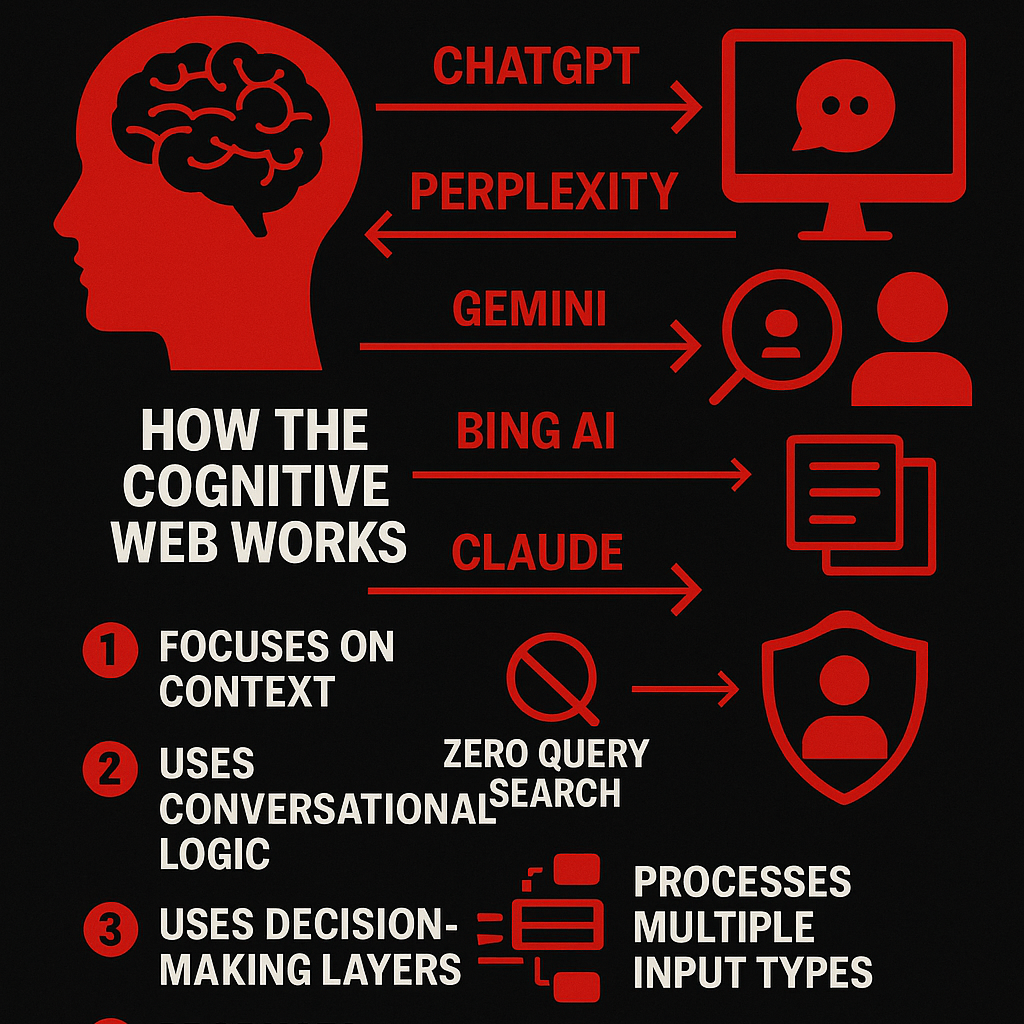
Most people still imagine the internet as a place where you type a query, press enter, and scroll through a list of blue links. That version of the web is fading fast. A new layer of intelligence has moved to the center of online discovery, shaped by tools like ChatGPT Search, Perplexity, Gemini, Bing AI, and Claude. These systems do not behave like search engines in the old sense. They act more like digital thinking partners.
Instead of waiting for a keyword, they try to understand what the user wants in advance. This is the beginning of what many call Zero Query Search. The idea is simple: the system does not wait for a typed request. It anticipates needs based on context, past behavior, location, device activity, or simply the situation the user appears to be in.
This shift is made possible by cognitive agents that read more than text. They interpret tone, urgency, and emotional cues. They adjust responses based on habits and preferences. They understand patterns like what you typically buy, how you research a topic, when you tend to ask for help, or what matters most to you at that moment.
The result is a web environment that feels more like interacting with a guide than using a search engine.
How the Cognitive Web Works
The Cognitive Web is not a new interface. It is a new way the entire system thinks behind the scenes. Several features define how it behaves:
1. It focuses on context rather than keywords
Keyword matching is no longer the anchor that determines relevance. Cognitive systems examine the meaning behind a question or message, not the literal words used. They link thoughts, situations, motivations, and pain points, even when the phrasing changes.
2. It uses conversational logic instead of static queries
People increasingly talk to their devices as if they were speaking to another person. Cognitive systems are built to respond in that format. They follow the flow of the conversation, remembering earlier details and adjusting answers as the dialogue progresses.
3. It uses decision-making layers instead of traditional rankings
Classic search engines used ranking formulas to decide which pages appear first. Cognitive engines do not rely only on ranking signals. They evaluate data through layers of reasoning and relevance. They look at experience, authority, historical accuracy, and topical connections to decide what to present.
4. It processes information from multiple input types
The next wave of search is not limited to text. Cameras, microphones, sensors, and even environmental signals influence how the system interprets a situation. Voice commands, gestures, images, and IoT data all feed into the engine’s understanding of what a person needs.
5. It produces personalized results shaped by individual identity
There is no universal search result anymore. What one person sees can be entirely different from what another sees. The system tailors responses to each user’s background, interests, past behavior, preferences, and buying patterns. Relevance becomes personal, not universal.
Why This Breaks the Old SEO Model
The emergence of the Cognitive Web changes everything businesses used to rely on.
Rankings no longer behave as fixed positions.
They shift constantly depending on who is searching, why they are searching, and what the system infers from their behavior. A page might appear for one person and disappear for another.
The idea of being “number one on Google” loses meaning.
With AI summaries taking the spotlight, the actual list of links receives far less attention. Many users never reach the traditional search results.
AI systems often bypass websites altogether.
Instead of sending traffic to individual pages, cognitive engines scan the content, pull insights, and present a condensed answer. The website is not the destination. It is a source to be mined.
Traffic flows toward AI intermediaries rather than websites.
People interact with AI systems first, and those systems decide what information to surface. This means the power shifts from pages optimized for keywords to brands presented clearly and accurately within AI-curated summaries.
In this environment, businesses that still rely only on traditional SEO methods will find themselves gradually losing visibility, even if they believe they are doing everything right.
The Collapse of Traditional SEO Methodologies
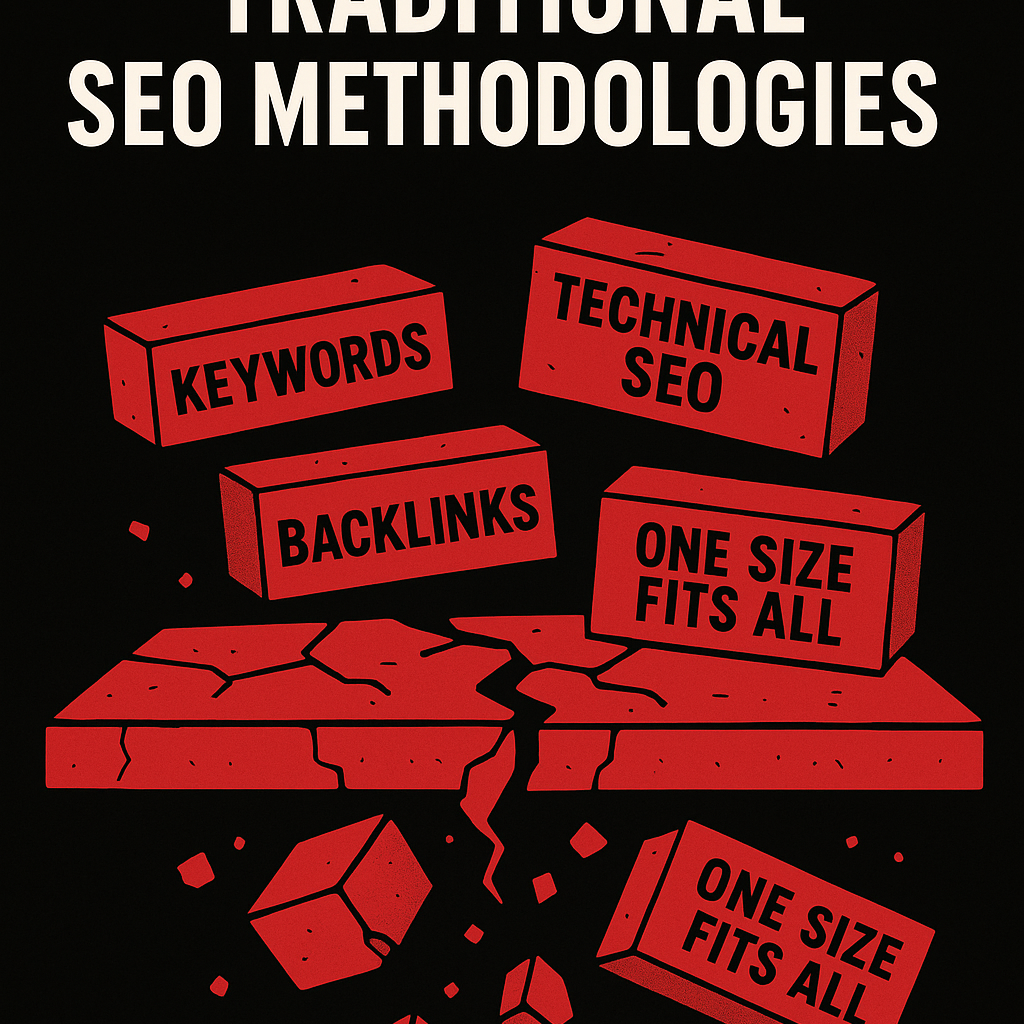
The search landscape is being reshaped so quickly that many long standing SEO habits now feel like relics from another era. What once worked with impressive consistency has become unpredictable or simply irrelevant. The shift is not due to minor algorithm tweaks. It comes from how modern search systems think, learn, and process information. The core mechanics of search have changed, and the old blueprint can no longer keep up.
Below is an honest look at where the traditional methods are breaking down and why many agencies built on those methods will struggle to stay relevant.
Keyword Centric Strategies Fail When Queries Vanish
For almost two decades, keywords sat at the heart of SEO. Entire campaigns revolved around spreadsheets filled with keyword lists, variations, and long tail phrases. In a world driven by cognitive search, that model falls apart.
Modern search systems interpret intent, not just text. They break away from literal strings and focus on context, meaning, sentiment, and user motivation. This shift alone weakens the foundation of keyword targeting.
Long tail optimization used to be an easy win. When users typed “best waterproof backpack for hiking,” an agency could craft a post that matched the phrase and capture traffic. Today, large language models rewrite queries based on user behavior and conversation patterns. This means the original query may never reach the search index in its raw form. The system reformulates the question into a more natural version or extracts the intent behind it.
Consider a simple example. A user who once typed “plumber near me” may now ask something like “My sink is leaking and I need help fixing it.” Cognitive systems understand the intent immediately, even though the phrasing is completely different. If your content depends on exact match keywords, it will not appear because the system no longer respects that type of matching.
In this environment, keyword driven strategies cannot carry the same weight. Brands must focus on depth, clarity, and intent coverage. Keyword density and long tail variations no longer guarantee visibility.
Backlink Focused Approaches Lose Relevance
Backlinks have always been treated as the currency of authority. Traditional agencies spend huge amounts of time building links, swapping links, or purchasing guest posts. The problem is that modern search systems operate very differently. They rely more heavily on content embeddings and contextual relationships than on link graphs.
Large language models analyze meaning rather than link pathways. They evaluate how well a piece of content explains a topic, how reliable the information is, and how consistently the content aligns with other trusted sources. In simple terms, authority has shifted from websites to the content itself.
This change creates a new challenge. AI search systems may pull information from unexpected sources. A website that invested heavily in backlinks may lose visibility to a YouTube video transcript, a PDF posted on an academic site, or a Reddit thread filled with real user experiences. These sources often hold richer data and stronger context signals, which is exactly what cognitive systems prefer.
The traditional link building strategy becomes less effective when the system no longer treats links as the primary compass for relevance and credibility. Agencies that still rely on these methods will struggle to achieve meaningful results in an environment where semantic understanding outperforms link graphs.
Technical SEO Stops Being a Competitive Advantage
Technical SEO once separated top performing websites from average ones. Clean code, fast loading pages, proper schema, and well designed sitemaps were essential markers of quality. While these elements still matter, they no longer create a competitive edge. They have become minimum requirements rather than differentiators.
Modern search systems can pull answers directly from multiple sources without sending traffic to your site. This means your perfectly optimized page may never be seen, even if it loads instantly. AI driven search responses often summarize relevant points without needing to surface your page at all.
The real determining factor today is content authority. Not authority in the old link building sense, but authority built through consistency, depth, and entity clarity. If your content covers a topic thoroughly, aligns with verified information, and is recognized as part of a trusted knowledge graph, AI is far more likely to use your content as a reference.
A technically polished website without semantic depth is invisible. The winners in the cognitive web era will be brands that combine technical hygiene with strong content identity and clear topical direction.
Overreliance on Old Tools
Many agencies still lean heavily on tools like Ahrefs, SEMrush, Surfer, or Yoast. While these platforms remain useful for certain tasks, they are grounded in an older model of search. Their measurements do not reflect the decision making patterns of modern AI systems.
Keyword volumes and difficulty scores become less meaningful when search queries are fluid, personalized, or rewritten by AI. Backlink indexes are less valuable when cognitive systems rely more on embeddings and trust signals. On page optimization tools that evaluate density and structure cannot predict how an AI model evaluates content quality.
A new set of metrics is taking shape. These include:
- Strength of vector embeddings
- Placement within industry knowledge graphs
- Trust signals verified across multiple sources
- Likelihood of being cited by AI driven engines
Traditional tools provide none of these insights. Agencies that rely solely on them operate with an outdated map in a new landscape.
Content Farms and Writer Mills Cannot Compete with AI
For years, many agencies offered content packages that produced articles at scale. This approach worked when quantity influenced rankings. Today, it falls apart.
AI can produce generic content at a rate no writing team can match. More importantly, modern search systems can detect repetitive or shallow content. They recognize when an article exists only to fill space or capture keywords.
Search platforms prioritize content with real world insight, hands on experience, and unique data. Stories, experiments, expert opinions, and original research carry far more value than keyword optimized filler.
Agencies that depend on writer mills will find themselves buried under the weight of AI generated content. Their content blends into a sea of similar articles and fails to stand out. Their structure driven templates and formulaic writing styles no longer satisfy systems that evaluate nuance, authenticity, and expertise.
High quality content in the cognitive web era is not about volume. It is about truth, clarity, and depth.
One Size Fits All SEO Packages Collapse
Traditional SEO agencies often sell fixed packages. These packages promise a certain number of keywords, pages, backlinks, or blog posts. This approach made sense when search behavior was relatively stable. It is no longer viable.
Cognitive search systems personalize results to the individual. The idea of a single ranking that applies to all users is fading. Your visibility can differ depending on:
- demographic group
- geographic location
- device used
- recent behavior
- past search history
- emotional or situational context
This level of personalization makes it impossible for a fixed package to deliver consistent value. Two people can search for the same topic and receive entirely different results. Traditional ranking reports cannot capture this variation, and traditional methods cannot influence it at scale.
Agencies that continue to sell one size fits all solutions will struggle to justify their results, because the model itself is fundamentally outdated.
Why Traditional Agencies Are Structurally Unprepared
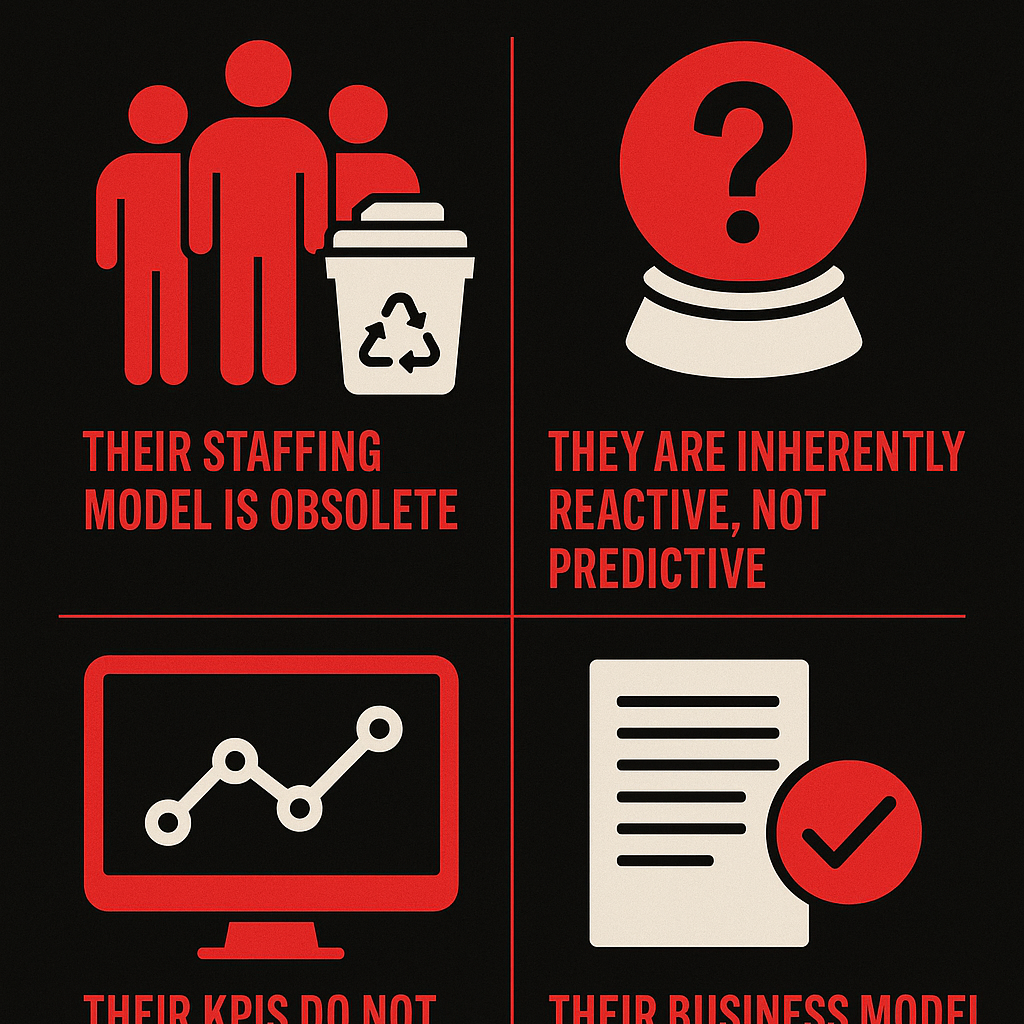
Their Staffing Model Is Obsolete
Most traditional SEO agencies were built for a different era. Their entire structure reflects a time when ranking higher simply required more blog posts and more links. So they hired armies of junior writers who spent their weeks writing predictable articles that followed templates. They also leaned heavily on manual link builders who spent long days chasing guest posts, trading backlinks, or submitting sites to endless directories. These roles were enough when search engines depended on keywords and link graphs.
The Cognitive Web has changed the ground beneath their feet. Search today requires people who can understand how modern AI systems work. It demands talent such as data scientists, machine learning specialists, and engineers who can look at content the same way an algorithm does. The new landscape requires people who can work with embeddings, model tuning, entity structures, and the technical language of AI systems.
Most agencies simply do not have these people. Many do not even know where to find them or how to train for these skills. They remain deeply tied to an outdated staffing model while the entire search ecosystem marches forward without them.
They Are Inherently Reactive, Not Predictive
Traditional agencies have always played catch-up. They wait for Google updates, read the blog posts afterward, and then rush to make adjustments. This habit worked when updates rolled out slowly, sometimes only a few times a year. It no longer works in a world where AI models learn every day. Search systems now evolve continuously, and the signals they use to rank content shift in ways that old-style teams cannot anticipate.
The factors that mattered even a year ago no longer hold the same weight. Techniques that once produced clear results barely move the needle. The agencies built around reacting to algorithm shifts now struggle to keep up because the Cognitive Web is not driven by scheduled updates. It is shaped by machine learning cycles that refresh constantly.
Businesses caught in this cycle end up staying one step behind modern search behavior. They cannot prepare for the future because their agency is still trying to decode the past.
Their KPIs Do Not Map to the New Reality
The metrics used by many SEO agencies tell a story that no longer matches what is happening inside modern search systems. For years, agencies centered their success around traffic numbers, ranking positions, backlink counts, and keyword growth. These metrics once made sense because the old search engines rewarded them.
Today, they provide a very incomplete picture.
Search is now influenced by factors that cannot be measured by basic ranking tools. Brands need to know whether AI models are including their content in answers. They need to monitor how often they are cited across AI engines. They need to understand their entity authority, their position within public knowledge graphs, and whether AI agents can interpret and recommend their content.
Traditional KPIs cannot show any of this. They paint a picture that looks healthy on a report, even when a brand is losing visibility inside AI-driven systems. Many businesses still believe they are doing well because their keyword rankings look strong, but they are invisible to the new discovery channels that matter most.
Their Business Model Incentivizes Busywork
Many agencies operate on long monthly retainers that reward repetitive activity. They fill each month with tasks that feel productive, such as pumping out more blog posts, submitting to directories, tweaking title tags, and arranging link swaps. These activities keep deliverables flowing, but they do not help brands adapt to the new search environment.
The Cognitive Web rewards creativity, originality, and depth of insight. It favors brands that present real expertise, unique data, and content designed for machine understanding. These things require strategic thinking rather than repetitive tasks. They require innovation instead of routine.
Yet the traditional agency model is built on routines, because routines are billable and predictable. As a result, most agencies are trapped in cycles that lead nowhere. They repeat the same formulas even when the market has moved on.
This is the core reason so many businesses feel frustrated. They pay for activity, but the activity does not lead to meaningful growth. The agencies are working hard, but they are working on the wrong things.
How Search Engines Have Already Shifted (Proof We Are Living in the Cognitive Web)
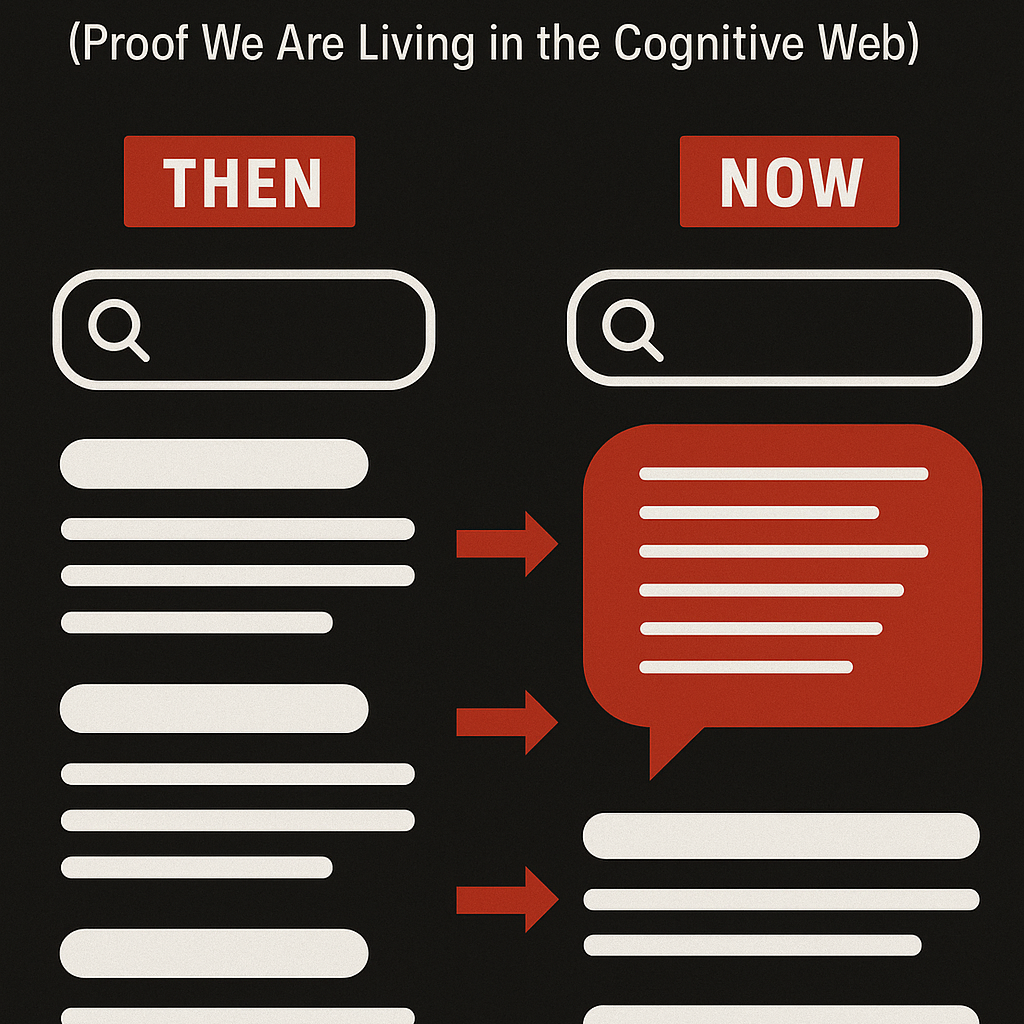
Search is no longer the simple list of links most of us grew up with. It has quietly evolved into something far more adaptive and intuitive. These changes happened so quickly that many businesses still operate under assumptions that are already outdated. The Cognitive Web is not a prediction for the future. It is happening right now, and every major search platform has already crossed the line.
Below is a closer look at how this shift unfolded and why it matters for brands that want to stay visible in the new landscape.
Google SGE: When Answers Replace Links
Google’s Search Generative Experience (SGE) shows exactly where search is headed.
The classic ten blue links used to be the foundation of SEO, but SGE turns that model on its head.
1. AI snapshots now sit above traditional results
When you search for something in SGE, you often get a detailed, conversational answer at the top. This answer blends insights from multiple sources and removes the need to scroll or click. The old race for the top position has become less important because the AI summary takes center stage.
2. Zero click searches are rising fast
Users now get everything they need on the results page itself. They no longer feel the need to visit a website to compare data or gather basic facts. This has pushed zero click behavior to its highest level in history. Even websites that rank well notice fewer visits because the information is already visible in the AI response.
3. Fewer citation opportunities mean tougher competition
SGE often highlights only a handful of sources inside the summary. Before SGE, a page could get noticed even if it ranked fifth or sixth. Now the real estate is limited. If your site is not explicitly quoted in the snapshot, you lose visibility, even if your content is excellent. This creates a winner-takes-all dynamic that traditional SEO was never designed to handle.
OpenAI, Perplexity, Anthropic and Bing Have Become Search Engines
Search is no longer controlled by one company. AI platforms have stepped in with powerful engines of their own.
Each one pulls information from the entire web, but they do not display it the way Google does.
1. AI agents rely on knowledge graphs instead of individual pages
These systems do not treat your website as a standalone document. They see it as a set of ideas and entities connected to countless others across the web. They understand topics through relationships, patterns and context. This approach reduces the influence of traditional ranking factors and focuses entirely on meaning and accuracy.
2. Summaries reduce traffic to traditional websites
OpenAI, Perplexity and Bing give polished summaries that often answer the full query. Users rarely need to click through to a site unless they want something very specific. As a result, many industries are already seeing drops of sixty to ninety percent in organic traffic. It is not a mistake or a penalty. It is simply how cognitive interfaces work.
The Rise of Vertical Cognitive Engines
General search engines are not the only ones changing. Many industries now run on specialized AI systems created for particular needs.
1. eCommerce and Amazon Q
Amazon Q helps shoppers understand products, compare features and get instant recommendations. Users no longer browse through dozens of pages. They ask a question and get a direct suggestion.
2. Travel and Kayak’s AI
Travel planning used to involve endless tab-hopping. Kayak’s AI can create itineraries, compare prices and help narrow choices without the user doing any heavy lifting.
3. Health and WebMD AI with MedLM
Health questions are incredibly sensitive. People trust fast, clear explanations. AI-powered medical engines summarize symptoms, highlight risks and offer guidance in a way static pages never could.
4. Education and Khanmigo
Students receive personalized help that adapts to their learning style. Traditional search cannot provide that level of guidance.
5. Programming and GitHub Copilot
Developers ask Copilot for solutions directly inside their editor. They do not search Google for code snippets anymore. Copilot understands context better than any search query ever could.
6. Local searches guided by LLMs inside map applications
Instead of typing “best coffee shop near me,” users ask their map app where locals go or where the quietest seating is. The answer is tailored to the user, not based on a global ranking.
These vertical cognitive engines keep users inside their ecosystems. This reduces traffic to websites and shifts the competition away from rankings and toward being the most reliable source of information that AI can reference.
User Behavior Has Changed for Good
Perhaps the clearest sign of the Cognitive Web is how real people behave. They are no longer searching the way they did five years ago.
1. People ask AI before they ask Google
Instead of typing keywords into a search bar, users ask ChatGPT, Perplexity or other assistants. They ask for recommendations, summaries, comparisons and instructions. They expect clear answers, not a list of articles to sift through.
2. Personalized answers feel more trustworthy
When people receive an answer that reflects their preferences, their location and their past behavior, they trust it more than a generic result. AI tools remember context and provide guidance that feels tailored to the individual. Traditional search cannot match this.
3. The next generation may never learn old search habits
Gen Alpha is growing up in a world where information comes through conversation, not queries. They speak to an assistant and receive the exact answer they want. They may never experience the ritual of scrolling through multiple search results or comparing blog posts. Their expectations will shape the future of online visibility, and traditional SEO does not fit into that future.
The New Ranking Factors of the Cognitive Web Era
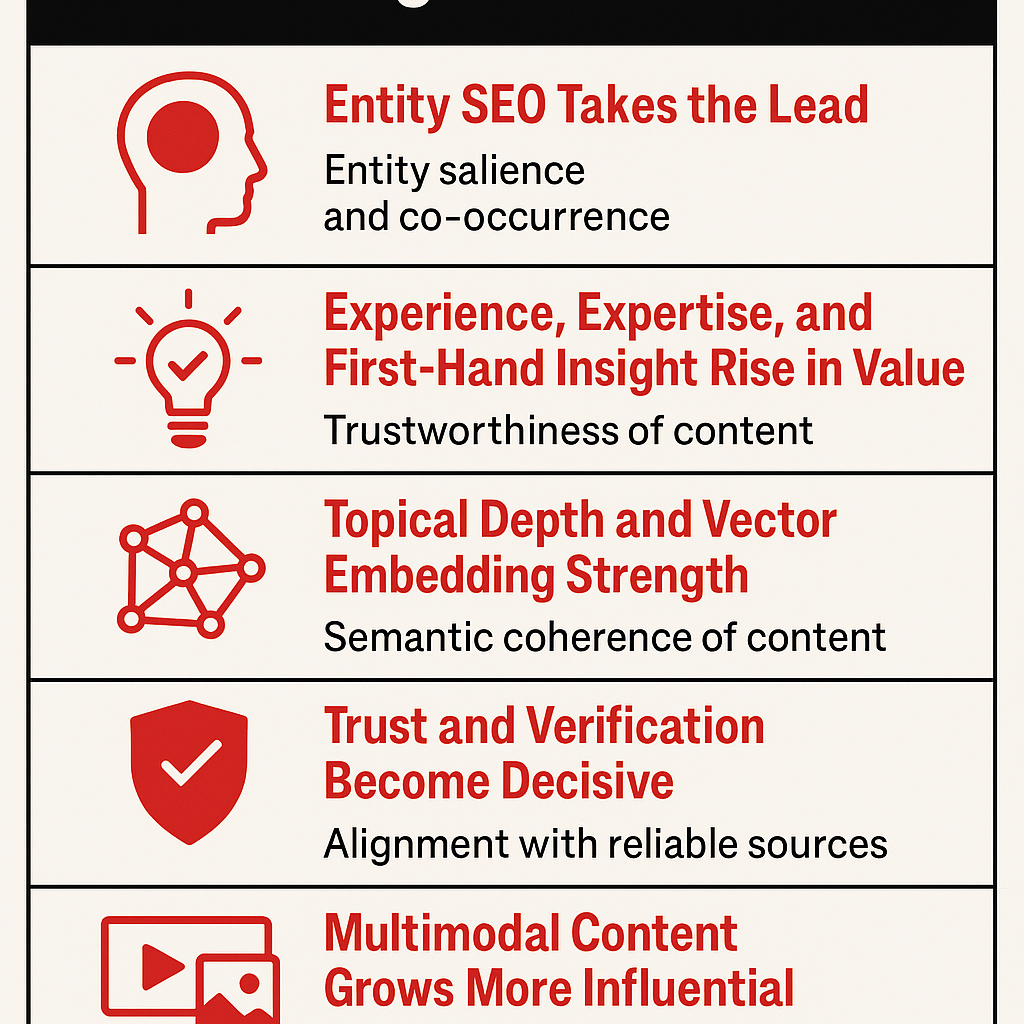
The search landscape is moving into unfamiliar territory. Instead of matching search terms to web pages, the Cognitive Web tries to understand people, contexts, and intent. This shift has introduced ranking factors that revolve less around clever optimization tricks and more around how clearly a brand shows up in the broader digital conversation. The sections below break down the elements that now carry the most weight.
Entity SEO Takes the Lead
In this new environment, a brand is treated less like a collection of pages and more like a definable, trainable concept. Search systems work best when they can understand a business the same way a person does. That means your brand must exist as a clear entity that machines can identify, interpret, and connect to the right topics.
Two things matter most:
- entity salience and co-occurrence.
If your brand is consistently associated with specific ideas, specialties, or subject areas across the web, cognitive search systems begin to form a stable picture of who you are and what you stand for. Any confusion or contradictory signals weaken that picture.
Factual consistency also plays a major role. If your website says one thing, your social pages say another, and external listings tell a third story, search models become unsure of your identity. Clean, unified information across all platforms helps LLMs connect the dots instantly, giving you a more authoritative presence in their reasoning processes.
Experience, Expertise, and First-Hand Insight Rise in Value
AI models are flooded with surface-level content. They can generate basic definitions, rewrites, and summaries without breaking a sweat. What they cannot replicate convincingly is real experience.
This is where businesses can stand out.
Content rooted in personal involvement, data from internal projects, field tests, failures, customer outcomes, and behind-the-scenes processes gives AI models something rare and valuable. When a business can explain how it solved a problem, what it learned along the way, and why it took a certain approach, that content becomes difficult to replace.
Case studies, real experiments, customer insights, expert commentary, demonstrations, and original research all act as trust anchors. These pieces give LLMs evidence, not just text. And evidence is exactly what they rely on to choose which sources deserve visibility.
Topical Depth and Vector Embedding Strength
One of the biggest changes in the Cognitive Web is how search systems measure topical authority. Instead of checking how many pages mention a keyword, they analyze the semantic depth and continuity of your content.
If your content forms a dense, interconnected web of ideas around a subject, your brand appears stronger in the model’s internal vector space. This means your content carries more weight, and the AI is more likely to pull from your material when producing answers.
A site that has a scattered collection of posts around different topics cannot compete with a site that explores a single field through dozens of detailed pieces, each building on the last.
In short:
- Depth trumps dispersion.
- Semantic meaning matters more than keyword occurrence.
- Coherence matters more than volume.
Trust and Verification Become Decisive
LLMs rely on patterns. When dozens of trustworthy sources repeat the same information, AI models treat that information as reliable. When a source stands alone or contradicts the consensus, the model becomes skeptical.
This is why trust and factual accuracy have become essential ranking signals.
If your content is consistent with reputable references, grounded in demonstrable facts, and supported by real data, cognitive engines are more likely to use it. If your content makes claims that are not supported elsewhere, it becomes harder for the model to validate, and your visibility drops.
Authority on the Cognitive Web is created through alignment, clarity, and evidence. Inconsistent or exaggerated claims are now actively damaging rather than merely ignored.
Multimodal Content Grows More Influential
Most traditional SEO strategies still revolve almost entirely around text. But cognitive engines do not think in terms of paragraphs or headers. They analyze every type of media they can access.
Videos, images, audio clips, product manuals, PDF guides, interview transcripts, slides, and even diagrams can influence how an AI understands a topic.
If your brand appears consistently across these media types, the AI has more context about your expertise. This helps you surface more often in answers, especially in queries that involve demonstration, visuals, or step-by-step guidance.
Businesses that rely only on written content are competing with one hand tied behind their back. The Cognitive Web rewards brands that show up in multiple formats and communicate ideas in ways humans naturally consume them.
Real-Time Relevance and Behavioral Signals
Freshness is not new in SEO, but the Cognitive Web interprets it differently. It mixes content freshness with behavioral activity across multiple platforms.
Engagement on places like YouTube, Reddit, LinkedIn, podcasts, research platforms, review sites, and discussion forums influences how search engines perceive ongoing relevance. These signals help the AI decide which sources are still active contributors in the field and which ones are outdated.
When people interact with a brand across several platforms, it tells the search system that the brand is part of the current conversation. This boosts visibility in generative answers and recommendation systems.
In practice, this means your standing on social platforms, customer reviews, video channels, research contributions, and even community discussions all feed into the bigger picture.
If you disappear from these ecosystems, your digital relevance begins to fade.
The Death of the Website as the Primary SEO Asset
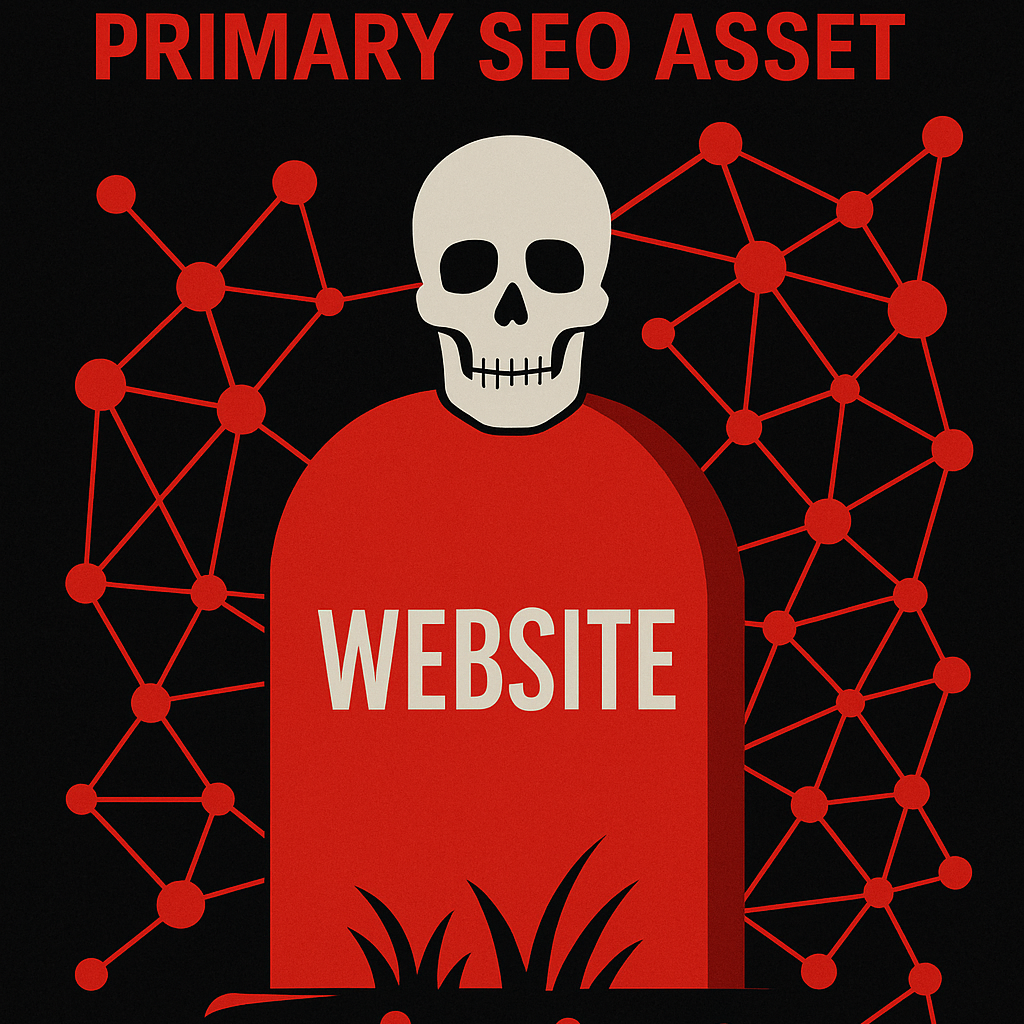
For the past two decades, a company’s website felt like the digital headquarters of the brand. It was the place you polished, optimized, redesigned, and fussed over because every marketing effort pointed back to it.
That world is fading fast. The Cognitive Web has introduced a new reality where traditional websites no longer sit at the center of online discovery. They still matter, but they no longer control the visibility game in the same way they once did.
Below is what this shift really means for brands and why businesses that cling to the old model will lose ground to competitors who adapt early.
Websites Have Become Only One Node in a Much Larger Knowledge Graph
The Cognitive Web does not see your brand the way a human user sees it. Instead of focusing on your website as the source of truth, AI systems pull information from every corner of the internet to build a broader understanding of who you are and what you offer.
1. AI search gathers signals from everywhere
When an AI system forms an answer, it scans and weighs content from:
- articles
- podcasts
- video transcripts
- product reviews
- forum discussions
- public databases
- social platforms
- industry directories
- PDF files
- government sources
- and yes, your website, but not exclusively
In this new landscape, your website becomes one node in a wide network of information. If your brand does not exist clearly and consistently across this network, AI engines struggle to form confidence in your authority.
2. Structured and API based content becomes essential
AI systems often prefer information that is easy to parse. This is why structured formats like schemas, APIs, and machine readable data are becoming essential assets.
When your information is clean, organized, and accessible, AI engines can map your brand more accurately. When it is not, they fill the gaps with content from other sources and competitors.
If your brand is not shaping your own knowledge graph, someone else’s content eventually will.
Your Real Homepage Is No Longer Your Website: It Is Your Entity Profile
A surprising shift has happened almost overnight. When someone asks an AI tool about your business, the first thing they see is not your homepage. They see a summary written by the AI itself. That summary is your new first impression.
1. AI creates the introduction before users ever reach your site
If someone searches your name on Google, Perplexity, ChatGPT Search, or Bing, the AI response often appears before the list of links. That means users form a view of your brand from the AI summary rather than from your own website.
This is a major shift. It means your true homepage is the collection of facts and relationships the AI has pieced together about you.
2. Businesses must actively manage their factual footprint
To influence how AI introduces you, your brand needs a stronger foundation of credible and consistent data. This includes:
- Entity markup so your brand is properly recognized and categorized
- Verified factual databases that support claims about your experience, products, and history
- A strong brand graph that links your business to the right topics, industries, and experts
- Reliable public knowledge sources such as Wikipedia, industry directories, and other third party authorities
If these elements are missing or messy, AI engines tend to fill the gaps with assumptions or irrelevant information.
Brands that treat entity management as a core part of SEO will dominate visibility in the Cognitive Web.
Zero Click Discovery Is Replacing Traditional Website Traffic
We have reached the point where users no longer need to visit your website to get what they want. AI tools answer questions directly, show summaries, compare products, and give recommendations within the search interface itself.
1. AI answers fulfill most intent on the spot
When a user searches for a problem, an AI can now provide a complete response right in the results page. That means users no longer need to click ten blue links and scan through pages to find what they are looking for.
This is why website traffic numbers are falling even when rankings look stable on paper. The clicks are disappearing because the need for them has disappeared.
2. The new goal of SEO is to be referenced, not necessarily clicked
The brands that win in the Cognitive Web are the ones that get mentioned inside the AI generated answers. The goal has shifted from attracting visitors to being included, cited, or referenced as part of the AI’s output.
Visibility is still the ultimate objective, but the path to that visibility has changed. Instead of optimizing for clicks, brands must optimize for representation inside AI driven summaries.
In other words, the focus moves away from page visits and toward influence over the narrative that AI engines present.
The Failure Modes of Traditional SEO Agencies (And the Consequences for Businesses)
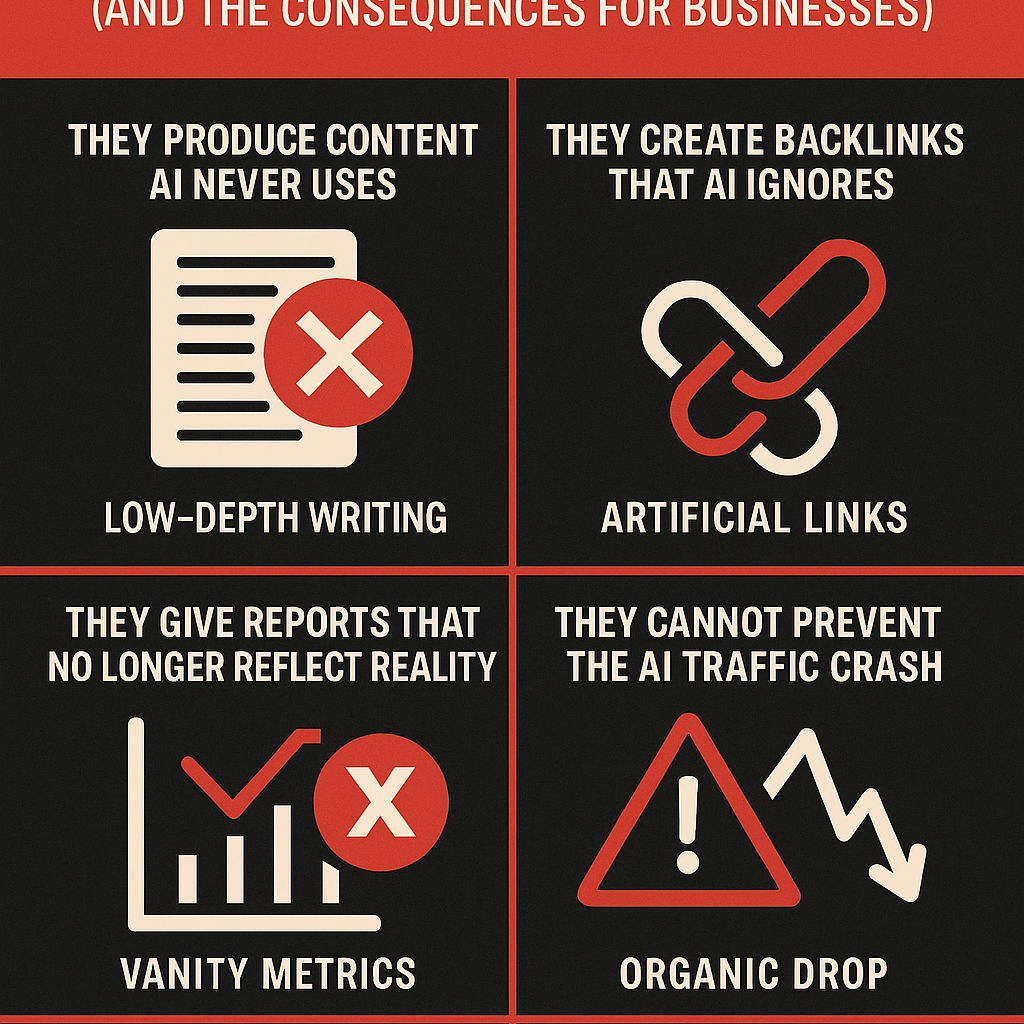
Traditional SEO has reached a breaking point. Many agencies still run on processes that were created for a very different internet. When businesses rely on those outdated systems, the results often look fine on paper but fall apart where it matters. Below is a clear look at the most common failure points and how they quietly drain growth while giving clients a false sense of progress.
They Produce Content AI Never Uses
Most traditional agencies still create content the same way they did ten years ago. They open a keyword tool, scoop up a list of phrases, assign them to junior writers and publish a batch of articles that read like they were assembled with spare parts. None of this aligns with how modern AI driven search engines understand information.
The problem is simple. These articles are built around keywords, not real human intent. They answer the wrong questions or they answer the right questions in shallow, predictable ways. Large language models treat this type of content as noise because it has nothing unique to add. If your blog sounds like every other blog on the topic, AI will skip it and pull insights from sources that provide original experience, expert observations or data backed explanations.
Businesses often assume that more content means more visibility. In reality, low depth writing only teaches AI that your brand is forgettable.
They Create Backlinks That AI Ignores
Backlinks used to be the backbone of SEO. The problem is that many agencies still operate with that mindset even though the search landscape has shifted. They spend time building links from guest posts, link swaps, article directories and private networks that were designed for older ranking systems.
AI powered search does not rely on link volume in the same way. It checks whether your information holds up across reliable sources. It scans for consistency, accuracy and genuine authority. A thousand links from recycled blogs mean nothing if the content lacks real value. When agencies lean on artificial link building tricks, the results are invisible to modern AI systems.
Worse, businesses end up paying for backlinks that never influence their visibility.
They Give Reports That No Longer Reflect Reality
One of the biggest traps for businesses is the monthly SEO report. Many agencies still send dashboards built around vanity metrics. Ranking charts go up even while overall visibility and conversions go down. The numbers look positive but they are disconnected from the way users actually find information today.
The truth is that ranking in traditional search results matters far less than it used to. AI tools often bypass the familiar list of links and deliver direct answers instead. That means you can see ranking improvements while your real traffic continues to slide. The agency celebrates. The client loses ground.
When reports are locked to outdated metrics, clients cannot see the warning signs until the damage is done.
They Cannot Prevent the AI Traffic Crash
Many businesses discover too late that their SEO strategy was built on a dying model. Traditional agencies are slow to adapt because their entire workflow is tied to the old system. They still optimize around keywords, backlinks and on page checklists.
This approach does nothing to prepare brands for AI generated answers, entity based search, or conversational query patterns. When the shift hits, organic traffic drops quickly and without warning. Agencies rarely have a solution because the foundation of their work was never designed for this new environment.
Businesses end up paying for a strategy that cannot protect them from the biggest transformation the search world has seen.
Long Contracts for Zero ROI
The final blow comes from the contracts themselves. Many agencies lock clients into long term agreements that promise ongoing optimization and monthly deliverables. The problem is that most of those deliverables are routine tasks that no longer move the needle.
Clients keep paying even while results decline. By the time the contract expires, months of opportunity have been lost and entire traffic pipelines have collapsed. The agency walks away with their retainer. The business is left trying to figure out what went wrong.
A modern search environment requires agility, experimentation and a real understanding of how AI interprets information. Traditional long term retainers rarely provide any of that.
What the Future of SEO Actually Looks Like

Search is going through one of the biggest shifts the digital world has ever seen. Anyone working in SEO can already feel the ground moving. The old tricks are fading. Rankings are no longer about stuffing keywords or stacking backlinks. The future belongs to brands that understand how modern AI learns, reasons, and interprets information.
Below is a look at how SEO is changing and what businesses must embrace to stay relevant.
AI Ready Content Architecture
Websites were once designed for search engines that crawled text, extracted keywords, and followed links. That era is almost gone.
Today, every page you publish needs to be written in a way that large language models can easily consume, understand, and reuse.
This starts with clarity. Pages should clearly explain what you do, who you serve, and why your information is reliable. Walls of vague marketing copy do not work. AI systems look for well structured explanations, clean headings, genuine expertise, and content that can be traced back to real people or real data.
Factual accuracy matters even more. Modern AI tools prefer content that is supported by sources, real examples, and verifiable insights. When your site becomes a trustworthy reference, AI systems are more likely to use your information in answers, summaries, comparisons, and recommendations.
Think of it like building a library. The more organized your information is, the easier it becomes for an AI to find it and trust it.
Knowledge Graph Engineering
The future of SEO will rely heavily on how well your brand is represented in digital knowledge graphs. These graphs are networks of facts that help search systems understand topics, relationships, and authority.
In practical terms, this means your brand must be connected to the right ideas, categories, and industries. It must be recognized not only through content on your website but also through your presence on platforms that feed data to search engines and AI models.
This is not only about structured data markup, although that is a piece of it. It is about building a digital fingerprint that clearly shows what your brand stands for, which problems you solve, and which topics you can speak about with authority.
When your brand is correctly represented in these broader graphs, AI powered search tools are more likely to reference you when answering user queries.
AI Persona Targeting
People once optimized content for human readers and search engine spiders. Now, there is a third audience that sits in the middle. AI agents. These agents act as assistants, advisors, and decision makers for millions of users across phones, apps, and devices.
To be recommended by these systems, your content has to match the way these agents evaluate information. They look for relevance, clarity, helpfulness, and consistency. They also judge whether your content fits the needs and preferences of the user.
This creates an entirely new discipline. You are no longer optimizing only for potential customers. You are also optimizing for digital decision makers that interpret your content before humans even see it.
Understanding how these agents think and what signals they rely on will become a defining skill in modern SEO.
Multimodal SEO
Words alone will not win the future of search. AI models now interpret video, audio, images, charts, and documents. This means your content strategy cannot be built around text alone.
Video SEO
Search engines now pull insights from transcripts, on screen text, objects in the frame, and even tone of voice. Video is quickly becoming one of the most valuable forms of content for search visibility.
Audio SEO
Podcasts, interviews, and voice notes can be analyzed for expertise, storytelling, emotions, and unique insights. These signals can influence how AI systems rank and reference your brand.
Image SEO
AI vision models can identify products, places, diagrams, and logos. Good imagery improves brand understanding and contextual relevance.
PDF and Document SEO
Whitepapers, case studies, and reports are being scanned for facts, statistics, and expert opinions. These often carry more authority in AI reasoning models.
Data Structure Optimization
Tables, charts, lists, timelines, and frameworks all help AI systems interpret your content faster. Structured information is easier to reuse, which increases your visibility.
In short, modern SEO rewards brands that communicate through many formats, not just blog posts.
Conversation Based SEO
Search no longer begins with a list of keywords. It begins with a conversation. People type full sentences, follow up with clarifications, and ask for comparisons or insights that feel personalized.
This means your brand needs to be trained into these conversational models. Your content should anticipate questions, address concerns, and present answers with clarity and depth. It should reflect how real people talk, not how old school SEO articles were written.
Conversation based SEO also focuses on how your brand is described within AI responses. The goal is to shape how these systems speak about your company, your strengths, and your value. This involves consistent messaging, strong positioning, and content that reflects your authentic voice.
Continuous SEO Instead of Static SEO
The Cognitive Web changes fast. Models update constantly. New signals emerge every week. User behavior evolves just as quickly.
Static SEO strategies that remain unchanged for months will not survive.
Modern SEO requires ongoing monitoring, retraining, and refinement. Content must be evaluated regularly to see if AI models still interpret it correctly. Search patterns should be tested and simulated. New AI features must be explored as they appear.
This does not mean chasing algorithms. It means keeping your brand aligned with the way AI systems learn and interpret information. This shift transforms SEO into a living discipline. Businesses that treat it as a one time project will fall behind those who treat it as a continuous practice.
How Cognitive SEO Agencies Differ From Traditional Ones
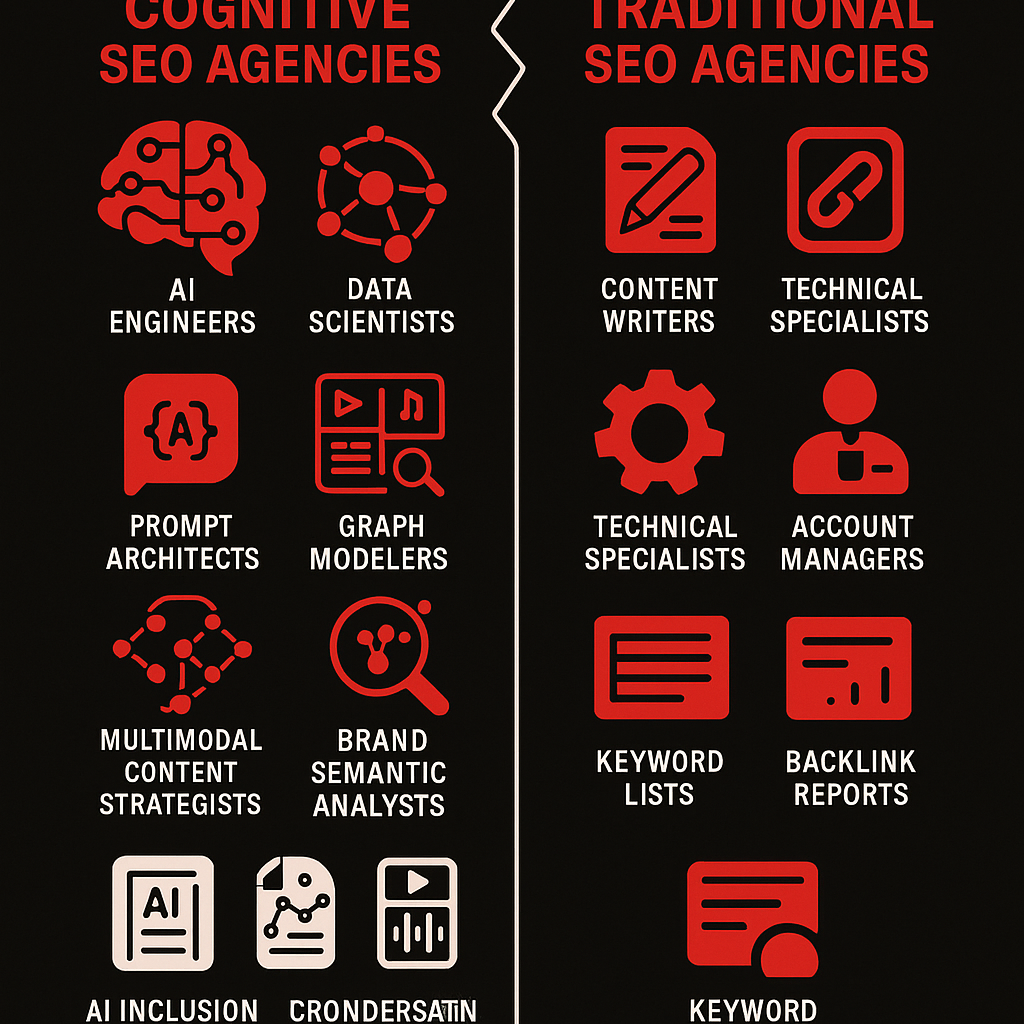
The shift from classic SEO to Cognitive SEO has created a completely different kind of agency. These agencies are built around a deeper understanding of how modern search systems think, learn, and interpret information. Instead of relying on keywords, backlinks, and checklists, they focus on how brands are represented inside the reasoning layers of AI models. This change affects the people they hire, the deliverables they produce, and the technology they use each day.
Below is a closer look at the most important differences.
Team Composition
Traditional SEO teams are usually built around roles like content writers, link builders, technical specialists, and account managers. Cognitive SEO teams look very different because the work they do requires talent that can understand data, machine learning, and the structure of modern AI systems.
AI Engineers
These professionals understand how large language models interpret information. They analyze how AI systems pull data from a brand and how that data influences responses. Their work often involves testing different formats, revising content structures, and designing systems that help AI models recognize and trust the brand.
Data Scientists
Data scientists study patterns in how AI engines respond to queries. They collect insights from vector scores, user behavior, ranking simulations, and real text outputs from models like GPT, Claude, and Gemini. This helps the agency identify opportunities that traditional dashboards cannot detect.
Prompt Architects
These specialists test prompts and instructions to see how AI agents describe or reference a brand. They shape the brand’s presence inside dialogue-based models by studying how answers change depending on context and user intent. Their work ensures that the brand shows up in conversations, not just search results.
Graph Modelers
Graph modelers help structure information so AI systems can understand a brand as an entity. They build and refine knowledge graphs that show relationships among topics, products, services, locations, and people. These connections play a major role in how AI decides whether a brand is credible or relevant.
Multimodal Content Strategists
Search today is no longer just text driven. AI systems pull information from videos, audio clips, images, PDFs, transcripts, and even product data feeds. Multimodal strategists design and optimize content across all of these formats, making sure each one strengthens the brand’s presence in AI-generated answers.
Brand Semantic Analysts
These experts study how AI interprets the meaning and identity of a brand. They examine tone, factual consistency, topic associations, and the way a brand appears when summarized by different models. Their goal is to ensure AI sees the brand in a positive and accurate light.
Deliverables
Cognitive SEO agencies do not focus on keyword lists, backlink reports, or thousands of blog posts. Their deliverables help a brand build authority inside AI ecosystems, which is where modern discovery happens.
AI Inclusion Audits
These audits show how often the brand is mentioned by AI engines and in what context. They highlight gaps in knowledge, inaccurate information, and areas where competitors are being referenced more often.
Brand Graph Maps
A brand graph map visualizes how a brand is connected to topics, entities, products, and relationships. It helps identify missing links that stop AI systems from understanding the brand fully.
Embedding Optimization Reports
Embedding analysis looks at how AI models cluster the brand’s content semantically. Instead of keywords, embeddings reflect deeper meaning and relationships. These reports show where the brand stands within the AI’s internal knowledge space.
Conversation Simulations
Agencies run simulations to see how AI agents respond to common queries, customer pain points, and industry questions. This reveals whether the brand is included, overlooked, or incorrectly represented.
Multimodal Content Plans
These plans organize how the brand uses text, video, audio, and visual assets to strengthen its presence across AI systems. Each format supports the others, creating a more complete representation of the brand.
Technologies Used
Cognitive SEO agencies depend on a different set of tools. They move away from keyword trackers and backlink scrapers and rely on systems that analyze meaning, relationships, and AI responses.
Vector Databases
Vector databases store semantic representations of content. They help agencies study how AI sees the brand and how content can be grouped, clustered, or reorganized for better recognition.
Neural Search Systems
These tools simulate how modern search and AI engines retrieve information. They reveal what an AI would consider relevant, even if a traditional search engine would rank it differently.
LLM Training Pipelines
Some agencies build small, custom models or fine tune existing ones. These pipelines help train AI to understand the brand more clearly, which improves consistency across different AI platforms.
Cognitive Crawlers
These crawlers scan websites and content sources the way an AI model would. They evaluate meaning, structure, and factual consistency rather than just metadata and technical signals.
AI Content Validators
Validators check content for accuracy, clarity, semantic alignment, and consistency with industry knowledge. They help ensure the brand is seen as a trustworthy source by AI models.
How Businesses Can Future-Proof Themselves
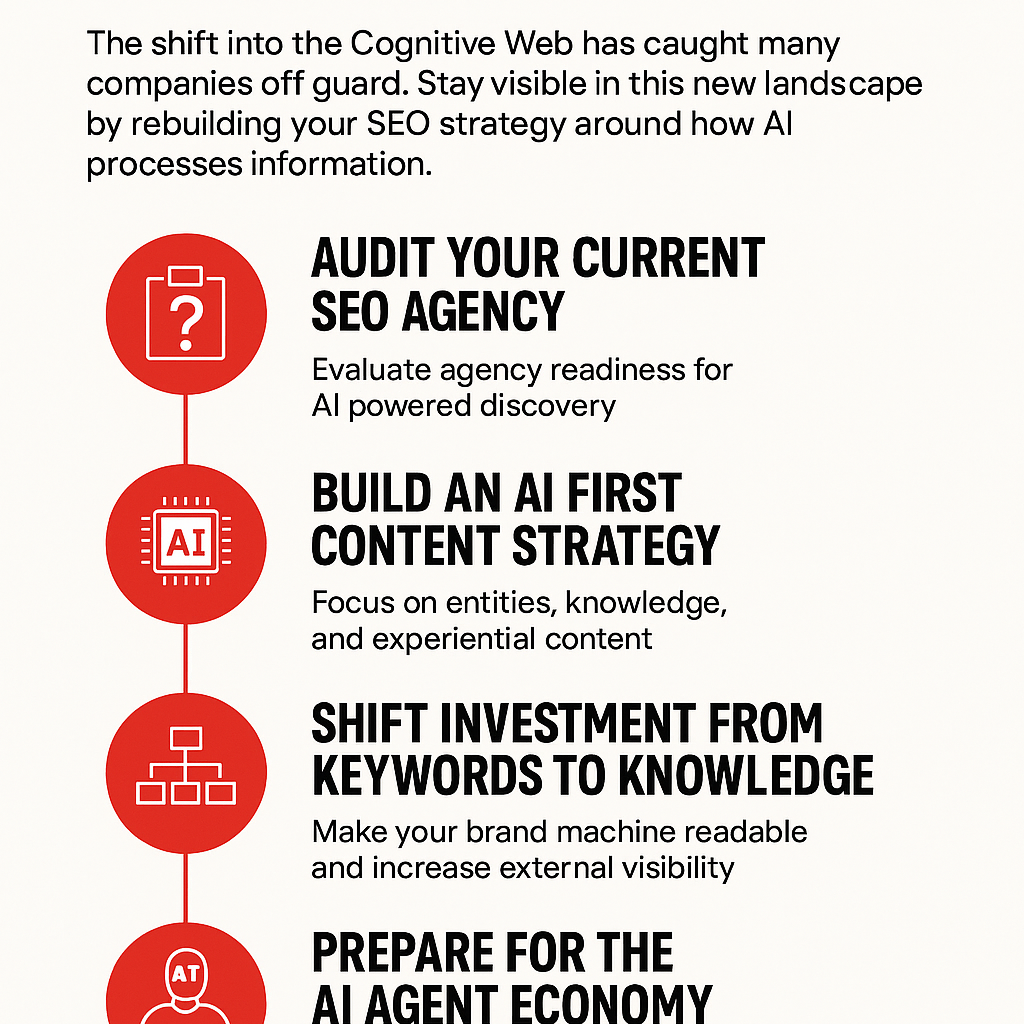
The shift into the Cognitive Web has caught many companies off guard. Some are still pouring money into outdated SEO playbooks while their competitors are quietly building the kind of digital presence that modern AI systems favor. If you want to stay visible in this new landscape, you need to understand how to evaluate your current SEO efforts and rebuild your strategy around how AI reads, understands, and distributes information.
Below are the core steps that help businesses stay relevant as search transforms.
Audit Your Current SEO Agency
Most businesses hire an SEO agency and trust whatever is delivered each month. In a stable search environment that might work, but when search itself is being rebuilt, blind trust becomes costly.
Here is how to evaluate whether your agency is truly preparing you for the future.
Questions to Ask
- How are you preparing our site and brand for AI powered discovery?
You want specifics, not a vague promise that they are watching algorithm updates.
- Are we optimizing for entities or only for keywords?
If they don’t fully understand entity optimization, graph relationships, and content embeddings, they are operating behind the curve.
- How often do you revise our content to keep it aligned with current AI search behavior?
AI models change fast. Your content has to evolve with them.
- Where do you see the biggest risk to our visibility in the next twelve months?
Their answer will reveal whether they understand what is coming.
- Can you show examples of how our brand appears inside AI synthesized answers?
If they cannot show how often you appear or do not appear inside AI generated responses, they are not tracking the metrics that now matter.
Red Flags to Spot
- Monthly reports filled with keyword rankings and not much else.
- Heavy focus on backlinks that come from low quality sites or generic guest posts.
- Content creation that is purely volume driven and lacks depth or originality.
- No clear strategy for entity building or knowledge graph visibility.
- The team refuses to explain things in simple terms or avoids your questions.
- Repeating the same tasks month after month without producing any meaningful change.
If any of these appear familiar, your agency may be stuck in traditional SEO habits that no longer move the needle.
How to Interpret Their Reports
Traditional SEO reports often look impressive, yet hide the fact that nothing valuable is happening. A future friendly report should show:
- How often your brand appears in AI answers
- Growth of your topical authority
- Evidence that users engage with your content beyond the first click
- Improvements in entity recognition and structured data
- Signals showing how AI models process and classify your content
If the report only shows rankings and traffic and fails to acknowledge the new search reality, it is time to rethink your partnership.
Build an AI First Content Strategy
In the Cognitive Web, content is not just written for people. It must also help AI models recognize what your business is, what it stands for, and why your information is trustworthy.
A modern strategy revolves around three pillars.
Entity Hubs
Think of an entity hub as a central place where AI can clearly understand a topic or a product your business is known for. It contains definitions, examples, FAQs, supporting documents, and other materials that make your brand the natural authority on that subject.
These hubs help AI systems map your company into their knowledge networks.
Knowledge Clusters
Clusters are groups of connected articles, videos, tutorials, and supporting pages that cover every angle of a topic. They are not meant to stuff keywords into similar sounding articles. Instead, they provide depth that proves your expertise to machines and humans.
AI models reward brands that demonstrate consistent understanding across a topic rather than publishing scattered content.
First Hand Experience Content
The internet is flooded with generic information. AI knows this and filters most low value content out. What stands out is experience driven content created from real interactions, case studies, personal experiments, professional insights, original data, interviews, and authentic scenarios.
Experience based content has become one of the strongest signals used by AI systems when choosing which source to pull from.
Shift Investment from Keywords to Knowledge
Keywords represent how humans speak to search engines. Knowledge represents how AI understands the world. The difference matters.
Structured Data
Structured data helps AI systems interpret the meaning behind your content. This includes schema markup, clean data relationships, and consistent organization across every page. When done well, structured data makes your brand machine readable, not just human readable.
Public Knowledge Sources
Your brand needs visibility where AI systems gather information. That means strengthening your presence in credible external databases, industry publications, directories, interviews, and public repositories. The more widely your information appears in verified sources, the more likely AI models are to trust you.
Industry Authority Building
Authority is no longer measured only by backlinks or domain strength. AI evaluates authority by checking:
- Consistency of your facts
- Depth of your explanations
- How many other trusted sources mention you
- Whether people cite your work
- How often you appear in industry discussions
Investing in brand authority directly increases your presence in AI generated answers.
Prepare for the AI Agent Economy
AI agents are becoming decision making assistants for everyday tasks. They help people shop, book travel, choose services, screen candidates, manage their health, and handle productivity tasks. Businesses that fail to adapt to this shift will lose customers before they even reach the website.
AI Agents Managing Shopping, Travel, Hiring, Health, and Productivity
AI agents will soon make recommendations the same way people used to rely on search results. If an agent does not recognize your brand, cannot interpret your product data, or does not trust your information, it will simply not recommend you.
Once this becomes normal, brands that are invisible to AI agents will vanish from buyer consideration.
Optimizing Your Brand to Be Recommended by Default
To become an automatic recommendation, your brand needs:
- Clear, structured product and service data
- Strong entity profiles
- Verified information across multiple sources
- Rich content that proves experience
- Consistency across every platform where AI systems gather information
- High engagement signals from real users
When your brand maintains these signals, AI agents begin to treat you as a reliable option. From there, your visibility grows without needing constant manual optimization.
Conclusion: The Cognitive Web Is Not a Future Event. It Is Already Here
The shift in search behavior has been rapid, and many traditional SEO tactics no longer have the same power they once did. Technology is moving faster than most agencies can adjust, and companies that continue to rely on outdated methods will see their visibility decline slowly at first, then sharply.
This moment is not the end of SEO. It is a transformation of the discipline itself. The focus is no longer on rankings, keywords, and backlinks. The new landscape rewards knowledge, expertise, trust, clarity, and machine understanding.
Businesses that accept this shift and adapt their strategies toward AI centric visibility will thrive in the coming years. Those that hesitate will fall behind competitors who are already building their presence inside the very systems that shape modern discovery.
If you build for the Cognitive Web now, you secure your place in the next decade of online visibility. If you wait, you may be fighting to regain attention in an environment that no longer plays by the old rules.