
SUPERCHARGE YOUR Online VISIBILITY! CONTACT US AND LET’S ACHIEVE EXCELLENCE TOGETHER!
If you are reading this, chances are you opened Google Analytics or Search Console recently and saw something you were not prepared for. Organic traffic suddenly dipped. Rankings slipped. Leads slowed down. For many website owners, that moment creates instant anxiety. The first thought is often the same: “Did Google penalize my site?”
The truth is, a sudden traffic drop after a Google core update does not automatically mean your website has been penalized. In most cases, it means Google has reassessed how your content compares to others in the search results. Core updates work by re-evaluating pages across the web, not by punishing individual sites for mistakes.
Still, the fear is understandable. Core updates tend to shake entire industries overnight. Blogs that performed well for years can lose visibility, while newer or more authoritative brands move ahead. In 2026, this effect feels even stronger because Google is changing how search results are displayed. AI-generated summaries now take up more space. Brand authority plays a larger role. Similar content is being grouped together, leaving less room for sites that do not clearly stand out.
This guide is written for people who depend on organic traffic to grow. That includes business owners trying to protect revenue, bloggers who rely on search visibility, SEO professionals managing client expectations, and affiliate site owners who have seen earnings drop without warning.
If your traffic declined, it does not automatically mean you failed. Many strong websites are affected during core updates simply because Google’s understanding of quality evolves. Recovery is possible, but it rarely happens by chance. It requires clear diagnosis, smart prioritization, and content improvements based on real patterns, not guesses or panic-driven changes.
Everything in this guide is built from observed recovery trends and hands-on analysis, not theory. The goal is to help you understand what changed, why it mattered, and how to move forward with confidence rather than fear.
What Is a Google Core Update?
If you run a website long enough, a Google Core Update will eventually affect you. Sometimes positively, sometimes painfully. To understand why traffic changes happen, it helps to clearly understand what a core update actually is and what it is not.
Definition in Simple Terms
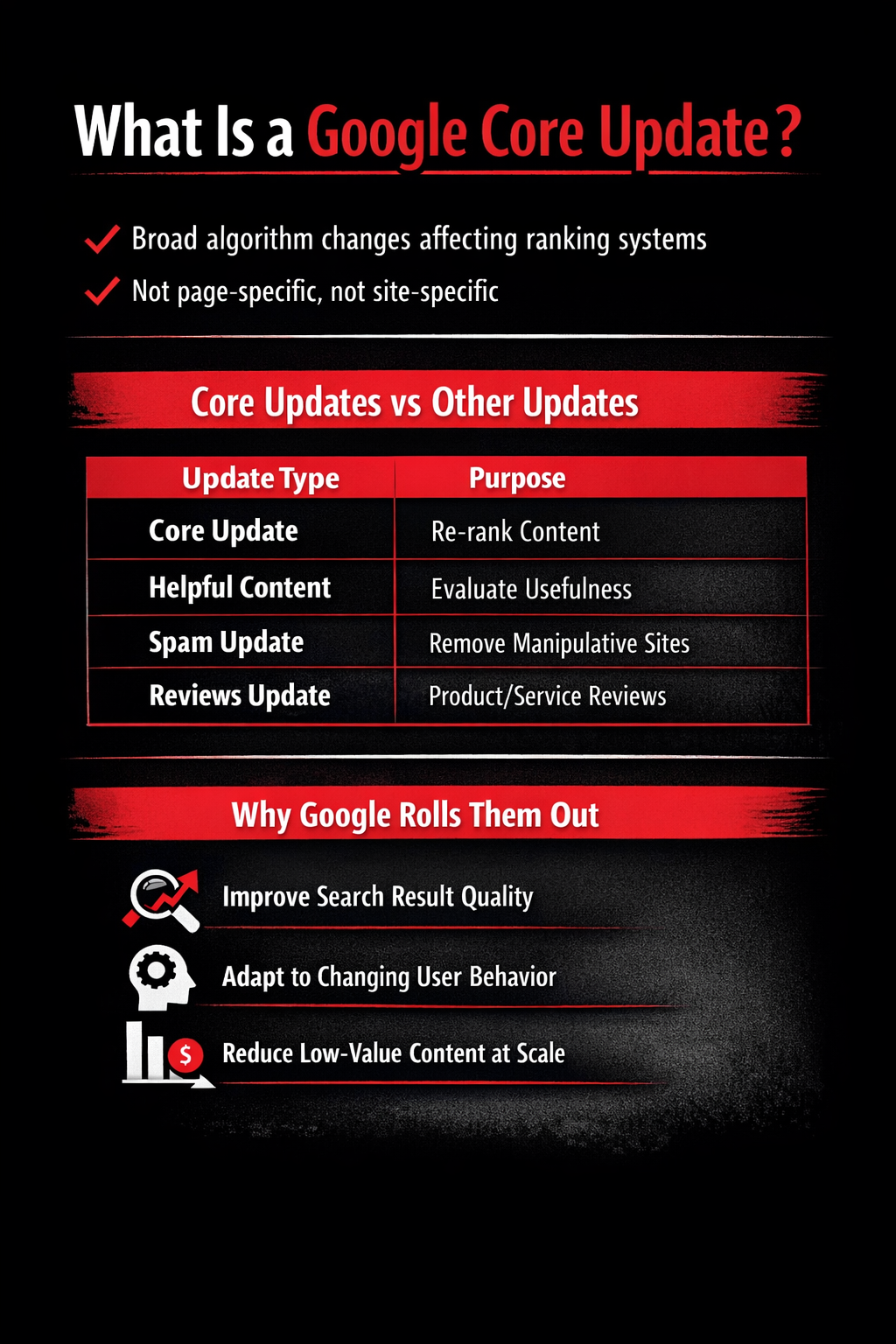
A Google Core Update is a broad change to how Google’s ranking systems evaluate content across the web. It is not a tweak aimed at one page, one keyword, or even one specific website. Instead, Google adjusts how it weighs hundreds of signals together to decide which pages deserve to rank higher and which deserve less visibility.
Think of it like Google reshuffling its entire bookshelf. Your content may still be good, but if other pages better match what users want right now, they may move ahead of you. This is why core updates are not punishments. Nothing is broken. Nothing needs to be appealed. Rankings are simply re-evaluated at scale.
Core Updates vs Other Google Updates
Not all Google updates do the same job. Understanding the difference prevents unnecessary panic.
| Update Type | Purpose |
| Core Update | Re-ranks content across many topics |
| Helpful Content Update | Evaluates how useful content feels to real users |
| Spam Update | Targets manipulative or deceptive practices |
| Reviews Update | Assesses quality of product or service reviews |
A core update looks at the big picture, while other updates focus on specific problems like spam or low trust reviews.
Why Google Rolls Out Core Updates
Google’s goal is simple but difficult to execute. It wants users to find the most helpful, accurate, and trustworthy answers as quickly as possible.
User behavior changes constantly. Search intent evolves. New formats appear. Old advice becomes outdated. Core updates allow Google to adapt to these shifts while reducing the visibility of content that adds little value.
For site owners, this means one thing. Ranking well is no longer about gaming signals. It is about genuinely serving the user better than alternatives.
What Changed in Google Core Updates in 2026?
Google core updates in 2026 marked a clear shift in how search quality is evaluated and rewarded. While earlier updates focused heavily on content relevance and backlinks, the latest updates reflect Google’s aggressive push toward trust, experience, and brand-level authority, especially in an ecosystem now saturated with AI-generated content.
Below are the most important changes introduced or strengthened in 2026—and why they matter for your traffic.
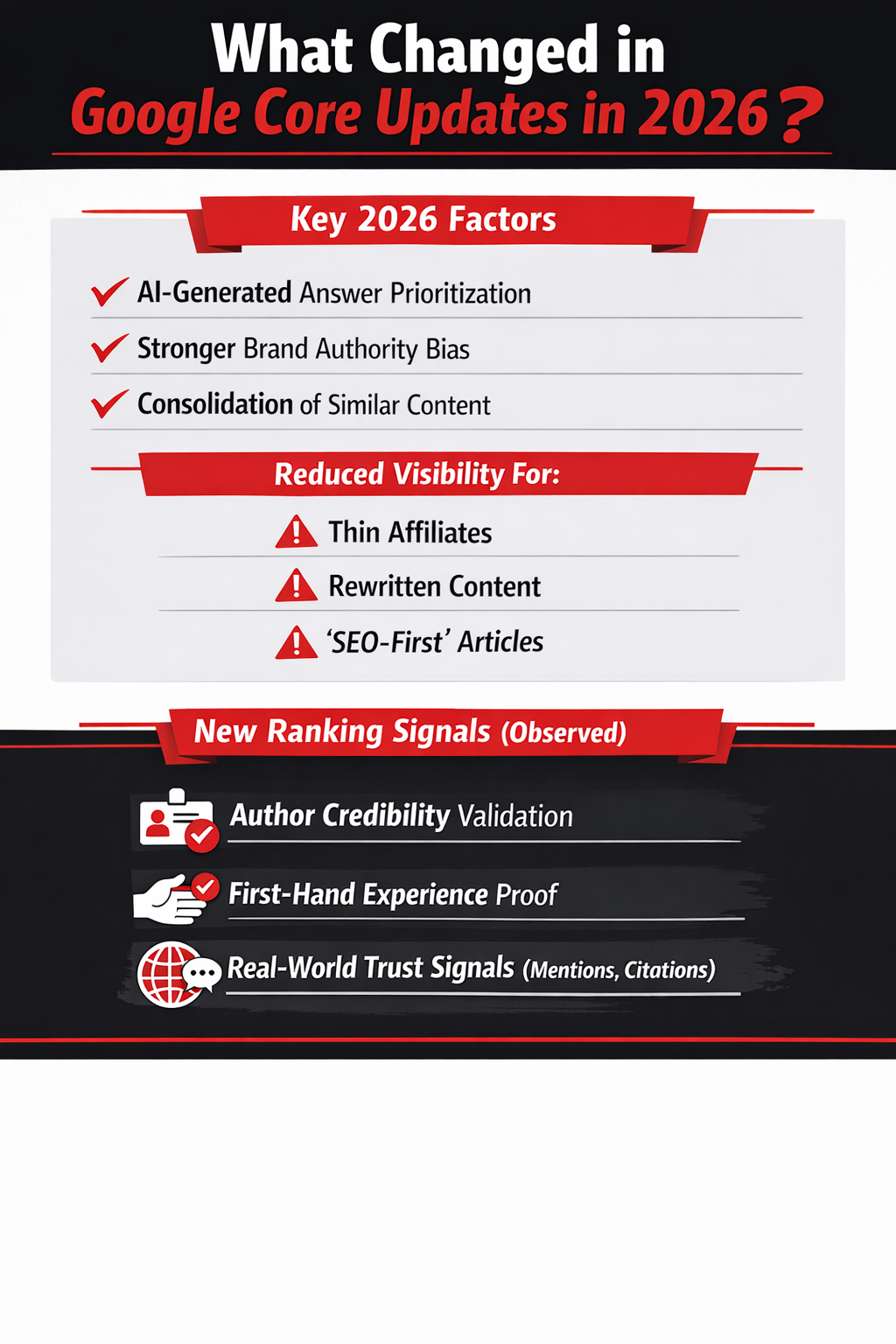
1. AI-Generated Answer Prioritization Reshaped the SERPs
In 2026, Google significantly expanded the visibility of AI-generated answers and AI-assisted summaries directly within search results. These answers often appear above traditional organic listings, reducing click-through rates for informational queries.
This means:
- Even if your rankings didn’t drop, your organic traffic still may have
- Informational content without unique insights is more likely to be absorbed by AI answers
- Pages that simply restate commonly known facts are increasingly redundant
To compete, content must go beyond summarization and offer original perspectives, experience-based insights, or proprietary data.
2. Stronger Brand Authority Bias Became More Obvious
One of the most noticeable changes in 2026 is Google’s increased preference for recognized brands and established entities. Sites with:
- Strong brand searches
- Consistent mentions across the web
- Clear ownership and identity
are being favored over anonymous or purely niche-driven websites.
This doesn’t mean small sites can’t rank—but it does mean Google now requires clear trust indicators to compensate for lack of brand recognition.
3. Aggressive Consolidation of Similar Content
Google has become far less tolerant of duplicate intent content, even if it’s technically unique. In 2026:
- Multiple articles covering the same topic from the same site are often consolidated in rankings
- Only the strongest, most comprehensive page tends to survive
- Supporting content must add genuine subtopic depth, not just keyword variation
This change hit large content libraries particularly hard.
4. Reduced Visibility for Low-Value Content Types
Several content models saw widespread ranking declines:
- Thin affiliate pages with minimal added value
- Rewritten or lightly edited AI content
- Articles written primarily to target keywords rather than solve problems (“SEO-first” content)
Google’s systems are now far better at detecting value gaps, not just spam.
New Ranking Signals Observed in 2026
Across multiple core updates, new quality signals consistently emerged:
- Author credibility validation: Clear author profiles, expertise indicators, and content ownership matter more than ever.
- First-hand experience proof: Original photos, real examples, case studies, and personal insights significantly improve trust.
- Real-world trust signals: Brand mentions, citations, reviews, and off-site references now play a larger role in ranking stability.
In short: Google’s 2026 core updates reward real expertise, real experience, and real trust—not volume, not automation, and not shortcuts.
First Things to Check After a Traffic Drop (Quick Diagnosis)
When you notice a sudden dip in traffic, the first reaction is usually panic. That is natural. Rankings fall, leads slow down, and your mind jumps straight to worst-case scenarios. Before changing anything on your site, you need to slow down and diagnose the situation properly. Many traffic drops are misread, and acting too fast often causes more damage than the update itself.
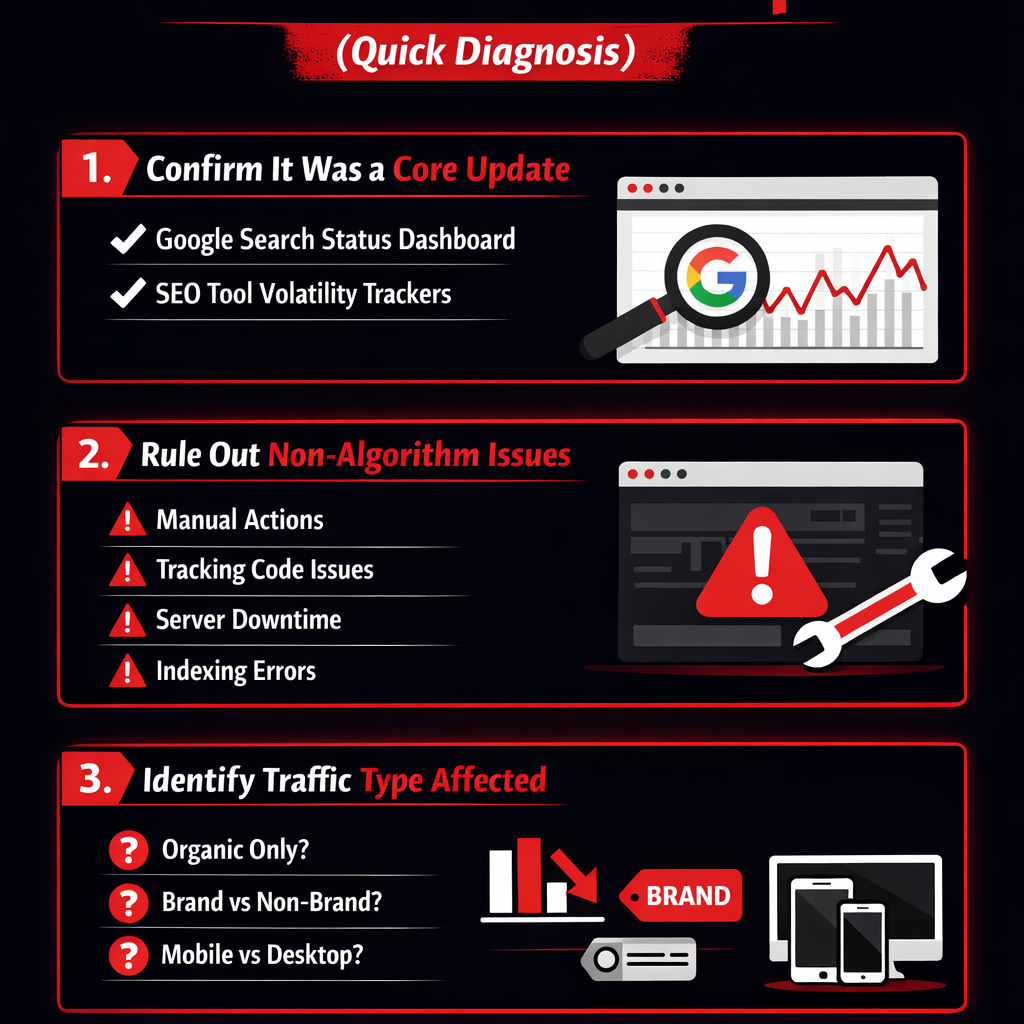
1. Confirm It Was Actually a Core Update
The first step is simple but often skipped. You need to confirm whether Google rolled out a core update around the time your traffic dropped. Start with the Google Search Status Dashboard. It clearly shows confirmed algorithm updates and their rollout dates. Match those dates with the decline you see in Google Search Console or Analytics.
Next, cross-check using SEO volatility trackers from tools like Semrush, Ahrefs, or Moz. These tools track ranking fluctuations across thousands of sites. If volatility spikes line up with your traffic loss, there is a strong chance you were affected by a core update rather than something specific to your website.
If there is no update and no unusual volatility, your issue likely has a different root cause.
2. Rule Out Non-Algorithm Problems First
Before blaming Google, eliminate technical and tracking issues. Check Google Search Console for any manual action notifications. Core updates do not trigger manual penalties, but a sudden drop caused by one can look similar.
Next, verify your tracking setup. A broken GA4 tag, duplicate tags, or accidental removal during a site update can make traffic appear lower than it really is.
Server uptime is another common issue. Even short periods of downtime during crawl windows can affect rankings. Also review indexing reports to make sure important pages are still indexed and not blocked by robots.txt, noindex tags, or canonical errors.
3. Identify Exactly What Traffic You Lost
Not all traffic losses mean the same thing. Check whether only organic traffic dropped or if other channels were affected too. Core updates impact organic search, not paid, referral, or email traffic.
Then separate brand and non-brand queries. Losing non-brand traffic usually points to content quality or relevance issues. Losing brand traffic can signal trust or visibility problems.
Finally, compare mobile and desktop performance. If one device type dropped more than the other, usability or page experience issues may be involved.
This quick diagnosis helps you move from fear to clarity. Once you know what actually changed, you can plan recovery with confidence instead of guessing.
15 Real Reasons Your Traffic Dropped After a Core Update
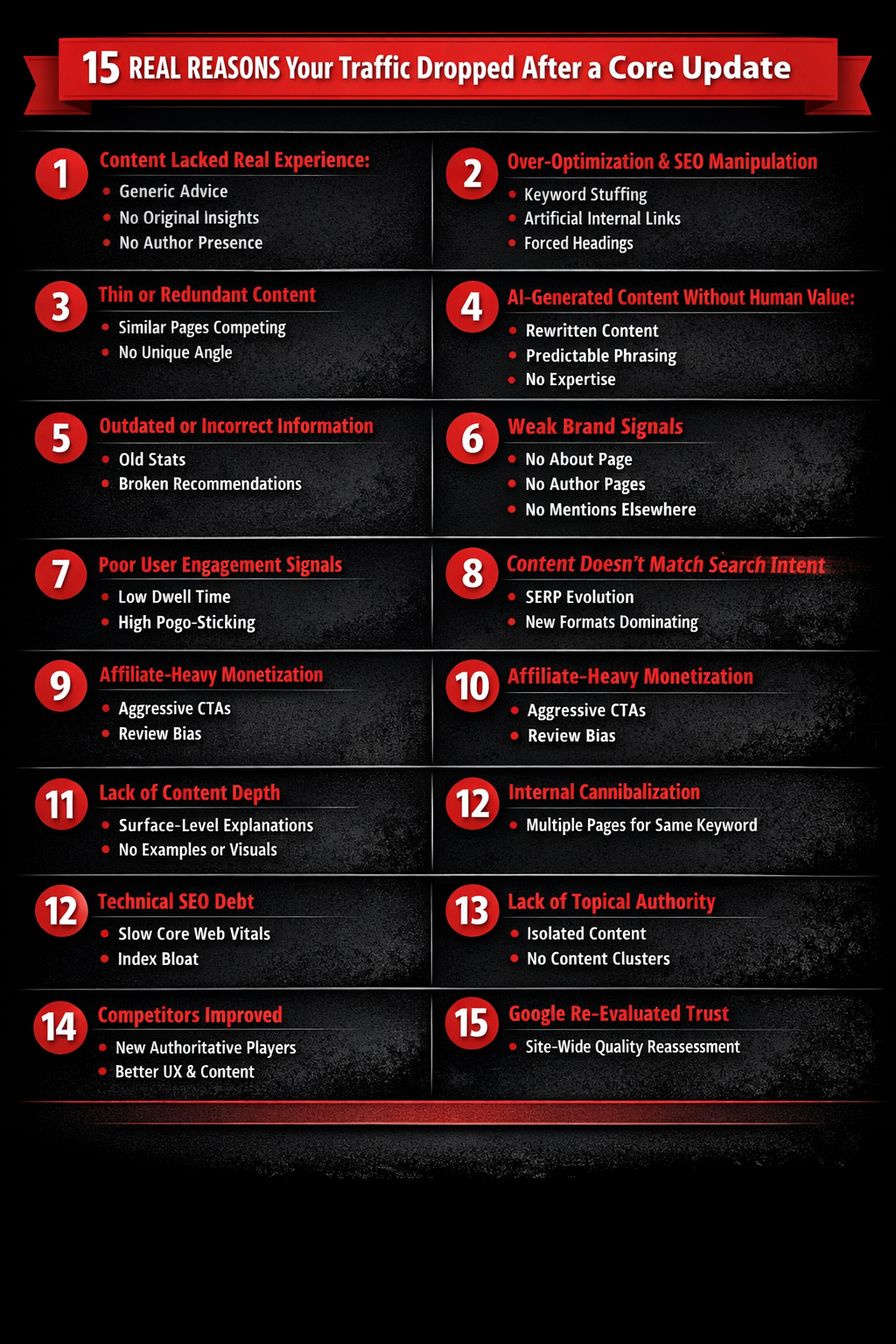
When traffic drops after a core update, the instinct is to look for a single mistake. In reality, Google rarely demotes sites for one isolated issue. Core updates work more like a reassessment. Google takes a fresh look at your site, compares it against competitors, and decides whether your pages still deserve the same visibility they once had.
Below are the most common and proven reasons sites lose traffic after core updates, based on patterns seen across multiple industries.
1. Your Content Lacked Real Experience and Depth
One of the biggest shifts in recent core updates is Google’s ability to distinguish between content written from experience and content written from assumption.
Many articles look polished but offer nothing beyond what already exists. They repeat the same advice found on dozens of other blogs, often reworded just enough to look different.
When content:
- Gives generic tips without context
- Lacks real examples, opinions, or lessons learned
- Has no visible author or expert behind it
Google struggles to justify ranking it over stronger alternatives. Sites that lost traffic often did not lose because the content was bad, but because it was interchangeable.
2. Over-Optimization and SEO Manipulation Backfired
Tactics that once worked quietly can now hurt visibility.
Over-optimized pages often show patterns like:
- Keywords forced into headings where they do not belong
- Internal links placed unnaturally just to pass relevance
- Paragraphs written for crawlers instead of readers
Core updates are especially good at identifying content created primarily to rank rather than to help. When optimization becomes obvious, Google devalues the page, not as punishment, but as a quality adjustment.
3. Thin or Redundant Pages Weakened the Site Overall
Many sites publish multiple pages that target similar keywords with only slight variations. Each page may look fine on its own, but together they dilute authority.
Common signs include:
- Several blog posts answering the same question
- Location or service pages that differ only by city name
- Articles rewritten from one core source
Instead of strengthening topical relevance, these pages compete against each other. Over time, Google may decide none of them are the best result.
4. AI-Generated Content Without Human Value
AI tools are not the problem. Unedited, unoriginal AI output is.
Pages that lost rankings often show:
- Predictable sentence structures
- Vague explanations without specificity
- No evidence of expertise or personal insight
When content feels like it was assembled rather than written, users disengage. Google measures that behavior and adjusts rankings accordingly. AI content that lacks human contribution is increasingly easy for algorithms to discount.
5. Information Became Outdated or Inaccurate
Search expectations change quickly. A page that ranked well two years ago may now contain outdated advice.
This includes:
- Old statistics that no longer reflect reality
- Recommendations based on deprecated tools or tactics
- Screenshots or examples from older interfaces
Core updates often elevate newer, more accurate content even if the older page once performed well. Relevance has a shelf life.
6. Weak or Non-Existent Brand Signals
Google trusts brands it can verify.
Sites without:
- A clear About page
- Author bios or editorial transparency
- Any external mentions or citations
tend to struggle during core updates. Even strong content can be held back if Google cannot connect it to a real entity. Trust is no longer just about links. It is about presence, consistency, and legitimacy.
7. Poor User Engagement Sent the Wrong Signals
User behavior matters more than many realize.
Pages that experience:
- Short dwell time
- Frequent back-to-SERP clicks
- Low scroll depth
often lose visibility over time. These signals suggest the page did not satisfy the query. Core updates amplify this effect by comparing engagement across competing results.
8. Search Intent Shifted Without You Noticing
Search results evolve constantly.
A keyword that once rewarded long blog posts may now favor:
- Comparison tables
- Video results
- Step-by-step guides
If your content format no longer matches what users expect, rankings drop even if the information is technically correct. Many traffic losses happen simply because the SERP changed and the page did not.
9. Affiliate-Heavy Monetization Hurt Perceived Trust
Affiliate content is not inherently bad, but balance matters.
Pages overloaded with:
- Aggressive calls to action
- Biased product recommendations
- Monetization placed above helpful information
tend to lose credibility. Google evaluates whether the primary purpose of the page is to inform or to sell. When sales dominate, rankings often suffer.
10. Content Lacked Depth and Substance
Surface-level explanations struggle in competitive spaces.
Thin content often:
- Explains what without explaining why
- Avoids nuance or edge cases
- Lacks examples, visuals, or data
As competitors publish deeper, more useful resources, Google shifts rankings accordingly. Depth is no longer optional for core topics.
11. Internal Keyword Cannibalization Confused Google
When multiple pages target the same intent, Google may struggle to decide which one to rank.
This happens when:
- Blog posts overlap heavily
- Category and article pages compete
- Old and new versions coexist
Instead of choosing one, Google may suppress all of them. Traffic drops often trace back to internal competition rather than external factors.
12. Technical SEO Issues Accumulated Over Time
Core updates do not directly target technical issues, but they amplify their impact.
Common problems include:
- Slow page speed and poor Core Web Vitals
- Excessive low-value indexed pages
- Crawl budget wasted on irrelevant URLs
When technical debt accumulates, content quality improvements alone may not be enough to maintain rankings.
13. Lack of Topical Authority Weakened Relevance
Publishing isolated articles without a supporting content structure limits authority.
Sites that struggle often:
- Cover topics sporadically
- Lack internal linking between related pages
- Do not demonstrate subject mastery
Google favors sites that show consistent, comprehensive coverage. One good article cannot compensate for a weak topical footprint.
14. Competitors Simply Became Better
Sometimes the issue is not your site at all.
Competitors may have:
- Improved content quality
- Invested in better UX
- Built stronger brand trust
Core updates reorder rankings based on relative value. Even unchanged sites can lose traffic if others improve faster.
15. Google Re-Evaluated Site-Wide Trust
In some cases, traffic loss is not page-specific.
Google periodically reassesses entire domains. If it detects patterns of low value, thin content, or inconsistent quality, it may reduce visibility across many pages at once.
This is not a penalty. It is a recalibration of trust.
Final Perspective on Core Update Drops
Traffic loss after a core update rarely has a single cause. It is usually the result of accumulated weaknesses that went unnoticed while rankings were stable.
The upside is that core updates reward improvement. Sites that focus on real experience, depth, clarity, and trust consistently recover over time.
How to Identify Exactly What Google Devalued
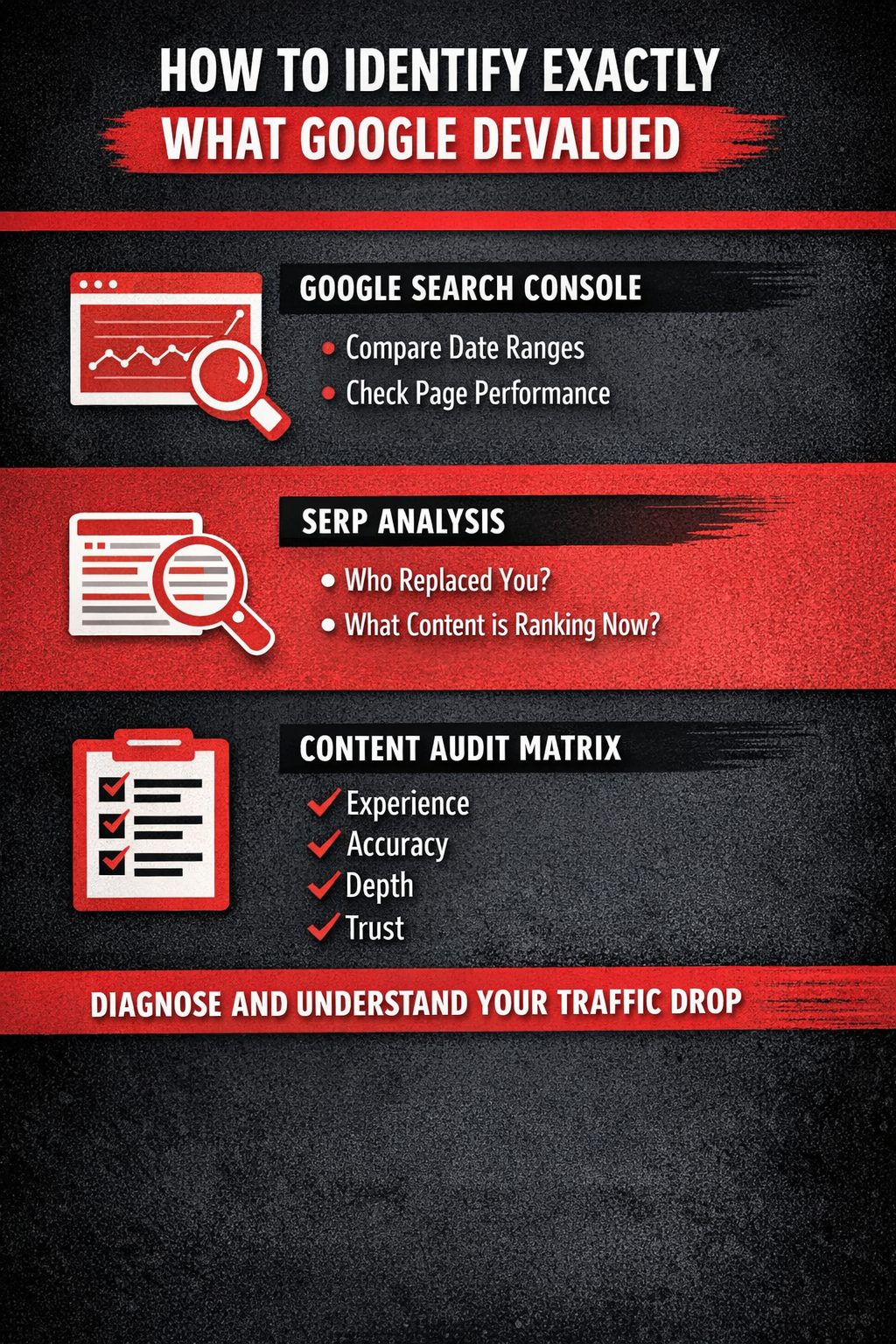
When traffic drops after a core update, most site owners jump straight to fixing things without fully understanding what actually went wrong. That usually leads to wasted effort. The smarter approach is to diagnose before you repair. Google does not randomly reduce visibility. It reassesses value. Your job is to figure out which part of that value equation changed.
This process does not require expensive tools or guesswork. It requires calm analysis and a willingness to look at your content honestly.
Start With Google Search Console Comparisons
The first place to look is Google Search Console, specifically the Performance report.
Compare the date range before the update with the period after the update finished rolling out. Focus on organic search only. You are looking for patterns, not isolated losses.
Check which pages lost impressions first. Rankings usually decline before clicks do, so impressions give early clues. If only a handful of pages dropped, the issue is likely page-level quality or intent mismatch. If large sections declined together, Google may have reassessed the overall trust or usefulness of that topic on your site.
Also pay attention to queries. If informational queries dropped but branded or navigational queries remained stable, that often signals a content quality or experience issue rather than a technical problem.
Analyze the SERPs That Replaced You
Next, search your primary keywords manually, preferably in an incognito browser. Look at who replaced your pages.
Ask yourself some uncomfortable but important questions. Are the top results now from recognized brands? Are they written by identifiable experts? Do they include first-hand experience, examples, images, or original data?
If competitors now provide clearer answers, better structure, or deeper explanations, Google is telling you what it prefers. This step is not about copying competitors. It is about understanding what users now find more helpful than your page.
Often, the replacement content is not more optimized. It is simply more convincing.
Use a Simple Content Audit Matrix
Once you identify affected pages, evaluate them using four core dimensions that align closely with how Google judges usefulness today.
- Experience: Does the content reflect real involvement with the topic, or does it sound like a summary of other articles? Pages that lack personal insight, examples, or proof of use are commonly devalued after core updates.
- Accuracy: Check facts, statistics, and recommendations. Outdated information quietly erodes trust. Even small inaccuracies can reduce credibility across an entire page.
- Depth: Ask whether the content fully answers the query or just touches the surface. Thin explanations, vague advice, and missing context are frequent causes of ranking loss.
- Trust: Look for author transparency, clear sourcing, and signals that show the content was created responsibly. Anonymous pages with no accountability often struggle after updates.
What This Diagnosis Really Tells You
When you finish this process, you should be able to say not just that traffic dropped, but why it dropped. That clarity is what separates recovery from repeated losses.
Google did not remove your traffic out of punishment. It shifted attention toward content that better met user expectations. Once you understand what was devalued, fixing it becomes far more focused and far more effective.
Is This a Penalty or a Re-Ranking?
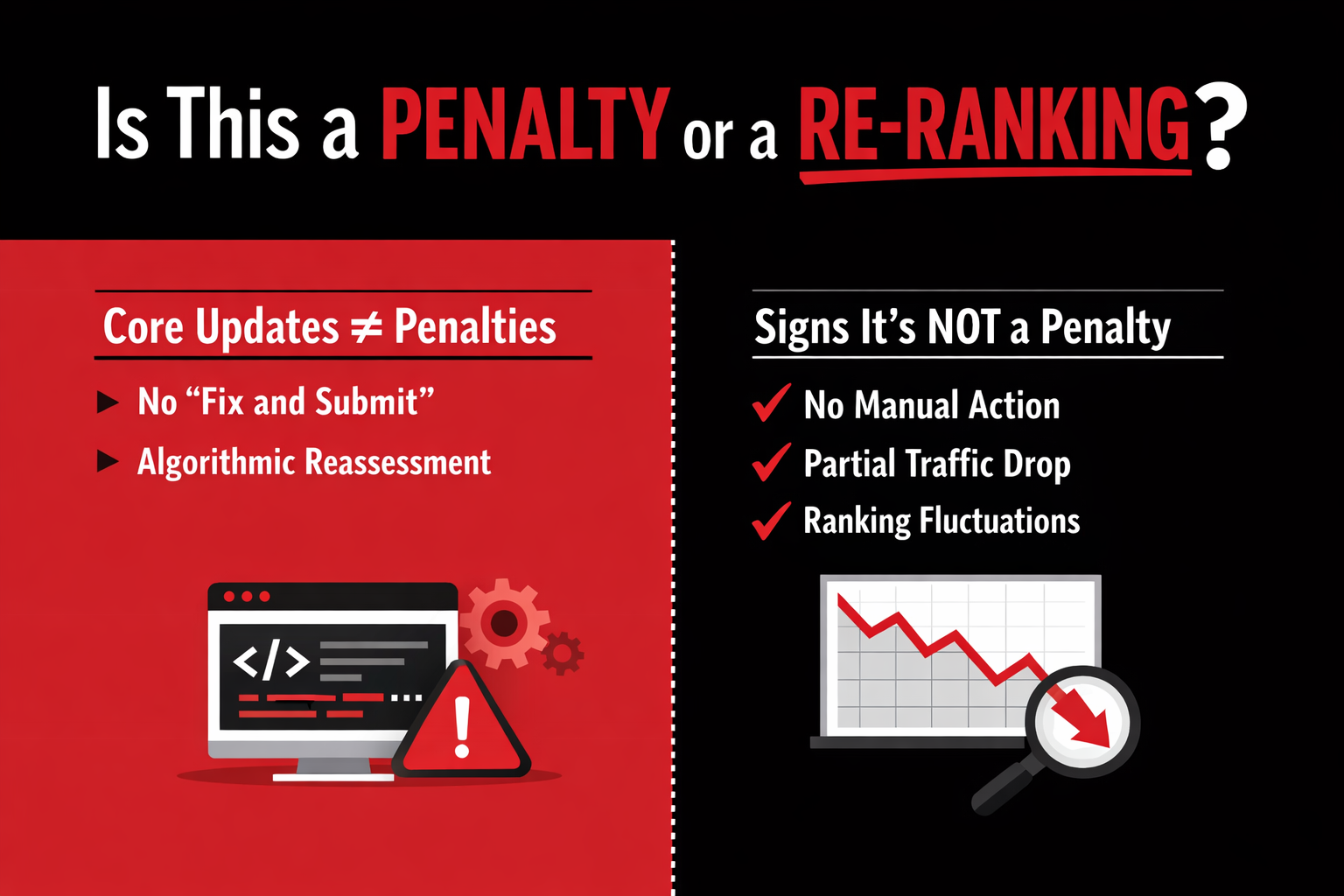
One of the first fears site owners have after a sudden traffic drop is that Google has penalized them. In most cases, that fear is misplaced. A Google core update is not a penalty. It is a broad reassessment of how content compares to other available options in the search results at that moment.
Penalties are corrective actions. They happen when a site violates specific guidelines, and they usually come with a clear signal such as a manual action notice in Google Search Console. Core updates work very differently. There is no form to submit, no reconsideration request, and no single issue to “fix and resend.” Google is simply re-evaluating content quality, relevance, and trust across the entire search ecosystem.
Think of it less as being punished and more as being reshuffled. Your pages are being measured again against competitors that may now better satisfy user intent, demonstrate stronger expertise, or offer a clearer experience.
There are a few strong signs that your traffic loss is not a penalty. The most obvious is the absence of a manual action warning in Search Console. Another is a partial drop rather than a complete disappearance from search. Many sites notice some pages falling while others remain stable or even improve. You may also see rankings fluctuate daily instead of dropping to page ten and staying there.
These patterns point to algorithmic re-ranking, not enforcement. That distinction matters because recovery comes from improving real value, not chasing quick fixes or panic-driven changes.
How Long Does It Take to Recover From a Google Core Update?
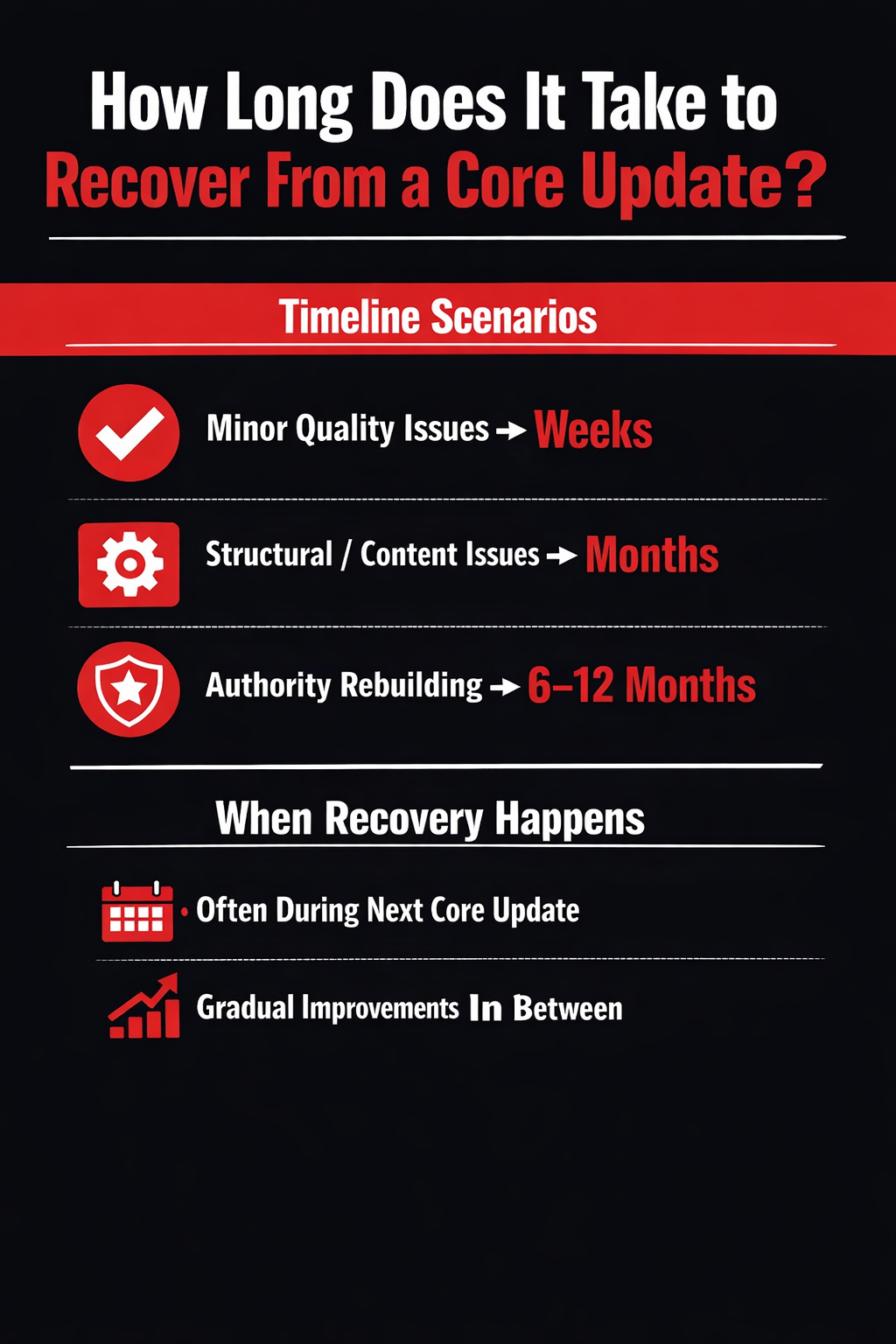
This is usually the first question people ask after seeing their traffic graph fall off a cliff. The honest answer is that recovery does not follow a fixed timeline. It depends entirely on why your site was affected in the first place and how deeply those issues run.
If the drop was caused by minor quality gaps, recovery can happen relatively fast. For example, content that is thin, slightly outdated, or missing clarity around intent often rebounds within a few weeks once improvements are made. These cases usually involve tightening content, adding better explanations, and aligning pages more closely with what users actually want.
When the issue is structural or content-related, the process takes longer. Sites with overlapping pages, weak internal linking, shallow topic coverage, or inconsistent quality typically need several months to see meaningful improvement. Google needs time to reprocess the changes and reassess the overall value of the site, not just individual pages.
The longest recoveries happen when the problem is authority and trust. If your site lacks strong brand signals, real-world credibility, or visible expertise, rebuilding that trust can take six to twelve months or more. This is common for newer sites, affiliate-heavy projects, or publishers competing against established brands.
In many cases, noticeable recovery happens during the next core update. That is when Google fully reevaluates sites at scale. However, smaller gains often appear in between updates as content improves, engagement stabilizes, and rankings slowly return for long-tail queries.
The key takeaway is patience paired with consistent improvement. Sites that recover are rarely the ones chasing quick fixes. They are the ones steadily becoming more useful, more trustworthy, and more aligned with real users.
Step-by-Step Core Update Recovery Plan
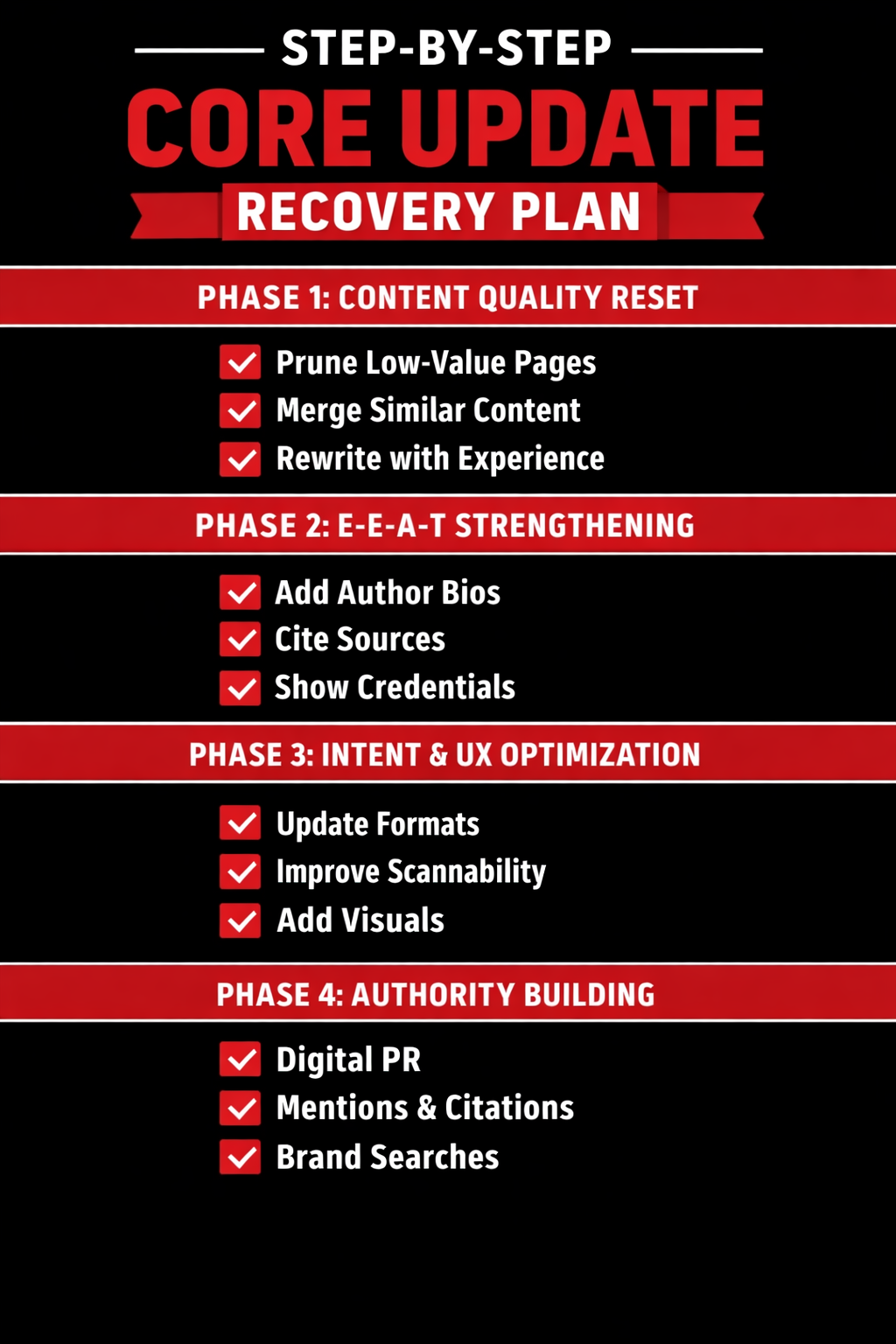
When traffic drops after a core update, most people do the same two things: panic, then change everything. Both are expensive mistakes. The goal is simple: figure out which parts of the site look weak in Google’s new evaluation and rebuild them in a way that users actually feel. Use these four phases in order. Don’t skip ahead to “links” if your content foundation is wobbly.
Phase 1: Content Quality Reset
Start with a clean audit. Pull a list of URLs from Search Console and sort by clicks lost in the last 28 to 90 days. You are looking for patterns: topics that slipped, page types that slipped, and sections of the site that never performed well.
Prune low-value pages. Low-value does not mean “low traffic.” It means pages that don’t earn trust or don’t deserve to rank. Typical examples: thin location pages, near-duplicate “how to” posts, tag pages indexed by accident, and old articles that were written for keywords rather than readers. Your options are: improve, merge, noindex, or remove. If a page has no clear purpose, no links, and no conversions, it is usually a candidate to drop.
Merge similar content. Core updates often expose content cannibalization. If you have five posts that could all answer the same query, Google will pick one and ignore the rest, or it will decide none of them are strong enough. Combine overlapping pages into one definitive resource. Keep the best URL, move unique sections from the other pages into it, then redirect the old URLs. This single change fixes dilution, improves user experience, and makes your internal linking cleaner.
Rewrite with experience. This is where many sites recover. If your content reads like it was assembled from other articles, it is not adding value. Add real-world details: what you tested, what failed, what surprised you, and what you would do differently next time. Include examples, screenshots, templates, before/after results, and decision criteria. Even in boring niches, experience shows up as specificity.
Phase 2: E-E-A-T Strengthening
You do not need celebrity authors. You need clarity about who is responsible for the content and why they should be trusted.
Add author bios. Put a real author name on the page. Create an author page with a short bio, relevant background, and links to social profiles or other published work if available. If the site has multiple writers, make roles obvious: writer, editor, reviewer.
Cite sources. When you state something factual, support it. Link to primary sources, official documentation, reputable studies, and known industry references. This helps readers and it also reduces the “hand-wavy” feel that gets content ignored. Avoid dumping a list of links at the bottom. Put citations near the claims they support.
Show credentials. Credentials can be professional (certifications, years in the field), practical (running the process for clients, managing campaigns, conducting audits), or lived experience (first-hand use, field testing). Add “reviewed by” where appropriate, especially for health, finance, legal, or safety topics. Also make your About page strong. Many sites treat it like a formality, but it is a trust anchor.
Phase 3: Intent and UX Optimization
Core updates often coincide with shifts in how Google interprets intent. The same keyword can start favoring a different page type than it did six months ago.
Update formats. Look at the current top results for your target queries. Are they guides, lists, tools, videos, forums, comparisons, or category pages? Match the winning format while keeping your unique value. If the SERP is full of step-by-step tutorials and your page is a long opinion piece, you will struggle.
Improve scannability. Most users skim. Use short paragraphs, clear headings, numbered steps, and quick summaries. Put the most useful answer early. Add a “who this is for” section and a “common mistakes” section. These reduce bounce and help people find what they came for.
Add visuals. Visuals are not decoration. They are proof and clarity. Use screenshots of processes, simple charts, checklists, tables, and examples. In product and service niches, include your own photos and testing notes. In local niches, add location-specific images and details. This is one of the easiest ways to stand out from generic content.
Phase 4: Authority Building
Once your content and trust signals are solid, then push authority. Otherwise, you are pouring water into a cracked bucket.
Digital PR. Share original data, publish mini-studies, release free templates, or create a useful tool. Pitch these assets to relevant publishers and communities. One strong mention on a respected site can be worth more than dozens of weak backlinks.
Mentions and citations. For local and service businesses, consistency matters: directories, profiles, industry associations, partner pages. For content sites, aim for citations in roundups, newsletters, podcasts, and expert quotes. Brand mentions often correlate with stronger performance during volatility.
Brand searches. This is a slow build, but it is real. Improve your newsletter, build a community, show up on social consistently, and give people a reason to remember your name. When more users search for you directly, you become harder to replace in the results.
What NOT to Do After a Core Update
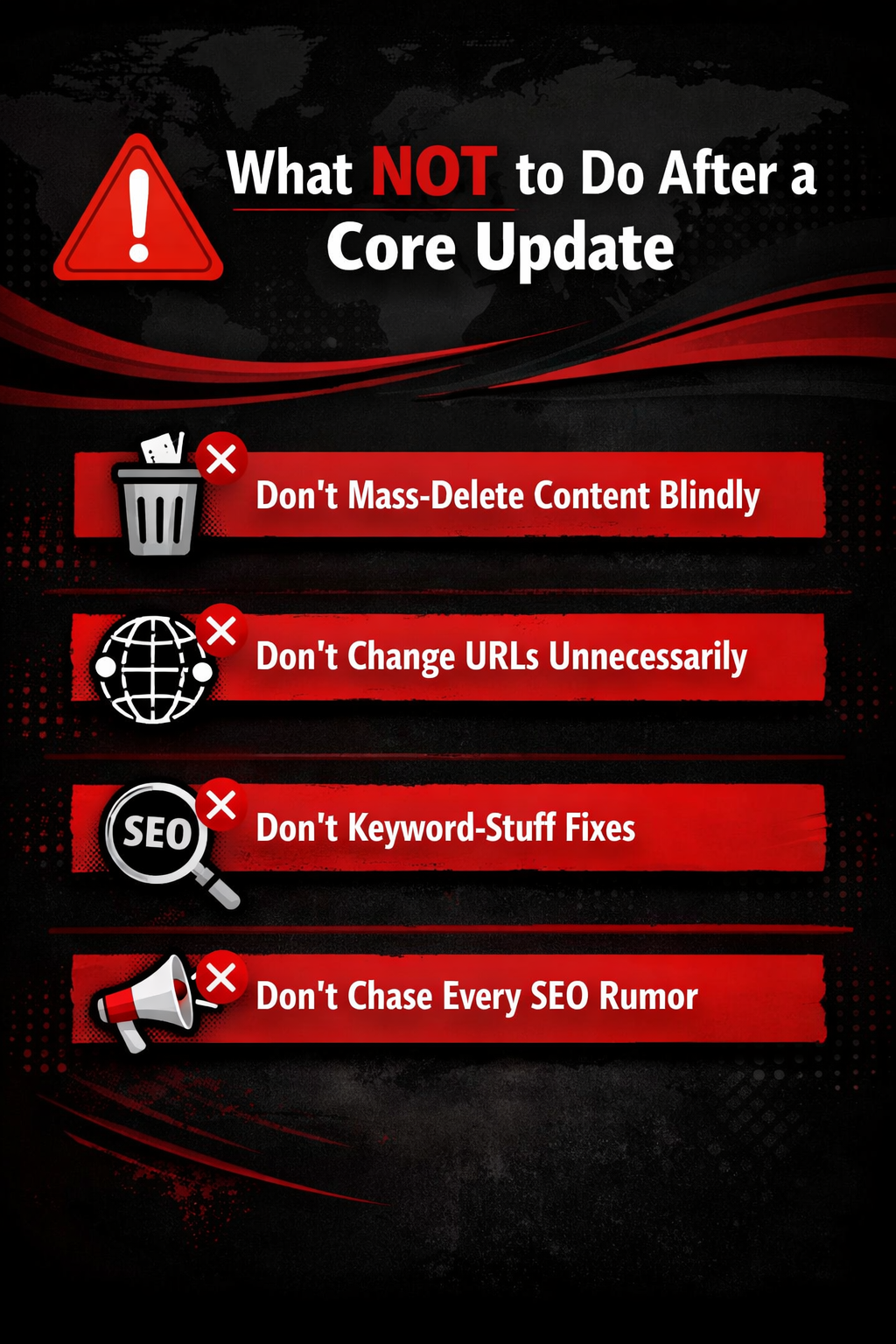
When traffic drops after a core update, panic is natural. The problem is that panic-driven decisions often do more damage than the update itself. Some of the most common reactions feel productive in the moment, but they quietly weaken your site over time.
First, do not mass-delete content blindly. Many site owners start removing pages simply because they lost rankings. That is risky. A page can lose visibility temporarily without being low quality. Deleting it removes historical signals, backlinks, and internal relevance that took years to build. Instead of deleting, evaluate whether the content can be improved, consolidated, or updated with real experience and clarity.
Second, avoid changing URLs unless there is a clear technical reason. Changing URLs resets Google’s understanding of that page. Even with redirects, authority can dilute. If the content itself is the issue, rewriting it is far more effective than moving it to a new address.
Third, do not keyword-stuff as a “fix.” After an update, many people try to force rankings back by adding more keywords, headings, or internal links. This usually backfires. Core updates focus on usefulness and trust, not density or repetition.
Finally, do not chase every SEO rumor on social media or forums. Every update creates noise, theories, and quick-fix advice. Acting on unverified tactics leads to constant site changes with no clear direction. Google rewards consistency and quality improvements, not reactionary tweaks.
Calm analysis beats rushed action every time.
Core Update Recovery Case Snapshot
To make this more practical, here is a real-world style recovery snapshot that reflects what many site owners experienced after the latest Google core update.
- Site type: A mid-sized niche blog in the personal finance space, focused on budgeting, credit improvement, and beginner investment guides. The site had been publishing consistently for four years and relied heavily on informational content for organic traffic.
- Traffic loss: Within two weeks of the core update rollout, organic traffic dropped by approximately 42 percent. The biggest losses came from long-form guides that previously ranked on page one for competitive informational keywords. Branded traffic stayed mostly stable, which ruled out tracking or technical issues early on.
- Key fixes applied: Instead of rushing into mass deletions, the site owner started with a focused content audit. Pages that relied on generic advice were rewritten using first-hand examples, updated data, and clearer explanations. Author profiles were expanded to show real experience in finance, including credentials and references. Several overlapping articles were merged into stronger, more complete resources to reduce internal competition. The team also improved internal linking to guide readers naturally through related topics, not just keywords.
- Recovery outcome: Traffic did not bounce back overnight. After about eight weeks, impressions began to rise slowly. By the time the next minor algorithm refresh rolled out, the site had recovered roughly 80 percent of its lost traffic, with some updated pages ranking higher than before. More importantly, engagement metrics improved across the board, including time on page and return visits.
The biggest takeaway was clear. Recovery came from improving real value for readers, not chasing quick fixes. This approach also positioned the site to be more resilient against future updates, which is where long-term growth truly comes from.
How to Future-Proof Your Site Against Core Updates
If there is one lesson most site owners learn the hard way after a core update, it is that short-term SEO wins rarely last. Google’s updates are not designed to punish websites randomly. They are designed to reward sites that consistently serve real users better than the alternatives. Future-proofing your site means aligning with that reality instead of trying to outsmart it.
The first and most important shift is to write for humans, not algorithms. Content that exists only to rank usually feels hollow when you read it closely. It answers questions halfway, repeats what dozens of other pages already say, and avoids taking a clear point of view. Human-first content does the opposite. It reflects experience, context, and judgment. It anticipates follow-up questions. It sounds like it was written by someone who has actually dealt with the problem, not someone summarizing other articles.
Next, focus on building a brand rather than publishing isolated pages. Google increasingly favors sites that feel like real entities instead of content factories. This shows up in simple but powerful ways: a clear About page, visible authors, consistent tone, and a recognizable perspective in your niche. When users search for your brand by name or reference your content elsewhere, those signals compound over time.
Regular content updates are another overlooked defense against ranking volatility. Many traffic drops happen because pages quietly become outdated while competitors improve theirs. Updating does not mean changing a few words. It means revisiting assumptions, refreshing examples, adding new insights, and removing sections that no longer serve readers. A well-maintained article sends a strong quality signal.
Finally, invest in authority, both on and off your site. Authority grows through credible mentions, thoughtful collaborations, expert contributions, and content that others genuinely want to reference. It is slower than chasing keywords, but it is far more resilient.
Core updates will keep coming. Sites built around trust, usefulness, and real presence tend to bend, not break.
Final Thoughts & Next Steps
A drop in traffic after a core update can feel personal, but it rarely is. Google core updates are not designed to punish sites for minor technical mistakes or missed SEO tactics. They are designed to surface content that delivers real value to real users. That is the lens through which every recovery effort should be viewed.
If your traffic declined, the solution is not a shortcut or a quick fix. Recovery happens when you step back and look at your site honestly. Start with a proper content audit. Identify pages that add little value, repeat what already exists, or fail to reflect real expertise. Improve what deserves to exist and remove what no longer serves users.
In many cases, an external expert review can make the difference. Fresh eyes often catch gaps in intent, credibility, and clarity that are easy to miss when you are close to the content. Most importantly, adopt a long-term mindset. Sites that recover and grow are built around trust, depth, and usefulness over time.
Core updates come and go. Websites that focus on genuine quality, clear expertise, and consistent improvement tend to outlast every update. Treat this moment as a reset, not a setback, and use it to build something stronger than before.