
GET A FREE CUSTOMIZED SEO AUDIT & DIGITAL MARKETING STRATEGY FOR YOUR BUSINESS in China
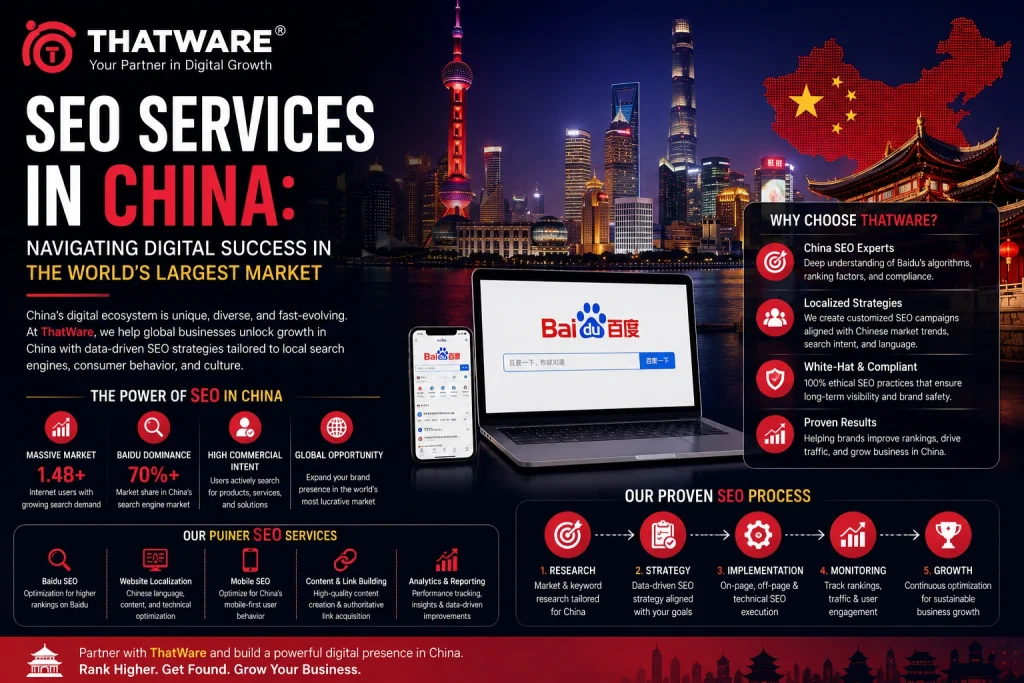
China represents one of the largest and most complex digital markets in the world. By the end of 2025, the country had 1.125 billion internet users, internet penetration had reached 80.1%, and 1.121 billion people were accessing the internet through mobile devices.
These numbers make the current “over 900 million internet users” statement obsolete.
For businesses evaluating an SEO company in China, the challenge is no longer simply translating a website into Simplified Chinese and attempting to rank a collection of commercial keywords. Search discovery increasingly intersects with mobile platforms, ecommerce ecosystems, AI assistants, social discovery and generative-answer environments.
An effective SEO services China strategy should therefore connect conventional organic optimization with Chinese-language localization, technical accessibility, local search behavior, entity authority, ecommerce discovery and AI-search readiness.
China’s Digital Market: Key Statistics Businesses Should Know
| Indicator | Latest figure | Strategic meaning |
| Internet users | 1.125 billion at end-2025 | One of the world’s largest addressable online audiences |
| Internet penetration | 80.1% | Digital discovery is deeply embedded in everyday behavior |
| Mobile internet users | 1.121 billion | Mobile-first UX remains fundamental |
| Generative AI users | 602 million | AI-assisted information discovery is already mass-market |
| Generative AI adoption | 42.8% | GEO/LLM visibility is a current issue, not a future one |
| 2025 online retail sales | 15.97 trillion yuan | Ecommerce search and product discovery remain enormous |
| Online retail growth | +8.6% YoY | Digital commerce continues expanding |
| 2025 cross-border ecommerce | About 2.75–2.84 trillion yuan, depending on the customs reporting release | International brands need China-specific digital strategies |
Sources include China’s National Bureau of Statistics, CNNIC-linked government reporting, Ministry of Commerce and customs-related government releases.
China’s Search Ecosystem Is More Fragmented Than a Baidu-Only Strategy Suggests
The current page presents Baidu as dominant and then focuses mainly on Shenma and Sogou. That framework is now too narrow.
StatCounter’s July 2026 page-view dataset attributes approximately 50.83% of China’s conventional search-engine share to Baidu. This dataset should be interpreted cautiously because conventional webpage tracking cannot fully capture searches conducted inside China’s super-app, ecommerce and closed-platform ecosystems.
The practical takeaway is not that Baidu has become unimportant. Baidu remains central. The takeaway is that Chinese digital discovery cannot be reduced to one search engine.
Conventional SEO vs Modern China Search Strategy
| Dimension | Older China SEO Model | 2026 China Discovery Model |
| Primary target | Baidu rankings | Baidu + broader web + AI + platform discovery |
| Keyword model | Exact Chinese keywords | Intent, entities, topics and conversational queries |
| Content | Translated webpages | Native localization and market-specific information |
| Authority | Backlinks | Chinese citations, authoritative mentions, brand evidence and relevant links |
| Ecommerce | Website product SEO | Website + marketplaces + shopping discovery |
| AI | Optional | Major visibility layer |
| Measurement | Rankings and traffic | Rankings, qualified traffic, conversions, brand mentions, AI retrieval and citation visibility |
| Technical | Crawlability | Crawlability, speed, accessibility, rendering, structured information and regional delivery |
AI Search Is Already Mainstream in China
China’s generative-AI adoption has accelerated dramatically. Official reporting says the number of generative-AI users reached 602 million by December 2025, a 141.7% increase from the end of 2024. Adoption reached 42.8%.
Earlier CNNIC reporting showed the user base at 515 million in June 2025, meaning adoption continued expanding materially during the second half of the year.
This makes AEO, GEO and LLM optimization much more relevant than the current page’s heavy emphasis on featured snippets and voice search implies.
SEO, AEO, GEO and LLM Optimization in China
| Discipline | Primary objective | China-specific application |
| SEO | Earn organic search visibility | Chinese keywords, Baidu/web discovery, technical SEO |
| AEO | Make answers easy to extract | FAQs, direct definitions, structured answers |
| GEO | Improve inclusion in generative responses | Entity clarity, citations, authoritative information |
| LLM SEO | Help models understand the brand | Semantic relationships, corroborated facts, expert evidence |
| Ecommerce SEO | Improve product/category discovery | Category architecture, product information and marketplace-aware research |
| Local SEO | Build geographic relevance | Location entities, regional service information and local proof |
A business choosing an SEO agency in China should therefore ask whether the agency understands both conventional Chinese search optimization and the rapidly expanding AI-discovery layer.
Localization in China Is More Than Translation
English-language pages should not simply be translated word-for-word and treated as localized SEO.
Effective localization considers:
Chinese terminology and search intent, Simplified Chinese conventions, different product/category vocabulary, regional demand, buying stages, cultural context, locally credible sources, page speed and technical accessibility.
The same English commercial concept can produce multiple Chinese search formulations depending on the audience, industry and purchasing stage.
A capable SEO company China strategy should therefore start with Chinese search-intent research rather than translating a pre-existing English keyword spreadsheet.
Understanding Answer Engine Optimization (AEO)
Affordable Answer Engine Optimization (AEO) services in China focus on optimizing content so that it directly answers user queries in search engines and AI-driven platforms. Unlike traditional SEO, which prioritizes ranking pages, AEO prioritizes delivering concise, accurate answers that can appear in featured snippets, voice search results, and AI-generated responses.
AEO is built around structured data, question-based content, and semantic clarity. It ensures that content is easily interpreted by search engines and AI systems. For example, when users ask a question, AEO ensures your content is selected as the best possible answer.
Types of AEO:
- Featured Snippet Optimization: Structuring content to appear in position zero on search engines.
- Voice Search Optimization: Creating conversational content tailored for voice assistants.
- FAQ Optimization: Providing direct answers to commonly asked questions.
- Knowledge Graph Optimization: Enhancing entity recognition for better visibility.
Understanding Generative Engine Optimization (GEO)
The best Generative Engine Optimization (GEO) solutions in China are the next step beyond AEO. It focuses on optimizing content for AI systems that generate responses instead of simply retrieving them. Platforms powered by generative AI create summaries, recommendations, and answers by synthesizing multiple data sources.
GEO ensures that your content is not only indexed but also selected and cited by AI engines when generating responses. This is particularly important in China, where AI-driven platforms and ecosystems are deeply integrated into user behavior.
Types of GEO:
- AI Citation Optimization: Structuring content so it is referenced in AI-generated answers.
- Contextual Authority Building: Creating in-depth content clusters that establish expertise.
- Conversational Content Optimization: Writing content that aligns with natural language queries.
- Multimodal Optimization: Incorporating text, images, and structured data for AI comprehension.
Understanding Large Language Models (LLMs)
Effective Large Language Models (LLMs) services in China are advanced AI systems trained on vast datasets to understand and generate human-like text. These models power modern search engines, chatbots, and AI assistants.
LLMs analyze context, intent, and relationships between words to deliver meaningful responses. They are the backbone of both AEO and GEO strategies.
Types of LLM Applications in SEO:
- Content Generation Models: Assist in creating high-quality, relevant content.
- Semantic Analysis Models: Understand user intent and improve keyword targeting.
- Predictive Models: Forecast trends and optimize strategies proactively.
- Conversational AI Models: Enhance user interaction and engagement.
The Interconnection Between AEO, GEO, and LLM
AEO, GEO, and LLM are interconnected components of modern search optimization. AEO ensures content answers queries directly, GEO ensures content is used in AI-generated responses, and LLMs power the intelligence behind these processes.
Together, they create a comprehensive strategy that aligns with how users search and interact with digital platforms today. Businesses that adopt these technologies can significantly enhance their visibility, engagement, and authority in competitive markets like China.
China SEO for Domestic vs International Brands
| Requirement | Domestic-China Campaign | Foreign Brand Entering China |
| Language | Native Chinese | Localization from original-market content |
| Brand recognition | Often established | Entity/brand introduction required |
| Website infrastructure | Usually domestically optimized | Performance/accessibility assessment required |
| Search research | Local intent | Local intent + international-brand terminology |
| Authority | Existing Chinese mentions | Chinese source development and PR needed |
| Ecommerce | Local-platform integration | Channel-entry and marketplace discovery strategy |
| Legal/compliance | Existing processes | Additional regulatory assessment may be necessary |
| AI visibility | Domestic model discovery | Brand translation/entity consistency becomes especially important |
Businesses researching an SEO company in China should ask whether the provider has a different methodology for established domestic brands versus international companies entering the market.
Locations We Serve In China
SEO Services in Hong Kong
Increase the exposure of your website online with our excellent SEO services in Hong Kong. Our area of expertise is creating unique SEO plans that take into account local search engine algorithms and market trends. Our team of SEO specialists is committed to improving your website’s performance so that it appears higher in search engine results (SERPs). Whether you’re looking to grow locally in Hong Kong or internationally, we make sure your website draws in quality traffic and turns visitors into devoted patrons.
SEO Services in Macau
With our all-inclusive SEO services in Macau, you may improve your online visibility. We provide strategic SEO solutions that are specifically designed to satisfy the expectations of the Macau market. Our skilled staff uses tried-and-true SEO strategies to increase the visibility of your website and generate organic traffic. We improve each and every facet of your online presence, from link building and content production to keyword research and on-page optimization. Join up with us to improve your search engine results and attain long-term success in the cutthroat digital market of Macau.
SEO Services in Beijing
Use our results-driven SEO services in Beijing to grow your company. Our area of expertise is developing SEO tactics that work for your target market and company objectives. To maximize exposure and traffic, our committed team of SEO experts optimizes your website for search engines like Baidu and Google using cutting-edge strategies. Whether you own a small firm in Beijing or are trying to grow abroad, we offer customized SEO services that yield quantifiable outcomes. Join up with us to grow organic traffic, improve your online visibility, and secure long-term success in Beijing’s ever-changing market.
SEO Services in Chongqing
With the help of our expert SEO services in Chongqing, grow your company. We use our knowledge of the dynamics of the local market to develop SEO tactics that are specifically suited to your goals. Our staff concentrates on increasing your website’s exposure on search engines and optimizing it for pertinent keywords. Our strategies include technical SEO audits, content optimization, link building, and other tried-and-true methods to improve your online visibility and draw in quality leads. In Chongqing’s competitive digital landscape, work with us to remain ahead of the competition, boost organic traffic, and achieve sustainable growth.
SEO Services in Shanghai
Achieve digital success with our strategic SEO services in Shanghai. We specialize in creating customized SEO strategies that resonate with Shanghai’s diverse audience and competitive market. Our team of SEO experts implements proven techniques to enhance your website’s visibility and drive organic traffic. From keyword research and on-page optimization to content marketing and local SEO, we optimize every aspect of your online presence. Partner with us to strengthen your search engine rankings, attract targeted visitors, and maximize your ROI in Shanghai’s bustling digital economy.
SEO Services in Tianjin
Transform your online presence with our comprehensive SEO services in Tianjin. We specialize in crafting tailored SEO strategies that align with your business objectives and target audience. Our dedicated team of SEO professionals utilizes advanced techniques to optimize your website for search engines like Baidu and Google, ensuring maximum visibility and traffic. Whether you’re a local business in Tianjin or aiming for global reach, we provide strategic SEO solutions that drive tangible results. Partner with us to improve your search engine rankings, increase organic traffic, and achieve sustainable growth in Tianjin’s competitive digital landscape.
Modern Technical SEO for the Chinese Market
The existing technical section focuses mainly on mobile responsiveness and speed. Those remain important, but the framework should be broader.
Modern China technical SEO should evaluate crawl accessibility, server response, regional page delivery, JavaScript rendering, duplicate content, canonical signals, site architecture, XML sitemaps, structured data, mobile UX and the accessibility of important assets.
International sites also need to assess whether third-party scripts, fonts, embedded services or infrastructure choices create latency or rendering issues for mainland visitors.
The goal is simple: important content should be fast, accessible and comprehensible to both users and search systems.
Authority Building: Move Beyond “More Backlinks”
The current page states that backlinks from authoritative Chinese websites improve domain authority. That explanation is too metric-driven.
A modern authority strategy should prioritize topical relevance, editorial quality, trusted Chinese sources, industry publications, genuine business citations, expert commentary, partnerships, research, reviews and corroborating brand mentions.
For AI-search visibility, these external signals can also help establish relationships between the brand, its services, industries and expertise.
Link quantity alone is therefore an incomplete KPI.
Ecommerce SEO Matters Even More in China
China has remained the world’s largest online retail market for thirteen consecutive years. Online retail sales reached 15.97 trillion yuan in 2025, increasing 8.6% year on year.
Cross-border ecommerce is also enormous. Government reporting puts 2025 cross-border imports and exports at roughly 2.75–2.84 trillion yuan, depending on the reporting release and preliminary/final dataset used.
For ecommerce brands, organic search should therefore connect with product taxonomy, Chinese category terminology, product attributes, comparison content, structured information, trust assets and marketplace-aware user journeys.
A sophisticated SEO services China campaign should distinguish informational searches from commercial product research instead of treating ecommerce as a generic keyword-ranking exercise.
Choosing the Right China Search Partner
A business evaluating an SEO agency in China should compare providers using operational capabilities rather than promises of “first-page rankings.”
| Evaluation criterion | Basic SEO vendor | Modern China search partner |
| Chinese localization | Translation | Native intent and terminology research |
| Search engines | Mainly Baidu | Multi-engine and platform-aware |
| AI discovery | Minimal | AEO, GEO and LLM monitoring |
| Technical SEO | Audit report | Audit + implementation priorities |
| Authority | Link volume | Relevance, PR, citations and entity authority |
| Ecommerce | Product keywords | Category, product and research journeys |
| Reporting | Rankings/traffic | Visibility, engagement, conversions and AI discovery |
| International entry | Generic SEO | China-specific infrastructure and localization analysis |
The ideal SEO company China partner should also distinguish between what can be automated with AI and what requires human Chinese-market expertise, editorial review and regulatory judgment.
Metrics & Benefits of AEO, GEO, and LLM (Expanded)
To fully capitalize on Answer Engine Optimization (AEO), Generative Engine Optimization (GEO), and Large Language Model (LLM)–driven strategies, businesses must go beyond traditional SEO KPIs and adopt a more advanced, AI-centric measurement framework. Unlike legacy SEO, which primarily tracks rankings and backlinks, these modern approaches demand a deeper understanding of how content performs across AI-powered ecosystems, voice interfaces, and generative search environments.
Today’s search landscape is no longer limited to blue links. Users expect instant, accurate, and conversational answers. As a result, performance metrics must reflect visibility within AI-generated responses, contextual relevance, and real-time engagement across multiple touchpoints. This is especially critical in fast-evolving digital ecosystems like China, where mobile-first behavior and AI integration dominate user interactions.
Key Metrics for AEO
AEO success is determined by how effectively your content satisfies user intent by delivering direct, concise, and authoritative answers. The goal is to become the primary answer source rather than just another ranked page.
Important AEO Metrics:
- Featured Snippet Rate: This measures how often your content appears in “position zero” on search engines. A high featured snippet rate indicates that your content is structured effectively to answer user queries clearly and concisely.
- Voice Search Visibility: With the rise of voice assistants, tracking how often your content is used in voice responses is essential. This metric reflects how well your content aligns with conversational queries and natural language patterns.
- Click-Through Rate (CTR): Even though AEO focuses on direct answers, CTR remains important. It measures how often users click through to your website after seeing your content in snippets or answer boxes, indicating deeper engagement.
- Query Matching Accuracy: This evaluates how closely your content aligns with user intent. High accuracy means your content is not just keyword-optimized but also contextually relevant and useful.
- Answer Completeness Score (Advanced Insight): A growing metric in AEO, this assesses whether your content fully answers a query or leaves gaps. Complete answers are more likely to be selected by search engines and AI systems.
Key Metrics for GEO
GEO introduces a new dimension to affordable SEO solutions in China by focusing on how content performs within AI-generated responses rather than traditional search listings. These metrics are crucial for understanding your presence in generative search environments.
Important GEO Metrics:
- AI Citation Frequency: This tracks how often your content is referenced or cited by AI systems when generating responses. A high citation rate indicates strong authority and trustworthiness.
- Content Inclusion Rate: This measures how frequently your content is included in AI-generated summaries or responses. It reflects your visibility in generative search ecosystems.
- Contextual Relevance Score: This evaluates how deeply your content aligns with broader topics and user intent. Content with strong contextual depth is more likely to be used by AI systems.
- User Engagement in AI Interfaces: This metric captures how users interact with your content within AI-driven platforms, including chatbots and conversational interfaces.
- Multi-Source Contribution Index (Emerging Metric): AI models often combine information from multiple sources. This metric measures how often your content contributes to multi-source responses, highlighting its importance in the knowledge ecosystem.
Key Metrics for LLM Optimization
LLMs are the backbone of modern search and AI systems. Optimizing for LLMs requires tracking how effectively your content is understood, processed, and utilized by these models.
Important LLM Metrics:
- Semantic Relevance: This measures how accurately your content matches user intent based on meaning rather than keywords. High semantic relevance ensures better alignment with AI interpretation.
- Content Readability Score: LLMs favor content that is clear, well-structured, and easy to understand. This metric evaluates how accessible your content is for both users and AI systems.
- Entity Recognition Rate: This tracks how effectively key topics, brands, and concepts within your content are identified and categorized by AI models.
- Prediction Accuracy: This reflects how well your content anticipates user queries and provides proactive answers, improving its chances of being selected by AI systems.
- Context Retention Score (Advanced Insight): This measures how well your content maintains logical flow and coherence, which is critical for LLMs when generating extended responses.
Benefits of AEO, GEO, and LLM
- Enhanced Visibility Across Platforms: By implementing these strategies, your content gains exposure not only on traditional search engines but also across AI-powered platforms, voice assistants, and conversational interfaces. This multi-channel visibility significantly expands your digital footprint.
- Improved User Experience: AEO and GEO prioritize delivering precise, relevant, and context-aware answers. This leads to faster information retrieval, reduced friction, and higher user satisfaction.
- Higher Conversion Rates: When content directly addresses user intent, it attracts more qualified traffic. This increases the likelihood of conversions, as users find exactly what they are looking for without unnecessary navigation.
- Future-Proof SEO Strategy: As search continues to evolve toward AI-driven models, adopting AEO, GEO, and LLM ensures your strategy remains relevant. These approaches align with the future of search rather than relying on outdated tactics.
- Competitive Advantage: Early adopters of AI-driven optimization gain a significant edge. While competitors focus on traditional SEO, businesses leveraging these strategies can dominate emerging search channels.
- Data-Driven Decision Making: AI-powered metrics provide deeper insights into user behavior, content performance, and search trends. This enables continuous optimization and more informed strategic decisions.
- Increased Brand Authority: Consistent visibility in AI-generated responses positions your brand as a trusted source of information. Over time, this builds credibility and strengthens your market presence.
- Scalability and Efficiency: LLM-driven strategies allow businesses to scale content production and optimization without compromising quality. Automation and AI insights streamline processes and improve efficiency.
Why These Metrics Matter in China
China’s digital ecosystem presents unique challenges and opportunities. With a strong emphasis on mobile usage, super-app ecosystems, and AI-driven platforms, traditional and cheap SEO metrics in China alone are insufficient.
AEO ensures that content aligns with conversational and voice-based searches, which are increasingly popular among Chinese users. GEO enables visibility within AI-powered platforms that dominate the Chinese market, while LLM optimization ensures content is accurately interpreted and delivered.
By focusing on these advanced metrics, businesses can:
- Align with local user behavior and preferences
- Improve visibility across Chinese search engines and AI platforms
- Enhance engagement in a mobile-first environment
- Stay compliant with evolving digital trends and technologies
In a market as competitive and dynamic as China, leveraging AEO, GEO, and LLM metrics is not just an advantage; it is a necessity for sustainable growth and long-term success.
Case Study: M-INT — SEO Growth for an Interior Architecture Business
The supplied M-INT case study describes the client as an interior architecture service focused on designing and renovating spaces around aesthetics, sustainability, functionality and long-term value. The SEO challenge involved limited keyword optimization, weak content hierarchy, internal linking and insufficient on-page signals.
The campaign used ThatWare’s “3Cs” model of content type, content format and content angle.
Reported Search Results
| Metric/result | Supplied case-study outcome |
| “interieurarchitect Deerlijk” | #1 |
| “optimalisatie woonruimte” | Ranking visibility reported |
| Clicks | 55 → 94 |
| Impressions | 7.64K → 8.4K |
| CTR | 1.2% → 1.7% |
| Average position | 20.5 → 20 |
The #1 ranking is documented in the supplied deck. The Search Console improvements are recorded at .
The campaign also reports total users increasing from 280 to 305 (+8.93%), new users from 264 to 287 (+8.71%), and returning users from 36 to 40 (+11.11%). Sessions increased from 374 to 399, while engaged sessions increased from 252 to 260.
What M-INT Demonstrates
The relevant lesson for the China page is that narrow service businesses can improve visibility by connecting precise search intent with appropriate service pages, internal architecture, technical performance and localized terminology.
There is one source inconsistency worth checking before publication: the M-INT deck’s written referring-domain section says 962, while the screenshot visibly appears to show 60 referring domains. The screenshot figure should be verified against the original SEO tool before using this metric publicly.
Case Study: Keuringsfirma — Search Growth for a Specialist Inspection Business
The supplied Keuringsfirma case study describes a company providing technical and specialized inspection services. Its reported SEO problems included weak keyword optimization, content hierarchy, internal links and on-page signals.
The strategy likewise centered on content type, content format and content angle.
Reported Results
| Metric/result | Supplied outcome |
| “asbestinventaris verplicht” | #2 |
| “asbestinventaris ovam” | Ranking visibility reported |
| Search clicks | 85 → 96 |
| Impressions | 8.76K → 9.59K |
| CTR | 1.1% → 1.6% |
| Average position | 31.5 → 30.3 |
| Avg. engagement/session | 39s → 46s (+17.38%) |
| Events/session | 5.95 → 6.00 (+0.88%) |
The keyword result is recorded at , while Search Console performance appears at and engagement metrics at .
The case-study snapshots additionally report 192 backlinks, 106 referring domains and 96 referring IPs.
Important Verification Note
The deck says “Number of events increased from 1,601 to 1,417,” but that is actually a decline of approximately 11.49%, which the deck itself also displays as -11.49%.
That wording should be corrected before the statistic is published.
The more defensible positive outcomes are the improvement in important/key events, engagement time, CTR and search visibility.
⭐️ Challenges and Opportunities in Chinese SEO
A. Unique Challenges and Obstacles Faced by Businesses in China’s Digital Space
The digital landscape in China poses distinct challenges for businesses venturing into the market. The stringent regulatory framework, including censorship and stringent data protection laws, presents compliance challenges. Language barriers and cultural nuances demand nuanced strategies for effective communication. Furthermore, intense competition among local and international brands amplifies the complexity of gaining SEO traction. Evolving search engine algorithms and the rapid pace of technological advancements also pose ongoing challenges, necessitating businesses to remain agile and adaptive to overcome these obstacles and carve a niche in China’s fiercely competitive digital arena.
B. Opportunities for Growth and Innovation in the Realm of SEO Services
Amidst the challenges, the Chinese digital market is ripe with opportunities for SEO services. The market’s immense size offers an extensive customer base, enabling businesses to augment their outreach and solidify their presence. The dynamic nature of China’s digital landscape stimulates innovation in SEO strategies, encouraging the development of novel approaches to captivate and engage Chinese audiences. Embracing these opportunities facilitates the growth of businesses and fosters an environment conducive to pioneering advancements in SEO services tailored specifically for China’s evolving market dynamics.
C. How SEO Agencies Navigate Regulatory Restrictions and Censorship in China
Regulatory restrictions and censorship in China present a unique challenge for SEO agencies. Compliance with strict regulations while maintaining effective SEO practices requires a delicate balance. SEO agencies need to adapt their strategies to comply with Chinese laws and censorship policies while ensuring their clients’ online visibility and adherence to ethical practices. This involves thorough understanding and compliance with regulations governing content, keywords, and data privacy, ensuring that SEO efforts align with the legal framework of China’s digital ecosystem.
Successfully navigating these challenges and capitalizing on the opportunities in Chinese SEO demand agility, adaptability, and an in-depth understanding of the market dynamics. SEO agencies need to strategize and innovate to overcome obstacles while leveraging the immense potential for growth and innovation in the ever-evolving Chinese digital landscape.
⭐️ Choosing the Right SEO Service Provider in China
A. Factors to Consider When Selecting an SEO Agency in China
Selecting an SEO agency in China demands a thorough evaluation of critical factors. Experience and expertise within the Chinese market are paramount, requiring an agency well-versed in local culture, language intricacies, search engine algorithms, and regulatory compliance. Furthermore, scrutinizing their track record, client portfolio, and success stories specific to the Chinese digital landscape is crucial. A transparent communication approach, commitment to ethical practices, adaptability to market trends, and a collaborative mindset for tailored strategies are equally imperative. Clients should prioritize agencies capable of aligning seamlessly with their business objectives while demonstrating agility and innovation in navigating China’s dynamic SEO terrain.
B. Questions to Ask and Criteria to Evaluate Potential SEO Service Providers
When assessing potential SEO service providers in China, asking specific questions and employing predefined criteria becomes pivotal. Inquire about the agency’s methodology for keyword research, content localization, and adeptness in tailoring backlink strategies for China’s diverse search engines. Scrutinize their grasp of mobile SEO intricacies and comprehension of user behavior in the Chinese market. Furthermore, explore their strategies in addressing regulatory complexities and adapting to the dynamic nature of the market. Evaluating their capabilities in these facets enables businesses to discern a provider’s depth of understanding and readiness to craft effective, culturally-aligned SEO strategies essential for success in the Chinese digital landscape.
C. Case Studies or Testimonials Showcasing Successful Collaborations with SEO Agencies in China
Case studies and testimonials provide valuable insights into an SEO agency’s capabilities and success in China. Assessing previous collaborations and success stories with other clients can offer a glimpse into an agency’s expertise, results achieved, and the strategies employed. Look for agencies that have helped businesses improve their online visibility, increase traffic, and achieve tangible business objectives in the Chinese market.
Choosing the right SEO service provider in China demands thorough research, diligent assessment, and consideration of various factors unique to the Chinese digital ecosystem. By evaluating an agency’s expertise, strategies, and past achievements, businesses can make informed decisions and partner with an agency that aligns with their goals for successful SEO endeavors in China.
⭐️ Advanced Techniques in Chinese SEO:
Advanced techniques in Chinese SEO involve sophisticated strategies tailored to navigate the intricacies of China’s distinctive digital ecosystem. These methodologies go beyond basic optimization practices and delve into specialized tactics to secure higher rankings on Chinese search engines and resonate with the targeted audience.
Structured data markup and schema play a pivotal role in Chinese SEO strategies. They aid search engines in comprehending website content, enabling enhanced visibility and relevance in search results. Implementing structured data markup, such as Rich Snippets and Breadcrumbs, allows search engines like Baidu to display more informative and appealing search results, ultimately attracting more clicks and traffic.
SEO auditing and competitive analysis are fundamental components for success in the Chinese market. Conducting comprehensive SEO audits helps identify areas for improvement, rectify technical issues, and ensure adherence to search engine guidelines. Furthermore, competitive analysis provides insights into rival strategies, allowing businesses to benchmark their performance, identify competitive gaps, and refine their SEO approaches to gain a competitive edge.
In the context of China’s rapidly evolving digital landscape, these advanced techniques are instrumental. With the dominance of localized search engines like Baidu, Shenma, and Sogou, optimizing structured data, leveraging schema, and conducting rigorous SEO audits are critical to enhancing online visibility and staying ahead of competitors. Adapting and deploying these advanced SEO methodologies cater specifically to the preferences and algorithms of Chinese search engines, fostering improved rankings and better user engagement.
⭐️Why choose Thatware for SEO Services in China?
Choosing Thatware for SEO services in China offers a strategic advantage due to its specialized expertise and tailored approach designed to excel in China’s dynamic digital landscape. Thatware stands out as a reliable partner for several reasons:
- Deep Understanding of China’s Market Dynamics: Thatware possesses an in-depth understanding of China’s digital ecosystem, encompassing the intricacies of local search engines like Baidu, Shenma, and Sogou. Their expertise in navigating these platforms ensures tailored SEO strategies aligned with Chinese market preferences. By delving into the specific algorithms and user behavior on these platforms, Thatware crafts precise strategies that resonate deeply with the dynamics of the Chinese market, ensuring optimal visibility and engagement.
- Localized SEO Strategies: Thatware excels in crafting highly localized SEO strategies customized for Chinese audiences. Their approach involves meticulous adaptation of content, keywords, and SEO techniques to seamlessly align with cultural nuances, language preferences, and prevalent search trends in China. By tailoring strategies to resonate with the local audience, Thatware ensures content relevance, improving search rankings and user engagement.
- Proven Track Record and Success Stories: The agency boasts an impressive portfolio of success stories showcasing how their SEO strategies propelled businesses toward success in China. These illustrative case studies underscore Thatware’s prowess in enhancing brand visibility, driving organic traffic, and achieving tangible business outcomes within the Chinese market. Through documented achievements, Thatware demonstrates its ability to deliver measurable results and strategic successes for clients.
- Ethical and Data-Driven Approach: Thatware prioritizes ethical SEO practices and adopts a data-driven approach. Their strategies are not just tailored to client needs but are deeply rooted in analytics and insights, ensuring continuous optimization and better performance. By relying on data-backed decisions, Thatware maximizes the impact of SEO efforts, ensuring sustained growth and relevance in the dynamic Chinese market.
- Innovation and Adaptability: With a keen focus on future trends, Thatware stands at the forefront by integrating innovation and adaptability into their SEO methodologies. The agency’s proactive stance allows them to embrace emerging technologies and adapt to market shifts swiftly. By being agile and open to innovation, Thatware ensures their clients remain competitive, ahead of the curve, and well-positioned in China’s ever-evolving digital landscape.
In essence, Thatware’s commitment to understanding China’s market intricacies, crafting localized strategies, and delivering measurable results makes it a top choice for businesses seeking effective and tailored SEO services to excel in China’s competitive digital sphere.
ThatWare vs Competitors in China
In China’s highly competitive digital ecosystem, businesses face a unique challenge: standing out in a market dominated by advanced search engines, AI-driven platforms, and rapidly evolving user behavior. While many SEO agencies in China still depend on traditional optimization methods such as keyword targeting, backlink building, and basic on-page improvements, these approaches are no longer sufficient in an environment increasingly shaped by artificial intelligence and generative search systems. As search behavior shifts toward conversational queries, voice assistants, and AI-generated responses, businesses require a far more advanced and adaptive strategy to remain visible and relevant.
ThatWare positions itself as a next-generation SEO partner by integrating Large Language Models (LLM), Answer Engine Optimization (AEO), and Generative Engine Optimization (GEO) into a unified framework. Unlike conventional agencies that treat AI as an add-on, ThatWare builds its entire SEO ecosystem around AI-driven intelligence. This allows businesses not only to rank in traditional search engines like Baidu but also to gain visibility across AI-generated answers, voice search results, and conversational interfaces that are rapidly becoming dominant in China’s digital landscape.
The core strength of ThatWare lies in its ability to combine LLM-powered intelligence with actionable SEO execution. By leveraging LLMs, ThatWare analyzes massive datasets to understand user intent, predict search behavior, and identify semantic relationships between queries. This enables the creation of content that is not just keyword-optimized but deeply context-aware and aligned with how users actually search. In contrast, many competitors still rely heavily on static keyword lists and outdated ranking strategies, which often fail to capture evolving search intent.
Through AEO (Answer Engine Optimization), ThatWare ensures that content is structured to deliver precise, direct answers to user queries. This significantly increases the chances of appearing in featured snippets, voice search results, and instant answer boxes. In China’s mobile-first environment, where users demand quick and accurate responses, this capability becomes a major competitive advantage. Many traditional agencies fail to optimize for AEO, resulting in missed opportunities in high-visibility answer placements.
Similarly, GEO (Generative Engine Optimization) allows ThatWare to position content within AI-generated responses. As generative search systems become more prevalent, AI models increasingly synthesize answers from multiple sources. ThatWare ensures its clients’ content is structured in a way that makes it more likely to be cited or referenced by these systems. This creates a powerful visibility layer beyond traditional rankings, something most competitors in China have not yet fully adopted or understood.
Beyond its technical advantages, ThatWare also stands out through its advanced data analytics and predictive SEO capabilities. Instead of reacting to algorithm updates after they occur, ThatWare anticipates changes using AI-driven forecasting models. This proactive approach allows businesses to stay ahead of market shifts, maintain stable rankings, and continuously optimize performance. Many competing agencies, on the other hand, operate reactively, adjusting strategies only after performance drops occur.
Localization is another key differentiator. China is not a single uniform digital market; it is an ecosystem composed of multiple platforms, user behaviors, and linguistic nuances. ThatWare develops highly localized and trusted SEO strategies in China tailored specifically for Chinese search engines like Baidu, Shenma, and Sogou. These strategies take into account cultural context, language variations, and platform-specific ranking factors. Many competitors fail to provide this level of localization, resulting in strategies that do not fully resonate with Chinese audiences.
ThatWare also emphasizes continuous real-time optimization, powered by AI monitoring systems. Unlike traditional SEO agencies that rely on monthly reporting cycles, ThatWare constantly tracks performance metrics and adjusts strategies dynamically. This ensures that campaigns remain effective even as search algorithms and user behaviors evolve rapidly. Combined with its ethical, white-hat approach, ThatWare builds long-term digital authority rather than short-term ranking spikes.
⭐️ Summary: Navigating China’s Dynamic Digital Landscape Through Strategic SEO
The significance of SEO in China cannot be overstated. It serves as a pivotal tool for businesses aiming to establish a strong online presence, enhance brand visibility, and penetrate the vast and competitive Chinese market. Effective SEO strategies tailored to China’s unique digital landscape are indispensable for achieving success and staying competitive.
For businesses seeking to leverage SEO services in China, several key takeaways are vital. Understanding the importance of localized strategies, adapting to emerging trends, prioritizing user experience, and aligning with regulatory frameworks are crucial factors for successful SEO endeavors in China. Collaboration with experienced SEO service providers with a proven track record in the Chinese market is also essential for achieving desired outcomes.
The ever-evolving nature of SEO in China’s dynamic digital sphere underscores the need for continuous adaptation and innovation. As technology and user behaviors evolve, so must SEO strategies. Staying abreast of emerging trends, embracing new technologies, and constantly refining SEO approaches to align with market dynamics are imperative for businesses aspiring to thrive in China’s rapidly evolving digital landscape.
In conclusion, SEO remains an indispensable tool for businesses navigating China’s digital market. Adapting and evolving with the changing SEO landscape in China is key to achieving sustained online visibility, engaging Chinese audiences effectively, and driving business success in this vibrant and competitive environment.
Recommended China SEO Measurement Framework
| Performance layer | Metrics to monitor |
| Traditional organic search | Rankings, impressions, clicks, CTR |
| Baidu/web visibility | Priority-query coverage and qualified traffic |
| Technical SEO | Crawlability, indexation, rendering and performance |
| Localization | Chinese query coverage and engagement |
| Authority | Relevant Chinese referring sources and brand citations |
| Ecommerce | Product/category discovery, transactions and revenue |
| AEO | Answer inclusion and direct-response visibility |
| GEO/LLM | Brand mentions, retrieval, citations and entity consistency |
| Commercial impact | Leads, qualified enquiries, transactions and pipeline |
This also gives the page a more defensible replacement for the current collection of invented-sounding AI metrics. AI visibility metrics should be clearly defined, reproducible and tied to observable results rather than presented as universal industry standards unless an external standard actually exists.
Final Positioning
China’s search market in 2026 is not simply “Baidu SEO.”
It is a combination of Chinese-language SEO + technical accessibility + mobile UX + ecommerce discovery + brand/entity authority + AEO + GEO + LLM visibility + conversion measurement.
With 1.125 billion internet users, 602 million generative-AI users and nearly 16 trillion yuan in annual online retail sales, the opportunity is enormous—but the strategy has to reflect the way China’s digital ecosystem actually operates today.
I would replace rather than append this content. In particular, I would remove most of the hundreds-of-cities block, merge the repetitive AEO/GEO/LLM explanations, replace the old 900-million-user statistic, rewrite the search-engine section and swap the generic “case studies prove SEO works” paragraph for the two summarized client cases above. That would make the page substantially shorter, more evidence-led, and more credible for both traditional China SEO and AI-era discovery.