SUPERCHARGE YOUR ONLINE VISIBILITY! CONTACT US AND LET’S ACHIEVE EXCELLENCE TOGETHER!
Healthcare organizations face increasing competition to attract patients online in this highly competitive era. Multi-specialty hospitals, in particular, must not only provide exceptional medical care but also ensure their digital presence accurately reflects their capabilities. With patients increasingly relying on search engines and AI-driven platforms to find trusted healthcare providers, appearing prominently in search results has become a critical factor in building trust and driving patient inquiries. GD Super Specialty Hospital, a leading NABH-accredited facility in Mayiladuthurai, recognized the importance of this digital visibility. Despite offering advanced treatments across multiple specialties, the hospital initially struggled to gain traction online, with low organic clicks, poor keyword rankings, and limited AI-driven presence. Addressing these challenges required a cutting-edge, technology-driven approach that could optimize both traditional search visibility and AI-assisted discovery.
ThatWare’s Quantum SEO as a Service (QSAAS) provided the perfect solution. Unlike conventional SEO methods that often focus solely on keywords or backlinks, QSAAS leverages quantum-inspired algorithms, semantic clustering, and AI-aware strategies to restructure websites and optimize authority flow. For GD Super Specialty Hospital, this meant transforming their entire website into a structured, intelligent system where internal links, content clusters, and page authority worked harmoniously. By aligning the hospital’s content with user intent and integrating AI-friendly structures, QSAAS enabled faster indexing, improved crawl efficiency, and superior visibility across multiple search engines and AI platforms such as Google AI Overview, Gemini, ChatGPT, and Claude.
This case study explores how ThatWare applied QSAAS to elevate GD Super Specialty Hospital’s digital presence, driving measurable results in rankings, organic traffic, and patient engagement. We will examine the initial challenges the hospital faced, the strategic steps taken to align content with searcher intent, the quantum-inspired technical implementations, and the tangible outcomes across AI-driven search environments. By understanding the transformative impact of QSAAS, other healthcare providers can gain valuable insights into leveraging advanced SEO and AI-focused strategies to future-proof their online presence, enhance patient trust, and achieve sustainable digital growth.
1. Project Overview & Initial Challenges
1.1 About GD Super Specialty Hospital
GD Super Specialty Hospital is a leading multi-specialty healthcare provider based in India, committed to delivering comprehensive medical care to patients across the Mayiladuthurai region and nearby localities. As an NABH-accredited facility, the hospital has established a reputation for maintaining stringent quality standards, ensuring safety, and offering modern treatment solutions. Its services encompass a wide spectrum of healthcare provisions, including multi-speciality care, emergency medical support, advanced diagnostic procedures, surgical interventions, and specialist consultations across key medical domains such as gastroenterology, oncology, cardiology, and pediatrics. By combining state-of-the-art infrastructure with highly qualified healthcare professionals, GD Super Specialty Hospital aims to provide holistic care to patients while maintaining a patient-first approach.
1.2 Business Objectives
The primary business objective of this project was to elevate the hospital’s online visibility and increase organic traffic from search engines. This meant targeting healthcare-specific search queries and geo-focused keywords relevant to Mayiladuthurai and its surrounding areas. Key goals included improving rankings for search terms such as “top multi-speciality hospital in Mayiladuthurai,” “advanced treatment hospital near me,” and queries related to specialized care across various medical fields. Another critical objective was to enhance engagement, increase patient inquiries through the website, and strengthen brand trust among prospective patients seeking reliable medical care. Achieving higher organic clicks and impressions for these search queries was central to fulfilling the hospital’s digital marketing and outreach goals.
1.3 Initial Website Condition
Before implementing ThatWare’s QSAAS solution, the hospital’s website faced significant visibility challenges. Despite having relevant content, the site ranked poorly for crucial healthcare keywords, resulting in minimal organic impressions and a low volume of patient inquiries. Additionally, the website had limited AI and semantic visibility, meaning it rarely appeared in AI-driven search results or virtual assistant recommendations. This lack of presence in modern search ecosystems further restricted patient outreach and hindered overall brand authority in the digital space.
1.4 Immediate Challenges
Several immediate challenges prevented the hospital from achieving its online objectives. First, the internal linking and content structure were weak, making it difficult for search engines to crawl and interpret the website effectively. Second, structured data was missing, which restricted AI platforms from properly understanding and presenting the hospital’s services in rich snippets or AI overview sections. Third, the website had low authority and a lack of credible backlinks, limiting its competitive edge in search rankings. Finally, targeting searcher intent for healthcare-related queries was inconsistent, causing a disconnect between user needs and the website’s offerings. Addressing these challenges required a sophisticated, AI-driven approach capable of aligning technical SEO, semantic relevance, and authority-building strategies simultaneously.
2. Understanding the Searcher’s Intent
2.1 The 3C’s of Search Intent
Understanding the user’s search intent was critical to driving better performance for GD Super Specialty Hospital. ThatWare’s strategy focused on the three C’s of search intent: content type, content format, and content angle.
Content Type involved creating informative blogs, dedicated landing pages for key medical specialties, and FAQs addressing patient queries. This ensured that users received relevant information aligned with their search intent, whether seeking guidance on a gastroenterologist or looking for emergency care options.
Content Format emphasized structured pages, data-rich tables, and visual aids. By presenting complex healthcare information in a visually accessible and organized manner, the website enhanced user experience while also allowing AI-driven search engines to parse the content efficiently. Tool comparison charts and step-by-step procedural visuals further improved comprehension and engagement.
Content Angle addressed the patient’s perspective, focusing on pain points, local relevance, and trust-building. For example, content highlighted the hospital’s NABH accreditation, advanced treatment facilities, and personalized care. This approach ensured that searchers not only found the information they sought but also felt confident in choosing GD Super Specialty Hospital.
2.2 Strategic Insights
AI tools and modern search algorithms interpret queries based on semantics, intent, and context rather than merely keyword matches. Recognizing this, ThatWare prioritized aligning the hospital’s content with these AI-driven evaluation criteria. Semantic clustering was applied to group related medical content, improving topical authority. By mapping queries to user intent, the strategy ensured that each page addressed specific patient needs effectively, whether it involved selecting a specialist, understanding treatment options, or finding location-specific services.
Integrating this understanding into the website architecture allowed search engines to correctly interpret the hospital’s offerings, resulting in improved visibility across AI-driven platforms such as Google AI Overview, Gemini, ChatGPT, and Claude. Aligning content with searcher intent not only optimized rankings but also enhanced patient engagement, establishing GD Super Specialty Hospital as a trusted authority in its niche.
3. QSAAS Implementation for GD Super Specialty Hospital
3.1 Website Restructuring with Hamiltonian Graphs
ThatWare implemented its Quantum SEO as a Service (QSAAS) framework to completely restructure the hospital’s website. Each page was mapped as a node within a Hamiltonian graph, and links between pages were represented as edges. This enabled a complete visualization of internal link structures, highlighting authority flow and identifying orphaned or weakly connected pages. By understanding these relationships, the team optimized internal linking pathways, ensuring that high-value pages received proper attention from crawlers while distributing authority evenly across the site.
3.2 Parallel Crawl & PageRank Optimization
The adiabatic algorithm, a quantum-inspired approach, was applied to allow parallel processing of multiple pages simultaneously. Traditional PageRank methods are sequential, consuming time as each page is crawled individually. With QSAAS, all pages were analyzed in parallel, dramatically reducing crawl time and ensuring critical pages were prioritized. This approach also allowed real-time detection of crawl bottlenecks and the application of targeted fixes at the page level rather than requiring site-wide changes. As a result, indexing efficiency increased significantly, and search engines were able to understand the site hierarchy and authority flow more effectively.
3.3 Content & Semantic Clustering
Keyword research powered by AI tools identified high-impact search terms, including local and multi-specialty healthcare queries. Content, including blogs, FAQs, and service pages, was then clustered based on semantic relevance. This clustering ensured that related pages reinforced each other, improving topical authority. Geo-targeted content integration further enhanced the hospital’s visibility for location-specific queries, ensuring that residents of Mayiladuthurai and surrounding areas could easily discover the hospital’s offerings.
3.4 AI Overview Integration
Structured data markup and AI-friendly page design were applied to maximize presence in AI overview sections. Tool comparison tables, detailed FAQ pages, and visual content were strategically created to appear in AI-driven search results. This enabled search platforms to present the hospital as a top suggestion for queries such as “best gastroenterologist in Mayiladuthurai” or “most trusted hospital for advanced care.” By leveraging AI overview integration, the hospital’s digital footprint expanded beyond traditional organic search, reaching AI-assisted decision-making environments.
3.5 Backlink Acquisition & Authority Boosting
High-authority backlinks were acquired, particularly for AI overview and specialty pages. These backlinks improved domain authority, signaling to search engines that the website was a trusted and credible source of healthcare information. Combined with semantic clustering and internal linking improvements, this strengthened the overall ranking potential of key pages.
3.6 Internal Linking Strategy
Orphaned pages were identified and strategically linked to high-authority pages. PageRank distribution was optimized to ensure that critical medical service pages received adequate link equity. Internal linking improvements also enhanced crawl efficiency, ensuring that search engines could navigate the website effectively and understand the relative importance of each page. Overall, QSAAS provided a comprehensive, multi-dimensional optimization framework that aligned technical SEO, semantic relevance, and authority-building strategies for maximum impact.
4. Results: GD Super Specialty Hospital Post-QSAAS
4.1 Google AI Overview Presence
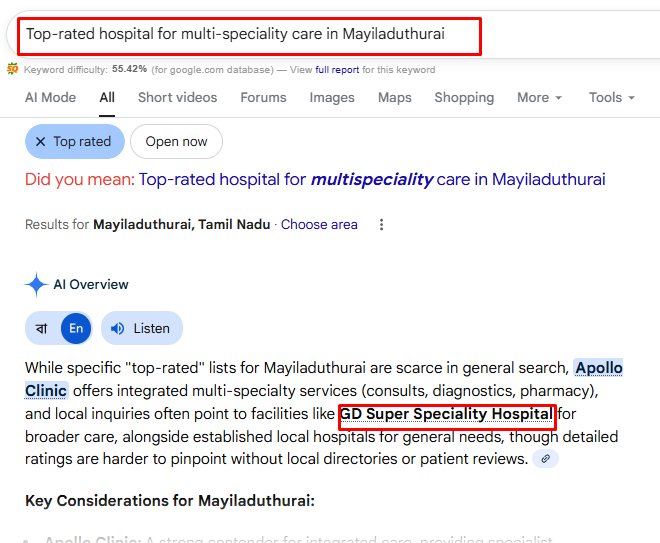
After implementing QSAAS, GD Super Specialty Hospital began appearing prominently in the Google AI Overview section. For queries such as “Top-rated hospital for multi-speciality care in Mayiladuthurai” and “Most trusted hospital in Mayiladuthurai for advanced treatment,” the hospital featured in the first-page AI overview, significantly increasing visibility and patient engagement. These placements ensured that searchers were immediately exposed to the hospital’s credentials, services, and trust signals.
4.2 Gemini Presence Insights
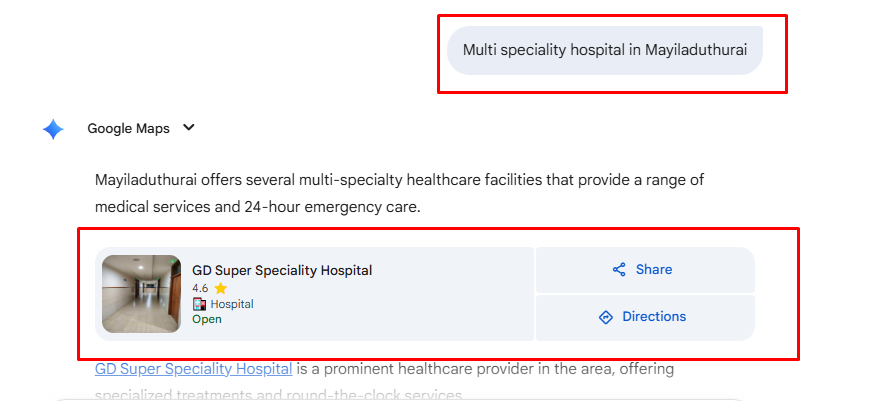
In Gemini search results, the hospital appeared in the first position for location-based queries such as “Top hospitals in Mayiladuthurai for advanced treatment.” An excerpt highlighted the hospital’s NABH accreditation, modern facilities, and wide range of medical specialties, reinforcing its credibility. This positioning drove increased clicks and attention from users actively seeking healthcare solutions in the region.
4.3 ChatGPT Presence Insights
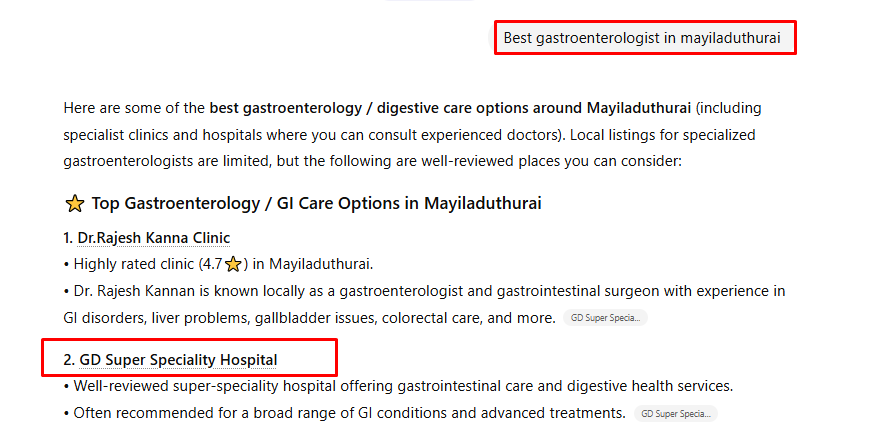
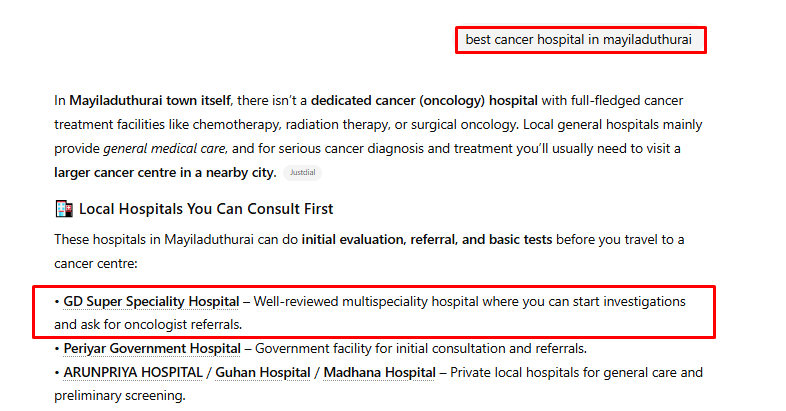
The hospital also gained first-position suggestions on ChatGPT for queries including “Best gastroenterologist in Mayiladuthurai” and “best cancer hospital in Mayiladuthurai.” These AI-driven recommendations listed GD Super Specialty Hospital as a well-reviewed and trusted provider for gastrointestinal and oncology care, strengthening its reputation in AI-assisted search environments.
4.4 Claude Presence Insights
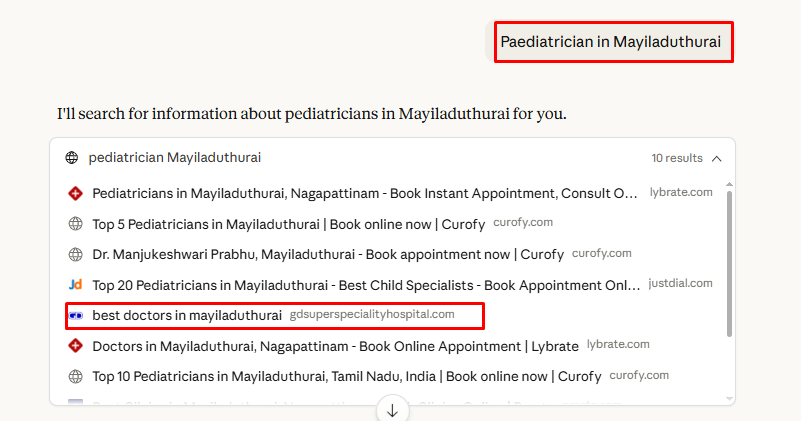
On Claude, the hospital ranked fourth for broader queries like “Paediatrician in Mayiladuthurai” and “hospitals in Mayiladuthurai.” Despite not occupying the top spot, GD Super Specialty Hospital was prominently featured as a top local authority, reflecting the effectiveness of QSAAS in elevating visibility across multiple AI platforms.
4.5 Quantitative & Qualitative Improvements
The project yielded substantial improvements in both organic traffic and authority signals. Organic clicks and impressions increased significantly, leading to higher patient inquiries and appointments. AI-driven visibility across Google, Gemini, ChatGPT, and Claude reinforced the hospital’s brand trust, positioning GD Super Specialty Hospital as a leader in multi-specialty healthcare services. Additionally, the combination of semantic clustering, internal linking, and structured data ensured that the hospital maintained a competitive edge in both traditional search and AI-driven environments, delivering measurable business impact.
5. Key Takeaways from the QSAAS Project
The GD Super Specialty Hospital project demonstrates the transformative potential of AI-inspired, quantum SEO strategies for healthcare businesses. By leveraging QSAAS, ThatWare delivered faster crawling, efficient indexing, and improved ranking outcomes, showcasing how quantum principles can redefine website optimization.
The implementation of Hamiltonian graphs and the adiabatic algorithm allowed parallel processing of multiple pages, dramatically reducing crawl times and ensuring high-value pages were prioritized. Semantic clustering and AI overview integration strengthened topical authority and improved visibility across both conventional search engines and AI platforms such as ChatGPT and Gemini.
Internal linking optimization played a crucial role in distributing authority across pages, while orphaned pages were identified and linked to relevant hubs. Combined with high-quality backlink acquisition, this created a strong digital foundation for sustained ranking improvements.
The real-world impact extended beyond search rankings. Increased visibility translated into higher patient engagement, enhanced brand trust, and more inquiries for multi-specialty services. Geo-targeted content ensured that local searchers could easily find the hospital, while semantic and AI-driven optimization aligned with modern searcher intent, improving overall user experience.
Finally, the project illustrates the scalability of QSAAS for other multi-location healthcare businesses. Hospitals seeking to improve digital presence can benefit from the same principles: parallel crawling, semantic clustering, internal linking optimization, structured data integration, and AI-aware content creation. By adopting QSAAS, healthcare providers can achieve measurable growth, improve patient outreach, and maintain a competitive advantage in increasingly AI-driven search landscapes.
6. Practical Lessons for Hospitals & Healthcare Brands
The GD Super Specialty Hospital case study offers valuable insights and practical lessons for other hospitals and healthcare brands looking to improve their digital presence. One of the key takeaways is the importance of optimizing websites with user intent in mind. In today’s AI-driven search ecosystem, understanding what users are looking for—whether it is finding a specialist, locating a nearby hospital, or understanding treatment options—is crucial. Content must directly address patient needs while providing actionable and trustworthy information. This user-centric approach ensures that search engines and AI platforms recognize the website as a relevant and authoritative source, which directly impacts rankings and patient engagement.
Leveraging structured data and AI-focused content is another critical strategy. Hospitals must ensure that their web pages are designed to be easily interpreted by AI assistants and search algorithms. Structured data, schema markup, and AI-friendly design allow platforms like Google AI Overview, Gemini, ChatGPT, and Claude to present hospital information in rich snippets, AI suggestions, and overview cards. By making content machine-readable while maintaining human readability, healthcare websites can significantly increase visibility in both conventional and AI-assisted search results.
The importance of semantic clusters and internal linking cannot be overstated. Grouping related content into topical clusters improves the website’s authority for specific medical specialties, while strategic internal linking ensures that link equity flows efficiently throughout the site. Orphaned or weakly connected pages are brought into the network, boosting their visibility and enhancing crawl efficiency. This combination of semantic clustering and internal linking creates a coherent structure that reinforces both AI and human understanding of the hospital’s services.
Finally, integrating QSAAS-like advanced techniques can accelerate growth and competitiveness. Parallel crawling, PageRank optimization, Hamiltonian graph modeling, and adiabatic algorithm-based analysis allow hospitals to handle large websites with multiple specialties efficiently. These techniques ensure faster indexing, real-time identification of issues, and optimized authority distribution across all pages. Hospitals that adopt these quantum-inspired strategies gain a clear edge over competitors, achieving higher visibility, increased patient inquiries, and stronger brand credibility.
By implementing these lessons, healthcare providers can not only improve search visibility but also create a digital ecosystem that aligns with modern AI-driven user behavior, paving the way for sustainable growth and enhanced patient trust.
7. Conclusion
The GD Super Specialty Hospital project demonstrates the transformative impact of ThatWare’s QSAAS on modern healthcare websites. From initially struggling with low visibility, weak keyword rankings, and limited AI-driven presence, the hospital leveraged quantum-inspired SEO strategies to achieve top rankings across multiple search and AI platforms. By restructuring the website into Hamiltonian graphs, implementing parallel crawl optimization, and clustering content semantically, the hospital was able to improve crawl efficiency, authority flow, and overall search performance.
The practical application of QSAAS allowed GD Super Specialty Hospital to appear in Google AI Overview, Gemini, ChatGPT, and Claude, capturing attention for highly targeted healthcare queries. Internal linking strategies, structured data implementation, and AI-focused content created a seamless user experience while reinforcing topical authority. The result was not only improved rankings but also increased patient inquiries, brand trust, and recognition as a leading multi-specialty facility in Mayiladuthurai.This case study highlights QSAAS as a game-changing strategy for digital rankings, demonstrating that hospitals can achieve measurable results by integrating quantum-inspired principles, semantic clustering, and AI-aware content strategies. Looking forward, healthcare websites that embrace these advanced techniques will be well-positioned to thrive in increasingly AI-driven search environments, delivering faster visibility, better patient engagement, and sustainable growth. GD Super Specialty Hospital’s journey serves as a benchmark for hospitals aiming to future-proof their digital presence and maximize impact in a competitive healthcare landscape.