
SUPERCHARGE YOUR ONLINE VISIBILITY! CONTACT US AND LET’S ACHIEVE EXCELLENCE TOGETHER!
Google prioritizes user satisfaction in terms of search functionality made in search engines. Thus, they launched a framework to make it much easier for the users and publishers for a better search experience. E‑A-T is the acronym for expertise, authoritativeness, and trustworthiness. EAT SEO deployed from Google’s Search Rater Guidelines with a view to improving search appearance.

EAT Necessity
- Google prioritizes websites that demonstrate expertise, authority, and trustworthiness (E-A-T).
- E-A-T is determined combination of the creator, the content, and the website.
- Basically, E-A-T is vital for websites that publish YMYL (your money, your life) content.
How does Google determine E-A-T?
- Based on the expertise of the author of the overall content.
- The authoritativeness of the author of the overall content, and the website.
- The trustworthiness of the author of the overall content, and the website.
E-A-T SEO Significance
Google understands that a person may make a life-altering decision based on what they read online. Therefore, a bad source of information in Google search results can have real-world consequences.
You might also categorize your web pages or to determine that fall into any of these YMYL categories, you must tread carefully. Make it crystal clear.
The more you abide by and utilize the EAT specifications to your content, the better opportunity you will get in terms of organic visibility and ranking potential for your content.
E-A-T Considered As A Ranking Factor or Not
Google itself declared that E-A-T is not a ranking factor for the sites. Though you need to consider expertise, authority, and trust which are ranking factors.
Not only E-A-T is the only metric to measure in terms of SEO but also there are other factors also need to consider. Just like other measurable factors that indicate the quality of authors, web pages, websites, and brands.
Here’s what Danny Sullivan said:
“It’s almost like we look for signals that align with expertise, authoritativeness and trustworthiness. We should give that an acronym like E-A-T and maybe suggest people aim for this. Oh wait, we did”: https://webmasters.googleblog.com/2019/08/core-updates.html
Why E-A-T is important for your SEO strategy
Google started penalizing keyword stuffing a long time ago because it diverts the reading experience. They made device responsiveness (especially mobile) a ranking factor when the majority of people started using mobile devices to search the internet. Google prioritized HTTPS over HTTP because it wanted increased security for searchers. They developed Core Web Vitals because they wanted to quantify a fast, seamless user experience.
E-A-T is no such exception. It is one more way to explore for Google the deliverability of what users want.
E-A-T assists determine credibility. It is the basis of evaluation as to whether a website and its individual pages create real value for the user. Google generally gives much relevance to those web pages which brings more value to its users that helps to keep engage people with your site.
Steps to improve EAT SEO
1. Build the proper backlinks
2. Get more brand mentions from trusted sources
3. Keep old and new content accurate and up to date
4. Get more online reviews and obviously respond to them
5. Get a Wikipedia page for your brand
6. Do a proper content audit
Here’s a brief assessment on E.A.T signal:
Step 1: Expertise
Landing Page: https://thatware.co/ai-based-seo-services/
Focus Keyword: AI Based SEO Services
Activity:
Need to post a PDF submission on the High Domain Authority website with the above-mentioned keyword.
Step 2: Authoritativeness
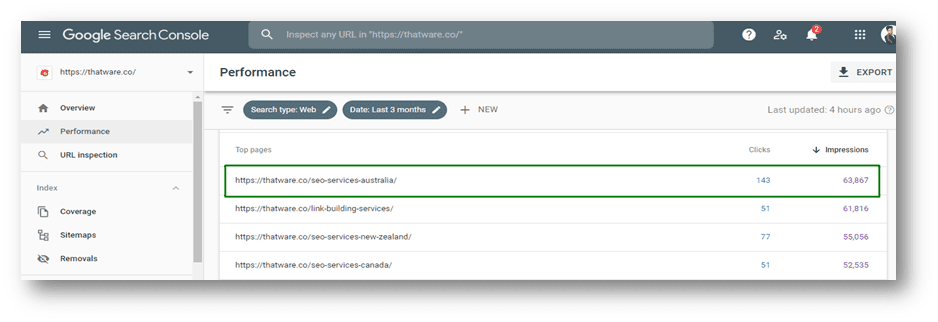
Observation: Go to Search Console and check which page receives high impression.
Landing Page: https://thatware.co/seo-services-australia/
Focus Keyword: SEO Services in Australia
Anchor Text: ThatWare
Activity:
Need to post Press Release
/ Review post or Third party post on High Domain Authority website with the above-mentioned keyword, but mainly use the brand name as anchor text.
Step 3: Trustworthiness
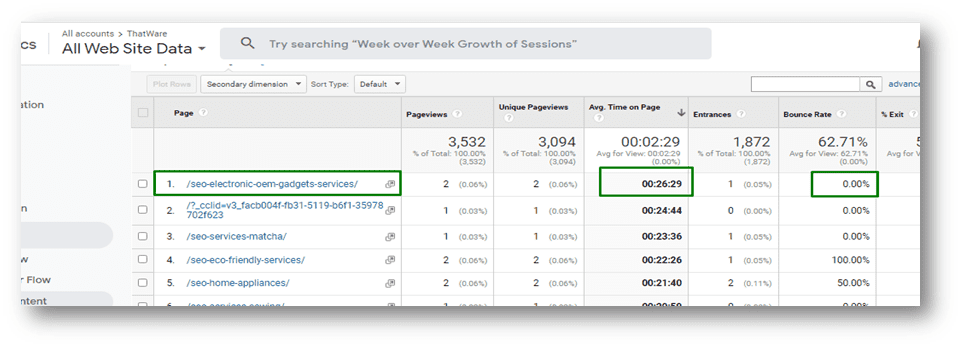
Observation: Go to Google analytics and check the max avg. time spent and low bounce rate.
Landing Page: https://thatware.co/seo-electronic-oem-gadgets-services
Focus Keyword: SEO Services For Electronic OEM Gadgets (LSI Keyword)
Activity:
Need to post on High Domain Authority website with the above mention keyword.
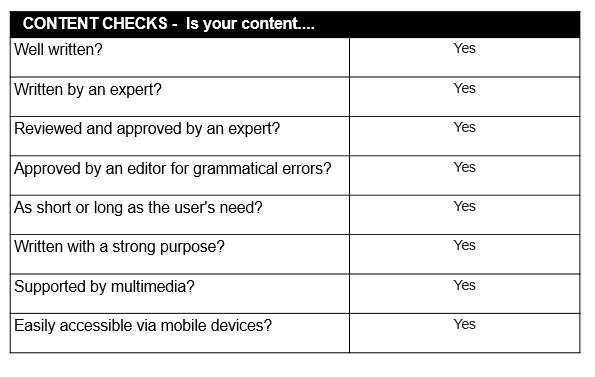
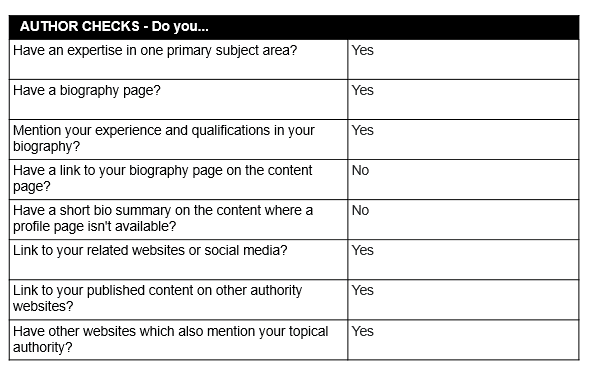
Also you need to ensure the following checklist as well:

From E-A-T to E-E-A-T: The Evolution of Google’s Content Evaluation and User Experience
Understanding E-E-A-T (Expertise, Authoritativeness, Trustworthiness, and Experience) is essential for anyone looking to optimize their online presence and rank well on Google. But before delving into E-E-A-T, it’s crucial to grasp its predecessor, E-A-T, which first surfaced in Google’s Quality Rater Guidelines in 2014.
Google’s Quality Rater Guidelines serve as a blueprint for evaluators, known as “Quality Raters,” who gauge the quality of Google’s search results. These guidelines aid evaluators and assist Google’s algorithms in discerning what constitutes high-quality and relevant content.
E-A-T encompasses three fundamental components:
Expertise: This refers to the proficiency and knowledge exhibited by the content creator. Google expects content to originate from individuals possessing genuine expertise in their respective fields.
Authoritativeness: It pertains to the credibility and reputation of both the content creators and the websites they represent. Sites and content creators are deemed authoritative if they are well-established and respected within their domains.
Trustworthiness: This denotes the reliability and credibility of the information presented. Content that is accurate, well-sourced, and transparent is more likely to be trusted by users and search engines alike.
E-E-A-T SEO: Building Experience, Expertise, Authority and Trust Into Search Performance
Modern search visibility is no longer only about technical fixes, keywords and backlinks. Strong websites also need to show why users and search engines should trust the information they publish. This is where E-E-A-T SEO becomes important. A practical E-E-A-T optimization program connects first-hand experience, subject expertise, reputation, transparency and content quality with the rest of the site’s organic search strategy.
Google E-E-A-T stands for Experience, Expertise, Authoritativeness and Trustworthiness. Google uses the concept in its Search Quality Rater Guidelines to help evaluators assess whether search results appear helpful and reliable. For marketers, E-E-A-T for SEO is best understood as a quality framework rather than a checklist that guarantees rankings.
A strong E-E-A-T SEO strategy should therefore avoid treating E-E-A-T as a single score. Instead, it should identify the signals that help users understand who created the content, why that person or organization is qualified to discuss the topic, what evidence supports the claims, and whether the website is transparent about its identity and purpose.
What Google E-E-A-T Means for a Modern Website
Google E-E-A-T places particular emphasis on trust. Experience can show that a creator has used a product, completed a process, visited a place or dealt with a real-world problem. Expertise demonstrates relevant knowledge. Authoritativeness is connected with reputation and recognition. Trust depends on accuracy, transparency, safety and whether users have good reasons to rely on the page.
The E-E-A-T guidelines are especially useful when reviewing YMYL content, where inaccurate information could affect a person’s health, financial stability, safety or broader well-being. An effective E-E-A-T optimization process should examine both page-level quality and broader site signals, including authorship, editorial standards, citations, reputation, contact information, policies and content maintenance.
People often search for E-E-A-T ranking factors as though there were a fixed list of ranking signals. That is not how Google describes the framework. E-E-A-T itself is not a single ranking factor. Instead, Google’s systems use multiple signals that may align with qualities associated with experience, expertise, authority and trust. That distinction should guide every E-E-A-T SEO strategy.
How to Improve E-E-A-T Across the Website
When businesses ask How to improve E-E-A-T, the answer usually starts with an evidence audit. Every important page should make it easy to understand who created or reviewed the content, what qualifications or first-hand experience support it, when it was last updated, and which sources were used.
A strong E-E-A-T content optimization process can include adding detailed author bios, reviewer credentials, editorial policies, citations to reliable primary sources, first-hand examples, original screenshots, demonstrations, case studies, testing notes and transparent update dates. E-E-A-T content optimization should also remove unsupported claims, vague statistics and generic statements that cannot be verified.
For service pages, How to improve E-E-A-T often means showing evidence of real delivery. That can include methodology, team expertise, client examples, process screenshots, certifications, awards that can be independently verified, testimonials with appropriate context, and case studies based on real work.
For editorial content, How to improve E-E-A-T may require stronger sourcing, expert review and clearer distinctions between fact, opinion and experience.
E-E-A-T for SEO also extends beyond the main article. About pages, contact details, privacy policies, terms, refund information, editorial policies and author profile pages can all help users understand the organization behind the content. This broader E-E-A-T optimization work supports trust because visitors do not have to guess who is responsible for what they are reading.
Building an E-E-A-T SEO Strategy Around Who, How and Why
A practical E-E-A-T SEO strategy can be built around three questions:
Who created the content?
How was the content created?
Why was the content created?
These questions help teams move beyond superficial optimization and evaluate whether a page genuinely serves its audience.
The “Who” component of E-E-A-T SEO should establish authorship and accountability. Pages should identify the writer or reviewer when readers would reasonably expect that information. Author pages should explain relevant background, real-world experience and areas of expertise without exaggerating credentials.
The “How” component supports E-E-A-T content optimization by explaining the process behind the content where it matters. A product comparison can describe testing methodology. A case study can explain the starting point, actions taken and measurement method. A technical guide can show screenshots, original examples or steps used to validate the recommendations.
The “Why” component is central to E-E-A-T for SEO because content created primarily to help users is different from content produced only to capture search traffic. Every E-E-A-T SEO strategy should therefore ask whether the page solves a genuine problem, adds original value and leaves the reader with enough information to make progress.
Applying Google E-E-A-T Guidelines to Content Production
The Google E-E-A-T guidelines should influence content planning before writing begins, not be added as a final SEO layer. Teams can also use Google E-E-A-T guidelines as a review framework when auditing important pages.
Topic briefs can specify the required expert input, first-hand evidence, original examples, citations, author information and fact-checking requirements before a draft is approved.
This makes E-E-A-T content optimization part of the editorial workflow. For high-stakes topics, reviewers can check the accuracy of important claims and ensure that sources are current and authoritative. For reviews and comparisons, writers can demonstrate first-hand experience rather than rewriting product descriptions. For service pages, businesses can show how the service is actually delivered.
The E-E-A-T guidelines also encourage teams to think carefully about reputation. Authority is not created by adding the word “expert” to a bio. It is strengthened when other credible sources recognize the person or organization, when the business demonstrates consistent subject depth, and when users can independently verify important claims.
A mature E-E-A-T optimization program therefore combines on-page improvements with off-page reputation work. Digital PR, relevant citations, expert contributions, credible brand mentions and quality backlinks can support authority, while transparent business information and accurate content reinforce trust.
Understanding E-E-A-T Ranking Factors Without Oversimplifying Them
The phrase E-E-A-T ranking factors is useful for keyword targeting, but it should be explained carefully. There is no official Google checklist where experience, expertise, authoritativeness and trustworthiness each receive a fixed score.
Google E-E-A-T is better viewed as a way to understand the types of qualities Google’s systems try to reward through many signals.
When reviewing possible E-E-A-T ranking factors, focus on observable improvements that make a page more useful and trustworthy. Examples include accurate sourcing, original research, relevant author expertise, first-hand demonstrations, transparent business information, helpful page experience, a positive reputation and clear ownership of the content.
This is also why E-E-A-T for SEO should not be reduced to author schema, backlinks or author bios alone. Those elements can support the broader picture, but they do not compensate for weak, inaccurate or unhelpful content.
The strongest E-E-A-T SEO work improves the substance of the page first and then makes the supporting evidence easy to see.
E-E-A-T SEO for YMYL and High-Trust Topics
Google E-E-A-T becomes particularly important when a topic could affect important life decisions. Health, finance, legal guidance, safety and other YMYL subjects generally require greater care because the cost of inaccurate information can be high.
For these websites, the Google E-E-A-T guidelines should be reflected in stronger review processes, tighter sourcing standards and clearer expert involvement. Applying Google E-E-A-T guidelines consistently can make editorial expectations easier to document and review.
E-E-A-T content optimization should verify important claims against primary or highly reliable sources, identify qualified authors or reviewers, explain limitations where necessary, and keep time-sensitive information current.
An E-E-A-T SEO strategy for a YMYL site should also review reputation and trust outside the content itself. Business identity, regulatory information where applicable, customer support access, security, policies and public reputation all contribute to how users judge a site.
When teams ask How to improve E-E-A-T for a YMYL website, the answer is rarely one technical fix. It usually requires improvements across editorial standards, author credibility, evidence, reputation, user experience and ongoing content maintenance.
Turning E-E-A-T Optimization Into an Ongoing SEO Process
E-E-A-T optimization should not be treated as a one-time project. Sites change, experts move roles, statistics become outdated, policies change and competitors publish better evidence. A quarterly or biannual review can identify pages where trust signals have weakened or information is no longer current.
A sustainable E-E-A-T SEO strategy can track content freshness, expert review coverage, citation quality, author profile completeness, branded search visibility, quality backlinks, reputation signals and performance changes in Search Console.
These are not official E-E-A-T ranking factors, but they can help teams monitor whether their quality and credibility work is improving.
The final goal of E-E-A-T for SEO is not to “pass” an algorithmic checklist. It is to create pages that users can understand, verify and trust.
When E-E-A-T SEO, technical SEO, content quality and authority building work together, a website is better positioned to deliver the kind of helpful, reliable experience Google’s search systems aim to surface.
For organizations still asking How to improve E-E-A-T, the best starting point is a structured audit of content, authorship, reputation and trust. Use the E-E-A-T guidelines to identify gaps, apply E-E-A-T content optimization to the pages that matter most, and build the evidence needed to support long-term credibility.
That approach keeps Google E-E-A-T grounded in what matters: useful information, real experience, demonstrable expertise, recognized authority and trust.
E-A-T vs E-E-A-T: What Changed in Google’s Quality Framework?
Google’s move from E-A-T to E-E-A-T added Experience to the existing concepts of Expertise, Authoritativeness and Trustworthiness. For businesses working on E-E-A-T SEO, this means credibility is not demonstrated only by what a creator knows. Depending on the topic, evidence of what the creator has actually done or experienced can also make content more useful.
| Comparison Factor | E-A-T | E-E-A-T |
| Full meaning | Expertise, Authoritativeness and Trustworthiness | Experience, Expertise, Authoritativeness and Trustworthiness |
| Experience | Not separately identified | Explicitly considers relevant first-hand experience |
| Expertise | Focuses on knowledge or specialist competence | Remains important, particularly where specialist knowledge is necessary |
| Authoritativeness | Considers reputation and recognition | Continues to assess reputation of the creator and source |
| Trustworthiness | Central to content quality | Remains the most important element of the framework |
| First-hand evidence | Helpful but not separately emphasized | Can be particularly useful for reviews, tutorials, comparisons and demonstrations |
| Author information | Helps demonstrate expertise and accountability | Can demonstrate both relevant expertise and real experience |
| Content examples | Expert articles, professional guidance and authoritative resources | Expert guidance plus tests, demonstrations, original observations and real-world examples |
| YMYL relevance | Particularly important for sensitive subjects | Strong E-E-A-T becomes especially important for topics affecting health, finances, safety or well-being |
| SEO application | Used as a quality assessment framework | Provides a broader framework for modern E-E-A-T SEO and people-first content |
| Ranking factor? | Not a standalone ranking factor | E-E-A-T ranking factors should not be interpreted as a fixed Google score or individual ranking factor |
| Best optimization approach | Demonstrate knowledge, authority and trust | Combine E-E-A-T optimization, genuine experience, expert knowledge, authority and strong trust signals |
What Does This Mean for SEO?
The additional Experience component changes how businesses should approach E-E-A-T content optimization.
A product review becomes more convincing when readers can see evidence that the product was actually tested. A service case study becomes more useful when it explains what work was performed and what results were measured. A tutorial becomes stronger when its creator can demonstrate practical experience with the process being explained.
That does not mean experience replaces expertise. Different searches require different combinations.
For medical, financial, legal or other high-stakes information, appropriate expertise and highly reliable sourcing may be particularly important. For product reviews, travel experiences, software tutorials or practical guides, first-hand experience can add substantial value.
A strong E-E-A-T SEO strategy therefore asks which combination of experience, expertise, authority and trust is most appropriate for the page rather than forcing identical signals across an entire website.
From E-A-T to E-E-A-T: The Evolution of Google’s Content Evaluation and User Experience
In the ever-changing landscape of digital marketing and search engine optimization (SEO), one constant factor that can significantly impact your website’s ranking is how well your content aligns with Google’s evaluation criteria. Google’s evaluation system has evolved over the years to better assess content quality and user experience, with the transition from E-A-T (Expertise, Authoritativeness, and Trustworthiness) to the newer E-E-A-T (Expertise, Authoritativeness, Trustworthiness, and Experience). Understanding these concepts is crucial for optimizing your online presence and improving search engine rankings.
The Birth of E-A-T: A Foundation for Content Evaluation
E-A-T first emerged as a key concept in Google’s Quality Rater Guidelines (QRG) in 2014, a document designed to assist human evaluators—referred to as “Quality Raters”—in assessing the quality of Google’s search results. These guidelines were developed to ensure that Google’s algorithm consistently delivers the most relevant and reliable search results for users. As Google’s algorithm evolves, its reliance on these principles has only grown, making E-A-T a cornerstone of SEO strategy.
E-A-T stands for Expertise, Authoritativeness, and Trustworthiness, three essential elements that Google uses to evaluate the quality of content and the credibility of the websites that produce it. Let’s break these elements down further:
- Expertise refers to the level of knowledge and skill that a content creator possesses on a specific topic. Google seeks to prioritize content that is written by professionals, subject-matter experts, or individuals with proven experience in the relevant field.
- Authoritativeness measures how recognized and reputable the content creator and the website are in their respective industry or niche. A high-authority website is one that is consistently seen as a leader or trusted voice in its field.
- Trustworthiness pertains to the reliability and credibility of both the content itself and the website hosting it. Trustworthiness ensures that users can rely on the information provided without worrying about misinformation or malicious intent.
For instance, medical, financial, and legal websites have higher standards for expertise, as misinformation in these fields can have serious consequences. Therefore, Google would prioritize content from recognized professionals with a proven track record in these industries.
Google’s Quality Rater Guidelines and the Role of Human Evaluators
Google’s Quality Rater Guidelines are a set of instructions designed for human evaluators who assess the quality of web pages based on various factors, including relevance, content accuracy, and overall user experience. These raters, while not directly influencing search rankings, provide valuable feedback that helps refine Google’s algorithms, improving the search results over time.
The guidelines offer examples of both high- and low-quality content, explaining how factors like expertise, authority, and trustworthiness should be weighed when determining a website’s credibility. While the Quality Rater Guidelines do not directly affect search engine rankings, they provide a framework that helps Google’s search algorithms assess the quality of content. In essence, the guidelines act as a manual for Google’s algorithms and its evaluators, helping Google understand what types of content should rank higher.
Enter E-E-A-T: The Evolution of Content Evaluation
In December 2022, Google introduced an important update to its search quality evaluation criteria: Experience was added as a fourth component to the existing E-A-T framework. This new evaluation criterion is encapsulated in E-E-A-T, which stands for Expertise, Authoritativeness, Trustworthiness, and Experience. The inclusion of “Experience” marks a significant shift in Google’s approach to content evaluation, particularly for content that aims to demonstrate first-hand knowledge or real-world experience.
The key reason behind the addition of Experience is Google’s recognition of the increasing importance of personal experience in the creation of high-quality, useful content. This is particularly relevant for certain types of content, such as reviews, tutorials, travel blogs, product recommendations, and personal stories. By emphasizing the importance of Experience, Google aims to prioritize content that not only demonstrates expertise in a subject but also reflects real-world involvement and firsthand knowledge.
Let’s break down the elements of E-E-A-T:
- Expertise remains crucial in the evaluation process, as users still need content written by individuals who have in-depth knowledge in a particular area. Expertise is particularly important in fields like health, law, and finance, where incorrect information can have serious consequences.
- Authoritativeness continues to signify the reputation and credibility of the content creator or website within its niche. High-authority content creators are seen as leaders in their field, contributing valuable insights or information.
- Trustworthiness is still paramount in content evaluation. Google values content that is credible, transparent, and free from harmful or misleading information.
- Experience is the new addition to the equation, focusing on the actual, hands-on knowledge or personal experience that content creators bring to the table. Content that demonstrates experience is generally viewed as more reliable and valuable because it reflects real-world involvement with the subject matter, rather than just theoretical knowledge. For example, a travel blog that shares firsthand experiences from a trip will likely be considered more valuable than generic content about a location, even if both articles have the same level of expertise.
Why Experience Matters
The addition of Experience highlights the growing importance of authentic, personal content that resonates with users on a deeper level. Google has long emphasized the need for high-quality, authoritative content, but now it also recognizes the value of firsthand experience as a determining factor in content evaluation. This shift reflects Google’s aim to prioritize content that adds value to users’ experiences, making it more likely to meet their needs.
In practical terms, the “Experience” factor is particularly relevant for content types that involve reviews, testimonials, how-to guides, and personal anecdotes. For example, a review of a product or service that comes from someone who has actually used the product will likely be rated higher than one that merely parrots product specifications. Similarly, a blog post about a trip to a remote destination is more valuable if the author can share real-life experiences and tips based on their own travels, rather than relying on second-hand information.
The Impact of E-E-A-T on SEO and Content Creation
The shift to E-E-A-T highlights the importance of not just creating content that is technically proficient but also ensuring that it resonates with users through authenticity and experience. Content creators and SEO professionals must adapt to this evolving standard by prioritizing both the credibility of their information and their real-world engagement with the topic at hand.
For websites and content creators, this means:
- Hiring experts: Ensuring that content creators have demonstrated expertise in their fields and that the content is backed by factual and accurate information.
- Showcasing authority: Establishing a reputable online presence through quality backlinks, partnerships with authoritative sources, and recognition within the community.
- Building trust: Maintaining transparency, being honest about sources, and avoiding misleading or biased content.
- Sharing personal experience: When applicable, offering firsthand experiences, whether through product reviews, personal stories, or case studies, to add authenticity to the content.
E-A-T encompasses three fundamental components:
- Expertise:
Expertise refers to the knowledge, skills, and experience that the content creator demonstrates in their field. Google values content created by individuals who have a deep understanding of the subject they are discussing. This ensures that the information provided is accurate, informed, and insightful. For example, a health-related article written by a medical professional is considered more authoritative than one written by someone without relevant qualifications or experience in healthcare. Content creators are expected to showcase their expertise through well-researched and thoughtfully presented information. - Authoritativeness:
Authoritativeness refers to the reputation and credibility of the content creator and the website or platform hosting the content. A website or individual is deemed authoritative if they are widely recognized as a trusted source of information in their field. This reputation is often built over time, through consistent high-quality content, citations from other reputable sources, and acknowledgment from peers or experts within the industry. For instance, a website specializing in legal advice authored by experienced lawyers will be considered authoritative within the legal domain. Authoritativeness can also be influenced by factors like the website’s age, its number of quality inbound links, and its industry recognition. - Trustworthiness:
Trustworthiness is about the reliability and accuracy of the content and the website as a whole. Google prioritizes content that is factually correct, well-sourced, and free from misleading or false information. A trustworthy website demonstrates transparency by providing clear sources, references, and credentials where necessary. Websites with a privacy policy, user reviews, secure browsing protocols (like HTTPS), and visible contact information are also seen as more trustworthy. For example, a product review site with honest, unbiased reviews and detailed disclosures about affiliate relationships would be considered trustworthy. Trustworthiness builds confidence in users, making them more likely to engage with the content or make purchasing decisions based on it.
E-A-T was crafted to ensure that users receive reliable and valuable information when utilizing Google’s search engine.
Fast forward to December 2022, Google introduced an additional “E” to the equation, thus giving rise to E-E-A-T, with the “E” standing for Experience. This addition underscores Google’s heightened emphasis on authentic, firsthand involvement or practical familiarity with the subject matter covered in content.
In essence, E-E-A-T signifies that Google now places greater importance on content creators with actual experience in the topics they discuss. This shift is particularly pertinent when users seek insights or advice on specialized topics or contemplate purchasing products or services.
Pages created by individuals with genuine experience in the subject matter are often rewarded with higher rankings by Google. Aligning with E-E-A-T principles enhances a page’s chances of securing prominent positions in search engine results pages (SERPs) and navigating future Google algorithm updates successfully.
Google also emphasizes that Trust (the “T” in E-E-A-T) is paramount, serving as the cornerstone of the entire framework. Without trustworthiness, a page’s E-E-A-T is significantly compromised. After all, if users lack trust in the content, its value diminishes considerably.
Comprehending the core elements of E-E-A-T is crucial for crafting high-quality, trustworthy content that resonates with both users and search engines, ultimately leading to improved visibility and credibility in the digital realm.
E-A-T SEO: Elevate Your Search Rankings with ThatWare
In today’s competitive digital landscape, Expertise, Authoritativeness, and Trustworthiness (E-A-T) are crucial factors influencing search engine rankings. At ThatWare, we specialize in advanced AI-driven SEO strategies that align perfectly with Google’s E-A-T guidelines, ensuring your website achieves higher visibility, credibility, and organic growth.
Why E-A-T Matters in SEO?
Search engines prioritize websites that demonstrate expert knowledge, industry authority, and user trust. Without a strong E-A-T foundation, even well-optimized content may struggle to rank. ThatWare integrates semantic SEO, knowledge graphs, and AI-based content optimization to enhance your website’s authority and reliability.
Our Approach to E-A-T Optimization
- AI-Driven Content Enhancement – We ensure your content reflects expert insights, well-researched data, and authoritative references.
- Building Digital Authority – We help establish strong backlink profiles, citations, and brand mentions from high-authority domains.
- Trust Signals & User Experience – Secure protocols, transparent authorship, and seamless UX play a pivotal role in reinforcing trust.
- Knowledge Graph & Entity SEO – Leveraging structured data and AI, we strengthen your brand’s presence in Google’s knowledge panels and SERP features.
By adopting ThatWare’s AI-powered E-A-T SEO strategies, businesses can boost rankings, enhance credibility, and drive organic conversions. Ready to dominate search results? Let’s optimize your E-A-T today!
How Google’s E-E-A-T Update is Shaping Content Quality and SEO
Google’s algorithm has always been aimed at improving search results to offer users the most relevant, trustworthy, and authoritative content. Over the years, E-A-T (Expertise, Authoritativeness, and Trustworthiness) has been a central pillar of Google’s search ranking system, especially for websites dealing with sensitive topics like health, finance, and legal advice.
But in December 2022, Google made an important adjustment to its framework: the introduction of Experience to the mix, evolving E-A-T into E-E-A-T. The added Experience factor is reshaping how content is evaluated, offering a deeper understanding of what it takes to gain trust and authority on the web.
Here’s how E-E-A-T impacts SEO, content creation, and website ranking strategies in 2024.
From E-A-T to E-E-A-T: What’s Changed?
The primary change from E-A-T to E-E-A-T is the addition of “Experience” as a core element. While E-A-T emphasized the qualifications of the content creator, E-E-A-T looks deeper into the personal experience behind the content. This new change is all about ensuring that the content reflects authentic, hands-on knowledge and understanding.
- Experience: Google’s recognition that firsthand, real-life experience significantly enhances the value of content. Experience now plays a critical role in validating the authenticity of information and is particularly important for YMYL (Your Money or Your Life) content.
For instance, a travel blog now has more weight if the writer shares personal experiences about visiting a destination, rather than just rehashing general information. Similarly, a financial guide written by someone who has personally navigated the complexities of investing will now hold more value than a theoretical piece from an anonymous expert.
Why Experience Matters More Than Ever
Google’s decision to elevate Experience underscores a shift in search priorities. While expertise is important, E-E-A-T acknowledges that experience creates a stronger connection between content and users. Let’s explore why Experience is now a critical factor:
- Authenticity: Content born from real-life encounters carries a level of authenticity that theoretical knowledge can’t match. People trust content that feels genuine.
- Relatability: Content from someone who has walked in the reader’s shoes provides more insight and actionable advice.
- User Engagement: Firsthand stories and experiences tend to engage audiences more effectively, leading to increased time on site and more interactions with content.
If you think about it, a “how-to” article about baking bread written by a professional baker is much more valuable (and trustable) when it includes their personal success stories and lessons learned along the way. This shift is all about showing that content is more than just informative; it’s rooted in lived knowledge.
How E-E-A-T Affects SEO Rankings
While E-E-A-T isn’t a direct ranking factor (Google hasn’t explicitly confirmed that), it heavily influences the quality of content that ranks well. High E-E-A-T content tends to have longer engagement times, lower bounce rates, and higher conversion rates. These signals, in turn, affect rankings. Here’s how:
- Better User Experience: Google places a premium on user experience. Content that’s based on real experience tends to be more engaging and useful, leading to better interaction signals (such as time spent on the page).
- Increased Trust Signals: As Google adjusts its algorithms to favor content with E-E-A-T, websites that show real-life experience and credibility will naturally gain more trust. Trust signals like user reviews, backlinks from authoritative sites, and secure browsing (HTTPS) become essential.
- Content Relevance: Content that demonstrates practical experience in its field is inherently more relevant to users’ queries. Google wants to rank pages that satisfy user intent—content that’s not just factual but personally insightful too.
Mastering E-E-A-T for SEO Success
In conclusion, understanding and implementing the principles of E-E-A-T (Expertise, Authoritativeness, Trustworthiness, and Experience) is essential for achieving online visibility and credibility in today’s SEO landscape. Google’s algorithm continuously evolves, and with the recent shift towards prioritizing firsthand experience in content evaluation, it is more important than ever to create content that resonates with both users and search engines. By focusing on expertise, establishing authority, building trust, and showcasing real-world experience, you can significantly improve your website’s performance in search rankings.
To stay ahead of the competition, make sure to incorporate these elements into your SEO strategy and content creation process. Whether it’s providing valuable insights backed by expertise, sharing personal experiences, or earning trust through transparent practices, aligning with Google’s E-E-A-T guidelines will help you stand out in search results, foster user engagement, and ultimately achieve long-term success in the digital space.