
SUPERCHARGE YOUR ONLINE VISIBILITY! CONTACT US AND LET’S ACHIEVE EXCELLENCE TOGETHER!
Every SEO success story sounds impressive once results appear on charts and dashboards. But what often gets overlooked is the hardest phase of all: starting from absolute nothing. No authority. No consistent traffic. No historical rankings. No AI or answer-engine visibility. That was the exact position when ThatWare began working on the digital growth journey of Billion Events EA.
The event planning industry in Kenya and the broader East African region is intensely competitive. Wedding planners, corporate event managers, destination event specialists, and luxury planners all compete for the same high-intent keywords. Search results are dominated by directories, long-established agencies, and aggregator websites with years of authority and backlinks. For a brand starting from scratch, visibility does not come naturally—it must be engineered.
Traditional SEO alone struggles in such environments. Linear optimization methods—optimize a page, wait weeks, observe results—are simply too slow. Meanwhile, search itself has evolved. Rankings alone are no longer enough. Brands now need to appear inside AI-driven answers, generative search results, and answer engines such as ChatGPT, Gemini, and Google AI Overviews. This shift demands a dual-growth strategy.
ThatWare’s mission for this project was clear:
- Build classical SEO growth from nothing
- Simultaneously establish AEO (Answer Engine Optimization) and GEO (Generative Engine Optimization) visibility
This was not about incremental improvement. It was about architecting authority from the ground up using Hyper-Intelligence SEO, LLM SEO, and QSAAS (Quantum SEO as a Service).
SEO GROWTH CASE STUDY
II. Project Overview: SEO Growth Objectives
At its core, Billion Events EA operates as a professional event planning and wedding management service, offering end-to-end solutions across multiple East African countries. The geographic footprint included:
- Kenya
- Uganda
- Tanzania
- Rwanda
- Ethiopia
From an SEO perspective, this immediately introduced complexity. Each country carries different search behaviors, keyword phrasing, competition levels, and local intent signals.
Primary SEO Objective
The objective defined by ThatWare was straightforward in words but complex in execution:
- Increase organic clicks and impressions
- Achieve dominant visibility for event planning service queries
- Capture high-commercial-intent keywords tied to “event planners” and “event management”
Initial Performance Baseline
When the campaign began, the baseline metrics told a clear story:
- Very low impressions
- Minimal clicks
- No consistent keyword rankings
- No meaningful presence for competitive service terms
There was no inherited authority, no aged backlink profile, and no historical SEO momentum. This made the project a true from-scratch SEO build, requiring a systemized approach rather than isolated optimizations.
ThatWare approached this not as a typical SEO campaign, but as a search intelligence engineering project.
III. Understanding Searcher Intent at Scale
For large-scale or multi-region SEO, keywords alone are not enough. What matters is why users search and what they expect to see when they do. This is where ThatWare anchored the strategy around searcher intent at scale.
Intent-driven SEO was critical because:
- Event planning searches are highly commercial
- Users expect service pages, not blog posts
- Misaligned content fails even if technically optimized
To solve this, ThatWare applied the 3C’s of Search Intent, a framework that became the backbone of the entire SEO execution.
1. Content Type
What type of page does Google prefer for this query?
(Service page, landing page, article, list, directory?)
2. Content Format
How is the information structured?
(Long-form service descriptions, concise overviews, visual sections, FAQs?)
3. Content Angle
What angle satisfies the intent best?
(Service-based, price-based, comparison-based, or location-based?)
This framework was applied across multiple countries, ensuring that intent mapping remained consistent while still respecting regional nuances.
IV. Content Type Strategy: Landing Pages That Rank
One of the earliest and most decisive insights was this:
Service queries demand service pages.
Many websites fail by targeting high-commercial keywords with informational blogs. ThatWare avoided this pitfall by aligning content type perfectly with user intent.
For Billion Events EA, the correct content type was clearly identified as:
- Event Planning Service Pages / Landing Pages
These pages were built and optimized as ranking assets, not generic website fillers.
Two core keyword clusters became focal points:
- “event planners in kenya”
- “event management in kenya”
Instead of spreading optimization thinly, ThatWare concentrated authority and relevance into dedicated service landing pages. Every structural element—from headings to internal links—reinforced service intent.
This alignment paid off. Once Google recognized that the content type perfectly matched the searcher’s expectation, rankings moved rapidly into Top 2 positions, even against established competitors.
This was a textbook example of how intent alignment can outperform raw authority when executed precisely.
V. Content Angle Optimization: Service-Category Positioning
Ranking is not just about what you publish, but how you position it.
For this project, ThatWare identified that the dominant ranking pages consistently followed a service-category angle. Users searching for event planners were not looking for inspiration—they were looking for providers.
ThatWare refined the content angle to emphasize:
- Clear service categories
- Scope of offerings
- Geographic coverage
- Professional credibility
Page messaging was aligned directly with commercial intent, ensuring that:
- The value proposition was immediately visible
- Trust signals appeared early on the page
- Content reinforced authority rather than curiosity
This approach strengthened E-E-A-T signals (Experience, Expertise, Authority, Trustworthiness), which are critical in service-based niches.
The result was not just improved rankings, but higher-quality traffic—users who were genuinely ready to engage.
VI. Content Refresh & On-Page SEO Execution
Starting from scratch does not mean publishing once and waiting. ThatWare treated content as a living system, continuously refined through data and intelligence.
Key execution steps included:
1. Updating Thin or Outdated Content
Existing pages were expanded with deeper service explanations, structured sections, and clarity improvements.
2. Expanding Coverage for Missed Queries
Semantic gaps were identified using LLM-driven analysis, allowing the inclusion of related service requests and long-tail variations.
3. Integrating Visual and Graphic Content
Visual elements were added to improve engagement and dwell time—signals that indirectly reinforce rankings.
4. Freshness Signals
Dates were updated and content revisions were signaled clearly, helping Google recognize ongoing relevance.
5. Semantic Enrichment via LLM SEO
Rather than keyword stuffing, ThatWare used LLM SEO principles to:
- Expand topical depth
- Improve contextual relevance
- Align language with how users and AI interpret intent
This combination ensured that pages were not just optimized for crawlers, but also for human comprehension and AI interpretation.
VII. UX & Page Experience Optimization
SEO today is inseparable from user experience. ThatWare treated UX not as a design task, but as a ranking multiplier.
Google’s Page Experience signals were fully integrated into the strategy, focusing on:
- How fast pages load
- How easily users navigate
- How quickly search engines crawl
Three pillars defined this phase:
Core Web Vitals
Ensuring pages met performance thresholds.
Mobile Usability
Optimizing layouts and interactions for mobile-first indexing.
Crawl Depth & Navigation Simplicity
Reducing unnecessary clicks and ensuring important pages were reachable quickly.
This work ensured that once users arrived, they stayed—and once bots arrived, they crawled efficiently.
VIII. Core Web Vitals Optimization Framework
ThatWare applied a structured performance optimization framework, addressing both frontend and backend bottlenecks.
Key actions included:
- Reducing JavaScript execution to eliminate render-blocking delays
- Implementing lazy loading for images and media
- Compressing and resizing images with proper dimensions
- Optimizing server response time through caching and configuration
These improvements had a compound effect:
- Faster load times
- Better crawl efficiency
- Improved engagement metrics
Performance optimization ensured that SEO gains were not undermined by technical friction.
IX. SEO Results & Performance Growth
The outcomes validated the strategy.
Keyword-Level Results
- Strong visibility for “Kenya event planners”
- Top-tier positioning for service-based queries
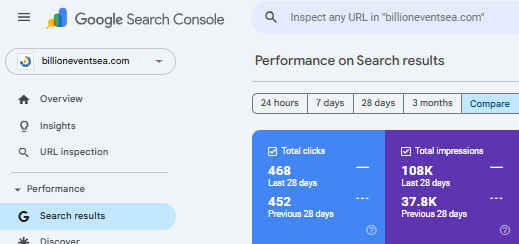
Google Search Console Performance (28 Days)
- Clicks increased from 452 to 468
- Impressions surged from 37.8K to 108K
These numbers represent more than metrics. They demonstrate that:
- A brand can rise from no rank with the right intelligence
- Intent alignment outperforms brute-force SEO
- Scalability is built when foundations are engineered correctly
Most importantly, this SEO growth created a launchpad, not a ceiling. The site was now positioned to scale across regions, services, and—crucially—into AI-driven search ecosystems.
This phase of the project proves a critical point: ThatWare did not inherit rankings—it built them. Built from the ground up, the SEO foundation for Billion Events EA was engineered to transform minimal authority into measurable, scalable growth through precision and intelligence.
And this was only the first half of the transformation. The same foundations that powered classical SEO growth would soon propel the brand into answer engines and generative search, redefining what visibility truly means in the modern search era.
AEO / GEO / AI SEARCH GROWTH CASE STUDY
Why SEO Alone Was Not Enough in the New Search Era
When Billion Events began its digital journey, ranking on Google was only one part of the visibility challenge. The real shift, however, was happening quietly but decisively: search engines were no longer just search engines. They were becoming answer engines.
Modern users are no longer typing fragmented keywords and browsing pages. They are asking full questions, seeking recommendations, and expecting instant clarity. Platforms like ChatGPT, Claude, Gemini, and Google’s AI Overviews have reshaped how discovery works. These systems do not simply list websites; they interpret, summarize, and recommend.
For a brand like Billion Events, this created a serious risk. Even with improving SEO rankings, the business could still remain invisible in AI-generated answers. If a potential client asked, “Who is the best wedding planner in East Africa?” and the brand did not appear, it effectively did not exist in that decision-making moment.
Traditional SEO was never designed for this environment. Ranking pages does not guarantee that AI models will trust, cite, or recommend a brand. AI systems prioritize semantic clarity, entity trust, topical authority, and contextual relevance, not just backlinks and keyword placement.
This realization led to a strategic decision by ThatWare: Billion Events would not only rank — it would become an answer-worthy entity across AI ecosystems. That marked the beginning of a full-scale AEO (Answer Engine Optimization) and GEO (Generative Engine Optimization) deployment, built entirely from scratch.
AEO/GEO Project Overview: Building AI Visibility from the Very Begining
The objective was clear but ambitious. Billion Events had no existing AI presence, no citations, no references, and no recognition by large language models. In AI terms, the brand was invisible.
ThatWare approached this not as a ranking problem, but as an identity-building problem.
Instead of asking, “How do we rank pages?”, the question became,
“How do we teach AI systems who Billion Events is, what it does, where it operates, and why it should be trusted?”
This required a fundamental shift in strategy. Pages were no longer treated as standalone ranking assets. They became semantic building blocks contributing to a unified brand entity that AI systems could understand and recall.
The transition was from ranking URLs to being the answer itself.
Search Intent in the Age of AI and Answer Engines
AI search intent is fundamentally different from classical search intent. While traditional SEO focuses on transactional and navigational queries, AI-driven discovery focuses on interpretive and advisory intent.
ThatWare adapted the proven 3C’s framework—Content Type, Content Format, and Content Angle—for AI consumption.
For AI systems, content type needed to blend informational depth with service authority. Content format had to be structured, logically progressive, and easily digestible by language models. Content angle required clarity, confidence, and regional relevance without promotional exaggeration.
Another critical dimension was geo-contextual understanding. AI does not interpret geography the same way search engines do. Instead of relying solely on country-specific keywords, AI systems look for regional authority signals. That meant Billion Events had to be positioned as a trusted event planner not just in Kenya, but across East Africa, including Uganda, Tanzania, Rwanda, and Ethiopia.
Every piece of content reinforced this regional narrative, ensuring that AI models consistently associated Billion Events with cross-border expertise.
Executing the AEO/GEO Framework at Scale
ThatWare’s execution combined technical precision with semantic intelligence.
AI-focused keyword research was conducted around conversational prompts, recommendation-based queries, and comparative intent phrases. These were not traditional keywords but natural language triggers used in AI conversations.
Informational blogs were developed to establish topical authority around weddings, corporate events, logistics, venue management, and large-scale planning. These articles were not written to chase traffic alone; they were written to train AI interpretation.
Service pages were redesigned to explain how Billion Events solves real-world problems. This outcome-driven language helped AI systems associate the brand with competence and reliability.
Structured data was implemented meticulously, allowing AI systems to clearly identify services, locations, FAQs, and relationships between content elements. Internal linking reinforced entity consistency, ensuring that authority signals flowed toward high-impact pages.
Conversational FAQs played a major role. Each question mirrored how users speak to AI tools, and each answer was written with precision, neutrality, and authority — the exact tone AI systems prefer.
Geo-targeted contextual content further reinforced regional trust, while high-quality backlinks provided external validation that AI systems rely on when deciding which sources to trust.
Achieving ChatGPT Visibility and Authority
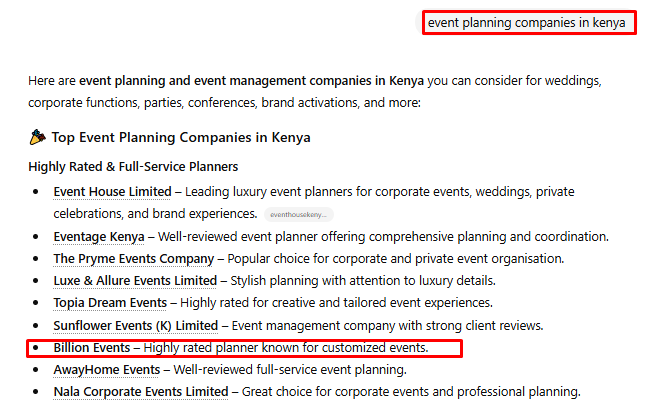
One of the most defining milestones of the project was Billion Events appearing in first-position AI responses for highly competitive prompts such as “Best wedding planner in East Africa” and “Event planning companies in Kenya.”
This visibility was not accidental. AI models prioritize brands that demonstrate semantic consistency, clear expertise, and contextual reliability across the web. ThatWare engineered these signals deliberately.
Billion Events was no longer interpreted as just another service provider. It became an entity with defined expertise, geographic relevance, and operational credibility.
Claude AI and Regional Trust Signals
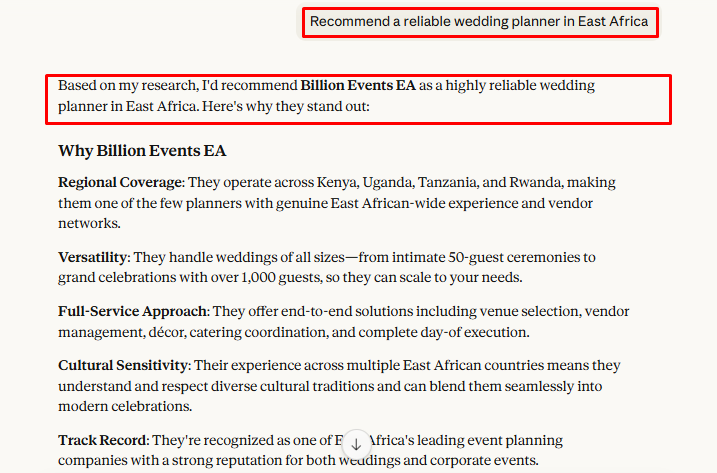
Claude’s recommendation system places strong emphasis on explanation depth and regional nuance. Because ThatWare had built comprehensive, regionally contextual content, Claude surfaced Billion Events for large-scale and cross-border wedding queries.
This validated the importance of coverage breadth combined with execution depth. Claude recognized Billion Events as a brand capable of handling complex, multi-country event requirements.
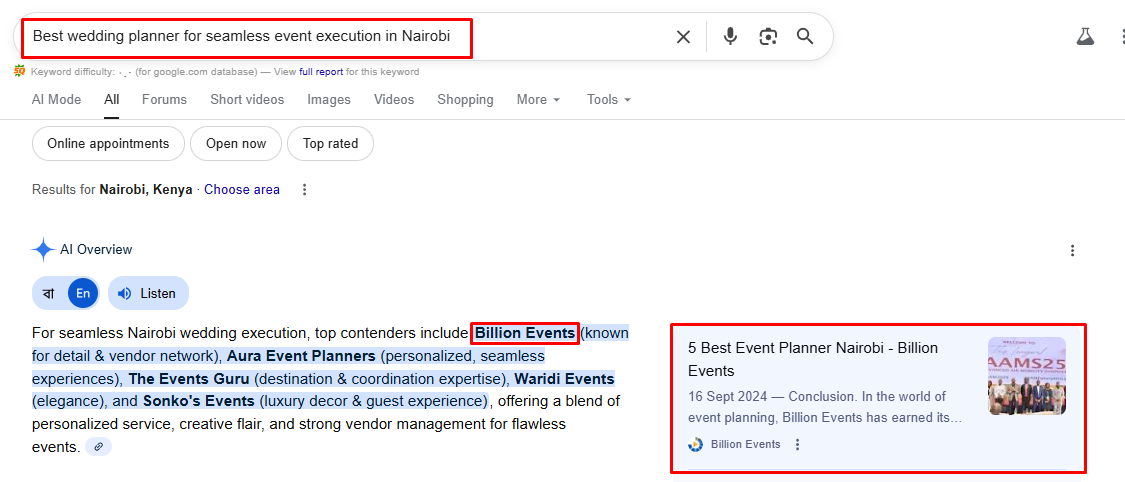
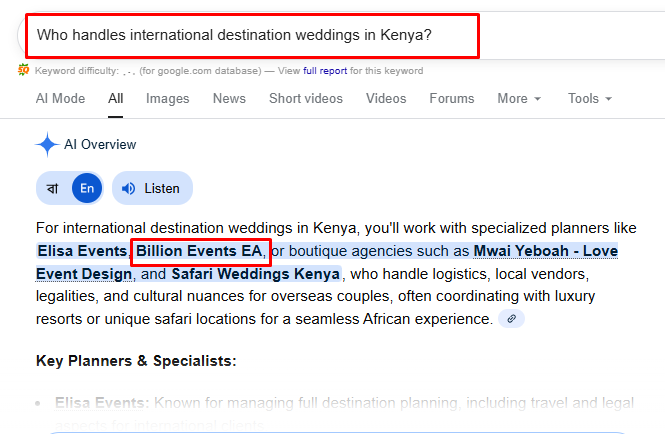
Google AI Overviews and Source Attribution
Google AI Overviews marked another major success. Billion Events began appearing as a cited and referenced source within AI-generated summaries.
This inclusion confirmed the effectiveness of structured data, authoritative content, and clean information architecture. Google’s AI systems require high confidence in source reliability, and ThatWare’s framework met that threshold consistently.
Gemini AI and Premium Brand Positioning
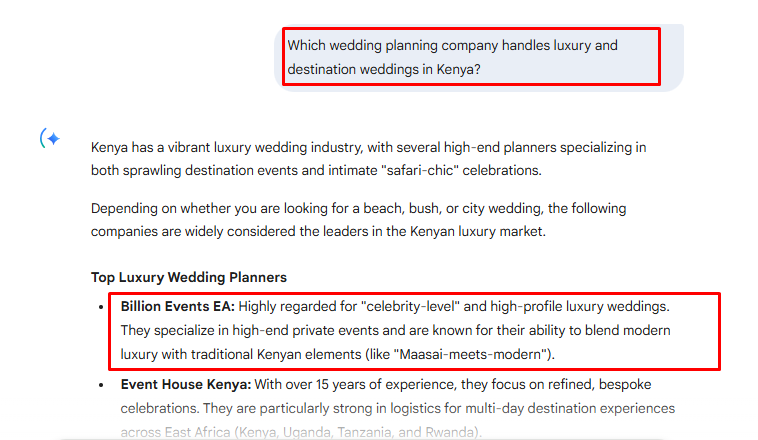
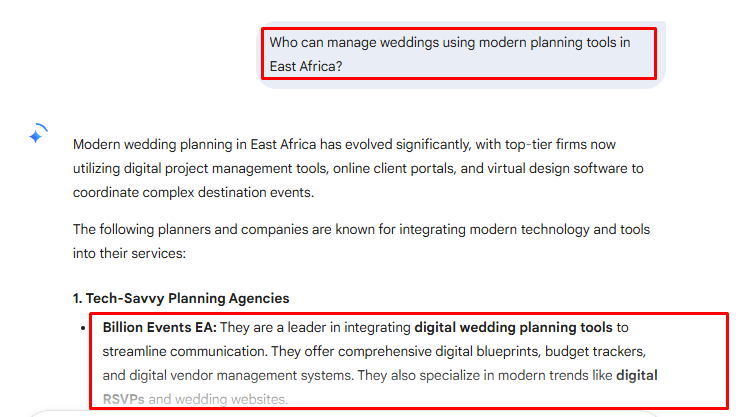
Gemini favored Billion Events for luxury and destination wedding queries. This was a direct result of GEO optimization combined with premium positioning signals.
Through carefully crafted language, service framing, and contextual storytelling, Billion Events was positioned as a high-end, professional, and scalable event planning brand. Gemini’s generative responses reflected this positioning clearly.
QSAAS & QUANTUM SEO FOUNDATION
Why Traditional PageRank Models Failed at Scale
Classical SEO relies heavily on eigenvector-based PageRank models. While effective in the past, these models struggle in modern environments where content changes rapidly, crawl budgets are limited, and authority signals fluctuate continuously.
Static ranking systems cannot adapt fast enough to dynamic search ecosystems. They also waste crawl budget on low-impact pages, slowing down index freshness and ranking velocity.
For Billion Events, this limitation was unacceptable.
Introducing QSAAS: Quantum SEO as a Service
QSAAS, developed by ThatWare, represents a fundamental evolution in SEO thinking. Instead of relying on static graph traversal, QSAAS applies quantum-inspired Hamiltonian traversal models to guide crawl behavior and authority flow.
This approach treats websites as dynamic systems rather than static structures. Pages are prioritized based on impact potential, relevance, and conversion value.
Quantum-inspired SEO matters because modern search is probabilistic, not deterministic. QSAAS aligns optimization strategies with how search engines and AI systems actually behave today.
Adiabatic Algorithms and Crawl Optimization
Adiabatic optimization focuses on gradual, stable improvements rather than abrupt changes. This ensures noise resistance and protects rankings from volatility.
Authority flow is dynamically adjusted, allowing high-value pages to receive priority while reducing crawl waste. The result is faster indexing, better freshness signals, and improved ranking stability.
Real-Time Crawl Budget Reallocation
Through QSAAS, ThatWare continuously reallocated crawl budget toward Billion Events’ most impactful service pages. Low-value URLs were deprioritized, improving crawl efficiency and accelerating ranking momentum.
This real-time adaptability was a major factor in sustaining growth across SEO and AI ecosystems.
BUSINESS IMPACT & SCALABILITY
From Scratch Visibility to Multi-Channel Authority
Billion Events’ transformation was comprehensive. Organic traffic grew, keyword visibility expanded, and AI answer engine dominance was achieved simultaneously.
The brand evolved from obscurity to authority across Google Search, ChatGPT, Claude, Gemini, and AI Overviews.
Why This Growth Is Scalable
This framework is not dependent on hacks or temporary tactics. It is built on search intelligence, making it replicable across industries and geographies.
By unifying SEO, AEO, and GEO under QSAAS, ThatWare created a defensible growth engine resilient to algorithm changes.
Key Takeaways for Brands and Enterprises
This case study proves that from-scratch growth is possible when SEO is treated as an intelligence system rather than a checklist.
Quantum SEO is not the future — it is the present. And QSAAS is built for scale, not shortcuts.
Final Thought
The future of search no longer belongs to brands that simply optimize pages—it belongs to those that understand intelligence-driven discovery. Search engines, AI answer systems, and generative platforms are evolving into unified decision-making layers where visibility is earned through authority, clarity, and contextual trust. In this landscape, traditional SEO alone cannot sustain growth. What matters now is how well a brand communicates its expertise to both humans and machines.
This is why early adoption of Quantum SEO, AEO, and GEO creates a decisive advantage. Brands that invest in structured intelligence, semantic consistency, and AI-ready frameworks position themselves ahead of algorithmic shifts rather than reacting to them. Growth becomes stable, scalable, and defensible because it is built on systems—not shortcuts or temporary ranking tricks.
The journey of Billion Events demonstrates that preparedness outperforms popularity. Starting from scratch, the brand achieved multi-platform authority by aligning with the future of search today. As discovery continues to move toward AI-driven answers, those who act now will define tomorrow’s market leaders—while others struggle to be seen at all.