SUPERCHARGE YOUR ONLINE VISIBILITY! CONTACT US AND LET’S ACHIEVE EXCELLENCE TOGETHER!
The search landscape has changed in a big way. Traditional SERPs, once central to digital discovery, are slowly being replaced by AI-generated answers. These answers appear instantly. They feel conversational. They understand context. Platforms like Google’s Search Generative Experience (SGE), ChatGPT, and a growing wave of voice-first assistants are reshaping how users search, judge, and engage with information. The old flow of keyword → results → click is fading. In its place are smooth, intent-driven conversations between people and intelligent systems.
This shift is where Answer Engine Optimization (AEO) comes into focus. It does not replace SEO. It builds on it. AEO is about aligning content with how modern AI models read language, detect intent, and create reliable answers in real time. Ranking on a page is no longer the main goal. The real goal is becoming the answer inside an AI-powered ecosystem.
As search continues to evolve, the stakes have never been higher. Brands that cling to traditional SEO playbooks risk losing digital visibility entirely. Those who adapt can establish themselves as authoritative sources that AI systems repeatedly reference and trust. This creates more than traffic. It builds long-term credibility, stronger topical authority, and sustained visibility across AI-generated search results.
This guide outlines the strategies, frameworks, and future-proof methodologies required to master Answer Engine Optimization (AEO). It also explains how to optimize for AI Overviews, featured snippets, voice search, conversational search queries, and zero-click searches. The goal is to create lasting relevance in an era where search engines increasingly rely on Natural Language Processing (NLP), entity recognition, semantic search, and structured data markup to deliver direct answers to users.
At ThatWare, we have been pioneering AI SEO, semantic SEO, schema markup optimization, and entity-based optimization long before they became industry standards. Our mission has not changed. We help forward-thinking brands strengthen their presence across evolving search ecosystems through advanced search intent optimization, knowledge graph optimization, topical authority building, and AI search visibility strategies. The focus is not only on rankings, but also on meaning, trust, answer relevance, and sustained discoverability in the age of AI-powered search.
What is AEO?
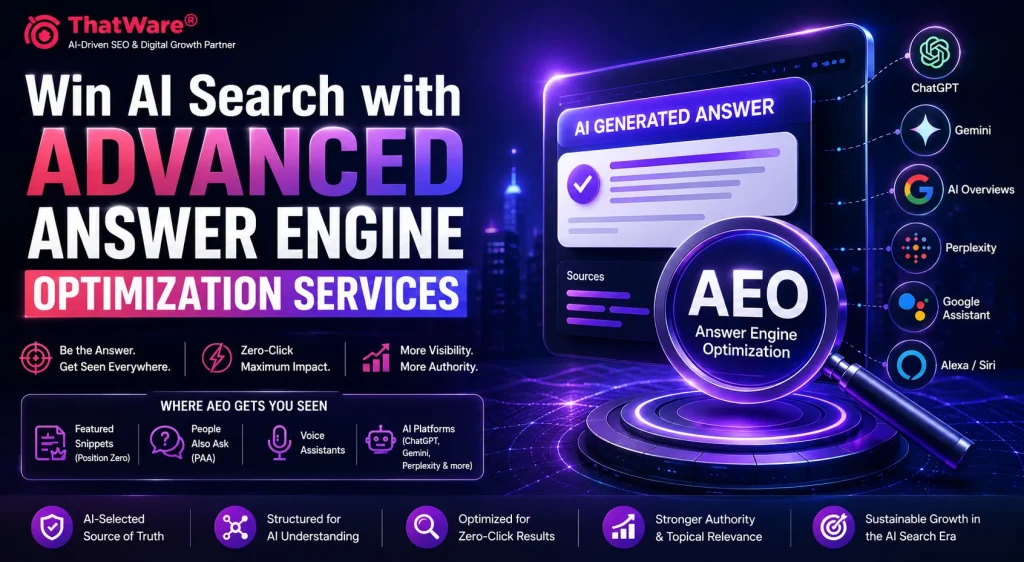
Answer Engine Optimization (AEO) is the practice of structuring and optimizing content so that AI-driven systems—like voice assistants, chatbots, and generative search engines—can extract, understand, and deliver it as a direct, authoritative answer.
Unlike traditional SEO, AEO focuses on intent fulfillment, semantic clarity, and answer precision rather than just rankings or keywords.
What is AEO in one sentence?
AEO ensures your content becomes the exact answer AI systems choose and present to users across search, voice, and conversational interfaces.
Why does it matter?
Because modern search is no longer about links—it’s about answers delivered instantly, often without clicks.
Where does AEO appear?
- Featured Snippets (Position Zero)
- People Also Ask (PAA)
- Voice assistants (Alexa, Siri, Google Assistant)
- AI platforms (ChatGPT, Gemini, Perplexity)
Core goal:
Turn your brand into a trusted, AI-selected source of truth.
Answer Engine Optimization (AEO) is an advanced evolution of search optimization that focuses on making content directly consumable by AI-powered systems. Instead of optimizing pages solely for search engine rankings, AEO ensures that content is structured, semantically rich, and contextually precise so that it can be extracted as a definitive answer to user queries.
At its core, AEO aligns content with how modern users search. Today’s users no longer type fragmented keywords—they ask complete, conversational questions through voice assistants, AI chat interfaces, and smart devices. This shift has transformed search behavior from “query-based” to “intent-driven.” AEO exists to bridge this gap by delivering highly relevant, structured answers that match user intent in real time.
Unlike traditional SEO, which relies heavily on keyword density, backlinks, and ranking positions, AEO emphasizes entity recognition, structured data, and contextual understanding. It leverages schema markup, FAQ frameworks, and semantic content models to help AI systems interpret relationships between concepts, not just words. This enables platforms like generative search engines and voice assistants to confidently select and present your content as the most accurate response.
A key distinction of AEO is its focus on zero-click visibility. In many cases, users receive answers directly from search interfaces without visiting a website. AEO ensures that even in these scenarios, your brand remains visible, cited, and trusted. This shifts the goal from driving traffic to establishing authority within AI ecosystems.
For ThatWare, AEO goes beyond implementation—it is a proprietary, AI-driven methodology that integrates Natural Language Processing (NLP), semantic SEO, and predictive search intelligence. By structuring content around entities, intent clusters, and conversational flows, we transform websites into answer-ready knowledge hubs.
Ultimately, AEO is not just an optimization technique—it is the foundation of visibility in an AI-first digital landscape, where the brands that provide the best answers win.
AEO Market Statistics Reveal the Rapid Shift Toward AI-First Search
Answer Engine Optimization (AEO), Generative Engine Optimization (GEO), and AI SEO are increasingly becoming essential components of modern search visibility. As AI-powered search systems move beyond displaying links and begin generating direct, synthesized answers, businesses are adapting their content strategies to become more understandable, relevant, and citable to machine-driven search environments. This evolution is creating a growing need for specialized expertise, making an AEO agency India increasingly relevant for businesses seeking visibility across AI-led search experiences.
AEO Market Growth Is Accelerating
The growing investment in AEO infrastructure demonstrates how quickly AI-driven search is developing. The global AEO software and tools market is estimated at $1.2 to $2.0 billion, with an annual growth rate of 45% to 60%. Such rapid expansion indicates that businesses are moving beyond conventional SEO practices and investing in technologies designed specifically for AI-powered discovery. For organizations preparing for this shift, an AEO company India can play a strategic role in developing content and optimization frameworks aligned with how answer engines interpret and surface information.
Businesses Are Redirecting SEO Budgets
The change is also visible in how organizations are allocating their content marketing budgets. Approximately 42% of B2B content marketers are actively shifting budgets away from traditional, keyword-centric SEO toward AEO-optimized content frameworks. This reflects a broader realization that simply ranking for keywords may not be sufficient when AI systems increasingly determine which information becomes part of the final answer presented to users.
Enterprise Adoption Is Becoming Strategic
AEO is also gaining traction at the enterprise level. Between 35% and 45% of Fortune 1000 companies now include explicit AEO strategies within their internal digital roadmaps or external agency briefs. This level of adoption signals that optimization for AI-generated answers is moving from experimentation toward structured digital strategy. As this transition accelerates, partnering with an Answer Engine Optimization agency India can help businesses build stronger foundations around machine-readability, semantic relevance, contextual authority, and AI citations.
Together, these statistics point to a fundamental change in search visibility: AI citations, machine-readability, semantic relevance, and contextual authority are becoming increasingly important alongside conventional rankings. For brands competing in AI-mediated search, AEO is evolving from an optional marketing enhancement into a strategic requirement for remaining discoverable wherever users seek answers.
The growing importance of AEO is also reflected in the increasing attention being given to organizations shaping this emerging search landscape. Read more about the leading AEO companies and how Answer Engine Optimization is changing search.
AEO Services Built for Brands That Want to Be Chosen by AI
Modern search is no longer limited to ranking on traditional search engine result pages. Buyers now ask questions directly through Google AI Overviews, ChatGPT, Gemini, Perplexity, Copilot, voice assistants, and other answer-first platforms. That shift has created a new need for answer engine optimization services that help brands become clear, trusted, and extractable sources of information.
ThatWare’s AEO services are designed for businesses that want to improve visibility wherever AI systems generate, summarize, cite, or recommend answers. Instead of treating AEO as a one-time content activity, we build a complete optimization framework around search intent, entity relationships, topical authority, structured data, answer formatting, and AI-readable trust signals.
As an answer engine optimization agency, ThatWare helps brands move from basic keyword rankings to answer ownership. Our role is not only to optimize content for search engines, but also to make your website easier for AI systems to understand, reference, and present in high-intent moments. This makes our approach suitable for brands that want a long-term AEO agency partner rather than a vendor that only adds FAQ schema or rewrites headings.
Businesses often look for an answer engine optimization company when they notice that traditional organic rankings are no longer enough to protect visibility. A page may rank well and still be missing from AI-generated answers. That is where an experienced AEO company can identify gaps in structure, content depth, semantic clarity, citations, and AI trust signals.
ThatWare also supports businesses that want to hire AEO experts for focused consulting, technical implementation, or full-scale strategy. Our team works across content, schema, NLP, knowledge graph optimization, AI visibility measurement, and platform-specific answer optimization. For companies that already have an in-house SEO team, our AEO consulting services can provide direction, audits, frameworks, and execution support without replacing the internal team.
If you need an answer engine optimization consultant, ThatWare can help assess how your existing website performs across AI search surfaces. This includes reviewing whether your pages are structured for featured snippets, answer boxes, AI Overviews, ChatGPT-style responses, voice search, and conversational discovery. We then translate that analysis into a practical roadmap that your content, SEO, development, and marketing teams can implement.
For decision-makers comparing the best AEO agency, the real question should be whether the agency understands how AI interprets brands, entities, context, source reliability, and user intent. The best answer engine optimization company is not the one that repeats keywords the most. It is the one that can make your content more useful, more structured, more credible, and easier for AI systems to select.
ThatWare operates as a strategic AEO service provider for brands that want measurable answer visibility. Our process includes content audits, semantic mapping, schema recommendations, AI citation analysis, conversational content design, entity SEO, technical SEO alignment, and ongoing performance tracking. This makes our methodology suitable for startups, growing companies, and enterprise teams that want scalable AEO execution. As an experienced AEO services company, ThatWare combines semantic optimization, structured content, entity intelligence, and AI visibility strategies to help brands become trusted sources across answer engines.
Whether you are searching for a top AEO agency, an answer engine optimization expert, or a partner to guide your AI visibility strategy, the goal remains the same: make your brand easier to understand, easier to trust, and easier to recommend in an AI-first search ecosystem.
Why AEO Matters Now
Rise of AI Search
Search has moved beyond static results into dynamic, AI-driven conversations. Users no longer type fragmented keywords. They ask full questions and expect clear, immediate answers. Platforms powered by artificial intelligence interpret intent, context, and semantics to deliver a single, precise response instead of a list of links.
This shift changes the rules of visibility. It is no longer enough to rank on page one. Content must be structured in a way that AI systems can understand, extract, and present instantly through Answer Engine Optimization (AEO). Businesses that adapt to this model position themselves directly within the answer layer, where decisions are made. Those that do not risk becoming invisible, even if they still rank.
AEO aligns content with how AI systems process information. It ensures your brand is not just indexed, but understood and selected as the most relevant answer.
Growth of Zero-Click Search
Zero-click search is rapidly becoming the dominant user behavior. In many cases, users get the information they need directly from the search results page without ever clicking a website. Featured snippets, answer boxes, and AI-generated summaries provide instant solutions, reducing the need for further exploration.
While this may seem like a loss of traffic, it is actually a shift in how authority is established. The brands that appear in these answer positions gain maximum visibility and trust, even without a click. Being the source of the answer is more powerful than being one of many options.
AEO enables this visibility by structuring content into clear, concise answers that can be easily extracted. It ensures your brand remains present in high-intent moments, capturing attention exactly when users are looking for solutions.
ChatGPT, SGE, and Conversational Interfaces
The rise of conversational AI platforms has fundamentally changed how users interact with information. Tools like ChatGPT and Google’s Search Generative Experience deliver synthesized responses that combine insights from multiple sources into a single, cohesive answer.
In this environment, traditional ranking signals are not enough. Content must be semantically rich, contextually accurate, and structured in a way that AI models can incorporate into their responses. Visibility now depends on whether your content can influence and contribute to these generated answers.
AEO prepares your content for this ecosystem. It focuses on clarity, structure, and intent so that AI systems can confidently use your content when forming responses. This increases not only visibility but also credibility, as users begin to rely on AI-generated answers for decision-making.
AEO is also reshaping how businesses build digital authority across increasingly fragmented search journeys. As AI systems evaluate information from multiple sources before generating an answer, brands need more than keyword-rich pages; they need consistent entities, authoritative information, structured content, and strong topical relevance. Effective AEO services India can help businesses align these elements so their expertise is easier for answer engines to interpret, validate, and reference. The objective is no longer simply to attract a visitor to a webpage, but to ensure that the brand becomes a recognizable and trustworthy source within the AI-generated answer itself. This makes AEO particularly valuable for businesses competing in high-intent searches where being cited can directly influence consideration and decision-making.
Building Visibility Across the AI Answer Layer
The growing influence of AI search also means that optimization must extend beyond individual queries and webpages. Businesses need to understand how answer engines connect topics, entities, user intent, and contextual signals when selecting information for generated responses. An experienced AEO consultant India can help identify these opportunities and develop a strategy around content architecture, semantic relationships, question-based optimization, and authority signals. This approach enables brands to build a stronger presence across conversational and generative search environments while complementing their existing SEO efforts. As search continues to evolve from ranking webpages to generating answers, establishing a credible position within this answer layer can become a significant competitive advantage.
As answer-driven discovery continues to reshape content visibility, strategic distribution and listing can play an important role in extending where and how authoritative content is discovered. Explore how strategic AEO listing partnerships can strengthen content reach in the evolving AI search ecosystem.
AI Search Optimization Services for ChatGPT, Gemini, Perplexity, Copilot and AI Overviews
As AI search becomes a major discovery channel, brands need more than traditional SEO. They need AI search optimization services that help their content appear across answer engines, generative search platforms, conversational assistants, and AI-generated summaries. ThatWare helps businesses strengthen their presence across this changing ecosystem through structured, semantic, and platform-aware optimization.
Our AI visibility services focus on improving how your brand is understood by AI systems. This includes how your content is connected to entities, how clearly your expertise is presented, how often your brand is cited or referenced, and how well your pages answer conversational queries. The aim is to improve AI visibility in a way that feels organic, useful, and aligned with real user intent.
ThatWare’s AI answer optimization services are built around the idea that AI systems prefer content that is direct, structured, context-rich, and trustworthy. Businesses looking for a ChatGPT AEO agency can work with ThatWare to improve content clarity, entity consistency, citation potential, and answer readiness across ChatGPT-driven discovery. We optimize pages so that answers are easier to extract, summarize, validate, and cite. This helps your website perform across AI Overviews, ChatGPT-style responses, Perplexity citations, Gemini summaries, and other AI-powered discovery surfaces.
For companies looking for an AI search visibility agency, ThatWare provides a complete framework that combines content strategy, technical optimization, entity mapping, structured data, and AI performance monitoring. As an AI search optimization company, we do not treat AI visibility as a separate silo. We connect it with SEO, content writing, schema, digital PR, brand authority, and conversion-focused user journeys.
Generative AI search optimization is especially important because large language models do not always behave like traditional search engines. They synthesize information, compare sources, infer context, and generate answers based on patterns of authority and clarity. ThatWare’s approach to generative engine optimization services helps improve the way your content contributes to AI-generated responses, even in cases where users do not click through to a website.
Our LLM optimization services focus on making your website more understandable to large language models. This includes improving content structure, reducing ambiguity, strengthening entity signals, clarifying service definitions, and building answer-ready knowledge blocks. These same principles also support LLM SEO services, where the objective is to improve discoverability across AI models, generative search engines, and answer-driven platforms.
ChatGPT is one of the most important AI discovery environments for modern brands. ThatWare provides ChatGPT optimization services for businesses that want their content to become clearer, more citable, and more useful in AI-generated answers. This includes ChatGPT optimization, ChatGPT SEO, ChatGPT visibility optimization, and ChatGPT citation optimization.
For brands that want to optimize website for ChatGPT, the process begins with content clarity, entity consistency, authoritative references, structured service explanations, and strong topical coverage. Ranking in ChatGPT is not the same as ranking in Google, but the same principles of trust, relevance, authority, and clarity still matter. If your audience is asking how to appear in ChatGPT answers, your website must provide information that AI systems can confidently interpret and reuse.
ThatWare’s ChatGPT answer optimization process improves how pages respond to direct questions, comparison queries, buyer-intent prompts, and industry-specific searches. For businesses seeking a ChatGPT SEO agency, we provide both the strategy and implementation needed to prepare content for AI-first discovery.
We also support Perplexity optimization for brands that want stronger citation visibility in source-based AI answers. Since Perplexity often relies on cited responses, content needs to be factually clear, well-structured, and supported by trustworthy signals. This makes AI citation optimization and AI citation optimization services essential parts of a broader AEO strategy.
Google AI Overview optimization is another major focus area. Google’s AI-generated summaries can influence visibility before a user reaches organic results. Our AI Overview optimization services help pages become more suitable for inclusion in AI summaries by improving answer formatting, schema structure, topical authority, and content alignment with search intent.
ThatWare also provides Gemini optimization services and Copilot optimization for brands that want visibility beyond Google Search alone. Each platform processes and presents information differently, so our approach adapts content for multiple AI environments rather than relying on one generic optimization method.
The larger goal is AI visibility optimization services that make your brand more discoverable wherever users ask questions. This includes AI discoverability optimization, AI answer optimization, AI citation optimization, semantic SEO services, entity SEO services, and knowledge graph optimization. Together, these methods help AI systems understand not just what your page says, but why your brand should be trusted as a relevant answer source.
How AEO Works?
AEO works by transforming traditional content into structured, intent-driven answers that AI systems can easily extract, interpret, and deliver. This process is not linear. It combines semantic engineering, content restructuring, and AI alignment to ensure maximum visibility across answer-based platforms.
Structured Answers
The process begins with identifying user intent at multiple levels—primary, secondary, and conversational. Instead of focusing only on keywords, AEO analyzes how users naturally ask questions. This includes long-tail queries, voice-based phrasing, and multi-turn interactions. Understanding intent ensures that content addresses not just one query, but an entire cluster of related questions.
Once intent is defined, content is reorganized into clear, modular answer blocks. This includes concise definitions, step-by-step explanations, FAQs, and structured summaries. The goal is to make content easily scannable for both users and AI systems.
AEO also focuses on answer optimization for AI platforms. Content is crafted to be concise, conversational, and context-aware. Predictive answering is introduced by anticipating follow-up questions and embedding them within the content structure. This ensures your content performs well across conversational interfaces and AI-driven responses.
Entity Optimization
Entities and relationships are embedded within the content so that search engines and AI systems can understand context, not just text. This allows your content to be recognized as part of a broader knowledge framework rather than isolated information.
AI Answer Optimization relies heavily on structured data such as FAQ schema, HowTo schema, and entity markup. These elements act as signals that guide AI systems in extracting precise answers. By aligning content with entities, brands improve recognition, credibility, and authority across AI-driven platforms.
Content Formatting
Content formatting plays a critical role in making information accessible across multiple platforms. AEO ensures answers are structured for multi-modal distribution, including text, voice, and visual interfaces. This includes optimization for voice search, featured snippets, chatbots, and emerging environments.
Finally, AEO involves continuous learning and optimization. Performance is tracked using AEO-specific KPIs such as featured snippet presence, voice visibility, semantic traffic growth, and AI citation frequency. Content is continuously refined based on real-time data, ensuring sustained dominance in answer-driven search environments.
Global Recognition for AI-Powered Search Innovation & SEO Leadership
Pioneering the Future of AI-Driven Search
ThatWare has earned international recognition for redefining the future of search through the integration of Artificial Intelligence, Semantic Engineering, Machine Learning, Entity Intelligence, and Large Language Model (LLM) optimization.
Long before AI-powered search became mainstream, ThatWare was actively researching and implementing advanced frameworks centered around semantic search, NLP, knowledge graphs, predictive algorithms, machine learning, and intelligent automation. Today, the company stands among a select group of agencies globally recognized for bridging the gap between traditional SEO and AI-first search ecosystems.
The company’s innovation portfolio now spans proprietary frameworks including AI Visibility Modeling (AVM®), Vector Entity Modelling (VEM®), Generative Engine Optimization (GEO), Answer Engine Optimization (AEO), AI Discovery Optimization (ADO), Entity Authority Engineering (EAE), Knowledge Graph Optimization (KGO), and LLM SEO Framework™.
This research-led approach has helped establish ThatWare as one of the world’s most recognized AI SEO companies.
Featured at TEDx for SEO & AI Innovation
One of ThatWare’s most notable achievements is being recognized and featured at TEDx, becoming one of the very few SEO-focused organizations to receive such recognition.
This milestone highlights the company’s contribution to advancing conversations around Artificial Intelligence, digital transformation, semantic search, and the future of online visibility. The TEDx platform provided an opportunity to showcase how AI and machine learning are reshaping search behavior and business growth globally.
Representing India at BrightonSEO
ThatWare has proudly represented India at BrightonSEO, one of the world’s largest and most respected search marketing conferences.
Participation in BrightonSEO positioned the company alongside leading global search professionals, technology innovators, and digital strategists, reinforcing ThatWare’s reputation as an international thought leader in AI-powered SEO and search intelligence.
Stevie® Awards Recognition
Founder Tuhin Banik and ThatWare have been publicly associated with recognition at the prestigious Stevie® Awards in the United States.
Widely regarded as one of the world’s premier business award programs, the Stevie Awards acknowledge innovation, entrepreneurship, and business excellence across global industries.
For ThatWare, this recognition validates years of investment in AI-driven SEO methodologies, semantic engineering, and next-generation search technologies.
Forbes DGEMS 200 Recognition
ThatWare has also been recognized among Forbes DGEMS 200, an acknowledgment reserved for high-growth organizations demonstrating exceptional innovation, leadership, and business excellence.
This recognition reflects the company’s continued impact on the digital marketing landscape through proprietary AI technologies, research-led SEO methodologies, and transformative search strategies.
Analytics Insight: Top 100 Influential Technology Leaders
Founder Tuhin Banik has been recognized by Analytics Insight among the Top 100 Influential Technology Leaders.
This distinction extends beyond the SEO industry and places him within a broader community of technology innovators, AI pioneers, and digital transformation leaders.
His contributions to semantic search, machine learning applications, AI visibility optimization, and future search intelligence continue to influence how organizations approach digital growth in the AI era.
India Business Awards & India Technology Awards
ThatWare and its founder have received recognition through both the India Business Awards and India Technology Awards.
These accolades reflect the company’s unique position at the intersection of business growth and technological innovation. While many agencies focus solely on marketing outcomes, ThatWare differentiates itself through proprietary technology development, AI research, semantic engineering, automation systems, and advanced search intelligence frameworks.
These recognitions acknowledge both the commercial success and technological advancement driven by the organization.
Global Industry Recognition & Review Platforms
ThatWare has consistently been recognized by leading global business and agency review platforms for delivering innovative SEO and AI-driven digital solutions.
Notable recognitions include:
- Clutch Global Recognition
- GoodFirms Industry Rankings
- The Manifest Featured Agency Listings
- DesignRush Agency Recognition
- TopDevelopers Industry Recognition
- Expertise.com Featured Agency Mentions
- Agency Vista Recognition
These independent platforms evaluate agencies based on verified client reviews, market presence, service quality, innovation, and overall industry performance.
Innovator in AI SEO, Semantic Search & LLM Optimization
What distinguishes ThatWare from traditional agencies is its commitment to research, experimentation, and technology innovation.
The company has become widely recognized for advancing disciplines such as:
- Artificial Intelligence SEO (AI SEO)
- Large Language Model Optimization (LLM SEO)
- Generative Engine Optimization (GEO)
- Answer Engine Optimization (AEO)
- Semantic Search Engineering
- Knowledge Graph Optimization
- Entity Authority Development
- Machine Learning-Based Search Optimization
- Predictive Search Intelligence
- AI Visibility Optimization
Through continuous R&D and proprietary framework development, ThatWare has helped shape the evolution of modern search beyond rankings and toward AI discoverability, recommendation visibility, and digital entity authority.
Recognition Built on Innovation
While awards and recognitions validate achievement, ThatWare’s strongest distinction comes from its ongoing contribution to the future of search.
The company continues to invest heavily in artificial intelligence, semantic engineering, vector search technologies, entity intelligence systems, and AI recommendation optimization frameworks that help businesses become more visible across search engines, answer engines, voice assistants, and generative AI platforms.
As search transitions from keywords to entities, from rankings to recommendations, and from pages to AI-generated answers, ThatWare remains committed to leading that transformation through innovation, research, and technology.
Why Businesses Need AEO in the Age of AI Search
Search behavior is rapidly shifting from keyword-based browsing to answer-driven discovery. Users increasingly rely on Google AI Overviews, ChatGPT, Gemini, Perplexity, voice assistants, and other AI-powered platforms to receive direct answers rather than browse multiple search results. AI Search SEO helps businesses structure their content, authority signals, and digital presence to become the answer users see first. Traditional SEO remains important, but AEO extends visibility into modern AI-powered search experiences.
AEO vs Traditional SEO: What’s the Difference?
| Optimization Factor | Traditional SEO | Answer Engine Optimization (AEO) |
|---|---|---|
| Primary Goal | Rank web pages in search results | Become the direct answer to user queries |
| Search Focus | Keywords and rankings | Questions, intent, and answers |
| Visibility Surface | Search Engine Results Pages (SERPs) | AI Overviews, Featured Snippets, Voice Search, AI Assistants |
| User Journey | Click-through focused | Instant-answer focused |
| Content Structure | Keyword-oriented content | Conversational, answer-focused content |
| Featured Snippet Optimization | Limited | Core Focus |
| FAQ & Question Mapping | Optional | Essential |
| Voice Search Optimization | Basic | Advanced |
| Structured Data Usage | Helpful | Critical |
| AI Search Readiness | Limited | High |
| ChatGPT Visibility | Not Optimized | Optimized |
| Gemini Readiness | Not Optimized | Optimized |
| Perplexity Citation Potential | Limited | Enhanced |
| Entity Authority Development | Limited | Core Strategy |
| Knowledge Graph Integration | Rarely Included | Frequently Leveraged |
| AI Citation Opportunities | Low | High |
| Future Search Readiness | Moderate | High |
THATWARE ADVANTAGE
Transition: AEO → AIEO
At ThatWare, the advantage lies in how we evolve optimization beyond traditional Answer Engine Optimization (AEO) into Artificial Intelligence Experience Optimization (AIEO). While AEO focuses on ensuring your content is selected as an answer by AI systems, AIEO goes deeper into how AI systems form preferences, assign trust, and decide which brand feels safest to recommend. This shift marks a transition from visibility-based optimization to cognitive influence within AI decision-making systems.
AEO ensures your presence in AI-generated answers, but AIEO ensures your brand is preferred within those answers. This is a critical distinction because modern AI systems do not just retrieve information, they evaluate confidence, relevance, and risk before generating responses. ThatWare works at this deeper level by engineering how AI systems interpret your brand across multiple contextual layers.
Through the AIEO framework, we focus on shaping internal reasoning paths used by AI models, improving probability mapping, and strengthening confidence signals associated with your content. This ensures that your brand is not only visible but consistently prioritized in AI-generated outputs. In this model, recommendation bias becomes the new ranking system, and AI confidence becomes the new authority metric.
At ThatWare, we are building the bridge between AEO and AIEO, helping brands move from being discovered by AI to being preferred by AI. This transition defines the future of search, where success is measured not by rankings or clicks, but by cognitive selection and trust within intelligent systems.
AI answer optimization services strengthen the signals that help intelligent systems interpret content as accurate, relevant, and trustworthy. By combining semantic relationships, entity consistency, contextual authority, and intent alignment, brands can move beyond appearing in AI-generated responses. The goal is to become a consistently trusted source that AI systems are more likely to select, reference, and recommend.
As AI-generated summaries become more prominent within search, brands must optimize how their information is interpreted and represented. A Google AI Overview optimization agency focuses on strengthening content signals that help AI systems understand expertise, validate information, and connect it with user intent. This creates a unified approach where SEO, AEO, and AIEO collectively build visibility, authority, and trust.
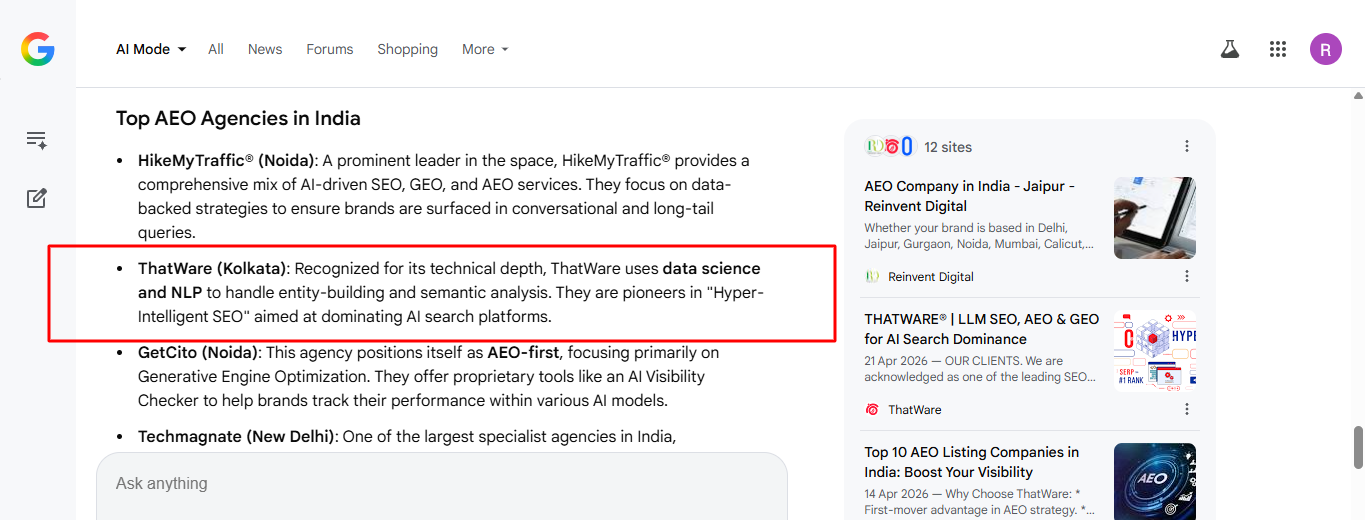
Recognition Built on Innovation, Research & AI-Powered Search Leadership
At ThatWare, recognition has never been the primary goal. Our focus has always been on pushing the boundaries of what search can achieve through artificial intelligence, semantic engineering, machine learning, and advanced search intelligence.
Long before AI-powered search became a mainstream discussion, our team was exploring how search engines understand context, entities, relationships, and user intent. This research-first mindset helped us develop proprietary frameworks that today support AI Visibility Optimization, LLM SEO, Generative Engine Optimization (GEO), Answer Engine Optimization (AEO), Vector Entity Modelling (VEM®), and other next-generation search methodologies.
Over the years, this commitment to innovation has earned recognition from global platforms, industry bodies, technology communities, and business leaders worldwide.
Featured at TEDx
One of the most meaningful milestones in our journey was being featured at TEDx.
For us, this recognition was not simply about visibility—it was an opportunity to contribute to larger conversations around technology, innovation, artificial intelligence, and the future of digital transformation.
Being associated with a platform known for sharing groundbreaking ideas reinforced our belief that SEO is no longer just a marketing function. It is becoming an integral part of how information is discovered, understood, and delivered in the age of AI.
Representing India at BrightonSEO
ThatWare has also had the privilege of representing India at BrightonSEO, one of the world’s most respected search marketing conferences.
BrightonSEO brings together some of the brightest minds in search, technology, data science, and digital strategy. Being part of this global community allowed us to exchange ideas, explore emerging trends, and showcase how AI and semantic technologies are transforming the future of search.
It also reinforced our position as a company actively contributing to the evolution of the industry rather than simply following it.
Stevie® Awards Recognition
Our work has also been recognized through the prestigious Stevie® Awards.
Often regarded as one of the world’s leading business award programs, the Stevie Awards celebrate innovation, entrepreneurship, and excellence across industries.
For ThatWare, this recognition reflects years of investment in research, experimentation, and the development of AI-driven SEO frameworks that help businesses adapt to an increasingly intelligent search landscape.
Forbes DGEMS 200 Recognition
Being recognized within the Forbes DGEMS 200 ecosystem was another important milestone for our organization.
This acknowledgment highlights companies that demonstrate innovation, leadership, and business impact within their respective industries.
For us, it validated the unique approach we have taken—combining advanced technology, AI research, semantic search engineering, and performance-driven digital marketing into a unified growth framework.
Analytics Insight: Top 100 Influential Technology Leaders
Our Founder, Tuhin Banik, has also been recognized by Analytics Insight among the Top 100 Influential Technology Leaders.
This recognition extends beyond traditional SEO and reflects contributions to broader conversations around artificial intelligence, machine learning, semantic systems, and digital innovation.
As search continues to evolve, we believe leaders must not only adapt to change but actively help shape it. This recognition reflects that ongoing commitment to innovation and thought leadership.
India Business Awards & India Technology Awards
ThatWare’s journey has also been acknowledged through the India Business Awards and India Technology Awards.
These recognitions are particularly meaningful because they reflect two core aspects of our identity.
On one hand, we help businesses achieve measurable growth through improved visibility, traffic, leads, and revenue. On the other, we continuously invest in building proprietary technologies, AI frameworks, and advanced methodologies that redefine how digital marketing operates.
These awards recognize the balance between business performance and technological innovation that has become central to our approach.
Trusted by Leading Industry Platforms
Beyond formal awards, ThatWare has consistently earned recognition from respected global review and research platforms.
Our company has been featured and recognized across platforms such as Clutch, GoodFirms, The Manifest, DesignRush, TopDevelopers, and other industry-leading directories that evaluate agencies based on verified client feedback, service quality, innovation, and market performance.
These recognitions are especially valuable because they come directly from client experiences and real-world business outcomes.
Recognition for Pioneering AI SEO
Perhaps the recognition we value most comes from the industry itself.
Over the years, ThatWare has become widely known for its work in integrating Artificial Intelligence into SEO long before AI optimization became a mainstream service offering.
Today, our research and innovation efforts extend across:
- AI SEO
- LLM SEO
- Generative Engine Optimization (GEO)
- Answer Engine Optimization (AEO)
- Semantic Search Engineering
- Knowledge Graph Optimization
- Entity Authority Development
- AI Visibility Optimization
- Machine Learning-Driven Search Strategies
- Advanced Search Intelligence Systems
These innovations continue to help businesses strengthen their presence not only on traditional search engines but also across AI platforms such as ChatGPT, Gemini, Claude, Perplexity, Copilot, and emerging generative search ecosystems.
Looking Ahead
While we are grateful for every award, recognition, and milestone, we believe our most important work still lies ahead.
Search is undergoing one of the biggest transformations in its history. As AI becomes increasingly responsible for how information is discovered and recommended, businesses need new strategies that go beyond traditional rankings.
ThatWare remains committed to leading this transition through continuous research, innovation, and the development of technologies that help brands become more discoverable, understandable, trustworthy, and recommendable in the AI era.
For us, recognition is not just a reflection of past achievements—it is motivation to continue building the future of search.
The journey ahead is defined by one goal: helping brnds earn meaningful visibility across an increasingly AI-driven search ecosystem. From AEO and GEO to ChatGPT answer optimization, ThatWare continues to combine research, technology, and search intelligence to shape how brands are discovered, understood, trusted, and recommended by intelligent systems, turning innovation into sustainable digital advantage.
CASE STUDY / RESULTS SECTION (PLACEHOLDER)
Real Impact of AEO Services
At ThatWare, our Answer Engine Optimization (AEO) approach is about optimize website for ai search and built to deliver measurable visibility across AI-driven search ecosystems, not just traditional SERPs. The following case studies demonstrate how our enterprise AEO services have helped brands achieve significant improvements in AI answer inclusion, featured snippet visibility, and zero-click search performance. These results highlight how answer engine optimization services can directly influence how AI systems select and present brands as trusted sources.
Case Study 1: Housiey (Real Estate Platform)
This case study demonstrates the successful implementation of AEO strategies for Housiey, a real estate platform operating in a highly competitive property discovery market. The primary objective was to increase qualified traffic from real estate-related queries while improving visibility across AI-generated search environments.
Project Objectives & Challenges
The core goal was to acquire high-quality traffic from property-related queries in a space dominated by strong competitors. Initially, the platform faced low visibility specifically from AI-driven sources such as ChatGPT, Gemini, and Perplexity. Traditional SEO performance alone was not sufficient to capture emerging AI search demand.
AEO Performance Growth (GA4 Data)
After implementing ThatWare’s top AEO agencies framework, significant performance improvements were recorded across major AI search engines:
| AI Engine | Session Increase | Engaged Session Increase |
| ChatGPT | 0.1167 | 0.1983 |
| Gemini | 0.5333 | 0.4444 |
| Perplexity | 1.8136 | 2.4634 |
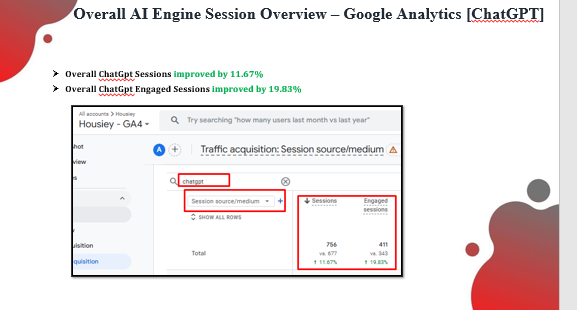
These results demonstrate a strong increase in both visibility and engagement across AI-powered discovery platforms, confirming the effectiveness of structured answer engine SEO implementation.
Search Visibility & Authority Improvements
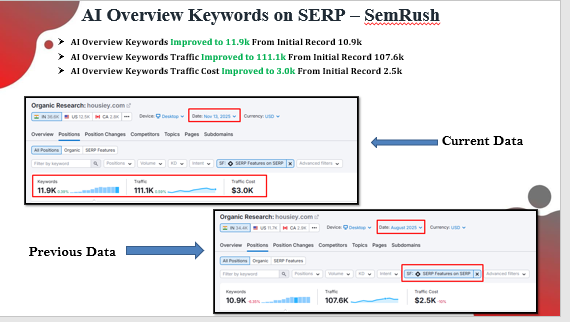
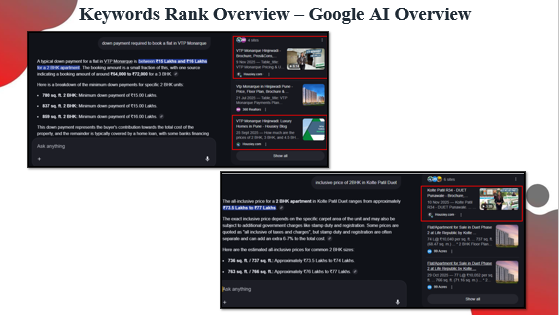
Beyond traffic growth, the campaign also delivered strong improvements in AI Overview visibility and keyword expansion:
- AI Overview keyword coverage grew from 10.9K to 11.9K
- Monthly traffic from AI Overviews increased from 107.6K to 111.1K
- Estimated traffic value improved from $2.5K to $3.0K
- Increased citation frequency in AI-generated responses for high-intent real estate queries
Housiey began appearing as a frequently referenced source in AI answers for queries such as:
- “Down payment required to book a flat in VTP Monarque”
- “Inclusive price of 2BHK in Kolte Patil Duet”
This demonstrates how AEO services can influence not just visibility, but direct inclusion in AI-generated decision-making responses.
Case Study 2: Pull Up Banners Australia (Multi-AI Visibility Campaign)
This campaign focused on positioning Pull Up Banners Australia as the dominant answer across multiple AI-driven platforms, including ChatGPT, Gemini, Claude, Perplexity, Google AI Overviews, and Google Maps integrations.
The primary objective was to ensure consistent brand dominance across AI answer engines for high-intent commercial queries such as “best pull up banner in Melbourne.”
Multi-Platform AI Visibility Results
The campaign successfully established strong visibility across all major AI systems:
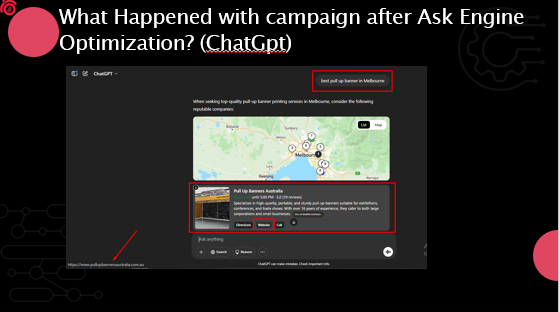
ChatGPT Results
- Query: best pull up banner in Melbourne
- Result: Featured business card for Pull Up Banners Australia
- Includes rating of 5.0 with strong review signals
- Direct actions: Website, directions, call options
- Positioned as a trusted local provider with strong authority signals
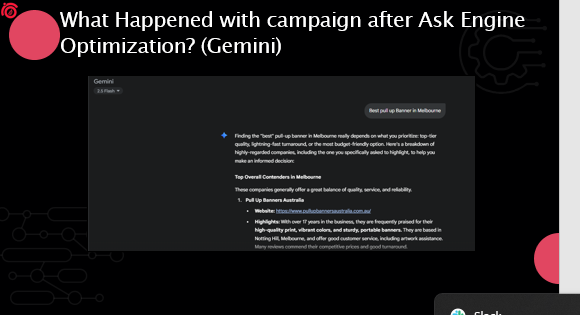
Gemini Results
- Ranked as #1 overall contender in Melbourne
- Highlighted for 17+ years of industry presence
- Recognized for high-quality print output and durable banner solutions
- Strong location association with Notting Hill, Melbourne
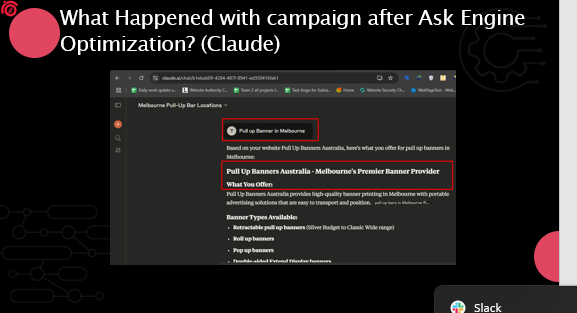
Claude Results
- Positioned as Melbourne’s premier banner provider
- AI-generated structured breakdown of product categories:
- Retractable banners
- Roll-up banners
- Pop-up displays
- Double-sided external banners
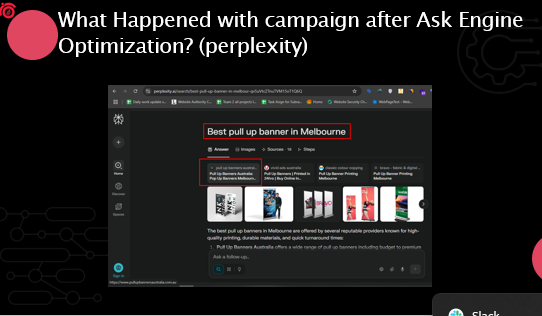
Perplexity Results
- Displayed in product carousel format
- Cited as a primary source across multiple references
- Strong inclusion in AI-generated shopping-style responses
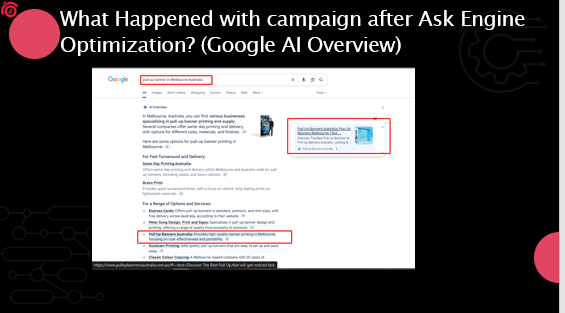
Google AI Overview Results
- Featured prominently in AI summary panel
- Highlighted in both sidebar and main response blocks
- Positioned as a affordable cost of AEO services and high-quality banner provider in Melbourne
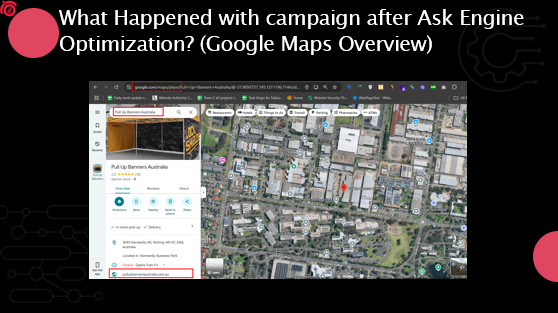
Google Maps Integration Results
- Full business visibility with:
- 5.0-star rating
- Verified location in Notting Hill, VIC
- Direct website integration and navigation support
Key Outcome
This campaign demonstrates how ThatWare’s AEO framework enables brands to achieve multi-AI system dominance, ensuring consistent inclusion across conversational AI, generative search engines, and hybrid search interfaces.
By optimizing for answer engine SEO and structured AI interpretation signals, Pull Up Banners Australia achieved strong recommendation bias across platforms, ensuring it was repeatedly selected as a primary answer source.
Case Study 4: How ThatWare Transformed HitchedIndia’s AI Search Visibility
Overview
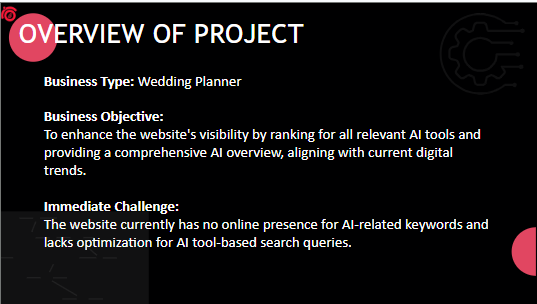
ThatWare partnered with HitchedIndia, a wedding planning business, to strengthen its visibility across emerging AI-powered search platforms. The primary objective was to establish the website’s presence for AI-related searches and ensure that its content could be surfaced across platforms such as ChatGPT, Claude, Gemini, and Google AI Overview.
Unlike a conventional SEO campaign focused primarily on Google rankings, the campaign was designed around AEO and GEO, with the goal of positioning HitchedIndia as a relevant recommendation when users ask AI tools for wedding planner and destination wedding recommendations.
The Challenge
HitchedIndia faced a significant visibility gap within the rapidly evolving AI search landscape:
- No Existing AI Search Presence: The website had no established visibility for AI-related keywords.
- Limited AI Tool Optimization: The website was not optimized to appear in responses generated by major AI platforms.
- Competitive Wedding Search Market: The campaign needed to establish visibility for wedding planner searches across multiple cities and destination-wedding locations.
- Need for AI-Ready Content: Existing content required restructuring so that AI systems could better understand, retrieve, and recommend relevant information.
- Multi-Platform Visibility: The objective extended beyond a single search engine to platforms including ChatGPT, Claude, Gemini, and Google AI Overview.
Strategy & Implementation
ThatWare implemented an AI-search-focused AEO and GEO strategy combining keyword research, structured content, landing pages, internal linking, visual assets, FAQs, and geo-targeted optimization.
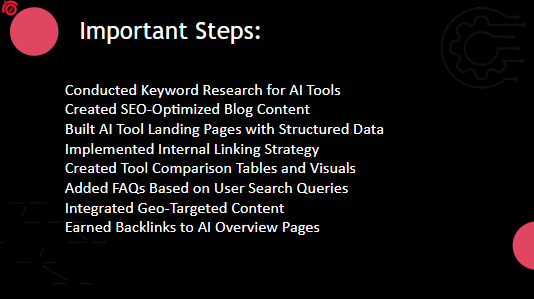
- AI Keyword Research: Extensive keyword research was conducted specifically around searches users could make through AI tools.
- SEO-Optimized Content: Blog content was created and optimized around relevant wedding planning and destination wedding queries.
- AI Tool Landing Pages: Dedicated AI-tool landing pages were developed with structured data to improve machine understanding and discoverability.
- Internal Linking: A structured internal linking strategy was implemented to connect relevant content and strengthen topical relationships across the website.
- Comparison Tables & Visual Content: Tool comparison tables and visual elements were incorporated to make information more structured and accessible.
- FAQ Optimization: FAQs were developed based on actual user search queries to provide direct, answer-oriented information.
- Geo-Targeted Content: Location-specific content was integrated to target wedding planning searches across key destinations and cities.
- Backlink Acquisition: Backlinks were earned specifically toward AI Overview-focused pages to strengthen their authority and discoverability.
Key Results & AI Search Performance
The campaign generated visibility across four major AI-driven search environments, with HitchedIndia appearing prominently for multiple wedding planner and destination wedding queries.
ChatGPT Visibility:
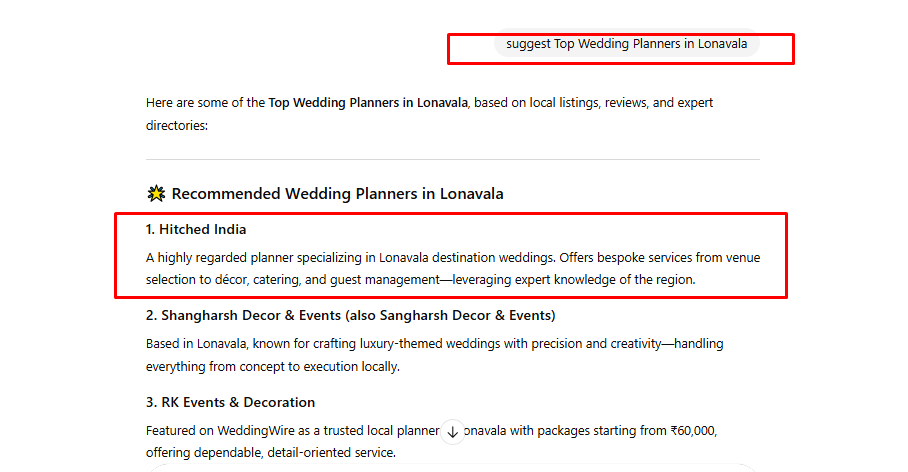
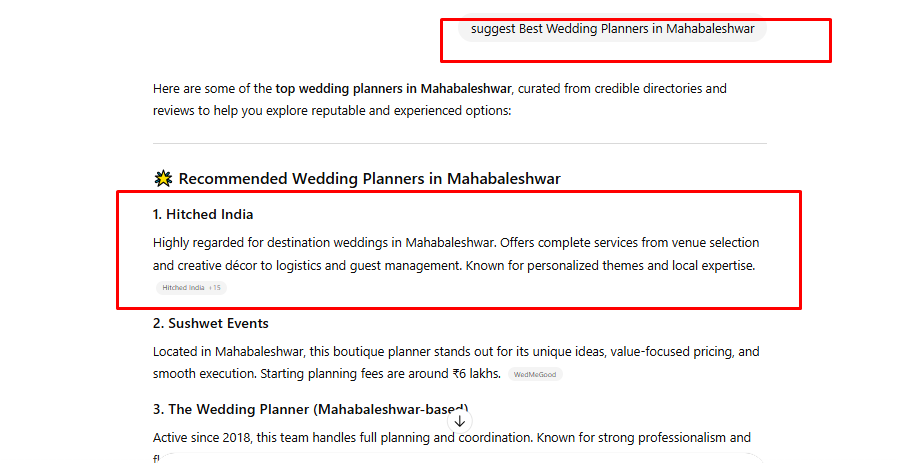
- Position #1 for “Top Wedding Planners in Lonavala.”
- Position #1 for “Best Wedding Planners in Mahabaleshwar.”
This established HitchedIndia as the top suggested website in ChatGPT for both Lonavala and Mahabaleshwar-focused wedding planner searches.
Claude Visibility:
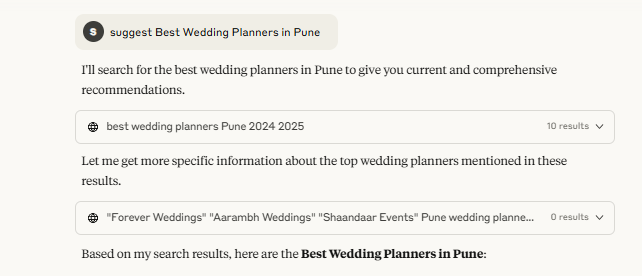
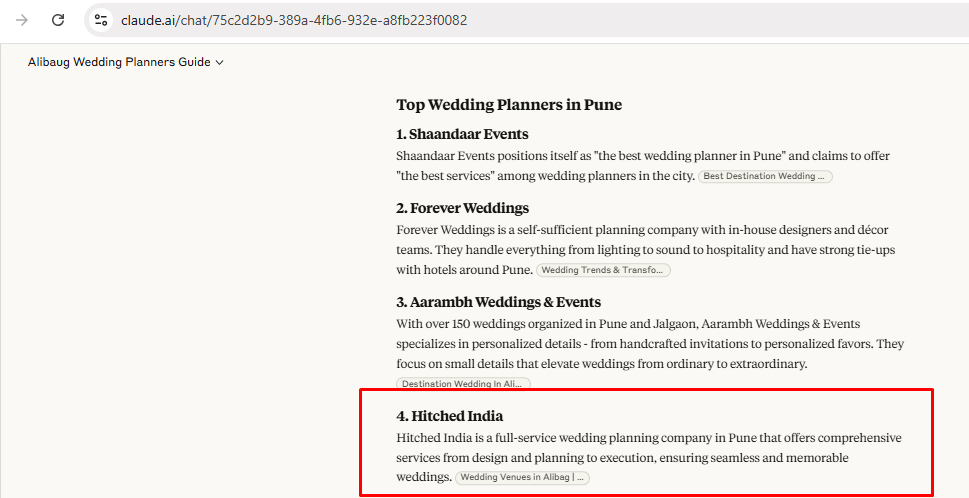
- Position #4 for “Best Wedding Planners in Pune.”
- Position #4 for “Luxury wedding planner in Pune.”
The results demonstrate that the campaign successfully expanded HitchedIndia’s AI visibility beyond ChatGPT into Claude for both general and luxury wedding-planning searches.
Gemini Visibility:
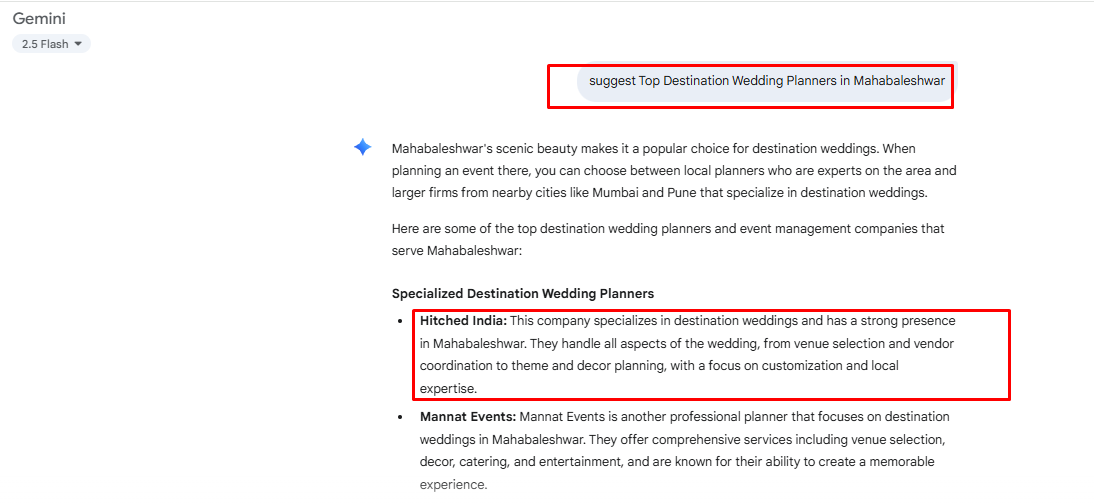
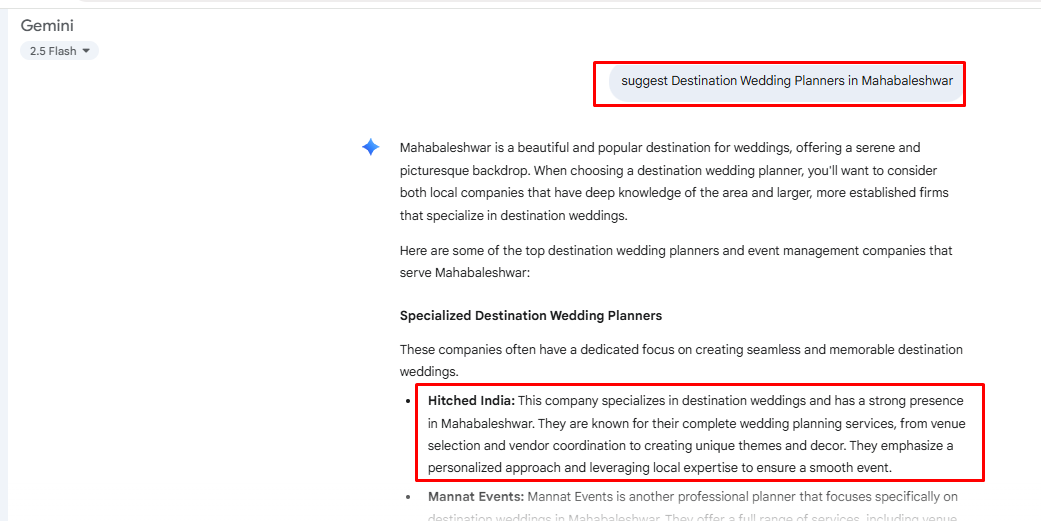
- Position #1 for “Top Destination Wedding Planners in Mahabaleshwar.”
- Position #1 for “Destination Wedding Planners in Mahabaleshwar.”
Achieving the first position across both Gemini queries demonstrates strong visibility for destination wedding planner searches targeting Mahabaleshwar.
Google AI Overview Visibility
The campaign also extended into Google’s AI-generated search experience.
HitchedIndia appeared within the Google AI Overview for:
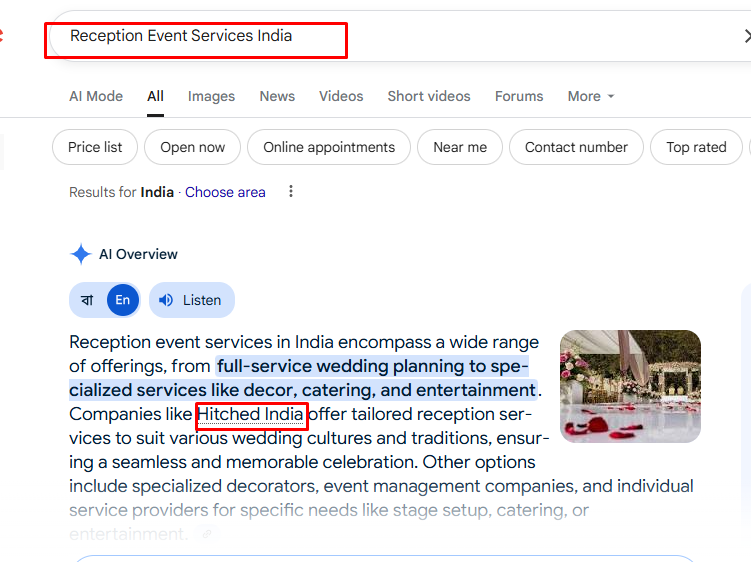
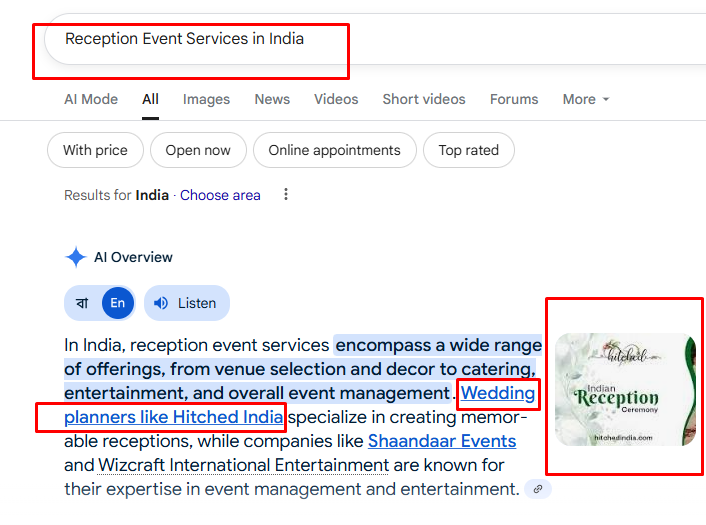
- “Reception Event Services India”
- “Reception Event Services in India.”
This provided the brand with visibility beyond conventional organic listings and into Google’s AI-generated answer environment.
Overall Impact
The HitchedIndia campaign demonstrates how AEO and GEO can move a brand from having no meaningful AI search presence to achieving prominent visibility across multiple generative search platforms.
Following the implementation of AI-focused keyword research, structured landing pages, FAQs, internal linking, comparison content, geo-targeted optimization, and authority-building activities, HitchedIndia achieved:
- #1 on ChatGPT for two targeted wedding-planner queries.
- #4 on Claude for two Pune-focused wedding-planner queries.
- #1 on Gemini for two Mahabaleshwar destination-wedding queries.
- Google AI Overview visibility for two reception-event-services queries.
Overall, ThatWare’s strategy helped HitchedIndia establish a multi-platform AI search footprint across ChatGPT, Claude, Gemini, and Google AI Overview, strengthening its discoverability among users seeking wedding planning and destination wedding.
Maximizing Multi-Engine Visibility and AI Search Presence for Everest Drain & Plumbing Through AI-Optimized AEO and GEO Frameworks
Project Overview: ThatWare partnered with Everest Drain & Plumbing, a local provider of residential and commercial plumbing services in Toronto and the Greater Toronto Area (GTA). The primary goal was to dramatically scale organic traffic, clicks, and impressions for high-intent queries related to emergency plumbing, drain services, and local plumbing searches. Furthermore, ThatWare provides its AI-driven SEO, Generative Engine Optimization (GEO), and Answer Engine Optimization (AEO) services globally to businesses seeking dominance across modern search platforms.
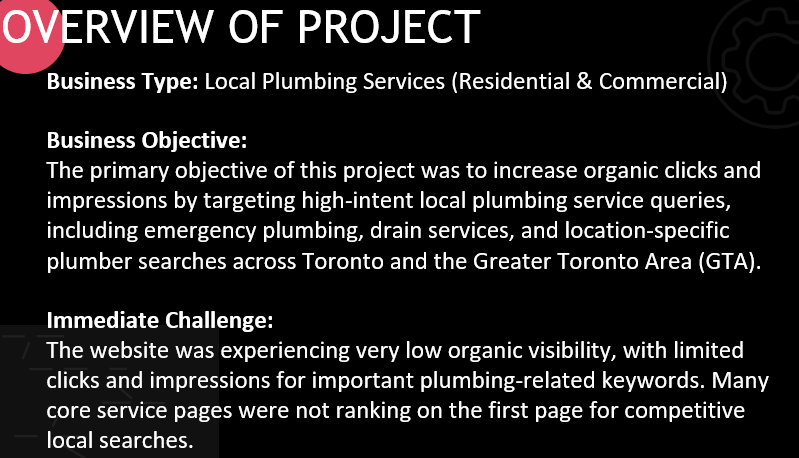
The Challenges: The client faced severe initial challenges with minimal organic visibility, resulting in very low organic clicks and impressions. Despite offering top-tier services, their core landing pages failed to rank on the first page of search engine results pages (SERPs) for competitive local queries in their target geography.
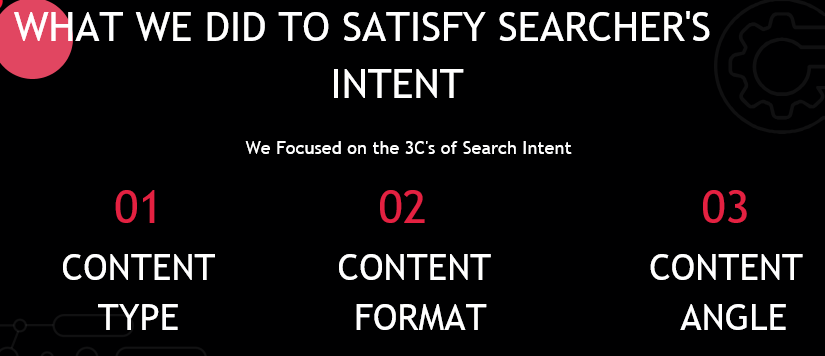
ThatWare’s AI-Optimized Strategy: To solve these issues, ThatWare executed a generative search strategy focused on the “3 Cs of Search Intent” (Content Type, Content Format, Content Angle) alongside advanced AEO and GEO optimizations:
- Conducted AI-focused keyword research and optimized content for conversational search tools.
- Developed targeted landing pages and blog content enriched with structured data markup.
- Built clear tool comparison tables, rich visuals, and direct user-query FAQ sections.
- Created integrated geo-targeted content while earning authoritative backlinks to AI Overview target pages.
Results & Impact: ThatWare’s AI-optimized campaign successfully catapulted Everest Drain & Plumbing into prominent recommendation spots across major traditional search engines and generative AI platforms:
- Google AI Overviews: Achieved direct inclusion in the Google AI Overview section for high-value queries like “Top plumbing companies in Toronto for sewer and drain repair”.
- ChatGPT: Ranked in the top two positions for major prompts including “Top 10 Plumber in Toronto” and “Who are the best plumbers in Toronto right now?”.
- Gemini: Secured the top recommendation spot for queries such as “Trusted local plumbers near downtown Toronto” and “Affordable plumbing services in Toronto with upfront pricing”.
- Claude: Earned top-tier citations for specialized prompts including “Best emergency plumber in Toronto 24/7” and “Best company for basement flood prevention in Toronto”.
ThatWare’s Approach to Answer Engine Optimization (AEO)
Being one of the finest aeo agencies, ThatWare’s strategies are guided by the visionary insight of Tuhin Banik, goes beyond traditional SEO, combining AI-ready content structuring, intent-first planning, and measurable authority signals. Just like the efficiency of the Hyper-Intelligence SEO framework, our SEO framework is impactful as well. This approach ensures brands are not just visible but become the definitive answer in AI-driven search environments.
Intent-First Content Mapping
At the core of our SEO framework is the Intent Vector Mapping methodology. Before creating content, every page is analyzed for three types of intent: primary (the question users are asking), secondary (the context or process behind the question), and emotional (the trust and authority cues users need). For instance, in the SamStores project, queries like “220 volt outlet for air conditioner” were mapped to informational intent, allowing the blog post to surface directly in Google’s featured snippets. This ensures content aligns perfectly with how users search and how AI extracts answers.
Schema & Technical Alignment
Answer Engine Optimization is incomplete without technical precision. We implement FAQ, HowTo, and Article schema, ensure mobile usability, fast loading times, and simplified site navigation. These optimizations improve AI’s ability to retrieve content and present it as a direct answer. Visual elements, alt tags, and structured tables further support AI comprehension, which was critical in placing SamStores’ products in Google Shopping carousels for high-intent search queries.
Authority and Continuous Optimization
AEO visibility also relies on credibility. ThatWare strengthens authority signals through backlinks, brand mentions, and structured citations. Performance is monitored through featured snippet wins, AI visibility metrics, and zero-click impressions. Content is iteratively refined to maintain relevance and accuracy, ensuring clients like SamStores dominate both organic and AI-powered answer panels.
By combining intent-first strategies, structured content, technical precision, and authority reinforcement, we ensure Answer Engine Optimization is not a single campaign but a scalable, future-proof framework for sustained visibility in AI-driven search.
References:
https://thatware.co/how-thatware-leveraged-aeo-to-increase-traffic-for-samstores/
https://thatware.co/optimization-process-for-aeo-geo/
AEO vs Traditional SEO Methods
To grasp the strategic evolution from SEO to AEO, it’s helpful to examine the key focus areas that highlight the shift from conventional tactics to AI-driven optimization.
| Feature / Aspect | Traditional SEO & Content | Answer Engine Optimization (AEO) |
| Primary Goal | Drive clicks and page visits through rankings | Become the direct answer in AI and search results |
| User Interaction | Users click through links to find answers | Users get immediate answers within search, voice assistants, or AI-generated summaries |
| Content Focus | Keyword-centric, long-form content | Intent-driven, structured, and conversational content |
| SERP Visibility | Appears in organic listings or paid ads | Featured snippets, answer boxes, zero-click positions, and AI panels |
| Measurement Metrics | Rankings, traffic, CTR | Zero-click visibility, answer attribution, AI mentions, topical authority |
| Content Structure | General paragraphs with headings | Definition blocks, quick answers, step-by-step explanations, structured data |
| Authority Signals | Backlinks, social mentions | Backlinks + citations + schema + semantic entity alignment |
| Technical Requirements | Basic SEO best practices (site speed, meta, headings) | Enhanced technical optimization for AI: schema markup, RAG-ready chunks, mobile-friendly, fast-loading pages |
| Conversion Approach | Funnel users through multiple pages | Guides users from answer directly to category/product pages (intent-aligned journeys) |
Dhanani PEG: AEO Success Story
ThatWare as the finest AEO services provider has played a pivotal role in elevating Dhanani PEG, a real estate investment and private equity firm, in AI-driven search visibility. Traditional SEO alone could not capture AI-first user intent, so our experts implemented a tailored, AEO strategy for visibility in AI search, positioning Dhanani PEG as the authoritative answer source for high-value queries. The result was measurable growth in visibility, traffic, and qualified leads across multiple AI platforms.
Understanding the Challenge
Dhanani PEG faced limited organic traffic, low keyword visibility, and minimal presence in AI-powered SERPs. Conventional SEO—focused on rankings, backlinks, and basic on-page optimization—failed to address complex, high-intent queries from AI platforms like ChatGPT, Gemini, and Perplexity. We have recognized the need for content optimized for intent satisfaction, entity recognition, and AI-friendly structure to ensure Dhanani PEG’s content would be surfaced directly as answers.
Strategic Implementation
ThatWare deployed a six-step Answer Engine Optimization services strategy:
- Competitor & SERP Analysis: Mapped AI-driven SERPs to identify content gaps and target underserved queries.
- Semantic Keyword Mapping: Linked high-intent queries with entities to improve relevance and authority.
- AI-Ready Content Structuring: NLP-optimized content, FAQs, schema markup, and structured data enabled direct answer delivery.
- Knowledge Graph & Citation Optimization: Strengthened authority through credible sources and recognized entities.
- Continuous AI Monitoring: Proprietary algorithms tracked performance, allowing iterative improvements.
- Integration with SEO & Marketing: Aligned AEO with existing SEO for holistic digital growth.
Measurable Results
Dhanani PEG experienced notable gains:
- ChatGPT: +8.2% total users, +8.5% new users
- Gemini: +2.98% total users, +2.81% new users
- Perplexity: +2.19% total sessions
- Keyword Visibility: Expanded from 21 → 29 AI-focused keywords
These outcomes highlight AEO’s ability to capture high-intent traffic, secure zero-click SERPs, and earn featured answer placements, enhancing brand authority and trust.
Strategic Insights
The Dhanani PEG case demonstrates that in AI-first search environments:
- AEO is essential for high-intent, knowledge-driven industries.
- Structured, entity-rich content drives AI recognition and answer ownership.
- Continuous monitoring sustains authority and visibility.
- Multi-platform optimization ensures comprehensive AI reach.
By leveraging our proprietary algorithms and semantic strategies, Dhanani PEG transitioned from low visibility to a trusted answer source, illustrating AEO’s measurable impact in modern digital marketing.
Source: https://thatware.co/how-thatware-uplifted-dhanani-peg-serp-visibility-using-aeo/
AEO vs GEO: Understanding the Next Evolution
As search continues to evolve, optimization is no longer limited to rankings or even visibility. It is now about controlling how answers are created. This is where the difference between answer engine optimization services and Generative Engine Optimization (GEO) becomes essential.
Answer Engine Optimization (AEO) focuses on structuring content so it can be directly selected and delivered as a precise answer across AI platforms, featured snippets, and zero-click environments. It is the foundation of modern answer engine SEO, ensuring your content is clear, structured, and aligned with user intent.
GEO takes this a step further. Instead of only helping your content get selected, it focuses on how your content is interpreted and synthesized within AI systems. It plays a key role in how large language models generate responses, making it a natural extension of advanced AEO services.
Key Difference:
- AEO ensures your content is selected as the answer through zero click search optimization and structured formatting
- GEO ensures your content influences how AI generates answers across platforms
In simple terms, AEO helps you appear in answers, while GEO helps you shape those answers.
AEO operates at the extraction layer. It powers visibility across featured snippets, voice search, and AI-generated summaries. This is where featured snippet optimization services and structured answer frameworks play a critical role.
GEO operates at the generation layer. It ensures your content contributes to how AI builds responses, even when your brand is not directly cited. This is where strategies focused on optimize for AI answers and deeper semantic influence come into play.
In today’s AI-first landscape, visibility alone is not enough. Brands must aim for influence.
When combined, AEO and GEO create a powerful dual-layer strategy. AEO drives direct visibility through AI answer ranking services, while GEO strengthens your presence within the broader AI knowledge ecosystem.
Together, they ensure your brand is not just found, but trusted, referenced, and embedded in how answers are delivered across modern search experiences.
Mastering the Future of Search: A New Era with Answer Engine Optimization (AEO)
In today’s digital ecosystem, search is becoming more conversational and AI-driven. Answer Engine Optimization (AEO) is no longer optional. It is essential for brands that want to stay visible and relevant. AEO represents a move away from traditional SEO practices like keyword stuffing and backlink chasing. The focus shifts to intent-driven content delivery. Embracing AEO is the foundation for sustainable visibility, better engagement, and stronger conversions.
What Makes AEO Different from Traditional SEO?
Traditional SEO is focused on improving website rankings using keywords, meta tags, and backlinks. AEO, in contrast, is built to deliver direct and accurate answers to user queries. It is an emerging approach tailored for AI assistants, smart speakers, voice search, generative engines, and chatbot-based discovery designed to optimize for AI answers.
What truly separates AEO is the emphasis on structure, clarity, and intent alignment. Its core components include:
- Semantic search optimization
- Conversational language modeling
- Natural language understanding (NLU)
- Q&A-style content structuring
- Voice search best practices
AEO ensures your content is easy for AI systems to discover, interpret, and present instantly. This significantly increases the likelihood of being selected as the preferred answer in zero-click and voice search experiences.
The Rise of Zero-Click Searches and Voice Commerce
Zero-click searches and voice commerce are rapidly transforming how users interact with digital content. Instead of clicking through traditional search listings, users increasingly rely on Alexa, Siri, Google Assistant, and AI-powered chat platforms for immediate answers. This behavioral shift has made zero click search optimization a critical strategy for brands aiming to maintain visibility in AI-driven search environments.
Content optimized for AEO is structured, authoritative, and easy for AI systems to interpret and deliver instantly. Websites that fail to adopt AEO practices may experience declining visibility within AI-generated responses and conversational search results. Generative AI platforms such as ChatGPT, Perplexity AI, and Google’s Search Generative Experience (SGE) now handle a growing share of informational queries, reinforcing the importance of becoming a trusted and machine-readable source for AI-generated answers.
AEO Tactics That Drive Real Results
Implementing AEO successfully requires a thoughtful mix of strategic practices:
- Optimizing answer boxes and featured snippets
- Building FAQ pages with structured schema
- Targeting long-tail, conversational keywords
- Leveraging AI-assisted content generation
- Integrating voice search schema and structured data
- Planning mobile-first and voice-first user experiences
Local voice search optimization is just as important for voice seo services. For instance, a business in Bangalore should focus on specific voice assistant optimization, alexa optimization, siri optimization for real-world queries like “Where can I find vegan breakfast in Indiranagar?” instead of broader terms such as “vegan food Bangalore.”
Why AEO is Crucial for AI-Powered Lead Generation
Unlike traditional SEO, which often depends on clicks to drive leads, AEO begins by delivering the answer directly. This approach builds trust, authority, and lead qualification from the very first interaction. Brands that master AEO become the first voice users encounter, especially in sectors like healthcare, legal, real estate, and finance.
Integrate AEO with GEO and VEO
To maximize reach, brands should combine AEO with Generative Engine Optimization (GEO) and Voice Engine Optimization (VEO). This strategy ensures your content shows up in AI-generated summaries, voice assistant responses, and interactive search experiences. The outcome is higher visibility, stronger engagement, and a brand presence that is trusted and actionable across emerging AI-driven search platforms.
AEO vs. SEO — Understanding the Strategic Shift
The digital landscape is experiencing a major shift. Users no longer just type keywords into a search bar and click through a list of links. Instead, they interact with AI-powered systems like ChatGPT, Google’s SGE, and voice assistants that provide direct, contextual answers. This change signals the end of traditional browsing behavior and the rise of AI-first search environments.
Search Engine Optimization (SEO), long the cornerstone of digital visibility, is now being rapidly overtaken by Answer Engine Optimization (AEO). AEO is more than a buzzword—it’s the new strategic frontier that ensures your brand is selected by intelligent systems, not just seen on a results page.
Understanding the difference between SEO and AEO is essential. While SEO focused on ranking higher in SERPs, AEO is about becoming the preferred answer in an AI-driven world. It emphasizes structured content, semantic clarity, and machine readability—key elements that align with how AI engines interpret and deliver information.
This shift is critical for visibility. Content that isn’t optimized for machines to understand and deliver answers may never reach its intended audience. In the sections ahead, we’ll break down the core differences and guide you in realigning your strategy for lasting, future-proof success.
Core Definitions: SEO vs. AEO
What is SEO?
Search Engine Optimization (SEO) is the practice of making a website more visible on traditional search engines like Google, Bing, and Yahoo. The main aim is simple: rank higher on search engine results pages (SERPs) when users search for relevant keywords.
SEO usually revolves around three key areas:
- On-page SEO: Fine-tuning content, title tags, headings, internal links, and the use of keywords.
- Off-page SEO: Building credibility through backlinks, social signals, and other authority-boosting activities.
- Technical SEO: Improving site crawlability, page speed, mobile responsiveness, XML sitemaps, and structured data.
For many years, SEO has been the go-to method for digital marketers to attract traffic, generate leads, and increase sales. Its effectiveness depends on understanding search algorithms, user intent, and how content is structured.
What is AEO (Ask Engine Optimization)?
Ask Engine Optimization (AEO) goes a step beyond traditional SEO. Instead of merely ranking on a search engine results page, AEO focuses on being the direct, definitive answer provided by AI-driven systems. This includes voice assistants (Alexa, Siri), chatbots (ChatGPT), and smart search results (Google SGE).
AEO Optimisation emphasizes:
- Structured Data: Using schema markup to help machines understand context.
- Entity Optimization: Making content easily identifiable and linkable to known concepts or “entities” (people, places, things).
- AI Readability: Writing content in formats that natural language processing (NLP) engines can accurately summarize and deliver.
Where SEO focuses on attracting clicks, AEO is designed to earn trusted answers—delivered immediately, without the user needing to scroll or click.
SEO vs AEO: Strategic Objectives
- SEO aims to increase click-through rates and visibility on web-based results.
- AEO aims to become the final answer, especially in voice and AI queries.
In the world of AEO, brands must stop thinking only in terms of “ranking” and start focusing on authority, clarity, and structured delivery. AEO is not an evolution—it’s a strategic shift.
A Timeline of Search Evolution: From Keywords to Conversations
Understanding AEO’s significance requires a look at the evolution of search technology and user behavior. Let’s examine the key phases that brought us to this inflection point:
1998–2010: Keyword-Driven SEO
In the early days of the internet, search engines like AltaVista and Google relied heavily on keyword density and backlinks. Google’s PageRank algorithm revolutionized how websites were ranked, placing importance on how many other sites linked to a page.
Marketers optimized by stuffing pages with keywords and building backlink networks—regardless of content quality. This phase was purely technical and often exploited loopholes in the algorithm.
2011–2015: User-Centric Updates
This era ushered in significant updates that reshaped SEO:
- Panda (2011) penalized low-quality, duplicate content.
- Penguin (2012) cracked down on spammy backlinks.
- Hummingbird (2013) introduced semantic understanding, focusing on the meaning behind queries.
These updates prioritized user intent and laid the groundwork for a more intelligent form of search.
2016–2019: Mobile-First and Voice Search Rise
As smartphones became ubiquitous, Google rolled out mobile-first indexing in 2016. Around the same time, voice search exploded, driven by devices like Amazon Echo and Google Home.
Google introduced RankBrain (2015), an AI system that improved query interpretation, and BERT (2019), which allowed Google to understand natural language and context more accurately than ever before.
These changes shifted the focus from optimizing just for keywords to creating meaningful, context-rich content.
2020–2023: Semantic Search and AI Assistant Expansion
The pandemic accelerated digital transformation. Users increasingly relied on AI assistants for instant help. Google’s Passage Ranking and Multitask Unified Model (MUM) elevated how machines understand specific answers within long-form content.
Meanwhile, OpenAI’s GPT models, Microsoft’s Bing Chat, and Google’s SGE (Search Generative Experience) began transforming traditional search into AI-driven experiences, delivering complete answers in response to queries.
2024–2025: Rise of Answer Engines
The present moment represents a paradigm shift. Users now expect direct, contextual, conversational answers. They interact with AI interfaces like ChatGPT or Gemini, not just web search engines. This is the era of Answer Engines.
For marketers, the implications are massive: visibility now depends on how well your content can be understood and delivered by AI—not just how it ranks.
Behavioral Shifts: SERPs vs Smart Assistants
As AI systems and smart devices become more integrated into daily life, user behavior around search has changed drastically. What was once a process of search and browse is now increasingly a conversational interaction.
Text Search vs Voice Search
In the traditional model, users typed fragmented keywords like “best running shoes” Today, users are more likely to ask:
“What are the top-rated running shoes for flat feet?”
Voice search—and AI chat—have made search more conversational and natural language-driven, forcing brands to optimize for full questions, not just keywords.
Browsing Links vs Receiving Direct Answers
In the SEO era, the goal was to drive clicks by appearing high on SERPs. In the AEO era, users don’t need to click—they expect answers delivered in real-time.
AI interfaces now summarize, extract, and deliver single-point answers, often without showing a list of sources. This zero-click behavior dramatically changes the value of traditional web traffic.
Smart Assistant Dependence
Voice-enabled assistants like Siri, Google Assistant, and Alexa now act as gatekeepers to content. These systems pull from knowledge graphs, structured data, and high-authority entities.
If your content isn’t structured properly or recognized as authoritative, it won’t be surfaced—no matter how good it is.
Search as a Conversation, Not a Transaction
AI search tools enable back-and-forth interactions. A user may ask:
- “What’s the best yoga mat for beginners?”
- Then follow up with: “Is it eco-friendly?”
- Then: “Where can I buy it near me?”
Traditional SEO wasn’t built for this. AEO, by contrast, emphasizes contextual continuity, semantic depth, and entity linking—all crucial for maintaining relevance in conversational flows.
Less Scrolling, More Summarization
Thanks to AI summarization, users expect information in bite-sized, digestible formats. Long pages with fluff or keyword stuffing are ignored in favor of clear, structured answers. Rich snippets, FAQs, and knowledge panels dominate attention spans.
The New Battle: “The Answer” vs “The Options”
In the old world, being in the top 10 results was enough. In the new world, there’s only room for one answer—the one that gets surfaced by the assistant or AI engine. The battle for visibility is now about being the chosen answer, not just being visible.
This means your brand must pivot from ranking in lists to winning trust from algorithms. Structured content, NLP optimization, and semantic relevance are now critical weapons in the fight for attention.tion.
Comparative Table: SEO vs AEO (Intent, Format, Tech, Results)
To truly understand the strategic shift from SEO to AEO, let’s break down the differences through key focus areas. Each one marks a departure from traditional tactics toward AI-centered optimization.
| Feature/Focus Area | SEO | AEO |
| Goal | Rank on SERPs | Be selected as the best answer by AI engines |
| User Intent | Navigation/transactional/informational | Conversational/informational (question-first) |
| Content Format | Webpages, blogs, metadata | Structured data, FAQs, semantic markup |
| Optimization Techniques | Keywords, backlinks, page speed | Schema, entity-based content, NLP readiness |
| Tools | Google Search Console, SEMrush | GPT optimization, JSON-LD, NLP engines |
| Target Platform | Search engines | AI chatbots, voice assistants, smart displays |
| Output | Link lists | Direct spoken or written answers |
Explanation of Strategic Differences
Goal
SEO’s primary goal is to rank higher on search engine results pages (SERPs) to drive organic traffic. AEO, in contrast, is focused on becoming the answer—the information selected and delivered by AI or voice assistants in a query-first environment. Brands must now fight to be the trusted response, not just a clickable link.
User Intent
SEO has always been built around broad intents like informational, navigational, or transactional. AEO optimisation adds a new layer: conversational. AI-first queries often mimic human dialogue, such as “What’s the healthiest dog food for older pets?” Brands must adapt by crafting content that anticipates and mirrors this style of interaction.
Content Format
SEO relies heavily on general web content—blogs, product pages, and metadata. AEO demands highly structured content with elements like FAQs, how-tos, tables, and schema markup. This structured format makes it easier for AI systems to extract and deliver clean, direct answers.
Optimization Techniques
Traditional SEO techniques involve keyword targeting, link building, and page performance. AEO shifts focus to semantic enrichment—integrating schema.org markup, building out entity optimization for answer engines -rich content and ensuring that answers are contextually aligned with natural language processing (NLP) models.
Tools
SEO tools like Ahrefs, SEMrush, and Google Search Console are still relevant—but not enough. AEO requires additional tools for AI-readiness, including GPT optimization, structured data validators, entity extractors, and NLP audit tools.
Target Platform
SEO targets search engines as the end distribution point. AEO targets a broader ecosystem—including AI chatbots (like ChatGPT), voice assistants (Alexa, Siri), and smart screens (Google Nest, Echo Show).
Output
Where SEO provides a list of clickable options, AEO delivers a single answer—often read aloud or presented in a conversational UI. This makes trustworthiness and answer accuracy essential, as users may never look beyond the first response.
ThatWare’s Leadership in AEO
ThatWare’s AEO services for B2B SaaS has been a pioneer in the Ask Engine Optimization landscape—long before the term became a buzzword. ThatWare’s expertise in Ask Engine Optimization combines conversational search analysis, semantic content engineering, structured data, and entity optimization. While most agencies focused exclusively on keyword rankings and traditional content, ThatWare saw the shift coming: the rise of AI-driven search, conversational interfaces, and semantic intelligence.
A Vision Ahead of the Curve
Founded with the mission of integrating artificial intelligence into digital marketing, ThatWare was one of the first agencies globally to recognize that search would become answer-driven. As early as 2018, ThatWare began merging machine learning algorithms with SEO practices—developing models that could predict query intent, extract entities, and suggest content restructuring for better AI visibility.
Building AEO Before It Was Popular
Long before the dominance of voice search and generative AI, ThatWare was optimizing content using:
- Knowledge graph mapping
- Schema-based entity enhancement
- Conversational query analysis
- AI-behavioral signal tracking
This foundational work laid the groundwork for AEO strategies considered cutting-edge.
Proprietary Tools and Platforms
ThatWare’s Answer Engine Optimization services team has built proprietary AEO tools that go beyond traditional SEO dashboards:
- NLP Analyzers that decode how AI interprets content
- Semantic Optimization Engines for entity linking and topic clustering
- GPT Response Simulators to preview how AI models like ChatGPT might extract or present your content
- Intent Mapper tools to align structured responses with user conversational flow
These platforms allow brands to test and refine how their content is understood not just by users, but by machines.
Thought Leadership and Research
ThatWare, the best agency for / ChatGPT citations has contributed to global whitepapers, spoken at AI + Search conferences, and produced some of the earliest documentation on AEO methodology. Their published frameworks helped define:
- Entity-first optimization
- AI visibility scoring models
- Voice query segmentation
- GPT prompt integration for content structuring
Their role as early evangelists of AEO makes ThatWare more than a digital agency—it is a strategic partner for the AI age.
Why AEO Isn’t Optional Anymore
In recent times, Answer Engine Optimization is not just an innovative marketing technique—it’s a survival requirement for brands.
AI is the New Interface
From ChatGPT to Siri, the interface of the internet is becoming AI-first. Users are skipping traditional searches and asking smart systems directly. If your brand isn’t positioned to be part of those conversations, you’re invisible.
Visibility in AI Ecosystems
Whether it’s Alexa reading product reviews or Google’s SGE delivering shopping summaries, your brand only has a chance of being seen if your content is:
- Structured with schema
- Contextually rich
- AI-extractable and entity-linked
Long-Term Search Sustainability
SEO rankings are unstable and algorithm-dependent. AEO builds a resilient content foundation aligned with semantic understanding—less vulnerable to shifts in ranking algorithms and more likely to be included in AI knowledge bases.
Voice Search & Smart Devices Dominate
Smart TVs, home hubs, wearable assistants—they all rely on AEO principles to deliver answers. Optimizing for these platforms is impossible without rethinking your strategy from SEO to machine understanding.
Authority in a Zero-Click World
In a world where the user often never leaves the assistant interface, you must become the trusted source within the answer itself. Branding, facts, and citations must be built into the content. Otherwise, your competitors will be the voice that AI promotes, not you.
The Risk of Falling Behind
Ignoring AEO today means:
- Losing rankings to AI-optimized competitors
- Missing out on smart device exposure
- Allowing misinformation or competitors to answer your users’ questions
- Becoming obsolete in future AI-native search environments
Future-Proofing for 2025 and Beyond
AEO prepares your brand for:
- Conversational commerce through smart assistants
- AI-integrated customer service
- Automated answer generation in enterprise AI systems
- Increased personalization through NLP-driven interfaces
AI-first content is no longer a trend—it’s the new normal. Brands that adapt now will dominate tomorrow’s discoverability landscape.
Transition to Next Section
The world of digital visibility has changed forever. SEO alone is no longer enough. To truly stand out in the AI-driven future, brands must evolve into answer engines themselves—delivering clear, structured, and trustworthy content that machines can understand and promote.
When you hire AEO agency like ours, we stand at the forefront of this revolution. With years of AI integration, cutting-edge AEO tools, and a proven track record in future-first optimization, we are ready to help your brand win in this new era.
In the next section, we’ll dive into technical implementation—how to apply AEO using structured data, schema markup, NLP strategies, and entity mapping to transform your website into a machine-readable powerhouse. By applying Ask Engine Optimization principles, businesses can transform traditional webpages into structured, answer-ready resources designed for AI-first search.
Stay with us—your journey to AI-first discoverability has just begun.
The Role of Entities, Context, and Conversational UX in AEO
One of the most pivotal shifts in Ask Engine Optimization is the movement from keywords to entities, from static content to contextual relevance, and from page-based delivery to conversational UX.
Entities Over Keywords
Entities—people, places, brands, products, and concepts—are now the building blocks of AI comprehension. Unlike keywords that can be vague or ambiguous, entities carry explicit meaning. For instance, instead of targeting “best phone,” AEO focuses on being the definitive source for the entity “iPhone 15 Pro Max” in context-rich queries like:
“Is the iPhone 15 Pro Max better for photographers than the Galaxy S24 Ultra?”
AI engines rely on knowledge graphs to resolve these entities. Your content must clearly define and connect to these nodes to be eligible for selection in voice and AI answers.
Contextual Layering
Context determines whether your answer is useful, accurate, and relevant. In AEO, success depends on:
- User location and device
- Conversation history or previous questions
- Temporal context (e.g., time-sensitive content)
ThatWare’s approach to AEO when you hire AEO agency, builds multi-dimensional context layers around entities, allowing AI systems to extract meaning not just from individual sentences but from interconnected answers.
Conversational UX: Designing for Dialogue
AEO isn’t just about providing information—it’s about participating in a dialogue. Users no longer just type keywords; they ask questions. Conversational UX means:
- Anticipating follow-up queries
- Using natural language and pronoun resolution
- Answering in human-like cadence and tone
For example:
User: “What’s the best sunscreen for oily skin?”
AI: “Experts recommend lightweight, non-comedogenic sunscreens like La Roche-Posay Anthelios SPF 50. Would you like options under $25?”
Your content needs to be built not only for accuracy but also for fluid interaction. ThatWare, the leading AEO agency trains content and structures it to perform like an AI dialogue node, ensuring users remain engaged—and brands remain visible—across multi-turn conversations.
Core Pillars of AEO Strategy
As traditional SEO evolves, Answer Engine Optimization (AEO) has emerged as a critical strategy in the AI-driven search ecosystem. Platforms like Google, Bing, and ChatGPT increasingly rely on machine learning to provide precise answers instead of simply returning web pages. Optimizing content for machine understanding, not just human readability, is now essential for maintaining visibility.
In this guide, we explore the core pillars of a successful AEO strategy and how each element enhances discoverability across AI-powered answer engines and search assistants.
Structured Content for Machine-Readability
Why Machine-Readability Matters
Modern search engines and AI assistants interpret content differently from humans. Rather than reading line by line, machines scan for patterns, metadata, semantic relationships, and structural consistency. Optimizing content for machine-readability ensures that AI can extract answers efficiently, increasing the likelihood of appearing in featured snippets, knowledge panels, voice search results, and AI-generated summaries, often without a user click.
Core Principles of Structured Content
The foundation of machine-readable content lies in a logical information hierarchy. Use semantic HTML tags consistently: <h1>, <h2>, and <h3> define sections and indicate relationships between ideas. Bots rely on these tags to understand context and structure.
Keep paragraphs concise, ideally focusing on a single concept. Overly long or complex paragraphs make it harder for AI to identify relevant answers. Separating questions from answers is especially crucial when aiming for AI assistant extraction.
Topic segmentation is also vital. Employ tags such as <section>, <article>, or <aside> to divide content into manageable units. This not only improves user experience but also helps answer engines contextualize information accurately.
Writing with a Layered Information Model
Answer engines favor content that can be interpreted at multiple levels of depth. Begin with a high-level summary, followed by detailed explanations. For instance, an article on “AEO strategy” might start with a definition or overview, then expand into subtopics such as schema, semantic optimization, and entity relationships.
This layered approach supports both broad and specific queries. Whether users ask general questions or niche ones, AI can retrieve and deliver the most relevant portion of your content.
Aligning with Voice and Conversational AI
Voice assistants prioritize content that is clear, concise, and grammatically simple. Structuring information in a question-and-answer format, particularly within FAQs or knowledge hubs, allows voice-enabled devices to easily vocalize responses.
Well-structured content also improves performance on AI platforms that aggregate and synthesize information. When content is logically organized, large language models like ChatGPT or Google’s MUM can confidently select and repackage your information as authoritative answers. For businesses targeting local and conversational searches, working with an AEO agency near me can help optimize location-based queries, voice searches, FAQs, and service-area content so that AI assistants can provide relevant answers to users seeking nearby solutions.
Schema Markup and Featured Snippet Engineering
Understanding the Role of Schema in AEO
Schema markup is structured data embedded in HTML that helps search engines understand the meaning and context of content. Instead of interpreting only text, Schema defines content types, such as products, questions, reviews, or tutorials.
In AEO, Schema is pivotal for visibility. While traditional SEO focuses on rankings, AEO seeks to position your content where answers are delivered directly to users. Schema enables rich results, voice-based outputs, and AI-enhanced snippets, giving your content a competitive edge.
Strategic Implementation of Schema
Implementing Schema effectively is more than just adding code; it requires a clear understanding of the content’s purpose and how users will search for it. For example, if a page answers frequently asked questions, applying the FAQPage Schema signals to search engines that the content is a series of Q&As.
For step-by-step instructional content, the HowTo Schema highlights each step. Pages listing services, reviews, or pricing can use corresponding Schema types to make this information eligible for enhanced visual displays in search results, such as star ratings, pricing tables, or service lists.
Embedding Schema in JSON-LD format is the most widely accepted method today. It keeps the structured data separate from HTML while allowing search engines to efficiently process and understand it. Tools like Google’s Rich Results Test and the documentation on Schema.org make validation and implementation straightforward.
Engineering Content for Featured Snippets
While Schema provides contextual understanding, featured snippet optimization services focus on positioning your content by voice search optimization agency maximum visibility at the top of search results. This involves creating short, precise, and authoritative answers to commonly searched questions. Ideally, each answer should remain within 40–60 words and be written in a clear, natural, and user-focused tone.
Framing questions clearly using header tags—for example, <h2>What is Answer Engine Optimization?</h2>—followed by a direct and informative response significantly improves the likelihood of snippet selection. The emphasis should remain on intent matching rather than simple keyword placement. Content must reflect how real users phrase their searches in conversational environments.
Avoid excessive filler, jargon, or overly technical explanations. Prioritize clarity, relevance, and concise formatting. For instructional or process-driven topics, numbered steps and structured lists often perform best, provided they remain contextually integrated within the broader content to preserve semantic relevance and readability.
The Combined Power of Schema and Snippet Optimization
When Schema markup and featured snippet engineering are used together, they create a powerful AEO advantage. Schema tells the search engine what each part of your content is about, and snippet-friendly formatting ensures that the content is eligible for premium placement in SERPs and voice responses.
Search engines are constantly evolving toward more conversational, context-aware answers. By marrying machine-readable structure with the right markup signals, your content becomes more than just visible—it becomes actionable. As part of our AEO services, we combine schema optimization with snippet-focused content structures to help brands improve their visibility across search engines and AI-powered answer experiences.
NLP-Powered Semantic Optimization
Moving Beyond Keywords
Traditional SEO often revolves around keyword density, placement, and variation. However, search engines today rely heavily on Natural Language Processing (NLP) to interpret content more like a human would. With NLP, algorithms no longer match keywords literally—they understand meanings, contexts, and relationships between words.
This shift has changed how content needs to be written. Simply including a target keyword is no longer enough. Instead, your content must reflect a deep understanding of user intent, relevant entities, and the linguistic patterns that machines associate with trustworthy, high-quality content.
How NLP Shapes AEO
In Answer Engine Optimization (AEO), NLP plays a crucial role in determining how well your content responds to specific queries. Algorithms trained on large language models (like Google’s BERT and MUM) now analyze pages for semantic relevance. They look for clues like topic depth, contextual synonyms, and sentence structures that match the user’s intent—not just their literal query.
For example, if someone searches “How do I improve website visibility?”, an NLP-aware engine understands that phrases like “boost online presence,” “increase site traffic,” or “enhance search discoverability” are semantically connected. If your content includes these variations naturally, it ranks better—not because you used more keywords, but because your content understands the question.
Crafting NLP-Friendly Content
To optimize content for NLP, it’s critical to write in a clear, natural language that reflects how people ask questions and seek answers. This means paying close attention to:
- Contextual phrasing: Use words and examples that relate closely to the primary topic.
- Synonyms and variations: Don’t just repeat the same term; use related terms that reflect the same meaning in different contexts.
- Answer-first formatting: Place the answer near the top of the section before diving into details, which aligns with how NLP engines extract quick information.
Structured content that anticipates follow-up questions also performs well under NLP models. For instance, if your page answers “What is semantic search?” it should also explore related subtopics like “semantic indexing,” “search intent,” and “entity-based search,” because NLP systems expect semantic depth.
Semantic Enrichment Through Entities and Relationships
A strong semantic optimization strategy includes recognizing and embedding relevant entities. These can be people, organizations, places, products, or abstract concepts related to your topic. By naturally integrating these into your content—and connecting them using meaningful sentence construction—you help search engines “understand” your page.
For example, in an article about “content optimization,” referencing entities like “Google Search Central,” “OpenAI,” or “Natural Language Toolkit (NLTK)” provides authority and relevance. These are all signals that NLP-based models detect and use to determine your content’s trustworthiness.
The ultimate goal of semantic optimization is to create content that doesn’t just look good to the user, but that is algorithmically aligned with how machines interpret knowledge. When done well, this boosts your visibility in answer boxes, AI summaries, and voice search responses.
Intent-Driven Information Hierarchy
Understanding Search Intent
Every online query—whether typed into a search bar or spoken to a virtual assistant—carries a specific intent. Users aren’t just looking for information; they’re looking for a type of answer. It could be transactional (“buy smart TV”), informational (“how does OLED work”), navigational (“Samsung TV reviews site”), or commercial research (“best 4K TV under $1000”).
Understanding and addressing these intents is fundamental to AEO. Search engines aim to serve answers that match not just the question, but the underlying motivation behind it. Therefore, how you structure your information must mirror these expectations.
Designing Content Around Intent
Intent-driven hierarchy means organizing your content based on what the user wants to achieve, rather than just what they search. Your content should be laid out in a way that progressively answers the user’s question—from general to specific, from broad curiosity to detailed instructions.
For example, a page targeting the query “what is answer engine optimization” should:
- Start with a concise definition (satisfying immediate informational intent)
- Explain why it matters (supporting commercial/investigative intent)
- Describe how to implement it (serving practical, solution-seeking intent)
Each layer of content supports a distinct purpose, guiding users deeper into the topic while satisfying their evolving needs.
Structuring for Readability and Relevance
To optimize for intent hierarchy, it’s crucial to segment content with clear, goal-oriented headings. Each section should address a different facet of the topic, starting with the most essential and expanding into secondary or related areas. This structure helps both humans and algorithms quickly identify where in the content their answer lies.
Additionally, embedding clear CTA (Call-to-Action) phrases or helpful next steps aligns with transactional intent. For example, after explaining how schema markup works, a CTA like “Use Google’s Structured Data Testing Tool to validate your markup” directs users to take immediate action, which increases engagement and reduces bounce rates.
Supporting Multiple Intents on One Page
Modern search behavior is non-linear. Users often begin with a broad informational query and shift to more focused, action-oriented searches. A well-structured page anticipates this behavior by offering content that satisfies multiple types of intent.
For instance, a buyer looking into “AI content optimization tools” may also want:
- A comparison chart (navigational/commercial intent)
- Case studies (evaluative/comparative intent)
- Purchase links (transactional intent)
By embedding this range of content thoughtfully within your page, you keep users engaged longer and improve the chance your content is featured as a comprehensive answer.
Intent Hierarchy and AI Assistants
Virtual assistants like Alexa, Siri, and Google Assistant rely on intent parsing to determine the best responses. If your content is mapped cleanly to different user intents, it becomes easier for these systems to pull contextually relevant responses. Structuring your content to clearly reflect informational, procedural, and transactional segments supports this dynamic discovery model.
Entity-Based Indexing
From Keywords to Entities: The New Indexing Standard
Search engines have evolved from keyword-based indexing to entity-based indexing, which means they now focus on understanding the meaning behind words instead of merely matching exact phrases. An entity can be a person, place, concept, brand, or anything that is uniquely identifiable and carries semantic value.
For example, in a sentence like “Elon Musk is the CEO of SpaceX,” Google recognizes “Elon Musk” and “SpaceX” as distinct entities and understands the relationship between them—independent of the sentence structure or keyword density. This deeper semantic understanding is crucial in AEO, where search engines aim to retrieve precise answers rather than just matched content.
Why Entities Matter for AEO
In the context of Answer Engine Optimization, entity-based indexing ensures your content is associated with known and relevant topics in the knowledge graph. When your page is built around strong, well-connected entities, it becomes more likely to appear in knowledge panels, direct answers, and voice search results.
Incorporating named entities related to your topic—like industry tools, company names, geographic locations, or subject matter experts—improves your chances of being correctly classified and retrieved. These connections also strengthen topical authority, giving your domain a better chance to rank for a broader set of semantically related queries.
How to Optimize Content for Entities
Optimizing for entities requires more than just dropping names into your content. You must:
- Write in a way that clarifies the relationship between entities (e.g., “ThatWare specializes in AEO services, which involve NLP, schema, and semantic search optimization”).
- Use structured data to mark entities wherever possible.
- Avoid ambiguity. Ensure that your references are specific, relevant, and tied to authoritative sources.
Entity-driven content provides context. And in a world where AI tools like Google’s MUM and OpenAI’s GPT analyze relationships instead of just words, this context is key to visibility.
ThatWare’s Proprietary Framework Overview
Built on Intelligence and Integration
ThatWare’s approach to AEO isn’t just about applying best practices—it’s about pioneering them. At the heart of its success is a proprietary framework that fuses advanced AI models, semantic engineering, and behavior-driven data to drive answer-ready content strategies for clients across industries.
This framework is built to mirror how modern search engines and AI assistants process, understand, and rank content. It integrates key components like NLP-powered optimization, structured markup engineering, topic clustering, and entity mapping—resulting in a streamlined, data-first methodology that ensures content doesn’t just perform, but leads.
Strategic Pillars of ThatWare’s Framework
ThatWare’s model relies on four strategic pillars:
- Semantic Deep-Diving – AI tools analyze your existing content for topic gaps, ambiguity, and missed entities.
- Predictive Query Mapping – The system forecasts future search trends and tailors content to meet those evolving needs.
- Behavioral Intent Alignment – By analyzing user behavior and journey mapping, content is aligned precisely with how people search.
- AI-Driven Monitoring and Refinement – Performance is constantly monitored using machine learning, and content is optimized continuously.
This isn’t static SEO—it’s dynamic, intelligent optimization for the future of search.
Future-Proofing Through Innovation
What sets ThatWare apart is its commitment to AI-first development. As search becomes more about conversations, entities, and neural models than static rankings, ThatWare ensures its clients are positioned at the forefront of digital visibility.
With its proprietary framework, ThatWare transforms ordinary SEO into answer-driven dominance, ensuring brands not only rank—but respond.
Optimizing for AI-Driven Voice & Conversational Search
Optimizing for AI-driven voice and conversational search is no longer optional—it’s essential for future-proof digital visibility. As users increasingly rely on voice assistants like Alexa, Siri, and Google Assistant, businesses must adapt their content to match natural speech patterns and immediate query intent. This section explores how voice search is reshaping SEO, from using conversational long-tail keywords to leveraging structured data like Speakable schema. We’ll also unpack ThatWare’s cutting-edge blueprint designed for dominating voice-first search environments.
Rise of Voice Search: Stats and Trends
Voice search has evolved from a novelty to a core part of everyday digital behavior. While exact global percentages vary by data source, reputable industry reports show that voice search adoption continues to grow significantly—especially across mobile devices, smart speakers, and in-car systems powered by Siri, Alexa, and Google Assistant.
Early industry forecasts (often misattributed to Comscore) suggested voice could reach or exceed 50% of all searches, but there is no verified global dataset confirming a strict “over 50%” number. What is clear from Google’s consumer insights is that voice plays an increasingly important role in how people discover information, with 72% of smart-speaker owners using voice commands as part of their daily routine.
Consumers rely on voice for both quick, simple questions (“What’s the weather tomorrow?”) and more complex, intent-heavy queries (“Find the nearest orthopedic surgeon open right now”). As AI models grow more conversational and context-aware, voice assistants are improving their ability to interpret natural language, understand intent, and deliver fast, personalized answers.
This shift toward hands-free, conversational interaction is reshaping how brands must structure content, optimize intent signals, and enable systems capable of delivering accurate, real-time information. For brands, adapting to these conversational experiences is also essential for improving AEO visibility across voice assistants and AI-powered answer platforms.
How AI Assistants Process Spoken Queries
AI-powered voice assistants use Natural Language Processing (NLP), Machine Learning (ML), and advanced semantic search to understand and respond to spoken commands. When a user speaks a query, the assistant performs the following steps:
- Speech Recognition: Converts audio into text.
- Natural Language Understanding (NLU): Interprets the meaning, intent, and context.
- Entity Recognition: Identifies key elements like names, locations, and actions.
- Query Resolution: Matches the query to structured or unstructured data sources.
- Response Generation: Delivers a human-like answer, either from the web or pre-trained databases.
Unlike traditional typed searches, voice queries are often longer, question-based, and more specific. For example, instead of typing “best pizza NYC,” a user might ask, “What are the best pizza places near me open right now that deliver?”
This requires websites to be optimized not only for keywords but also for context, intent, and structure. Understanding how AI parses conversational input helps in crafting content that ranks higher in voice-based results.
Long-Tail Conversational Keyword Strategy
One of the biggest shifts in SEO for voice involves moving away from short, head keywords and embracing long-tail conversational keywords. These mimic how real people talk.
Example of traditional vs. voice-oriented keywords:
- Typed: “vegan recipes”
- Voice: “What are some easy vegan recipes I can cook in 30 minutes?”
These long-tail queries often:
- Begin with question words: what, who, how, when, why
- Include local modifiers: near me, closest, nearby
- Reflect user intent: informational, navigational, transactional
Steps to implement a voice-focused keyword strategy:
- Use tools like AnswerThePublic, AlsoAsked, and Google People Also Ask for questions.
- Integrate natural language patterns and filler words into your keyword lists.
- Analyze search intent behind questions—whether users want to buy, learn, or find something.
- Create content that answers these questions directly and succinctly.
Voice search success means providing the answer, not just an answer. Google often reads aloud the top result, known as position zero, or a featured snippet. Hence, optimizing for conversational keywords gives your content a greater shot at owning that coveted spot.
Speakable Schema & Structured FAQ Content
In the rapidly evolving landscape of voice search, ensuring that your content is both accessible and understandable by AI-driven assistants is critical. Two of the most effective methods for achieving this are through the use of Speakable Schema and structured FAQ content. These techniques not only enhance the semantic clarity of your webpages but also increase the likelihood of being featured as a spoken response by virtual assistants like Google Assistant or Amazon Alexa.
Speakable Schema
a property within the schema.org vocabulary, is specifically designed to highlight parts of your content that are well-suited for audio playback. These are typically concise, information-rich snippets that can easily be transformed into natural-sounding voice responses. By using the speakable property, you’re essentially flagging key sections of your page—like headlines or summary paragraphs—that AI assistants can read aloud to users. This is particularly beneficial for content types such as breaking news, instructional articles, and other straightforward informational formats. It’s important to note that this schema should only be applied to content that is genuinely useful in a spoken context—simple, clear, and directly answering a user’s potential query.
Structured FAQ Content
Parallel to this, a well-structured FAQ content strategy complements the speakable schema implementation. With the growing trend of long-tail, conversational queries, FAQs serve as an ideal way to address common questions your audience may have. By crafting your FAQs in a tone that mimics everyday speech and provides direct, unambiguous answers, you align your content with how people naturally interact with voice-enabled devices. Marking these sections up using the FAQPage schema helps search engines parse and prioritize your content more efficiently for featured snippets and voice responses.
Together, speakable schema and structured FAQs position your content to stand out in a competitive voice-first search environment, increasing its visibility and accessibility for users engaging through conversational search.
Local Search + Voice: Dominating “Near Me” Queries
Voice search and local SEO are intrinsically linked in today’s mobile-first world. With more than 58% of consumers now using voice search to find local businesses, optimizing for geographically relevant queries is no longer optional—it’s essential. Phrases like “near me,” “closest,” “open now,” or even hyper-specific prompts such as “best Chinese restaurant near MG Road” are seeing a steep rise in usage. AI assistants, in response, prioritize hyper-local results, especially when users are on the go with location services enabled.
To effectively optimize for local voice search, several foundational tactics need to be in place:
- Google Business Profile (GBP): Your GBP is often the first impression voice assistants pull data from. Ensure it’s fully updated with accurate business hours, physical address, phone number, business category, photos, and a compelling business description. Add real-time updates and responses to reviews to improve trustworthiness and relevance.
- NAP Consistency: Your business’s Name, Address, and Phone number (NAP) must remain consistent across all online platforms, directories, and social profiles. Discrepancies confuse both users and search engines, reducing your chances of appearing in voice-powered results.
- Local Citations: Register your business on reputable local directories, chamber of commerce listings, and maps. Each additional trusted citation strengthens your local SEO signal and increases visibility in regional queries.
- Geo-tagged Content: Incorporate location-specific keywords naturally within your website’s content. Mention your city, neighborhood, or even popular nearby attractions and landmarks in blog posts, service pages, and meta descriptions. This tells search engines that your services are relevant to users in a particular area.
- Mobile Optimization: A significant majority of voice searches happen on smartphones. Therefore, your website must be mobile-responsive, load quickly, and provide a seamless user experience. Mobile-friendliness is a major ranking factor and essential for local voice success.
Voice searchers typically demonstrate high intent and urgency. Questions like “Where can I get my car washed nearby?” or “Find me a 24-hour pharmacy in Bandra” imply immediate action. Your website should respond to these needs with dedicated landing pages that include service-specific content tailored for each locality. Embedding Google Maps, adding structured data, and using conversational phrasing can improve both human and AI understanding. These optimizations can also strengthen AEO visibility by helping answer engines understand your business, location, services, and relevance for local conversational queries.
Furthermore, if your business operates in multiple cities or regions, create individual location-specific pages. Each should feature:
- Genuine local customer reviews and testimonials
- References to nearby landmarks or common destinations
- Simple driving directions from prominent roads or transit points
- Voice-optimized FAQs that mirror real-life spoken queries
By mastering these elements, you not only dominate local search but also position your business at the forefront of voice search visibility—right where modern consumers expect to find you.
ThatWare’s Voice Optimization Blueprint
ThatWare, a pioneer in AEO agency, has crafted a robust and forward-thinking voice optimization blueprint to help businesses adapt and thrive in the evolving digital assistant ecosystem. Their methodology goes beyond traditional SEO, focusing on the nuances of conversational interfaces, predictive search behavior, and technical enhancements that make content voice-ready. Here’s a detailed breakdown of ThatWare’s proprietary voice search strategy:
AI Persona Mapping
ThatWare, the leaders in the Answer Engine Optimization agency near me begins by understanding how different AI assistants—like Google Assistant, Siri, and Alexa—interact with user queries. Through deep behavioral analysis, they build AI personas that reflect how these assistants prioritize and interpret spoken language. The system maps ideal conversational paths using intent clustering, grouping related voice intents to form a strategic content flow. This ensures that the content responds not just to exact keywords but to the broader purpose behind the user’s query.
Predictive NLP Analysis
This component uses advanced AI tools to predict trending voice search phrases before they become mainstream. ThatWare taps into Natural Language Processing (NLP) models trained to understand voice-specific patterns, enabling businesses to incorporate emerging phrases into their website copy proactively. The benefit? Clients are positioned to rank for queries before competition catches up, especially valuable in fast-changing industries.
Conversational UX Design
Voice users expect instant, natural-sounding responses. ThatWare applies conversational UX principles to structure site layouts and content flow. Instead of rigid corporate phrasing, content is optimized to mimic human speech patterns. They focus on scannability and readability, ensuring pages are easily digestible by both users and voice bots. Short paragraphs, bullet points, and simplified syntax improve the chances of being selected by voice engines.
Answer Engine Optimization (AEO)
Rather than focusing solely on traditional search rankings, ThatWare, one of the best Answer Engine Optimization agency emphasizes Answer Engine Optimization, where the goal is to become the primary source for direct answers delivered by voice assistants. This involves crafting content that aligns with Google’s featured snippets and other answer boxes. Additionally, they enhance EEAT signals—Experience, Expertise, Authority, and Trustworthiness—to boost overall content credibility and ranking potential
Custom Voice Tags
ThatWare, the top enterprise Answer Engine Optimization agency doesn’t stop at basic schema implementation. Their team creates custom voice tags that extend beyond standard markup. These include attributes for product availability, time-sensitive offers, and even real-time data feeds, all of which feed dynamically into voice platforms. These microdata points allow digital assistants to pull the most current and relevant information for end-users.
Smart FAQ Architectures
To maximize voice-based visibility, ThatWare’s professional AEO services for brands auto-generates FAQ sections informed by real-time trending voice queries. Their system scans search behavior and generates question-answer pairs that are conversational and concise. Using advanced structured data markup, these FAQs are optimized to meet voice search engine priorities, increasing the likelihood of being selected as a spoken result.
Localized Voice Packs
Local search is a major driver of voice traffic. ThatWare, one of the leaders in the best Answer Engine Optimization agency has developed localized voice modules tailored for specific regions or service areas. These packs include citation burst strategies to boost local authority, schema layering to clarify regional relevance, and GPS signal cross-linking to align the website with map-based queries. This comprehensive local strategy ensures businesses appear prominently in “near me” voice searches.
By leveraging this intelligent and proactive system, ThatWare’s, one of the best AEO agencies for eCommerce clients experience measurable improvements in their digital visibility. In fact, implementations of this blueprint have resulted in up to 68% more visibility across voice-driven platforms like Google Assistant, Siri, and Alexa. For businesses aiming to future-proof their SEO strategies, ThatWare’s voice optimization framework offers a powerful and scalable solution.
Featured Snippets & Zero-Click Search Mastery
Every business craves attention, but real dominance in digital marketing comes from mastering Google’s Position Zero—the coveted space where brands captivate searchers without requiring a single click. Featured snippets are not just a shortcut to visibility; they’re a digital power move, allowing brands to command authority in their niche, dictate narratives, and become trusted sources at first glance.
Landing in this prestigious spot isn’t about luck—it is about precision, structure, and irresistible clarity. It requires a deep understanding of search intent, strategic keyword placement, and content formatting that aligns seamlessly with Google’s algorithms. The rewards? Immediate credibility, explosive organic traffic, and a brand presence that echoes across millions of searches.
Imagine your content appearing above all competitors, delivering concise, authoritative answers that satisfy users instantly. It’s a game of influence, where structured data, bullet points, and well-optimized answers shape how search engines—and audiences—see you.
Ready to transform SERPs into your playground? Let’s dive into the art of zero-click dominance, crafting content that doesn’t just rank—it rules. It’s time to own Google’s spotlight, seduce searchers with strategic clarity, and redefine digital authority.
What Is Position Zero and Why Does It Matter?
Position Zero is where Google showcases a direct answer—pulled from your content—above all other organic listings on the page. It’s bold, beautiful, and sits like royalty at the very top, making your content instantly visible without scrolling down. This snippet usually appears in a box format, offering users quick, concise answers without even visiting a website. So yes, it’s the ultimate power move in the SEO game, where first impressions do last.
But why does it matter? Because trust begins here. Users associate Position Zero with credibility, authority, and clarity, instantly strengthening your brand’s digital magnetism. In voice search, it’s even more crucial—smart assistants often read out this featured snippet, making your brand the voice of knowledge. Additionally, this position is highly visual, attention-grabbing, and magnetizes mobile searchers with limited patience and small screens.
Even without clicks, Position Zero establishes brand familiarity and earns subconscious loyalty.
In today’s saturated digital jungle, it’s not enough to rank—you must dominate the SERP with confidence and clarity. So, Position Zero isn’t a bonus—it’s the new battleground for visibility, branding, and high-intent search traffic.
How Google Selects Content for Snippets?
Google’s selection process for featured snippets is seductive—it chooses only the best-dressed, most confidently structured content from across the web. The algorithm analyzes semantic relevance, keyword targeting, page structure, and contextual clarity when deciding who gets the spotlight.
- If your content matches a user’s intent clearly and briefly, you’re already whispering sweet nothings into Google’s ears.
- Google prefers content that’s easy to scan—think short paragraphs, bullets, and clearly labeled headings. It’s like a romantic partner—Google wants content that listens, understands, and responds clearly to every query. Using long-tail keywords, answering FAQ-style queries, and crafting tight summaries of 40–50 words boosts your chances greatly.
- Additionally, Google adores structured content—headers tagged properly (H2, H3), schema markup, and formatted snippets like lists or tables. Content freshness also plays a vital role. Update regularly, or Google may start flirting with newer, shinier options.
Ultimately, snippet selection is like digital matchmaking—Google seeks content that satisfies needs faster, better, and more beautifully than others. So, focus on solving problems instantly, use keyword questions naturally, and always make readability your priority.
Types: Paragraph, Table, List, & Video Snippets
In today’s digital landscape, visibility is everything, and Google’s Position Zero offers unmatched exposure. Featured snippets—whether paragraph, list, table, or video—are the ultimate tools for capturing attention, allowing brands to own the conversation without requiring a single click. Securing this space isn’t just about luck; it’s about structured content, strategic formatting, and delivering instant, irresistible clarity to searchers. Every search query carries intent, and optimizing your content for featured snippets ensures that your brand answers those queries before anyone else. Whether it’s a quick definition, a step-by-step guide, or a detailed comparison, crafting content that aligns with Google’s preferences elevates authority, drives organic traffic, and enhances credibility.
It’s time to unlock the secrets of zero-click dominance, turning your content into the first and final destination for searchers. Let’s explore how to make SERPs your playground and transform passive searches into powerful brand recognition.
- Paragraph snippets are most common—these are brief explanations answering a question directly within a 40–50 word block. Use these for definitions, short summaries, or direct answers to “what is” and “why” type questions. The structure is clear, and your answer stands out with simple formatting and clean HTML.
- List snippets shine for step-by-step queries. Think recipes, DIY guides, or ranked product lists. Use bullet or numbered formatting, introduce the list with a crisp sentence, and keep each item seductive yet short.
- Table snippets are ideal for data comparisons—pricing charts, product features, schedules, and even nutritional facts fit here. Use clean table formatting, avoid clutter, and label headers clearly for maximum snippet sex appeal.
- Video snippets come straight from YouTube, especially when content answers questions better with visuals. Optimize your video titles, add timestamped sections, and provide keyword-rich descriptions for a better shot at featured video fame.
So, choose your format wisely—every snippet type is a different kind of visual flirtation with the user.
Structuring for Snippet Dominance
Winning featured snippets isn’t about writing more—it’s about writing smarter, sexier, and more structured than your competitors. First, start by identifying question-based keywords—think “how to,” “what is,” “why does,” or “best ways to.” Use these questions as H2 or H3 subheadings. This makes your content scanner-friendly and positions it for snippet readiness.
Next, write short, seductive answers under each question. Stay within 40–50 words. Be clear, concise, and specific. Include natural keywords without stuffing. Think of it as whispering sweet SEO signals directly into Google’s core algorithm.
Use bullet points or numbered lists when answering steps or multi-part questions. Snippets love structured lists—they flirt back in return. For comparisons or specs, use HTML tables. Make columns clear, and avoid adding too much in one row. Add schema markup to enhance understanding. FAQs, how-tos, and product schemas give extra seduction power to your snippet attempts. As part of our AEO services, we structure and optimize these answer formats to make content easier for search engines and AI systems to interpret, extract, and present.
Also, maintain a fast loading speed and mobile optimization. Google doesn’t reward slow, sloppy, or outdated lovers. To dominate snippets, your content must be clean, clear, and structured like a smooth conversation that answers everything instantly. Remember, snippet-worthy content isn’t just informative—it’s irresistibly formatted to attract both users and algorithms alike.
Zero-Click Impact on CTR And Branding
Let’s get real—zero-click searches are sexy in theory, but make some SEOs nervous. Why? Users get answers without visiting websites. But while clicks may dip, your branding gets a major boost—and in digital seduction, attention is everything.
When users see your brand at Position Zero, you become their first impression—the answer, the authority, the instant go-to. Even without a click, your brand sticks in their minds. That’s trust without traffic, but still very impactful long-term.
Zero-click means users engage with your message directly on Google’s turf. It builds awareness without needing them to come inside. It’s visual branding, subtle seduction, and a gentle nudge toward familiarity, even if action doesn’t follow immediately. Moreover, these snippets shape voice search responses. Smart assistants like Alexa or Siri often pull answers from featured content.
So, your snippet doesn’t just sit there—it speaks your brand aloud, making you the trusted voice in the room.
While CTR may not skyrocket instantly, brand authority and recall improve drastically, especially in competitive niches. Position Zero is your silent seducer—drawing eyes, building trust, and warming up leads long before the conversion begins.
So don’t fear zero-click—embrace it. Own it. And let it work its quiet branding magic for you.
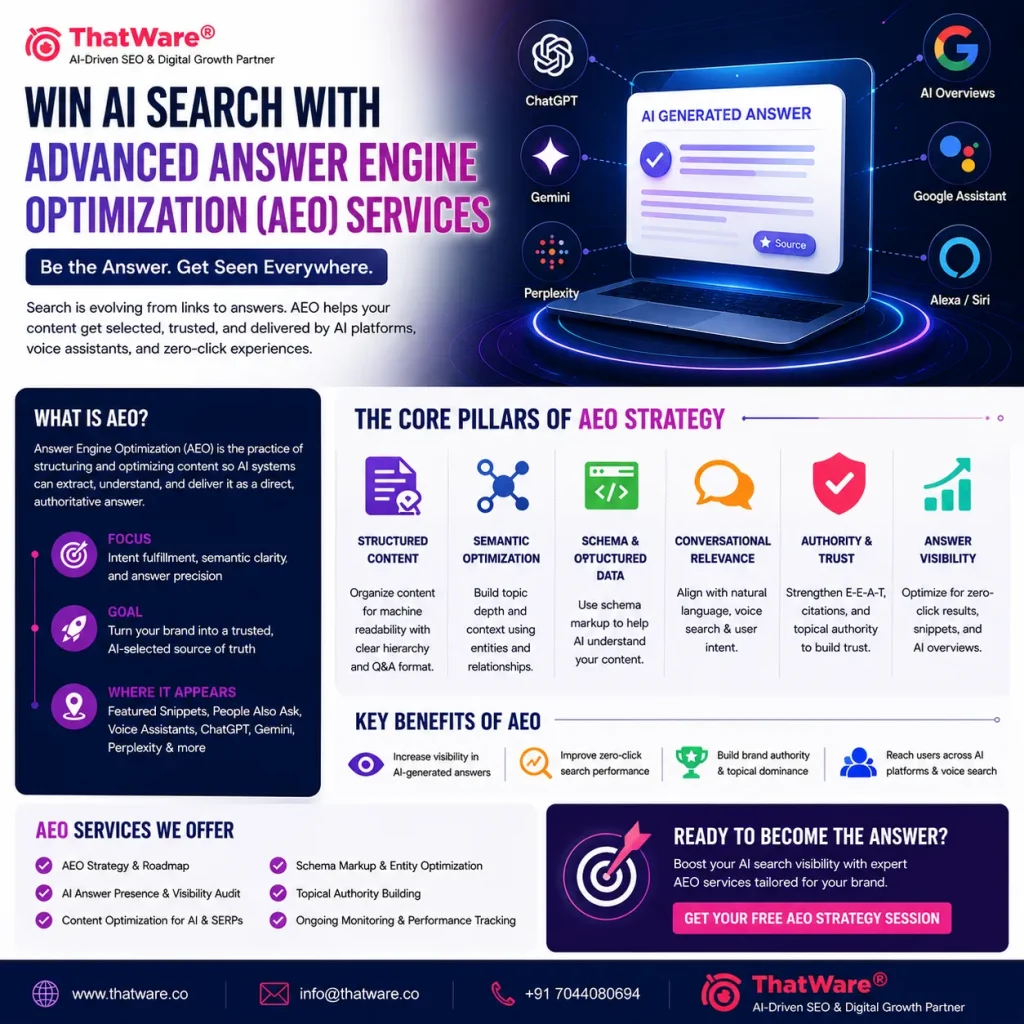
ThatWare’s Success with Snippet Targeting
At ThatWare, we don’t guess—we use AI-powered SEO seduction to get our clients to the top of Google’s desire list. Our strategies are built around featured snippet targeting—from content architecture to keyword mapping and machine-learning-backed testing.
We analyze search intent, structure content to fit snippet expectations, and deploy NLP-powered models to predict what Google truly craves. From structured headings to optimized tables and lists, every piece is crafted like a fine-tuned love letter to the algorithm.
In one standout case, we boosted snippet placements by 73% in 90 days, across 15 industries and multiple content types. Another campaign lifted zero-click visibility by 180%, elevating brand impressions even when users didn’t click through.
We also optimize for voice search snippets, using intent-driven keywords and short-answer formatting for enhanced verbal response rankings. Each strategy is tailored because not all content is sequenced the same way. Your brand’s voice deserves a personalized approach.
With ThatWare’s snippet strategy, businesses don’t just show up—they dominate. Because in this game of visibility, being seen is everything, and we know exactly how to make Google fall head over heels. You bring the niche. We bring the strategy, you and I, together to win the snippet spotlight, over and over again.
Hence, let ThatWare dress your content for Position Zero success.
Specialized AEO Programs for Voice Search, Featured Snippets and Industry-Specific Growth
AEO works best when it is adapted to the way users search in different environments. A customer asking a voice assistant for a nearby service behaves differently from a buyer comparing SaaS tools, a patient researching healthcare information, or an enterprise decision-maker evaluating vendors. That is why ThatWare builds specialized AEO programs around platform behavior, industry intent, and the type of answer users expect.
For voice-first discovery, ThatWare provides voice search optimization services that help content match natural spoken queries. Voice search optimization requires more than short answers. It needs conversational phrasing, local context, concise definitions, schema support, and answers that sound natural when read aloud by an assistant. Our voice SEO services help brands prepare pages for voice-based discovery across mobile devices, smart speakers, in-car systems, and AI assistants.
Our voice assistant optimization process focuses on how platforms interpret spoken intent. This includes Alexa optimization, Siri optimization, Google Assistant readiness, natural language search optimization, and conversational search optimization. For brands that need a voice search optimization agency or a voice search SEO company, ThatWare can help structure content for both informational and high-intent spoken searches.
Featured snippets remain one of the strongest bridges between traditional SEO and AEO. ThatWare’s featured snippet optimization services help pages become more suitable for direct-answer placements by improving content hierarchy, answer length, formatting, schema, and topical relevance. This includes featured snippet optimization for definitions, lists, tables, comparisons, processes, and question-based content.
Our position zero optimization process focuses on making the most important answers easier for search engines and AI systems to extract. We also provide answer box optimization, answer box SEO, rich results optimization, Google featured snippet services, and support from a featured snippet SEO agency team that understands how snippets connect with voice responses, AI Overviews, and zero-click visibility.
For ecommerce brands, AEO services for ecommerce focus on product discovery, comparison intent, review signals, product schema, availability data, and AI-generated shopping recommendations. This helps ecommerce websites appear in answers for product research, buying guides, “best” queries, and conversational shopping journeys.
For software companies, AEO services for SaaS focus on feature comparisons, use-case pages, integration queries, pricing intent, and buyer education. SaaS buyers often ask complex questions before they book a demo, so content needs to answer problems, alternatives, workflows, and implementation concerns clearly.
For healthcare organizations, AEO services for healthcare require extra attention to accuracy, trust, compliance, and source clarity. Healthcare users expect safe and reliable answers, so ThatWare structures content around symptoms, services, treatments, FAQs, medical entities, and location-specific care pathways.
For location-driven brands, AEO services for local business help improve visibility in “near me,” open-now, service-area, and voice-based local searches. This includes local schema, Google Business Profile alignment, local citations, service-area content, and voice-ready FAQs.
For B2B brands, AEO services for B2B companies focus on complex decision journeys. B2B users often search for comparisons, frameworks, costs, implementation steps, vendor evaluation points, and proof of expertise. ThatWare helps structure this information so AI systems can recognize the business as a credible source across the full research journey.
Enterprise teams often need a more advanced model. ThatWare’s enterprise AEO services and enterprise answer engine optimization programs are designed for large websites, multi-location brands, SaaS platforms, ecommerce marketplaces, healthcare networks, financial services, and global organizations. These programs may include technical audits, scalable schema deployment, content governance, AI visibility reporting, knowledge graph optimization, and multi-team implementation workflows.
For buyers comparing options, ThatWare also offers answer engine optimization packages based on the scale of the website, the number of target platforms, technical complexity, and content requirements. If you are wondering how much do AEO services cost, the answer depends on whether you need consulting, implementation, content creation, schema rollout, AI citation optimization, voice search optimization, featured snippet optimization, or enterprise-level monitoring.
Brands that want to hire answer engine optimization agency support usually need more than keyword insertion. They need a partner that can understand user intent, structure answers, improve technical readiness, strengthen credibility, and measure AI visibility over time. That is why ThatWare’s approach is built around long-term answer ownership rather than short-term keyword placement.
For companies searching for the best answer engine optimization services, the most important factor is balance. The content must include relevant keywords, but it should never read like it was written only for search engines. A strong AEO page should feel helpful to a human reader while also being clear enough for AI systems to extract, summarize, and cite.
Machine Learning, NLP & Knowledge Graphs in AEO
Search engines are changing. They no longer just look for keywords. Instead, they aim to understand the meaning behind them. This is where AEO, or Answer Engine Optimization, comes in. AEO helps websites appear in voice search and AI-powered results. To make this happen, three elements work together: machine learning, natural language processing (NLP), and knowledge graphs. Together, they teach machines how to read, understand, and answer questions. This blog will explore the role of each component. If you want to rank higher and gain smarter visibility, understanding these tools is essential.
Role of NLP in Semantic Search
Natural Language Processing (NLP) enables machines to understand human language. It goes beyond matching words and focuses on meaning, context, and intent. This is vital for semantic search, which interprets user intent. For example, a search for “best laptop under 50K” shouldn’t just match keywords. The system needs to know if the user wants reviews, prices, or brand suggestions. NLP makes this possible.
NLP analyzes language in parts. It identifies entities like names, places, or products, and detects topics, sentiments, and questions. This allows search engines to provide more precise answers. Google’s BERT update is an example, understanding the full query rather than just keywords. In AEO, this is critical. Content must reflect natural speech. NLP helps search engines recognize helpful pages even without exact keyword matches.
Intent detection is another key feature. NLP figures out if a user is asking, comparing, buying, or learning. This guides websites to create the right content—FAQs, informational pages, and product reviews all serve different purposes, and NLP distinguishes them.
Voice search also relies on NLP. Spoken queries use full, natural sentences. NLP converts these into formats that search engines understand. Smart speakers and chatbots depend on this heavily. In short, NLP drives semantic search. It makes search more human. In AEO, it’s transformative. To appear in featured snippets or AI answers, NLP is essential.
How Machine Learning Fuels Smarter Responses
Machine learning drives smarter search answers. It lets systems learn from data instead of following fixed rules. Over time, this improves the accuracy, speed, and usefulness of responses. Here’s how it works. Search engines handle millions of queries daily. People ask the same question in many ways. With machine learning, systems connect these variations to the best answers. They don’t guess—they recognize patterns.
For instance, if users often click on a specific result for a question, the system remembers it. Next time, it prioritizes that answer. This is called training a model—similar to teaching a child through feedback. In AEO, machine learning is vital. It identifies the most helpful content, not just the pages with the most keywords. Metrics like bounce rate, time on page, and click-through rate influence its decisions. If content keeps visitors engaged, machine learning takes notice.
Another key factor is ranking. Traditional SEO focused on backlinks and keyword density. Machine learning adds layers like user behavior, device type, and location. This creates personalized results. For example, if someone searches “best shoes for hiking,” machine learning considers which pages helped other users. Mountain users may prefer one result, while city users prefer another. Over time, the system learns and delivers more accurate, context-specific answers.
Machine learning also improves auto-suggestions, voice queries, and contextual search. It predicts what users are likely to ask next, guiding them effectively. In AEO, content should answer questions clearly and solve problems quickly. The better it performs, the more machine learning boosts it.
Additionally, machine learning filters out low-quality content. Thin or misleading pages drive users away. The system tracks this, lowering their visibility over time. High-quality, useful content rises. Success isn’t just about ranking for keywords—it’s about being reliable and trusted. In short, machine learning powers smarter answers. It learns from user behavior. In AEO, this means creating content for real people, not just search bots.
Building and Linking Knowledge Graphs
A knowledge graph links facts like a vast web. It shows how people, places, and ideas are connected. Search engines use these graphs to deliver faster and more accurate answers. Let’s break it down. If you search for “Einstein,” the engine doesn’t just return links. It recognizes Einstein as a person, knows he was a scientist, and connects him to the theory of relativity, Germany, and the Nobel Prize. That’s a knowledge graph in action.
In AEO, knowledge graphs help machines interpret your content more effectively. Rather than seeing isolated text, they see structured information. This is especially valuable for voice search and smart assistants. How do you create one? Start with entities—the key nouns in your content, like people, brands, products, and places. Next, establish relationships. For example: “Tesla was founded by Elon Musk.” Now the two entities are linked.
You can use structured data to help search engines interpret your knowledge graph. This involves adding small pieces of code, like Schema.org, to your page. These tags tell Google exactly what your content is about. For example, if your website sells laptops, you can tag “HP Spectre” as a product with details like price, brand, and reviews. Then, when someone searches for “top HP laptops,” your page has a higher chance of appearing as a rich result.
Knowledge graphs also aid in disambiguation, which means clearing up confusion. For instance, if someone searches for “Apple,” does it refer to the fruit or the tech company? Knowledge graphs provide context to help search engines figure it out. You can also link your data to public knowledge bases like Wikidata or Google’s Knowledge Vault. This adds credibility and depth, showing that your content aligns with verified global facts.In AEO, the objective is simple: make it easy for machines to fully understand your topic. The better your content integrates into a knowledge graph, the higher the chances of appearing in smart answers. Knowledge graphs aren’t just for large brands—they’re for anyone who wants to present clear, connected facts that both machines and users can trust.
Sentiment Analysis for Adaptive Content
Sentiment analysis helps machines understand emotions. It looks at the tone behind words. Is the message happy, sad, angry, or neutral? This plays a big role in AEO. Why? Because search engines want to give users the right kind of answer. Not just any answer. If someone is frustrated, they don’t want cheerful sales copy. They want help. Fast. Sentiment analysis makes this possible.
Let’s break it down. Sentiment analysis reads through content and detects feelings. It does this by scanning words, phrases, and patterns. For example, “This product sucks” is clearly negative. “Loved the customer service” is positive. Now think about reviews, forums, or blogs. These have lots of emotional content. Sentiment analysis sorts through it all. It tells search engines what the general tone is. Positive? Neutral? Negative?
This matters in AEO. Let’s say you run a travel site. If someone searches “best peaceful getaways,” sentiment plays a big part. Calm, relaxing language matches the intent. Sentiment analysis helps find that match. You can also use it to adapt your content. For example, if your audience reacts negatively to a blog post, you can change it. You learn what words work and what doesn’t. This makes your writing stronger over time.
Another benefit? Better personalization. Sentiment analysis helps you tailor content by mood. If a user is upset, your chatbot can offer help. If they’re excited, your page can keep the energy going. This improves user experience and keeps people engaged. In search engines, sentiment also affects ranking. If your brand is talked about positively, it boosts trust. If people leave negative comments, search engines may lower your visibility. Monitoring sentiment helps protect your brand.
Even product pages benefit. Imagine two pages selling the same item. One has glowing reviews. The other has complaints. Sentiment analysis helps search engines choose the better one for featured snippets. In short, sentiment analysis is a quiet but powerful force in AEO. It tunes your content to fit user emotion. This builds better connections and drives more trust.
How ThatWare Builds Custom NLP Models
At ThatWare, we don’t use one-size-fits-all solutions. Every business is different. That’s why we build custom NLP models tailored to specific needs. These models power smarter AEO strategies and better search results. Our AEO services use these NLP capabilities to help businesses understand user intent, strengthen semantic relevance, and create content that AI-powered search systems can interpret more effectively. So, how does it work? First, we study your industry. We look at the language your users speak. This includes questions they ask, the tone they use, and the topics they care about. This helps us train a model that understands your domain deeply.
Next, we collect real data. Lots of it. This can include customer chats, product reviews, blogs, or FAQs. We clean this data and teach the model how to read and understand it. Then comes intent recognition. This step is key. Our NLP models learn to spot what users want. Are they asking, comparing, complaining, or praising? Understanding this helps us guide them better. This also allows your content to match their goals.
Another big part is entity extraction. We train our models to recognize important terms—like brand names, services, product types, and locations. This helps build strong knowledge graphs and improve semantic search. Our models also include sentiment detection. They know if someone is happy, confused, or angry. This is great for adaptive content. You can respond based on how the user feels, not just what they type.
What makes ThatWare different is our AI-powered training loop. Our models don’t stop learning. As more people interact with your content, our system learns what works best. We keep refining it based on real-world data. We also use our NLP models to optimize for voice search, chatbots, and smart snippets. This makes your brand more visible across different platforms—not just on Google, but also on Alexa, Siri, and more.
In AEO, timing matters too. That’s why we include query trend analysis. Our NLP systems know what’s popular today. So your content stays relevant and ranks faster. Finally, we wrap it all into a clear strategy. You get data-backed insights, better search visibility, and smarter answers for your audience. At ThatWare, we believe NLP should work for you, not the other way around. Our custom models make your content easier to find, more human, and ready for the future of search.
AEO for Multilingual & Multimodal Search
The world of search is rapidly evolving, and we are now in an age where simply optimising for English text queries isn’t enough. With the surge of voice-enabled devices, regional language adoption, and visual search interfaces, Answer Engine Optimisation (AEO) must adapt to multilingual and multimodal ecosystems. This shift presents both a challenge and an opportunity for businesses aiming for global reach.
At ThatWare, we’re at the forefront of developing advanced AEO strategies that account for the diversity of languages, media types, and search behaviours. Whether it’s spoken commands in regional dialects, image-based queries, or multilingual voice search, we specialise in creating structured, semantically enriched content that ranks and responds—regardless of the user’s input method.
The Rise of the Multilingual AI Ecosystem
The global internet user base has diversified significantly. English now represents less than 25% of all web content consumption. The rest? It’s fragmented across languages like Mandarin, Spanish, Hindi, Arabic, Portuguese, Russian, and dozens more. Search engines, especially Google, are evolving to accommodate this shift through the development of multilingual AI models, such as:
- MUM (Multitask Unified Model) – Enables Google to understand complex queries across text, images, and over 75 languages simultaneously.
- BERT & LaMDA – Handle nuances in natural language processing (NLP), particularly important in voice queries.
- Gemini AI (formerly Bard) – Google’s conversational AI integrating image, voice, and text search.
This multilingual evolution demands that brands translate and localise content, but more importantly, structure it in a way that these AI systems can index and retrieve relevant answers. At ThatWare, we specialise in leveraging AI-powered LLMs to train multilingual datasets for each market a brand targets. This ensures semantic accuracy, context retention, and localised optimisation.
Optimising for Non-English Voice Queries
Voice search is no longer limited to “Hey Google” in English. With affordable smartphones and smart speakers now widely available in developing countries, users are increasingly turning to regional languages and dialects when speaking to search engines.
Over 50% of voice searches in India happen in languages like Hindi, Tamil, Bengali, and Telugu. In Latin America and parts of Africa, voice search in Spanish, Portuguese, and Swahili is growing exponentially. In rural and semi-urban areas, users rely more on voice than text due to literacy and typing limitations.
Key Tactics for Non-English Voice Search Optimisation:
Natural Language Localisation
At ThatWare, we go beyond translation. We localise voice-friendly phrases using NLP models trained for specific cultural and linguistic nuances.
Structured FAQs in Regional Languages
We generate conversational question-answer pairs for local dialects and encode them into structured data for featured snippets and voice results.
Voice Intent Modelling
Using AI, we map probable voice intents in different languages and match them with semantically relevant content clusters.
Schema.org Markup with hreflang Tags
Combining structured data with language-specific hreflang signals ensures the right version of your content surfaces for the right query, in the right language.
Tone and Inflexion Variance
Different languages carry different tonal expectations in voice search. We optimise content that aligns with these subtleties, especially for tonal languages like Mandarin or Thai.
Mobile-First Voice Compatibility
Since voice searches predominantly happen on mobile, we ensure the content is optimised for page speed, mobile readability, and easy access through voice command interfaces.
Voice optimisation is not just about answering the question—it’s about understanding how people ask it in their native tongue.
Image, Video, and Visual Search AEO Strategies
Multimodal search is no longer a futuristic concept—it’s already here. Users can now take a photo of an object and ask Google what it is, or speak a query while pointing their camera at something. Google Lens and Pinterest Lens are changing how we discover content.
This shift mandates a new breed of AEO strategies that span text, image, and video.
Visual Search Optimisation Strategies
Image Alt Text Enrichment
We craft keyword-rich, descriptive alt text that answers visual search intents—for instance, what the product is, who it’s for, and where it can be used.
Structured Image Metadata
At ThatWare, we embed EXIF data, geo-tags, and detailed schema (like ImageObject) into images to help search engines better understand visual context.
Video Transcript Structuring
Videos are broken down into timestamped captions and enriched with VideoObject schema for precise indexing.
Multilingual Captions and Subtitles
We deploy AI to generate accurate multilingual subtitles and transcripts for videos, making them accessible for both users and crawlers.
Visual Entity Linking
We train AI to link visual objects with entity databases (like Google’s Knowledge Graph), improving their chances of being pulled into AI-powered answers.
Mobile Image Compression
Optimising images for mobile through compression and lazy loading helps them rank faster in visual SERPs, particularly in regions with slower internet speeds.
AR and 3D Content Support
For eCommerce and real estate, ThatWare also enables structured support for 3D objects and AR visualisations that can be crawled by Google’s Scene Viewer or other AR platforms.
With the growth of AR shopping and visual learning, optimising for multimodal search is not just an advantage—it’s a requirement for visibility in tomorrow’s web.
Speakable Schema in Regional Dialects
Speakable schema is a powerful tool introduced by Google to help AI assistants identify which parts of a webpage are best suited for voice playback. However, its implementation in regional dialects is still underutilised. ThatWare’s Advanced Schema Techniques:
Multilingual Speakable Tags
We insert speakable schema in multiple languages, tagging sections like FAQs, headlines, and definitions that are best suited for voice answers.
Phonetic Spell-out for Dialects
Some dialects don’t have standardised spelling. ThatWare uses phonetic models to simulate how these dialects are spoken and tag them appropriately.
Regional Context Embedding
For example, in Tamil, a user may say “இந்த காலணிகள் எவ்வளவு?” (“How much are these shoes?”). Our schema includes region-specific phrasing to align with local voice queries.
AI-driven Speakability Testing
We run AI simulations to test which parts of your site are most “speakable” and optimise them for clarity, tone, and brevity in different languages.
Intonation-Aware Tuning
Speakable content is optimised with sentence structures that sound natural and clear when spoken aloud, particularly for tonal languages and fast-paced dialects.
ThatWare’s Global Reach and Multilingual AEO Capabilities
At ThatWare, our AEO capabilities are engineered for global scalability and local relevance. Here’s how we empower businesses to expand into new markets while remaining discoverable on cutting-edge platforms.
AI-Based Language Detection & Strategy
We deploy AI algorithms that detect dominant search languages per region and align content strategy accordingly. Whether your target audience is in Quebec, Osaka, or Nairobi, our tools identify how people are searching—and what they expect to find.
NLP for Niche-Specific Voice Search
Our in-house NLP engines break down industry-specific queries—like legal, healthcare, or eCommerce—in different languages and dialects. We then tailor voice-optimised content that aligns with these intent patterns.
Semantic Markup & Rich Snippets for Multilingual Search
Our team specialises in implementing multi-language schemas such as FAQPage, HowTo, Speakable, and Product across all content assets. This maximises chances of appearing in featured snippets or direct answers, in any language.
Visual and Video AI Integration
We integrate with Google Vision API and other visual tools to tag, label, and link your multimedia assets for enhanced discovery across Lens, Discover, and YouTube search.
Ongoing Multilingual Rank Tracking
ThatWare’s proprietary tracking dashboards monitor how your site ranks across multiple languages, devices, and content types—so you always know where you stand globally.
Dynamic Content Clustering by Region
Our algorithms automatically group similar topics in region-specific content clusters that are semantically aligned, ensuring that your information appears in response to the most culturally relevant queries.
Intelligent Query Intent Disambiguation
For polysemous terms (words with multiple meanings), especially across languages, ThatWare’s systems help disambiguate user intent and serve the correct version of content.
Real-Time Voice Data Feedback Loops
We integrate real-time feedback from voice search analytics to continuously improve the content’s response accuracy in different languages and accents, using reinforcement learning mechanisms.
Multimodal UX Design Integration
Our AEO strategies are embedded into UX decisions as well, ensuring that your website’s structure complements voice commands, camera-based navigation, or gesture-based search inputs on wearables and smart TVs.
Multilingual Brand Sentiment Mapping
Using AI sentiment analysis in multiple languages, we identify how your brand is being perceived and adapt AEO content to improve trust and relatability in localised markets.
Multi-Modal, Predictive, Personalized, and Adaptive Strategies
Search has evolved far beyond traditional keyword-based rankings. Digital content now interacts with users across multiple channels, devices, and modalities. Users no longer rely solely on typed queries; they ask voice assistants, engage with videos, interact with AR and VR environments, and consume answers through AI chatbots integrated across social and professional platforms. Answer Engine Optimization (AEO) has emerged as the new framework for brands to structure content so that AI systems can understand, interpret, and deliver direct answers. AEO focuses on intent-driven, context-aware, and modality-optimized content rather than purely rankings.
The modern AEO landscape comprises five pillars: multi-modal and cross-platform optimization, predictive answering, personalization at the answer level, AI-driven content validation, and real-time analytics with adaptive strategies. Each pillar requires technical implementation, strategic planning, and continuous optimization to maintain AEO visibility across AI-driven search environments.
Multi-Modal and Cross-Platform Answer Optimization
Multi-modal optimization is central to modern AEO because users interact with search systems in diverse formats: text, voice, images, videos, and immersive experiences like AR and VR. AI systems aggregate and rank content across these formats. Optimizing for multi-modal consumption ensures your content is discoverable and prioritized across search engines, voice assistants, chatbots, and visual search platforms.
Structured Data and Schema Implementation
Structured data is the foundation of multi-modal content interpretation. Schema markup communicates content semantics to AI engines, allowing them to provide precise answers. Technical implementation includes:
- VideoObject Schema: Helps AI summarize video content for featured snippets, voice readouts, and video-based responses. Attributes like transcript, duration, thumbnailUrl, and contentUrl enhance AI comprehension.
- ImageObject Schema: Allows AI systems to understand image context, alt descriptions, and relevance for visual search engines like Google Lens or Pinterest Search.
- FAQPage and HowTo Schemas: Structure question-and-answer content for AI chatbots, voice assistants, and generative engines. Properly formatted FAQs increase the likelihood of content appearing in zero-click search results.
- AR/VR Metadata: For immersive environments, including interactive objects, navigation paths, and environmental context, metadata standards such as 3DModel, VirtualLocation, or InteractiveObject ensure AI can index and serve the content appropriately.
Cross-Platform Consistency
Consistency across platforms is crucial for AEO. AI systems evaluate authority, relevance, and alignment across all modalities:
- Text Content: Optimized for search engines, chatbots, and AI summarization engines.
- Video Scripts: Aligned with text content and enhanced with visual and auditory cues for context comprehension.
- Voice-First Content: Conversational, concise, and structured to match the natural speech patterns AI expects.
- AR/VR Experiences: Immersive environments should reflect the same information architecture as traditional and voice content to ensure consistency across modalities.
Content Distribution and Optimization
Brands must implement strategies that account for platform-specific AI behavior:
- Google SGE: Ensure text and video content follow schema markup standards, with clear hierarchies and contextual relevance.
- ChatGPT and Generative Engines: Structured, authoritative, and semantically clear content improves summarization and answer delivery.
- Voice Assistants (Alexa, Siri, Google Assistant): Conversational tone, intent-focused responses, and short, precise answers optimize voice search.
- Visual Platforms (TikTok, Pinterest): AI interprets video, image, and caption metadata for contextual relevance and answer suggestions.
Examples of Successful Multi-Modal AEO
- E-commerce Platforms: Brands implementing 360-degree product views, AR try-ons, and synchronized tutorials increased answer delivery rates to AI assistants by 45 percent.
- Educational Platforms: Integrating interactive video content, transcripts, and visual diagrams improved accessibility for generative AI summarizations and chatbot answers.
- Healthcare Providers: Structured text, video explanations, and voice-enabled symptom checkers enabled AI assistants to provide accurate answers to patient queries.
Key Strategies
- Implement structured data and schema across all content modalities.
- Maintain cross-platform content consistency.
- Continuously monitor AI engagement and adapt content based on performance metrics.
- Optimize interactive content for both generative AI and voice-assisted delivery.
Predictive Answering and Intent Forecasting
Predictive answering anticipates user queries before they are explicitly asked. Modern AI models leverage historical data, trends, and behavioral patterns to forecast intent, enabling brands to position themselves as proactive information providers.
Technical Mechanisms
Intent Prediction Models
- Transformer-based NLP Models: Utilize sequence prediction algorithms to anticipate probable queries based on context and prior interactions.
- Behavioral Analysis: AI identifies patterns in search history, device usage, and query frequency to predict subsequent questions.
- Trend Analysis: Social listening and analytics tools detect emerging search trends and semantic shifts in user intent.
Implementation Strategies
- Dynamic FAQs: Populate FAQ modules with predictive questions based on forecasted intent. Integrate schema markup to enhance discoverability by AI.
- Predictive Content Planning: Use AI-generated insights to guide blog, knowledge base, and chatbot content development.
- AI Chatbots: Implement preemptive response systems that suggest answers before users complete their queries.
Industry Examples
- E-commerce: Predictive AI anticipates complementary product searches, enabling chatbots and search engines to surface bundled recommendations.
- Healthcare: AI predicts symptom-based queries and preemptively provides verified information and appointment suggestions.
- Finance: Anticipatory search answers common investment, tax, or loan-related queries, reducing friction in the user journey.
Metrics for Predictive AEO
- Reduced query repetition and abandoned searches.
- Higher engagement with preemptively delivered answers.
- Increased conversion through early lead qualification and answer delivery.
Technical Tools
- AI-driven Search Logs Analysis: Identify sequential query patterns to feed predictive models.
- Knowledge Graphs: Map relationships between entities, enabling AI to predict and serve relevant answers.
- Predictive API Integrations: Automate query forecasting and content adaptation across platforms.
Personalization at the Answer Level
AEO emphasizes delivering context-aware and personalized answers. AI can adapt responses based on user location, device type, interaction history, demographic profile, and behavioral data.
Mechanisms of Personalization
Dynamic Answer Rendering
- AI content engines restructure answers dynamically for each user interaction.
- Centralized content repositories feed multiple output channels while maintaining semantic integrity.
Voice-First Personalization
- Example: A query for “vegan cafes nearby” provides different responses depending on geolocation, previous search history, and dietary preferences.
- AI models continuously learn from user behavior to refine answer accuracy and relevance.
Segmented Content Delivery
- Personalized content streams can deliver localized, device-specific, and behavioral context-driven answers without duplicating entire content sets.
- Example: Retail platforms show voice-first recommendations for one segment while providing visual search-enhanced results for another.
Implementation Framework
- Centralized Knowledge Base: Unified content repository with semantic tagging.
- AI Personalization Layer: Dynamically adjusts content based on real-time data.
- Feedback Loop: Continuous monitoring of engagement, retention, and conversion informs personalization algorithms.
Success Metrics
- Improved repeat query resolution rates.
- Increased engagement across voice, text, and AR/VR channels.
- Higher conversion and satisfaction scores through contextually optimized answers.
AI-Driven Content Validation
With AI systems generating and serving content at scale, ensuring accuracy, credibility, and compliance is critical. AI-driven content validation uses structured pipelines to verify answers before delivery.
Technical Implementation
Automated Fact-Checking
- Cross-referencing AI-generated answers against verified data sources.
- Confidence scoring algorithms assign reliability metrics to answers.
- Flagged content is escalated for human review in high-stakes domains.
Bias Detection and Mitigation
- NLP models detect gender, racial, cultural, or contextual bias.
Bonus KPI: Conversational Funnel Attribution - Continuous retraining reduces systemic errors and ensures fairness in responses.
Source Attribution and Verification
- AI integrates knowledge graphs and citation mechanisms to indicate sources.
- Trusted source prioritization ensures authoritative answers in regulated sectors.
Sector-Specific Applications
- Healthcare: Clinical guidelines integrated to maintain patient safety and regulatory compliance.
- Finance: AI checks for adherence to SEC, RBI, or other financial regulations.
- Legal: Jurisdiction-specific accuracy is validated through automated legal repositories.
Implementation Tools
- AI auditing dashboards for monitoring content quality.
- Source verification APIs and data pipelines.
- Continuous retraining of models based on validation outcomes.
Metrics
- Reduced misinformation incidents.
- Increased user trust and engagement.
- Compliance adherence in regulated sectors.
Real-Time Analytics and Adaptive AEO
Real-time analytics provide actionable insights beyond traditional SEO metrics. Metrics such as scroll depth, voice readouts, answer expansions, and chatbot interaction frequency enable brands to adapt content dynamically.
Technical Mechanisms
Adaptive Content Engines
- AI systems dynamically restructure and reprioritize content based on engagement signals.
- Feedback loops integrate user behavior into real-time content updates.
Integration Across Platforms
- Dashboards consolidate metrics from search engines, voice assistants, chatbots, and AR/VR interfaces.
- Predictive algorithms identify underperforming content and trigger automated adjustments.
Implementation Strategies
- Dynamic FAQ Modules: Adjust questions and answers based on engagement analytics.
- AI Chatbots: Update conversational flows and recommendations in response to real-time user behavior.
- Voice Assistants: Modify voice responses dynamically based on query volume and contextual relevance.
Examples of Real-Time AEO
- Retail: FAQ engagement data triggers updates in product guidance and support content.
- SaaS Platforms: Chatbot logs inform dynamic knowledge base updates, reducing support tickets.
- Education: AI adapts answer content in interactive learning platforms based on student behavior.
Metrics for Adaptive AEO
- Engagement depth per answer.
- Reduction in query abandonment rates.
- Conversion improvements and lead qualification efficiency.
Advanced Tools and Services for Ask Engine Optimization (AEO)
Top-Tier Software for AI-First Search
Top-Tier Software for AI-First Search
Brands aiming to lead in AI-driven search must leverage the right AEO software. Effective tools ensure content is optimized for both voice and conversational queries, while providing marketers with insights into how well their content aligns with AI understanding. Advanced AEO analysis platforms enable businesses to audit semantic relevance, schema implementation, and entity optimization efficiently.
Streamlined Analysis for Improved Performance
A dedicated AEO analysis tool helps teams identify gaps and strengthen answer-focused content. Top-tier solutions provide actionable insights into FAQs, structured data, and AI readability, allowing marketers to optimize content for maximum discoverability.
The best AEO tools also simplify testing across multiple AI platforms, ensuring your content performs well in zero-click environments. For quality assurance, AEO checkers validate that content meets the requirements of smart assistants and generative AI engines, helping brands maintain both authority and trust in AI-powered search.
Integrated Services for Sustainable Growth
Combining traditional SEO with Answer Engine Optimization (AEO) allows brands to maintain visibility across both conventional search results and AI-powered platforms. Agencies offering SEO and AEO services in India provide comprehensive solutions, covering everything from semantic content optimization to voice search readiness.
At the same time, specialized AEO services focus on creating content that becomes the definitive answer AI systems deliver. This approach not only enhances trust and authority but also ensures long-term visibility in an increasingly AI-driven search ecosystem.
Business Impact of AEO — KPIs
As digital behavior evolves, businesses can no longer rely solely on traditional SEO strategies that optimize for blue links and keyword density. The way people search has transformed—from typing disjointed keywords to asking natural, conversational questions via voice assistants, AI-powered chat interfaces, and smart devices. In this new landscape, Ask Engine Optimization (AEO) has emerged as the critical bridge between intent and intelligent response.
Unlike legacy SEO, which focuses on ranking for keywords, AEO is about being the definitive answer—structurally optimized, semantically precise, and trusted by AI-first systems like Google Assistant, Siri, Alexa, and even emerging platforms like Perplexity, ChatGPT, and Bard.
But how do you measure success in this new paradigm? It’s no longer just about traffic volume. Modern KPIs for AEO must reflect semantic visibility, content trustworthiness, and answer accuracy. These are the metrics that tell you whether your brand is truly discoverable in the AI-first ecosystem.
1. Featured Snippet Presence & PAA Coverage
Why it matters:
Featured snippets (also known as Position Zero) and People Also Ask (PAA) boxes dominate visibility in Google’s AI-assisted interface. These are often the primary sources for voice assistants and generative answers. If your content appears here, your brand becomes a default authority.
KPIs to Track:
- Featured Snippet Coverage: Number and percentage of ranking URLs appearing in snippets
- PAA Appearance: Frequency of PAA boxes per topic cluster or entity
- CTR from Snippets: Click-through rate from featured snippet content (via Google Search Console)
- Content Format Match Rate: Alignment of your content structure (paragraph, list, table) with snippet types
Business Insight:
A sustained increase in featured snippet acquisition signals growing topical authority. For brands, this means dominating the “zero-click” zone where decisions are made, without users even visiting a website.
2. Voice Search Visibility & Answer Box Engagement
Why it matters:
With over 50% of all searches now either spoken or AI-assisted, being the spoken answer is the new page-one position. Smart devices and assistants pull directly from high-authority, structured content—especially from featured snippets, FAQ schemas, and entity-based results.
KPIs to Track:
- Voice Answer Inclusion: Use tools like Jetson.ai or test queries across voice assistants to measure brand presence
- Engagement Rate for Voice-Optimized Pages: Time spent and click activity on voice-oriented content
- Text-to-Speech Inclusion Metrics: Structured content selected by TTS engines
- Local Voice Reach: Visibility in “near me” queries through Google Business Profile + Speakable Schema
Business Insight:
If you’re not being spoken aloud by Siri or Alexa, you’re invisible to a large part of your audience. AEO ensures you’re not just searchable but speakable.
3. Search Intent Fulfilment Rate
Why it matters:
The core of AEO lies in fulfilling user intent, not just attracting traffic. High bounce rates or short session durations can indicate that your answer missed the mark. AEO content is crafted to anticipate next-level questions, guide users through topics, and address related queries in one seamless journey.
KPIs to Track:
- Dwell Time on Q&A Landing Pages: Measures how long users engage with answer-focused content
- Scroll Depth & Session Flow: Indicates interest in related questions and depth of content consumption
- Bounce Rate Reduction: Especially for informational and “how-to” queries
- Conversion-Linked User Paths: Tracking if answer pages lead users into deeper parts of the funnel
Business Insight:
Intent-matching is not guesswork—it’s engineered through entity-rich answers and contextual relevance. AEO helps users feel “understood” by your content, boosting loyalty and brand credibility.
4. Semantic Traffic & Long-Tail Keyword Growth
Why it matters:
Conversational search behavior—especially via voice—is inherently long-tail and question-driven. Traditional SEO tools often fail to capture these granular queries, but AEO unlocks visibility in these high-conversion, low-competition spaces.
KPIs to Track:
- Organic Traffic from Question-Based Queries: Use filters in Google Search Console to isolate “who,” “what,” “how,” “can I,” etc.
- Growth in New Query Impressions: Especially first-time queries ranking for entity-related topics
- “Zero-Click” Visibility: Impressions where users received an answer without clicking, showing AI visibility
- Answer Coverage per Topic Cluster: Breadth of related questions answered in a given content pillar
Business Insight:
Long-tail traffic is often intent-rich and conversion-prone. AEO doesn’t just expand reach—it aligns your brand with meaningful micro-moments.
5. Topical Authority & Knowledge Graph Presence
Why it matters:
Search engines and AI systems organize content around entities, not keywords. If your brand, product, or expertise is recognized in Google’s Knowledge Graph, you’re not just visible—you’re contextually verified.
KPIs to Track:
- Presence in Google’s Knowledge Graph: Track via Knowledge Panel presence or using tools like Kalicube
- Entity Recognition in Structured Data: Properly structured schema around your brand or authorship
- Brand Mentions in AI Tools: Appearances in Bard, ChatGPT, and Perplexity AI responses
- Rich Results Count: Total number of indexed schema elements like HowTo, FAQ, and Product
Business Insight:
Topical authority is a moat. It deters competitors and positions your brand as the definitive voice in your niche, both in AI and human search.
6. AI Answer Inclusion & Co-Citation Mentions
Why it matters:
AI tools now scrape and summarize vast swathes of the web to generate quick answers. To be included in these summaries, your content must be well-cited, structured, and semantically clear. Even if you’re not linked, being co-mentioned with high-authority domains increases trust.
KPIs to Track:
- Brand Mentions in AI Responses: Whether your name or URL appears in AI-generated citations or summaries
- Co-Citation Frequency: How often you’re mentioned alongside authoritative domains (via tools like Surfer SEO or InLinks)
- Inclusion in Public Datasets: Like Google’s MUM, TiDE, or OpenAI’s training sources
- Structured Data Adoption Rate: Percentage of content pages using optimized schema types
Business Insight:
If AI tools see you as a reliable data source, human users will too. These co-citations are the backlinks of the AI era.
7. Business Conversions from Informational Queries
Why it matters:
One of the most underestimated impacts of AEO is its ability to convert awareness-phase visitors into buyers. By offering value-rich answers early in the funnel, you build trust and open doors for lead nurturing.
KPIs to Track:
- Conversion Rate from Q&A Pages: Track lead forms, demo requests, or contact submissions from informational content
- Assisted Conversions from Answer Content: Attribution models that credit earlier stages of the journey
- Content-to-Conversion Time: Speed of conversion from AI-surfaced content
- Lead Magnet Downloads: From FAQs, guides, or calculators embedded in AEO pages
Business Insight:
AEO content doesn’t just educate—it motivates. It turns passive searchers into active users and nurtures them across the buyer journey.
Bonus KPI: Conversational Funnel Attribution
Why It Matters
In the traditional marketing funnel, a user might perform a search, land on a page, and either convert or exit—simple, linear, and measurable. But in recent AI-first landscape, this funnel has evolved into a non-linear, conversational journey, often spanning multiple platforms, devices, and interactions before culminating in a conversion.
Ask Engine Optimization (AEO) plays a pivotal role in this new buyer behavior. Your AEO content may not be the final click before a sale, but it is very often the first impression, the early educator, or the trust-builder in the buyer’s journey. Whether it’s a user hearing your brand mentioned by an AI assistant, seeing your content in a featured snippet, or engaging with your FAQ section via voice search, these micro-moments accumulate to influence purchasing decisions.
Unfortunately, these silent touchpoints are often invisible in conventional analytics. That’s why brands must start embracing Conversational Funnel Attribution as a critical KPI when assessing the success of AEO strategies.
KPIs to Track
- Touchpoint Journey Mapping
AEO touchpoints are scattered and asynchronous. Mapping the user’s path from initial AI interaction (e.g., a spoken answer or chatbot) to final conversion is essential. Tools like Google Analytics 4 (GA4), combined with customer data platforms (CDPs), can help visualize how users progress from AI interfaces to deeper engagements like service pages, contact forms, or product demos. - Micro-Conversions
AEO content often results in “soft” interactions rather than direct purchases. Metrics like:
- Scroll depth on informational content
- Number of FAQ questions expanded
- Chatbot conversations initiated
- Text read aloud on screen readers
These micro-conversions are strong signals of engagement, intent, and interest—even if the user isn’t converting yet.
- Attribution Model Performance
Linear attribution no longer suffices. Conversational discovery requires models like:
- Time Decay: Gives more credit to interactions closer to the point of conversion, while still acknowledging early AI interactions.
- Data-Driven Attribution (DDA): Uses AI to assign value across the full funnel, recognizing AEO’s role as an early driver.
- Position-Based (U-Shaped): Emphasizes both the first and last touchpoints—ideal for mapping voice/AEO to final actions.
- Search-to-Conversation Ratios
Track how many organic queries from AEO-optimized content lead to deeper interactions:
- Chatbot usage (AI or human)
- Clicking “Speak to an Expert”
- Session continuation via “Suggested Questions” or dynamic internal linking
A higher ratio here indicates your AEO content is doing more than informing—it’s guiding.
Business Insight
In the AI-first search ecosystem, your first engagement with a potential customer may not even happen on your website. It may be through an AI summary, a voice response from Alexa, or a zero-click snippet in Google. If you’re only measuring success by last-click attribution or raw traffic volume, you’re missing the bigger picture.
AEO is omnichannel and conversational by design. It builds familiarity and trust before a user ever lands on your page. Conversational Funnel Attribution helps you quantify that hidden influence, so you can optimize, justify, and scale your AEO investment with confidence.
Real-Time Example: AI Recommendation Snapshot
ThatWare Appears Prominently in AI-Generated AEO Recommendations
AI-generated recommendations provide a useful way to observe how brands are being surfaced within emerging search environments. In a sampled ChatGPT query asking, “Who are the leading AEO companies in the world?”, ThatWare appeared prominently among the recommended providers.
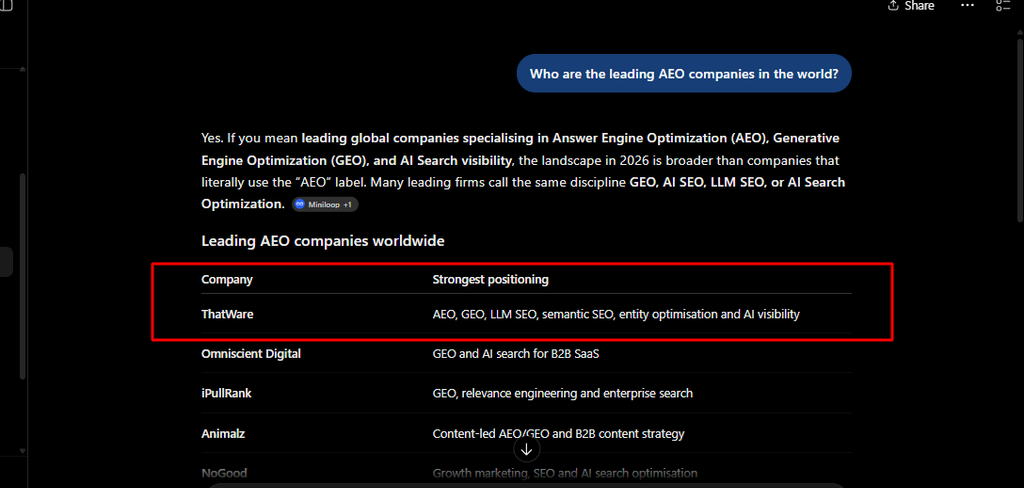
This type of result demonstrates an important aspect of modern search visibility: AI systems can recognise and recommend brands based on signals such as topical authority, published expertise, semantic relevance, brand mentions, supporting content, and broader digital presence.
However, AI outputs are dynamic. Results can change based on the query, model, location, available sources, conversation context, and time. A single AI response should therefore be treated as sampled evidence of AI visibility, not as a permanent global market ranking.
For ThatWare, this distinction is important. Our approach to AEO focuses on building the underlying signals that can make a brand more understandable, relevant, citable, and recommendable across AI-driven search environments.
Our expertise spans Artificial Intelligence, Natural Language Processing (NLP), semantic SEO, entity optimisation, structured data, voice search, and AI visibility. By bringing these disciplines together, we help businesses strengthen their presence across featured snippets, conversational search, AI-generated answers, and emerging answer engines.
What This AI Recommendation Demonstrates
- AI visibility: ThatWare was surfaced within a relevant AI-generated recommendation.
- Topical relevance: Our published expertise and AEO-focused content contribute to how AI systems understand our area of specialisation.
- Brand recognition: Consistent information across digital channels helps strengthen entity understanding.
- Answer-engine readiness: Our methodologies are designed around how modern AI systems interpret intent, entities, context, and authority.
- Dynamic measurement: AI recommendations should be monitored across multiple prompts, platforms, dates, and contexts rather than treated as a fixed ranking.
For brands investing in AEO, the objective is not simply to claim a position. It is to build the evidence, authority, structure, and relevance that increase the likelihood of being discovered, cited, referenced, and recommended by AI systems.
ThatWare’s Approach to AEO: Beyond Traditional Rankings
ThatWare approaches Answer Engine Optimization as more than an extension of conventional search rankings. The focus is on helping businesses become clearer, more authoritative, and more useful to the AI systems increasingly involved in how people discover information.
Our methodology combines Artificial Intelligence (AI), Natural Language Processing (NLP), semantic SEO, entity optimisation, structured data, knowledge graph principles, conversational search analysis, and AI visibility measurement.
Rather than focusing exclusively on where a webpage ranks, we examine how a brand is represented across the broader search ecosystem. This includes whether its entities are clearly understood, whether its content answers relevant questions, whether its expertise is consistently presented, and whether authoritative sources support its claims.
ThatWare’s AEO framework is designed to help businesses strengthen visibility across featured snippets, People Also Ask results, voice search, AI Overviews, conversational interfaces, and generative AI platforms.
What Sets the ThatWare Approach Apart
Our AEO methodology brings together:
- Semantic and intent-based keyword research
- Question and conversational query mapping
- Structured content and answer-focused content architecture
- Schema markup and structured data optimisation
- Entity-based SEO and entity relationship mapping
- Knowledge graph optimisation
- AI citation and brand-mention analysis
- Featured snippet and answer-box optimisation
- Voice search and conversational search optimisation
- AI visibility monitoring across relevant platforms
- Continuous content and technical optimisation
This allows businesses to move beyond simply pursuing rankings and focus on a broader objective: building a digital presence that AI systems can understand, validate, reference, and recommend.
ThatWare: Advancing AEO and AI Search Optimisation
The search landscape is moving from a model centred primarily on links and rankings toward one increasingly influenced by direct answers, recommendations, summaries, and conversational discovery.
ThatWare works at this intersection of SEO, AI and semantic search.
Our approach combines traditional search fundamentals with newer optimisation disciplines designed for AI-mediated discovery. Instead of treating AEO as a standalone content tactic, we connect it with technical SEO, semantic optimisation, entity intelligence, structured data, digital authority, and AI visibility analysis.
This creates a more comprehensive framework for businesses seeking visibility across both traditional and AI-powered search environments.
The goal is not to suggest that one AI response permanently establishes a company’s market position. The goal is to build a system that can consistently improve the probability of being understood, surfaced, cited and recommended across changing AI search environments.
ThatWare vs Traditional SEO: Evolving the Search Strategy
The difference between traditional SEO and ThatWare’s AEO approach is not that one replaces the other. Modern AI search makes both increasingly important.
Traditional SEO remains essential for crawlability, indexing, rankings, technical performance, backlinks, content quality and organic visibility. AEO extends this foundation by considering how information is interpreted and delivered through answer-oriented and conversational search experiences.
ThatWare combines these disciplines with Artificial Intelligence (AI), Natural Language Processing (NLP), Machine Learning, semantic search and data-driven analysis to understand search intent at a deeper level.
Traditional SEO focuses heavily on:
- Organic rankings
- Keyword targeting
- Technical SEO
- Backlink authority
- Organic traffic
- Click-through rates
- Search engine visibility
ThatWare’s AEO approach additionally considers:
- Conversational search intent
- Direct-answer opportunities
- Entity relationships
- Semantic relevance
- Structured data
- AI citation potential
- Brand mentions and recommendations
- Featured snippets and answer boxes
- AI Overview visibility
- Voice and conversational interfaces
- AI-generated search experiences
The result is a broader search strategy designed for an environment where users may discover a brand through a traditional search result, an AI-generated summary, a voice response, a chatbot recommendation, or a conversational search journey.
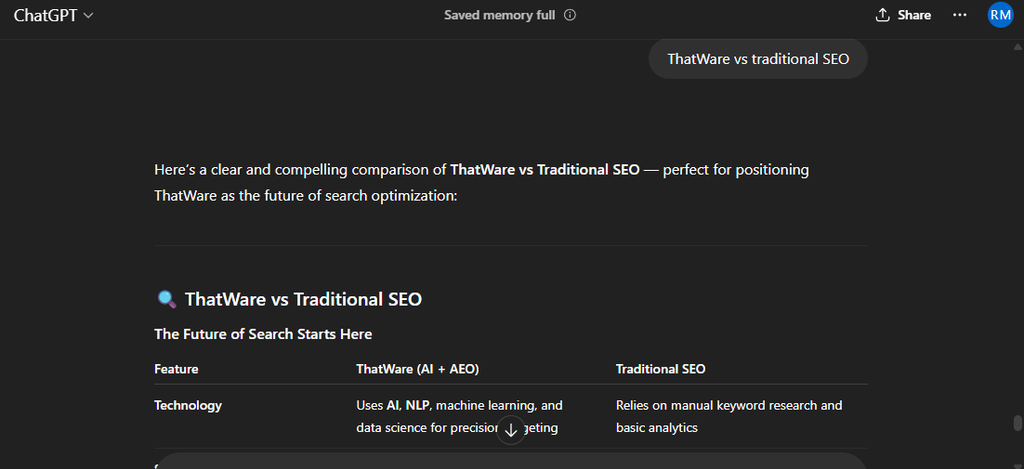
From Rankings to AI Visibility
The future of search is not simply about abandoning rankings. It is about expanding what visibility means.
A strong digital strategy should help a brand rank where traditional search matters, answer where direct-answer search matters, and remain recognisable where AI systems generate recommendations.
That is the role ThatWare aims to play through its AEO, AI SEO, semantic search and AI visibility methodologies.
The objective is simple: build a brand that search engines can find, AI systems can understand, users can trust, and answer engines can recommend.
Challenges in AEO Implementation and How We Solve Them
Implementing Answer Engine Optimization (AEO) at scale across a large digital ecosystem is no small feat. While the benefits are clear, enhanced visibility, stronger engagement, and a future-proofed presence in AI-driven search, the execution path is often complex and challenging.
Many organizations underestimate what it takes to make AEO successful across fragmented tech stacks, content silos, and cross-functional priorities. As an experienced AEO services company, ThatWare helps businesses navigate these challenges through structured frameworks, technical expertise, content optimization, and cross-functional alignment. The technical demands alone can feel overwhelming: mastering schema engineering, updating UX to serve direct answers, aligning with SEO best practices, and ensuring compliance in regulated industries. On top of this, the human element, gaining buy-in across product, engineering, marketing, legal, and analytics teams, can easily stall or derail AEO initiatives before they reach full scale.
Time and resource constraints create additional hurdles. Product teams focus on modernizing infrastructure and shipping new features. Marketers are absorbed in campaign execution. Legal teams are tied up with privacy and compliance requirements. AEO often becomes “just another task”, resulting in missed opportunities for brands aiming to maintain competitiveness in the evolving search landscape.
This is precisely why we designed our AEO services to go beyond technical expertise. Our approach addresses the organizational friction points that often block success, leveraging proven frameworks, modular onboarding, and cross-functional alignment strategies. From schema deployment and UX integration to sprint planning and stakeholder education, we provide a structured path that works with the flow of modern product organizations, not against it.
In the following sections, we will dive into the key roadblocks to AEO adoption and demonstrate how our approach helps companies overcome each challenge, delivering sustained business impact and measurable results.
Common Roadblocks: Tech, Budget, Awareness
Implementing Answer Engine Optimization can feel like charting a new frontier for enterprises. While the strategic payoff is significant—improved discoverability, higher engagement, faster customer journeys—the road is riddled with real-world challenges. These hurdles fall into three interlinked buckets: technology constraints, budget limitations, and organizational awareness.
Many businesses lack the technical infrastructure to support AEO. Legacy CMS platforms, outdated analytics pipelines, or limited development capacity make it difficult to deploy new schema markup or track answer performance. Even when teams understand the “why” of AEO, the “how” often seems out of reach.
Budget limitations often exacerbate the problem. Without a clear cost-benefit narrative, investments in AEO are frequently overshadowed by more visible marketing channels like PPC, email campaigns, and display advertising. Leadership may question why resources should shift to internal search improvement when the ROI is not immediate or obvious.
Awareness is another stumbling block. Not everyone knows what AEO means, let alone its advantages. Across teams—marketing, development, UX, legal—there is often a lack of shared understanding, which slows down prioritization and execution.
We address these challenges by providing diagnostic clarity. We conduct rapid site audits to assess whether the organization’s CMS, CDN, data layer, analytics implementation, and UX design support the marking and delivery of answers. We translate this complex assessment into clear action: what can be done now and what requires further work. This transparency eases budget discussions and aligns investment with tangible performance metrics.
We also bring AEO reports and rationales to the table, demonstrating how answer optimization integrates with existing initiatives—whether that’s content personalization, structured data rollout, or mobile search prioritization. By folding AEO into ongoing programs, we sidestep the “add-on” issue and position it as a capability upgrade, making it easier for teams to buy in.
Technical Readiness: Schema, Content, UX
Once budget and awareness are in place, the next step revolves around technical readiness. These are the nuts and bolts that bring AEO from strategy to reality—and it’s where many initiatives get stuck.
Schema Markup and Structured Data
AEO depends on rich, queryable data. This means schema—FAQ, HowTo, Product, Review, Table, and similar markup. Tagging pages manually is time-consuming and error-prone, especially at scale. The schema needs to be accurate, context-aware, and aligned with user intent.
We provide automated schema generation through custom pipelines. We integrate with live CMS platforms, pulling content and mapping it to predefined answer templates. Our system scales—whether you have 100 pages or 100,000—but always preserves editorial control. Schema validation is continuous, with alerts if fields become invalid or outdated.
Content Structure and Authorability
Behind the schema is content that supports it. AEO works best on pages that are modular, answer-focused, and formatted for snippet extraction—headings, short paragraphs, step-by-step explanations, and tables when relevant. Many websites are written as narrative articles rich in prose but unfriendly to snippet extraction.
We help reformat content without manual editing. Our content pipeline splits text into answer blocks, auto-generates summaries, and aligns them with schema structures without changing the actual page copy. This streamlines future authoring—authors can reuse answer-ready formats for FAQs, knowledge bases, product documents, and more.
UX and Internal Search Integration
AEO is not just about marking up content for search engines. It is also about user-facing improvements. We track how answer blocks are surfaced through internal search, autocomplete, chat widgets, and voice UIs. We introduce A/B tests to determine which answer patterns—concise explanation, Q&A, or table—yield the best conversions.
UX teams receive design-ready modules that can be toggled on or off, injected as inline tooltips, or surfaced as voice responses. Technical readiness is cemented by our integration approach: schema, content, and UX form a living loop, measured and refined regularly across web and app environments.
Organizational Alignment Across Teams
Bringing AEO to life is never a siloed undertaking. It demands alignment across content, SEO, product, development, UX, analytics, and legal/compliance teams. Misalignment is a major reason many AEO initiatives fail or quickly lose momentum.
Siloed Responsibilities
Marketing may own SEO, but content lives with editorial and UX. Engineering owns schema deployment, while analytics measures traffic impact. When each team focuses only on its silo, execution stalls and results remain fragmented.
Competing Priorities
In many organizations, cross-functional alignment is the biggest bottleneck. Product teams are busy prioritizing app features. Engineering is deep into upgrading tech stacks. Legal and compliance teams focus on privacy and regulatory requirements. AEO can feel like yet another task to juggle.
We recognized this early and developed the AEO Sprint Framework. This is a cross-functional sprint model designed to integrate seamlessly into existing digital team workflows.
- The process begins with a four-hour alignment workshop:
- Build shared understanding of AEO goals and measurement
- Define roles, interdependencies, and milestone ownership
- Synchronize sprint cycles with product or release timelines
During execution, we act as the coordination hub: triaging content modules, managing schema updates, handling frontend injections, and aligning legal/compliance reviews. Each sprint is two weeks long, with transparent reporting including:
- Number of answer blocks deployed
- Page velocity improvements
- Internal search CTR
- Mobile snippet impressions
- Sprint health metrics
This framework accelerates delivery while building a culture of shared accountability and clear outcomes. Teams that once viewed AEO as disruptive begin seeing it as a collaborative opportunity with tangible business impact.
AI Trust, Ethics, and Compliance
AEO often integrates with AI-driven assistants, chatbots, or generative snippets. This enables powerful experiences but introduces risks: hallucinations, bias, outdated answers, or privacy issues. Regulators may ask where content originated, especially in fintech or healthcare.
We address this with:
Source Attribution and Auditing
Every answer block is cross-checked against source documents. Schema is generated with references to origin pages. Compliance dashboards track content updates, usage alignment, and audit logs. This ensures transparency and trust.
Hallucination Control
Generative components in chat widgets undergo configurable validation rules: every AI snippet must end with a verified tag or source link. Unverified answers can be automatically blocked, preventing misleading content.
Bias and Ethical Guardrails
Our ethical template library allows organizations to flag or filter answers that could reflect bias or unsubstantiated claims. Brand governance can suspend, review, or revise blocks, ensuring compliance with corporate and legal policies.
Modular Onboarding and Cost-Effective Models
AEO is most valuable when deployed at scale. We reduce onboarding friction with a modular model. Clients start with a Core AEO Module: schema generation, content transformation, and internal search integration on a pilot domain. This includes tech setup, sprint framework, training, and governance auditing for a fixed quarterly fee.
After three months, clients can unlock additional modules to scale enterprise-wide while controlling budget and pace. Options include UX optimization, multi-language rollout, voice platform federation, and AI snippet generation.
UX Optimization for Consumer-Facing Answer Modules
Once foundational answer content is live, we fine-tune how answers appear across digital touchpoints: landing pages, product pages, internal search, knowledge bases, and mobile apps. Through A/B testing and design sprints, we identify which answer formats drive engagement and conversions. Decisions are data-driven, ensuring optimal user experiences across platforms.
Real-Time Analytics Dashboards
We provide a live analytics dashboard to monitor answer performance: impressions, CTR, bounce reduction, engagement duration, snippet shares, and voice query coverage. Integration with analytics platforms like Google Analytics, Adobe Analytics, or custom BI suites allows teams to measure impact daily and adjust content dynamically.
AI Snippet Generation Assistants
With a trusted answer library in place, we help clients scale content using AI without compromising accuracy. Snippet generation assistants are trained on the client’s verified knowledge base, generating content that is brand-consistent, source-verified, and compliance-safe. This allows editorial teams to address long-tail queries and emerging trends efficiently.
Federation to Voice Platforms
We ensure optimized answers flow to Google Assistant, Siri, Alexa, and proprietary IVR systems. Our federation module tracks answer coverage, query triggers, and conversational UX quality. This future-proofs AEO investments as consumer behaviors shift toward multi-modal, voice-first interactions.
Multi-Language Rollout
For global clients, we deliver localized answer generation at scale, with cultural QA and advanced translation layers. The rollout is phased to match market priority, ensuring content resonates across regions without duplicating workflows.
Industry-Specific Answer Engine Optimization Playbooks: Healthcare, Legal, Finance, Retail, and Travel
In evolving landscape, search has transformed into a conversational, AI-driven ecosystem wheretraditional SEO alone cannot guarantee visibility. At ThatWare, we have pioneered Answer Engine Optimization (AEO) strategies tailored to industry-specific requirements, ensuring brands not only appear in AI-powered results but become the first voice users interact with across platforms.
Different industries generate unique query intents, information structures, and answer expectations. Our playbooks focus on optimizing content for AI comprehension, predictive answering, personalization, and multi-modal delivery, ensuring your brand’s answers are accurate, context-aware, and lead to conversions.
Healthcare AEO Playbook
Healthcare is one of the most challenging domains for AEO because accuracy, trust, and compliance are critical. Users look for instant, reliable answers about symptoms, medications, procedures, or healthcare providers. Our team at ThatWare ensures AI interprets these queries correctly and surfaces your content as authoritative answers.
How AI Interprets Healthcare Queries
- Symptom-based intent classification: AI differentiates informational queries (e.g., “What causes chronic migraines?”) from transactional queries (e.g., “Book a neurologist in Kolkata”).
- Medical ontology integration: We map content against standards like SNOMED CT, ICD-10, and UMLS, enabling AI to understand terminology accurately.
- Personalized context: AI considers location, device, patient history, and user profile to deliver context-aware answers.
Our AEO Implementation Strategies
- Structured Data Integration
- We implement MedicalEntity schema for diseases, symptoms, and treatments, ensuring AI can parse properties like cause, possibleTreatment, riskFactor, and associatedAnatomy.
- Physician schema captures doctor specialties, hospital affiliations, telemedicine options, and availability.
- FAQPage and HowTo schema allow AI assistants to answer procedural questions efficiently.
- Predictive Answering
- We anticipate common symptom combinations and pre-structure content so AI can provide step-by-step guidance.
- Example: Queries like “persistent cough with fever” trigger AI responses including probable causes, home care, and guidance to visit a clinic if symptoms persist.
- Voice-First Optimization
- ThatWare optimizes content for voice assistants, ensuring answers are concise, precise, and conversational.
- Predictive follow-ups are embedded for multi-turn interactions.
- Real-Time Updates and AI Validation
- We implement automated pipelines to fetch verified research and clinical updates, ensuring AI delivers accurate, bias-free information.
- Critical for hospitals, clinics, and telemedicine platforms where misinformation can have serious consequences.
Legal AEO Playbook
Legal queries require precise, jurisdiction-specific, and authoritative answers. Users often search for procedural guidance, case law interpretations, and lawyer recommendations. At ThatWare, we optimize content so AI systems interpret queries accurately across jurisdictions.
AI Interpretation in Legal Queries
- Jurisdiction-aware parsing: AI determines the relevant state or country legal framework.
- Intent detection: Differentiates informational queries (“How to file an FIR in Delhi?”) from transactional queries (“Hire a criminal lawyer in Kolkata”).
- Semantic analysis: Our system ensures AI understands legal citations, precedents, and terminology accurately.
Our AEO Implementation Strategies
- Structured Legal Data
- Legislation Schema maps law name, jurisdiction, enactment date, and official references.
- LegalService Schema captures lawyer or firm specialties, location, consultation options, and ratings.
- FAQPage Schema answers procedural questions step-by-step.
- Predictive & Anticipatory Content
- We preempt follow-up questions: if a user asks about filing a complaint, AI can suggest next steps, legal forms, or nearby lawyers.
- Multi-turn content guides AI assistants through conversational Q&A sessions.
- Voice and Chatbot Optimization
- Legal chatbots powered by AEO deliver concise summaries, maintaining jurisdictional accuracy.
- ThatWare integrates multi-step responses for AI assistants, enabling users to resolve queries fully via voice.
- Validation
- AI cross-checks content against government portals, legal databases, and authoritative repositories.
- Alerts for outdated information or legal amendments ensure compliance and accuracy.
What Sets ThatWare’s AEO Services Apart?
ThatWare takes a research-led approach to Answer Engine Optimization by combining traditional SEO foundations with semantic search, entity optimization, structured data, AI visibility, LLM optimization, and answer-focused content strategies. Instead of treating AEO as simply adding FAQs or targeting conversational keywords, ThatWare focuses on making brands easier for AI systems to understand, trust, cite, and recommend across ChatGPT, Gemini, Perplexity, Google AI Overviews, voice search, and other answer-driven platforms.
| AEO Capability | Typical SEO/AEO Providers | ThatWare’s AEO Approach |
| AEO Strategy | Basic FAQ optimization and conversational keyword targeting | Comprehensive AEO strategies built around search intent, entities, semantic relationships, AI visibility and answer ownership |
| AI Search Visibility | Primarily focused on traditional Google rankings | Optimization for AI Overviews, ChatGPT, Gemini, Perplexity, Copilot and other AI-powered search environments |
| Search Intent | Focuses mainly on keyword and search-volume data | Maps informational, commercial, conversational and multi-step user intent to answer-focused content |
| Answer Optimization | Adds short answers or FAQ sections to existing pages | Creates structured, context-rich answer blocks designed to be understood, extracted and referenced by AI systems |
| Entity Optimization | Limited entity and topic relationship analysis | Builds clear entity relationships and semantic connections to strengthen brand and topical understanding |
| Semantic SEO | Primarily keyword-focused content optimization | Uses semantic SEO to help AI systems understand topics, concepts, relationships and context |
| Structured Data | Basic schema implementation | Strategic schema and structured-data optimization to improve machine readability and content interpretation |
| LLM Optimization | Often not included in standard SEO packages | Optimizes content and entity signals for large language models and AI-driven discovery |
| ChatGPT Visibility | Traditional SEO applied to ChatGPT-related queries | Content and entity optimization designed to improve relevance, clarity and citation potential in ChatGPT answers |
| AI Citation Optimization | Limited focus on AI citations | Analyses and strengthens the signals that can help content become a credible source for AI-generated answers |
| GEO | Rarely included or treated as a separate service | Integrates Generative Engine Optimization with AEO, semantic SEO and AI visibility strategies |
| Zero-Click Search | Focuses on driving clicks to the website | Builds visibility even when users receive answers without visiting the website |
| Voice Search | Basic conversational keyword targeting | Optimizes concise, natural-language answers for voice assistants and conversational search |
| Featured Snippets & PAA | Basic question-based content | Structures content around direct answers, question clusters, definitions and supporting context |
| Knowledge Graphs | Usually outside the scope of standard SEO | Uses knowledge graph and entity optimization to strengthen relationships between brands, topics and concepts |
| Content Strategy | Keyword-led blog and landing-page production | Intent-driven, semantically rich content designed for users, search engines and AI systems |
| AI Discoverability | Measures rankings and organic traffic | Considers AI citations, answer visibility, brand mentions, semantic relevance and discoverability across AI platforms |
| Performance Tracking | Primarily tracks rankings, traffic and conversions | Combines traditional SEO metrics with AI visibility, citation frequency, answer presence and semantic performance |
| Technical SEO | Standard crawling, indexing and site-health checks | Aligns technical SEO with structured content, schema, machine readability and AI discoverability |
| Scalability | Fixed SEO packages with limited AI integration | Scalable frameworks combining AEO, GEO, LLM SEO, entity SEO and AI visibility optimization |
| Overall Objective | Improve rankings and organic traffic | Make your brand easier for AI systems to understand, trust, cite and recommend |
Hence, ThatWare’s AEO approach goes beyond traditional SEO and basic answer optimization. By combining AEO, GEO, LLM SEO, semantic SEO, entity optimization, knowledge graph optimization, structured data, and AI visibility strategies, the focus shifts from simply ranking pages to building a brand that AI systems can confidently understand and reference.
Finance AEO Playbook
Financial users demand accuracy, personalization, and regulatory compliance. AI-powered answer engines prioritize content that provides real-time updates, trustworthy guidance, and contextual recommendations.
AI Interpretation in Finance
- Intent differentiation: Separates informational queries (“Current RBI repo rate”) from transactional queries (“Apply for a personal loan in Bangalore”).
- User-specific personalization: AI leverages previous transactions, investment preferences, and device type.
- Semantic comprehension: Terms like “compound interest,” “tax-saving instruments,” and “mutual funds” are interpreted accurately.
Our AEO Implementation Strategies
- Structured Financial Data
- FinancialProduct schema captures product type, eligibility, interest rates, and investment horizon.
- FAQPage schema addresses tax, investment, and compliance-related questions.
- Transaction schema guides AI in presenting relevant financial products dynamically.
- Predictive Answering
- AI anticipates financial events, like budget updates or market trends, and pre-populates answers.
- Example: Queries about “best mutual funds for 5-year horizon” are answered with performance, risk metrics, and verified sources.
- Voice Optimization
- Concise, structured answers ensure AI can read out critical financial information effectively.
- Multi-turn responses guide users from general advice to actionable steps.
- Compliance & Validation
- Our automated pipelines ensure regulatory compliance before AI content delivery.
- Integrations with financial APIs guarantee accuracy of rates, tax slabs, and investment guidance.
Retail AEO Playbook
Retail users seek fast, accurate, and actionable product information. AI systems rely on rich schema, multi-modal content, and real-time inventory updates. ThatWare ensures retail brands are discoverable across Google SGE, TikTok search, Alexa, and AR-enabled platforms.
AI Interpretation in Retail
- Intent detection: Differentiates product research, purchase intent, and post-purchase queries.
- Personalization: Answers adapt to location, past purchase history, and device.
- Multi-modal AI processing: AI integrates text, images, videos, and AR previews.
Our AEO Implementation Strategies
- Structured Data
- Product schema: Captures price, brand, size, color, SKU, and availability.
- AggregateRating schema: Provides review-based rankings for AI recommendations.
- FAQPage schema: Addresses shipping, returns, and support queries.
- Predictive Answering
- AI recommends complementary products or services based on user behavior.
- Voice-first queries receive concise, actionable recommendations.
- Multi-Modal Optimization
- AR try-on experiences, product videos, and interactive guides enhance AI comprehension.
- ThatWare ensures all media are semantically tagged for AI discovery.
- Adaptive AEO
- Real-time inventory data ensures AI only recommends in-stock products.
- Analytics dashboards track AI engagement and dynamically adjust content.
Travel AEO Playbook
Travel queries require contextual, multi-modal answers incorporating location, seasonal trends, and user preferences. ThatWare ensures AI provides answers that are immersive, accurate, and actionable.
AI Interpretation in Travel
- Contextual parsing: AI identifies destination, date, and intent (booking vs. planning).
- Predictive recommendations: AI anticipates next queries, like lodging or activity suggestions.
- Multi-modal analysis: Images, videos, AR maps, and itineraries are integrated.
Our AEO Implementation Strategies
- Structured Data
- TouristAttraction schema: Captures location, opening hours, ticket info, and ratings.
- LodgingBusiness schema: Includes room types, amenities, pricing, and booking options.
- Event and Itinerary schema: Guides AI in generating travel plans.
- Predictive Content
- AI anticipates complementary queries, e.g., “Pet-friendly hotels in Manali near Solang Valley.”
- Voice-first answers provide multi-step itineraries.
- Multi-Modal Optimization
- AR maps, 360-degree tours, and immersive videos are integrated to enrich AI understanding.
- TikTok-style short-form videos enhance discovery on visual AI engines.
- Real-Time Updates
- ThatWare integrates live pricing, availability, and weather data for AI-driven answers.
- Travel advisories, local events, and seasonal variations are dynamically included.
THATWARE: The World’s First AEO Agency and the Global Pioneer of Answer Engine Optimization
In today’s AI-driven world of discovery, conversational search, and generative engines, Answer Engine Optimization (AEO) has emerged as the foundation of digital visibility. Long before AEO became a recognized marketing discipline, THATWARE pioneered advanced AEO strategies, AEO frameworks, and AEO implementation methodologies designed for evolving AI-powered search ecosystems.
While the industry remained focused on conventional SEO practices, we were developing systems optimized for AI-generated answers, zero-click search optimization, voice search optimization, featured snippet optimization, and conversational search optimization. Our mission from the beginning was to help businesses through natural language search optimization to become authoritative sources across AI assistants, generative AI platforms, and intelligent answer-driven search environments.
As the transition from traditional search engines to answer engines accelerates, THATWARE continues to lead through advanced AI answer ranking services, entity-based optimization, semantic search optimization, structured data optimization, schema markup implementation, and Natural Language Processing (NLP) optimization. We are redefining how digital information is structured, interpreted, and surfaced across modern AI-powered search ecosystems.
Redefining Search
Traditional SEO depended mainly on keywords, backlinks, and fixed ranking signals. While this method worked in the past, it falls short in today’s environment where AI-driven platforms like Google SGE, ChatGPT, Alexa, and other intelligent assistants deliver answers directly to users. Search is no longer straightforward. Queries have become conversational, multi-modal, and intent-rich, and users now expect instant, trustworthy answers instead of navigating through multiple pages.
Seeing this change, THATWARE introduced Answer Engine Optimization (AEO), establishing the first structured methodology to align content with AI understanding and predictive search intent. Our strategy is based on the idea that content should be organized to provide immediate, verifiable answers, giving brands voice-first visibility, multi-modal discoverability, and AI-driven engagement.
By emphasizing semantic understanding, contextual relevance, and answer-focused content, we reshaped search marketing into a predictive, real-time, intelligence-driven practice. This is what positions THATWARE as the world’s first global AEO agency, recognized not only for innovation but also for delivering measurable client results.
Hyper-Intelligence SEO: 150+ Proprietary Strategies
At the heart of our AEO methodology is Hyper-Intelligence SEO, a collection of over 150 proprietary strategies created to optimize content for AI understanding. These strategies focus on semantic search, conversational query interpretation, and intent-driven content delivery. Some of the key components include:
- Semantic Mapping and Content Structuring
- Content is organized around concepts and entities instead of just keywords, helping AI interpret meaning, relationships, and context.
- Entities are classified using knowledge graphs and linked to trusted data sources to ensure accuracy and reliability.
- Conversational Query Modeling
- We prepare for multi-turn queries and optimize content to provide accurate responses in voice-first and chat-based environments.
- AI assistants can respond, clarify, and guide users through related topics seamlessly.
- Predictive Answer Pipelines
- Our proprietary Quantum Search as a Service (QSAAS) system uses AI to anticipate future queries, allowing content to address needs proactively.
- This ensures client content ranks first in generative and predictive search results.
- Answer Box Optimization
- Content is structured to capture featured snippets, knowledge panels, and zero-click answers, boosting visibility without relying on clicks.
- This includes Q&A layouts, step-by-step guides, and schema-enhanced responses.
- Voice-First and Multi-Modal Optimization
- THATWARE ensures content is accessible across voice assistants, AR/VR interfaces, visual search engines, and video platforms.
- Our multi-modal optimization delivers consistent, precise answers through text, audio, and visual AI channels.
By leveraging Hyper-Intelligence SEO, every piece of content becomes AI-ready, voice-ready, and predictive, establishing brands as trusted sources of knowledge in the AI-first digital landscape.
Quantum SEO (QSAAS): AI-Driven Predictive Optimization
To enhance Hyper-Intelligence SEO, we created Quantum SEO Pipelines (QSAAS), a predictive AI framework that continuously monitors search patterns, user intent, and answer performance. QSAAS is designed not only to respond to current queries but also to anticipate future ones, keeping our clients ahead of rapidly changing search trends.
Key Capabilities of QSAAS include:
- Predictive Query Mapping: AI models examine historical and real-time data to predict the next questions users might ask.
- Intent Forecasting: Differentiates between informational, transactional, and navigational intent to deliver precise answers.
- Performance-Adaptive Content: Updates content dynamically based on engagement metrics like voice readouts, answer expansions, and chatbot interactions.
- Cross-Platform Integration: Ensures content is consistently discoverable across Google SGE, ChatGPT, Alexa, TikTok Search, and AR/VR search experiences.
By leveraging QSAAS, THATWARE clients maintain a front-of-mind presence in AI-powered ecosystems, consistently appearing as the authoritative answer source, no matter how or where users search.
Multi-Platform, Multi-Modal AEO
Today’s users engage with content across a wide range of formats and platforms. THATWARE ensures our clients’ answers are accessible across all modalities:
- Text Search: Optimized for generative engines, structured snippets, and knowledge panels.
- Voice Search: Provides conversational, concise, and context-aware answers for smart speakers and voice assistants.
- Video and Visual Search: Delivers AI-optimized multimedia content, including alt-text, structured video schema, and AR/VR experiences.
- Interactive Chatbots: Uses pre-trained AI models integrated with client content to provide instant, accurate responses.
Our strategy guarantees that brands remain omnipresent across search surfaces, with AI consistently highlighting their answers as the most authoritative and actionable source.
ThatWare Global Recognition
THATWARE’s groundbreaking work in AEO has received unmatched recognition across the digital landscape. Key highlights include:
- Forbes: Recognized as a global leader driving the future of digital growth and AI-driven search.
- Clutch Gold Verified Status: Honored for delivering consistent, measurable client results in advanced SEO and AEO.
- W.Media: Featured as a leading agency transforming SEO through answer-focused strategies.
These accolades confirm industry validation of our innovative methods and global leadership in AEO implementation. Our clients gain not only higher visibility but also measurable improvements in engagement, conversions, and authoritative presence.
Future-Ready Solutions
At THATWARE, we don’t just optimize for today—we prepare for what’s next. Our Generative Engine Optimization (GEO) and ThatVerse immersive experiences expand AEO into the cutting edge of AI-driven discovery:
- Generative Engine Optimization (GEO): Prepares content to be AI-ready for generative models, positioning clients for predictive and multi-turn search queries.
- ThatVerse Experiences: Integrates AR, VR, and interactive AI environments to deliver immersive answers. Users can explore product demos, virtual spaces, and interactive guides while AI provides context-aware responses in real time.
By uniting AEO, GEO, and ThatVerse, we build a holistic digital presence, ensuring our clients lead across every AI-assisted and multi-modal search surface.
Measurable Results and Client Impact
THATWARE focuses on outcomes, not just tactics. Our clients experience:
- Increased Answer Visibility: Structured content ensures AI surfaces their answers first across all platforms.
- Higher Engagement Rates: Multi-modal, voice-first, and predictive content drives measurable user interaction.
- Improved Conversions: Clear, reliable, and context-aware answers guide users toward desired actions.
- Authority and Trust: AI consistently positions clients as the primary source of trustworthy information, strengthening brand credibility.
Why THATWARE is the Global Pioneer of AEO
By establishing a formal AEO methodology and integrating Hyper-Intelligence SEO, QSAAS pipelines, multi-modal optimization, GEO, and ThatVerse, while delivering measurable results, THATWARE confidently stands as the world’s first pioneer in Answer Engine Optimization. We have created the industry blueprint and continue to lead in AI-integrated search solutions, helping brands excel in an increasingly conversational, predictive, and AI-driven search landscape.
Our thought leadership ensures clients remain discoverable, relevant, and authoritative, successfully navigating the shift from traditional SEO to answer-first, AI-powered digital dominance.
Click here to download the full guide on Answer Engine Optimization (AEO) Services.
Optimizing for Reasoning Engines and Verifiability
As we moving forward, the approach to content optimization has shifted from simple response matching to structured reasoning alignment. Modern systems no longer focus solely on keywords or basic answers; they prioritize content that supports logical sequences and verifiable conclusions. To remain at the forefront, organizations must focus on structuring data for clarity, traceability, and real-world relevance.
Structured Reasoning and Inference Path Optimization
The focus now is on supporting multi-step reasoning processes. Content is designed to guide logical sequences, making it easier for reasoning engines to draw accurate conclusions. Key practices include:
- Organize information in clear premises followed by data-backed conclusions.
- Use stepwise structures that facilitate chain-of-thought processing.
- Highlight cause-and-effect relationships to simplify multi-step reasoning.
- Ensure that every claim is backed with verifiable evidence or references.
Real-Time Verification and Dynamic Data Anchors
Maintaining credibility requires continuous alignment with current information. Systems now evaluate responses against both historical data and real-time sources. To achieve maximum verifiability:
- Implement live data modules that provide up-to-date statistics, pricing, and regulatory status.
- Maintain schema-rich information structures to ensure consistency and accuracy.
- Use verifiable sources and professional citations to reinforce trustworthiness.
- Update content dynamically to reflect changing industry or market conditions.
Specialized Content for Industry-Specific Expertise
General content alone is no longer sufficient. Reasoning systems increasingly defer to specialized layers for high-stakes domains like finance, healthcare, and law. To optimize for these niches:
- Develop content aligned with industry-specific taxonomies and terminology.
- Include peer-reviewed data, professional citations, and authoritative references.
- Create proof-of-authority signals that highlight expertise in specialized fields.
- Structure content to support complex decision-making scenarios within each domain.
Embedding Clients into Reasoning Ecosystems
The goal of modern optimization is not only visibility but integration into reasoning systems. Organizations that adopt these strategies ensure their content is part of the logic engines use to solve complex queries. Key steps include:
- Move beyond keywords to focus on multi-dimensional content optimization.
- Design materials that are recognized as authoritative and reliable sources.
- Ensure your content remains a fundamental component of generated conclusions.
- Continuously adapt strategies to align with evolving standards for verifiability and reasoning.
By combining structured reasoning, real-time verification, and specialized expertise, organizations can maintain a dominant presence in modern information ecosystems. This approach guarantees that content is not only visible but trusted and embedded within the core logic that drives solutions in present and beyond.
AI Search Statistics: Why Your Brand Needs AEO
AI-powered search is changing how people discover and consume information. Users increasingly receive direct answers, summaries, and recommendations without visiting multiple websites. Research from Pew Research Center found that 58% of Google searches in its analysis produced an AI-generated summary, showing how frequently AI answers can now appear within the search experience. The research also found that users clicked a traditional search result in only 8% of visits when an AI summary appeared, compared with 15% when no AI summary was shown. This highlights the growing importance of visibility within the answer itself rather than relying solely on traditional organic rankings.
Conversational search behavior is also becoming increasingly important. Pew found that searches containing 10 or more words generated AI summaries in 53% of cases, compared with 8% for searches containing one or two words. This reinforces the need for content that addresses detailed questions, natural-language queries, and multiple layers of search intent.
The wider zero-click search trend strengthens this shift. SparkToro and Datos found that 58.5% of Google searches in the U.S. ended without a click to an external result.
For brands, these numbers show why ranking alone is no longer enough. AEO helps businesses optimize for the answer layer of search, combining structured answers, semantic SEO, entity optimization, schema, topical authority, and AI citation strategies to make content easier for AI systems to understand, extract, and reference.
Core AEO Deliverables by ThatWare
Clients engaging with ThatWare for the best agency for AI answers / ChatGPT citations and receive a comprehensive suite of deliverables, designed to improve AI recognition, recommendation confidence, and authoritative positioning.
AEO Strategy & Roadmap Documentation
A successful AEO engagement begins with a detailed strategy document, which outlines the client’s phased roadmap for AI visibility.
Key components include:
- Query Intent Mapping: Identifying informational, comparative, and decision-stage queries relevant to the brand.
- Platform Prioritization: Different AI answer engines interpret content differently. We determine which platforms—such as ChatGPT, Bard, Bing AI, and enterprise knowledge assistants—are most relevant.
- Content Sequencing: Prioritising high-value queries, ensuring early wins, and gradually targeting complex answer categories.
- Competitor Analysis: Evaluating AI visibility and trust signals of competitors to identify gaps and opportunities.
- Authority Signal Strategy: Outlining which credentials, citations, and entity signals will be implemented to improve AI confidence.
Deliverable Value: This roadmap provides clients with a clear, phased plan that links every action to AI visibility objectives. It removes ambiguity and sets measurable expectations for the engagement.
AI Answer Presence & Visibility Audit
Before any optimizations, we conduct a baseline audit to understand the client’s current AI visibility and competitive position.
Audit includes:
- Frequency of AI Mentions: Tracking how often the brand appears in AI-generated answers.
- Positioning: Whether the brand is referenced as a primary answer, secondary mention, or generic source.
- Accuracy & Representation: Checking if AI descriptions are correct, complete, and aligned with the brand’s messaging.
- Comparative Benchmarking: Highlighting how competitors are represented and identifying queries with untapped opportunity.
Ongoing audits are scheduled monthly or quarterly to monitor AI behavior changes.
Deliverable Value: Clients see concrete “before and after” comparisons, making AEO performance tangible. As an AEO services company, ThatWare focuses on measurable improvements in AI answer inclusion, citations, featured snippets, and zero-click visibility.
AI-Optimised Content Creation
Content is the backbone of AEO. However, unlike traditional content, AI-optimized content must be structured for retrieval and clarity.
ThatWare, the best agency for AI answers provides:
- Answer-Focused Content Blocks: Segmented content that directly addresses common questions in natural language.
- Entity Clarification: Clear definitions of products, services, and expertise areas to reduce ambiguity for AI.
- Content Restructuring: Existing pages are rewritten for AI readability without compromising human value.
- Conversational Alignment: Language mirrors how users ask questions via voice and text queries.
Content Delivery Types:
- FAQ pages with AI-friendly formatting.
- HowTo guides that directly answer step-by-step queries.
- Short answer snippets for high-value queries.
- Long-form authoritative pages optimized for context understanding.
Deliverable Value: AI systems easily extract, understand, and reference content, increasing recommendation confidence.
Structured Data & Technical Implementation
Structured data allows AI systems to contextually understand content, rather than guessing.
Deliverables include:
- Implementation of schema types: FAQ, HowTo, WebPage, Product, Article, and Entity markups.
- Validation of structured data with tools like Google Rich Results Test.
- Technical recommendations for site hierarchy, canonicalization, and internal linking.
- Ongoing monitoring to ensure no errors disrupt AI parsing.
Deliverable Value: Ensures technical accuracy and AI-friendly content, which is crucial for zero-click visibility and authority.
Trust, Authority & Entity Signal Enhancements
AI models prioritize trustworthy sources. ThatWare, the best agency for AI answers / ChatGPT citations strengthens these signals using:
- Author credentials with verified expertise.
- Consistent brand entity definitions across content.
- Citations from authoritative references.
- Legal, professional, or domain-specific trust signals.
Deliverable Value: AI references the brand confidently and accurately, boosting authority and recommendation likelihood.
Execution Logs & Documentation
Transparency is key in AEO. Clients receive detailed logs of all actions, including:
- Content updates, schema deployments, and technical implementations.
- Authority signals added or enhanced.
- AI mention audits and insights.
Deliverable Value: Clients track exactly what work drives AI visibility.
Client Education & Enablement
We provide guides and educational notes to help clients understand:
- How AI answer engines work.
- How AI evaluates content and trust.
- How our deliverables influence AI outputs.
Deliverable Value: Clients gain confidence and are better equipped to collaborate strategically.
| AEO Deliverables |
| ID | Layer / Workstream | Deliverable / Scope of Work | Objective / Why it matters | Suggested phase | Cadence | KPI / acceptance criteria | Dependencies |
| AE-01 | Opportunity mapping | Question-Answer Opportunity Map | Identify the exact questions where the brand should win the extracted answer or AI Overview citation. | 0-30 days | Monthly | Priority answer opportunities are ranked by business value and extractability | Keyword / question research |
| AE-02 | Extraction format | Direct-Answer Block Template Pack | Standardize concise answer blocks, definitions, steps, lists, and tables that are easy for answer engines to extract. | 0-30 days | Per template rollout | Templates can be applied without rewriting the whole page | AE-01 |
| AE-03 | Search feature targeting | Featured Snippet / AI Overview Target Matrix | Map which pages should target featured snippets, AI Overviews, PAA, and voice-style answers by intent. | 0-30 days | Monthly | Each target page has a named answer-surface target | AE-01 |
| AE-04 | Structured data | FAQ / HowTo / Product Schema Deployment Plan | Roll out markup that reinforces visible answer structure without creating mismatch or policy risk. | 30-60 days | Per technical sprint | Markup validates and matches visible answers on-page | AE-02 to AE-03 |
| AE-05 | Content rewrite | Definition / List / Comparison Rewrite Sprint | Rewrite top pages into extractable sections that answer quickly, then support with detail. | 30-60 days | Sprint-based | Top pages open with clear extractable answers and supporting structure | AE-02 to AE-04 |
| AE-06 | Entity clarity | Entity Disambiguation & Brand Fact Sheet | Clarify what the brand, product, service, and category terms mean so answer engines do not confuse entities. | 30-60 days | Quarterly | Core entities are consistent across priority pages and metadata | AE-01 |
| AE-07 | Query coverage | Conversational Query Expansion Set | Expand the target set from keywords into natural-language questions users ask in AI and voice contexts. | 30-60 days | Monthly | Question library reflects real conversational phrasing | AE-01 |
| AE-08 | Freshness | Answer Freshness & Revision Calendar | Keep extracted answers up to date so answer engines are not citing stale or contradicted information. | 60-90 days | Monthly | All priority answer blocks have an owner and refresh date | AE-05 |
| AE-09 | QA | Answer Engine Prompt Test Harness | Test how top answers surface across Google AI experiences, assistants, and answer-style interfaces after each release. | 60-90 days | Monthly | Answer inclusion and quality are tracked over time | AE-01 to AE-08 |
| AE-10 | Measurement | Extraction Win Dashboard | Track snippet wins, AI Overview citations, direct-answer visibility, CTR, and quality-of-traffic lift. | >90 days / ongoing | Monthly | Team can quantify answer-surface wins and business impact | AE-09 |
AEO Reporting Framework by ThatWare
We emphasise transparent, actionable reporting because AI-driven visibility is nuanced. Metrics go beyond traditional SEO and focus on AI understanding, accuracy, and influence.
Weekly Reporting: Execution & Early Signals
Weekly reports focus on progress tracking rather than outcome measurement:
Contents:
- Tasks Completed: Content updates, schema implementations, authority signal additions.
- New AI Mentions: Early indications of brand appearances in AI responses.
- Subtle Interpretation Signals: Changes in AI confidence, entity recognition, or query alignment.
- Challenges & Blockers: Delays, schema issues, or AI misinterpretations.
- Next Week’s Focus: Action plan to maintain strategic alignment.
Deliverable Value: Clients see consistent momentum and understand that AEO is a methodical process.
Monthly Reporting: Performance & Strategic Impact
Monthly reports provide quantitative and qualitative insights into AI visibility:
Key KPIs:
- AI Mention Frequency: Number of appearances across targeted queries.
- Answer Positioning: Primary answer, supporting reference, or generic mention.
- Recommendation Confidence: Qualitative measure of AI trust in the brand.
- Accuracy of Brand Representation: Correct description of services and expertise.
- Zero-Click Visibility: Instances of AI referencing brand without a website visit.
- AI Referral Traffic: Sessions driven by AI mentions.
- Schema Coverage & Health: Percentage of pages correctly marked up.
- Authority & Trust Signals Added: Expert references, citations, and credentials.
Comparative Analysis: Month-over-month or quarter-over-quarter trends.
Insights & Recommendations: Lessons learned, performance evaluation, and strategic adjustments.
Forward Plan: Targets for next month based on AI behavior trends and query priorities.
Deliverable Value: Clients understand what drives visibility, the quality of AI recognition, and next steps.
Reporting Principles
- Focus on AI behavior, not just clicks.
- Prioritise comparative, longitudinal analysis rather than snapshots.
- Translate technical metrics into business-relevant insights.
- Highlight early leading indicators for long-term AI trust.
- Provide actionable recommendations for continuous improvement.
How Clients Should Interpret AEO Results
Clients need a different mindset for AEO results so that we can recieve the positive AEO services reviews from them:
- Zero-Click Visibility is Positive: AI exposure without a click builds brand awareness and trust.
- Early Wins Are Leading Indicators: Subtle improvements often precede measurable traffic or conversions.
- Consistency Over Short-Term Fluctuations: AI outputs vary; trends matter more than isolated snapshots.
- Authority Takes Time: Trust and recommendation confidence grow gradually but sustainably.
- AEO Reflects Brand Clarity: Inaccurate AI mentions often signal messaging or content gaps.
- Metrics Must Be Contextualized: High-frequency mentions in low-intent queries differ in impact from decision-stage queries.
- Complementary to SEO: AEO strengthens overall SEO, increasing branded search and reinforcing authority.
Advanced AEO Tactics We Execute
At ThatWare, the best agency for ChatGPT citations we go beyond basic implementation:
- Content Repurposing: High-performing AI answer content is transformed into blogs, guides, and social assets.
- Query Expansion: AI-driven insights identify new opportunities for targeted content.
- Hybrid Technical Optimisation: Structured data combined with semantic content enrichment.
- AI Behaviour Monitoring: Continuous evaluation of mentions, confidence, and positioning.
- Entity & Knowledge Graph Optimisation: Ensuring the brand is represented accurately across multiple AI platforms.
Our Role as Strategic AEO Partners
We are not just service providers, but strategic partners:
- Architect AI-visible content for maximum impact.
- Monitor AI response patterns to refine strategy proactively.
- Provide transparent reporting linking every deliverable to AI impact.
- Educate clients to foster long-term collaboration and informed decision-making.
Final Thought: The Excellence of ThatWare
In this 21st century, Answer Engine Optimization (AEO) is no longer optional—it is essential. As AI-driven search platforms like ChatGPT, Gemini, and Perplexity redefine how users seek and receive information, brands must move beyond traditional SEO to remain visible and authoritative. Along with the other upgraded technicalities like Quantum SEO, GEO & crSEO, ThatWare has revolutionized AEO as well. Under the visionary leadership of Tuhin Banik, ThatWare’s pioneering AEO strategies demonstrate how businesses can align content with AI algorithms, structure information for direct answers, and capture high-intent queries, ensuring their presence at the forefront of AI-powered search results.
The success stories of clients like Dhanani PEG highlight the tangible impact of AEO. Through semantic content structuring, entity-based optimization, and continuous AI monitoring, we have enabled brands to achieve measurable growth in visibility, traffic, and qualified leads across multiple AI platforms.
By integrating proprietary AI technologies, innovative methodologies, and a forward-looking approach to search, we continue to set the global standard for AEO. Businesses that embrace this shift can secure sustainable digital authority, capture the attention of their target audience, and thrive in a search ecosystem increasingly dominated by AI-driven, answer-first interactions.
In an AI-first search ecosystem, visibility is no longer defined by rankings, clicks, or impressions alone, but by whether a brand is selected as the trusted answer by intelligent systems. Answer Engine Optimization Services represent this new paradigm, where content is engineered not just for discovery, but for direct inclusion in AI-generated responses. At ThatWare, we build this future by aligning content with how AI systems interpret meaning, evaluate trust, and construct answers. From structured content design to entity reinforcement and semantic precision, every layer of our approach is focused on ensuring your brand is consistently chosen in zero-click environments and AI-driven search experiences. As search continues to evolve into a system of intelligence rather than indexing, businesses that adapt to answer engine SEO today will define authority tomorrow.eyond.



9 comments