
SUPERCHARGE YOUR Online VISIBILITY! CONTACT US AND LET’S ACHIEVE EXCELLENCE TOGETHER!
Search is no longer just a list of links. In 2026, more people are bypassing the traditional “10 blue links” experience and going straight to conversational AI systems, ChatGPT, Gemini, Copilot, and Perplexity-style tools to get a single, confident answer. This shift is rewriting the rules.
Traditional search queries looked like this:
- “best CRM for startups pricing”
Short, keyword-heavy, and designed for an algorithm that ranks pages.
Now, users speak like they’re consulting an expert:
- “What’s the best CRM for a 5-person SaaS startup under $50/month? Compare options and recommend one.”
This is no longer a query; it’s a decision request. It’s exactly the kind of prompt that pushes AI systems to summarize multiple sources, weigh trade-offs, and deliver one answer that feels final.Here’s the new reality: In 2026, your content doesn’t just need to rank. It needs to be selectable by an AI search optimization that summarizes the web into one answer. If your page isn’t structured for an AI assistant to extract, trust, and reuse, it may never appear in the response, even if it technically ranks well in Google.
What “AI Search Optimization” really means
AI Search Optimization is not “SEO with a new name.” It’s a different goal with a different mechanism.
- SEO = Rank a page
- AI Search Optimization = Become the “source” inside an answer
Instead of optimizing for positions in a search results page, you optimize for how AI systems understand, trust, and assemble answers, often by pulling short, clear chunks of information from multiple sources and blending them into a single response.
A simple way to define it:
AI Search Optimization is the practice of engineering content so AI assistants can confidently extract, trust, and reuse it.
This means your content must be:
- Clear: Summarizable without losing meaning
- Structured: Extractable as standalone “answer chunks”
- Trustworthy: Chosen over competing sources
If SEO is about “getting the click,” AI Search Optimization is about being included.
Who this playbook is for
This guide is for anyone aiming to win visibility where attention is moving fastest:
- SEOs and content strategists seeking frameworks beyond rankings
- SaaS and brand marketers want AI assistants to recommend their products
- Agencies and consultants building modern discovery systems for clients
- Founders aiming for early “AI visibility” before the space gets crowded
The simplest reason to read on: if your customers are discovering answers inside ChatGPT or Gemini, this playbook is your new SEO.
How ChatGPT & Gemini Actually “Search” Content
To optimize for AI search, you first need to grasp a key truth: ChatGPT and Gemini do not search the web like Google. They don’t rank pages and send users to links. They retrieve information, evaluate trust, and compose answers. This fundamentally changes how content should be written and structured.
ChatGPT Search & Retrieval Fundamentals
ChatGPT’s responses are powered by a combination of training data and retrieval-augmented generation (RAG).
- Training data: Mix of public web content, licensed sources, and human-created examples
- RAG: Fetches relevant information from search indexes or connected tools in real time
User context: How the question is asked, including follow-ups and constraints, heavily influences what information is retrieved and how it’s summarized.
Unlike Google, ChatGPT does not ask:
“Which page ranks #1?”
Instead, it asks:
“Which sources are trustworthy and clear enough to help me compose the best possible answer?”
A simple way to visualize ChatGPT’s retrieval process looks like this:
Query → Retrieve sources (search/index) → Extract relevant chunks → Generate response
This means ChatGPT rarely uses entire pages. It pulls specific content chunks—definitions, steps, explanations, comparisons—and recombines them into a single answer.
Content implication:
ChatGPT rarely uses entire pages. It pulls specific chunks, definitions, steps, comparisons, and recombines them.
So your content must be written so that each section can stand alone without losing meaning.
Gemini’s Search Architecture Explained
Gemini works differently because it’s deeply integrated with Google Search and the broader Google ecosystem:
Key characteristics of Gemini’s search behavior are:
- Native access to Google’s index and Knowledge Graph: Gemini can pull directly from Google’s ecosystem, giving it deep, structured knowledge.
- Strong reliance on real-time and fresh data: It prioritizes up-to-date information over static content.
- Multimodal understanding: It can interpret text, images, videos, and audio, allowing for richer content comprehension.
- Higher likelihood of explicit citations: When summarizing sources, Gemini often references them directly.
Gemini doesn’t just read text; it interprets structure, visuals, and instructional clarity. This makes formatting especially critical for how-to or procedural content.
Optimization insight:
For process-oriented content, Gemini favors clearly structured steps rather than long narrative paragraphs.
Example of Gemini-friendly formatting:
- Step 1: Define the objective
- Step 2: Prepare required inputs
- Tools required: List any software or tools
- Time needed: Estimated duration
- Common mistakes: Pitfalls to avoid
Pages formatted this way are easier for Gemini to parse, verify, and summarize accurately, increasing the chances your content will be included in its answers.
Key Differences Between ChatGPT & Gemini
| Factor | ChatGPT | Gemini |
| Data freshness | Limited or tool-based | Near real-time |
| Knowledge source | Training corpus + tools | Google ecosystem |
| Multimodality | Growing | Native |
| Citation behavior | Sometimes implicit | More explicit |
Practical takeaway:
If your content depends heavily on fresh information—such as pricing, product features, policies, or comparisons—Gemini visibility is often easier to achieve. However, this only works if your content is well-structured, updated regularly, and written for extraction, not just ranking.
Understanding these differences allows you to tailor your AI Search Optimization strategy instead of using one generic approach for all AI platforms.
AI Search Optimization vs Traditional SEO
The biggest mistake brands make in 2026 is treating AI search optimization as just SEO with new tools. It’s not. Traditional SEO was built to rank web pages in a list, while AI search systems like ChatGPT and Gemini are designed to generate answers. This fundamental difference completely changes what “optimization” actually means.
Why Old SEO Tactics Fail in the AI Search Era
Traditional SEO depends on signals that no longer ensure visibility in AI-generated answers.
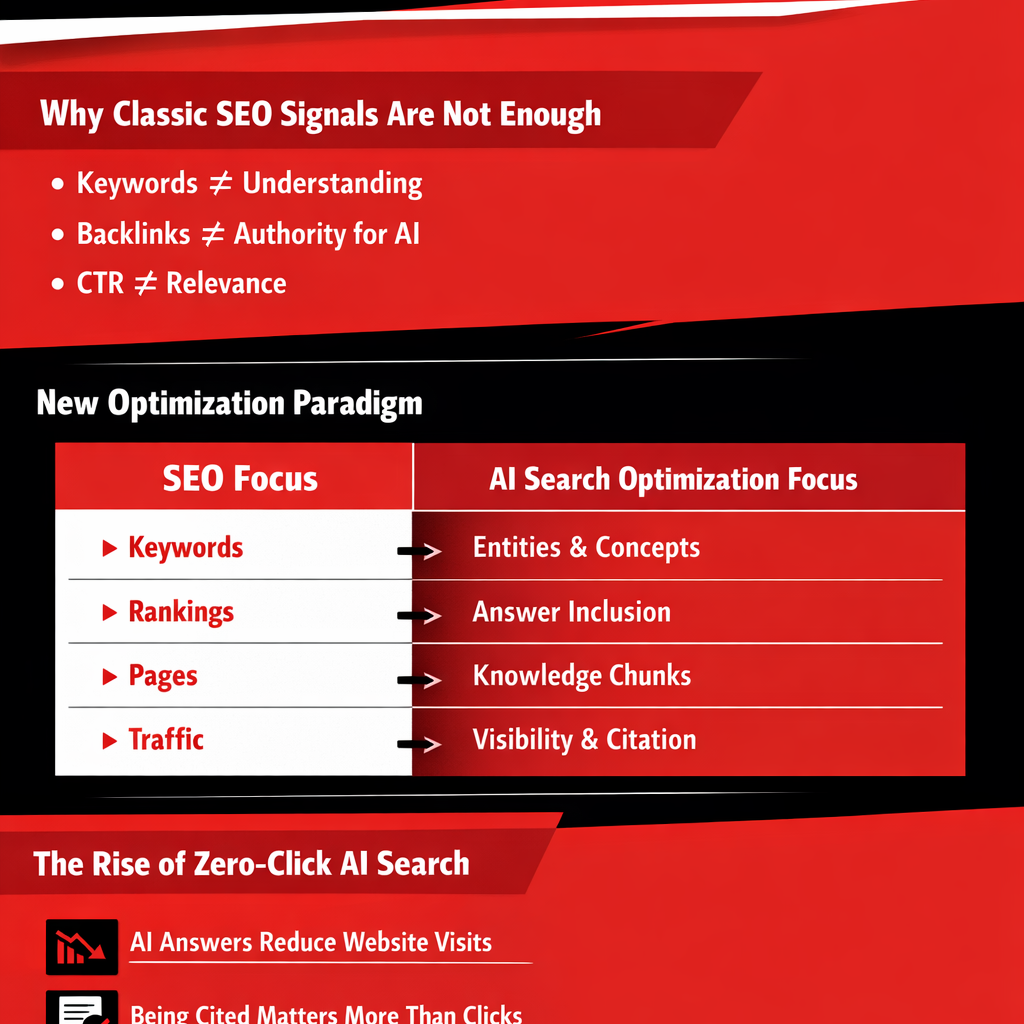
- Keywords ≠ understanding: Keywords help search engines match queries, but AI models prioritize meaning, context, and relationships. A page stuffed with keywords might rank in Google, yet be ignored by AI if it lacks clear, extractable knowledge.
- Backlinks ≠ full authority: Backlinks measure popularity, not accuracy or expertise. AI models value content that is consistent, well-defined, and corroborated across trusted sources.
CTR ≠ relevance: Click-through rate reflects user behavior on search results pages. AI systems don’t rely on clicks; they rely on confidence in the content itself.
Example: keyword SEO vs AI optimization
- Traditional SEO article:
“Best Email Marketing Tools 2026” — a generic listicle with shallow descriptions, affiliate-heavy language, and minimal differentiation. - AI-optimized article:
“Email Marketing Tools by Use Case, Budget Constraints, and Team Size (with Decision Matrix)” — structured, comparative, and designed so AI can extract clear recommendations.
The second version gives AI something it can reason with, not just rank.
The New Optimization Paradigm
AI Search Optimization shifts the goal from rankings to answer inclusion.
| SEO Focus | AI Search Optimization Focus |
| Keywords | Entities + relationships |
| Rankings | Answer inclusion |
| Pages | Extractable knowledge chunks |
| Traffic | Mentions + citations + trust |
Instead of optimizing entire pages, you optimize knowledge chunks—self-contained blocks that AI can lift into an answer.
Recommended “AI chunk” format (copy-paste ready):
- Definition: Clear, factual explanation (1–2 lines)
- When to use: Bullet points tied to real scenarios
- How it works: 3–5 logical steps or principles
- Example: Practical, concrete use case
- Limitations: When it doesn’t apply or breaks down
This structure makes content easier for AI systems to retrieve, verify, and reuse.
The Rise of Zero-Click AI Search
AI answers dramatically reduce the need for users to visit websites. Instead of ten links, users get one synthesized response. That doesn’t mean visibility disappears—it changes form.
In AI search, success looks like:
- Being mentioned by name
- Being cited as a source
- Being repeatedly referenced across prompts
As a result, brand visibility behaves less like SEO and more like authority-driven PR.
In AI search, brand visibility behaves like PR: you win by being referenced, repeated, and trusted.
Optimizing for AI search isn’t about chasing clicks—it’s about becoming the source AI confidently speaks for.
Core AI Search Optimization Signals
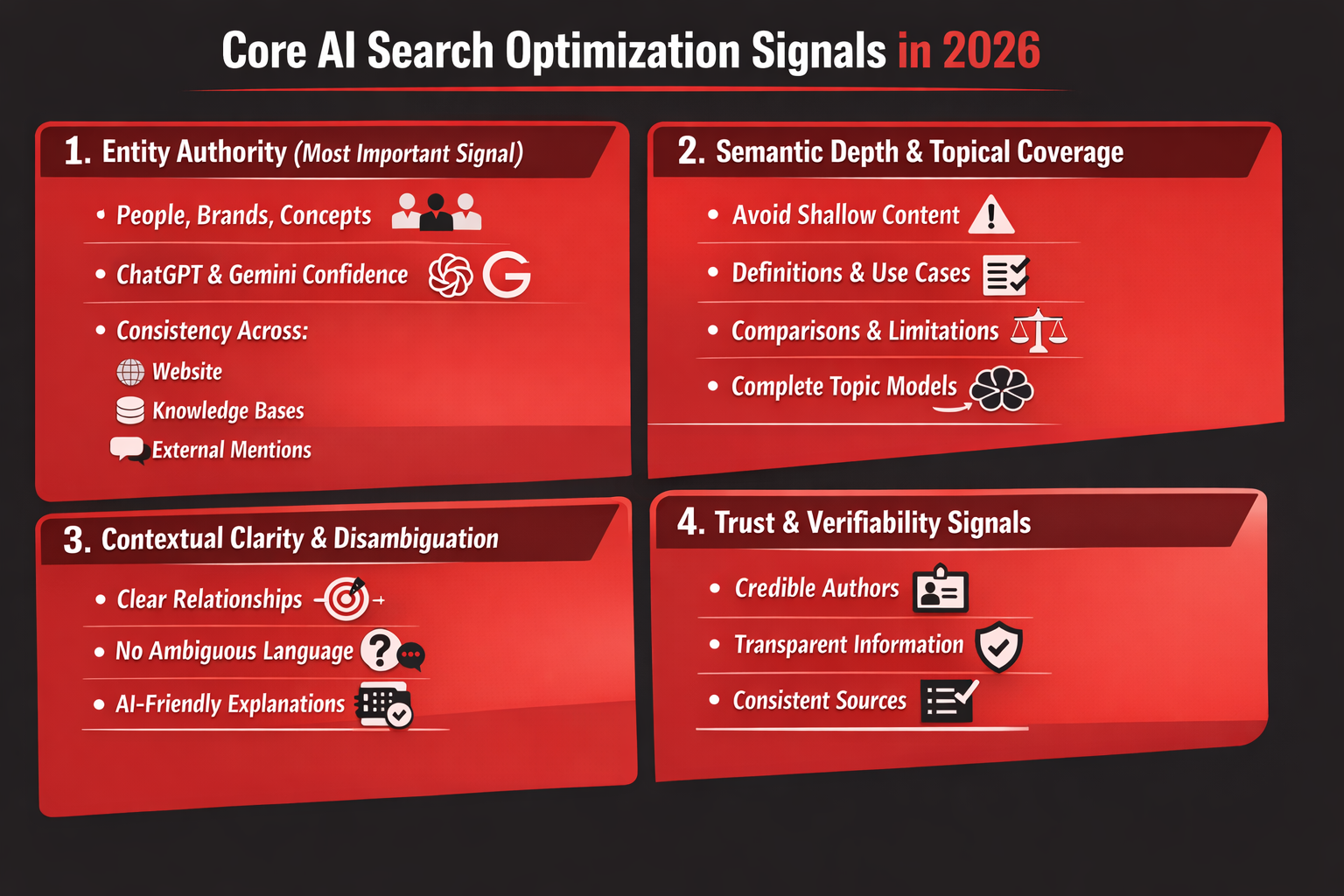
If traditional SEO is about ranking pages, AI Search Optimization is about earning selection. ChatGPT and Gemini don’t “scroll” and pick the blue link with the best title tag—they assemble answers by pulling from sources that feel confident, complete, clear, and trustworthy. That selection is driven by a few core signals you can intentionally engineer into your content.
Entity Authority (Most Important Signal)
At the center of AI answer engines is a simple question: “Do I know what this thing is, and can I trust it?”
That “thing” is usually an entity—a person, brand, product, place, or concept. Entities are the building blocks AI models use to form meaning.
AI builds confidence when your entity is consistent across sources. If your About page, service pages, author bios, and external profiles describe your brand differently—or vaguely—AI gets mixed signals. Consistency reduces uncertainty and increases the likelihood your brand is included in answers.
Here’s a clean “entity clarity” format you can reuse on your About page or press kit:
- Brand: ThatWare
- Category: AI SEO / AI Search Optimization
- Primary Offering: AI-driven SEO services for AI answer engines
- Audience: SaaS, local businesses, agencies
- Proof: case studies, awards, credentials
When this information appears clearly and repeatedly across your site (and ideally across a few third-party mentions), you become easier to “recognize” in AI outputs.
Example entity-stable paragraph (simple, extractable, and AI-friendly):
“ThatWare is an AI SEO agency focused on AI Search Optimization—helping brands increase visibility in ChatGPT, Gemini, and answer-first search.”
Notice what this does: it defines the brand, the category, the outcome, and the ecosystem in one clean chunk. That makes it easy for models to reuse accurately.
Semantic Depth & Topical Coverage
Most content fails in AI search because it’s thin. It might rank in Google for a keyword, but it doesn’t provide enough context for an AI model to confidently build an answer. AI systems prefer pages that cover a topic with semantic completeness—not just surface-level definitions.
A useful way to think about it: AI wants content that answers the entire question tree, not just the first question.
Use this coverage checklist when writing any “AI Search Optimization” section (or any pillar topic):
- What it is (definition in 1–2 lines)
- Why it matters (what changes in outcomes)
- How it works (simple mechanism explanation)
- Best practices (actionable steps)
- Common mistakes (what breaks trust/confidence)
- Tools (what helps execute/measure)
- Example workflow (step-by-step application)
- FAQs (real prompt-style questions users ask)
For this article specifically, “AI Search Optimization” should include concepts like: entities, chunking, schema, citations, authority, prompt mapping, and measurement. If those pieces are missing, your page often becomes “incomplete,” and AI has to patch gaps using other sources—reducing the chance it chooses you as the primary reference.
Depth isn’t about writing more words. It’s about covering the right concepts in a structured way that makes extraction easy.
Contextual Clarity & Disambiguation
Even strong content can fail if it’s unclear. AI models rely on stable relationships between subjects and objects—who did what, what causes what, what applies when. Vague writing creates ambiguity, which lowers confidence.
A common mistake is using “empty” statements that sound good but don’t specify meaning:
- Bad: “This improves results a lot.”
- Good: “This improves AI answer inclusion by making definitions extractable in a single chunk.”
That “good” version names the outcome (AI answer inclusion) and explains the mechanism (extractable definitions). That’s exactly the kind of clarity AI answer engines reward.
Disambiguation is equally important—especially because “AI search optimization” is often confused with SEO.
Use a sentence like this early in the section (it prevents misinterpretation and helps AI frame your article correctly):
Copy-paste disambiguation sentence:
“In this guide, ‘AI search optimization’ refers to optimizing content so LLM-based answer engines can retrieve, validate, and summarize it—not traditional SERP ranking.”
This one line reduces confusion for both humans and AI systems.
Trust & Verifiability Signals
Finally, AI systems prefer content that looks verifiable—meaning it has authorship, transparency, and alignment across sources. Trust signals become especially important for advice-style content (marketing, finance, health, legal, etc.), but they also matter for technical topics like this.
A simple E-E-A-T block makes your page easier to trust and easier to cite. Add this near the top or bottom of posts:
- Author: Name, role
- Credentials: years, certifications
- Experience proof: 2–3 relevant outcomes
- Last updated: date
- Sources: list of references
This doesn’t just help readers. It also helps AI systems interpret your content as grounded, maintained, and accountable—making it more likely to be selected as a source.
Content Structuring for AI Search Optimization
Content structuring is one of the most overlooked—but most decisive—factors in AI Search Optimization. Unlike humans, AI models such as ChatGPT and Gemini don’t “read” content linearly or emotionally. They ingest, segment, and retrieve information in discrete, machine-readable chunks. If your content is poorly structured, even highly accurate information may never be selected for AI-generated answers.
How AI Reads Content (Not Like Humans)
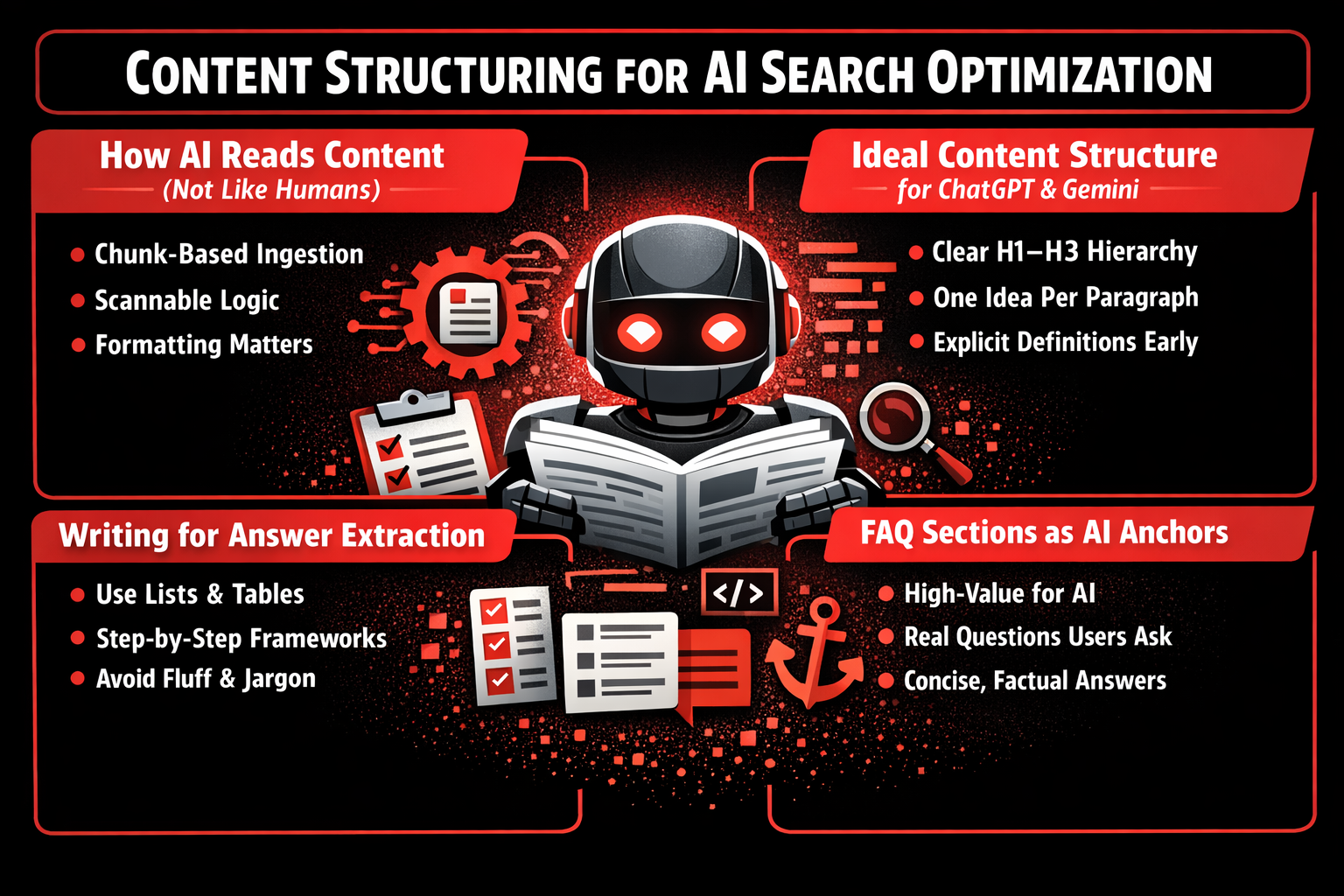
AI systems rely on chunk-based ingestion, meaning your content is broken into smaller semantic units during indexing and retrieval. Each chunk is evaluated independently for relevance, clarity, and trustworthiness.
This is why formatting directly impacts extraction quality.
A practical rule to follow is the “chunk rule”:
- Each concept should be contained within 60–120 words
- Include:
- 1 clear heading
- 1 concise definition or explanation
- 3–6 supporting bullets or steps
This structure allows AI models to extract a complete idea without needing surrounding context. Long, meandering paragraphs dilute meaning and reduce the likelihood of being reused in AI answers.
Example of a strong AI-readable chunk:
- Clear heading
- Immediate definition
- Bullet-based elaboration
This ensures the chunk can stand alone if pulled into a ChatGPT or Gemini response.
Ideal Content Structure for ChatGPT & Gemini
Both ChatGPT and Gemini strongly favor logical hierarchy and predictable structure. This doesn’t just help users—it helps AI models understand how ideas relate to one another.
Key structural principles:
- Use a clean H1–H3 hierarchy
- Keep one idea per paragraph
- Place definitions early, not buried mid-section
A recommended structure pattern for each major concept looks like this:
- H2: Concept Name
- H3: Definition – what it is, clearly and neutrally
- H3: When to Use – context and applicability
- H3: Steps – process or implementation
- H3: Example – real-world or simplified illustration
- H3: Pitfalls – limitations, mistakes, edge cases
This predictable layout allows AI systems to quickly locate definitions, processes, and comparisons—exactly the elements needed to generate high-quality answers.
Writing for Answer Extraction
To be selected by AI models, content must be extractable, not persuasive. That means prioritizing clarity over creativity.
Use:
- Lists for scannability
- Tables for comparisons
- Frameworks for processes and decisions
Avoid:
- Fluff and filler introductions
- Sales-heavy or promotional language
- Vague statements without specifics
Example of an extractable snippet:
AI Search Optimization (Definition):
AI Search Optimization is the practice of structuring content so AI assistants can retrieve accurate chunks, verify trust signals, and summarize the content confidently in answers.
Key elements:
- Entity clarity
- Topical completeness
- Chunk-based formatting
- Verifiable sources
- Structured data
This format allows AI systems to lift the definition and supporting points verbatim without losing meaning.
FAQ Sections as AI Training Anchors
FAQ sections are exceptionally valuable for AI Search Optimization because they closely mirror how users interact with AI—through natural-language questions.
Effective FAQ syntax:
- Question written exactly like a user prompt
- Answer limited to 2–4 concise lines
- Avoid hedging early; add “it depends” only after stating a baseline
Example FAQ pair:
Q: How is AI Search Optimization different from SEO?
A: SEO focuses on ranking pages in search results. AI Search Optimization focuses on making your content the trusted source AI systems use when generating answers, through entity clarity, structured chunks, and verifiable signals.
Well-written FAQs often become direct answer sources inside ChatGPT and Gemini responses.
Prompt-Aware Content Strategy
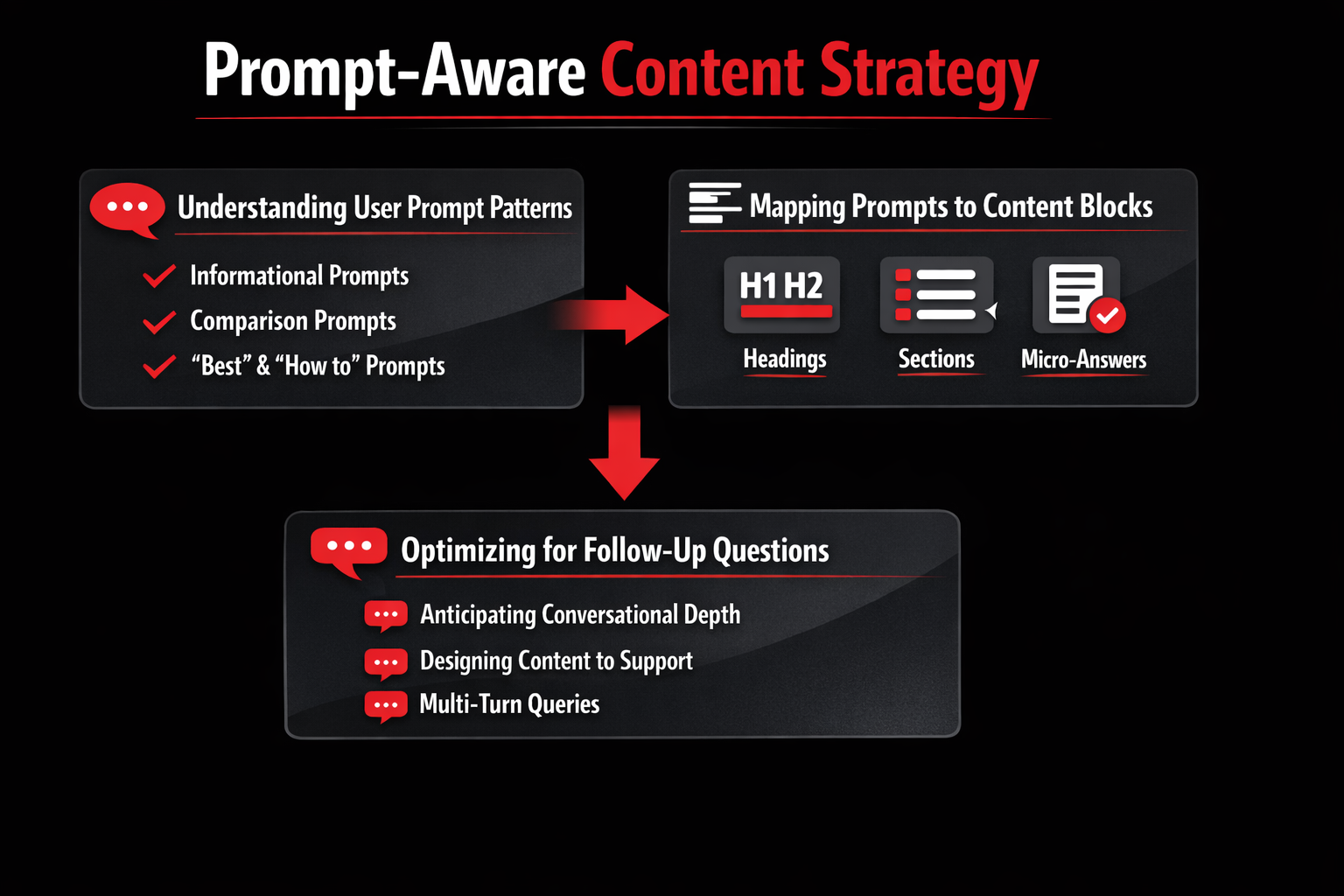
A prompt-aware content strategy is the bridge between how users think and how AI systems retrieve answers. Unlike traditional SEO—where keywords drive structure—AI search optimization requires understanding the intent patterns behind prompts and shaping content so it naturally fits into conversational flows used by ChatGPT and Gemini.
Understanding User Prompt Patterns
Users don’t interact with AI assistants using short, fragmented keywords. They ask complete, contextual questions, often layered with constraints, comparisons, or personal situations. Most prompts fall into a few predictable categories:
- Informational prompts
Example: “What is AI Search Optimization?”
These require clear definitions and concise explanations.
- Comparison prompts
Example: “ChatGPT vs Gemini for AI search optimization”
These demand structured comparisons, tables, and balanced analysis.
- “Best” prompts
Example: “Best AI search optimization strategies for SaaS companies”
AI looks for criteria-based recommendations, not vague lists.
- “How to” prompts
Example: “How to optimize content for ChatGPT answers”
These perform best with step-by-step frameworks.
- Situation-based prompts
Example: “Which is better for my situation: Gemini or ChatGPT?”
These require conditional logic and use-case-driven answers.
Common prompt formulas AI frequently sees:
- “Best X for Y with constraint Z”
- “Compare A vs B for use case C”
- “Explain X like I’m a beginner”
- “Give a step-by-step plan for X”
Designing content around these patterns makes it easier for AI models to reuse your material verbatim or as a trusted reference.
Mapping Prompts to Content Blocks
Once prompt patterns are identified, the next step is mapping them directly to content sections. Each major prompt should correspond to a clearly defined block within your article.
Example prompt:
“Best CRM for small SaaS?”
Mapped content structure:
- CRM selection criteria for SaaS – defines the decision framework
- Top options by budget – categorizes answers by constraints
- Decision table – enables fast comparison for AI extraction
- FAQ prompts – handles follow-up and edge cases
This structure allows AI systems to pull only the relevant block needed for a specific prompt, increasing your chances of inclusion in answers.
Optimizing for Follow-Up Questions
AI conversations are rarely one-and-done. Users ask follow-up questions to refine answers, so your content should support multi-turn conversations.
A conversation-ready sequence might look like:
- What is AI Search Optimization?
- How does it work for ChatGPT?
- How does it work for Gemini?
- What should I implement first?
- How do I measure results?
To guide both users and AI, include explicit transition cues such as:
“Next, you’ll want to map your target prompts to content blocks.”
These subtle signals help AI models understand the logical progression of your content—making it more reusable, coherent, and authoritative in ongoing conversations.
Entity-Based Brand Optimization for AI Search
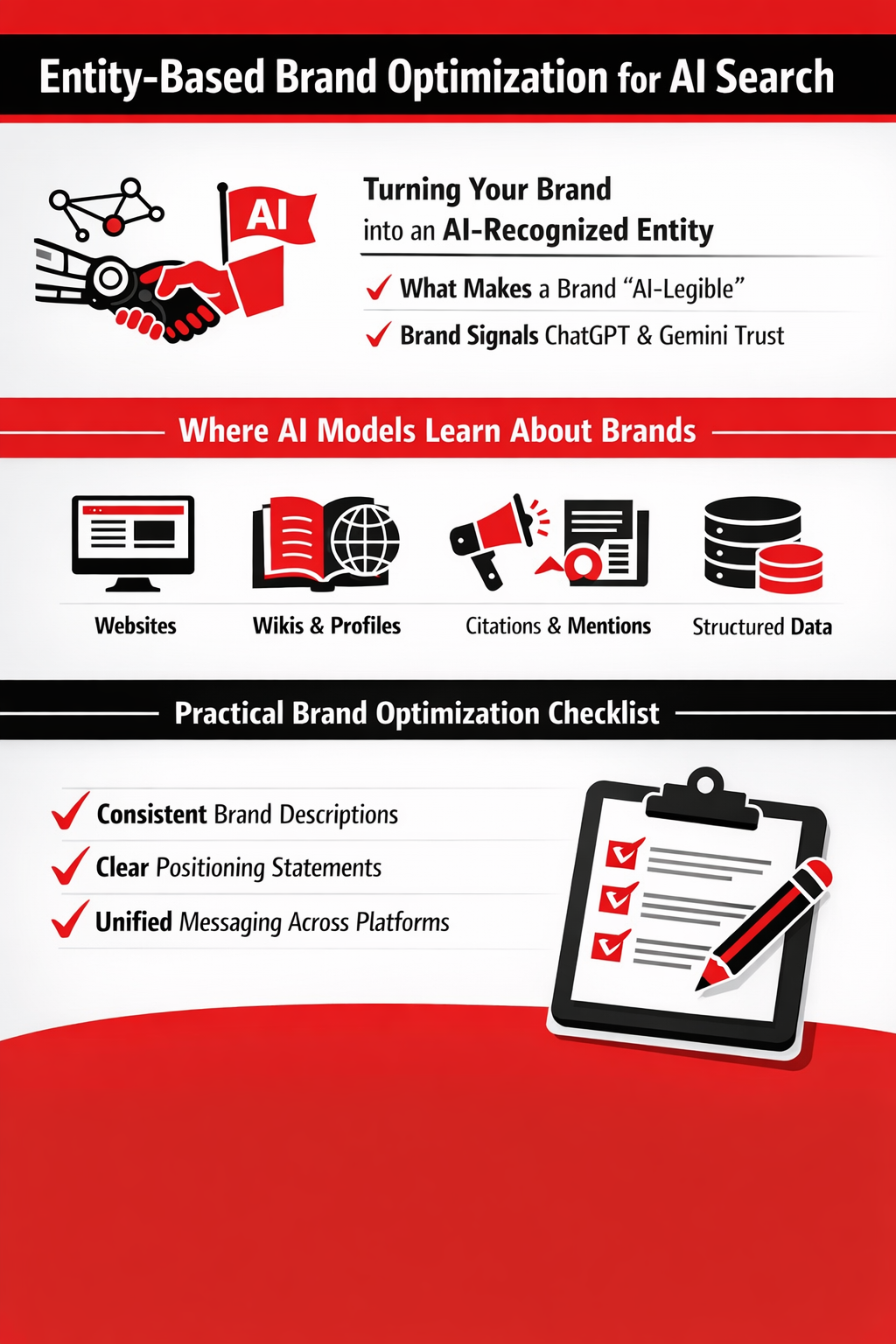
Entity-based brand optimization is one of the most critical, and often misunderstood, pillars of AI Search Optimization. In 2026, ChatGPT, Gemini, and other AI systems don’t just “read” your website; they model your brand as an entity. Whether your brand appears in AI-generated answers depends on how clearly, consistently, and confidently that entity is defined across the web.
If AI cannot form a stable understanding of who you are, what you do, and why you’re credible, your content will struggle to be selected, no matter how well written it is.
Establishing Your Brand as an AI Entity
An AI-recognized brand entity is unambiguous, consistent, and verifiable, essentially your brand’s “digital footprint” that AI models learn from over time.
At a minimum, your entity footprint checklist should include:
- A clear About page
Clearly state what your brand is, who it serves, and what problem it solves, using plain, factual language. Avoid vague marketing slogans.
- Author bios with credentials
AI models rely on author identity to assess trust. Ensure each author has a consistent bio detailing role, expertise, and experience.
- Consistent name and branding
Keep your brand name, spelling, logo usage, and tagline uniform across all platforms. Even small variations can fragment entity recognition.
- Aligned positioning across profiles
Keep your brand name, spelling, logo usage, and tagline uniform across all platforms. Even small variations can fragment entity recognition.
- Case studies and proof
Include real examples of work, outcomes, and clients to strengthen AI confidence in your brand.
- Citations and mentions
External mentions, on websites, blogs, podcasts, and industry platforms, help AI validate that your brand exists beyond your own site.
Goal: Make it effortless for AI to answer: “Is this brand real, relevant, and trustworthy?”
Where AI Models Learn About Brands
ChatGPT and Gemini don’t rely on a single source to understand brands. Instead, they triangulate information from multiple inputs, including:
- Your website (especially About, homepage, and blog content)
- Public profiles (LinkedIn, company directories, review platforms)
- Third-party mentions (articles, citations, expert quotes, PR)
- Structured data (schema markup that explicitly defines your brand and authors)
To reduce ambiguity, your brand should use a standardized brand definition snippet consistently across key pages and profiles.
Example brand definition snippet (homepage or press kit):
“ThatWare is an AI SEO agency that helps SaaS and local businesses improve visibility in ChatGPT and Gemini using entity-driven content, structured data, and AI-focused optimization strategies.”
This type of sentence is extremely valuable because it clearly defines:
- The entity type (AI SEO agency)
- The audience (SaaS and local businesses)
- The outcome (visibility in ChatGPT and Gemini)
- The method (entity-driven content, structured data)
Practical Brand Optimization Checklist (with Examples)
To operationalize entity-based brand optimization, your messaging should pass a simple consistency test. You should be able to describe your brand the same way—everywhere—using a clear positioning matrix.
Example positioning matrix:
- We help: SaaS companies
- Do: AI Search Optimization
- So they can: appear in ChatGPT and Gemini answers
- Using: entity-driven content, structured data, and authority building
When this positioning is reflected consistently across your website, profiles, schema markup, and content, AI systems can confidently associate your brand with specific concepts and use cases.
The result? Your brand becomes easier to recognize, easier to trust, and far more likely to be included in AI-generated answers—exactly where modern search visibility now happens.
Technical Foundations That Support AI Search Optimization
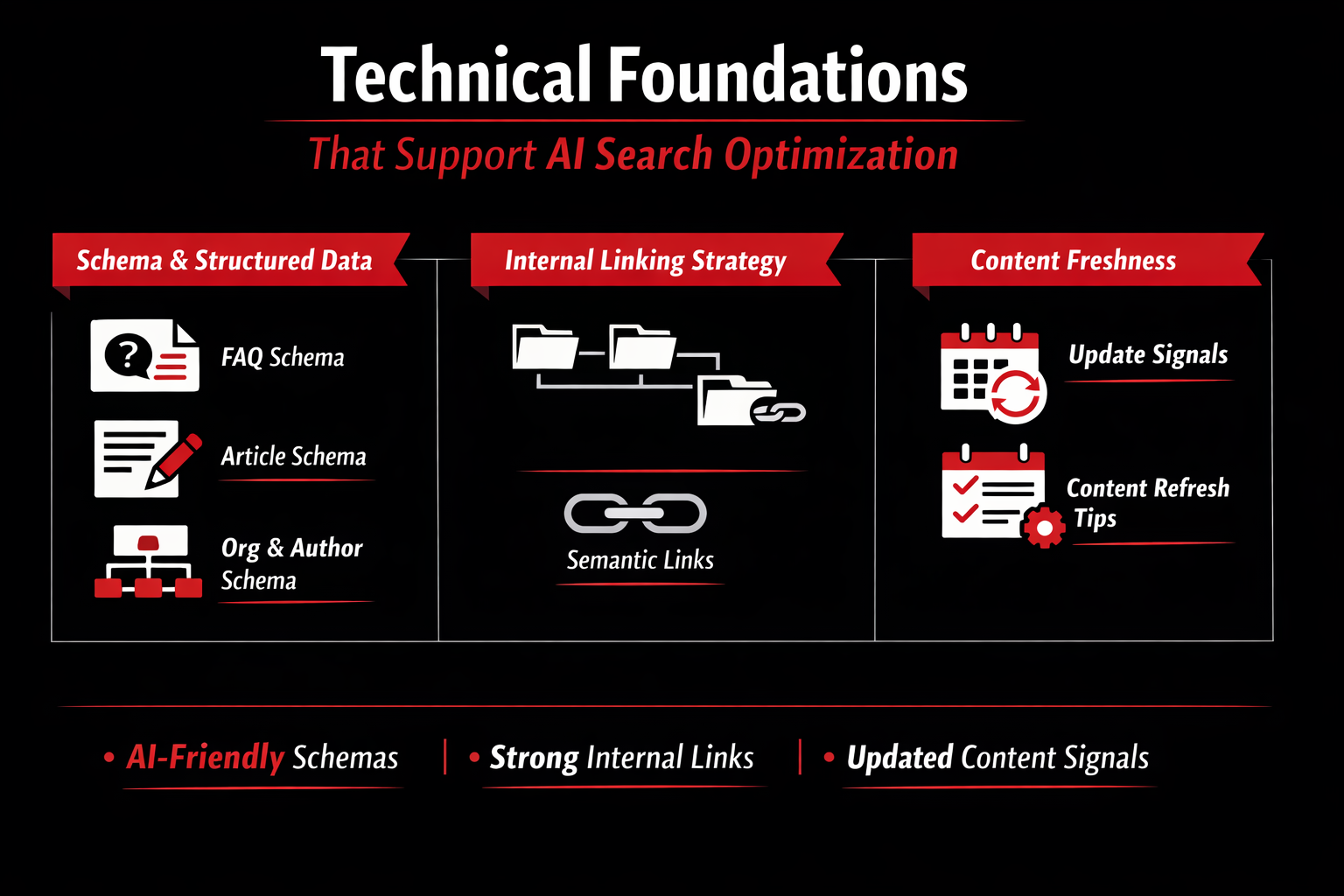
Technical optimization still plays a supporting—but critical—role in AI Search Optimization. While AI answer engines like ChatGPT and Gemini rely heavily on semantic understanding and entity trust, technical signals help models interpret, validate, and reuse your content more confidently.
Schema & Structured Data (What Actually Helps)
Structured data doesn’t “rank” content in AI answers, but it reduces ambiguity and strengthens trust signals, especially for Gemini, which is closely integrated with Google’s ecosystem.
The most impactful schema types for AI Search Optimization include:
- Organization – clarifies who you are as a brand
- Person (Author) – establishes author credibility and expertise
- Article / BlogPosting – defines content ownership and freshness
- FAQPage – helps AI extract direct question–answer pairs
- HowTo – useful for step-by-step instructional content
At a minimum, your schema should clearly communicate:
- Organization: name, official URL, logo, social profiles (sameAs)
- Person: author name, job title, organization affiliation
- Article: headline, author reference, publish date, last modified date
This structured clarity makes it easier for AI systems to associate content with trusted entities and reuse it accurately in generated answers.
Internal Linking for Concept Reinforcement
Internal links are no longer just for crawlability—they now help reinforce conceptual relationships for AI models.
Use semantic anchor text, not generic phrases. For example:
- “entity authority in AI search” → link to your entity optimization guide
- “prompt mapping framework” → link to your prompt testing article
A strong topic-cluster structure improves AI comprehension:
- Pillar: AI Search Optimization 2026
- Cluster 1: Entity SEO
- Cluster 2: Prompt Mapping
- Cluster 3: Schema for AI Visibility
- Cluster 4: AI Search Measurement Framework
This structure signals topical depth and reinforces your authority across related concepts.
Content Freshness & Update Signals
AI systems prefer current, well-maintained content, especially for evolving topics. Explicit update signals improve reliability.
Use a visible update block such as:
- Last updated: January 2026
- What changed in this update:
- Added new Gemini citation behavior insights
- Updated schema implementation examples
- Expanded AI search measurement section
These signals help AI models assess relevance and accuracy—without requiring a full rewrite—making your content more likely to be reused in AI-generated answers.
Measuring AI Search Optimization Success
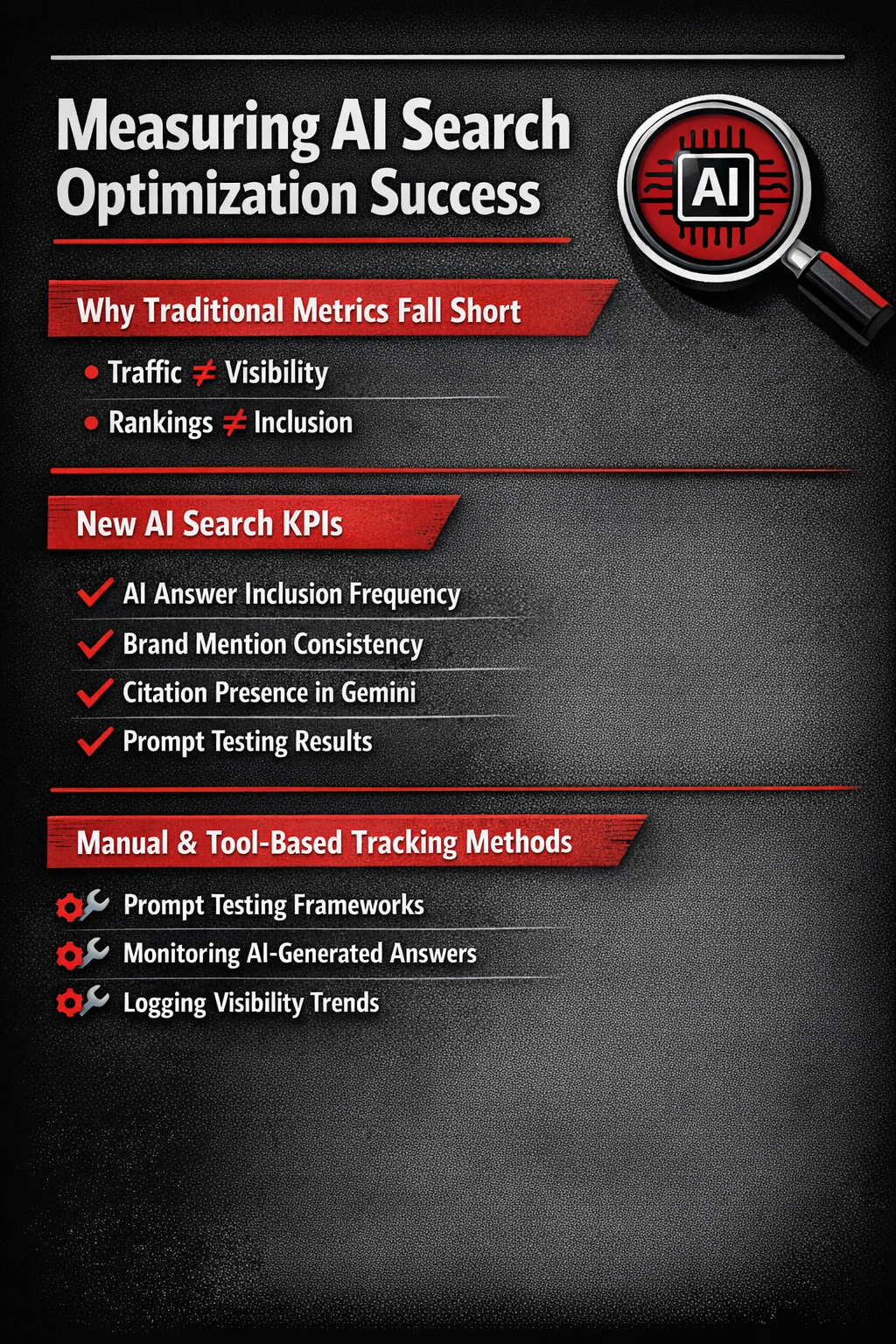
Measuring success in AI Search Optimization requires a mindset shift. Traditional SEO metrics were built for ranking-based search engines, not answer-first AI systems like ChatGPT and Gemini. In 2026, visibility is no longer only about how many users click your page—it’s about whether AI systems choose your content when generating answers.
Why Traditional Metrics Fall Short
In classic SEO, success is typically measured using organic traffic, keyword rankings, and click-through rates. However, these indicators are increasingly disconnected from how AI-powered search works.
- Traffic ≠ Inclusion
Your content may be heavily used by AI models without driving visits to your website. If ChatGPT or Gemini summarizes your insights directly in its response, the user may never click through—yet your brand still influences the decision.
- Rankings ≠ Citations
Ranking #1 in Google does not guarantee inclusion in AI answers. AI models prioritize clarity, trust, and extractable knowledge over SERP position.
Example: You may see a drop in organic traffic while simultaneously noticing your brand being repeatedly mentioned in ChatGPT or cited in Gemini answers. From an AI search perspective, this is still a win—your authority is compounding even if clicks decline.
New AI Search KPIs
To accurately measure AI Search Optimization performance, you need metrics aligned with how AI systems surface information.
Key KPIs to track include:
- AI Answer Inclusion Rate
Out of a defined prompt set (e.g., 20 prompts), how often does your brand or content appear in AI-generated answers? - Brand Mention Consistency
Are you mentioned sporadically, or consistently across different prompts and sessions? - Citation Presence
Gemini, in particular, often provides explicit citations. Tracking how often your site is cited is a strong indicator of trust. - Prompt Test Improvements
Over time, does your visibility improve after content updates and optimization?
Simple scoring template (copy-paste):
- Prompt set: 20 prompts
- Mentions: __ / 20
- Citations: __ / 20
- Correct positioning: __ / 20
- Competitor displacement: __ / 20
This scoring system helps quantify AI visibility in a repeatable, trend-focused way.
Manual & Tool-Based Tracking Methods
Because AI platforms don’t yet provide native analytics dashboards, most measurement relies on structured testing.
Prompt testing framework:
- Create a prompt list (20–50 real user-style prompts)
- Run weekly tests in ChatGPT and Gemini
- Log results (mentions, citations, accuracy, positioning)
- Update content blocks based on gaps or misinterpretation
- Re-test and compare trends over time
Example starter prompts:
- “What is AI Search Optimization?”
- “How do I optimize content for Gemini answers?”
- “Best practices for appearing in ChatGPT citations?”
- “How do entities influence AI answers?”
Over time, this feedback loop turns AI Search Optimization from guesswork into a measurable, improvable system—much like SEO was a decade ago, but built for answer engines instead of rankings.
Common Mistakes in AI Search Optimization
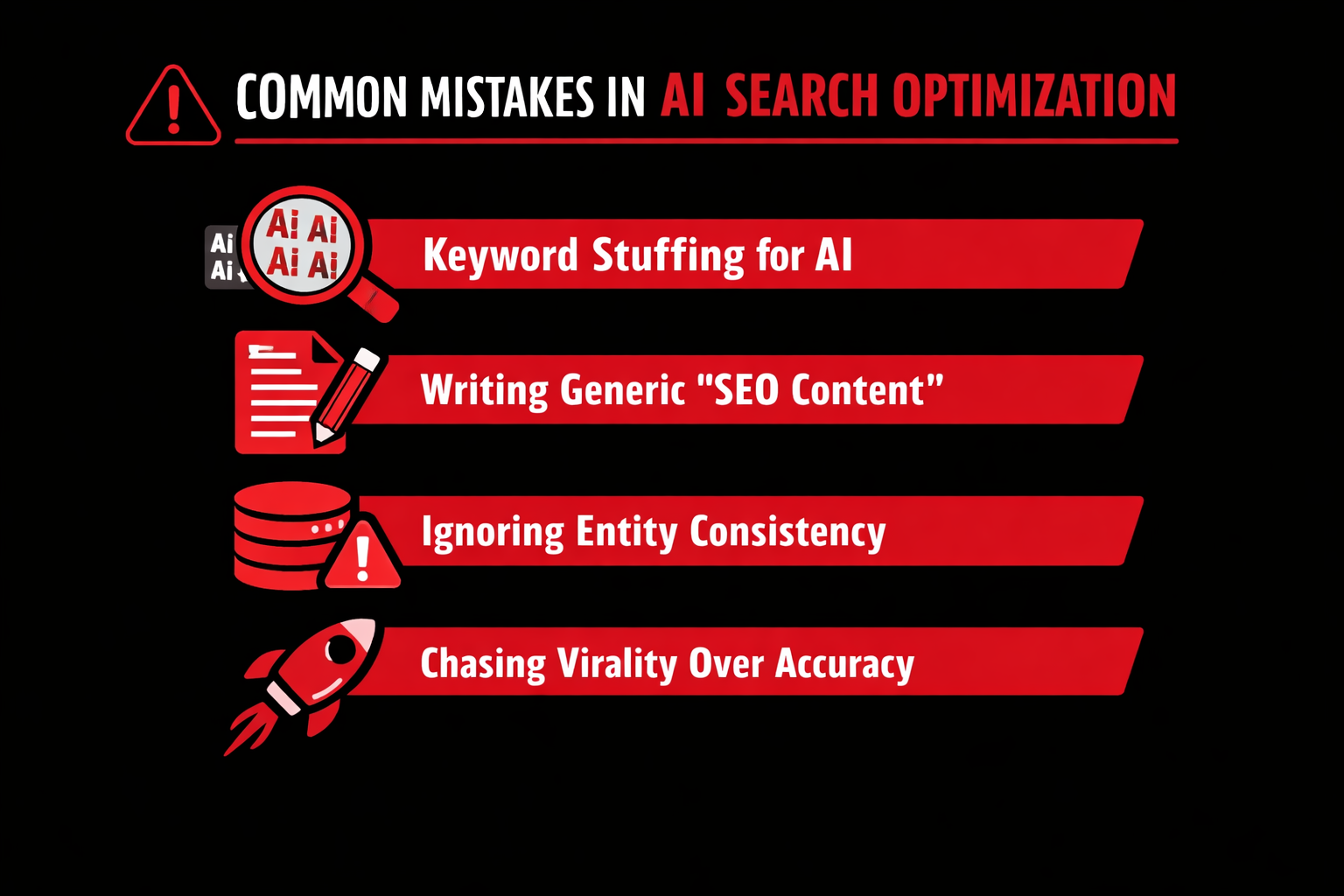
As brands rush to adapt to AI-driven discovery, many repeat old SEO habits that simply don’t work for ChatGPT, Gemini, or other answer engines. Below are the most common pitfalls and how to fix them effectively.
Keyword Stuffing for AI
A major misconception is that AI models rely on keyword density like traditional search engines. Repeating phrases like “AI search optimization” over and over adds no value and can reduce clarity. AI systems focus on entities and relationships, not keyword frequency.
Fix: Adopt an entity-first structure. Clearly define core entities, ChatGPT, Gemini, retrieval-augmented generation (RAG), schema, knowledge graphs, and explain their relationships. When entities are well connected, AI models can confidently extract and reuse your content.
Writing Generic “SEO Content”
Generic SEO content, long intros, vague advice, or listicles without depth, fail in AI search. If your article mirrors hundreds of others, AI has no reason to select it as a trusted source.
Fix: Make your content decision-oriented and extractable. Include clear definitions, real examples, comparison tables, and FAQ sections that directly answer common prompts. This structure makes it easy for AI to lift accurate chunks into responses.
Ignoring Entity Consistency
Many brands undermine AI visibility by being inconsistent across platforms. Different descriptions on your website, schema markup, and third-party profiles confuse AI about who you are and what you do.
Fix: Align your About page, structured data (Organization and Person schema), and external profiles with consistent terminology, positioning, and entity definitions. Consistency builds trust and strengthens your brand’s entity authority.
Chasing Virality Over Accuracy
Viral content often sacrifices precision for attention. AI models prioritize accuracy, clarity, and verifiability over hype.
Fix: Cite reliable sources, clearly state limitations, and be specific in your claims. Accurate, well-scoped content is far more likely to be reused in AI-generated answers than sensational but shallow takes.
Final Playbook: Step-by-Step AI Search Optimization Framework
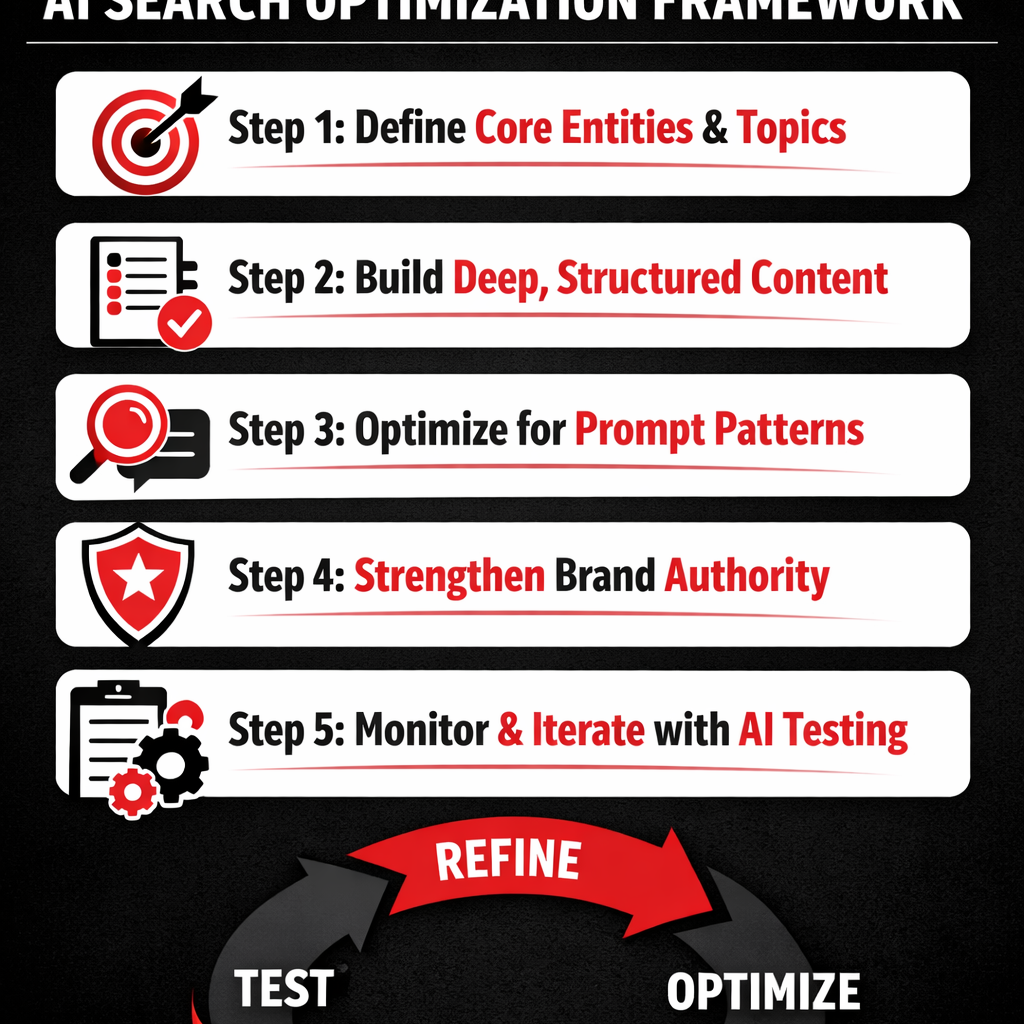
This final playbook distills AI Search Optimization for ChatGPT & Gemini into a repeatable, execution-first framework you can apply to any brand, page, or content cluster.
Step 1: Define Core Entities & Topics
AI search systems reason in entities and relationships, not keywords. Your first task is to clearly define what you want AI models to recognize and associate you with.
Use this entity-mapping template:
- Primary entity: AI Search Optimization
- Supporting entities: ChatGPT, Gemini, answer engines, RAG, schema, entity SEO
- User intents / prompt themes:
- “What is AI Search Optimization?”
- “How to optimize for ChatGPT answers?”
- “ChatGPT vs Gemini optimization differences”
This step ensures AI systems can correctly classify who you are, what you cover, and when to surface you in answers.
Step 2: Build Deep, Structured Content
Once entities are defined, content depth and structure determine whether AI can extract usable answers.
Every core page should include:
- Definition block: Clear, concise explanation (2–3 lines)
- Steps block: Actionable process or framework
- Comparison block: Alternatives, tools, or approaches
- Mistakes block: Common pitfalls AI users ask about
- FAQ block: Natural-language questions with direct answers
This structure maximizes “answer-ready” chunks.
Step 3: Optimize for Prompt Patterns
AI answers are triggered by prompts, not queries. Design content to match common prompt structures:
- “Best X for Y” (decision-based)
- “A vs B” (comparison-based)
- “How to do X” (procedural)
- “X checklist” (implementation-focused)
Each prompt type should map to a dedicated section or table.
Step 4: Strengthen Brand Authority
AI models prefer trusted, consistent sources.
Authority checklist:
- Clear About page defining your entity
- Author bios with real expertise
- Case studies or proof of experience
- Consistent brand mentions across platforms
Step 5: Monitor & Iterate with AI Testing
AI optimization is iterative, not one-time.
Use this loop continuously:
Test → Identify missing chunk → Add structured block → Update schema → Re-test
This feedback loop is how brands compound visibility inside ChatGPT and Gemini answers over time.
Conclusion: Mastering Visibility in the AI-Driven Search Era
The AI search era represents a fundamental shift in how visibility is earned online. Success is no longer measured by ranking pages or chasing clicks; it’s about being understood, trusted, and reused by AI systems that now act as the primary gateways to information. ChatGPT, Gemini, and other answer engines don’t browse the web like humans; they synthesize it. Only content with clear meaning, strong authority, and reliable structure makes it into the answers users actually see.
Brands that recognize this shift early are gaining a powerful advantage. When your content is optimized for AI search, every accurate mention, citation, or inclusion compounds over time. Instead of competing for fleeting rankings, you’re building long-term digital authority that persists across prompts, platforms, and user contexts. That’s why AI Search Optimization isn’t a short-term tactic; it’s a strategic evolution of SEO itself.
As traditional discovery gives way to conversational and answer-first experiences, the brands that succeed will be those that align their content with how AI understands knowledge. Start with entity clarity, publish extractable, well-structured content chunks, and regularly test real user prompts. Done consistently, your brand’s AI visibility won’t just grow, it will compound, positioning you as a trusted source in the AI-driven search landscape.