
SUPERCHARGE YOUR ONLINE VISIBILITY! CONTACT US AND LET’S ACHIEVE EXCELLENCE TOGETHER!
Introduction: The End of Keyword-Centric Search?
For more than two decades, SEO has been built on a deceptively simple idea: match the right keywords to the right pages and search engines will reward you with visibility. From early exact-match queries and keyword density formulas to more advanced on-page optimization, the core objective remained the same—rank pages by aligning text with user queries. Even as algorithms grew more sophisticated, most SEO strategies still revolved around keywords as the primary unit of relevance.
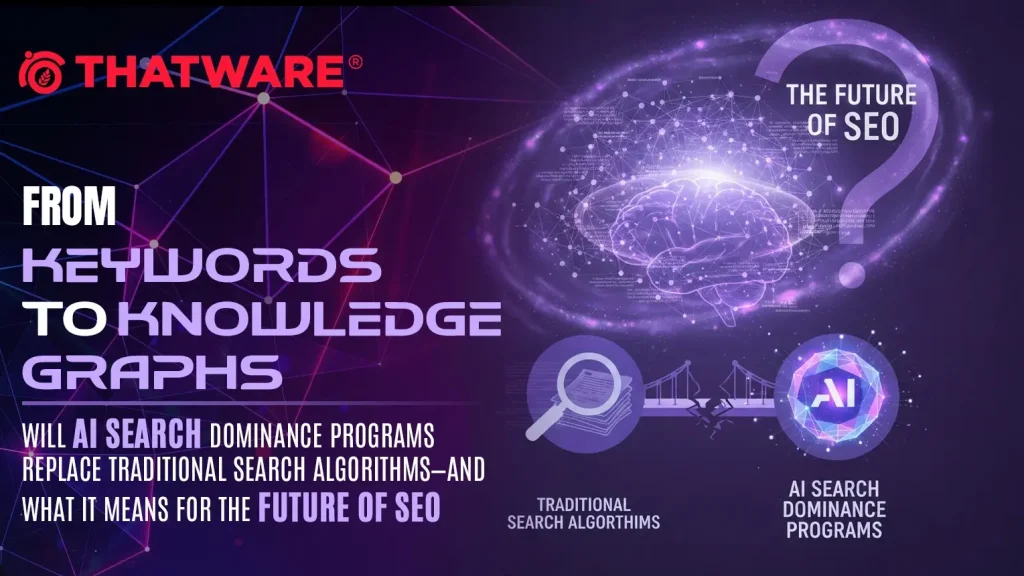
But that foundation is now cracking.
Modern search is no longer about ranking pages—it’s about ranking understanding. Search engines are moving beyond strings of text toward interpreting meaning, intent, relationships, and context. Semantic search, machine learning, and large language models have quietly but fundamentally changed how results are generated. Instead of asking, “Which page best matches these keywords?”, AI-driven systems ask, “Which source best understands and satisfies the user’s underlying need?”
This shift has given rise to what can be broadly described as AI Search Dominance Programs (ASDPs). This isn’t a single product, tool, or update. Rather, it represents an ecosystem of AI-powered ranking systems that combine machine learning models, knowledge graphs, entity understanding, and real-time behavioral feedback to determine visibility. These systems don’t just index content—they interpret it, connect it, and continuously refine their understanding based on user interaction.
Which brings us to the central question facing every SEO professional and digital marketer today:
Are traditional search algorithms being replaced, or are they being subsumed by AI-driven systems that operate at a higher level of intelligence? The answer matters, because it determines whether classic SEO tactics still work—or quietly fail.
In this article, we’ll unpack how search actually works today beneath the surface, what’s changing inside ranking systems as AI takes a dominant role, and why knowledge graphs and entity-based understanding are becoming more important than keyword targeting. Most importantly, we’ll explore what SEOs, content creators, and brands must do differently right now to remain visible in an AI-driven search landscape.
Because while SEO didn’t die—it evolved.
But many strategies didn’t.
How Traditional Search Algorithms Actually Worked (and Still Do)
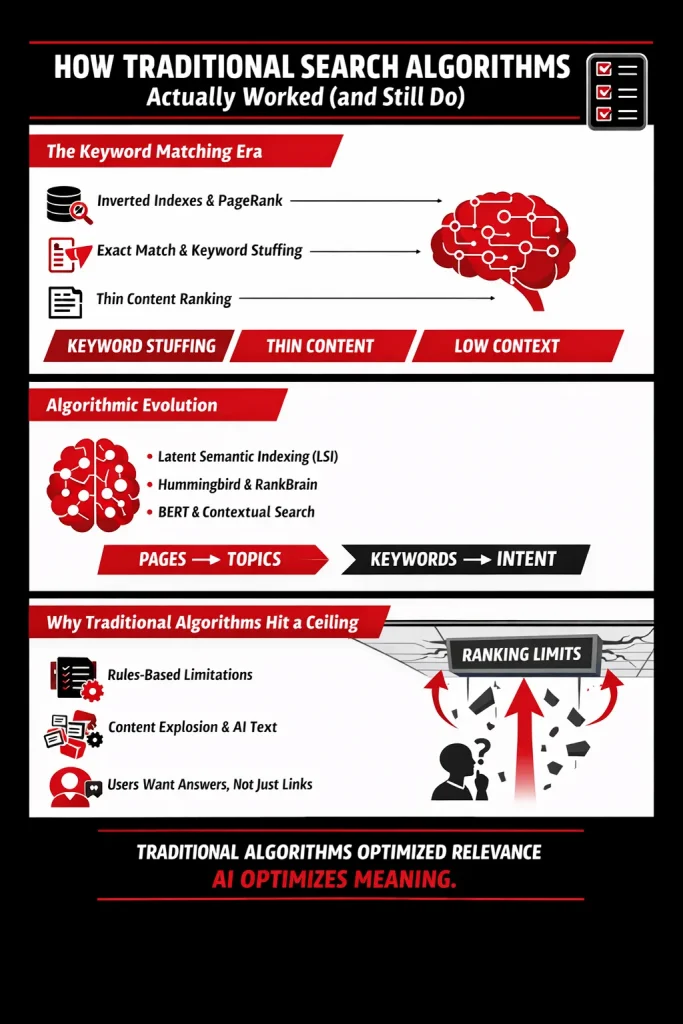
Before understanding why AI-powered search systems are reshaping SEO, it’s important to establish how traditional search algorithms worked—and why many of their core mechanics still exist today. While search has evolved significantly, its foundations were built on rule-based systems designed to match text, not truly understand meaning.
The Keyword Matching Era
Early search engines relied heavily on inverted indexes, a system that mapped keywords to the documents in which they appeared. When a user entered a query, the search engine looked up those terms in the index and retrieved pages containing the same words. Rankings were largely influenced by keyword frequency, placement (titles, headings, body text), and exact-match logic.
The introduction of PageRank added a critical second layer: link-based authority. Pages that received more links—especially from trusted or authoritative sites—were considered more valuable. In simple terms, links acted as votes, and pages with more votes ranked higher.
However, this model had serious limitations:
- Keyword stuffing became rampant, with pages repeating terms unnaturally to manipulate rankings.
- Thin or low-quality content often ranked well simply because it matched keywords and had enough links.
- Search engines struggled with contextual understanding, failing to differentiate between intent, ambiguity, or nuanced meaning.
Search worked well for matching words, but poorly for understanding what users actually wanted.
Algorithmic Evolution (Pre-AI)
To overcome these weaknesses, search engines began introducing semantic and behavioral improvements—still rule-based, but more sophisticated.
Latent Semantic Indexing (LSI) helped search engines identify related terms and concepts, reducing reliance on exact matches. This allowed search systems to recognize that different words could express similar ideas.
Later updates marked a deeper shift:
- Hummingbird focused on understanding entire queries instead of individual keywords.
- RankBrain introduced machine learning to interpret unfamiliar or ambiguous searches.
- BERT improved natural language processing, helping search engines understand context, word relationships, and sentence structure.
Conceptually, this era marked two major transitions:
- From pages to topics, where content depth and coverage mattered more than isolated URLs.
- From keywords to intent, where understanding why a user searched became as important as what they typed.
Why Traditional Algorithms Hit a Ceiling
Despite these advances, traditional algorithms faced structural limits. Rule-based systems—even when enhanced with machine learning—could approximate relevance but not true understanding. They relied on signals, patterns, and probabilities rather than meaning itself.
At the same time, the explosion of online content, amplified by AI-generated text, made it increasingly difficult to assess originality, authority, and trust at scale. Meanwhile, user expectations evolved: people no longer wanted ten blue links—they wanted direct, accurate answers.
This is where traditional search reached its ceiling.
Traditional algorithms optimized relevance; AI optimizes meaning.
That shift defines the next era of search and sets the stage for AI Search Dominance Programs.
What Are AI Search Dominance Programs?
AI Search Dominance Programs are not a single update, tool, or algorithm that suddenly replaces traditional search systems. Instead, they represent a fundamental ecosystem shift in how search engines discover, understand, rank, and surface information. To understand their impact on SEO, it’s important to move beyond the idea of “an algorithm change” and see AI search as a multi-layered intelligence system.
Defining “AI Search Dominance Programs”
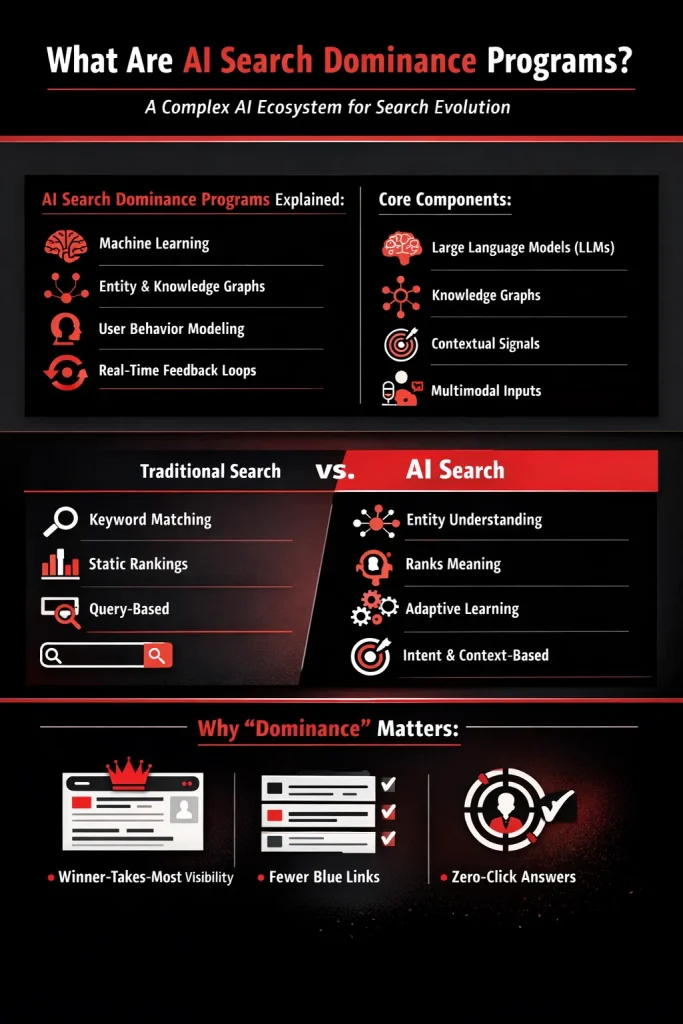
At their core, AI Search Dominance Programs are layered search frameworks designed to prioritize understanding over matching. Unlike traditional search, which relied heavily on predefined ranking rules, these systems continuously learn, adapt, and refine results based on real-world interactions.
They combine several advanced capabilities working together:
- Machine learning models that evolve ranking behavior over time
- Entity graphs that map real-world concepts and their relationships
- User behavior modeling to understand satisfaction, intent, and engagement
- Real-time feedback loops that adjust results based on live data signals
The result is a system that doesn’t just retrieve information—it interprets it, evaluates confidence, and predicts what the user actually wants next.
Core Components Powering AI Search
Several core technologies enable this new search paradigm.
Large Language Models (LLMs) allow search systems to process natural language at scale, understand nuance, and generate coherent answers rather than simply pointing to documents.
Knowledge graphs and entity resolution form the backbone of AI search understanding. These systems identify entities—people, brands, locations, concepts—and map how they relate to each other. This allows search engines to distinguish between similar terms, maintain context across queries, and trust authoritative sources.
Contextual ranking signals go beyond static metrics like backlinks or keyword density. They evaluate factors such as query intent, user history, location, device, and even prior interactions to personalize and refine results.
Multimodal understanding expands search beyond text. Modern AI systems can interpret voice queries, images, videos, and mixed inputs, creating a more holistic understanding of user intent.
Together, these components turn search into a continuously learning system rather than a fixed ruleset.
How AI Search Differs from Traditional Search
The shift becomes clear when comparing old and new models:
- Traditional search matches keywords, while AI search understands entities
- Traditional systems rank pages, AI systems rank meaning
- Static signals are replaced with adaptive learning
- Search moves from being query-based to intent- and context-based
In short, AI search focuses less on what was typed and more on what was meant.
Why “Dominance” Matters
The term “dominance” is not accidental. AI-driven search systems create winner-take-most visibility, where only a small set of highly trusted entities consistently surface across answers. As blue links shrink and direct answers grow, users increasingly get what they need without clicking.
This leads to more zero-click outcomes, fewer opportunities for marginal content, and higher rewards for brands and publishers that are deeply understood by AI systems. In this environment, being indexed is no longer enough—being recognized, trusted, and contextually relevant is what determines visibility.
AI Search Dominance Programs don’t just change how search works—they redefine who gets seen at all.
The Shift from Keywords to Entities & Knowledge Graphs
For decades, SEO revolved around keywords—specific strings of text that users typed into search engines and marketers tried to match. While this approach powered early search success, it was fundamentally limited. Keywords describe how people ask questions, not what they actually mean. As search behavior became more conversational and content volumes exploded, search engines needed a more reliable way to understand the world. That shift led to entities and knowledge graphs, which now form the backbone of modern, AI-driven search systems.
What Is an Entity?
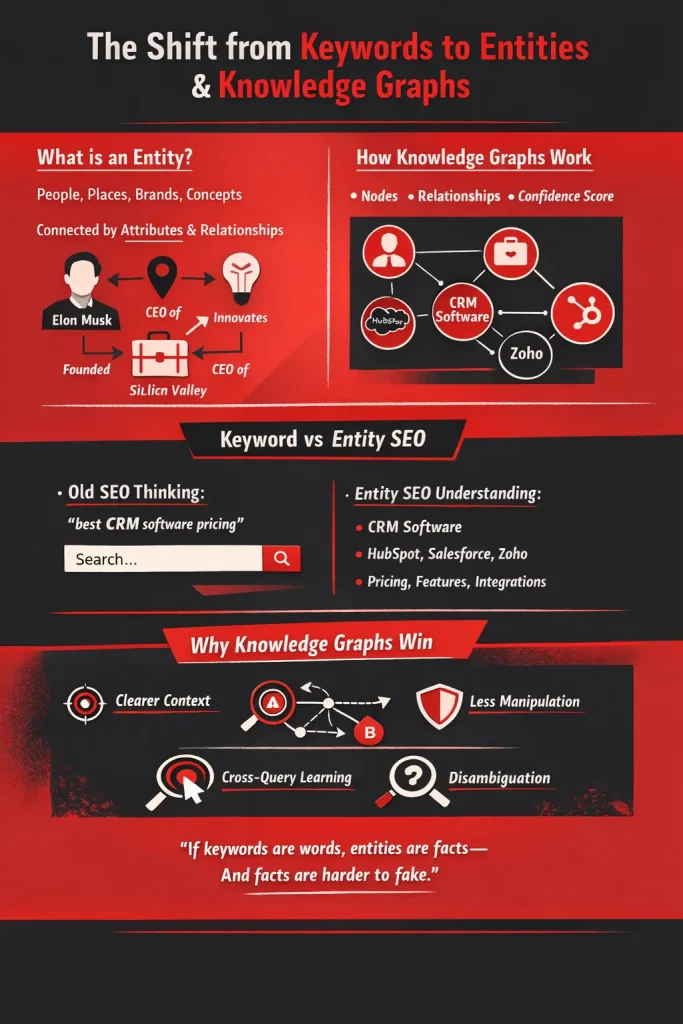
An entity is a clearly defined, distinguishable “thing” in the real or conceptual world. This includes people, places, brands, products, organizations, and abstract concepts—not just words on a page. For example, “Apple” as an entity can be a company, a fruit, or a record label, each with entirely different meanings.
What makes entities powerful is not just their existence, but how they connect to other entities. Each entity has attributes (such as name, category, location, price, or function) and relationships that define how it fits into a broader context. A brand entity might be linked to its founders, competitors, products, industries, and customer segments. These structured relationships allow search engines to understand meaning rather than relying on keyword frequency or placement.
In short, entities transform search from text matching into knowledge understanding.
Knowledge Graphs Explained (Simply)
A knowledge graph is the system search engines use to organize entities and their relationships. At its core, it consists of:
- Nodes: individual entities (people, brands, concepts)
- Relationships: how those entities connect (e.g., “competes with,” “founded by,” “offers pricing for”)
- Confidence scoring: signals that determine how trustworthy and authoritative an entity or relationship is
Instead of ranking pages purely on keywords, search engines increasingly rely on knowledge graphs to verify facts, resolve ambiguity, and deliver accurate answers. This is why Google and other platforms trust entities more than pages. Pages can be manipulated; entities are reinforced by consistent signals across multiple sources—websites, databases, reviews, media mentions, and user behavior.
As AI models learn from these graphs, search becomes less about retrieving documents and more about assembling understanding.
Keyword SEO vs Entity SEO: A Simple Example
Consider the traditional keyword query: “best CRM software pricing.”
In keyword-based SEO, success meant optimizing a page with that exact phrase, adding related keywords, and building links. The engine matched text and ranked pages accordingly.
Entity-based SEO interprets the same query very differently:
- Primary entity: CRM software
- Sub-entities: HubSpot, Salesforce, Zoho
- Attributes: pricing, features, integrations, reviews
Rather than searching for pages with the right words, the engine evaluates which CRM entities are most relevant, authoritative, and helpful for pricing-related intent. Content that clearly explains these entities and their attributes becomes far more valuable than pages stuffed with keywords.
Why Knowledge Graphs Beat Keywords
Knowledge graphs outperform keyword-based systems for several reasons. They enable disambiguation, ensuring the engine understands exactly which entity a user means. They support context retention, allowing search systems to connect multiple related queries over time. Through cross-query learning, AI can improve results by learning from patterns across millions of searches. Most importantly, knowledge graphs are far more resistant to manipulation, making them essential in an era of AI-generated content.
Thought leadership insight: If keywords are words, entities are facts—and facts are harder to fake.
Are Traditional Search Algorithms Being Replaced or Absorbed?
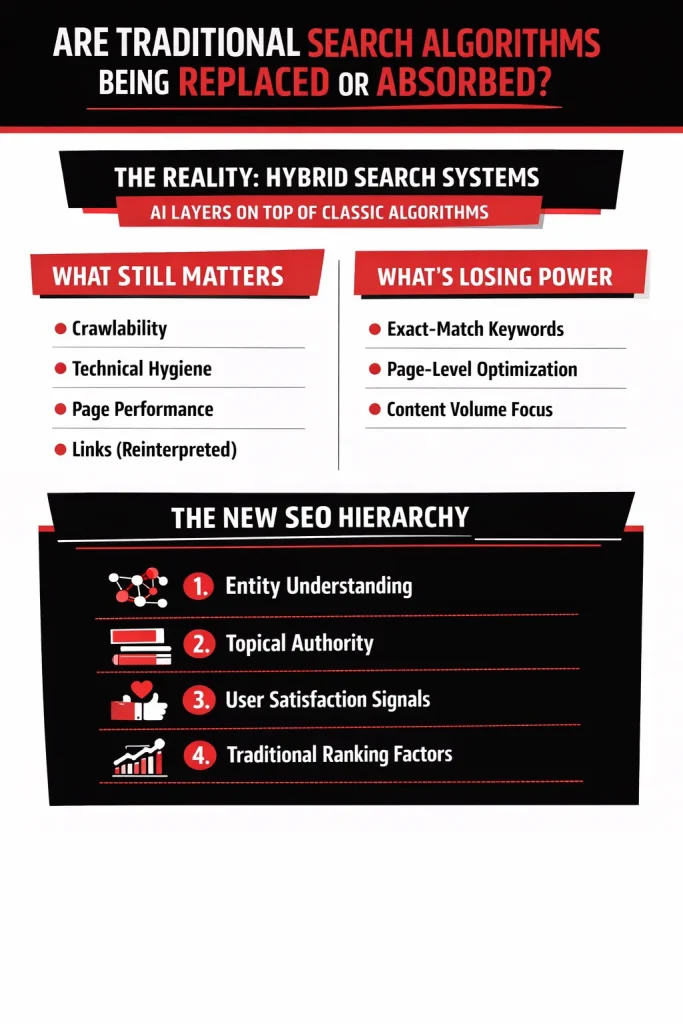
The short answer is no—traditional search algorithms are not being replaced. They are being absorbed.
Modern search engines no longer operate on a single ranking logic. Instead, they run hybrid search systems where classic algorithmic foundations coexist with AI-driven intelligence layers. Crawlers, indexes, and rule-based ranking signals still do the heavy lifting of discovering and organizing the web. On top of this infrastructure, AI systems interpret meaning, predict intent, and continuously learn from user behavior. In other words, traditional algorithms provide the structure; AI provides the understanding.
This layered approach allows search engines to remain stable while becoming adaptive. Rules ensure consistency and scalability, while machine learning models refine relevance in real time. The result is not an “AI takeover,” but a deeply integrated system where logic and learning work together.
What Still Matters from Old SEO
Despite all the noise around AI, many foundational SEO principles remain critical. Crawlability ensures search systems can access and interpret your content. Technical hygiene—clean code, proper indexing, structured navigation—still determines whether your site can participate in rankings at all. Page performance, including speed and mobile usability, continues to influence both user experience and visibility.
Links also still matter, but not as raw quantities. AI systems interpret links as contextual trust signals, evaluating relevance, consistency, and the entities involved rather than sheer volume.
What’s Losing Power
At the same time, several once-dominant tactics are clearly declining. Exact-match keyword targeting no longer guarantees relevance in an entity-driven search environment. Page-level optimization in isolation—treating each URL as a standalone asset—fails to signal broader authority. Likewise, volume-based content strategies that prioritize scale over substance are increasingly ineffective, especially in a world saturated with AI-generated text.
The New Ranking Hierarchy
Search visibility today follows a new order of importance:
- Entity understanding – Who and what you are in the knowledge graph
- Topical authority – Depth and consistency across a subject
- User satisfaction signals – Engagement, usefulness, and trust
- Traditional ranking factors – Technical and structural foundations
SEO hasn’t disappeared—it has been restructured. Those who adapt to this hierarchy will remain visible; those who don’t will slowly fade from relevance.
How AI Search Changes Ranking, Visibility & Traffic
AI-driven search systems are fundamentally changing what it means to “rank.” For marketers, the shift is not just technical—it’s strategic. Visibility is no longer confined to blue links, and success can no longer be measured by traffic alone. AI Search Dominance Programs are redefining how content is surfaced, consumed, and valued.
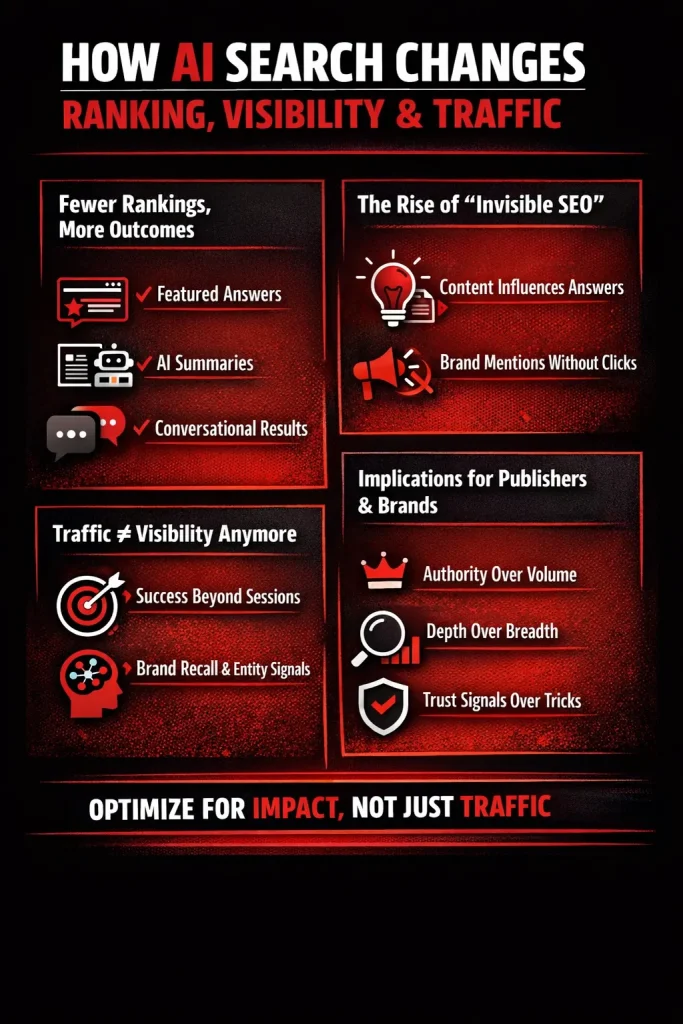
Fewer Rankings, More Outcomes
Traditional search rewarded visibility through positions—rank #1, #2, or #3. AI search rewards outcomes. Instead of ten blue links, users increasingly see:
- Featured answers that extract and synthesize information from multiple sources
- AI-generated summaries that resolve intent without requiring a click
- Conversational results that evolve as the user refines their question
In this model, multiple pages may contribute to a single answer, but only the most authoritative and contextually accurate sources influence the final response. Ranking becomes less about owning a position and more about being included in the AI’s decision-making layer.
The Rise of “Invisible SEO”
One of the most disruptive changes is the rise of what can be called invisible SEO. Your content may shape AI-generated answers even if the user never visits your site. This means:
- Pages can influence visibility without generating traffic
- Brand mentions, citations, and factual accuracy matter more than clicks
- Being a trusted source increases long-term discoverability across queries
For marketers, this requires a mindset shift: optimization is no longer just about attracting visits—it’s about training AI systems to recognize your brand and content as reliable.
Traffic ≠ Visibility Anymore
In AI search environments, traffic is an incomplete metric. A brand may experience declining sessions while simultaneously gaining influence. Visibility now includes:
- Brand recall when users repeatedly see or hear your name in AI responses
- Entity inclusion, where your brand is recognized as part of a topic cluster
- Citations and references within AI-generated summaries
Modern SEO measurement must expand beyond sessions and rankings to include qualitative indicators of authority and presence across the search ecosystem.
Implications for Publishers & Brands
These changes force a strategic recalibration. AI search rewards:
- Authority over volume: fewer, higher-quality assets outperform mass content production
- Depth over breadth: comprehensive coverage of a topic beats surface-level posts
- Trust signals over tricks: expertise, consistency, and credibility replace tactical manipulation
For publishers and brands, the goal is no longer just to be found—but to be understood, trusted, and reused by AI systems. Those who adapt will maintain influence even as traditional traffic models continue to erode.
What the Future of SEO Looks Like (Next 3–5 Years)
The next phase of SEO will not be defined by small algorithm updates or new ranking “hacks.” Instead, it will be shaped by a structural shift in how search engines understand information, brands, and users. Over the next three to five years, SEO will evolve from a tactical marketing function into a discipline that blends engineering, content strategy, and AI literacy. Those who adapt early will gain compounding advantages; those who don’t may find themselves increasingly invisible.
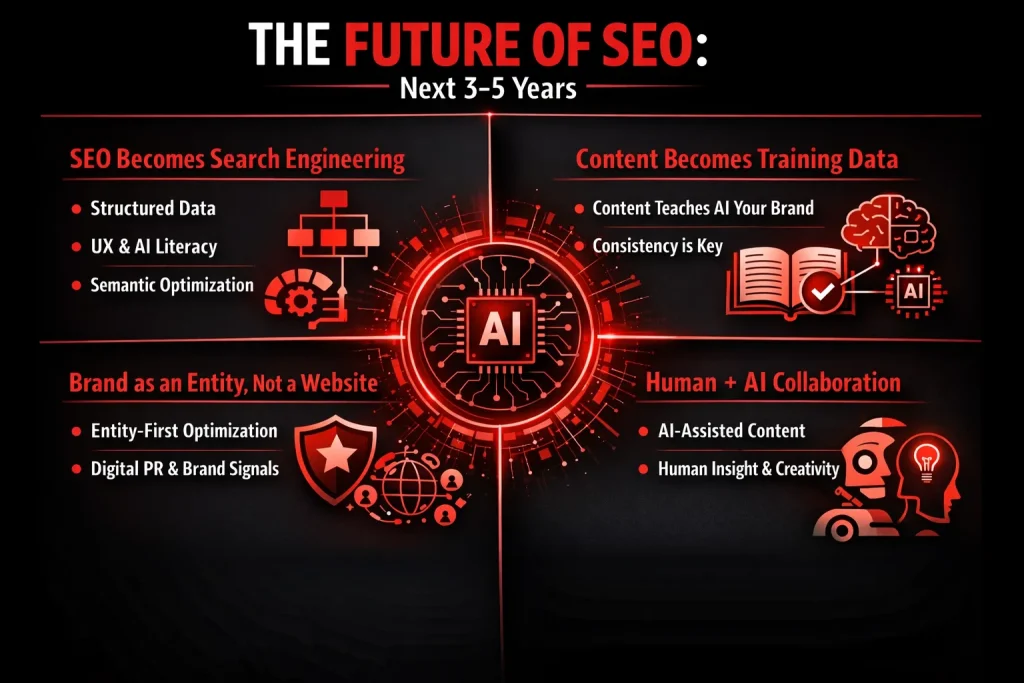
SEO Becomes Search Engineering
SEO is moving beyond keywords, metadata, and backlinks into something closer to search engineering. Modern optimization requires aligning structured data, high-quality content, user experience, and a working understanding of how AI systems interpret information. Schema markup, internal linking, page architecture, and UX signals will no longer be “technical extras” but foundational components of how meaning is communicated to search systems. SEO professionals will need to think less like content optimizers and more like system designers—engineering clarity, context, and trust into every digital asset.
Content Becomes Training Data
In an AI-driven search ecosystem, content no longer exists just to rank—it exists to train AI systems how to understand your brand, expertise, and relevance. Every article, landing page, and mention contributes to how search models classify and recall your entity. This makes consistency critical. Conflicting messaging, fragmented positioning, or shallow coverage can confuse AI systems just as much as users. Brands that publish clear, structured, and semantically aligned content will effectively “teach” search engines what they stand for and when they should appear.
Brand as an Entity, Not a Website
The future of SEO is entity-first, not website-first. Search engines increasingly evaluate brands as interconnected entities across the web rather than isolated domains. This means optimization extends beyond your site to include digital PR, authoritative citations, knowledge panels, reviews, and third-party mentions. Brand signals—such as consistent naming, expert associations, and topical authority—will carry more weight than page-level tweaks. In practice, SEO will overlap more with branding, communications, and reputation management.
Human + AI Collaboration
While AI will assist with research, drafting, and optimization, human insight will become more—not less—valuable. AI can generate content, but it cannot replace lived experience, original thinking, or strategic judgment. The most effective SEO strategies will combine AI efficiency with human-led insight, storytelling, and expertise. In this future, AI scales execution, while humans define meaning, originality, and trust—the true drivers of search visibility.
Practical SEO Strategy for the AI Search Era
If classic SEO was about finding the right keywords and placing them in the right spots, AI-era SEO is about something bigger: helping search systems understand what you are, what you’re known for, and why you’re trustworthy. That shift changes how you plan content, how you structure your site, and even how you measure success.
Here’s a practical playbook you can implement without chasing every new “AI search” rumor.
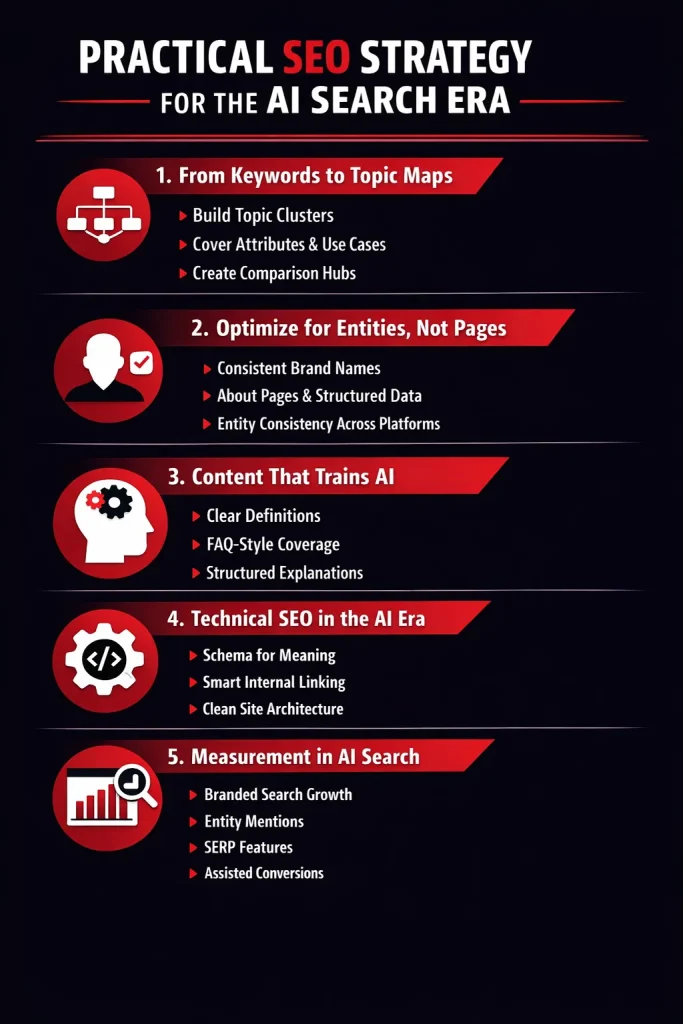
Shift from Keyword Lists to Topic Maps
Keyword lists still have value, but they’re no longer the best starting point. AI-driven search systems interpret queries through entities (things) and relationships (how those things connect). That means the winning strategy is building topic maps—structured coverage around a theme—rather than writing isolated posts for isolated keywords.
What to do:
- Build topic clusters around entities.
Pick a core entity you want to own (e.g., “AI SEO,” “customer data platform,” “project management software”) and create a cluster of supporting pages that explain it from multiple angles.
- Cover attributes, comparisons, and use cases.
AI systems reward completeness. So instead of writing “What is X?” and stopping, expand into:
- X features and components (attributes)
- X vs Y (comparisons)
- X for specific industries or roles (use cases)
- Implementation, pricing, mistakes, best practices
A simple way to sanity-check your topic map: if a user asked 10 follow-up questions after reading your main page, do you already have pages that answer them? If not, your cluster isn’t deep enough yet.
Optimize for Entities, Not Just Pages
In AI search, your site is not only a collection of URLs—it’s a representation of a brand/entity. If your brand/entity is inconsistent or unclear, you’ll struggle to be “recognized” and trusted across different queries and contexts.
What to do:
- Be consistent with brand naming.
Use one standard name everywhere—site headers, schema, social profiles, author bios, press mentions. Even small variations can weaken entity clarity (e.g., “ThatWare” vs “Thatware Solutions” vs “ThatWare.co”).
- Strengthen About pages and authorship.
AI systems care about “who is speaking.” A strong About page and author pages help establish legitimacy. Include:
- clear company description
- founders/leadership
- location (if relevant)
- expertise areas
- media mentions, certifications, partnerships
- Use structured data strategically.
Don’t add schema just to add it. Use it to clarify meaning: Organization, Person, Article, FAQ, Product/Service, Review (where appropriate). Think of it as a “machine-readable identity card.”
- Align the entity across platforms.
Your brand entity is shaped beyond your website. Keep your positioning consistent across:
- LinkedIn / YouTube / X
- directory listings
- podcast appearances
- guest posts
- PR mentions
In short: AI will trust what it can consistently verify across sources.
Create Content That “Trains” AI Systems
When AI systems generate answers, they rely on patterns: definitions, structured explanations, and consistent framing. Your job is to publish content that’s not only readable for humans, but easy for machines to interpret and reuse.
What to do:
- Start with clear definitions.
In the first 100–150 words, define the concept in plain language. This increases your chance of being used in summaries and answer-style results.
- Write structured explanations.
Use predictable structure:
- what it is
- why it matters
- how it works
- examples
- common mistakes
- best practices
- Add FAQ-style semantic coverage.
FAQs aren’t just for conversions anymore. They’re a practical way to cover long-tail variations and related sub-questions. Add questions that mirror real search behavior:
- “Is X better than Y?”
- “How long does X take?”
- “What tools are used for X?”
- “What’s the cost of X?”
- “What are the risks of X?”
The goal isn’t to “game” AI—it’s to become the clearest, most complete source on the topic so the system naturally leans on you.
Technical SEO Still Matters—Differently
AI didn’t replace the fundamentals. It simply raised the bar: if your site is messy or confusing, AI models and crawlers will struggle to interpret it. Technical SEO now plays a bigger role in meaning, clarity, and reinforcement.
What to do:
- Use schema for meaning—not markup abuse.
Overloading pages with irrelevant structured data is the new keyword stuffing. Use schema only where it accurately reflects the page.
- Use internal linking to reinforce concepts.
Internal links help search systems understand relationships between pages. Link clusters intentionally:
- pillar page → supporting pages
- supporting pages → pillar page
- supporting pages → related supporting pages
- Keep site architecture clean and predictable.
The easier it is for users and crawlers to navigate, the better. Avoid orphan pages, confusing categories, or thin tag archives. If your structure doesn’t reflect a clear topic map, fix it.
A good rule: your internal linking should look like a knowledge graph—not a random web of blog posts.
Measurement in an AI Search World
As AI-driven answers reduce clicks, traditional “rankings + traffic” dashboards can mislead you. You still need traffic, but you also need to measure visibility and influence—even when users don’t click immediately.
What to track:
- Branded search growth
If more people search your brand name (or brand + category), your authority is rising.
- Entity mentions
Monitor where your brand is mentioned (press, forums, partnerships, reviews). Mentions build entity credibility.
- SERP features & AI placements
Track appearances in featured snippets, “People Also Ask,” and answer-style results where applicable.
- Assisted conversions
AI search often influences users early, while conversion happens later through direct visits, email, or branded search. Use attribution models (even simple ones) to track how content supports conversions over time.
The win condition is changing: you’re not just trying to get clicks—you’re trying to become the default source.
Common SEO Mistakes in the AI Search Era
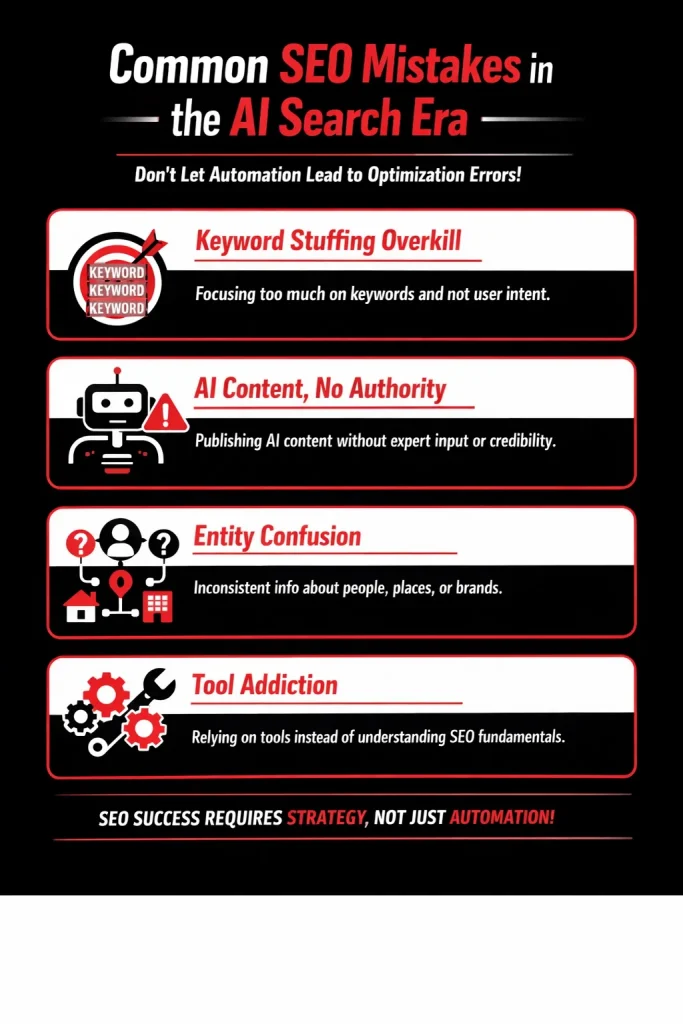
As search engines evolve into AI-driven systems, many brands are unknowingly sabotaging their own visibility by clinging to outdated SEO habits. The rules haven’t just changed—they’ve shifted at a foundational level. Below are the most common SEO mistakes in the AI search era, along with the mindset shift required to fix them.
1. Over-optimizing for keywords
Keyword optimization still matters, but obsessing over exact-match phrases is no longer a winning strategy. AI search systems prioritize meaning, context, and intent over repetition. Pages stuffed with variations of the same keyword often signal low-quality or manipulative content. Instead of asking, “How many times should I use this keyword?”, the better question is, “Have I fully explained the concept behind this query?” Depth, clarity, and semantic coverage now outperform keyword density.
2. Publishing AI-generated content without authority
AI tools can produce content at scale, but scale without credibility is a liability. Search systems increasingly evaluate who is speaking, not just what is being said. Content that lacks original insight, real-world experience, or clear authorship struggles to earn trust. AI should assist research and structure—not replace expertise. Authority, experience, and consistency are what turn content into a reliable training signal for AI search systems.
3. Ignoring entity consistency
In an entity-driven search world, inconsistency confuses algorithms. Variations in brand names, author identities, service descriptions, or positioning across pages and platforms weaken entity recognition. When search engines can’t confidently connect the dots, visibility suffers. Consistent naming, clear definitions, and structured information help AI systems understand exactly who you are and what you represent.
4. Chasing tools instead of understanding systems
New SEO tools appear constantly, promising quick wins in AI-driven search. But tools don’t replace strategy. Without understanding how AI search systems interpret content, entities, and user satisfaction, tools become distractions. Sustainable SEO success now comes from system-level thinking—understanding how content, authority, and user value work together to signal trust.
In the AI search era, avoiding these mistakes isn’t optional. It’s the difference between being indexed and being understood.
Final Verdict: Adapt or Become Invisible
The verdict is clear: AI-driven search is no longer a future trend—it’s the present reality. Search engines are evolving from systems that simply retrieve information to systems that interpret, synthesize, and answer. In this environment, visibility is no longer guaranteed by keyword density, backlinks, or technical compliance alone. AI search is not optional, and treating it as an add-on to legacy SEO strategies is a fast path to declining relevance.
That said, traditional SEO isn’t dead. Crawlability, site structure, performance, and authority still matter—but they now serve as the foundation, not the differentiator. What determines success today is whether search systems understand who you are, what you represent, and how your content fits into a broader web of knowledge. SEO has shifted from optimization tactics to system-level thinking.
The future belongs to brands that are clearly defined as entities, with consistent signals across content, platforms, and contexts. It belongs to content that teaches, not just targets queries—content that explains, connects, and demonstrates real expertise. And it belongs to SEO strategies built around ecosystems, not isolated pages or one-off rankings.In the AI search era, visibility is earned through clarity, authority, and meaning—not manipulation. Or put simply: “In the AI search era, you don’t rank because you exist—you rank because you’re understood.”