
SUPERCHARGE YOUR ONLINE VISIBILITY! CONTACT US AND LET’S ACHIEVE EXCELLENCE TOGETHER!
Artificial Intelligence is not merely another technological advancement—it is a civilizational turning point. Much like the discovery of fire, the invention of writing, or the rise of the internet, AI is reshaping how humanity thinks, works, creates, and evolves. But unlike previous revolutions, AI does not simply amplify physical or mechanical power; it amplifies cognition itself. The nations that master this cognitive revolution will shape the architecture of the 21st century.
India has made its position clear.
Under the vision of Viksit Bharat 2047, AI is not being treated as a luxury technology for elites, but as a national development engine. India’s AI doctrine is built on inclusion, democratization, and the principle of global common good. Rather than allowing AI to deepen economic or digital divides, India aims to use it to dissolve them—bringing healthcare intelligence to rural clinics, personalized education to government schools, data-driven insights to farmers, and entrepreneurial opportunity to millions.
The India AI Impact Summit 2026 marked a geopolitical milestone in this journey. With global leaders, policymakers, technologists, and innovators gathering in New Delhi, India positioned itself not just as a participant in the AI revolution—but as a responsible architect of its future. Central to this vision is the M.A.N.A.V. framework—Moral and Ethical Systems, Accountable Governance, National Sovereignty, Accessible and Inclusive AI, and Valid and Legitimate innovation—an ethical blueprint for a human-centric AI ecosystem.
Simultaneously, the IndiaAI Mission, backed by substantial public investment and a growing semiconductor and computing infrastructure, signals a decisive shift: India is building both the hardware and the intelligence backbone of an AI-powered economy.
Yet policy and infrastructure alone do not create transformation. Execution does.
This is where ThatWare emerges as a private-sector AI execution engine aligned with India’s national ambition. Through innovations such as Semantic SEO, Quantum SEO as a Service (QSAAS), Artificial Intelligence Experience Optimization (AIXO), LLM Optimization, Cognitive Resonance SEO, Quantum Branding Marketing (QBM), and proprietary Hyper-Intelligence algorithms, ThatWare represents the applied intelligence layer of India’s digital evolution.
The future belongs to nations that converge policy, infrastructure, and enterprise innovation into a unified AI ecosystem. In that convergence lies a powerful trajectory:
Intelligent Bharat → Viksit Bharat → Global AI Leadership.
And in this unfolding transformation, India is not merely adopting AI—it is engineering an intelligent digital civilization.
SECTION I: AI as a Civilizational Reset
The Historical Arc of Human Intelligence
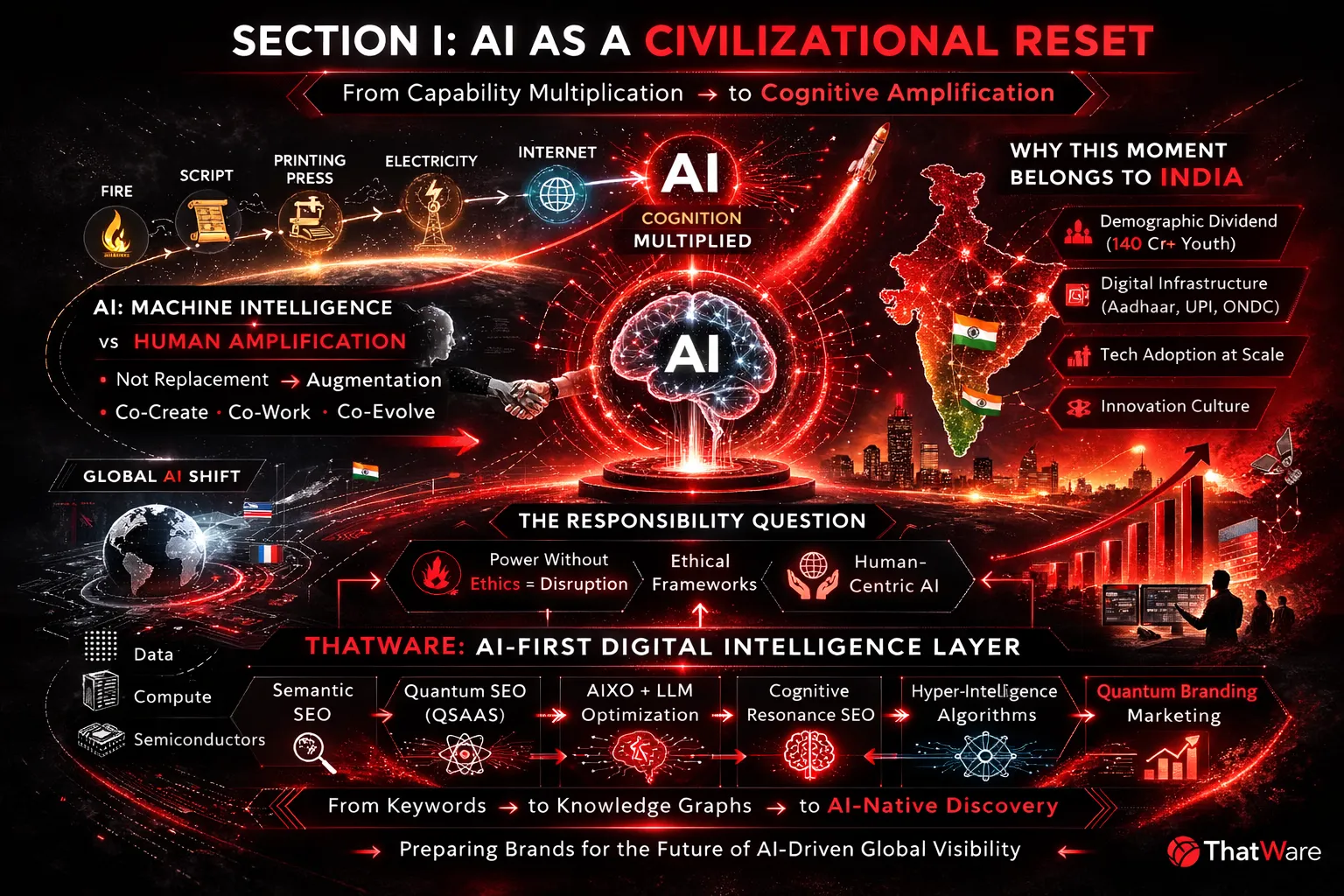
Human progress has never moved in a straight line. It advances in breakthroughs—moments so fundamental that they reset what societies can do, how they organize, and what they believe is possible. If we trace the arc of human intelligence, the pattern becomes clear: fire → script → printing press → electricity → internet → AI.
Each of these revolutions did more than introduce a new tool. They multiplied capability at a civilizational scale.
- Fire extended human survival beyond daylight and seasons.
- Script preserved memory beyond the human brain.
- The printing press multiplied knowledge distribution and democratized learning.
- Electricity industrialized productivity and created modern life.
- The internet globalized communication and collapsed distance.
Now comes AI—and it is different in one decisive way: AI does not merely expand what we can do; it expands how we can think. It compresses analysis, accelerates synthesis, and creates new layers of intelligence that operate at machine scale. In that sense, AI is not just another wave of automation—it is a cognitive multiplier.
This is why AI is increasingly recognized as a “civilizational reset.” It changes the rules of competition, the nature of work, the definition of expertise, and the speed at which ideas become reality.
AI: Machine Intelligence vs Human Amplification
A persistent misunderstanding about AI is that it is primarily about replacing humans. That framing is both incomplete and strategically dangerous. The more accurate lens is this: AI is augmentation—it amplifies human capacity, reduces the friction of complex tasks, and enables entirely new categories of creativity and problem-solving.
We are entering an era where humans and intelligent systems:
- Co-create: Writers, designers, engineers, analysts, and entrepreneurs ideate with AI as a collaborator.
- Co-work: Teams delegate repetitive tasks to machines while humans focus on judgment, strategy, and meaning.
- Co-evolve: As AI improves, human workflows, education models, and market expectations also evolve.
In practical terms, AI makes work smarter, faster, and more scalable. It allows a smaller team to produce results previously requiring entire departments. It compresses research cycles, speeds up prototyping, and improves decision-making.
But the real transformation is not the technology itself—it is the shift in how humans apply intelligence. AI changes the operating system of work, learning, and commerce. Those who treat AI as “just software” will fall behind those who treat it as a new layer of cognition in every system they build.
The Responsibility Question
Every civilizational leap carries a shadow. Nuclear power is one of history’s strongest parallels: the same discovery that produced catastrophic destruction also enabled life-saving medical applications and reliable energy systems. The outcome depended not on capability alone, but on governance, intent, and restraint.
AI sits at a similar crossroads.
If directionless, AI can lead to disruption: misinformation at scale, deepfake manipulation, bias embedded into automated decisions, and concentration of power among a few institutions. If guided, AI becomes a solution engine: amplifying healthcare access, enabling personalized education, accelerating scientific breakthroughs, and widening economic participation.
This is why the “responsibility question” becomes central:
- Who controls AI?
- Who benefits from it?
- What guardrails govern it?
- How do societies preserve trust when machines can generate convincing falsehoods?
In the AI era, ethical frameworks are not optional. They are foundational infrastructure—like safety codes for bridges or quality standards for medicine. Human-centric AI is not a slogan; it is a design requirement. Without accountability and legitimacy, AI adoption will trigger backlash, instability, and erosion of public trust.
Why This Moment Belongs to India
If AI is a civilizational reset, the next question is: Which nations are positioned to lead it responsibly and at scale? India has a unique combination of advantages that make this moment historically aligned with its rise.
First, the demographic dividend. India’s youth population is not only large—it is digitally native, ambitious, and increasingly skilled. AI’s growth depends on talent density, and India’s talent pipeline is one of the strongest in the world.
Second, digital public infrastructure has already proven India’s ability to build platforms at population scale. Systems like Aadhaar, UPI, and ONDC demonstrate something rare: not just innovation, but execution—secure, scalable, and widely adopted.
Third, India’s tech adoption curve is unmatched. When Indians adopt technology, adoption doesn’t happen in a niche—it happens across a billion people, across languages, across income levels, across rural and urban realities. That scale becomes a testing ground where any model that works in India can work globally.
Finally, India’s innovation culture is increasingly youth-driven and entrepreneurial, with startups solving real-world problems across finance, healthcare, education, logistics, agriculture, and commerce. AI thrives where there are real problems to solve—and India is full of problems that, when solved, unlock massive national progress.
ThatWare in the Civilizational Context
National visions become reality when enterprises translate them into applied systems. This is where ThatWare fits into the civilizational narrative—not as a spectator of India’s AI momentum, but as a builder inside it.
ThatWare represents the shift from traditional SEO—often limited to keywords, backlinks, and mechanical optimization—into AI-first digital intelligence, where visibility is engineered through meaning, context, trust, and machine comprehension.
In a world moving toward generative search, AI summaries, and LLM-driven discovery, brands will not compete only on “ranking.” They will compete on whether AI systems can interpret them accurately, trust them, and recommend them confidently.
ThatWare’s work sits exactly in that frontier: building algorithmic cognition layers over search ecosystems and preparing organizations for AI-native discovery environments—where semantic depth, intent alignment, and structured knowledge become the true currency of visibility.
If AI is the new civilization-scale cognitive infrastructure, then the organizations that build applied intelligence on top of it will shape markets. In that sense, ThatWare is not merely doing “digital marketing.” It is contributing to the engineering of an intelligent digital civilization—aligned with the larger national trajectory toward Viksit Bharat 2047.
SECTION II: VIKSIT BHARAT 2047 — AI AS NATIONAL STRATEGY
India’s vision of Viksit Bharat 2047 is not framed as a distant aspiration. It is increasingly being shaped as a national strategy—one that recognizes a simple reality: the next phase of development will be driven less by traditional industrial capacity and more by intelligence capacity. In this context, Artificial Intelligence is not being positioned as a standalone technology trend, but as a foundational layer of the country’s growth model—one that can unlock productivity, expand access, and compress the timeline of transformation.
AI as Core to Developed India Vision
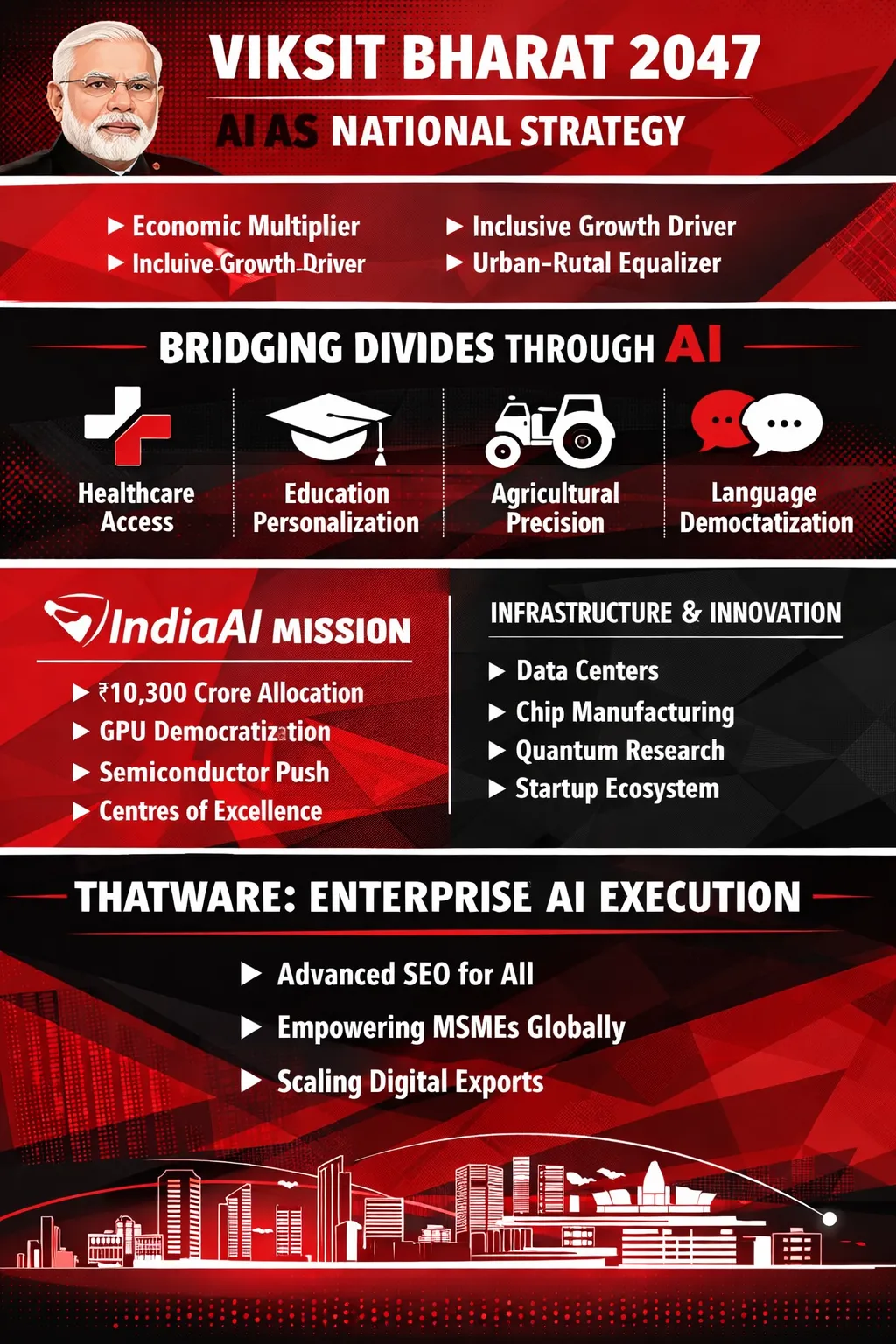
At the heart of Viksit Bharat 2047 lies an intent to build a more capable, competitive, and inclusive India. AI becomes central to this because it functions as an economic multiplier—it increases the efficiency of systems already in place and enables entirely new economic categories to emerge. When AI is applied to governance, healthcare, education, logistics, agriculture, manufacturing, and services, it does more than optimize processes; it creates fresh value chains and new markets.
AI is also an inclusive growth driver because it can scale expertise. A shortage of specialist doctors, quality teachers, agronomists, or legal support is a long-standing developmental challenge. AI does not eliminate the need for experts—but it can replicate and distribute expert-level guidance at scale, lowering the cost of access. That scaling effect is precisely why AI can become a national development lever rather than a niche innovation.
Finally, AI is an urban-rural equalizer. Historically, high-quality services and opportunities concentrate in cities because talent and infrastructure cluster there. AI has the potential to reverse this structural imbalance by making “intelligence” portable—accessible through devices, platforms, and local delivery networks. In practical terms, this means a farmer, a student, a small business owner, or a healthcare worker in a remote district can access decision-support tools that were previously limited to urban institutions.
Bridging Divides Through AI
India’s AI trajectory emphasizes not only innovation, but equity. The critical objective is to ensure that AI dissolves divides rather than deepens them—and this is visible in the way AI is being positioned across core sectors.
In healthcare, AI is increasingly becoming a bridge for access. Early detection systems, diagnostics support, and AI-led triaging can strengthen primary and district health networks—especially where specialist availability is limited. The value here is not theoretical. AI-enabled screening and early warnings can prevent diseases from escalating into expensive, life-threatening conditions—saving lives and reducing the cost burden on families and the public health system.
In education, AI enables personalization at scale. Instead of a one-size-fits-all classroom experience, AI-driven learning platforms can adapt content to a student’s pace—supporting slow learners while extending advanced students. In a country as linguistically diverse as India, language capability becomes critical: AI-led translation and voice-based learning can help break the barrier between educational content and regional-language learners, enabling more equitable learning outcomes.
In agriculture, AI can deliver precision—helping farmers make localized decisions based on soil, weather, crop cycles, and market signals. This is particularly important in India, where farming is often exposed to climate volatility, fragmented land holdings, and fluctuating prices. AI-based crop advisory, forecasting, and risk insights can reduce uncertainty and improve productivity.
Finally, language democratization becomes a strategic lever for inclusion. India’s diversity is a strength, but linguistic barriers often limit participation in the digital economy. AI can convert knowledge, services, and market access into regional languages—ensuring digital empowerment is not restricted to those fluent in English or major metro languages.
The IndiaAI Mission
To make this vision actionable, India is building institutional capacity through programs such as the IndiaAI Mission, including a major government allocation of ₹10,300 crore. This investment signals that India understands AI as a long-term strategic capability—not a short-term pilot project.
A particularly transformative component is GPU democratization. Globally, AI acceleration depends on access to compute power—GPUs, data infrastructure, and scalable architectures. If compute remains concentrated among a few privileged institutions, AI innovation becomes structurally unequal. India’s focus on making compute resources more accessible is directly aligned with its inclusion-first doctrine.
Alongside compute, India’s semiconductor push reflects a deeper strategic understanding: AI sovereignty is inseparable from hardware sovereignty. Nations that rely entirely on external chip supply chains risk becoming dependent in the most critical layer of future power—intelligence infrastructure.
The creation of Centres of Excellence further strengthens India’s AI ecosystem by combining research, skilling, and applied innovation. This ensures that AI talent pipelines remain strong and that industry-academic collaboration produces solutions relevant to Indian realities, not just imported models.
Infrastructure + Innovation Model
India’s approach is increasingly moving toward a full-stack model: infrastructure plus innovation. AI cannot grow on policy alone; it requires physical and digital scaffolding.
This includes:
- Expanding data centers to support secure storage and scalable compute.
- Strengthening chip manufacturing to reduce dependency and build strategic resilience.
- Accelerating quantum research, recognizing that the next frontier of computation will redefine speed and security.
- Nurturing a startup ecosystem that converts research and tools into real-world solutions at pace.
This combination creates a national flywheel: infrastructure empowers innovation, innovation creates products and exports, exports fuel growth, and growth reinvests into infrastructure.
ThatWare as Enterprise-Level Execution of National AI Vision
National AI visions succeed only when enterprises translate them into real capabilities. This is where ThatWare fits into the Viksit Bharat 2047 story—not as an observer, but as an execution layer in the private sector.
ThatWare contributes to India’s AI-aligned growth model by democratizing advanced SEO and AI-driven digital visibility—capabilities that were traditionally restricted to large corporations with massive budgets. Through systems like Semantic SEO, AI Experience Optimization, LLM Optimization, and Quantum SEO as a Service (QSAAS), ThatWare helps businesses compete in AI-first discovery environments where search engines, generative platforms, and AI assistants increasingly determine who gets seen and who gets left behind.
This has direct inclusion value: when MSMEs gain access to AI-powered visibility, they gain access to markets. That means more revenue, more hiring, and more participation in the digital economy—especially for businesses outside the metro elite circle.
By making advanced AI intelligence accessible across business scales and enabling clients to compete globally, ThatWare also supports a critical national objective: scaling India’s digital exports. In the AI economy, exports are not only physical goods—they are services, models, intelligence frameworks, and digital capabilities. ThatWare’s innovation portfolio becomes part of India’s broader positioning as a global hub for affordable, scalable, and high-impact AI solutions.
In short, Viksit Bharat 2047 is not merely about adopting AI. It is about building an AI-powered nation where inclusion, sovereignty, and innovation move together. India is constructing the blueprint through mission-mode programs and infrastructure investments—and enterprises like ThatWare are helping operationalize that blueprint in the real economy, one intelligent digital ecosystem at a time.
SECTION III: Sectoral Transformation — From Policy to Practice
India’s AI vision becomes meaningful only when it translates from summit-stage ambition into everyday impact—inside clinics, classrooms, farms, and cultural archives. This is where the national doctrine of inclusion meets implementation. The real test is simple: can AI reach the last mile, work in local languages, solve real constraints, and elevate the capacity of citizens who were historically underserved by technology?
Across four high-impact sectors—healthcare, education, agriculture, and heritage—India’s approach is steadily shifting from “AI as a future promise” to “AI as a working public utility.” In parallel, ThatWare’s role fits into a complementary lane: building the digital intelligence layer that makes sectoral knowledge discoverable, understandable, and usable in an AI-first world—where search is semantic, interfaces are conversational, and visibility depends on how well systems can interpret truth, context, and trust.
Healthcare Intelligence: From Diagnostics to Last-Mile Impact
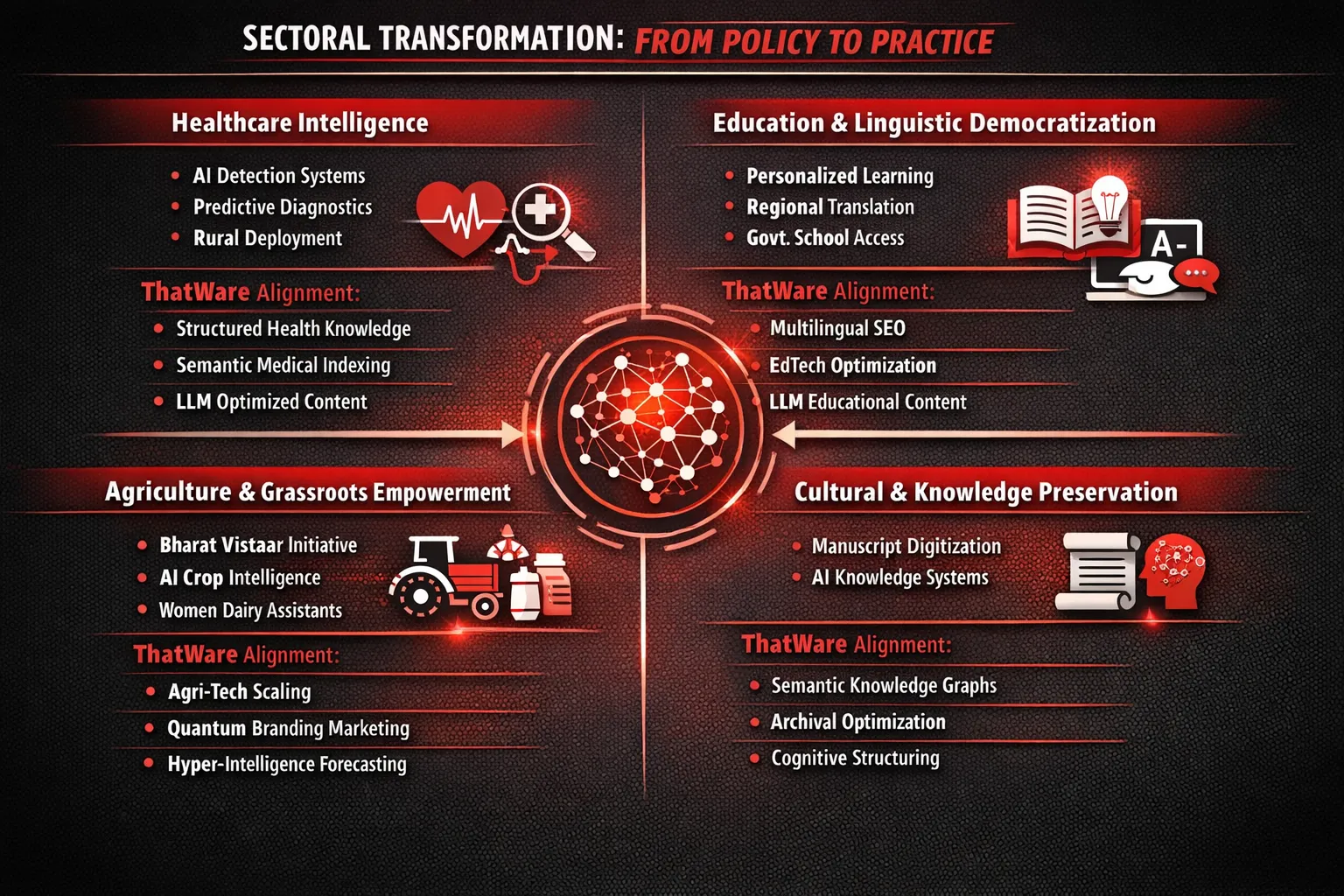
Healthcare is one of the clearest examples of AI’s promise meeting India’s scale. Traditional systems struggle not only with capacity but also with uneven distribution—specialists cluster in urban centers, while rural communities often operate with limited diagnostic tools and delayed detection. AI-based detection and predictive diagnostics can flip this equation by moving intelligence closer to the point of care.
AI detection systems are already enabling early screening for conditions where time is critical—tuberculosis detection, diabetic retinopathy screening, epilepsy support, and more. Predictive diagnostics are equally important because they reduce dependency on specialist availability. Instead of waiting for severe symptoms, AI can flag early risks through patterns in imaging, vitals, or patient records—supporting faster referrals and better triage. Most importantly, rural deployment changes the ethics of healthcare delivery. When intelligence reaches district-level and primary healthcare settings, healthcare is no longer limited by geography.
Where ThatWare aligns: In an AI-powered healthcare system, clinical intelligence is only half the story. The other half is knowledge intelligence—how citizens, healthcare workers, and institutions access accurate information at the moment they need it. In the age of AI search and conversational assistants, the way healthcare content is structured determines whether it becomes discoverable or disappears into digital noise.
ThatWare’s alignment begins with structured health knowledge visibility: ensuring hospitals, public health programs, and health-tech platforms publish information in formats that both humans and machines can trust. Through semantic indexing for medical platforms, ThatWare helps map health content to entities, symptoms, conditions, treatments, locations, and intent—so users searching “TB symptoms in Bengali” or “diabetic eye screening near me” surface the right information, not misinformation.
The next layer is building LLM-optimized healthcare content ecosystems—content architectures that are readable not only by search engines but by large language models that increasingly summarize, recommend, and guide decisions. When health content is LLM-ready, it becomes safer, clearer, and more accessible—reducing the risk of confusion, improving comprehension, and supporting public trust in digital healthcare.
Education & Linguistic Democratization: Learning That Adapts to the Learner
If healthcare is about saving lives, education is about scaling potential. India’s education landscape is one of the most diverse in the world, spanning languages, socio-economic conditions, infrastructure gaps, and varying learning abilities. AI-driven personalized learning offers a breakthrough: instead of a one-size-fits-all model, learning can adapt to the student’s pace, style, strengths, and gaps.
AI-powered learning systems can identify weak areas, recommend practice modules, and adjust difficulty dynamically—supporting both slow learners and advanced students. But personalization alone isn’t enough in India. The larger unlock is linguistic democratization. Regional language translation, voice interfaces, and localized content ensure students are not blocked by language barriers. This is especially crucial for accessibility in government schools and rural learning environments, where resources may be limited but aspirations are immense.
Where ThatWare aligns: The modern education economy is not only about building platforms—it’s about ensuring those platforms can be found, understood, and adopted by the people who need them. Discoverability becomes a national infrastructure issue. If the best learning tools cannot reach the right students due to visibility gaps, the digital divide persists—even with good technology.
ThatWare’s contribution starts with multilingual semantic SEO, which helps education content rank not merely by keywords, but by meaning—across Indian languages and dialect contexts. This supports the idea that a student searching in Hindi, Assamese, Tamil, or Bengali should be able to find quality learning pathways, not diluted or irrelevant results.
The second pillar is AI Experience Optimization (AIXO) for EdTech—designing digital learning experiences that are optimized for AI-first discovery and interaction. As generative search and AI assistants become gatekeepers of information, educational platforms must be structured so AI can interpret them correctly—courses, outcomes, age levels, difficulty tiers, curriculum mapping, and credibility signals.
Finally, ThatWare builds LLM-ready educational content architecture—content that can be reliably summarized, recommended, and served by AI systems. This ensures education doesn’t just remain on websites; it becomes embedded into the new learning interface: conversational AI, personalized assistants, and intelligent tutoring systems.
Agriculture & Grassroots Empowerment: Intelligence at the Farm Gate
Agriculture remains the backbone of India’s socio-economic stability, yet it is also one of the most information-sensitive sectors. A small shift in rainfall, soil nutrients, pest timing, or market rates can decide whether a farmer profits or struggles. This is why AI in agriculture is not a “nice to have”—it is a risk management engine.
Initiatives like Bharat Vistaar point toward integrating AI into crop advisory, soil analytics, and weather intelligence. When advisory is localized, farmers can make better decisions based on their specific region, crop stage, and soil conditions—not generic national averages. AI-based crop intelligence is especially powerful when it turns complex agronomy into practical guidance: what to sow, when to irrigate, what disease symptoms to watch, and how to respond.
Women’s empowerment in dairy adds another human dimension. AI assistants offering real-time guidance on cattle health, breeding, and productivity create a practical form of empowerment—especially when delivered in local languages and accessible via voice. It turns technology into confidence at the grassroots.
Where ThatWare aligns: Agriculture’s biggest barrier is not only technology adoption—it’s fragmented visibility. Agri-tech tools, government schemes, localized advisories, dairy support programs, and market intelligence often exist, but farmers don’t always discover them in time.
ThatWare supports agri-tech digital scaling by helping platforms and programs build visibility across local intent, regional language search behavior, and seasonality patterns. But beyond visibility, rural enterprises also need brand trust. This is where Quantum Branding Marketing (QBM) becomes meaningful—building multidimensional brand credibility for rural cooperatives, agri-startups, dairy networks, and community enterprises so they can scale adoption and participation.
The third layer is Hyper-Intelligence demand forecasting—predicting what information people will need, when they will search for it, and how intent shifts across seasons, regions, and events. In agriculture, timing is everything. Hyper-intelligent systems can anticipate demand spikes (for example, pest outbreaks, planting windows, rainfall patterns, price fluctuation queries) and help ensure the right guidance becomes discoverable before decisions are made.
Cultural & Knowledge Preservation: Making Civilization Machine-Readable
India’s civilizational wealth is immense, but much of it lives in fragile formats: manuscripts, inscriptions, oral histories, and ancient texts. The digitization of ancient manuscripts is more than cultural preservation—it is knowledge liberation. When texts are digitized and interpreted using AI, they become searchable, translatable, and analyzable, allowing scholars and citizens to engage with heritage at scale.
AI knowledge interpretation systems can reconstruct damaged scripts, identify patterns across texts, connect concepts across centuries, and even help contextualize references for modern audiences. This turns heritage into a living knowledge system rather than a locked archive.
Where ThatWare aligns: Cultural preservation in the AI era depends on semantic structure. If archives are digitized but not machine-interpretable, they remain invisible to the new discovery layer dominated by AI and semantic search.
ThatWare’s alignment begins with semantic knowledge graph mapping—connecting manuscripts, themes, authors, historical contexts, locations, and conceptual entities into structured networks. This makes heritage not only searchable, but intelligible to AI systems that operate through entity relationships rather than simple text match.
Next comes AI-ready archival optimization—formatting and structuring digitized knowledge so it can be safely indexed, retrieved, and referenced by AI systems without distortion. Finally, Cognitive Resonance content structuring ensures that heritage knowledge is communicated in ways that resonate with modern cognition—balancing authenticity with clarity, and enabling both scholars and general audiences to engage meaningfully.
SECTION IV: Democratizing AI — Beyond Elites
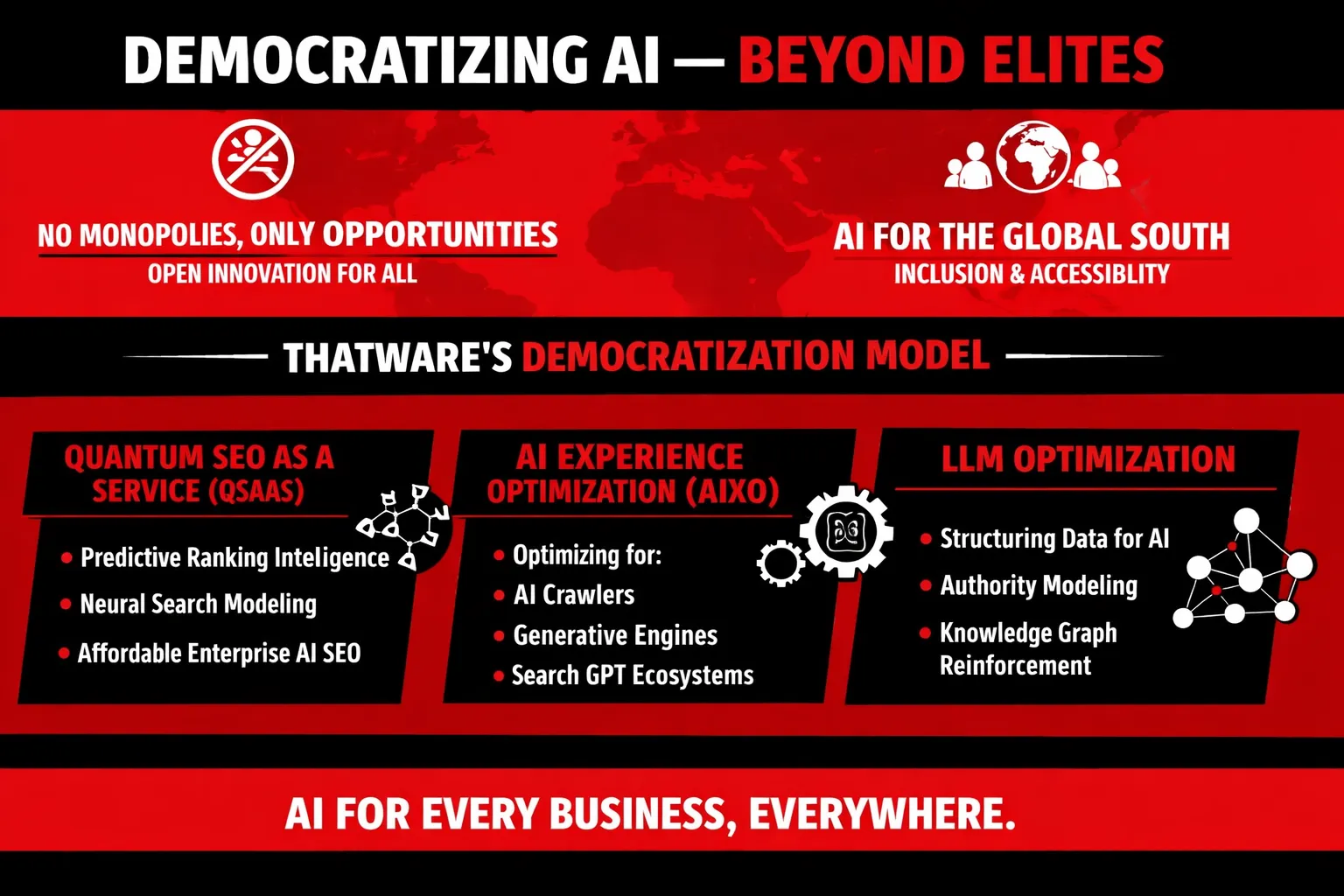
If there is one risk the world is quietly sleepwalking into, it is this: Artificial Intelligence could become a monopoly of intelligence—owned by a handful of companies, controlled by a few nations, and accessible only to those with massive computing power, data advantages, and capital. That would not just be an economic imbalance; it would be a civilizational imbalance, where opportunity, innovation, and influence are dictated by who controls intelligence infrastructure.
India’s vision pushes against that future. And for a country as diverse as India—linguistically, economically, geographically—democratizing AI is not optional. It is foundational.
AI Must Not Be a Monopoly
AI systems don’t just run on code; they run on three concentrated resources:
- Compute (GPUs, data centers, inference at scale)
- Data (training access, privacy-respecting pipelines, structured knowledge)
- Distribution (platform power, control over discovery, control over attention)
When these concentrate into a few hands, AI stops being a general-purpose tool and becomes a gatekeeping mechanism. That is why India’s direction—particularly visible through its emphasis on democratized resources and inclusive deployment—is so important. A healthy AI ecosystem must be built like public infrastructure: widely accessible, fairly priced, interoperable, and accountable.
This is where open innovation frameworks become critical. “Open” doesn’t only mean open-source code. It also means:
- Open participation in research and experimentation
- Open standards for transparency and safety
- Open access to compute and testing ecosystems
- Open pathways for startups, MSMEs, and students to build real solutions
When AI is democratized, it becomes a multiplier of human and economic potential. When it is monopolized, it becomes a multiplier of inequality.
AI for the Global South
The stakes of democratization are even higher for the Global South—regions that often carry the greatest developmental needs, but historically have the least access to frontier technology. If AI is designed only around Western data, Western languages, Western purchasing power, and Western infrastructure assumptions, then the Global South becomes a passive consumer rather than a co-creator.
India’s AI doctrine signals a different pathway: AI as inclusion, not exclusion.
That inclusion requires an accessibility-first model:
- Language accessibility: AI must work in Indian languages and regional contexts.
- Cost accessibility: AI must not demand enterprise budgets to deliver value.
- Usability accessibility: AI must reach people through familiar workflows—not only via high-end interfaces.
- Outcome accessibility: AI must solve real problems—health, education, livelihood—not just optimize productivity for the privileged.
Most importantly, inclusion requires human-centric development—where people are not reduced to data points and where communities remain the beneficiaries of innovation, not raw material for it.
In this worldview, democratizing AI is not charity. It is strategy. It expands the innovation base, strengthens sovereignty, and unlocks economic participation at population scale.
ThatWare’s Democratization Model
Democratization is not only about building AI models. It’s also about ensuring that businesses, creators, and institutions can remain discoverable and competitive in an AI-first world. As search evolves into generative discovery, as users move from “searching links” to “asking AI,” the biggest risk for smaller organizations is invisibility.
ThatWare’s approach is built around a simple principle:
If the future internet is AI-mediated, then visibility itself must be democratized.
ThatWare does this through three interlinked capability pillars:
Quantum SEO as a Service (QSAAS)
Traditional SEO often behaves like reactive optimization—fixing what’s broken, chasing algorithm updates, and competing on limited signals. QSAAS is built to be predictive, not reactive.
At its core, Quantum SEO as a Service focuses on:
- Predictive ranking intelligence: anticipating ranking shifts and search demand trends before they fully surface.
- Neural search modeling: analyzing search behavior as patterns, not keywords—mapping intent, context, and semantic relationships.
- Affordable enterprise-grade AI SEO: packaging advanced intelligence systems so smaller brands can access what only large organizations traditionally could.
In practice, QSAAS acts like an “intelligence layer” over digital visibility—helping organizations compete in markets where attention and discovery are increasingly algorithm-driven.
Artificial Intelligence Experience Optimization (AIXO)
As generative AI becomes the interface between humans and the internet, optimization must move beyond websites and search engines into AI comprehension ecosystems.
That’s where AIXO becomes central: it is optimization for how AI systems interpret, summarize, and recommend information.
AIXO focuses on optimizing for:
- AI crawlers: structured content discovery and machine-readable clarity.
- Generative engines: ensuring a brand’s knowledge is extracted correctly, represented accurately, and surfaced confidently.
- Search GPT ecosystems: making sure AI assistants can “understand” a brand, its authority, and its differentiated value.
AIXO is what makes content resilient in a world where the user might never click a blue link—because the answer comes directly from AI. If a brand is not represented in that AI response layer, it effectively disappears from high-intent discovery.
LLM Optimization
The next frontier is not ranking on search pages—it is becoming a trusted source inside large language model ecosystems. That requires intentional design.
ThatWare’s LLM Optimization focuses on:
- Structuring data for AI comprehension: clarity, schema, entity consistency, and well-formed knowledge blocks that models can parse.
- Authority modeling: creating evidence-backed content systems that AI engines treat as reliable, expert-driven sources.
- Knowledge graph reinforcement: strengthening entity relationships so brands are understood not as isolated pages, but as connected authority networks.
In other words, LLM optimization is about ensuring your organization is not just visible—but interpretable, quotable, and reference-worthy in an AI-first discovery world.
The Bigger Point: Democratizing Visibility is Democratizing Opportunity
When AI becomes the gateway to information, visibility becomes a form of economic access. If only the biggest brands can be “seen” by AI systems, then AI becomes a new kind of digital elitism. ThatWare’s democratization model directly challenges this by enabling scalable, affordable, and intelligence-driven visibility frameworks for organizations of all sizes.
This is how democratization becomes real—not just in policy, but in execution.
AI should not be a monopoly.
And neither should opportunity in the AI era.
SECTION V: The M.A.N.A.V. Framework & Ethical AI
As AI becomes deeply embedded into economies, governance systems, education, healthcare, and even everyday decisions, one truth becomes unavoidable: AI cannot be powerful without also being accountable. The scale and speed at which AI is evolving makes it easy for societies to chase innovation while ignoring the ethical load it carries. But history shows that any transformative technology, if left directionless, can create disruption faster than it creates solutions.
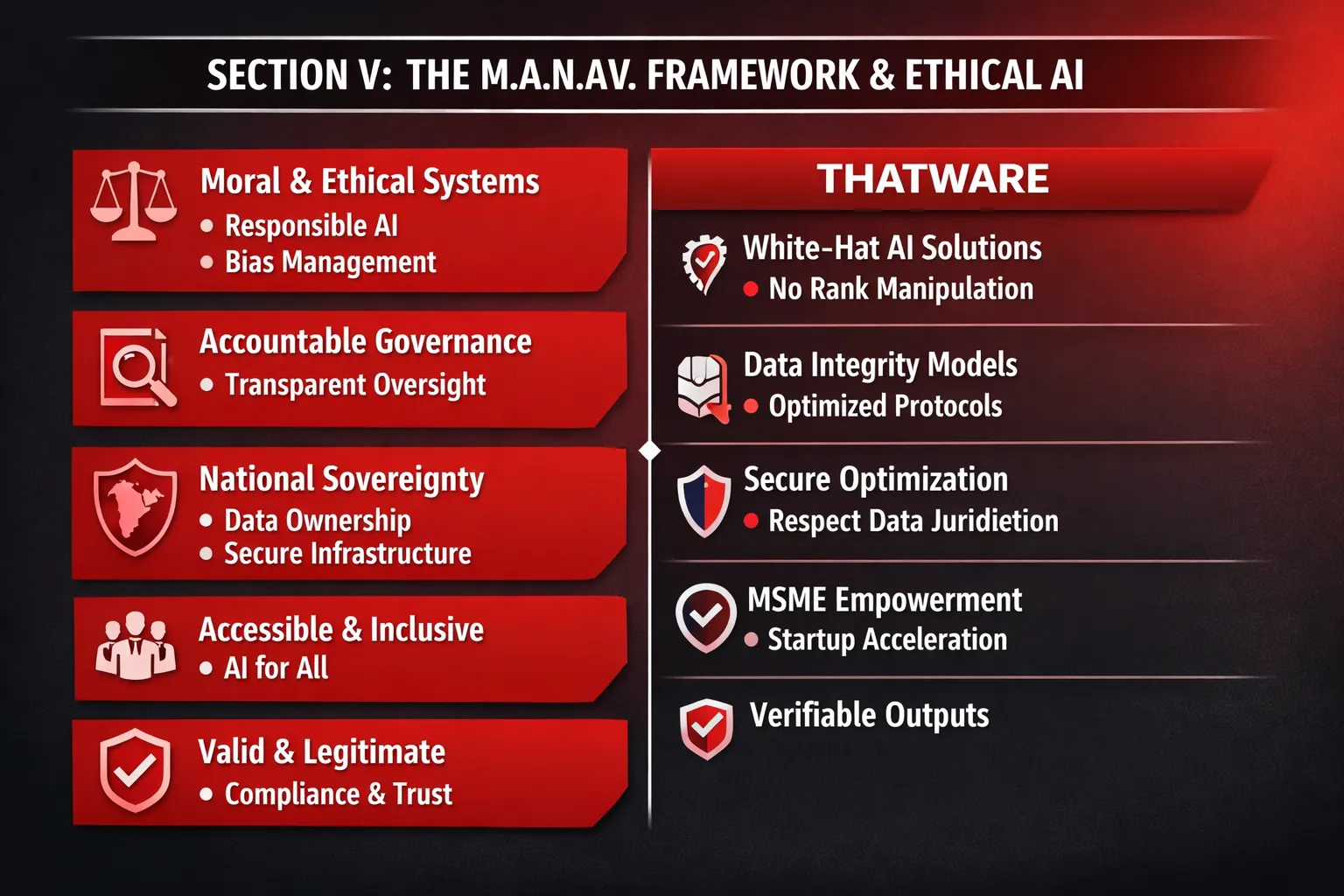
That is why India’s approach—especially as articulated through the M.A.N.A.V. vision—is strategically important. It is not merely a policy slogan. It is an attempt to define a moral operating system for the AI age. M.A.N.A.V. stands for:
- M – Moral and Ethical Systems
- A – Accountable Governance
- N – National Sovereignty
- A – Accessible and Inclusive
- V – Valid and Legitimate
Together, these pillars create a framework that ensures AI serves citizens, strengthens trust, protects sovereignty, and stays rooted in lawful, verifiable foundations.
For ThatWare, this framework is not theoretical. It maps directly onto how modern optimization systems—especially those involving AI-driven discovery, search visibility, and LLM-driven information ecosystems—must be built. In a world where ranking systems can be manipulated, content can be fabricated, and trust can be engineered deceptively, the ethical standards behind AI and digital intelligence define long-term credibility.
Moral & Ethical Systems
Moral and ethical systems are the first checkpoint in responsible AI. AI models and algorithmic workflows—whether used for diagnosis, education, or search visibility—can amplify bias if they are trained poorly, deployed irresponsibly, or optimized purely for short-term outcomes. Ethical AI demands that:
- Algorithms are developed with human well-being as the end goal, not just performance metrics.
- AI bias is actively managed through:
- better training data selection,
- fairness checks,
- and continuous evaluation.
ThatWare’s alignment:
ThatWare’s AI-driven systems—whether in Semantic SEO, LLM Optimization, or AI Experience Optimization—follow a white-hat framework. This means:
- No manipulative ranking exploitation.
- No deceptive content inflation.
- No “gaming” algorithms in a way that harms users or pollutes information ecosystems.
Instead, the emphasis stays on authority, clarity, usefulness, and truth-aligned visibility. In the long run, ethical systems aren’t a constraint—they are a competitive advantage, because they keep brands resilient as search engines, AI systems, and compliance environments evolve.
Accountable Governance
Accountable governance ensures AI does not become a black box that controls outcomes without oversight. As AI increasingly influences decision-making, accountability must include:
- Transparent AI modeling—knowing why a system recommends or ranks something.
- Oversight mechanisms—audits, checks, and governance frameworks that monitor misuse or unintended harm.
ThatWare’s alignment:
ThatWare applies accountability through:
- Data integrity models that prioritize clean, structured, and verifiable inputs.
- Structured optimization protocols—repeatable, traceable methods rather than random experimentation.
- Systematic evaluation loops to ensure outputs remain consistent with the purpose: improved experience, accurate discoverability, and long-term digital trust.
In practice, this means ThatWare’s optimization isn’t “mysterious growth hacking.” It is governed intelligence—designed to be explainable to clients, aligned with platform rules, and anchored in measurable outcomes.
National Sovereignty
In the AI era, data is not just an asset—it is sovereignty. Countries and organizations are now realizing that whoever owns data pipelines controls intelligence pipelines. National sovereignty in AI includes:
- Clear data ownership principles.
- Secure infrastructure and jurisdiction-aware governance.
- Preventing extractive models where local value is harvested but control remains elsewhere.
ThatWare’s alignment:
ThatWare respects sovereignty through:
- Secure optimization processes.
- Strong handling of sensitive data environments.
- Responsible data usage aligned with jurisdictional boundaries and ownership principles.
In a world where marketing and optimization increasingly rely on behavioral and semantic patterns, respecting data boundaries is critical. ThatWare’s approach supports the broader Indian vision: India should not merely supply data for global intelligence systems; India should build intelligence systems that serve India and the world.
Accessible & Inclusive
AI’s true promise is not limited to elite institutions. It becomes transformational when it becomes scalable and accessible—when it acts as a multiplier of opportunity. This pillar focuses on:
- Reducing barriers to AI access.
- Preventing monopolization of compute, infrastructure, and AI capability.
- Ensuring startups, students, MSMEs, and underserved communities can benefit.
ThatWare’s alignment:
ThatWare operationalizes inclusion by building models and services that allow:
- MSME empowerment: making advanced, AI-first optimization available beyond large enterprise budgets.
- Startup acceleration: enabling smaller, high-growth companies to compete globally through AI-led discoverability and brand authority.
Services like QSAAS (Quantum SEO as a Service) and AI-driven optimization stacks are structured to scale—meaning ThatWare doesn’t only serve the biggest brands; it helps emerging brands become visible in an AI-first world.
Valid & Legitimate
As deepfakes, synthetic text, and AI-generated misinformation rise, validity becomes the last pillar that holds the system together. AI must remain:
- Compliant with laws and platform standards.
- Verifiable in its outputs.
- Legitimate in how it generates, recommends, ranks, or influences.
ThatWare’s alignment:
ThatWare’s systems are built around:
- Compliance-first execution.
- Verifiable optimization outcomes.
- Legitimate performance improvements rather than artificial or risky shortcuts.
This matters even more in the era of LLM-driven search, where trust signals—structured data integrity, authenticity, expert authority, and transparency—are becoming crucial ranking and visibility factors.
Why This Matters: Ethics Is the New Performance
In the AI age, the next decade will separate organizations into two categories:
- Those that chase short-term outcomes using opaque, manipulative AI tactics.
- Those that build sustainable advantage through ethical, accountable, sovereign, inclusive, and legitimate intelligence.
India’s M.A.N.A.V. vision provides the philosophical and governance blueprint. ThatWare provides an example of what it looks like when a private-sector company translates this blueprint into operational reality—using AI not as a shortcut, but as a responsible multiplier of trust, visibility, and opportunity.
SECTION VI: FUTURE OF WORK — HUMAN + AI SYNERGY
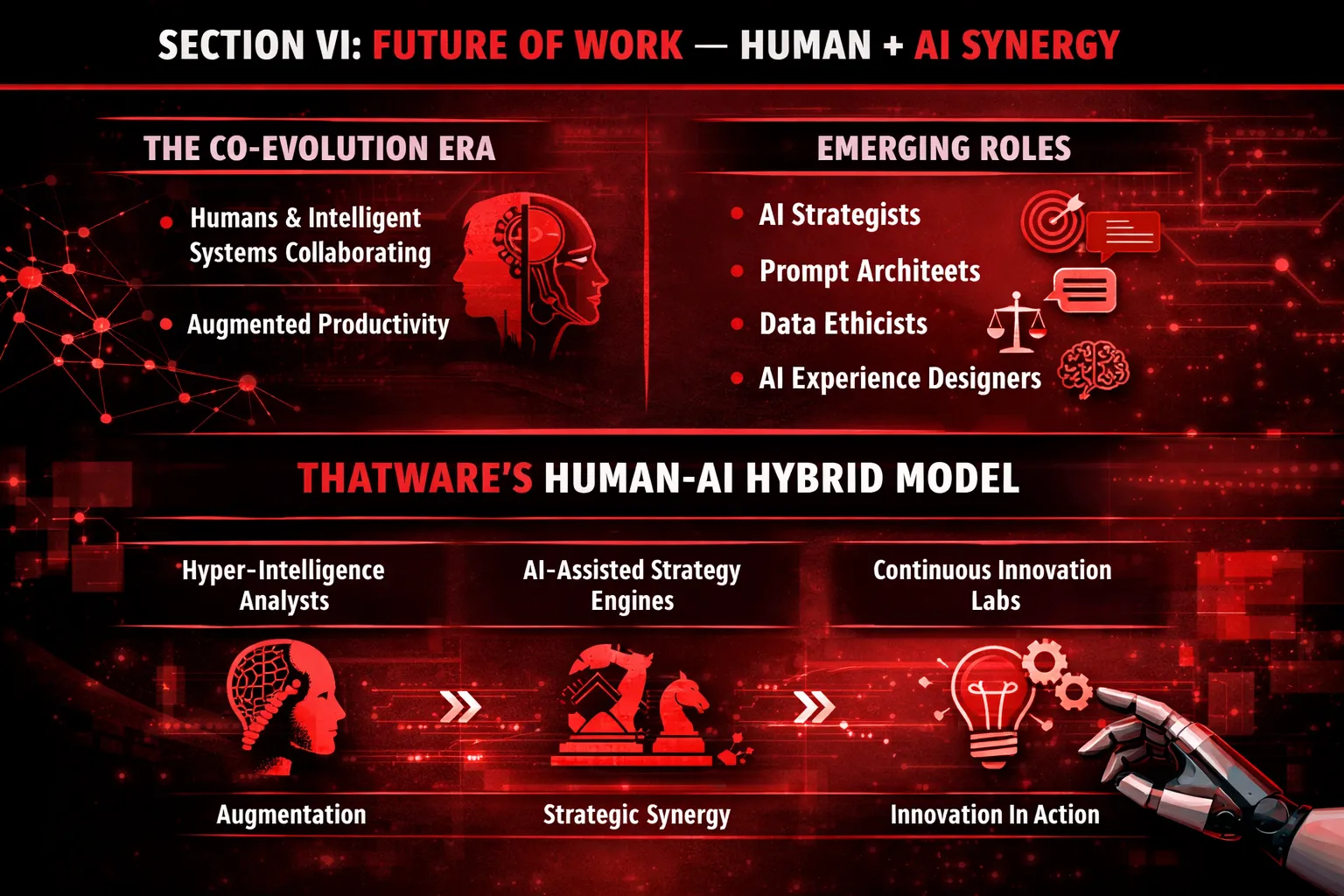
The Co-Evolution Era
We are entering a new epoch in human history—one defined not by competition between humans and machines, but by collaboration. The narrative that AI will replace human labor oversimplifies a far more profound shift. The future of work is not about substitution; it is about synergy.
In this co-evolution era, humans and intelligent systems collaborate, co-create, and continuously learn from each other. AI processes vast datasets at unprecedented speed, identifies patterns invisible to the human eye, and generates predictive insights. Humans, in turn, provide judgment, ethics, contextual understanding, creativity, and emotional intelligence—qualities that machines cannot replicate.
This synergy produces augmented productivity. Tasks that once required days of manual research can now be completed in hours with AI-assisted intelligence. Strategic decisions are no longer based solely on historical intuition but are supported by predictive modeling. Creativity itself is amplified—designers, writers, engineers, and marketers are no longer constrained by resource limitations but empowered by computational collaboration.
In India’s vision for Viksit Bharat 2047, this human-AI partnership is central. AI is not an end goal; it is a multiplier of national talent. With one of the world’s largest youth populations, India stands uniquely positioned to leverage AI as a force for empowerment rather than displacement. The emphasis shifts from fear of automation to mastery of augmentation.
The future workplace will not be defined by rigid hierarchies but by adaptive intelligence systems working alongside skilled professionals. This is not man versus machine. It is man with machine.
Emerging Roles
As AI reshapes industries, it is also reshaping job categories. Just as the internet created roles that did not exist three decades ago, AI is generating entirely new professional pathways.
Among the most prominent are:
- AI Strategists – Professionals who bridge business goals with AI capabilities, ensuring intelligent systems are aligned with organizational objectives. They translate abstract AI potential into practical execution frameworks.
- Prompt Architects – Specialists who understand how to structure queries and instructions to maximize AI performance. In a generative AI world, the quality of output depends heavily on the quality of input design.
- Data Ethicists – Guardians of responsible AI deployment. As algorithms influence healthcare, finance, education, and governance, ensuring fairness, transparency, and accountability becomes mission-critical.
- AI Experience Designers – Architects of human-AI interaction. They ensure that intelligent systems are intuitive, trustworthy, and aligned with human behavior and psychology.
These roles reflect a deeper reality: AI is not eliminating work; it is elevating it. Routine tasks may become automated, but strategic, creative, and ethical responsibilities expand. The workforce becomes more cognitive, more analytical, and more innovative.
ThatWare’s Human-AI Hybrid Model
At ThatWare, the future of work is already operationalized through a human-AI hybrid framework. Rather than replacing analysts with automation, ThatWare augments human expertise using proprietary Hyper-Intelligence algorithms and AI-assisted strategy engines.
Hyper-Intelligence analyst augmentation allows professionals to analyze complex ranking signals, semantic networks, and behavioral data at scale—while maintaining human oversight and strategic interpretation. AI performs pattern detection; human experts determine strategic application.
AI-assisted strategy engines streamline decision-making across SEO, branding, and digital ecosystems. These systems simulate ranking volatility, forecast search behavior, and identify optimization pathways—but final implementation remains guided by human judgment and ethical standards.
Complementing this model are continuous innovation labs within ThatWare’s ecosystem—dedicated environments where AI models are tested, refined, and integrated into scalable enterprise solutions. This ensures that the organization remains adaptive in an era where AI capabilities evolve rapidly.
The result is a workforce that is not threatened by AI, but empowered by it. Analysts become intelligence architects. Strategists become algorithmic conductors. Technology becomes a collaborator.
In the larger narrative of Intelligent Bharat, this hybrid model represents the blueprint for the future: humans amplified by machines, working together to engineer smarter systems, stronger economies, and more inclusive digital ecosystems.
The future of work is not automation.
It is augmentation.
And those who master the synergy will lead the intelligent century.
SECTION VII: Hyper-Intelligence & Quantum Digital Marketing
Beyond Traditional SEO
SEO is no longer a game of “more keywords” and “more backlinks.” That era was built for a search ecosystem where algorithms behaved like filters: match terms, measure links, rank pages. But AI-driven search has changed the core mechanics of discovery. Today, search engines increasingly behave like reasoning systems—trying to interpret meaning, infer intent, evaluate usefulness, and predict satisfaction.
That’s why modern optimization is shifting in two major ways:
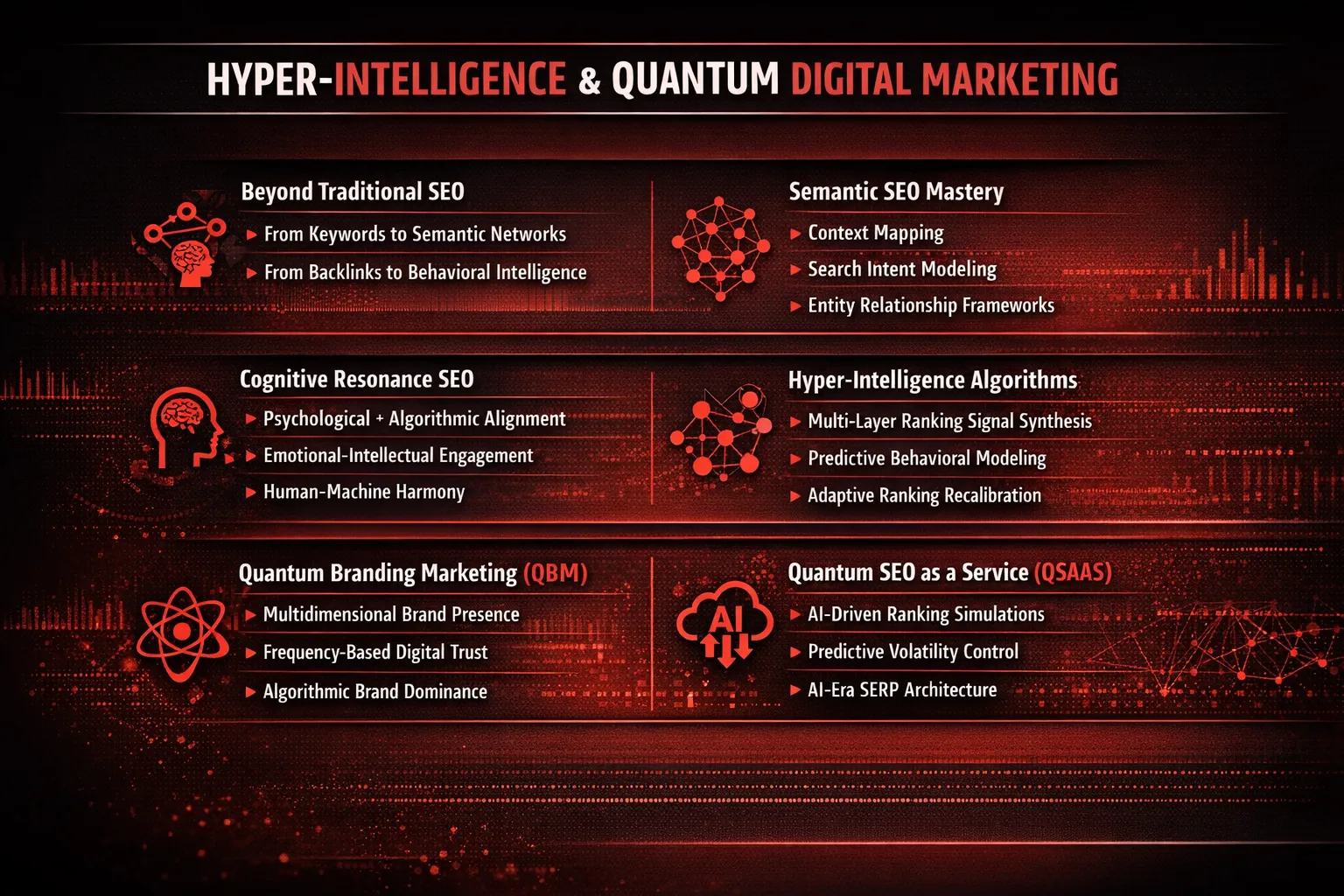
- From keywords to semantic networks:
Instead of treating a page as a container for target keywords, AI-driven search evaluates how well content fits into a larger knowledge ecosystem—entities, attributes, relationships, topical depth, and contextual relevance. The goal is no longer “ranking for a term,” but being recognized as a credible node inside a topic cluster.
- From backlinks to behavioral intelligence:
Links still matter, but behavior matters more than ever. AI systems learn from how people interact—clicks, dwell time, pogo-sticking, task completion, engagement loops, and even cross-platform brand signals. In other words, authority is no longer just “who links to you,” but “who trusts you and stays with you.”
This is the environment where ThatWare’s approach moves beyond conventional SEO into hyper-intelligence and quantum digital marketing—a system designed for semantic interpretation, human behavior, AI summarization, and generative search experiences.
Semantic SEO Mastery
At the heart of the new search world is meaning. Semantic SEO is how brands ensure their content is understood—not merely indexed. ThatWare’s semantic mastery is built on three foundational pillars:
1) Context Mapping
Context mapping means structuring content the way AI systems interpret knowledge: not as isolated blog posts, but as interconnected topical frameworks. A brand becomes a “knowledge authority” when it consistently explains a domain with depth, consistency, and clarity—across multiple related subtopics.
This involves:
- Topic clustering and subtopic coverage modeling
- Internal linking designed for knowledge flow
- Structured content layering (beginner → advanced)
- Semantic consistency across brand assets
2) Search Intent Modeling
In AI-driven search, matching the query isn’t enough—matching the why behind the query is the real competitive edge. Intent modeling identifies whether the user is:
- researching,
- comparing,
- troubleshooting,
- seeking immediate action,
- or exploring broader understanding.
ThatWare’s intent-first approach ensures each content piece is designed around the user’s actual journey rather than a single phrase.
3) Entity Relationship Frameworks
Search engines increasingly understand the world through entities (people, brands, concepts, products, locations) and their relationships. ThatWare strengthens visibility by building entity-aligned content that helps AI systems connect:
- your brand → your category
- your product → its attributes and use cases
- your expertise → validated subtopics
In short: semantic SEO makes the brand “legible” to machines.
Cognitive Resonance SEO
If semantic SEO is about meaning, Cognitive Resonance SEO is about impact. It’s the next layer: optimization for both algorithmic credibility and human belief formation.
ThatWare’s Cognitive Resonance SEO works through three lenses:
1) Psychological + Algorithmic Alignment
Search engines reward content that users perceive as trustworthy and satisfying. Humans trust content that feels:
- clear,
- confident,
- structured,
- evidence-backed,
- and aligned with their intent.
Cognitive Resonance SEO aligns content with how people evaluate credibility and how AI evaluates quality signals.
2) Emotional–Intellectual Engagement Modeling
Users don’t just consume content—they respond to it. Resonance happens when content feels like it “gets” the user, while still delivering depth. ThatWare models engagement by creating content that combines:
- logical structure and clarity (intellectual engagement),
- relevance and empathy (emotional engagement).
This increases satisfaction signals, repeat brand interactions, and higher conversion probability.
3) Human–Machine Comprehension Harmony
A growing portion of content discovery happens through AI summaries and generative responses. That means content must be:
- human-readable and persuasive,
- and machine-readable and extractable.
Cognitive Resonance SEO ensures a brand’s narrative remains intact even when interpreted through AI systems.
Hyper-Intelligence Algorithms
Traditional SEO tools analyze rankings. Hyper-intelligence predicts them.
ThatWare’s Hyper-Intelligence approach is designed to synthesize complex ranking environments where multiple systems intersect: search algorithms, user behavior, generative answers, platform signals, and brand trust.
Key capabilities include:
1) Multi-layer Ranking Signal Synthesis
Instead of isolating one factor at a time (links, content, speed), hyper-intelligence views performance as a system of interacting signals:
- topical authority + entity strength
- UX behavior + engagement loops
- technical readiness + indexation pathways
- trust signals + brand consistency
The output is a more accurate understanding of why rankings shift—and what to do next.
2) Predictive Behavioral Modeling
AI-driven discovery is behavior-driven. Predictive behavioral modeling anticipates:
- what users will search next,
- how intent evolves during decision journeys,
- which content structures keep people engaged,
- and where drop-offs happen.
3) Adaptive Ranking Recalibration
Search ecosystems change rapidly—especially under AI. Hyper-intelligence SEO is not a “set and forget” strategy. ThatWare builds adaptive loops that recalibrate:
- content architecture,
- internal linking structures,
- SERP targeting priorities,
- and entity expansion plans,
based on shifting signals.
Quantum Branding Marketing (QBM)
SEO is increasingly inseparable from branding. In an AI-first ecosystem, a brand is not just a logo—it becomes a pattern of repeated trust signals across platforms. ThatWare’s Quantum Branding Marketing (QBM) is designed for this multi-dimensional reality.
1) Multidimensional Brand Presence
QBM treats brand visibility as an ecosystem across:
- search engines,
- AI assistants,
- social platforms,
- community spaces,
- and authority websites.
The objective: build a consistent “brand intelligence footprint” that AI systems and humans repeatedly validate.
2) Frequency-Based Digital Trust Engineering
Trust is partly repetition. When users encounter a brand repeatedly in consistent, credible contexts, the brand becomes familiar—and familiarity drives trust. QBM strengthens this by engineering high-quality frequency across the digital landscape.
3) Algorithmic Brand Dominance Strategies
This is not about gaming algorithms—it’s about becoming structurally unavoidable in your domain through:
- entity authority building,
- semantic topic ownership,
- consistent narrative framing,
- and trust reinforcement across channels.
Quantum SEO as a Service (QSAAS)
If traditional SEO is optimization, QSAAS is search architecture engineering for the AI era.
ThatWare’s Quantum SEO as a Service focuses on three high-impact capabilities:
1) AI-Driven Ranking Simulations
QSAAS models ranking environments through simulation thinking:
If we change entity signals, topical coverage, page structures, and engagement pathways—what ranking outcomes become most probable?
This helps brands make strategic moves with higher predictability, not guesswork.
2) Predictive Volatility Control
AI-era SERPs are volatile: new features, generative panels, shifting intent interpretation, and rapid re-ranking. QSAAS builds resilience by identifying volatility triggers and building systems that reduce exposure to sudden performance drops.
3) AI-Era SERP Architecture Engineering
Search results are no longer “10 blue links.” They are:
- featured snippets,
- knowledge panels,
- video & image carousels,
- local packs,
- and increasingly, generative answers.
QSAAS designs content ecosystems that compete across this entire SERP architecture—ensuring brands win visibility in multiple layers, not just traditional rankings.
SECTION VIII: GLOBAL COMMON GOOD & INDIA’S AI DIPLOMACY
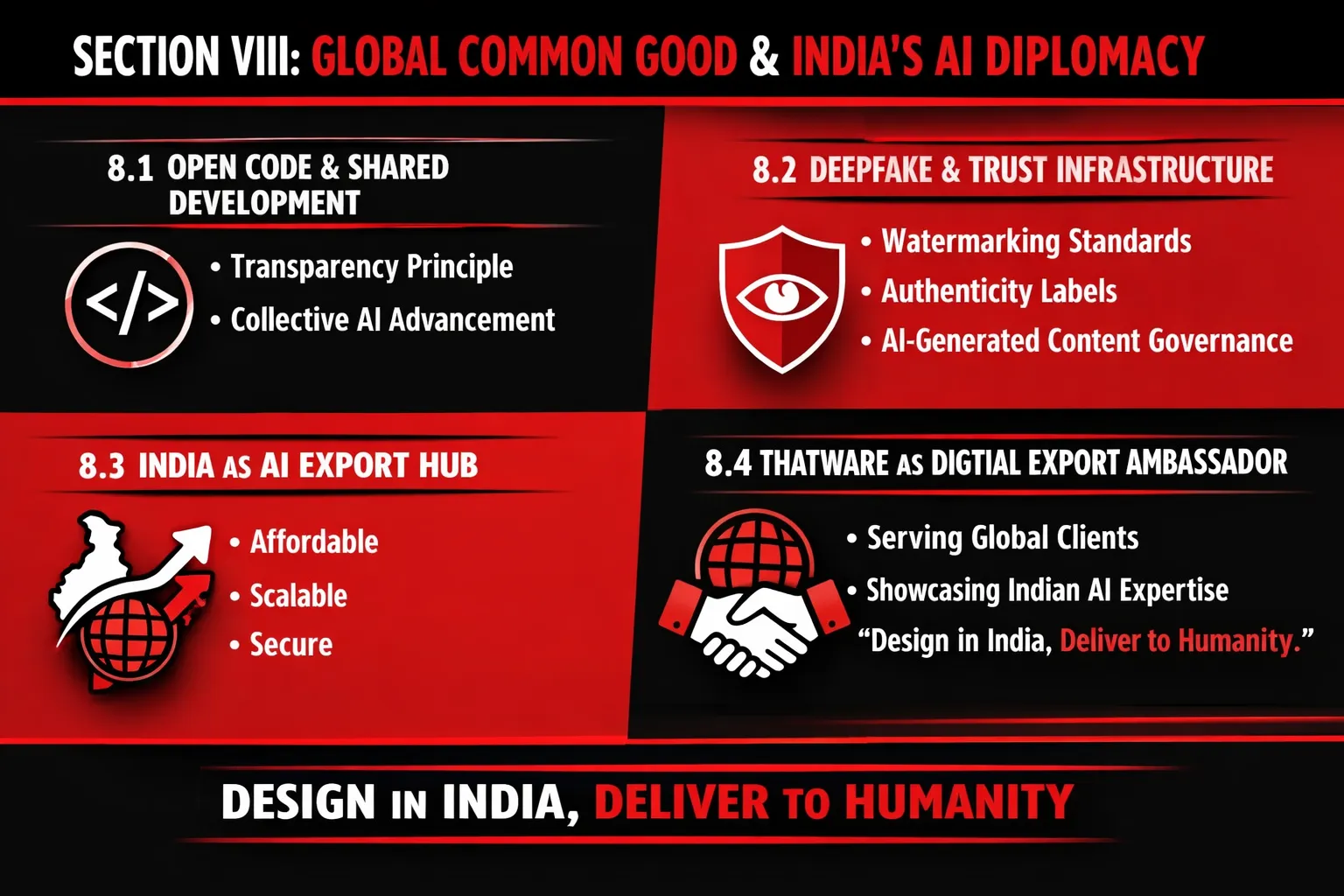
Artificial Intelligence is no longer confined within national borders. Its algorithms travel instantly, its models influence billions, and its decisions ripple across economies and societies. Recognizing this, India has framed its AI strategy not merely as a domestic development tool, but as a global responsibility. AI, in India’s view, must evolve as a Global Common Good—accessible, accountable, and aligned with humanity’s collective progress.
Open Code & Shared Development
At the heart of India’s AI diplomacy lies the principle of transparency. While some nations treat AI as a guarded strategic asset, India advocates for collaborative innovation and shared technological progress. The belief is simple yet powerful: AI becomes safer and more effective when it is built in the open.
Open code ecosystems encourage peer review, collective problem-solving, and ethical oversight. Shared development models enable young innovators, researchers, and startups—especially from the Global South—to participate in shaping AI’s future. This approach not only democratizes opportunity but also distributes responsibility. By fostering collaborative platforms and encouraging interoperable systems, India is positioning itself as a champion of collective AI advancement rather than technological isolationism.
Deepfake & Trust Infrastructure
As AI grows more sophisticated, so do the risks. Deepfakes, synthetic media, and AI-generated misinformation pose serious threats to democratic institutions and public trust. India has acknowledged that technological advancement must be matched by trust infrastructure.
Proposals such as watermarking standards for AI-generated content, authenticity labels similar to nutrition labels on food, and governance mechanisms for digital provenance reflect a forward-thinking approach. The objective is clear: build trust into technology from its inception. Transparency in origin, traceability of content, and verifiable AI systems will be critical pillars of a stable digital future.
By advocating for global norms around AI-generated content governance, India is contributing to the creation of international standards that safeguard open societies while enabling innovation.
India as an AI Export Hub
With strong digital public infrastructure, a vast talent pool, and growing semiconductor and computing capabilities, India is rapidly emerging as a global AI export hub. Its value proposition is distinctive: affordable solutions, scalable architectures, and secure implementation frameworks.
India’s diversity and scale act as real-world testing grounds. If an AI model succeeds in India—with its linguistic variety, demographic complexity, and socio-economic diversity—it can succeed anywhere. This makes India not just a developer of AI, but a validator of globally deployable intelligence systems.
ThatWare as a Digital Export Ambassador
In this global AI landscape, ThatWare exemplifies India’s private-sector contribution. Serving clients across continents, ThatWare demonstrates how Indian AI expertise can power international digital ecosystems. Through advanced Semantic SEO, LLM Optimization, Quantum SEO as a Service (QSAAS), and Hyper-Intelligence algorithms, the company translates India’s AI strength into measurable global impact.
ThatWare’s innovation model reflects a larger national ethos: build in India, scale globally, and contribute to humanity’s digital advancement.
In many ways, it embodies a powerful call to action:
Design in India. Deliver to the World. Deliver to Humanity.
SECTION IX: THE STRATEGIC CONVERGENCE
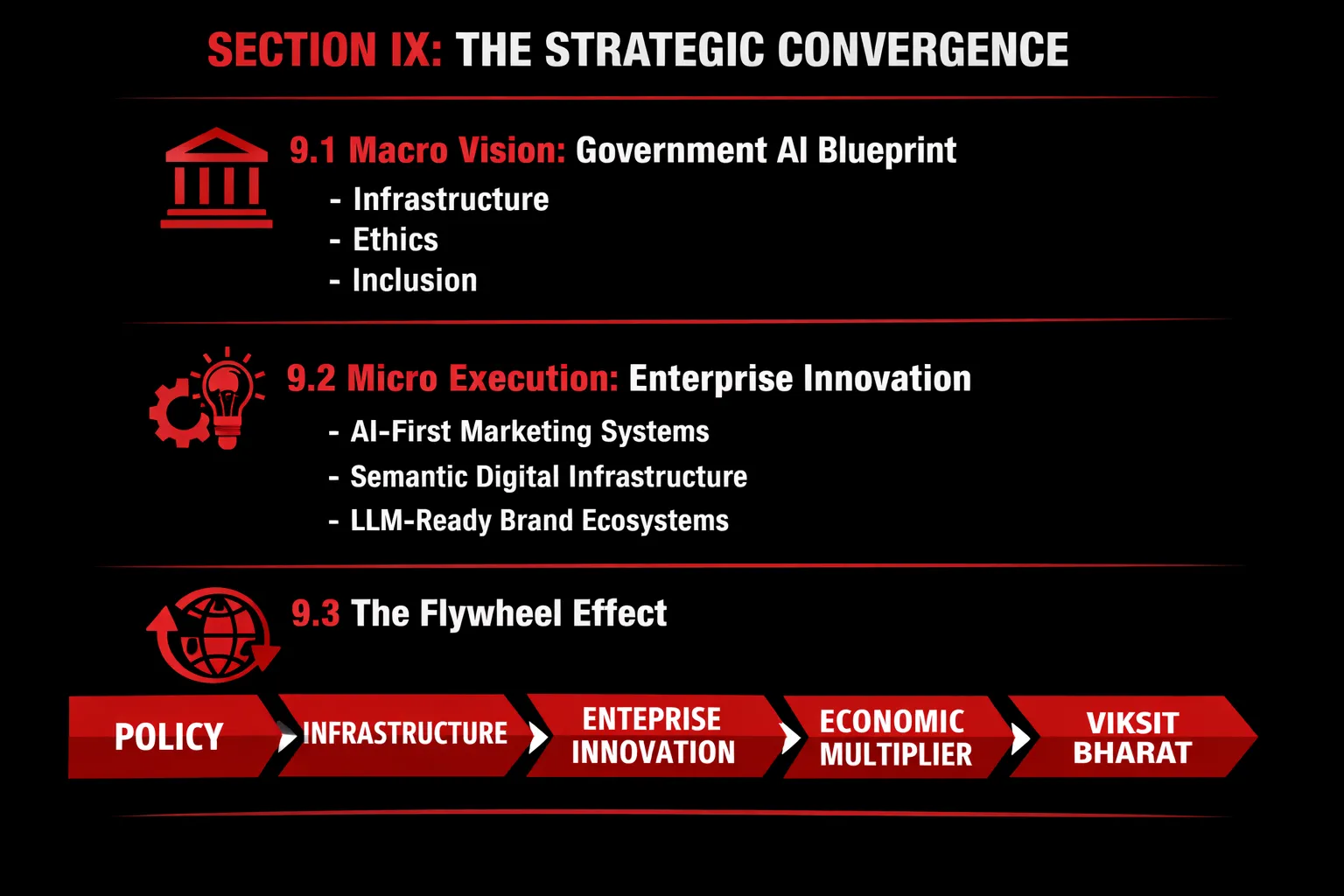
India’s AI transformation is not unfolding in isolation. It is the result of a deliberate convergence between macro-level national strategy and micro-level enterprise execution. True technological revolutions occur when public vision and private innovation align—and India’s AI journey reflects precisely this synchronization.
Macro Vision: Government AI Blueprint
At the macro level, India’s AI roadmap rests on three foundational pillars: infrastructure, ethics, and inclusion.
Infrastructure is the backbone. Through the IndiaAI Mission, semiconductor initiatives, GPU access democratization, and secure data center expansion, the government is laying down the computational highways required for an AI-powered economy. This is not incremental progress—it is foundational architecture. Just as roads and railways powered industrial growth, AI infrastructure will power cognitive growth.
But infrastructure without guardrails can create imbalance. Hence the emphasis on ethics, embodied in the M.A.N.A.V. framework. By prioritizing Moral and Ethical Systems, Accountable Governance, National Sovereignty, Accessibility, and Validity, India is signaling that AI must remain human-centric. The objective is not unrestrained automation, but responsible intelligence amplification.
Equally critical is inclusion. India’s doctrine is clear: AI must not deepen divides between urban and rural, rich and poor, English-speaking and vernacular populations. Instead, it must expand opportunity—bringing advanced capabilities to grassroots levels and enabling equitable digital participation.
Together, these pillars form the macro blueprint of Intelligent Bharat.
Micro Execution: Enterprise Innovation
However, strategy alone does not generate economic transformation. Execution does. This is where enterprise innovation becomes decisive.
Companies like ThatWare represent the applied intelligence layer of India’s AI ambitions. Through AI-first marketing systems, traditional digital frameworks are being re-engineered for an AI-native world. Marketing is no longer keyword-driven—it is intelligence-driven.
Building semantic digital infrastructure ensures that brands are not just searchable, but understandable to machines. In the era of generative AI, visibility depends on structured meaning, contextual authority, and algorithmic resonance.
Simultaneously, LLM-ready brand ecosystems prepare businesses for AI-powered discovery environments. As search evolves from links to answers, enterprises must structure content for machine comprehension, conversational engines, and knowledge graphs. This is not optimization for today—it is positioning for tomorrow’s AI interface economy.
Enterprise innovation translates policy ambition into tangible economic output.
The Flywheel Effect
When macro vision and micro execution synchronize, a powerful flywheel emerges:
Policy → Infrastructure → Enterprise Innovation → Global Exports → Economic Multiplier → Viksit Bharat.
Government policy builds infrastructure. Infrastructure empowers enterprises. Enterprises innovate and export intelligence globally. Global exports generate economic growth. Economic growth accelerates national development.
This is the strategic convergence shaping India’s AI century.
In this model, AI is not merely technology—it is national strategy, economic catalyst, and civilizational momentum combined.
SECTION X: Toward Intelligent Bharat
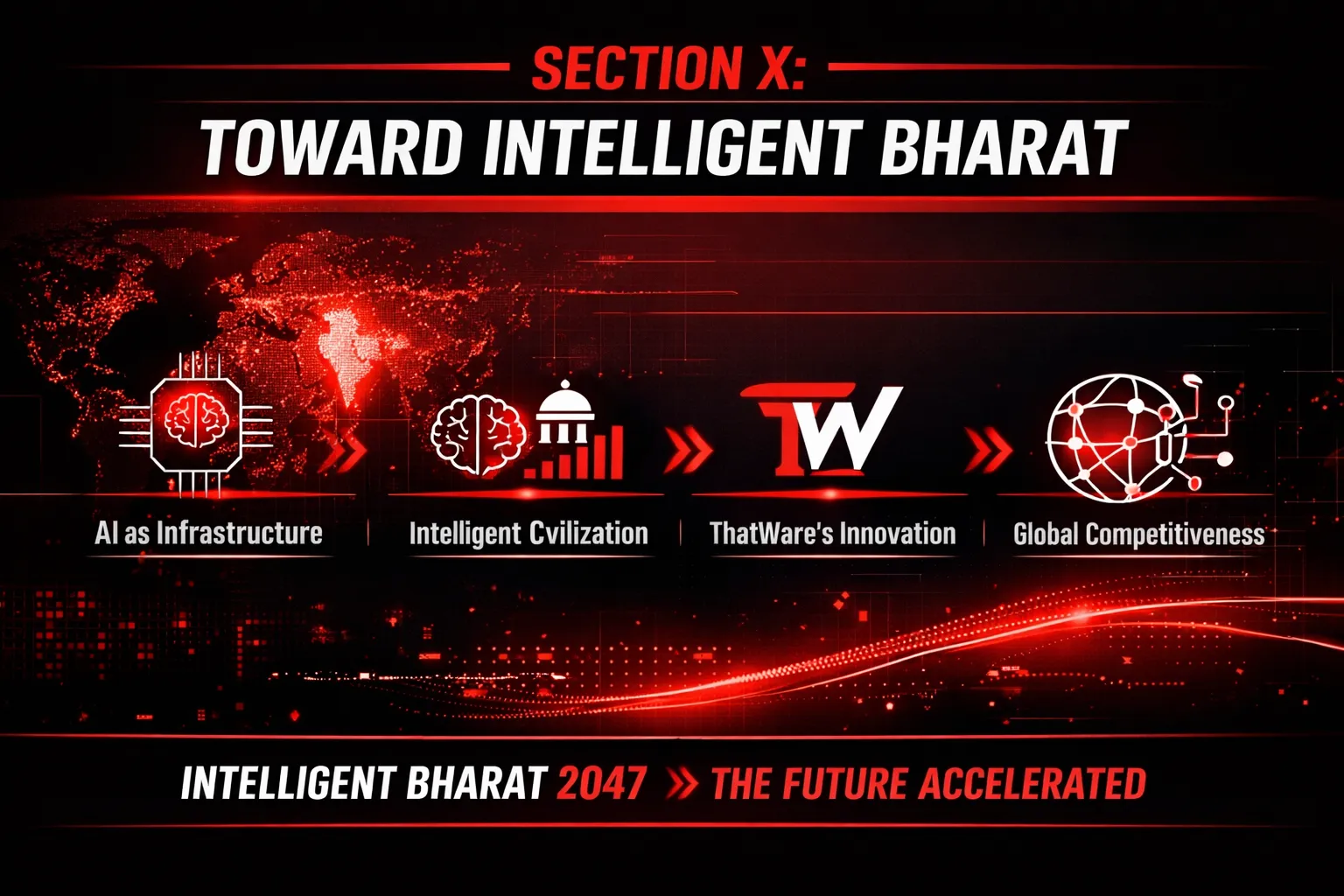
AI as Infrastructure, Not Tool
To understand the future India is building, we must first redefine Artificial Intelligence. AI is no longer a feature, an application, or a productivity enhancer. It is infrastructure.
Just as electricity transformed industry and the internet transformed communication, AI is transforming cognition. It is becoming the invisible backbone of decision-making, governance, commerce, education, and innovation. Nations that treat AI merely as a tool will fall behind those that recognize it as foundational infrastructure for a new economic order.
We are entering the age of the cognitive economy—where intelligence, data interpretation, predictive modeling, and algorithmic decision systems drive value creation. In this economy, competitive advantage does not depend solely on capital or labor; it depends on the ability to process information intelligently and act faster than uncertainty.
Alongside it rises the intelligence economy—where knowledge systems, AI-native platforms, semantic networks, and machine-augmented insights become the primary engines of growth. Businesses no longer compete only on products; they compete on intelligent visibility, intelligent operations, and intelligent engagement.
For India, recognizing AI as infrastructure means embedding it across governance, industry, and digital ecosystems—not as an optional upgrade, but as the backbone of Viksit Bharat 2047.
From Developed Nation to Intelligent Civilization
The vision of Viksit Bharat 2047 goes beyond GDP expansion or industrial growth. A developed nation is defined by economic strength. An intelligent civilization is defined by how effectively it applies intelligence to elevate society.
This transformation rests on three pillars:
Economic Intelligence
Data-driven policymaking, AI-powered industries, predictive agriculture, precision healthcare, and intelligent logistics create a resilient, adaptive economy. Productivity multiplies when human effort is augmented by machine insight.
Cultural Intelligence
India’s civilizational depth—its languages, knowledge systems, diversity, and heritage—can be preserved and amplified through AI. Digitized manuscripts, multilingual AI models, and culturally aware algorithms ensure that modernization does not erase identity, but strengthens it.
Digital Sovereignty
In the intelligence age, data is strategic capital. Control over computing infrastructure, AI models, semiconductor capabilities, and digital standards determines autonomy. Digital sovereignty ensures that innovation serves national interest while contributing responsibly to global ecosystems.
Moving from “developed” to “intelligent” means aligning economic growth with ethical frameworks, technological strength with inclusivity, and innovation with sovereignty.
ThatWare’s Role in the Intelligent Economy
If AI is infrastructure, then digital ecosystems are the highways of the intelligence economy. ThatWare operates precisely at this layer.
Through AI-native search ecosystems, ThatWare is redefining how brands interact with intelligent systems. Search is no longer keyword-based—it is semantic, contextual, predictive, and increasingly LLM-driven. By mastering Semantic SEO and LLM Optimization, ThatWare ensures that businesses remain visible in AI-mediated environments where machines interpret intent before humans even articulate it.
Through Cognitive Resonance SEO and Artificial Intelligence Experience Optimization (AIXO), ThatWare aligns brand communication with both human psychology and machine comprehension. The result is not just traffic—but intelligent engagement.
With Quantum SEO as a Service (QSAAS) and Hyper-Intelligence algorithms, ThatWare introduces predictive modeling, multi-layer ranking synthesis, and adaptive recalibration—turning digital marketing into an intelligence discipline rather than a promotional tactic.
And through Quantum Branding Marketing (QBM), brands are elevated beyond visibility into multidimensional authority ecosystems—built to thrive in global markets shaped by AI discovery engines.
In essence, if India is building the AI foundation—GPUs, semiconductor capability, policy frameworks—ThatWare is building the intelligent layers that operate on top of it, enabling enterprises to compete globally in an AI-first world.
Final Call
AI is not automation alone.
It is amplification.
It is democratization.
It is strategic leverage.
India is laying the infrastructure for an AI-powered future—through policy clarity, ethical governance, and technological investment.
ThatWare is architecting the applied intelligence systems that allow businesses to function within that future—smarter, faster, and globally competitive.
The convergence of national vision and enterprise innovation defines the next era.
Together, this alignment does not merely lead to development.
It leads to transformation.
Together → Intelligent Bharat 2047.