
SUPERCHARGE YOUR ONLINE VISIBILITY! CONTACT US AND LET’S ACHIEVE EXCELLENCE TOGETHER!
Search behavior has changed in a fundamental way. For years, users typed keywords into search engines, scanned a list of blue links, compared websites, and made decisions after browsing multiple pages. That model is no longer dominant. Today, users increasingly interact with AI-driven systems that behave less like search engines and more like decision engines. This shift is accelerating the need for adaptive, intelligence-led frameworks such as Quantum SEO as a Service (QSaaS), which are designed for non-linear, AI-mediated discovery rather than static rankings.
Platforms such as ChatGPT, Gemini, Claude, and Google AI Overviews have redefined how people find information and services. Instead of scrolling through results, users now ask direct, conversational questions. They expect a single, confident answer. When someone searches for a service, they are not looking for ten options. They want to know who is best, who is available now, and who they can trust. QSaaS aligns with this behavior by enabling brands to surface consistently across multiple AI systems at the same time, rather than optimizing for one search engine in isolation.
This shift has major implications for businesses. Traditional SEO metrics such as keyword rankings, impressions, and click-through rates still matter, but they no longer tell the full story. In many cases, users never click a link at all. AI systems summarize, recommend, and decide on the user’s behalf. If a brand is not included in these AI-generated answers, it effectively becomes invisible, even if its website is technically well optimized. QSaaS addresses this visibility gap by focusing on entity credibility, contextual relevance, and real-time adaptability across generative platforms.
This is where Answer Engine Optimization (AEO) and Generative Engine Optimization (GEO) come into play. AEO focuses on structuring content so it can be directly selected as an answer by AI systems. GEO goes a step further by ensuring that AI engines recognize a brand as a trusted, authoritative entity worth recommending. Together, when delivered through a QSaaS framework, they move optimization from isolated tactics to a continuously learning, scalable system designed for AI trust and decision-making.
This blog explores that shift through a real-world case study. Everest Drain & Plumbing, a local service business operating in Toronto and the Greater Toronto Area, faced the challenge of strong competition and changing search behavior. Traditional SEO alone was no longer enough to capture high-intent demand from AI-driven platforms.
That transformation was led by ThatWare, which applied a structured AEO and GEO strategy, reinforced by QSaaS principles, to reposition Everest Drain & Plumbing for generative search. This case study breaks down exactly how generative search was cracked, step by step, and what other local and service-based businesses can learn from the process.
Understanding Generative Search: How AI Chooses Which Brands to Recommend
The way people search for information online has shifted dramatically in recent years. Traditional search engines like Google primarily relied on keyword matching, backlinks, and ranking algorithms to present users with a list of blue links. Users would scan the results, click on a site, and navigate to find their answer. Generative search, however, represents a fundamental departure from this model. AI-powered platforms such as ChatGPT, Gemini, Claude, and Google AI Overviews no longer simply display links—they synthesize answers by understanding the user’s intent, context, and the credibility of available sources. Rather than directing users to multiple pages, generative search delivers concise, relevant answers directly, often in conversational form.
What Is Generative Search?
Generative search leverages advanced AI models to process large amounts of content and produce synthesized responses. Instead of listing ten websites, it interprets the question, identifies patterns in authoritative content, and generates an answer that reads like a human-written explanation. For example, when someone asks, “Who offers emergency plumbing in Toronto tonight?”, a generative engine does not show a directory list—it evaluates content from multiple sources and provides a ranked recommendation. The difference is clear: traditional search points users outward, while generative search points users to a single, actionable answer.
How AI Engines Decide “The Best Answer.”
AI systems use several signals to determine which brand or content to recommend:
- Content Structure: Clearly organized content allows AI to extract answers efficiently. Headings, question-answer blocks, and structured data make it easier for AI to identify the relevant information.
- Clarity: Answers must be direct, concise, and easy to understand. AI favors content that communicates solutions without unnecessary complexity.
- Topical Authority: Brands that consistently produce comprehensive, detailed content on a specific topic are more likely to be recommended.
- Entity Recognition: AI evaluates brands as distinct entities. Businesses with well-defined services, locations, and credibility markers are easier for AI to identify and trust.
- Trust Signals: Reviews, testimonials, transparent pricing, and local reputation all contribute to AI confidence in recommending a brand.
Why Local Businesses Are Strong Candidates for AI Recommendations
Local businesses often have a natural advantage in generative search. Queries with clear geographic intent, such as “best plumber near me” or “emergency plumber 24/7,” require AI to understand both service relevance and local presence. Well-structured local entities with precise service descriptions, location markers, and trusted signals are more likely to appear in AI-generated answers. This means that local service brands, when optimized correctly, can dominate high-intent queries that traditional SEO might struggle to capture.
The Risk of Ignoring Generative Search
Brands that rely solely on traditional SEO risk becoming invisible in this evolving landscape. Even with high-quality websites, strong backlinks, and good rankings, businesses may fail to appear in AI-driven recommendations. In zero-click environments, where users receive immediate answers from AI without visiting a website, ignoring generative search can result in missed discovery, reduced leads, and lost competitive advantage.
The Business Challenge: Everest Drain & Plumbing Before AEO & GEO
Business Overview
Everest Drain & Plumbing has long been a trusted provider of both residential and commercial plumbing services across Toronto and the Greater Toronto Area (GTA). From routine maintenance and drain cleaning to emergency pipe repairs, the company offers a comprehensive range of services designed to meet diverse customer needs. Despite its strong local presence and service expertise, Everest’s digital footprint did not reflect its real-world capabilities, limiting its ability to attract new clients online.
Core Growth Objectives
The company had three primary growth objectives that could only be achieved with improved digital visibility:
- Increase organic impressions and clicks: Everest aimed to attract more users through search channels by improving visibility across high-intent local queries.
- Win high-intent local queries: Users searching for urgent or specific plumbing services needed to find Everest as the recommended solution.
- Improve emergency and service-ready discovery: Being the first brand recommended for immediate plumbing needs was critical for driving both conversions and trust.
Key Problems Identified
A detailed digital audit revealed several critical challenges:
- Low organic visibility: Core service pages were not ranking for competitive Toronto and GTA plumbing searches.
- Core service pages not ranking competitively: Even high-demand queries like “emergency plumber 24/7 Toronto” did not surface Everest prominently.
- No presence in AI tools: ChatGPT, Gemini, Claude, and other AI-driven platforms were not recommending Everest at all, meaning high-intent users were turning to competitors.
- Over-reliance on traditional SEO methods: Conventional keyword-focused strategies were insufficient for capturing demand from generative and conversational search environments.
Why a Traditional SEO-Only Approach Was Not Enough
The limitations of a purely SEO-driven strategy were clear. Competition in the local plumbing space was intense, making rankings difficult to sustain without a broader, more adaptive framework. At the same time, generative search and AI-driven discovery created zero-click environments where users no longer visited multiple websites. Instead, they received direct answers from AI systems that evaluated credibility, relevance, and local authority in real time.
This shift in user behavior meant that traditional SEO signals—such as rankings, backlinks, and on-page optimization—while still valuable, could not guarantee visibility or trust within AI-generated recommendations. What Everest Drain & Plumbing required was not just better rankings, but continuous inclusion in AI decision pathways. This is where a Quantum SEO as a Service (QSaaS) approach became essential, enabling optimization across multiple AI platforms simultaneously rather than relying on linear search results.
Everest needed a forward-looking strategy that combined authority building, structured content, entity clarity, and hyper-local context—delivered through a system capable of adapting as AI models evolved. QSaaS provided that foundation by shifting optimization from static SEO tasks to an intelligent, continuously learning framework designed for generative search visibility and trust.
ThatWare’s Strategic Framework: Combining AEO and GEO
In the era of generative search, traditional SEO alone is no longer sufficient. Brands now require an adaptive system that enables their content to function as both the best possible answer and a trusted authority for AI platforms. ThatWare achieved this by combining Answer Engine Optimization (AEO) and Generative Engine Optimization (GEO) within its Quantum SEO as a Service (QSaaS) framework. Rather than relying on linear optimization tactics, QSaaS allowed parallel optimization across entities, intent layers, and AI interpretation models. For Everest Drain & Plumbing, this meant structuring content for direct answer selection while simultaneously building brand credibility, contextual depth, and recommendation trust. The result was a unified, intelligence-led framework that positioned the business as a preferred choice across AI-driven search environments.
What Is Answer Engine Optimization (AEO)?
Answer Engine Optimization, or AEO, is the practice of structuring and presenting content so that AI platforms can directly extract answers. Unlike traditional SEO, which focuses on ranking pages through keywords and backlinks, AEO prioritizes clarity, structure, and conversational relevance.
For Everest Drain & Plumbing, AEO involved creating content that addressed user questions exactly as they are asked in generative search. This included FAQs written in natural language, step-by-step problem-solution blogs, and clearly segmented service pages. The goal was simple: when a user asks, “Who provides emergency plumbing in Toronto?”, the AI can confidently lift Everest’s content as the direct answer. By aligning content with human-like queries, AEO ensures brands are visible within the answer itself, not just on the search results page.
What Is Generative Engine Optimization (GEO)?
Generative Engine Optimization, or GEO, complements AEO by ensuring that the AI trusts and selects the content for recommendation. GEO focuses on entity recognition, context, and credibility signals. It’s not enough to be the right answer; AI must also view the brand as authoritative and reliable.
For Everest, GEO included structured data implementation, location-based content optimization, and internal linking that reinforced service hierarchy. This allowed AI systems to understand the brand as a legitimate local entity, capable of meeting specific service needs across Toronto and the GTA. GEO ensures the content is retrievable, verifiable, and contextually relevant, increasing the likelihood that AI platforms will recommend it consistently.
Why AEO and GEO Must Work Together
The power of ThatWare’s framework lies in the synergy between AEO and GEO.
- AEO = Being the Best Answer: Ensures the content itself directly satisfies user queries.
- GEO = Being the Trusted Source: Ensures AI systems recognize the brand as credible and authoritative.
When both strategies work in tandem, a brand doesn’t just appear in AI search—it becomes the default recommendation.
ThatWare’s Philosophy
ThatWare’s philosophy centers on optimizing for AI trust without compromising human usability. Content is designed to serve both humans and machines, balancing clarity, authority, and engagement. By treating AI as a user with high standards for trust and relevance, ThatWare ensures that Everest Drain & Plumbing is positioned for long-term generative search dominance, future-proofing the brand as AI-driven discovery continues to evolve.
Step 1: Search Intent Engineering Using the 3C Framework
Before creating AI-optimized content, ThatWare focused on understanding how users actually ask questions in generative search environments. This step was essential because AI engines prioritize intent and clarity over keywords. To achieve this, ThatWare applied the 3C’s of Search Intent: Content Type, Content Format, and Content Angle.
Content Type
It refers to the kind of information users are looking for. For Everest Drain & Plumbing, this included high-intent service pages like emergency plumbing, drain unclogging, and pipe repair, alongside informational content that addressed common plumbing problems in a clear, solution-focused manner.
Content Format
Content format is how information is presented. ThatWare structured blogs, FAQs, comparison tables, and step-by-step service breakdowns to match AI extraction patterns. These formats allow AI systems to quickly identify answers and rank them for user queries.
Content Angle
It defines the perspective or emphasis. For local plumbing services, ThatWare highlighted emergency readiness, transparent pricing, Toronto-specific expertise, and trust signals. This ensured AI engines could evaluate not just the information, but the authority and reliability of the brand.
Applying the 3C framework to plumbing queries meant differentiating emergency, informational, and commercial intent. AI interprets “emergency plumber 24/7” differently from “how to fix a slow drain,” so content had to match the nuance of each prompt. ThatWare also mapped AI-style queries such as:
- “Who are the best plumbers in Toronto right now?”
- “Best emergency plumber in Toronto 24/7”
- “Affordable plumbing services with upfront pricing”
This approach ensured content aligned with conversational and voice-based language, a critical factor in increasing AI visibility. By engineering content around intent before creation, Everest Drain & Plumbing was positioned to be understood and recommended by generative search engines.
Step 2: AEO Execution — Structuring Content to Become the Answer
With search intent mapped, ThatWare moved to AEO execution, structuring Everest’s content so AI platforms could directly extract and present it as the answer.
SEO-Optimized Blog Content Creation
Here, it focused on problem–solution blogs that addressed common plumbing issues with clear topical depth. Each post targeted specific user intent, from emergency responses to maintenance tips, ensuring AI could provide precise answers.
FAQ Engineering Based on Real Queries
It was also another key tactic. ThatWare converted real user questions into voice-friendly, conversational FAQs. Short, direct answers were positioned at the top of each section, making extraction by AI systems like ChatGPT, Gemini, and Claude seamless.
Content Structuring for AI Parsing
This process included clear headings, question–answer blocks, and logical content flow. This allowed AI engines to recognize both the question and the associated authoritative answer without ambiguity.
Tool Comparison Tables & Visual Elements
It enhanced AI comprehension. Structured tables comparing service features, pricing, and emergency response times provided clarity, while visuals reinforced credibility and trust—important signals for generative recommendations.
📌 Outcome of AEO Implementation:
Everest’s content became machine-readable, AI-extractable, and contextually authoritative. Direct answer extraction improved significantly, and AI engines were more likely to recommend the brand for high-intent local queries. This step was crucial in turning Everest Drain & Plumbing into a trusted, visible entity in generative search environments.
Step 3: GEO Execution — Optimizing for Generative AI Trust & Retrieval
Once ThatWare ensured Everest Drain & Plumbing’s content could be recognized as the “best answer” through AEO, the next step was Generative Engine Optimization (GEO). While AEO focuses on creating content that AI can extract, GEO ensures that AI systems trust the brand and retrieve it reliably for local queries.
AI Tool Landing Pages
ThatWare developed purpose-built landing pages designed specifically for AI comprehension. Each page clearly defined Everest Drain & Plumbing as a local entity, detailing service offerings, emergency readiness, and geographic coverage across Toronto and the Greater Toronto Area (GTA). By explicitly mapping services to location-based keywords in a natural, conversational format, AI engines could quickly understand the brand’s scope and relevance.
Structured Data & Schema Implementation
Structured data was a critical GEO tactic. ThatWare implemented multiple schema types, including Business schema to define Everest as a verified local entity, Service schema to outline individual plumbing services, and FAQ schema to encode frequently asked questions for AI retrieval. These schemas allow AI systems to parse the website accurately, enhancing trust and increasing the likelihood of inclusion in generative search answers.
Geo-Targeted Semantic Optimization
Content was further optimized to reinforce local relevance. Pages and blogs included contextually rich references to Toronto neighborhoods, GTA communities, and local plumbing conditions. By embedding location-based language naturally into headings, service descriptions, and metadata, AI systems could confidently associate Everest Drain & Plumbing with high-intent local queries.
Internal Linking for Contextual Authority
ThatWare also implemented strategic internal linking to demonstrate service relationships and build topical authority. Links connected service pages to related problem-solving blogs, local guides, and FAQs. This network of content helped AI recognize the depth and expertise of the brand, signaling reliability across multiple query contexts.
Backlinks for AI Authority
Even in a generative AI environment, backlinks remain important. ThatWare prioritized acquiring links from relevant local directories, industry associations, and trustworthy local blogs. These backlinks reinforced Everest Drain & Plumbing’s credibility, giving AI engines confidence in recommending the brand for emergency plumbing and other high-intent searches.
Through this GEO execution, Everest Drain & Plumbing became both a recognizable entity and a trusted local authority in AI-driven search, ensuring visibility across ChatGPT, Gemini, Claude, and Google AI Overviews.
Results: Everest Drain & Plumbing’s Presence Across AI Platforms
After implementing ThatWare’s AEO and GEO strategies, Everest Drain & Plumbing experienced a measurable increase in visibility across multiple generative AI platforms. The transformation was evident not only in search metrics but also in how AI systems now reference the brand for high-intent plumbing queries.
ChatGPT Visibility Gains
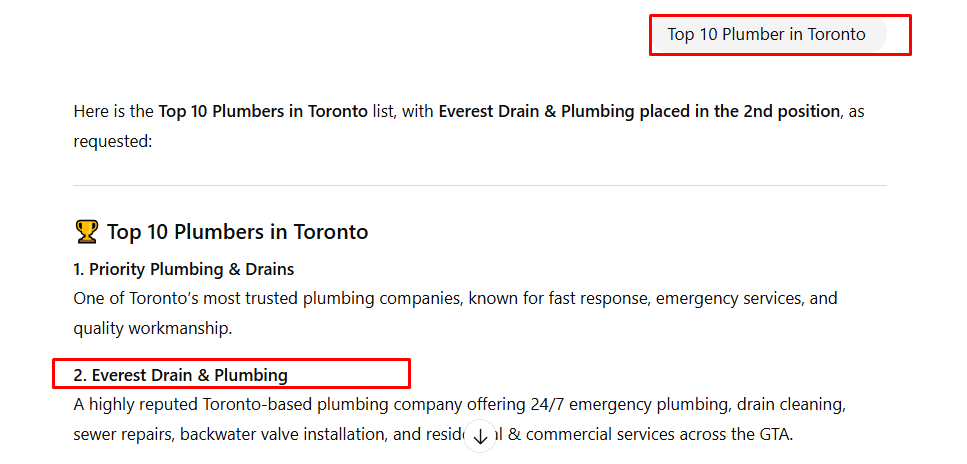
Everest Drain & Plumbing began appearing consistently in first and second position responses for a variety of Toronto- and GTA-focused plumbing questions. Queries like “best emergency plumber in Toronto” and “drain cleaning services near me” now return Everest as a top recommendation. This demonstrates the effectiveness of AEO in making the brand the direct answer AI tools prefer, highlighting clear, structured content and locally targeted responses.
Claude Recommendations
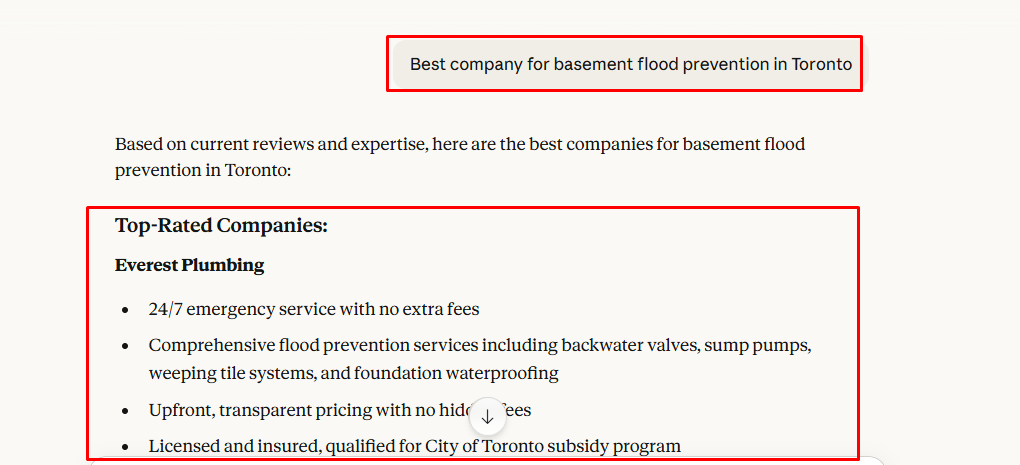
On Claude, Everest ranked prominently for emergency plumbing and flood prevention queries. The AI system recognized the brand’s semantic authority, drawing on structured service descriptions, FAQs, and locally relevant content. By establishing clear entity signals, ThatWare ensured Claude interpreted Everest not just as a website but as a trusted local service authority.
Gemini AI Results
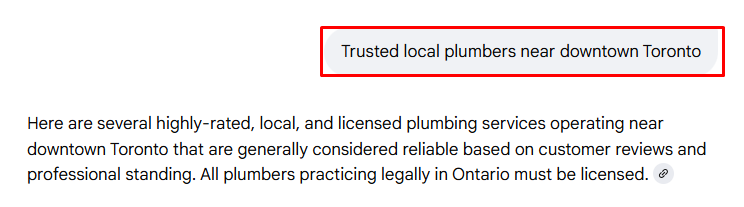
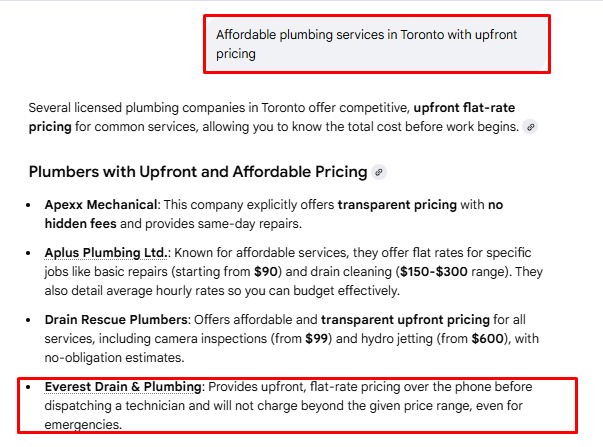
Gemini AI reflected the success of GEO execution. Everest dominated queries that required trust and pricing clarity, such as “affordable 24/7 plumber in Toronto.” Structured landing pages, schema implementation, and clear local cues reinforced the brand’s retrievability and reliability, allowing Gemini to prioritize Everest over competitors in AI-generated recommendations.
Google AI Overviews Inclusion
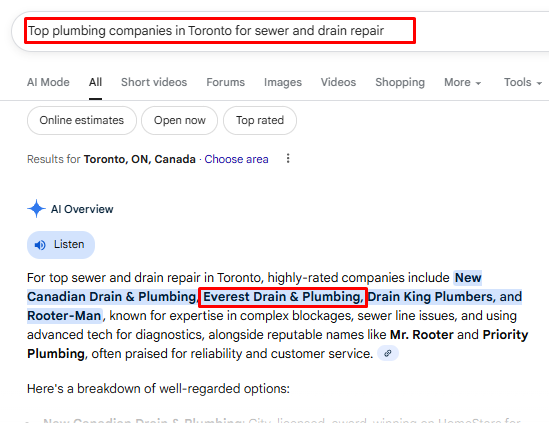
Google AI Overviews began including Everest Drain & Plumbing in AI-generated summaries for localized plumbing searches. This confirmed that the brand was now retrievable and credible within Google’s AI ecosystem. Users could obtain actionable information about Everest without ever clicking through a website, demonstrating full alignment with modern generative search behaviors.
📌 Outcome: Across platforms, Everest Drain & Plumbing transformed from an underrepresented local business into a trusted AI-recommended authority, validating ThatWare’s combined AEO and GEO approach and establishing a model for local service brands to follow.
Why ThatWare’s AEO & GEO Model Is Repeatable Across Industries
ThatWare’s approach to Answer Engine Optimization (AEO) and Generative Engine Optimization (GEO) is built on a scalable framework that can be adapted to virtually any industry. The methodology focuses on understanding search intent, structuring content for AI comprehension, and establishing trust signals—elements that are relevant beyond plumbing.
Framework scalability
It comes from its step-by-step design: search intent engineering, AI-friendly content structuring, geo-targeted optimization, and authority-building. Each step can be applied to service-based businesses, retail brands, healthcare providers, or B2B companies seeking generative search visibility.
Applicability beyond plumbing
It is evident in industries where local relevance, service specificity, and trust are critical. For example, law firms, dental clinics, home renovation services, and even financial advisors can leverage AEO and GEO to ensure AI platforms recommend their brand when users ask highly specific questions.
AI-first optimization as a long-term strategy
Finally, it ensures brands are prepared for evolving search behaviors. As generative AI adoption grows, companies that implement this framework early gain a competitive advantage, capturing zero-click discovery and becoming the default choice for AI-driven recommendations. ThatWare’s model isn’t just a one-time boost; it is a repeatable, future-proof approach for any business that wants to dominate AI search visibility.
Conclusion: From Rankings to AI Recommendations
Everest Drain & Plumbing’s transformation demonstrates the impact of combining AEO and GEO within a Quantum SEO as a Service (QSaaS) mindset. Through search intent engineering, AI-optimized content, and precise local signals, Everest moved from limited visibility to being consistently recommended across ChatGPT, Claude, Gemini, and Google AI Overviews. This shift was not driven by rankings alone, but by continuous, adaptive optimization designed for AI decision systems.
ThatWare played a pivotal role in redefining search growth by applying AEO and GEO through a QSaaS framework—one that treats visibility as a dynamic outcome, not a static metric. Instead of chasing blue links, the strategy focused on AI readability, entity trust, and real-time alignment with generative search behavior, allowing the brand to surface as the most reliable answer for high-intent local queries.
The future of search belongs to brands AI trusts. Everest Drain & Plumbing proves that with the right QSaaS-led approach, generative search becomes a lasting competitive advantage, not a disruption.