SUPERCHARGE YOUR ONLINE VISIBILITY! CONTACT US AND LET’S ACHIEVE EXCELLENCE TOGETHER!
The SEO industry is not going through another algorithm update. It is going through an extinction-level shift.
For more than a decade, SEO agencies have survived by adapting to Google updates, tweaking strategies, and rebranding old services as “new frameworks.” But what’s happening now is fundamentally different. The rise of AI-powered search, large language models (LLMs), answer engines, and generative results has changed not just how search works—but what visibility even means.
Search engines are no longer just indexing pages. They are understanding language, predicting intent, and generating answers. Visibility is no longer earned simply by ranking a page—it’s earned by being trusted, cited, and understood by machines that don’t think in keywords or blue links.
Yet most SEO agencies are still selling the same things they sold years ago:
- Rankings
- Traffic
- Monthly reports filled with outdated metrics
- Deliverables that AI can now generate in seconds
This is where irrelevance begins.
Irrelevance doesn’t mean agencies will disappear overnight. It means they become commoditized, forced to compete on price instead of insight. It means their work becomes replaceable by AI tools, in-house teams, or automated platforms. And most dangerously, it means they are excluded from strategic decision-making, reduced to execution vendors rather than growth partners.
Clients no longer want more traffic for the sake of traffic. They want outcomes. They want visibility where decisions are influenced—across search engines, AI answers, generative platforms, and emerging discovery channels. Agencies that can’t connect their work to business impact, brand authority, and future-proof visibility are already being quietly sidelined.
By 2026, this gap will be impossible to ignore.
The agencies that survive won’t look like traditional SEO agencies at all. They will operate as hyper-intelligent search partners—combining AI, human strategy, semantic understanding, and predictive insight to engineer visibility across an increasingly complex search ecosystem.
The rest—no matter how established or experienced—will lose relevance, pricing power, and authority. Not because SEO is dead, but because they failed to evolve with how search now thinks.
The SEO Agency Boom Created a Fragile Industry
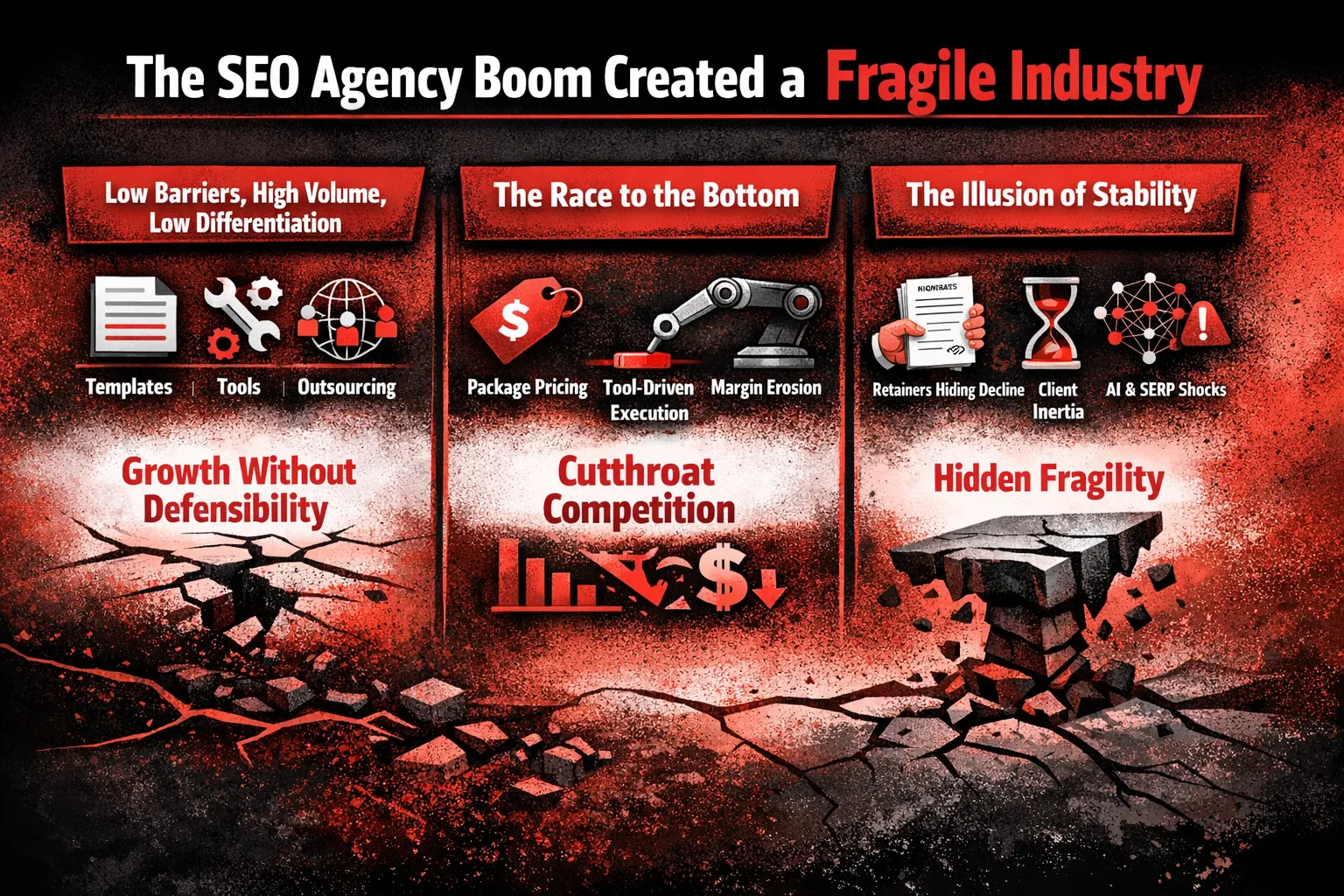
The explosive growth of SEO agencies over the last decade wasn’t driven by deep innovation or defensible expertise—it was driven by ease of entry. SEO became one of the fastest-scaling digital services because almost anyone could start an agency with minimal upfront investment. A handful of tools, a few templates, and outsourced execution were enough to look “legit” in the eyes of most clients. This low barrier to entry created volume—but it also created fragility.
Low Barriers, High Volume, Low Differentiation
Most SEO agencies scaled quickly by relying on the same three pillars: standardized templates, off-the-shelf tools, and outsourced labor. Keyword research templates, generic audit reports, content briefs, and backlink spreadsheets became interchangeable across agencies. Tools replaced thinking. Outsourcing replaced skill development.
The result was growth without defensibility. Agencies didn’t build proprietary frameworks, original methodologies, or unique insight layers. They built delivery machines that looked efficient but were fundamentally replaceable. When everyone uses the same tools and follows the same playbooks, differentiation disappears—and pricing power goes with it.
The Race to the Bottom Model
As differentiation vanished, competition shifted almost entirely to price. “SEO packages” became the industry standard: fixed deliverables, fixed hours, fixed expectations. Tool-driven execution replaced strategic problem-solving, and agencies competed by offering more for less.
This created a dangerous feedback loop:
- Lower prices forced higher client volume
- Higher volume reduced quality
- Reduced quality increased churn
- Churn forced even lower pricing
Margins eroded quietly. Many agencies stayed busy, but few stayed profitable in a meaningful, scalable way. The business looked healthy on the surface—but structurally, it was weak.
The Illusion of Stability
Retainers gave agencies a false sense of security. Monthly payments masked a deeper issue: declining perceived value. Clients stayed not because SEO was driving clear business impact, but because switching felt risky, time-consuming, or inconvenient.
This inertia-based retention worked—until it didn’t. AI-driven automation, LLM-powered tools, and rapidly changing SERPs exposed how fragile these models really were. Once clients realized that much of what they were paying for could be automated, internalized, or delivered cheaper, the illusion collapsed.
The SEO agency boom didn’t fail because of a lack of demand. It failed because it optimized for scale instead of substance—and fragility is the inevitable cost of that choice.
Search Engines Have Become Answer Engines
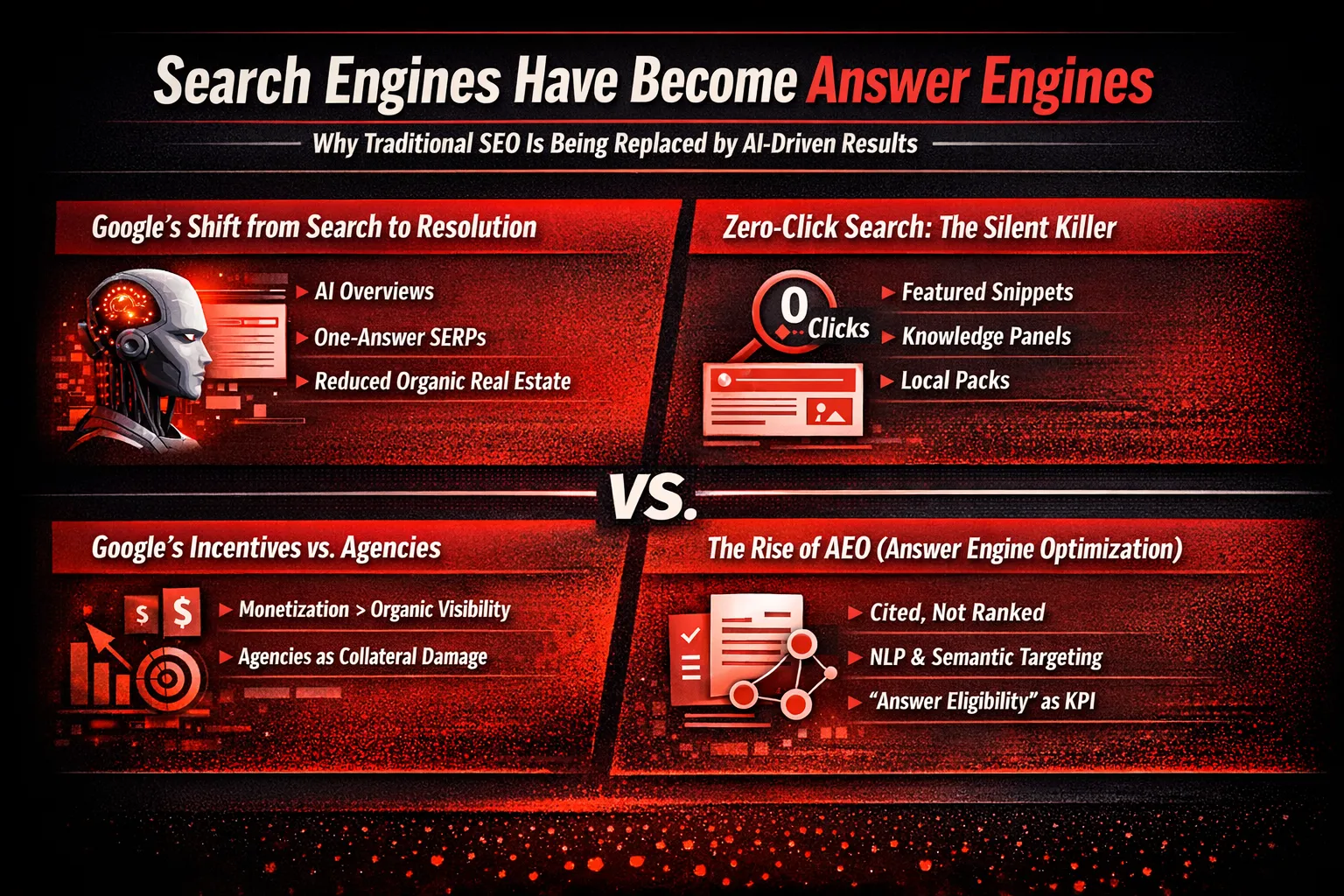
For more than two decades, search engines functioned as gateways. You typed a query, received a list of links, and chose where to go next. That era is ending. By 2026, search engines—especially Google—will no longer be judged by how well they direct traffic, but by how efficiently they resolve intent. This single shift is one of the biggest reasons traditional SEO agencies are rapidly losing relevance.
Google’s Shift From Search to Resolution
Google’s introduction of AI Overviews marks a fundamental change in philosophy. Instead of helping users find information, Google now aims to deliver the answer immediately. This results in one-answer SERPs, where a synthesized response sits above everything else, pushing organic listings further down—or removing the need to click altogether.
The consequence is reduced organic real estate. Where ten blue links once competed for attention, now a single AI-generated response dominates the screen. Traditional SEO strategies built around ranking “position #1” are becoming meaningless when the real visibility is happening above the rankings, inside AI-generated answers.
Zero-Click Search as the Silent Killer
Zero-click searches didn’t arrive overnight—they’ve been quietly growing for years. Featured snippets, knowledge panels, and local packs already trained users to get answers without clicking. AI Overviews simply accelerate this trend.
For agencies still measuring success by traffic alone, this is disastrous. A client might “rank,” but see no corresponding increase in visits, leads, or revenue. Visibility without interaction becomes the norm. SEO agencies that cannot explain—or monetize—this reality quickly lose trust and budget.
Google’s Incentives Are Not Aligned With Agencies
A hard truth many agencies avoid: Google’s business model does not depend on organic SEO success. Google optimizes for monetization, retention, and ecosystem control. AI-driven answers keep users on Google longer, reduce dependency on external sites, and create more premium ad inventory.
In this equation, SEO agencies are collateral damage. Google is not designing search experiences to preserve agency retainers. Agencies that build their entire value proposition around “how Google used to work” are betting against Google’s incentives—and that is a losing bet.
The Rise of AEO (Answer Engine Optimization)
This shift gives rise to Answer Engine Optimization (AEO). The goal is no longer to rank a page, but to be cited, referenced, or trusted by the answer engine itself.
AEO focuses on:
- Structuring content so AI systems can easily extract and trust answers
- Leveraging NLP-driven content interpretation, not keyword density
- Optimizing for answer eligibility—the probability that your brand or content becomes part of an AI-generated response
In this new paradigm, success isn’t measured by position, but by presence inside the answer. Agencies that fail to adapt to AEO will find themselves optimizing for a search experience that no longer exists—while the real visibility battle happens elsewhere.
LLMs Have Redefined How Search Understands Content
For nearly two decades, SEO revolved around a simple premise: match keywords to queries. Pages ranked because they repeated phrases users typed into search engines. That era is over. Large Language Models (LLMs) have fundamentally changed how search systems interpret, evaluate, and surface content. Search is no longer keyword-native — it is language-native.
From Keyword Matching to Language Understanding
LLMs don’t “scan” pages for keywords the way traditional algorithms did. They understand language holistically. This means they interpret:
- Meaning: What is the content actually saying?
- Context: In what situation or intent does this information apply?
- Relationships: How ideas, entities, and concepts connect to each other.
In this new paradigm, keywords are no longer the goal — they are merely inputs. They help systems understand a topic, but they don’t determine outcomes. Two pages can target the same keyword, yet the one that demonstrates deeper contextual understanding, clearer intent alignment, and stronger conceptual relationships will be favored by LLM-driven systems.
This is why “perfect keyword optimization” increasingly fails. LLMs evaluate whether a piece of content answers a question comprehensively, not whether it repeats a phrase enough times.
NLP, Semantic Search & Entity-Based Indexing
At the core of this shift is Natural Language Processing (NLP) combined with semantic search. Modern search engines build and rely on knowledge graphs — structured representations of entities (people, brands, concepts, locations) and how they relate to one another.
Instead of ranking pages, systems assess:
- Entity authority: Is this source recognized as credible for a specific entity or topic?
- Topical trust signals: Has this source demonstrated consistent, deep coverage across a topic ecosystem?
- Relationship strength: How well does the content connect subtopics, supporting concepts, and adjacent ideas?
In practical terms, search visibility is no longer page-centric — it’s entity-centric. Brands, authors, products, and concepts that are clearly defined and semantically connected gain preferential treatment across both traditional SERPs and AI-generated answers.
Why Most SEO Content Is Invisible to LLMs
Despite using AI tools, most SEO content performs poorly in this new environment. The reasons are structural, not technical:
- Shallow topical coverage: Content that scratches the surface fails to signal expertise or authority.
- AI-generated noise: Mass-produced articles with no original insight blend into an undifferentiated corpus of text.
- Lack of semantic structure: Disconnected headings, weak internal logic, and absent entity relationships make content hard for LLMs to contextualize.
As a result, vast amounts of SEO content exist — but remain invisible to LLM-driven search systems.
In the LLM era, visibility isn’t earned by optimizing pages. It’s earned by engineering understanding. Agencies that don’t adapt to this reality will continue publishing content that machines can read — but never trust, cite, or surface.
AI Has Commodified SEO — Except Intelligence
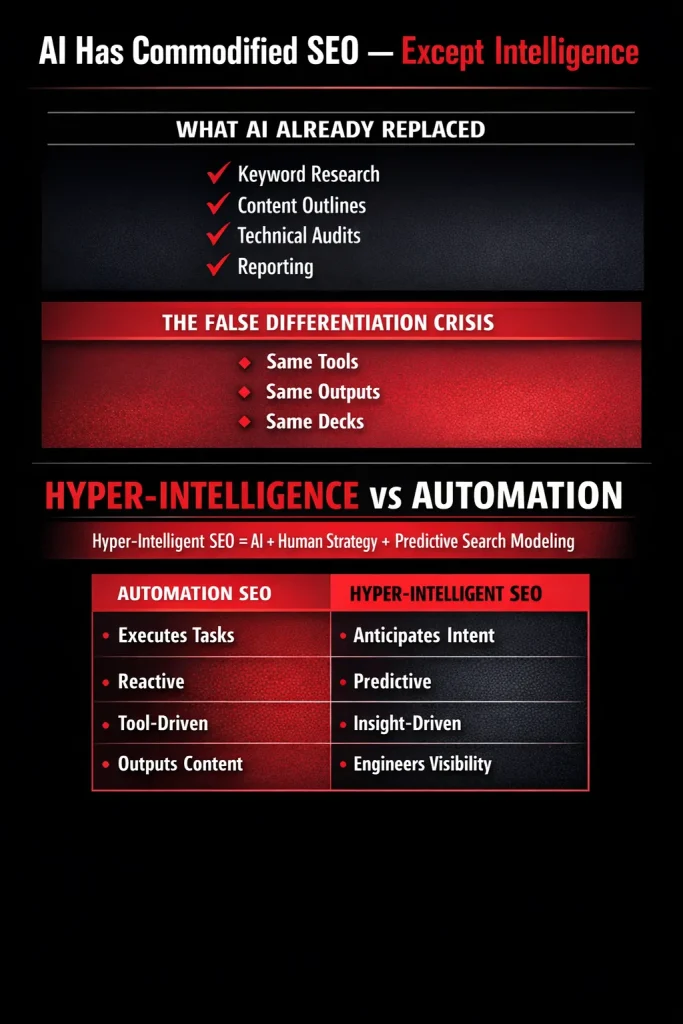
Artificial intelligence didn’t just improve SEO workflows — it flattened the entire playing field. Tasks that once justified retainers, long timelines, and specialist teams are now executed in minutes by machines. This shift hasn’t killed SEO, but it has destroyed the value of execution-only agencies. What remains valuable is not doing SEO, but thinking beyond it.
What AI Has Already Replaced
A large portion of traditional SEO work has already been absorbed by AI-driven systems:
- Keyword research:
AI can instantly cluster keywords, map intent, identify gaps, and prioritize opportunities with far more speed and scale than humans ever could.
- Content outlines:
LLMs generate structured outlines, FAQs, headings, and even full drafts in seconds — making “content planning” a baseline capability, not a premium service.
- Technical audits:
AI-powered crawlers and tools now flag technical issues, Core Web Vitals problems, schema gaps, and indexation errors automatically.
- Reporting:
Dashboards, automated insights, and AI-generated summaries have replaced manual reports that once took hours to prepare.
These tasks are no longer differentiators. They are commodities — expected, cheap, and increasingly handled in-house by clients themselves.
The False Differentiation Crisis
This commoditization has created a dangerous illusion across the SEO agency landscape.
Most agencies claim to be “data-driven” or “AI-powered,” yet:
- They use the same tools
- Produce the same outputs
- Present the same strategy decks
Audits look identical. Content plans feel interchangeable. Recommendations lack originality. From a client’s perspective, one agency is easily replaceable by another — or worse, by an internal AI stack.
When differentiation is based on tools instead of thinking, pricing power disappears, trust erodes, and agencies compete on cost rather than value. This is where irrelevance begins.
Hyper-Intelligence vs Automation
The agencies that will survive — and thrive — are the ones that understand a critical distinction:
Automation executes. Hyper-intelligence anticipates.
Hyper-Intelligent SEO is not about doing more with AI. It’s about combining AI + human strategy + predictive search modeling to make decisions machines alone cannot.
| Automation SEO | Hyper-Intelligent SEO |
| Executes tasks | Anticipates intent |
| Reactive | Predictive |
| Tool-driven | Insight-driven |
| Outputs content | Engineers visibility |
Automation focuses on what to do.
Hyper-intelligence focuses on why, when, and where visibility will emerge next.
This means:
- Predicting shifts in user intent before keywords spike
- Designing semantic ecosystems, not isolated pages
- Engineering presence across search, AI answers, and platforms — not chasing rankings
In the AI era, execution is cheap. Intelligence is scarce.
And by 2026, only agencies built around intelligence — not automation — will still matter.
Clients No Longer Trust SEO Agencies
For years, SEO agencies benefited from information asymmetry. Clients didn’t fully understand how search worked, so they trusted agencies to “handle SEO” as long as reports looked positive. That trust is now eroding—fast. In 2026, skepticism toward SEO agencies isn’t emotional; it’s financial, strategic, and data-driven.
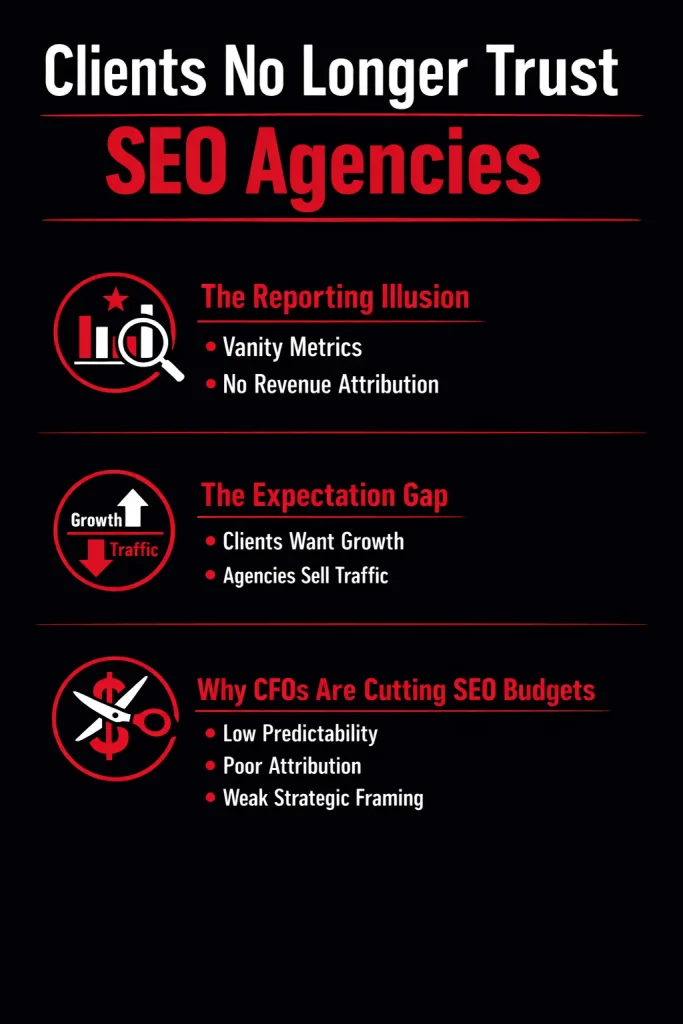
The Reporting Illusion
Most SEO reports still revolve around vanity metrics: keyword rankings, impressions, clicks, crawl scores, and abstract “SEO health” indicators. These metrics are easy to generate, look impressive in slides, and require little business context.
The problem? None of them prove impact.
Modern leadership teams don’t care if a keyword moved from position 9 to 4 if it didn’t:
- Increase qualified demand
- Improve conversion rates
- Reduce customer acquisition cost
SEO reporting has largely failed to evolve from activity reporting to outcome reporting. There’s rarely a clear line between SEO efforts and revenue, pipeline contribution, or retention. As a result, reports feel disconnected from reality—creating the perception that SEO is busy work rather than a growth driver.
The Expectation Gap
This leads to a widening expectation gap.
Clients hire SEO agencies for business growth, but agencies still sell traffic.
From the client’s perspective:
- Traffic without conversions is noise
- Rankings without demand are irrelevant
- Visibility without influence is meaningless
Agencies, however, continue to frame success around search-centric metrics instead of business-centric outcomes. This mismatch creates frustration. Clients feel they are buying effort, not results. Over time, SEO becomes viewed as a support function—useful, but not essential.
That perception is lethal in budget conversations.
Why CFOs Are Cutting SEO Budgets
When economic pressure increases, CFOs scrutinize every line item. SEO often fails this scrutiny for three reasons:
- Low Predictability – Results are slow, variable, and difficult to forecast compared to paid or product-led channels.
- Poor Attribution – SEO’s contribution to revenue is often indirect, making it easy to undervalue.
- Weak Strategic Framing – SEO is rarely positioned as a system that drives demand, trust, and long-term growth.
To a CFO, SEO frequently looks like a cost center with unclear ROI—not a scalable growth engine. Until agencies change how they measure, frame, and communicate value, trust will continue to decline—and budgets will continue to disappear.
The Death of “SEO as a Standalone Service”
For most of its history, SEO was sold as a separate channel—something you “add on” alongside paid ads, social media, or email. That model is now obsolete. By 2026, SEO that operates in isolation will not just underperform; it will actively fail.
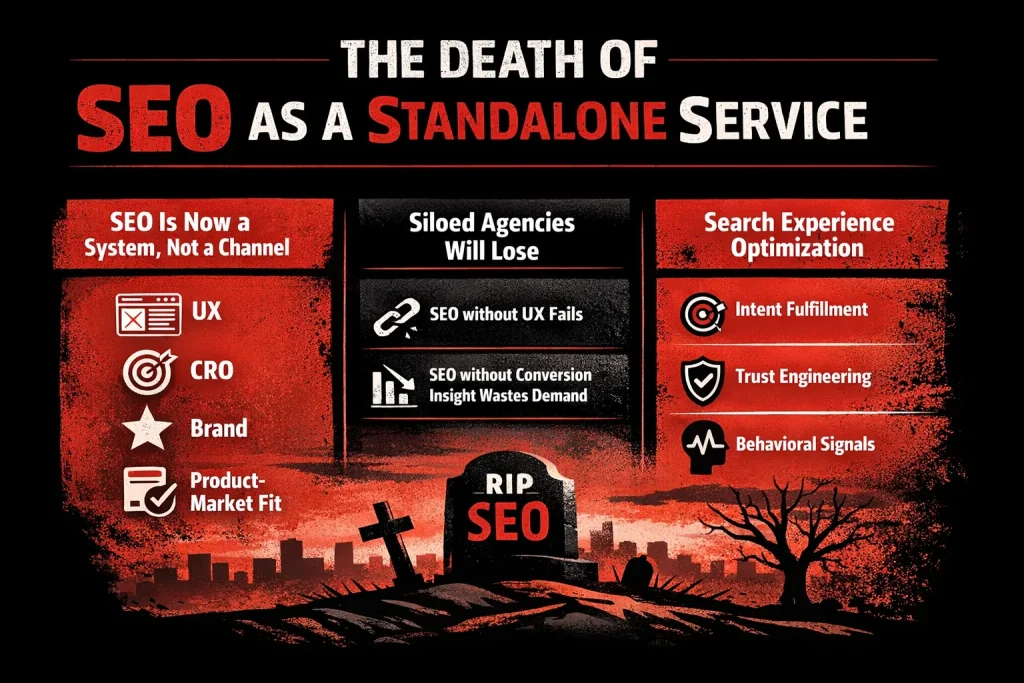
SEO Is Now a System, Not a Channel
Modern search performance is no longer determined by keywords and backlinks alone. Search engines—powered by AI, LLMs, and behavioral modeling—evaluate entire systems, not isolated tactics. SEO today is inseparable from:
- UX (User Experience): Page speed, interaction quality, clarity, and usability directly influence engagement signals that feed ranking and visibility models.
- CRO (Conversion Rate Optimization): Traffic without conversion insight is wasted demand. Search engines increasingly reward outcomes, not visits.
- Brand: Trust, authority, and brand recognition influence click behavior, dwell time, and AI citation likelihood.
- Product–Market Fit: No amount of optimization can compensate for unclear value propositions or misaligned offerings.
SEO now sits at the intersection of technology, psychology, and business strategy.
Siloed Agencies Will Lose
Agencies that operate in silos—“we do SEO, someone else handles UX or CRO”—are structurally disadvantaged.
- SEO without UX fails because users bounce, hesitate, or disengage, sending negative behavioral signals back into search systems.
- SEO without conversion insight wastes demand by generating visibility that never turns into revenue, trust, or retention.
In an AI-driven search environment, these failures compound quickly. Visibility without satisfaction is penalized. Traffic without outcomes is deprioritized.
The Rise of Search Experience Optimization
What replaces standalone SEO is Search Experience Optimization—a holistic approach focused on how users experience, trust, and act on what they find.
This means optimizing for:
- Intent fulfillment: Solving the user’s real problem, not just matching a query.
- Trust engineering: Clear signals of credibility, expertise, and authority across content and design.
- Behavioral signals: Engagement, satisfaction, and decision-making patterns that modern search engines and AI systems increasingly rely on.
In short, SEO is no longer about ranking pages. It’s about engineering outcomes across the entire search journey.
The Rise of Quantum SEO as a Service (QSAAS)
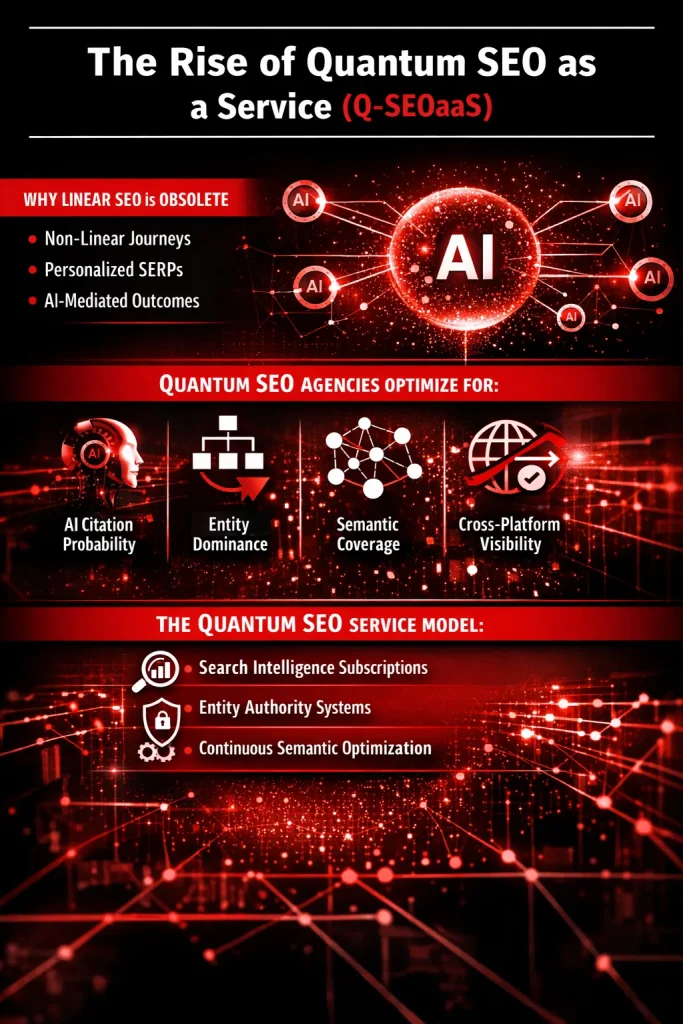
Why Linear SEO Models Are Obsolete
For over a decade, SEO has been built on a linear mental model:
keyword → page → ranking → traffic → conversion.
That model no longer reflects how search actually works.
Modern search journeys are non-linear. Users don’t move from Google to a single page and convert. They bounce between AI answers, forums, videos, marketplaces, social platforms, and brand touchpoints. A single decision may involve:
- A Google AI Overview
- A ChatGPT or Perplexity response
- Reddit or community discussions
- YouTube explainers
- Brand SERPs and reviews
At the same time, SERPs themselves are personalized and dynamic. Two users searching the same query can see entirely different results based on context, intent signals, device, history, and location.
On top of this, AI-mediated outcomes now sit between users and content. Large language models don’t “rank pages” — they predict answers. Visibility becomes probabilistic, not deterministic.
Linear SEO models fail because they assume:
- One correct result
- One stable SERP
- One predictable ranking path
None of those assumptions are true anymore.
What Quantum SEO Really Means
Quantum SEO is not about physics or buzzwords. It’s about adapting SEO strategy to a probabilistic, multi-dimensional search reality.
Quantum SEO = optimizing probabilistic visibility across AI engines, platforms, and intent layers simultaneously.
Instead of asking:
- “How do we rank page X for keyword Y?”
Quantum SEO asks:
- “What increases the probability that this brand is surfaced, cited, or trusted across all relevant search and AI environments?”
It accepts that:
- Visibility happens in parallel, not in sequence
- Outcomes are influenced by context, not just optimization
- Being present everywhere that intent exists matters more than ranking #1 somewhere
Quantum SEO shifts the goal from controlling rankings to engineering visibility likelihood.
What Quantum SEO Agencies Optimize For
Quantum SEO agencies do not optimize pages in isolation — they optimize search ecosystems.
Key optimization objectives include:
AI Citation Probability
How likely is a brand or page to be referenced by:
- Google AI Overviews
- ChatGPT-style assistants
- Generative search engines
This depends on clarity, authority, entity strength, and semantic depth — not backlinks alone.
Entity Dominance
Search engines and LLMs think in entities, not URLs.
Quantum SEO focuses on making brands, products, and people unmistakable, authoritative entities within their domain.
Semantic Coverage Density
Instead of individual keywords, agencies build dense semantic topic ecosystems:
- Covering core concepts
- Supporting subtopics
- Related questions
- Contextual language patterns
This increases trust and retrieval probability across AI systems.
Cross-Platform Visibility
Search no longer lives only on Google. Quantum SEO optimizes for presence across:
- AI answer engines
- YouTube
- Marketplaces
- Community platforms
where real intent is expressed and evaluated.
Quantum SEO as a Service Model (Q-SEOaaS)
Because Quantum SEO is continuous and system-driven, it cannot be sold as one-off deliverables or fixed packages.
Surviving agencies will adopt Quantum SEO as a Service (Q-SEOaaS) models, such as:
Search Intelligence Subscriptions
Ongoing analysis of:
- Emerging intent
- Competitive semantic gaps
- AI visibility trends
- Platform shifts
Entity Authority Systems
Long-term programs focused on:
- Entity clarity
- Trust signals
- Narrative ownership
- Knowledge graph alignment
Continuous Semantic Optimization
Not content “campaigns,” but living systems that:
- Expand topical authority
- Adapt to AI behavior
- Reinforce visibility over time
In this model, agencies stop selling tasks and start selling search intelligence infrastructure.
That shift — from linear SEO execution to quantum-level visibility engineering — is what separates agencies that survive 2026 from those that quietly disappear.
GEO (Generative Engine Optimization) Will Replace Traditional SEO KPIs
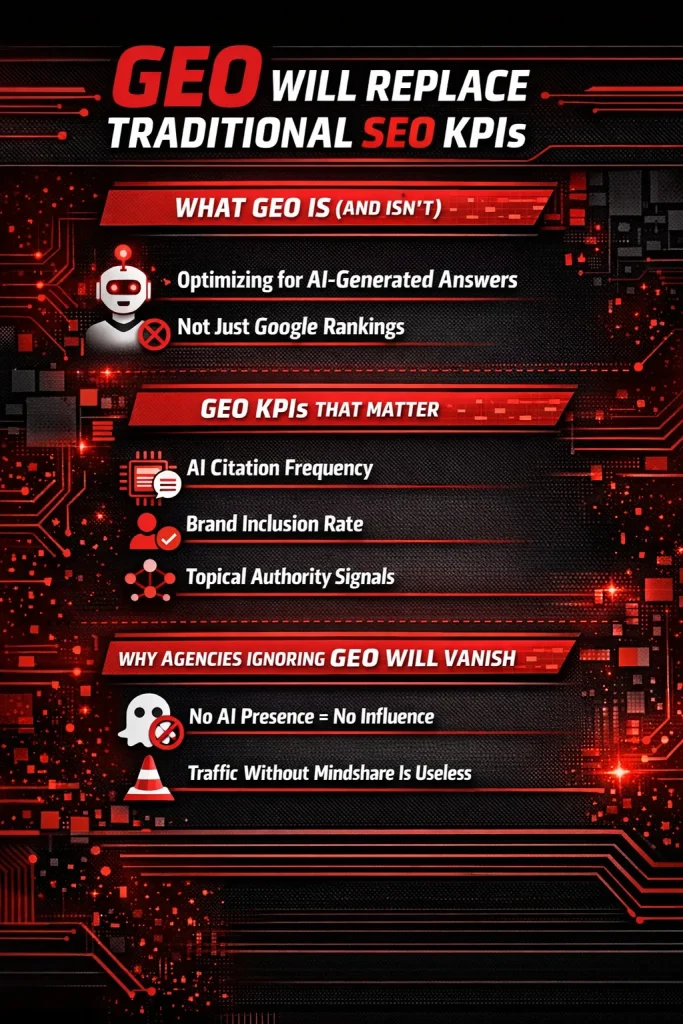
The next major shift in search is not an algorithm update—it’s a measurement revolution. As search engines evolve into generative answer engines, the way visibility is earned and measured is fundamentally changing. This is where GEO (Generative Engine Optimization) comes in, and it will redefine what “success” looks like for SEO agencies by 2026.
What GEO Is (and Isn’t)
GEO is the practice of optimizing brands, entities, and content to be selected, cited, and referenced by AI-driven answer engines such as Google AI Overviews, ChatGPT, Perplexity, Gemini, and future LLM-based systems. Unlike traditional SEO, which focused on ranking pages in search results, GEO focuses on inclusion within generated answers.
What GEO is:
- Engineering content and entities to be understood, trusted, and reused by AI systems
- Optimizing for semantic clarity, authority, and contextual relevance
- Ensuring brands appear as sources of truth in AI responses
What GEO isn’t:
- A replacement keyword strategy with a new name
- A Google-only tactic
- Another reporting layer on top of rankings
In a generative search world, being ranked but not cited is the same as being invisible.
GEO KPIs That Matter
Traditional SEO KPIs fail in a generative environment because AI doesn’t think in rankings—it thinks in probabilities and trust. GEO introduces a new performance framework, including:
- AI Citation Frequency: How often your brand or content is referenced in AI-generated answers across platforms
- Brand Inclusion Rate: The percentage of relevant AI responses that mention your brand or entity
- Topical Authority Signals: Semantic depth, entity relationships, and consistency across the knowledge graph
These metrics measure influence, not just visibility—and influence is what drives long-term demand.
Why Agencies Ignoring GEO Will Vanish
Agencies that ignore GEO will still report traffic while their clients disappear from AI-driven decision-making moments. In a world where users increasingly trust summarized answers over search results, no AI presence equals no influence.
Traffic without mindshare is meaningless. Rankings without citations are irrelevant.
By 2026, the agencies that survive won’t be the ones chasing clicks—they’ll be the ones engineering authority inside the machines that now decide what gets seen, trusted, and chosen.
What the Surviving 10% Will Do Differently
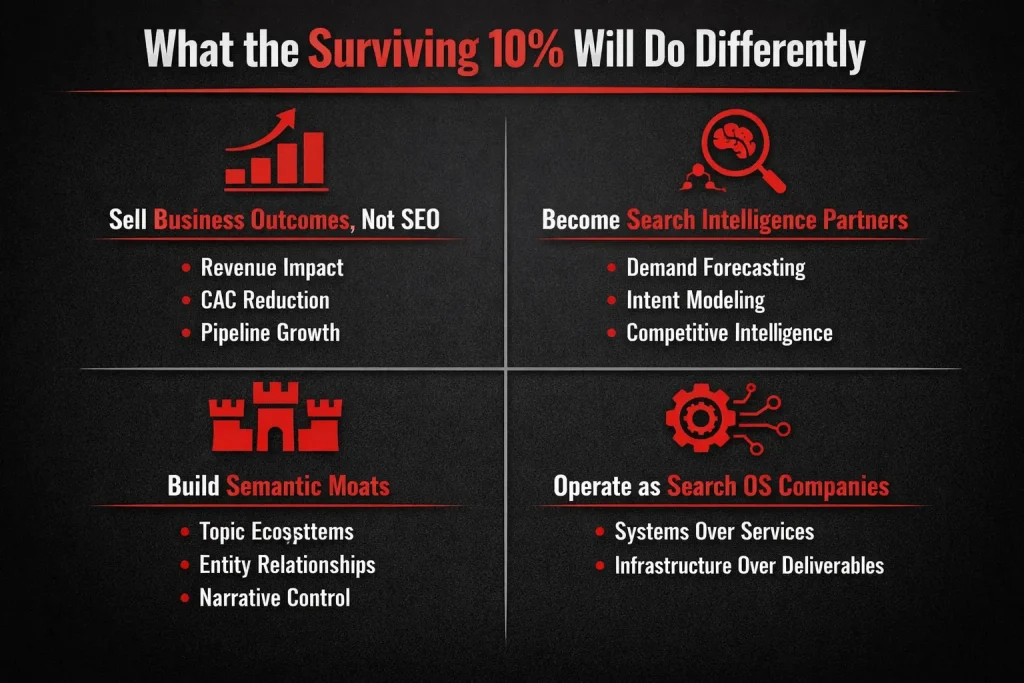
Most SEO agencies won’t “die” in a dramatic way. They’ll fade into the background—outperformed by in-house teams using LLMs, undercut by automation, and ignored by leadership because their work doesn’t connect to business outcomes. The surviving 10% will look less like “SEO vendors” and more like growth partners, intelligence firms, and search-product companies. Here’s what they’ll do differently.
Sell Business Outcomes, Not SEO
The agencies that survive won’t pitch “rankings” as the win. They’ll pitch business impact and build an operating model around it.
Revenue impact becomes the north star. Instead of reporting “we improved positions,” they’ll map SEO work to revenue pathways: which pages influence demos, trials, calls, purchases, upgrades, renewals. They’ll build measurement around assisted conversions, lead quality, pipeline velocity, and the actual economics of customer acquisition—not just traffic.
They’ll also obsess over CAC reduction. In 2026, smart companies won’t ask, “How much traffic did we get?” They’ll ask, “How much did organic reduce our cost to acquire customers compared to paid?” Survivor agencies will track:
- blended CAC changes over time,
- paid search cannibalization,
- and how organic increases conversion efficiency across channels (e.g., paid converts better when brand trust is higher).
And they’ll speak in the language leadership cares about: pipeline growth. That means SEO is no longer just top-of-funnel blog traffic. It’s category pages that convert, BOFU content that handles objections, use-case landing pages that close, comparison pages that steal deals, and proof-led content that shortens sales cycles. The survivor pitch becomes: “We don’t do SEO. We build organic acquisition that improves unit economics.”
Become Search Intelligence Partners
The next-gen agency won’t be hired just to “optimize.” They’ll be hired to interpret demand and convert it into growth advantage.
First, they’ll provide demand forecasting. Using search data, platform trends, LLM-assisted research, and first-party analytics, they’ll answer questions executives actually ask:
- Where is demand moving in the next 6–12 months?
- Which segments are rising and which are commoditizing?
- What new use cases are emerging that your competitors haven’t captured yet?
Then comes intent modeling—the part most agencies never truly master. Survivors won’t treat all keywords equally. They’ll create intent layers (informational, evaluative, transactional, post-purchase) and design content systems that move a user through those layers with minimal friction. This is where LLMs + NLP become leverage: clustering not by “topic,” but by decision psychology and problem context.
Finally, survivor agencies will bring competitive intelligence that’s actually usable. Not screenshots and keyword lists—real insights:
- Which narratives competitors are winning (and why)
- Where they’re vulnerable (thin entity coverage, weak trust signals, poor conversion architecture)
- Which SERP surfaces they dominate (AI answers, snippets, communities, video, local, marketplaces)
They’ll help brands stop guessing and start operating with search as a market sensing system.
Build Semantic Moats
In 2026, “publishing more content” will not be a moat. Everyone can generate content. What’s hard—and defensible—is building semantic authority that engines (and LLMs) recognize as trustworthy, complete, and uniquely valuable.
Survivors will build topic ecosystems, not scattered blog posts. Think: a structured network of pages that covers a category end-to-end—definitions, comparisons, use cases, implementation, pricing, objections, alternatives, troubleshooting, and outcomes. Each piece supports the others. The goal is not “ranking a keyword,” it’s owning a subject.
They’ll also engineer entity relationships. Modern search is increasingly entity-based: brands, products, people, concepts, locations, categories, attributes. Survivor agencies will make entity clarity a discipline:
- structured data where it matters,
- consistent naming and definitions,
- internal linking that reinforces relationships,
- and content that explicitly connects entities in ways machines can understand.
And they’ll pursue narrative control—the most underrated moat. In an AI-mediated world, your visibility depends on how the ecosystem describes you. Survivors will shape:
- what your brand is “known for,”
- which comparisons you win,
- how your POV shows up in AI answers,
- and which sources and communities reinforce your authority.
This is where SEO becomes closer to category design and positioning than technical optimization.
Operate as Search OS Companies
The agencies that survive won’t feel like agencies. They’ll feel like a Search Operating System—a system that continuously turns search signals into execution.
They’ll choose systems over services. Instead of selling “monthly SEO,” they’ll sell a repeatable operating model:
- search intelligence intake,
- prioritization frameworks,
- content and experience production pipelines,
- technical governance,
- testing loops,
- and performance review cycles tied to business KPIs.
They’ll build infrastructure over deliverables. Meaning: the client doesn’t just receive reports and tasks—they receive capabilities. Playbooks. Dashboards that matter. Content architectures. Entity maps. Brand visibility monitoring across AI engines. QA processes that prevent SEO decay. Internal enablement so marketing teams compound results instead of restarting every quarter.
This is the shift: from “doing SEO work” to building a search growth machine. And once a client has that machine, the agency becomes far harder to replace—because replacing them isn’t swapping a vendor, it’s ripping out a system.
Bottom line: The surviving 10% won’t win by working harder. They’ll win by working smarter, operating higher in the value chain, and building defensible search advantage—across human search, AI search, and everything in between.
The 2026 SEO Agency Skill Stack
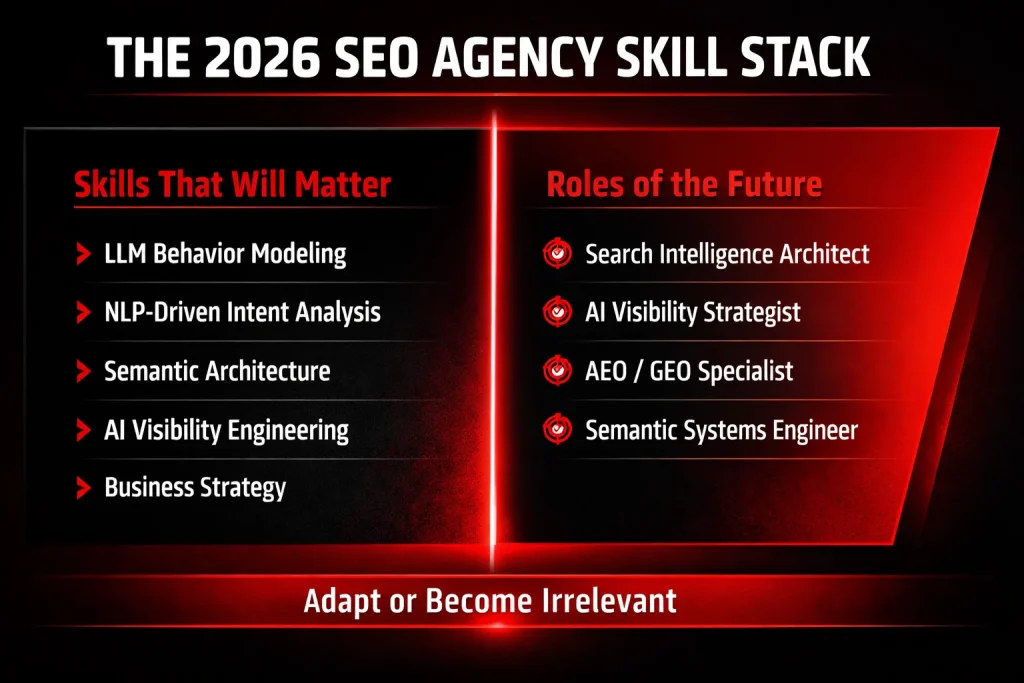
By 2026, the defining factor between surviving SEO agencies and those that fade into irrelevance will not be tools, tactics, or even AI adoption—it will be skills. The SEO agency of the future will look far less like a production shop and far more like a search intelligence firm. Execution will be automated. Insight, interpretation, and orchestration will be the real value.
At the core of this shift is a new skill stack built for LLM-driven, semantic, and generative search ecosystems.
Skills That Will Matter
LLM Behavior Modeling
Search is no longer deterministic. Large Language Models decide what to cite, summarize, and trust based on probabilistic patterns. Future-ready agencies must understand how LLMs ingest content, weight sources, interpret entities, and generate answers. This skill is about predicting AI behavior—not reacting to rankings.
NLP-Driven Intent Analysis
Keywords describe queries; NLP reveals intent layers. Agencies must move beyond surface-level keyword research to analyze linguistic patterns, emotional cues, and contextual meaning at scale. NLP-driven intent analysis allows agencies to map why users search, not just what they type.
Semantic Architecture
In 2026, content performance will depend on how well information is structured, interconnected, and semantically complete. Semantic architecture involves designing topic ecosystems, entity relationships, and narrative hierarchies that both humans and machines can understand. This is how agencies build long-term authority instead of chasing short-term rankings.
AI Visibility Engineering
Visibility is no longer limited to Google SERPs. Agencies must engineer presence across AI Overviews, answer engines, LLM outputs, and multimodal platforms. AI visibility engineering focuses on citation probability, brand inclusion, and trust signaling within generative systems—where traffic may never click, but influence still compounds.
Business Strategy
Finally, SEO can no longer exist without commercial context. Agencies must understand revenue models, customer acquisition costs, funnels, and growth constraints. Search intelligence that isn’t tied to business outcomes will be ignored—no matter how advanced the technology behind it is.
Roles of the Future
This new skill stack gives rise to entirely new roles:
- Search Intelligence Architect – designs predictive, cross-platform search systems
- AI Visibility Strategist – optimizes brands for LLM citations and generative inclusion
- AEO / GEO Specialist – ensures dominance in answer and generative engines
- Semantic Systems Engineer – builds scalable entity and topic infrastructures
By 2026, SEO agencies that fail to develop these skills and roles won’t be outperformed—they’ll be outdated by design.
How Existing Agencies Can Still Survive
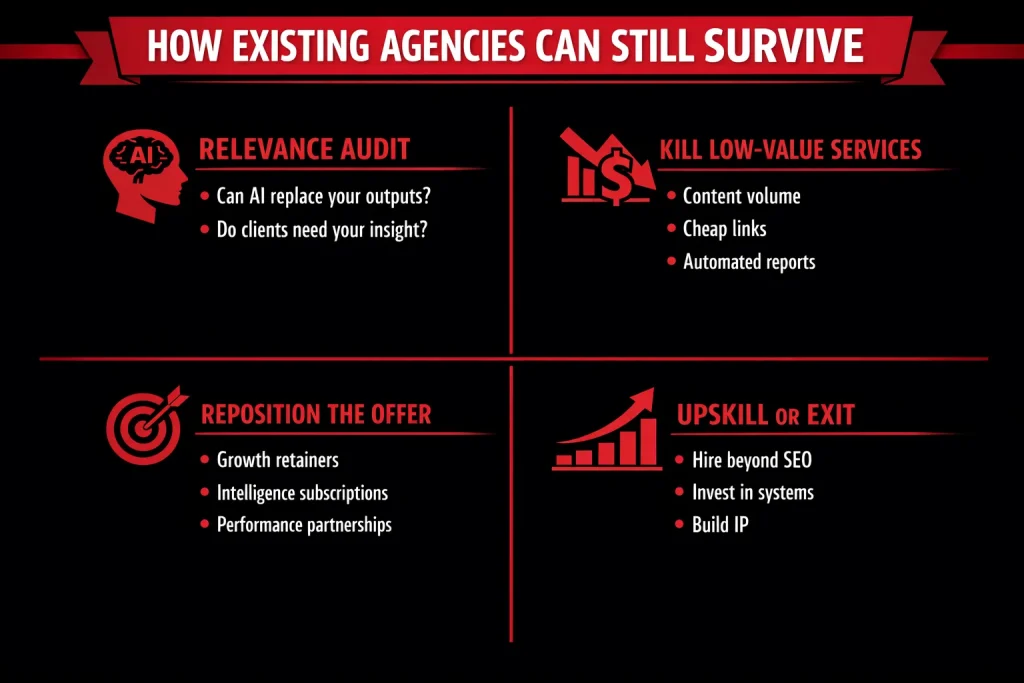
The extinction of traditional SEO agencies is not inevitable—but survival will require brutal honesty, decisive action, and a complete rethink of what “value” means in an AI-dominated search ecosystem. Agencies that make the transition won’t do so by adding new tools or rebranding old services. They’ll survive by eliminating irrelevance and rebuilding around intelligence, outcomes, and systems.
Relevance Audit: Brutal Self-Assessment Comes First
The first step is a relevance audit—not of websites, but of your agency itself.
Ask two uncomfortable questions:
- Can AI replace your current outputs?
If your core deliverables are keyword research, content briefs, on-page optimization, audits, or reporting dashboards, the answer is likely yes. LLMs can already generate these faster, cheaper, and at scale.
- Do clients actually need your insight—or just your execution?
Execution is becoming a commodity. Insight is not. If your value disappears when tools improve, your business model is already obsolete.
Surviving agencies are honest enough to admit where they’ve become replaceable.
Kill Low-Value Services Without Mercy
Once relevance is assessed, the next move is subtraction.
The following services actively damage long-term positioning:
- Content volume without strategic depth
Publishing more pages no longer equals more visibility in semantic and AI-driven search.
- Cheap or scalable link building
Links without context, authority, or narrative alignment are increasingly ignored—or penalized.
- Automated reports that explain nothing
Dashboards without interpretation fail to influence decisions or budgets.
If a service does not directly influence business outcomes or AI-level trust signals, it should be retired—regardless of short-term revenue.
Reposition the Offer Around Outcomes, Not Activities
SEO packages are dying because they sell effort, not impact. Survivors will restructure their offers around how clients grow, not what tasks are performed.
Winning models include:
- Growth retainers focused on revenue, pipeline, or demand capture—not rankings.
- Search intelligence subscriptions that deliver market insights, intent trends, and competitive positioning.
- Performance partnerships where the agency shares accountability for outcomes, not just execution.
This shift transforms the agency from vendor to strategic partner—and changes who signs the contract.
Upskill or Exit: There Is No Middle Ground
Finally, survival requires reinvention at the talent and infrastructure level.
That means:
- Hiring beyond SEO: data analysts, UX strategists, product marketers, and AI specialists.
- Investing in systems, not just tools: internal frameworks, semantic models, automation pipelines.
- Building proprietary IP: methodologies, intelligence engines, and repeatable strategic assets.
Agencies unwilling to make this leap won’t fail suddenly—but they will slowly become invisible. In 2026, relevance won’t be optional.
Conclusion: SEO Isn’t Dead — Irrelevance Is
SEO is not facing extinction — mediocrity is.
Most SEO agencies will not collapse overnight. There will be no dramatic shutdowns, no public apologies, no industry-wide headlines announcing failure. Instead, the majority will fade quietly into irrelevance. Their retainers will shrink. Their influence will erode. Their services will be questioned, commoditized, and eventually replaced — first by AI tools, then by in-house teams, and finally by nothing at all.
This quiet fade happens when agencies keep selling outputs instead of insight, execution instead of intelligence, and rankings instead of results. When they fail to adapt to a world where search is no longer keyword-driven, page-based, or even human-mediated.
By 2026, search visibility will be decided by machines — not by who publishes more content, builds more links, or runs more audits. Visibility will be granted to brands and entities that machines understand, trust, and choose to reference. LLMs, answer engines, and generative systems will act as the new gatekeepers of attention.
In that reality, only agencies that understand how machines think — how they interpret language, evaluate authority, model intent, and generate answers — will survive. These agencies won’t look like traditional SEO vendors. They will operate as search intelligence partners, AI visibility architects, and semantic system builders.
SEO isn’t dead. But the era of outdated SEO agencies absolutely is.
The choice now is simple: evolve into a hyper-intelligent search partner — or slowly disappear from relevance.
Next Steps (If You Choose to Adapt):
- Run a Hyper-Intelligent Search Audit
- Take the Quantum SEO Readiness Assessment
- Implement a GEO + AEO Visibility Framework
Because in the next era of search, being visible is no longer enough — you must be understood.