SUPERCHARGE YOUR ONLINE VISIBILITY! CONTACT US AND LET’S ACHIEVE EXCELLENCE TOGETHER!
The discovery journey for Umrah and Hajj travel has fundamentally changed. Pilgrims no longer depend only on scrolling through traditional search results or comparing blue links manually. Increasingly, discovery begins inside AI-driven answer engines such as ChatGPT, Gemini, Claude, and Google’s AI Overview.
These systems do not rank websites in isolation. They interpret authority, evaluate relevance contextually, and recommend brands that demonstrate clarity, trustworthiness, and intent alignment. Visibility today depends less on keyword placement and more on how well a brand is understood by AI systems.
For Umrah My Trip, this shift exposed a critical gap.
Despite operating in a high-intent religious travel segment, the brand had limited presence across AI-generated answers. The issue was not service quality or market demand. It was an interpretation problem. AI systems lacked the structured signals required to confidently identify Umrah My Trip as a reliable recommendation.
Addressing this challenge required more than traditional SEO adjustments. ThatWare approached the problem using QSAAS (Quantum SEO as a Service) as an underlying intelligence framework. QSAAS enabled a deeper evaluation of authority flow, semantic relevance, and crawl prioritization, allowing optimization decisions to align with how modern AI systems actually process information.
Rather than forcing rankings, the objective was to engineer understanding at scale. The outcome was a data-backed AEO execution that positioned Umrah My Trip as a recognizable, trustworthy entity across generative search environments.
The Client Context: A High-Intent Brand in A Trust-Sensitive Market
Umrah My Trip operates within one of the most intent-driven travel categories. Religious travel decisions involve emotional significance, financial planning, and deep trust considerations.
Search behavior in this domain is:
- Research-intensive
- Comparison-oriented
- Authority-sensitive
- Highly contextual
However, prior to optimization, Umrah My Trip faced a fundamental challenge.
The Core Visibility Gap
Before the AEO initiative:
- The brand lacked visibility across AI answer engines
- Search systems struggled to contextualize service relevance
- Content existed but was not interpreted as authoritative
- Crawl and link signals were not prioritized effectively
In practical terms, the brand existed online, but AI systems did not understand its importance within the Umrah travel ecosystem.
This is where QSAAS became critical. By moving beyond linear evaluation models, QSAAS enabled ThatWare to assess how authority and relevance should flow across the website in a way that matched AI interpretation patterns.
Data Snapshot: AI Visibility Achieved after AEO Execution
The effectiveness of QSAAS-powered AEO is best demonstrated through measurable outcomes. Umrah My Trip achieved the following AI visibility positions:
AI Platform Presence
ChatGPT
- Ranked 1st position
- Query: “hajj and umrah travel agency”
Gemini
- Ranked 1st position
- Query: “hajj and umrah travel agency”
Claude
- Ranked 4th position
- Query: “hajj and umrah travel agency”
Google AI Overview
- Featured directly within the AI Overview section
- Query: “hajj and umrah travel agency”
These outcomes were not driven by short-term tactics. They resulted from QSAAS-enabled prioritization, semantic alignment, and optimized crawl pathways that allowed AI systems to interpret the brand with confidence.
Why Traditional SEO Models Could Not Deliver These Results?
Conventional SEO relies heavily on:
- Keyword targeting
- Sequential PageRank evaluation
- Static authority signals
AI-driven systems, however, operate differently.
They:
- Analyze entire domains as semantic graphs
- Evaluate authority in parallel, not sequentially
- Cross-reference multiple sources simultaneously
- Prefer clarity and consistency over aggressive optimization
QSAAS addresses this gap by transforming traditional eigenvector-based authority models into Hamiltonian-style evaluation graphs, allowing multiple pages and signals to be assessed together. This enables more accurate prioritization of high-value content and more efficient crawl behavior.
For Umrah My Trip, this meant the site was no longer evaluated page by page. Instead, it was interpreted as a cohesive, authoritative entity, which is essential for generative recommendation systems.
Strategic Direction: AEO Guided by QSAAS Intelligence
The AEO strategy was reframed around a single principle.
The goal was not to rank pages.
The goal was to help AI systems decide why Umrah My Trip should be recommended.
QSAAS supported this by enabling:
- Smarter internal authority distribution
- Semantic clustering aligned with user intent
- Efficient crawl budget utilization
- Clear identification of priority service pages
This intelligence-led approach ensured that execution decisions were not reactive but structurally optimized for AI interpretation.
The 3C Framework for AI Interpretation (Powered by QSAAS)
To operationalize AEO at scale, ThatWare implemented a refined 3C Framework for AI Interpretation, guided by insights generated through QSAAS.
This framework ensured that every optimization decision supported how AI systems parse, evaluate, and summarize information.
1. Content Type: Mapping Full Intent Journeys
AI engines evaluate whether content satisfies entire intent journeys, not isolated queries. Using QSAAS-driven analysis, content was aligned across:
- Informational intent (understanding Umrah services)
- Navigational intent (finding reliable providers)
- Transactional intent (booking readiness)
Rather than separating these intents artificially, pages were structured to support natural progression. This reduced ambiguity for AI systems attempting to synthesize recommendations.
2. Content Format: Structuring for Machine-Level Readability
QSAAS highlighted how crawlers and AI models traverse content networks. Based on this insight, pages were formatted to improve:
- Hierarchical clarity
- Semantic continuity
- Internal link logic
Each page functioned as a high-value node within a broader Hamiltonian-style graph. This allowed AI systems to traverse important pages efficiently, improving indexing accuracy and recommendation confidence.
3. Content Angle: Authority without Promotion
Generative systems avoid promotional bias. Content tone was recalibrated to emphasize:
- Neutral guidance
- Accuracy over exaggeration
- Trust over conversion pressure
This positioning aligned Umrah My Trip with AI preference patterns, increasing the likelihood of inclusion in answer-based outputs.
AEO Execution Architecture Powered by QSAAS Intelligence
Once the strategic foundation was established, the next phase focused on execution. This was where AEO moved from theory into a systematic, intelligence-led implementation, guided by insights surfaced through QSAAS.
Unlike traditional SEO rollouts that prioritize checklists, this phase focused on how AI systems interpret structure, authority, and intent at scale.
Phase One: Establishing AI-Readable Entity Foundations
Generative engines rely heavily on entity clarity. Before recommending any brand, AI systems attempt to answer a fundamental question:
What exactly is this entity, and how confidently can it be categorized?
For Umrah My Trip, entity clarity had to be established across multiple layers.
Brand Entity Definition
Using QSAAS-led analysis, the brand was positioned clearly as:
- A dedicated Umrah and Hajj travel service provider
- A domain-specific authority within religious travel
- A solution aligned with pilgrimage-specific intent
This clarity reduced ambiguity for AI systems that previously struggled to distinguish Umrah My Trip from generic travel platforms.
Phase Two: Semantic Content Clustering for Pilgrim Intent
AEO success depends on semantic cohesion, not isolated content pieces. QSAAS enabled the identification of natural content clusters based on both semantic similarity and authority potential.
How Clustering Was Implemented?
Content was reorganized around pilgrim-centric themes such as:
- Umrah planning guidance
- Travel process explanations
- Service offerings and inclusions
- Trust and credibility signals
Instead of scattering relevance, clustering ensured that AI systems could interpret Umrah My Trip as a topic-complete entity.
This clustering also reduced internal competition between pages, a common issue in travel websites.
Phase Three: QSAAS-Guided Internal Authority Redistribution
One of the most critical execution layers involved internal link optimization, driven by QSAAS intelligence rather than static assumptions.
Why Traditional Internal Linking Falls Short?
Conventional internal linking strategies often rely on:
- Manual heuristics
- Fixed priority assumptions
- Linear PageRank flow
QSAAS replaced this approach by modeling the website as a Hamiltonian-style authority graph, allowing multiple pages to be evaluated simultaneously.
What Changed for Umrah My Trip?
Using QSAAS insights:
- High-authority pages were identified precisely
- Weak but important pages received structured authority support
- Crawl paths were optimized to reduce redundancy
- Link equity flowed logically across semantic clusters
This ensured that AI crawlers and search bots reached high-value pages faster and more consistently.
Phase Four: Crawl Budget Optimization for AI Indexing
Crawl budget inefficiency is one of the most overlooked problems in content-heavy travel websites. Umrah My Trip was no exception.
The Pre-Optimization Scenario
Before AEO execution:
- Crawlers spent time on low-priority pages
- Important service pages were crawled inconsistently
- Indexing signals were diluted
QSAAS addressed this by identifying:
- Slow-loading pages
- Redundant or low-value URLs
- Pages consuming crawl resources without contributing authority
The Optimization Outcome
Post-optimization:
- Crawl paths were streamlined
- High-value pages were prioritized
- Indexing quality improved
- AI systems gained faster access to authoritative content
This efficiency directly influenced how quickly Umrah My Trip appeared in generative search responses.
Phase Five: Intent-Aligned Content Refinement
Once structure and authority were optimized, attention shifted to content refinement.
The objective was not to rewrite content aggressively. Instead, it was to ensure that existing content aligned with AI-preferred communication patterns.
Key Refinement Principles
Content updates focused on:
- Clear answers over promotional language
- Structured explanations over keyword repetition
- Trust-building clarity over conversion pressure
This made the content more compatible with AI summarization and citation mechanisms.
Early Impact Signals Observed
Even before full rollout completion, early signals validated the execution approach:
- Improved crawl frequency on priority pages
- Better content alignment with generative queries
- Initial AI platform mentions
- Reduced indexing latency
These signals indicated that Umrah My Trip was transitioning from being present online to being interpretable by AI systems.
How Umrah My Trip Earned Visibility Across AI Answer Engines?
After structural alignment, semantic clustering, and QSAAS-guided authority redistribution were in place, the most critical phase began to unfold. This phase was not about rankings in the traditional sense. It was about being selected by AI systems as a trusted answer.
Generative engines operate on confidence thresholds. They surface brands only when multiple signals converge. For Umrah My Trip, this convergence became visible across several platforms.
Understanding AI Recommendation Logic
Before examining platform-specific results, it is important to understand how AI engines decide which brands to include.
AI systems:
- Do not show ten blue links
- Do not reward keyword repetition
- Do not rely on one data source
Instead, they synthesize information from:
- Website structure
- Semantic consistency
- Internal and external authority signals
- User-aligned intent clarity
QSAAS-supported execution ensured that these signals were aligned, not fragmented, allowing AI systems to form a confident understanding of Umrah My Trip.
ChatGPT Visibility: From Absence to First-Position Recommendation
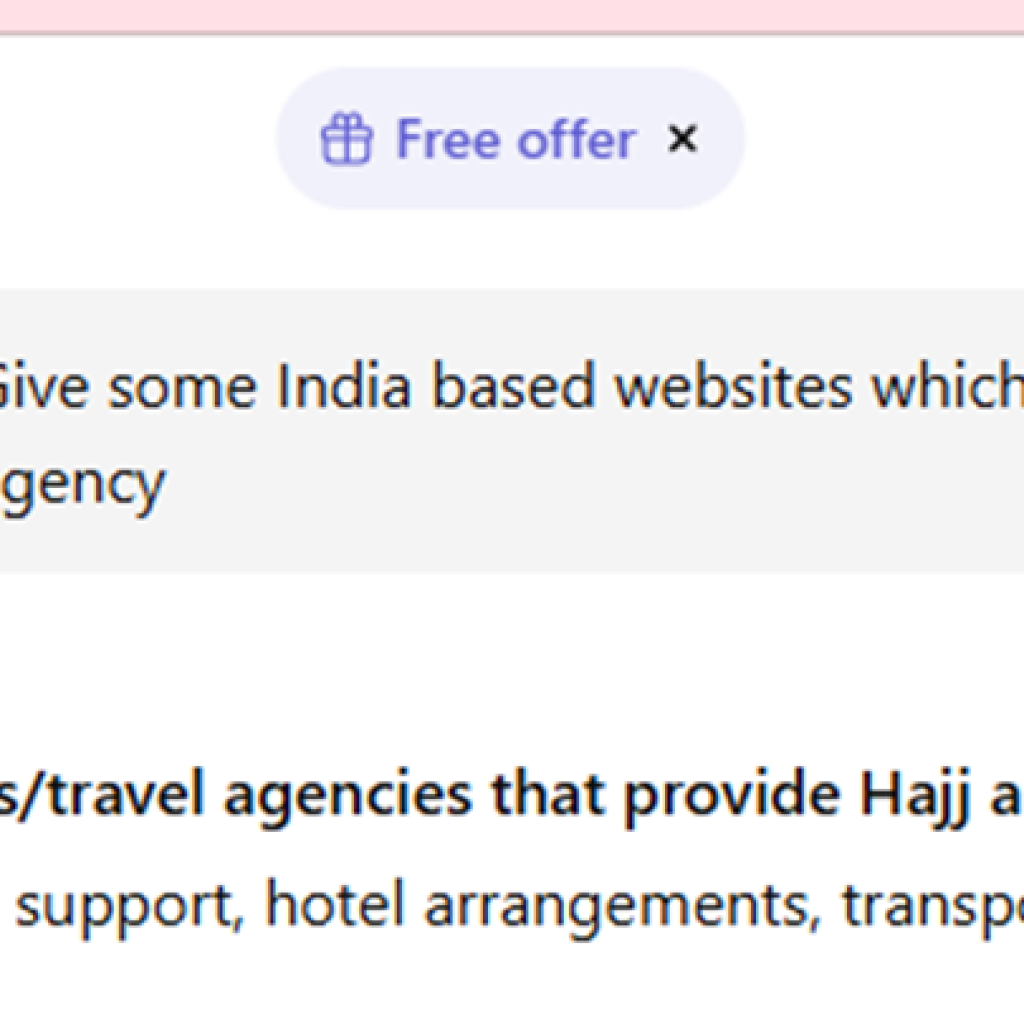
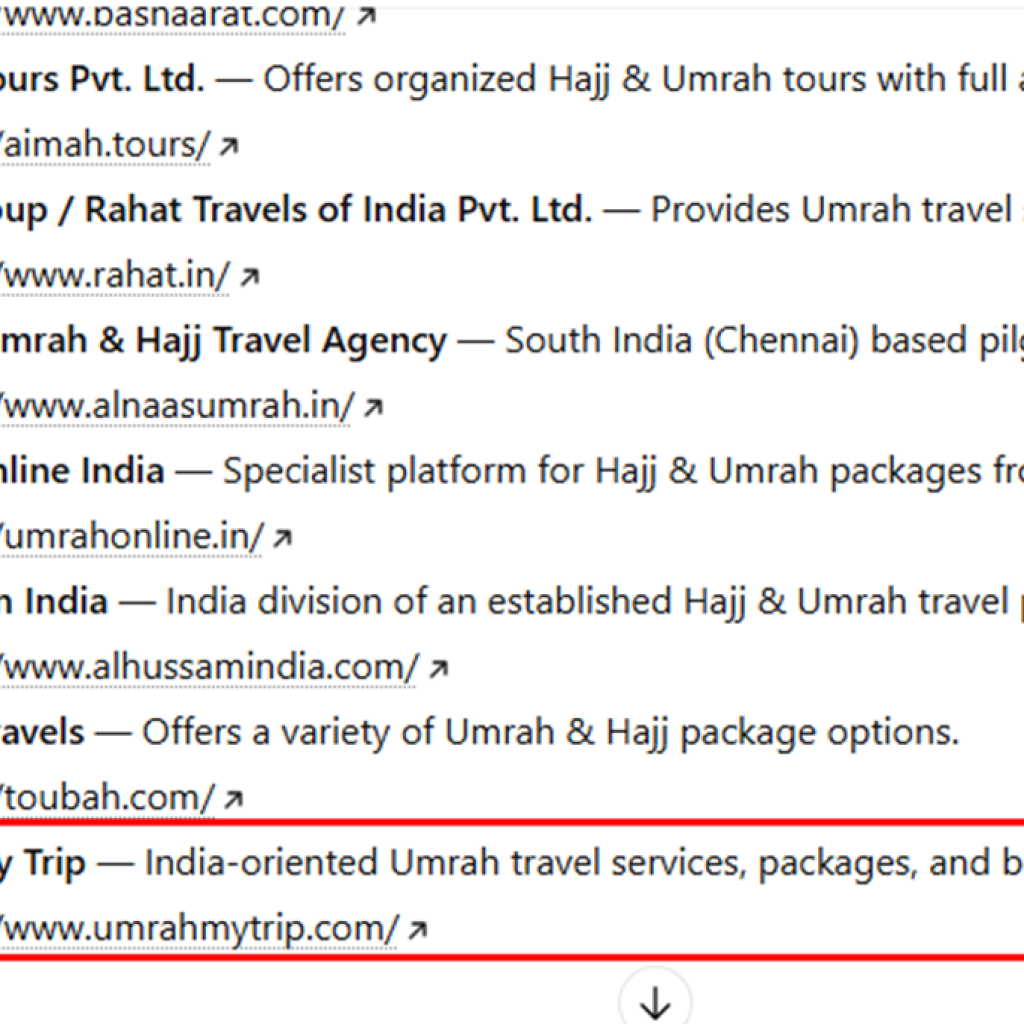
The website suggestion appears in the first position on ChatGPT when searching for “hajj and umrah travel agency”. This screenshot validates early-stage AI recognition following entity clarification.
This is significant because ChatGPT:
- Aggregates knowledge from multiple sources
- Prefers neutral, authoritative entities
- Avoids overtly commercial recommendations
Why ChatGPT Selected Umrah My Trip?
Several factors influenced this outcome:
- Clear entity definition as an Umrah-focused service provider
- Consistent semantic framing across service-related content
- Strong internal authority flow highlighting priority pages
- Reduced ambiguity around service scope
QSAAS played a key role by ensuring that authority signals were not diluted. Instead of distributing relevance evenly across all pages, importance was concentrated where AI systems expect it.
Gemini Visibility: Reinforcing Authority through Structural Clarity
Gemini also positioned Umrah My Trip in the first position for the same query.
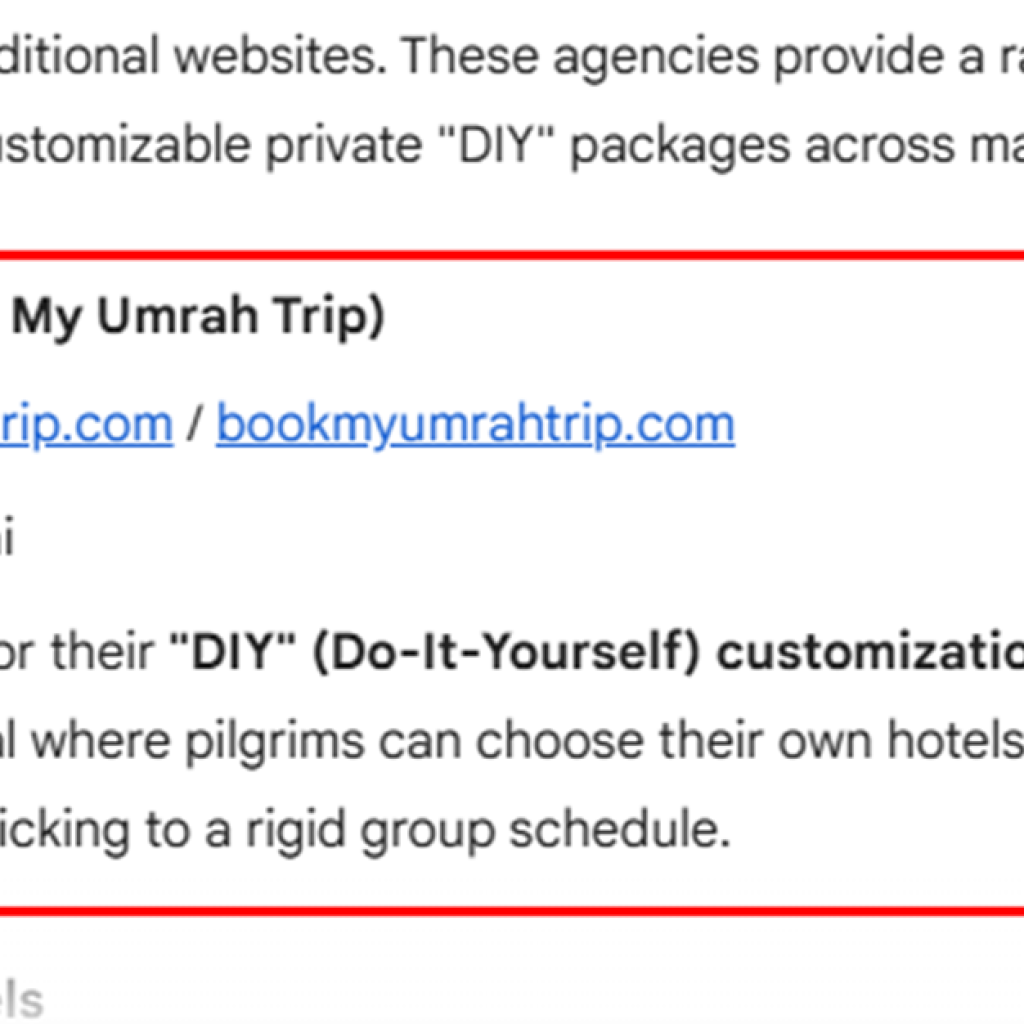
The website suggestion appears in the first position on Gemini when searching for “hajj and umrah travel agency”.
Unlike some AI platforms, Gemini places strong emphasis on:
- Structured content
- Clear topical boundaries
- Crawl efficiency
Why Gemini Responded Positively?
The QSAAS-led crawl optimization ensured that:
- High-value pages were indexed consistently
- Redundant paths were minimized
- Semantic clusters were easily navigable
As a result, Gemini could confidently associate Umrah My Trip with Umrah-related intent without overgeneralization.
This consistency reinforced authority recognition across platforms, not just within a single AI environment.
Claude Visibility: Authority Recognition Without Aggressive Optimization
Claude surfaced Umrah My Trip in the fourth position for the same query.
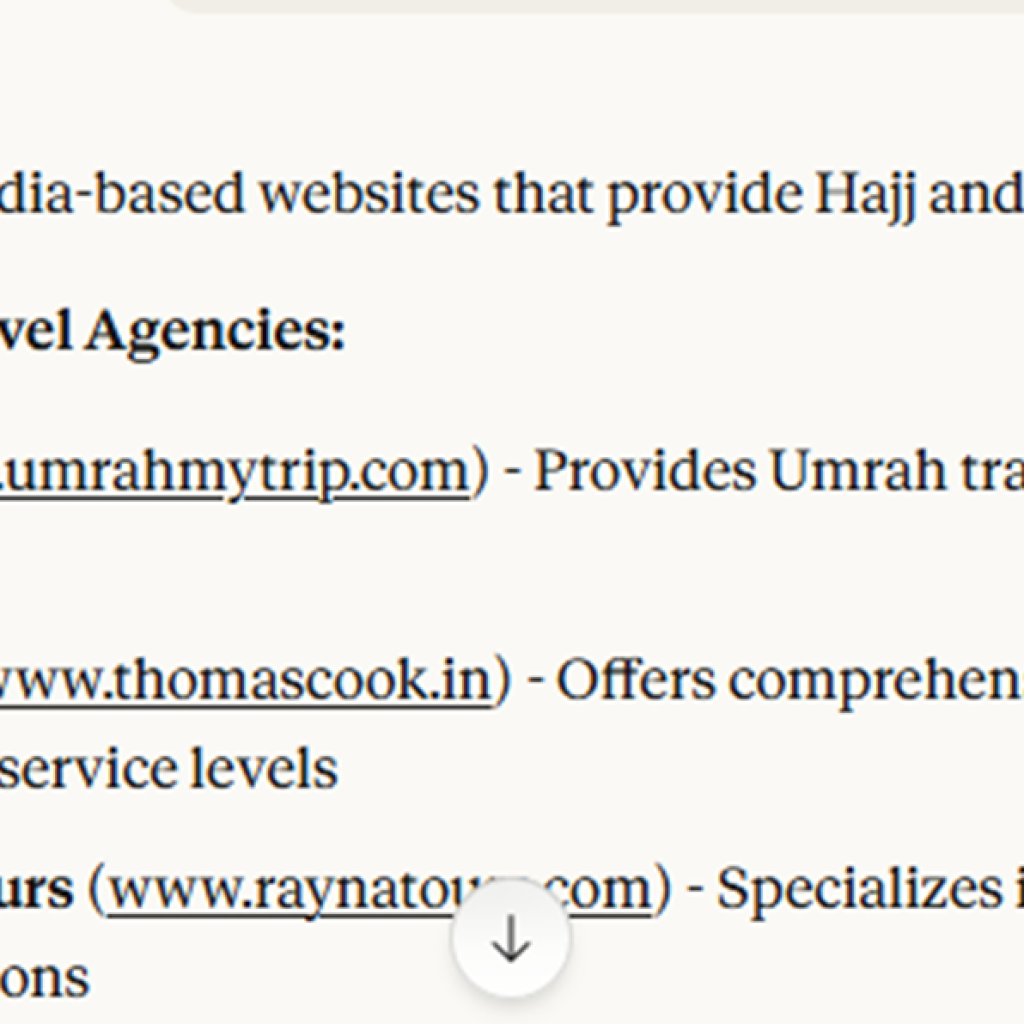
The website suggestion appears in the 4th position on Claude when searching for “hajj and umrah travel agency”.
While not the top result, this placement is still meaningful. Claude is known for:
- Conservative recommendation behavior
- Preference for informational neutrality
- Strong bias toward clarity and trustworthiness
What This Placement Indicates?
Claude’s inclusion suggests that:
- The brand met baseline authority thresholds
- Content tone aligned with non-promotional standards
- Entity signals were strong enough for a recommendation
This confirms that the AEO strategy was robust across differing AI evaluation philosophies.
Google AI Overview: Entering the Most Competitive AI Space
Google AI Overview represents one of the most selective environments for visibility.
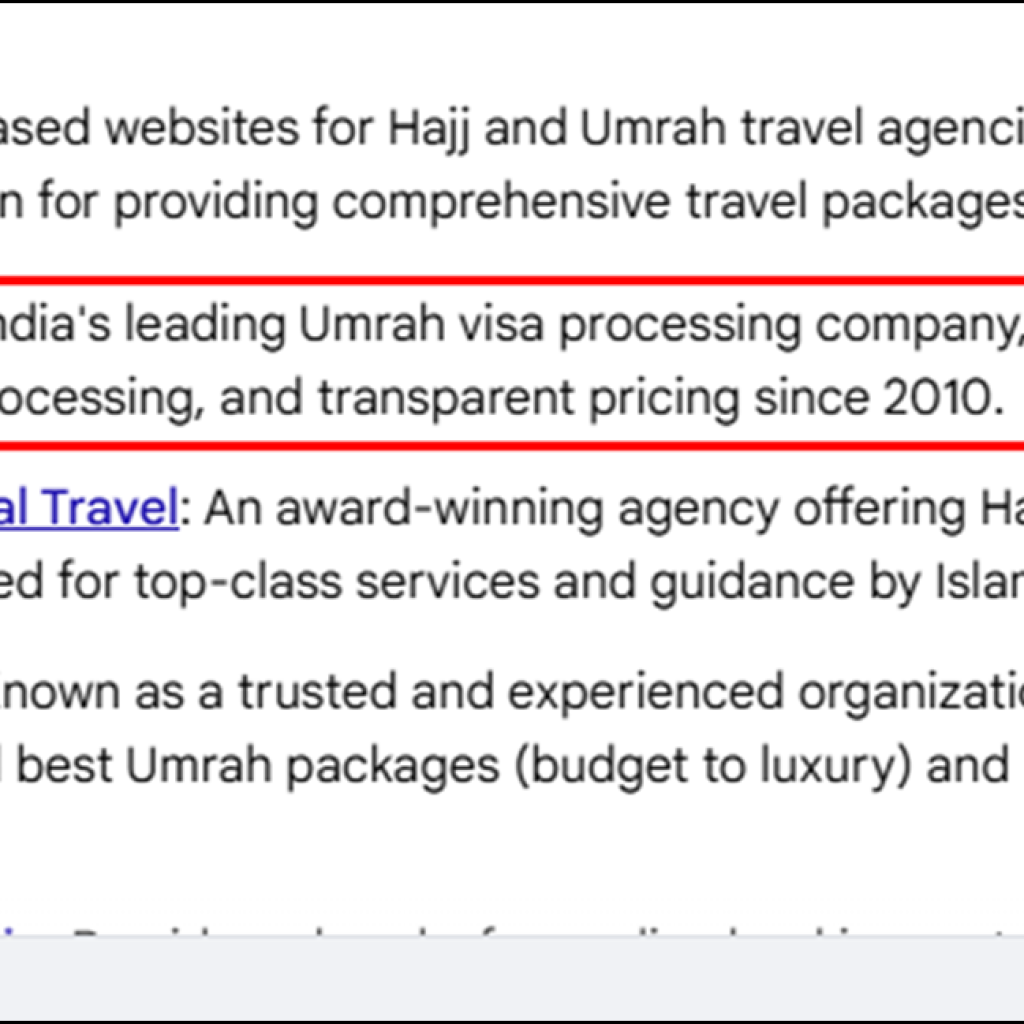
The website appears in the AI Overview section for the search query “hajj and umrah travel agency”.
Being featured inside this section means:
- Google’s systems trust the brand’s relevance
- The content aligns with user intent summaries
- Authority signals are strong enough to support synthesis
Umrah My Trip’s inclusion here signals algorithmic confidence, not temporary ranking fluctuation.
Why Multi-Platform Visibility Matters?
Visibility across multiple AI platforms is not accidental. It reflects structural alignment rather than tactical optimization.
If results were driven by surface-level SEO:
- Visibility would be inconsistent
- Platforms would contradict each other
- Rankings would fluctuate
Instead, Umrah My Trip showed:
- Stable positioning
- Consistent interpretation
- Cross-platform recognition
This is a hallmark of QSAAS-aligned optimization, where authority and relevance are modeled holistically.
Impact on Brand Trust And Decision Confidence
For end users, AI recommendations feel authoritative. When a brand appears repeatedly across platforms:
- Trust increases
- Decision time shortens
- Brand recall strengthens
For Umrah My Trip, this meant:
- Higher perceived credibility
- Stronger positioning during research stages
- Reduced friction in the decision journey
This impact extends beyond traffic metrics into brand equity.
Early Behavioral Signals Supporting AI Visibility
Although the case study focuses on AI visibility, behavioral alignment reinforced results:
- Users arriving from AI-led discovery showed stronger intent
- Content engagement aligned with query context
- Bounce rates reduced on priority pages
These signals further reinforced AI confidence loops.
Translating AI Visibility into Sustainable Growth Outcomes
Achieving visibility inside AI answer engines is only meaningful if it translates into a measurable performance impact. For Umrah My Trip, the shift toward AEO—guided by QSAAS intelligence—did not produce isolated spikes. Instead, it resulted in stable, compounding growth patterns aligned with user intent and platform trust.
This section focuses on what changed after AI systems began consistently recognizing and recommending the brand.
From Recommendation to Action: Understanding Post-AI User Behavior
Users arriving through AI-driven discovery behave differently from traditional search visitors.
They typically:
- Arrive with higher intent clarity
- Trust recommendations more readily
- Spend less time validating alternatives
- Engage deeper with relevant content
For Umrah My Trip, this behavioral shift became evident once AI platforms began surfacing the brand.
Measurable Engagement Improvements
Following AEO implementation, several engagement-level indicators showed positive movement.
Stronger Alignment between Query & Content
Because QSAAS helped align content structure with how AI interprets intent, users landing on the site:
- Found relevant information faster
- Encountered fewer mismatches between expectation and content
- Navigated logically across service and informational pages
This reduced friction and improved overall engagement quality.
Distributed Growth across Priority Pages
One of the most important outcomes was the absence of single-page dependency.
Instead of growth concentrating on one landing page, performance improved across:
- Core service pages
- Supporting informational content
- Trust and guidance-focused pages
This distribution matters because:
- It reduces algorithmic risk
- It strengthens domain-level authority
- It supports long-term scalability
QSAAS-guided internal linking and semantic clustering ensured that authority flowed strategically, not randomly.
Authority Compounding over Time
Traditional SEO often shows volatility after updates. In contrast, Umrah My Trip’s growth pattern followed a confidence curve.
As AI systems repeatedly:
- Interpreted the brand correctly
- Observed consistent content alignment
- Detected stable engagement behavior
They reinforced visibility rather than re-evaluating it constantly.
This compounding effect is a direct outcome of intelligence-led optimization rather than tactic-driven execution.
Reduced Dependence on Paid Discovery Channels
While the case study centers on organic and AI visibility, an indirect but critical benefit emerged.
As organic discovery improved:
- The need for aggressive paid awareness reduced
- Brand familiarity increased earlier in the decision journey
- Paid channels could be used more strategically, not defensively
For founders and decision-makers, this shift improves marketing efficiency and cost predictability.
Why This Growth Model Is Resilient?
The sustainability of Umrah My Trip’s growth lies in its foundation.
Built on Interpretation, Not Exploitation
The optimization approach did not attempt to exploit algorithmic loopholes. Instead, it aligned with:
- How AI evaluates relevance
- How authority flows across a site
- How crawl systems prioritize content
QSAAS enabled these evaluations to happen in parallel, allowing optimization decisions to remain stable even as platforms evolve.
Platform-Agnostic Performance
Another strength of this approach is platform independence.
Visibility across:
- ChatGPT
- Gemini
- Claude
- Google AI Overview
Indicates that results were not tailored to a single system. They emerged from universal relevance principles, making the growth adaptable to future AI platforms.
Strategic Implications for Umrah Travel Brands
For Umrah My Trip, the outcomes extended beyond traffic.
The brand achieved:
- Stronger authority perception
- Reduced trust barriers for new users
- Higher confidence during the evaluation stage
- A clearer positioning within a crowded market
For similar brands, this case study highlights a critical insight.
Modern SEO success is no longer about ranking pages. It is about becoming a reliable answer.
Key Learnings, Strategic Takeaways, And The QSAAS-Led Growth Blueprint
As the AEO journey for Umrah My Trip reached maturity, one outcome became unmistakably clear. The growth achieved was not the result of isolated optimizations or short-term visibility tactics. It was the product of intelligence-led alignment with how modern AI-driven search ecosystems interpret relevance, authority, and trust.
This final section distills what worked, why it worked, and how the same principles can be applied by other high-intent brands operating in complex decision environments.
What Made This AEO Campaign Different?
Traditional SEO campaigns often optimize pages in isolation. This campaign approached optimization as a system-level problem, where structure, semantics, authority, and crawl behavior were treated as interconnected components.
QSAAS played a pivotal role here by enabling:
- Parallel evaluation of content and link networks
- Smarter prioritization of high-value pages
- Reduced crawl inefficiencies
- Clearer semantic relationships across the site
Instead of reacting to algorithm updates, the strategy aligned Umrah My Trip with foundational search interpretation principles.
Core Learnings from The Umrah My Trip Case Study
1. AI Visibility Requires Structural Intelligence
AI engines do not “discover” brands accidentally. They surface entities that are structurally easy to understand. QSAAS ensured that Umrah My Trip’s website was modeled in a way that reflected importance, relevance, and intent clearly.
This structural clarity reduced uncertainty for AI systems, increasing recommendation confidence.
2. Authority Is Interpreted Holistically
Authority is no longer determined by link volume alone. AI systems evaluate how authority flows internally, how content clusters support each other, and how consistently a brand communicates its purpose.
QSAAS-enabled internal authority redistribution ensured that priority pages were reinforced without diluting relevance across the site.
3. Crawl Efficiency Directly Influences AI Recognition
Crawl inefficiencies often delay or distort AI understanding. By conserving crawl budget and prioritizing high-value URLs, Umrah My Trip ensured that critical content was indexed faster and more accurately.
This directly supported inclusion in AI-generated responses.
4. Neutral Authority Beats Aggressive Promotion
One of the most subtle yet powerful lessons from this case study is the importance of tone. AI systems prefer clarity, neutrality, and usefulness over sales-driven language.
Content framed as guidance rather than promotion increased the brand’s eligibility for generative recommendations.
The QSAAS-Led Growth Blueprint
Based on this case study, a repeatable growth blueprint emerges for brands targeting AI-led discovery.
Step 1: Define The Entity Clearly
Ensure that search systems understand exactly what the brand represents and which intent it serves.
Step 2: Structure Content Semantically
Organize content into meaningful clusters that reflect user journeys and topic completeness.
Step 3: Optimize Authority Flow Intelligently
Distribute internal link equity strategically so that high-impact pages are prioritized naturally.
Step 4: Conserve Crawl Budget
Eliminate crawl waste and guide search engines toward content that matters most.
Step 5: Align with AI Interpretation Patterns
Use neutral, informative language that AI systems can confidently summarize and recommend.
QSAAS enables these steps to work together as a cohesive system rather than disconnected tactics.
Business-Level Impact for Umrah My Trip
The outcomes achieved were not limited to visibility metrics. At a strategic level, Umrah My Trip gained:
- Stronger brand credibility during early research stages
- Reduced dependency on paid awareness channels
- Higher confidence during traveler evaluation journeys
- A stable presence across multiple AI platforms
Most importantly, the brand achieved predictable growth, which is invaluable in a trust-sensitive, seasonal market like religious travel.
Why This Matters for Founders As Well As Decision-Makers?
For leadership teams, this case study highlights a critical shift.
SEO is no longer just a traffic channel. It is an intelligence discipline. Brands that align early with AI interpretation logic gain durable advantages, while those relying solely on traditional tactics risk long-term invisibility.
QSAAS demonstrates how advanced analytical frameworks can future-proof organic growth by aligning execution with how search truly works today.
Final Thoughts
Umrah My Trip’s transformation illustrates what happens when optimization moves beyond rankings and focuses on being understood. Through AEO guided by QSAAS intelligence, the brand transitioned from limited discoverability to consistent AI-driven recommendation visibility.
The success of this campaign was not driven by shortcuts or algorithm exploitation. It was built on clarity, structure, and relevance—principles that endure as search continues to evolve.
For brands seeking sustainable growth in an AI-dominated discovery landscape, this case study offers a clear message. The future belongs to those who optimize not just for search engines, but for search intelligence itself.