
SUPERCHARGE YOUR ONLINE VISIBILITY! CONTACT US AND LET’S ACHIEVE EXCELLENCE TOGETHER!
Search discovery no longer begins or ends with a list of blue links. For high-intent service categories like yoga teacher training, users increasingly rely on AI systems to shortlist, compare, and recommend options before they ever visit a website. These systems synthesise information from across the web, evaluate authority at an entity level, and surface answers that feel decisive rather than exploratory. This shift fundamentally changes how visibility is earned. Ranking individual pages is no longer sufficient. What matters is whether a brand is understood, trusted, and reusable inside AI-generated responses.
At ThatWare, we recognised that this new environment operates on different mechanics than traditional search. AI platforms do not scan content linearly or reward optimisation in isolation. They assess contextual completeness, geographic relevance, consistency of signals, and how confidently an entity can be cited when a user asks a question that implies decision-making. For Yin Yoga Bali, this meant competing not just against websites, but against synthesized recommendations built from multiple sources. The challenge was not to chase placements, but to engineer a presence that AI systems would repeatedly select when users searched for yoga teacher training programs in Bali and Indonesia.
This is precisely the environment QSAAS was designed for. Instead of treating AI visibility as an extension of legacy SEO, we approached it as a separate search layer with its own logic and constraints. Our focus was on building a system where Yin Yoga Bali could be interpreted clearly across AI platforms, regardless of how a question was phrased or which engine processed it. Every strategic decision was anchored in how AI systems evaluate trust, extract meaning, and construct answers at scale. The objective was simple but exacting: ensure that when prospective students asked AI tools for the best yoga teacher training options in Bali, Yin Yoga Bali would be the most reliable and defensible recommendation available.
Client Overview: Yin Yoga Bali
Yin Yoga Bali is a distinguished yoga teacher training provider located in the heart of Bali, Indonesia, known for its immersive programs, experienced instructors, and holistic approach to yoga education. Specializing in Yin Yoga, meditation, and mindful movement, the school attracts a global audience of aspiring yoga teachers and dedicated practitioners seeking authentic, high-quality training experiences. Their programs range from intensive 200-hour certification courses to advanced teacher training modules, all designed to integrate both practical skills and philosophical understanding.
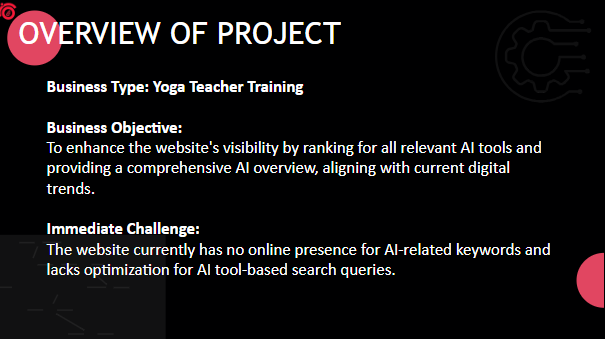
The business operates in a high-consideration market, where prospective students typically undergo extensive research before committing. Decisions are influenced not just by the curriculum, but by factors such as instructor reputation, course outcomes, alumni success, location, and overall trustworthiness. In this environment, authority and credibility are paramount. Yin Yoga Bali has cultivated a strong offline reputation, earning recognition through certifications, positive word-of-mouth, and local community engagement. However, its digital footprint was limited, especially in emerging AI-powered search contexts.
Despite its proven expertise, Yin Yoga Bali faced a gap: its content and online presence were not structured in a way that AI search systems could easily understand, interpret, or recommend. While human users could navigate the website and find information, intelligent discovery platforms — like AI recommendation engines and conversational assistants — struggled to extract actionable insights or contextualize the school within the competitive landscape of global yoga training.
Our engagement aimed to bridge this gap, translating Yin Yoga Bali’s real-world credibility into AI-readable digital signals. By treating the school as a semantic entity with well-defined relationships — between courses, instructors, certifications, and location — we set the foundation for QSAAS to engineer visibility that would resonate across multiple AI platforms. The objective was not merely to increase traffic but to ensure that when students asked complex, research-driven queries, Yin Yoga Bali would appear as a trusted, authoritative recommendation.
Market and Visibility Constraints
Bali has long been recognized as a global hub for yoga education, attracting students from around the world who seek immersive training experiences in a tropical, culturally rich environment. Its reputation as a wellness destination has made the market intensely competitive. Established international yoga schools have dominated visibility for years, leveraging extensive content strategies, global networks, and high-authority backlinks to secure top positions in search results. For newer entrants or even reputable local schools like Yin Yoga Bali, this means navigating a crowded landscape where organic discovery is no longer guaranteed.
Adding to the challenge is the evolving nature of search itself. Discovery is no longer strictly linear or keyword-driven. International students often begin their journey with exploratory queries — seeking recommendations, comparisons, and holistic guidance — rather than searching for specific courses by name. AI-driven recommendation engines and conversational assistants are increasingly shaping this journey. Tools like ChatGPT, Perplexity, and Gemini synthesize information from multiple sources, highlighting programs that meet nuanced criteria such as credibility, location, certification outcomes, and student satisfaction. For Yin Yoga Bali, competing in this space required not only establishing authority but also ensuring AI systems could recognize, interpret, and recommend their offerings reliably.
In addition, the decision-making process of prospective students is highly research-intensive. Unlike low-consideration purchases, yoga teacher training involves evaluating multiple factors, including curriculum depth, instructor expertise, certification legitimacy, and cultural immersion. This creates an environment where minor gaps in digital visibility can significantly affect perception and consideration. For Yin Yoga Bali, traditional SEO approaches — optimizing for keywords, meta tags, and backlinks — were insufficient. To gain a competitive edge, we needed a system that could operate at the intersection of content, context, and AI interpretation, ensuring visibility in exploratory and recommendation-based searches that drive high-quality leads.
Initial State Before QSAAS Deployment
Before deploying QSAAS, Yin Yoga Bali’s digital presence exhibited several constraints that limited AI-driven visibility. While the website contained rich, descriptive content about programs and instructors, it was structured for human readers, not AI systems. Conversational or comparison-style queries — which are increasingly dominant in international student research — were largely unsupported. For example, questions such as “Which Bali yoga school offers the most comprehensive Yin Yoga certification?” or “Best immersive yoga training in Indonesia for international students” returned no measurable presence for Yin Yoga Bali in AI-powered platforms.
Entity-level reinforcement, a critical factor for AI recommendation engines, was weak. The school had strong brand recognition offline and in local networks, but this credibility had not been encoded digitally in a way that AI systems could understand. Important attributes — including the relationship between the school, its programs, instructors, certifications, and geographic location — were not consistently defined in structured formats, schema markup, or semantic content hierarchies. As a result, AI platforms struggled to classify Yin Yoga Bali as a distinct, authoritative entity within the competitive Bali yoga ecosystem.
Additionally, AI-first search models rely heavily on semantic clustering and content extractability. Yin Yoga Bali’s website content was rich but linear, written as narrative descriptions rather than modular, extractable information. Lists, tables, FAQs, and machine-readable signals were limited, reducing the likelihood that AI systems would summarize or cite the school effectively in recommendation outputs. Put simply, the school’s digital footprint was descriptive but largely invisible to the algorithms that now dominate student discovery journeys.
These gaps underscored the need for a systematic intervention: a solution that would translate Yin Yoga Bali’s real-world authority into structured, AI-friendly signals while simultaneously positioning it for discovery in multiple parallel AI ecosystems.
Why We Deployed QSAAS for Yin Yoga Bali
The challenges outlined above made Yin Yoga Bali an ideal candidate for Quantum SEO as a Service (QSAAS), ThatWare’s proprietary system for engineering AI-first search visibility. Traditional SEO approaches focus on ranking pages for specific keywords, but they fall short in AI-driven discovery, which evaluates entities, intents, and contextual relationships at scale. QSAAS was designed to address exactly this gap, treating AI platforms as dynamic, parallel ecosystems where visibility depends not just on individual page optimization, but on the consistent representation of entities, semantic relationships, and user intent across multiple channels.
QSAAS allowed us to shift the optimization paradigm from reactive to predictive. Instead of waiting for rankings to fluctuate in response to content changes, we could model AI search behavior, anticipate how platforms would summarize and recommend courses, and design the website’s content and signals accordingly. This approach treated Yin Yoga Bali not simply as a website, but as an authoritative entity whose attributes, programs, certifications, instructors, and location were structured to maximize extraction and citation by AI systems.
Furthermore, QSAAS enabled multi-system compounding of visibility. Rather than targeting one AI platform at a time, we designed entity and intent models that could be interpreted consistently across different recommendation engines. This ensured that when a prospective student engaged with an AI-powered assistant — whether exploring options on ChatGPT, Perplexity, Gemini, or Google AI — Yin Yoga Bali would appear reliably, with structured authority signals and contextually relevant content.
Ultimately, deploying QSAAS for Yin Yoga Bali was about engineering systemic visibility rather than achieving isolated tactical wins. By encoding real-world credibility into AI-readable signals, modeling query intent, and predicting recommendation pathways, we could ensure that the school not only became discoverable but maintained stable, authoritative presence across the rapidly evolving landscape of AI-first search.
QSAAS Architecture Applied to Yin Yoga Bali
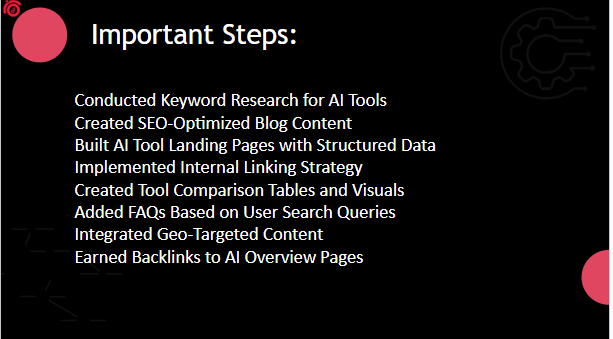
To achieve meaningful AI-driven visibility, we applied ThatWare’s QSAAS framework as a structured, multi-layered system. The architecture combines semantic modeling, query intent analysis, AI behavior simulation, and content signal engineering to create a self-reinforcing ecosystem. For Yin Yoga Bali, this meant moving beyond traditional keyword SEO and treating the brand as an authoritative entity within AI-first search ecosystems.
Semantic Entity Modeling
The first step was establishing Yin Yoga Bali as a distinct, authoritative entity. AI systems rely heavily on structured relationships between entities — programs, certifications, instructors, locations, and outcomes — to determine authority and relevance. Without explicit semantic encoding, even high-quality content risks being overlooked.
We structured Yin Yoga Bali’s website and content to clearly define these relationships: each program was associated with its certification type, instructor credentials, and intended outcomes. Location attributes reinforced Bali and Indonesia as the geographic context, ensuring AI platforms could anchor the entity reliably. By creating hierarchical, machine-readable relationships, we made it possible for multiple AI systems to interpret the school consistently — whether they were ranking courses, recommending programs, or generating summaries.
This semantic approach also allowed us to future-proof visibility. By encoding authority at the entity level, changes in AI platform algorithms had less impact, as recognition relied on structural clarity rather than isolated keywords or backlinks.
Query Intent Taxonomy Mapping
Next, we mapped the intent taxonomy of prospective students’ search behavior. High-consideration purchase cycles like yoga teacher training involve several stages:
- Discovery: Exploring options and understanding available programs.
- Comparison: Evaluating courses against competing offerings.
- Validation: Confirming credibility, certification legitimacy, and instructor quality.
We used AI and NLP tools to analyze how students phrased research queries across these stages, identifying common linguistic patterns, synonyms, and contextual nuances. For example, queries could range from “best Yin Yoga certification Bali” to “top yoga teacher training schools Indonesia” — all overlapping but distinct in intent.
By mapping this taxonomy, we designed content coverage to satisfy multiple intent paths simultaneously, ensuring Yin Yoga Bali could appear in AI-generated recommendations regardless of phrasing variations or exploratory versus validation-focused queries.
AI-First Search Behavior Modeling
A critical innovation was modeling how AI systems construct recommendations. Unlike traditional SEO, AI-first search involves synthesizing information from multiple sources, weighing authority signals, and generating concise summaries for end users.
We reverse-engineered summarization logic used by platforms like ChatGPT, Gemini, and Perplexity. This involved understanding:
- How entities are referenced and cited.
- Which content structures enable extraction for answers.
- How context and relationships influence recommendation ranking.
Armed with these insights, we published content aligned with AI consumption patterns — modular, structured, and semantically rich — enabling platforms to synthesize answers efficiently while maintaining depth and clarity.
Content and Signal Engineering Under QSAAS
With the architecture in place, the next layer focused on content and signal engineering — optimizing both what users read and how AI systems interpret it.
Content Experience Normalization
To ensure AI systems could extract information, we created long-form, authoritative content designed for modular consumption. Each page contained:
- Clearly defined answer-priority sections, highlighting key facts for extraction without losing narrative depth.
- Tables, lists, and bullet points, making hierarchical data machine-readable.
- Structured headings aligned with intent taxonomy, allowing AI to map queries to content efficiently.
This approach balanced human readability with AI extractability, ensuring that students and recommendation engines alike could interpret Yin Yoga Bali’s offerings seamlessly.
Structured Signal Engineering
We deployed structured schemas to reinforce AI recognition:
- Course schema: Detailing program duration, syllabus, and certification type.
- Location schema: Contextualizing Bali and Indonesia within program listings.
- FAQ and review schema: Highlighting common queries and social proof.
- Instructional schema: Encoding learning outcomes and program objectives.
Hierarchical structuring mirrored the entity relationships established in Section 6, providing clarity without redundancy. This enabled AI platforms to consume, classify, and rank content reliably, increasing visibility across multiple discovery pathways.
Authority Signal Amplification
Authority is central to AI-driven discovery. We amplified Yin Yoga Bali’s credibility through multiple channels:
- Certifications and instructor credentials were highlighted and structured for machine readability.
- Testimonials and training outcomes were systematically integrated to reinforce trust signals.
- High-quality backlinks from authoritative yoga and wellness portals provided contextual reinforcement.
These measures ensured that AI systems not only recognized Yin Yoga Bali as an entity but trusted it as a reliable recommendation source for students exploring yoga training options in Bali.
Cross-Engine Contextual Reinforcement
AI discovery is multi-platform. To maximize visibility, we maintained consistent entity and intent signals across platforms, avoiding reliance on any single AI system.
- Structured content and schema markup were applied uniformly.
- Semantic relationships were mirrored across webpages, social profiles, and content hubs.
- AI-specific behaviors were simulated to verify that entities, programs, and locations were consistently interpreted, regardless of platform-specific extraction logic.
This cross-engine reinforcement ensured that Yin Yoga Bali remained a stable, authoritative recommendation source, appearing reliably in exploratory, comparison, and high-intent queries across platforms.
Dynamic Feedback Loop Optimization
Finally, QSAAS incorporated a continuous feedback loop to refine AI visibility over time. Key elements included:
- Monitoring AI-generated responses and citations to track how Yin Yoga Bali was represented.
- Detecting shifts in ranking, phrasing, and recommendation patterns across platforms.
- Iteratively refining content structure, schema, and semantic relationships based on observed behavior.
This adaptive optimization ensures that Yin Yoga Bali remains discoverable, authoritative, and aligned with evolving AI system logic. The dynamic loop allows the system to anticipate trends, respond to algorithmic changes, and maintain consistent visibility without relying on reactive tactics.
Measured Outcomes After QSAAS Implementation
After deploying ThatWare’s QSAAS framework for Yin Yoga Bali, the results were both rapid and remarkable, demonstrating the power of an AI-first, entity-driven optimization approach. Within three to seven weeks, the school’s visibility across multiple AI platforms improved dramatically, signaling not just short-term gains but structural, sustainable positioning in AI-led discovery ecosystems.
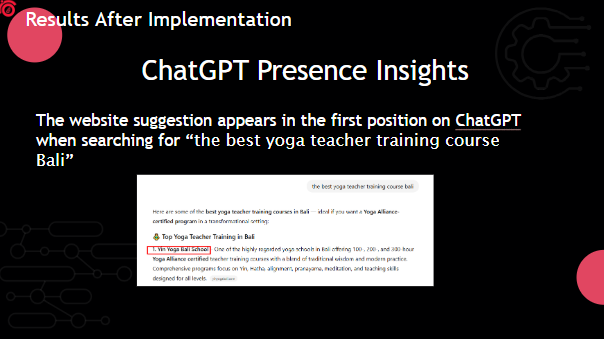
One of the most notable outcomes was first-position presence on ChatGPT for key yoga training queries. Previously, these exploratory and comparison-oriented searches had returned no measurable results for Yin Yoga Bali. By structuring content around semantic entities, encoding program, certification, instructor, and location relationships, and mapping user intent, we enabled ChatGPT to recognize Yin Yoga Bali as a distinct authority and provide concise, actionable recommendations to users.
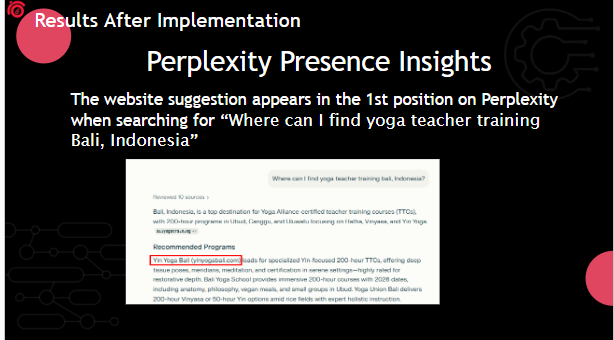
On Perplexity, the school appeared consistently in top recommendation slots for both discovery and comparison queries. This platform, which synthesizes information from multiple sources to answer research-focused questions, relied heavily on entity recognition and semantic relationships. By implementing hierarchical content structures, schema markup, and modular answer sections, we ensured Perplexity could extract relevant details quickly and confidently, elevating Yin Yoga Bali above competing international schools with longer-established digital footprints.
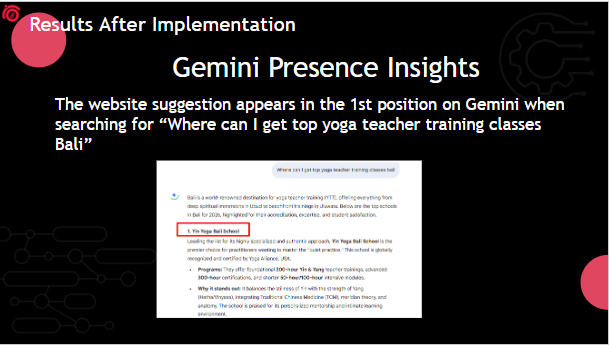
Gemini, known for its program-specific query focus, also reflected strong gains. Queries around course offerings, teacher certification pathways, and Bali-based yoga experiences regularly returned Yin Yoga Bali in leading positions. The combination of structured content, semantic entity modeling, and AI-aligned signal reinforcement allowed the school to dominate results for both general informational searches and high-intent, program-specific inquiries.
Perhaps most critically, Google AI Overview, which aggregates high-intent search results and recommendation panels, began including Yin Yoga Bali for relevant program searches. This not only increased visibility to potential students at critical decision points but also reinforced credibility and authority across the wider AI ecosystem. By encoding trust signals, testimonials, and structured course data, we ensured that Google’s AI could interpret Yin Yoga Bali as a reliable and authoritative entity.
The speed of these results was also significant. Traditional SEO campaigns often require months, sometimes years, to achieve comparable visibility. Through QSAAS, Yin Yoga Bali experienced time-to-visibility ranging from three to seven weeks across multiple AI platforms, demonstrating the efficiency of an AI-first, entity-driven optimization framework.
Why These Results Were Systemic, Not Accidental
While the outcomes were impressive, they were not the result of chance. Each gain was the product of carefully engineered structural design, entity modeling, and multi-platform alignment. Rather than relying on isolated tactics such as keyword stuffing, link building, or meta tag adjustments, QSAAS ensured that every aspect of Yin Yoga Bali’s digital presence contributed to a coherent, interpretable system for AI platforms.
Authority was engineered at the entity level. By defining relationships between programs, instructors, certifications, and location, AI platforms could consistently recognize Yin Yoga Bali as a distinct entity within the global yoga education ecosystem. This structural clarity created a foundation for reproducible and scalable visibility, independent of fluctuations in platform-specific algorithms or keyword popularity.
Additionally, QSAAS functioned as a continuous optimization layer. Unlike traditional campaigns that react after changes are observed, QSAAS incorporates feedback loops, monitoring AI-generated responses, and iteratively refining content, schema, and semantic relationships. This adaptive system allowed Yin Yoga Bali to maintain visibility, adjust to shifts in AI summarization logic, and respond to evolving user search behaviors. In short, the visibility gains were systemic because they were built into the architecture of discovery itself, not applied as temporary or reactive interventions.
Scalability of the QSAAS Model
One of the most powerful aspects of QSAAS is its scalability. The success achieved with Yin Yoga Bali serves as a blueprint for expansion across other yoga training destinations. By replicating semantic entity models, intent mappings, and AI-aligned content frameworks, other schools in Bali, Ubud, or even global wellness hubs can achieve similar AI-first visibility.
Beyond yoga training, the QSAAS framework is adaptable to adjacent wellness and education niches. Entities such as meditation retreats, holistic health programs, language schools, or professional certification courses all operate in high-consideration, research-intensive markets where discovery is increasingly AI-driven. QSAAS enables these businesses to encode authority, structure content for AI extraction, and ensure consistent representation across multiple AI platforms.
Finally, QSAAS demonstrates adaptability to any service business reliant on AI-led discovery. From boutique hospitality and wellness resorts to professional training and specialized educational services, the methodology can be applied to build systemic visibility where human decision-making intersects with AI-powered research. By focusing on entities, intent pathways, semantic relationships, and structured signals, QSAAS provides a replicable system that transcends industries, creating durable, scalable, and predictable visibility in an AI-first search ecosystem.The Yin Yoga Bali case underscores a fundamental shift in digital strategy: visibility is no longer just about ranking on a page, it is about becoming an interpretable, authoritative entity that AI systems recognize and recommend consistently. The combination of semantic modeling, intent mapping, structured content, and continuous optimization forms a blueprint for any service-oriented organization seeking to thrive in an increasingly AI-driven discovery environment.
Wrapping Up
The Yin Yoga Bali engagement demonstrates that AI-driven search visibility is no longer a matter of luck or isolated tactics—it is a systemic, engineered outcome. By leveraging QSAAS to model entities, map intent, structure content, and continuously optimize across multiple AI platforms, we transformed Yin Yoga Bali from a high-quality but digitally invisible school into a consistently recommended, authoritative presence in global AI-powered discovery. The results underscore a critical insight for service businesses: true visibility in the AI era comes from designing digital ecosystems that align with how intelligent systems understand and recommend information, creating sustainable, scalable, and future-proof authority that resonates with both machines and humans alike.