
SUPERCHARGE YOUR ONLINE VISIBILITY! CONTACT US AND LET’S ACHIEVE EXCELLENCE TOGETHER!
For years, SEO was treated as a mechanical process. Identify keywords, optimise pages around them, build links, and wait for rankings to improve. While this approach once delivered results, it no longer reflects how modern search engines or users behave. Search today is shaped by intent, context, and experience. Users no longer search in isolated keywords but in complete thoughts, questions, and needs. As a result, websites that focus only on keyword placement without understanding why a user is searching often fail to convert, even if they rank. Traditional SEO creates visibility, but visibility alone does not solve business problems.

Astwood Storage faced this exact limitation. Operating in a competitive local market in Redditch, the business did not need more generic traffic. It needed the right visitors at the right moment, people actively looking for storage solutions with clear commercial intent. Expansion of physical facilities added another layer of complexity, as scaling demand without sacrificing service quality or pricing required precision, not volume. Conventional SEO methods, focused mainly on rankings and traffic metrics, were insufficient to support this level of operational growth.
This is where ThatWare redefined the approach. Instead of treating SEO as a set of optimisation tasks, it was reframed as a digital intelligence system. By applying the Hyper Intelligence SEO framework, ThatWare aligned search intent, user psychology, technical performance, and content strategy into one cohesive structure. The focus shifted from attracting clicks to satisfying intent, from chasing keywords to understanding behaviour. This shift marked the beginning of a modern SEO strategy built for sustainable growth rather than temporary visibility.
Client Background: Understanding Astwood Storage’s Business Reality
A Local Business with Physical Constraints
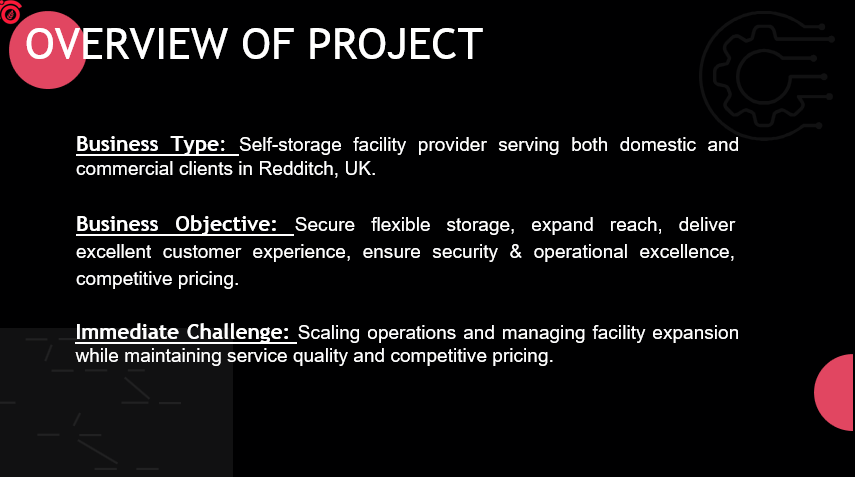
Astwood Storage is a self-storage provider based in Redditch, UK, operating in a sector that is deeply tied to physical infrastructure and local demand. Unlike digital-only businesses, growth for a storage provider is limited by space, location, and operational capacity. Every enquiry has a real-world implication, from unit availability to staffing and security. This means marketing cannot simply focus on driving higher traffic volumes. It must attract customers whose needs align precisely with the services available at that moment.
Astwood Storage had already established itself as a reliable local provider, known for secure facilities and flexible storage options. However, the business environment in Redditch had become increasingly competitive, with multiple storage providers targeting overlapping service areas. In such a market, visibility alone is not a competitive advantage. What matters is relevance, trust, and the ability to connect with customers who are actively seeking storage solutions rather than casually browsing.
Serving Two Distinct Customer Segments
One of the defining aspects of Astwood Storage’s business model is its dual audience. On one side are residential customers, individuals and families requiring temporary or long-term storage during life transitions such as moving house, renovating, or downsizing. These users often search with emotionally driven intent, prioritising safety, accessibility, and affordability. Their decision-making process is influenced by reassurance, clarity, and ease of use.
On the other side are commercial clients. These include small businesses, tradespeople, retailers, and organisations requiring document storage, inventory space, or equipment storage. This segment is driven by practicality and efficiency. Commercial users value reliability, contract flexibility, access hours, and compliance standards. Their searches tend to be more specific, often including service qualifiers and local intent signals.
For Astwood Storage, this meant that a single generic SEO strategy could not effectively serve both audiences. Each segment required tailored messaging, content structure, and intent alignment to ensure the website addressed their expectations accurately.
Competitive Pressure in the Local Storage Market
The self-storage industry in the UK has matured significantly, and Redditch is no exception. Prospective customers are presented with multiple options, often within a short driving distance. Price comparison, location convenience, and perceived security play major roles in decision-making.
In this environment, search behaviour becomes highly intent-driven. Users search with clear expectations and compare options quickly. If a website does not immediately demonstrate relevance to their needs, they move on. This creates a challenge for businesses relying on traditional SEO tactics that prioritise keyword rankings without addressing user decision pathways.
Astwood Storage needed to stand out not just in search results, but in how effectively it communicated value once users arrived on the site. The business reality demanded differentiation through clarity, not claims.
Growth Ambitions and Operational Scaling
Astwood Storage was in a phase of operational expansion. Physical facility growth meant increased capacity, but also higher responsibility to maintain service quality and pricing stability. Scaling demand without strategy would risk overcrowding, operational inefficiencies, or misaligned customer expectations.
From a digital perspective, this required predictability. The business could not afford spikes in low-intent traffic that produced enquiries unlikely to convert. Every lead needed to have a high probability of turning into a customer. This made lead quality more valuable than lead volume.
The digital strategy therefore had to support controlled growth, ensuring that demand aligned with capacity and service standards. This requirement fundamentally shaped how ThatWare approached the SEO campaign.
Limitations of the Existing Digital Presence
Before engaging ThatWare, Astwood Storage’s digital presence reflected a common issue among local service businesses. The website provided essential information but lacked depth in addressing specific user queries. Content was largely generic, leaving gaps between what users were searching for and what the site delivered.
Additionally, the site structure did not fully support efficient navigation or discovery of services. Important pages were buried within deeper layers, increasing friction for both users and search engines. Performance issues, while not severe, affected perceived speed and engagement, particularly for mobile users.
These limitations did not indicate poor execution, but rather an outdated approach that had not evolved with modern search behaviour. Addressing these issues required more than optimisation. It required a rethinking of how the website functioned as a decision-making environment.
Why a Different SEO Approach Was Necessary
Astwood Storage’s business reality made one thing clear: traditional SEO metrics such as rankings and traffic counts were not enough to support sustainable growth. The business needed an approach that connected digital visibility directly to operational outcomes.
ThatWare recognised that the solution lay in aligning digital strategy with real-world business constraints. This meant understanding not just what users searched for, but why they searched, when they searched, and what they expected to find. The SEO strategy had to act as a filter, attracting only the most relevant demand while reinforcing trust and clarity.
This understanding formed the foundation for applying the Hyper Intelligence SEO framework, ensuring that Astwood Storage’s online presence worked in harmony with its physical operations, customer expectations, and long-term growth objectives.
The Core Challenge: Scaling Without Diluting Service or Margins
Growth Bottlenecks in Location-Dependent Service Businesses
For service-based businesses that operate within fixed geographic and physical limits, growth is rarely straightforward. Unlike digital products that can scale instantly, businesses such as self-storage providers must balance demand with real-world capacity. Space, staffing, security, and operational workflows all impose limits on how quickly and efficiently a business can grow.
Astwood Storage found itself at precisely this junction. The business had strong fundamentals, a solid local reputation, and expanding facilities, yet its digital growth strategy was not keeping pace with operational ambitions. The challenge was not a lack of interest in storage services, but the unpredictability of demand quality. Too many enquiries would strain operations, while irrelevant leads would waste time and resources. Growth had to be controlled, intentional, and aligned with actual service capability.
This is a common bottleneck for local service providers. Traditional digital marketing often focuses on increasing exposure without adequately filtering intent. For a business like Astwood Storage, this approach risked attracting users who were browsing casually, researching broadly, or comparing prices without serious purchase intent. Each low-quality enquiry carried a hidden cost in staff time and operational overhead.
The Risk of Marketing Spend Without Intent Clarity
One of the most significant risks in scaling a location-dependent business is increasing marketing investment without a corresponding improvement in lead quality. Paid advertising and traditional SEO can inflate traffic numbers quickly, but traffic alone does not equate to revenue.
Without clear intent signals, marketing spend becomes inefficient. Businesses may see rising visitor numbers while conversion rates stagnate or decline. This disconnect creates the illusion of growth while margins quietly erode. For Astwood Storage, maintaining competitive pricing was a core part of its value proposition. Any strategy that increased customer acquisition costs without improving conversion efficiency would undermine this position.
The business needed a digital strategy that acted as a filter, not a funnel. It had to attract users who were actively searching for storage solutions in Redditch, with specific requirements that Astwood Storage could meet. The challenge was not visibility, but relevance.
Limitations of Keyword-First SEO Approaches
Keyword-first SEO strategies have long been the default approach for local businesses. Pages are optimised around search terms, rankings are tracked, and success is measured by position improvements. While this method can deliver surface-level results, it fails to account for how users actually search and make decisions today.
Search behaviour has evolved beyond isolated keywords. Users now search with intent-rich phrases, questions, and scenarios. A keyword-focused approach often ignores this complexity, producing content that technically ranks but fails to resonate with the user’s actual need.
For Astwood Storage, ranking for broad storage-related terms did not guarantee that users were looking for the specific services offered, in the correct location, with immediate intent. This mismatch resulted in traffic that looked promising on paper but lacked commercial value.
ThatWare identified this as a structural issue rather than a tactical one. The problem was not insufficient optimisation, but an outdated decision-making model. SEO needed to shift from keyword alignment to intent alignment.
The Need for Predictable, High-Intent Demand
To support operational scaling, Astwood Storage required predictability. Sudden spikes in enquiries followed by quiet periods made planning difficult. What the business needed was a steady flow of high-intent users whose needs matched available services.
This required an SEO strategy capable of understanding demand signals before users even landed on the site. It had to anticipate intent, guide users efficiently, and reinforce trust throughout the decision journey. Only then could digital growth translate into sustainable business growth.
This challenge set the stage for a fundamentally different approach, one that moved beyond optimisation and into intelligence-driven SEO execution.
Introducing ThatWare’s Hyper Intelligence SEO Framework
What Hyper Intelligence SEO Means in Practice
Hyper Intelligence SEO is ThatWare’s proprietary framework designed to align search behaviour, algorithmic interpretation, technical performance, and human decision-making into a unified system. Rather than treating SEO as a collection of isolated tasks, the framework views it as a continuous intelligence loop.
In practice, this means every optimisation decision is informed by multiple data layers. Content is not created simply because a keyword has volume, but because it satisfies a clear intent. Technical improvements are prioritised based on how they influence behaviour, not just compliance metrics. Performance is measured not only in rankings, but in engagement quality and conversion signals.
For Astwood Storage, this framework transformed the website from an informational asset into a demand qualification engine.
Integrating Search Intent Psychology
At the heart of Hyper Intelligence SEO is an understanding of user psychology. Search behaviour is a reflection of intent, urgency, and context. A user searching for “storage units Redditch” is in a different mindset from someone researching storage options nationally.
ThatWare mapped these psychological states across the customer journey, from early research to decision-making. Each stage required different content, messaging, and structural support. The goal was to reduce cognitive friction and make it easy for users to recognise that Astwood Storage met their needs.
Algorithmic Interpretation as a Strategic Input
Modern search engines are no longer static rule-based systems. They interpret meaning, context, and satisfaction signals. Hyper Intelligence SEO treats algorithm updates not as disruptions, but as insights into how search engines evaluate relevance.
By aligning content and structure with how algorithms interpret language and behaviour, ThatWare ensured that Astwood Storage’s website communicated relevance clearly and consistently. This reduced reliance on reactive changes and created a more stable performance foundation.
Technical Performance as a Behavioural Signal
Technical SEO within the Hyper Intelligence framework is not viewed as a checklist. It is understood as a behavioural amplifier. Page speed, layout stability, and navigation clarity all influence how users interact with content. These interactions, in turn, send signals back to search engines.
For Astwood Storage, technical improvements were prioritised based on their impact on user experience. Faster load times, reduced layout shifts, and clearer site architecture improved both engagement and crawl efficiency.
User Behaviour and Conversion Data
Hyper Intelligence SEO closes the loop by incorporating real user behaviour into strategic decisions. Engagement patterns, navigation paths, and conversion actions were analysed to identify friction points and opportunities.
This data-driven feedback ensured continuous refinement. Pages were adjusted not based on assumptions, but on observed behaviour. Over time, this created a self-reinforcing system where user actions informed optimisation, and optimisation improved user outcomes.
Optimisation vs Intelligence-Driven Systems
Traditional SEO focuses on optimisation. Hyper Intelligence SEO focuses on understanding. Optimisation asks what needs fixing. Intelligence asks why something is happening and how it connects to broader goals.
For Astwood Storage, this distinction was critical. The business did not need incremental ranking improvements. It needed a system capable of adapting to demand shifts, operational constraints, and evolving search behaviour.
Hyper Intelligence SEO was designed for scalability, not short-term wins. It ensured that growth was sustainable, predictable, and aligned with business reality.
Search Intent as the Primary Intelligence Signal
Why Intent Replaced Keywords
Search intent is the most reliable indicator of both ranking potential and conversion likelihood. Keywords describe what users type. Intent explains why they type it.
ThatWare placed intent at the centre of every strategic decision. Instead of asking which keywords to target, the focus shifted to which problems users were trying to solve. This change allowed content to meet users where they were, rather than forcing them into predefined keyword buckets.
Mapping Intent Across the Buyer Journey
User intent evolves as they move through the decision-making process. Early-stage users seek information. Mid-stage users compare options. Late-stage users are ready to act.
Hyper Intelligence SEO mapped these stages explicitly. Informational content built trust and authority. Service pages addressed practical concerns. Local landing pages captured high-intent searches with clear conversion pathways.
This structured approach ensured that no matter where a user entered the journey, the site provided relevant guidance.
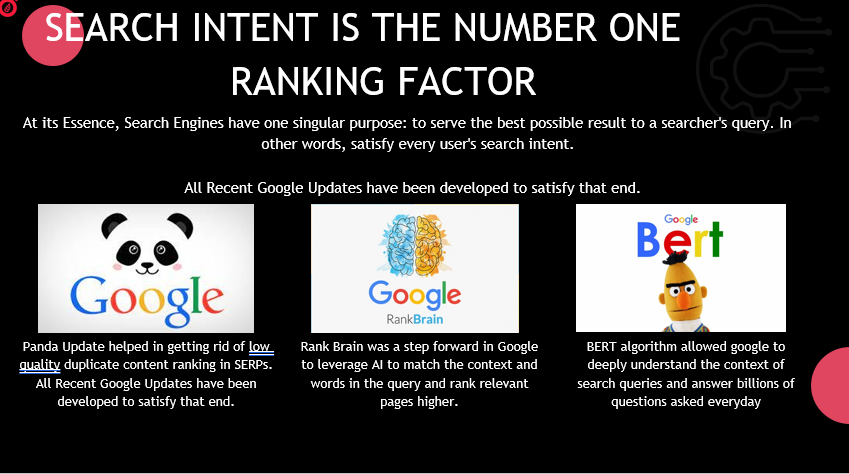
Google’s Evolution and Intent Understanding
Google’s algorithm updates reflect a clear trajectory towards intent satisfaction.
- Panda reinforced the importance of content quality and usefulness.
- RankBrain introduced contextual understanding and machine learning.
- BERT enhanced natural language comprehension, allowing search engines to interpret nuanced queries.
Hyper Intelligence SEO aligns directly with this evolution. By designing content and structure around intent, ThatWare ensured that Astwood Storage’s website spoke the same language as modern search engines.
Translating Algorithm Behaviour into Actionable Strategy
Rather than chasing updates, Hyper Intelligence SEO decodes algorithm behaviour into practical decisions. This includes how content is structured, how topics are interconnected, and how technical elements support engagement.
For Astwood Storage, this meant building pages that answered real questions, supported decision-making, and signalled relevance clearly. The result was improved visibility, stronger engagement, and higher-quality demand.
Intent as the Foundation for Sustainable Growth
By treating search intent as the primary intelligence signal, ThatWare transformed SEO from a traffic-generation tool into a growth framework. The strategy aligned user needs with business capacity, ensuring that digital performance supported operational success.
For Astwood Storage, this shift enabled controlled scaling, preserved service quality, and protected margins. It demonstrated that modern SEO, when driven by intelligence rather than tactics, can become a strategic asset rather than a marketing expense.
Technical Intelligence: Turning Infrastructure into a Ranking Asset
Technical SEO as a Behavioural Lever
Within the Hyper Intelligence SEO framework, technical SEO is not treated as background maintenance. It is positioned as an active behavioural lever. Search engines increasingly rely on user interaction signals to evaluate quality and relevance. Slow pages, unstable layouts, and confusing structures do not simply frustrate users; they quietly weaken ranking potential over time.
For Astwood Storage, ThatWare approached technical optimisation with a clear objective: improve how users experience the site in real conditions, and allow search engines to observe that improvement through consistent engagement signals.
Content Refresh for Missed Intent Queries
One of the first technical intelligence actions was identifying “missed intent” queries. These were search terms already driving impressions or clicks, but where the existing page content did not fully answer the user’s underlying question.
Instead of creating unnecessary new pages, ThatWare refreshed existing content by expanding sections, clarifying explanations, and restructuring information to better match user expectations. This ensured continuity of authority while improving relevance. The result was longer engagement times and reduced bounce behaviour, both of which reinforce quality signals.
Visual Content Integration for Engagement
Visual elements were introduced strategically, not decoratively. Graphics were added to explain storage options, security features, and usage scenarios. These visuals reduced cognitive load, making it easier for users to process information quickly.
From a behavioural perspective, this improved scroll depth and time on page. From a technical perspective, images were optimised to ensure they enhanced engagement without compromising performance.
Core Web Vitals Optimisation
JavaScript Reduction
Excessive JavaScript execution can delay interactivity and frustrate users. ThatWare reduced non-essential scripts and deferred loading where possible. This ensured faster initial interaction and smoother navigation.
Lazy Loading Implementation
Lazy loading was implemented for below-the-fold content, allowing critical elements to load first. This improved perceived speed and reduced unnecessary resource usage.
Image Dimension and Compression Control
Images were resized to appropriate dimensions and compressed without quality loss. This prevented layout shifts and improved visual stability, a key component of Core Web Vitals.
Server Response and Latency Optimisation
Server performance was refined to reduce response times. Faster servers shorten the gap between user action and content delivery, directly influencing satisfaction and engagement.
Why Performance Impacts Rankings and Trust
Performance affects trust in subtle ways. Users associate speed and stability with professionalism and reliability. A fast, responsive site reassures visitors that the business behind it is equally dependable.
Search engines observe this behaviour. When users stay longer, interact more, and complete actions without friction, those signals reinforce relevance and authority. For Astwood Storage, technical intelligence turned infrastructure into a competitive advantage rather than a silent liability.
Flat Site Architecture: Engineering Crawl and User Efficiency
Limitations of Deep Site Structures
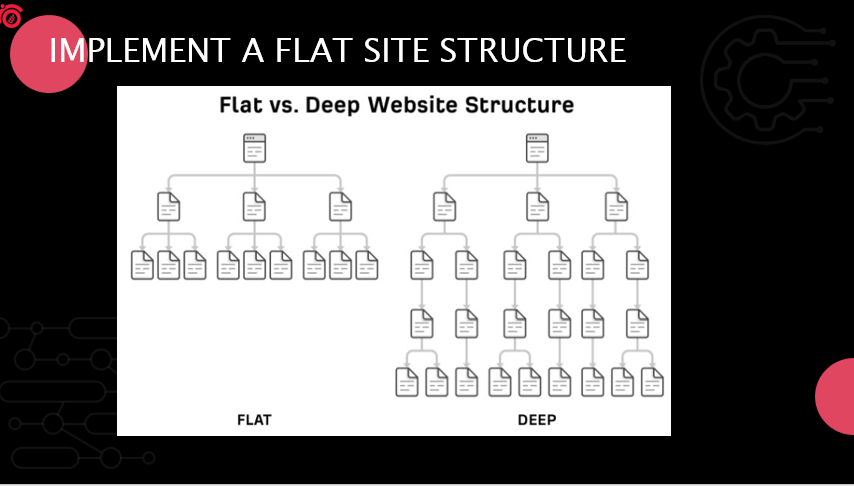
Deep site architectures bury important pages under multiple layers of navigation. This increases friction for users and makes it harder for search engines to discover and prioritise content. Pages with commercial intent often receive less visibility simply because they are harder to reach.
Astwood Storage’s previous structure reflected this common issue. Valuable service pages were accessible, but not optimally positioned for crawl efficiency or user flow.
The Strategic Shift to a Flat Architecture
ThatWare restructured the site into a flatter architecture where critical pages were only a few clicks from the homepage. This change served both users and search engines simultaneously.
Reduced Crawl Depth
Search engines could reach important pages more efficiently, improving crawl frequency and indexation reliability.
Faster Indexation
New and updated content was discovered more quickly, allowing optimisations to take effect sooner.
Improved Internal Linking Clarity
Clear internal links signalled topical relevance and priority. This helped search engines understand which pages mattered most and how they related contextually.
Impact on User Navigation and Discoverability
From a user perspective, the flatter structure simplified decision-making. Visitors could find relevant services without unnecessary navigation steps. This reduced abandonment and improved engagement flow.
For Astwood Storage, the architecture itself became a form of guidance, directing users toward the most relevant content based on their intent.
Measuring Intelligence, Not Just Traffic: Performance Outcomes
Why Metrics Must Reflect Strategy
Hyper Intelligence SEO does not measure success through traffic volume alone. Metrics are interpreted through the lens of intent alignment, engagement quality, and brand strength. The results from late 2025 validated this approach.
Traffic and Engagement Growth
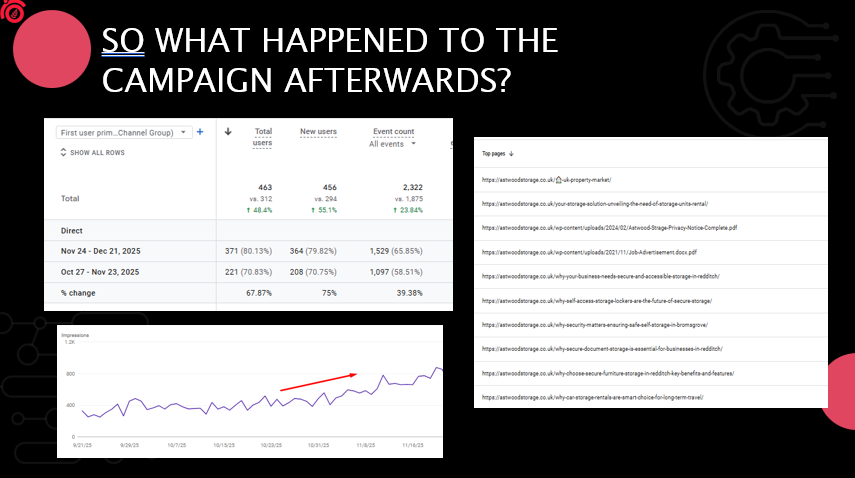
Between Oct 27 – Nov 23, 2025 and Nov 24 – Dec 21, 2025, Astwood Storage experienced clear improvements:
- Total Users: Increased by 48.4% (312 to 463)
- New Users: Increased by 55.1% (294 to 456)
- Engagement Events: Increased by 23.84%, reaching 2,322 events
These figures indicated not just higher reach, but more meaningful interaction with the site.
Brand Signal Strength Through Direct Traffic
Direct traffic grew at a notable rate:
- Direct Users: Increased by 67.87%
- Direct New Users: Increased by 75%
Direct traffic is a strong indicator of brand recall and trust. Users typing the URL directly or returning via bookmarks suggests that the brand has established credibility beyond search results alone. For a local service business, this is a critical long-term signal.
Content Visibility and Impression Trends
Search impressions showed steady growth from September through November 2025, peaking between 800 and 1.2K impressions per period.
This upward trend correlated closely with the rollout of intent-focused content and technical improvements. Rather than short-lived spikes, visibility increased consistently, reinforcing the stability of the Hyper Intelligence SEO framework.
Performance as Proof of Intelligence
The performance outcomes demonstrated that when technical infrastructure, architecture, and content are aligned with intent and behaviour, SEO becomes predictable and scalable. For Astwood Storage, the data confirmed that intelligence-driven optimisation delivers sustained visibility, stronger engagement, and measurable business value.
What Made This Campaign Different from Conventional SEO
What set this campaign apart from conventional SEO was not a single tactic, but a fundamental shift in how optimisation was approached. Traditional SEO often treats growth as a linear process: improve rankings, increase traffic, and expect conversions to follow. In reality, this model overlooks how users think, how search engines interpret behaviour, and how businesses operate within real-world constraints. For Astwood Storage, such an approach would have delivered visibility without control, creating more noise than value.
ThatWare’s Hyper Intelligence SEO framework replaced keyword-first thinking with intent-first decision-making. Instead of asking which terms could rank fastest, the strategy focused on why users were searching and what they expected to find. Content was designed to resolve specific problems, guide decisions, and reduce uncertainty. This ensured that traffic arriving on the site was already aligned with Astwood Storage’s services and capacity, resulting in higher-quality engagement rather than inflated numbers.
Another key difference was the role of technical SEO. Rather than treating performance and structure as backend tasks, they were positioned as active contributors to user trust and search visibility. Core Web Vitals, site architecture, and content accessibility were optimised to support behaviour, not just compliance. This created a smoother experience for users while sending consistent quality signals to search engines.
Finally, success was measured differently. Conventional campaigns often rely on rankings and traffic as primary indicators. This campaign evaluated intelligence signals such as engagement depth, direct traffic growth, and sustained impression trends. These metrics reflected real brand strength and user confidence. By aligning technology, psychology, and business objectives, ThatWare delivered an SEO strategy built for stability, scalability, and long-term value rather than short-term gains.
Wrapping Up
Hyper Intelligence SEO proved to be more than an optimisation approach for Astwood Storage; it functioned as a growth framework that aligned search behaviour, technical performance, and business reality into one cohesive system. By shifting focus from keywords to intent, from isolated fixes to intelligence-driven decisions, ThatWare enabled sustainable visibility that supported operational scaling without compromising service quality or margins. The campaign demonstrated that modern SEO succeeds when it is treated as a strategic layer of business intelligence, one that interprets user behaviour, reinforces trust through performance, and adapts alongside evolving search ecosystems. For Astwood Storage, this approach transformed SEO from a marketing activity into a reliable engine for controlled, long-term growth.