
SUPERCHARGE YOUR ONLINE VISIBILITY! CONTACT US AND LET’S ACHIEVE EXCELLENCE TOGETHER!
Growth used to be a straight line. You picked a channel, built a funnel, pushed traffic into it, and tried to convert a predictable percentage into revenue. Teams planned in quarters, launched campaigns in batches, and measured performance in tidy dashboards. For a while, that approach worked—because markets moved slower, customer journeys were simpler, and the volume of signals you needed to interpret was manageable.
That era is ending fast.
Why Growth Needs a New Intelligence Layer
The Death of Linear Growth Models
Traditional growth strategies are failing for one simple reason: the world they were designed for no longer exists.
Funnels are too rigid. A classic funnel assumes customers move step-by-step: awareness → consideration → purchase → retention. But modern buyers don’t behave like that. They research across platforms, bounce between devices, seek peer validation, and make decisions in loops—not lines. They might discover you through content, leave, return via a referral, compare you on a review site, try a free feature, and only then convert. A one-direction funnel can’t capture that complexity, let alone optimize it.
Quarterly planning is too slow. The market doesn’t wait for your QBR. Trends, competitors, ad auctions, customer sentiment, and platform algorithms shift weekly—sometimes daily. When your growth engine relies on decisions made every 90 days, you’re reacting to yesterday’s reality.
Siloed teams break the customer experience. Marketing optimizes for acquisition, product focuses on features, sales pushes pipeline, and customer success fights churn—but customers experience one brand. When signals and decisions live in separate systems, growth becomes a tug-of-war instead of a compounding system.
And then there’s the biggest pressure of all: the explosion of data, channels, and expectations.
Today, businesses sit on oceans of data—web analytics, product events, CRM activity, ad performance, support tickets, call transcripts, social feedback, community discussions, and more. Yet many teams still make decisions like it’s 2012: by scanning dashboards, debating interpretations in meetings, and launching “best guess” experiments.
That creates a painful modern paradox:
We have more data than ever, but less decision intelligence than we need.
The gap isn’t data availability. The gap is the ability to convert that data into fast, accurate, continuously improving decisions.
From Growth Hacking to Growth Intelligence
To understand what comes next, it helps to see how growth has evolved.
- Growth hacking prioritized speed: quick experiments, clever tactics, and rapid acquisition.
- Data-driven growth matured the process: better measurement, attribution models, and KPI-based optimization.
- AI-assisted growth introduced automation: smarter segmentation, predictive analytics, basic personalization, and content support.
Now we’re entering the next phase:
Hyper-intelligent growth
This isn’t about using AI to write ad copy faster or generate more content. It’s about building a system that can learn from every interaction, detect patterns humans miss, adapt strategies in real time, and continuously improve growth performance across the lifecycle.
Because at a certain point, incremental optimization stops working.
When acquisition costs rise, competition intensifies, and channels saturate, you can’t A/B test your way to dominance. You need a smarter engine—one that compounds learning, not just results.
Enter the Hyper-Intelligence Growth Engine
A Hyper-Intelligence Growth Engine is a modern growth system that integrates AI, advanced analytics, and self-reinforcing growth loops to produce compounding outcomes.
At a high level, it’s designed to do what traditional growth systems struggle to do:
- Learn continuously from customer behavior, market shifts, and internal performance signals
- Adapt automatically by updating targeting, messaging, onboarding, and experiences in near real time
- Scale intelligently by turning insights into action without adding linear headcount
Think of it as the difference between a car with a fixed route and a car with a live navigation system that adjusts every second based on traffic, road closures, and your destination. One follows a plan. The other follows reality.
This guide is built for people who don’t want growth to depend on luck, heroic teams, or a handful of “high-performing campaigns.” It’s for:
- Innovators designing modern business systems
- Founders trying to scale efficiently without bloating teams
- CMOs and growth leaders who want compounding performance across channels
- Product leaders who see growth as a product outcome—not a marketing afterthought
In the sections ahead, we’ll define the Hyper-Intelligence Growth Engine in depth, break down its core components, and map exactly how AI, analytics, and growth loops work together to create a growth system that gets smarter over time.
Defining the Hyper-Intelligence Growth Engine
What Does “Hyper-Intelligence” Really Mean?
To understand a Hyper-Intelligence Growth Engine, we must first unpack the term hyper-intelligence—and how it fundamentally differs from intelligence models businesses are already familiar with.
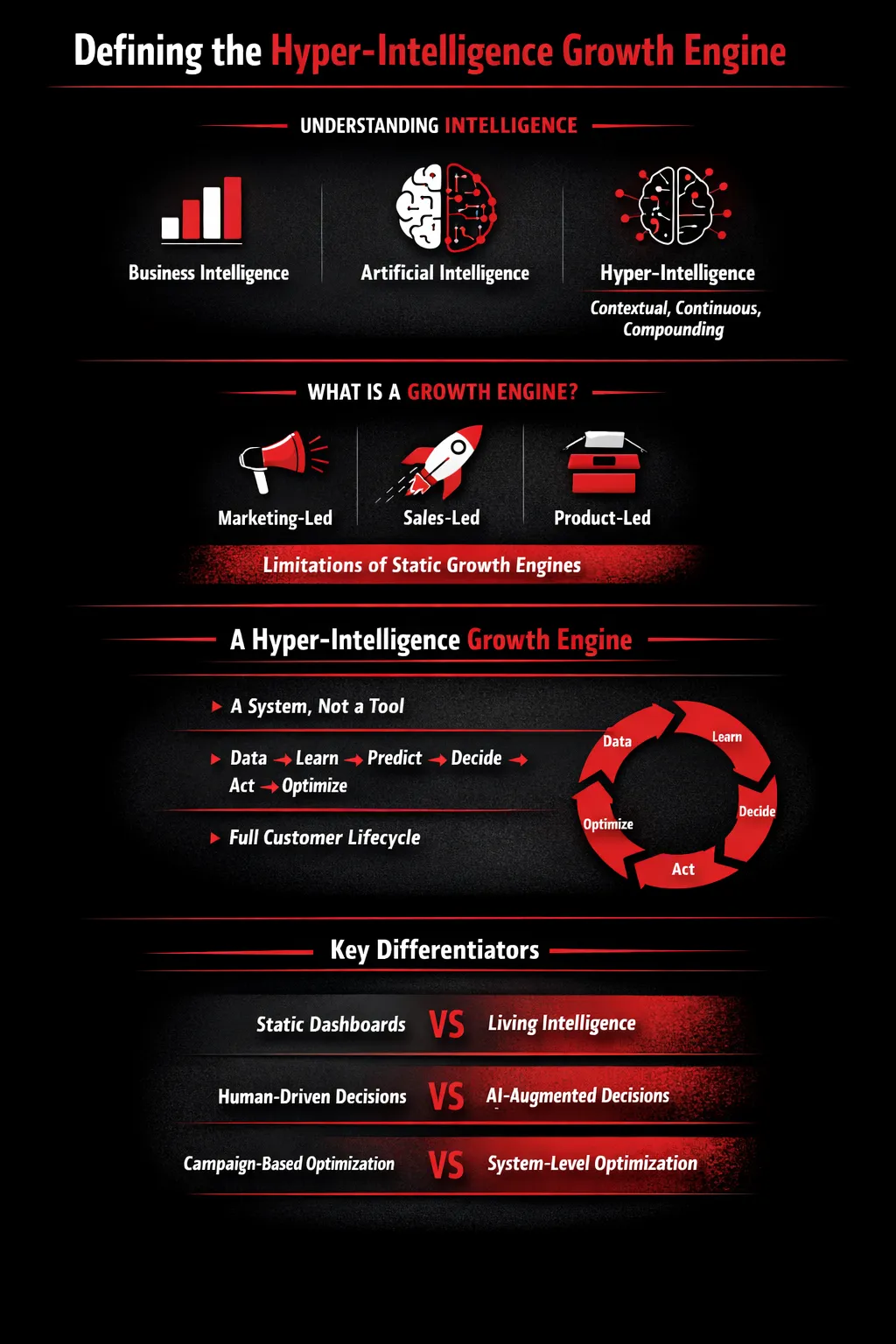
- Business Intelligence (BI) focuses on historical data. Dashboards, reports, and KPIs help organizations understand what happened and, to some extent, why it happened. BI is descriptive and diagnostic, but largely reactive.
- Artificial Intelligence (AI) goes a step further. Using machine learning and predictive models, AI can identify patterns, forecast outcomes, and automate specific tasks. However, in many organizations, AI operates in silos—supporting isolated use cases rather than orchestrating growth holistically.
- Hyper-Intelligence represents the next evolution. It is not just predictive, but context-aware, continuously learning, and compounding over time. Hyper-intelligence connects data, AI models, decision systems, and execution layers into a unified intelligence fabric.
In essence, hyper-intelligence is contextual (it understands intent and environment), continuous (it learns in real time), and compounding (each interaction improves future decisions). This makes it uniquely suited for dynamic growth environments.
What Is a Growth Engine?
A growth engine is the underlying mechanism that drives customer acquisition, retention, and revenue expansion.
Traditionally, businesses have relied on:
- Marketing-led growth, driven by campaigns, channels, and demand generation
- Sales-led growth, powered by human-led pipelines and relationship management
- Product-led growth, where the product experience itself fuels adoption and expansion
While effective in the past, these models are often static and linear. They depend on predefined funnels, periodic analysis, and manual optimization. As markets become faster and more complex, static growth engines struggle to adapt in real time.
The Combined Definition
A Hyper-Intelligence Growth Engine brings these concepts together into a single, adaptive system.
It is not a tool or a single platform, but a connected system that:
- Continuously collects data from users, products, markets, and operations
- Learns from patterns using AI and advanced analytics
- Predicts outcomes such as conversion likelihood, churn risk, or growth opportunities
- Decides the best next action based on context and objectives
- Acts through automation or human-in-the-loop execution
- Optimizes itself through feedback loops
Crucially, it operates across the entire customer lifecycle—from first touch to long-term loyalty and expansion.
Key Differentiators from Traditional Growth Systems
The difference between traditional growth systems and hyper-intelligent ones is profound:
- Static dashboards vs living intelligence that evolves with every interaction
- Human-driven decisions vs AI-augmented decisions that scale judgment without losing control
- Campaign-based optimization vs system-level optimization, where growth compounds continuously
In short, a Hyper-Intelligence Growth Engine transforms growth from a series of disconnected efforts into a self-improving, intelligent system built for modern innovation.
The Core Pillars of a Hyper-Intelligence Growth Engine
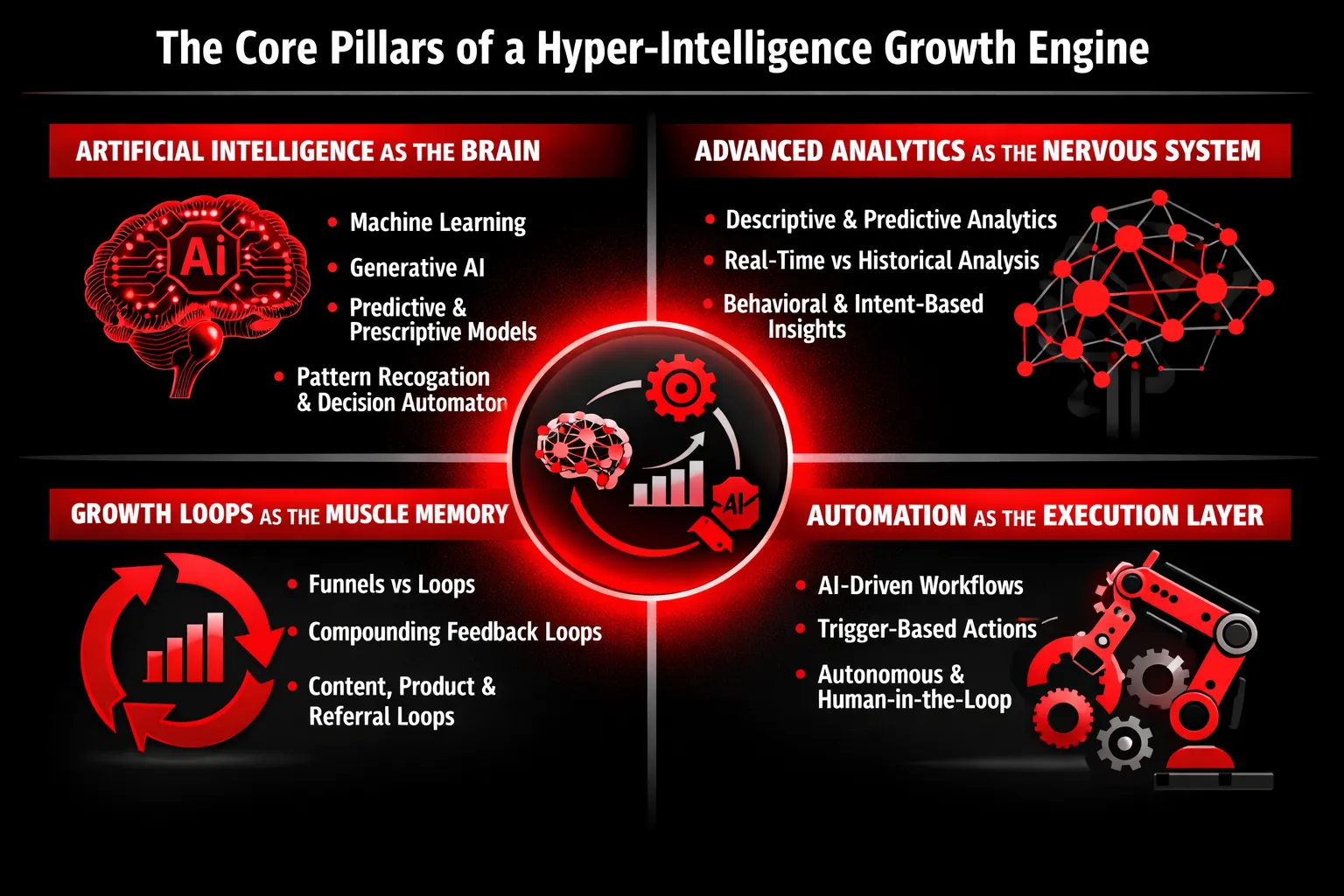
A Hyper-Intelligence Growth Engine is not a single technology or tactic—it is a system of interconnected capabilities that continuously sense, learn, decide, and act. At its foundation lie four core pillars that work together much like a living organism. Artificial intelligence functions as the brain, analytics act as the nervous system, growth loops form muscle memory, and automation becomes the execution layer. When these pillars are tightly integrated, growth becomes adaptive, scalable, and compounding.
Artificial Intelligence as the Brain
Artificial intelligence is the central thinking unit of a Hyper-Intelligence Growth Engine. It enables the system to move beyond static rules and human intuition toward continuous learning and autonomous decision-making.
At the core are machine learning models that learn from historical and real-time data. These models detect hidden correlations, segment users dynamically, and continuously improve their accuracy as new data flows in. Instead of relying on predefined customer personas or fixed assumptions, machine learning allows growth strategies to evolve alongside user behavior.
Generative AI adds a creative and adaptive dimension to the engine. It enables the system to generate personalized content, messaging, offers, and even product experiences at scale. From dynamically tailored landing pages to AI-written email variations, generative models help brands respond to individual intent in real time rather than broadcasting one-size-fits-all campaigns.
Equally important are predictive and prescriptive models. Predictive AI forecasts outcomes such as churn risk, lifetime value, or conversion probability, while prescriptive AI recommends the best next action to influence those outcomes. Together, they shift growth from reactive optimization to proactive orchestration.
Above all, AI excels at pattern recognition and decision automation. It identifies emerging trends, anomalies, and growth opportunities faster than any human team could, and it automates decisions where speed and scale matter most—freeing humans to focus on strategy and creativity.
Advanced Analytics as the Nervous System
If AI is the brain, analytics are the nervous system that carries signals across the entire growth engine. Advanced analytics transform raw data into actionable intelligence by continuously sensing what is happening across channels, products, and customer touchpoints.
A Hyper-Intelligence Growth Engine integrates descriptive, diagnostic, predictive, and prescriptive analytics. Descriptive analytics explain what happened, diagnostic analytics uncover why it happened, predictive analytics anticipate what will happen next, and prescriptive analytics suggest what should be done. Together, they create a complete intelligence loop rather than isolated reports.
Modern growth engines also prioritize real-time analytics over purely historical analysis. While historical data provides context, real-time insights allow businesses to adapt instantly—adjusting offers, content, or experiences in the moment of engagement.
Additionally, advanced systems rely on behavioral, cohort, and intent-based analytics rather than surface-level metrics. By analyzing how users behave, how groups evolve over time, and what signals indicate intent, the engine uncovers deeper growth drivers that traditional dashboards often miss.
Growth Loops as the Muscle Memory
Growth loops provide the compounding force that turns intelligence into sustained momentum. Unlike traditional funnels—which are linear and transactional—growth loops are self-reinforcing systems where each output feeds back into the input.
The key difference lies in scalability. Funnels convert users once; loops learn and improve continuously. Each interaction generates data, insights, and signals that strengthen future growth actions.
Common examples include content loops (where user engagement improves content relevance), product loops (where usage data enhances product experience), and referral loops (where satisfied users attract new users). Over time, these loops create muscle memory—allowing the growth engine to respond faster and more effectively with each cycle.
Automation as the Execution Layer
Automation is the execution layer that turns intelligence into action at scale. Without automation, even the smartest insights remain trapped in dashboards.
AI-driven workflows enable continuous execution across marketing, sales, product, and customer success. Trigger-based actions—such as sending personalized messages, adjusting onboarding flows, or escalating retention interventions—ensure timely and relevant responses.
Crucially, Hyper-Intelligence Growth Engines balance autonomous execution with human-in-the-loop oversight. Routine decisions are automated, while high-impact or sensitive decisions remain guided by human judgment. This balance ensures speed without sacrificing control, trust, or ethics.
Together, these four pillars form a living growth system—one that learns, adapts, and compounds over time, redefining what sustainable growth looks like in the age of hyper-intelligence.
How AI Integrates into the Hyper-Intelligence Growth Engine
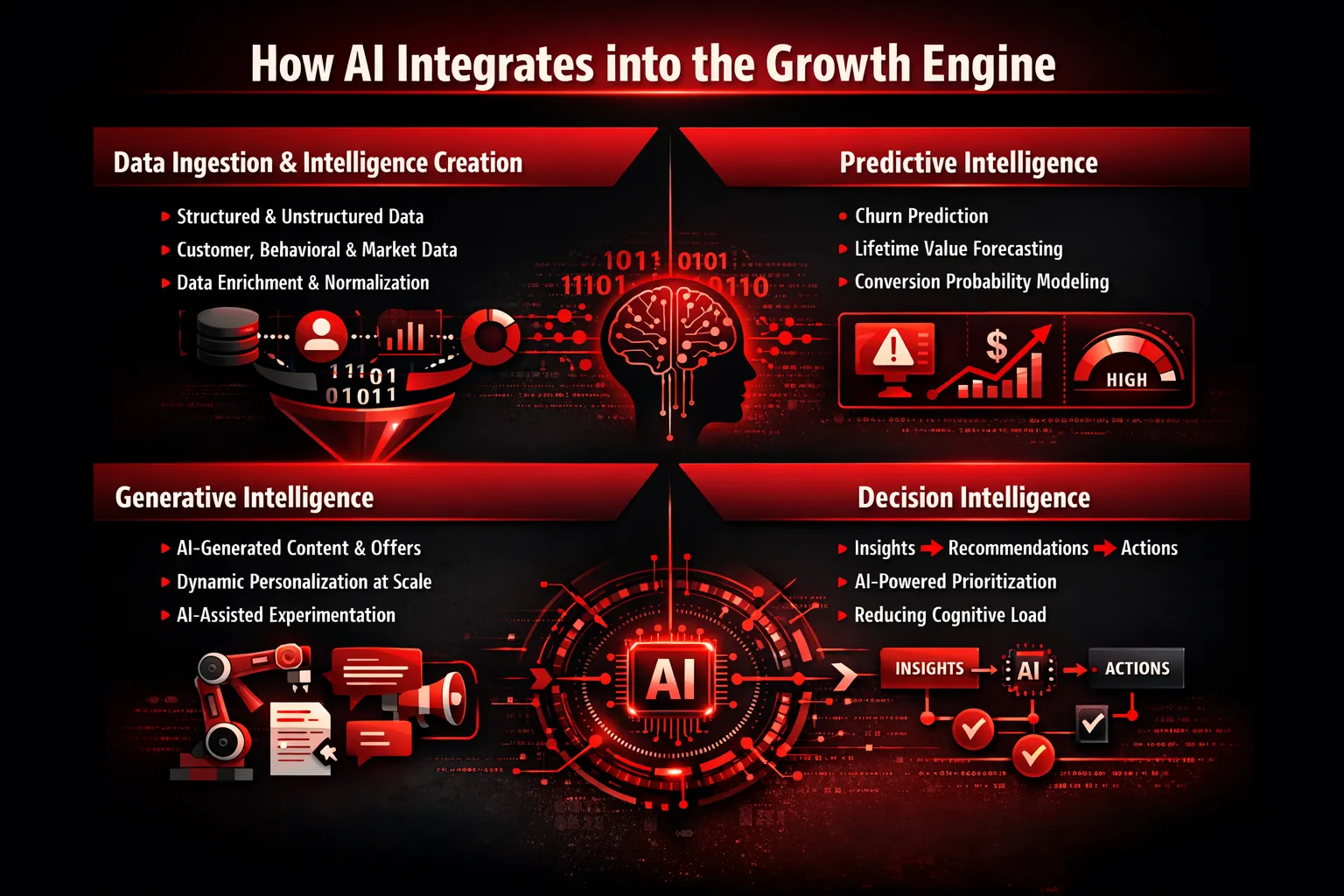
At the core of a Hyper-Intelligence Growth Engine lies artificial intelligence—not as a standalone feature, but as an embedded capability that continuously converts raw data into growth-driving actions. AI acts as the brain of the engine, enabling learning, prediction, generation, and decision-making at a speed and scale that human teams alone cannot achieve. This integration unfolds across four critical layers.
Data Ingestion and Intelligence Creation
The foundation of AI-driven growth is data ingestion, but not all data is created equal. A Hyper-Intelligence Growth Engine ingests both structured data (CRM records, transaction logs, analytics tables) and unstructured data (customer conversations, reviews, emails, social signals, support tickets, content interactions).
Beyond internal data, the engine pulls from multiple sources:
- Customer data: demographics, firmographics, preferences, purchase history
- Behavioral data: clicks, scrolls, feature usage, session depth, drop-offs
- Market data: competitor movements, pricing changes, demand signals, trends
However, ingestion alone does not create intelligence. AI systems rely heavily on data enrichment and normalization. Enrichment augments raw data with external signals—intent data, technographic insights, or predictive attributes—while normalization ensures consistency across formats, sources, and timeframes. This process transforms fragmented data into a unified, context-rich intelligence layer that AI models can reliably learn from.
Predictive Intelligence
Once data is structured and contextualized, AI enables predictive intelligence—the ability to anticipate future outcomes rather than merely react to past performance.
Key predictive applications include:
- Churn prediction: Identifying early warning signals that indicate which users or accounts are likely to disengage or cancel, often weeks before it becomes obvious to human teams.
- Lifetime value (LTV) forecasting: Estimating the long-term revenue potential of users based on behavior patterns, acquisition sources, and engagement depth.
- Conversion probability modeling: Scoring leads, users, or actions based on their likelihood to convert, upgrade, or take a desired next step.
Predictive intelligence shifts growth teams from reactive firefighting to proactive orchestration, allowing resources to be allocated where they will have the highest impact.
Generative Intelligence
If predictive intelligence tells you what is likely to happen, generative intelligence helps determine what to do about it. Powered by large language models and generative AI, this layer creates assets, messages, and experiences dynamically.
Key capabilities include:
- AI-generated content, offers, and messaging tailored to specific segments, behaviors, or intent signals.
- Dynamic personalization at scale, where every user can experience a unique journey without manual intervention.
- AI-assisted experimentation, enabling rapid creation and testing of multiple variants across content, UX, pricing, and messaging.
Generative intelligence dramatically reduces the time and cost required to test ideas, enabling continuous optimization rather than episodic campaigns.
Decision Intelligence
The most transformative layer is decision intelligence, where AI closes the loop between insight and execution. Instead of overwhelming teams with dashboards and reports, the system moves from insights → recommendations → actions.
This includes:
- AI-powered prioritization, ranking opportunities, experiments, or interventions based on predicted impact and confidence.
- Automated or semi-automated actions triggered by real-time signals.
- Reduced cognitive load on teams, allowing humans to focus on strategy, creativity, and governance while AI handles complexity and speed.
In a Hyper-Intelligence Growth Engine, AI doesn’t replace decision-makers—it augments them, turning growth into a continuously learning, self-optimizing system.
Together, these four layers ensure that AI is not an add-on, but a deeply integrated force that powers intelligent, scalable, and compounding growth.
The Analytics Backbone: Turning Data into Growth Signals
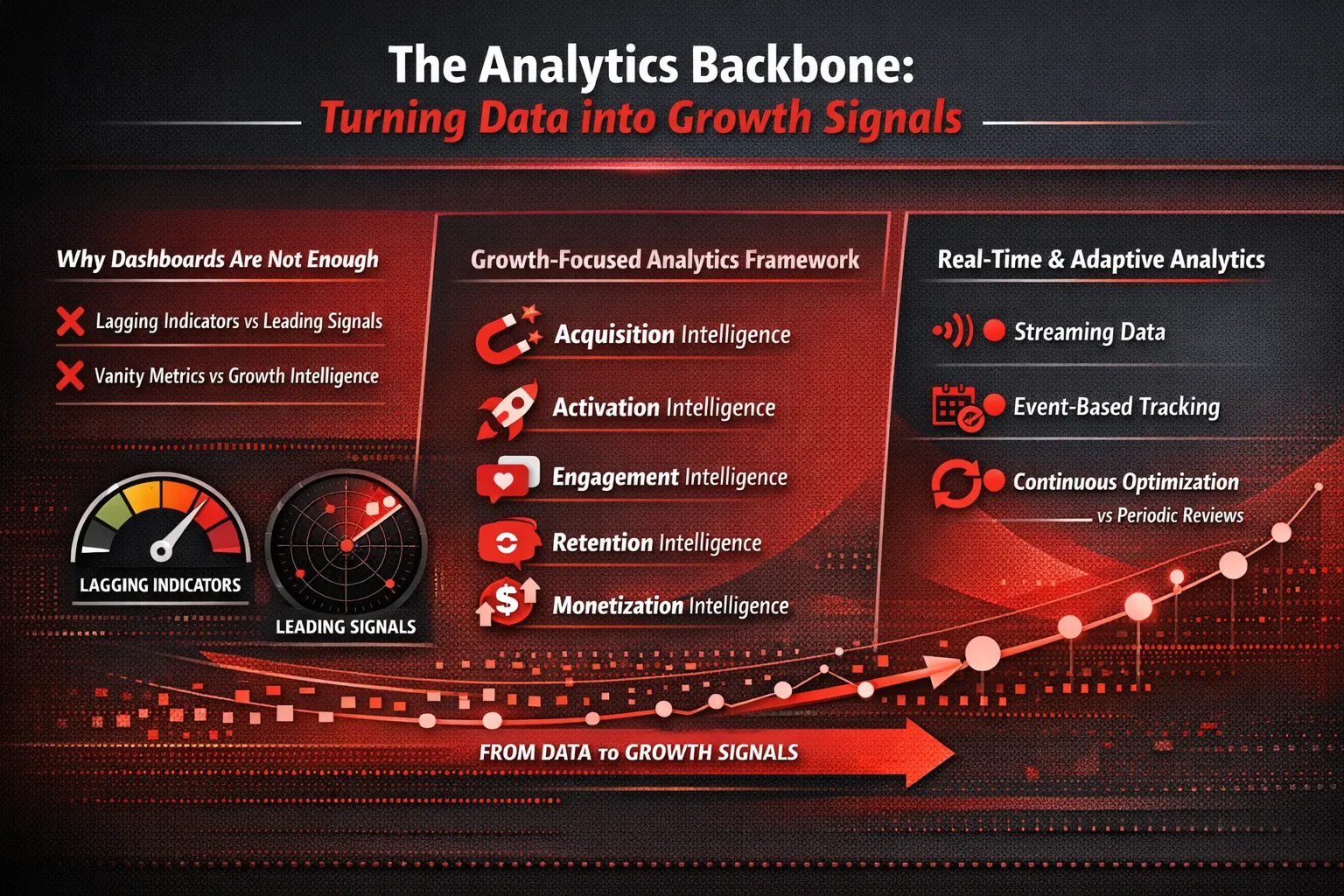
At the heart of a Hyper-Intelligence Growth Engine lies its analytics backbone. This is not just a reporting layer—it is the system that converts raw data into actionable growth signals. While most organizations collect massive amounts of data, very few translate it into intelligence that can guide timely, high-impact decisions. The difference lies in how analytics is designed, interpreted, and operationalized.
Why Dashboards Are Not Enough
Traditional dashboards are built to explain the past. They focus heavily on lagging indicators such as monthly revenue, conversion rates, or churn after it has already occurred. While useful for reporting, these metrics arrive too late to influence outcomes. A Hyper-Intelligence Growth Engine, in contrast, prioritizes leading signals—early behavioral cues that indicate future success or failure, such as intent signals, engagement depth, or product usage anomalies.
Another major limitation of dashboards is their obsession with vanity metrics. Page views, impressions, or app downloads may look impressive, but they rarely correlate directly with sustainable growth. Growth intelligence demands metrics that answer deeper questions: Why is growth happening? What is likely to happen next? What action should be taken now? Instead of static visualizations, hyper-intelligent analytics surfaces insights, probabilities, and recommendations that guide real decisions.
Growth-Focused Analytics Framework
To generate meaningful growth signals, analytics must be structured around the entire customer lifecycle:
- Acquisition Intelligence
Identifies which channels, messages, and audiences deliver not just traffic, but high-quality, high-intent users. It focuses on intent strength, cost efficiency, and predicted lifetime value rather than volume alone.
- Activation Intelligence
Analyzes how quickly and effectively users reach their first moment of value. It highlights friction points in onboarding, feature discovery, and early engagement.
- Engagement Intelligence
Measures depth, frequency, and quality of interactions. Instead of asking “Are users active?” it asks “How meaningfully are users interacting, and what patterns predict long-term adoption?”
- Retention Intelligence
Detects early churn signals and identifies behaviors that correlate with stickiness. AI models forecast churn risk before disengagement becomes visible.
- Monetization Intelligence
Connects behavior to revenue outcomes, revealing upgrade triggers, expansion opportunities, and pricing sensitivity across segments.
Real-Time and Adaptive Analytics
Hyper-intelligence thrives on real-time and adaptive analytics. Streaming data and event-based tracking allow systems to respond the moment user behavior changes, rather than weeks later. This enables dynamic personalization, instant experimentation, and rapid course correction.
Unlike periodic reviews or monthly reporting cycles, continuous analytics supports always-on optimization. The system learns with every interaction, adjusts growth loops automatically, and feeds insights back into AI models. As a result, growth becomes proactive, adaptive, and compounding—driven not by static reports, but by living intelligence.
Growth Loops: The Compounding Engine of Scale
Growth loops are the true force multipliers inside a Hyper-Intelligence Growth Engine. While many organizations still rely on funnels to manage acquisition and conversion, modern scalable growth is increasingly driven by loops—systems that continuously reinforce themselves, learn from outcomes, and compound results over time.
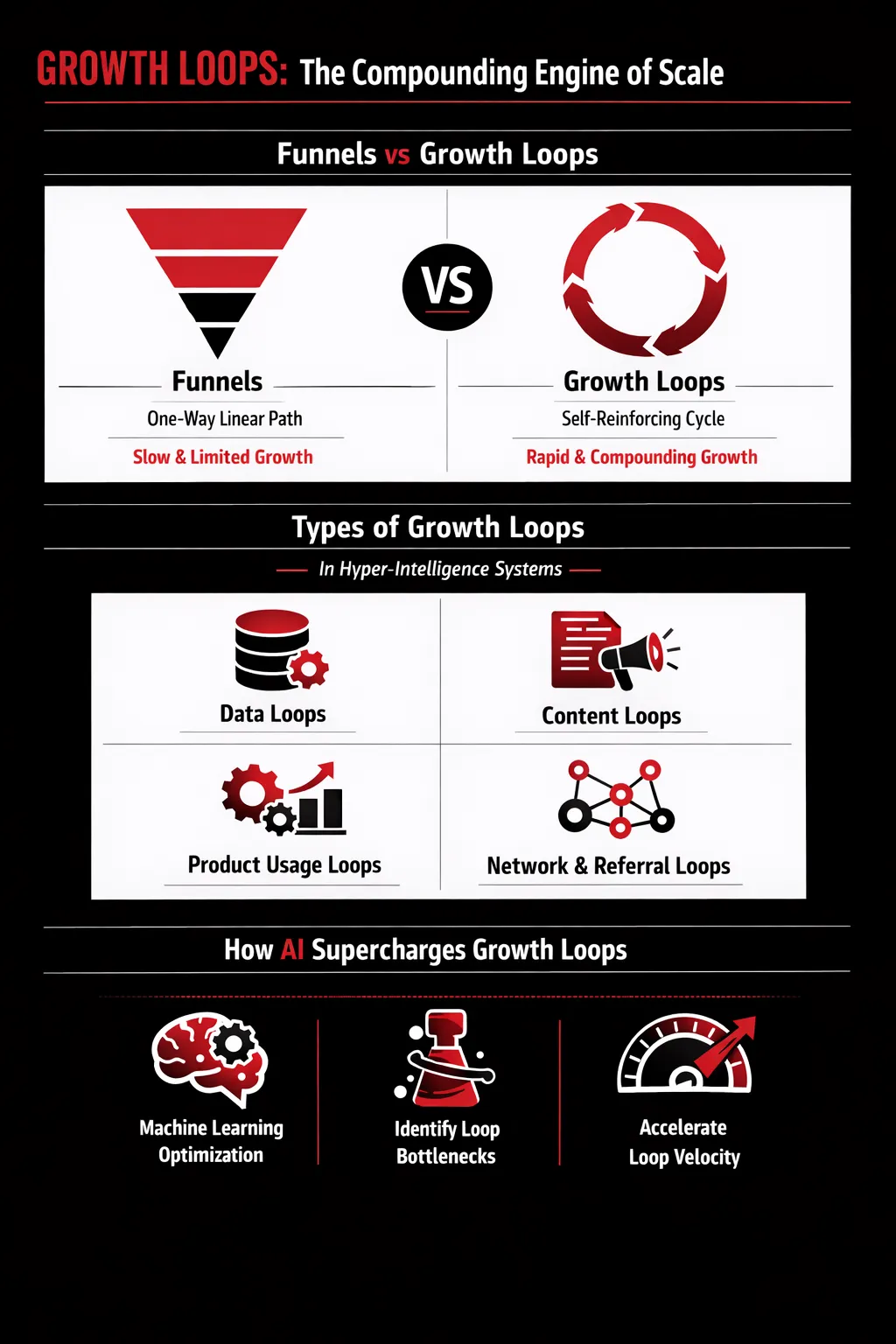
Funnels vs Growth Loops (The Critical Shift)
Traditional growth funnels are linear and one-directional. Users enter at the top, some convert, and the process largely ends there. Funnels are useful for visualization, but they have inherent limitations: they leak value, reset after each cycle, and rely heavily on constant external inputs like ad spend or manual campaigns.
Growth loops, in contrast, are self-reinforcing systems. Every output of the system becomes an input for the next cycle. Instead of ending with a conversion, a loop feeds back into itself—creating more data, more engagement, more reach, or more users without proportional increases in effort or cost.
This is why loops scale faster over time. Funnels grow linearly: more input equals more output. Loops grow exponentially: each cycle strengthens the next. When designed correctly, loops reduce marginal acquisition costs, increase learning speed, and create compounding advantages that competitors find hard to replicate. In a Hyper-Intelligence Growth Engine, loops are not accidental—they are intentionally designed, measured, and optimized.
Types of Growth Loops in Hyper-Intelligence Systems
A hyper-intelligent system typically runs multiple loops simultaneously, each reinforcing a different dimension of growth.
Data loops convert user behavior into intelligence. Every interaction generates data, which improves models, predictions, and personalization. Better intelligence leads to better experiences, which in turn generates higher-quality data—closing the loop.
Content loops use intelligence to create, distribute, and refine content. Performance data informs what content works, AI optimizes messaging and formats, and high-performing content attracts more users, producing new signals to refine future content.
Product usage loops are driven by engagement. As users interact with features, the system learns which actions drive retention or value realization. AI adapts onboarding, recommendations, or workflows, increasing usage, which feeds more insight back into the system.
Network and referral loops leverage user advocacy. Intelligent systems identify high-propensity advocates, trigger referrals at optimal moments, and personalize incentives—turning existing users into growth drivers.
How AI Supercharges Growth Loops
AI is what transforms basic loops into hyper-intelligent growth loops.
Machine learning models continuously optimize loops by learning which inputs create the strongest downstream effects. Instead of static rules, the system adapts dynamically based on real-world outcomes.
AI also excels at identifying loop bottlenecks—points where momentum slows, drop-offs increase, or value leakage occurs. These insights would be difficult or slow for humans to detect manually, especially across complex, multi-loop systems.
Finally, AI accelerates loop velocity. By automating decisions, triggering actions in real time, and continuously refining inputs, AI shortens the time between each loop cycle. Faster cycles mean faster learning, faster improvement, and faster growth.
In a Hyper-Intelligence Growth Engine, growth loops are not just mechanisms—they are living systems, constantly learning, accelerating, and compounding at scale.
Architecture of a Hyper-Intelligence Growth Engine
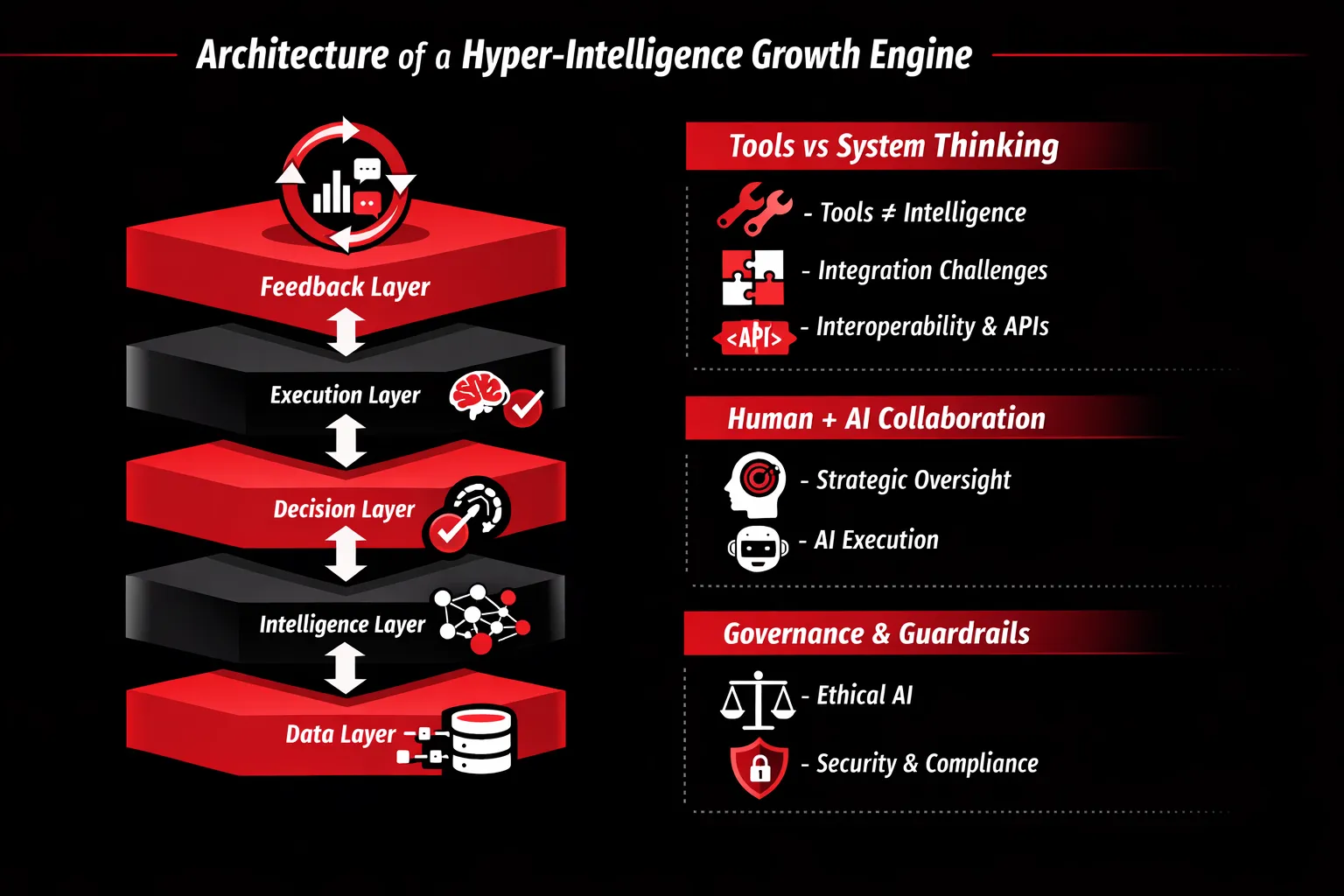
A Hyper-Intelligence Growth Engine is not a single platform or a collection of disconnected tools. It is a system-level architecture designed to continuously learn, decide, act, and improve. Understanding this architecture is critical for innovators because true growth intelligence emerges from how components interact—not from individual technologies in isolation.
High-Level System Architecture
At its core, a Hyper-Intelligence Growth Engine consists of five tightly connected layers:
1. Data Layer
This is the foundation of the engine. The data layer aggregates inputs from multiple sources—customer interactions, product usage, marketing campaigns, CRM systems, support tickets, and external market signals. Both structured and unstructured data are ingested, cleaned, enriched, and standardized. Without a reliable and unified data layer, intelligence remains fragmented and unreliable.
2. Intelligence Layer
The intelligence layer transforms raw data into meaning. This is where machine learning models, predictive analytics, and generative AI operate. Patterns are identified, behaviors are predicted, and insights are continuously refined. Unlike static reporting, this layer evolves as new data flows in, enabling the system to learn in real time.
3. Decision Layer
Insights alone do not drive growth—decisions do. The decision layer converts intelligence into prioritized recommendations and actions. It answers questions such as what should happen next, for whom, and when. AI-powered decision engines evaluate trade-offs, predict outcomes, and recommend optimal growth actions.
4. Execution Layer
This layer operationalizes decisions. Automated workflows, campaign triggers, personalization engines, and AI agents execute actions across marketing, sales, product, and customer success systems. Human-in-the-loop controls can be applied where needed, but speed and consistency are the primary advantages here.
5. Feedback Layer
The feedback layer closes the loop. Every action generates outcomes that are fed back into the system. This continuous feedback allows the engine to self-correct, optimize strategies, and improve decision accuracy over time—creating compounding growth intelligence.
Tool Stack vs System Thinking
One of the most common mistakes organizations make is equating a sophisticated tool stack with intelligence. Tools alone do not create a Hyper-Intelligence Growth Engine. Intelligence emerges from integration, orchestration, and learning across systems.
Modern growth teams often struggle with siloed platforms, inconsistent data definitions, and brittle integrations. APIs and interoperability are essential, but they must serve a system-wide architecture. When tools are connected by intelligence rather than workflows alone, the engine becomes adaptive instead of reactive.
Human + AI Collaboration Model
Hyper-intelligence does not replace humans—it amplifies them. Humans provide strategic oversight, defining objectives, ethical boundaries, and long-term vision. AI handles tactical execution, real-time optimization, and pattern detection at scale.
Governance and guardrails ensure responsible use of AI, preventing bias, over-automation, or misaligned decisions. The most successful growth engines are built on collaboration, where human judgment and machine intelligence continuously reinforce each other.
Real-World Use Cases Across Business Functions
A Hyper-Intelligence Growth Engine is most powerful when it operates across the entire organization rather than being confined to a single team. By embedding AI, advanced analytics, and growth loops into core business functions, companies can move from reactive decision-making to proactive, intelligence-led growth. Below are key real-world use cases across major functions.
Marketing: From Campaigns to Continuous Intelligence
In marketing, hyper-intelligence transforms one-size-fits-all campaigns into hyper-personalized customer journeys. Instead of segmenting audiences only by static attributes like demographics or firmographics, AI analyzes real-time behavioral signals—clicks, dwell time, intent data, content consumption, and purchase history. This allows marketers to deliver the right message, on the right channel, at the right moment, for each individual user.
Alongside personalization, predictive campaign optimization becomes a major advantage. Machine learning models forecast which campaigns, creatives, and channels are most likely to perform before budgets are fully deployed. The system continuously reallocates spend toward high-performing variants, pauses underperforming assets, and suggests new experiments. Over time, marketing evolves into a self-learning engine that improves ROI with every interaction.
Product: Building What Users Actually Need
Product teams often struggle with feature prioritization due to competing opinions and limited visibility into real usage. A Hyper-Intelligence Growth Engine solves this through usage intelligence—analyzing how users interact with features, where they drop off, and which behaviors correlate with retention and expansion.
AI models surface insights such as “features that drive long-term engagement” or “actions that predict churn within 30 days,” helping teams prioritize roadmap decisions based on impact rather than intuition.
Additionally, AI-driven onboarding optimization personalizes the first-time user experience. Instead of a static onboarding flow, the system adapts tutorials, prompts, and tooltips based on user role, behavior, and skill level, accelerating time-to-value and improving activation rates.
Sales: Intelligence-Led Revenue Acceleration
In sales, hyper-intelligence replaces manual guesswork with intelligent lead scoring. AI evaluates hundreds of signals—engagement patterns, firmographic data, buying intent, and historical deal outcomes—to prioritize leads most likely to convert. This ensures sales teams focus their time where it matters most.
Beyond scoring, next-best-action recommendations guide sales reps on what to do next: when to follow up, which message to send, what offer to propose, or when to involve a senior stakeholder. These recommendations are continuously refined through feedback loops, increasing win rates and shortening sales cycles.
Customer Success: From Reactive Support to Predictive Growth
Customer success teams benefit enormously from proactive churn prevention. By analyzing product usage, support tickets, sentiment signals, and engagement trends, AI can predict churn risk weeks or months in advance. This allows teams to intervene early with targeted actions—training, feature recommendations, or personalized outreach.
Finally, expansion intelligence identifies upsell and cross-sell opportunities by detecting patterns that signal readiness to upgrade. Instead of generic renewal conversations, customer success becomes a growth driver powered by intelligence, timing, and relevance.
Together, these use cases demonstrate how a Hyper-Intelligence Growth Engine turns every function into a coordinated, learning system—one that compounds insights into sustainable, scalable growth.
Measuring the Impact: KPIs for Hyper-Intelligent Growth
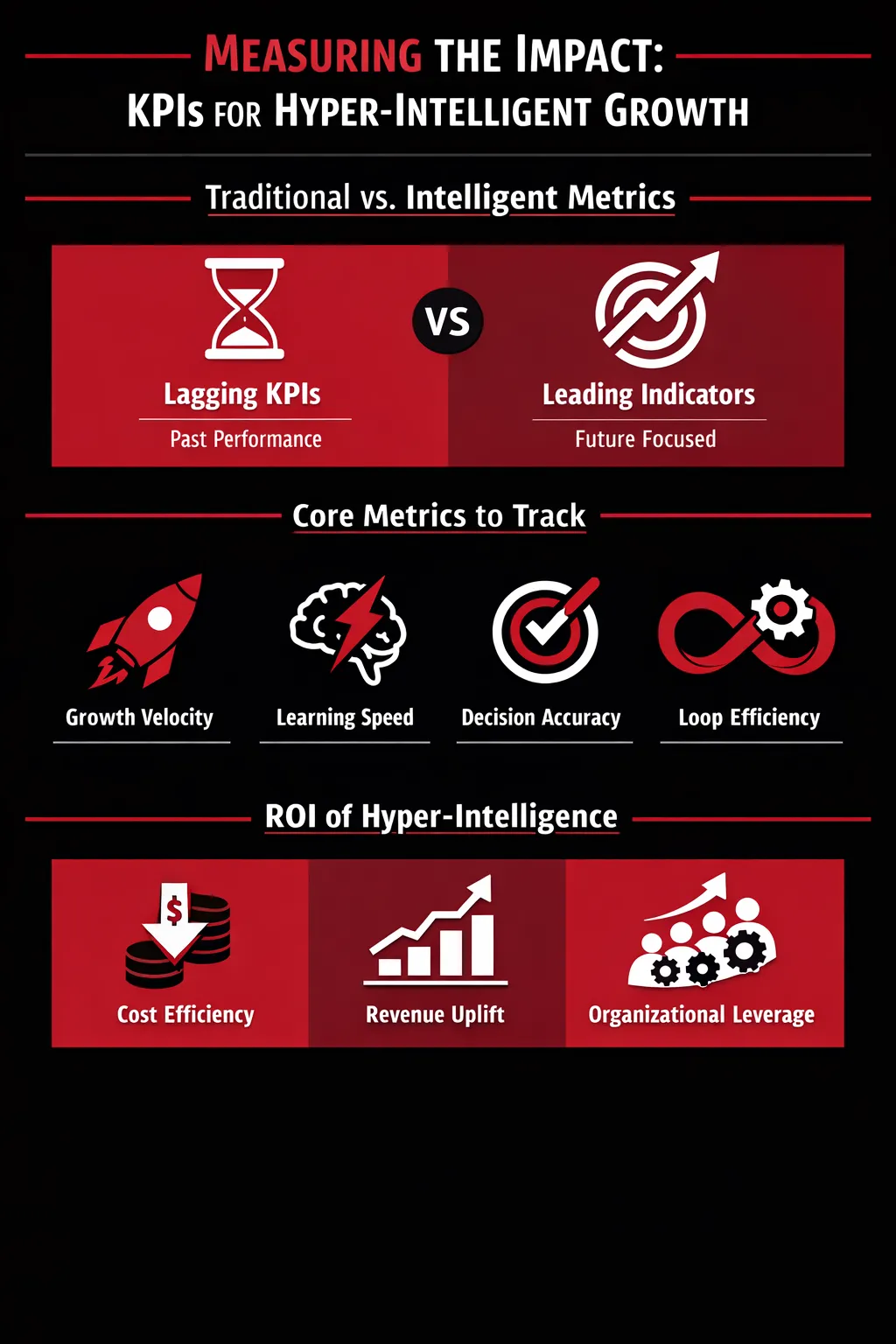
A Hyper-Intelligence Growth Engine is only as powerful as its ability to prove impact. Unlike traditional growth systems that rely on surface-level metrics, hyper-intelligent growth demands a new class of KPIs—ones that measure learning, adaptability, and compounding efficiency, not just outcomes. This shift requires moving beyond what happened to understanding why it happened, how fast the system learned, and how effectively it acted.
Traditional Metrics vs Intelligence Metrics
Traditional growth metrics are predominantly lagging indicators. Metrics such as revenue, conversions, churn, and CAC tell you what has already occurred, often weeks or months after decisions were made. While these KPIs are still important, they offer little guidance on what to do next.
Hyper-intelligent systems prioritize leading intelligence metrics—signals that predict future performance and guide real-time decisions. These include behavioral signals, intent scores, prediction confidence levels, and model outputs. Instead of asking, “Did this campaign work?”, intelligence-driven teams ask, “What signals indicate the next growth opportunity?”
In short, lagging KPIs measure results, while intelligence metrics measure capability—the system’s ability to anticipate, adapt, and improve continuously.
Core Metrics to Track
To evaluate a Hyper-Intelligence Growth Engine effectively, organizations should track four foundational metrics:
- Growth Velocity: Measures how quickly key growth metrics improve over time. Faster velocity indicates that intelligence-driven decisions are compounding impact rather than producing linear gains.
- Learning Speed: Assesses how rapidly the system learns from new data. This includes model retraining frequency, experimentation cycles, and time-to-insight. Faster learning creates a sustainable competitive advantage.
- Decision Accuracy: Evaluates how often AI-driven or AI-assisted decisions lead to positive outcomes. High decision accuracy reflects strong data quality, model reliability, and feedback integration.
- Loop Efficiency: Measures how efficiently growth loops convert inputs (data, users, content) into outputs (engagement, referrals, revenue). Optimized loops scale growth with diminishing marginal cost.
ROI of Hyper-Intelligence
The ROI of hyper-intelligence extends beyond direct financial returns:
- Cost Efficiency: Reduced waste in campaigns, tools, and manual effort through automation and precision targeting.
- Revenue Uplift: Higher conversion rates, improved retention, and increased lifetime value driven by predictive and personalized actions.
- Organizational Leverage: Teams achieve more with fewer resources, as intelligence amplifies human decision-making and execution capacity.
Ultimately, hyper-intelligent growth is not just about growing faster—it’s about growing smarter, earlier, and with exponential efficiency.
Risks, Ethics, and Governance
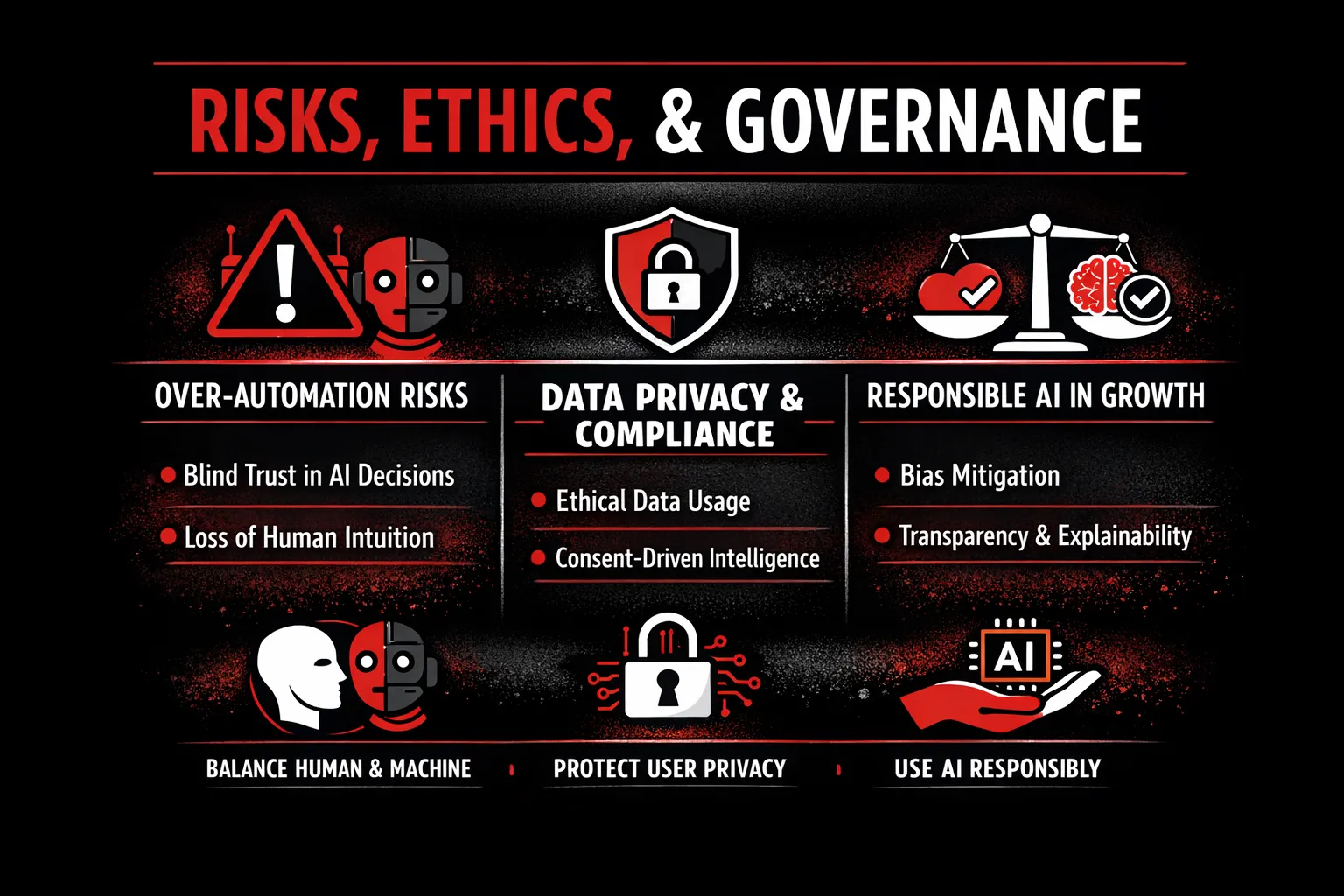
As Hyper-Intelligence Growth Engines become more autonomous and deeply embedded in business decision-making, they introduce a new class of risks that innovators must actively govern. Intelligence at scale is powerful—but without guardrails, it can amplify mistakes just as efficiently as it drives growth.
Over-Automation Risks
One of the most significant dangers is blind trust in AI-driven decisions. When organizations over-rely on automated recommendations, they risk treating AI outputs as objective truth rather than probabilistic guidance. Models are trained on historical data, which may reflect outdated assumptions, incomplete signals, or embedded biases. Without critical human oversight, automated growth systems can reinforce suboptimal strategies at scale.
Equally important is the loss of human intuition. Strategic creativity, market sensing, and ethical judgment are uniquely human strengths. Over-automation can gradually deskill teams, reducing their ability to question, challenge, or contextualize AI-driven insights. The most resilient growth engines therefore adopt a human-in-the-loop model—where AI accelerates decisions, but humans retain strategic control.
Data Privacy and Compliance
Hyper-intelligence depends on large volumes of customer and behavioral data, making ethical data usage non-negotiable. Growth should never come at the cost of user trust. Organizations must define clear data boundaries—what is collected, why it is collected, and how long it is retained.
Consent-driven intelligence is the foundation of sustainable growth. This means transparent data policies, explicit opt-ins, and strict adherence to global privacy regulations such as GDPR and emerging AI governance frameworks. Companies that embed privacy by design into their growth engines not only reduce legal risk but also build long-term brand credibility.
Responsible AI in Growth
Responsible growth intelligence requires active bias mitigation. AI models can unintentionally disadvantage certain user segments if trained on skewed datasets. Regular audits, diverse training data, and continuous monitoring are essential to prevent systemic bias.
Finally, transparency and explainability matter. Growth leaders must be able to understand why an AI system recommends a specific action. Explainable AI builds internal trust, enables accountability, and ensures that hyper-intelligence remains aligned with human values and business ethics.
The Future of Hyper-Intelligence Growth Engines
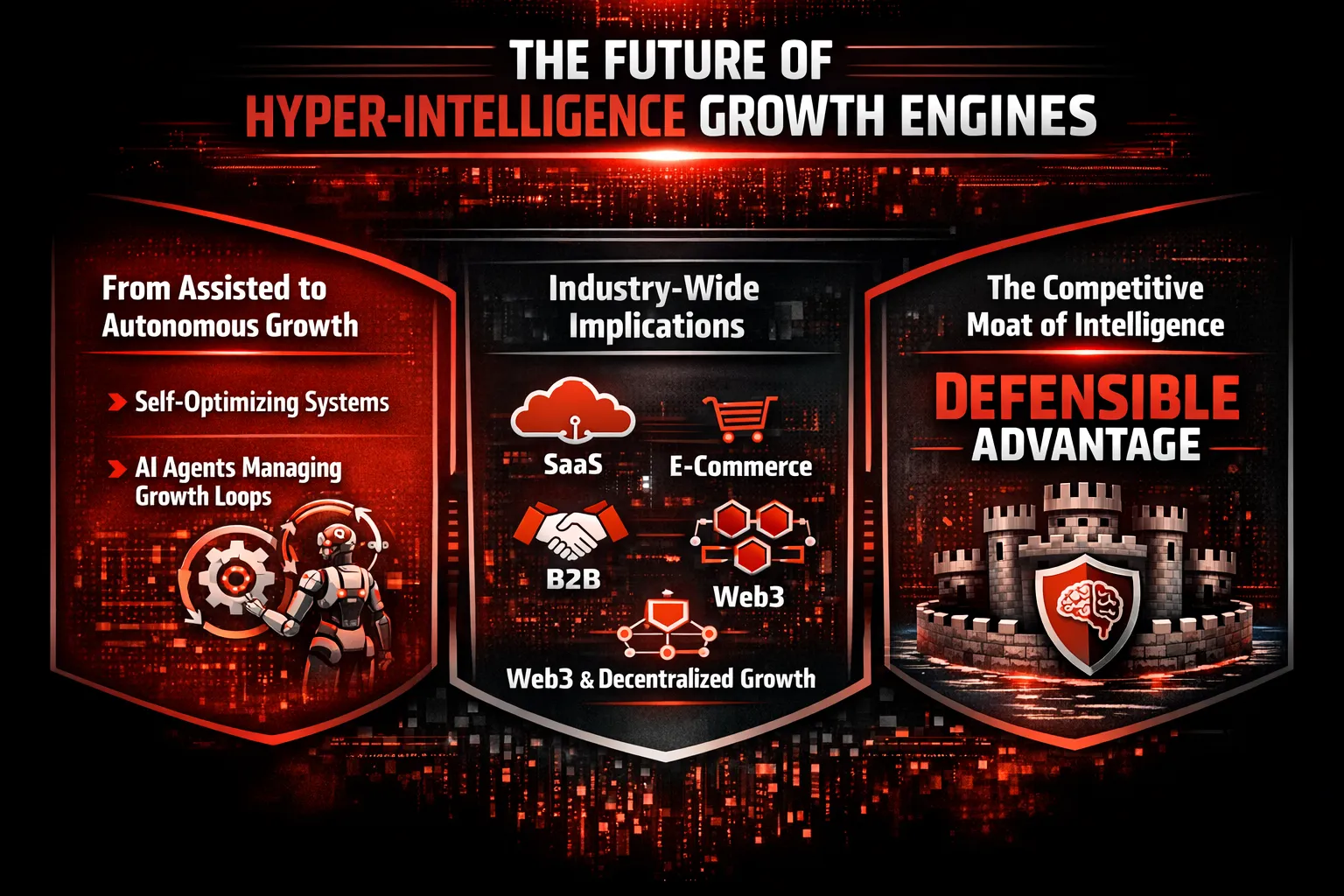
The evolution of Hyper-Intelligence Growth Engines is moving rapidly from assisted intelligence toward autonomous growth. What began as AI-powered insights and recommendations is transforming into self-optimizing systems capable of sensing, deciding, and acting with minimal human intervention.
From Assisted Intelligence to Autonomous Growth
In the near future, growth engines will no longer wait for human prompts. Self-optimizing systems will continuously ingest data, test hypotheses, learn from outcomes, and refine strategies in real time. AI agents will manage entire growth loops end-to-end—from identifying opportunities and generating personalized content to triggering campaigns, adjusting pricing, or optimizing product experiences based on live signals.
These AI agents won’t replace humans but will function as autonomous operators within clearly defined guardrails. Humans will shift into roles of system designers, ethicists, and strategic overseers, while AI handles speed, scale, and complexity that manual processes cannot match.
Industry-Wide Implications
The impact of hyper-intelligence will cut across industries:
- SaaS companies will see growth engines that dynamically optimize onboarding, feature adoption, and expansion revenue.
- E-commerce platforms will run AI-driven demand forecasting, hyper-personalized merchandising, and real-time pricing loops.
- B2B organizations will benefit from intelligent account-based growth, predictive deal intelligence, and automated pipeline optimization.
- Web3 and decentralized ecosystems will leverage hyper-intelligence for tokenomics optimization, community-led growth loops, and trustless yet adaptive systems.
The Competitive Moat of Intelligence
As hyper-intelligence matures, it becomes more than a growth tool—it becomes a defensive moat. Competitors can copy features, campaigns, and even products, but they cannot easily replicate a system that learns faster, decides better, and improves continuously. In the future, sustainable advantage will belong to organizations whose growth engines are not just data-driven, but intelligence-compounding by design.
How Innovators Can Start Building Today
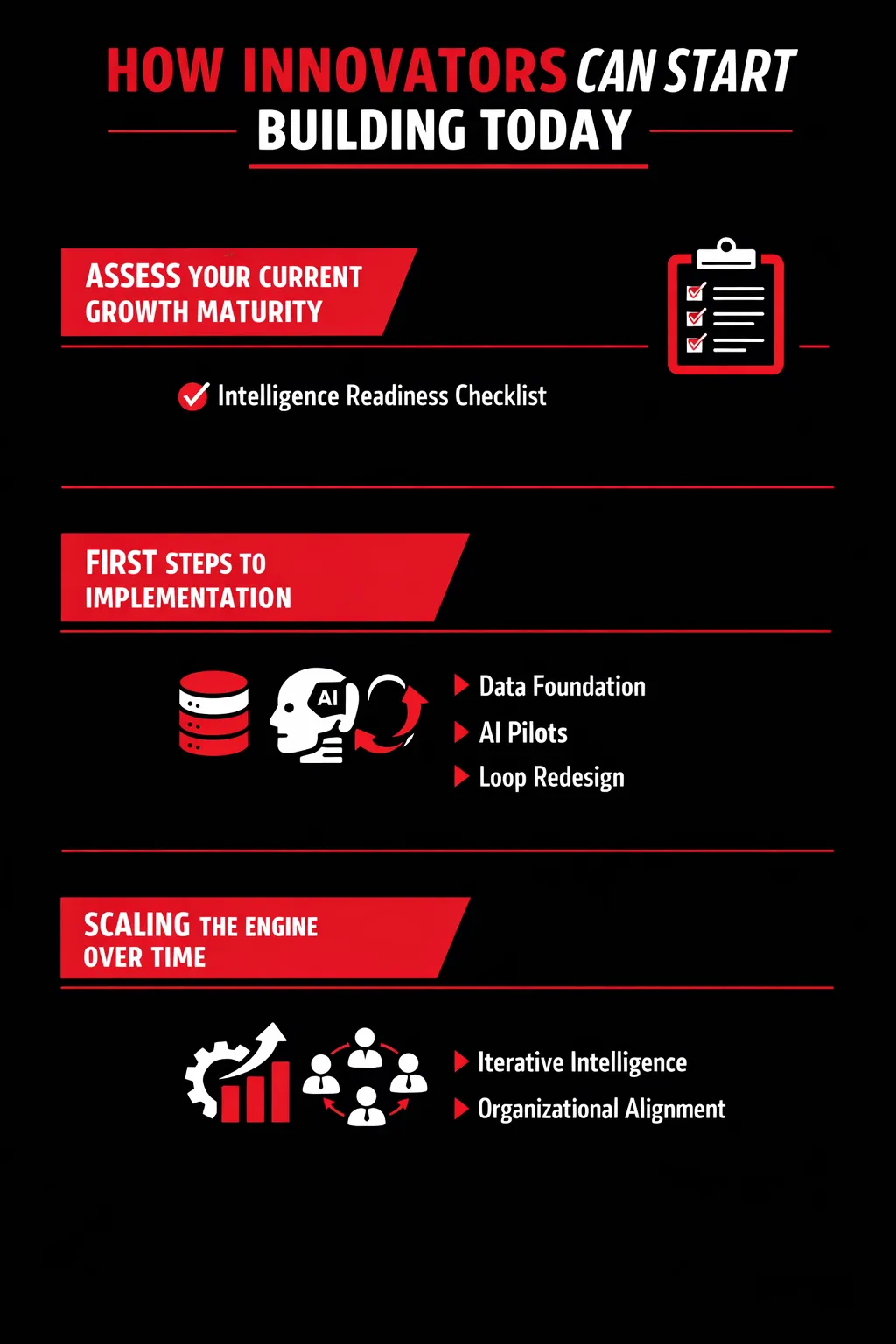
Building a Hyper-Intelligence Growth Engine doesn’t require a massive, all-at-once transformation. The most successful innovators start small, build intelligently, and scale deliberately. The key is to approach growth as an evolving system rather than a one-time initiative.
Assess Your Current Growth Maturity
Before adding new tools or AI models, innovators must understand where they currently stand. A simple intelligence readiness checklist can reveal critical gaps:
- Are growth decisions driven by real-time data or historical reports?
- Is customer data unified across marketing, product, sales, and support?
- Do teams rely on intuition or predictive insights to prioritize actions?
- Are experiments continuous and automated, or manual and sporadic?
- Is learning from past performance systematically fed back into decisions?
Organizations that answer “no” to most of these questions are not behind—they are simply at the starting line. Clarity at this stage prevents wasted investment and sets a realistic foundation for intelligent growth.
First Steps to Implementation
Once maturity is assessed, execution should begin with three practical moves.
First, strengthen the data foundation by centralizing high-quality customer, product, and behavioral data. Without clean, connected data, intelligence cannot emerge.
Second, launch small AI pilots focused on high-impact use cases such as churn prediction, lead scoring, or content personalization. These pilots validate value quickly and build internal confidence.
Third, initiate growth loop redesign. Shift from linear funnels to self-reinforcing loops where every interaction generates data, insight, and momentum for the next action.
Scaling the Engine Over Time
As the system matures, intelligence should evolve iteratively. Models improve with feedback, decisions become faster, and automation grows more autonomous. Just as important is organizational alignment—teams, leadership, and incentives must support experimentation, learning, and AI-assisted decision-making. Hyper-intelligent growth is not only a technology shift; it is a mindset transformation.
Conclusion: Growth Belongs to the Intelligent
The Hyper-Intelligence Growth Engine represents a fundamental shift in how modern organizations pursue and sustain growth. It is not a single tool, tactic, or campaign—it is a living system that continuously learns from data, applies artificial intelligence, interprets advanced analytics, and fuels self-reinforcing growth loops. By unifying AI as the decision-making brain, analytics as the signal-detection system, and growth loops as the compounding force, this engine enables businesses to move from reactive optimization to proactive, predictive, and adaptive growth.
What makes this transformation unavoidable is the reality of today’s markets. Customer behaviors change in real time, competition moves faster than ever, and the volume of data has exceeded human capacity to process it manually. In this environment, intuition alone is no longer sufficient, and static strategies quickly become obsolete. Organizations that fail to embed intelligence into their growth systems will struggle to keep pace, while those that do will continuously outlearn, out-adapt, and outperform the rest. Hyper-intelligent growth is no longer a competitive advantage—it is rapidly becoming the baseline for survival.
For innovators and leaders, the path forward is clear. Start by rethinking growth as a system, not a function. Invest in data foundations, experiment with AI-driven insights, and redesign funnels into intelligent, compounding loops. Most importantly, cultivate a culture where human creativity and machine intelligence work together. The future of growth will not belong to the biggest or the fastest—it will belong to the most intelligent.