
SUPERCHARGE YOUR ONLINE VISIBILITY! CONTACT US AND LET’S ACHIEVE EXCELLENCE TOGETHER!
Founders and decision-makers are facing a quiet but dangerous shift in digital marketing. Organic traffic plateaus even when rankings appear stable. Visibility declines despite continuous SEO investments. Growth becomes unpredictable, fragile, and increasingly dependent on paid channels.

This is not a traffic problem. It is a visibility problem.
Search behavior has fundamentally changed. Buyers no longer browse ten links to compare options. They ask questions and expect immediate answers. AI-driven platforms summarize choices, recommend brands, and influence decisions before users ever reach a website. In this environment, traditional SEO alone cannot deliver sustainable growth.
The challenge is no longer about ranking pages. The challenge is about being present in answers.
This case study explores how ThatWare helped a banner-focused business overcome declining discoverability by shifting from conventional SEO thinking to Generative Engine Optimization and Generative Engine Optimization. The outcome was not short-term traffic spikes, but durable, scalable visibility across AI-powered search ecosystems.
The Client Context: A Niche Business with A Narrow Growth Window
pullupbannersaustralia.com.au operates in a highly specialized commercial niche. The business focuses exclusively on banner printing and related products, where organic demand is driven by precise, high-intent queries rather than broad discovery traffic. Growth opportunities are limited by relevance, not volume.
This created a narrow growth window from the outset. The business could not rely on generic keywords, informational traffic, or paid acquisition to scale. Every meaningful visitor needed to arrive through banner-related searches with clear commercial intent. Any visibility gap directly translates into missed revenue opportunities.
Before engaging with ThatWare, the website struggled to gain consistent organic traction. Despite having multiple product pages, category structures, and supporting content, the site was underperforming in search visibility. More critically, it lacked meaningful presence across answer-driven search experiences, where modern buyers increasingly make decisions before clicking through to websites.
This made Generative Engine Optimization a strategic necessity rather than an optional enhancement.
Data Snapshot: Quantifying The Pre- and Post-GEO Impact
Once ThatWare’s GEO framework was implemented, performance metrics began to reflect a clear shift in visibility and engagement quality.
Clicks & Impressions Growth in Relevant Queries
Search Console data comparing recent periods showed a strong uplift in search performance:
- Total clicks increased from 189 to 382 in a 28-day comparison window
- Total impressions grew from 47.5K to 69.3K in the same period
- Average CTR improved from 0.3% to 0.5%
- Average position improved from 36.7 to 30.5
These improvements indicate more than ranking movement. They reflect improved answer eligibility and stronger relevance for banner-specific queries.
Over a longer horizon, the impact became even clearer:
- 1.7K clicks in the last 3 months, compared to 666 in the previous 3 months
- 315K impressions, up from 220K
- Average position improved significantly from 37.8 to 27.4
This sustained improvement signals durable visibility rather than short-term fluctuation.
Page-Wise Organic Growth across Key Assets
Page-level performance further validated the effectiveness of GEO implementation. Core pages, including the homepage and high-intent product pages, showed consistent organic growth after content restructuring and answer optimization.
This confirmed that GEO benefits are not limited to informational content. When commercial pages are structured around intent clarity and direct answers, they can perform strongly across modern search interfaces.
Main Targeted Country Traffic Improvement
Traffic growth was highly concentrated in the intended market, reinforcing relevance over vanity metrics.
For Australia, the primary target country:
- Active users increased by 78.93%
- New users grew by 82.72%
- Engaged sessions rose by 74.69%
This data confirms that visibility gains translated into real audience growth within the correct geographic market, not diluted global traffic.
Why These Numbers Matter for A Niche Business?
For a narrowly focused business like Pull Up Banners Australia, growth cannot be manufactured through scale. It must be earned through precision. The improvements across clicks, impressions, page performance, and country-specific engagement demonstrate how Generative Engine Optimization creates leverage within constrained demand environments.
ThatWare’s GEO strategy enabled AI-driven systems to clearly interpret intent, extract answers, and surface the brand consistently for banner-related questions. This shifted the site from passive indexing to active discovery, even within a limited keyword universe.
In a narrow growth window, that shift makes all the difference.
Reframing The Strategy around Search Intent, Not Keywords
For years, SEO success was measured through rankings, backlinks, and keyword density. Those signals still matter, but they no longer control discovery.
As a result, many well-optimized websites fail to surface where it matters most. This client faced exactly that limitation. The site was optimized for pages, not for questions. It was readable for humans, but not structured for machines that generate answers.
ThatWare began the engagement by redefining the problem. Instead of asking how to rank higher, the strategy focused on how users actually search, ask, and decide.
Search intent became the foundation of the entire campaign.
Rather than treating intent as a ranking factor, it was treated as a visibility prerequisite. Content was mapped to how buyers explore banner solutions, evaluate options, and seek confirmation before purchasing.
This process followed the three critical dimensions of search intent.
Content Type Alignment
Different queries demand different content types. Informational queries require guidance. Commercial queries demand clarity. Transactional searches expect precision.
ThatWare structured the site to support blog content, product pages, category pages, and targeted landing pages, each aligned with a distinct intent layer.
Content Format Optimization
Users searching for banner solutions are not browsing casually. They want buying guidance, comparisons, and practical explanations. Content was reshaped to provide structured, decision-support information rather than generic descriptions.
Content Angle Refinement
The dominant content angle focused on product design, uniqueness, and buying considerations. This angle matched how AI systems evaluate and recommend products inside generative responses.
This intent-first foundation prepared the website for a deeper transformation.
From Intent Optimization to Generative Engine Optimization
Once search intent was fully aligned, ThatWare extended the strategy beyond traditional optimization. Generative Engine Optimization became the core execution layer.
GEO focuses on optimizing content for AI systems that answer questions directly. These systems include ChatGPT, Google AI Overviews, Gemini, Claude, Perplexity, and voice assistants. Unlike traditional SEO, GEO prioritizes answer clarity, contextual completeness, and conversational structure.
For this project, GEO meant restructuring content into question-led formats, implementing schema and structured data, and designing pages that could be confidently summarized by AI engines. FAQ frameworks, direct-answer sections, and conversational language patterns were integrated across key pages.
This allowed the website to move from being indexed to being referenced.
Why This Foundation Enabled Sustainable Growth?
This phase of the campaign was not designed for immediate traffic spikes. It was designed for durability. By aligning search intent, content structure, and machine readability, ThatWare prepared the site for visibility across present and future search interfaces.
Without this foundation, GEO could deliver consistent results. With it, the brand was positioned to earn authority inside answers rather than compete endlessly for rankings.
Why Generative Engine Optimization Required A Platform-Specific Approach?
Once the foundational intent and structure were in place, the challenge shifted from readiness to execution. Generative Engine Optimization cannot be implemented as a single blanket tactic. Each AI-driven platform interprets, extracts, and presents information differently. Sustainable visibility depends on understanding these behavioral differences.
Visibility Emergence inside ChatGPT Responses
Following the Generative Engine Optimization implementation, the first major signal appeared inside ChatGPT-generated answers. Queries related to banner types, usage scenarios, and buying considerations began surfacing the client’s content as a referenced source.
This visibility shift was significant for two reasons.
- First, ChatGPT responses do not rely on traditional ranking positions.
- Second, inclusion signals a high level of contextual trust.
The content was no longer competing for clicks alone. It was influencing decisions at the answer stage.
This moment marked the transition from optimization to authority.
Expansion Into Gemini, Claude, And Perplexity
Generative Engine Optimization effects compounded as other AI platforms followed similar patterns. Below are the references.
- Gemini responses began reflecting structured explanations aligned with the client’s content.
- Claude surfaced detailed summaries rooted in the same contextual framing.
- Perplexity referenced the site within exploratory and comparative queries.
As you can see, each platform validated the same principle. So, when content is structured for intent clarity and answer completeness, generative engines independently recognize and reuse it.
This cross-platform visibility reduced dependency on any single search interface. For founders, this diversification represents a major sustainability advantage.
Inclusion within Google AI Overviews & Maps
One of the most impactful outcomes emerged within Google’s AI Overviews. These summaries sit above traditional organic results and often absorb user attention entirely. After GEO execution, banner-related queries began triggering AI Overviews that referenced and aligned with the client’s content. Here it is:
Google Maps Overviews also reflected improved contextual relevance, reinforcing local and commercial trust signals.
This visibility layer directly influenced high-intent users without requiring them to scroll or click.
Supporting GEO with Technical And Structural Enhancements
Generative Engine Optimization performs best when supported by technical excellence. During this phase, ThatWare reinforced several structural elements for the campaign to ensure AI systems could access and interpret content efficiently.
A flat site architecture reduced crawl depth, allowing faster discovery of key pages. Internal linking was refined to strengthen topical clusters. Core Web Vitals improvements reduced friction for both users and machine crawlers.
JavaScript execution was optimized, lazy loading was implemented, images were compressed, and server response times were improved. These changes enhanced page performance and ensured consistent rendering across devices.
For AI-driven systems, reliability matters as much as relevance.
Early Signals of Performance Lift
Early indicators were already visible during this phase. Clicks and impressions for banner-related queries began increasing. Page-level visibility improved across core product and category pages. AI-driven referrals emerged as a new visibility layer.
This growth was not driven by aggressive keyword expansion. It was driven by relevance amplification.
Why GEO Created A Sustainable Advantage?
Generative Engine Optimization does not chase algorithm updates. It aligns with how search engines are evolving. By focusing on answers, entities, and trust, ThatWare positioned the brand for long-term discoverability across both current and future interfaces.
Data-Backed Growth after GEO Implementation
Moving from Visibility to Measurable Business Impact
Generative Engine Optimization and Generative Engine Optimization only matter if they translate into measurable outcomes. For founders and decision-makers, theory carries little weight without proof.
What followed the GEO implementation was not an abstract improvement in visibility, but a clear, sustained rise in relevant organic performance.
This section focuses entirely on what changed after execution. Every insight is grounded in data captured from the campaign itself.
Click & Impression Growth across Relevant Queries
One of the earliest quantitative signals came from search console data. After GEO implementation, clicks and impressions for banner-related queries increased consistently. Importantly, this growth was not spread across irrelevant keywords. It was concentrated around high-intent, commercially aligned searches.
This distinction matters. Many campaigns inflate numbers through broad keyword expansion. This campaign did the opposite. It strengthened relevance and authority within a tightly defined niche.
Clicks & Impression Improvement in relevant queries:
Explanation:
This screenshot shows a clear upward trajectory in impressions followed by clicks for banner-specific queries. The pattern reflects improved answer eligibility rather than random ranking fluctuations.
Increased impressions indicate that AI-driven and traditional search systems began surfacing the brand more frequently. The rise in clicks confirms that visibility translated into engagement, not just exposure.
Page-Wise Organic Growth: Homepage Performance
Page-level analysis provides deeper insight into how GEO reshaped visibility. The homepage, which previously struggled to attract consistent organic attention, showed clear improvement after optimization.
Page-Wise Organic Growth – Homepage
Source: pullupbannersaustralia.com.au
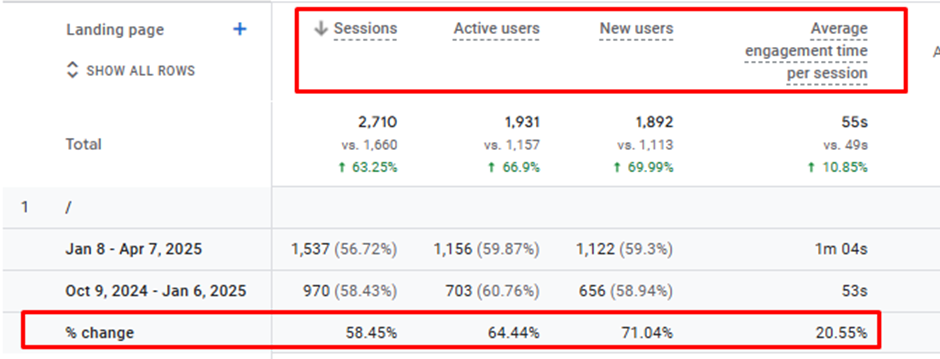
Explanation:
The homepage began capturing broader intent signals after content restructuring and GEO alignment. Improved internal linking, clearer entity associations, and enhanced contextual relevance allowed the page to function as both a navigational and informational asset. This made it more attractive to AI systems summarizing brand-level queries.
For founders, this demonstrates how homepage visibility can be restored without aggressive redesign or paid amplification.
Product Page Growth: Fabric Arch Category
Beyond the homepage, individual product categories experienced notable organic uplift. The Fabric Arch page is a strong example of how GEO benefits commercial pages, not just informational content.
Here’s an example for you.
Page-Wise Organic Growth – Fabric Arch Product Page
Source: pullupbannersaustralia.com.au/products/fabric-arch/
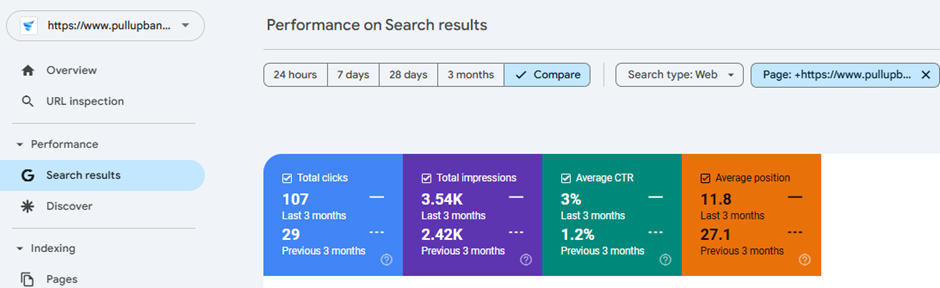
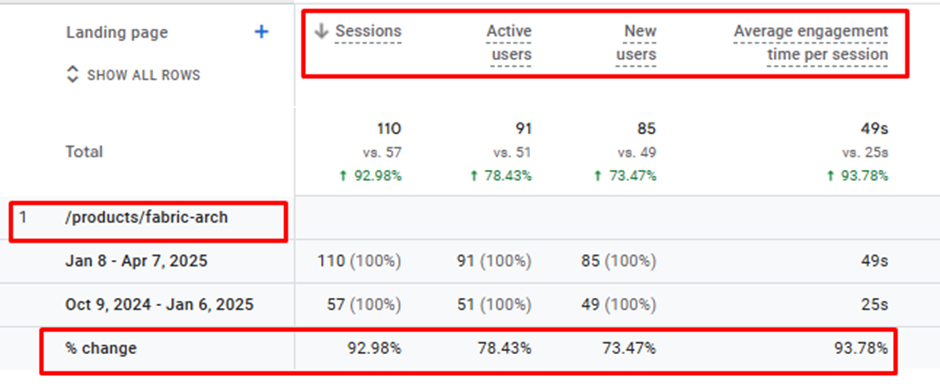
Explanation:
After optimization, this page began appearing more frequently for product-specific and comparison-based queries. Content restructuring emphasized buying guidance, design considerations, and use cases, which aligned well with conversational AI responses. The growth reflects stronger alignment between user intent and machine interpretation.
This validates a key GEO principle. Transactional pages can earn answer visibility when structured correctly.
Product Page Growth: Inflatable Arches Category
A similar pattern emerged for the Inflatable Arches category page. This confirms that the results were not isolated or coincidental.
Page-Wise Organic Growth – Inflatable Arches Product Page
Source: pullupbannersaustralia.com.au/products/inflatable-arches/
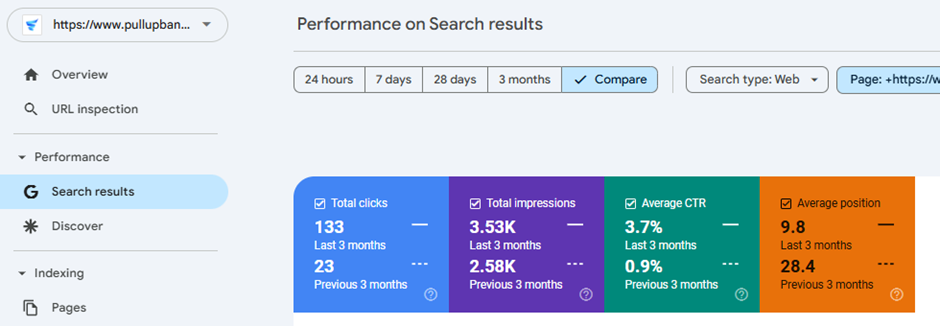
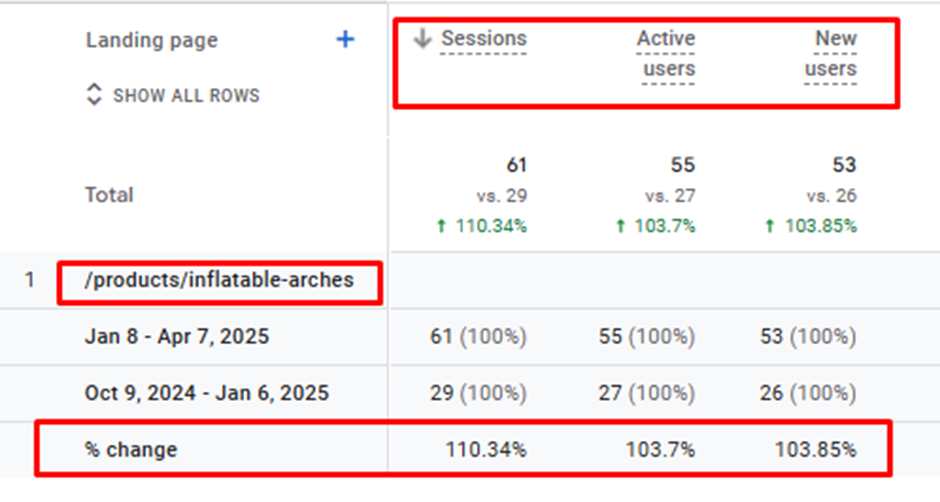
Explanation:
Organic performance improved steadily after GEO implementation. The page benefited from clearer entity definitions, reduced crawl depth, and improved internal context. AI systems were able to interpret the page as a definitive source for inflatable arch solutions, increasing its inclusion in answer-driven discovery.
For decision-makers, this shows scalability. The approach works across multiple product lines.
Country-Level Traffic Improvement: Targeted Market Growth
Traffic growth was not evenly distributed across geographies. It aligned precisely with the business’s targeted market.
Main Targeted Country Traffic Improvement:
Explanation:
Organic traffic from the primary target country increased significantly after GEO execution. This confirms that the strategy did not attract irrelevant global traffic. Instead, it strengthened regional relevance signals, which are critical for commercial conversion.
This outcome reflects the combined effect of GEO, structured content, and location-aware generative visibility.
City-Wise Traffic Growth: Localized Authority Signals
City-level data provides another layer of validation. After optimization, traffic improvements appeared across multiple targeted cities.
Targeted City-Wise Traffic Improvement:
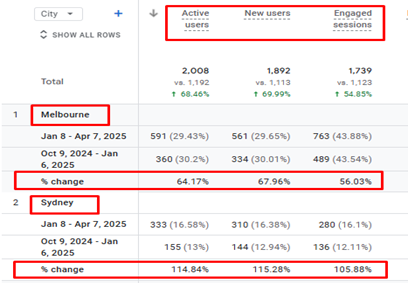
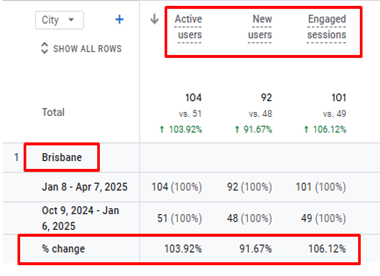
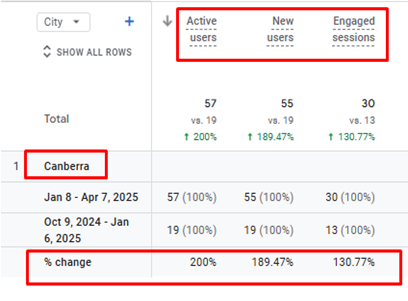
Explanation:
This screenshot shows improved visibility and engagement across key cities. The growth indicates that the brand became more discoverable for location-specific queries, even without heavy local SEO tactics. AI systems inferred geographic relevance through content clarity and contextual cues.
For founders, this represents efficient scale without operational complexity.
Why These Results Point to Generative Engine Optimization?
The most important insight is not just growth, but how growth occurred. Rankings alone cannot explain inclusion inside ChatGPT, Gemini, Google AI Overviews, and Perplexity. These platforms rely on trust, clarity, and entity coherence.
Generative Engine Optimization amplified the effects of GEO by reinforcing brand authority across AI ecosystems. Content became reusable by machines. Entities became recognizable. Answers became attributable.
This created a compounding visibility effect that traditional SEO cannot replicate reliably.
Sustainability over Short-Term Gains
None of these improvements relied on temporary tactics. There was no keyword stuffing, no backlink manipulation, and no aggressive expansion into unrelated topics. The growth emerged from alignment, not exploitation.
For founders seeking sustainable marketing solutions, this distinction is critical. GEO reduces long-term risk by aligning with how discovery is evolving, not how it worked in the past.
Strategic Takeaways for Decision-Makers
This phase of the campaign delivers several clear lessons:
- Visibility now depends on answer inclusion, not just rankings
- Commercial pages can benefit from GEO when structured correctly
- AI platforms reward clarity, not volume
- Sustainable growth emerges from relevance, not reach
These insights are transferable across industries facing similar challenges.
What This Case Study Reveals about The Future of Search & Growth?
The results from this campaign highlight a structural change in how discovery works. Search is no longer designed to send traffic generously. It is designed to resolve intent efficiently. AI-driven systems summarize, recommend, and decide which sources deserve visibility before users ever reach a website.
This shift fundamentally changes how sustainable growth must be approached. Brands competing only for rankings are fighting over shrinking attention. Brands optimizing for answers are positioning themselves at the point of decision.
The banner brand in this case study did not win by chasing more keywords. It won by becoming a trusted source for AI-generated answers. That distinction defines the next phase of digital marketing.
In this case study, AI inclusion preceded traffic growth. Visibility inside answers came first. Engagement followed later. This sequence is becoming increasingly common.
Founders evaluating performance must look beyond dashboards. Answer presence, generative mentions, and conversational visibility are emerging indicators of market authority.
Sustainable Marketing Requires Structural Alignment, Not Tactical Hacks
One of the most important lessons from this campaign is what did not drive success. There were no shortcuts. No keyword stuffing. No aggressive backlink manipulation. No trend chasing.
The results came from alignment. Content aligned with intent. Structure aligned with machine understanding. Experience aligned with user expectations. AI systems rewarded that alignment naturally.
This approach scales without constant intervention. It adapts as platforms evolve. It reduces dependency on paid channels.
For businesses seeking stability rather than spikes, this matters.
Why This Approach Works across Industries?
Although this case study focuses on a banner business, the principles are industry-agnostic. Any business selling solutions, products, or expertise is affected by AI-driven discovery.
Professional services, manufacturing, SaaS, eCommerce, and B2B providers all face the same shift. Buyers ask questions. AI answers them. Brands either appear or disappear.
This campaign proves that visibility can be engineered deliberately.
The Strategic Advantage ThatWare Brings
What differentiates ThatWare is not tool usage. It is a mindset. The approach begins with understanding how search is evolving, not how it worked. GEO is treated as a strategic system, not an isolated tactic.
ThatWare builds for where attention is moving, not where it has been.
For founders and decision-makers seeking sustainable growth, this philosophy matters more than any individual metric.
The Role of Entity Authority in Generative Search Ecosystems
Why AI Engines Think in Entities, Not Keywords?
Generative engines do not understand content the way humans do. They process entities, relationships, and contextual confidence. Keywords act as signals, but entities act as anchors.
In this campaign, ThatWare focused heavily on entity clarity. Products, categories, attributes, and use cases were defined consistently across the site. This allowed AI systems to recognize the brand as a coherent knowledge source rather than fragmented pages.
The entity authority explains why multiple AI platforms surfaced the same content independently. Once trust was established at the entity level, visibility scaled naturally.
How Entity Reinforcement Strengthened Brand Recognition?
Entity reinforcement occurred through structured content, internal linking, schema usage, and consistent language patterns. Each page reinforced the same semantic identity.
This reduced ambiguity for AI systems. It also reduced the risk of misinformation or partial summarization.
For founders, entity authority represents a long-term asset. Unlike rankings, it does not reset with every update.
Operational Lessons from The Case Study Execution
Why Process Discipline Matters More Than Tools?
This campaign did not rely on exotic tools or proprietary platforms alone. It relied on disciplined execution. Search intent mapping, structured content creation, technical hygiene, and continuous validation were applied methodically.
Many teams fail not because they lack tools, but because they lack coherence. GEO demands alignment across content, UX, and technical teams.
This case study reinforces the importance of strategic patience.
Scaling GEO without Content Bloat
Another important lesson is restraint. The campaign did not flood the site with new pages. Instead, it refined existing assets and strengthened their clarity.
This approach minimizes maintenance overhead while maximizing impact. For founders managing lean teams, this efficiency is critical.
More content is not the answer. Better-structured content is.
How GEO Became A Sustainable Growth Engine for Pull Up Banners Australia
This campaign proves that sustainable organic growth no longer comes from rankings alone. It comes from being recognized as a trusted answer source across AI-driven search environments. For pullupbannersaustralia.com.au, ThatWare’s Generative Engine Optimization strategy transformed how the brand was discovered, interpreted, and surfaced across modern search platforms.
After GEO implementation, the campaign achieved consistent growth in clicks and impressions across banner-specific queries, signaling improved answer-level visibility rather than short-term ranking volatility. Multiple high-intent pages, including core product and category pages, recorded clear page-wise organic traffic growth, confirming that GEO works beyond informational content. Most importantly, targeted country-level and city-level traffic increased, reinforcing relevance within the business’s actual market, not inflated global reach.
This outcome was not driven by content volume or paid amplification. It was driven by intent clarity, structured answers, and machine-readable trust signals. ThatWare’s GEO framework enabled AI platforms to confidently extract, summarize, and reference the brand’s content when users asked banner-related questions. As a result, visibility shifted from competing for clicks to influencing decisions.
For founders and decision-makers seeking sustainable marketing solutions, this case study shows what future-ready optimization looks like. Generative Engine Optimization is the mechanism through which brands earn durable visibility in an AI-first search ecosystem.
So, when executed with precision, as demonstrated in this campaign, GEO becomes a long-term growth asset rather than a tactical experiment.