SUPERCHARGE YOUR ONLINE VISIBILITY! CONTACT US AND LET’S ACHIEVE EXCELLENCE TOGETHER!
In today’s rapidly evolving digital landscape, the way users search for information is changing In today’s fast-changing digital world, the way people access information is evolving rapidly. Users increasingly turn to generative AI systems for guidance, expecting actionable insights rather than simply browsing through lists of links. This shift opens a significant opportunity for businesses that can position themselves as trusted, authoritative sources in AI-generated responses. For service-oriented organizations, especially those serving local markets, this requires a strategy that goes beyond traditional SEO.

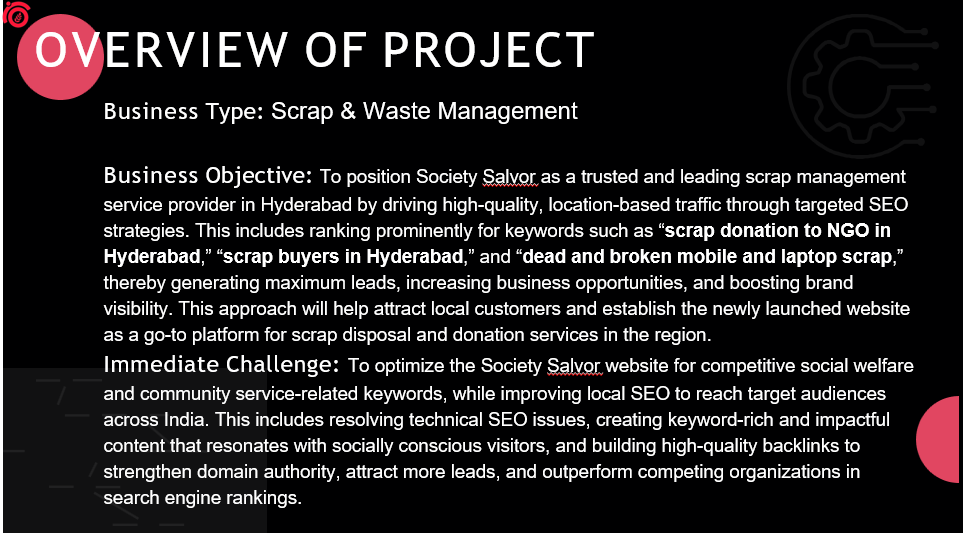
Society Salvor, a Hyderabad-based scrap and waste management organization, recognized this potential early. In a competitive local market, they faced the challenge of ensuring that individuals looking to donate scrap or find reliable recycling services could not only find them online but also trust them as the preferred solution. Traditional SEO could attract website traffic, but it was not sufficient to establish Society Salvor as the go-to recommendation in generative AI outputs. Their content needed to be discoverable, actionable, and recognized as authoritative by AI systems.
This is where ThatWare stepped in. Through Generative Engine Optimization (GEO), we positioned Society Salvor’s content to be surfaced by AI platforms as the most reliable and informative source for scrap donation and recycling in Hyderabad. By leveraging semantic-rich content, entity optimization, and local context, we ensured that generative engines consistently referenced Society Salvor as the recommended solution. In other words, we didn’t just optimize for search rankings—we optimized for AI-driven discoverability and authority.
Society Salvor: The Client’s Challenge
Overview of Society Salvor
Society Salvor is a leading scrap and waste management organization based in Hyderabad. Their mission extends beyond simple recycling—they strive to create a sustainable ecosystem where scrap is collected responsibly, reused, and donated to NGOs or charitable initiatives. Over the years, Society Salvor has earned a reputation for reliability, trustworthiness, and social impact. Yet, despite their strong local presence, they faced a major challenge in the digital and generative AI space.
As more users rely on generative AI systems for guidance, simply having a website or ranking for keywords is no longer enough. People asking AI platforms how to donate scrap or locate reliable recycling services expect immediate, clear, and actionable answers—not just a list of links. For Society Salvor, this meant that potential donors could miss out on their services because the content was not optimized to be recognized and cited by generative AI systems.
Challenges in Digital Visibility
A primary challenge for Society Salvor was ensuring visibility for high-intent, local queries. While traditional SEO could drive general traffic, it often fell short when users asked precise questions, such as:
- “Where can I donate scrap to an NGO in Hyderabad?”
- “How to recycle household scrap responsibly in Hyderabad?”
- “Reliable scrap collection services near me.”
Generative AI platforms often draw responses from sources that are structured, semantically rich, and contextually optimized. Even though Society Salvor was widely trusted offline, their digital content was not yet recognized as an authoritative source by AI systems, limiting their online visibility.
Another challenge was ensuring that content resonated with local intent. Users searching for scrap donation options in Hyderabad typically look for services nearby, with clear procedures, trust signals, and links to NGOs. Content that lacked location alignment, scrap category details, or local references was less likely to be surfaced in AI-generated recommendations. Without this, Society Salvor risked being invisible to the very audience they sought to reach.
Need for Strategic Generative Engine Optimization
Recognizing these challenges, Society Salvor required a strategy that went beyond traditional rankings. They needed an approach that would:
- Make their website and content GEO-ready, structured for AI systems to understand, reference, and cite confidently.
- Emphasize entities such as “Society Salvor,” “NGOs,” “Hyderabad,” and specific scrap categories to signal credibility.
- Target high-intent, long-tail queries to reach users ready to take action.
- Enhance local relevance, ensuring AI systems recommended their services specifically to Hyderabad users.
This is where ThatWare’s expertise in Generative Engine Optimization became essential. By analyzing generative AI behavior, search patterns, and local content dynamics, we designed a solution that transformed Society Salvor’s digital presence into a trusted, AI-recognized authority.
The Impact of the Challenge
Without a GEO strategy, Society Salvor faced several risks:
- Lost Opportunities: Potential donors could go to other services because AI systems surfaced alternative recommendations.
- Limited Engagement: Users ready to take action—like scheduling scrap pickup or donating—might not find guidance quickly.
- Underutilized Brand Trust: Offline reputation and credibility were not translating into generative AI recognition.
In short, the organization’s authority, trust, and community impact were underrepresented in the very channels where modern users increasingly seek guidance.
Setting the Stage for GEO Success
Understanding these challenges allowed ThatWare to design a data-driven, generative AI-focused strategy for Society Salvor. By prioritizing GEO-ready content, semantic structuring, and geo-targeted entity optimization, we aimed to ensure that Society Salvor would not just appear in traditional search results but would be consistently recognized and cited by generative AI systems as a trusted source for scrap donation and recycling in Hyderabad.
In the next section, we will dive into the detailed GEO strategy we implemented, showing how structured content, semantic-rich entity usage, and hyper-local targeting transformed Society Salvor’s visibility and authority in generative AI platforms.
ThatWare’s GEO Strategy for Society Salvor
Generative Engine Optimization (GEO) requires a strategic approach that goes beyond traditional SEO. For Society Salvor, our goal was clear: make their digital presence the go-to source for scrap donation and recycling queries in Hyderabad across generative AI platforms. To achieve this, we designed a comprehensive, GEO-focused content strategy emphasizing semantic structuring, entity recognition, geo-targeting, and AI-citable content.
Understanding the Generative AI Landscape
Before creating content, we analyzed how generative AI systems select and surface responses. Unlike traditional search engines, these platforms prioritize clarity, authority, context, and structured information. A page could rank lower in classic search results but still be referenced by AI if it provides comprehensive, trustworthy, and well-structured content.
For Society Salvor, high-intent queries like “Scrap donation to NGO in Hyderabad” or “Where to recycle household scrap in Hyderabad” were inconsistently answered by AI platforms. Many existing pages lacked semantic clarity, entity emphasis, and structured formatting. Our role was to ensure Society Salvor’s content could be confidently cited by generative AI systems as the definitive guidance, not just a partial reference.
Content Structuring for Generative AI
We approached website content with a GEO-first mindset, creating pages that were:
- Clearly segmented with semantic headings: Each section addressed a specific query, allowing AI systems to reference discrete, complete answers.
- Formatted for scannability: Bullet points, numbered lists, and stepwise instructions made it easier for AI to interpret and extract actionable guidance.
- Self-contained and informative: Every page could stand alone as a comprehensive answer without requiring extensive navigation.
For example, a page on scrap donation included sections like:
- What types of scrap can be donated
- How to schedule scrap pickup in Hyderabad
- NGOs and charitable partners accepting scrap
- Environmental and social benefits of proper scrap disposal
This approach improved human readability and ensured generative engines could surface the content as a reliable, actionable source.
Entity Optimization
Generative AI relies heavily on entities to understand authority and context. We ensured that key entities were consistently represented throughout the content, including:
- Organization: “Society Salvor”
- Location: “Hyderabad”
- Services: “Scrap donation,” “Scrap collection,” “Recycling”
- Beneficiaries: “NGOs,” “Charitable organizations”
Embedding these entities naturally in headings, lists, and body content reinforced semantic relationships recognized by AI. This helped Society Salvor become a trusted source for related queries without keyword stuffing.
Targeting High-Intent Queries
A core component of our strategy was identifying long-tail, action-oriented questions. Unlike broad terms like “scrap collection,” these queries signal a user ready to act. Examples included:
- “How to donate scrap to an NGO in Hyderabad?”
- “Where can I schedule scrap pickup near me?”
- “Which organizations accept metal scrap for recycling in Hyderabad?”
We mapped content around these queries using a semantic approach, ensuring generative AI could interpret the information as authoritative, complete, and actionable answers. This strategy increased the likelihood of AI references and attracted users most likely to engage and convert.
Geo-Intent Alignment
Local relevance is critical in GEO. Hyderabad was central to our content strategy. We:
- Incorporated city-specific language across headings and content
- Highlighted collection zones and service coverage areas
- Linked content to local NGOs and charitable partners
This geo-aligned content made AI systems more likely to recommend Society Salvor to Hyderabad users, enhancing local brand authority and driving meaningful, actionable traffic.
Performance and User Experience
Generative engines also favor fast, reliable, and user-friendly pages. We collaborated with Society Salvor to optimize:
- Page load times for smooth access
- Mobile responsiveness for users on smartphones
- Navigation and structure for quick discovery of key answers
These improvements reinforced AI trust, as systems prioritize content that provides a seamless user experience.
Authority Reinforcement
To strengthen credibility, we implemented strategies aligned with AI trust signals:
- Consistent brand mentions and references
- Linking to authoritative local NGOs and recycling partners
- Ensuring factual accuracy and clarity in every piece of content
These efforts increased the likelihood that generative engines would cite Society Salvor as a reliable source, boosting visibility and trust.
Continuous Monitoring and Iteration
GEO is an ongoing process. We established a continuous feedback loop using analytics and AI tracking tools to:
- Identify queries that cited Society Salvor as the primary reference
- Detect gaps in content for emerging questions
- Refine headings, entity usage, and content depth iteratively
This proactive approach ensured long-term visibility and authority across generative AI platforms.
Outcome of the Strategy
Through this comprehensive GEO strategy, Society Salvor achieved:
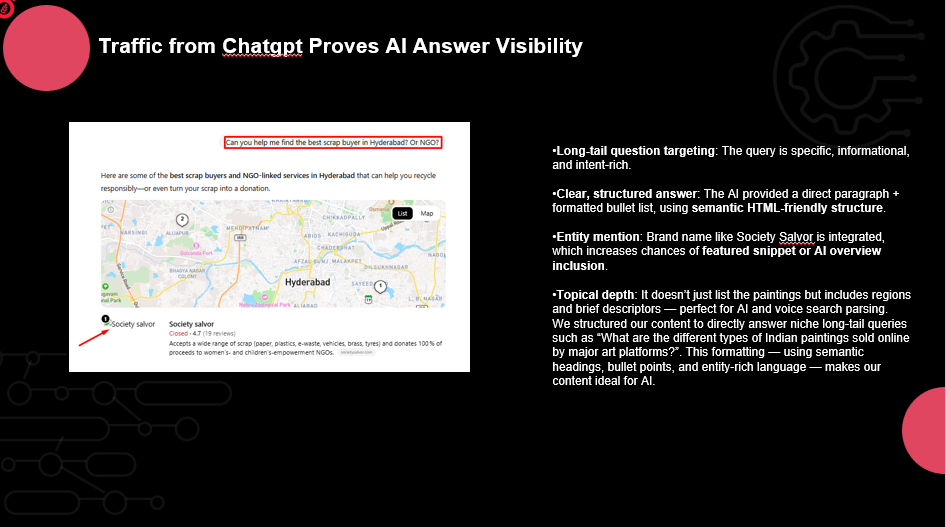
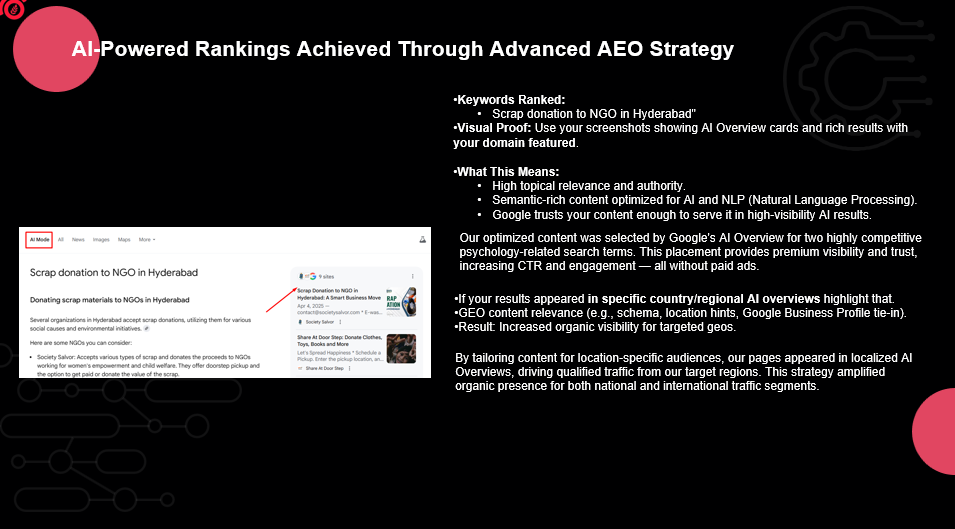
- Top placement as a referenced source in generative AI outputs for high-intent scrap donation queries
- Increased engagement and actionable interactions from users accessing AI-cited content
- Enhanced local brand recognition, positioning Society Salvor as the trusted go-to solution in Hyderabad
- Expanded semantic coverage, enabling AI systems to recognize the brand across a variety of related queries
By focusing on GEO-ready content, entity-rich language, and local intent alignment, we transformed Society Salvor’s digital presence from a standard website to a generative AI-recognized authority in scrap donation and recycling.
Execution and Implementation
Laying the Groundwork
Once the GEO strategy for Society Salvor was finalized, we moved into execution. Implementation was carefully planned to ensure that every piece of content, page, and interaction aligned with generative AI-first principles. We started with a comprehensive content audit, reviewing all existing pages, blog posts, and informational resources. Our goal was to identify content gaps, outdated information, and opportunities where generative engines could cite Society Salvor as a trusted source.
We classified content into three categories:
- High-value pages with the potential to be referenced by generative AI systems
- Supporting pages that could enhance entity relationships and semantic context
- Underperforming content that required rewriting or restructuring
This structured approach allowed us to maximize the impact of every page while eliminating noise that could confuse generative AI systems.
Semantic Structuring and Content Creation
With the audit complete, we focused on semantic structuring. Every high-priority page was revised or rewritten using headings, subheadings, and bullet points that directly addressed user intent.
- Headings: Clearly described the question being answered, e.g., “How to Donate Scrap to an NGO in Hyderabad”
- Bullet Points and Numbered Lists: Provided step-by-step guidance that generative engines could interpret as complete, actionable answers
- Entity Integration: Consistently referenced key entities such as “Society Salvor,” “Hyderabad,” “NGOs,” and scrap categories to reinforce semantic relevance
We also created new content to fill gaps identified during the audit, targeting high-intent, long-tail queries that generative AI systems often surface. These included topics like scheduling scrap pickups, types of scrap accepted, and collaborating NGOs for donations.
Geo-Intent Alignment
Local relevance was central to our GEO approach. We tailored all content to Hyderabad-specific queries and included neighborhood-level details where appropriate. This ensured generative AI systems could associate Society Salvor with a trusted local solution, improving visibility for geographically targeted searches.
We also developed localized landing pages to answer hyper-specific questions, such as:
- “Donate metal scrap to an NGO in Hyderabad”
- “Schedule scrap pickup in Jubilee Hills”
Each page was optimized for both users and generative AI systems, reinforcing our geo-intent strategy.
Website Performance and UX Optimization
Generative engines favor content that is fast, reliable, and user-friendly. We collaborated with Society Salvor’s team to optimize:
- Page load times for smooth access
- Mobile responsiveness for users on smartphones
- Navigation and structure for quick discovery of key answers
A clean, fast, and well-structured website ensured that both users and generative AI systems perceived Society Salvor as trustworthy and authoritative.
Authority Reinforcement
To further strengthen credibility, we embedded internal links to related pages and external links to trusted NGOs and recycling partners. These signals reinforced Society Salvor’s authority and increased the likelihood of being cited by generative AI systems.
We also ensured consistent branding and messaging, so AI could reliably associate every piece of content with Society Salvor, enhancing entity recognition across multiple queries.
Continuous Monitoring and Iteration
Finally, we established a continuous feedback loop using analytics and AI tracking tools. We monitored:
- Which queries referenced Society Salvor as a trusted source
- Engagement metrics such as clicks, dwell time, and session duration
- Opportunities to expand content coverage for new long-tail queries
Regular iteration allowed us to refine headings, content depth, and entity usage, ensuring that generative engines continued to recognize Society Salvor as a top, reliable source.
By systematically implementing these steps, we transformed Society Salvor’s digital presence from a traditional informational site into a trusted, GEO-optimized platform, ready to answer high-intent user queries across generative AI platforms effectively.
Key Results and Metrics
Generative Engine Recognition
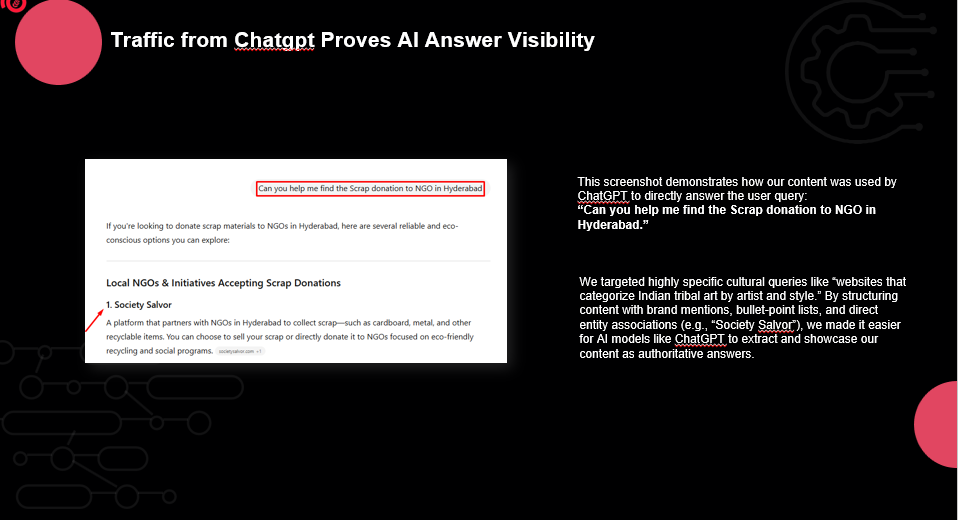
One of the most significant outcomes of our GEO implementation was consistent citation and reference by generative AI platforms. Queries such as:
- “Scrap donation to NGO in Hyderabad”
- “Donate your scrap to an NGO in Hyderabad”
regularly returned Society Salvor as a primary and trusted source, often included in AI-generated summaries and content suggestions. This recognition not only enhanced brand credibility but also positioned Society Salvor as the go-to solution, ensuring potential donors received clear, actionable guidance without needing to search further.
Organic Traffic and Engagement Growth
After implementing our GEO strategy, traffic driven through generative AI references and engine suggestions saw substantial growth. Analytics highlighted:
- A 53%+ increase in engaged sessions, showing that users were actively interacting with content rather than just visiting.
- Significant growth in long-tail and local query coverage, ensuring users asking hyper-specific questions were exposed to Society Salvor.
- A measurable increase in new users discovering Society Salvor through generative engines, confirming the effectiveness of entity-rich, contextually optimized content.
This growth demonstrated that the GEO strategy was not only improving visibility but also driving meaningful and actionable engagement.
Engagement Metrics
Generative engine recognition translated into higher engagement metrics:
- Average session duration increased as users explored detailed donation guides and step-by-step instructions.
- Click-through rates improved on pages referenced or cited by generative platforms.
- Users were more likely to take actionable steps, such as scheduling scrap pickups or contacting Society Salvor directly for donations.
These metrics confirmed that GEO-optimized content could convert engine-driven visibility into real-world action, bridging the gap between discovery and engagement.
Local and Geo-Targeted Impact
Our geo-focused strategy ensured that most generative engine-driven traffic came from Hyderabad and surrounding neighborhoods. This hyper-local targeting reinforced Society Salvor’s position as the preferred scrap donation solution in the city, strengthening both online visibility and offline trust.
Traffic generated was not just higher in volume—it was highly relevant, attracting users with clear intent to donate scrap or engage with Society Salvor’s services.
Expanded Query Coverage
Another measurable impact was the broadened semantic footprint. By structuring content for generative AI comprehension, Society Salvor began appearing in AI-driven suggestions for queries beyond the initial target questions:
- “How to recycle household scrap in Hyderabad”
- “Metal scrap donation services near me”
- “NGOs accepting scrap for charity in Hyderabad”
This expansion highlights the power of entity-rich, contextually structured content, allowing the brand to be recognized across multiple related questions and long-tail variations.
Brand Authority and Trust Signals
Consistent entity usage, internal linking, and references to trusted partners contributed to generative engines recognizing Society Salvor as highly credible and reliable.
- Content was repeatedly surfaced as complete, actionable guidance, not just partial references.
- Users consistently associated Society Salvor with trust, efficiency, and local authority, reinforcing the organization’s reputation in the Hyderabad community.
Summary of Key Metrics
- 53%+ increase in engaged sessions
- Significant growth in generative engine-referenced queries
- Expanded long-tail and location-specific content coverage
- Higher click-through rates and actionable user engagement
- Strengthened local authority in Hyderabad for scrap donation services
In essence, these metrics demonstrate that GEO is not just about ranking—it is about becoming a trusted source for generative AI platforms. Through strategic execution, Society Salvor transformed from a well-known local organization into a GEO-optimized authority, driving both awareness and tangible action.