
SUPERCHARGE YOUR Online VISIBILITY! CONTACT US AND LET’S ACHIEVE EXCELLENCE TOGETHER!
For nearly two decades, digital visibility followed a predictable pattern. A user typed a query into Google, scanned a page of ten blue links, and clicked through results until they found what they needed. Brands fought for rankings, optimized for keywords, and measured success by traffic. That model is now quietly breaking down.
Today, users are no longer browsing search results. They are asking questions and expecting direct answers. Tools like ChatGPT, Google Gemini, Microsoft Copilot, and Perplexity are changing how information is consumed. Instead of presenting a list of options, these systems summarize, filter, and often recommend. In many cases, the user never clicks a website at all.
This shift has fundamentally changed user behavior. People are moving from searching to asking, and more importantly, from clicking to trusting. When an AI system suggests a brand, tool, or company, users tend to accept that recommendation as pre-vetted. The decision-making work has already been done for them.
As a result, brands are no longer simply “found” online. They are selected, mentioned, and endorsed inside AI-generated answers. If your brand does not exist clearly in the knowledge layer these systems rely on, you are invisible at the exact moment decisions are being made.
This is where Answer Engine Brand Training, or AEBT, comes in.
Answer Engine Brand Training is the practice of shaping how AI systems understand, categorize, and recall your brand. It goes beyond traditional SEO or content marketing. The goal is not just to rank pages, but to build brand-level recognition so that AI models naturally include you when users ask relevant questions.
In this guide, you will learn how AI systems decide which brands to mention, reference, or recommend, and how you can intentionally influence that process. This is not about manipulation or shortcuts. It is about clarity, authority, and consistency at scale.
This article is written for founders, marketers, consultants, SaaS teams, and niche experts who depend on trust-driven discovery. If your customers research before they buy, compare options, or ask AI for guidance, this matters to you.
The timing is critical. The brands that train answer engines today will shape tomorrow’s recommendations. Those who wait will be trying to catch up in a system that has already made up its mind.
What Are Answer Engines?
To understand why brands now need to train AI systems, we first need to understand what answer engines actually are and how they think.
Definition of Answer Engines
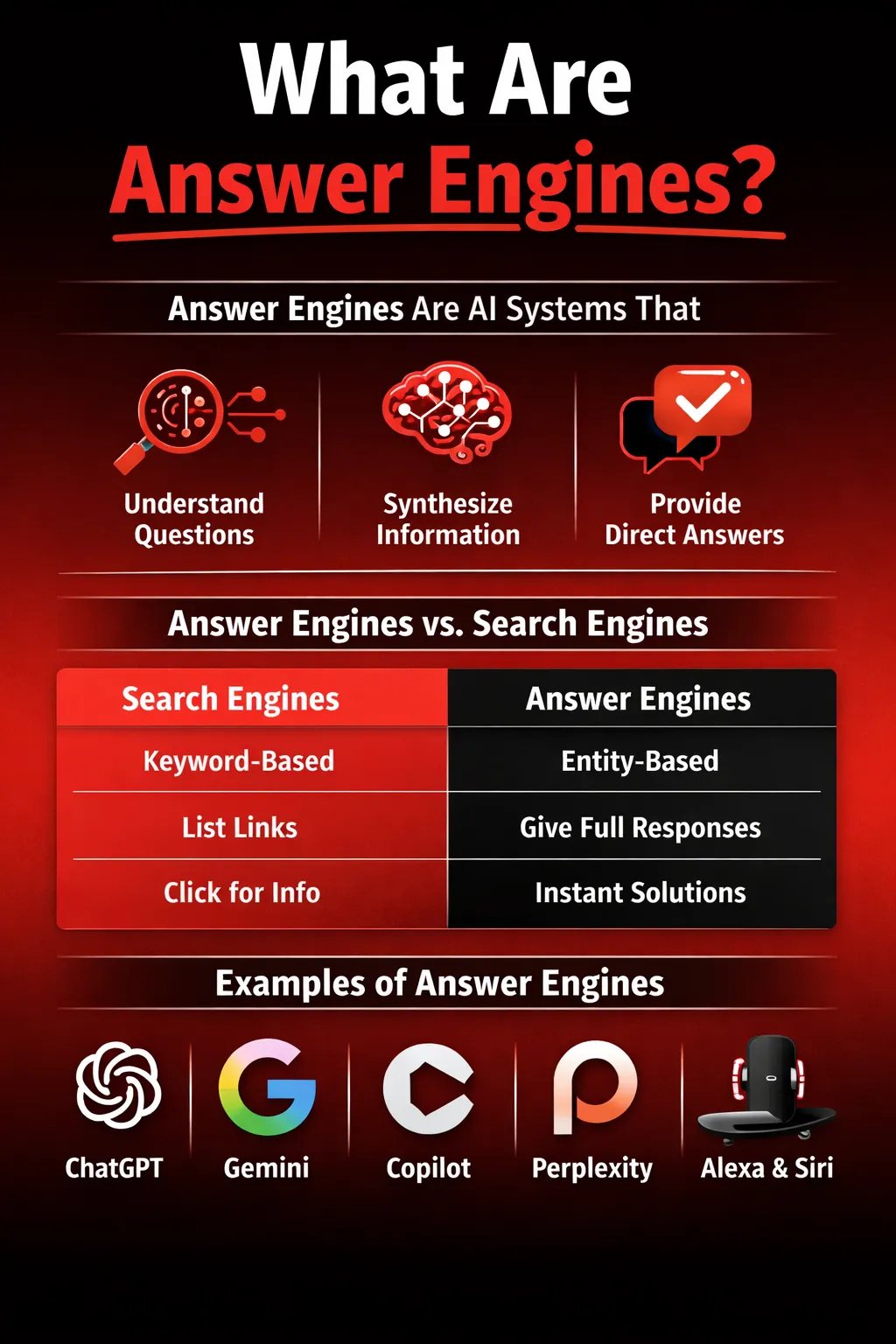
An answer engine is an AI-powered system designed to directly respond to user questions instead of simply pointing them to a list of links. Unlike traditional search engines, answer engines do not stop at finding information. They interpret intent, pull insights from multiple sources, and generate a single, synthesized response.
Search engines work on a relatively straightforward model. They crawl the web, index pages, and rank results based on relevance and authority. The user does the final work by clicking, comparing, and deciding.
Answer engines work differently. They act more like a researcher and advisor combined. When a user asks a question, the system analyzes meaning, context, and expectations, then composes an answer that feels complete and confident. This shift removes friction for users and places enormous influence in the hands of the AI system delivering the response.
In simple terms, search engines help users find information. Answer engines help users make decisions.
Examples of Popular Answer Engines
Several platforms already function as answer engines, even if users do not consciously label them that way. ChatGPT is often used as a first stop for explanations, comparisons, and recommendations. Google Gemini powers conversational responses inside Google’s ecosystem. Microsoft Copilot integrates AI answers directly into work tools and search results. Perplexity AI blends real-time sources with conversational responses. Claude is widely used for reasoning-heavy and research-driven queries. Voice assistants like Alexa and Siri also fall into this category, especially when users ask for advice or recommendations instead of facts.
Each of these systems influences how people discover brands, products, and experts.
How Answer Engines Work at a High Level
Answer engines rely on a mix of pre-trained knowledge and real-time information. Large language models provide the reasoning and language skills. Retrieval-augmented generation allows systems to pull fresh data from trusted sources when needed. Knowledge graphs help connect entities such as brands, people, products, and industries.
What matters most is that answer engines think in entities, not keywords. They recognize brands as concepts with attributes, expertise, and reputation. This is why repeating keywords is no longer enough. To be recommended, a brand must be understood.
From SEO to AEO to Brand Training
Digital visibility has gone through a clear evolution over the last two decades. The first phase was SEO (Search Engine Optimization), where success meant ranking web pages on search engine results pages using keywords, backlinks, and technical optimizations. The objective was simple: get clicks by appearing higher than competitors.
As AI-powered systems entered search, the focus shifted to AEO (Answer Engine Optimization). Instead of ranking pages, the goal became optimizing content so that answer engines could extract direct responses—featured snippets, voice answers, and AI-generated summaries. AEO improved content structure, clarity, and relevance, but it still centered on content performance, not brand influence.
This is where Answer Engine Brand Training emerges as the next stage. Unlike SEO or AEO, brand training is not about optimizing individual pages. It is about shaping how AI systems perceive, understand, and trust a brand over time. Answer engines do not simply pull answers—they decide which entities to mention, recommend, or exclude altogether.
AEO alone is insufficient because AI does not recommend content; it recommends brands. You can have well-optimized content and still be invisible if your brand lacks authority, consistency, and contextual relevance in the AI’s knowledge model. Optimizing content helps AI read you. Training perception helps AI remember and trust you.
Modern AI acts as a decision layer between users and information. It filters options, narrows choices, and often presents a single recommendation. In this environment, brand presence matters more than page rankings. If your brand is not recognized as a trusted entity, ranking signals become secondary.
The future of visibility is no longer about being indexed—it is about being endorsed by AI.
What Is Answer Engine Brand Training?
Answer Engine Brand Training is not about manipulating algorithms or forcing your brand name into AI outputs. At its core, it is about shaping how AI systems understand who you are, what you stand for, and when your brand is genuinely relevant to a user’s question.
Core Definition
In an AI-driven environment, “brand training” refers to the process through which large language models form a reliable understanding of a brand over time. Unlike search engines that rely heavily on pages and links, answer engines build internal representations. You can think of this as a mental profile that helps the AI decide whether your brand belongs in a specific answer.
This is where many brands get it wrong. A brand is not your logo, your website design, or your tagline. Those are surface elements. To an answer engine, a brand is an entity made up of several layers working together. It includes what you are known for, how deeply you understand a topic, how others talk about you, and the situations in which you are mentioned as a solution. In simple terms, brand equals entity plus expertise plus reputation plus context.
When these elements align consistently across the web, AI systems start treating your brand as a dependable reference point rather than a random name.
How AI Learns Brands
Answer engines learn brands through pattern recognition at scale. They observe where and how your brand appears, who it is associated with, and the problems it is repeatedly connected to solving. Mentions matter, but only when they occur in meaningful contexts. Associations matter because they tell the AI which industries, tools, experts, or concepts your brand belongs with. Use cases matter because they clarify when your brand is relevant and when it is not.
Over time, repetition builds familiarity, consistency builds clarity, and authority builds trust. A single article or campaign rarely moves the needle. What matters is sustained alignment across content, platforms, and third-party sources.
Brand Mentions vs Brand Understanding
Many brands celebrate when they see their name cited by an AI tool, but mentions alone do not equal understanding. Surface-level citations often happen because a brand appears in a list or comparison. Deep semantic recognition happens when the AI can explain what your brand does, who it is for, and why it is a good fit without relying on prompts or lists.
Most brands fail to reach this stage because their presence is fragmented. They talk about too many things, shift positioning frequently, or rely on self-promotion instead of earned authority. Answer Engine Brand Training focuses on closing this gap so your brand is not just mentioned, but genuinely understood and recommended when it matters most.
How AI Decides Which Brands to Recommend
When people ask AI tools for advice, they are rarely looking for a long list of options. They want a clear direction. This is where the difference between being listed and being recommended becomes critical.
The Recommendation Layer
Listing brands is easy. Recommending one is not.
When an answer engine lists brands, it is simply acknowledging their existence within a category. Think of this as informational recall. The AI is saying, “These brands operate here.”
A recommendation goes much deeper. When an AI recommends a brand, it is making a judgment call. It is signaling confidence and trust. The brand is not just relevant, it is suitable, reliable, and contextually appropriate for the user’s specific problem. In human terms, this is closer to a professional referral than a directory listing. That is why recommendations carry far more weight and influence buying decisions much faster.
Key Factors AI Uses to Recommend Brands
AI systems evaluate brands using a combination of signals rather than a single ranking factor.
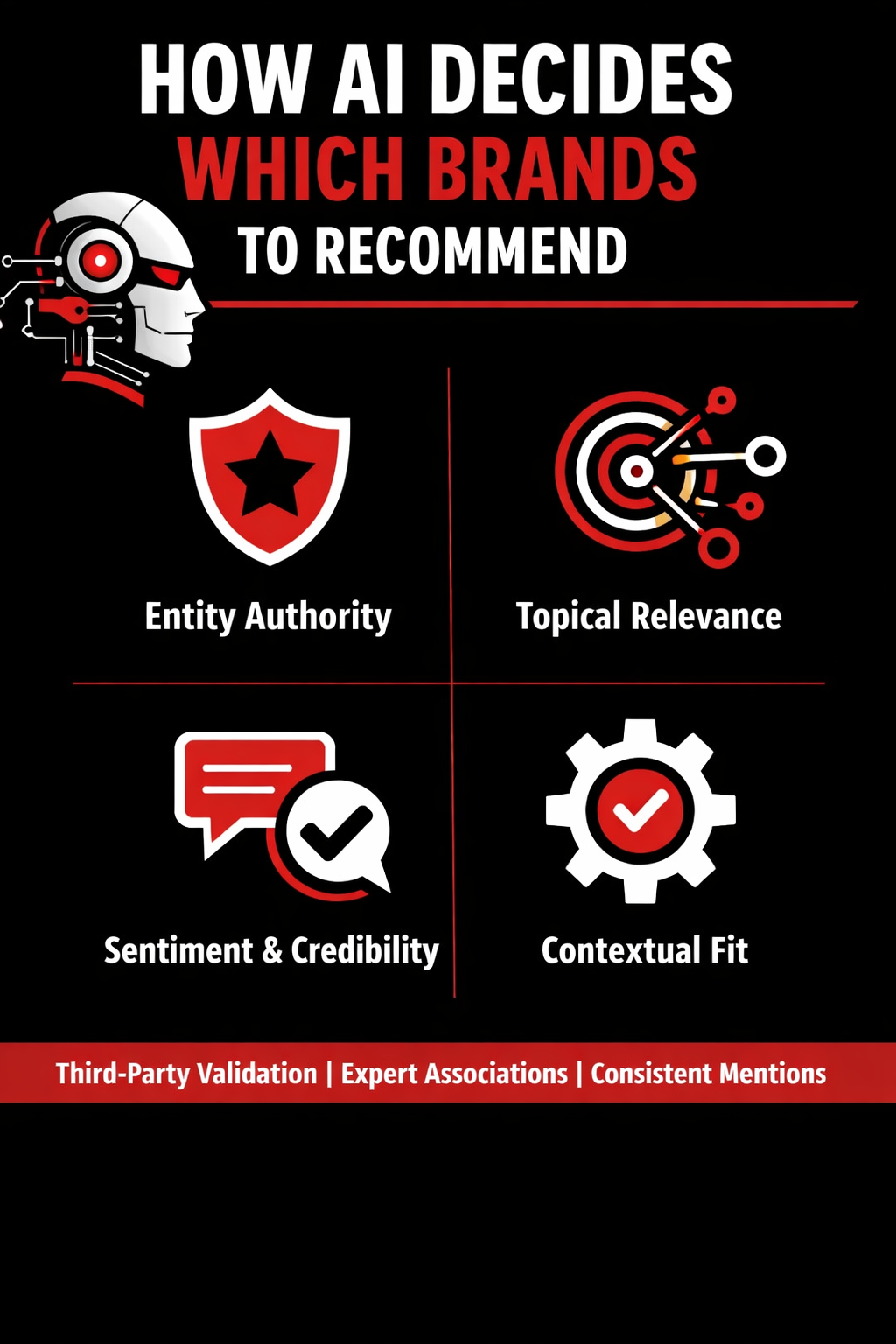
- Entity authority plays a major role. Brands that are clearly defined as entities with a consistent identity across platforms are easier for AI to trust. This includes clarity around what the brand does, who it serves, and how it is positioned.
- Topical relevance matters just as much. AI prefers brands that are strongly associated with a specific problem space, not those that appear scattered across unrelated topics.
- Contextual fit determines whether a brand matches the user’s intent. A well known brand may exist, but if it does not align with the exact use case, AI will skip it.
- Sentiment and credibility are subtle but powerful. Positive language, expert tone, and problem solving contexts influence how AI perceives reliability.
Finally, frequency and consistency of mentions reinforce memory. Brands that appear repeatedly in relevant, high quality discussions become familiar and therefore safer to recommend.
The Role of Implicit Trust Signals
AI rarely trusts brands based on self promotion alone. Implicit trust signals often tip the scale.
Third party validation such as media coverage, industry mentions, or peer discussions signals legitimacy. Expert associations, whether through founders, spokespeople, or quoted professionals, add authority. Industry alignment ensures the brand feels native to its category rather than forced into it.
These signals work quietly, but together they shape how AI evaluates trust.
Examples of AI Recommendation Behavior
When someone asks “best tools for X,” AI favors brands repeatedly linked to successful outcomes.
For “who should I hire for Y,” it leans toward specialists with visible expertise.
For “which company is known for Z,” it selects brands that consistently appear in that exact context.
In every case, AI is not guessing. It is reflecting patterns of trust it has already learned.
Entity-Based Branding: The Foundation of AEBT
If Answer Engine Brand Training has a backbone, entity-based branding is it. Without a clear brand entity, AI systems struggle to understand who you are, what you do, and when they should recommend you. This is where many brands quietly fail, not because they lack content, but because they lack clarity.
What Is an Entity in AI Systems?
In AI systems, an entity is not a keyword or a phrase. It is a distinct, identifiable concept with attributes, relationships, and context. Keywords are simple strings of text. Entities are meaning.
For example, “best SEO agency” is a string. A specific company, with a name, founders, services, industry focus, and reputation, is an entity. Answer engines do not think in rankings. They think in entities and how those entities relate to user questions.
Your brand exists as a node inside massive knowledge graphs used by AI models. That node connects to other nodes such as industries, problems, solutions, people, locations, and concepts. The stronger and clearer those connections are, the easier it becomes for AI to recall and recommend your brand naturally in relevant contexts.
If your brand is poorly defined or inconsistent, that node becomes weak, fragmented, or confused. When that happens, AI either ignores you or replaces you with a clearer alternative.
Core Brand Entity Elements
A strong brand entity is built from a set of consistent signals that reinforce each other.
Your brand name must be used consistently, without variations that confuse context. Founders or key leaders matter because AI often associates credibility and expertise with people, not just companies.
Your products or services should be clearly defined, not vaguely described. The industry or category you operate in must be explicit. Trying to belong everywhere usually results in belonging nowhere.
Geographic relevance also plays a role, especially for regional or local brands. Finally, unique differentiators are critical. AI systems remember what makes you distinct, not what makes you generic.
Together, these elements form a complete identity that AI can understand, store, and reuse.
How to Strengthen Your Brand Entity
Strengthening your brand entity starts with consistency. Your brand description should not change tone or positioning across your website, social profiles, PR mentions, and third-party content.
Unified messaging matters more than clever copy. Say the same core things, in slightly different ways, everywhere your brand appears.
Avoid fragmentation by eliminating mixed signals. Do not describe yourself as three different things across platforms. Do not shift industries based on trends. Clarity compounds over time.
When your brand becomes easy for AI to understand, it becomes easier for AI to recommend. That is the quiet power of entity-based branding, and it is the foundation of effective Answer Engine Brand Training.
Content Strategies That Train Answer Engines
Training answer engines is less about gaming algorithms and more about teaching machines the same way you would teach a human expert. The content that works best does not chase keywords or trends. It builds understanding, context, and trust over time. Below are the content strategies that consistently help brands become the ones AI systems refer to and recommend.
Topical Authority Content
Shallow blog posts fail because they do not teach anything. Short, surface-level articles written just to target a keyword rarely provide enough context for an answer engine to understand what a brand truly knows. AI systems look for depth, consistency, and clarity across multiple pieces of content, not isolated posts.
Topical authority comes from covering a subject end to end. This is where topic clusters matter. Instead of publishing ten unrelated articles, strong brands create one central pillar and support it with detailed subtopics that explore different angles, problems, and use cases. Over time, this interconnected structure signals expertise and focus.
Brand-led explanations are critical here. Rather than repeating generic definitions found everywhere else, explain concepts through your own perspective. Share how you approach a problem, how your team thinks about it, and what you have learned in real-world scenarios. This helps answer engines associate the topic with your brand specifically, not just the topic itself.
Brand-as-the-Teacher Content
Answer engines tend to trust teachers more than sellers. Content that educates clearly and patiently often outperforms content that pushes products or services. Educational guides are a strong foundation. These can be step-by-step walkthroughs, beginner-to-advanced explainers, or practical playbooks that help readers actually do something.
Frameworks and methodologies elevate this further. When you introduce a clear process or model that helps people think better about a problem, you give AI something concrete to remember and reuse. Over time, these frameworks become reference points that answer engines draw from.
Proprietary terminology also plays a role. Naming your approach, your process, or your way of thinking helps distinguish your brand from others in the same space. When used consistently and explained well, this terminology becomes part of how AI understands and recalls your brand.
Contextual Brand Placement
Brands should appear naturally inside problem-solving content, not as interruptions. The most effective mentions happen when the brand is part of the explanation, example, or solution flow. This mirrors how humans recommend tools or companies to each other in conversation.
Promotional language weakens trust signals. Overuse of claims, slogans, or sales-focused phrasing can make content feel biased or unreliable. Answer engines tend to favor neutral, informative tone even when a brand is mentioned.
The goal is to position your brand as the default solution through clarity and relevance, not persuasion. When your brand consistently shows up in the right contexts solving the right problems, AI begins to treat it as an obvious choice.
Long-Form vs Short-Form Content
Long-form content trains AI better because it provides richer context and stronger relationships between ideas. Detailed articles allow answer engines to understand not just what you do, but why and how you do it.
Long-form content also has permanence. A well-written guide can remain relevant for years, continuing to reinforce your brand’s authority. It can be reused across formats, cited by others, and updated without losing its core value. Short-form content has its place, but long-form content is what builds lasting recognition and trust with answer engines.
Off-Site Signals That Train AI to Trust Your Brand
If your brand only talks about itself on its own website, AI treats that information cautiously. Answer engines, much like humans, look for confirmation from the outside world before forming trust. This is where off-site signals play a decisive role. They help AI understand whether your brand is credible, respected, and relevant beyond its own marketing claims.
The Importance of Third-Party Validation
AI systems are designed to reduce bias. Because of that, they place far more weight on what others say about your brand than what you say about yourself. When independent platforms, experts, or publications reference your company in a neutral or positive context, it signals legitimacy. These external mentions act as proof that your brand exists within a broader ecosystem and is acknowledged by people who have no direct incentive to promote you. Over time, repeated third-party validation helps AI associate your brand with trust, expertise, and real-world relevance.
High-Impact Off-Site Channels
Not all off-site signals are equal. Some environments carry far more authority in the eyes of answer engines.
Digital PR remains one of the strongest trust builders. Mentions in credible news outlets, niche blogs, or respected media platforms give AI strong contextual clues about your industry standing.
Podcasts and interviews offer another powerful signal. When founders or senior leaders discuss problems, trends, and solutions publicly, AI connects their expertise directly to the brand. These long-form conversations often get transcribed, indexed, and referenced across multiple platforms.
Industry publications help position your brand within a specific niche. Thoughtful contributions, guest articles, or case studies reinforce topical authority.
Community platforms like Reddit, Quora, and specialized forums provide organic validation. When real users mention your brand while discussing solutions, AI sees authentic usage rather than marketing language.
Brand Mentions Without Links
Links are helpful, but they are no longer mandatory for trust. Unlinked brand mentions still matter because AI processes language semantically, not just structurally. Each mention reinforces associations between your brand, the problems you solve, and the context in which you appear. Over time, these references help AI build a clearer mental model of who you are and when you should be recommended.
Expert Positioning
People build trust faster than logos. Founder-led authority plays a major role in brand training. When a founder or key expert consistently shares insights, frameworks, or opinions, AI begins to associate that individual with expertise. That credibility naturally transfers to the company they represent. A strong personal brand, built through consistent public knowledge sharing, often becomes the bridge that turns a company into a trusted recommendation inside answer engines.
Structured Data, Schema, and Technical Signals
When it comes to getting AI systems to clearly understand your brand, structured data plays a quiet but decisive role. While content shapes perception, structured data shapes clarity. It removes ambiguity and tells answer engines exactly who you are, what you offer, and how different parts of your brand connect. For AI models that rely heavily on entity recognition, this clarity is essential.
Structured data works like a translator between your website and AI systems. Instead of forcing machines to infer meaning from raw text alone, schema markup provides explicit signals. It helps answer engines confidently identify your brand as a distinct entity rather than a loose collection of pages, keywords, or mentions.
Several schema types are especially important for brand training. Organization schema defines your company’s official name, logo, website, location, and industry. This becomes the foundation of your brand entity. Person schema is critical for founders, executives, and public-facing experts, especially when personal authority influences brand trust. Product schema clarifies what you sell, who it is for, and how it is positioned. Article schema helps AI systems understand which pieces of content represent original thought, expertise, or guidance from your brand.
Consistency matters more than most teams realize. Your schema markup should reflect exactly what users see on the page. If your structured data says one thing and your visible content says another, AI systems receive mixed signals. Over time, this weakens trust and dilutes brand recognition.
Equally important is avoiding conflicting signals across platforms. Inconsistent brand names, outdated founder information, or mismatched product descriptions confuse answer engines. Clean, aligned technical signals reinforce everything your content and off-site mentions are trying to teach AI about your brand.
Measuring Answer Engine Brand Training Success
If answer engines are becoming the new gatekeepers of visibility, then measuring how they perceive your brand is no longer optional. The challenge is that traditional analytics tools were never designed for AI-driven recommendations. Measuring success here requires a mix of observation, pattern recognition, and intent-focused testing.
Key Metrics to Track
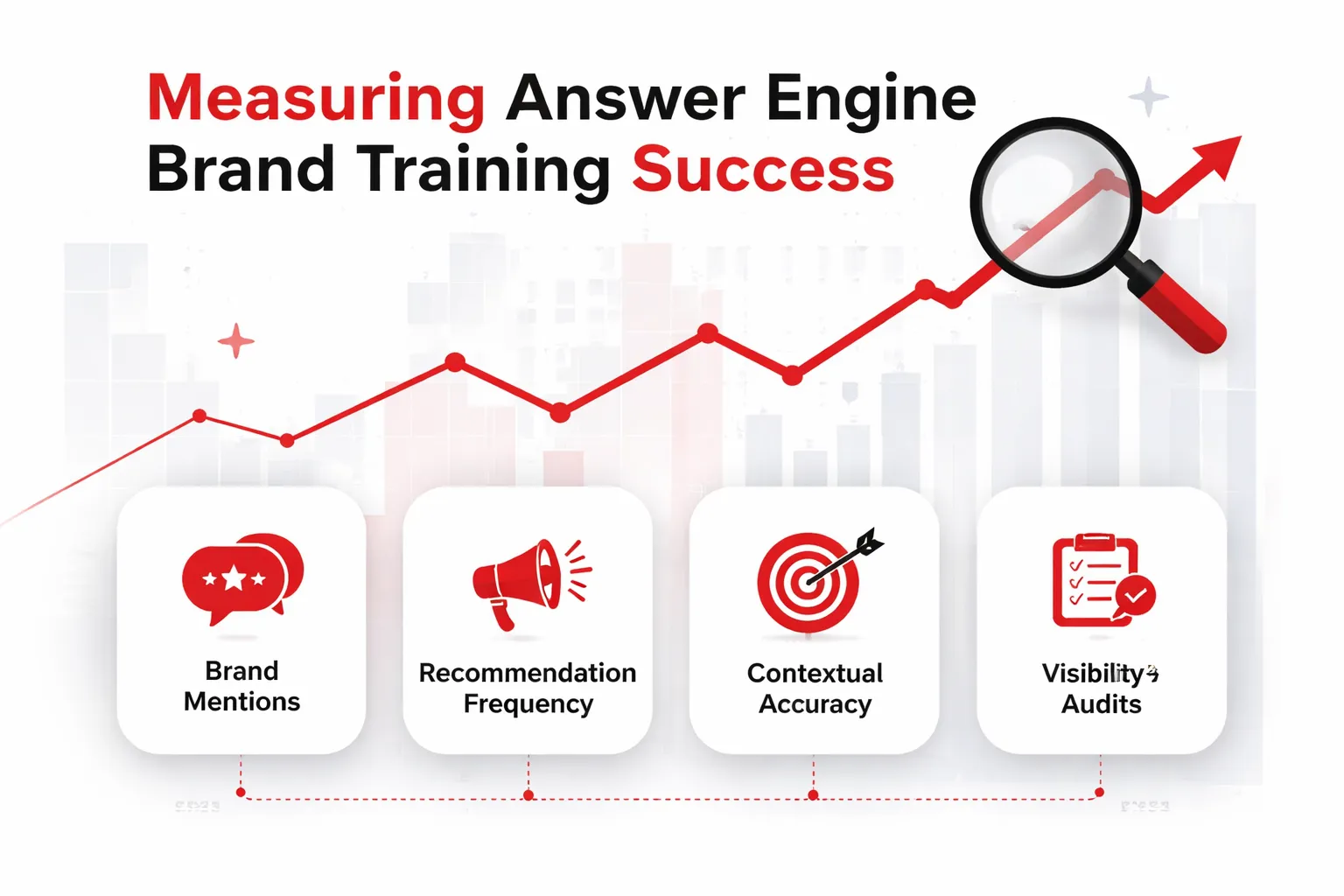
The first signal to watch is brand mentions inside AI-generated answers. This goes beyond simple name drops. Pay attention to whether your brand appears naturally when users ask problem-oriented questions in your category. The second metric is recommendation frequency. If your brand consistently shows up when users ask for tools, services, or experts in a specific niche, that is a strong indicator that the AI associates you with that solution space. The third and most overlooked metric is contextual accuracy. Are answer engines describing your brand correctly? Are they aligning you with the right use cases, industries, and strengths? Incorrect or vague associations are a sign that your brand training is incomplete.
Manual and Automated Testing
One of the most effective methods is structured prompt testing. Use real-world queries your customers would ask and track how often your brand appears, how it is framed, and which competitors are mentioned alongside you. Complement this with periodic brand visibility audits across multiple answer engines. Over time, patterns begin to emerge that reveal how your brand is being understood.
Leading vs Lagging Indicators
AI visibility is a leading indicator. Increased mentions, improved contextual clarity, and stronger recommendations usually appear well before traffic or revenue changes. Brands that learn to read these early signals gain a strategic advantage, allowing them to refine positioning long before competitors realize what is happening.
Common Mistakes in Answer Engine Brand Training
As more brands rush to “optimize for AI,” many repeat the same mistakes that once limited their SEO efforts. Answer Engine Brand Training is not a shortcut or a tool hack. It is a long-term brand perception exercise, and getting it wrong can quietly erase your visibility.
One of the most common errors is over-optimizing for keywords. Answer engines do not think in exact-match phrases the way search engines once did. When content is stuffed with repetitive terms, it weakens clarity instead of reinforcing authority. AI systems look for understanding, not mechanical repetition. Brands that focus on explaining problems clearly and consistently tend to surface more often in AI recommendations.
Another major mistake is ignoring off-site signals. Many teams obsess over their own website while overlooking how their brand appears across the wider web. Mentions in expert articles, podcasts, communities, and industry discussions help AI systems assess credibility. If your brand only talks about itself, trust remains limited.
Inconsistent brand messaging is another silent killer. When your positioning, tone, or service descriptions vary across platforms, AI struggles to form a stable mental model of your brand. Consistency builds recognition, and recognition drives recommendations.
Many brands also chase tools instead of strategy. New AI tools promise quick wins, but without a clear brand narrative, they add noise rather than authority.
Finally, treating AI like Google is a fundamental mistake. Answer engines do not rank pages. They synthesize knowledge. Brands that act like educators, not optimizers, are the ones AI learns to trust and recommend.
The Future of Brand Visibility in an AI-First World
Brand visibility is no longer shaped only by rankings, ads, or social reach. In an AI-first world, visibility is filtered through systems that decide what information is trustworthy enough to be surfaced as an answer. AI has quietly become the gatekeeper of trust. When users ask questions, they are not comparing ten options anymore. They are accepting a single, confident response. The brands mentioned there gain instant credibility, while the rest fade into the background.
This shift is accelerating the decline of traditional discovery channels. Organic clicks are shrinking. Social feeds are crowded and unpredictable. Paid visibility is getting more expensive and less memorable. Instead of browsing, people are delegating judgment to AI. That changes everything. If AI does not recognize your brand as relevant and reliable, you simply do not exist in the decision journey.
In this environment, brands stop being marketing assets and start becoming knowledge assets. AI does not promote slogans or taglines. It recalls patterns, expertise, context, and consistency. Brands that are clearly understood as authorities in a specific domain are the ones that get recommended. Those without a defined knowledge footprint are treated as interchangeable or ignored.
This is why Answer Engine Brand Training will soon become non-optional. It is not a growth hack or a short-term tactic. It is foundational brand infrastructure for the next decade. Companies that delay will find it harder to influence AI perception later.
Brands that act now gain a first-mover advantage. They shape how AI understands their category, their expertise, and their value. Once that trust is established, it compounds quietly and defensibly, long before competitors realize what changed.
Step-by-Step Framework to Start Answer Engine Brand Training
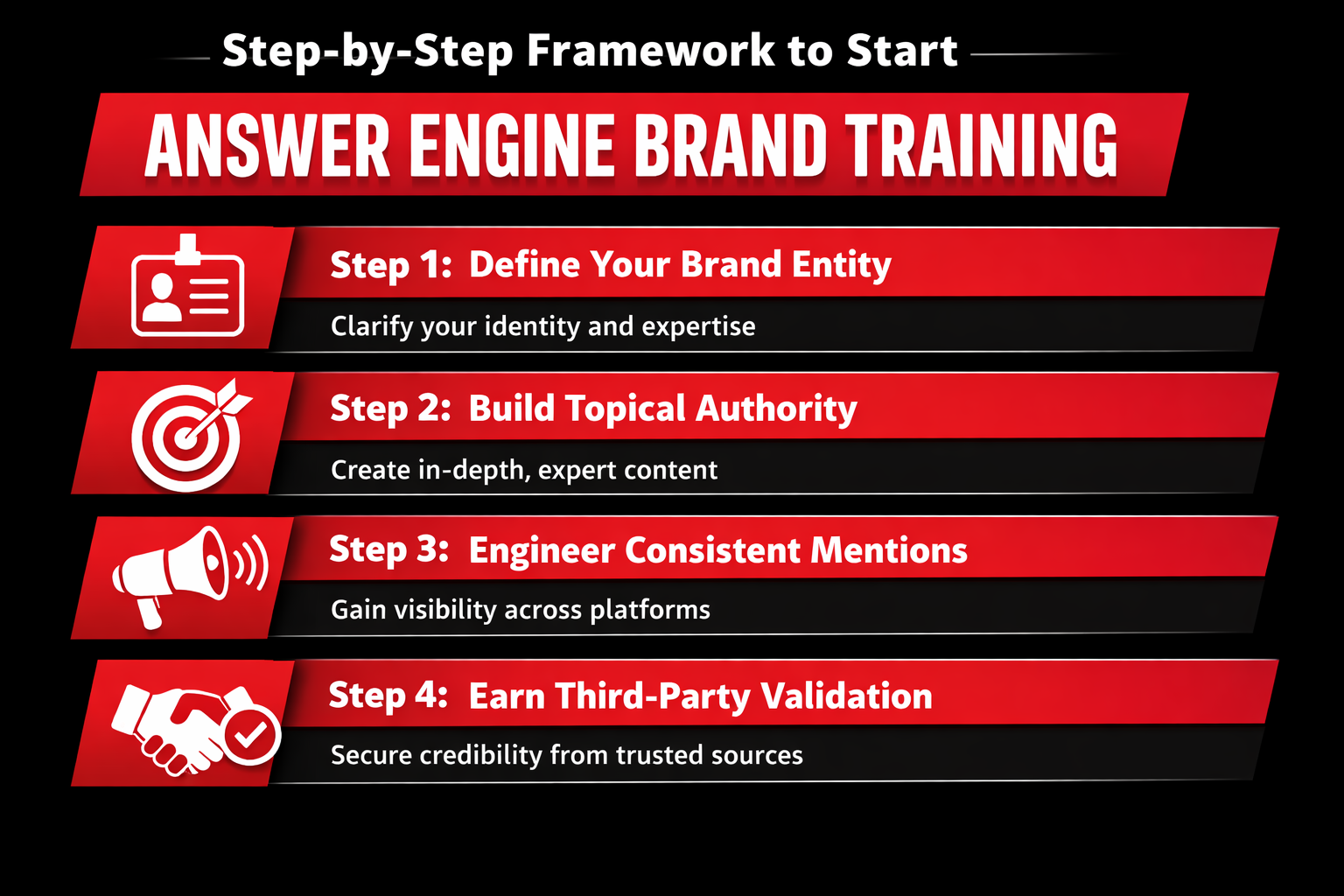
If you want AI systems to recommend your brand naturally, you need to approach Answer Engine Brand Training as a long-term brand-building discipline, not a growth hack. The framework below is practical, brand-first, and designed for founders, marketers, and niche businesses that want lasting visibility inside AI-generated answers.
Step 1: Define your brand entity clearly
Start by getting brutally clear about who you are as a brand. Answer engines do not understand vague positioning. They rely on clarity and consistency. Define your brand in simple language across your website, About page, author bios, and profiles. Be specific about what you do, who you serve, and what problem you solve better than anyone else. When your brand description changes across platforms, AI struggles to form a stable understanding. Consistency builds recognition.
Step 2: Build deep topical authority
Surface-level content will not train AI systems to trust you. You need depth. Focus on one or two core problem areas and create content that genuinely helps users understand them. Go beyond tips and write explainers, frameworks, comparisons, and real-world insights. The goal is not traffic alone. The goal is to signal expertise. When AI sees your brand repeatedly associated with meaningful explanations, it begins to treat you as a reliable source.
Step 3: Engineer consistent brand mentions
Your brand should appear naturally within educational content, not just on landing pages. Mention your brand in context when explaining solutions, processes, or case examples. Do this across blogs, guides, interviews, and community platforms. Over time, these contextual mentions help AI associate your brand with specific use cases instead of generic marketing claims.
Step 4: Earn third-party validation
AI places more trust in external voices than self-promotion. Secure mentions in industry blogs, podcasts, expert roundups, and trusted publications. Even unlinked mentions matter. These references act as reputation signals and strengthen how AI evaluates your credibility within a niche.
Step 5: Monitor and refine AI perception
Regularly test how answer engines describe your brand. Look for inaccuracies, missing context, or weak positioning. If the output is unclear, refine your messaging and content. Brand training is iterative. The brands that win are the ones that actively shape how they are understood, not the ones that leave it to chance.
Conclusion
For years, visibility meant rankings. If you appeared on page one, you existed. That reality is fading fast. Today, people are no longer scrolling through results. They are asking questions and accepting recommendations from AI systems they trust. In this new environment, being listed is not enough. Being recommended is what drives influence, consideration, and growth.
That shift makes this moment urgent. Answer engines are already shaping decisions across software, services, healthcare, finance, and local businesses. The brands that show up consistently in AI responses are quietly building an advantage that late adopters will struggle to replicate. Once an AI system learns to associate your brand with expertise and reliability, that perception compounds over time.
This is where Answer Engine Brand Training becomes a long term moat. It is not a campaign or a hack. It is the deliberate process of teaching AI systems who you are, what you are known for, and why you deserve trust. Done well, it creates durable visibility that competitors cannot easily displace.
The next step is practical. Start by auditing how your brand currently appears in AI responses. Notice where you are missing, misrepresented, or absent entirely. From there, invest early in building clear brand authority through consistent messaging, deep expertise, and credible third party signals.
If you want a structured way forward, consider a focused brand visibility audit or a strategic consultation. The brands that act now will not just be discovered. They will be recommended.



