SUPERCHARGE YOUR ONLINE VISIBILITY! CONTACT US AND LET’S ACHIEVE EXCELLENCE TOGETHER!
Moving Beyond Vanity Metrics to Measurable Business Impact
Raising funding is a defining moment for any startup. It validates the idea, unlocks resources, and sets the stage for aggressive growth. But it also changes expectations overnight—especially when it comes to marketing performance. SEO, which may have previously been treated as a long-term traffic play or an experimental channel, suddenly comes under sharper scrutiny. After funding, SEO can no longer exist to “grow traffic” alone. It must prove its impact on revenue.

One of the biggest mistakes funded startups make is continuing to optimize SEO for vanity metrics—sessions, impressions, and keyword rankings—without connecting those metrics to business outcomes. It’s not uncommon to see a startup celebrating 200% organic traffic growth while the sales team struggles with poor-quality leads and an underwhelming pipeline. Traffic looks impressive on dashboards, but it doesn’t pay salaries, justify burn rate, or satisfy investors.
Investor expectations fundamentally change SEO priorities. Post-funding, the question is no longer “Are we growing visibility?” but “How does organic search contribute to predictable, scalable revenue?” Boards and VCs care about metrics like customer acquisition cost (CAC), pipeline velocity, and lifetime value (LTV). If SEO can’t tie into these numbers, it risks being seen as a cost center rather than a growth lever.
This creates a clear distinction between SEO that looks good and SEO that grows the business. The former focuses on rankings, traffic spikes, and broad keywords with impressive search volume. The latter prioritizes buyer intent, conversion paths, sales alignment, and measurable revenue contribution. One earns applause in marketing meetings; the other earns trust in boardrooms.
Consider a hypothetical scenario: a Series A SaaS startup drives 500,000 monthly organic visits through generic “how-to” content, yet organic leads convert at less than 0.2%. As one investor bluntly puts it, “Traffic without revenue is noise. Show me how SEO moves the bottom line.”
This article is built around that exact challenge. We’ll explore how funded startups can realign SEO with revenue goals, move beyond vanity metrics, and build an organic growth engine that investors, founders, and revenue teams all believe in. The core thesis is simple but powerful: SEO is not a traffic channel—it’s a revenue channel.
Understanding Revenue-Driven SEO
For many startups, SEO is still viewed as a channel for increasing visibility—more rankings, more impressions, and more traffic. While those metrics may look impressive in dashboards, they rarely answer the most important question a funded startup must face: How is SEO contributing to revenue? Revenue-driven SEO reframes search optimization from a traffic-generation activity into a measurable growth engine tied directly to business outcomes.
What Is Revenue-Aligned SEO?
Revenue-aligned SEO treats organic search as both a demand-generation and demand-capture channel. On the demand-generation side, SEO educates and shapes market awareness by helping potential customers understand problems, use cases, and emerging solutions. On the demand-capture side, it ensures that when prospects are actively evaluating or ready to buy, your product or service is visible at the exact moment of intent.
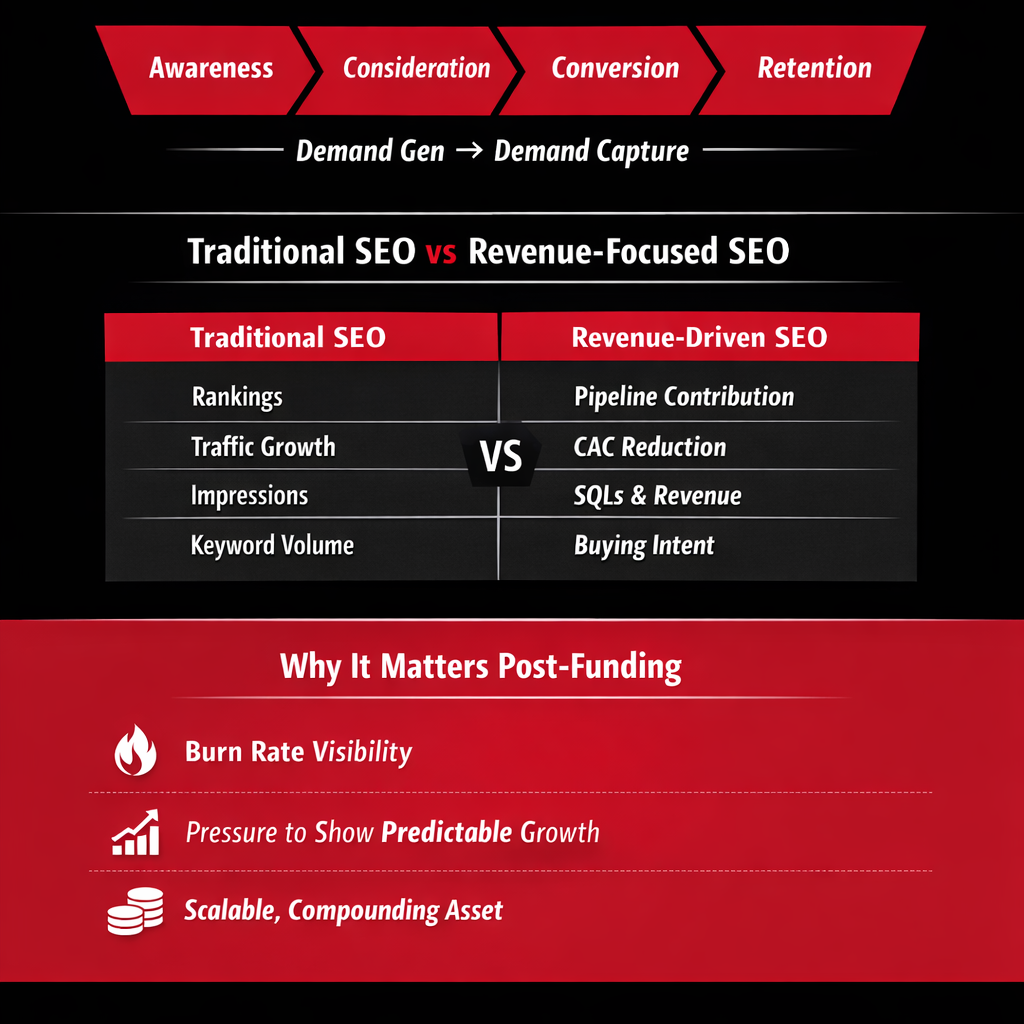
Unlike traditional approaches, revenue-driven SEO connects clearly to the entire customer funnel:
- Awareness: Educational and problem-focused content introduces your brand to the right audience.
- Consideration: Comparison pages, use-case content, and solution-driven articles influence buying decisions.
- Conversion: High-intent landing pages, demos, pricing pages, and case studies turn demand into revenue.
- Retention: SEO supports customer success through product documentation, feature updates, and expansion-focused content that drives long-term value.
SEO is no longer isolated at the top of the funnel—it becomes a continuous growth loop that supports acquisition, conversion, and retention.
Traditional SEO vs. Revenue-Focused SEO
The shift becomes clearer when comparing traditional SEO metrics with revenue-driven priorities:
| Traditional SEO | Revenue-Driven SEO |
| Rankings | Pipeline contribution |
| Traffic growth | CAC reduction |
| Impressions | SQLs & revenue |
| Keyword volume | Buying intent |
Traditional SEO celebrates visibility. Revenue-driven SEO measures impact. Instead of asking, “Did we rank #1?”, the question becomes, “Did organic search generate qualified leads, shorten sales cycles, or reduce acquisition costs?”
Why This Matters Post-Funding
After funding, expectations change. Startups must manage burn rate visibility, demonstrate predictable and scalable growth, and show that every channel can justify its investment. SEO becomes especially powerful in this phase because it is a compounding asset—one that continues to generate demand and revenue over time without linear increases in spend.
When aligned with revenue goals, SEO evolves from a cost center into a strategic growth lever—one that investors trust, executives understand, and businesses can scale with confidence.
The Post-Funding Growth Reality: What Investors Expect from SEO
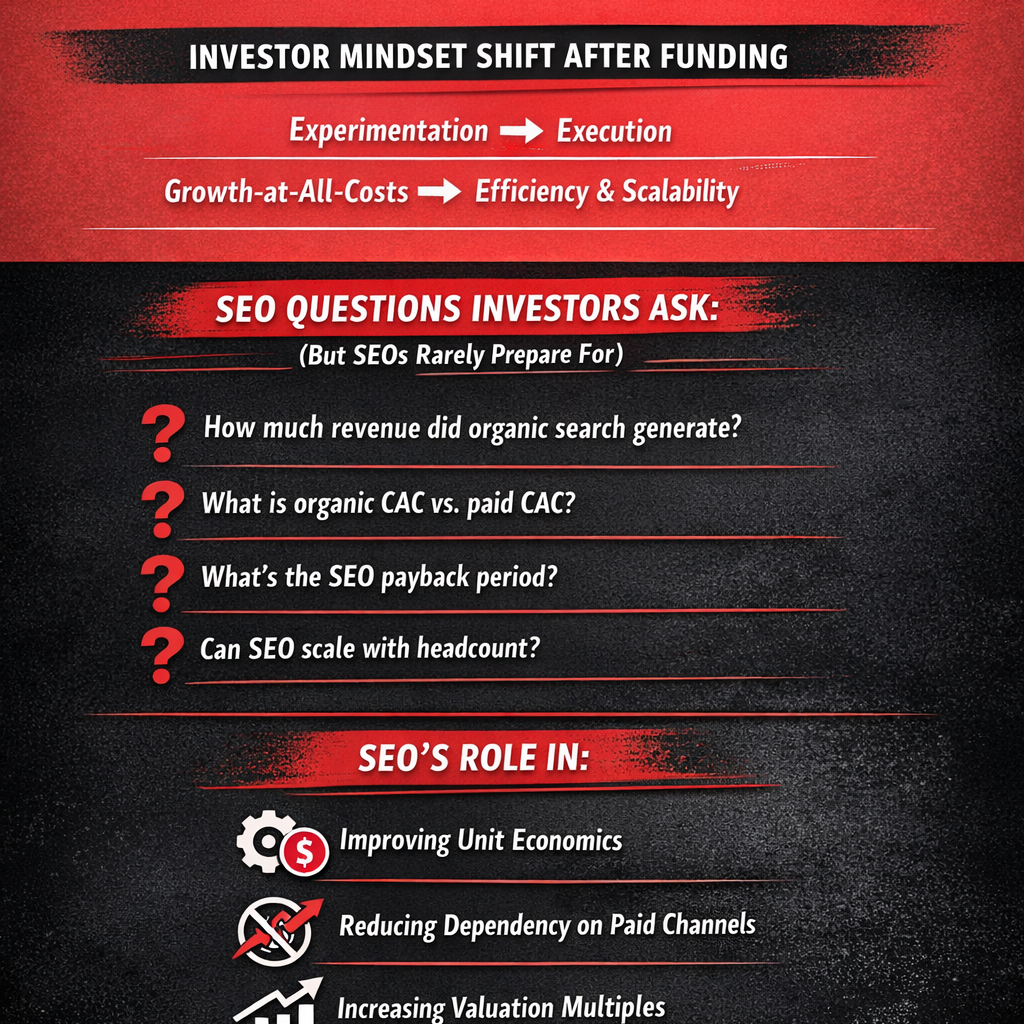
Once a startup secures funding, the growth conversation changes fundamentally. What was once a phase of experimentation—testing channels, validating audiences, and proving traction—quickly shifts into a phase of execution. Investors are no longer interested in whether SEO can work; they want to know how reliably and efficiently it can contribute to growth. This transition forces SEO to mature from a traffic-driving experiment into a predictable, scalable revenue channel.
The Investor Mindset Shift After Funding
Post-funding, startups move from growth-at-all-costs to efficient, scalable growth. During pre-seed or seed stages, high traffic growth or keyword wins might be celebrated as signals of momentum. After funding, however, those same metrics mean little unless they translate into pipeline, revenue, or reduced acquisition costs. Investors expect clarity, repeatability, and accountability. SEO must show that it can deliver consistent outcomes—not just one-off ranking successes—while supporting the company’s broader financial goals.
SEO Questions Investors Actually Ask
In boardrooms and investor updates, SEO is evaluated through a business lens. Common questions include:
- How much revenue did organic search generate?
Not traffic, not rankings—actual revenue or pipeline contribution. - What is organic CAC compared to paid CAC?
Investors want to understand efficiency and long-term cost advantages. - What’s the SEO payback period?
How long does it take for SEO investments in content, tools, and talent to break even? - Can SEO scale with headcount?
Does adding budget or people create linear or compounding returns?
Many SEO teams struggle here because they are not prepared with revenue-linked answers, only performance metrics.
SEO’s Strategic Role in Post-Funding Growth
When aligned correctly, SEO becomes a powerful lever for:
- Improving unit economics by lowering blended CAC over time
- Reducing dependency on paid channels, which often become more expensive as the company scales
- Increasing valuation multiples by building a defensible, compounding organic growth asset
In short, investors don’t see SEO as a marketing tactic—they see it as a long-term growth engine. Funded startups that understand this shift are the ones that turn SEO into a true competitive advantage.
Defining SEO Success Through Revenue Metrics
For funded startups, SEO success can no longer be defined by surface-level indicators like traffic growth or keyword rankings. While these metrics may signal visibility, they rarely answer the most important question investors and leadership teams care about: is SEO driving revenue? To make SEO a credible growth lever post-funding, teams must track KPIs that directly connect organic efforts to business outcomes.
Below are the core revenue-linked SEO metrics that matter—and how to measure them correctly.
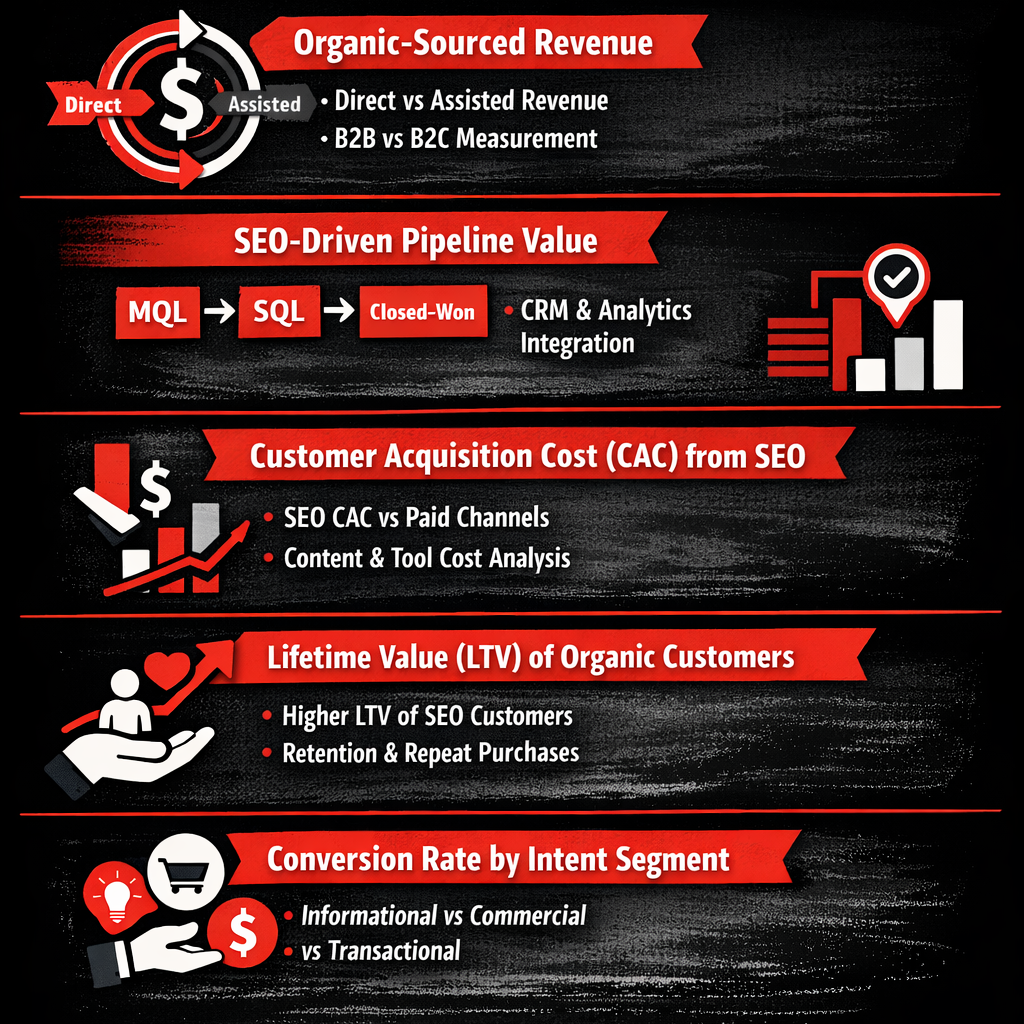
1. Organic-Sourced Revenue
Organic-sourced revenue measures how much revenue is generated from users who first discovered your brand through organic search.
There are two ways to view this:
- Direct revenue: When organic search is the final conversion channel.
- Assisted revenue: When organic search plays an earlier role in the buyer journey but another channel closes the conversion (e.g., email, paid retargeting, sales).
For B2C companies, this is usually easier to track via GA4 e-commerce attribution models.
For B2B startups, organic revenue is often assisted rather than direct, making multi-touch attribution and CRM integration essential. Ignoring assisted revenue significantly undervalues SEO’s impact in longer sales cycles.
2. SEO-Driven Pipeline Value
In B2B, revenue alignment starts with pipeline contribution. This metric tracks how much qualified pipeline originates from organic traffic.
The ideal flow looks like: Organic Visit → MQL → SQL → Closed-Won
To measure this accurately:
- Track organic source at the first touch
- Connect form fills and demo requests to CRM records
- Attribute pipeline value and closed deals back to SEO
This requires tight CRM + analytics integration (GA4, HubSpot, Salesforce), but it transforms SEO from a “traffic channel” into a predictable pipeline generator.
3. Customer Acquisition Cost (CAC) from SEO
SEO CAC reveals how cost-efficient organic acquisition truly is—especially compared to paid channels.
To calculate SEO CAC:
- Include content production costs
- SEO tools and software
- Internal or agency resources
- Technical SEO investments
When compared to paid CAC, SEO often appears expensive in the short term but dramatically cheaper over time. This metric is critical for showing SEO’s long-term efficiency and scalability to investors.
4. Lifetime Value (LTV) of Organic Customers
Organic customers frequently have higher LTV than paid-acquired users. Why?
- They often discover the brand during problem research
- They enter with higher trust
- They convert with stronger intent
Key signals to track include:
- Retention rate
- Repeat purchases
- Expansion revenue (for SaaS)
LTV validates SEO not just as an acquisition channel, but as a quality growth channel.
5. Conversion Rate by Intent Segment
Not all organic traffic should convert the same way. Segment conversion rates by intent:
- Informational (blogs, guides): micro-conversions
- Commercial (comparisons, alternatives): lead conversions
- Transactional (pricing, demos): revenue conversions
This helps teams optimize content based on revenue potential, not pageviews—ensuring SEO efforts are aligned with business growth, not vanity metrics.
When these KPIs are tracked together, SEO becomes measurable, defensible, and boardroom-ready—exactly what funded startups need.
5. Mapping SEO Efforts to the Revenue Funnel
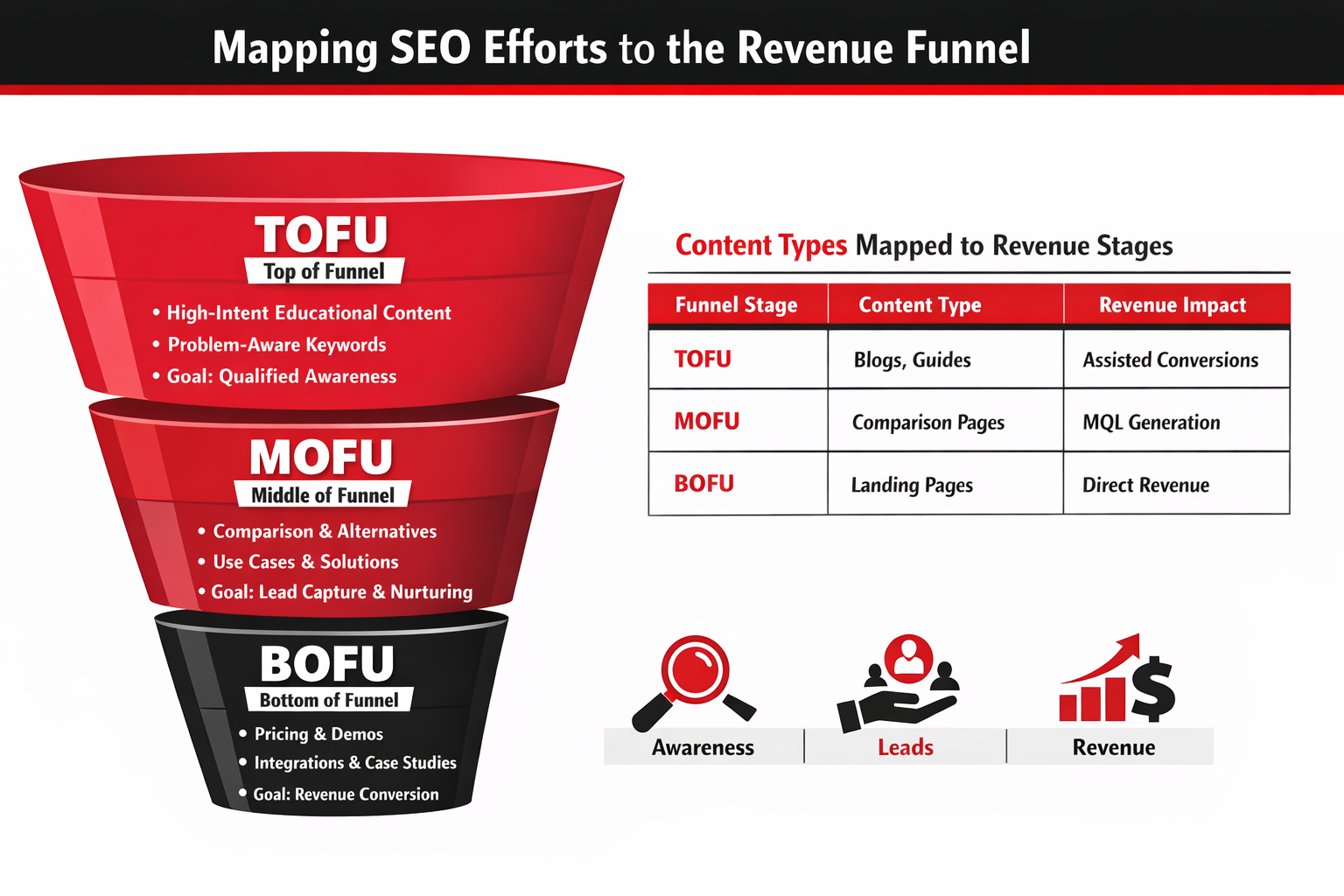
For funded startups, SEO can no longer operate as a top-of-funnel traffic engine alone. To truly impact growth, SEO efforts must be intentionally mapped to the revenue funnel, ensuring that every piece of content supports a measurable business outcome. A funnel-based SEO framework helps align search intent with user readiness to buy—turning organic visibility into pipeline and revenue.
The Funnel-Based SEO Framework
Not all organic visitors are equal. Some are just discovering a problem, while others are actively evaluating solutions or ready to purchase. Revenue-aligned SEO recognizes these differences and designs content accordingly.
Top of Funnel (TOFU): Qualified Awareness, Not Vanity Traffic
Purpose: Capture early-stage demand from users who are problem-aware but not yet solution-aware.
What TOFU SEO Looks Like
- High-intent educational content such as blogs, long-form guides, and industry explainers
- Problem-aware keywords that signal real pain points (not generic informational searches)
- Topics framed around “why” and “how” rather than product promotion
Revenue Role of TOFU SEO
The goal at this stage is qualified awareness, not raw traffic volume. For funded startups, TOFU content should attract users who match the ICP and operate in revenue-relevant industries or roles.
Rather than chasing high-volume keywords, TOFU SEO should:
- Educate future buyers
- Build trust and topical authority
- Support assisted conversions later in the funnel
While TOFU content rarely converts directly, it plays a critical role in warming prospects and reducing friction in downstream conversion paths.
Middle of Funnel (MOFU): From Interest to Intent
Purpose: Capture and nurture users who are actively evaluating solutions.
What MOFU SEO Looks Like
- Comparison pages (e.g., “Tool A vs Tool B”)
- Alternatives pages and detailed use-case content
- Keywords indicating solution awareness and evaluation intent
Revenue Role of MOFU SEO
MOFU is where SEO begins to directly influence pipeline. Visitors at this stage are:
- Comparing vendors
- Validating fit
- Looking for proof and differentiation
Well-optimized MOFU content is designed to capture leads, not just inform. This includes:
- Gated assets
- Demo prompts
- Newsletter or product sign-ups
The primary KPI here is MQL generation—turning organic visitors into identifiable prospects that sales or growth teams can nurture.
Bottom of Funnel (BOFU): Turning Demand into Revenue
Purpose: Convert high-intent organic users into paying customers.
What BOFU SEO Looks Like
- Pricing pages optimized for search intent
- Demo and trial landing pages
- Integration pages, case studies, and customer stories
Revenue Role of BOFU SEO
BOFU SEO is the most directly tied to revenue. These pages target users who are:
- Product-aware
- Vendor-shortlisting
- Ready to convert
The success metric here is simple and executive-friendly: direct revenue from organic search. Optimized BOFU pages reduce dependency on paid acquisition and improve overall CAC efficiency.
Content Types Mapped to Revenue Stages
| Funnel Stage | Content Type | Revenue Impact |
| TOFU | Blogs, guides | Assisted conversions |
| MOFU | Comparison pages | MQL generation |
| BOFU | Landing pages | Direct revenue |
By mapping SEO efforts deliberately across TOFU, MOFU, and BOFU, funded startups can transform SEO from a traffic-focused channel into a predictable, revenue-driving growth engine—one that investors and leadership teams can clearly measure and trust.
Keyword Strategy Built for Revenue, Not Volume
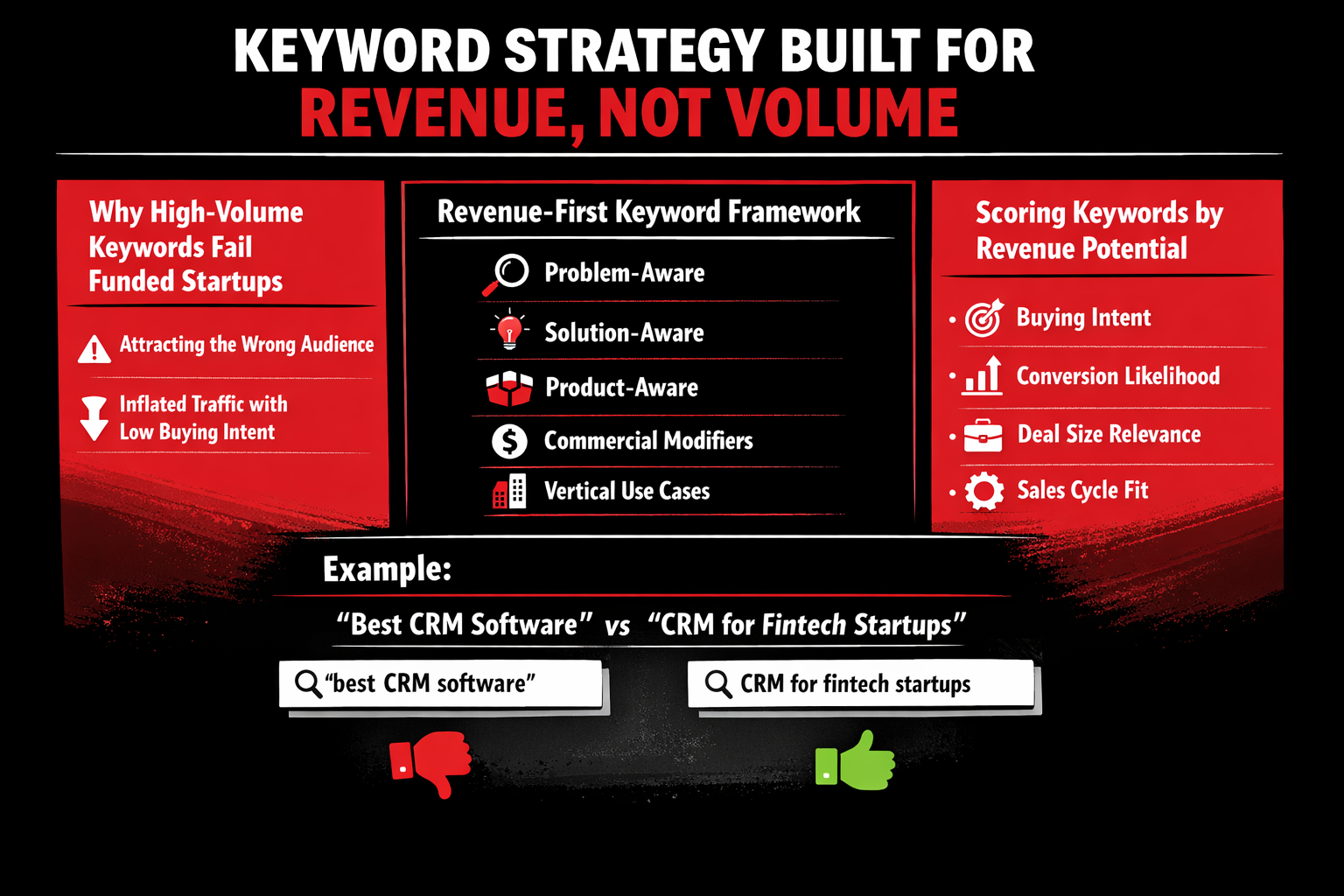
For funded startups, keyword strategy must evolve from a traffic acquisition mindset to a revenue generation discipline. While high-volume keywords may look impressive in SEO reports, they often fail to deliver meaningful business outcomes. In a post-funding environment—where burn rate, efficiency, and predictability matter—keyword decisions must be tied directly to buying intent and revenue impact, not search volume alone.
Why High-Volume Keywords Often Fail Funded Startups
High-volume keywords are typically broad, generic, and top-of-funnel. While they can drive significant traffic, they frequently attract the wrong audience—users who are researching, comparing casually, or have no immediate intent to buy. For example, a keyword like “CRM software” may attract students, consultants, or early-stage founders who are far from making a purchase decision.
The second major issue is inflated traffic with low buying intent. Large traffic numbers can mask poor performance downstream. Founders and executives may see organic sessions growing while sales teams see no increase in qualified leads or closed deals. This disconnect leads to frustration, misaligned expectations, and, in some cases, underinvestment in SEO—despite SEO not being the real problem. The issue lies in what the startup is ranking for, not how well it ranks.
The Revenue-First Keyword Framework
A revenue-aligned keyword strategy starts with intent classification, not volume:
- Problem-aware keywords indicate users who recognize a pain point but aren’t yet evaluating solutions (e.g., “how to manage sales leads efficiently”). These keywords are valuable for assisted conversions and nurturing but rarely convert directly.
- Solution-aware keywords show users actively evaluating categories or approaches (e.g., “CRM tools for startups”). These often drive high-quality leads.
- Product-aware keywords reflect bottom-of-funnel intent, where users are close to a purchase decision (e.g., “HubSpot alternatives for SaaS”). These are the most revenue-critical.
Next, layer in commercial modifiers such as best, pricing, software, tool, platform, comparison, and alternatives. These signals dramatically increase conversion probability.
Finally, prioritize vertical-specific and use-case-driven keywords. Funded startups win by being relevant, not generic. Narrow positioning reduces competition, shortens sales cycles, and improves close rates.
Scoring Keywords by Revenue Potential
Instead of ranking keywords by search volume, score them using revenue-focused criteria:
- Buying intent: How close is the searcher to a purchasing decision?
- Conversion likelihood: Does this keyword historically drive demos, sign-ups, or inquiries?
- Deal size relevance: Does it attract customers aligned with your ideal contract value?
- Sales cycle fit: Does it match your typical buying journey length?
For example, while “best CRM software” may have massive volume, it attracts a broad, unfocused audience. In contrast, “CRM for fintech startups” has lower volume but significantly higher revenue potential—targeting a defined ICP with clear needs, faster qualification, and higher conversion rates.
For funded startups, the goal is not more traffic—it’s better traffic that converts into revenue.
Aligning SEO with Sales, Product & Growth Teams
For funded startups, SEO cannot operate as a siloed marketing function. Once capital is raised, the expectation shifts from experimentation to predictable, scalable growth—and that requires tight alignment between SEO, Sales, Product, and Growth teams. When SEO works in isolation, it often optimizes for rankings and traffic. When it works cross-functionally, it becomes a powerful revenue intelligence engine.
Why SEO Cannot Operate in Isolation
Modern SEO generates more than traffic—it generates market intelligence. Search data reveals what prospects are struggling with, how they describe their problems, which alternatives they compare, and what objections delay buying decisions. These insights are invaluable to Sales, Product, and Growth teams.
One of the most overlooked opportunities lies in sales objections. Every “not now,” “too expensive,” or “missing feature” objection is a content opportunity. When SEO teams collaborate with Sales to document common objections, they can proactively create comparison pages, objection-handling blogs, and feature explainers that meet prospects before a sales call even happens—shortening sales cycles and increasing close rates.
Cross-Team Alignment Tactics
SEO + Sales
- Objection-based content: Create SEO pages around pricing concerns, comparisons, alternatives, and implementation challenges that sales teams hear repeatedly.
- Demo keyword tracking: Monitor keywords like “{product} demo,” “{product} pricing,” or “{competitor} alternatives” to understand and grow bottom-of-funnel demand.
SEO + Product
- Feature-based landing pages: Turn key product features into SEO-optimized landing pages that capture high-intent searches.
- Use case SEO: Align content with real-world use cases (e.g., “CRM for fintech startups”) so product positioning matches how users search.
SEO + Growth
- SEO + paid keyword overlap: Identify keywords performing well in paid campaigns and build organic strategies around them to reduce long-term CAC.
- Retargeting organic visitors: Feed SEO traffic into paid retargeting funnels to increase conversion rates and maximize ROI from organic acquisition.
Internal Process Framework
To sustain alignment, funded startups need structure, not ad-hoc collaboration:
- Monthly SEO–Revenue sync meetings involving SEO, Sales, Product, and Growth leaders to review pipeline impact, keyword insights, and conversion performance.
- Shared KPIs across teams, such as organic-sourced pipeline, assisted revenue, conversion rates by funnel stage, and SEO-driven CAC.
When SEO is embedded into revenue conversations across teams, it stops being “just traffic” and becomes a strategic growth lever—one that compounds over time and directly supports investor expectations.
Building SEO Dashboards That Executives Care About
For funded startups, the way SEO performance is reported can determine whether the channel gets increased investment—or gets questioned in the next board meeting. Unfortunately, most traditional SEO reports fail to resonate with executives because they focus on activity, not outcomes.
Why Traditional SEO Reports Fail
The biggest issue with conventional SEO dashboards is that they are overloaded with metrics but underwhelming in insight. Rankings, impressions, clicks, bounce rates, and keyword counts may excite SEO teams, but to founders, CMOs, and investors, these numbers rarely answer the most important question: Is SEO driving business growth?
Another major gap is the lack of revenue context. When SEO performance is presented without tying it to pipeline contribution, customer acquisition cost, or revenue impact, it gets perceived as a “brand” or “long-term” channel—rather than a scalable growth lever. In a post-funding environment, that perception can be costly.
What an Executive SEO Dashboard Should Include
An executive-level SEO dashboard must be outcome-driven, concise, and revenue-focused. At a minimum, it should highlight:
- Organic Revenue & Pipeline Contribution: Show how much revenue and pipeline value organic search is directly or indirectly influencing, segmented by product, region, or funnel stage if possible.
- Cost vs Return: Clearly compare SEO investment (content, tools, headcount, agencies) against revenue generated to demonstrate ROI and efficiency versus paid channels.
- Conversion Rates by Page Type: Break down how blogs, comparison pages, product pages, and landing pages convert. This helps leadership see what actually drives growth, not just traffic.
- Time-to-Impact Trends: Visualize how long SEO initiatives take to deliver results, reinforcing SEO as a compounding asset rather than a short-term expense.
Tools & Stack to Enable Executive Reporting
To build such dashboards, data integration is critical. GA4 should be connected with your CRM (HubSpot or Salesforce) to track organic users through the full revenue funnel. Visualization tools like Looker Studio or Power BI help translate complex data into executive-friendly insights, while attribution tools ensure SEO gets proper credit across multi-touch buyer journeys.
When SEO dashboards speak the language of revenue, they earn a seat at the executive table.
Common Mistakes Funded Startups Make with SEO
After raising funding, startups often rush to “do SEO” without redefining what success actually means. This leads to predictable—and costly—mistakes that limit SEO’s impact on revenue.
One of the most common pitfalls is hiring SEO too late or too early. Some startups delay SEO until paid acquisition becomes expensive, losing valuable compounding time. Others hire aggressively before product–market fit, resulting in traffic that doesn’t convert. SEO should be introduced when the ICP, pricing, and core use cases are reasonably clear.
Another frequent issue is scaling content without conversion optimization. Funded startups often publish content at scale but fail to optimize pages for lead capture, demos, or purchases. Traffic grows, but revenue does not—turning SEO into a cost center rather than a growth channel.
Many teams also make the mistake of chasing rankings instead of real demand. Ranking #1 for high-volume keywords looks impressive in reports, but if those keywords don’t reflect buying intent, they rarely contribute to pipeline or sales.
Ignoring technical SEO debt is another silent growth killer. As startups scale quickly, site speed, crawlability, indexing issues, and poor architecture accumulate—ultimately limiting organic growth and hurting conversions.
Finally, not connecting SEO to CRM data prevents teams from proving ROI. Without linking organic traffic to leads, opportunities, and revenue, SEO performance remains invisible to leadership and investors.
How to Avoid These Mistakes
Funded startups should adopt revenue-first planning, defining success through pipeline and revenue impact rather than traffic alone. SEO experimentation with clear guardrails ensures growth without wasted spend. Most importantly, establish clear ownership and accountability, aligning SEO with growth, sales, and revenue teams to ensure every effort drives measurable business outcomes.
Case-Style Examples: What Revenue-Aligned SEO Looks Like in Practice
To understand how SEO can directly influence revenue after funding, let’s look at two realistic, case-style examples—one from a B2B SaaS startup and another from a B2C funded brand. While the business models differ, both demonstrate how aligning SEO with revenue goals produces measurable outcomes beyond traffic and rankings.
Example 1: B2B SaaS Startup (Series A)
Focus: Comparison Pages + Use Case–Driven Content
Result: Significant Increase in SQLs from Organic Search
After raising a Series A round, this B2B SaaS company faced pressure to show pipeline growth—not just user sign-ups. Instead of scaling top-of-funnel blogs, the SEO strategy pivoted toward high-intent comparison pages (e.g., “Product X vs Product Y”) and industry-specific use case pages.
These pages were built around keywords already appearing in sales calls and demo requests. Each page included clear CTAs for demos, customer proof, and feature differentiation aligned with buyer objections. SEO and sales teams collaborated closely, ensuring content mirrored real purchasing conversations.
Within a few months, organic traffic grew modestly—but more importantly, SQLs from organic search increased significantly. The SEO channel began contributing directly to the sales pipeline, with organic leads converting at a higher rate than paid traffic. SEO success was now measured in qualified demos and deal velocity, not keyword positions.
Example 2: B2C Funded Brand
Focus: Category SEO + Conversion Rate Optimization (CRO)
Result: Organic Revenue Growth Outperforming Paid Channels
This B2C brand, fresh off a growth funding round, relied heavily on paid ads for revenue. SEO previously focused on blog content with limited commercial intent. The post-funding shift prioritized category and sub-category pages targeting high-conversion search terms, supported by continuous CRO improvements.
Product listings, internal linking, page speed, and mobile UX were optimized to reduce friction and increase checkout conversions. Instead of chasing traffic spikes, the team tracked revenue per organic session and organic conversion rate.
Over time, organic revenue grew steadily and began outperforming paid channels in ROI, with lower acquisition costs and higher repeat purchases. SEO evolved from a branding channel into a predictable revenue driver.
Key Learnings from Both Examples
- Content Focus Shift: From informational traffic to intent-driven, revenue-impacting pages
- KPI Tracking Evolution: From sessions and rankings to SQLs, revenue, and conversion rates
- ROI Timelines: SEO revenue impact compounds over time but becomes highly defensible and scalable
These examples highlight a clear truth: revenue-aligned SEO doesn’t chase visibility—it builds profitable growth.
90-Day Action Plan to Align SEO with Revenue
For funded startups, speed and focus matter. This 90-day roadmap helps transform SEO from a traffic channel into a measurable revenue engine—without overwhelming your team or burning budget.
First 30 Days: Build the Revenue Foundation
The first month is about clarity, not execution volume.
1. Revenue Audit
Start by understanding how SEO currently contributes to revenue. Analyze organic traffic alongside leads, opportunities, and closed deals. Identify:
- Which pages influence conversions (directly or assisted)
- Which keywords bring high-intent visitors
- Where organic traffic drops off before converting
This audit reveals whether SEO is attracting buyers or just browsers.
2. Funnel & Keyword Mapping
Next, map keywords and pages to each stage of the revenue funnel:
- TOFU: Problem-aware educational queries
- MOFU: Comparison, alternatives, and use-case keywords
- BOFU: Pricing, demos, integrations, and solution-specific terms
Prioritize keywords based on conversion potential, not search volume.
3. Analytics & CRM Alignment
Ensure analytics platforms (GA4) are properly connected to your CRM (HubSpot, Salesforce, etc.). Organic leads should be trackable from first visit to closed revenue. Without this alignment, SEO impact remains invisible to leadership.
Days 31–60: Execute High-Intent SEO
With the foundation set, focus on revenue-driving execution.
1. BOFU & MOFU Content Rollout
Create or optimize pages targeting high-intent searches:
- Comparison and alternatives pages
- Use-case and industry-specific landing pages
- Feature-focused content tied to sales conversations
These pages generate leads that sales teams actually want.
2. Conversion Rate Optimization (CRO)
Traffic without conversion is wasted opportunity. Improve:
- CTAs (demo, trial, consultation)
- Page layout and messaging
- Trust signals (case studies, testimonials, security badges)
Small CRO gains often outperform large traffic increases.
3. Sales Enablement Content
Turn SEO insights into sales assets. Build objection-handling content, SEO-driven FAQs, and landing pages sales teams can share during the buying cycle.
Days 61–90: Prove, Optimize, and Scale
The final phase is about validation and growth.
1. Attribution Refinement
Move beyond last-click attribution. Measure how SEO assists conversions across touchpoints—especially in B2B sales cycles.
2. Executive Dashboard Setup
Create a simple dashboard showing:
- Organic pipeline and revenue
- SEO CAC vs paid CAC
- Conversion rates by funnel stage
This makes SEO boardroom-ready.
3. Scale What Converts
Double down on pages, keywords, and formats that generate revenue. Pause what doesn’t. At this stage, SEO becomes a predictable, scalable growth channel—not an experiment.
Conclusion: SEO as a Revenue Engine, Not a Cost Center
For funded startups, SEO can no longer live in the shadow of vanity metrics or be treated as a long-term “brand play” with unclear returns. Post-funding, every function is expected to justify its budget, and SEO is no exception. Traffic, impressions, and rankings may look impressive in reports, but unless they contribute directly or indirectly to pipeline, revenue, and customer lifetime value, they fail to answer the only question that matters to leadership: Is this driving business growth?
Aligning SEO with revenue transforms it from a cost center into a predictable growth engine. When organic search is mapped to the funnel, measured through revenue-linked KPIs, and connected to sales and product data, SEO becomes boardroom-ready. Founders and investors can clearly see how organic visibility reduces CAC, supports scalable demand generation, and compounds over time. This level of clarity not only secures continued investment in SEO but also elevates it to a strategic lever alongside paid media, partnerships, and product-led growth.
Most importantly, revenue-driven SEO delivers a long-term compounding advantage. Unlike paid channels that stop performing when spend is reduced, well-executed SEO continues to generate qualified demand, close deals, and retain customers long after the initial investment. Over time, this creates defensibility, efficiency, and sustainable growth—exactly what funded startups are expected to achieve.
The startups that win don’t just rank—they convert, retain, and scale profitably.