SUPERCHARGE YOUR ONLINE VISIBILITY! CONTACT US AND LET’S ACHIEVE EXCELLENCE TOGETHER!
What It Is
The modern web is no longer navigated solely by search engine crawlers—it is increasingly interpreted, synthesized, and acted upon by artificial intelligence systems. In this evolving landscape, traditional XML sitemaps—designed merely to list URLs—have become insufficient.
What emerges instead is a hybrid semantic sitemap architecture—a next-generation framework that transcends basic indexing and introduces machine-readable intelligence layers directly into the site’s structural blueprint.
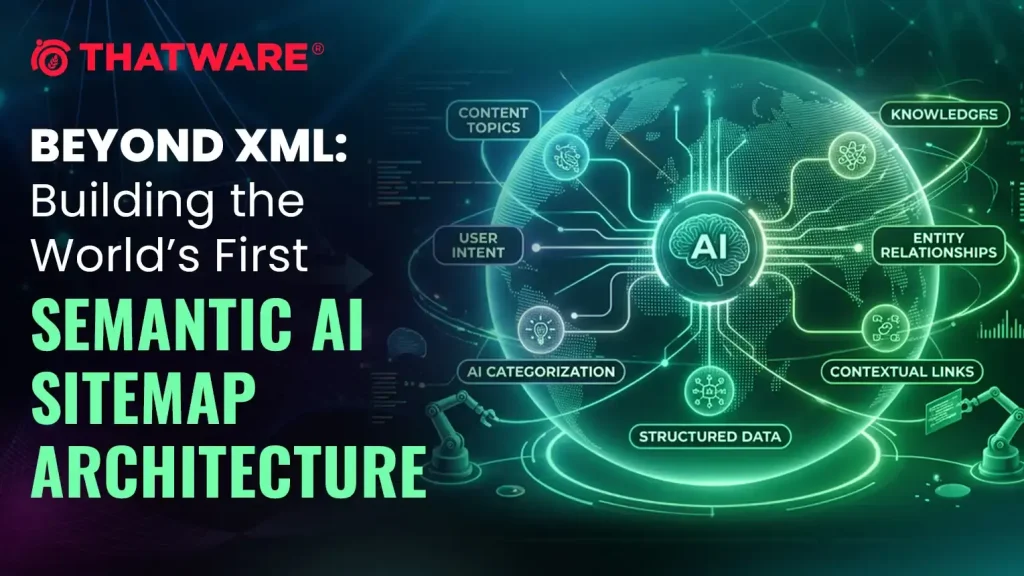
This architecture goes beyond conventional XML by embedding:
- AI endpoints such as ai.txt, llms.txt, and ai-manifesto.json, transforming the sitemap into an AI-accessible control surface
- Service-layer semantic clustering, where related offerings are grouped into meaningful conceptual domains rather than isolated pages
- Authority hierarchies through priority signals, guiding both search engines and AI agents toward high-value entities within the ecosystem
Rather than functioning as a passive directory, the sitemap becomes an active orchestration layer—one that communicates intent, structure, and relevance to both human and machine interpreters.
Why It Exists
The fundamental purpose of this architecture is to bridge two previously disconnected worlds:
- Human-centric SEO strategies
- Machine-readable AI ecosystems
Until now, websites have been optimized primarily for search engines like Google. However, with the rise of:
- Large Language Models (LLMs)
- AI-driven search engines
- Autonomous indexing and retrieval systems
…the rules of discoverability are changing.
This new semantic sitemap is designed not just for traditional crawlers, but for:
- LLM agents that interpret and summarize content
- AI search engines that prioritize contextual understanding over keyword matching
- Autonomous systems that ingest, rank, and act on structured knowledge
In essence, it ensures that a website is not only indexed—but understood, contextualized, and trusted by AI.
Core Philosophy
At its core, this approach represents a paradigm shift in how digital presence is structured and perceived.
It moves away from the outdated model of:
- ❌ URL discovery — where the goal is simply to ensure pages are found
…and toward a far more advanced framework:
- ✅ Knowledge graph orchestration — where the objective is to define relationships, authority, and meaning across an interconnected ecosystem
This is not just an upgrade in technical implementation—it is a redefinition of SEO itself.
The sitemap evolves from a static list into a dynamic intelligence layer, enabling machines to:
- Understand entity relationships
- Identify authoritative nodes
- Navigate conceptual hierarchies
- Extract structured meaning at scale
The Strategic Shift
In practical terms, this means:
- Websites are no longer just collections of pages
- They become structured knowledge systems
- SEO is no longer just about ranking
- It becomes about representation in AI cognition
- Crawling is no longer just about indexing
- It becomes about interpretation and integration
How It Is Different: Moving Beyond Traditional AI.txt and XML Sitemaps
For years, the role of a sitemap has been fundamentally limited—serving as a structured list of URLs to guide search engine crawlers. Similarly, the emergence of ai.txt introduced a new layer of machine communication, but still remained largely instructional and isolated in nature.
What ThatWare has engineered is not an iteration—but a paradigm shift.
From URL Listing to Semantic Infrastructure
A traditional XML sitemap operates as a directory of pages. It answers a simple question: “What URLs exist on this website?”
The semantic sitemap, however, answers a far more advanced question:
👉 “How does this website think, relate, and communicate as an entity within an AI-driven ecosystem?”
This transforms the sitemap from a passive listing mechanism into an active semantic infrastructure layer—one that encodes meaning, hierarchy, and intent.
Redefining AI.txt: From Instructions to Orchestration
While industry-standard ai.txt files primarily define how AI systems should crawl or interact, they remain:
- Flat in structure
- Limited in scope
- Disconnected from broader site intelligence
ThatWare’s semantic sitemap takes a fundamentally different approach by embedding AI interaction within a larger, interconnected system.
Instead of treating AI as an external consumer, it positions AI as an integrated participant in the site’s architecture.
A Multi-Layered Intelligence Framework
At the core of this innovation lies a shift from static directives to dynamic intelligence mapping:
- Purpose evolves from simple crawling rules → to full ecosystem orchestration
- Depth expands from flat instructions → to multi-layered semantic relationships
- Integration matures from standalone files → to deep interlinking with AI endpoints (ai.txt, llms.txt, manifesto layers)
- Intelligence upgrades from static configurations → to contextual, priority-driven signaling
This creates a system where every element is not just discoverable, but understandable and interpretable by machines.
The Core Differentiator: Unified Crawlable Intelligence
The most critical distinction lies here:
- It does not isolate AI instructions into separate files
- It does not treat SEO and AI as parallel systems
Instead, it unifies AI, SEO, and entity architecture into a single, crawlable intelligence framework
This means:
- Search engines don’t just index pages
- AI systems don’t just follow rules
👉 They interpret a structured knowledge system
Why This Matters
In an era where search is rapidly transitioning from keyword retrieval to AI-driven understanding, this approach positions the website as:
- A machine-readable entity, not just a collection of pages
- A context-rich knowledge source, not just content
- A participant in AI ecosystems, not just a target for crawling
What Differentiates It: Core Innovations Driving the Semantic Sitemap
At the heart of this architecture lies a set of deliberate, high-level innovations that fundamentally redefine how websites communicate with both search engines and AI systems. These are not incremental improvements—they represent a structural evolution of digital discoverability.
1. AI Endpoint Inclusion Inside the Sitemap
Repositioning AI from Peripheral to Core Infrastructure
One of the most groundbreaking aspects of this semantic sitemap is the direct inclusion of AI-specific endpoints as first-class URLs within the sitemap itself, including:
- /ai.txt
- /llms.txt
- /ai-manifesto.json
Traditionally, these files exist in isolation—accessible only when explicitly requested by crawlers or AI agents. They are treated as supplementary layers, not integral components of the website’s architecture.
ThatWare disrupts this convention by:
- Elevating these endpoints to primary crawlable assets
- Ensuring they are discovered, indexed, and interpreted alongside core pages
Strategic Implication
This signals a powerful shift:
👉 AI relevance is not an add-on—it is a foundational layer of the digital entity
By embedding these files within the sitemap:
- AI systems are guided proactively, not reactively
- Crawlers understand that AI governance, intent, and philosophy are part of the site’s identity
- The website becomes AI-native by design, not retrofitted for compatibility
2. Semantic Priority Engineering
From Arbitrary Weights to Intent-Driven Hierarchy
In conventional sitemaps, priority values are often:
- Randomly assigned
- Uniform across pages
- Largely ignored as a strategic lever
In contrast, this semantic sitemap employs precision-driven priority engineering, where each value reflects intent, authority, and strategic importance.
How Priority Is Structured
The hierarchy is intentionally distributed across:
- Authority Nodes
- About page
- Founder profile
- AI Governance Layer
- AI policy
- AI instruction files
- Core Service Pages
- Quantum SEO
- AEO (Ask Engine Optimization)
- LLM SEO
Each of these is assigned elevated priority, not for indexing convenience—but to signal:
👉 “This is where meaning, authority, and decision-making originate.”
Strategic Implication
This creates an intent-weighted architecture, where:
- Crawlers prioritize understanding before indexing
- AI systems identify core knowledge nodes instantly
- The site communicates what matters most—structurally and semantically
In essence, priority becomes a semantic signal, not just a crawl hint.
3. Conceptual SEO Layering
From Keywords to Cognitive Frameworks
Another defining innovation is the introduction of conceptual SEO layers—pages that go beyond services and into theoretical and cognitive domains, such as:
- Cognitive Resonance SEO
- Reality Optimization SEO
- Keywords → Cognition
These are not conventional service pages. They are intellectual constructs that define how search, intent, and human-machine interaction are understood.
What This Represents
This marks a critical transition:
- From:
- Keyword targeting
- Query matching
- To:
- Intent modeling
- Cognitive alignment
- Search behavior interpretation
Strategic Implication
By embedding these conceptual layers into the sitemap:
- The website evolves into a knowledge system, not just a service provider
- AI models can interpret:
- Concept relationships
- Thought leadership positioning
- Domain expertise depth
👉 This is how a site moves from being indexed to being understood
4. AI + SEO + Branding Convergence
Unifying Identity, Authority, and Intelligence Signals
Perhaps the most powerful differentiator is the seamless convergence of:
- Brand identity
- AI governance
- SEO architecture
Within the sitemap, high priority is assigned to:
- Founder page
- AI manifesto
- AI policy
These are not traditionally considered “SEO-critical” pages. Yet here, they are treated as central authority signals.
Why This Matters
Modern search ecosystems—especially AI-driven ones—prioritize:
- Entity recognition
- Authorship credibility
- Trust frameworks
By elevating these elements:
- The website establishes a clear authorship lineage
- It communicates intent, ethics, and expertise
- It aligns with frameworks like:
- Google’s E-E-A-T
- AI trust and attribution models
Strategic Implication
This convergence creates:
👉 A unified entity signal across search engines and AI systems
Where:
- SEO is not just about visibility
- AI is not just about interaction
- Branding is not just about perception
Instead, all three merge into a cohesive digital intelligence identity
4. Execution Process: How the Semantic AI Sitemap Was Engineered
Building a semantic sitemap of this nature is not a linear SEO task—it is a multi-layered systems design exercise that combines entity modeling, AI protocol integration, and crawl optimization into a unified architecture.
Below is a breakdown of the execution framework that powers this innovation.
Step 1: Entity Mapping — Establishing the Knowledge Backbone
The foundation of the entire system begins with entity-first thinking, not pages or keywords.
Instead of asking “what pages exist?”, the process starts with:
👉 “What entities define the business and how are they interconnected?”
Key Entity Identification:
- Brand Entity (ThatWare)
The central node of the entire ecosystem. All signals, authority, and relationships ultimately resolve back to this entity.
- Founder Entity
Acts as a trust amplifier and authorship signal. In modern AI and search systems, founder identity contributes heavily to:
- E-E-A-T signals
- Knowledge graph validation
- Entity credibility scoring
- Service Entities
Each service (e.g., Quantum SEO, AEO, LLM SEO) is treated as an independent yet interconnected node within the larger ecosystem.
Why This Matters:
This transforms the website from a collection of URLs into a structured knowledge graph, where:
- Relationships are explicit
- Authority flows through connections
- Machines can interpret context, not just content
Step 2: AI Layer Integration — Embedding Machine Communication Protocols
Once the entity layer is defined, the next step is to enable direct communication with AI systems.
This is achieved by integrating specialized AI-facing files into the architecture.
Core Components:
- ai.txt → Crawling Behavior Layer
Defines how AI agents should:
- Access content
- Interpret permissions
- Navigate the site
- llms.txt → Model-Specific Signal Layer
Provides structured guidance tailored for:
- Large Language Models
- AI assistants
- Retrieval systems
- ai-manifesto.json → Philosophical & Alignment Layer
This is a unique addition that goes beyond technical instruction. It communicates:
- Brand intent
- Ethical positioning
- AI alignment principles
Strategic Impact:
Instead of treating AI as an external crawler, this step:
- Invites AI into the system as a participant
- Establishes bidirectional understanding
- Creates a machine-readable identity layer
Step 3: Semantic Clustering — Structuring Intelligence Domains
With entities and AI protocols in place, the next step is to organize the ecosystem into semantic clusters.
This replaces traditional keyword grouping with conceptual domain modeling.
Core Clusters:
- AI SEO
Covers machine-driven optimization strategies
- Quantum SEO
Represents advanced, future-facing search methodologies
- AEO (Ask Engine Optimization)
Focuses on conversational and answer-based search systems
- Cognitive SEO
Aligns with human intent modeling and behavioral understanding
Why Clustering Matters:
- Helps AI systems understand topical boundaries and depth
- Strengthens topical authority signals
- Enables contextual retrieval instead of keyword matching
This step effectively builds a semantic architecture layer, where each cluster acts as a knowledge domain.
Step 4: Priority Calibration — Engineering Signal Hierarchy
Not all pages carry equal importance—and in AI-driven ecosystems, signal weighting becomes critical.
This step involves assigning priority values that guide both search engines and AI agents in understanding:
👉 “What matters most?”
Calibration Factors:
- Business Importance
Core service pages and revenue-driving assets receive higher priority.
- Authority Signals
Pages like:
- About
- Founder
- AI policy
Are elevated to reinforce trust and credibility. - AI Relevance
Pages directly interacting with AI systems (e.g., ai.txt, llms.txt) are prioritized to ensure:
- Faster discovery
- Higher indexing frequency
Outcome:
A hierarchical signal system where:
- Authority flows logically
- Crawlers allocate resources efficiently
- AI systems prioritize high-value knowledge nodes
Step 5: Crawl Frequency Engineering — Optimizing for Bots and AI Agents
The final step is to define how often different parts of the system should be revisited and updated.
This is where traditional crawl optimization evolves into dual-layer optimization:
- Search engine bots
- AI retrieval agents
Frequency Design:
- Daily → Blogs
High-frequency updates signal:
- Freshness
- Ongoing knowledge expansion
- Weekly → AI Assets & Case Studies
These are:
- Dynamic but not volatile
- Critical for AI interpretation and proof validation
- Monthly → Core Pages
Stable assets such as:
- Service pages
- About pages
Indicate structural consistency and authority
The Strategic Insight
This is not just crawl scheduling—it is crawl budget orchestration across two ecosystems:
- Traditional search engines (Google, Bing)
- AI systems (LLMs, agents, retrieval engines)
👉 The result:
- Reduced crawl waste
- Faster indexing of critical assets
- Improved AI comprehension and retrieval accuracy
Definition of Layers / File (In-Depth Breakdown of the Semantic Sitemap Architecture)
What makes this semantic sitemap truly powerful is not just the URLs it contains—but the layered intelligence architecture it represents.
Each layer is intentionally designed to serve a distinct role in how search engines, AI systems, and knowledge models interpret the entity.
This is not a flat structure. It is a multi-layered semantic stack.
Layer 1: Core Identity Layer
URLs:
- /about-us/
- /tuhin-banik/
👉 Purpose: Defining Entity Identity
At the foundation lies the identity layer, which establishes who the entity is—both as a brand and as an individual authority.
This layer performs several critical functions:
- Entity Declaration: Clearly defines the organization (ThatWare) and its primary human authority (Tuhin Banik)
- Authorship Signal: Reinforces authorship and leadership, which is crucial for both Google’s E-E-A-T and LLM-based trust systems
- Knowledge Graph Anchoring: These pages act as root nodes in the site’s knowledge graph
From an AI perspective, this layer answers:
“Who is speaking?”
Without this clarity, all downstream content loses contextual weight.
Layer 2: Governance & AI Control Layer
URLs:
- /ai-policy/
- /ai.txt
- /llms.txt
- /ai-manifesto.json
👉 Purpose: Defining Rules, Ethics, and Machine Intent
This layer is where the architecture becomes AI-native.
Instead of treating AI as an external crawler, this layer establishes:
- How AI systems should interact
- What principles guide that interaction
- What the entity stands for in machine-readable terms
Key Components:
- AI Policy: Defines boundaries, acceptable usage, and governance principles
- ai.txt: Provides structured instructions for AI agents (similar to robots.txt but AI-focused)
- llms.txt: Tailors signals specifically for Large Language Models, enabling contextual understanding
- AI Manifesto (JSON): A machine-readable philosophy layer—encoding intent, positioning, and alignment
Why This Layer Is Critical
- Establishes trust protocols for AI systems
- Creates predictable interaction frameworks
- Enables alignment between human values and machine interpretation
From an AI standpoint, this layer answers:
“How should I interpret and interact with this entity?”
Layer 3: Service Intelligence Layer
Examples:
- Quantum SEO
- AEO (Ask Engine Optimization)
- LLM SEO
- AI-Based SEO
👉 Purpose: Representing the Solution Graph
This layer defines what the entity does—but more importantly, how its services are semantically structured.
Unlike traditional service pages, these are not isolated offerings. They form an interconnected:
👉 Solution Graph
Key Characteristics:
- Semantic Clustering: Services are grouped based on technological and conceptual alignment
- AI Relevance: Each service is inherently aligned with future search paradigms (AI, LLMs, quantum computing)
- Interconnectivity: Services reinforce each other instead of competing for relevance
Strategic Impact
- Helps AI systems understand:
- Capability depth
- Domain specialization
- Contextual relationships between services
From a machine perspective, this layer answers:
“What does this entity solve—and how are those solutions connected?”
Layer 4: Conceptual / Innovation Layer
Examples:
- Cognitive Resonance SEO
- Reality Optimization SEO
- Keywords → Cognition
👉 Purpose: Building Thought Leadership Ontology
This is where the architecture transcends services and enters intellectual territory.
This layer represents:
- Proprietary frameworks
- Emerging theories
- Conceptual innovations
What Makes This Layer Unique
- Not service-driven, but idea-driven
- Encodes original thinking into the sitemap
- Expands the entity from a service provider → to a knowledge creator
Ontological Function
This layer builds what can be described as a:
👉 Thought Leadership Ontology
- Defines new concepts
- Establishes semantic ownership of ideas
- Enables AI systems to associate the brand with innovation narratives
From an AI perspective, this answers:
“What new knowledge or frameworks does this entity contribute?”
Layer 5: Proof & Distribution Layer
Components:
- Case studies
- Blogs
- Press releases
👉 Purpose: Validation, Amplification, and Freshness
If previous layers establish identity, rules, and capabilities, this layer provides:
👉 Evidence
Functions of This Layer:
1. Performance Validation
- Case studies demonstrate real-world success
- Converts claims into measurable outcomes
2. Authority Amplification
- Blogs showcase expertise and continuous knowledge output
- Press releases build external credibility
3. Recency Signaling
- Frequent updates (daily/weekly) indicate:
- Active engagement
- Fresh knowledge
- Ongoing innovation
Why This Matters
AI systems and search engines increasingly prioritize:
- Demonstrated expertise
- Content freshness
- Real-world validation
This layer answers:
“Can this entity prove what it claims—and is it actively evolving?”
Layer 6: Interaction Layer
URL:
- /contact-us/
👉 Purpose: Conversion and Engagement Endpoint
At the top of the stack lies the interaction layer, where all intelligence converges into action.
This is not just a contact page—it is the:
👉 Conversion Interface of the Semantic System
Role in the Architecture
- Translates:
- Knowledge → into engagement
- Authority → into trust
- Discovery → into conversion
- Acts as the final node in the user + AI journey
Strategic Importance
- Completes the lifecycle:
- Discovery → Understanding → Validation → Interaction
- Enables:
- Human conversion
- AI-driven recommendations (future-facing)
From a system perspective, this answers:
“How can I engage with this entity?”
Final Perspective
These six layers together form a fully integrated semantic architecture where:
- Identity establishes trust
- Governance defines rules
- Services demonstrate capability
- Concepts drive innovation
- Proof validates authority
- Interaction enables conversion
Proofs (Why This Is Powerful)
The strength of this semantic sitemap architecture is not theoretical—it is structurally provable through the way it aligns with both search engine mechanics and emerging AI indexing paradigms. Each layer demonstrates measurable advantages that go far beyond traditional SEO implementations.
Proof 1: AI-Ready Architecture
One of the most defining aspects of this system is the direct inclusion of AI-specific endpoints within the sitemap itself, such as:
- ai.txt
- llms.txt
- ai-manifesto.json
This is a critical shift in how websites communicate with machines.
Why this matters:
Traditionally, AI-related files exist in isolation—placed in root directories without strong discoverability signals. Crawlers may find them, but they are not contextually prioritized.
By embedding these files directly into the sitemap:
- They become part of the primary crawl path
- They are treated as first-class assets, not auxiliary files
- They gain priority signals and update frequency cues
Resulting Impact:
👉 The website becomes natively discoverable by LLM crawlers and AI agents, not just traditional search bots.
This enables:
- Faster ingestion into AI systems
- Better interpretation of site-level intent
- Structured alignment with Retrieval-Augmented Generation (RAG) pipelines
In essence, the site transitions from being crawlable to being AI-readable by design.
Proof 2: Entity Authority Reinforcement
Another powerful signal emerges from how entity-defining pages are prioritized, including:
- Founder page
- AI policy
- AI manifesto
- About page
These are not treated as secondary informational pages—they are elevated within the sitemap hierarchy.
Why this matters:
Modern search and AI systems increasingly rely on entity-based understanding, not just keyword matching.
By prioritizing these pages, the architecture:
- Establishes clear authorship and ownership signals
- Reinforces organizational identity
- Provides governance and ethical context
Alignment with Key Frameworks:
👉 Google E-E-A-T (Experience, Expertise, Authoritativeness, Trustworthiness)
- Founder → Expertise & Authority
- Policy → Trust & Transparency
- Manifesto → Vision & Intent
👉 LLM Trust Scoring Systems
- AI systems assess:
- Source credibility
- Content origin
- Ethical positioning
This structure feeds directly into those evaluation layers.
Resulting Impact:
- Higher trust weighting in AI-generated responses
- Increased likelihood of being cited or referenced by LLMs
- Stronger entity recognition across search and AI ecosystems
This is not just SEO—it is entity engineering at scale.
Proof 3: Crawl Behavior Optimization
The sitemap demonstrates a highly intentional use of change frequency signals, segmented by content type:
- Daily → Blogs
- Weekly → AI-related assets, case studies
- Monthly → Core service and foundational pages
Why this matters:
Most websites either:
- Ignore changefreq, or
- Apply it uniformly without strategic intent
Here, it is used as a crawl behavior control mechanism.
Strategic Implications:
👉 Freshness Signaling
- Blogs updated daily → signals ongoing activity
- Encourages frequent re-crawling
👉 Stability Signaling
- Core pages updated monthly → signals reliability
- Prevents unnecessary crawl waste
👉 Priority Alignment
- AI assets updated weekly → reflects evolving nature of AI systems
Resulting Impact:
- Optimized crawl budget allocation
- Faster indexing of high-value dynamic content
- Reduced noise from static pages
In effect, the site communicates not just what exists, but how often each layer of knowledge evolves.
Proof 4: Semantic Topic Depth
Perhaps the most sophisticated element lies in the nature of the content itself.
The sitemap does not merely list services—it includes conceptual frameworks, such as:
- Cognitive Resonance SEO
- Reality Optimization SEO
- Keywords to Cognition
- Quantum SEO
Why this matters:
Traditional SEO architectures focus on:
- Services
- Keywords
- Transactional intent
This system expands into conceptual and cognitive domains, which are far more aligned with how AI systems process information.
Strategic Advantages:
👉 Topical Authority Graph Expansion
- Covers not just “what you do”
- But also “how you think” and “what frameworks you own”
👉 Knowledge Embedding
- AI systems can:
- Map relationships between concepts
- Understand domain expertise at a deeper level
- Associate the brand with emerging paradigms
👉 Ontology Creation
- These conceptual pages act as nodes in a knowledge graph, not just landing pages
Resulting Impact:
- Stronger semantic relevance across a broader topic spectrum
- Increased probability of inclusion in AI-generated knowledge responses
- Long-term dominance in niche conceptual territories
Pro-long Benefits
1. Future-Proof SEO: Built for the Next Evolution of Search
The fundamental advantage of a semantic sitemap architecture lies in its forward compatibility with emerging search paradigms.
Traditional SEO frameworks are optimized for:
- Keyword indexing
- Link-based authority
- Static crawling mechanisms
However, the search landscape is rapidly shifting toward:
- AI-native search engines (e.g., conversational and generative search systems)
- Autonomous agents that navigate, interpret, and act on web data
- Retrieval-Augmented Generation (RAG) systems, where content is dynamically retrieved and synthesized
This architecture ensures that the website is not merely crawlable—but contextually interpretable across all these systems.
👉 Instead of optimizing for algorithms, it optimizes for machine cognition.
As a result:
- Content becomes reusable across AI pipelines
- Site structure aligns with knowledge retrieval systems
- The website remains relevant even as traditional ranking factors evolve
In essence, it future-proofs SEO by making the site compatible with how machines will think—not just how they index.
2. Higher AI Visibility: From Indexing to Interpretation
In conventional setups, visibility depends on:
- Ranking positions
- Keyword alignment
- Backlink signals
But in AI-driven environments, visibility is determined by:
👉 “Can the system understand and trust this entity enough to reference it?”
A semantic sitemap enables Large Language Models (LLMs) to:
- Understand structure
→ Clear hierarchy of pages, services, and authority nodes allows AI systems to map relationships
- Extract knowledge
→ Content is not just crawled—it is parsed into usable knowledge units
- Reference the brand
→ When AI systems generate answers, they can cite or rely on the brand as a recognized entity
This transforms visibility from:
- ❌ Being listed in results
- ✅ Being embedded within AI-generated answers
3. Stronger Entity Authority: Unified Signal Engineering
Modern search and AI systems rely heavily on entity-based understanding, not just pages or keywords.
This architecture deliberately combines:
- Brand identity (organizational presence)
- Founder authority (human credibility layer)
- Philosophy & manifesto (intent + positioning)
👉 Into a single, unified semantic signal
This has profound implications:
- Reinforces E-E-A-T (Experience, Expertise, Authority, Trust) signals
- Creates a multi-dimensional entity graph
- Aligns with how LLMs evaluate credibility and source reliability
Instead of fragmented signals across pages, the system produces:
👉 A cohesive identity that machines can confidently interpret and trust
4. Crawl Efficiency: Intelligent Resource Allocation
One of the most overlooked advantages is precision in crawl behavior.
Traditional websites often:
- Waste crawl budget on low-value pages
- Lack clear prioritization
- Send inconsistent signals to crawlers
This semantic architecture introduces:
- Noise reduction
→ Eliminates ambiguity about which pages matter most - Priority-driven crawling
→ High-value assets (AI files, core services, authority pages) are clearly emphasized - Frequency optimization
→ Dynamic content (blogs) vs stable assets (core pages) are treated differently
The result:
👉 Search engines and AI systems spend more time on what matters—and less on what doesn’t.
This leads to:
- Faster indexing cycles
- Better content freshness recognition
- Improved overall crawl efficiency
5. Competitive Moat: A Structural Advantage Few Can Replicate
Most websites today operate within a fragmented model:
- Either they implement a traditional sitemap
- Or they experiment with ai.txt or LLM directives in isolation
Very few integrate these into a unified, semantically structured ecosystem.
ThatWare’s approach creates a defensible competitive moat by:
- Combining SEO infrastructure + AI protocols + semantic modeling
- Establishing machine-readable differentiation at the architecture level
- Building a system that is not easily reverse-engineered without deep expertise
This is critical because:
👉 Competitive advantage is no longer just about content—it’s about how that content is structured for machine understanding
Over time, this leads to:
- Higher AI recall and citation rates
- Stronger topical dominance
- Sustained visibility across evolving search platforms
“This is not a sitemap. It is a machine-readable intelligence architecture designed for the post-search era—where AI agents, not just search engines, interpret, rank, and interact with digital entities.”
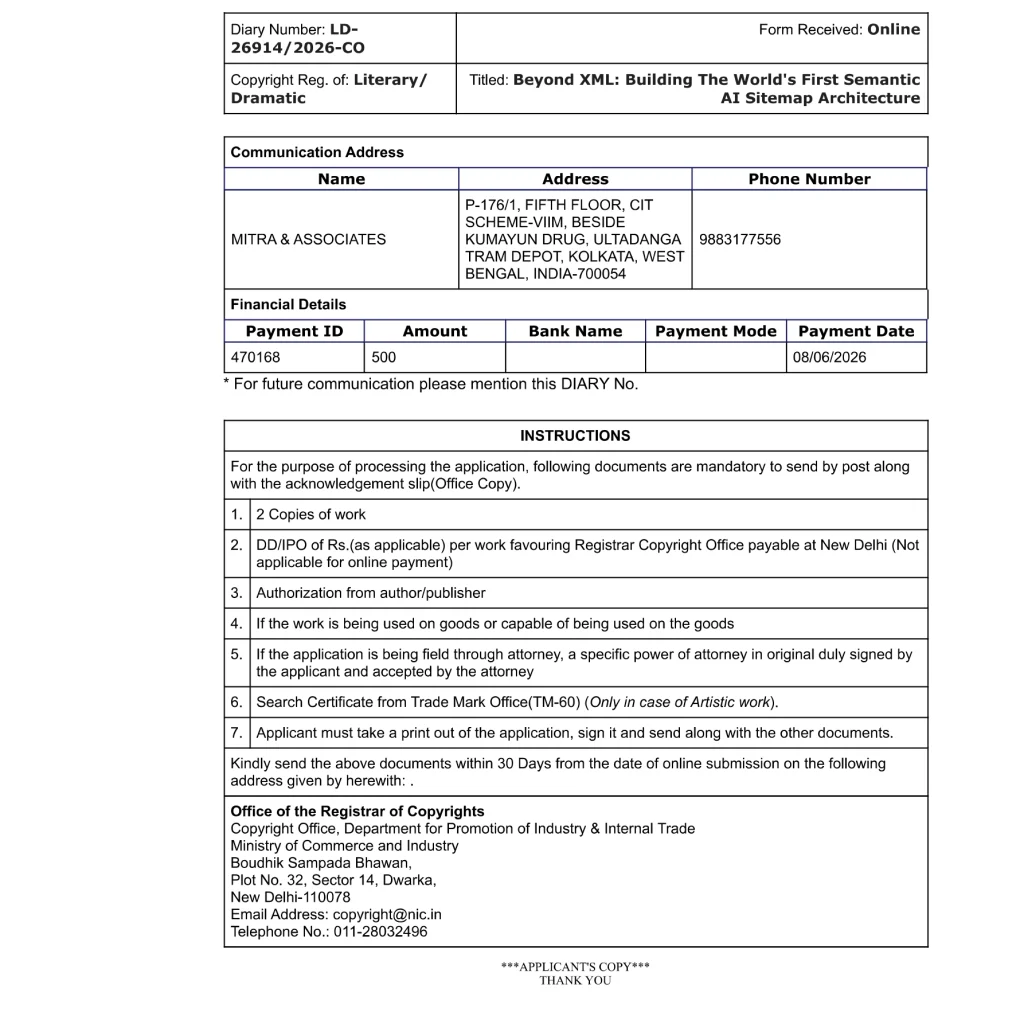
It is protected by the copyright license number: LD-26914/2026-CO



1 comment