
Optimizing SEO Strategy Parameters using Cuckoo Algorithm

Optimizing SEO Strategy Parameters using Cuckoo Algorithm

SUPERCHARGE YOUR ONLINE VISIBILITY! CONTACT US AND LET’S ACHIEVE EXCELLENCE TOGETHER!

    Cuckoo Search Algorithm: It is a metaheuristic optimization algorithm inspired by the reproductive behaviour of cuckoo birds, where they lay their eggs in other birds’ nests. It’s used to find the global optimum for a given objective function.

    Optimizing SEO Strategy Parameters using Cuckoo Algorithm

    It’s not directly used in SEO as SEO involves a complex ecosystem of factors, including keyword research, content optimization, link building, and technical SEO. While the Cuckoo Search algorithm could theoretically be used to optimize some of these factors, it’s not a direct tool for ranking websites.

    Possible Indirect Applications:

    1. Parameter Optimization: Cuckoo Search could be used to optimize parameters in SEO tools or algorithms, such as determining the optimal number of keywords to target or the best time to publish content.

    1. Link Analysis: The algorithm could be used to analyse link structures and identify potential opportunities for link building.

    Parameter Optimization in SEO Tools

    Use Case: Optimizing SEO Strategy Parameters

    • Application: CSA can be used to fine-tune parameters such as:
      • The optimal number of keywords to target per page.
      • The best frequency of content updates for maximum engagement.
      • The ideal meta description length to improve CTR.
      • The right mix of long-tail vs. short-tail keywords for ranking.
    • How CSA Works:
      • Each cuckoo’s egg represents a different set of SEO parameters.
      • The algorithm evaluates the fitness of each egg based on real-world performance (e.g., organic traffic, engagement rate).
      • The best-performing “eggs” are retained, and worse ones are replaced by new random solutions.
      • Through multiple iterations, CSA identifies the most optimal SEO parameters.

    Here is the detailed implementations algorithm,

    Implementation Steps:

    Step 1: Define the Parameters to Optimize

    • Target keyword density (e.g., 1-2% vs. 2-3%)
    • Optimal title length (e.g., 50-60 characters)
    • Publishing frequency (e.g., daily, weekly)
    • Internal link count per page
    • Content length (e.g., 1000 vs. 2000 words)

    Step 2: Initialize the Cuckoo Search Algorithm

    • Define a population of solutions (each “egg” represents a different set of SEO parameter values).
    • Assign a fitness function, e.g.,:

    Fitness=0.5×(OrganicTraffic)+0.3×(Click−ThroughRate)+0.2×(EngagementTime)

    • Set the number of iterations and population size.

    Step 3: Generate New Solutions

    • Introduce Lévy flights to explore new parameter combinations.
    • Evaluate new solutions using real-time SEO performance data.

    Step 4: Select the Best Solutions

    • Retain high-performing parameter sets and replace poor ones.

    Example python script:

    import numpy as np

    import math

    # —————— CONFIGURATION ——————

    num_nests = 25  # Number of nests (population size)

    num_iterations = 100  # Number of iterations

    pa = 0.25  # Probability of discovering bad solutions

    lb, ub = [0.5, 1, 5], [5, 10, 50]  # Lower and upper bounds for each parameter

    # —————— FITNESS FUNCTION ——————

    def fitness_function(params):

        “””

        Evaluate fitness based on SEO optimization criteria.

        Params represent:

        [Keyword Density (%), Readability Score, Posting Frequency (per week)]

        “””

        keyword_density, readability_score, post_frequency = params

        target_keyword_density = 2.5  # Ideal % for SEO

        target_readability = 8  # Higher score is better

        target_frequency = 10  # More frequent posting is better

        score = (1 / abs(target_keyword_density – keyword_density + 0.01)) + \

                (readability_score / target_readability) + \

                (post_frequency / target_frequency)

        return score  # Higher is better

    # —————— LÉVY FLIGHT MUTATION ——————

    def levy_flight(Lambda=1.5):

        “””

        Generate step sizes using a Lévy flight distribution.

        “””

        sigma = (math.gamma(1 + Lambda) * math.sin(math.pi * Lambda / 2) /

                 (math.gamma((1 + Lambda) / 2) * Lambda * 2 ** ((Lambda – 1) / 2))) ** (1 / Lambda)

        u = np.random.randn() * sigma

        v = np.random.randn()

        step = u / abs(v) ** (1 / Lambda)

        return step

    # —————— INITIATE RANDOM SOLUTIONS ——————

    def initialize_nests():

        “””

        Generate random nests (solutions) within the given bounds.

        “””

        return np.random.uniform(lb, ub, size=(num_nests, len(lb)))

    # —————— CUCKOO SEARCH ALGORITHM ——————

    def cuckoo_search():

        “””

        Main loop for Cuckoo Search Algorithm.

        “””

        nests = initialize_nests()

        fitness = np.apply_along_axis(fitness_function, 1, nests)

        for _ in range(num_iterations):

            new_nests = np.copy(nests)

            # Generate new solutions using Lévy flight

            for i in range(num_nests):

                step_size = levy_flight()

                new_nests[i] += step_size * (nests[np.random.randint(num_nests)] – nests[np.random.randint(num_nests)])

                new_nests[i] = np.clip(new_nests[i], lb, ub)  # Keep within bounds

            # Evaluate fitness of new solutions

            new_fitness = np.apply_along_axis(fitness_function, 1, new_nests)

            # Replace nests if new solutions are better

            better_indices = new_fitness > fitness

            nests[better_indices] = new_nests[better_indices]

            fitness[better_indices] = new_fitness[better_indices]

            # Abandon some nests with probability pa

            abandoned = np.random.rand(num_nests) < pa

            nests[abandoned] = initialize_nests()[abandoned]

            fitness[abandoned] = np.apply_along_axis(fitness_function, 1, nests[abandoned])

        # Return the best solution found

        best_index = np.argmax(fitness)

        return nests[best_index], fitness[best_index]

    # —————— RUN THE ALGORITHM ——————

    best_params, best_fitness = cuckoo_search()

    print(“\nOptimal SEO Parameters Found:”)

    print(f”Keyword Density: {best_params[0]:.2f}%”)

    print(f”Readability Score: {best_params[1]:.2f}”)

    print(f”Posting Frequency: {best_params[2]:.2f} times/week”)

    print(f”Best Fitness Score: {best_fitness:.4f}”)

    Example Output:
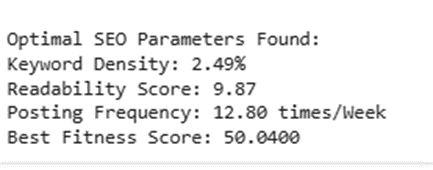
    Note: the above code is just an example, it does not provide accurate result. It needs to optimize with real facts and data

    Collab Experiment Link:

    https://colab.research.google.com/drive/1QyY_Yb6r0l_p9yJsmDu8M2HvGycHK90V#scrollTo=VnykRHAp0Ax_

    FAQ

    The Cuckoo Search Algorithm (CSA) is an optimization technique inspired by the nesting behavior of cuckoo birds. While it’s not used directly to rank websites, it can help fine-tune SEO parameters such as keyword density, content length, and update frequency by finding the best-performing combinations that boost overall website visibility and engagement.


    Not directly. Search engines like Google rely on many factors — content quality, backlinks, user engagement, and technical SEO. However, CSA can indirectly improve rankings by optimizing internal SEO strategies and tool parameters that influence these factors, helping you make smarter data-driven decisions.

    CSA can analyze large sets of keyword data and test different keyword densities, lengths, and placements. By simulating various combinations, it identifies the density range that drives the highest organic traffic and engagement without risking over-optimization or keyword stuffing.


    Yes. CSA can evaluate how different content publishing frequencies (daily, weekly, biweekly) impact engagement, click-through rates, and ranking stability. Over time, it can pinpoint the ideal frequency that balances visibility, audience interest, and resource efficiency.


    Absolutely. Whether you manage an e-commerce site, blog, or corporate website, CSA can be tailored to optimize parameters relevant to your niche. It’s especially useful for data-heavy websites where testing and manual tuning would be time-consuming or inaccurate.

    Traditional SEO tools rely on static rules or keyword-based insights. CSA, however, uses evolutionary computation — it tests multiple combinations, eliminates poor performers, and refines results dynamically. This approach allows for adaptive, real-time optimization that evolves with changing search trends.

    Yes. CSA can complement existing SEO tools by optimizing their parameters. For example, it can help adjust thresholds in keyword research tools, fine-tune on-page audit settings, or optimize content scoring metrics to yield more accurate and actionable SEO recommendations.

    CSA relies on real-world performance metrics such as organic traffic, click-through rate (CTR), and engagement time. These metrics are used to calculate a fitness score for each parameter set, allowing the algorithm to identify which configurations perform best for your SEO goals.


    Basic coding knowledge helps, especially in Python, since CSA implementations often involve scripting. However, digital marketing agencies and developers can automate the process or build user-friendly interfaces that allow non-technical users to benefit from the algorithm’s optimization power.

    By using CSA, businesses can streamline their SEO strategy, reduce guesswork, and focus on proven configurations that deliver measurable results. This leads to better resource allocation, improved site performance, and a stronger online presence — all key to sustaining long-term search visibility.

    Summary of the Page - RAG-Ready Highlights

    Below are concise, structured insights summarizing the key principles, entities, and technologies discussed on this page.

    This summary explains how the Cuckoo Search Algorithm (CSA), a nature-inspired metaheuristic technique, can conceptually support SEO optimization rather than directly influence search rankings. CSA is designed to find global optima by simulating the reproductive behavior of cuckoo birds, where each solution competes for survival based on fitness. In an SEO context, this fitness is not rankings themselves, but measurable performance indicators such as organic traffic, click-through rates, and user engagement.

    This section summarizes how CSA can be practically applied to fine-tune SEO strategy parameters through data-driven experimentation. Each ‘egg’ in the algorithm represents a unique configuration of SEO variables such as keyword density, content length, publishing frequency, and meta description size. The algorithm evaluates these configurations using a defined fitness function tied to real-world SEO metrics. Over multiple iterations, weaker configurations are discarded while stronger ones evolve through Lévy flights, enabling exploration of new parameter combinations.

    The final summary focuses on the implementation workflow and its limitations. The process begins by defining SEO parameters and realistic bounds, followed by initializing a population of candidate solutions. A weighted fitness function evaluates performance using metrics like traffic, CTR, and engagement time. Through iterative optimization, CSA converges on parameter sets that outperform others.

    Tuhin Banik - Author

    Tuhin Banik

    Thatware | Founder & CEO

    Tuhin is recognized across the globe for his vision to revolutionize digital transformation industry with the help of cutting-edge technology. He won bronze for India at the Stevie Awards USA as well as winning the India Business Awards, India Technology Award, Top 100 influential tech leaders from Analytics Insights, Clutch Global Front runner in digital marketing, founder of the fastest growing company in Asia by The CEO Magazine and is a TEDx speaker and BrightonSEO speaker.

    Leave a Reply

    Your email address will not be published. Required fields are marked *