SUPERCHARGE YOUR ONLINE VISIBILITY! CONTACT US AND LET’S ACHIEVE EXCELLENCE TOGETHER!
You raised money.
The round closes, the wire hits, and for a few days everything feels lighter—like the hard part is over. The deck worked. The story landed. People congratulate you with that tone that says, you made it.
Then the real work begins.
Headcount increases. You hire faster than you planned—because you can. A growth lead, a couple SDRs, maybe an agency to “help you scale.” The marketing calendar fills up. The ad budget expands. What used to be a careful experiment becomes a monthly commitment. You go from watching every dollar to watching the line go up.
And growth should be easier now.
But it isn’t.
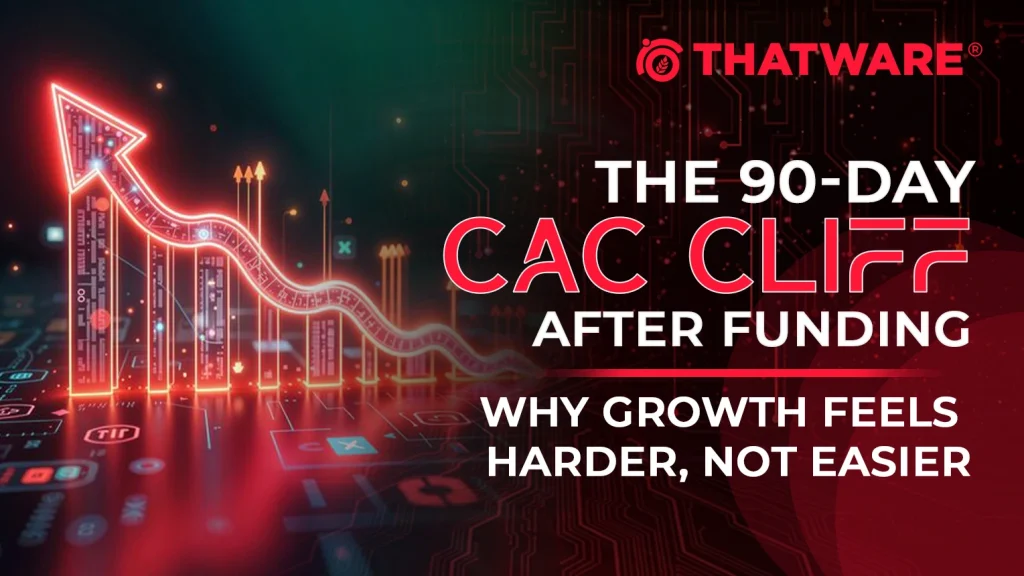
Somewhere between day 60 and day 90 after funding, a strange thing starts happening in a lot of startups—quietly at first, then all at once. Customer acquisition costs rise. The easy wins disappear. The same paid channels that looked “proven” start producing leads that don’t convert. The spreadsheet that used to show momentum starts showing friction.
The board meeting gets closer.
And instead of feeling like you’re finally scaling, it feels like you’re sprinting on sand.
This is the post-funding paradox: the moment you have more resources than ever is often the moment growth starts feeling harder, not easier. Not because you suddenly forgot how to execute—but because the system you’ve built is now being stress-tested.
In many companies, the pattern is remarkably consistent:
- CAC climbs even though spend increases
- Pipeline quality drops even though volume rises
- Sales cycles stretch even though the team gets bigger
- Pressure intensifies even though you “de-risked” the business with capital
Founders often interpret this as a performance problem: the hire isn’t good, the creatives are stale, the targeting is off, the product messaging needs a refresh. So you tweak. You optimize. You rebuild the landing page. You test more audiences. You add more tools.
Sometimes it helps—but often it doesn’t fix the underlying issue.
Because the “CAC cliff” isn’t just a tactical marketing problem. It’s a structural growth problem that shows up when capital changes your incentives, your pacing, and your dependency on channels that don’t compound.
That’s the core idea of this article:
- Funding accelerates spend, not efficiency. It gives you fuel, but it doesn’t automatically give you an engine.
- Post-funding growth stress isn’t a failure. In many startups, it’s a predictable phase triggered by scaling paid acquisition before you’ve built durable demand.
- The 90-day CAC cliff is common—and avoidable. But only if you treat organic visibility and demand creation as foundational, not optional.
If you’re a founder who just raised a Seed, Series A, or Series B and you’re wondering why the numbers feel less controllable than before, you’re not alone. If you’re a growth or marketing leader trying to defend performance while CPMs rise and conversion rates fall, this will feel familiar. And if you’re an operator watching paid channels underperform and thinking, “We’re doing everything right—why is it getting worse?”—this is written for you.
Because the uncomfortable truth is: many startups don’t hit a growth ceiling after funding. They hit a growth bill.
And it typically comes due around day 90.
What Is the “90-Day CAC Cliff”?
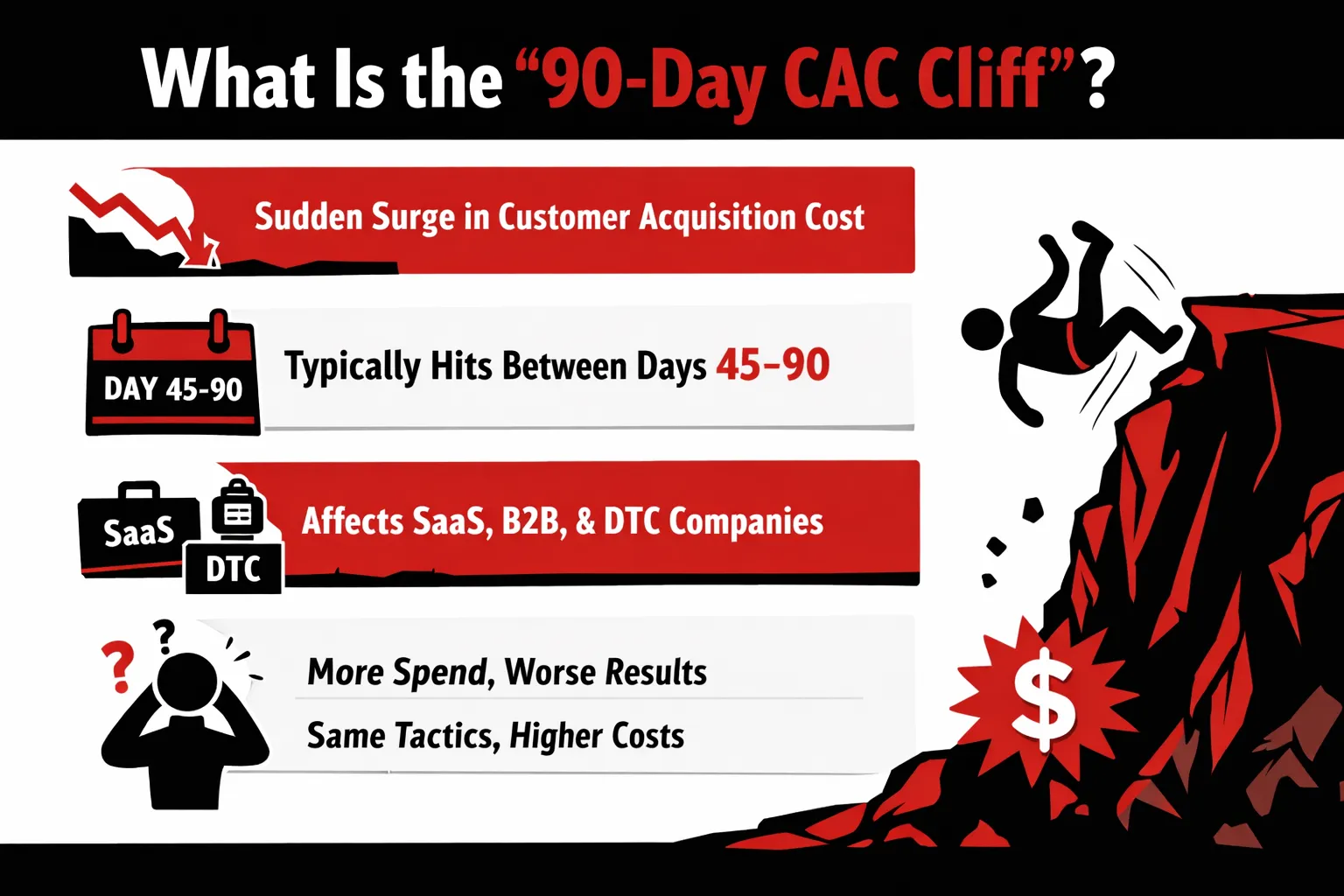
The 90-day CAC cliff is a pattern that shows up repeatedly after a company raises capital—and almost always catches founders off guard. Simply put, it refers to a sudden and often sharp increase in customer acquisition cost (CAC) within the first 45–90 days after funding. Instead of growth becoming smoother with more capital, it starts to feel heavier, slower, and more expensive.
This phenomenon isn’t limited to one business model or industry. It appears consistently across SaaS, B2B services, DTC brands, and even marketplaces. The common factor isn’t the product or the team—it’s the way growth is scaled immediately after money hits the bank.
Defining the CAC Cliff
At its core, the CAC cliff happens when funding accelerates spending faster than it accelerates demand. New budgets unlock larger paid media spends, expanded sales teams, and more aggressive growth targets. But while spend scales instantly, efficient demand does not. The result is a widening gap between how much you’re paying to acquire customers and how many qualified buyers actually exist at that moment.
Most companies don’t notice the problem immediately. The first few weeks after funding often look strong. There’s leftover demand, early ad performance holds, and momentum from pre-funding efforts. The cliff typically reveals itself between day 45 and day 90, when marginal returns begin to collapse.
What the CAC Cliff Looks Like in Practice
When the cliff hits, the symptoms are hard to ignore. Paid acquisition channels that once performed reliably start to flatten or decline. CPMs rise as audiences saturate and competition intensifies. Conversion rates quietly drop as campaigns move beyond high-intent buyers and into colder territory.
Downstream, sales teams feel the impact even more acutely. Sales cycles lengthen, demos take longer to close, and objections increase. Pipeline volume may stay high, but pipeline quality degrades, forcing teams to work harder for fewer wins.
Why It Feels So Confusing
The most disorienting part of the CAC cliff is that nothing seems fundamentally broken. The same playbooks are in use. The team is bigger. The budget is larger. Yet results are worse. Founders often assume this is an execution problem—better creatives, tighter targeting, more hiring.
In reality, the issue is structural. More budget does not automatically mean more traction when growth is overly dependent on paid channels. The cliff isn’t caused by poor execution; it’s caused by timing and channel mix. Without compounding demand sources, scaling spend simply exposes the limits of rented attention.
Why the CAC Cliff Happens After Funding (Core Diagnosis)
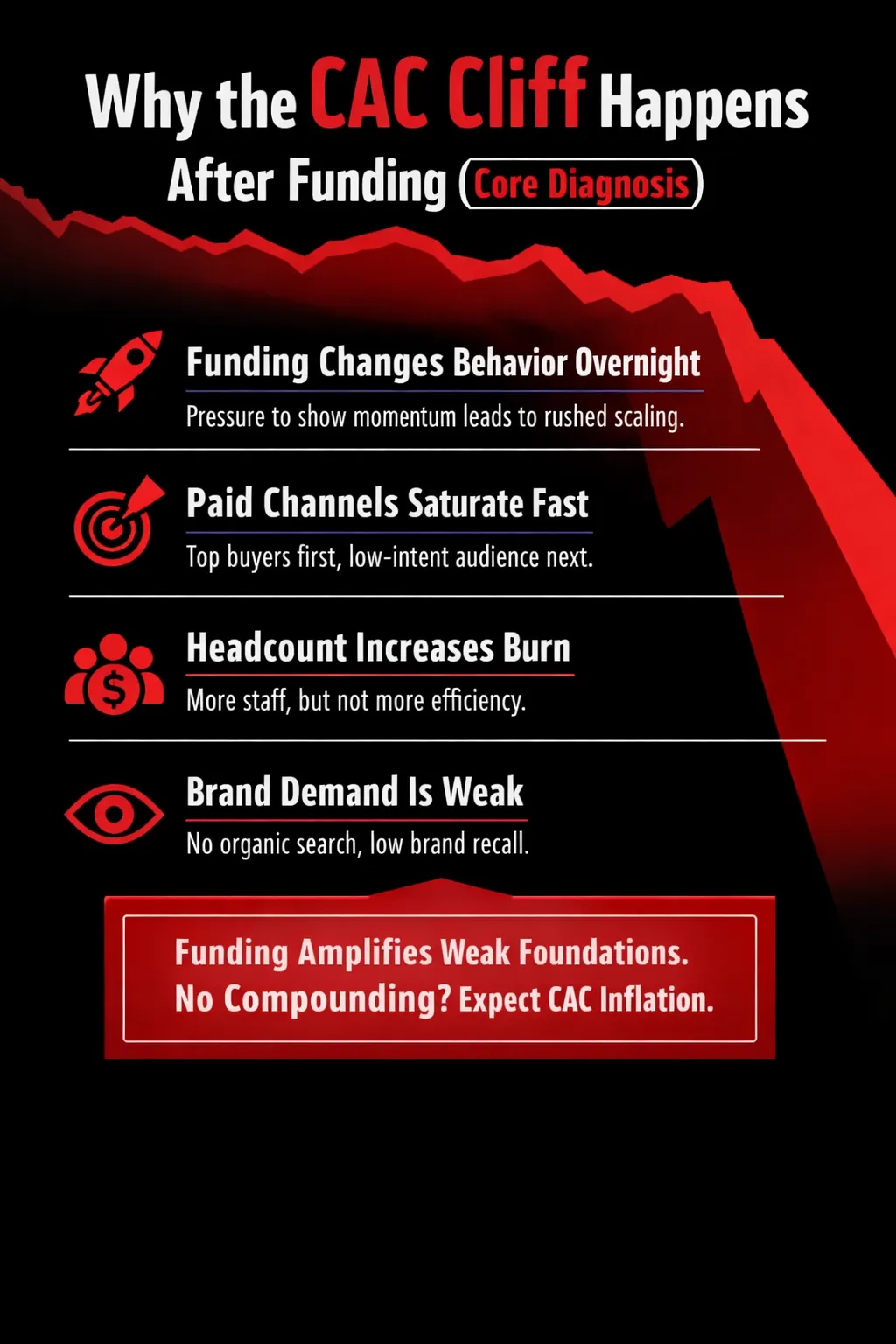
Funding doesn’t just change your bank balance. It changes your behavior — and the behavior of everyone around you. That’s why the “90-day CAC cliff” isn’t random. It’s the predictable result of how teams act once the round closes and the expectations reset overnight.
Here’s the core diagnosis: post-funding CAC pressure is rarely caused by one channel suddenly “breaking.” It’s caused by four structural shifts that happen almost immediately — and compound into higher acquisition costs within a couple of months.
Funding Changes Behavior Overnight
The day the money lands, the scoreboard changes. What used to feel like patient iteration suddenly feels like a countdown.
There’s pressure to “show momentum” quickly — not because anyone explicitly says “spend more,” but because the emotional default becomes: we need to prove this round was justified. That pressure shows up in small decisions that add up fast:
- Marketing increases budgets earlier than planned.
- Sales ramps faster than the pipeline is ready for.
- Leadership pushes for visible activity: more campaigns, more experiments, more launches.
The hidden tradeoff is that speed starts to outrank compounding. Channels like SEO, partnerships, community, brand, and content don’t look impressive in a monthly board update until they’ve had time to compound. Paid channels do. So the organization naturally leans into what creates immediate charts—even if those charts come with hidden long-term costs.
The result: you scale the spend before you’ve scaled the demand engine.
Paid Channels Saturate Faster Than Expected
Most founders underestimate how quickly paid acquisition runs out of “easy wins.”
When you start running ads aggressively post-funding, you typically capture the top 10–20% of high-intent buyers first — the people already searching, already aware of the problem, already close to making a decision. Those early conversions create a dangerous illusion: the channel works; we just need to put more money into it.
But paid performance is not linear. As you increase spend, you don’t keep reaching the same quality of prospects. You expand outward:
- from high-intent to medium-intent audiences,
- from warm to cold,
- from problem-aware to barely-aware.
At that point, incremental spend reaches lower-intent audiences, and your efficiency drops. CPMs rise as audiences overlap. CTR falls as fatigue sets in. Conversion rates decline because people need more education than an ad can provide.
This is where diminishing returns kick in rapidly—often within 30–60 days of scaling budgets. And when paid is your primary growth lever, those diminishing returns show up as rising CAC.
Paid is excellent at harvesting existing demand. But when you scale without increasing underlying demand, you end up bidding harder for the same pool — and paying more for worse-fit traffic.
Headcount Scaling Increases Burn, Not Efficiency
The second shift post-funding is hiring. More marketers, more SDRs, more “growth.” It feels like the right move—because more people should produce more output.
But output isn’t the same as leverage.
More SDRs ≠ better pipeline if the market hasn’t expanded. If demand generation isn’t keeping up, your SDR team spends more time scraping, spamming, and chasing marginal accounts. You might increase activity metrics—calls, emails, meetings set—while quietly degrading conversion rates downstream.
Similarly, more ad creatives ≠ more demand. Most creative scaling just increases variation, not intent. When the audience isn’t ready, you’re optimizing messaging around an attention problem when the real problem is a demand problem.
This creates a subtle organizational trap: teams optimize for what they can control (activity, output, dashboards) instead of what actually moves the business (qualified demand, intent, trust). The company becomes busier—without becoming more efficient.
And since burn rises immediately with headcount, the pressure to justify those hires increases. That pressure pushes even more spend into paid channels. CAC creeps up. Then it jumps.
Brand Demand Is Still Underdeveloped
Here’s the part that’s easy to miss: most startups raise before they’re known. Funding doesn’t magically create awareness. It just creates urgency.
If your brand demand is underdeveloped, you’re missing the invisible force that makes acquisition cheaper over time:
- People aren’t searching for you by name.
- They don’t recognize you in ads.
- They don’t trust you on first touch.
- They need more proof, more education, more reassurance.
That means you’re operating with no existing search demand and low brand recall, so every acquisition attempt is essentially an interruption. And interruption-based growth is expensive—because you have to pay repeatedly to appear in front of prospects who weren’t looking for you.
When organic and brand demand are weak, paid performance suffers in ways that look like “platform issues” but aren’t:
- conversion rates drop because trust is missing,
- sales cycles lengthen because credibility isn’t pre-built,
- and CAC increases because every customer costs full price.
Key Insight: Funding Amplifies Weak Foundations
The CAC cliff is not a marketing mystery. It’s a structural outcome.
Funding amplifies whatever foundation you already built. If your demand creation engine is strong, funding helps you scale efficiently. If it’s weak, funding accelerates spending into channels that saturate quickly, supported by teams that increase burn faster than efficiency.
And that’s the unavoidable conclusion:
If demand creation isn’t already compounding, CAC inflation is inevitable.
Because once you’ve harvested the easy buyers, scaled activity without leverage, and tried to buy attention instead of earning trust, the math turns against you—right around the time the organization expects growth to feel easiest.
The Hidden Timeline: What Actually Happens in the First 90 Days
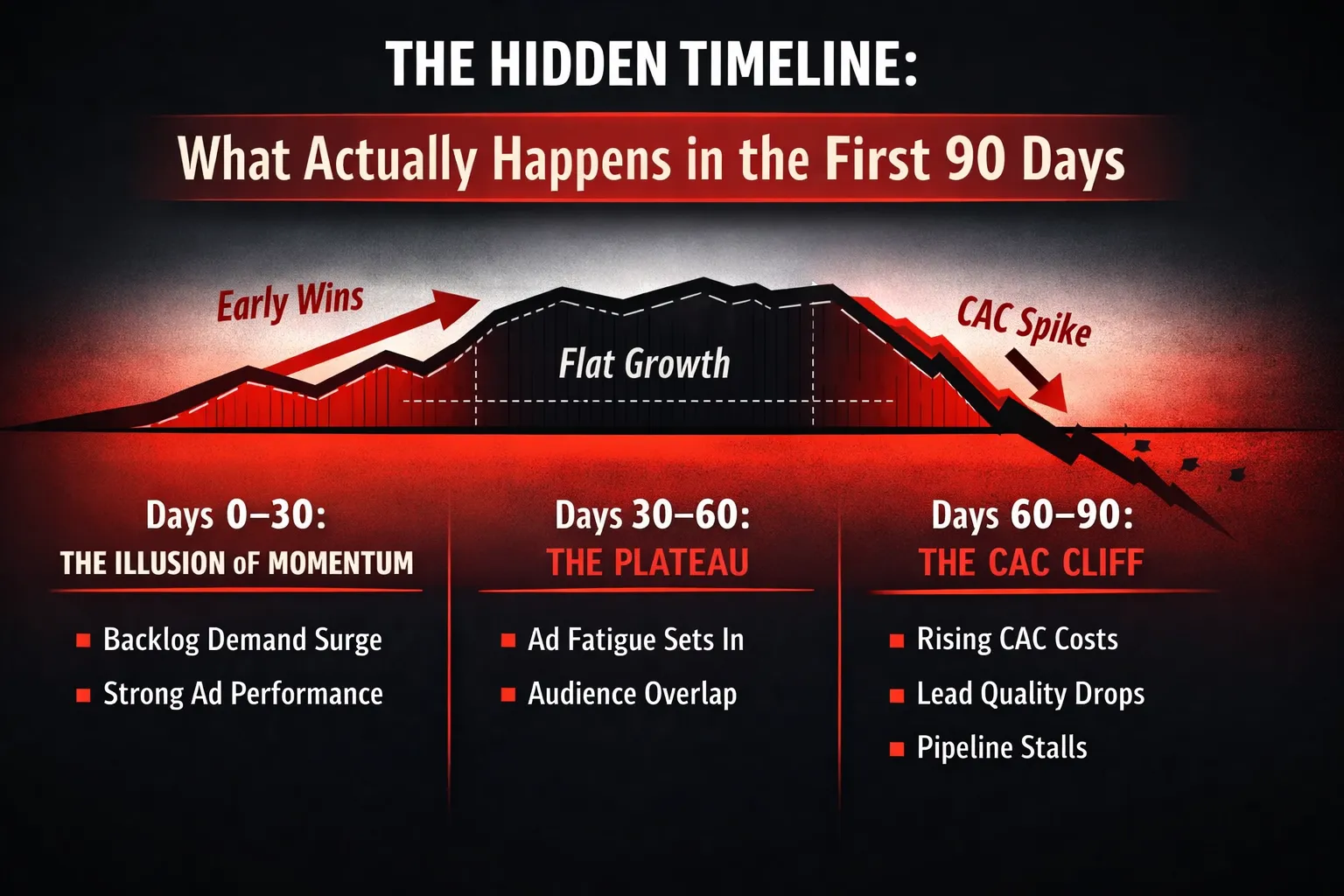
One of the most frustrating things about post-funding growth pressure is that it feels sudden, even though it’s not. The CAC spike doesn’t arrive out of nowhere. It follows a remarkably predictable timeline—one that repeats across startups, stages, and industries.
Understanding this hidden 90-day pattern is critical, because what feels like a performance problem is usually a timing and system problem.
Days 0–30: The Illusion of Momentum
The first month after funding often feels validating. Metrics move in the right direction, dashboards look healthy, and growth appears to “unlock.”
This is largely driven by a backlog of pent-up demand. Prior to funding, most startups operate with constrained budgets. When spend increases, they immediately capture the highest-intent users—people who were already close to buying but hadn’t been reached aggressively yet. These users convert well, making CAC look efficient.
At the same time, fresh ad accounts and new campaigns perform unusually well. Platforms like Google, Meta, and LinkedIn reward early exploration with lower costs and higher delivery. Early creatives feel novel to the audience, frequency is low, and targeting pools haven’t been exhausted.
These early wins create confidence. Teams interpret them as proof that the growth model works at scale.
But underneath the surface, structural issues remain untouched:
- Demand is being harvested, not created
- Brand search and organic discovery are still weak
- Growth depends almost entirely on incremental spend
The momentum is real—but it’s temporary.
Days 30–60: The Plateau
By the second month, the cracks begin to show.
Ad fatigue starts creeping in. The same audiences see similar messages repeatedly, click-through rates soften, and conversion rates begin to normalize downward. What worked in month one now requires more spend to maintain the same volume.
At the same time, audience overlap increases. As budgets scale, targeting expands horizontally rather than vertically. High-intent segments are already saturated, so spend spills into lower-intent users who take longer to convert—or don’t convert at all.
Growth teams respond the only way they know how: small optimizations.
- New creatives
- Minor copy changes
- Landing page tweaks
- Funnel experiments
These adjustments can slow the decline, but they rarely reverse it. The core issue isn’t execution—it’s that the demand pool isn’t growing.
Momentum flattens. CAC stops improving. Growth feels… harder.
Days 60–90: The Cliff
This is where the pressure becomes unavoidable.
CAC spikes. Not gradually, but noticeably. Every additional customer costs more than the last. Paid efficiency drops faster than teams can compensate.
Sales teams start complaining about lead quality. Leads feel colder. Sales cycles lengthen. Close rates dip. Marketing and sales friction increases as both sides try to explain why pipeline quality has changed.
For founders, this is the most disorienting phase. Growth hasn’t stopped—but it no longer feels controllable. The levers that worked before now deliver diminishing returns. Every board conversation starts circling the same question: Why isn’t more money producing more growth?
This is the CAC cliff.
Why This Timeline Repeats Across Startups
What makes this pattern so dangerous is how universal it is.
It repeats because startups rely on:
- The same channels – paid search, paid social, outbound
- The same incentives – show fast traction post-funding
- The same investor expectations – speed over sustainability
Very few companies invest early in demand creation channels like organic search, content, and brand visibility—channels that compound instead of saturate.
So when paid performance inevitably degrades, there’s no stabilizing force underneath it.
The CAC cliff isn’t a surprise.
It’s the natural outcome of scaling spend without scaling demand.
And unless the growth system changes, the next 90 days will look exactly like the last.
Why Paid Growth Alone Cannot Carry Post-Funding Scale
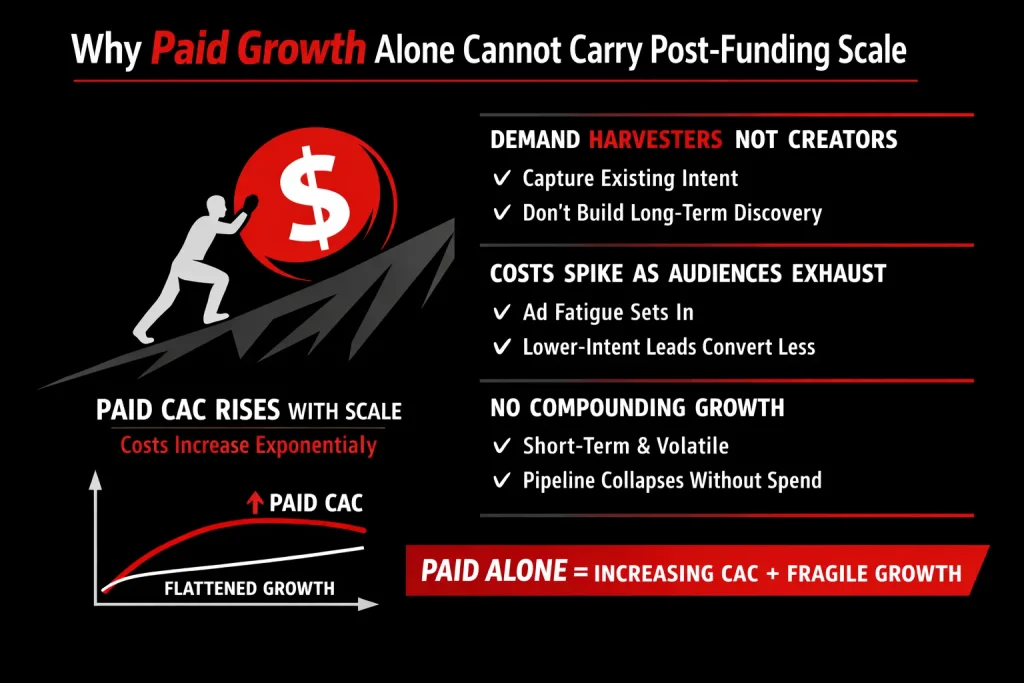
At first glance, paid growth feels like the most logical way to scale after funding. You have fresh capital, clear growth targets, and channels that promise immediate results. Ads turn money into traffic, traffic into leads, and leads into revenue—at least in theory. But this logic breaks down quickly at scale. The reason isn’t execution or creative fatigue alone. It’s math.
The Math Problem: When Scale Works Against You
Paid acquisition does not behave linearly. As spend increases, paid CAC almost always rises. Early budgets capture the most obvious, high-intent buyers—the people already looking for a solution. Once that layer is exhausted, additional spend pushes you into broader, colder audiences. CPMs increase, conversion rates drop, and efficiency erodes.
Organic growth follows the opposite curve. Organic CAC decreases over time because each piece of content, each ranking, and each brand interaction compounds. The upfront investment is higher in effort and patience, but the marginal cost of acquiring the next customer trends toward zero. This creates a fundamental asymmetry: paid growth compounds negatively with scale, while organic growth compounds positively with time.
When a post-funding company relies solely on paid channels, it is effectively tying its growth engine to the most expensive, least durable lever available.
Paid Channels Harvest Demand—They Don’t Create It
Paid media excels at capturing existing intent. Search ads intercept users who already know what they want. Social ads interrupt users who are close enough to convert. But in both cases, the demand already exists. Paid channels do not meaningfully expand the market’s awareness of a problem, nor do they build long-term discovery.
This limitation becomes obvious once initial demand is saturated. As soon as the pool of high-intent users is depleted, costs rise sharply. You’re no longer harvesting demand—you’re competing aggressively for the same limited attention. Without an inflow of new, organically generated demand, paid growth becomes a zero-sum game where scale only increases spend, not efficiency.
Organic visibility fills this gap by creating demand upstream. Educational content, problem-aware searches, brand-driven discovery, and thought leadership expand the total addressable intent over time. Paid channels perform better when organic demand exists beneath them. Without it, they stall.
Investor Pressure Accelerates the Problem
Post-funding pressure magnifies these dynamics. Investors push for speed, early traction, and clean growth curves. As a result, teams prioritize channels that show immediate results and clean dashboards. Paid growth fits this narrative perfectly. Organic does not.
SEO, content, and brand-building are often deferred as “later-stage” work—something to fix once scale is achieved. But by the time CAC spikes and paid efficiency collapses, it’s already too late. Organic growth requires lead time. Ignoring it early forces companies into a corner where growth becomes increasingly expensive and increasingly fragile.
Paid growth isn’t the enemy—but paid growth alone cannot carry post-funding scale. Without organic demand creation running in parallel, the CAC cliff isn’t a possibility. It’s an inevitability.
Organic Visibility as the Missing Growth Stabilizer
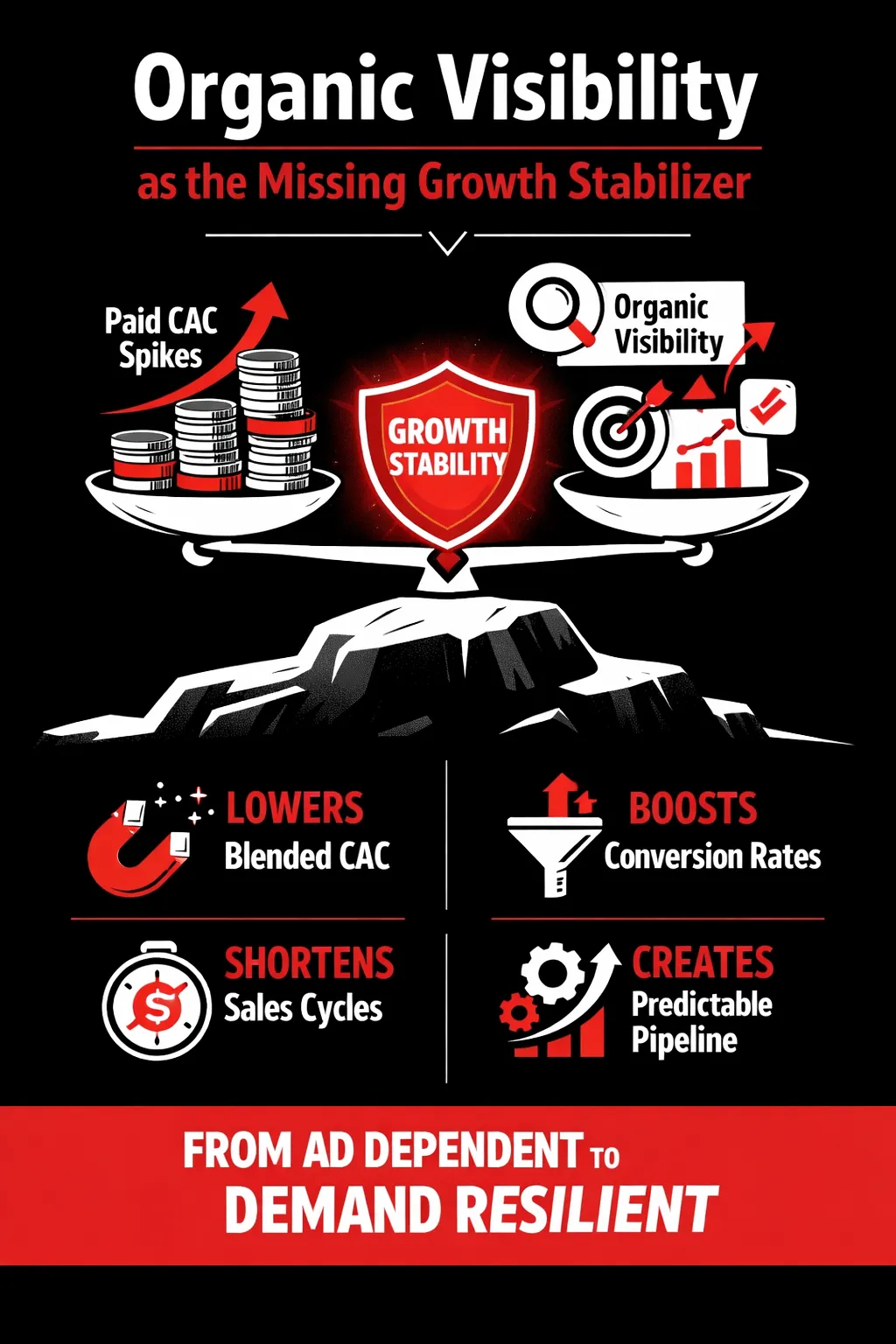
Organic visibility is the piece most post-funding teams underestimate—because it doesn’t look like “growth” the way paid dashboards do. It doesn’t spike overnight. It doesn’t give you instant attribution dopamine. But it does something far more important in the 60–90 days after a round: it stabilizes growth when everything else starts wobbling.
And to be clear, when I say organic visibility, I don’t mean “do some SEO” as a side project. I mean building owned demand—the kind that shows up whether or not you increased budgets this week.
What “Organic Visibility” Really Means (Not Just SEO)
Most teams reduce organic to rankings and blog traffic. That’s like reducing sales to “how many calls did we make.” Organic visibility is bigger, and it’s measurable in multiple signals that compound together.
1) Search demand (category + problem intent)
This is the universe of people actively looking for solutions: pain-driven queries, alternatives, comparisons, “best tools for X,” and “how do I fix Y?” When you show up consistently for these terms, you aren’t interrupting someone—you’re meeting them mid-need. That difference matters because intent is the biggest driver of acquisition efficiency.
2) Brand search growth
Brand search is the canary in the coal mine for marketing health. When people start searching your company name (or misspellings of it), it means you’ve moved from “a vendor” to “a considered option.” Brand search also tends to improve conversion rates across every channel, especially paid, because people trust what they recognize.
3) Content-led discovery
Organic discovery isn’t only Google. It’s also: founder posts, thought leadership articles, partner mentions, distribution in communities, YouTube explainers, product-led templates, and pages that get shared internally inside companies. The common thread is this: you get found without paying per click.
4) Trust accumulation
This is the silent multiplier. Organic builds credibility in a way ads can’t. When prospects see you repeatedly in search results, in comparisons, in “how-to” guides, and in expert commentary, you become the “safe choice.” The real outcome is not “more sessions”—it’s lower friction in the buying decision.
Organic visibility is essentially your market presence. Not your traffic. Your presence.
How Organic Fixes the CAC Cliff
Post-funding CAC pressure usually isn’t caused by one thing—it’s caused by the reality that paid channels saturate, and every incremental dollar has to work harder. Organic visibility changes that equation in four compounding ways:
It lowers blended CAC over time.
Paid CAC often rises with scale because you exhaust the highest-intent pockets first. Organic works differently: the upfront effort is higher, but the marginal cost of acquisition trends downward as assets compound. The result is not “replace paid.” The result is a healthier blended CAC curve that doesn’t spike when you increase spend.
It improves paid conversion rates.
This is the most overlooked benefit. Strong organic presence makes paid more efficient because buyers recognize you. They’ve seen you in search, read a guide, heard of you from a colleague, or came across your POV content. That familiarity reduces skepticism, raises CTR, improves landing page conversion, and often boosts sales acceptance rates. In other words: organic makes your paid budget behave like it’s smarter.
It shortens sales cycles.
Organic content pre-handles objections. Comparison pages clarify positioning. Use-case pages validate fit. Educational content aligns stakeholders. When prospects arrive informed and confident, fewer calls are spent on “what do you do?” and more calls are spent on “how do we implement?” That compresses cycle time—and in B2B, time is a huge hidden cost inside CAC.
It builds inbound intent.
Inbound intent is the opposite of chasing. It’s prospects raising their hand already partially sold. Inbound doesn’t just create leads; it creates better leads: higher urgency, clearer pain, stronger fit, and higher close rates.
When organic visibility is strong, paid doesn’t carry the whole company on its back. It becomes one engine among multiple, not the only oxygen supply.
Organic as a Growth Shock Absorber
The most dangerous moment post-funding is when paid performance dips and suddenly everyone panics—because pipeline is directly tied to spend. That’s the fragile version of growth: “If we stop paying, we stop existing.”
Organic visibility acts like a shock absorber.
- When CPMs spike or targeting degrades, your pipeline doesn’t collapse overnight because you still have inbound discovery and search demand flowing.
- You rely less on constant spend increases, because organic creates baseline demand that persists.
- Marketing stops being a monthly expense you rent outcomes from and starts becoming an asset you build outcomes with.
This is the biggest psychological shift for founders: organic isn’t “content.” It’s insurance against volatility—and volatility is guaranteed after funding because expectations rise faster than efficiency does.
Why Organic Must Start Before the Cliff
Here’s the catch: you cannot decide to “do organic” when CAC already spiked and expect relief next month. SEO is lagging, not instant. Organic demand generation is a compounding system, which means it needs lead time to work.
- Google rankings take time.
- Content needs time to be discovered, shared, linked, and trusted.
- Brand presence builds through repeated exposure, not one campaign.
Waiting until CAC pressure hits is like buying a parachute after you’ve already jumped. At that point you’ll still do it—but now it’s reactive, stressful, and expensive.
The funded companies that avoid the 90-day CAC cliff aren’t the ones that cracked a clever ad creative. They’re the ones that treated organic visibility as part of the growth infrastructure from day one—so when paid gets noisy, expensive, or saturated, growth doesn’t feel harder.
It feels steadier. Predictable. Owned.
The Biggest Post-Funding SEO Mistakes Companies Make
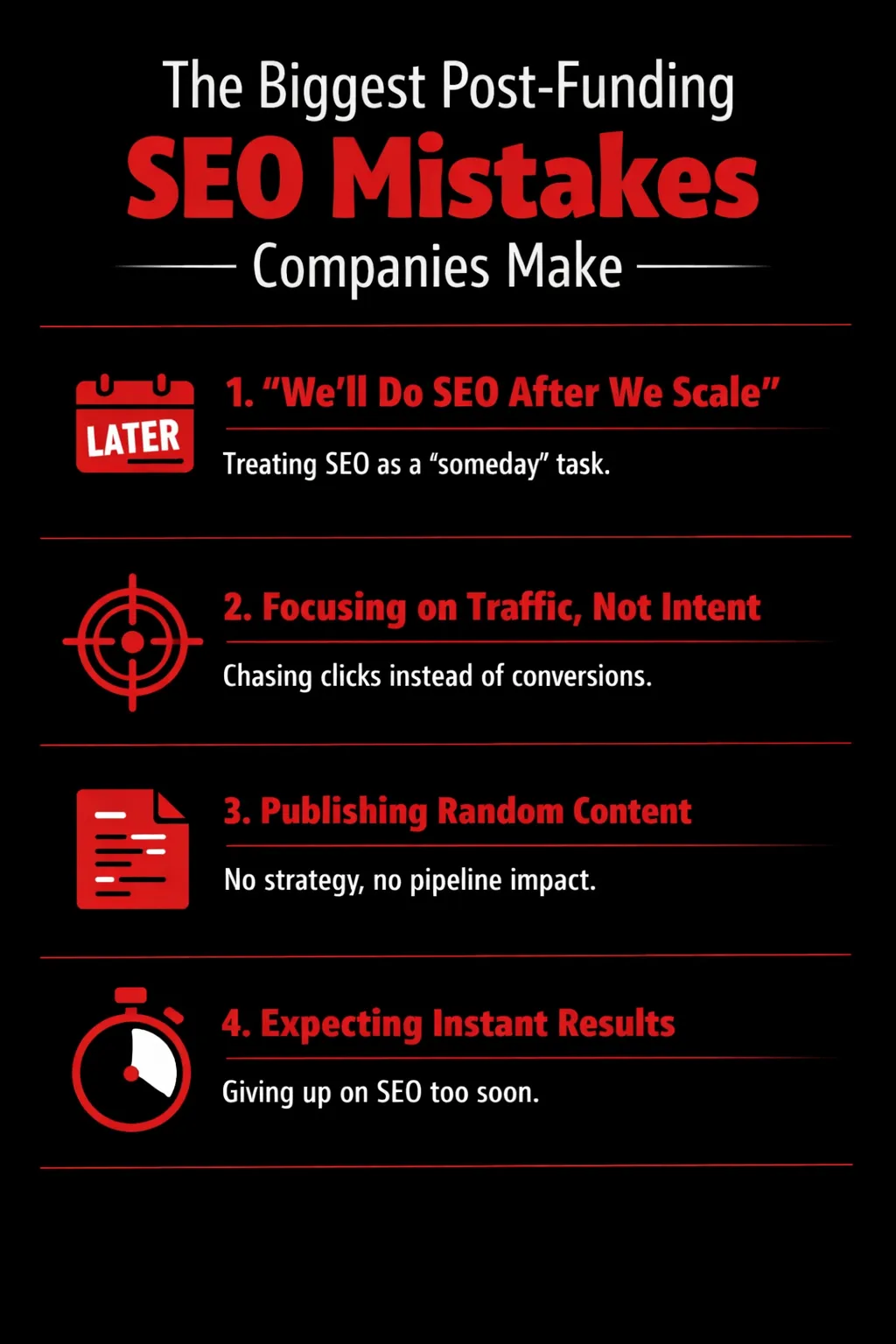
Post-funding is when SEO decisions matter the most—and paradoxically, when most companies get them wrong. With fresh capital, aggressive targets, and investor pressure to “move fast,” SEO is either postponed, misused, or abandoned too early. The result isn’t just missed traffic—it’s higher CAC, weaker demand, and fragile growth.
Here are the four most common (and costly) SEO mistakes companies make after funding.
Mistake 1: “We’ll Do SEO After We Scale”
This is the most dangerous assumption of all.
SEO is often treated as a cleanup activity—something to focus on once paid channels, sales teams, and partnerships are “working.” But SEO is not a finishing touch. It’s the infrastructure that makes scaling efficient.
Paid growth scales linearly: spend more, get more—until it doesn’t. SEO scales asymmetrically: the same content can generate demand for years without proportional cost increases. When companies delay SEO until after scale, they lock themselves into high CAC channels during their most expensive growth phase.
Post-funding is precisely when SEO should begin—not because traffic is needed immediately, but because compounding needs time. Waiting until CAC spikes at day 90 is already too late.
Mistake 2: Treating SEO as Traffic, Not Demand
Many funded companies “do SEO” by chasing rankings and pageviews. The problem? Traffic does not equal revenue.
High-volume keywords often attract low-intent users who are curious, not ready to buy. Rankings look impressive in reports, but sales teams see no impact. This creates the false belief that SEO “doesn’t work.”
What actually failed wasn’t SEO—it was intent alignment.
Effective post-funding SEO focuses on:
- Problem-aware searches
- Use cases, alternatives, and comparisons
- Buyer-stage queries that align with the sales motion
Demand creation beats traffic accumulation. Intent matters more than volume, especially when CAC pressure is real.
Mistake 3: Publishing Content Without a Growth Thesis
Another common pattern: blogs get published, but nothing compounds.
There’s no clear reason why a piece exists beyond “we need content.” Topics are random. Messaging shifts weekly. Content isn’t mapped to ICP pain points, funnel stages, or revenue goals. Over time, the blog becomes a disconnected archive instead of a growth engine.
SEO without a growth thesis lacks:
- Narrative consistency
- Internal linking strategy
- Clear connection to sales enablement
High-performing organic programs are built like products—with positioning, focus, and intent. Without that, content becomes noise, not leverage.
Mistake 4: Expecting Immediate ROI
This mistake kills more SEO programs than budget ever could.
Founders used to paid acquisition expect SEO to perform on the same timeline. When results don’t appear in 30–60 days, SEO is labeled “slow” and deprioritized. The irony? SEO usually starts working right when companies stop investing.
Compounding channels only work if given time to compound. Pulling the plug early breaks momentum, resets learning, and guarantees future CAC dependency.
SEO isn’t a quick win—it’s a growth stabilizer. And the companies that benefit most are the ones patient enough to let it work.
In short: post-funding SEO fails not because it’s ineffective, but because it’s misunderstood. When treated as infrastructure—not a tactic—SEO becomes the difference between panicked growth and predictable scale.
A Practical 90-Day Organic Growth Framework for Funded Startups
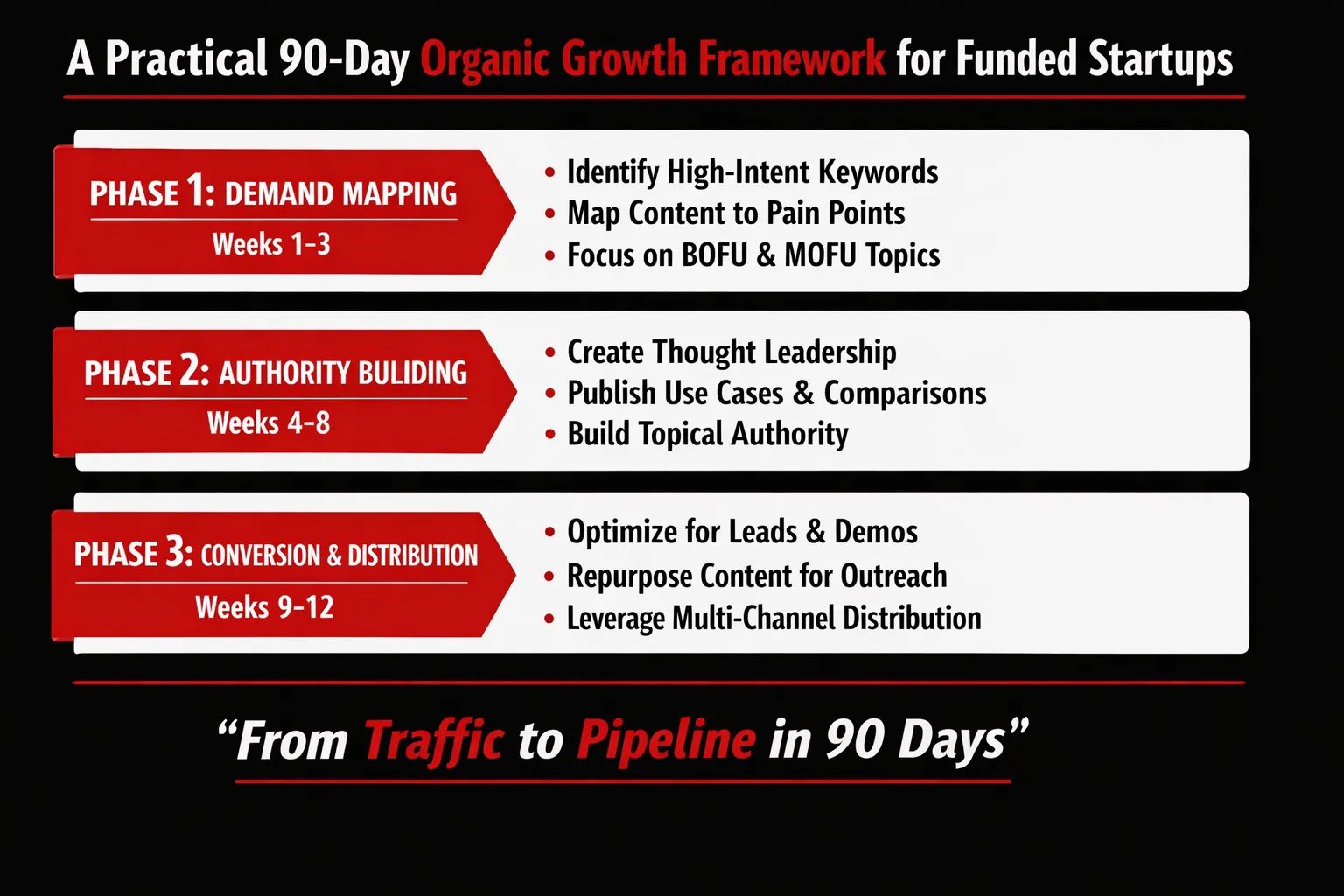
If you’re post-funding, you don’t have the luxury of “content that might work someday.” You need organic to start behaving like a growth system—one that reduces dependency on paid spend, improves conversion efficiency, and builds durable demand over time.
The good news: organic isn’t slow by default. It’s slow when it’s random—when companies publish disconnected blog posts, chase high-volume keywords with low intent, or treat SEO like a brand exercise instead of a pipeline lever.
Below is a focused 90-day framework that works especially well for funded startups under CAC pressure. It’s built around three phases: Demand Mapping → Authority Building → Conversion & Distribution.
Phase 1: Demand Mapping (Weeks 1–3)
This phase determines whether organic becomes a compounding asset—or a content graveyard.
1) Identify high-intent problem searches
Start with searches that signal active pain, not curiosity. High-intent keywords usually look like:
- “how to reduce ___”
- “___ software for ___”
- “best way to ___”
- “alternatives to ___”
- “___ vs ___”
- “___ pricing”
- “___ integration”
- “___ for [industry/role]”
These queries already contain a buying context. They don’t need education—they need clarity and confidence.
Rule of thumb: if a keyword doesn’t naturally connect to a sales conversation, it’s not a priority in the first 90 days.
2) Align content with ICP pain stages
Map content to where your ICP actually is in their journey:
- Problem-aware: “Why is X happening?” “How to fix X?”
- Solution-aware: “What are the best ways/tools to solve X?”
- Vendor-aware: “X vs Y” “Best tools for X” “Alternatives”
- Decision-ready: “Pricing” “Implementation” “Case studies”
Most startups waste time on top-of-funnel content because it feels safe. But funded startups need a faster bridge to revenue. That means prioritizing solution-aware to decision-ready themes.
3) Focus on bottom- and mid-funnel keywords
In the first month, build a keyword set that can produce pipeline, not vanity traffic. Your initial content backlog should include:
- Use-case pages (role + outcome)
- Comparison pages (you vs competitor)
- Alternatives pages (competitor alternatives)
- Industry-specific pages (vertical + problem)
- Implementation and integration topics
Even if search volume is modest, the intent is strong—and strong intent is what moves CAC.
Deliverable by end of Week 3:
A demand map that includes: ICP segments, pain points, keyword clusters, and a content backlog ordered by revenue intent.
Phase 2: Authority & Trust Building (Weeks 4–8)
Once you know what to write, the next step is making content believable. In competitive markets, ranking isn’t enough—your content must convert and build trust.
1) Founder-led POV content
Most startup content reads like it was written to “sound helpful.” That’s not persuasive. Funded startups need content that sounds like it was written by someone who has seen the problem up close.
Founder-led POV content works because it:
- signals credibility
- differentiates you from generic SEO blogs
- earns shares and backlinks naturally
- builds brand search over time
Examples of founder POV angles:
- “Why X doesn’t work anymore”
- “What we learned after trying Y”
- “The hidden cost of doing Z”
- “What no one tells you about X”
2) Use cases, comparisons, alternatives
These formats are organic growth cheat codes because they sit closest to purchase intent.
Prioritize:
- Use cases: “How [role] achieves [outcome] using [approach]”
- Comparisons: “Tool A vs Tool B (for [specific situation])”
- Alternatives: “Top alternatives to [competitor] (and when to choose each)”
They also support your sales team. Every one of these pages can become a “here’s a helpful breakdown” link that an AE or SDR can send.
3) Internal linking and topical clusters
Don’t publish standalone posts. Build clusters so Google and readers both understand you’re an authority.
A cluster looks like:
- 1 pillar page: “How to reduce CAC post-funding”
- 5–10 supporting pages: comparisons, use cases, implementation, objections
- strong internal links that guide users deeper toward decision pages
This makes SEO stronger and moves people down the funnel naturally.
Deliverable by end of Week 8:
A functioning organic “trust layer”: cluster content, strong internal linking, founder POV assets, and at least a few BOFU pages live.
Phase 3: Conversion & Distribution (Weeks 9–12)
Traffic is not the finish line. It’s the raw material. The final phase is about turning organic visibility into pipeline.
1) Turn traffic into pipeline
At this stage you optimize your content for action:
- strong CTAs tied to intent (not generic “book a demo” everywhere)
- contextual offers: templates, calculators, audits, benchmarks
- case study modules inside key pages
- “next step” internal links (comparison → use case → demo)
Think in terms of conversion paths, not pages.
2) Optimize for demos, signups, sales conversations
Your high-intent pages should make it easy for a ready buyer to take the next step:
- clearer positioning above the fold
- proof blocks (logos, metrics, quotes)
- objection handling sections
- product screenshots (where relevant)
- simple next actions (demo, trial, consult)
A good organic system doesn’t just attract visitors—it creates sales-ready clarity.
3) Repurpose content into LinkedIn, sales enablement, email
Distribution is how you accelerate compounding.
Every strong post becomes:
- 3–5 LinkedIn posts (problem → insight → framework)
- 1 sales enablement asset (battlecard, competitor breakdown, objection doc)
- 1 email sequence (educational nurture)
- 1 founder memo (for credibility and investor updates)
This is the “unfair advantage” move: you’re not just producing content—you’re producing assets across channels.
Deliverable by end of Week 12:
An organic-to-pipeline engine: content that ranks, converts, and feeds distribution loops.
Key Principle: Focus Makes Organic Fast
Organic isn’t slow when it’s focused.
It’s only slow when it’s random.
When you build around high-intent demand, trust-building formats, and conversion + distribution loops, organic becomes the stabilizer paid growth can’t be—especially in that post-funding window where CAC starts creeping up.
How Founders Should Rethink Growth After Funding
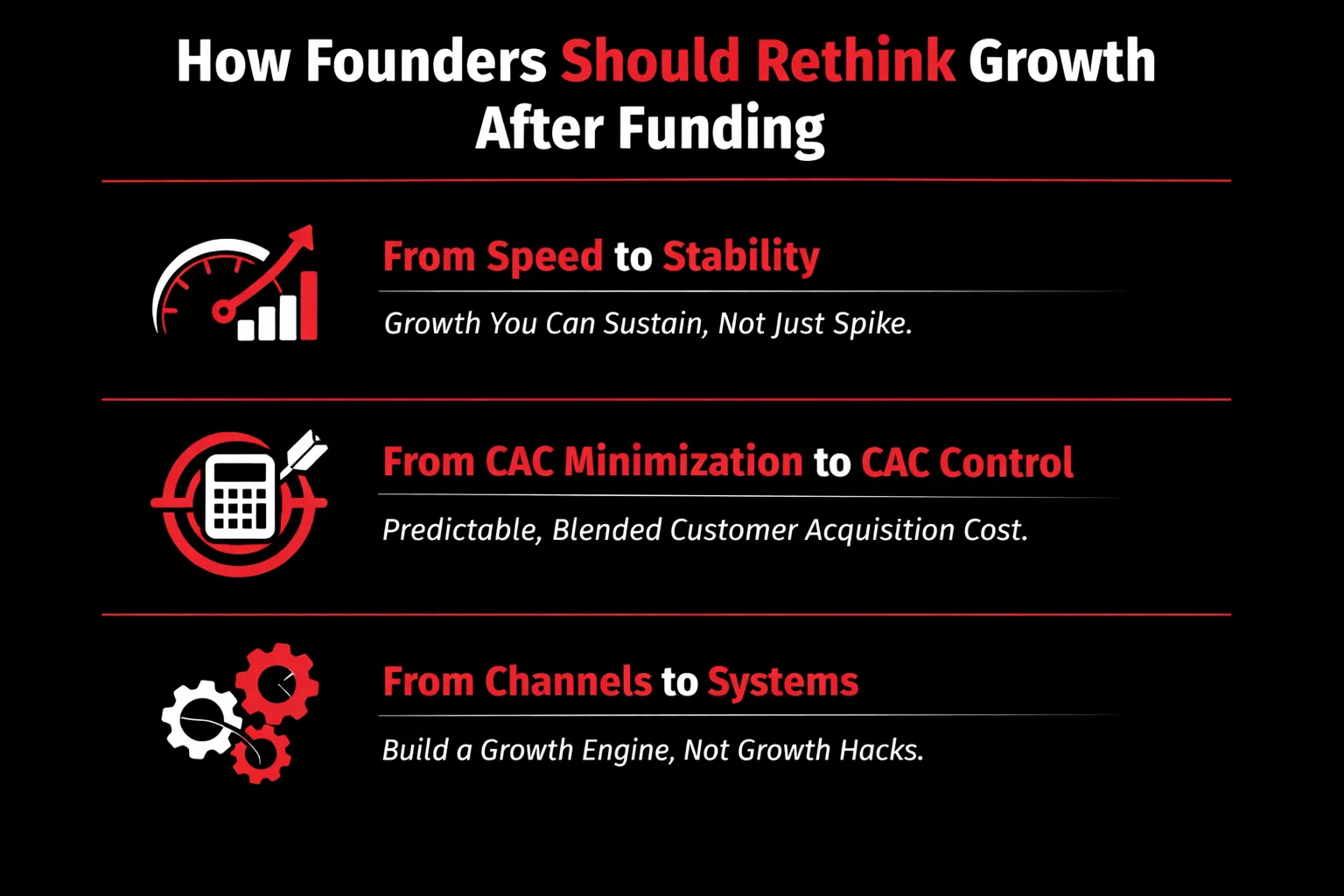
Raising capital doesn’t just change your bank balance—it changes the rules of how growth is judged. What worked pre-funding often breaks once expectations shift from “early traction” to “repeatable scale.” To avoid the 90-day CAC cliff, founders need to rethink growth along three fundamental dimensions.
Shift 1: From Speed to Stability
Immediately after funding, speed becomes the default instinct. More spend, more hires, more activity. But fast growth that collapses under scrutiny isn’t growth—it’s noise. Boards and investors may initially reward steep curves, but those curves are quickly interrogated for sustainability.
Post-funding growth must be able to survive scrutiny:
- Can it hold up when budgets stop increasing?
- Does performance improve with time, or deteriorate?
- Can the same results be repeated next quarter without heroics?
Founders should optimize less for how fast charts go up and more for how well they hold. Stability beats volatility in the long run, even if it looks slower in the short term. The goal is not impressive graphs for board decks, but durable momentum that compounds between meetings.
Shift 2: From CAC Minimization to CAC Control
Early-stage teams obsess over lowering CAC at all costs. After funding, that mindset becomes limiting. The real challenge isn’t achieving the lowest CAC—it’s achieving predictable CAC.
Unpredictable acquisition costs make planning impossible:
- Sales forecasts break
- Hiring plans stall
- Burn becomes reactive
This is where founders should shift focus from channel-level CAC to blended CAC—the true cost of acquiring a customer across all channels over time. Blended CAC rewards balance: paid, organic, brand, referrals, partnerships. It exposes over-reliance on any single lever and highlights which investments actually stabilize growth.
Control beats minimization. A slightly higher but predictable CAC is far more valuable than a volatile one that spikes every quarter.
Shift 3: From Channels to Systems
Post-funding growth fails when it’s built on isolated channels and short-term hacks. Winning teams think in systems, not tactics.
A growth system:
- Creates demand, not just captures it
- Improves efficiency as it scales
- Doesn’t reset when spend pauses
This is where organic visibility becomes infrastructure. SEO, content, and brand aren’t “marketing tasks”—they are long-term growth assets that compound quietly while paid channels fluctuate. Treating organic as a system, rather than a side project, is what turns growth from a recurring expense into an appreciating asset.
The core reframe is simple:
After funding, growth isn’t about proving you can move fast. It’s about proving you can keep moving—without falling off the CAC cliff.
Conclusion: Escaping the CAC Cliff Before It Hits
The post-funding CAC cliff isn’t a sudden accident or a sign that something is “broken” in your go-to-market motion. It’s a predictable outcome of how most startups scale after raising capital. When growth is driven primarily by paid channels, headcount expansion, and short-term velocity, rising acquisition costs aren’t an anomaly — they’re the math catching up.
What makes the CAC cliff feel so painful is not the increase in spend, but the lack of leverage. Paid channels demand constant fuel. The moment efficiency dips, pressure rises. Teams scramble, founders question execution, and growth starts to feel heavier instead of lighter. Not because the company is failing — but because demand is being rented, not built.
The companies that avoid this panic share one critical trait: they invest in organic visibility early. They don’t wait for CAC to spike before thinking about search demand, brand trust, or inbound intent. By the time the 90-day mark arrives, they’ve already started compounding attention, credibility, and pipeline. Growth doesn’t stall — it stabilizes.
As you think about your own post-funding strategy, step back and audit your growth mix. How much of your demand disappears the moment you stop paying for it? How much of it compounds quietly in the background? The difference between surviving the CAC cliff and compounding through it often comes down to that single question.The best time to build organic visibility isn’t when pressure peaks — it’s before pressure forces your hand.