
SUPERCHARGE YOUR ONLINE VISIBILITY! CONTACT US AND LET’S ACHIEVE EXCELLENCE TOGETHER!
The Provocation: Why “SEO Is Dead” Is Not Clickbait Anymore
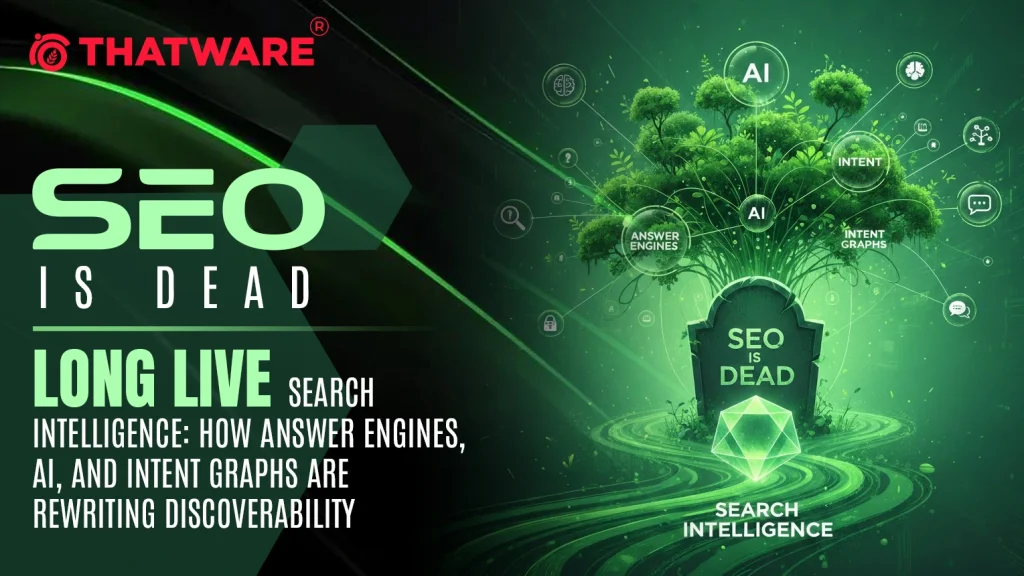
For over a decade, headlines declaring “SEO is dead” have surfaced with predictable regularity. Each time, the industry shrugged, adjusted a few tactics, and moved on. Google rolled out a new update, marketers adapted, and SEO survived—stronger, some would argue. But the version of SEO that endured those past disruptions is not the same one being challenged today. This time, the claim isn’t sensationalism. It’s a signal.
The Familiar Claim—and Why This Time It’s Different
Yes, “SEO is dead” has been proclaimed for 15+ years—after Panda, Penguin, Hummingbird, RankBrain, BERT, and Core Web Vitals. Each shift changed how SEO worked, but not what it fundamentally was: a practice centered on optimizing pages to rank higher on Google.
What has changed in the last 24 months is not another algorithm tweak—it’s the nature of search itself. The rise of large language models (LLMs), generative AI, and answer engines has altered how information is retrieved, synthesized, and presented. Search is no longer about matching queries to pages; it’s about generating answers from an understanding of intent, context, and knowledge.
Dismissing the “SEO is dead” narrative today is dangerous because it assumes continuity where there is rupture. We’re no longer dealing with an improved search engine—we’re dealing with a different discovery paradigm altogether.
The Quiet Collapse of the Ranking-Centric Model
For years, rankings acted as a reliable proxy for visibility. Rank on page one, get clicks. Rank in the top three, win traffic. That relationship has quietly broken.
Zero-click searches now dominate large portions of the SERP. AI summaries, featured snippets, knowledge panels, and instant answers satisfy user intent without requiring a visit. Brands maintain “stable rankings” while organic traffic declines—often without an obvious explanation. Visibility is happening, but clicks are not.
The result is an invisible loss: brands are present in search, yet absent from outcomes.
The Real Death: SEO as We Knew It
SEO isn’t dead because optimization no longer matters. It’s dead because search optimization is no longer synonymous with SEO. Keywords, backlinks, and rankings still exist—but they’ve been demoted to secondary signals in a system that prioritizes understanding over indexing.
Mechanical optimization—tuning pages to satisfy algorithms—is reaching its end. What replaces it is not better SEO, but something fundamentally different: Search Intelligence, built for machines that reason, summarize, and decide what humans see.
Google Is No Longer “Search”—It’s Just One Discovery Node
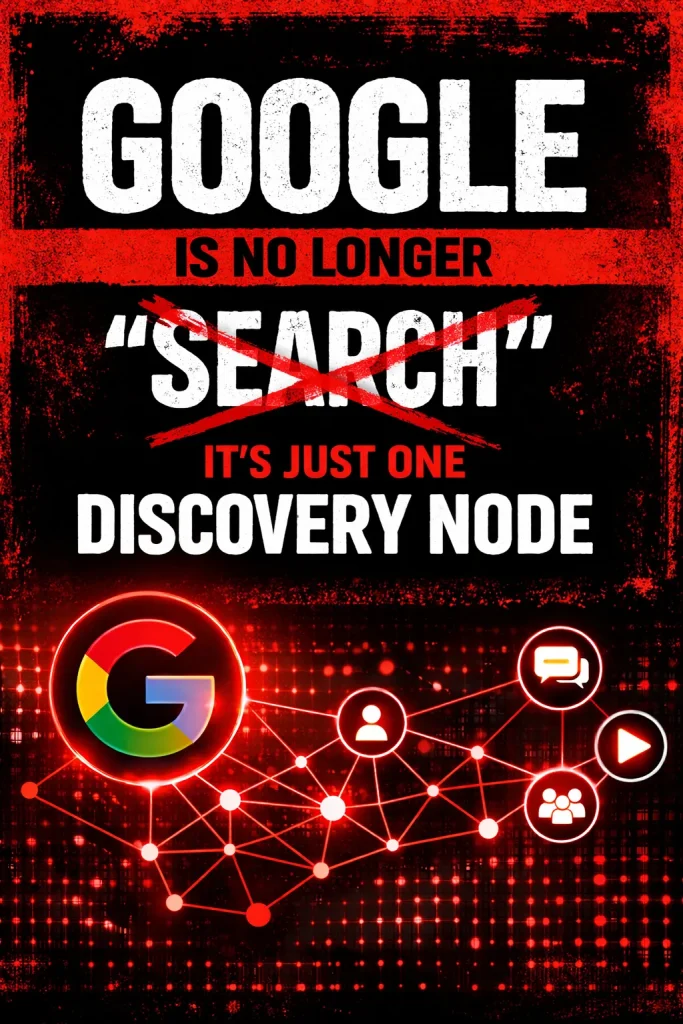
For over two decades, Google didn’t just dominate search—it defined it. If something wasn’t on Google, it effectively didn’t exist. This dominance trained marketers, founders, and entire organizations to think about discoverability in a single, linear way: a user types a query → Google returns results → the highest-ranking page wins. That mental model shaped SEO strategies, content calendars, KPIs, and even how success was measured.
But that model no longer reflects reality.
The Myth of Google as the Internet
Google’s greatest achievement wasn’t technical—it was psychological. It convinced the world that search meant Google. As a result, marketers learned to optimize for one interface, one algorithm, and one outcome: rankings. However, calling Google a “search engine” today is increasingly misleading. What we now call search is better described as distributed discovery—a set of interactions happening across multiple platforms, contexts, and interfaces. Google is still powerful, but it’s no longer synonymous with intent fulfillment.
Search is no longer a destination. It’s a behavior.
The Fragmentation of Search Behavior
Modern search journeys rarely begin and end on Google. A single decision might start with a question in ChatGPT, continue through a Reddit thread, get validated on YouTube, and finally convert on a marketplace or app. Users now “search” across:
- Answer engines like ChatGPT, Perplexity, and Gemini for synthesized understanding
- Communities such as Reddit and Quora for lived experiences
- Short-form platforms like TikTok, YouTube, and Shorts for visual validation
- Marketplaces and apps where intent is already transactional
In this environment, discoverability is no longer about being ranked—it’s about being present wherever intent emerges. The idea that discovery equals ten blue links is an outdated abstraction.
The Decline of the Traditional SERP
The classic SERP is quietly collapsing under its own evolution. AI Overviews, instant answers, featured snippets, and knowledge panels now intercept user intent before organic results are even considered. The outcome? Fewer clicks, more summaries, and a growing number of searches that never leave Google—or never reach a website at all.
Search has shifted from a list of options to an experience of resolution. Users don’t want results; they want answers. And increasingly, those answers are delivered without requiring a click.
Implication: Optimizing for Google Alone Is a Strategic Blind Spot
Brands still running Google-only SEO strategies are optimizing for a shrinking slice of discovery. Visibility today is cross-ecosystem by default. If your brand is absent from AI-generated answers, community discussions, video platforms, and app-based search, you’re invisible to large segments of intent—even if you “rank” well.
The future of discoverability isn’t about winning Google. It’s about being understood, referenced, and trusted across the entire search ecosystem. Google is no longer the map—it’s just one stop along the journey.
From Search Engines to Answer Engines: The Paradigm Shift
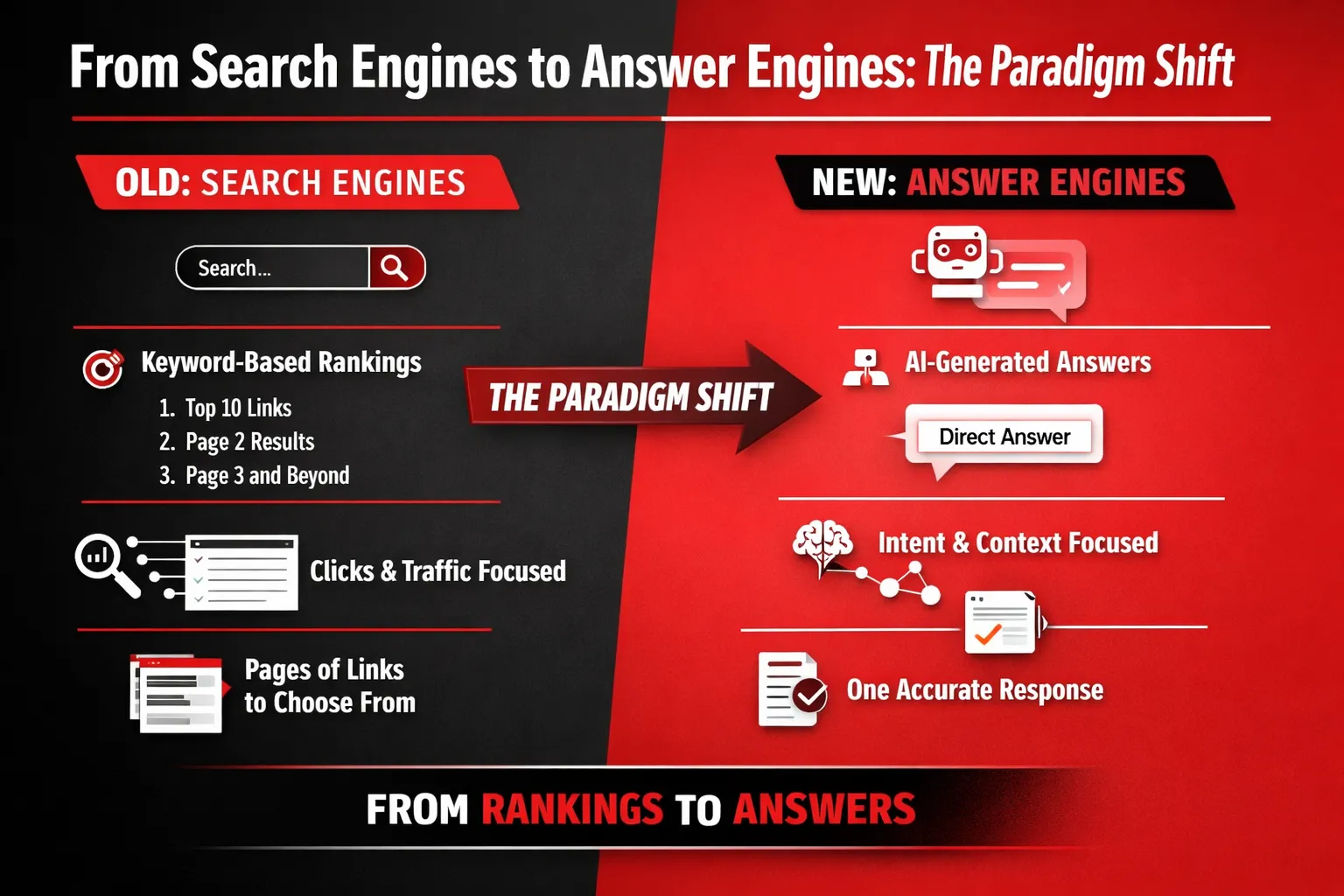
For more than two decades, “search” meant one thing: type a query into Google, scan a list of blue links, and click through pages until you found what you needed. Entire industries—including SEO—were built around this behavior. But that model is quietly being replaced. Today, search is no longer about finding pages. It’s about receiving answers. This is the shift from search engines to answer engines, and it fundamentally changes how discoverability works.
What Are Answer Engines?
Answer engines are AI-driven systems designed to understand a question and deliver a direct, synthesized response, rather than a list of documents. Instead of acting as directories, they act as interpreters.
Examples include:
- ChatGPT, which generates conversational, contextual answers
- Perplexity, which combines answers with cited sources
- Gemini and Claude, which reason across multiple data points
- AI assistants embedded in apps, operating silently inside products, browsers, and devices
The key difference is intent. Search engines retrieve information; answer engines resolve intent. They don’t ask users to “go find” the answer—they become the answer.
Where search engines are optimized for indexing and ranking web pages, answer engines are optimized for understanding, synthesis, and trust. This alone breaks the foundational assumptions of traditional SEO.
Why Rankings Don’t Exist in Answer Engines
In an answer-engine world, there is no page one, page two, or page ten. There is no scrolling through options or comparing headlines. There is one response.
That response may be influenced by dozens or hundreds of sources behind the scenes, but the user sees a single output. As a result, visibility is no longer binary—ranking or not ranking. Instead, it becomes:
- Inclusion: your content or brand informs the answer
- Citation: you are referenced as a trusted source
- Omission: you don’t exist at all in the response
This is a brutal shift. Being “position #3” or even “position #1” is meaningless if the answer engine never exposes a list of results. Discoverability collapses into a winner-take-most model, where being understood matters more than being visible.
The New Competition: Being Understood, Not Indexed
Traditional SEO competed for crawlability and indexation. Answer engines compete on comprehension.
Most modern answer engines rely on retrieval-augmented generation (RAG). In simple terms, this means the AI:
- Retrieves relevant information from trusted sources
- Evaluates credibility and relevance
- Synthesizes those inputs into a coherent answer
The AI isn’t asking, “Which page is best optimized?” It’s asking, “Which sources explain this concept clearly, accurately, and authoritatively?”
This is why many SEO tactics fail in answer engines. Keyword density, internal linking tricks, and over-optimized content offer little value. What wins instead is:
- Clear explanations
- Strong entity associations
- Consistent topical authority
- Content that teaches, not manipulates
The competition has shifted from technical optimization to intellectual clarity.
The Rise of Answer Engine Optimization (AEO)
This new reality has given rise to Answer Engine Optimization (AEO)—a discipline focused on making brands and content understandable, trustworthy, and usable by AI systems.
Unlike SEO, AEO does not optimize for rankings. It optimizes for:
- Entities: who you are, what you do, and how you relate to concepts
- Concepts: ideas, frameworks, and explanations, not just keywords
- Authority: demonstrated expertise across ecosystems
- Contextual relevance: matching intent, not queries
AEO is not a replacement tactic—it’s a replacement mindset. In a world where machines decide what answers humans receive, discoverability belongs to those who help machines understand them best.
The End of Keyword-Based SEO (And Why It Failed)
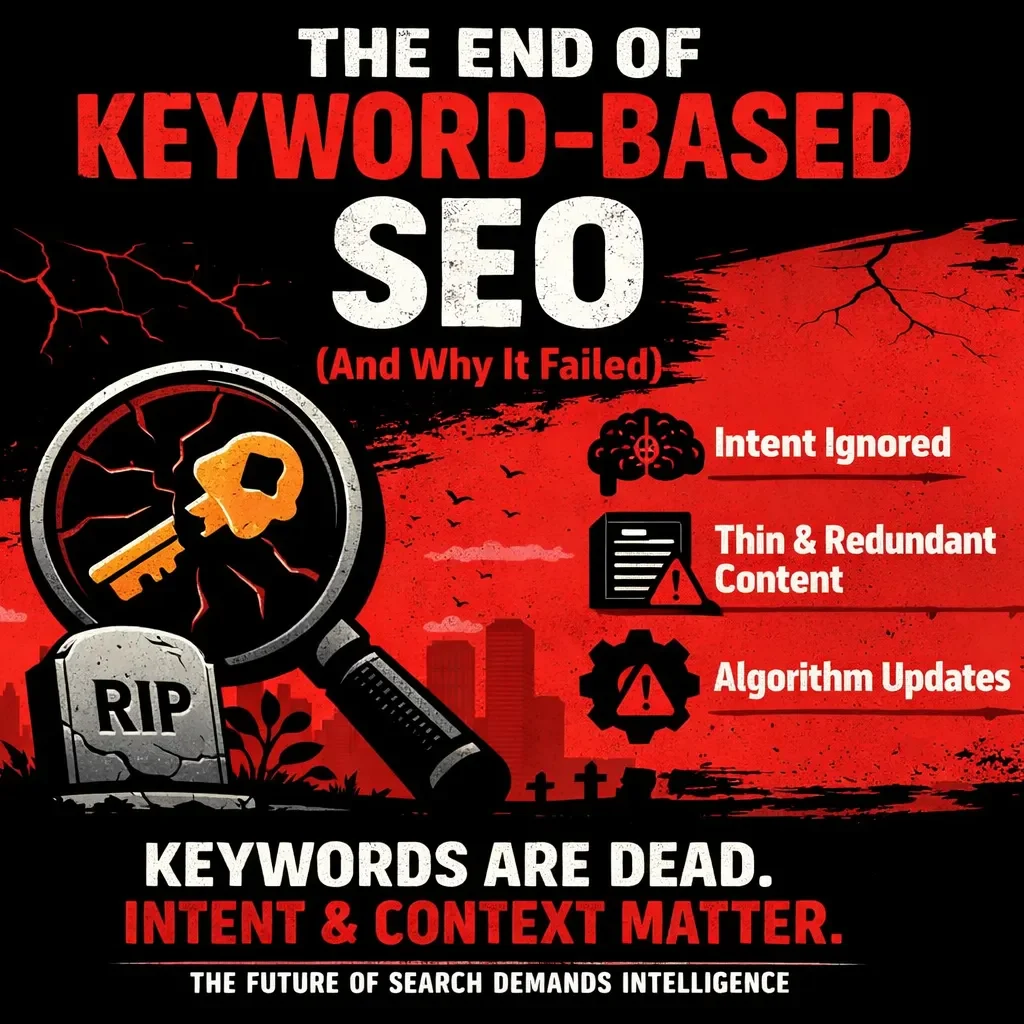
For years, keyword-based SEO was treated as the foundation of search visibility. Find the right keyword, place it strategically, build a page around it, and rankings would follow. That model worked—not because it reflected how humans think, but because early search engines were limited enough to reward it. Today, that limitation no longer exists. And with AI-driven systems taking center stage, keyword-based SEO hasn’t just become inefficient—it has become fundamentally obsolete.
Keywords Were Always a Crude Approximation of Intent
Humans don’t think in keywords. No one wakes up and decides to search for a precise phrase with an exact word order. People think in problems, goals, confusion, and curiosity. Keywords were merely a workaround—a way for machines to approximate human intent when they lacked the ability to understand language.
That workaround is no longer necessary.
Modern AI systems don’t need keywords to interpret meaning. Large language models analyze context, relationships between concepts, and the underlying intent behind a query. Whether a user asks a question directly, phrases it casually, or expresses it indirectly, AI can infer what they are actually trying to achieve. Keywords become optional metadata, not the core signal.
In other words, keywords were never the truth—they were a translation layer for weak machines. Now that machines can understand language, the translation layer is being removed.
How Keyword Obsession Broke Content Strategy
The obsession with keywords didn’t just distort SEO—it actively damaged content strategy.
To “cover” keywords, brands began over-segmenting content: one page per variation, per modifier, per phrasing. This led to dozens of near-identical pages competing with each other, each too shallow to provide real value. Instead of depth, content strategies optimized for surface-level relevance.
The result was predictable:
- Thin, repetitive content created for algorithms, not users
- Keyword cannibalization, where pages fought each other for the same intent
- Redundant explanations scattered across the site with no central authority
What looked like scale was actually fragmentation. Brands weren’t building knowledge—they were manufacturing pages.
Semantic Search Was the Warning—AI Is the Final Blow
Semantic search was the first signal that keyword-based SEO was on borrowed time. Search engines began moving from matching strings of text to understanding meanings. Queries were no longer evaluated purely on words, but on what those words represented.
AI takes this several steps further.
Through natural language processing, embeddings, and vector search, content is no longer retrieved because it contains a keyword, but because it is contextually similar to a user’s need. In simple terms: AI compares ideas, not words. It understands that different phrases can represent the same intent, and that the same phrase can mean different things depending on context.
This shift—from strings, to meanings, to intentions—makes keyword targeting increasingly irrelevant.
The Shift from Keywords to Questions, Problems, and Context
Modern search is no longer about queries—it’s about needs.
A keyword is just the surface expression of a deeper problem. Answer engines and AI-driven search systems are designed to resolve that problem directly, not send users to ten possible pages that might help. Search becomes problem-solving, not information lookup.
This is why content built around real questions, real scenarios, and real contexts outperforms keyword-stuffed pages. The goal is no longer to match phrasing, but to fully satisfy intent—anticipating what the user needs before they ask the next question.
In a post-keyword world, visibility belongs to those who understand intent better than their competitors. Not those who repeat phrases better.
Intent Graphs: The Missing Layer SEO Never Had
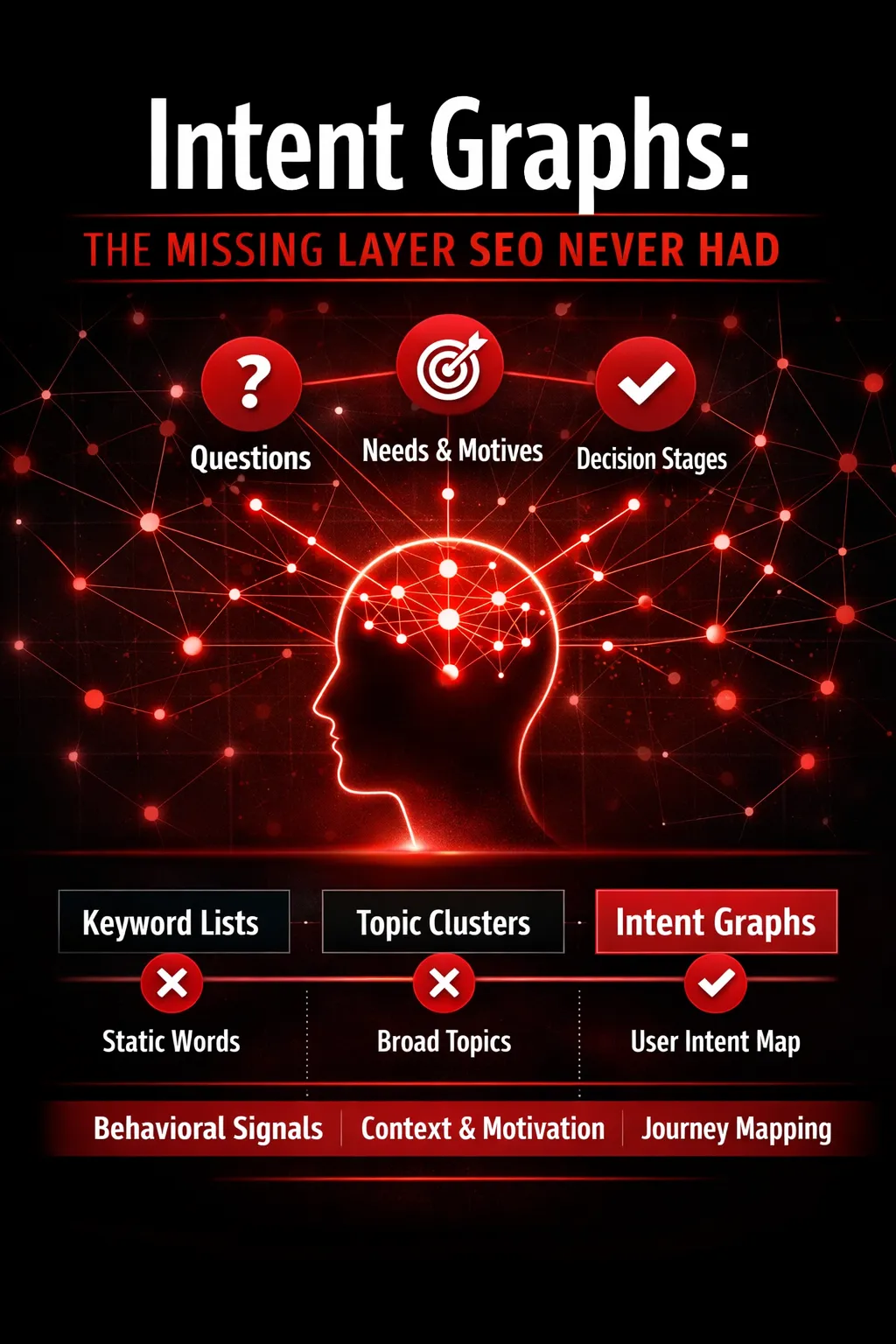
For decades, SEO has tried to reverse-engineer human behavior using keywords. But keywords were never the goal—they were a proxy, and a poor one at that. As search shifts from retrieval to reasoning, the systems deciding visibility are no longer matching words; they’re modeling intent. This is where intent graphs enter the picture.
What Is an Intent Graph?
An intent graph is a dynamic map of user needs, motivations, and decision stages—connected not by keywords, but by why someone is searching, what problem they’re trying to solve, and how their intent evolves over time.
To understand why this matters, compare it to the models SEO traditionally relied on:
- Keyword lists focus on isolated phrases. They treat searches as standalone events and assume intent can be inferred from a string of words.
- Topic clusters improve on this by grouping related concepts, but they still center content around themes, not user motivation.
- Intent graphs, by contrast, model the relationships between intents. They connect awareness questions to evaluation needs, decision triggers, trust signals, and post-decision validation.
In other words, intent graphs don’t ask, “What keyword should we rank for?”
They ask, “What does the user need next—and why?”
This shift is critical in an AI-driven discovery environment where content is selected, summarized, and cited based on usefulness across an entire decision journey.
How AI Understands Intent (Not Queries)
Modern AI systems don’t interpret searches as text inputs—they interpret them as signals.
- Behavioral signals reveal intent through actions: dwell time, follow-up questions, engagement depth, and task completion.
- Contextual inference allows AI to understand meaning beyond words—factoring in location, prior interactions, device, and even emotional framing.
- Cross-session understanding enables AI to recognize that intent evolves. A user researching today may be evaluating tomorrow and deciding next week.
This is why keyword matching is increasingly irrelevant. AI systems don’t need exact phrases to understand what someone wants—they infer intent probabilistically and holistically. Content that fits into an intent graph is far more likely to be selected than content optimized for a single query.
Intent > Traffic: The New Optimization Metric
One of the most uncomfortable truths for traditional SEO teams is this: not all traffic is valuable—and much of it never was.
High-volume keywords often represent early, unfocused, or low-commitment intent. High-intent visibility, on the other hand, aligns with users who are closer to decision, trust-building, or action.
As a result:
- Traffic becomes a byproduct, not a goal.
- Rankings become less meaningful than being present at the right moment.
- Vanity metrics—impressions, keyword counts, “top 3” positions—lose relevance.
In an intent-driven model, success is measured by coverage of meaningful intent, not by raw visit counts.
Building Content for Intent Coverage, Not Keyword Coverage
Intent graphs force a fundamental rethink of content strategy.
Instead of producing dozens of pages targeting adjacent keywords, content is designed to support intent progression:
- Awareness: identifying and framing the problem
- Consideration: exploring options, approaches, and trade-offs
- Decision: validating choices, reducing risk, and enabling action
- Trust: reinforcing confidence before and after conversion
Within this framework, content must address multiple intent types:
- Informational (learning)
- Navigational (finding)
- Transactional (acting)
- Emotional (reassurance, confidence, validation)
AI systems favor content that fits naturally into this continuum because it mirrors how humans actually make decisions.
Intent Graphs as Competitive Moats
The true power of intent graphs lies in their compounding effect.
When a brand consistently satisfies intent across stages, it becomes:
- A reference point for AI systems
- A trusted source for users
- A default inclusion in synthesized answers
This kind of intent ownership is difficult to displace. Competitors can outrank a page, but they can’t easily replace an entity that owns the decision narrative.
Rankings are temporary. Intent coverage compounds.
In a world where discoverability is determined by understanding—not optimization—intent graphs become the moat SEO never had, and Search Intelligence now requires.
Search Intelligence: What Replaces SEO
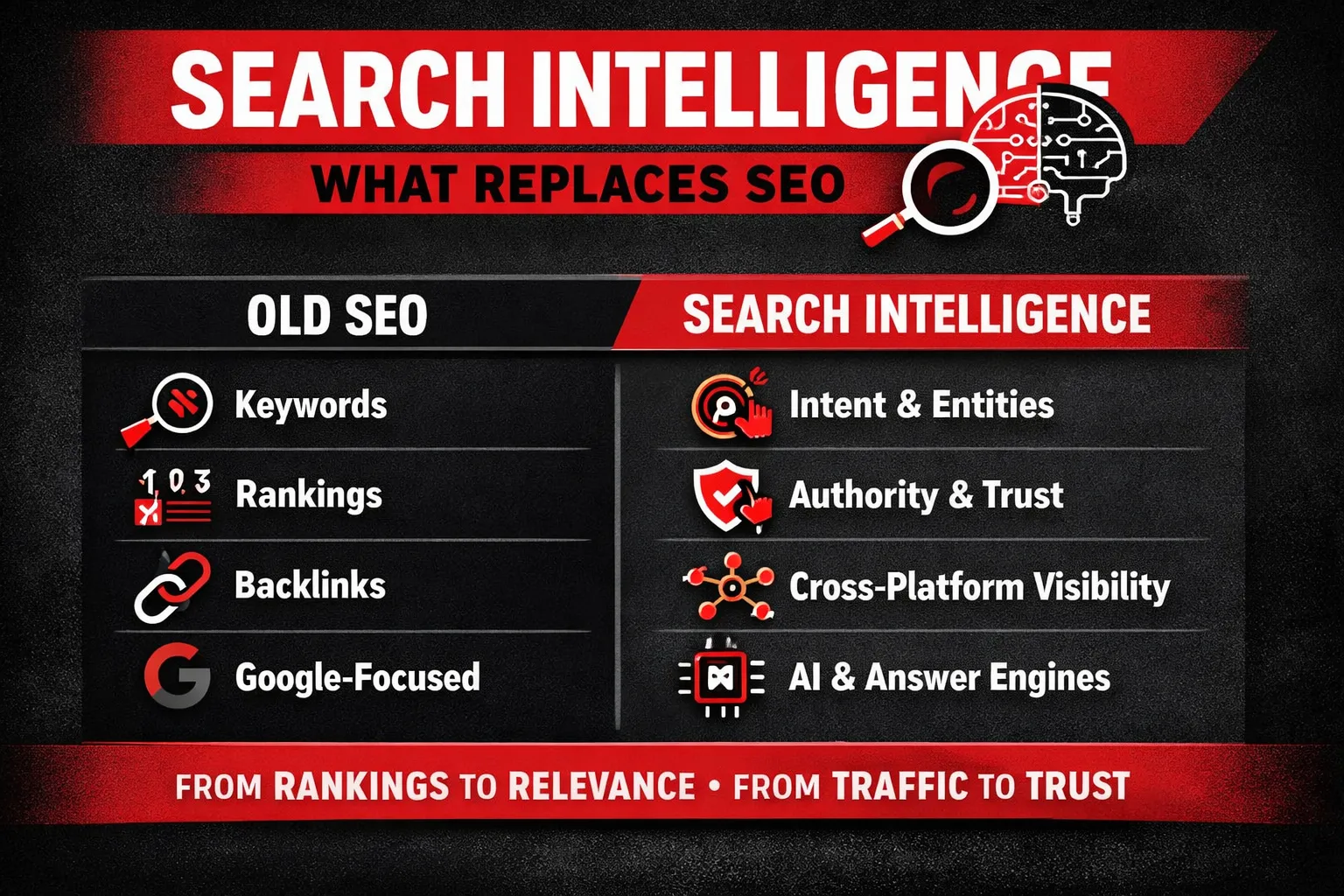
If traditional SEO was about optimizing for search engines, Search Intelligence is about being understood by intelligent systems. This is not a tactical upgrade—it’s a structural replacement. As AI-driven discovery becomes the default, visibility is no longer awarded to pages that follow rules, but to entities that machines can confidently recognize, trust, and recommend.
Defining Search Intelligence
Search Intelligence can be distilled into a simple but powerful equation:
Search Intelligence = Intent + Entity + Authority + Ecosystem Presence
Unlike SEO, which focused heavily on manipulating ranking signals, Search Intelligence focuses on how machines interpret reality.
- Intent: Understanding why a user is searching, not just what they typed.
- Entity: Being recognized as a distinct, well-defined concept (brand, person, product, idea).
- Authority: Demonstrating expertise and trustworthiness through consistent, verifiable signals.
- Ecosystem Presence: Existing wherever discovery happens—not just on Google.
Search Intelligence doesn’t chase algorithms. It aligns with how modern AI systems form understanding and generate answers.
How Search Intelligence Differs from SEO
The shift from SEO to Search Intelligence is not cosmetic—it’s foundational.
| SEO | Search Intelligence |
| Keywords | Intent modeling |
| Rankings | Visibility across ecosystems |
| Pages | Entities & concepts |
| Multi-platform discovery |
SEO was page-centric and platform-dependent. Search Intelligence is entity-centric and ecosystem-wide.
Where SEO asked, “How do I rank for this keyword?”, Search Intelligence asks, “How does an AI system understand this topic—and where does my brand fit within that understanding?”
This change reflects a deeper truth: machines no longer retrieve information, they synthesize it.
The Core Pillars of Search Intelligence
To be discoverable in an AI-first world, four pillars must be intentionally built:
1. Entity Authority
AI systems rely on entities, not URLs. Your brand must be clearly defined, contextually reinforced, and consistently referenced across sources. Authority emerges when machines see you repeatedly associated with a specific domain of expertise.
2. Knowledge Consistency
Contradictions confuse AI. Consistent messaging, terminology, positioning, and facts across your website, social platforms, communities, and third-party mentions increase machine confidence.
3. Content Depth and Clarity
Shallow, keyword-stuffed content fails in an AI-driven ecosystem. Search Intelligence rewards:
- Clear explanations
- Structured reasoning
- Comprehensive coverage of topics
Content must teach, not just target.
4. Ecosystem Distribution
Discovery now happens across AI tools, social platforms, forums, apps, and assistants. Search Intelligence ensures your presence extends beyond your website into the broader knowledge ecosystem where AI systems learn and retrieve context.
Why Search Intelligence Is AI-Native
Search Intelligence isn’t adapted to AI—it’s designed for it.
Traditional SEO was built for machines that crawled, indexed, and ranked. Modern AI systems reason, infer, and decide. They evaluate:
- Context
- Credibility
- Conceptual relationships
- Intent alignment
Search Intelligence works seamlessly across:
- Large Language Models (LLMs)
- AI assistants
- Answer engines
- Multi-modal search interfaces
In this environment, visibility is not earned through optimization tricks but through machine-level understanding.
SEO taught us how to speak to algorithms.
Search Intelligence teaches machines how to think about us.
And that is why SEO didn’t evolve into the future—it was replaced by it.
Authority in the Age of AI: How Trust Is Calculated Now
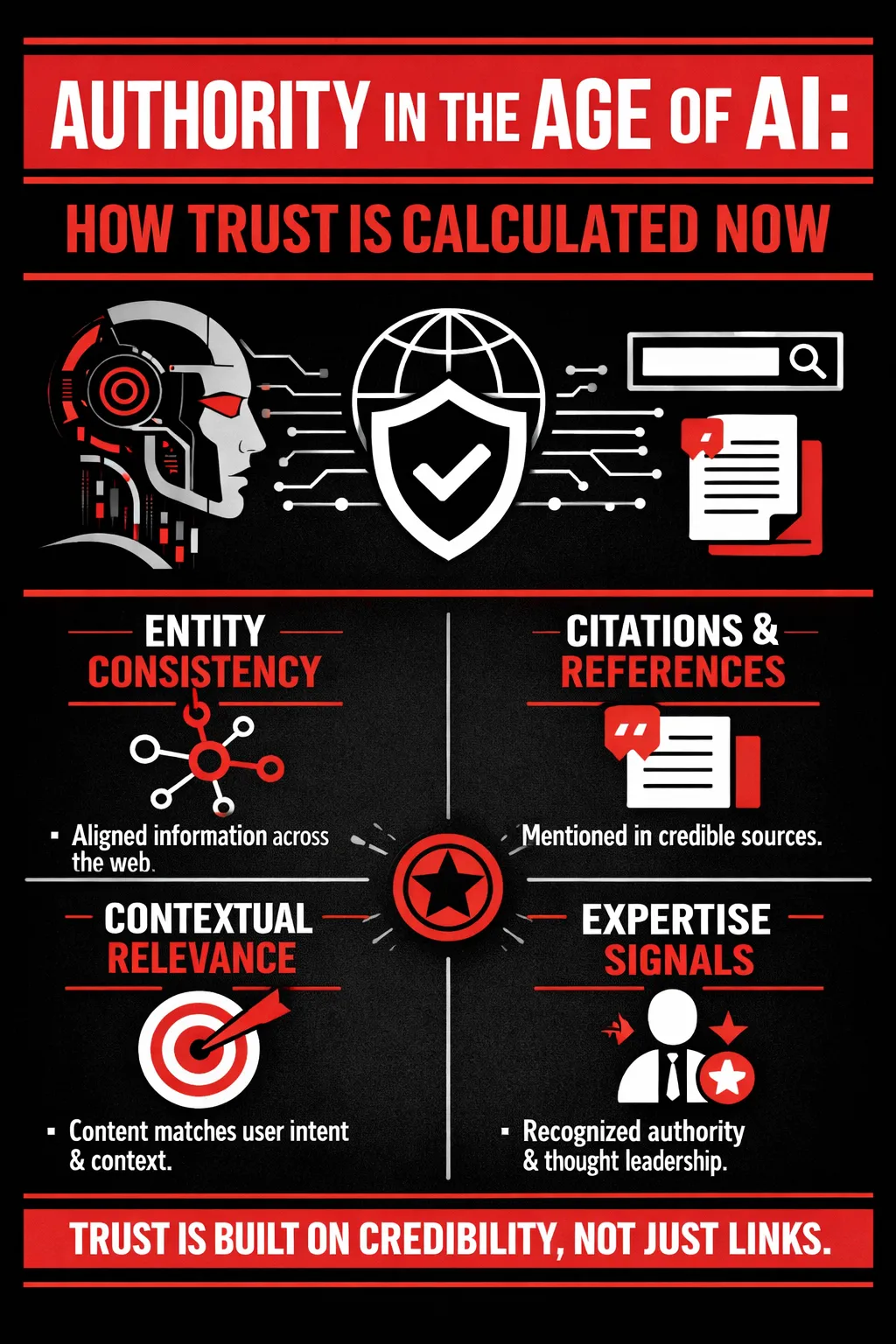
For over two decades, authority in search was largely reduced to one dominant signal: backlinks. The more sites that linked to you—especially “high-authority” ones—the more trustworthy you appeared. This model worked when search engines were primarily indexing documents and ranking pages. But in an AI-driven discovery ecosystem, authority is no longer borrowed through links; it is inferred through understanding.
Authority Is No Longer About Links Alone
Backlinks are not obsolete—but they are no longer sufficient. In an AI-first environment, links function as supporting evidence, not proof of authority. Large language models and answer engines don’t simply count endorsements; they evaluate credibility signals holistically.
Modern authority is shaped by:
- How consistently a brand or author demonstrates expertise
- Whether their content aligns with established knowledge
- How often they are referenced, quoted, or cited across trusted sources
In other words, authority is shifting from popularity-based validation to credibility-based recognition. AI systems are less interested in who links to you and more interested in whether your information holds up when cross-checked against the broader knowledge ecosystem.
Machine-Readable Authority
AI does not “trust” the way humans do. It calculates trust through patterns—and those patterns must be machine-readable.
Key signals include:
- Entity associations: How strongly your brand, people, or products are connected to specific topics, concepts, or industries.
- Co-occurrence: How often you appear alongside other trusted entities in credible contexts.
- Citations and references: Mentions in research, expert content, industry publications, and authoritative discussions.
- Consistent expertise signals: Repeated, accurate, and in-depth coverage of a subject over time.
Authority, in this sense, is not declared—it is statistically reinforced across the information graph.
Content That Gets Cited vs Content That Ranks
There is a growing divide between content that ranks on SERPs and content that gets cited by AI.
AI favors:
- Depth over volume: Fewer, more comprehensive pieces instead of dozens of thin articles.
- Original thinking over aggregation: Insights, frameworks, and explanations that add new value.
- Clear explanations over SEO padding: Direct, well-structured answers instead of keyword-stuffed prose.
Ranking content tries to attract clicks. Citable content tries to explain reality. Answer engines prefer the latter.
Becoming an “Answer Source,” Not Just a Website
The ultimate goal is no longer to be found—it’s to be referenced.
Brands become answer sources when they:
- Consistently publish authoritative explanations
- Clarify complex topics better than competitors
- Establish recognizable points of view
In the age of AI, thought leadership is not just branding—it’s a technical advantage. When machines need reliable answers, they return to sources that have proven they understand the subject deeply. Visibility now belongs to those who don’t just optimize content—but teach the system what the truth looks like.
The New Discoverability Playbook (Post-SEO)
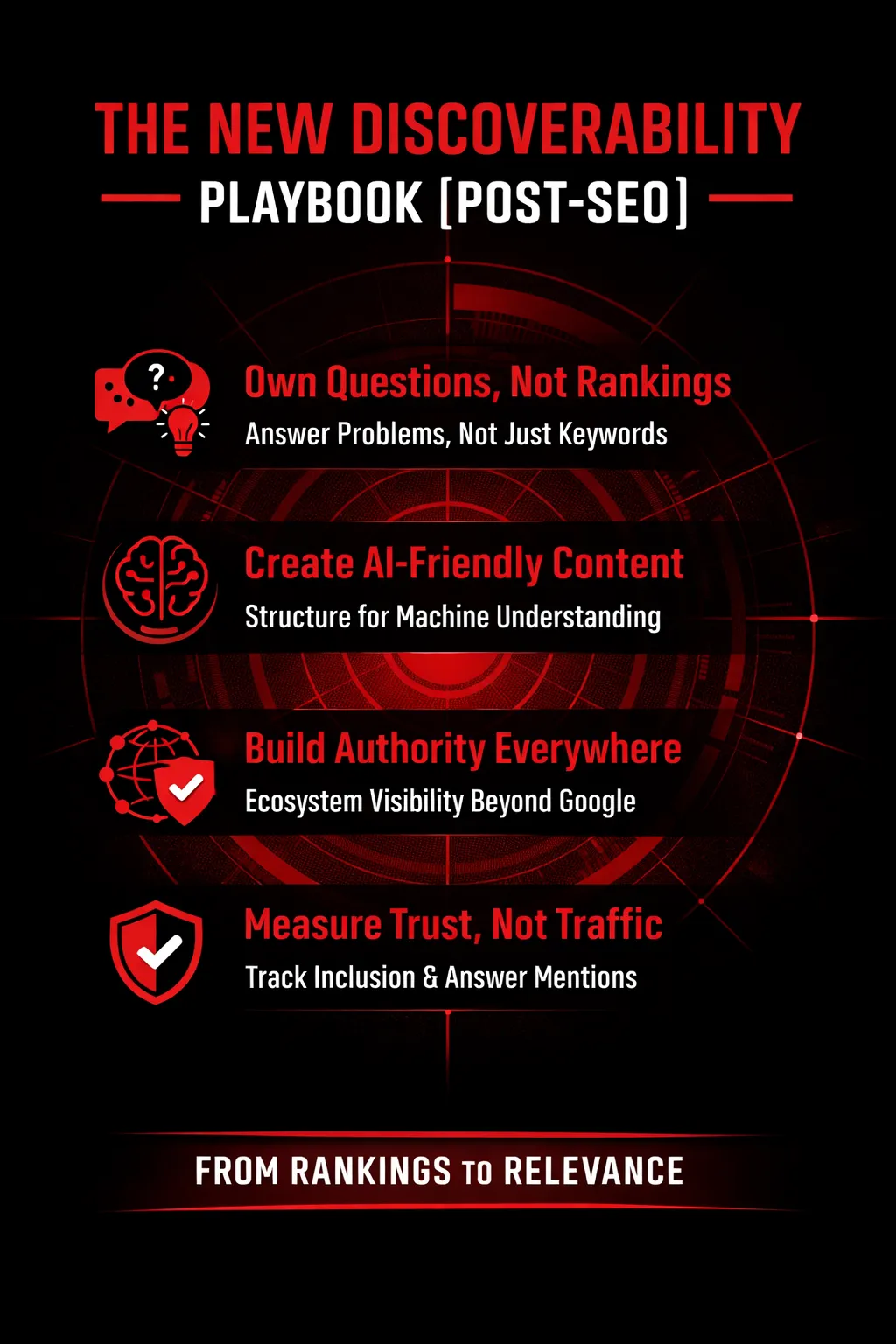
If traditional SEO was about chasing visibility, the post-SEO era is about earning understanding. Discoverability today is no longer won by ranking for isolated keywords—it’s won by becoming the most reliable answer across machines, platforms, and moments of intent. This requires a fundamentally different playbook.
Stop Chasing Rankings—Start Owning Questions
In a world dominated by answer engines, the unit of discovery is no longer the keyword—it’s the question.
People don’t wake up thinking in search terms. They think in problems, doubts, comparisons, and decisions. AI systems mirror this behavior. They interpret queries as expressions of intent, not strings of text. Brands that still organize content around keyword lists are optimizing for a mental model that no longer exists.
A post-SEO strategy starts with a question-first content framework:
- What questions does your audience ask before they know what to search?
- What uncertainties block their decision-making?
- What explanations reduce friction and build confidence?
This leads naturally to problem–solution mapping. Instead of publishing dozens of loosely related blog posts, you build authoritative content hubs that:
- Define the problem clearly
- Explain why it exists
- Explore options and trade-offs
- Present solutions with context and credibility
When you own the question, rankings become irrelevant—because the answer engine has already chosen you.
Design Content for AI Consumption
Modern discoverability depends on how well machines can understand, trust, and reuse your content.
That starts with clear structure. AI prefers content that is logically organized, scannable, and explicit. Headings should reflect real questions. Sections should deliver complete answers—not tease them.
Next comes declarative clarity. Post-SEO content avoids vague phrasing and SEO fluff. It states facts, explains relationships, and draws conclusions. This makes content easier to summarize, cite, and synthesize in AI-generated responses.
Entity reinforcement is equally critical. Brands, people, concepts, and processes should be named consistently and explained in context. AI systems build knowledge through entity relationships. The clearer your entities, the stronger your authority signal.
Finally, contextual completeness matters more than length. Content should fully answer the intent behind a question in one place, reducing the need for AI to stitch together fragmented sources.
Build for Ecosystems, Not Channels
Discoverability no longer happens in one place. It happens across an ecosystem.
Your website is just one node. Authority is now distributed across:
- Communities (Reddit, forums, niche groups)
- Social platforms (LinkedIn, X, YouTube)
- Knowledge platforms (Wikipedia, GitHub, documentation hubs)
- AI training and citation sources
Post-SEO brands don’t ask, “How do we rank?”
They ask, “Where does our audience—and AI—learn and validate information?”
By showing up consistently across these environments, you build distributed authority—a signal far more resilient than a single ranking on Google.
Measure What Actually Matters Now
Traditional SEO metrics reward visibility without impact. Post-SEO metrics reward presence with purpose.
What matters now:
- Inclusion in AI answers: Are you cited, referenced, or paraphrased by answer engines?
- Brand recall in discovery: Do users remember your brand when answers are delivered without links?
- Conversion-driven visibility: Does discoverability lead to trust, action, and long-term value?
In the post-SEO world, the goal isn’t to be found everywhere—it’s to be chosen when it matters most.
That’s the new discoverability advantage.
What This Means for Brands, Marketers, and Agencies
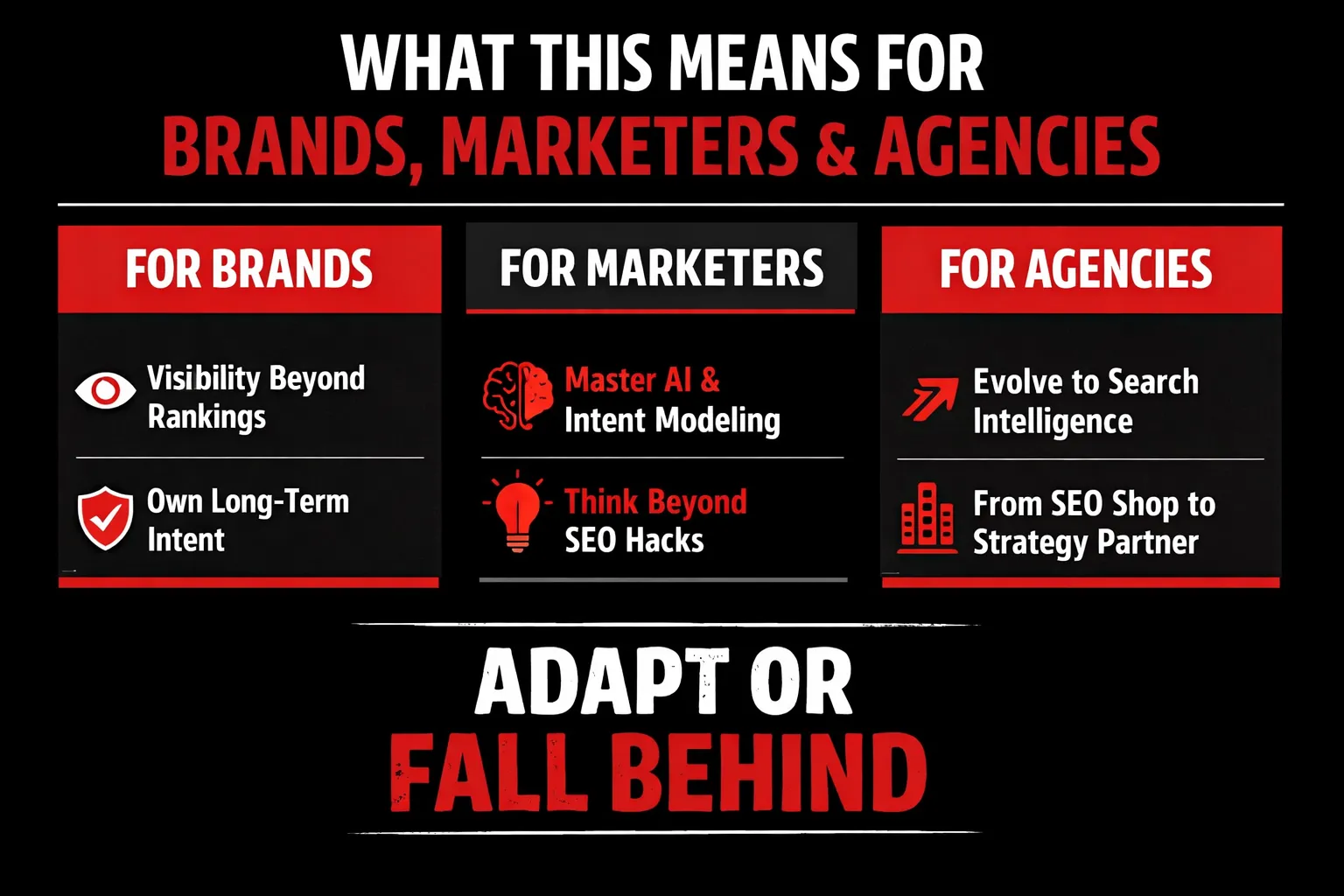
The shift from SEO to Search Intelligence is not a tactical update—it’s a structural change in how discoverability works. Different stakeholders will feel this shift in different ways, but one thing is clear: those who cling to ranking-centric thinking will steadily lose relevance.
For Brands: Visibility Without Rankings
For brands, the biggest mindset shift is accepting that visibility no longer requires rankings. In an answer-engine-driven world, being included matters more than being positioned. When AI systems synthesize responses, they don’t reward the brand that ranks #1—they reward the brand that best explains, contextualizes, and demonstrates authority on a topic.
This creates a powerful advantage for brands that invest in long-term intent ownership. Instead of chasing short-lived keyword wins, future-ready brands map the full spectrum of user intent—questions, doubts, comparisons, objections—and consistently address them. Over time, this builds a durable presence across AI systems, communities, and discovery platforms, even when algorithms change.
The result is compounding discoverability: fewer traffic spikes, more sustained relevance.
For Marketers: New Skills, New Mindsets
For marketers, this transition marks the end of hack-driven optimization. Tricks, loopholes, and mechanical checklists don’t translate to systems that reason and infer.
The most valuable skills now are intent modeling and AI literacy—understanding how users think, how AI interprets context, and how information is retrieved and synthesized. Marketers must learn to design content that explains, not just attracts; that educates, not just ranks.
This shift favors strategic thinking over tactical execution. The marketer of the future spends less time optimizing metadata and more time understanding user psychology, decision journeys, and knowledge gaps. Fewer hacks. More thinking.
For Agencies: The Repositioning Moment
For agencies, this is an existential inflection point.
Traditional SEO agencies—built around rankings, audits, and keyword deliverables—will struggle as those metrics lose meaning. In their place, a new category is emerging: Search Intelligence firms.
These firms don’t sell rankings. They sell visibility across ecosystems, authority within AI systems, and intent ownership over time. The coming repositioning wave will separate agencies that evolve from those that disappear.
The future belongs to agencies that stop optimizing pages—and start engineering understanding.
Conclusion: SEO Didn’t Die—It Was Replaced
SEO didn’t disappear overnight. It wasn’t killed by AI, nor was it made obsolete by a single Google update. What actually happened is more fundamental: SEO was outgrown. The mechanics that once governed visibility—keywords, rankings, and traffic volume—can no longer keep up with how search now works. Search didn’t stop evolving; SEO simply failed to evolve fast enough.
The Real Shift
The true transformation is not technological—it’s conceptual.
We are moving from optimization to intelligence. Instead of tweaking pages to satisfy algorithms, brands must now design content ecosystems that machines can understand. Intelligence beats optimization because modern search systems don’t just retrieve—they interpret, synthesize, and decide.
We are also shifting from ranking to relevance. In answer-driven environments, there is no “position one.” There is only inclusion or exclusion. If your brand is not contextually relevant to a question, it simply doesn’t exist in the response—regardless of how well it once ranked.
Most importantly, we are moving from traffic to trust. Visibility today is earned through credibility, clarity, and consistency across ecosystems. Traffic without trust is noise; trust without rankings is power.
The Brands That Will Win
The winners in this new era will not be the most aggressively optimized—but the most deeply understood.
They will be optimized for understanding, not algorithms—building clear entity identities, intent coverage, and authoritative knowledge signals that AI systems can confidently rely on.
They will also be brands that answer, not attract. Instead of luring clicks, they will solve problems, reduce uncertainty, and become reference points—whether a human ever visits their website or not.
Final Thought
“In a world where machines decide what humans see, discoverability belongs to those who teach machines how to think about them.”
That is not the future of search. That is search—now.