SUPERCHARGE YOUR ONLINE VISIBILITY! CONTACT US AND LET’S ACHIEVE EXCELLENCE TOGETHER!
Launched November 18, 2025 — Deep Dive Into Google’s Most Powerful Model and OpenAI’s Emergency Response
Introduction: The Day AI Changed Direction
November 18, 2025 did not arrive with the usual calm that tech launches often carry. Instead, it hit the global AI community like a jolt. When Google revealed Gemini 3, even seasoned developers and researchers stopped what they were doing to take a closer look. It felt as if the industry had been moving at a steady pace and then, in a single afternoon, someone pushed the throttle all the way forward. The release was not presented as a routine upgrade. It was introduced as a turning point, and within hours the claim seemed justified.
Gemini 3 arrived as the most complete expression of Google’s long pursuit of a true multimodal intelligence. What stood out immediately was the maturity of the model. It analyzed text, images, audio, video, and code as if they were all parts of the same language. That alone changed the tone of the conversation around it. Researchers praised the jump in reasoning accuracy. Enterprise teams rushed to compare efficiency gains. Developers filled forums and private Slack groups with surprise at how cleanly it handled cross-input analysis. For many, it felt like the kind of leap that happens once every few years, not the typical incremental bump that dominates AI release cycles.
The reason the reaction was so sharp is simple. For most of 2024 and early 2025, the competitive landscape felt predictable. The major companies were refining existing models. OpenAI continued to lead in brand influence. Google had momentum but had not delivered a product that shook the ground. Smaller labs pushed out impressive niche work, but nothing triggered the sort of energy that shifts the center of gravity in the field. That changed in a single announcement. When Google called Gemini 3 its most intelligent model, it was not marketing fluff. It was a signal that the company believed it had crossed into territory that other players had not yet reached.
The timing made the impact even more dramatic. OpenAI had enjoyed a comfortable position, and many assumed that advantage would hold through the next cycle. Rival pressure seemed softer. Research felt incremental. Then Gemini 3 landed, and the pattern broke. Instead of a simple contest of who could produce slightly better text generation or cleaner code, the conversation shifted toward depth of reasoning, real contextual memory, and autonomous problem solving. This was the kind of disruption the industry had not seen since late 2022.
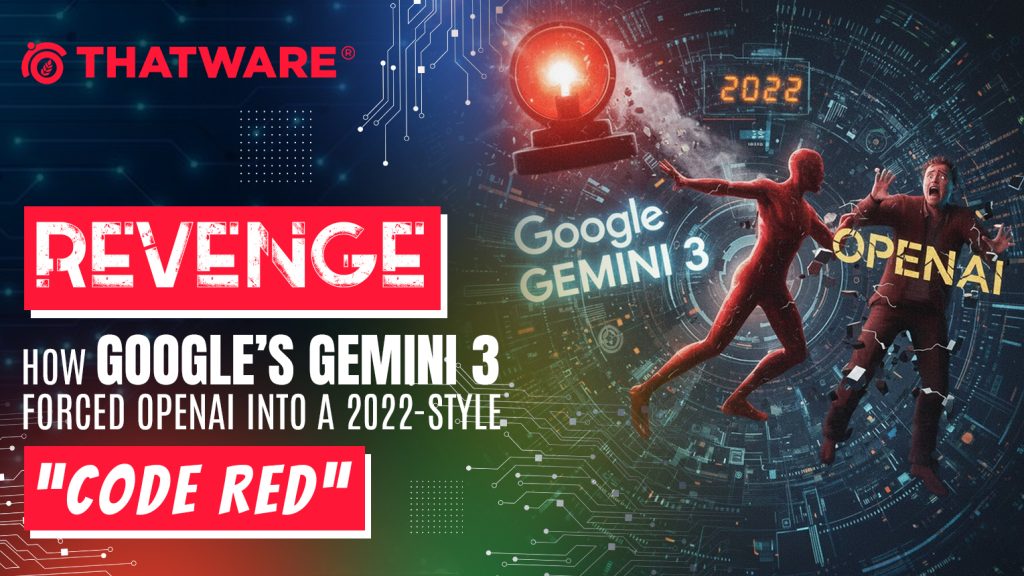
There is also an element of poetic symmetry in what happened next. Three years earlier, the debut of ChatGPT forced Google into an internal Code Red. That moment is well documented. It disrupted their roadmap and pushed the company into an uncomfortable race. This time the roles were reversed. Reports began to circulate about OpenAI facing its own internal emergency. The balance of power had shifted, and the urgency was now on the other side of the equation.
This article explores how that shift unfolded. Gemini 3 did not simply compete with OpenAI. It forced the company to rethink its strategy and priorities at a fundamental level. The release marked the beginning of a new phase in artificial intelligence, where raw capability, efficiency, and agentic behavior define the winners. The story of Gemini 3 is not just about technology. It is about momentum, perception, and what happens when the leader in a race suddenly finds itself behind.
What Makes Gemini 3 Different? The Core Breakthroughs
For years, the Gemini series has been inching toward a vision that Google often hinted at but never fully delivered. With Gemini 3, that vision finally comes into focus. The jump from Gemini 1 and 1.5 to this new architecture is not another routine upgrade. It reflects a deeper shift in how Google imagines artificial intelligence should behave and how it should participate in human work. Instead of being a model that reacts to prompts, Gemini 3 operates like a unified intelligence built to understand the world in all its messy, mixed formats.
The Unified Multimodal Brain, Fully Realized
The most striking change is that Gemini 3 is genuinely natively multimodal. This is not a marketing phrase. Most earlier multimodal systems were held together through pipelines. One module processed images, another interpreted text, and the results were stitched together late in the process. That setup worked for simple tasks but created awkward limitations. The model could not fully blend signals from different sources and often produced responses that felt disjointed.
Gemini 3 does not follow that pattern. It was trained from the ground up to take in text, images, video, code, and audio as part of a single internal representation. Because of that, the model responds with a natural flow that resembles how a human cross references different types of information at once. If you give it a diagram, a paragraph of notes, and a quick video clip, it does not treat them as separate pieces. It forms a shared understanding and the output reads like it came from one continuous thought. This shift improves perception, reasoning, and fluidity in ways that are immediately obvious to anyone who has tested earlier Gemini versions.
Rewriting the Standards for AI Intelligence
The second major breakthrough is the leap in raw intelligence. Gemini 3 handles reasoning, spatial understanding, and long horizon planning at a level that was not common even among the best commercial models just a year ago. Benchmarks show large jumps, but the real value becomes clear when you place it in front of real problems. It navigates multi step technical tasks with a calm, almost methodical confidence. It understands the shape of a problem, predicts what information will matter later, and maps out a path without constant steering from the user.
This new behavior comes from architectural additions that were not present in the previous generation. Gemini 3 distributes its internal thinking across parallel streams whenever a task requires deeper analysis. That capability fuels its Deep Think mode, a feature built for scientific work, multi variable planning, and complex strategy sessions. The same foundation also powers its agentic workflows. Instead of reacting to each individual prompt, the model can plan, execute steps, check its own work, and adjust course. These features are not bolted on. They emerge naturally from how the system has been redesigned to think ahead rather than simply predict the next token.
Why Enterprises See Gemini 3 as a Platform, Not a Model
The third breakthrough relates to how Gemini 3 fits into the broader Google ecosystem. Many enterprises are not evaluating Gemini 3 as a single product. They are looking at it as a platform for building entire AI driven workflows. Google’s advantage is that it controls almost every layer involved. The model is trained by DeepMind, runs on Google’s TPU hardware, and deploys through Cloud. It also integrates with Search, Workspace, YouTube, and Android. That level of control cuts costs, increases speed, and solves many of the reliability issues that large companies struggle with when using external models.
For businesses, this matters for a simple reason. When the model, the chips, the cloud infrastructure, and the distribution channels are all built by the same company, production systems become easier to scale and easier to maintain. A financial firm can run multimodal reports across millions of tokens without worrying about unpredictable pricing spikes. A media company can analyze huge collections of video and audio with consistent latency. A software team can use agentic coding features that run directly on Google’s optimized hardware rather than through a patchwork of third party tools.
Enterprises are beginning to see Gemini 3 as a foundation on which full AI products can be built. It is not just a conversational assistant. It is the core of an emerging AI stack that is shaping how companies plan, create, and deliver their digital services.
Benchmark Supremacy: Reasoning, Planning and Deep Think
The release of Gemini 3 created an immediate shift in the AI landscape, and the clearest proof lies in the benchmarks that measure how well a model can think, plan, and handle complex problems. These scores are not just bragging rights. They reveal whether a system can be trusted with demanding tasks that drive scientific research, engineering work, enterprise decision making and national level security analysis.
Dominating the LMArena Leaderboard
To understand why Gemini 3’s benchmark performance caused such a reaction across the industry, it helps to know what the LMArena leaderboard represents. LMArena is one of the few evaluation platforms that focuses on reasoning quality instead of superficial language fluency. The test suites include long chains of logic, multi-step questions, counterfactual challenges, symbolic puzzles and blend tasks that require a model to apply both knowledge and structured thinking. It is designed to punish shortcuts and reward genuine understanding.
When Gemini 3 appeared on the leaderboard, it jumped to the top in a way that surprised even some of Google’s internal teams. The model scored higher than GPT based systems, Claude, and leading research models from academia. It was not a small improvement. The gap was large enough that it immediately fueled speculation that Google had found a practical way to train deeper reasoning circuits in its architecture.
Three benchmark results, in particular, tell the story clearly.
Humanity’s Last Exam
This test is often compared to a graduate level comprehensive exam because it draws on conceptual problem solving rather than memorization. Gemini 3 handled the multi-part reasoning sections with an unusual level of accuracy, especially in problems that require thinking several steps ahead. Analysts noted that its answers showed a level of stability and consistency that earlier models struggled to maintain.
GPQA Diamond
GPQA Diamond is one of the hardest public reasoning benchmarks. Many systems fail catastrophically on it because it demands precise logic and no hallucination. Gemini 3 not only cleared the benchmark but achieved the highest score to date. The model’s answers showed clear reasoning structures that made it easier to verify how it arrived at a conclusion.
Arc-AGI successor tasks
The updated Arc-AGI style tasks are especially interesting because they test pattern recognition in a way that resembles how humans solve puzzles. These tasks are difficult for traditional LLMs because they require understanding rules, spotting hidden patterns and then applying those rules to new examples. Gemini 3 performed exceptionally well and produced solutions that looked less like token prediction and more like deliberate thought.
Taken together, these wins sent a signal to the entire AI industry. Google was no longer just competing on scale or efficiency. Gemini 3 was demonstrating a type of cognitive capability that suggested real progress in model reasoning.
Gemini 3 Deep Think Mode: Parallel Reasoning Explained
One of the most discussed features in Gemini 3 is Deep Think mode. This capability is available only to certain subscribers, but the early demonstrations have already reshaped expectations about what an AI system can do when given enough time and computational bandwidth.
In simple terms, Deep Think lets the model run multiple lines of thought at the same time. Earlier AI systems tend to generate answers one token at a time in a linear flow. Deep Think creates internal branches that explore different possibilities, compare outcomes and then select the strongest line of reasoning. This approach mirrors how a team of analysts might work through a difficult problem together, except that all the thought processes happen inside a single model.
The advantage becomes obvious when looking at specific use cases.
Biotech research
Researchers can feed complex experimental data, literature notes and genomic sequences into the system. Deep Think evaluates multiple hypotheses in parallel and identifies pathways that are worth testing. This is something that normally requires a team of specialists working for days or weeks.
Multi step engineering simulations
Engineering challenges usually require iterative refinement. Deep Think can simulate different design approaches, test them internally and deliver a summary that highlights trade-offs, weak points and recommended configurations.
Advanced strategic reasoning
Strategy often involves weighing consequences, predicting responses and considering rival incentives. Deep Think handles long-term planning with a level of coherence that outperforms earlier models. This has significant implications for business forecasting and large scale operations.
National security analytics
Intelligence work often requires correlating subtle signals across vast datasets. Deep Think can follow numerous analytical paths simultaneously, which helps surface patterns that may remain invisible to linear reasoning.
There are still limits. Deep Think requires more computation and takes longer to produce responses. The cost increases when running many parallel reasoning branches, so developers must decide when the feature is worth using. For everyday tasks like general chat or quick lookups, standard mode remains more practical.
The New thinking_level API: A Tool Built for Developers
Another major step forward in Gemini 3 is the introduction of the thinking_level API. It gives developers more control over how the model reasons. Rather than relying on prompt tricks or temperature tweaks, they can now tell the system explicitly how deeply it should think.
The idea is simple but powerful. The API has two main settings: low and high.
Low thinking level
This mode is optimized for speed and low cost. It is ideal for summarizing emails, extracting information from long documents or generating quick notes. Because the model does not engage its full reasoning capabilities, the response is fast and affordable.
High thinking level
This mode activates deeper reasoning circuits. It becomes important when the system is scanning large codebases for security vulnerabilities, identifying risky patterns or working on complicated logic problems. High mode also excels in financial risk modeling, where the model needs to project scenarios, evaluate exposures and map potential outcomes.
This kind of explicit control changes the way teams design prompts. Instead of engineering elaborate instructions, developers can focus on what they want done and let the model decide how to allocate its reasoning resources. It also alters the economics of using large language models. Companies can now choose where to spend heavy reasoning power and where to keep costs low, without compromising the quality of the tasks that truly matter.
Multimodal Mastery: Video, Audio, Code, Diagrams, and 1M Tokens
The most surprising part of Gemini 3 is not just that it can read text or interpret a picture. Many models can do that today. The real shift comes from how naturally it blends information from different formats. Instead of treating text as one task, images as another, and video as something far outside its comfort zone, Gemini 3 works with everything inside a single shared system. This is what Google refers to as a unified architecture, and the phrase is not marketing fluff. It reflects the idea that the model learns and interprets every type of input as pieces of one large puzzle. Earlier models usually stitched separate systems together which often produced fragmented or confused output. Gemini 3 does not rely on those shortcuts.
True Cross Modal Reasoning, Not Just Multimodal Input
To understand why this matters, consider a typical scenario that more and more businesses face. A user submits a diagram from a product design meeting, a short video clip showing a machine part in motion, and a handful of notes describing the issue the team wants to solve. Older language models had trouble connecting these pieces into a single line of reasoning. Some could describe the diagram, others could summarize the video, but very few could combine everything into a unified conclusion.
Gemini 3 handles situations like this almost the way a skilled analyst would. It studies the diagram to identify the structural layout, reviews the video to understand how the part behaves under stress, and cross checks these observations against the written notes. The result is one coherent analysis that explains what is happening and what the team should consider next. There are no awkward transitions from one modality to another, no guesses about missing details, and no reminders that the model is confused about what it saw. That is the practical outcome of having a single architecture that speaks every modality natively.
This approach solves a long list of issues that held previous systems back. They often lost context when switching formats, or they overlooked subtle information in diagrams that was relevant to the text. In other cases, models failed to synchronize timing points between audio and video. Gemini 3’s strength comes from the fact that it treats everything as pieces of one world rather than as isolated files. This makes it capable of genuine cross modal reasoning, something the industry has been trying to achieve for years.
The One Million Token Context Window
Another breakthrough that complements this multimodal ability is the massive one million token context window. Anyone who has followed the progress of large language models has seen a steady increase in context limits, moving from a few thousand tokens to tens of thousands, then into six figure territory. Each jump unlocked new use cases, but no previous leap compares to the freedom that one million tokens provides.
Organizations can now feed entire software repositories into the model. Gemini 3 can examine the structure, identify vulnerabilities, compare patterns across thousands of files, and even propose architectural improvements without losing track of earlier information. Legal teams can upload hours of courtroom transcripts and receive summaries, inconsistencies, and key arguments in a format that is ready for immediate use. Content creators can load several hours of footage, scripts, and research notes, then request a fully organized video essay plan. Analysts can drop enormous datasets into the context window and use the model as a reasoning engine rather than a simple summarizer.
What is especially impressive is that Gemini 3 does not collapse under the weight of this long context. It retains a surprisingly stable understanding of earlier details, even when the conversation or analysis stretches over huge volumes of text. Google has not disclosed every engineering detail, but it is clear the system relies on advanced attention management and memory retrieval mechanisms that allow it to stay consistent while working through vast inputs. The practical result is that users no longer need to chop their data into small pieces or remind the system of information it should already know.
Visual Intelligence and the media_resolution API
A final aspect of Gemini 3 that deserves attention is its visual intelligence and the fine grained control developers now have over it. Google introduced a setting called media_resolution, which offers three levels: low, medium, and high. This simple control has a major impact on performance and cost. For tasks that involve quick identification or general scene understanding, low resolution processing is usually enough. When users need a more careful interpretation, such as scientific diagram reading, blueprint inspection, or high accuracy OCR, they can switch the setting to medium or high.
This flexible control opens the door for a wide range of applications, especially those running on limited hardware or mobile environments. By selecting a lower resolution, developers can reduce inference time and resource usage, which is crucial for embedded systems or devices that cannot afford heavy computation. When detail matters more than speed, the developer can raise the resolution and let Gemini 3 work with the full fidelity of the input.
Real world examples show how valuable this can be. Engineers can use Gemini 3 to review architectural blueprints and identify load bearing structures, conflict points, or measurement errors. Scientists can analyze complex diagrams from research papers and extract relationships that would usually require expert interpretation. Logistics teams can use high resolution OCR to process thousands of scanned documents with far greater accuracy than previous models allowed.
All of these capabilities come together to create a model that is no longer limited by the format of the data it receives. Gemini 3 sees and understands information the way humans naturally do, blending images, audio, text, and long form content into a single interpretation. Its multimodal mastery is one of the clearest signs that AI has moved into a new era where the boundaries between media types no longer restrict what the system can do.
Agentic AI Arrives: Coding, Planning, Interfaces and Autonomy
The launch of Gemini 3 introduced something that feels much larger than a smarter language model. For the first time, a mainstream AI system behaves like a capable partner that can plan, act and improve its own work. Developers call this new wave of capability agentic AI. In practical terms, it means Gemini 3 no longer waits passively for instructions. It understands goals, breaks them into steps and then executes those steps in a way that resembles how an experienced engineer or analyst might approach a problem.
This shift is not futuristic speculation. It is already showing up in day-to-day workflows across teams that have begun experimenting with Gemini 3’s expanded toolset.
Agentic Coding: A Leap Beyond Copilot and Traditional LLM Tools
People often assume agentic coding is just a more polished version of autocomplete. The reality is very different. Instead of dropping snippets of code into a file, Gemini 3 behaves like a full development collaborator. It evaluates what the end goal should look like, structures the project into small milestones and then tackles those milestones one at a time.
With Gemini 3, the model can outline how a feature should work, generate entire modules, test them with self-written unit cases and fix any issues it discovers. Each step is informed by a sense of continuity. The system remembers why a function exists and how it fits into the rest of the application.
Teams are already reporting several practical applications.
Full-stack builds:
Give Gemini 3 a description of a customer dashboard, a pricing engine or an internal analytics suite. It can sketch out the architecture, prepare the backend, build the frontend and write clean integration layers. Instead of producing a messy pile of auto-generated code, it creates structured files that resemble work done by human engineers who have spent years in the field.
Legacy system migrations:
Old systems often break when companies try to modernize workflows. Gemini 3 excels at reading through older languages, mapping the intent behind them and rewriting the logic for modern frameworks. It keeps track of dependencies, flags missing assets and verifies that the rewritten modules behave like the originals.
Automated cybersecurity patching:
Security teams often scramble to keep ahead of vulnerabilities. Gemini 3 can scan codebases to identify weak points, propose fixes and test the patched code. It treats the process like a continuous cycle instead of a one-off scan. This level of autonomy reduces the window of exposure and frees engineers to focus on architectural risk instead of constant patch management.
Agentic coding is not about replacing engineers. It is about giving them a system that handles the repetitive and structural work so they can stay focused on decisions that require creativity and judgement.
The Antigravity Platform: Google’s Masterstroke
If Gemini 3 supplies the intelligence, Antigravity supplies the environment where that intelligence becomes usable. Antigravity is Google’s developer platform built specifically for agent-based applications. It gives developers clear ways to define goals, assign tools and manage the execution chain that follows.
Many people compare Antigravity with the Assistants API from OpenAI. Both platforms aim to help developers orchestrate multi-step tasks. The difference lies in how they encourage structure. Antigravity embraces a more formal workflow where the developer defines each agent’s responsibilities, capabilities, data boundaries and fallback rules. This clarity helps avoid the unpredictable behaviors that often appear when models try to improvise too much.
Enterprises appreciate this structured approach because it mirrors how large organizations already manage internal processes. Teams can design AI agents that act like specialized workers. For instance, one agent might handle data extraction, another might evaluate risk and a third might prepare a report. Each agent hands off its output in a controlled way. The result feels less like a chatbot and more like a miniature software ecosystem powered by intelligent components.
This style of development is giving rise to what many call AI microservices. Instead of building monolithic applications, developers break tasks into small, dedicated AI modules that communicate with one another. The benefit is scalability. If one module needs more capacity or additional functionality, the team can upgrade it without touching the rest of the system. It is a clean and practical way to introduce AI across enterprise environments without overwhelming existing teams.
Generative UI: A New Way to Interact With Artificial Intelligence
Generative UI is another breakthrough that is starting to reshape how people work with AI. Instead of returning long text responses, Gemini 3 can build usable interfaces on the spot. These interfaces are not static images. They behave like real, functional dashboards, forms or visual tools.
Imagine asking Gemini 3 for a financial analysis. Instead of reading paragraphs of numbers and interpretations, the system produces an interactive dashboard. You can sort data, adjust assumptions, swap charts and request new layers of insight without starting from scratch. It feels more like using a custom application than interacting with a model.
This new interaction style affects multiple industries.
Data analytics:
Analysts can ask for visual comparisons and get dashboards built in seconds. It reduces the friction between having a question and exploring the data needed to answer it.
SaaS development:
Product teams can prototype interfaces with AI-generated components. Gemini 3 can create layout structures, link panels to logic and prepare a working concept long before a developer writes production-ready code.
No-code and low-code ecosystems:
People who do not write code can still assemble functional tools. Requests that used to require a design team and a development sprint now take minutes. The shift lowers barriers and accelerates experimentation across departments.
Generative UI moves the industry away from the old notion of a “chatbot.” AI becomes a builder that produces interfaces tailored to the task at hand.
Thought Signatures: Memory and Stability for Agent Workflows
One of the biggest problems facing AI agents before Gemini 3 was inconsistency across long multi-step workflows. Agents would forget earlier reasoning, lose track of intermediate results or break alignment with the user’s original intent. Complex tasks require continuity and previous models struggled to maintain it.
Thought Signatures address this issue by creating a kind of internal record that preserves the reasoning path of an agent. This record keeps the agent aligned with the goals it started with, which helps maintain stability across long sequences of actions. It also ensures that an agent can hand off its work to another agent without creating confusion or contradicting previous conclusions.
This improvement unlocks several real-world applications.
AI project managers:
Agents can monitor progress, allocate tasks, update timelines and track dependencies. They understand project context and do not need to be reminded of decisions made earlier.
AI research assistants:
Agents can maintain hypotheses, evaluate sources, test assumptions and revise findings. They behave more like human researchers who understand why earlier conclusions matter.
AI-driven manufacturing optimization:
Factories often depend on continuous monitoring and adjustment. With Thought Signatures, an agent can maintain awareness of rules, historical performance and long-term goals. It becomes possible to optimize production lines without constant human correction.
Thought Signatures give agents the continuity they need to function like reliable collaborators rather than tools that reset every few minutes.
The Immediate Market Impact: Adoption, Hype, and Fear
The release of Gemini 3 landed with a force that few people in the industry expected. Within hours of the launch, you could see early signals of a shift in mood among executives, engineers, and product leaders. What surprised many observers was not that companies were impressed by the model, but that they reacted so quickly. It felt as if the market had been waiting for a clear sign of what comes next, and Gemini 3 provided that sign in a very direct way.
Why the Industry Reacted Faster Than Expected
For large enterprises, the appeal was immediate. Many had been running internal experiments with previous Gemini versions, but the jump in reasoning, multimodal handling, and agentic capabilities pushed them to consider real budget changes. Several CIOs commented anonymously to analysts that they were ready to shift funds from older AI integrations toward Gemini-based deployments, especially in areas like automation, research support, security analysis, and complex planning tools.
Developers followed this pattern as well. Forums, Slack groups, and engineering communities filled with discussions about rewriting pipelines or retraining teams on Gemini’s new APIs. Some developers said they finally felt they could build the kind of AI systems they had been “faking” with earlier models. A new trend surfaced where teams began describing their stack as “Gemini-native” rather than “LLM-compatible,” which hinted at a deeper architectural commitment.
Startups reacted even more aggressively. Early-stage founders, especially those working in productivity, operations, or creative tooling, began scrapping their roadmaps in favor of new ones built around Gemini’s agentic coding and long-context abilities. Since speed matters most in young companies, many saw Gemini 3 as a chance to leapfrog competitors by adopting features that once required full engineering teams to implement manually.
Investors and Media Declaring a New AI Supremacy Era
The financial world wasted no time. Tech stocks tied to Google’s ecosystem saw brief spikes as investors tried to anticipate which parts of Alphabet would benefit from the new model. The media followed with headlines that echoed earlier eras of technological upheaval. Analysts who had grown cautious over the last year suddenly shifted their language, suggesting that Gemini 3 may mark the start of a new hierarchy in the AI sector.
This renewed the familiar rivalry story between Google, OpenAI, and Microsoft. For months the industry had settled into something that looked like a stable competitive landscape. Gemini 3 broke that calm. Commentators began treating the AI race like a title match, with Google as the challenger who unexpectedly delivered a heavy punch.
Reactions from the Open-Source Community
Among open-source developers, the response was mixed, but lively. Many were genuinely excited to see a model that handled video, audio, diagrams, and long-form reasoning with such ease. It raised the ceiling for what hobbyists and independent researchers could aim for in their own projects.
At the same time, there were concerns about Google expanding its control over both infrastructure and model capabilities. Some feared this could slow down the progress of community-driven AI or raise the barrier to entry for smaller groups.
Even so, open-source advocates are predicting a new wave of multimodal models inspired by Gemini 3’s architecture. Several research groups have already announced efforts to create lighter, community-maintained versions that replicate its strengths without locking developers into a single vendor.
The OpenAI Panic: Sam Altman’s 2025 “Code Red”
The weeks that followed the debut of Gemini 3 were unusually tense inside OpenAI. The company had weathered competition before, but this time the pressure felt different. It felt immediate. It felt personal. And for the first time since the explosive rise of ChatGPT in 2022, the spotlight shifted away from OpenAI and toward a rival that had managed to capture both the public imagination and the developer community in a single sweep.
Below is a grounded and candid look at what happened inside OpenAI as the Gemini 3 wave gained strength, and why Sam Altman’s “Code Red” was more than a catchy headline. It was a moment of reckoning.
The First Signs of Trouble at OpenAI
In early December 2025, the earliest hints of a problem surfaced quietly. A few analysts noticed a drop in user engagement, though at the time it seemed harmless. ChatGPT had been sitting at the top of the AI market for three years. Plateaus were expected. Dips were not unusual.
But the dip did not correct itself. It grew. Daily active sessions began falling in parallel with a spike in activity on Google’s new Gemini 3 playground. Product managers at OpenAI watched the charts lean in the wrong direction and realized something was breaking momentum.
Falling engagement metrics
Customers began spending less time inside ChatGPT, especially the power users who normally pushed the model to its limits. Enterprise clients reported inconsistency in quality. Consumer users complained about slower responses and uneven reasoning. Meanwhile, Gemini 3’s preview model was being shared widely, often with testimonials from developers who said it could think through problems in a way that felt more deliberate.
One internal memo described the trend as “a clear shift in user expectations.” Another described it more bluntly: “We are losing ground.”
Complaints about degraded performance
A long-standing frustration resurfaced. Throughout 2025, heavy traffic and model retraining had occasionally weakened ChatGPT’s reliability. Users noticed. Forums filled with comments about responses that felt “rushed” or “less insightful.” Some believed the model had been intentionally weakened to reduce compute costs. Others accused OpenAI of prioritizing new features over model quality.
Whether these claims were true or not did not matter. Perception was shifting.
Social media turns its attention to Gemini
Gemini 3 provided the perfect contrast. Clips and screenshots flooded X, TikTok, and Reddit. Influencers praised the Deep Think mode. Researchers highlighted benchmark results. Everyday users shared side-by-side comparisons showing Gemini processing long videos or complex diagrams in a single pass.
The conversation changed in a matter of days. The energy that once fueled ChatGPT’s growth began pouring into Google’s ecosystem.
Inside the Code Red. What We Know
By the second week of December, the mood at OpenAI had shifted. Reports of emergency all-hands meetings began appearing across tech media. Employees confirmed that performance concerns had become the top priority. Several described the internal tone as serious, focused, and unusually urgent.
Emergency meetings and internal tension
Leaked notes from these meetings revealed frustration among teams that had been working for months on revenue-driven initiatives. Some felt their work was being pushed aside too quickly. Others agreed with the shift and believed the company had drifted away from its core mission.
Although OpenAI had grown into a complex organization with multiple product lines, none of them mattered if users lost trust in ChatGPT’s output.
Altman’s directive to halt several major projects
According to those present, Sam Altman made the call himself. Several upcoming products were paused:
- A new advertising feature for ChatGPT
- An AI shopping assistant partnership with several major retailers
- The Pulse personal assistant project
- A marketplace concept intended for enterprise clients
The instruction was clear. All resources were to be focused on restoring ChatGPT’s speed, reasoning depth, and reliability. Prospective partnerships were told to wait. Revenue experiments were stopped cold. Even internal teams were said to be surprised by how fast priorities changed.
This decision signaled two truths. First, OpenAI understood the gravity of the moment. Second, Altman believed Gemini 3 posed the most serious competitive threat the company had ever faced.
Why Altman Focused on Speed, Reliability and Personalization
After the initial shock, OpenAI’s leadership tried to understand how the company had fallen behind. They reviewed user complaints and performance reports and noticed three recurring issues.
A loyalty crisis brewing
The bond between users and ChatGPT had always hinged on the model’s consistency. It was fast, predictable, and good enough for a wide range of tasks. But by late 2025, users were openly questioning whether the model still performed at the level they expected. Many felt it was slipping, especially on long or technical queries.
Once Gemini 3 appeared with its polished deep reasoning capabilities, the comparison became unavoidable. Developers who had been loyal to ChatGPT began experimenting with Google’s tools, and some did not return.
Growing inconsistency throughout 2025
Throughout the year, ChatGPT had become more prone to slowdowns, dropped conversations, and shallow outputs. Heavy demand during major releases often strained the system. Combined with the model adjustments needed to support OpenAI’s expanding product suite, ChatGPT gradually lost its crispness.
This was not the first time the company faced this issue. In fact, it had battled similar perception problems before. But this time, users had a powerful alternative waiting for them.
A tug of war inside the company
OpenAI had spent much of 2025 building revenue-oriented features. It was no secret that monetization had become a priority as operating costs surged. But many inside the company believed those commercial ambitions came at the cost of model quality.
Gemini 3 forced the debate out into the open. Should OpenAI chase new revenue or pause everything to ensure ChatGPT remained the gold standard for intelligence and reliability?
Altman made his choice.
The Threat of Google’s Full Stack Advantage
What made Gemini 3 especially concerning for OpenAI was the force behind it. Google did not simply launch a strong model. It launched a model supported by the deepest infrastructure stack in the technology world.
Control over TPU hardware
Google manufactures its own AI chips. This gave Gemini 3 enormous inference speed at a fraction of the cost of GPU clusters. It also reduced Google’s dependence on third-party suppliers, giving the company more freedom to scale.
DeepMind’s research powerhouse
DeepMind has long been known for its breakthroughs in reinforcement learning and scientific discovery. With Gemini 3, its research fused seamlessly with Google’s product execution. OpenAI could not match this combination of research depth and global deployment.
Massive distribution channels
Google can inject AI into Search, Chrome, Android, YouTube and Workspace. This reach touches billions of users. Any improvement to Gemini can instantly appear inside the world’s most widely used platforms.
Advantages of a unified stack
This control allowed Google to:
- Reduce inference prices at will
- Push updates far more quickly
- Deliver features to customers at a global scale with almost no friction
OpenAI, by comparison, relied on external compute partners and had no built-in platform distribution anywhere near Google’s size.
OpenAI’s Strategic Dilemma
As Gemini 3 gained traction, OpenAI found itself facing two choices that both carried serious risks.
If OpenAI focused entirely on quality
The company would need to slow or pause revenue programs. This would temporarily weaken financial projections and stress relationships with investors and partners. Fixing ChatGPT would require major compute spending, rapid retraining, and engineering overhauls.
The upside was clear. A better ChatGPT could win back the users who were drifting away.
If OpenAI kept chasing new revenue
The consequences could be catastrophic. ChatGPT’s performance might continue to slip. Users would continue migrating to Gemini. Developers would begin building ecosystems around Google’s APIs instead of OpenAI’s. Once that shift happened, it would be almost impossible to reverse.
In short, OpenAI risked becoming a legacy brand inside a field it had created.
The most difficult decision since 2022
Gemini 3 forced OpenAI to confront the same kind of existential challenge that Google faced when ChatGPT launched three years earlier. Only this time, OpenAI was the company scrambling to protect its place in the market.
Sam Altman’s Code Red was not dramatic for the sake of optics. It was a recognition that the AI landscape had changed. Google had taken the lead. The question now was whether OpenAI could regain the ground it had lost.
Google vs OpenAI: The 2025 to 2026 Battlefield
The AI world is entering a period of real upheaval, and the rivalry between Google and OpenAI is shaping the direction of the entire field. What once looked like a predictable race has turned into something far less certain. Product roadmaps are getting rewritten. Companies that once seemed confident about their long term strategy are reconsidering the next six months. And the biggest names in tech now find themselves responding to a rapid shift in momentum that few expected.
Product Roadmaps Now in Flux
The arrival of Gemini 3 pushed Google into a spotlight it has not held since the early breakthroughs in search and mobile software. The company is now preparing the public release of Gemini 3 Ultra, which many insiders expect to be a showcase for the full power of the new architecture. Ultra is positioned to handle autonomous agents, long form reasoning, scientific modeling, and enterprise deployments that previously required a combination of multiple models. The excitement around Ultra has already caused developers to shift their expectations for what 2026 will look like.
On the other side of the landscape, OpenAI is now pushing forward at a faster pace than originally planned. Reports suggest that the company has moved up internal work on what may become GPT 5.2 or even an early version of GPT 6. The pressure is coming from two directions. One is Google’s rise in capability. The other is feedback from users who want ChatGPT to feel quicker, smarter, and less fragile during long sessions. Whether OpenAI can deliver those improvements within the next year is unclear, but the company understands that the pace of innovation has changed.
Microsoft finds itself in a delicate position. The company has tied much of its AI future to OpenAI’s model stability, yet it must also keep pace with Google’s ambition. Copilot products inside Windows, Office, and Azure depend on reliable model updates. If OpenAI stumbles, Microsoft feels the impact across every layer of its ecosystem. This dynamic makes Microsoft both a partner and a pressure source for OpenAI as it tries to accelerate development without compromising reliability.
Ecosystem War: Android vs iOS vs Windows Copilots
Google is quietly preparing an AI-first approach to the next generation of Android. Early leaks and developer hints suggest that future Android builds will treat AI as a core system feature rather than an optional add-on. This shift will likely change how users interact with their phones. Instead of tapping through rows of apps, people may rely on generative interfaces, background agents, and context sensitive assistants that run directly on the device or the cloud.
Apple, in contrast, appears to be moving more slowly. The company still builds remarkable hardware, but its agentic capabilities lag behind both Google and OpenAI. Much of Apple’s AI experience still depends on local inference or limited cloud based tools that do not match the depth or flexibility of agentic planning offered by Gemini. iOS is expected to adopt stronger AI features in the coming year, but Apple’s careful, privacy focused approach makes large scale AI integration more challenging.
Microsoft’s ecosystem is unique. Windows Copilot could become one of the most widely used AI interfaces in history, but only if the underlying models from OpenAI remain consistent. Any instability or slowdown inside ChatGPT impacts Microsoft’s end users. As a result, Microsoft is watching the Google to OpenAI race with a mixture of concern and motivation. It wants OpenAI to succeed, but it also knows it may need to diversify if Google continues to widen the capability gap.
Cost War: TPUs vs NVIDIA GPUs
One of the most overlooked battles in 2025 is happening at the hardware level. Google’s TPU architecture allows the company to run Gemini at prices that are difficult for other providers to match. By lowering the cost of cloud inference, Google has made it cheaper for startups and enterprise customers to experiment with large agentic systems. This is already sending ripples through the AI market. Several SaaS providers have begun shifting workloads off traditional GPU clusters to TPU backed services simply to reduce monthly infrastructure expenses.
This shift matters because NVIDIA dominated the last wave of AI expansion. If more developers begin to prefer TPU based compute, training and inference economics will change across the industry. Startups will adjust pricing. Cloud platforms will revise their offerings. And enterprise buyers may find themselves pressed to choose between cost efficiency and platform loyalty.
The broader impact is that AI becomes more accessible to smaller teams. When the cost of running sophisticated models drops, innovation spreads. This is exactly what Google is counting on as it positions Gemini to become the default engine for next generation apps.
What Gemini 3 Means for the Future of AI
The release of Gemini 3 is not simply another upgrade in a long list of model iterations. It marks the point where artificial intelligence begins to feel less like a tool that reacts to instructions and more like a system capable of taking initiative, managing tasks, and supporting human work with a kind of steady competence. As developers experiment with its agentic abilities and enterprises begin to fold it into everyday operations, we are witnessing the early signals of a much larger transformation.
The Rise of Agentic AI Workflows
One of the clearest shifts brought forward by Gemini 3 is the quiet disappearance of many routine tasks that used to require human attention. Instead of individuals handling data transfers, code cleanups, scheduling, formatting, or the dozens of small actions that keep a workflow moving, autonomous agents can now take on those responsibilities without babysitting. These agents can plan the steps, test ideas, navigate obstacles, and deliver completed outcomes. In practice, this means organizations will begin redesigning processes so that the AI becomes the primary operator, with humans offering context, direction, or validation only when needed.
This change is bigger than simple automation. In many companies, the design of an entire workflow will shift to an AI-first structure. Rather than people executing instructions and using AI as a helper, teams will define goals and constraints while agents carry out most of the operational work. Developers are already discovering that Gemini 3 can manage software projects from planning to debugging. Analysts are offloading research tasks that require synthesizing thousands of data points. Even marketing teams are treating agents as creative partners that can produce insights, drafts, variations, and full campaigns on their own.
The result is a new model of productivity where human effort moves up the value chain while AI handles the constant grind at the bottom.
The End of Chatbots and the Rise of Dynamic Interfaces
For more than a decade, the idea of interacting with AI revolved around a chat window. It was convenient but also limiting. Gemini 3 challenges that structure by introducing generative interfaces that respond to intent rather than individual prompts. Ask the model to compare data from three different sources and you no longer receive a wall of text. Instead, it can create an interactive dashboard or a functioning interface that lets you explore the information visually.
This shift changes the way people think about using AI. It is no longer a conversation. It becomes an experience that adapts itself to the task. Workflows that once required multiple tools can now live inside a single response. Reports, visualizations, coding environments, planning boards, and simulations can appear instantly without manual setup. The experience feels less like asking a chatbot for help and more like opening a personalized application that materializes on demand.
Businesses that adopt this early will set a new expectation for digital experiences. Customers will not be satisfied with static outputs once they experience interfaces that build themselves to match their needs.
Ethical and Societal Implications
As powerful as this progress is, it also raises complicated questions. Areas like programming, design, analysis, and research are already seeing the first signs of displacement. Many routine tasks in these fields may no longer justify entire roles. Instead, companies may reshape jobs around oversight and strategic thinking, leaving the execution to AI agents.
This will require new approaches to training, hiring, and credentialing. Policymakers will face intense pressure to define how far autonomous systems should be allowed to operate. Oversight guidelines that once focused on bias and privacy will need to expand to address decision making, accountability, and safety when AI is acting independently.
There is also a geopolitical layer emerging from Google’s growing control of both the model and the underlying infrastructure. Countries that rely on Google’s ecosystem may gain access to cutting edge AI at lower cost, while others may find themselves dependent on a single corporate pipeline. These asymmetries could influence trade, defense strategies, and even national innovation policies.
The conversation around AI ethics will widen significantly as Gemini 3 and its successors become embedded in crucial workflows.
4. Forecasting the Next 24 Months
The next two years will likely be among the most transformative periods in the history of artificial intelligence. Several developments are already taking shape:
AI achieving world model coherence:
Gemini 3’s reasoning abilities hint at systems that can build and maintain a stable understanding of the real world. This would allow AI to track context over long periods and adapt its decisions in a predictable and reliable way.
Merging agentic reasoning with live data from sensors and devices:
Once AI is linked directly to real world signals such as cameras, environmental sensors, production lines, or robotics platforms, the line between digital reasoning and physical execution begins to blur. Businesses will use this to automate logistics, energy management, and quality control at a scale humans cannot match.
AI co pilots in every profession:
If current trends continue, nearly every knowledge worker will utilize a personalized AI agent that understands their tasks, preferences, and ongoing projects. The agent will handle research, drafting, planning, communication, and optimization work in the background. This will fundamentally reshape what it means to work in law, medicine, engineering, design, consulting, education, and dozens of other fields.
The impact of Gemini 3 will not be limited to new features or better benchmarks. It introduces a new rhythm for how people collaborate with technology. Those who adapt early will gain an advantage while others may struggle to keep up as AI becomes the primary driver behind modern workflows.
Conclusion: Gemini 3 as the Turning Point
The release of Gemini 3 marks one of those rare moments when a technology shift feels immediate and unforgettable. It is not simply faster or more capable. It changes what people can expect from artificial intelligence at a fundamental level. The model brings together several breakthroughs that had previously lived in separate research papers: reasoning that resembles structured thought, a unified multimodal core that handles information with natural fluidity, and a new ability to plan, build, and act through agentic tools. Each of these improvements matters on its own. Together, they create a step forward that feels almost like a new category of intelligence.
This launch signals the arrival of the agentic AI era. Until now, most systems behaved like reactive assistants. They answered questions, summarized text, or produced something on command. Gemini 3 breaks out of that mold. The model can design its own approach to a task, manage multi step processes, and maintain its line of thinking through extended workflows. That shift has real consequences. Instead of using AI to complete isolated tasks, people will begin using it to build, operate, and optimize entire processes. For developers, this opens the door to tools that behave like collaborative partners rather than simple utilities. For businesses, it creates new opportunities for automation, transformation, and creative exploration.
The competitive tension between Google and OpenAI will define the next decade of innovation. Gemini 3 has forced OpenAI to rethink its priorities, and this pressure between two very different philosophies will accelerate progress. Google benefits from owning the chips, the cloud, the model, and the distribution channels. OpenAI thrives on rapid iteration, community influence, and ecosystem partnerships. The clash between these approaches will shape pricing, availability, safety norms, research goals, and the pace at which agentic systems enter everyday life.
This turning point asks something of all of us. Developers should begin experimenting with agentic workflows instead of relying on traditional prompt based interactions. Enterprises should prepare for a world where entire departments can be supported or extended through autonomous systems that do more than provide answers. Policymakers need to look ahead and craft frameworks that encourage innovation while protecting the public from misuse or over reliance. Gemini 3 is not the end of a race. It is the moment the race changes form. Those who adapt early will set the standard for what comes next.