
SUPERCHARGE YOUR ONLINE VISIBILITY! CONTACT US AND LET’S ACHIEVE EXCELLENCE TOGETHER!
When Virality Becomes a Liability—and Why Every Empire Falls When It Mistakes Momentum for Intelligence
“Every empire falls when it mistakes momentum for intelligence.”
It’s the kind of line that sounds poetic until you realize it’s also a business case study. Because momentum—whether in markets, media, or movements—has a way of dressing itself up as wisdom. It looks like clarity. It feels like proof. It persuades everyone in the room to stop asking hard questions.
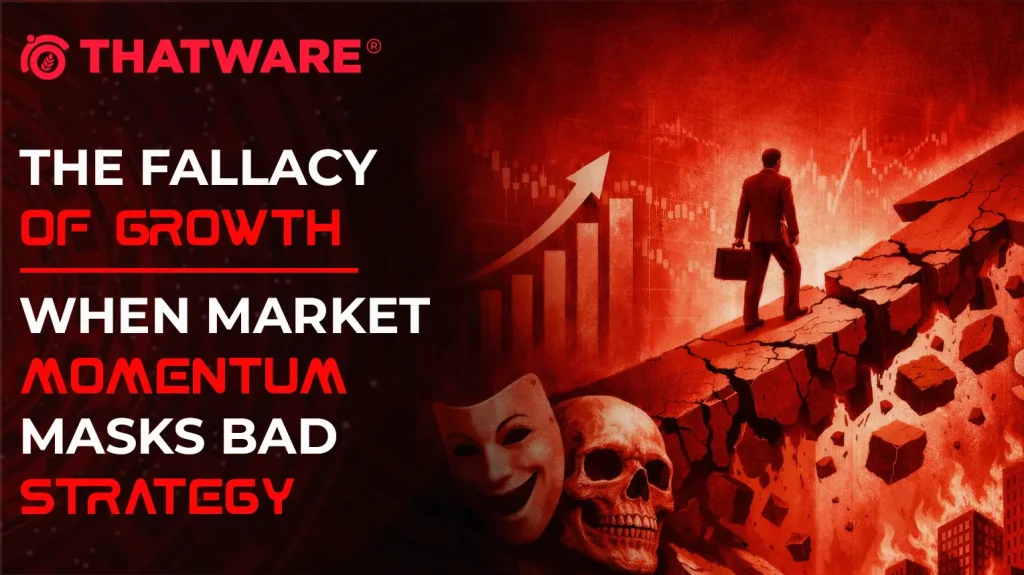
Momentum has a particular magic: it turns motion into meaning.
When your user graph climbs like a rocket, it’s easy to believe the product is brilliant. When revenue doubles quarter over quarter, it’s tempting to assume the strategy is solid. When the internet makes you trend overnight, virality starts to feel like validation, like the world is nodding in agreement.
And from the outside, it’s hard to argue with momentum’s evidence:
- Rising users imply product-market fit.
- Exploding revenue charts imply sustainable demand.
- Viral adoption implies relevance—maybe even inevitability.
But here’s the uncomfortable truth: momentum can be real and still be misleading.
Growth often tells you what is happening, not why it’s happening—and certainly not whether it will keep happening once conditions change. A brand can go viral because it hit the right algorithm at the right time. A startup can scale because capital was cheap and customer acquisition was artificially easy. A tech giant can expand because network effects create gravity, not because it’s making consistently intelligent decisions.
In other words, the machine can keep moving even if the steering is broken.
That’s where the danger begins.
Growth creates confidence. It makes leaders feel like they’re seeing the future clearly. It makes teams feel like their instincts are correct. It makes investors feel like they’ve found the next unavoidable winner. Momentum turns uncertainty into certainty—without actually doing the work of reducing uncertainty.
And once confidence arrives, it brings a silent companion: complacency.
Confidence suppresses critical thinking because questioning feels unnecessary when numbers are speaking loudly. Why debate strategy when the market is applauding? Why slow down to examine flaws when speed itself seems to be the advantage? Why listen to internal skeptics when the outside world is rewarding you every day?
That’s the seduction of momentum: it doesn’t just boost your outcomes—it reshapes your perception.
It changes what you notice. It changes what you tolerate. It changes what you dismiss.
Under momentum, warning signs don’t feel like warnings. They feel like friction—small problems that success will eventually smooth out. Customer complaints become “edge cases.” Culture cracks become “growing pains.” Governance becomes a “later problem.” Ethics becomes “PR risk management.”
And that’s how virality becomes a liability: not because attention is bad, but because attention arrives faster than understanding. It scales the impact of your decisions long before you’ve proved those decisions are wise.
This is the core fallacy—the one that takes down companies, movements, and empires alike:
Market momentum can disguise strategic flaws, and the faster the growth, the harder those flaws are to detect.
Because rapid growth doesn’t just expand your business. It expands your blind spots.
It makes luck look like skill. It makes scale look like strength. It makes speed look like intelligence.
And by the time the momentum fades—as it always does—you’re left with the only thing that ever mattered:
Not how fast you moved. But whether you were moving in the right direction.
Momentum vs Intelligence: Defining the Difference
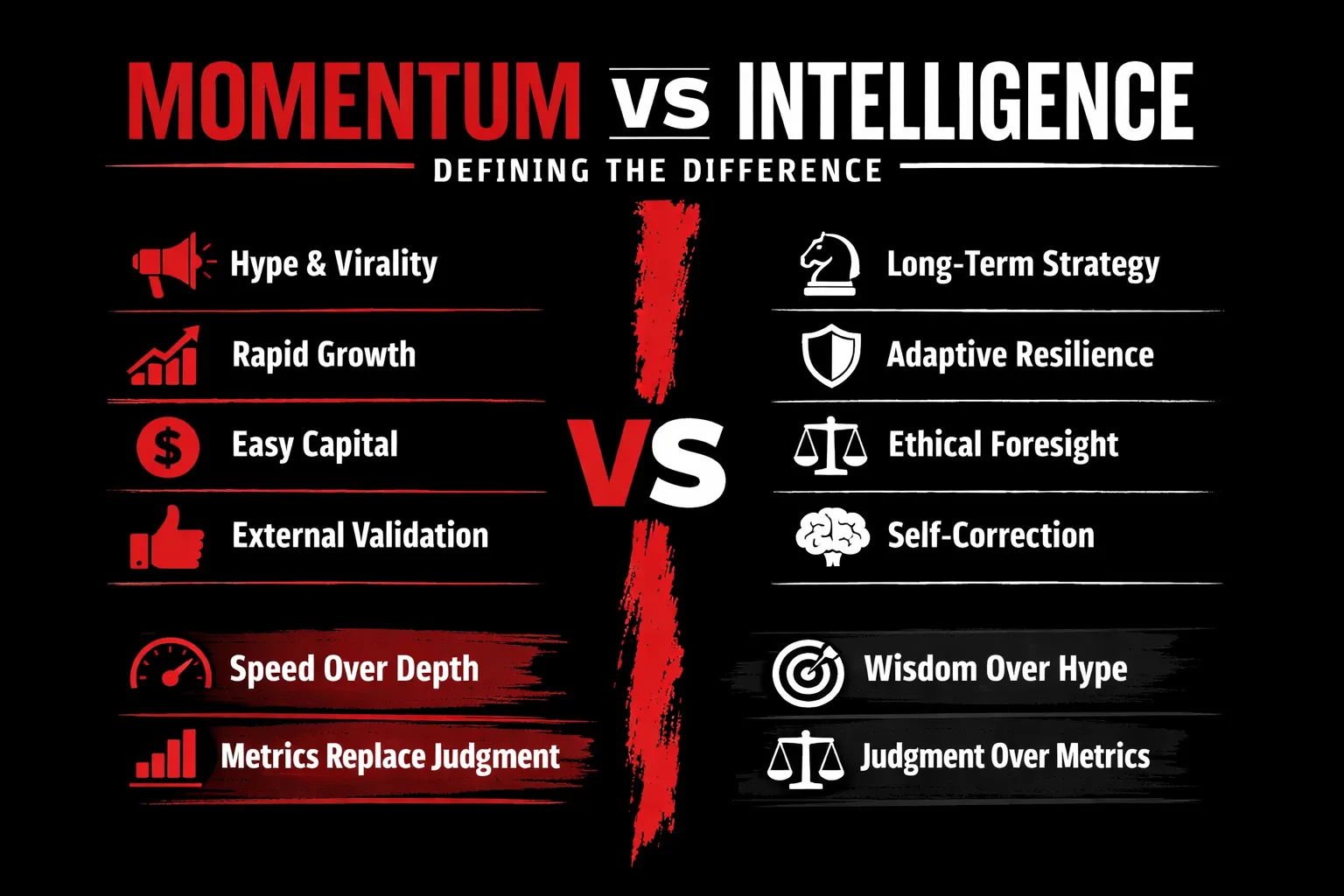
Before understanding how empires—corporate or civilizational—collapse, it’s essential to separate two forces that often appear identical in moments of success: momentum and intelligence. They can coexist for a time, but they are not the same. Confusing one for the other is where decline quietly begins.
What Market Momentum Really Is
Market momentum is movement with approval. It is the visible acceleration of growth that signals success to the outside world—but says very little about the quality of the underlying decisions.
Momentum is typically driven by short-term forces:
- Hype cycles that inflate expectations faster than fundamentals can keep up
- Network effects that reward early dominance regardless of long-term sustainability
- Easy capital that postpones hard strategic trade-offs
- Media amplification that turns popularity into perceived inevitability
These forces create speed, not wisdom. Momentum thrives on repetition, not reflection. The more something appears to work, the less it is questioned.
Crucially, momentum is externally validated. It is measured through likes, user counts, market share, and soaring valuations. These signals are seductive because they are public, quantifiable, and immediately rewarding. But external validation does not confirm internal coherence. A system can grow rapidly while becoming structurally weaker, ethically compromised, or strategically brittle.
Momentum answers one question extremely well: How fast are we moving?
It answers very little about where we are going—or whether we should be going there at all.
What Strategic Intelligence Looks Like
Strategic intelligence is quieter, slower, and far less glamorous. It does not always show up in quarterly reports, and it rarely trends on social media. Yet it is the difference between expansion and endurance.
At its core, strategic intelligence is the capacity to think beyond current success. It is defined by:
- Long-term adaptability – the ability to evolve as conditions change, not just scale what currently works
- Structural resilience – systems designed to absorb stress, failure, and uncertainty without breaking
- Ethical foresight – understanding second- and third-order consequences before they become crises
- The ability to self-correct under pressure – especially when correction threatens short-term growth
Intelligence values learning over acceleration. It recognizes that dominance today can become fragility tomorrow if it is not continually re-examined. Unlike momentum, intelligence is internally generated. It depends on honest feedback, dissenting voices, and leadership willing to trade speed for clarity.
Where momentum amplifies success, intelligence interrogates it.
The Dangerous Overlap
The real danger emerges when momentum begins to masquerade as intelligence.
This happens gradually, almost invisibly:
- When metrics replace understanding, and rising numbers are treated as proof of sound judgment
- When dashboards replace human judgment, and leaders trust abstractions more than lived realities
- When speed becomes the strategy, and slowing down is perceived as failure
In this overlap, decision-making becomes reactive rather than reflective. Organizations stop asking why things work and focus only on ensuring they continue to work—at least on paper. Growth becomes the justification for itself.
This is the inflection point where empires stop learning. Momentum silences curiosity. Intelligence is crowded out by urgency. And by the time the cracks appear, they are no longer isolated flaws—they are systemic.
History shows this pattern repeatedly: collapse does not begin when growth ends. It begins when growth convinces leaders that thinking is no longer necessary.
The Growth Fallacy: Why Expansion Is Mistaken for Success
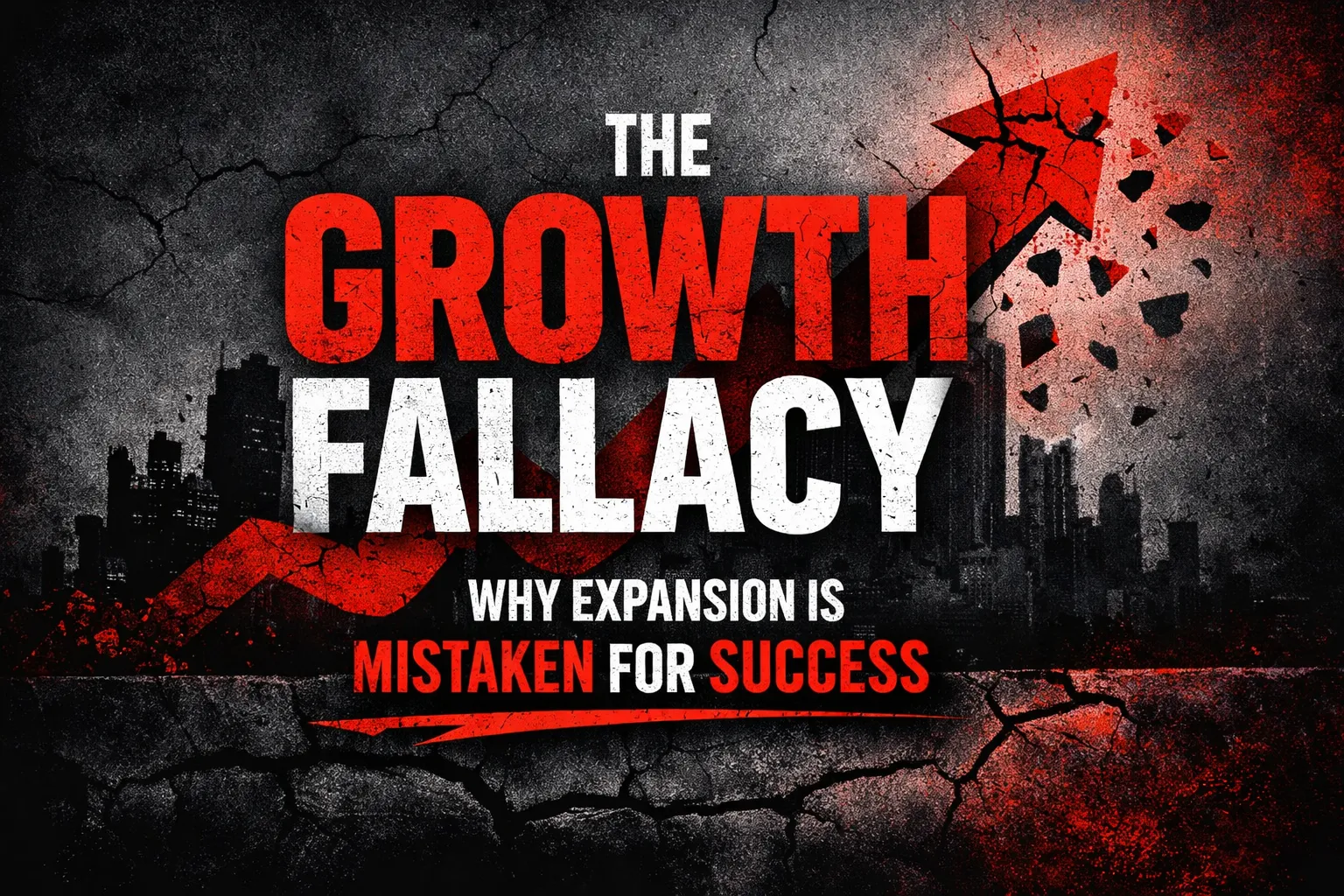
Growth has become the most persuasive storyteller in modern business. Rising charts, swelling user bases, and expanding markets create a powerful narrative of progress. But growth, by itself, answers only one question: “How fast?” It says nothing about “How well?” Speed can indicate demand, but it does not guarantee durability, wisdom, or even correctness.
This is the core illusion at the heart of the growth fallacy. Expansion feels like validation, so it often replaces evaluation.
One of the most common assumptions is deceptively simple: if it’s growing, it must be right. The market appears to be voting with its feet, and leaders interpret momentum as proof of sound strategy. Yet history repeatedly shows that markets are excellent at amplifying trends and terrible at assessing long-term consequences. Popularity measures attention, not alignment. Adoption reflects ease, not excellence.
Another deeply rooted belief is that scale will fix inefficiencies later. Early cracks—messy processes, unclear accountability, technical debt, ethical gray areas—are dismissed as “good problems to have.” The logic is seductive: once the company is big enough, it will have the resources, talent, and time to clean things up. In reality, scale does the opposite. It hardens inefficiencies into systems. What was once a manageable flaw becomes an institutional habit, expensive and politically difficult to remove.
Closely related is the assumption that governance can wait until dominance is secured. Rules slow things down, oversight complicates decisions, and restraint feels like surrender in competitive markets. So governance is postponed, ethics are minimized, and long-term risk is deferred. The problem is that dominance achieved without governance rarely creates control; it creates exposure. When scrutiny eventually arrives—regulatory, social, or internal—the organization discovers it has grown too large to steer and too fragile to adapt.
External forces reinforce this illusion. Venture capital rewards rapid expansion because its timelines are compressed and its incentives are asymmetric. Outsize growth promises outsize returns, while systemic risk can be externalized. Quarterly reporting adds another layer of distortion. Leaders are pushed to optimize for near-term metrics, often at the expense of long-term intelligence. Decisions that inflate short-term numbers are celebrated, even if they quietly undermine resilience.
The hidden costs of unchecked expansion accumulate slowly, then all at once.
Infrastructure becomes fragile because it was built for speed, not stress. Systems designed to support early growth buckle under sustained scale, creating outages, quality erosion, and operational chaos.
Culture decays as headcount grows faster than shared values. Early clarity dissolves into ambiguity, and cohesion gives way to internal silos. What once felt mission-driven becomes performative.
Most dangerously, strategic blindness sets in. Momentum dulls curiosity. Warning signals are reinterpreted as noise. Leaders become insulated by success, surrounded by metrics that confirm motion but obscure meaning. The organization keeps moving, but it stops learning.
This is how expansion becomes a substitute for strategy—and why momentum, when mistaken for intelligence, carries the seeds of its own collapse.
When Virality Becomes a Liability

Virality is often celebrated as proof of relevance. Products trend, platforms explode in user count, and narratives form around “winning the internet.” But virality is not neutral. It is an accelerant—and accelerants don’t discriminate between good ideas and dangerous ones. When growth is driven by virality rather than understanding, momentum begins to outpace intelligence.
This is where modern empires start making irreversible mistakes.
Virality as Accelerated Feedback Loops
Most digital systems today are governed by algorithms that reward engagement, not insight. Clicks, shares, watch time, and reactions become the proxy for value. The problem is simple: engagement measures intensity, not quality. Outrage spreads faster than nuance. Simplicity outperforms accuracy. Emotional resonance beats long-term truth.
As a result, virality creates a distorted feedback loop. What spreads is assumed to be what works. What works is assumed to be what’s right. And what’s right becomes unquestionable—until it breaks.
Fast adoption also suppresses internal resistance. When a product or feature is growing rapidly, dissent is reframed as obstruction. Engineers raising ethical flags, researchers questioning long-term impact, or managers pointing out structural risks are often dismissed as pessimistic or “not aligned with the growth mindset.” In high-momentum environments, criticism is interpreted as betrayal.
Over time, this creates a cultural filter: voices that amplify growth are promoted, while voices that question it are marginalized. The organization stops learning, even as it accelerates.
Scale Without Wisdom
Virality pushes platforms to scale faster than their capacity to understand the consequences of that scale. User bases multiply, influence expands, and systems become deeply embedded in society—often before governance structures are mature enough to handle the responsibility.
Many tech platforms reach global scale long before they can effectively:
- Moderate harm at volume
- Govern complex, diverse user behavior
- Understand second- and third-order social effects
The result is not neutral growth, but unmanaged power.
As scale increases, innovation quietly shifts its meaning. Instead of asking “What should we build?”, organizations ask “How do we optimize what already works?” Creativity gives way to efficiency. Exploration is replaced by A/B testing. Vision narrows into optimization funnels.
This is how platforms become very good at maximizing engagement while remaining dangerously underdeveloped in judgment. Growth continues, but wisdom does not.
The Irreversibility Problem
One of the most underestimated risks of virality is irreversibility. Decisions made during periods of explosive growth are rarely designed to be undone. Architecture choices, incentive structures, algorithmic priorities, and cultural norms get locked in while the system is still unstable.
When flaws are discovered later, the cost of reversal is enormous. Changing course risks alienating users, angering investors, or collapsing revenue streams. What could have been corrected early becomes politically, financially, or technically impossible to fix.
At scale, even small design flaws become systemic. A minor bias becomes a global distortion. A short-term growth hack becomes a long-term societal problem. What began as momentum hardens into structure.
This is the final danger of virality: it doesn’t just spread ideas quickly—it freezes them in place before they’re fully understood.
When momentum is mistaken for intelligence, speed replaces reflection and scale replaces wisdom. Virality feels like validation, but without restraint, it becomes the very force that ensures decline.
Case Patterns: How Empires Actually Decline
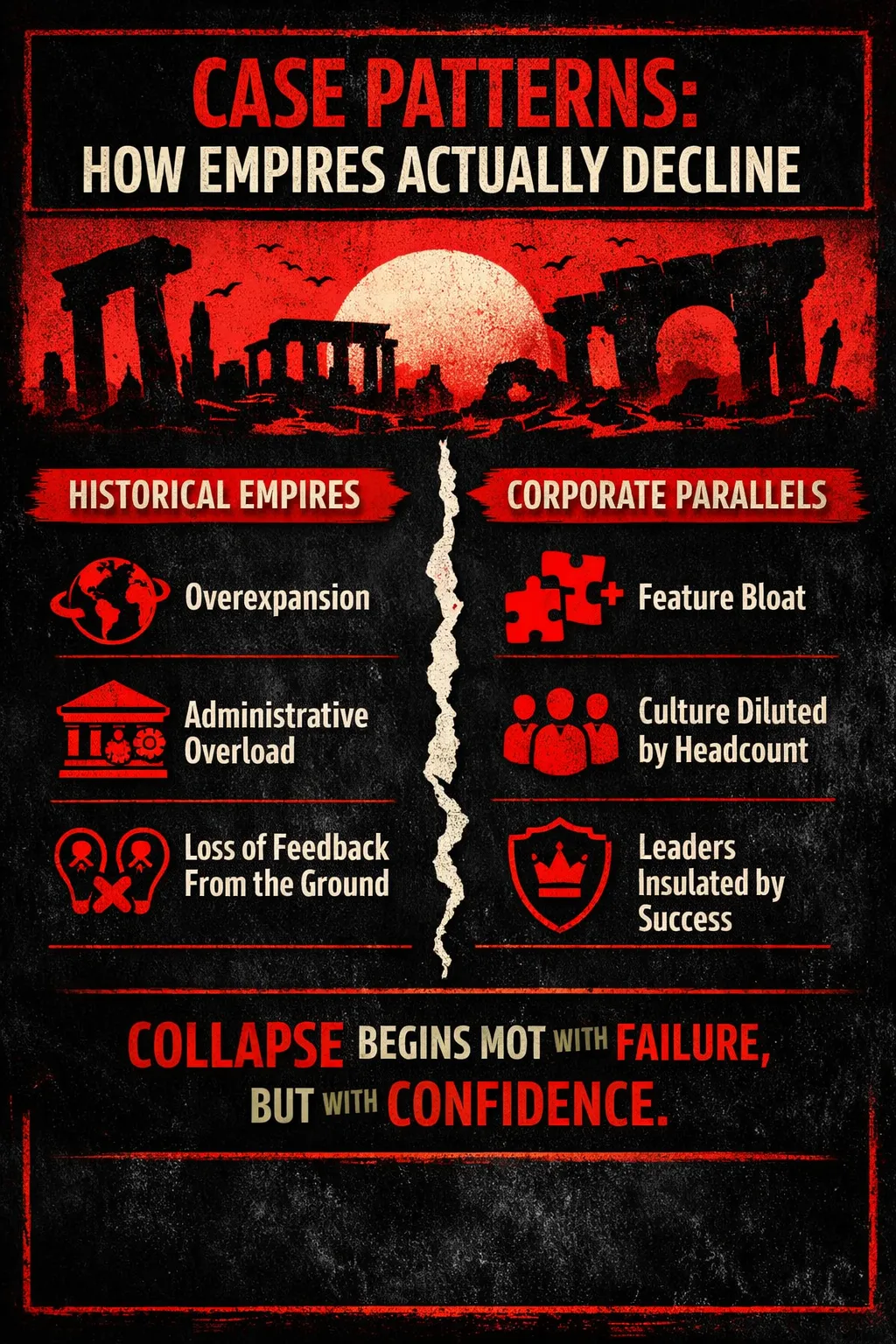
Empires—whether political, economic, or technological—almost never collapse because of a single catastrophic mistake. They decline through repeating patterns, visible across centuries and industries. The context changes, the tools evolve, but the underlying dynamics remain eerily consistent. Decline is not sudden; it is procedural.
Historical Empires: The Anatomy of Overreach
Overexpansion is often the first warning sign. At their peak, empires mistake territorial or economic reach for strength. Expansion accelerates faster than the systems designed to support it. Borders stretch, supply lines thin, and governance becomes reactive rather than deliberate. What once felt like dominance quietly becomes exposure.
This leads directly to administrative overload. As complexity increases, decision-making slows. Layers of bureaucracy multiply to manage growth, but those layers begin to obscure reality rather than clarify it. Policies become generic, enforcement uneven, and local nuance disappears. The empire is technically powerful, yet practically clumsy.
Most critically, empires suffer a loss of feedback from the ground. Leaders grow distant from citizens, soldiers, or provinces. Information is filtered upward to preserve appearances, not accuracy. Bad news arrives late—or not at all. When leaders finally recognize the depth of the problem, they are responding to a past that no longer exists.
Corporate Parallels: The Modern Empire
Modern corporations replay the same pattern in a different costume.
Feature bloat mirrors territorial overreach. Products expand rapidly to capture every possible user segment. Instead of solving problems better, companies solve more problems poorly. Complexity increases, clarity decreases, and users feel the weight of decisions made for growth rather than usefulness.
At the organizational level, culture diluted by headcount becomes inevitable. Rapid hiring prioritizes speed over alignment. Shared values fragment. What once felt like a mission becomes a set of slogans. Employees execute tasks but no longer understand why they matter.
Meanwhile, leaders become insulated by success. Metrics look strong, market share grows, and public perception reinforces confidence. Feedback becomes sanitized. Internal dissent is reframed as negativity. Decision-makers start believing their own narratives more than their data.
The Critical Insight: Confidence Is the First Cracks in the Foundation
Collapse rarely begins with visible failure. It begins with confidence that has stopped questioning itself.
When success becomes proof of intelligence, curiosity dies. When momentum feels self-sustaining, reflection feels unnecessary. By the time cracks appear externally—loss of trust, declining relevance, internal instability—the real damage has already been done internally.
Empires don’t fall because they lose power overnight.
They fall because they grow so certain of their power that they stop listening, stop learning, and stop thinking.
That moment—when confidence replaces comprehension—is where decline truly begins.
The Psychology Behind the Mistake
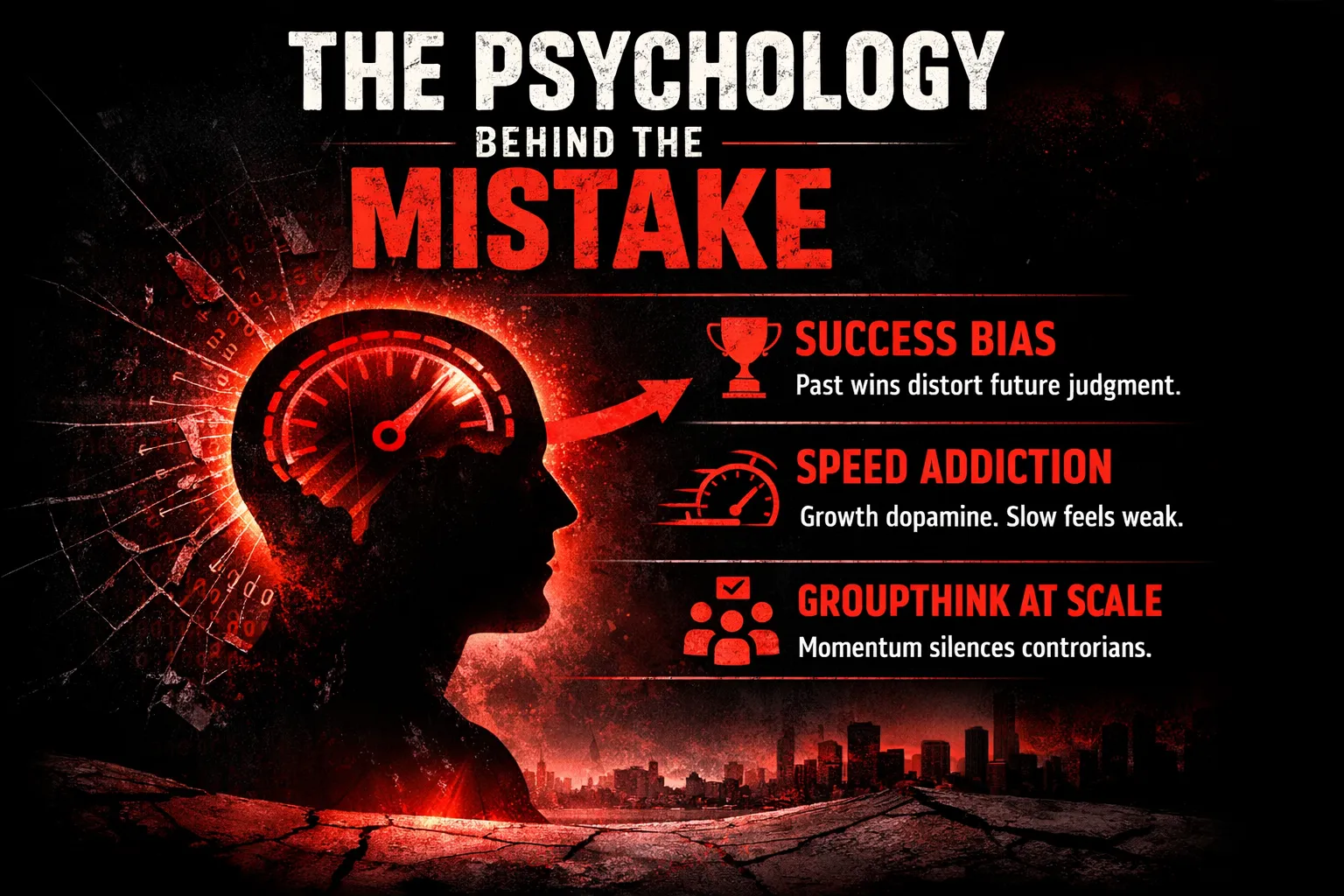
Why intelligent people, leading powerful organizations, still confuse momentum with intelligence
The most dangerous failures rarely come from ignorance. They come from misapplied intelligence—from smart people trusting the wrong signals for too long. When organizations collapse under the weight of their own momentum, it isn’t because leaders stopped thinking. It’s because human psychology quietly rewired how they think.
Success Bias: When Winning Becomes a Blindfold
Success bias is the tendency to overvalue past victories when making future decisions. It feels rational—after all, proven strategies worked. But this is exactly where the trap forms.
When leaders repeatedly win, they begin to treat success as evidence of correctness rather than context. The implicit belief becomes:
“If this strategy brought us here, it will take us forward.”
What gets ignored is that:
- Markets change faster than strategies
- Conditions that enabled early success rarely stay stable
- Repetition is mistaken for reliability
Over time, learning gives way to pattern-matching. Instead of asking “Is this still true?”, organizations ask “How can we scale this further?” Strategy turns into ritual. Intelligence becomes nostalgia.
Ironically, the smarter and more successful the organization, the stronger this bias becomes—because past success feels like data, not distortion.
Speed Addiction: The Dopamine Loop of Growth
Growth metrics are not neutral. They are neurological triggers.
Rising charts, expanding user bases, increasing engagement—all activate the brain’s reward system. Speed becomes emotionally reinforcing. Leaders don’t just like growth; they begin to need it.
This creates speed addiction:
- Fast decisions feel decisive
- Rapid expansion feels powerful
- Pauses feel like regression
In this mindset, slowness is reframed as weakness. Reflection becomes friction. Caution looks like fear. Anyone asking for more time is seen as “not getting it.”
But intelligence requires delay. Strategy needs space. Wisdom moves slower than momentum—and in speed-addicted systems, that makes wisdom feel obsolete.
Eventually, the organization isn’t optimizing for outcomes. It’s optimizing for the feeling of movement.
Groupthink at Scale: When Momentum Silences Truth
As organizations grow, so does the cost of dissent.
Momentum creates a powerful social signal: “This is working.” In high-growth environments, questioning direction feels almost unethical—like slowing down a winning machine.
Contrarians face subtle penalties:
- Being labeled “negative”
- Being excluded from decision loops
- Being told to “trust the vision”
At scale, optimism is rewarded more than accuracy. Leaders who reinforce confidence rise faster than those who introduce nuance. Over time, the system selects for agreement, not insight.
This is how smart organizations lose their intelligence:
- Feedback gets filtered
- Bad news arrives late—or never
- Reality is softened to preserve morale
By the time the truth becomes undeniable, it’s no longer manageable.
The Core Irony
The same psychological forces that enable rapid success—confidence, speed, unity—are the ones that later prevent correction.
Momentum doesn’t kill intelligence overnight. It crowds it out.
And by the time the organization realizes it’s no longer thinking clearly, it has already grown too large, too fast, and too committed to slow down.
That’s how empires fall—not because they lack smart people, but because their psychology stops letting those people think.
Warning Signs That Momentum Is Masking Bad Strategy
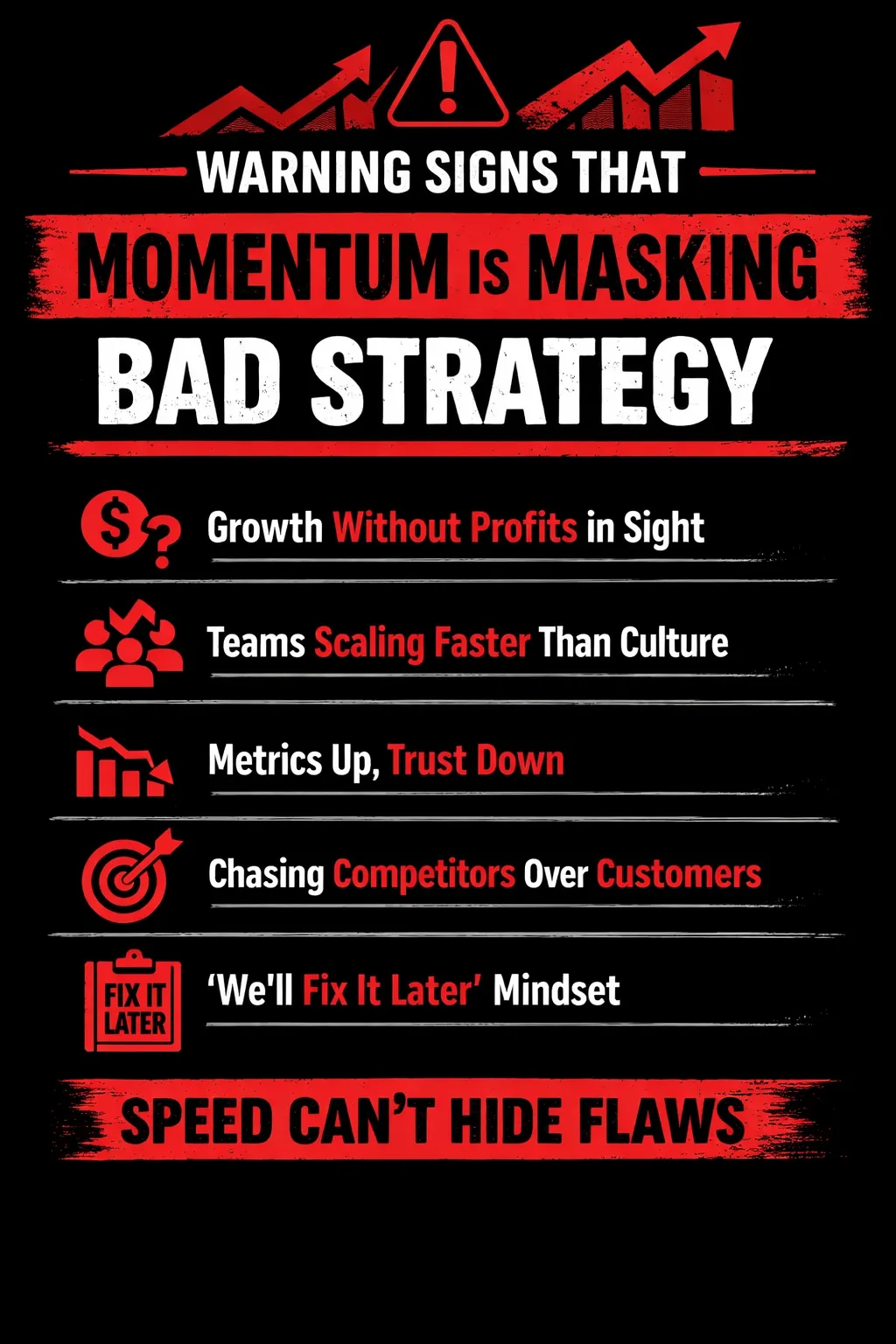
Momentum doesn’t announce itself as danger. It looks like success. That’s what makes it so effective at hiding strategic decay. By the time the warning signs feel obvious, the system is already too large, too fast, and too confident to change course easily.
What follows isn’t a checklist for failing companies. It’s a diagnostic for successful ones.
1. Growth Without Profitability Clarity
Revenue is rising, users are flooding in, valuations look impressive—but ask a simple question: Where does sustainable profit actually come from?
When growth outpaces understanding, profitability becomes an abstract future event rather than a designed outcome. Leaders reassure themselves with phrases like “monetization will come later” or “we’re prioritizing scale first.” Sometimes that’s valid. Often, it’s avoidance.
The danger isn’t operating at a loss. The danger is not knowing why the loss exists or when it should end. Momentum can keep the illusion alive long enough for the strategy to rot underneath.
2. Scaling Teams Faster Than Culture
Headcount is one of the most visible signs of momentum—and one of the most destructive when mismanaged.
Hiring rapidly without cultural integration creates an organization that looks large but thinks small. Shared values dilute. Institutional memory fragments. Decision-making slows while accountability evaporates.
Culture doesn’t scale automatically. It requires intentional design, reinforcement, and time. When teams grow faster than norms, momentum replaces alignment. People move, projects ship, meetings multiply—but no one is quite sure why things are done the way they are anymore.
That’s not growth. That’s entropy with payroll.
3. Metrics Increasing While Trust Decreases
Dashboards look healthy. Engagement is up. Usage is strong. Yet something more fragile is eroding—user trust, employee morale, public credibility.
Momentum-focused organizations often optimize what’s easy to measure and ignore what’s hard to quantify. Trust, however, is the invisible infrastructure of long-term success. Once it cracks, recovery is slow and expensive.
Rising numbers can coexist with declining belief. And when trust finally collapses, metrics usually follow—suddenly and without warning.
4. Roadmaps Driven by Competitors, Not Customers
When momentum takes over, attention shifts outward. Strategy becomes reactive. Roadmaps fill with features designed to match rivals rather than serve real needs.
The question quietly changes from “What problem are we solving?” to “What are they launching next?”
This is how companies lose identity. Differentiation erodes. Vision blurs. Instead of leading with insight, organizations chase momentum elsewhere, mistaking motion for progress.
A strategy that depends on competitors for direction has already surrendered its intelligence.
5. “We’ll Fix It Later” Becomes Policy
Every fast-growing organization accumulates technical debt, ethical shortcuts, and operational compromises. That’s normal. What isn’t normal is institutionalizing delay.
When “we’ll fix it later” becomes a standing justification, it signals a deeper issue: the belief that momentum will outpace consequences. But scale doesn’t erase problems—it amplifies them.
Later eventually arrives, usually in the form of crisis. And at scale, even small flaws become systemic failures.
Momentum can hide bad strategy longer than incompetence ever could. That’s why its warning signs are subtle, often dismissed, and frequently rationalized away. But intelligence shows up not in how fast an organization moves—only in how honestly it examines what that movement is building.
The most dangerous strategies don’t feel reckless. They feel unstoppable.
What Intelligent Growth Actually Looks Like
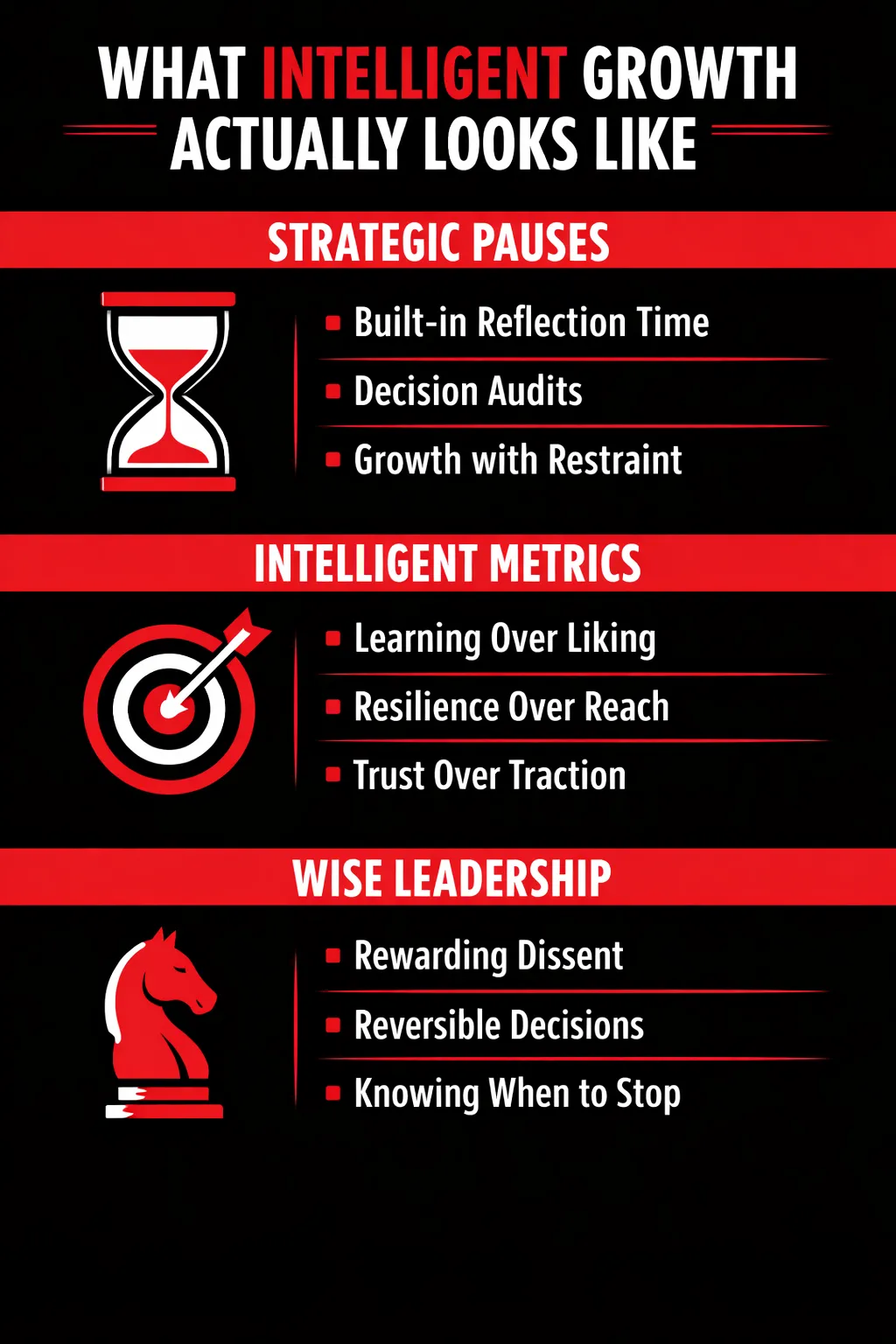
If momentum is the force that propels an empire forward, intelligence is what keeps it from running off a cliff. Intelligent growth does not reject expansion—but it refuses to let speed replace thinking. It treats growth as a question to be examined, not a verdict to be celebrated.
At its core, intelligent growth is deliberate. It is less concerned with how fast something spreads and more focused on what that spread is doing to the system underneath.
Strategic Pauses: Slowing Down to Think Better
The most counterintuitive move during rapid growth is to slow down on purpose.
Strategic pauses are not signs of weakness; they are acts of discipline. In high-momentum environments, every signal encourages acceleration—more users, more markets, more features. But without intentional slowdown, organizations lose the ability to reflect, learn, and correct.
Built-in slowdowns for reflection create space to ask uncomfortable questions:
- What assumptions are we making that no longer hold?
- Which decisions are being driven by fear of missing out rather than evidence?
- What problems are being postponed in the name of speed?
Alongside these pauses, decision audits during high-growth phases are critical. Instead of reviewing outcomes alone, intelligent organizations examine how decisions were made:
- Who had input?
- What data was ignored?
- Which risks were consciously accepted—and which were overlooked?
These audits prevent momentum from becoming automatic, ensuring growth remains a choice rather than a reflex.
Intelligence-Led Metrics: Measuring What Actually Matters
Momentum-driven systems obsess over visible metrics—users, clicks, revenue curves. Intelligent systems measure something deeper: understanding.
Learning velocity over user velocity shifts focus from how fast something grows to how fast an organization learns. A product gaining millions of users while repeating the same mistakes is not intelligent—it’s just loud. Learning velocity tracks:
- Speed of insight generation
- Quality of feedback loops
- Ability to adapt based on new information
Similarly, resilience over reach reframes success. Reach tells you how far you’ve spread; resilience tells you how well you’ll survive stress. Intelligent growth prioritizes:
- Systems that don’t collapse under pressure
- Teams that can operate without constant heroics
- Models that endure beyond favorable conditions
Finally, trust over traction recognizes that attention is fragile, but trust compounds. Traction can be bought, hacked, or engineered. Trust must be earned—and once lost, momentum cannot replace it. Organizations that measure trust track:
- User confidence
- Internal psychological safety
- Long-term reputation, not just short-term buzz
These metrics are quieter, harder to quantify, and slower to rise—but they predict longevity far better than explosive growth charts.
Leadership That Resists Momentum
No system grows intelligently without leaders willing to stand against the current.
Rewarding dissent is the first marker of such leadership. Intelligent leaders do not surround themselves with optimism; they cultivate challenge. They create environments where questioning growth narratives is not seen as disloyalty but as stewardship. Dissent becomes a signal of health, not friction.
Designing for reversibility is another critical discipline. Momentum encourages irreversible decisions—massive launches, permanent policies, all-in bets. Intelligent leaders ask instead:
- Can this be undone?
- What’s the cost of being wrong?
- How do we fail without collapsing?
Reversibility keeps power flexible and prevents early mistakes from hardening into systemic flaws.
Finally, there is the rarest skill of all: knowing when not to scale. Not every market should be entered. Not every feature should be built. Not every opportunity deserves pursuit. Intelligent leaders recognize that restraint is not missed opportunity—it is strategic clarity.
In a world obsessed with expansion, choosing not to scale is often the most intelligent growth decision available.
Intelligent growth doesn’t feel exciting in the moment.
It doesn’t spike charts or dominate headlines. But when momentum fades—as it always does—intelligence is what remains. And for empires that last, it’s the only thing that ever mattered.
The Final Collapse: Why Momentum Can’t Save You
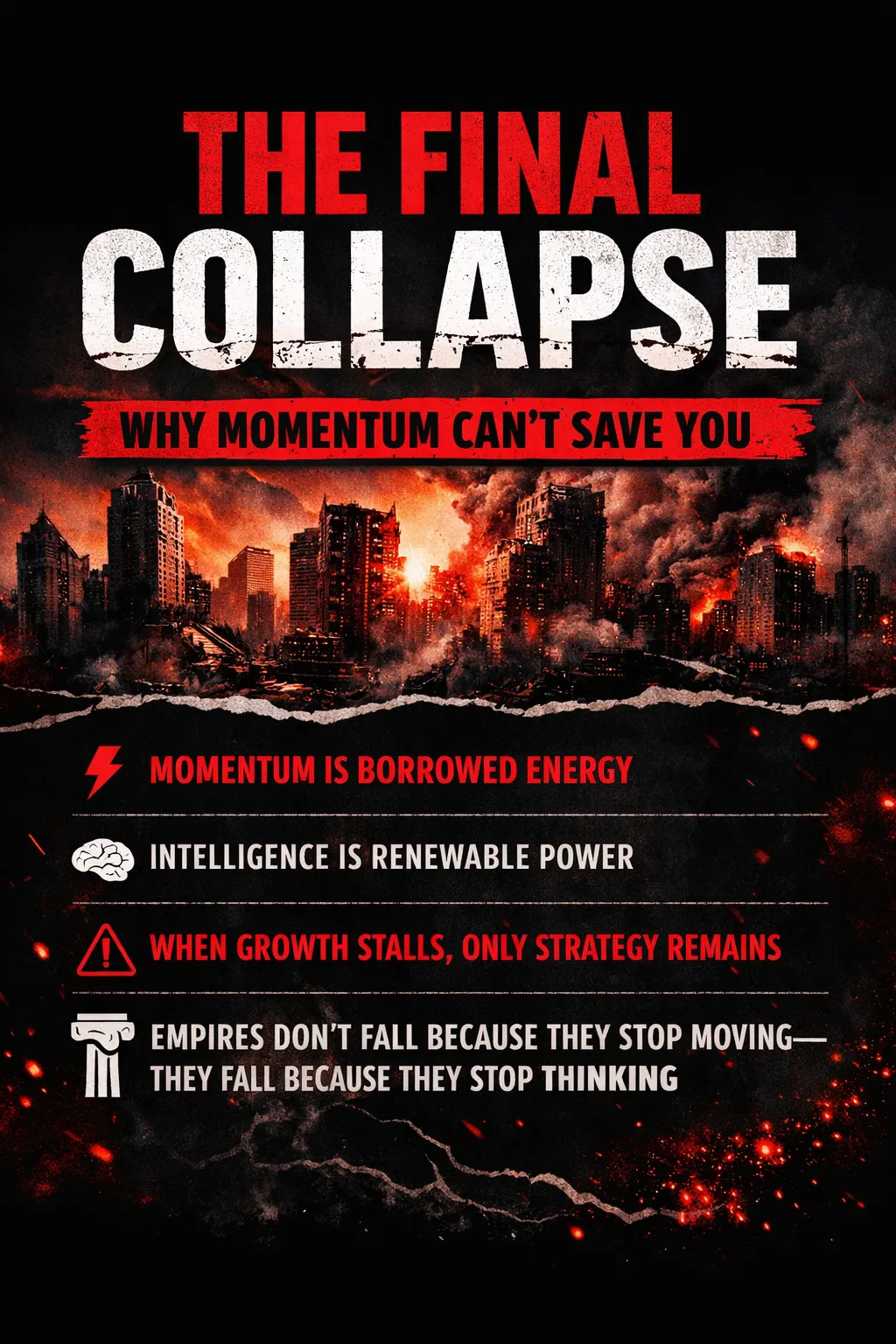
Momentum is not power.
It is borrowed energy—a temporary surge created by attention, capital, novelty, or fear of missing out. It feels unstoppable while it lasts, but it is never owned. It is rented, and the bill always comes due.
Empires at their peak rarely recognize this distinction. Growth charts rise, markets respond, applause grows louder. Movement becomes proof of correctness. Speed replaces scrutiny. The system keeps expanding, not because it is becoming wiser, but because nothing has yet forced it to stop.
But momentum is finite. It depends on conditions that eventually change—consumer behavior shifts, capital tightens, trust erodes, competitors adapt. When that happens, the illusion collapses. What remains is not the velocity of the past, but the quality of the thinking underneath it.
Intelligence, unlike momentum, is renewable. It does not depend on external validation. It comes from feedback loops, from reflection, from the willingness to question one’s own success. Intelligent systems evolve because they can pause, reassess, and correct course. Momentum-driven systems cannot. They only know how to move forward—faster—until forward is no longer an option.
This is why growth hides strategic weakness rather than fixing it. As long as numbers are rising, structural flaws are ignored. Fragile cultures are scaled. Poor incentives are amplified. Short-term wins crowd out long-term resilience. When growth finally stalls, leaders discover too late that speed was doing the thinking for them.
Empires do not fall because they stop moving. They fall because movement replaced thought.
When momentum fades, there is no algorithm, no marketing push, no acquisition that can compensate for the absence of strategy. Only intelligence can adapt to a new reality. Only thinking systems survive disruption. And those that confused acceleration with understanding find themselves powerful, massive—and suddenly helpless.
The final collapse is not dramatic. It is quiet. A series of reactive decisions. Missed signals. Overconfidence long after evidence demands humility. By the time decline becomes visible, the real failure has already happened: the empire stopped thinking when it should have been learning.
Momentum can build an empire. Only intelligence can sustain one.
Conclusion: Choosing Wisdom Over Speed
“Every empire falls when it mistakes momentum for intelligence.”
That warning isn’t poetic exaggeration—it’s a recurring pattern. Momentum is intoxicating. It feels like proof. It quiets doubt. It convinces leaders that movement itself is mastery. But history, business, and technology all tell the same story: speed can amplify direction, yet it cannot correct it.
Real success is not measured by how fast something grows, how loudly it trends, or how quickly it dominates a market. Those are surface signals. What matters is how deeply an organization understands what it is building—its impact, its limits, its second- and third-order consequences. Growth without understanding is not progress; it is acceleration toward an unknown destination.
The irony is that the moment of greatest danger is rarely visible as a crisis. It arrives at the peak—when metrics look flawless, confidence is high, and questioning feels unnecessary. Decline announces itself. Peak momentum disguises itself as inevitability.
Empires do not collapse because they slow down. They collapse because they stop thinking. And the ones that endure are not the fastest, but the most deliberate—those willing to trade speed for wisdom before momentum makes that choice for them.



