
SUPERCHARGE YOUR ONLINE VISIBILITY! CONTACT US AND LET’S ACHIEVE EXCELLENCE TOGETHER!
The rules of digital visibility are changing faster than most brands realize. For years, businesses built their online strategies around a familiar model: publish content, optimize pages, rank on search engines, and earn clicks. That model shaped the entire discipline of SEO. Success was measured by keyword positions, impressions, click-through rates, and traffic volumes. If your page appeared high enough in search results, you had a strong chance of winning attention.
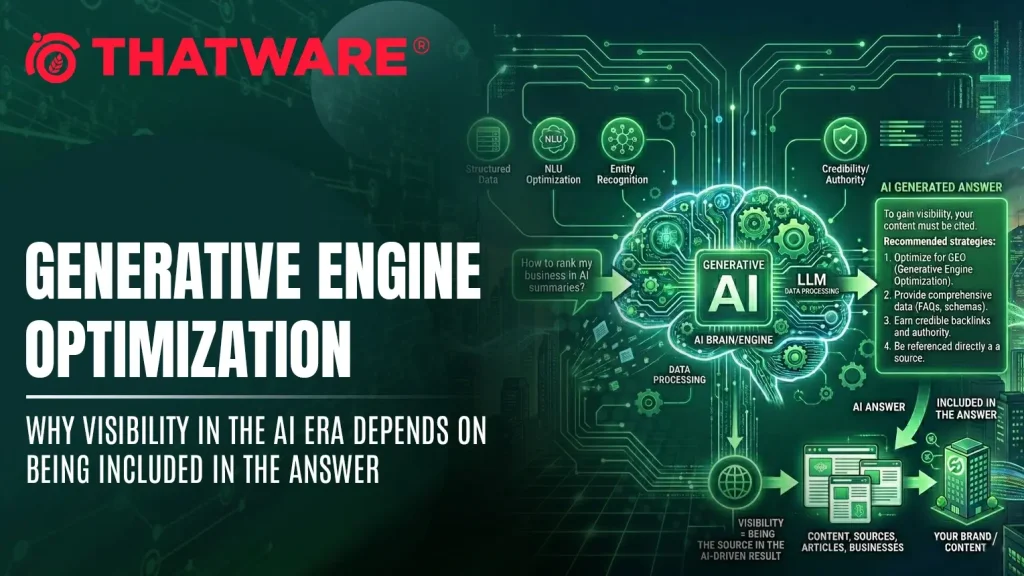
But the script for “Generative Engine Optimization – Visibility in the AI Era” highlights a major shift: search is no longer only about retrieving links. It is increasingly about generating answers.
This is a fundamental change, not a surface-level update. Instead of presenting users with a list of websites to compare, AI-driven systems now synthesize information from multiple sources and deliver a direct response. That means the old question — “Can you rank?” — is being replaced by a more strategic and urgent one: “Will AI include you in the response?”
That single shift has enormous consequences for brands, publishers, marketers, and businesses trying to remain discoverable online. The script captures that transformation scene by scene, and its significance goes far beyond a new marketing buzzword. It explains why Generative Engine Optimization (GEO) is emerging as one of the most important ideas in digital strategy.
The Evolution of Search: From Blue Links to Synthesized Answers
The opening scene of the script establishes the problem clearly. We begin with the classic search experience: a user types a query into Google, sees a page of blue links, scrolls, compares options, and clicks through to websites. This interface trained both users and marketers to think of search as a gateway. Search engines retrieved content, and websites provided the answer.
Then the script transitions into an AI-generated response that summarizes multiple websites into one answer. This visual change represents more than a design update. It reflects a deeper change in user behavior and information flow.
Users are increasingly interacting with search in a conversational way. Instead of entering short, fragmented phrases like “best SEO tools 2026” or “what is schema markup,” they are asking full questions such as, “How can my business stay visible when AI gives direct answers instead of links?” The expectation is not just discovery, but resolution. They want the answer immediately.
That changes the role of search engines. They are no longer functioning only as directories. They are now interpreters, summarizers, and answer generators.
This matters because the old SEO model assumed the user would still need to click. In the AI-first search model, the click may never happen. The answer itself becomes the destination. If your website informed the answer but your brand is not mentioned, then your visibility has been reduced, even if your page ranks well in traditional search.
This is one of the most important insights in the script. It shows that digital competition is no longer limited to ranking above competitors. Brands are now competing to become part of the knowledge layer that AI systems use to form responses.
What GEO Really Means
The second scene addresses a likely misconception: is Generative Engine Optimization just SEO rebranded?
The script says no, and that distinction is important.
Traditional SEO focuses on helping pages rank in search results. GEO focuses on helping content and brands become understandable, trustworthy, and extractable to AI systems so they can be included, cited, or referenced in generated answers.
That definition is powerful because it reframes visibility. In traditional SEO, visibility meant appearing on the results page. In GEO, visibility means being embedded inside the answer itself.
This is why the script states, “Citation is visibility.” In AI-generated environments, inclusion is the new equivalent of ranking.
The importance of this idea cannot be overstated. When an AI system answers a user’s question by synthesizing insights from multiple sources, the brands it references gain exposure, trust, and authority instantly. Those left out may be technically indexed and even highly ranked, but practically invisible within the user’s actual experience.
GEO, then, is not replacing SEO entirely. It is expanding the optimization challenge. Brands still need discoverability, crawlability, and content quality. But they now also need to optimize for AI comprehension and extraction.
The Hidden Risk: Ranking Without Being Mentioned
One of the strongest points in the script appears in Scene 3, where Dan realizes that even a number-one ranking may not guarantee brand visibility.
This is a profound shift in digital marketing logic.
For years, ranking at the top of search results was treated as the finish line. If you achieved that position, you were assumed to own attention. But in AI-generated search experiences, a top-ranking page may simply become one of many sources analyzed behind the scenes. The AI may pull the answer from your content, blend it with others, and present a final response that names different brands or no brand at all.
That creates a new kind of invisibility.
Your content may be useful, but if it is not structured in a way AI can confidently extract and attribute, you risk becoming a silent contributor rather than a visible authority. The script captures this with a sharp contrast: a website ranking number one on one side, and an AI summary citing three different brands on the other.
That image matters because it reveals how misleading old metrics can become. A brand may celebrate strong rankings while losing actual mindshare in AI-mediated discovery. Traffic could decline, branded recall could weaken, and competitors with stronger entity authority or better-structured content could dominate the answer layer.
The significance here is strategic: businesses can no longer assume that strong rankings automatically translate into strong visibility. GEO forces a brand to ask a more advanced question: When AI systems answer questions in my industry, am I recognized as a trusted source worth mentioning?
Why AI Understands Content Differently
Scene 4 explains the technical and conceptual foundation of GEO. AI systems do not read content the way human visitors do. Humans can interpret nuance, infer context from tone, tolerate ambiguity, and fill in missing information. AI systems, although sophisticated, depend on structured signals, semantic clarity, and explicit relationships to understand what content means.
The script identifies four core mechanisms:
- Natural Language Processing
- Entity recognition
- Context relationships
- Semantic relevance
These elements reveal why keyword stuffing and vague content no longer work effectively in the AI era.
AI does not merely scan for repeated phrases. It tries to identify meaning. It asks questions such as: Who is this brand? What does it do? What category does it belong to? What problems does it solve? How does this page relate to adjacent topics, products, services, or industry concepts?
This is where the script’s line about clarity and ambiguity becomes essential: clarity reduces ambiguity, and ambiguity reduces citation probability.
That is one of the most insightful ideas in the entire piece. If your content is too broad, too generic, too jargon-heavy, or too poorly organized, AI may struggle to classify it with confidence. And if the system lacks confidence, it becomes less likely to cite or reference your content.
In practical terms, this means brands need to communicate with much greater semantic precision. They need to define themselves clearly, explain their services in unambiguous terms, and show how their content fits into the broader conceptual map of their industry.
Why Structure Matters as Much as Quality
Scene 5 is especially relevant for content creators. Many marketers assume that high-quality long-form content is enough. The script challenges that assumption directly.
Quality remains important, but structure determines extractability.
This is a major idea in GEO. AI systems favor content that can be easily isolated, summarized, and reused in response generation. That means pages with:
- clear definition paragraphs
- concise summaries
- question-and-answer sections
- modular subsections
- logically grouped topics
perform better in AI extraction environments than dense, meandering blocks of text.
This does not mean content should become shallow. It means good content must be organized in a way that helps machines identify its key insights quickly and accurately.
The script’s warning is sharp and memorable: if AI cannot easily extract your insight, it will extract someone else’s.
That line captures the competitive reality of modern content strategy. The value of your expertise no longer depends only on whether you publish it. It also depends on whether your publishing format makes that expertise machine-legible.
This has enormous implications for blogs, service pages, case studies, and educational content. Brands need to think not only like writers, but also like information architects. Every page should guide both human readers and AI systems toward the same conclusion: this brand knows what it is talking about, and its content is easy to understand, trust, and cite.
Structured Data as a Translation Layer
Scene 6 brings in structured data, which plays a critical role in bridging human-readable content and machine understanding.
Schema markup is often treated as a technical SEO feature, something added mainly for search enhancements. But the script frames it in a more meaningful way: as a translation layer between your website and machine intelligence.
That framing is significant because it shifts structured data from optional enhancement to strategic necessity.
Schema helps identify what a piece of content is. Is it an article? A service page? An FAQ? An organization? A person? A product? It defines entities and relationships in a way that reduces confusion for machines parsing the page.
In the context of GEO, structured data matters because AI systems benefit from clarity. They need reliable cues about content type, brand identity, and topical relationships. Schema helps reduce interpretive uncertainty and improves the consistency of machine understanding.
This does not mean schema alone will make a brand visible in AI-generated answers. But it strengthens the foundational signals that support trust and comprehension. It is one piece of a larger ecosystem of machine clarity.
The script is correct to emphasize that clarity increases trust. In AI-driven systems, trust is rarely built from one signal alone. It emerges from the alignment of multiple signals: clean structure, semantic precision, consistent branding, authoritative mentions, and technical accessibility. Structured data supports that alignment.
Entity Authority and the Rise of the Knowledge Graph Mindset
Scene 7 may be the most conceptually important part of the script because it explains why entities and knowledge graphs are central to visibility in the AI era.
Traditional SEO often revolved around keywords. But AI systems increasingly operate through entities and relationships. That means they are not just matching terms; they are identifying real-world concepts and understanding how those concepts connect.
A brand is not merely a string of text. It is an entity. A service category is an entity. An industry concept is an entity. AI systems attempt to connect these pieces within a broader knowledge graph.
This is why the script says AI doesn’t think in keywords. It thinks in entities and relationships.
For a brand, this means visibility depends on whether AI can classify it confidently and consistently. Is your brand clearly associated with your domain of expertise? Is your positioning stable across your website and external mentions? Do your content clusters reinforce a coherent thematic identity?
If not, the AI system may struggle to map your brand accurately. And if it cannot classify you clearly, it cannot cite you confidently.
This is a profound strategic shift. Brands must stop thinking only in terms of ranking isolated pages and start thinking in terms of building a coherent digital identity. Their website, content architecture, definitions, author pages, service descriptions, and external references should all reinforce the same entity signals.
In other words, GEO requires a knowledge graph mindset. Your brand must not only publish content; it must exist as a clearly defined node in the digital ecosystem.
Authority Goes Beyond Your Website
Scene 8 expands the GEO conversation beyond owned media. This is crucial because many brands still assume optimization begins and ends on their website.
The script makes it clear that generative systems evaluate authority beyond your domain. They look at patterns across the wider web: topical depth, consistent mentions, contextual relevance, and reputation signals.
This reflects how trust works in both human and machine environments. A brand that only claims authority on its own site is less convincing than a brand whose expertise is reflected across industry articles, directories, citations, professional profiles, thought leadership pieces, and other third-party contexts.
Authority is cumulative. AI looks for corroboration.
This point is especially important for businesses trying to build brand visibility in competitive spaces. GEO is not just a content formatting exercise. It is also a reputation-building discipline. A brand must create enough reinforcing signals across the web that AI systems repeatedly encounter the same conclusions about who the brand is and why it matters.
That means public relations, digital branding, topical consistency, and off-site mentions matter even more than before. The web presence surrounding your brand becomes part of the evidence layer AI uses to assess credibility.
The significance of this cannot be ignored. In the AI era, your brand is not defined solely by what you say about yourself. It is defined by the total pattern of what the web says about you.
The Real Shift: Ranking Is Only the Entry Point
Scene 9 delivers the script’s core thesis in a sequence of clear, memorable lines:
- Ranking gets you crawled
- Semantic clarity gets you understood
- Structure gets you extracted
- Authority gets you trusted
- Trust gets you cited
This is the most complete summary of GEO in the entire script.
It shows that visibility is now a multi-stage process. Ranking still matters, but it is no longer the final objective. It is only the first gate. Once discovered, your content must still be interpreted, selected, and trusted by AI systems.
Each stage is dependent on the next.
If your content lacks clarity, AI may misunderstand it.
If it lacks structure, AI may fail to extract it.
If it lacks authority, AI may avoid citing it.
This layered model is what makes the script so valuable. It does not simply announce a trend. It provides a framework for understanding how AI-mediated visibility actually works.
This is the true significance of GEO. It gives brands a way to think strategically about discoverability in an environment where answers are generated, not merely retrieved.
Why the Closing Message Matters
The final scene concludes with a powerful insight: the future of search is not about appearing on a page. It is about being included in the answer.
That line captures the emotional and strategic truth of the AI era. The brands that win will not necessarily be those with the loudest content output or the most keyword pages. They will be the brands that are:
- structurally organized
- semantically precise
- technically accessible
- entity-defined
- authority-backed
This is not just advice for SEO specialists. It is a broader message for marketers, founders, content teams, and business leaders. Digital visibility is evolving into something more integrated and intelligent. Winning now requires collaboration between content strategy, technical SEO, branding, authority building, and information design.
The script succeeds because it translates a complex transformation into a clear narrative. Through Dan’s questions and ThatX’s analytical explanations, it shows that AI visibility is not accidental. It is engineered.
The Broader Significance of the Entire Script
Taken as a whole, the script is significant for three major reasons.
First, it explains a real transition in user behavior and search technology. The movement from link-based discovery to AI-generated answers is not hypothetical. It is already reshaping how users interact with information.
Second, it introduces GEO as a practical response to that shift. Rather than framing AI as a threat alone, the script shows that brands can adapt by becoming more understandable, structured, and authoritative.
Third, it changes the definition of success. In the old model, success meant ranking. In the new model, success means recognition inside machine-generated knowledge environments.
That is a much deeper challenge, but also a more meaningful one. It pushes brands to improve not just visibility tactics, but the actual clarity and integrity of their digital presence.
Final Thoughts
“Generative Engine Optimization – Visibility in the AI Era” is more than a script about a new marketing concept. It is a concise explanation of how online visibility is being redefined by AI.
Its central message is simple but transformative: ranking is no longer enough. To stay visible in the AI-first future, brands must become cite-worthy. They must be structured so machines can extract their insights, precise enough to be understood without confusion, and authoritative enough to be trusted across the wider web.
In this new environment, inclusion becomes the highest form of visibility.
That is why GEO matters. It is not just about optimizing for algorithms. It is about making your brand intelligible, credible, and indispensable within the systems that now shape how information is delivered.
The brands that understand this shift early will have an advantage. They will not just appear in search. They will become part of the answer.
And in the AI era, that is what real visibility looks like.



