
SUPERCHARGE YOUR ONLINE VISIBILITY! CONTACT US AND LET’S ACHIEVE EXCELLENCE TOGETHER!
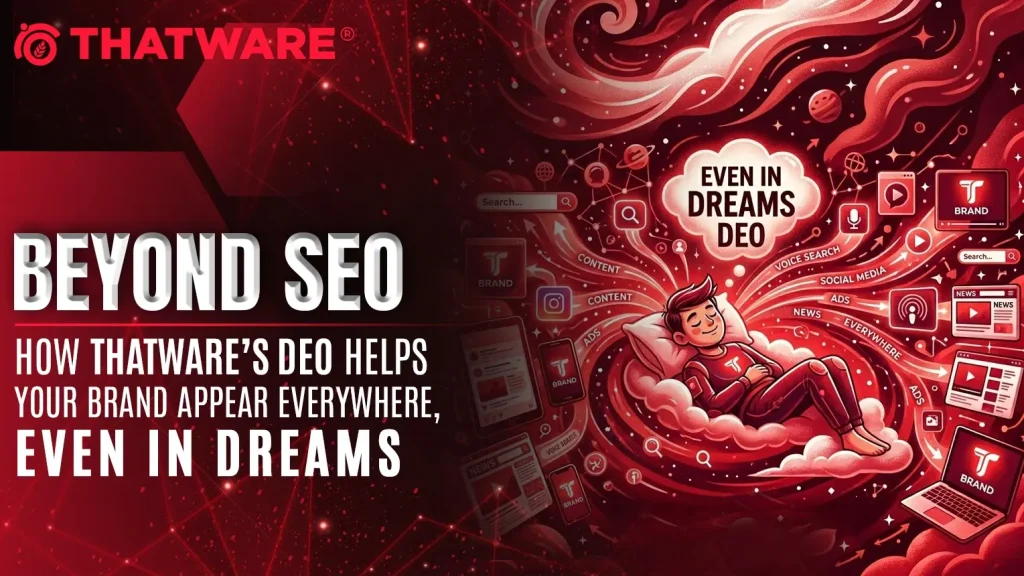
Imagine a world where your brand does not just appear on Google search results or in AI assistants like ChatGPT but also remains in the minds of your audience in ways they are not even consciously aware of. At ThatWare, we are pushing the boundaries of traditional SEO with our revolutionary Dream Engine Optimization (DEO). DEO goes beyond keywords, backlinks, and conventional ranking factors by combining AI-driven content optimization, semantic search techniques, and insights from cognitive science to influence both digital visibility and subconscious engagement. In this blog, we will explain what DEO is, why it is important in today’s AI-first landscape, and how our approach ensures your brand is discoverable across search engines, generative AI platforms, and in the subtle mental associations your customers form. This is the future of search optimization where your brand is not just found but also remembered.
What is Dream Engine Optimization (DEO)?
Definition and Core Concept
Dream Engine Optimization (DEO) is an advanced framework that extends the principles of traditional SEO into both AI-mediated search systems and subconscious cognitive engagement. Unlike conventional SEO, which primarily targets search engine ranking factors such as keywords, backlinks, and site architecture, DEO integrates semantic search methodologies, AI language model optimization, and neuromarketing-informed content strategies. The central premise of DEO is to ensure that a brand’s visibility is maximized not only across digital algorithms but also within the latent cognitive layers of the consumer’s mind. In essence, DEO seeks to create a dual-impact optimization: one that aligns with AI retrieval mechanisms and another that subtly influences memory encoding and brand recall at a subconscious level.
AI Search Optimization Layer
A critical component of DEO is the AI Search Optimization Layer, which focuses on enhancing discoverability across modern LLM-driven platforms, generative search engines, and answer retrieval systems. This involves leveraging semantic embeddings, entity recognition, knowledge graph integration, and structured data to ensure that content is interpretable by advanced AI systems. By aligning content with AI parsing mechanisms, DEO increases the likelihood that a brand is cited, referenced, or suggested in generative AI responses, digital assistants, and algorithmic recommendations. Techniques such as contextual relevance scoring, predictive intent mapping, and query pattern analysis are employed to ensure that brand content matches both explicit and latent user queries.
Cognitive Engagement Layer
Beyond AI, DEO incorporates a Cognitive Engagement Layer, which draws from neuromarketing and cognitive psychology. This layer focuses on embedding content with associative semantic triggers, emotional valence optimization, and attentional salience cues. These techniques are designed to increase the likelihood of subconscious recall, brand preference formation, and implicit decision-making influence. For example, priming mechanisms, where repeated exposure to specific semantic patterns increases recognition, can be integrated into content and visual assets. Additionally, affective computing insights allow for optimizing imagery, tone, and narrative structure to resonate with the target audience’s emotional and cognitive processing pathways.
Predictive Analytics and Behavioral Layer
The third component of DEO is the Predictive Analytics and Behavioral Layer. This layer utilizes machine learning algorithms, neural networks, and behavioral data modeling to forecast which content variations are most likely to generate subconscious engagement. Metrics such as dwell time, scroll depth, micro-interactions, and AI content citation frequency are analyzed to continuously refine optimization strategies. By applying reinforcement learning and A/B testing simulations, DEO ensures that content not only performs well in AI search environments but also reinforces latent brand associations within the consumer’s cognitive architecture.
Integration and Implementation
Implementing DEO requires a holistic integration of AI-SEO, cognitive science, and predictive analytics. Content must be structured to satisfy algorithmic parsing, semantic relevance, and cognitive salience simultaneously. This involves ontology-based content mapping, LLM-compliant formatting, and adaptive personalization strategies. The outcome is a multi-layered optimization framework that positions brands to achieve maximum visibility, higher engagement, and enhanced memorability.
Why DEO Matters
The Evolving AI Landscape
The digital search ecosystem is undergoing a profound transformation driven by artificial intelligence, large language models (LLMs), and generative search platforms. Traditional SEO strategies that focus solely on keywords, backlinks, and meta-optimization are no longer sufficient to achieve visibility in this AI-first environment. Platforms like Google’s AI-enhanced search, ChatGPT, Bing AI, and other generative agents interpret content semantically rather than literally, prioritizing contextual relevance, intent alignment, and information completeness.
In this landscape, Dream Engine Optimization (DEO) becomes critical because it ensures content is structured, semantically rich, and AI-compliant. By incorporating knowledge graph optimization, entity recognition, semantic embeddings, and AI-aligned content structuring, DEO allows brands to remain discoverable in a system where algorithms function as intermediaries between the user and the content. This ensures that brand messages are accurately interpreted, prioritized, and presented in AI-mediated responses, giving organizations a distinct advantage over competitors still relying on conventional SEO techniques.
Subconscious Influence and Cognitive Impact
One of the core differentiators of DEO is its focus on subconscious engagement, grounded in neuromarketing and cognitive science principles. Research in cognitive psychology demonstrates that pre-conscious exposure to stimuli significantly impacts memory encoding, recognition, and decision-making. By integrating these insights into content optimization, DEO enables brands to create content that is not only discoverable but also resonates at a latent cognitive level.
Techniques employed in this layer include:
- Priming: Strategically repeating semantic patterns and brand associations to increase recognition and recall.
- Affective content design: Leveraging emotional valence, narrative framing, and visual cues to stimulate engagement in both conscious and subconscious layers.
- Associative semantic networks: Embedding content within a broader cognitive schema, linking brand messaging with familiar concepts, experiences, or problem-solving pathways.
These approaches ensure that exposure to content, even if peripheral, enhances brand familiarity and trust, creating long-term cognitive and emotional resonance. In essence, DEO leverages predictive neuromarketing to optimize the pathways through which brands are internalized in consumer memory.
Competitive Advantage Through Integrated Optimization
Brands that adopt DEO gain a dual-layered competitive advantage: enhanced AI visibility and subconscious brand reinforcement.
1. AI Visibility: By optimizing content for LLMs, generative search engines, and answer retrieval systems, DEO ensures that brands are referenced and suggested in AI-generated responses, voice assistant queries, and recommendation engines. Techniques such as ontology-based content mapping, AI-friendly formatting, and semantic enrichment ensure alignment with AI retrieval protocols.
2. Cognitive Resonance: DEO extends beyond algorithmic optimization into consumer cognition, ensuring that content engages, influences, and remains memorable. This fosters brand loyalty, increased recall, and preference formation, which conventional SEO cannot achieve. Studies indicate that consumers exposed repeatedly to subtle brand cues exhibit higher conversion rates and stronger brand affinity, even without conscious awareness of the exposure.
The intersection of these layers positions DEO as a future-ready strategic framework. Brands that leverage this approach can outperform competitors by ensuring they are discoverable by both AI agents and human cognitive systems simultaneously.
Measurable Business Outcomes
DEO is not purely conceptual. Organizations implementing DEO strategies can track several quantifiable outcomes, including:
- Increased AI-driven visibility metrics: frequency of LLM citations, generative answer placements, and AI recommendation triggers.
- Higher engagement and attention scores: dwell time, scroll depth, click-through patterns, and micro-interaction data.
- Enhanced brand recall and recognition: measured through predictive modeling, survey proxies, and behavioral simulations.
By combining predictive analytics with cognitive modeling, DEO allows businesses to optimize strategies dynamically, refining content based on AI performance and subconscious engagement indicators. This ensures continuous improvement and sustained competitive advantage.
How ThatWare Approaches DEO
At ThatWare, we understand that the future of digital marketing extends far beyond traditional SEO and content optimization. With Dream Engine Optimization (DEO), we combine AI-driven search techniques, semantic optimization, neuromarketing principles, and predictive behavioral analytics to create a multi-layered approach that ensures your brand is not only discoverable by search engines but also resonates subconsciously with your audience. Our DEO methodology is designed to optimize content for AI search engines, generative platforms, and latent cognitive engagement, creating a comprehensive visibility framework that bridges algorithms and human perception.
AI Search Optimization Layer
The first layer of our DEO framework focuses on maximizing AI-mediated discoverability. Traditional SEO emphasizes keywords, backlinks, and page structure, but the AI-driven search ecosystem requires a more nuanced approach. We leverage Large Language Models (LLMs), AI knowledge graphs, and semantic retrieval systems to ensure your content is highly interpretable by modern search agents.
Key techniques include:
- Semantic Embedding Optimization: We structure content so that entities, concepts, and relationships are encoded in a way that AI models understand contextually, increasing the probability of being surfaced in generative answers or AI-driven recommendations.
- Knowledge Graph Integration: Our team maps brand content into knowledge graphs, ensuring that AI systems can associate your brand with relevant topics, questions, and industry concepts.
- LLM-Aligned Formatting: By adhering to AI parsing standards, structured markup, and hierarchical content formatting, we ensure your content is highly retrievable and citable by AI algorithms.
- Predictive Query Alignment: We analyze historical search patterns and AI model behavior to anticipate queries, aligning content semantics with both explicit and latent user intent.
Through these techniques, we ensure your brand appears consistently across AI-first discovery platforms, including ChatGPT, Google’s generative search features, and other AI-powered recommendation engines.
Cognitive Engagement Layer
DEO differentiates itself by incorporating subconscious cognitive influence into content optimization. At ThatWare, we apply neuromarketing principles, cognitive psychology insights, and affective design strategies to craft content that resonates on a pre-conscious level.
Our approach includes:
- Associative Semantic Anchoring: We embed brand-related concepts in content so that they activate associative networks in the reader’s mind, reinforcing memory encoding even when attention is peripheral.
- Emotional Valence Optimization: Using linguistic patterns, tone, and narrative framing, we design content that evokes positive emotional responses, enhancing brand attachment and recall.
- Attention Salience Design: Visual and textual cues are optimized for attentional capture, including color psychology, typography, and content hierarchy, ensuring that brand elements are subconsciously recognized.
- Priming Techniques: Repetition of thematic elements, keywords, and imagery primes the mind to recognize and prefer your brand during conscious decision-making.
By integrating these cognitive engagement strategies, we extend the impact of your content beyond immediate clicks and impressions, embedding your brand into the long-term mental schemas of your target audience.
Predictive Analytics and Behavioral Layer
The final layer of our DEO framework focuses on behavioral prediction and continuous optimization. At ThatWare, we use advanced machine learning, neural networks, and predictive modeling to determine which content structures, semantic cues, and visual elements are most likely to generate subconscious engagement and AI discoverability.
Techniques we employ include:
- Behavioral Data Modeling: Collecting and analyzing metrics such as dwell time, scroll depth, click patterns, and AI citation frequency to refine optimization strategies.
- Reinforcement Learning Simulations: Testing multiple content variations in AI-simulated environments to identify semantic structures and engagement patterns that yield the highest recall and AI visibility.
- Adaptive Personalization: Leveraging psychographic and behavioral insights, we dynamically adapt content to align with audience cognitive profiles, ensuring maximum impact across demographic and psychographic segments.
- Engagement Forecasting: Predictive models evaluate the long-term memorability and influence of content, enabling iterative improvements that optimize both AI and human impact.
This predictive layer allows us to continuously refine strategies, creating a feedback loop where content performance informs future semantic optimization, cognitive engagement, and AI alignment.
Implementation Methodology
Implementing DEO at ThatWare is a structured, multi-step process:
- Content and Semantic Mapping: We begin by mapping existing content into semantic frameworks and knowledge graphs, identifying opportunities for AI alignment and subconscious reinforcement.
- AI Optimization: Content is optimized for LLM retrieval, generative platforms, and AI algorithms using structured data, entity tagging, and semantic enrichment.
- Cognitive Embedding: Neuromarketing principles are applied to integrate emotional, associative, and attentional cues into the content.
- Predictive Simulation and Testing: Reinforcement learning models and behavioral simulations are used to identify optimal content variations.
- Continuous Analytics and Iteration: Performance is monitored using AI citation metrics, engagement scores, and predictive recall indicators, allowing for dynamic optimization over time.
Through this rigorous methodology, we ensure that DEO is not theoretical but actionable, measurable, and results-driven.
Benefits of Our DEO Approach
By integrating AI, cognitive science, and predictive analytics, our DEO framework delivers several key advantages:
- Enhanced AI discoverability: Ensures your brand is surfaced across generative platforms and AI agents.
- Subconscious brand reinforcement: Improves memory encoding, recall, and brand preference through cognitive priming.
- Predictive performance optimization: Continuously refines content strategies based on measurable behavioral and AI metrics.
- Future-ready scalability: Positions your brand to adapt to emerging AI platforms, voice search, and immersive media.
Our holistic DEO approach ensures that your brand achieves multi-dimensional visibility, from algorithmic discoverability to latent cognitive resonance.
DEO in Action
Dream Engine Optimization (DEO) is not merely a theoretical framework; at ThatWare, we implement it through practical, measurable strategies that demonstrate tangible results for our clients. By combining AI-driven search optimization, semantic structuring, neuromarketing principles, and predictive behavioral analytics, we ensure that your brand is discoverable across AI platforms and simultaneously leaves a lasting cognitive imprint on your target audience. In this section, we will explore how DEO functions in real-world scenarios, highlighting both its operational layers and the outcomes it drives.
AI-Driven Discoverability in Practice
The first dimension of DEO in action is ensuring maximum visibility across AI search engines, LLMs, and generative platforms. Brands today are not just competing for Google rankings but are increasingly subject to algorithmic selection by AI agents. These agents analyze content based on semantic relevance, intent alignment, and contextual richness, rather than just keyword density or backlinks.
At ThatWare, we apply semantic embedding strategies, knowledge graph integration, and AI-compliant formatting to optimize content for LLMs. For example, we structured a client’s content to align with AI-generated query contexts, ensuring that their brand appeared in ChatGPT responses, Bing AI answers, and Google AI-assisted snippets. Using entity-based mapping, we connected brand concepts with relevant topics and questions, which enabled AI models to understand and recommend the brand within generative responses.
Through predictive analysis of AI queries, we anticipate potential user questions and preemptively structure content to match AI interpretation patterns. This ensures that the brand is not only discovered but also positioned as authoritative and relevant, increasing the likelihood of being surfaced in AI-generated outputs.
Embedding Cognitive Engagement
While AI visibility is critical, DEO also emphasizes subconscious cognitive influence. At ThatWare, we integrate neuromarketing and cognitive psychology insights into every campaign to enhance memory encoding, brand recall, and implicit engagement.
Practical techniques include:
- Semantic Priming: By repeating core brand concepts across multiple content touchpoints, we increase latent familiarity in the audience’s mind. This ensures that when consumers make decisions, the brand is top-of-mind even if they have not consciously engaged with the content.
- Emotional Valence Optimization: Content is crafted to elicit positive emotional responses, using narrative framing, tonal modulation, and imagery designed to resonate subconsciously. This strengthens brand attachment and trust.
- Visual and Textual Salience: Strategic placement of attention-capturing cues, such as typography, iconography, and color psychology, ensures that brand elements are noticed and remembered.
Through these techniques, DEO transforms passive exposure into active subconscious engagement, reinforcing brand presence beyond conventional metrics like clicks and impressions.
Predictive Behavioral Analytics in Action
The final layer of DEO operationalization is predictive analytics and behavioral modeling. At ThatWare, we use machine learning algorithms, neural networks, and reinforcement learning simulations to identify content structures, semantic patterns, and visual cues that generate the highest engagement and recall.
Applications include:
- Behavioral Simulation: Before rolling out content, we simulate user interactions across multiple platforms to predict subconscious engagement outcomes.
- Micro-Interaction Analysis: Metrics such as dwell time, scroll depth, hover patterns, and micro-clicks are tracked to evaluate attention allocation and content effectiveness.
- Dynamic Personalization: Using psychographic and behavioral data, we adapt content in real-time to align with audience cognitive profiles, increasing resonance and recall probability.
- Predictive Performance Modeling: We forecast long-term brand impact by analyzing how repeated exposures and semantic associations influence decision-making over time.
This data-driven approach allows us to continuously refine content and optimization strategies, creating a self-improving DEO system that maximizes both AI visibility and cognitive influence.
Integrating DEO Across Channels
DEO is inherently multi-channel. At ThatWare, we ensure that optimized content permeates websites, social platforms, AI chat assistants, and generative AI systems simultaneously. By mapping semantic and emotional cues across all touchpoints, we create a consistent and reinforcing brand experience.
This integration allows a brand to:
- Maintain semantic consistency for AI interpretation.
- Reinforce associative memory cues in the audience’s subconscious.
- Enable cross-channel predictive optimization, ensuring that each interaction contributes to long-term brand resonance.
Measuring DEO Effectiveness
Effectiveness is measured through both quantitative and qualitative metrics:
- AI Visibility: frequency of LLM citations, generative search appearances, and AI recommendation placements.
- Behavioral Engagement: dwell time, scroll depth, click patterns, and micro-interactions.
- Subconscious Impact: measured through predictive modeling, brand recall surveys, and cognitive response simulations.
By tracking these metrics, we ensure that DEO is not speculative but actionable, with measurable results that validate both AI-first and cognitive-first optimization.
Why Choose ThatWare for DEO
In an era where AI-mediated search, generative platforms, and subconscious engagement are transforming digital marketing, organizations need a partner with expertise at the intersection of technology, cognitive science, and analytics. At ThatWare, we bring a unique, multi-dimensional approach to Dream Engine Optimization (DEO) that integrates AI-first SEO, neuromarketing principles, semantic optimization, and predictive analytics. We do not just optimize content for visibility; we ensure that brands achieve algorithmic prominence, subconscious resonance, and measurable business outcomes.
Proven Expertise in AI-Driven Optimization
Our team at ThatWare has extensive experience in AI search optimization (AISO), generative engine optimization (GEO), and LLM-aligned content strategies. Traditional SEO often relies on static ranking factors such as keywords, backlinks, and site architecture. DEO requires a dynamic, AI-aware strategy that aligns content with the way modern algorithms interpret semantic meaning, intent, and context.
We utilize advanced techniques including:
- Semantic embeddings and entity recognition: Ensuring content is comprehensible to AI systems and knowledge graphs.
- AI-friendly structuring: Optimizing content hierarchies, schema markup, and metadata for LLM interpretability.
- Predictive query alignment: Anticipating AI-generated queries and aligning content with probable semantic contexts.
By leveraging these capabilities, we ensure that your brand is discoverable not only in Google search results but also across generative AI platforms, virtual assistants, and knowledge-based recommendation systems.
Integrating Cognitive Science for Subconscious Engagement
DEO is more than AI optimization; it is a framework for influencing human cognition and decision-making. At ThatWare, we apply neuromarketing insights, cognitive psychology principles, and behavioral design techniques to enhance subconscious engagement with your brand.
Key strategies include:
- Priming and associative semantic networks: Embedding content that strengthens brand recognition and recall.
- Emotional valence optimization: Crafting narratives and visual elements that evoke positive emotional responses, increasing memory retention and brand affinity.
- Attention salience design: Employing visual and textual cues to capture attention and reinforce brand messaging subconsciously.
By combining algorithmic discoverability with cognitive resonance, our approach ensures your brand is remembered, preferred, and trusted, creating a long-term competitive advantage.
Data-Driven Predictive Analytics
A critical component of our DEO methodology is predictive behavioral analytics. We use machine learning models, neural networks, and reinforcement learning simulations to evaluate which content structures, semantic cues, and engagement techniques produce the highest impact.
Our predictive analytics capabilities include:
- Behavioral modeling: Tracking micro-interactions, dwell time, and engagement patterns to measure subconscious influence.
- Adaptive content personalization: Aligning content dynamically to audience psychographics and behavioral tendencies.
- Performance forecasting: Simulating the impact of content on AI discovery and cognitive engagement, enabling continuous optimization.
This ensures that our DEO strategies are iterative, evidence-based, and outcome-driven, giving clients measurable improvements in both AI visibility and brand recall.
Multi-Layered Implementation Framework
At ThatWare, DEO is implemented through a structured, multi-layered process:
- Content and Semantic Mapping: Structuring content to align with AI semantic models and cognitive schemas.
- AI Optimization: Ensuring content is AI-compliant, generative-engine friendly, and knowledge-graph ready.
- Cognitive Embedding: Integrating neuromarketing-driven emotional and associative cues to enhance subconscious engagement.
- Predictive Simulation and Refinement: Using AI simulations and behavioral modeling to refine content for optimal outcomes.
- Continuous Analytics and Iteration: Leveraging engagement data and AI metrics for ongoing optimization and adaptation.
This systematic approach ensures that DEO is not only effective but scalable, capable of evolving as AI platforms and consumer behavior continue to change.
Proven Track Record and Recognition
Our work at ThatWare has been recognized by 200+ elite global media outlets, including Forbes, TEDx, Clutch, BrightonSEO, GoodFirms, Entrepreneur, Manifest, and STEVIE’S Inventiva awards. These accolades reflect our expertise, innovation, and consistent delivery of measurable results.
Clients partnering with us have benefited from:
- Increased AI-generated content visibility.
- Higher subconscious brand recall and emotional engagement.
- Improved predictive performance of campaigns across digital channels.
- Strategic positioning for emerging AI platforms and generative technologies.
Our recognition demonstrates that we are not only thought leaders in DEO but also practitioners capable of delivering high-impact outcomes.
Future-Proofing Your Brand
The digital marketing ecosystem is rapidly evolving with AI-first search engines, voice assistants, augmented reality, and virtual environments. ThatWare’s DEO framework is designed to future-proof brands, ensuring that content remains discoverable, engaging, and memorable across emerging platforms and modalities.
Through DEO, we help brands:
- Anticipate AI interpretation trends and algorithmic changes.
- Embed cognitive and emotional cues for immersive engagement.
- Integrate data-driven behavioral insights into predictive content optimization.
This future-oriented approach ensures that our clients remain ahead of the competition, achieving long-term brand prominence and consumer engagement.
Measurable ROI and Business Outcomes
We design DEO campaigns with a focus on quantifiable results, bridging AI performance metrics with cognitive impact indicators. Key measurable outcomes include:
- AI Visibility: Frequency of AI citations, generative snippet appearances, and voice assistant references.
- Behavioral Engagement: Dwell time, micro-interactions, scroll depth, and conversion patterns.
- Cognitive Resonance: Brand recall, recognition, and implicit preference formation.
- Predictive Performance: Anticipated long-term engagement and brand loyalty based on behavioral simulations.
By tracking these metrics, we ensure that DEO investments are actionable, results-driven, and strategically aligned with long-term business goals.
Key DEO Techniques and Methodologies
Dream Engine Optimization (DEO) is a multi-dimensional framework that combines AI-driven search optimization, cognitive engagement, and predictive analytics to maximize visibility and subconscious impact. At ThatWare, we implement DEO using a systematic approach that integrates semantic SEO, LLM-compliant content, neuromarketing insights, and behavioral modeling. The following section outlines the key techniques and methodologies that form the foundation of our DEO strategy, demonstrating how each contributes to measurable outcomes.
1. Semantic SEO and Entity-Based Structuring
Semantic SEO is the cornerstone of DEO. Unlike traditional SEO, which relies heavily on keywords, semantic SEO focuses on conceptual relevance and contextual meaning. At ThatWare, we structure content around entities, topics, and semantic relationships, ensuring that both AI algorithms and human readers understand the depth and relevance of the content.
Key methodologies include:
- Entity Recognition: Identifying key concepts, brands, products, and services in content to establish semantic relationships.
- Topic Clustering: Organizing content into thematic clusters that enhance semantic authority and improve AI retrieval.
- Knowledge Graph Integration: Mapping entities into structured knowledge graphs to increase discoverability in AI-powered search results.
- Contextual Relevance Scoring: Ensuring that content aligns with both user intent and AI interpretation patterns.
By applying these techniques, we ensure that content is interpretable, relevant, and authoritative, positioning brands to be surfaced by LLMs, AI assistants, and generative search engines.
2. LLM-Compliant Content Optimization
Large Language Models (LLMs) like ChatGPT, Bard, and AI-enhanced Google search systems interpret content differently than traditional search engines. DEO requires that content be structured for machine comprehension, emphasizing clarity, hierarchy, and semantic richness.
Our LLM-focused methodologies include:
- Hierarchical Content Formatting: Using headings, subheadings, and bullet points to enhance readability for AI parsing.
- Schema Markup and Structured Data: Implementing JSON-LD, RDFa, and microdata to signal content type, entities, and relationships to AI.
- Contextual Prompt Alignment: Aligning content with predicted AI query patterns to ensure it is surfaced in generative responses.
- Embedding Semantic Vectors: Incorporating semantic embeddings to represent content meaningfully in AI vector spaces.
This ensures that your brand content is accurately interpreted, referenced, and recommended across AI-driven platforms, increasing discoverability in both direct searches and generative AI outputs.
3. Cognitive Priming and Subconscious Engagement
DEO goes beyond AI algorithms to influence human cognition at a subconscious level. At ThatWare, we apply neuromarketing principles and cognitive psychology insights to optimize content for memory encoding, recall, and brand preference.
Key methodologies include:
- Priming Techniques: Repeating core brand concepts, imagery, and phrases across multiple touchpoints to create latent familiarity.
- Emotional Valence Optimization: Crafting content that evokes positive emotions, reinforcing trust, attachment, and recall.
- Attention Salience Design: Using visual hierarchy, typography, color psychology, and micro-interactions to capture attention subconsciously.
- Associative Semantic Anchoring: Linking brand messages with related concepts, experiences, or problem-solving pathways in content.
These techniques ensure that audiences internalize brand messaging unconsciously, leading to stronger recognition, trust, and conversion potential over time.
4. Predictive Behavioral Analytics and Reinforcement Learning
DEO incorporates a predictive, data-driven layer that continuously refines strategies based on behavioral outcomes and AI interactions. We leverage machine learning, neural networks, and reinforcement learning to evaluate the effectiveness of content structures, semantic patterns, and cognitive cues.
Applications include:
- Behavioral Modeling: Tracking micro-interactions, dwell time, scroll depth, and engagement metrics to predict subconscious impact.
- Reinforcement Learning Simulations: Testing multiple content variations in simulated AI and user environments to identify optimal configurations.
- Adaptive Personalization: Dynamically tailoring content to audience psychographics, behavioral tendencies, and interaction patterns.
- Engagement Forecasting: Predicting long-term cognitive impact, brand recall, and conversion likelihood based on repeated exposure and semantic associations.
By incorporating predictive analytics, we ensure that DEO strategies adapt over time, continuously improving both AI visibility and cognitive resonance.
5. Multichannel Integration and Consistency
A key methodology of DEO is ensuring cross-channel consistency. Brand messages must be cohesive across websites, social media, AI platforms, and generative search engines.
Our approach includes:
- Semantic Consistency: Maintaining uniform entity definitions and thematic clusters across all channels.
- Cognitive Cue Reinforcement: Applying consistent priming, emotional valence, and attention salience across touchpoints.
- Platform-Specific Adaptation: Optimizing for AI search engines, voice assistants, chatbots, and emerging immersive platforms.
This multi-channel strategy ensures that each interaction reinforces brand presence, strengthening memory encoding and AI-driven discoverability simultaneously.
6. Continuous Monitoring and Iterative Refinement
DEO is not static. At ThatWare, we implement continuous monitoring and iterative refinement to ensure maximum performance.
Techniques include:
- Real-Time Analytics Dashboards: Monitoring AI citations, generative placements, engagement metrics, and cognitive response proxies.
- A/B and Multivariate Testing: Experimenting with semantic structures, narrative styles, and emotional cues to identify optimal configurations.
- Feedback Loops: Using AI performance and behavioral data to adjust content strategy, cognitive triggers, and semantic mapping.
- ROI Measurement: Linking engagement, recall, and conversion metrics to business objectives to validate DEO effectiveness.
This iterative methodology guarantees that DEO strategies remain adaptive, measurable, and continuously optimized for both AI-first and human-first outcomes.
Wrapping Up
Dream Engine Optimization (DEO) represents the next frontier in digital marketing, seamlessly integrating AI-driven search optimization, semantic intelligence, neuromarketing, and predictive behavioral analytics to deliver unparalleled brand visibility and cognitive impact. At ThatWare, we leverage a multi-layered approach that ensures your brand is discoverable across AI platforms, memorable in the subconscious minds of your audience, and measurably effective in driving engagement, recall, and conversions. By combining advanced technologies, human-centered design, and data-driven iteration, DEO positions your brand for sustained competitive advantage in an AI-first, ever-evolving digital landscape, ensuring that your messaging resonates both algorithmically and psychologically, now and in the future.