
SUPERCHARGE YOUR ONLINE VISIBILITY! CONTACT US AND LET’S ACHIEVE EXCELLENCE TOGETHER!
The Illusion of “Affordable Growth”
There’s a moment most founders and early-stage marketing leaders hit sooner or later: ads are getting expensive, referrals feel unpredictable, and everyone keeps saying the same thing—“You need SEO.” And SEO sounds perfect on paper. No daily spend. No bidding wars. Just steady, compounding traffic that shows up month after month.
So the logic kicks in.
“Let’s test it cheaply first.”
It feels responsible—almost disciplined. Why commit big money to something uncertain when you can hire an agency at a fraction of the cost, publish a few blogs, build some links, and see what happens?
That mindset isn’t wrong. It’s rational. But it’s based on an assumption that silently destroys brands.
Because cheap SEO doesn’t behave like a low-risk experiment. It behaves like a slow leak in your reputation—one that only shows up when your best prospects stop trusting what they see.
1) Why Cheap SEO Feels Like a Smart Decision at First
Startups are trained to move fast and validate fast. We’re conditioned to run small bets. Whether it’s product features, ad creatives, landing pages, or pricing tests, the default playbook is: try small, scale what works.
So when SEO enters the conversation, it gets treated like another test channel.
- A few blogs
- Some keyword optimizations
- A backlink package
- A monthly report with rankings
That’s all it seems to require. And compared to paid acquisition, it feels almost harmless. Ads have a clear cost per click. SEO appears to have no click cost at all. People even call it “free traffic,” which makes it sound like the only risk is wasting a little time.
But SEO isn’t like running a ₹50,000 Facebook test.
With ads, you can stop spending and the damage stops immediately. With SEO, you publish assets that live on your site, build signals that attach to your domain, and create an online footprint that doesn’t disappear just because you cancelled a retainer.
And that’s where founders underestimate what’s really happening.
SEO is not a set-and-forget channel. It’s a long-term reputation system. It compounds—in both directions.
If you do it well, trust compounds. If you do it cheaply, the wrong signals compound.
2) The Hidden Assumption No One Questions
The reason low-cost SEO sells so easily is that it leans on a few assumptions many buyers already believe:
- “SEO is just keywords and backlinks.”
As if the entire discipline is a checklist: add a keyword, insert internal links, get some backlinks, and rankings appear.
- “All agencies do the same thing.”
Most SEO proposals look identical—audits, on-page optimization, content, links, reporting—so price becomes the deciding factor.
- “Results = rankings, not reputation.”
Ranking reports feel measurable. Brand perception feels abstract. So teams optimize what they can track—even when it’s the wrong outcome.
And then comes the most dangerous assumption:
Cheap SEO = lower risk.
The thinking goes: “Worst case, it doesn’t work, and we stop.”
But that’s not the worst case.
The worst case is it works just enough to put your content in front of buyers—while making you look untrustworthy.
Because low-cost SEO doesn’t just fail quietly. It often succeeds loudly in the wrong way: by creating a large volume of mediocre pages, questionable links, and generic messaging that tells Google—and your buyers—that your brand is not serious.
When your company is small, credibility is everything. Cheap SEO attacks credibility at the source.
3) The Reality: SEO Touches Every Public Signal of Your Brand
Here’s the shift most teams need to make:
Google isn’t just a traffic engine. It’s a trust engine.
People don’t use search only to discover new tools. They use it to validate whether you’re real, reliable, and worth paying attention to. Your prospects will Google you before a call. Partners will Google you before a meeting. Candidates will Google you before accepting an offer. Investors will Google you before they take you seriously.
And what they see isn’t just your homepage.
They see:
- your blog titles and topics
- the depth (or shallowness) of your content
- your meta descriptions and the way you position yourself
- the quality of the sources linking to you
- the queries you show up for
- how consistent your message is across pages
That’s why SEO doesn’t sit in a marketing silo. It bleeds into every high-stakes perception moment:
- First impressions: Are you a brand with authority—or a brand chasing traffic?
- Brand credibility: Do you sound like an expert—or like an outsourced content farm?
- Sales conversations: Are prospects pre-sold—or skeptical before they even talk to you?
- Investor perception: Do you look like a mature business—or like you’re playing growth theatre?
This is why great SEO resembles digital PR at scale. It shapes the narrative the market sees when they’re forming opinions. Every page becomes a public statement. Every ranking becomes a public endorsement.
And that’s exactly why cheap SEO is so expensive.
Because when SEO is done poorly, you’re not just “not ranking.”
You’re broadcasting signals that quietly reduce trust—without realizing it—until your best customers start choosing someone else.
What “Cheap SEO” Actually Means Behind the Scenes
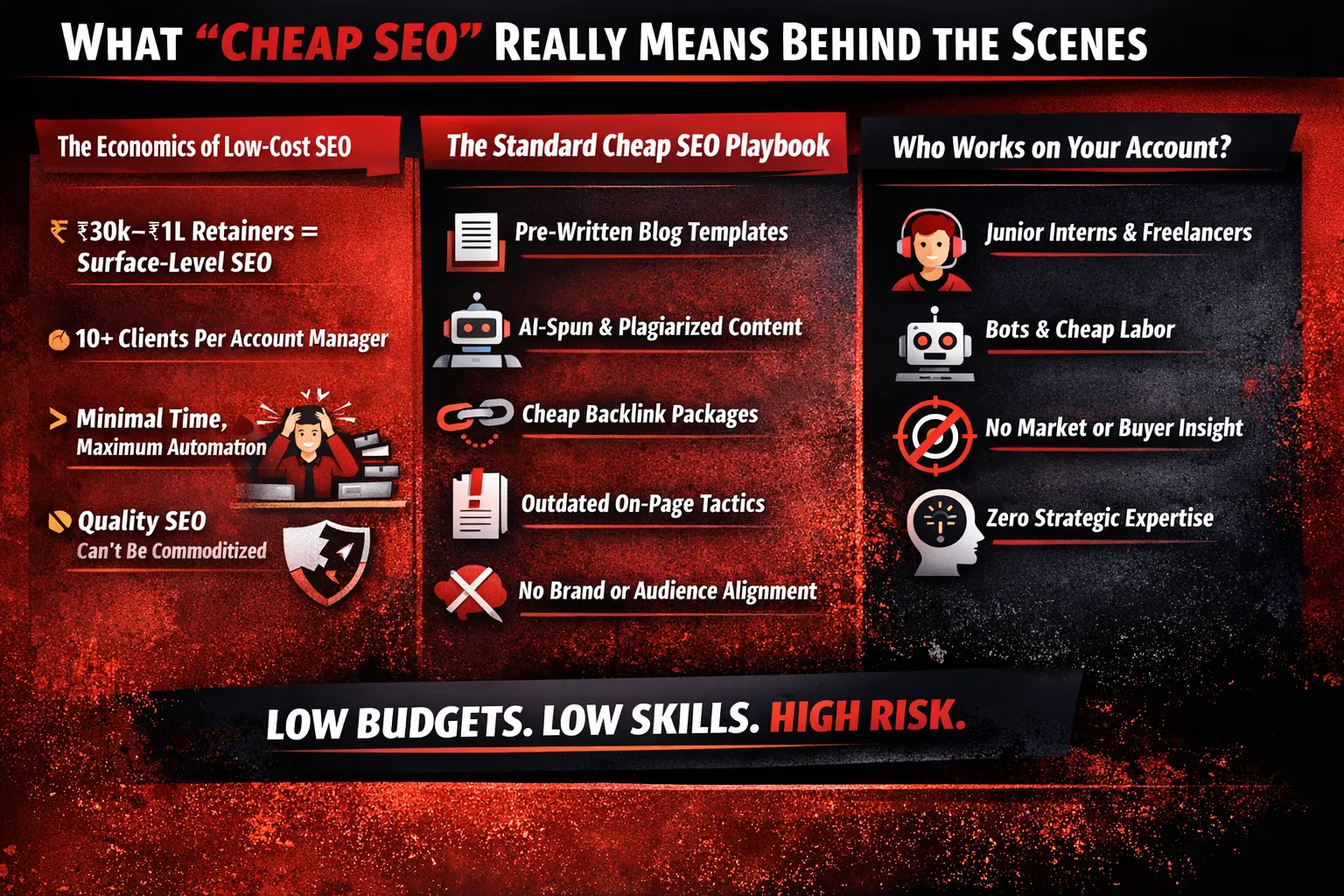
At face value, low-cost SEO sounds efficient. A monthly retainer of ₹30,000 to ₹1,00,000 feels like a low-risk experiment—especially when compared to paid ads or senior hires. But behind the pricing lies a reality most founders never see. Cheap SEO isn’t cheaper because agencies have cracked some secret growth formula. It’s cheaper because the economics force compromises that quietly destroy quality, intent, and brand alignment.
The Economics of Low-Cost SEO Agencies
Let’s start with the math—because SEO quality is ultimately constrained by time, talent, and attention.
A ₹30k–₹1L monthly retainer barely covers the cost of one junior resource for a few hours a week. Now factor in that agencies still need to pay for account management, tools, reporting, and margins. The only way this model works is by spreading one SEO manager across 20–40 clients simultaneously.
That means:
- 30–60 minutes per account per week, at best
- No room for research, experimentation, or deep thinking
- Zero strategic ownership of outcomes
To survive, these agencies lean heavily on automation—AI tools for content, bulk backlink software, and one-size-fits-all checklists. SEO becomes a production line, not a growth strategy.
And this is the core truth most businesses miss: SEO cannot be commoditized without losing its effectiveness. Real SEO is contextual. It depends on industry nuance, buyer psychology, competitive landscapes, and brand positioning. The moment SEO becomes “repeatable,” it stops being strategic—and starts being harmful.
The Standard Cheap SEO Playbook (Exposed)
Because low-cost agencies cannot afford custom work, they fall back on the same predictable playbook:
- Pre-written blog templates reused across dozens of clients, regardless of industry
- AI-spun or lightly rewritten content designed to fill word counts, not build authority
- Fiverr-style backlink packages that prioritize quantity over credibility
- Outdated on-page SEO checklists that stopped working years ago
- Keyword targeting driven by volume, not buyer intent
None of this considers your brand voice, your ideal customer profile (ICP), or your conversion funnel. Content is written for algorithms, not humans. Links are built for dashboards, not trust. The result is SEO activity that looks productive on reports but actively undermines brand credibility in the real world.
Who Actually Works on Your Account?
Perhaps the most uncomfortable truth: in cheap SEO setups, your business is rarely handled by experts.
Accounts are typically assigned to:
- Fresh interns learning SEO on live client websites
- Low-paid freelancers juggling multiple gigs
- Or worse—fully automated systems with minimal human oversight
These teams have no understanding of your market, no exposure to your buyers, and no grasp of what differentiates you. Strategy disappears because strategy requires senior thinking—and senior thinking cannot be delivered at junior prices.
At low price points, SEO stops being a partnership. It becomes task execution. And when execution is disconnected from business context, SEO doesn’t just fail to perform—it quietly teaches both Google and your audience that your brand isn’t worth trusting.
That’s the real cost of cheap SEO.
The First Casualty: Content That Erodes Brand Authority
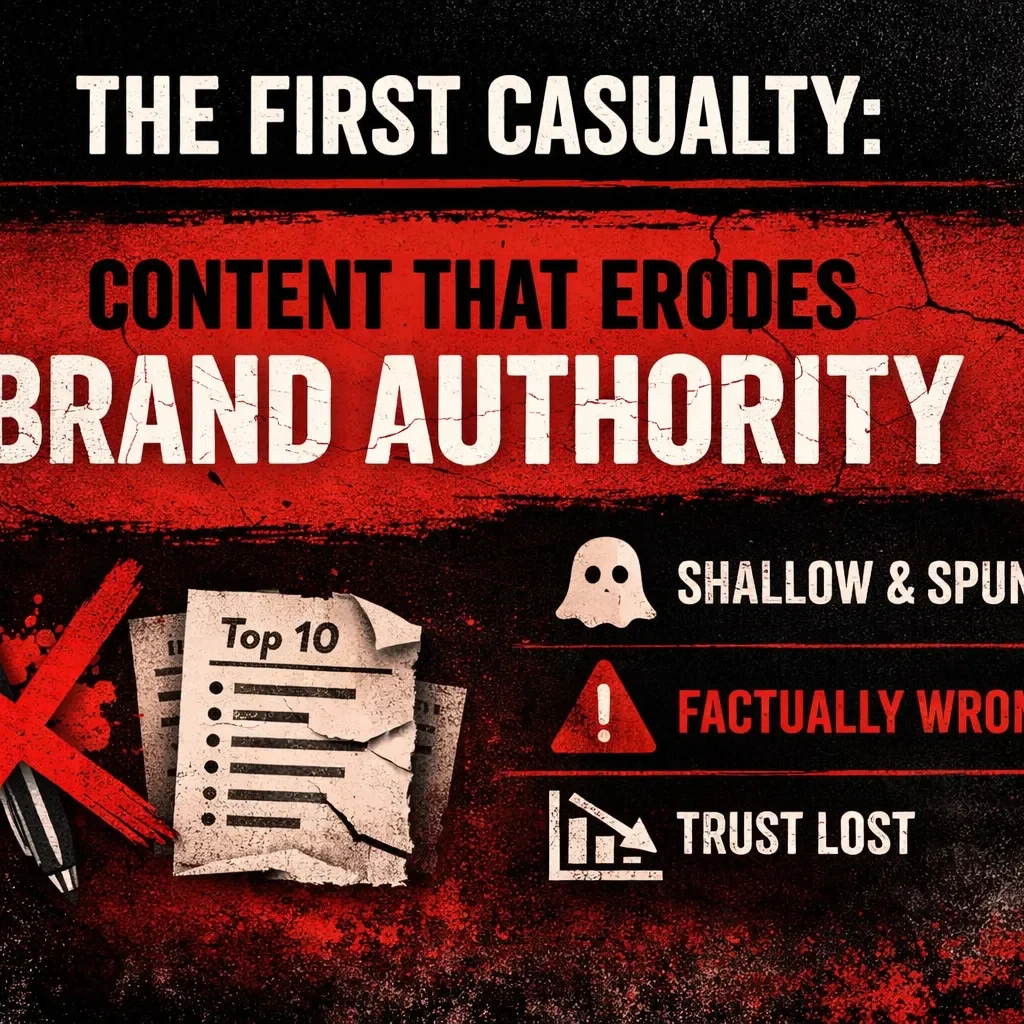
Content is often treated as the most “forgiving” part of SEO. Rankings can fluctuate, links can be cleaned up later—but content, once published, becomes a permanent public signal of who you are as a brand. This is why content is usually the first and most damaging casualty of cheap SEO.
Content Isn’t Just for Rankings—It’s a Brand Asset
Long before a prospect fills out a form or books a demo, they are already evaluating you. Today’s buyers—especially enterprise buyers—rarely talk to sales without doing extensive independent research. They Google your brand. They read your blogs. They skim two or three pages and subconsciously decide whether you feel credible enough to engage with.
In that moment, your SEO content stops being “marketing collateral” and starts acting as pre-sales persuasion.
Every blog post answers unspoken questions:
- Do these people actually understand my problem?
- Are they experienced or just repeating what everyone else says?
- Would I trust this company with a six- or seven-figure decision?
This is why tone, depth, and insight matter far more than keywords. High-quality SEO content doesn’t just attract traffic—it builds authority, shapes perception, and lowers resistance before sales ever enters the picture. It positions your brand as a guide, not a vendor. As a leader, not a follower.
Cheap SEO ignores this entirely. It treats content as a ranking tool, not a brand asset. And that mistake is where the damage begins.
How Cheap SEO Content Actively Hurts You
Low-cost SEO almost always relies on volume over value. The output looks impressive on a spreadsheet but disastrous in the real world.
You’ve seen this content before:
- Generic “Top 10” blogs that add no original insight and could belong to any company in your industry.
- Keyword-stuffed paragraphs written for search engines, not humans.
- Shallow or factually incorrect explanations that oversimplify complex topics your buyers actually care about.
- Content that feels obviously outsourced, templated, or AI-spun with no strategic thinking behind it.
On paper, these blogs “check the box.” They target keywords. They get indexed. Sometimes they even rank.
But in practice, they send a dangerous signal: this brand doesn’t think deeply. And when your content looks low-effort, buyers assume your solutions, processes, and people might be the same.
Cheap content doesn’t just fail to impress—it actively undermines trust.
The Trust Gap Created by Bad Content
Enterprise buyers are exceptionally good at spotting weak content. They don’t need to read every word. Within seconds, they pick up on tone, structure, and depth. And once doubt is introduced, it’s almost impossible to undo.
This creates a subtle but powerful trust gap:
- You may rank on Google, but you don’t feel credible.
- You may get traffic, but the right buyers quietly leave.
- You may attract leads, but they’re price-sensitive, low-intent, and hard to close.
Over time, bad content starts to shape how your brand is perceived:
- Inexperienced, because your insights feel surface-level
- Desperate, because your content chases keywords instead of clarity
- Undifferentiated, because nothing you publish sounds uniquely yours
This is why high-quality buyers bounce while low-quality leads convert. Strong brands repel the wrong audience. Weak content does the opposite.
In the end, cheap SEO content doesn’t just fail to build authority—it trains the market not to take you seriously. And that quiet erosion of brand trust is far more expensive than any SEO retainer you thought you were saving on.
The Second Casualty: Toxic Links & Algorithmic Risk
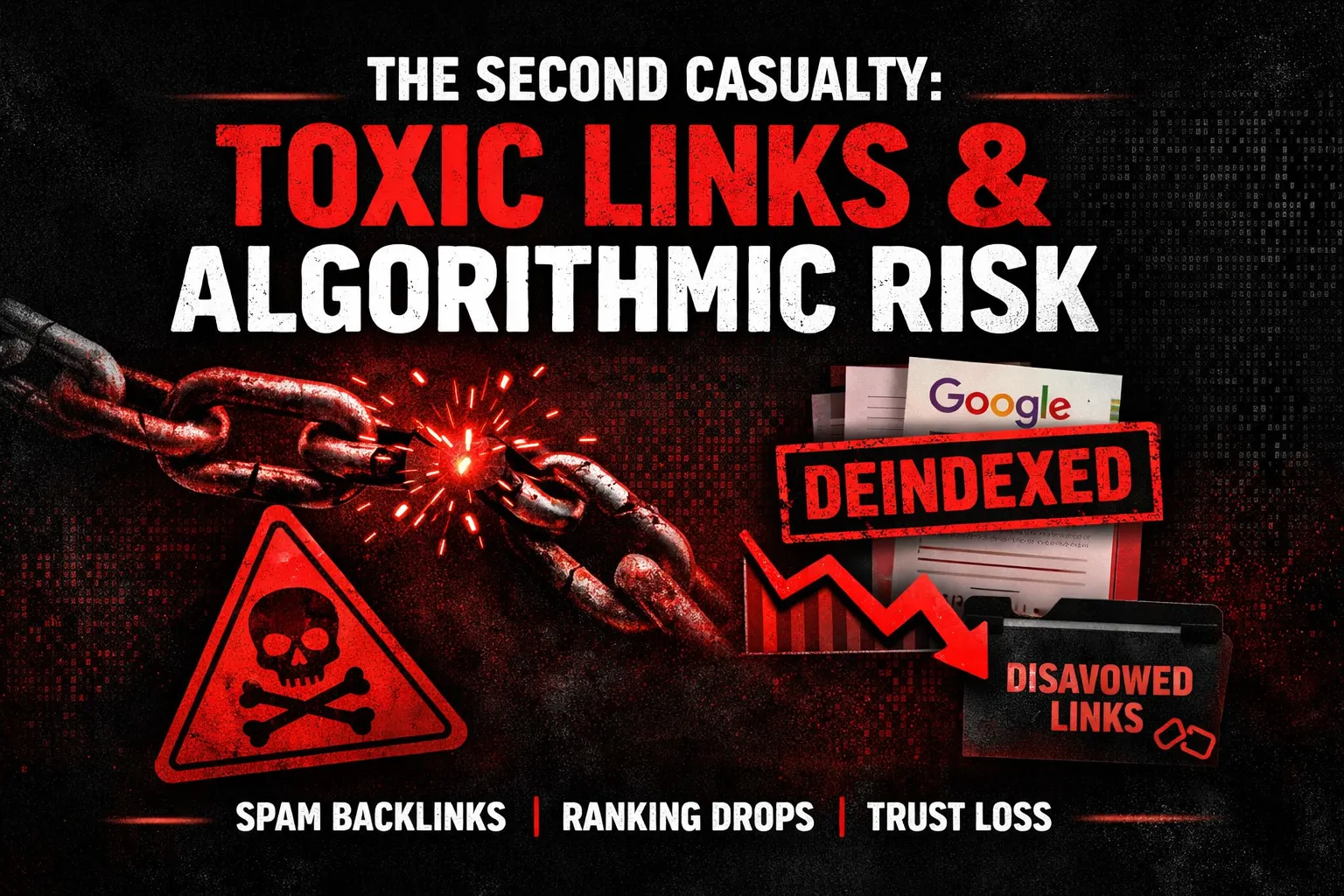
For most businesses, backlinks are still misunderstood as a mechanical SEO lever—something you “build” to push rankings upward. In reality, links are one of Google’s strongest trust signals. They are not fuel for algorithms; they are judgments made by the web about your credibility.
When cheap SEO interferes with this system, the damage isn’t always immediate—but it is almost always inevitable.
Backlinks Are Votes of Trust—Not Just SEO Juice
Google doesn’t treat links as neutral signals. Every link is a contextual endorsement, a signal that another website is willing to associate its reputation with yours. Over time, Google has evolved to interpret links less as quantity metrics and more as credibility indicators.
A link from a respected publication, industry authority, or niche-relevant platform sends a powerful message: this brand knows what it’s talking about. These are earned links—the result of expertise, insight, original research, or strong brand presence.
Cheap SEO, however, treats links as manufactured assets. Instead of earning trust, it attempts to simulate it. This creates a fundamental mismatch between how Google expects authority to grow and how low-cost agencies attempt to shortcut that process. The result is artificial credibility—something algorithms are increasingly trained to detect and devalue.
In other words, earned authority compounds trust. Manufactured links accumulate risk.
The Link-Building Shortcuts Cheap SEO Relies On
Low-budget SEO survives on scale, not strategy. To justify low retainers, agencies rely on link-building methods that are fast, repeatable, and disconnected from brand value:
- Private Blog Networks (PBNs): Networks of expired domains created solely to pass link equity, often with no real readership or editorial standards.
- Spam Directories: Outdated listings that exist only to host outbound links—long abandoned by legitimate businesses.
- Irrelevant Guest Posts: Generic articles placed on unrelated blogs with no topical alignment or real audience.
- Paid Link Farms: Websites built to sell links at scale, often shared across hundreds of SEO campaigns.
- Anchor Text Over-Optimization: Repeating exact-match commercial keywords in unnatural patterns—one of the clearest manipulation signals.
These tactics may temporarily move rankings, but they do so by violating Google’s trust model. They don’t build authority; they borrow it from low-quality sources that Google already distrusts.
Long-Term Damage: When Google Stops Trusting You
The real danger of toxic links isn’t a sudden traffic drop—it’s silent suppression. While some sites receive manual actions, most never do. Instead, they experience algorithmic devaluation: rankings plateau, impressions flatten, and growth mysteriously stalls.
Recovery is slow because trust, once lost, must be re-earned. Cleaning up toxic links, disavowing patterns, rebuilding authority through legitimate means—this process often takes months or even years. And during that time, competitors who invested in clean authority continue compounding.
Most businesses obsess over lost rankings. That’s not the real cost.
The real cost is lost domain trust—a ceiling placed on your future visibility.
When Google no longer trusts your link profile, every new piece of content works harder for smaller returns. Growth becomes expensive, unpredictable, and fragile.
Cheap SEO doesn’t just fail to help you grow.
It quietly teaches Google that your brand doesn’t deserve to be trusted.
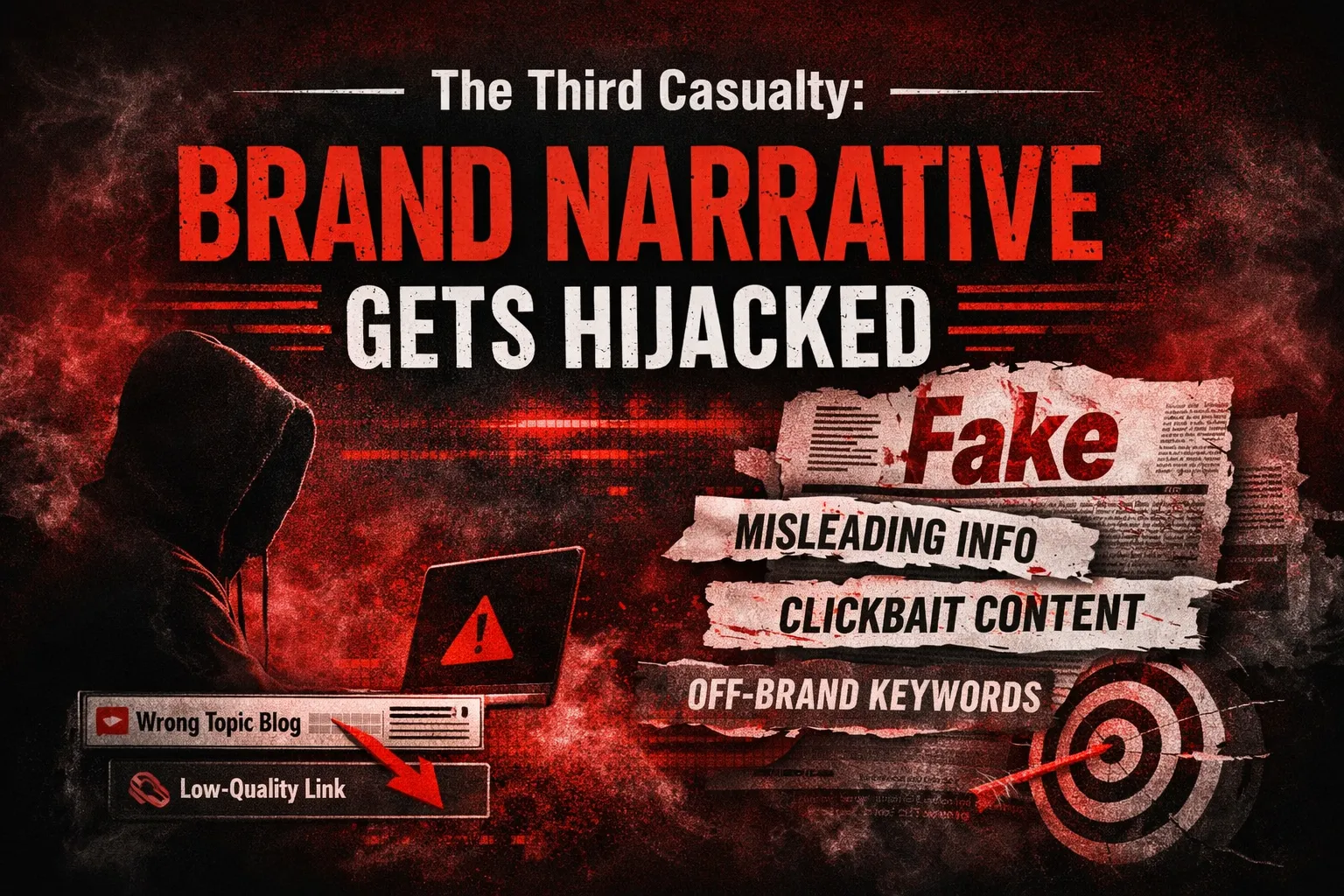
The Third Casualty: Brand Narrative Gets Hijacked
SEO Shapes What People Learn About You First
Before a prospect ever speaks to your sales team, downloads a deck, or books a demo, they Google you. That moment—often unnoticed internally—is where your brand narrative is formed.
Your branded search results are not just a list of links. They are a reputation layer. Blog titles, meta descriptions, featured snippets, People Also Ask boxes—these elements collectively tell a story about who you are, what you stand for, and how credible you appear. In many cases, this matters more than your homepage.
Think of the search engine results page (SERP) as your uncontrolled homepage. You don’t decide which blog appears first. You don’t choose which snippet gets highlighted. Google does—based on what it trusts most about your site. And SEO determines that trust.
When SEO is done right, the SERP reinforces authority, clarity, and relevance. It signals that you understand your market deeply. When it’s done poorly, the SERP becomes a confused, diluted, or even embarrassing introduction to your brand—often without you realizing it.
When Cheap SEO Publishes the Wrong Story
Low-cost SEO doesn’t just aim for traffic; it aims for any traffic. And that’s where brand narratives quietly go off the rails.
Cheap SEO strategies chase misaligned keywords—high-volume terms with little connection to your real buyers. Content gets written around generic pain points that don’t reflect your actual positioning. Articles start targeting industries you don’t even serve, simply because “the keyword had volume.”
Over time, Google learns the wrong things about you.
You stop ranking for what you want to be known for and start ranking for what an intern, a tool, or a template decided was easy. Your brand becomes associated with low-intent searches, entry-level problems, and price-sensitive queries.
The most dangerous outcome? You begin attracting bargain hunters instead of serious buyers. Prospects who negotiate aggressively, don’t value expertise, and churn quickly. Meanwhile, high-quality decision-makers take one look at your search presence and quietly exit—because nothing signals “strategic partner” or “enterprise-ready.”
How This Affects Sales, Partnerships, and Hiring
The damage doesn’t stay confined to marketing dashboards.
Sales teams feel it first. Reps are forced to fight perception gaps—explaining why the brand is more sophisticated than its content suggests, or why pricing doesn’t match what prospects assumed based on SEO-driven touchpoints.
Partnerships suffer next. Potential collaborators and enterprise partners vet you through search before engaging. If your content signals low maturity or shallow thinking, conversations never even begin.
Then comes hiring. Top-tier talent evaluates companies the same way buyers do—through Google. They read blogs. They scan thought leadership. Cheap, generic SEO content quietly signals a lack of ambition, rigor, or strategic depth.
Over time, this leads to brand dilution—a slow erosion of how you’re perceived in the market. And unlike rankings, brand trust doesn’t bounce back quickly. Once the wrong narrative takes hold, undoing it is far more expensive than doing SEO right in the first place.
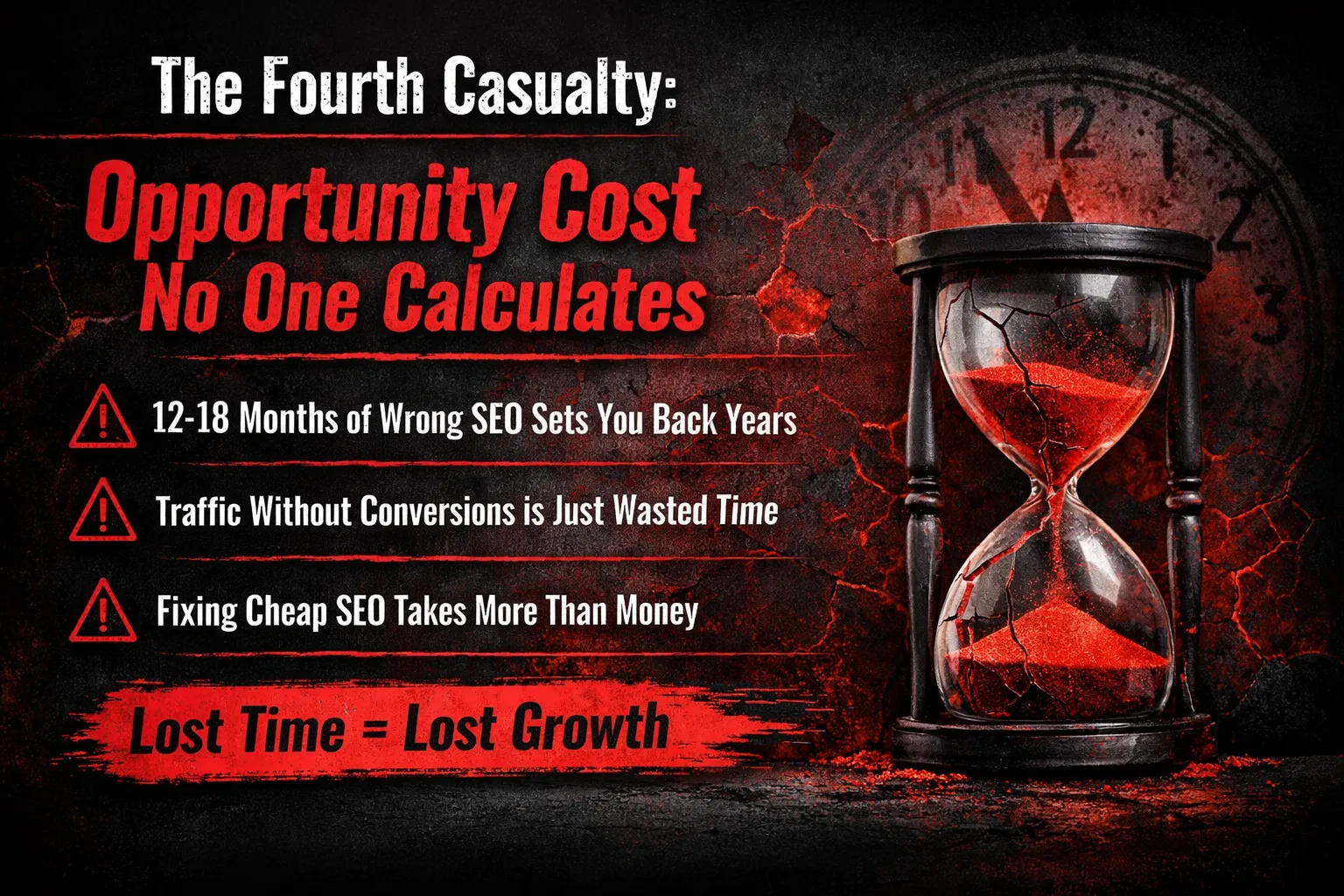
The Fourth Casualty: Opportunity Cost No One Calculates
The Myth of “At Least We’re Doing Something”
One of the most dangerous justifications for cheap SEO is the phrase, “At least we’re doing something.” It sounds responsible. It feels proactive. In reality, it is often the most expensive decision a growing company can make.
Bad SEO is not neutral. It doesn’t simply “not work.” It actively works against you.
When low-cost SEO is running in the background, leadership teams are lulled into a false sense of progress. Monthly reports show rising impressions, growing keyword counts, and sometimes even increasing traffic. On paper, it looks like momentum. In reality, it’s vanity metrics masquerading as growth.
This creates a dangerous blind spot. Because traffic is going up, the assumption is that SEO is “on track.” Meanwhile, sales quality doesn’t improve. Demo requests don’t increase. Enterprise buyers don’t reference your content in conversations. The problem isn’t noticed because the wrong signals are being celebrated.
Even worse, cheap SEO often attracts the wrong audience. Informational, low-intent traffic floods the site—students, job seekers, bargain hunters, or users with no buying power. These visits don’t convert, don’t influence revenue, and don’t support sales. They simply inflate dashboards.
In this scenario, doing nothing would have been safer. At least without bad SEO, your brand wouldn’t be sending confusing signals to Google, prospects, and internal teams. Cheap SEO doesn’t just fail to create value—it actively distorts decision-making by making teams believe growth is happening when it isn’t.
Lost Time = Lost Compounding
SEO is not linear. It is compounding.
Every high-quality piece of content strengthens domain trust. Every authoritative mention increases credibility. Every correct strategic decision builds on the previous one. Over time, good SEO accelerates itself.
Bad SEO compounds too—just in the opposite direction.
When 12 to 18 months are spent publishing weak content, chasing irrelevant keywords, and building low-quality links, the damage isn’t limited to that time period. Google’s trust systems remember. Authority doesn’t reset when you switch agencies. You don’t “start fresh.”
Instead of building momentum, companies spend their first 6 to 9 months of serious SEO undoing mistakes:
- Disavowing toxic links
- Rewriting low-quality content
- Fixing keyword cannibalization
- Repositioning brand narratives
Rebuilding trust is always slower than building it correctly the first time. The opportunity cost isn’t just the wasted budget—it’s the lost compounding effect that could have been working in your favor.
A Common Case Pattern (Hypothetical)
Consider a typical scenario.
A B2B company spends ₹3L per month on SEO for 18 months. Traffic grows steadily. Reports look positive. But the pipeline remains unchanged. Sales teams report no improvement in lead quality. SEO becomes “that thing we tried.”
Eventually, leadership switches to a premium SEO partner.
What happens next surprises them. The first six months aren’t about growth. They’re about cleanup. Removing damage. Rebuilding foundations. Correcting narratives that never should have existed.
Only after that does real growth begin—nearly two years after the original decision.
That is the real cost of cheap SEO. Not the money spent—but the years lost.
Why SEO Below ₹5L–₹7L/Month Almost Always Fails
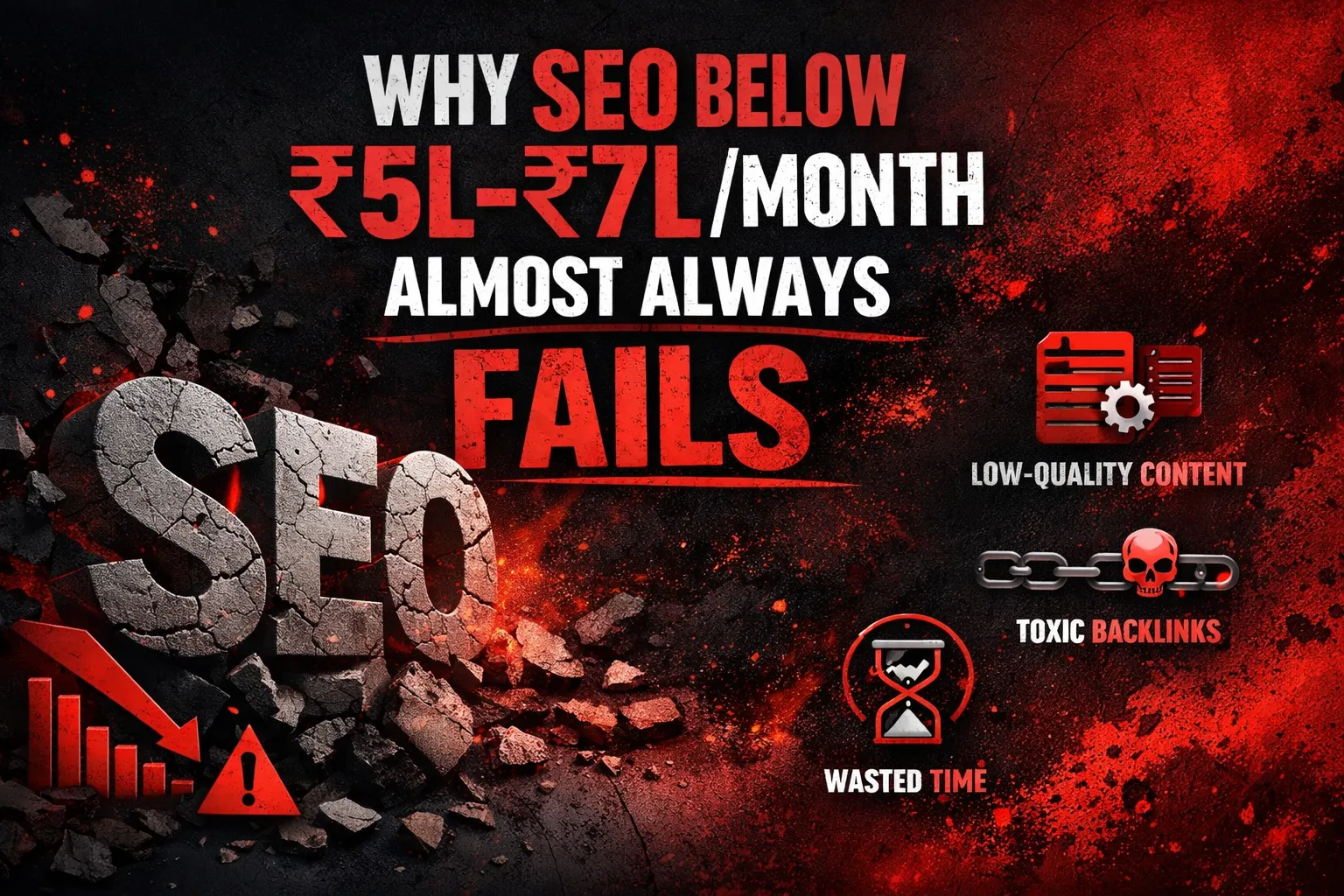
At a certain point, SEO stops being about effort and starts being about infrastructure. That threshold, in most competitive markets, sits uncomfortably above the ₹5L–₹7L per month mark. Not because agencies want higher retainers—but because serious SEO has non-negotiable requirements that cannot be met with bargain pricing.
What Serious SEO Actually Requires
Real SEO is not a checklist or a monthly activity report. It is an ongoing strategic function that sits at the intersection of brand, demand, and distribution.
It begins with strategy—understanding who you are targeting, why they buy, and how they search before they ever speak to sales. Without this, keywords become guesses, and content becomes noise.
That strategy must be grounded in market research: analyzing competitors, decoding search intent, mapping buyer journeys, and identifying authority gaps in your industry. This research alone often takes weeks—not hours.
Then comes content depth. Not SEO fluff, but genuinely insightful content that demonstrates expertise, answers complex questions, and earns trust. This kind of content is written by people who understand the market, not by templates or AI prompts.
Add digital PR, where authority is earned through real relationships, publications, and editorial merit—not purchased links. Combine that with technical excellence—site architecture, performance, crawlability, and indexation—areas that demand specialist skills.
Finally, serious SEO requires continuous iteration. Search behavior changes. Algorithms evolve. Competitors adapt. SEO that doesn’t iterate is SEO that decays.
None of this fits into a low-cost retainer.
The Real Cost Structure of High-Quality SEO
High-quality SEO is expensive because it is built on human expertise, not automation.
You are paying for skilled talent—strategists, researchers, content experts, and technical specialists who have spent years understanding how search ecosystems work. You are paying for senior oversight, not junior execution, because one wrong decision can undo months of progress.
You are funding custom research, not recycled playbooks. You are investing in relationship-based link earning, which takes time, credibility, and editorial judgment.
There is no shortcut here. If an agency claims they can do all of this cheaply, they are not doing all of this.
Budget as a Signal of Readiness
More than anything, budget is a signal—not of spending power, but of business maturity.
SEO is a growth amplifier, not a lifeline. It works best when product–market fit is proven, conversions are predictable, and sales teams can close demand efficiently. Companies under ₹10Cr in revenue often struggle not because SEO doesn’t work—but because their fundamentals aren’t ready for it.
In those cases, SEO doesn’t fail quietly. It fails expensively.
The uncomfortable truth is this: if a business cannot yet afford serious SEO, the smartest move is not to do cheap SEO—it’s to wait until the business is ready to make SEO work.
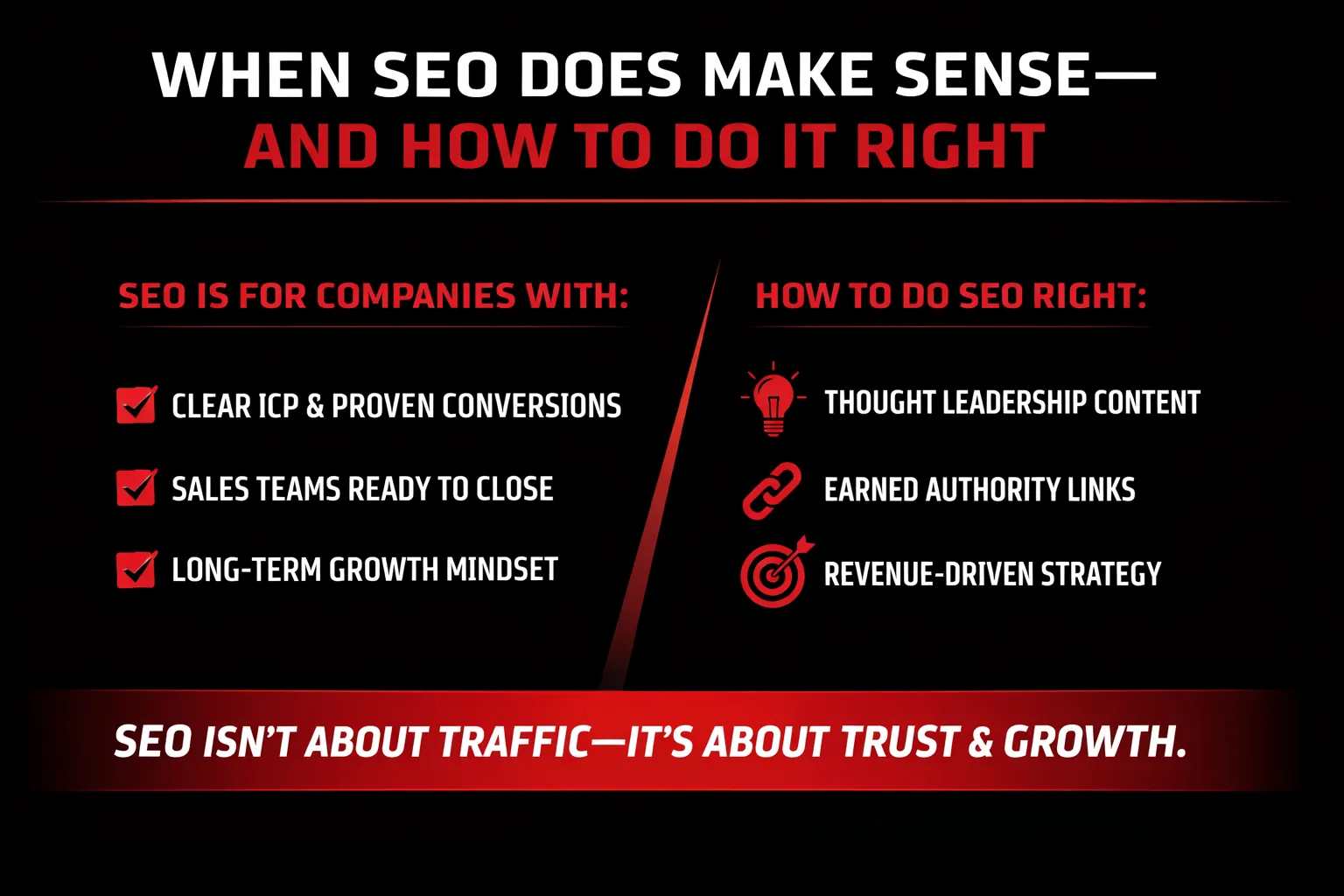
When SEO Does Make Sense—and How to Do It Right
After understanding how cheap SEO quietly damages brand trust, the natural question becomes: So when does SEO actually make sense? The answer is uncomfortable for many businesses—but necessary if SEO is to work as a growth lever rather than a liability.
Who SEO Is Actually For
SEO is not a rescue tactic for struggling businesses. It is not meant to compensate for unclear positioning, weak offers, or broken sales processes. Instead, SEO works best for companies that already have strong fundamentals in place.
First, there must be a clear Ideal Customer Profile (ICP). If a business cannot clearly define who it wants to attract, SEO will amplify that confusion at scale. Search visibility without clarity simply brings the wrong traffic faster.
Second, there must be proven conversions. SEO does not create demand out of thin air—it amplifies what already converts. If paid channels, referrals, or outbound efforts are not producing consistent results, SEO will only magnify inefficiencies.
Third, companies need sales teams that are ready to close. SEO often brings high-intent buyers who have already researched extensively. If sales is not equipped to handle informed prospects, the opportunity is wasted—and the channel gets blamed unfairly.
Finally, successful SEO requires a long-term growth mindset. Results compound over time. Companies looking for quick wins or instant validation usually abandon SEO before it ever has a chance to deliver meaningful returns.
What Premium, Brand-Safe SEO Looks Like
High-quality SEO looks very different from the low-cost, volume-driven approach. At the premium level, content is treated as thought leadership, not keyword filler. Each article exists to educate, influence, and establish authority—not just rank.
Links are earned as PR outcomes, not bought as SEO assets. Mentions, citations, and references come from relevant, credible sources because the brand has something worth referencing. This builds trust with both Google and human buyers.
Most importantly, premium SEO is aligned with revenue—not traffic. The goal isn’t to increase sessions; it’s to attract the right visitors—decision-makers who match the ICP and are capable of converting into long-term customers.
Everything is executed with a brand-first mindset. Tone, messaging, and positioning remain consistent across all SEO assets, ensuring that every touchpoint strengthens—not weakens—the brand’s perception.
The Right Question Isn’t “How Much Does SEO Cost?”
The most dangerous question businesses ask is, “How cheap can we do SEO?” A better set of questions leads to far better outcomes:
- What is the cost of bad SEO—in lost trust, wasted time, and recovery efforts?
- What does Google actually trust in our industry, and are we investing accordingly?
- What kind of buyers do we want to attract, and what signals will convince them we’re credible?
When these questions guide the decision, SEO stops being an expense—and becomes a strategic investment in long-term brand equity and growth.
Final Takeaway: Cheap SEO Is a Brand Liability, Not a Bargain
The biggest mistake companies make with SEO is treating it as a cost-saving growth hack instead of what it really is: risk management for your brand’s digital presence. SEO is not just about traffic or rankings—it is about what Google believes about your business and what buyers infer before they ever speak to you.
Done right, SEO functions as reputation control. Every page indexed, every backlink earned, and every search result shown either reinforces or weakens your credibility. It also acts as a demand-quality filter. High-quality SEO attracts informed, serious buyers who are already aligned with your positioning, while poor SEO pulls in low-intent traffic that wastes sales time and erodes perceived value. Over the long term, strong SEO becomes a brand equity engine—compounding trust, authority, and market leadership in ways paid channels never can.
The hard truth founders need to hear is this: not every company should be doing SEO right now. If you cannot afford to execute SEO properly, the smartest move is often to wait. Fix your fundamentals first—product–market fit, messaging clarity, conversion paths, and sales readiness. In many cases, investing in paid acquisition, partnerships, or product improvements will deliver far better returns than underfunded SEO ever could.
Because half-baked SEO doesn’t just “not work.” It actively works against you.
SEO doesn’t fail because it’s expensive. It fails because cheap execution teaches Google—and your buyers—not to trust you.
And once trust is lost, no amount of traffic can buy it back.